

- Market Size (2026)
- USD 236.4 Mn
- Forecast (2036)
- USD 529.6 Mn
- CAGR (2026 to 2036)
- 8.4%
Low-Gluten Emmer and Einkorn Flour Blends Market Size, Market Forecast and Outlook By FMI
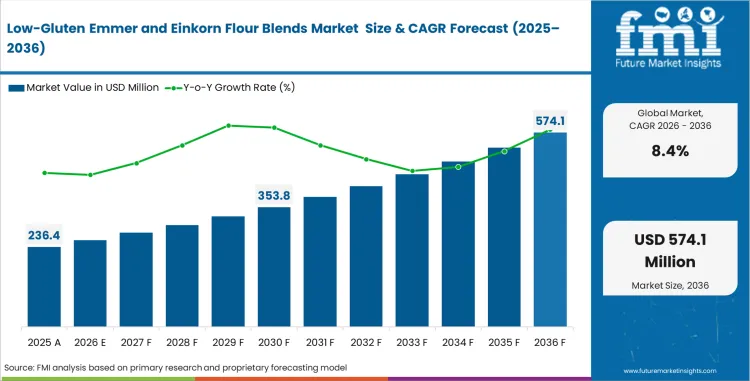
Low-Gluten Emmer and Einkorn Flour Blends Market was valued at USD 218.1 million in 2025. Industry outlook points to USD 236.4 million in 2026 and USD 529.6 million by 2036, reflecting an 8.4% CAGR over the forecast period. Expansion in this sector is being supported by commercial bakeries that want ancient grain character without losing dough stability on faster production lines.
Summary of Low-Gluten Emmer and Einkorn Flour Blends Market
- The market is forecast to reach USD 529.6 million by 2036.
- The market is expected to grow at a CAGR of 8.4% from 2026 to 2036.
- The market was estimated at USD 218.1 million in 2025.
- The forecast period represents an incremental opportunity of USD 293.2 million.
- The market focuses on specialty wheat flour blends based on emmer and einkorn, primarily used in premium baking and health-positioned wheat products rather than gluten-free applications.
- Demand is rising due to increasing consumer interest in ancient grains and nutritionally differentiated bakery ingredients.
- Bread and dough applications remain central, with ongoing product development in artisan and sourdough baking formats.
- Italy leads growth at 9.2% CAGR, followed by the United States, Germany, Turkey, France, the United Kingdom, and Japan.
- Einkorn-led blends dominate the grain type segment with a 39.0% share due to stronger retail visibility and consumer familiarity.
- 70:30 blend formulations account for 34.0% share, balancing ancient grain positioning with workable dough performance.
- Artisan bread leads the application segment with a 36.0% share, supported by demand for premium bakery products.
- Retail packs dominate distribution with a 42.0% share, reflecting the category’s premium and consumer-facing nature.
- Organic products hold a leading 58.0% share, aligned with regenerative and low-processing positioning.
- The market remains supply-constrained due to limited cultivation, lower yields, and additional dehulling requirements.
- The competitive landscape is fragmented, with the leading player expected to hold around 12.0% share due to the presence of regional mills and premium niche brands.
Key Takeaways, Market Size, and Forecast
- Low-Gluten Emmer and Einkorn Flour Blends Market is projected to grow from USD 236.4 million in 2026 to USD 529.6 million by 2036, at a CAGR of 8.4%.
- The low-gluten emmer and einkorn flour blends market was valued at USD 218.1 million in 2025.
- By 2036, the Low-Gluten Emmer and Einkorn Flour Blends Market is expected to be worth USD 529.6 million.
- From 2026 to 2036, the market is projected to expand at a CAGR of 8.4%.
- The market is projected to create an incremental opportunity of USD 293.2 million between 2026 and 2036.
- In 2026, Einkorn-led blends are expected to account for 39.0% of the grain type segment.
- Italy (9.2%) and United States (8.7%) are two of the fastest growing markets.
Low-Gluten Emmer and Einkorn Flour Blends Market Key Takeaways
| Metric | Details |
|---|---|
| Industry Size (2026) | USD 236.4 million |
| Industry Value (2036) | USD 529.6 million |
| CAGR (2026 to 2036) | 8.4% |
Source: Future Market Insights (FMI) analysis, based on proprietary forecasting model and primary research
Pure emmer or einkorn can create processing issues when used without balance in commercial flour systems. Dough structure becomes harder to control, divider performance can weaken, and line consistency suffers once hydration shifts too far. Blending these grains with limited volumes of stronger wheat helps stabilize machinability, which makes protein balance and milling specification more important than grain identity alone. Category adoption is therefore tied less to novelty and more to whether processors can deliver consistent baking performance in scaled production.
Milling capability remains a key part of that transition. Once regional processors can handle irregular kernels with tighter control and lower contamination risk, flour consistency improves and formulation uncertainty declines. That allows bakery recipes based on einkorn or emmer blends to move from trial batches into regular premium bread production.
Italy is projected to expand at 9.2% CAGR through 2036 as artisanal baking networks continue to use domestic emmer in routine flour applications. Cleaner-label bakery demand supports the United States market, which is expected to record 8.7% CAGR through 2036, though milling capacity remains tighter than in larger flour categories. Germany is likely to post 8.3% CAGR by 2036, supported by clean-label preferences, fermentation-based baking formats, and better domestic grain continuity. Historical grain familiarity keeps Turkey on a positive trend, with the sector forecast to register 8.1% CAGR during the study period. Premium pastry and specialty bread applications keep France advancing at 7.9% CAGR through 2036. 7.5% CAGR is projected for the United Kingdom, where adoption remains tied to selective premium retail channels. Ancient wheat blends remain more niche in Japan, where the market is anticipated to move ahead at 6.8% CAGR through 2036.
Segmental Analysis
Low-Gluten Emmer and Einkorn Flour Blends Market Analysis by Grain type
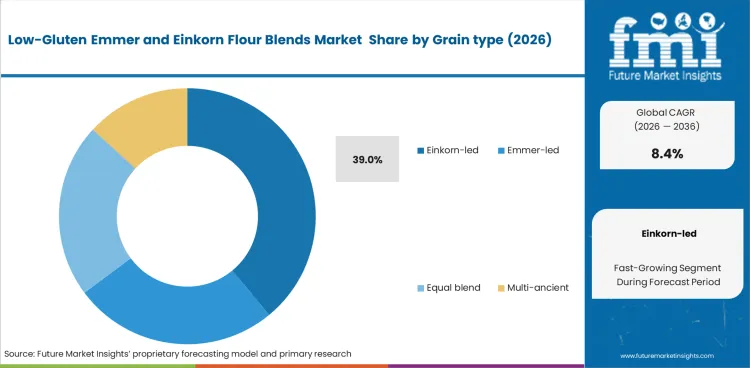
Einkorn-led blends are expected to account for 39.0% share in 2026 because they tend to be easier to work with than pure emmer in commercial bakery systems. Their hydration behavior is more familiar to bakers, which reduces the need for major changes in mixing and handling. Even so, dough strength still needs closer control because einkorn weakens faster under mechanical stress than modern wheat. This keeps processing discipline important in scaled bakery applications.
- Hydration behavior: Einkorn can fit more easily into existing bakery hydration systems than pure emmer, which reduces reformulation work in early trials.
- Mixing sensitivity: Weak protein networks break down more quickly under extended kneading, so mixing time needs tighter control than in standard wheat systems.
- Equipment control: Scaling einkorn use may require tighter mixer settings and better process control, but not necessarily full equipment redesign.
Low-Gluten Emmer and Einkorn Flour Blends Market Analysis by Formulation
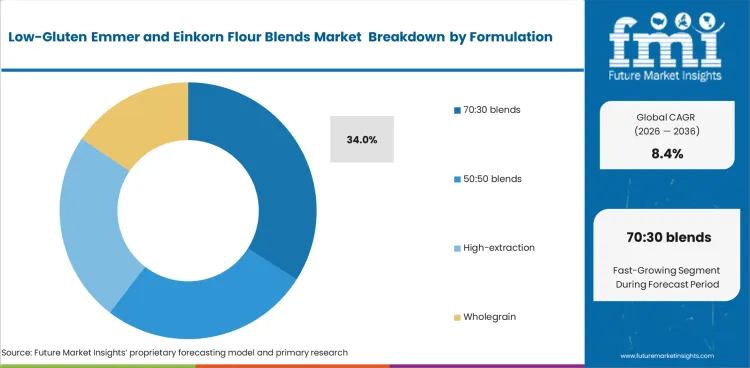
Blend ratio remains central to commercial usability because bakery lines need dough that can move through dividing and rounding equipment without tearing or sticking. A 70:30 blend is expected to account for 34.0% share in 2026 because it gives producers a workable balance between ancient-grain positioning and dough stability. The stronger wheat portion helps improve elasticity and reduce stoppages on automated lines. Fully ancient-grain formulas are still harder to control in continuous bakery production.
- Elasticity support: Adding a portion of stronger wheat helps improve dough stretchability and reduces tearing during automated shaping.
- Line cleanliness: Higher-wheat blends usually reduce dough sticking and help avoid repeated cleaning interruptions on bakery lines.
- Cost control: The wheat portion also helps manage recipe cost in a category where ancient grains remain materially more expensive than mainstream flour.
Low-Gluten Emmer and Einkorn Flour Blends Market Analysis by Application
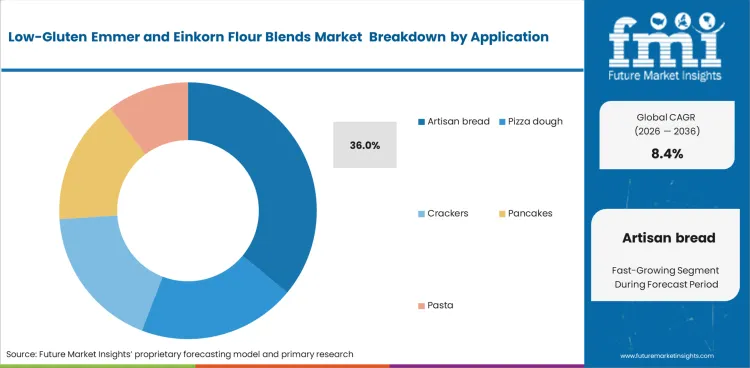
Artisan bread remains the clearest commercial fit for these blends because longer proofing and sourdough fermentation can support structure more gradually than short-process baking. These methods help manage weaker dough strength and improve gas retention during oven spring. Artisan bread is therefore expected to contribute 36.0% share in 2026, supported by its stronger compatibility with emmer- and einkorn-based flour systems. Faster industrial bread systems still face more formulation pressure with these grains.
- Fermentation effect: Long fermentation can improve dough handling and oven spring in ancient-grain bread systems.
- Process benefit: Extended resting can improve texture and overall baking performance, though consumer tolerance claims still require caution.
- Production limit: Artisan methods require more time and floor space, which limits daily output compared with faster commercial bread systems.
Low-Gluten Emmer and Einkorn Flour Blends Market Analysis by Channel
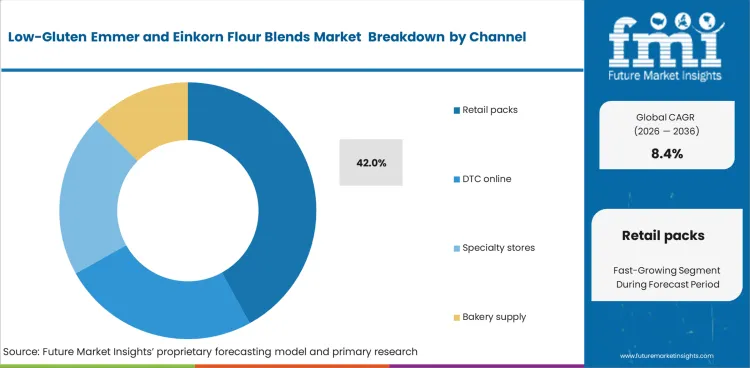
Retail packs are expected to account for 42.0% share in 2026 because the category still depends more on premium packaged flour than on large industrial contracts. Small retail formats carry stronger margins, which helps support specialty milling economics in a still-niche market. This can leave bakery-supply channels more exposed during poor harvest periods, especially when higher-grade grain is directed first toward branded retail packs.
- Margin profile: Small retail bags usually command much higher price realization than bulk bakery packs.
- Allocation risk: During weaker harvest years, limited high-grade grain is often prioritized for existing retail commitments before bulk bakery supply.
- Retail pressure: Brands still need steady turnover in a premium flour aisle where shelf space remains selective.
Low-Gluten Emmer and Einkorn Flour Blends Market Analysis by Nature
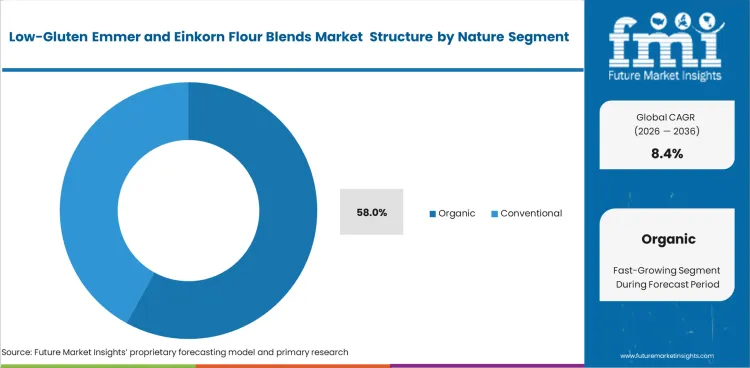
Organic products are forecast to represent 58.0% share in 2026 because ancient-grain flours are commonly positioned around premium, low-processing, and farm-origin claims. Lower field yields and higher production costs also make premium pricing more important in this category. That does not make conventional product unworkable, but organic positioning remains commercially stronger for many branded flour suppliers.
- Yield economics: Ancient grains generally deliver lower field yields than modern wheat, which supports higher selling prices at the flour stage.
- Supply constraint: Organic supply is also narrower because certified acreage and dependable grower relationships remain limited.
- Input cost escalation: Organic farming prohibits synthetic nitrogen fertilizers, requiring expensive cover cropping and mechanical weed control. Purchasing teams absorb these high farming costs, permanently elevating final retail flour prices.
Low-Gluten Emmer and Einkorn Flour Blends Market Drivers, Restraints, and Opportunities
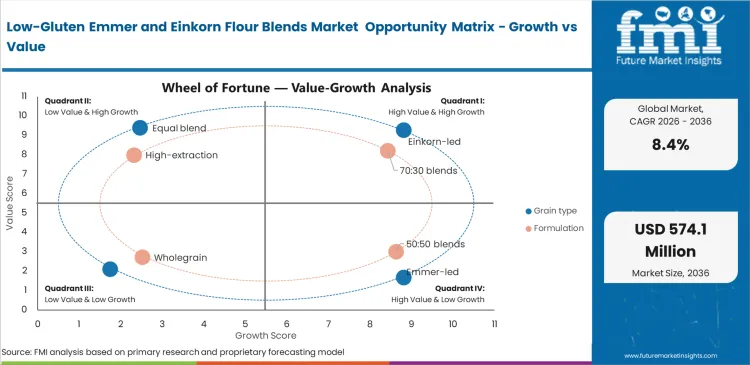
Demand is being supported by interest in ancient grains among consumers looking for differentiated bakery products with simpler ingredient stories and milder wheat positioning. These blends sit between conventional wheat flour and gluten-free alternatives, which gives brands a useful premium niche in bread and baking mixes. Adoption still depends on delivering acceptable dough performance rather than on health positioning alone.
Milling capacity remains a clear restraint. Ancient grains need more careful handling than mainstream wheat, and dedicated milling lines are still limited in many markets. Smaller specialty millers can support early demand, but broader national rollout remains harder until processors invest in more dependable commercial-scale capacity.
Opportunities in the Low-Gluten Emmer and Einkorn Flour Blends Market
- Sprouted grain integration: R&D bakery managers combine controlled sprouting techniques with ancient grains to increase bioavailability. This process creates ultra-premium flour categories commanding exceptional wholesale margins.
- Enzyme support: Natural enzyme systems that improve dough handling could help commercial bakeries use these blends more effectively on faster lines.
- Direct-to-farm contracting: Purchasing leads bypass commodity brokers to establish multi-year growing contracts directly with regional farming cooperatives. This strategy guarantees supply stability during volatile climate events.
Regional Analysis
Based on regional analysis, the low-gluten emmer and einkorn flour blends market is discussed across key countries including Italy, the United States, Germany, Turkey, France, the United Kingdom, and Japan.
.webp "Top Country Growth Comparison Low Gluten Emmer And Einkorn Flour Blends Market Cagr (2026 2036)")
| Country | CAGR (2026 to 2036) |
|---|---|
| Italy | 9.2% |
| United States | 8.7% |
| Germany | 8.3% |
| Turkey | 8.1% |
| France | 7.9% |
| United Kingdom | 7.5% |
| Japan | 6.8% |
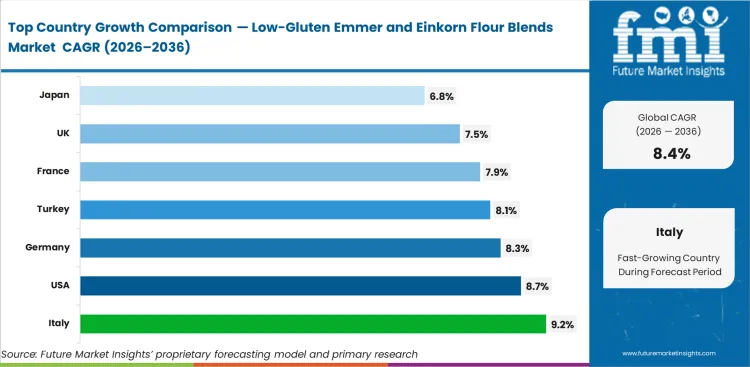
Source: Future Market Insights (FMI) analysis, based on proprietary forecasting model and primary research
Europe Low-Gluten Emmer and Einkorn Flour Blends Market Analysis
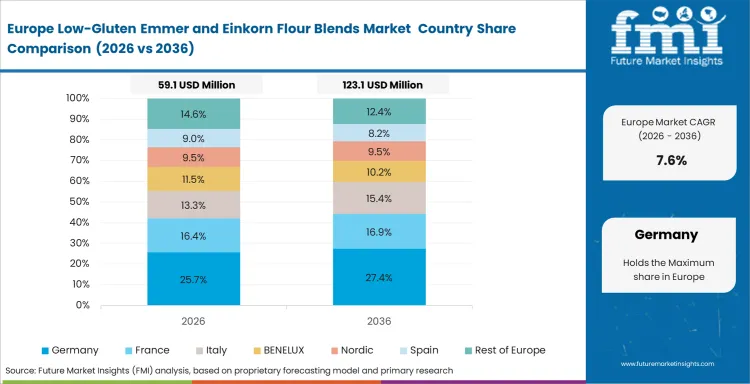
Europe remains the most established region for this market because ancient grain familiarity, artisanal baking traditions, and localized milling networks already support commercial use of emmer- and einkorn-based flour systems. Product acceptance is stronger here than in many other regions since premium bread, pastry, and specialty flour categories can absorb differentiated grain profiles without forcing immediate movement into mass-volume bakery production. Regional supply conditions are also more favorable where heritage grain cultivation, stone-milling capability, and specialty retail channels operate in closer alignment. This creates a steady industry outlook for flour processors and bakery brands that can maintain specification consistency while positioning these blends within premium, clean-label, and whole-grain product lines.
- Italy: Domestic emmer availability and long-established artisanal baking networks continue to support the market in Italy. Local milling traditions give processors better control over flour consistency, while routine use of heritage grains in bread and pasta applications keeps commercial adoption more practical than in less familiar markets. 9.2% CAGR is projected for Italy through 2036. That pace reflects strong regional fit between agricultural supply, specialty milling, and premium bakery production.
- Germany: Germany is expected to register 8.3% CAGR through 2036. This keeps the country among the stronger European markets for premium ancient grain flour blends. Clean-label bakery preferences and fermentation-led bread formats support continued market expansion in Germany. Ancient wheat blends fit well into premium bread systems where ingredient simplicity and process compatibility carry more weight, while local cultivation support improves continuity of raw material supply.
- France: Premium pastry and specialty bread applications keep France commercially relevant in this category. Einkorn and emmer blends remain better suited to higher-value bakery formats where flour differentiation matters more than broad flour replacement. The market in France is likely to record 7.9% CAGR during the forecast period. Progress remains concentrated in premium baking channels where product story and ingredient quality support category uptake.
- United Kingdom: The sector in the United Kingdom is projected to expand at 7.5% CAGR through 2036. Retail selectivity continues to shape the pace of category development. Health-led baking categories and selective premium retail placement continue to shape the market in the United Kingdom. Ancient grain blends remain a narrower niche than in continental Europe, but adoption is still rising where whole-grain quality and simpler ingredient positioning align with consumer preferences.
FMI’s report includes broader regional assessments across Europe, where artisanal baking traditions and stronger milling depth support wider use of ancient grain blends.
North America Low-Gluten Emmer and Einkorn Flour Blends Market Analysis
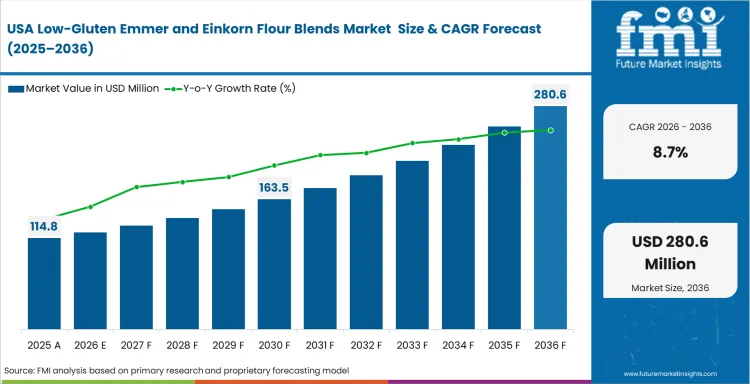
North America remains an important region for this market because premium baking, home-use flour demand, and cleaner-label product positioning are moving together. Commercial uptake is strongest where specialty milling and packaged retail flour channels can support differentiated grain formats without relying on large industrial flour volumes. Category expansion is also tied to whether regional processors can deliver stable blend performance for modern bakery systems, since production reliability matters as much as product positioning in this segment. Regional industry outlook remains favorable where branded flour suppliers and premium bakery operators can secure dependable specialty grain throughput.
- United States: The market in the United States is projected to expand at 8.7% CAGR through 2036. Reliable supply remains strategically important because smaller millers still carry much of the category. Premium baking categories and cleaner-label flour reformulation continue to support market expansion in the United States. Commercial use of einkorn- and emmer-based blends is gaining firmer space in premium bread and retail flour applications, though specialty milling capacity remains tighter than in mainstream flour categories.
FMI’s report includes broader regional assessments across North America, where premium baking demand and cleaner-label flour positioning continue to shape category development.
Middle East and Africa Low-Gluten Emmer and Einkorn Flour Blends Market Analysis
Middle East and Africa remain a more selective region for this market, but ancient grain familiarity gives certain countries a clearer commercial base than many other developing flour markets. Category potential is shaped less by mainstream packaged flour scale and more by the ability to connect heritage grain relevance with modern premium bakery applications. Regional progress depends on whether processors can turn grain familiarity into consistent blended flour formats suited for current bakery needs. That keeps the industry outlook uneven, with stronger opportunities in markets where historical cultivation and product familiarity already exist.
- Turkey: Historical grain familiarity continues to support Turkey’s role in this category. Ancient wheat relevance remains stronger here than in many newer premium flour markets, even though commercial flour blending is still less developed than in several Western bakery economies. Turkey is forecast to register 8.1% CAGR through 2036. Local agricultural relevance continues to support adoption across selected premium applications.
FMI’s report includes broader regional assessments across Middle East and Africa, where market potential remains more selective and is shaped by historical grain familiarity and localized premium bakery uptake.
East Asia Low-Gluten Emmer and Einkorn Flour Blends Market Analysis
East Asia remains a smaller regional market for these blends because adoption depends more heavily on premium positioning and category education than on broad household flour replacement. Commercial uptake is more selective, with better prospects in differentiated bakery formats than in standard flour consumption channels. Regional development depends on how effectively suppliers position ancient grain blends within premium baked products rather than everyday staple flour use. This keeps the market more niche, though still relevant in selected urban bakery segments.
- Japan: Ancient wheat blends remain a smaller premium niche in Japan, where product education and differentiated bakery positioning still play a larger role in commercial uptake. Broad flour substitution remains limited, so bakery-led applications continue to shape the market more than retail flour scale. Japan is expected to move ahead at 6.8% CAGR through 2036. Premium bakery applications are likely to remain the main route for further market expansion.
FMI’s report includes broader regional assessments across East Asia, where category progress depends more on premium positioning and bakery-led adoption than on broad household flour replacement.
Competitive Aligners for Market Players
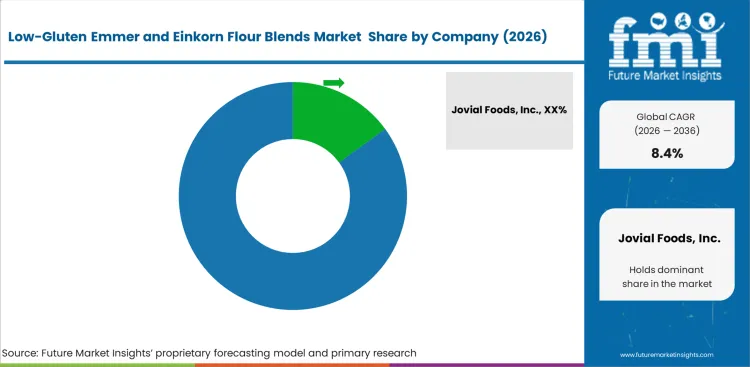
Competitive advantage depends heavily on milling quality and supply consistency. Companies with stronger control over stone-milling or specialty processing are better placed to deliver reliable particle size, lower contamination risk, and more stable baking performance. In a niche market like this, those operating capabilities often matter more than broad consumer marketing alone.
New entrants often face difficulties when they rely on generic milling partners that are not optimized for ancient grains. Established players usually have stronger relationships with growers, tighter control over specialty grain handling, and more experience in managing batch consistency. Those advantages can create a meaningful barrier in a market where supply is already narrow.
Large bakery buyers still try to avoid supplier lock-in by testing more than one blend ratio and more than one sourcing model. This keeps flexibility important for millers, especially when harvest quality varies from season to season. Suppliers that can offer dependable blending, better technical support, and more stable grain access are likely to remain better positioned.
Key Players in Low-Gluten Emmer and Einkorn Flour Blends Market
- Jovial Foods, Inc.
- Bluebird Grain Farms
- Hayden Flour Mills
- Grand Teton Ancient Grains
- Barton Springs Mill
- Central Milling
- SchapfenMühle
Scope of the Report
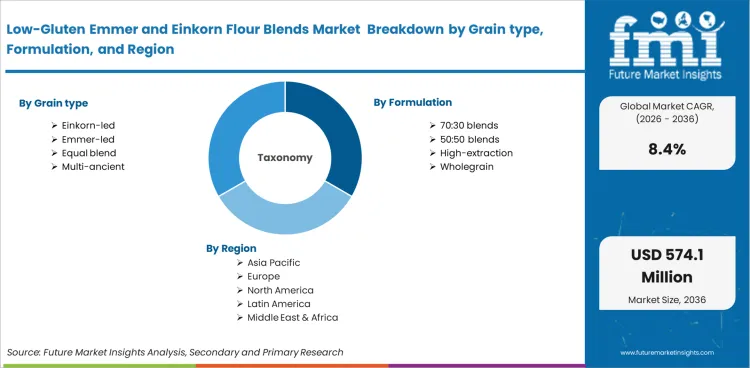
| Metric | Value |
|---|---|
| Quantitative Units | USD 236.4 million to USD 529.6 million, at a CAGR of 8.4% |
| Market Definition | Specialized milled grain mixtures combining ancient wheat varieties to achieve specific baking functionalities while retaining weak-gluten properties. Formulations carefully balance protein levels to support natural fermentation and dough aeration. |
| Segmentation | Grain type, Formulation, Application, Channel, Nature, Region |
| Regions Covered | North America, Latin America, Europe, Asia Pacific, Middle East and Africa |
| Countries Covered | Italy, United States, Germany, Turkey, France, United Kingdom, Japan |
| Key Companies Profiled | Jovial Foods, Inc., Bluebird Grain Farms, Hayden Flour Mills, Grand Teton Ancient Grains, Barton Springs Mill, Central Milling, SchapfenMühle |
| Forecast Period | 2026 to 2036 |
| Approach | Annual commercial milling volumes of dedicated ancient grain facilities cross-validated against organic farming acreage reports. |
Source: Future Market Insights (FMI) analysis, based on proprietary forecasting model and primary research
Low-Gluten Emmer and Einkorn Flour Blends Market Analysis by Segments
Grain type
- Einkorn-led
- Emmer-led
- Equal blend
- Multi-ancient
Formulation
- 70:30 blends
- 50:50 blends
- High-extraction
- Wholegrain
Application
- Artisan bread
- Pizza dough
- Crackers
- Pancakes
- Pasta
Channel
- Retail packs
- DTC online
- Specialty stores
- Bakery supply
Nature
- Organic
- Conventional
Region
- North America
- Latin America
- Europe
- Asia Pacific
- Middle East and Africa
Bibliography
- Aweya, J. J., Hseu, Y.-C., Kamgoua, W. S., & Chou, H.-L. (2025, July 18). Ancient grains as functional foods: Integrating traditional knowledge with contemporary nutritional science.
- Food and Agriculture Organization of the United Nations. (2025, December 31). Agricultural production statistics 2010-2024.
- Oldways Whole Grains Council. (2024, April). Stamp usage guide for the Whole Grain Stamp in the United States (except FSIS).
- Porto, A. L., et al. (2025, November). Evaluation of einkorn, emmer and spelt genotypes through agronomic and quality parameters under semi-arid conditions.
- United States Department of Agriculture, National Agricultural Statistics Service. (2025, May). Flour milling products 2024 summary.
This bibliography is provided for reader reference. The full FMI report contains the complete reference list with primary source documentation.
This Report Addresses
- Sourcing constraints impacting organic einkorn yield scalability.
- Specific 70:30 blending ratios enabling industrial mixer survivability.
- Automation failure causing pure ancient grain dough rejections.
- Sourdough fermentation advantages specifically applied to emmer proteins.
- Stone-milling capacity limits stalling national bakery rollouts.
- Italy's domestic cultivation networks bypassing international broker pricing.
- Premium retail packaging margins subsidizing commercial wholesale flour volumes.
- Contractual lock-in strategies utilized by established specialty mill operators.
Frequently Asked Questions
What limits pure einkorn dough scalability on commercial bakery lines?
Pure ancient-grain dough is harder to manage on automated bakery lines because weaker structure and stickier handling can disrupt dividing and rounding. A portion of stronger wheat improves elasticity and processing stability.
Why do 70:30 blends hold 34.0% share in 2026?
A 70:30 blend offers a practical balance between ancient-grain positioning and dough performance, which is why it remains the leading formulation.
How does artisan bread processing utilize emmer uniquely?
Master bakers use extended sourdough fermentation to naturally degrade fragile gluten chains, utilizing organic acids for gas-trapping elasticity.
Why does organic certification dominate ancient grain sourcing?
Emmer yields fewer bushels per acre. Organic premium pricing convinces farmers to plant these low-yield grains profitably.
What differentiates Italian supply from United States operations?
Italy benefits from stronger local milling tradition and grain familiarity, while the United States still depends more heavily on a smaller specialty-milling base.
How do retail packaging margins impact wholesale bakery supply?
Mill managers allocate high-grade grains to lucrative retail bags first, leaving wholesale bakeries vulnerable during poor harvest years.
Why do long fermentation cycles matter for weak-gluten flours?
Extended resting allows natural enzymatic activity to pre-digest complex carbohydrates, directly improving crumb texture and consumer digestibility profiles.
What capability defines top competitor advantage in this sector?
Owning temperature-controlled stone-milling facilities prevents heat destruction of enzymes, avoiding cross-contamination issues common in generic roller mill outsourcing.
Why does einkorn mimic modern wheat hydration during initial mixing?
Einkorn absorbs water at rates matching commercial flour, allowing formulation chefs to utilize existing recipe hydration percentages easily.
How do strict clean-label requirements accelerate category expansion?
Premium grocery buyers delist synthetic strengtheners, forcing R&D managers to replace them with functional ancient grain mixtures naturally.
What role do regional millers play in supply chain stability?
Large processors avoid small ancient grain batches. Regional stone millers handle these medium-scale volumes for mid-tier bakery launches.
Why do farmers resist planting conventional einkorn crops?
Tall stalks risk wind damage, and thick hulls require specialized dehulling. Without organic premiums, farmers lose per-acre revenue.
How does sourdough acidity affect einkorn protein networks?
Lactic and acetic acids physically tighten delicate gluten strands, providing crucial gas-trapping capability during oven spring baking phases.
What specific equipment upgrades do bakeries need for ancient grains?
Maintenance teams must install highly precise programmable logic controllers to halt mechanical kneading before fragile einkorn networks degrade.
Why is einkorn-led anticipated to capture 39.0% segment share?
Superior hydration compatibility with existing industrial water-metering systems allows bakeries to transition recipes quickly, minimizing expensive line downtime.
How do specialized seed banks protect established milling companies?
Top-tier millers fund breeding programs for weather resilience, securing exclusive seed rights that permanently block new market competitors.
Why do premium retail buyers monitor ancient grain shelf velocity closely?
High price points tie up capital. Category managers rigorously compare turnover against organic flours, quickly delisting underperforming brands.
What specific function does modern wheat serve in 50:50 blends?
Adding equal parts strong commodity flour provides maximum extensibility, preventing dough snap-back during rapid automated pizza sheeting operations.
How do import tariffs affect European ancient grain distribution?
Localized cultivation networks across Italy and Germany bypass international commodity taxes, creating favorable operating economics for bakery buyers.
Why does high-extraction milling benefit emmer flour functionality?
Leaving specific bran percentages intact improves dough water retention during prolonged fermentation, balancing nutritional density with baking performance.
What prevents large agricultural processors from dominating this sector?
Converting massive commodity facilities from hot roller mills to slow stone-grinding requires capital that current volumes cannot justify.
How do long-term agricultural contracts stabilize final flour pricing?
Purchasing leads fund regional farming cooperatives directly before planting, guaranteeing purchase volumes and protecting bakeries from extreme cost spikes.
Preview the report firsthand - request a free sample
Get SampleGet the brochure for pricing and purchase details.
Get PDFTable of Content
- Executive Summary
- Global Market Outlook
- Demand-side Trends
- Supply-side Trends
- Technology Roadmap Analysis
- Analysis and Recommendations
- Market Overview
- Market Coverage / Taxonomy
- Market Definition / Scope / Limitations
- Research Methodology
- Chapter Orientation
- Analytical Lens and Working Hypotheses
- Market Structure, Signals, and Trend Drivers
- Benchmarking and Cross-market Comparability
- Market Sizing, Forecasting, and Opportunity Mapping
- Research Design and Evidence Framework
- Desk Research Programme (Secondary Evidence)
- Company Annual and Sustainability Reports
- Peer-reviewed Journals and Academic Literature
- Corporate Websites, Product Literature, and Technical Notes
- Earnings Decks and Investor Briefings
- Statutory Filings and Regulatory Disclosures
- Technical White Papers and Standards Notes
- Trade Journals, Industry Magazines, and Analyst Briefs
- Conference Proceedings, Webinars, and Seminar Materials
- Government Statistics Portals and Public Data Releases
- Press Releases and Reputable Media Coverage
- Specialist Newsletters and Curated Briefings
- Sector Databases and Reference Repositories
- FMI Internal Proprietary Databases and Historical Market Datasets
- Subscription Datasets and Paid Sources
- Social Channels, Communities, and Digital Listening Inputs
- Additional Desk Sources
- Expert Input and Fieldwork (Primary Evidence)
- Primary Modes
- Qualitative Interviews and Expert Elicitation
- Quantitative Surveys and Structured Data Capture
- Blended Approach
- Why Primary Evidence is Used
- Field Techniques
- Interviews
- Surveys
- Focus Groups
- Observational and In-context Research
- Social and Community Interactions
- Stakeholder Universe Engaged
- C-suite Leaders
- Board Members
- Presidents and Vice Presidents
- R&D and Innovation Heads
- Technical Specialists
- Domain Subject-matter Experts
- Scientists
- Physicians and Other Healthcare Professionals
- Governance, Ethics, and Data Stewardship
- Research Ethics
- Data Integrity and Handling
- Primary Modes
- Tooling, Models, and Reference Databases
- Desk Research Programme (Secondary Evidence)
- Data Engineering and Model Build
- Data Acquisition and Ingestion
- Cleaning, Normalisation, and Verification
- Synthesis, Triangulation, and Analysis
- Quality Assurance and Audit Trail
- Market Background
- Market Dynamics
- Drivers
- Restraints
- Opportunity
- Trends
- Scenario Forecast
- Demand in Optimistic Scenario
- Demand in Likely Scenario
- Demand in Conservative Scenario
- Opportunity Map Analysis
- Product Life Cycle Analysis
- Supply Chain Analysis
- Investment Feasibility Matrix
- Value Chain Analysis
- PESTLE and Porter’s Analysis
- Regulatory Landscape
- Regional Parent Market Outlook
- Production and Consumption Statistics
- Import and Export Statistics
- Market Dynamics
- Global Market Analysis 2021 to 2025 and Forecast, 2026 to 2036
- Historical Market Size Value (USD Million) Analysis, 2021 to 2025
- Current and Future Market Size Value (USD Million) Projections, 2026 to 2036
- Y-o-Y Growth Trend Analysis
- Absolute $ Opportunity Analysis
- Global Market Pricing Analysis 2021 to 2025 and Forecast 2026 to 2036
- Global Market Analysis 2021 to 2025 and Forecast 2026 to 2036, By Grain type
- Introduction / Key Findings
- Historical Market Size Value (USD Million) Analysis By Grain type , 2021 to 2025
- Current and Future Market Size Value (USD Million) Analysis and Forecast By Grain type , 2026 to 2036
- Einkorn-led
- Emmer-led
- Equal blend
- Multi-ancient
- Einkorn-led
- Y-o-Y Growth Trend Analysis By Grain type , 2021 to 2025
- Absolute $ Opportunity Analysis By Grain type , 2026 to 2036
- Global Market Analysis 2021 to 2025 and Forecast 2026 to 2036, By Formulation
- Introduction / Key Findings
- Historical Market Size Value (USD Million) Analysis By Formulation, 2021 to 2025
- Current and Future Market Size Value (USD Million) Analysis and Forecast By Formulation, 2026 to 2036
- 70:30 blends
- 50:50 blends
- High-extraction
- Wholegrain
- 70:30 blends
- Y-o-Y Growth Trend Analysis By Formulation, 2021 to 2025
- Absolute $ Opportunity Analysis By Formulation, 2026 to 2036
- Global Market Analysis 2021 to 2025 and Forecast 2026 to 2036, By Application
- Introduction / Key Findings
- Historical Market Size Value (USD Million) Analysis By Application, 2021 to 2025
- Current and Future Market Size Value (USD Million) Analysis and Forecast By Application, 2026 to 2036
- Artisan bread
- Pizza dough
- Crackers
- Pancakes
- Pasta
- Artisan bread
- Y-o-Y Growth Trend Analysis By Application, 2021 to 2025
- Absolute $ Opportunity Analysis By Application, 2026 to 2036
- Global Market Analysis 2021 to 2025 and Forecast 2026 to 2036, By Channel
- Introduction / Key Findings
- Historical Market Size Value (USD Million) Analysis By Channel, 2021 to 2025
- Current and Future Market Size Value (USD Million) Analysis and Forecast By Channel, 2026 to 2036
- Retail packs
- DTC online
- Specialty stores
- Bakery supply
- Retail packs
- Y-o-Y Growth Trend Analysis By Channel, 2021 to 2025
- Absolute $ Opportunity Analysis By Channel, 2026 to 2036
- Global Market Analysis 2021 to 2025 and Forecast 2026 to 2036, By Nature
- Introduction / Key Findings
- Historical Market Size Value (USD Million) Analysis By Nature, 2021 to 2025
- Current and Future Market Size Value (USD Million) Analysis and Forecast By Nature, 2026 to 2036
- Organic
- Conventional
- Organic
- Y-o-Y Growth Trend Analysis By Nature, 2021 to 2025
- Absolute $ Opportunity Analysis By Nature, 2026 to 2036
- Global Market Analysis 2021 to 2025 and Forecast 2026 to 2036, By Region
- Introduction
- Historical Market Size Value (USD Million) Analysis By Region, 2021 to 2025
- Current Market Size Value (USD Million) Analysis and Forecast By Region, 2026 to 2036
- North America
- Latin America
- Western Europe
- Eastern Europe
- East Asia
- South Asia and Pacific
- Middle East & Africa
- Market Attractiveness Analysis By Region
- North America Market Analysis 2021 to 2025 and Forecast 2026 to 2036, By Country
- Historical Market Size Value (USD Million) Trend Analysis By Market Taxonomy, 2021 to 2025
- Market Size Value (USD Million) Forecast By Market Taxonomy, 2026 to 2036
- By Country
- USA
- Canada
- Mexico
- By Grain type
- By Formulation
- By Application
- By Channel
- By Nature
- By Country
- Market Attractiveness Analysis
- By Country
- By Grain type
- By Formulation
- By Application
- By Channel
- By Nature
- Key Takeaways
- Latin America Market Analysis 2021 to 2025 and Forecast 2026 to 2036, By Country
- Historical Market Size Value (USD Million) Trend Analysis By Market Taxonomy, 2021 to 2025
- Market Size Value (USD Million) Forecast By Market Taxonomy, 2026 to 2036
- By Country
- Brazil
- Chile
- Rest of Latin America
- By Grain type
- By Formulation
- By Application
- By Channel
- By Nature
- By Country
- Market Attractiveness Analysis
- By Country
- By Grain type
- By Formulation
- By Application
- By Channel
- By Nature
- Key Takeaways
- Western Europe Market Analysis 2021 to 2025 and Forecast 2026 to 2036, By Country
- Historical Market Size Value (USD Million) Trend Analysis By Market Taxonomy, 2021 to 2025
- Market Size Value (USD Million) Forecast By Market Taxonomy, 2026 to 2036
- By Country
- Germany
- UK
- Italy
- Spain
- France
- Nordic
- BENELUX
- Rest of Western Europe
- By Grain type
- By Formulation
- By Application
- By Channel
- By Nature
- By Country
- Market Attractiveness Analysis
- By Country
- By Grain type
- By Formulation
- By Application
- By Channel
- By Nature
- Key Takeaways
- Eastern Europe Market Analysis 2021 to 2025 and Forecast 2026 to 2036, By Country
- Historical Market Size Value (USD Million) Trend Analysis By Market Taxonomy, 2021 to 2025
- Market Size Value (USD Million) Forecast By Market Taxonomy, 2026 to 2036
- By Country
- Russia
- Poland
- Hungary
- Balkan & Baltic
- Rest of Eastern Europe
- By Grain type
- By Formulation
- By Application
- By Channel
- By Nature
- By Country
- Market Attractiveness Analysis
- By Country
- By Grain type
- By Formulation
- By Application
- By Channel
- By Nature
- Key Takeaways
- East Asia Market Analysis 2021 to 2025 and Forecast 2026 to 2036, By Country
- Historical Market Size Value (USD Million) Trend Analysis By Market Taxonomy, 2021 to 2025
- Market Size Value (USD Million) Forecast By Market Taxonomy, 2026 to 2036
- By Country
- China
- Japan
- South Korea
- By Grain type
- By Formulation
- By Application
- By Channel
- By Nature
- By Country
- Market Attractiveness Analysis
- By Country
- By Grain type
- By Formulation
- By Application
- By Channel
- By Nature
- Key Takeaways
- South Asia and Pacific Market Analysis 2021 to 2025 and Forecast 2026 to 2036, By Country
- Historical Market Size Value (USD Million) Trend Analysis By Market Taxonomy, 2021 to 2025
- Market Size Value (USD Million) Forecast By Market Taxonomy, 2026 to 2036
- By Country
- India
- ASEAN
- Australia & New Zealand
- Rest of South Asia and Pacific
- By Grain type
- By Formulation
- By Application
- By Channel
- By Nature
- By Country
- Market Attractiveness Analysis
- By Country
- By Grain type
- By Formulation
- By Application
- By Channel
- By Nature
- Key Takeaways
- Middle East & Africa Market Analysis 2021 to 2025 and Forecast 2026 to 2036, By Country
- Historical Market Size Value (USD Million) Trend Analysis By Market Taxonomy, 2021 to 2025
- Market Size Value (USD Million) Forecast By Market Taxonomy, 2026 to 2036
- By Country
- Kingdom of Saudi Arabia
- Other GCC Countries
- Turkiye
- South Africa
- Other African Union
- Rest of Middle East & Africa
- By Grain type
- By Formulation
- By Application
- By Channel
- By Nature
- By Country
- Market Attractiveness Analysis
- By Country
- By Grain type
- By Formulation
- By Application
- By Channel
- By Nature
- Key Takeaways
- Key Countries Market Analysis
- USA
- Pricing Analysis
- Market Share Analysis, 2025
- By Grain type
- By Formulation
- By Application
- By Channel
- By Nature
- Canada
- Pricing Analysis
- Market Share Analysis, 2025
- By Grain type
- By Formulation
- By Application
- By Channel
- By Nature
- Mexico
- Pricing Analysis
- Market Share Analysis, 2025
- By Grain type
- By Formulation
- By Application
- By Channel
- By Nature
- Brazil
- Pricing Analysis
- Market Share Analysis, 2025
- By Grain type
- By Formulation
- By Application
- By Channel
- By Nature
- Chile
- Pricing Analysis
- Market Share Analysis, 2025
- By Grain type
- By Formulation
- By Application
- By Channel
- By Nature
- Germany
- Pricing Analysis
- Market Share Analysis, 2025
- By Grain type
- By Formulation
- By Application
- By Channel
- By Nature
- UK
- Pricing Analysis
- Market Share Analysis, 2025
- By Grain type
- By Formulation
- By Application
- By Channel
- By Nature
- Italy
- Pricing Analysis
- Market Share Analysis, 2025
- By Grain type
- By Formulation
- By Application
- By Channel
- By Nature
- Spain
- Pricing Analysis
- Market Share Analysis, 2025
- By Grain type
- By Formulation
- By Application
- By Channel
- By Nature
- France
- Pricing Analysis
- Market Share Analysis, 2025
- By Grain type
- By Formulation
- By Application
- By Channel
- By Nature
- India
- Pricing Analysis
- Market Share Analysis, 2025
- By Grain type
- By Formulation
- By Application
- By Channel
- By Nature
- ASEAN
- Pricing Analysis
- Market Share Analysis, 2025
- By Grain type
- By Formulation
- By Application
- By Channel
- By Nature
- Australia & New Zealand
- Pricing Analysis
- Market Share Analysis, 2025
- By Grain type
- By Formulation
- By Application
- By Channel
- By Nature
- China
- Pricing Analysis
- Market Share Analysis, 2025
- By Grain type
- By Formulation
- By Application
- By Channel
- By Nature
- Japan
- Pricing Analysis
- Market Share Analysis, 2025
- By Grain type
- By Formulation
- By Application
- By Channel
- By Nature
- South Korea
- Pricing Analysis
- Market Share Analysis, 2025
- By Grain type
- By Formulation
- By Application
- By Channel
- By Nature
- Russia
- Pricing Analysis
- Market Share Analysis, 2025
- By Grain type
- By Formulation
- By Application
- By Channel
- By Nature
- Poland
- Pricing Analysis
- Market Share Analysis, 2025
- By Grain type
- By Formulation
- By Application
- By Channel
- By Nature
- Hungary
- Pricing Analysis
- Market Share Analysis, 2025
- By Grain type
- By Formulation
- By Application
- By Channel
- By Nature
- Kingdom of Saudi Arabia
- Pricing Analysis
- Market Share Analysis, 2025
- By Grain type
- By Formulation
- By Application
- By Channel
- By Nature
- Turkiye
- Pricing Analysis
- Market Share Analysis, 2025
- By Grain type
- By Formulation
- By Application
- By Channel
- By Nature
- South Africa
- Pricing Analysis
- Market Share Analysis, 2025
- By Grain type
- By Formulation
- By Application
- By Channel
- By Nature
- USA
- Market Structure Analysis
- Competition Dashboard
- Competition Benchmarking
- Market Share Analysis of Top Players
- By Regional
- By Grain type
- By Formulation
- By Application
- By Channel
- By Nature
- Competition Analysis
- Competition Deep Dive
- Jovial Foods, Inc.
- Overview
- Product Portfolio
- Profitability by Market Segments (Product/Age /Sales Channel/Region)
- Sales Footprint
- Strategy Overview
- Marketing Strategy
- Product Strategy
- Channel Strategy
- Bluebird Grain Farms
- Hayden Flour Mills
- Grand Teton Ancient Grains
- Barton Springs Mill
- Central Milling
- SchapfenMühle
- Jovial Foods, Inc.
- Competition Deep Dive
- Assumptions & Acronyms Used


