

- Industry Size (2026)
- USD 45.8 Mn
- Forecast (2036)
- USD 88.4 Mn
- CAGR (2026 to 2036)
- 6.80%
Lupin Flour Market Size, Market Forecast, and Outlook By FMI
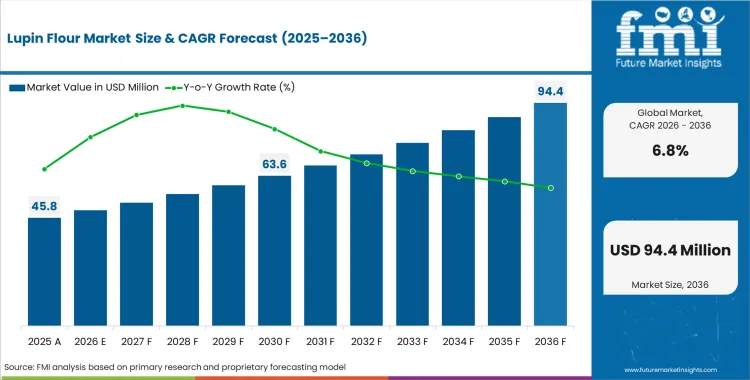
The lupin flour market size reached a valuation of USD 42.9 million in 2025. Industry outlook suggests the valuation to cross USD 45.8 million in 2026 at a CAGR of 6.80% during the forecast period. Continued investment in plant-based fortification pipelines is expected to lift market value to USD 88.4 million through 2036 as commercial bakeries standardize protein-enriched dough matrices across their primary product lines.
Summary of Lupin Flour Market
- The market is estimated at USD 42.9 million in 2025.
- The market is projected to reach USD 88.4 million by 2036.
- The market is expected to grow at a CAGR of 6.8% from 2026 to 2036.
- The forecast period represents an incremental opportunity of USD 42.4 million.
- Endosperm flour leads the product type segment with a 41.0% share.
- Bakery applications dominate the application segment with a 44.0% share.
- Food manufacturers lead the end user segment with a 58.0% share.
- B2B direct sales lead the sales channel segment with a 54.0% share.
- Sweet lupin dominates the source material segment with a 63.0% share.
- Australia (7.4%), Germany (6.9%), and the United Kingdom (6.6%) are among the fastest-growing markets.
Market concentration is low, with the top company holding a large number of shares. The category is still small, regionally dispersed, and product-form dependent.
Ingredient substitution decisions in commercial bakeries are shaped by hydration tolerance and dough rheology. Clean-label reformulation is increasing pressure to reduce reliance on vital wheat gluten and synthetic dough conditioners in selected bakery formulations. Formulating with lupin protein derivatives addresses this dual mandate. High-quality food grade lupin flour supplier networks offer exceptional water-binding capacity alongside naturally occurring emulsifying properties. Delaying the integration of these pulse-derived ingredients forces manufacturers to rely on increasingly expensive traditional texturizers.
Thresholds for allergen labeling dictate the pace of mainstream commercialization in new geographies. Clearer cross-reactivity guidance for peanut-allergic consumers can reduce launch delays by making internal risk assessment and labeling decisions easier to manage. Removing this compliance ambiguity acts as a structural gate. Niche gluten-free formulations transform into broad-scale bakery applications immediately following clearance. This dynamic heavily influences global lupin flour demand.
Australia lupin flour sector is estimated to expand at 7.4% CAGR by 2036, anchored by its structural dominance in upstream crop supply and advanced food-grade processing infrastructure. Germany is expected to rise at 6.9% CAGR, driven by Europe's familiarity with pulse ingredients. The United Kingdom expands at 6.6% as plant-based dietary shifts accelerate demand for fortified meat analogues. France is estimated to pose a 6.5% CAGR, supported by a sophisticated pastry sector adopting specialty flours. The United States is anticipated to advance at 6.2% CAGR, where protein-fortified snacking outpaces traditional bakery. Italy is expected to rise at 6.0%, leveraging the ingredient in premium pasta formulations. Japan is anticipated to expand at 5.4% CAGR because usage remains selective, and feed channels leads historical export volumes.
Segmental Analysis
Lupin Flour Market Analysis by Product Type
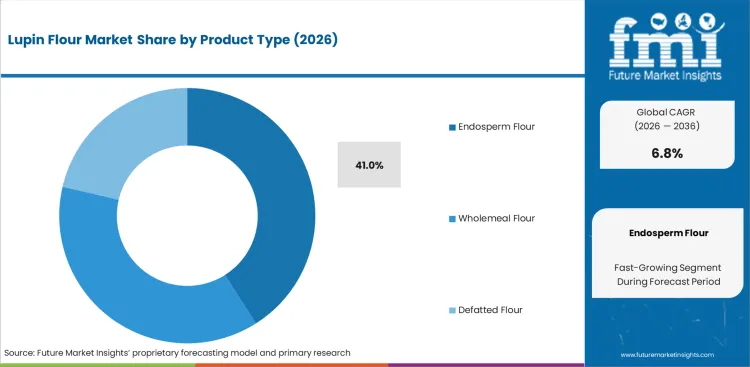
Endosperm flour leads this segment because product developers in gluten-free bakery formulations place a premium on texture control, crumb uniformity, and color consistency. In 2026, the endosperm flour segment is expected to account for 41.0% share, as removing the fibrous hull allows the material to perform more like conventional wheat flour in commercial baking systems. Refined grades give manufacturers better control over dough handling and final-product appearance, which matters in premium breads, cakes, and pastry lines where visible graininess or dark tone can weaken consumer acceptance. Gluten free flour variants still carry nutritional appeal, but their higher fibre load makes hydration less predictable and raises the risk of denser structure, rough mouthfeel, and batch variation during scale-up.
- Formulation precision: De-hulling and precision milling isolate the inner kernel, giving manufacturers tighter control over hydration behavior and reducing the process variability that comes with higher-fibre wholemeal inputs.
- Organoleptic performance: Removing the outer seed coat improves color and flavor stability, helping manufacturers avoid repeated reformulation work in applications where bitterness and darker appearance can limit acceptance.
- Supply constraint: Pure endosperm flour depends on dedicated milling and separation capability, which narrows the supplier base and keeps sourcing conditions tighter than for more conventional flour categories.
Lupin Flour Market Analysis by Application
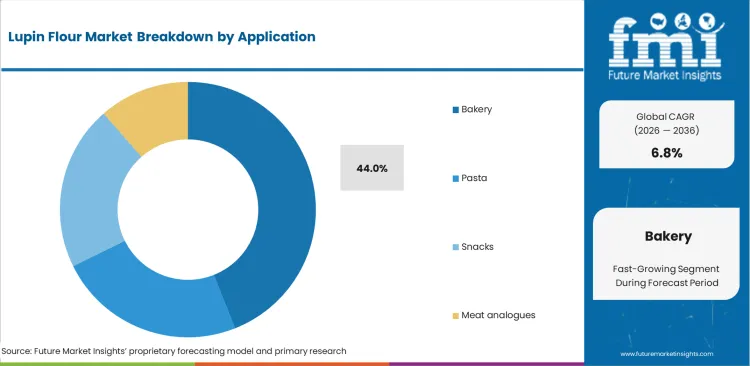
Bakery applications lead because lupin flour addresses several formulation demands within a single ingredient system, which gives it practical value in commercial baking where texture retention, label simplification, and shelf-life performance affect product economics. Strong water-binding capacity helps manufacturers preserve crumb softness during high-speed industrial processing, especially in high-protein flour, reduced-carbohydrate, and specialty baked products where early drying can reduce saleable shelf life. Naturally occurring lipid functionality also improves fat and water integration, giving formulators room to reduce dependence on added dough conditioners in selected recipes. Commercial demand remains strongest where one ingredient can improve handling, softness, and label appeal at the same time.
- Moisture retention: High protein and fibre content improves water retention through baking and storage, helping manufacturers maintain softer crumb texture across longer ambient shelf-life windows.
- Emulsifier replacement: Naturally occurring lipid fractions support fat-water integration, allowing cleaner formulations with lower dependence on mono- and diglycerides in selected bakery systems.
- Structural limitation: Higher inclusion rates need careful balancing in conventional wheat applications, as excess lupin flour can weaken dough structure and reduce loaf volume.
Lupin Flour Market Analysis by End User
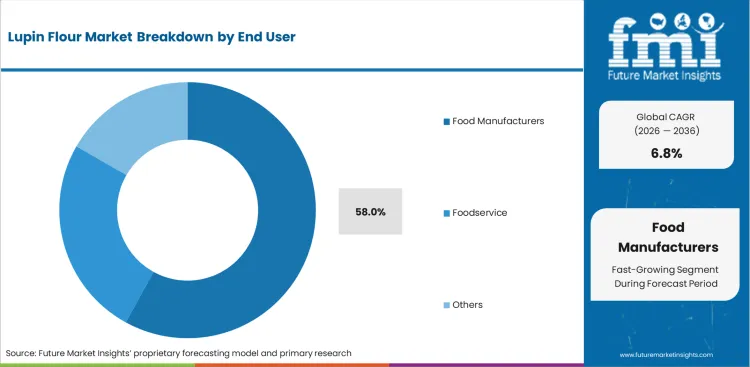
Food manufacturers lead this segment because they have the technical infrastructure, formulation budgets, and process control needed to integrate a specialized pulse ingredient into large-scale production. Lupin flour often requires pilot validation, shelf-life testing, allergen management, and line-level adjustments before it can move into routine output. Food manufacturers are expected to hold 58.0% share of the end user segment, reflecting their stronger ability to absorb development costs and convert technical approval into repeat industrial demand. Advantage is most visible in bakery, sauces, meat analogues, and other formulated food categories where ingredient performance must stay consistent across high-volume runs. Sweet lupin’s relatively bean flour also works in their favor, since it reduces the amount of masking and reformulation needed compared with more assertive pulse alternatives.
- Pilot scale-up: Standardized B2B specifications help manufacturers move from lab approval to commercial production with better batch consistency and fewer disruptions during continuous processing.
- Flavor neutrality: Milder taste characteristics make lupin flour easier to use in delicate formulations such as sauces, bakery fillings, and meat analogues without extensive flavor masking.
- Allergen protocol: Storage, segregation, and handling requirements add operational cost, which can slow adoption among smaller processors and contract manufacturers with limited compliance infrastructure.
Lupin Flour Market Analysis by Sales Channel
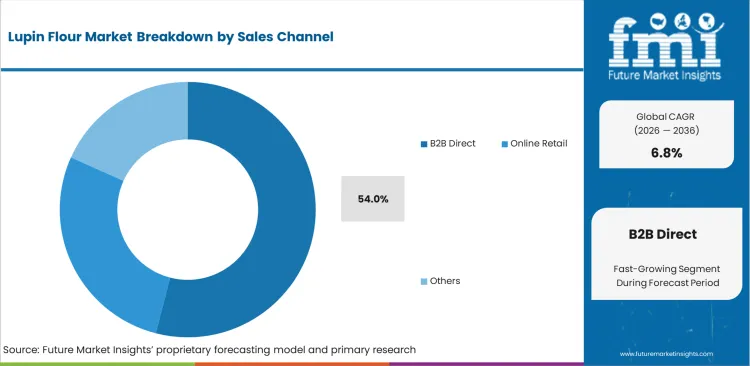
B2B direct channels lead this segment because traceability, grade consistency, and supply assurance matter more than simple distribution reach in a specialized ingredient category like lupin flour. B2B direct channels are expected to hold 54.0% share of the sales channel segment, reflecting the market’s continued dependence on supplier-managed relationships rather than broad distributor-led penetration. Many regional wholesale networks do not yet offer the technical support needed by mid-sized manufacturers shifting into flour substitutes and functional bakery blends.
Direct purchasing remains especially important for bulk lupin flour wholesale transactions, where volume movement, grade control, and logistics coordination have to stay aligned with plant schedules. Validation of a lupin flour B2B ingredient channel can also take months because documentation review, allergen checks, and trial-stage approval are often required before regular contracted use begins. Retail-led or fragmented sourcing channels remain less suitable for scaled commercial use because they weaken margin control and raise the risk of inventory gaps.
- Traceability assurance: Direct supplier relationships give manufacturers stronger documentation control from farm sourcing through finished ingredient delivery, which supports origin verification and clean-label claims.
- Customized milling: Contract-led supply arrangements make it easier to maintain particle size and flour characteristics more precisely, helping bakery lines maintain smoother pneumatic handling and more stable processing performance.
- Inventory risk: Minimum order quantities in direct purchasing can increase warehouse needs and working capital pressure, especially for smaller processors with tighter storage and cash-flow limits.
Lupin Flour Market Analysis by Source Material
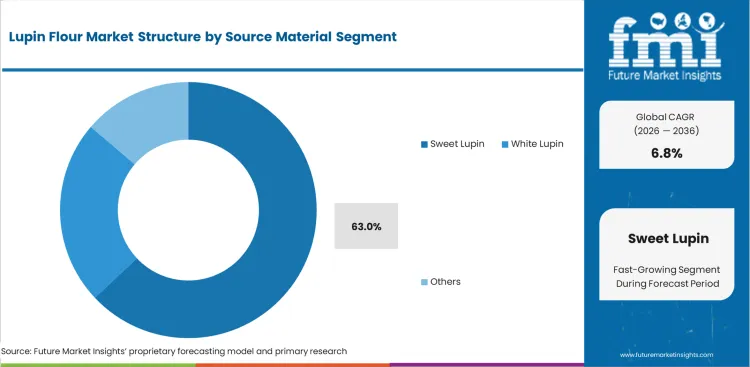
Sweet lupin leads this segment because food-grade lupin flour depends on low-alkaloid raw material that can move into milling without heavy corrective processing. Protein consistency adds to that advantage; a more stable composition reduces the need for repeated recipe adjustment across batches and production cycles. In 2026, sweet lupin is anticipated to capture 63.0% share of the source material segment, reflecting its stronger fit with industrial food use and its more established agronomic base. Dependence on a narrow varietal base still creates some exposure, particularly when output remains concentrated in a limited growing geography and seasonal disruption tightens ingredient availability.
- Alkaloid reduction: Lower alkaloid content allows direct food-grade milling with less reliance on corrective processing, which helps preserve clean-label positioning and improves processing economics.
- Protein standardization: More stable agronomic performance supports tighter ingredient specifications and reduces formulation variability in commercial food production.
- Geographic bottleneck: Heavy concentration in a limited production base can tighten availability when weather conditions affect crop output and exportable supply.
Lupin Flour Market Drivers, Restraints, and Opportunities
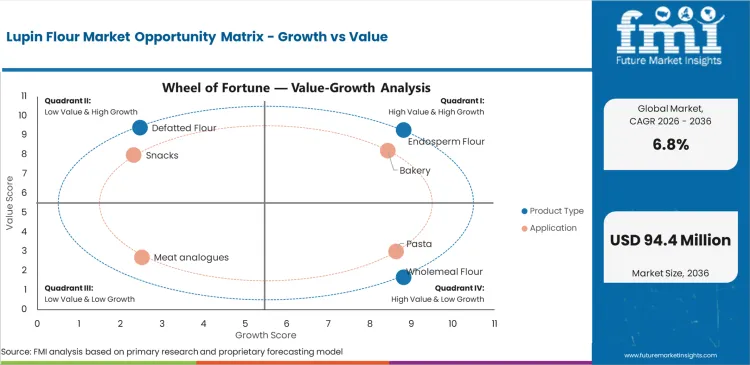
Margin compression forces commercial bakery directors to actively seek multi-functional ingredient solutions. Traditional bread formulations rely heavily on vital wheat gluten for structure and synthetic emulsifiers for shelf life. Replacing these distinct inputs with a single pulse derivative offers immediate cost-reduction strategies. Delaying this formulation pivot leaves manufacturers exposed to compounding commodity price hikes. It limits their ability to compete in the highly lucrative premium health-and-wellness grocery aisles.
Strict allergen management protocols create formidable operational friction. Integrating a known cross-reactive ingredient requires comprehensive hazard analysis, dedicated storage silos, and exhaustive sanitation validation between production runs. Understanding lupin flour allergy regulations becomes mandatory for compliance officers. Navigating strict lupin flour allergen labeling rules creates bottlenecks for product launches. Dedicated plant-based co-manufacturers are emerging as a partial solution. Their limited geographic distribution currently throttles the speed at which mid-sized brands can bring new fortified products to market.
Opportunities in the Lupin Flour Market
- Extrusion compatibility: High protein content and unique starch structures respond exceptionally well to high-shear extrusion. Process engineers develop highly texturized plant-based protein crisps that retain their crunch in liquid applications.
- Keto-friendly reformulation: Minimal net carbohydrate levels align perfectly with stringent low-glycemic dietary requirements. Product developers capture massive market share in specialized diabetic snacking sectors by replacing high-carb tapioca blends.
- Aquafeed crossover: Surplus production of specific milling fractions offers high-value protein streams for specialized aquaculture. Sustainability directors monetize secondary processing outputs, improving overall facility margin profiles.
Regional Analysis
Based on regional analysis, Lupin Flour is segmented into Oceania, Europe, North America, and East Asia across 40 plus countries.
.webp "Top Country Growth Comparison Lupin Flour Market Cagr (2026 2036)")
| Country | CAGR (2026 to 2036) |
|---|---|
| Australia | 7.4% |
| Germany | 6.9% |
| United Kingdom | 6.6% |
| France | 6.5% |
| United States | 6.2% |
| Italy | 6.0% |
| Japan | 5.4% |
Source: Future Market Insights (FMI) analysis, based on proprietary forecasting model and primary research
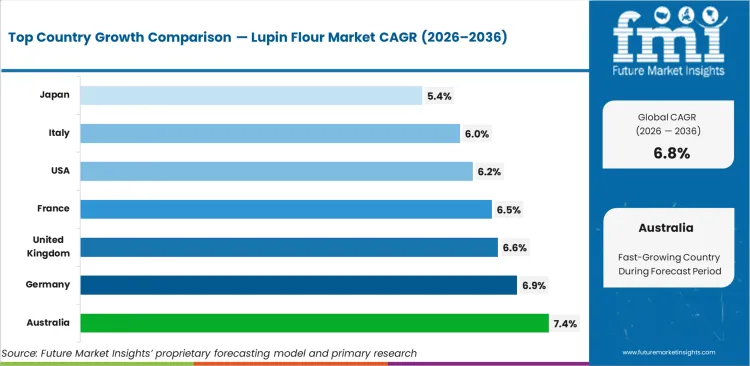
Oceania Lupin Flour Market Analysis
Oceania remains the core supply base for lupin flour because Australia combines broadacre lupin cultivation with food-grade milling capacity in the same regional chain. That integration gives the region a practical cost and availability advantage, especially in premium grades used in bakery and functional food formulations. Australia also sets the operating tone for the wider market, since local processing access allows earlier product testing, faster scale-up, and more stable conversion from crop output into commercial ingredient supply. Demand for lupin flour in Australia is anticipated to rise at a CAGR of 7.4% through 2036. Keeping Oceania commercially important not only as a consumption base, but as the region that anchors grade availability, supply continuity, and price formation for the broader global market.
- Australia: Broadacre production, established milling infrastructure, and closer alignment between farming and food-grade processing keep Australia a lucrative country in Oceania market. Sales of lupin flour in Australia are expected to increase at a CAGR of 7.4% during 2026 to 2036, supported by direct access to raw material, specialized milling infrastructure, and shorter domestic supply cycles.
FMI’s report includes New Zealand alongside emerging Pacific island processing nodes. New Zealand adds relevance through its established specialty food manufacturing base, where interest in gluten-free, high-protein, and clean-label formulations creates a natural testing ground for lupin flour in bakery and functional food applications.
Europe Lupin Flour Market Analysis
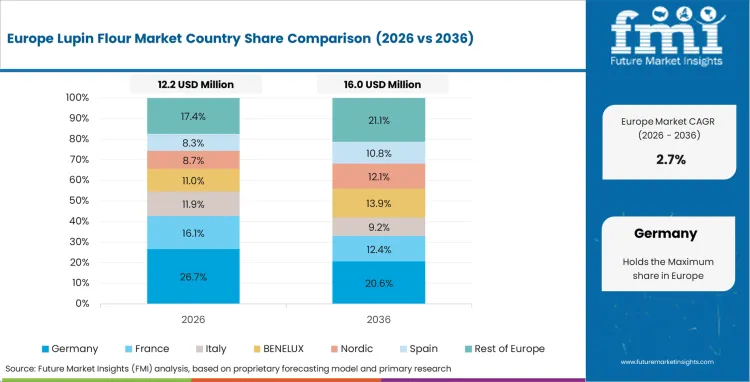
Europe remains one of the more commercially developed markets for lupin flour because allergen disclosure rules are well established and food manufacturers already have experience working with pulse-based ingredients in scaled production. Familiarity with functional bakery and pasta applications reduces the formulation friction that newer markets still face, particularly where ingredient handling, labeling, and sensory performance have to be validated together. Adoption is also supported by a product mix that already favors high-protein, clean-label, and specialty baked goods across several major economies. Demand across Europe carries a more mature profile, with growth coming from deeper application breadth rather than first-time category discovery.
- Germany: Dense breads, multigrain formats, and sourdough-based products give lupin flour a more natural route into established bakery systems. Demand for lupin flour in Germany is expected to rise at a CAGR of 6.9% from 2026 to 2036, supported by a strong fit with functional bakery positioning and a consumer base that is more receptive to texture-rich bread formats.
- United Kingdom: Prepared meals, meat alternatives, and retailer-led clean-label requirements keep product development cycles active in the UK food industry. Lupin flour adoption in the United Kingdom is likely to advance at a CAGR of 6.6%, as manufacturers look for plant-based ingredients that improve protein content without complicating label declarations. Demand also benefits from the ingredient’s ability to work across bakery, coatings, and meat-free formulations, which gives manufacturers more formulation flexibility than single-use specialty inputs.
- France: Packaged bakery and pastry formats create room for ingredients that improve softness retention and nutritional positioning without moving too far from established product standards. The sector for lupin flour in France is anticipated to expand at a CAGR of 6.5% during the forecast period, with uptake supported by premium baked goods where texture and formulation control remain commercially important. It keeps France relevant in the European market as demand builds through quality-led applications rather than through volume-led flour substitution.
- Italy: Pasta and specialty flour applications give lupin flour a practical role in formulations that need added protein, gluten-free positioning, or better extrusion balance. Sales of lupin flour in Italy are projected to rise at a 6.0% CAGR through 2036, reflecting continued use in premium pasta development and in flour systems designed to improve functionality in alternative grain products.
FMI’s report includes Spain, the Netherlands, and expanding agricultural zones across Eastern Europe. Spain adds depth to the regional outlook through its strong bakery and prepared food base, where demand for protein-enriched and gluten-free formulations can support wider lupin flour use in mainstream food processing.
North America Lupin Flour Market Analysis
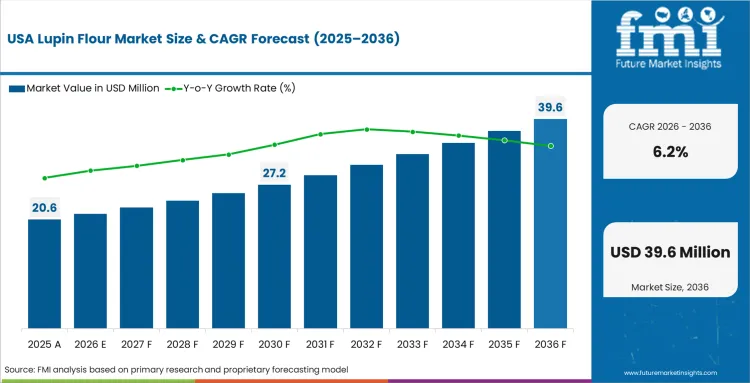
North America remains a more compliance-sensitive market for lupin flour because allergen management requirements raise the threshold for broader adoption. Regulatory caution around peanut cross-reactivity keeps formulation, sanitation, and labeling demands tighter than in more established lupin markets, which limits wider uptake across conventional food manufacturing. Use therefore remains concentrated in categories where controlled production environments and specialist positioning already exist, including gluten-free, keto-oriented, and protein-fortified products. Wider penetration will depend on more standardized handling protocols and greater operational familiarity across mainstream bakery and packaged food lines.
- United States: Protein-fortified snacks and specialty wellness products offer a more practical entry point than conventional bakery, where allergen-control requirements can slow reformulation and line conversion. Demand for lupin flour in the United States is expected to grow at a CAGR of 6.2% from 2026 to 2036, supported by manufacturers already operating in tightly managed gluten-free, keto, and functional food segments. Adoption is likely to widen gradually as allergen-control systems improve and the ingredient proves easier to manage in scaled food production.
FMI’s report includes Canada and Mexico. Canada adds medium-term relevance through its established pulse-processing base in the Prairie provinces, where existing pea and lentil infrastructure could be adapted over time for selected sweet lupin handling and ingredient conversion. Mexico also matters as bakery, snack, and prepared food manufacturing expands, creating a potential downstream market for lupin flour in protein-enriched and specialty formulations serving both domestic demand and North American production networks.
East Asia Lupin Flour Market Analysis
East Asia remains a constrained market for lupin flour because regional pulse-handling systems are still geared more toward feed movement than food-grade ingredient conversion. Port logistics, storage networks, and bulk handling capacity support large unrefined volumes, but bakery, noodle, and functional food applications require tighter segregation, cleaner de-hulling, and finer milling standards. Limited domestic capacity in those steps keeps reliance high on imported finished flour from Oceania, which raises input costs and narrows adoption to premium health-focused categories. Mass-market bakery and staple food applications remain harder to penetrate because processing economics and margin tolerance leave less room for elevated ingredient costs. Long-term expansion in East Asia will depend more on upgrading food-grade conversion infrastructure than on raw pulse availability alone.
- Japan: Japan remains a selective market because demand exists in gluten-free bakery, protein-enriched snacks, and wellness-oriented food categories, but food-grade lupin flour conversion capacity remains limited. Demand for lupin flour in Japan is estimated to rise at a 5.4% CAGR from 2026 to 2036, with staying concentrated in premium applications rather than broad bakery replacement. Continued dependence on imported finished flour keeps formulation costs high and limits wider use in mainstream baked goods and noodle products.
FMI’s report includes China and South Korea. China carries long-term relevance because its scale in food manufacturing could support wider lupin flour use once food-grade de-hulling, segregation, and milling capacity improve. South Korea also presents room for expansion as premium bakery, wellness snacks, and protein-forward packaged foods create a more favorable base for specialty flour adoption.
Competitive Aligners for Market Players
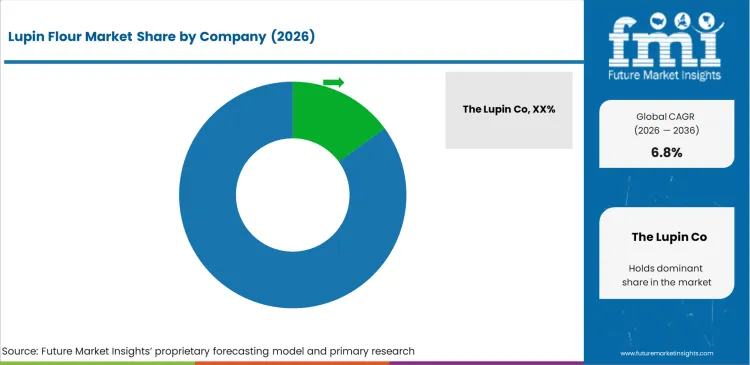
Competition in lupin flour remains fragmented, with a small group of specialist ingredient firms controlling much of the meaningful food-grade processing capacity across key regional supply chains. Companies such as The Lupin Co and Wide Open Agriculture stay focused on lupin milling and ingredient development rather than broad flour participation. Lupin flour key players prioritize alkaloid management, flour consistency, and food-grade conversion. Market position depends less on scale alone and more on the ability to maintain low alkaloid levels, stable quality, and application-ready grades. Global flour conglomerates still have a limited presence in the primary milling layer, leaving the category shaped mainly by focused processors with deeper technical specialization.
Established players retain an advantage through traceability systems, clean-label documentation, and operating familiarity with the de-hulling and separation steps required for food-grade lupin flour. Conventional wheat milling infrastructure is rarely enough for this category, particularly where pulse ingredients and tighter particle-size control are required. New lupin flour manufacturers face a higher barrier because matching quality standards often requires dedicated processing lines rather than minor upgrades to existing flour assets. Reliable output of fine, consistent, low-contamination grades remains concentrated in a limited number of facilities.
Geographic concentration also shapes competitive behavior, since a large share of food-grade lupin flour supply still depends on a narrow production base. Manufacturers looking to reduce that exposure often spread processing relationships across more than one region or grade source to protect continuity when harvest conditions tighten. Longer-term contracts remain common because stable access to specific flour grades matters as much as price. Multi-origin sourcing functions as a risk-control measure in a market where crop variability and regional concentration can quickly affect availability.
Key Players in Lupin Flour Market
- The Lupin Co
- Lupins for Life
- Wide Open Agriculture
- Lupina LLC
- Lopino Foods
- INVEJA
- Aminola
Scope of the Report
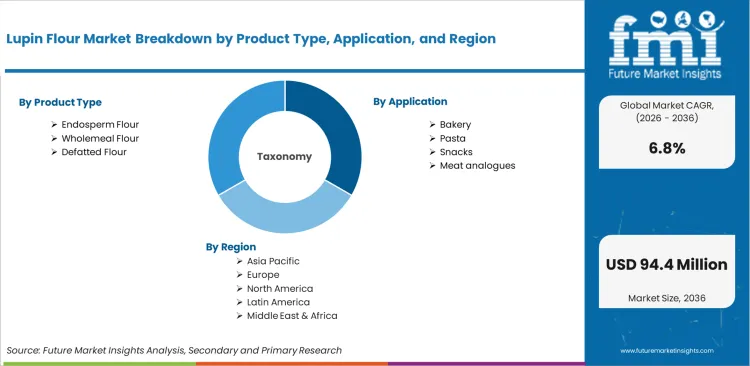
| Metric | Value |
|---|---|
| Quantitative Units | USD 45.8 Million to USD 88.4 Million, at a CAGR of 6.80% |
| Market Definition | Lupin flour is a functional food ingredient milled from Lupinus seeds. Industrial food manufacturers utilize it to improve dough hydration, enhance structural integrity in gluten-free applications, and elevate the protein profile of commercial baked goods. |
| Segmentation | Product Type, Application, End User, Sales Channel, Source Material |
| Regions Covered | Oceania, Europe, North America, Latin America, East Asia, South Asia, Middle East and Africa |
| Countries Covered | Australia, Germany, United Kingdom, France, United States, Italy, Japan |
| Key Companies Profiled | The Lupin Co, Lupins for Life, Wide Open Agriculture, Lupina LLC, Lopino Foods, INVEJA, Aminola |
| Forecast Period | 2026 to 2036 |
| Approach | Baseline volume anchors rely on agricultural yield data for sweet lupin harvests, adjusted for specific percentages diverted to food-grade milling facilities versus animal feed channels. |
Source: Future Market Insights (FMI) analysis, based on proprietary forecasting model and primary research
Lupin Flour Market Analysis by Segments
Product Type
- Endosperm flour
- Wholemeal flour
- Defatted flour
Application
- Bakery
- Pasta
- Snacks
- Meat analogues
- Sauces
End User
- Food manufacturers
- Foodservice
- Households
Sales Channel
- B2B direct
- Specialty retail
- Online retail
Source Material
- Sweet lupin
- White lupin
- Blue lupin
Region
- North America
- United States
- Canada
- Latin America
- Brazil
- Mexico
- Rest of Latin America
- Europe
- Germany
- United Kingdom
- France
- Italy
- Spain
- Rest of Europe
- East Asia
- China
- Japan
- South Korea
- South Asia
- India
- ASEAN
- Rest of South Asia
- Oceania
- Australia
- New Zealand
- Middle East and Africa
- GCC Countries
- South Africa
- Rest of Middle East and Africa
Bibliography
- Australian Bureau of Statistics. (2026, March 2). Australian Agriculture: Broadacre Crops, 2024-25 financial year.
- Barton, J., et al. [GRDC publication authorship as issued]. (2025, August 14). Lupin crop improvement plan. Grains Research and Development Corporation.
- Domínguez-Valencia, R., et al. (2025). Impact of supercritical CO2 treatment on lupin flour and derived protein isolate
- Elhordoy, M. R., et al. (2025). Exploring the potential of lupin (Lupinus angustifolius) flour, protein isolate, and their blends in high-moisture meat analogues. Journal of Food Science.
- Larenas, F. E. C., et al. (2024). Could snacks based on lupin be a nutritious treat? A point of view. Foods.
- Spina, A., et al. (2024). Lupin as ingredient in durum wheat breadmaking: Physicochemical properties of flour blends and bread quality. Foods, 13(5), 807.
- Western Australia Department of Primary Industries and Regional Development. (2025). Lupins.
This bibliography is provided for reader reference. The full FMI report contains the complete reference list with primary source documentation.
This Report Addresses
- Margin compression forcing commercial bakery directors to replace synthetic dough conditioners.
- The critical role of FDA cross-reactivity protocols in shaping mainstream adoption timelines.
- Specialized mechanical separation requirements that create supply bottlenecks for endosperm-grade variants.
- How Western Australian agronomic dominance controls global B2B pricing structures.
- Structural challenges preventing mid-sized manufacturers from securing pure product grades without cross-contamination.
- Moisture retention advantages driving adoption within the keto-friendly packaged baked goods sector.
- Traceability mandates locking premium ingredient flows into direct procurement channels rather than regional wholesalers.
- The competitive advantage European contract manufacturers maintain due to established EFSA allergen guidelines.
Frequently Asked Questions
what is lupin flour used for ?
Industrial food manufacturers incorporate the ingredient to improve dough hydration, enhance structural integrity in gluten-free applications, and elevate the protein profile of commercial baked goods. It functions as a powerful natural emulsifier, allowing bakeries to eliminate synthetic dough conditioners.
is lupin flour gluten free ?
Yes, the milled seed lacks the gluten proteins found in wheat, barley, and rye. Formulation scientists rely heavily on it to construct stable matrices in premium gluten-free breads, pastry, and pasta lines without triggering celiac responses.
is lupin flour safe for peanut allergy ?
No, clinical data confirms a significant cross-reactivity risk for individuals with existing peanut allergies. Facility compliance officers must implement strict allergen segregation protocols and front-of-pack warning labels to meet rigorous regulatory safety standards.
lupin flour vs chickpea flour ?
Procurement directors often favor lupin due to its remarkably neutral flavor profile and higher protein density. Chickpea alternatives frequently introduce overwhelming bean-like flavors that require heavy masking agents in delicate pastry applications.
lupin flour vs almond flour ?
Almond variants offer rich textures but carry steep agricultural costs and severe price volatility. Food manufacturers transition to lupin to achieve similar high-protein, low-carbohydrate nutritional profiles while securing much more stable commodity pricing structures.
What is the current size of the lupin flour market?
FMI assessments indicate the category recorded a valuation of USD 42.9 million in 2025. This baseline reflects the volume of food-grade milled ingredients actively purchased by commercial bakeries and contract manufacturers globally.
What will the lupin flour market be worth by 2036?
Cumulative revenue is projected to reach USD 88.4 million by 2036. This growth trajectory depends heavily on multinational food brands finalizing internal allergen protocols and launching fortified product lines globally.
Why is lupin flour demand rising?
Margin compression forces commercial baking directors to seek multi-functional ingredients. Swapping expensive synthetic dough conditioners and vital wheat gluten for a single pulse derivative reduces aggregate recipe costs while satisfying clean-label retail mandates.
Which countries are leading lupin flour consumption and supply?
Australia dominates the upstream raw material supply and specialized milling infrastructure. Germany and the United Kingdom lead European consumption, utilizing their established regulatory frameworks to integrate the ingredient into bakery and plant-based meat applications.
Who are the key companies in the lupin flour market?
Specialist firms like The Lupin Co, Wide Open Agriculture, and Lupins for Life control the primary production tier. These companies focus exclusively on optimizing agronomic traits and precise mechanical separation techniques for this specific leguminous seed.
Is lupin flour mainly used in bakery products?
Yes, commercial bakery operations account for the largest application share at 44.0%. Hydration tolerance, moisture retention, and natural emulsification properties make it an indispensable tool for extending the ambient shelf life of packaged breads.
How does processing affect product quality?
De-hulling and precision milling isolate the protein-rich inner kernel, creating premium endosperm grades. This exact physical processing removes bitter alkaloids and dark pigments, allowing food scientists to achieve optimal dough extensibility without organoleptic compromises.
Why do buyers prefer B2B direct channels?
Strict traceability requirements lock specialty ingredients into direct procurement models. Sourcing directors prefer this relationship to ensure continuous access to specific milled grades, bypassing regional wholesale networks that lack necessary technical sales expertise.
What role does Australia play in global supply?
Western Australian growers operate with a near-monopolistic advantage in raw material scale. Decades of selective breeding eliminated the need for chemical debittering, allowing Australian facilities to dictate global pricing and technical specifications.
What restricts broader adoption in North America?
Strict Food and Drug Administration guidelines regarding peanut cross-reactivity heavily influence procurement decisions. Facility managers face massive capital expenditures to update sanitation protocols before safely introducing the ingredient into legacy mixing plants.
How does the ingredient perform in pasta manufacturing?
Premium pasta manufacturers leverage its extrusion capabilities and neutral flavor profile. Production engineers value how the flour binds effectively under high shear forces, solving structural weaknesses common in traditional gluten-free pasta manufacturing.
What is the primary constraint for mid-sized bakeries?
Securing reliable volumes of pure endosperm grade requires contracting with specialized milling facilities. Purchasing directors at mid-sized firms frequently face extended lead times and premium pricing structures that delay product launches.
Why is sweet lupin the dominant source material?
Agronomic selection permanently lowered toxic alkaloid levels in this specific variety. Quality control directors specify it exclusively to completely bypass the complex and expensive debittering processes required for older, unrefined botanical strains.
How does European regulation impact market growth?
The European Food Safety Authority provides clear labeling mandates that actually accelerate adoption. Removing legal ambiguity allows European contract manufacturers to confidently expand high-protein pasta and clean-label pastry portfolios without fearing sudden compliance shifts.
What role does the ingredient play in meat analogues?
Formulation chemists prioritize pulse derivatives to fortify plant-based meats while adhering to strict supermarket clean-label criteria. The ingredient improves moisture retention and texture in high-moisture extrusion processes used for vegan alternative proteins.
How do manufacturers navigate supply chain risks?
Sourcing directors actively build redundancies to combat geographic concentration in Oceania. Buying teams qualify secondary suppliers in alternative regions to protect against Australian drought cycles that could severely disrupt global ingredient availability.
What unexpected benefits do formulators find?
Beyond protein fortification, R&D teams utilize the flour's natural lipid complexes to seamlessly interact with added fats and water. This allows manufacturers to quietly remove mono- and diglycerides from product labels, satisfying retailer clean-label demands.
Preview the report firsthand - request a free sample
Get SampleGet the brochure for pricing and purchase details.
Get PDFTable of Content
- Executive Summary
- Global Market Outlook
- Demand-side Trends
- Supply-side Trends
- Technology Roadmap Analysis
- Analysis and Recommendations
- Market Overview
- Market Coverage / Taxonomy
- Market Definition / Scope / Limitations
- Research Methodology
- Chapter Orientation
- Analytical Lens and Working Hypotheses
- Market Structure, Signals, and Trend Drivers
- Benchmarking and Cross-market Comparability
- Market Sizing, Forecasting, and Opportunity Mapping
- Research Design and Evidence Framework
- Desk Research Programme (Secondary Evidence)
- Company Annual and Sustainability Reports
- Peer-reviewed Journals and Academic Literature
- Corporate Websites, Product Literature, and Technical Notes
- Earnings Decks and Investor Briefings
- Statutory Filings and Regulatory Disclosures
- Technical White Papers and Standards Notes
- Trade Journals, Industry Magazines, and Analyst Briefs
- Conference Proceedings, Webinars, and Seminar Materials
- Government Statistics Portals and Public Data Releases
- Press Releases and Reputable Media Coverage
- Specialist Newsletters and Curated Briefings
- Sector Databases and Reference Repositories
- FMI Internal Proprietary Databases and Historical Market Datasets
- Subscription Datasets and Paid Sources
- Social Channels, Communities, and Digital Listening Inputs
- Additional Desk Sources
- Expert Input and Fieldwork (Primary Evidence)
- Primary Modes
- Qualitative Interviews and Expert Elicitation
- Quantitative Surveys and Structured Data Capture
- Blended Approach
- Why Primary Evidence is Used
- Field Techniques
- Interviews
- Surveys
- Focus Groups
- Observational and In-context Research
- Social and Community Interactions
- Stakeholder Universe Engaged
- C-suite Leaders
- Board Members
- Presidents and Vice Presidents
- R&D and Innovation Heads
- Technical Specialists
- Domain Subject-matter Experts
- Scientists
- Physicians and Other Healthcare Professionals
- Governance, Ethics, and Data Stewardship
- Research Ethics
- Data Integrity and Handling
- Primary Modes
- Tooling, Models, and Reference Databases
- Desk Research Programme (Secondary Evidence)
- Data Engineering and Model Build
- Data Acquisition and Ingestion
- Cleaning, Normalisation, and Verification
- Synthesis, Triangulation, and Analysis
- Quality Assurance and Audit Trail
- Market Background
- Market Dynamics
- Drivers
- Restraints
- Opportunity
- Trends
- Scenario Forecast
- Demand in Optimistic Scenario
- Demand in Likely Scenario
- Demand in Conservative Scenario
- Opportunity Map Analysis
- Product Life Cycle Analysis
- Supply Chain Analysis
- Investment Feasibility Matrix
- Value Chain Analysis
- PESTLE and Porter’s Analysis
- Regulatory Landscape
- Regional Parent Market Outlook
- Production and Consumption Statistics
- Import and Export Statistics
- Market Dynamics
- Global Market Analysis 2021 to 2025 and Forecast, 2026 to 2036
- Historical Market Size Value (USD Million) Analysis, 2021 to 2025
- Current and Future Market Size Value (USD Million) Projections, 2026 to 2036
- Y-o-Y Growth Trend Analysis
- Absolute $ Opportunity Analysis
- Global Market Pricing Analysis 2021 to 2025 and Forecast 2026 to 2036
- Global Market Analysis 2021 to 2025 and Forecast 2026 to 2036, By Product Type
- Introduction / Key Findings
- Historical Market Size Value (USD Million) Analysis By Product Type , 2021 to 2025
- Current and Future Market Size Value (USD Million) Analysis and Forecast By Product Type , 2026 to 2036
- Endosperm Flour
- Wholemeal Flour
- Defatted Flour
- Endosperm Flour
- Y-o-Y Growth Trend Analysis By Product Type , 2021 to 2025
- Absolute $ Opportunity Analysis By Product Type , 2026 to 2036
- Global Market Analysis 2021 to 2025 and Forecast 2026 to 2036, By Application
- Introduction / Key Findings
- Historical Market Size Value (USD Million) Analysis By Application, 2021 to 2025
- Current and Future Market Size Value (USD Million) Analysis and Forecast By Application, 2026 to 2036
- Bakery
- Pasta
- Snacks
- Meat analogues
- Bakery
- Y-o-Y Growth Trend Analysis By Application, 2021 to 2025
- Absolute $ Opportunity Analysis By Application, 2026 to 2036
- Global Market Analysis 2021 to 2025 and Forecast 2026 to 2036, By End User
- Introduction / Key Findings
- Historical Market Size Value (USD Million) Analysis By End User, 2021 to 2025
- Current and Future Market Size Value (USD Million) Analysis and Forecast By End User, 2026 to 2036
- Food Manufacturers
- Foodservice
- Others
- Food Manufacturers
- Y-o-Y Growth Trend Analysis By End User, 2021 to 2025
- Absolute $ Opportunity Analysis By End User, 2026 to 2036
- Global Market Analysis 2021 to 2025 and Forecast 2026 to 2036, By Sales Channel
- Introduction / Key Findings
- Historical Market Size Value (USD Million) Analysis By Sales Channel, 2021 to 2025
- Current and Future Market Size Value (USD Million) Analysis and Forecast By Sales Channel, 2026 to 2036
- B2B Direct
- Online Retail
- Others
- B2B Direct
- Y-o-Y Growth Trend Analysis By Sales Channel, 2021 to 2025
- Absolute $ Opportunity Analysis By Sales Channel, 2026 to 2036
- Global Market Analysis 2021 to 2025 and Forecast 2026 to 2036, By Source Material
- Introduction / Key Findings
- Historical Market Size Value (USD Million) Analysis By Source Material, 2021 to 2025
- Current and Future Market Size Value (USD Million) Analysis and Forecast By Source Material, 2026 to 2036
- Sweet Lupin
- White Lupin
- Others
- Sweet Lupin
- Y-o-Y Growth Trend Analysis By Source Material, 2021 to 2025
- Absolute $ Opportunity Analysis By Source Material, 2026 to 2036
- Global Market Analysis 2021 to 2025 and Forecast 2026 to 2036, By Region
- Introduction
- Historical Market Size Value (USD Million) Analysis By Region, 2021 to 2025
- Current Market Size Value (USD Million) Analysis and Forecast By Region, 2026 to 2036
- North America
- Latin America
- Western Europe
- Eastern Europe
- East Asia
- South Asia and Pacific
- Middle East & Africa
- Market Attractiveness Analysis By Region
- North America Market Analysis 2021 to 2025 and Forecast 2026 to 2036, By Country
- Historical Market Size Value (USD Million) Trend Analysis By Market Taxonomy, 2021 to 2025
- Market Size Value (USD Million) Forecast By Market Taxonomy, 2026 to 2036
- By Country
- USA
- Canada
- Mexico
- By Product Type
- By Application
- By End User
- By Sales Channel
- By Source Material
- By Country
- Market Attractiveness Analysis
- By Country
- By Product Type
- By Application
- By End User
- By Sales Channel
- By Source Material
- Key Takeaways
- Latin America Market Analysis 2021 to 2025 and Forecast 2026 to 2036, By Country
- Historical Market Size Value (USD Million) Trend Analysis By Market Taxonomy, 2021 to 2025
- Market Size Value (USD Million) Forecast By Market Taxonomy, 2026 to 2036
- By Country
- Brazil
- Chile
- Rest of Latin America
- By Product Type
- By Application
- By End User
- By Sales Channel
- By Source Material
- By Country
- Market Attractiveness Analysis
- By Country
- By Product Type
- By Application
- By End User
- By Sales Channel
- By Source Material
- Key Takeaways
- Western Europe Market Analysis 2021 to 2025 and Forecast 2026 to 2036, By Country
- Historical Market Size Value (USD Million) Trend Analysis By Market Taxonomy, 2021 to 2025
- Market Size Value (USD Million) Forecast By Market Taxonomy, 2026 to 2036
- By Country
- Germany
- UK
- Italy
- Spain
- France
- Nordic
- BENELUX
- Rest of Western Europe
- By Product Type
- By Application
- By End User
- By Sales Channel
- By Source Material
- By Country
- Market Attractiveness Analysis
- By Country
- By Product Type
- By Application
- By End User
- By Sales Channel
- By Source Material
- Key Takeaways
- Eastern Europe Market Analysis 2021 to 2025 and Forecast 2026 to 2036, By Country
- Historical Market Size Value (USD Million) Trend Analysis By Market Taxonomy, 2021 to 2025
- Market Size Value (USD Million) Forecast By Market Taxonomy, 2026 to 2036
- By Country
- Russia
- Poland
- Hungary
- Balkan & Baltic
- Rest of Eastern Europe
- By Product Type
- By Application
- By End User
- By Sales Channel
- By Source Material
- By Country
- Market Attractiveness Analysis
- By Country
- By Product Type
- By Application
- By End User
- By Sales Channel
- By Source Material
- Key Takeaways
- East Asia Market Analysis 2021 to 2025 and Forecast 2026 to 2036, By Country
- Historical Market Size Value (USD Million) Trend Analysis By Market Taxonomy, 2021 to 2025
- Market Size Value (USD Million) Forecast By Market Taxonomy, 2026 to 2036
- By Country
- China
- Japan
- South Korea
- By Product Type
- By Application
- By End User
- By Sales Channel
- By Source Material
- By Country
- Market Attractiveness Analysis
- By Country
- By Product Type
- By Application
- By End User
- By Sales Channel
- By Source Material
- Key Takeaways
- South Asia and Pacific Market Analysis 2021 to 2025 and Forecast 2026 to 2036, By Country
- Historical Market Size Value (USD Million) Trend Analysis By Market Taxonomy, 2021 to 2025
- Market Size Value (USD Million) Forecast By Market Taxonomy, 2026 to 2036
- By Country
- India
- ASEAN
- Australia & New Zealand
- Rest of South Asia and Pacific
- By Product Type
- By Application
- By End User
- By Sales Channel
- By Source Material
- By Country
- Market Attractiveness Analysis
- By Country
- By Product Type
- By Application
- By End User
- By Sales Channel
- By Source Material
- Key Takeaways
- Middle East & Africa Market Analysis 2021 to 2025 and Forecast 2026 to 2036, By Country
- Historical Market Size Value (USD Million) Trend Analysis By Market Taxonomy, 2021 to 2025
- Market Size Value (USD Million) Forecast By Market Taxonomy, 2026 to 2036
- By Country
- Kingdom of Saudi Arabia
- Other GCC Countries
- Turkiye
- South Africa
- Other African Union
- Rest of Middle East & Africa
- By Product Type
- By Application
- By End User
- By Sales Channel
- By Source Material
- By Country
- Market Attractiveness Analysis
- By Country
- By Product Type
- By Application
- By End User
- By Sales Channel
- By Source Material
- Key Takeaways
- Key Countries Market Analysis
- USA
- Pricing Analysis
- Market Share Analysis, 2025
- By Product Type
- By Application
- By End User
- By Sales Channel
- By Source Material
- Canada
- Pricing Analysis
- Market Share Analysis, 2025
- By Product Type
- By Application
- By End User
- By Sales Channel
- By Source Material
- Mexico
- Pricing Analysis
- Market Share Analysis, 2025
- By Product Type
- By Application
- By End User
- By Sales Channel
- By Source Material
- Brazil
- Pricing Analysis
- Market Share Analysis, 2025
- By Product Type
- By Application
- By End User
- By Sales Channel
- By Source Material
- Chile
- Pricing Analysis
- Market Share Analysis, 2025
- By Product Type
- By Application
- By End User
- By Sales Channel
- By Source Material
- Germany
- Pricing Analysis
- Market Share Analysis, 2025
- By Product Type
- By Application
- By End User
- By Sales Channel
- By Source Material
- UK
- Pricing Analysis
- Market Share Analysis, 2025
- By Product Type
- By Application
- By End User
- By Sales Channel
- By Source Material
- Italy
- Pricing Analysis
- Market Share Analysis, 2025
- By Product Type
- By Application
- By End User
- By Sales Channel
- By Source Material
- Spain
- Pricing Analysis
- Market Share Analysis, 2025
- By Product Type
- By Application
- By End User
- By Sales Channel
- By Source Material
- France
- Pricing Analysis
- Market Share Analysis, 2025
- By Product Type
- By Application
- By End User
- By Sales Channel
- By Source Material
- India
- Pricing Analysis
- Market Share Analysis, 2025
- By Product Type
- By Application
- By End User
- By Sales Channel
- By Source Material
- ASEAN
- Pricing Analysis
- Market Share Analysis, 2025
- By Product Type
- By Application
- By End User
- By Sales Channel
- By Source Material
- Australia & New Zealand
- Pricing Analysis
- Market Share Analysis, 2025
- By Product Type
- By Application
- By End User
- By Sales Channel
- By Source Material
- China
- Pricing Analysis
- Market Share Analysis, 2025
- By Product Type
- By Application
- By End User
- By Sales Channel
- By Source Material
- Japan
- Pricing Analysis
- Market Share Analysis, 2025
- By Product Type
- By Application
- By End User
- By Sales Channel
- By Source Material
- South Korea
- Pricing Analysis
- Market Share Analysis, 2025
- By Product Type
- By Application
- By End User
- By Sales Channel
- By Source Material
- Russia
- Pricing Analysis
- Market Share Analysis, 2025
- By Product Type
- By Application
- By End User
- By Sales Channel
- By Source Material
- Poland
- Pricing Analysis
- Market Share Analysis, 2025
- By Product Type
- By Application
- By End User
- By Sales Channel
- By Source Material
- Hungary
- Pricing Analysis
- Market Share Analysis, 2025
- By Product Type
- By Application
- By End User
- By Sales Channel
- By Source Material
- Kingdom of Saudi Arabia
- Pricing Analysis
- Market Share Analysis, 2025
- By Product Type
- By Application
- By End User
- By Sales Channel
- By Source Material
- Turkiye
- Pricing Analysis
- Market Share Analysis, 2025
- By Product Type
- By Application
- By End User
- By Sales Channel
- By Source Material
- South Africa
- Pricing Analysis
- Market Share Analysis, 2025
- By Product Type
- By Application
- By End User
- By Sales Channel
- By Source Material
- USA
- Market Structure Analysis
- Competition Dashboard
- Competition Benchmarking
- Market Share Analysis of Top Players
- By Region
- By Product Type
- By Application
- By End User
- By Sales Channel
- By Source Material
- Competition Analysis
- Competition Deep Dive
- The Lupin Co
- Overview
- Product Portfolio
- Profitability by Market Segments (Product/Age /Sales Channel/Region)
- Sales Footprint
- Strategy Overview
- Marketing Strategy
- Product Strategy
- Channel Strategy
- Lupins for Life
- Wide Open Agriculture
- Lupina LLC
- Lopino Foods
- INVEJA
- The Lupin Co
- Competition Deep Dive
- Assumptions & Acronyms Used


