

- Market Size (2026)
- USD 1.8 Bn
- Forecast (2036)
- USD 3.3 Bn
- CAGR (2026 to 2036)
- 6.2%
Vegan Flour Market Size, Market Forecast and Outlook By FMI
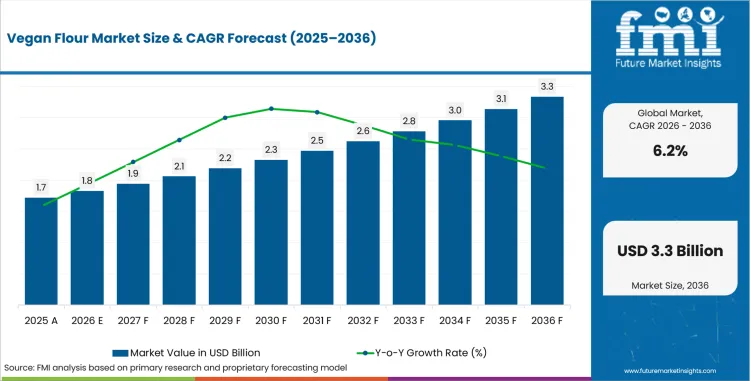
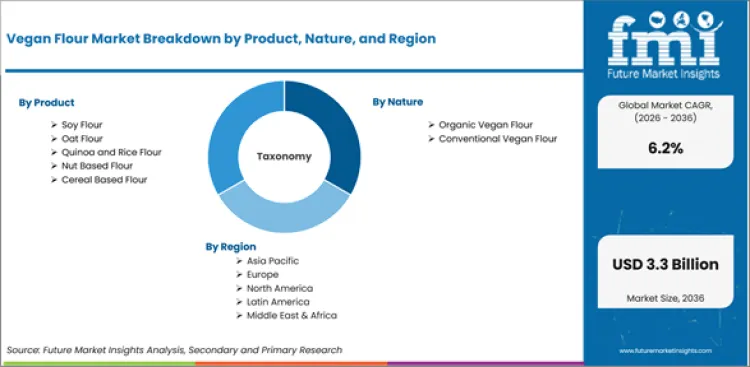
The vegan flour market was valued at USD 1.7 billion in 2025. The market is set to reach USD 1.8 billion by 2026-end and grow at a CAGR of 6.2% between 2026-2036 to reach USD 3.3 billion by 2036. Soy Flour will dominate with a 28.0% share, while Organic Vegan Flour will lead with a 46.0% share.
Key Takeaways, Market Size, and Forecast
- 2026 Market Size: USD 1.8 Bn
- 2036 Market Size: USD 3.3 Bn
- Compound Annual Growth Rate (CAGR): 6.2% from 2026 to 2036
- Absolute $ Opportunity: USD 1.5 Bn between 2026 and 2036
- Leading Product Segment: Soy Flour
- Soy Flour Share in 2026: 28.0%
- Fastest-growing Country: EU
- EU CAGR: 6.5% through 2036
| Parameter | Details |
|---|---|
| Market Size in 2026 (Value) | USD 1.8 Bn |
| Market Forecast in 2036 (Value) | USD 3.3 Bn |
| CAGR (2026 to 2036) | 6.2% |
| Years Considered | 2021 to 2036 |
| Base Year | 2025 |
| Forecast Period | 2026 to 2036 |
| Units Considered | Value (USD Bn) |
| Leading Sub-Region | EU |
Summary of the Vegan Flour Market
- Demand and Growth Drivers
- Plant-based diet adoption and gluten-free dietary requirements are creating structured demand for vegan flour products across bakery, confectionery, and functional food manufacturing.
- Food manufacturer reformulation programs incorporating plant-based and allergen-free ingredients are generating B2B procurement for soy, oat, quinoa, and nut-based flour alternatives.
- Growth in home baking and artisanal food preparation is expanding retail demand for specialty vegan flour products positioned as healthier and more sustainable alternatives to conventional wheat flour.
- Product and Segment View
- By product segment, soy flour is projected to account for a share of 28.0% in 2026, owing to the established soy processing infrastructure, protein content advantages, and functional performance in bakery applications.
- Grain-based flour comprises 42.0% of the source segment, exemplifying the diversity of oat, quinoa and rice-based vegan flour products that meet the needs of the gluten-free and plant-based consumer.
- Vegan flour’s application segment is dominated by bakery products, which make up 44.0% of the segment, with the majority of the demand for vegan flour being from bread, cake, cookie, and pastry formulations.
- Geography and Competitive Outlook
- The EU leads growth at 6.5% CAGR through 2036, driven by plant-based food adoption, gluten-free dietary trends, and food manufacturer reformulation programs aligned with sustainability commitments.
- South Korea at 6.4% reflects health-conscious consumer demographics and government food technology R&D investment supporting plant-based ingredient development.
- Cargill, ADM, and Conagra Brands hold established positions through flour milling infrastructure, ingredient supply networks, and diversified plant-based product portfolios.
- Analyst Opinion
- Nandini Roy Choudhury, Principal Consultant at FMI says, 'Producers that combine functional performance consistency with allergen-free formulation and cost-competitive pricing are positioned to capture both retail and food manufacturing demand as vegan flour transitions from specialty to mainstream ingredient status.'
- The vegan flour market is transitioning from a niche health food ingredient toward mainstream baking and food manufacturing adoption as functional performance and pricing approach conventional flour parity.
- Gluten-free and allergen-free positioning creates cross-category demand from consumers managing celiac disease, wheat allergies, and dietary preferences beyond vegan motivation.
- Demand is supported by the expansion of plant-based and free-from food product categories across retail, food service, and food manufacturing channels.
Vegan Flour Market Definition
The vegan flour market comprises plant-based flour products made from legumes, grains, nuts, and seeds, which act as alternatives to conventional wheat flour and animal-derived ingredients. Products include soy flour, oat flour, quinoa and rice flour, and nut-based flour in organic and conventional versions for bakery, confectionery and functional food applications.
Vegan Flour Market Inclusions
Market scope includes all commercially traded vegan flour products segmented by product (soy flour, oat flour, quinoa and rice flour, nut based flour), nature (organic vegan flour, conventional vegan flour), application (bakery products, soups sauces and dressings, confectioneries, functional foods), distribution channel (direct sales, indirect sales, online retail, store based retail), source (legume based flour, grain based flour, nut and seed based flour), and packaging type (pouches and sachets, bulk packaging). Revenue is tracked from 2026-2036.
Vegan Flour Market Exclusions
The scope excludes traditional wheat flour, rice flour marketed without vegan or plant-based positioning, and protein isolates and concentrates marketed separately from flour products.
Vegan Flour Market Research Methodology
- Primary Research: FMI analysts engaged with flour millers, plant-based ingredient suppliers, bakery product manufacturers, and retail category managers specializing in free-from and plant-based food products.
- Desk Research: Combined plant-based food industry data, flour milling production statistics, and regulatory documentation on allergen labeling and organic certification for plant-based ingredients.
- Market Sizing and Forecasting: Bottom-up aggregation from bakery, confectionery, and food manufacturing application volumes with regional plant-based food adoption curves.
- Data Validation: Cross-checked quarterly against flour miller production data, retail scanner data for plant-based baking products, and food manufacturer ingredient procurement reports.
Why is the Vegan Flour Growing?
- Increase in the adoption of the plant-based diet and gluten-free requirements are increasing the addressable market for vegan flour products as consumers and food manufacturers look for alternatives to conventional wheat flour.
- Reformulation in the bakery industry incorporating vegan flour blends is creating B2B procurement volume, as commercial bakers develop plant-based and allergen-free product lines.
The vegan flour market is growing as the adoption of plant-based diets, gluten-free diet trends and reformulation programs by food manufacturers creates demand for alternative flour products. Soy flour is leading the product segment with 28.0%, with established protein processing infrastructure and good functional properties in bakery applications such as binding, moisture retention, and protein fortification.
Organic vegan flour accounts for 46.0% of the nature segment, reflecting the overlap between plant-based and organic consumer concerns. Vegan flour is also used in formulations for bakery products such as bread, cake, cookie and pastry products for dedicated vegan consumers as well as the larger health-conscious market for protein-enriched or gluten-free baked foods, accounting for 44.0% of application demand.
62.0% of packaging is in the form of pouches and sachets, catering to retail consumers and small-batch bakery operations. Bulk packaging caters to food manufacturers and commercial bakeries that buy vegan flour as an ingredient for their production. Specialty ingredient distributors act as intermediaries serving food manufacturers, meaning that indirect sales channels account for 36.0% of distribution.
Market Segmentation Analysis
- Soy flour will hold 28.0% of the product segment in 2026 owing to its protein content, functional performance, and well-established production infrastructure.
- The applications demand for bakery products is 44.0% which signifies the major application of vegan flour in bread, cake and pastry formulations
- Organic vegan flour - 46.0% of the nature segment, reflecting the overlap between plant-based and organic consumer preferences.
The vegan flour market is divided by product, nature, application, distribution channel, source and packaging type. Product categories include soy, oat, quinoa/rice and nut-based flour. Uses include bakery, confectionery, soups/sauces and functional food categories.
Insights into the Soy Flour Segment
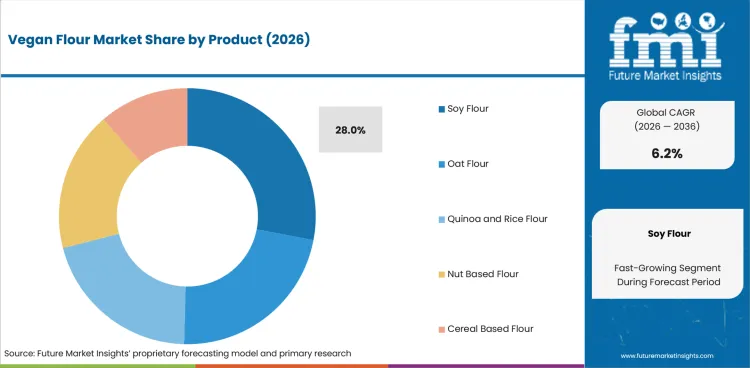
Product Segment accounted for 28.0% of Soy flour in 2026. With a rich protein content (40-50%), in addition to strong functional properties (binding, emulsification, and moisture retention), soy flour is the preferred vegan flour for protein fortified bakery products. The world’s soy processing infrastructure is well established allowing cost competitive scale production.
The growth trajectory of soy is influenced by a tension between the functional benefits of soy and the evolving consumer preferences for soy-free alternatives given allergen concerns. So manufacturers are coming back to defatted soy flour variants and blended formulations with soy and oat or quinoa to balance functionality with clean-label consumer expectations.
Insights into the Bakery Products Application Segment
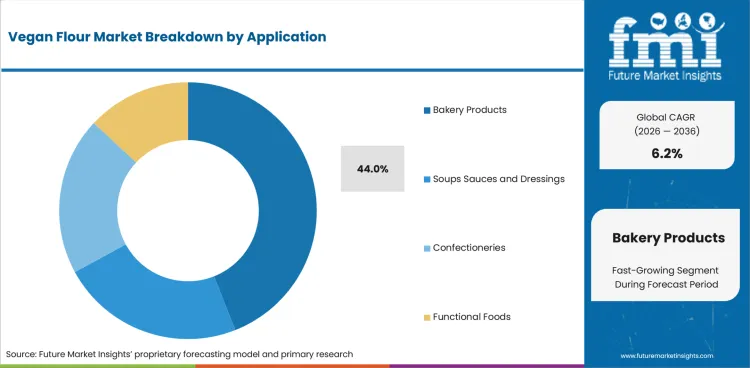
Application demand for bakery products will reach 44.0% of the total in 2026. Vegan flour can be used as a full or partial substitute for traditional wheat flour in recipes for breads, cakes, cookies, muffins and pastries. Key value propositions for vegan flour adoption in bakery are protein enrichment, gluten-free positioning and plant-based certification.
The largest volume consumers are commercial bakery operations. Artisan and retail bakeries add to the development of specialty products. Home baking demand offers a retail consumer channel with single-serve pouches and recipe-sized packaging formats making it easy for consumers to try and buy again.
Vegan Flour Market Drivers, Restraints, and Opportunities
- Plant-based food adoption is the main demand driver, with vegan flour benefiting from the broader consumer shift towards plant-based ingredients across food categories.
- The functional performance variability from wheat flour prevents adoption in applications that require specific gluten development, elasticity and rise characteristics.
- Allergen-free positioning creates cross-category demand from celiac, wheat-allergic and egg-allergic consumers seeking plant-based baking alternatives.
The vegan flour market is influenced by plant-based food trends, allergen management requirements, and bakery industry reformulation dynamics. The growth can be explained by growing consumer interest in plant-based ingredients, improving functional performance and increasing availability through mainstream retail channels.
Plant-Based Consumer Trend Alignment
Vegan flour is a part of the greater plant-based food trend that is expanding across food categories. Consumers looking for plant-based substitutes for conventional ingredients generate retail and food manufacturer demand for vegan flour products. Major grocery chains are expanding retailer shelf space allocation for plant-based baking ingredients.
Functional Performance Limitations
Gluten-free flour products lack gluten, which limits their direct substitution in bakery applications requiring elasticity, rise and structural integrity. Manufacturers are developing blended formulations and functional additives that mimic wheat flour performance, but complete functional parity remains a formulation challenge for many bakery applications.
Allergen Management and Free-From Demand
Vegan flour options that are also gluten-free, soy-free, and nut-free cater to consumers with other dietary restrictions in addition to vegan preference. This cross-category demand from celiac and food-allergic consumers expands the addressable market and supports multiple product variants within the vegan flour category.
Analysis of Vegan Flour Market By Key Countries
.webp "Top Country Growth Comparison Vegan Flour Market Cagr (2026 2036)")
| Country | CAGR |
|---|---|
| USA | 6.0% |
| UK | 6.3% |
| EU | 6.5% |
| Japan | 6.1% |
| South Korea | 6.4% |
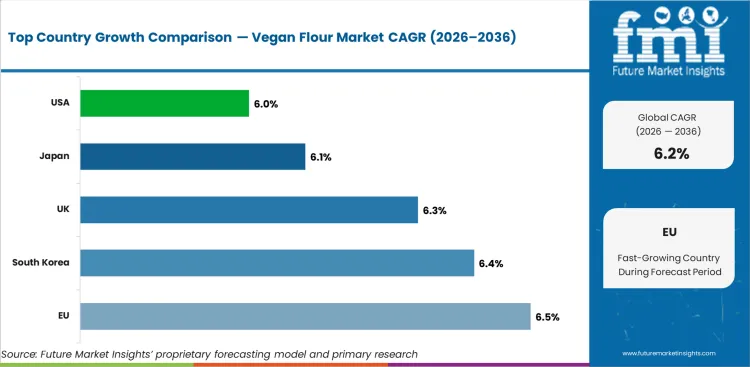
- The EU leads at 6.5% CAGR, driven by plant-based food adoption, gluten-free trends, and food manufacturer reformulation across member states.
- South Korea at 6.4% reflects health-conscious consumer demographics and government food technology investment.
- The UK at 6.3% and Japan at 6.1% generate demand through premium health food retail channels and aging population dietary preferences.
The global vegan flour market is projected to expand at a CAGR of 6.2% from 2026 to 2036. The study covers more than 30 countries, and the main markets are listed below.
Demand Outlook for Vegan Flour Market in the European Union
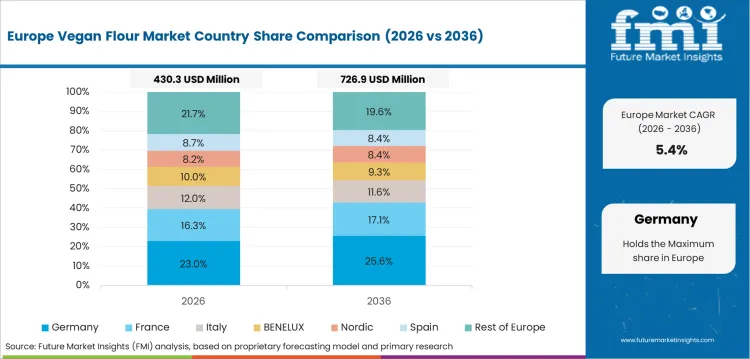
Europe is ahead at 6.5% through 2036. Germany, the Netherlands and France has the strongest demand for vegan flour in Europe driven by the adoption of plant-based food. EU organic regulations and EPR frameworks are impacting organic flour certification and packaging specifications.
- German and Dutch consumers are driving the adoption of plant-based foods in Europe, increasing retail demand for vegan flour products.
- Member states’ vegan flour products are harmonized under the standards for organic certification by the EU Organic Regulation.
- European food manufacturer reformulation creates B2B procurement for vegan flour ingredients for bakery & confectionery production.
Future Outlook for Vegan Flour Market in South Korea
South Korea grows at 6.4% through 2036. Government R&D investment in food technology and health-conscious consumer demographics create favorable conditions. K-food trends incorporating plant-based ingredients are generating both domestic and export demand for vegan flour products.
- Government food technology R&D supports development of functional vegan flour products with improved performance.
- Health-conscious consumer segments sustain premium pricing for certified organic and specialty vegan flour products.
- K-food export trends create opportunities for Korean-manufactured vegan flour in international markets.
Opportunity Analysis of Vegan Flour Market in the United States
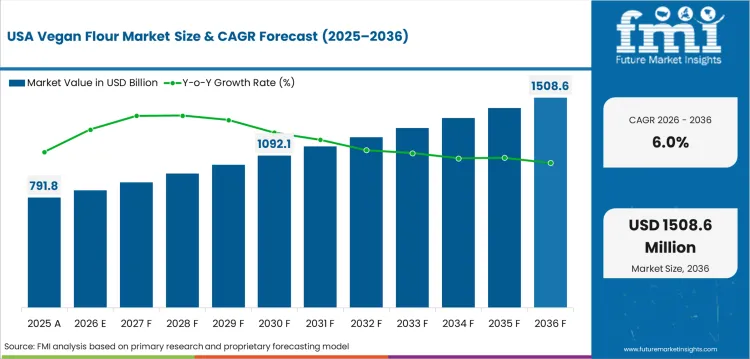
The USA grows at 6.0% to 2036. Growing demand is being driven by plant-based food category expansion and retailer shelf space allocation for free-from ingredients. Vegan flour product specification affected by FDA labeling pathways for allergen-free claims and sustainability mandates from major retailers
- Retailers increasing plant-based baking ingredient shelf space increases the availability of vegan flour at retail.
- FDA allergen labeling requirements provide product development incentives for certified allergen free vegan flour varieties.
- Retailer demands for sustainability push organic certification and sustainably sourced vegan flour into specs.
In-depth Analysis of Vegan Flour Market in Japan
Japan to expand 6.1% through 2036 The tradition of rice and soy-based food products and health-conscious consumer demographics create a culturally receptive market. The quality barriers are maintained by compliance with JIS and long qualification cycles for food ingredients, favoring the established flour producers.
- Familiarity with rice and soy-based foods culturally helps consumer acceptance of plant-based flour alternatives
- Health consciousness among the aging population boosts the demand for protein-fortified and functional vegan flour products.
- Timelines for JIS compliance and food ingredient qualification preserve quality standards to the advantage of established producers.
Sales Analysis of Vegan Flour Market in the United Kingdom
The UK will grow by 6.3% through 2036. Retailer sustainability pledges, post-Brexit food labelling rules boosting plant-based ingredient uptake. UK Plastics Tax, packaging impact and rising Veganuary participation fuel seasonal and year-round demand for vegan flour.
- Organic and sustainable vegan flour specification driven by the sustainability targets of major UK grocery chains.
- Clear regulatory pathways for marketing and claims of vegan flour product post Brexit.
- Growing Veganuary participation generates seasonal demand spikes that expose consumers to vegan baking ingredients.
Competitive Landscape and Strategic Positioning
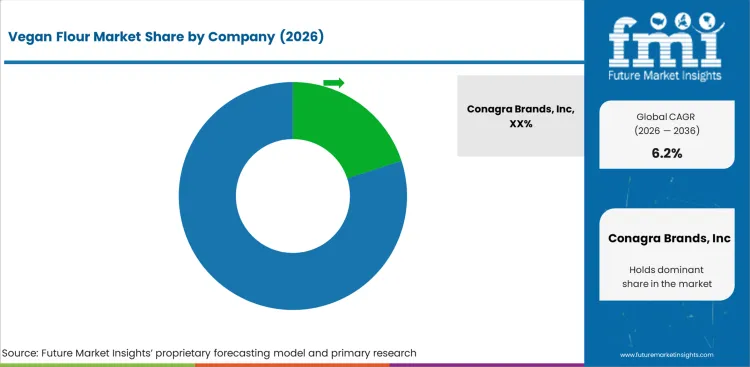
- Cargill and ADM are market leaders with extensive scale in flour milling, portfolios of plant-based ingredients and infrastructure supporting a global supply chain serving both food manufacturers and retail customers.
- Conagra Brands and Ardent Mills compete with branded and private-label flour portfolios that include vegan and specialty flour lines.
- Single source and organic vegan flour products are the primary focus for emerging specialty producers, targeting premium health food and artisanal bakery segments.
Cargill and ADM lead with integrated flour milling and plant-based ingredient capabilities serving food manufacturer customers at scale. Both companies utilize global sourcing networks and processing infrastructure to offer soy, oat and specialty vegan flour products across multiple geographies.
Conagra Brands is in the consumer-facing flour brands space with vegan and gluten-free product lines. Ardent Mills, the largest flour milling company in North America, offers specialty vegan flour blends and custom formulations to food manufacturers.
Newer specialty producers such as Bob’s Red Mill, King Arthur Baking and Pamela’s Products are targeting the premium retail and artisanal bakery segments with dedicated plant-based and allergen-free flour products with high brand awareness in the natural food channel.
Key Companies in the Vegan Flour Market
Key global companies leading the vegan flour market include:
- Leadership in flour milling scale, plant-based ingredient portfolios and global supply infrastructure from Cargill (USA), ADM (USA) and Ardent Mills (USA).
- Conagra Brands (USA) sells branded flour products, including vegan and specialty lines, to the consumer retail market.
- Bob’s Red Mill (USA), King Arthur Baking (USA) and specialty producers compete via premium positioning, organic certification and dedicated allergen-free production facilities.
Competitive Benchmarking: Vegan Flour Market
| Company | Product Range | Milling Scale | Organic Capability | Geographic Reach |
|---|---|---|---|---|
| Cargill | High | High | Strong | Global |
| ADM | High | High | Strong | Global |
| Ardent Mills | High | High | Strong | North America |
| Conagra Brands | Medium | Medium | Moderate | North America |
| Bob's Red Mill | High | Medium | Strong | North America |
| King Arthur Baking | Medium | Medium | Strong | North America |
| Pamela's Products | Medium | Low | Strong | North America |
| Doves Farm | Medium | Medium | Strong | UK, Europe |
Source: Future Market Insights competitive analysis, 2026.
Key Developments in Vegan Flour Market
- In 2025, Cargill, Incorporated introduced high-protein vegan flour blends designed for alternative baking applications, supporting growing demand for protein-enriched and plant-based food formulations.
- In 2025, Ardent Mills LLC developed fortified pea flour to enhance the nutritional profile of baked goods and functional food products, strengthening its position in the plant-based flour segment.
Key Players in the Vegan Flour Market
Major Global Players
- Conagra Brands, Inc.
- Cargill, Incorporated
- Archer Daniels Midland Company
- Ardent Mills LLC
Emerging Players/Startups
- Avena Foods
- NuCicer
- Ingredion Incorporated
- Puris
- Parabel USA
- The Mighty Flour
- Banza
Report Scope and Coverage
| Parameter | Details |
|---|---|
| Market size by 2036 | USD 3.3 Bn |
| Growth rate | 6.2% CAGR (2026 to 2036) |
| Forecast period | 2026 to 2036 |
| Base year value (2025) | USD 1.7 Bn |
| Key Segment Covered | Product, Nature, Application, Distribution Channel, Source, Packaging Type |
| Regions covered | North America, Latin America, Western Europe, Eastern Europe, East Asia, South Asia and Pacific, Middle East and Africa |
| Countries covered | USA, South Korea, UK, Japan, EU, 30 plus countries |
| Key companies profiled | Conagra Brands, Cargill, ADM, Ardent Mills, Bob's Red Mill, King Arthur Baking, Pamela's Products, Doves Farm |
| Approach | Hybrid bottom-up and top-down methodology starting with verified transaction data, projecting adoption velocity across segments and regions. |
Market Segmentation Analysis
Vegan Flour Market Segmented by Product:
- Soy Flour
- Full Fat Soy Flour
- Protein Rich Baking Applications
- Plant Based Food Products
- Defatted Soy Flour
- Functional Food Ingredients
- High Fiber Applications
- Full Fat Soy Flour
- Oat Flour
- Whole Grain Oat Flour
- Bakery Product Applications
- Breakfast Food Products
- Gluten Free Oat Flour
- Health Focused Food Applications
- Clean Label Products
- Whole Grain Oat Flour
- Quinoa and Rice Flour
- Quinoa Flour
- Protein Enriched Bakery Products
- Functional Nutrition Applications
- Rice Flour
- Gluten Free Food Products
- Confectionery Applications
- Quinoa Flour
- Nut Based Flour
- Almond Flour
- Premium Bakery Products
- Keto Food Applications
- Coconut Flour
- Low Carb Baking Products
- Dairy Free Food Applications
- Almond Flour
- Cereal Based Flour
- Millet Flour
- Traditional Grain Products
- Healthy Snack Applications
- Sorghum and Barley Flour
- High Fiber Food Products
- Functional Ingredient Applications
- Millet Flour
Vegan Flour Market Segmented by Nature:
- Organic Vegan Flour
- Certified Organic Flour
- Clean Label Products
- Premium Health Foods
- Non GMO Organic Flour
- Natural Food Ingredients
- Sustainable Farming Applications
- Certified Organic Flour
- Conventional Vegan Flour
- Commercial Grade Flour
- Mass Market Bakery Applications
- Packaged Food Production
- Standard Processed Flour
- Industrial Food Applications
- Affordable Consumer Products
- Commercial Grade Flour
Vegan Flour Market Segmented by Application:
- Bakery Products
- Bread and Cake Applications
- Gluten Free Bakery Products
- Artisan Baking Applications
- Cookies and Pastry Products
- Vegan Dessert Applications
- Ready to Bake Products
- Bread and Cake Applications
- Soups Sauces and Dressings
- Thickening Agent Applications
- Ready Meal Products
- Packaged Soup Formulations
- Sauce and Dressing Applications
- Plant Based Condiments
- Convenience Food Products
- Thickening Agent Applications
- Confectioneries
- Chocolate and Candy Applications
- Vegan Sweet Products
- Premium Confectionery Items
- Dessert Mix Applications
- Bakery Filling Products
- Ready to Eat Snacks
- Chocolate and Candy Applications
- Functional Foods
- Protein Enriched Food Products
- Sports Nutrition Applications
- Meal Replacement Products
- Health and Wellness Foods
- Digestive Health Products
- Weight Management Applications
- Protein Enriched Food Products
Vegan Flour Market Segmented by Distribution Channel:
- Direct Sales
- Food Manufacturer Supply
- Bulk Ingredient Contracts
- Industrial Bakery Supply
- Brand Direct Sales
- Private Label Partnerships
- Customized Flour Solutions
- Food Manufacturer Supply
- Indirect Sales
- Ingredient Distributors
- Regional Supply Networks
- Wholesale Food Ingredient Supply
- Retail Distribution Channels
- Supermarket Supply Chains
- Convenience Food Distribution
- Ingredient Distributors
- Online Retail
- E Commerce Platforms
- Direct Consumer Purchases
- Subscription Health Food Services
- Brand Owned Websites
- Specialty Vegan Products
- Customized Flour Orders
- E Commerce Platforms
- Store Based Retail
- Health and Organic Stores
- Premium Vegan Products
- Gluten Free Food Sections
- Supermarkets and Hypermarkets
- Mass Consumer Retail
- Packaged Flour Products
- Health and Organic Stores
Vegan Flour Market Segmented by Source:
- Legume Based Flour
- Soy and Chickpea Flour
- Protein Rich Food Products
- Plant Based Nutrition Applications
- Pea and Lentil Flour
- Functional Ingredient Applications
- Healthy Snack Products
- Soy and Chickpea Flour
- Grain Based Flour
- Oat and Rice Flour
- Bakery Applications
- Breakfast Food Products
- Ancient Grain Flour
- Quinoa Based Products
- Nutrient Rich Applications
- Oat and Rice Flour
- Nut and Seed Based Flour
- Almond and Coconut Flour
- Premium Bakery Products
- Keto Friendly Applications
- Flax and Chia Flour
- Omega Rich Food Products
- Functional Nutrition Applications
- Almond and Coconut Flour
Vegan Flour Market Segmented by Packaging Type:
- Pouches and Sachets
- Small Retail Packs
- Consumer Convenience Packaging
- Single Use Applications
- Resealable Pouches
- Freshness Retention Packaging
- Premium Retail Products
- Small Retail Packs
- Bulk Packaging
- Industrial Packaging Solutions
- Food Manufacturing Supply
- Commercial Bakery Applications
- Food Service Packaging
- Restaurant Ingredient Supply
- Large Volume Distribution
- Industrial Packaging Solutions
Vegan Flour Market by Region:
- North America
- USA
- Canada
- Mexico
- Latin America
- Brazil
- Chile
- Rest of Latin America
- Western Europe
- Germany
- UK
- Italy
- Spain
- France
- Nordic
- BENELUX
- Rest of Western Europe
- Eastern Europe
- Russia
- Poland
- Hungary
- Balkan & Baltic
- Rest of Eastern Europe
- East Asia
- China
- Japan
- South Korea
- South Asia and Pacific
- India
- ASEAN
- Australia & New Zealand
- Rest of South Asia and Pacific
- Middle East & Africa
- Kingdom of Saudi Arabia
- Other GCC Countries
- Türkiye
- South Africa
- Other African Union
- Rest of Middle East & Africa
Research Sources and Bibliography
- 1. Food and Agriculture Organization. (2025). FAO Global Plant-Based Food and Alternative Flour Market Data. FAO.
- 2. International Organization for Standardization. (2025). ISO Standards for Flour Quality Testing and Allergen Management. ISO.
- 3. Cargill, Incorporated. (2025). Annual Report: Plant-Based Ingredients Division Performance Review. Cargill.
- 4. USA Department of Agriculture. (2025). USDA Organic Certification and Plant-Based Ingredient Market Statistics. USDA.
- 5. European Commission. (2025). EU Food Allergen Labeling and Plant-Based Product Regulation Standards. EC.
This bibliography is provided for reader reference.
This Report Answers
- Estimating the size of the market and how much money it will make from 2026 to 2036.
- Dividing up by product, nature, application, distribution channel, source, and packaging type.
- Insights about more than 30 markets in the region.
- Analysis of vegan flour source technologies including soy, oat, quinoa, and nut-based formulations.
- Assessment of the competitive landscape.
- Finding investment opportunities in bakery, confectionery, and functional food vegan flour applications.
- Keeping track of the supply chain.
- Delivery of data in PDF and Excel formats.
Frequently Asked Questions
How big is the vegan flour market in 2026?
The global vegan flour market is estimated to be valued at USD 1.8 billion in 2026.
What will be the size of the vegan flour market in 2036?
The market size for the vegan flour market is projected to reach USD 3.3 billion by 2036.
How much will the vegan flour market grow between 2026 and 2036?
The vegan flour market is expected to grow at a 6.2% CAGR between 2026 and 2036.
What are the key products in the vegan flour market?
The key products in the vegan flour market are Soy Flour, Oat Flour, Quinoa and Rice Flour, Nut Based Flour and Cereal Based Flour.
Which nature segment is expected to contribute a significant share in the vegan flour market in 2026?
In terms of nature, the organic vegan flour segment is expected to command 46.0% share in the vegan flour market in 2026.
Preview the report firsthand - request a free sample
Get SampleGet the brochure for pricing and purchase details.
Get PDFTable of Content
- Key Takeaways
- Market Size and CAGR
- Top Growth Driver
- Fastest Growing Segment
- Leading Region
- Key Companies
- Emerging Opportunities
- Executive Summary
- Global Market Outlook
- Demand-side Trends
- Supply-side Trends
- Technology Roadmap Analysis
- Analysis and Recommendations
- Analyst Perspective (What is happening? Why now? What should investors know?)
- Key Questions Answered
- How large is the market?
- What is the CAGR?
- What are key trends?
- Which region dominates?
- Who are the leaders?
- Market Overview
- Market Coverage / Taxonomy
- Market Definition / Scope / Limitations
- Research Methodology
- Chapter Orientation
- Analytical Lens and Working Hypotheses
- Market Structure, Signals, and Trend Drivers
- Benchmarking and Cross-market Comparability
- Market Sizing, Forecasting, and Opportunity Mapping
- Research Design and Evidence Framework
- Desk Research Programme (Secondary Evidence)
- Expert Input and Fieldwork (Primary Evidence)
- Tooling, Models, and Reference Databases
- Data Engineering and Model Build
- Quality Assurance and Audit Trail
- Market Background
- Market Dynamics (Drivers, Restraints, Opportunity, Trends)
- Scenario Forecast (Optimistic, Likely, Conservative)
- Impact Analysis
- AI Impact
- Sustainability Impact
- Regulatory Impact
- Technology Impact
- Consumer / Buyer Analysis
- Purchase Drivers
- Adoption Barriers
- Buyer Journey
- Opportunity Map Analysis
- Product Life Cycle Analysis
- Supply Chain Analysis
- Investment Feasibility Matrix
- Value Chain Analysis
- PESTLE and Porter's Analysis
- Regulatory Landscape
- Regional Parent Market Outlook
- Production and Consumption Statistics
- Import and Export Statistics
- Global Market Analysis and Forecast, 2021 to 2036
- Historical Market Size Value (USD Million) Analysis, 2021 to 2025
- Current and Future Market Size Value (USD Million) Projections, 2026 to 2036
- Y-o-Y Growth Trend Analysis
- Absolute $ Opportunity Analysis
- Global Market Pricing Analysis, 2021 to 2036
- Global Market Analysis and Forecast, By Product, 2021 to 2036
- Introduction / Key Findings
- Historical Market Size Value (USD Million) Analysis By Product, 2021 to 2025
- Current and Future Market Size Value (USD Million) Analysis and Forecast By Product, 2026 to 2036
- Soy Flour
- Full Fat Soy Flour
- Defatted Soy Flour
- Oat Flour
- Whole Grain Oat Flour
- Gluten Free Oat Flour
- Quinoa and Rice Flour
- Quinoa Flour
- Rice Flour
- Nut Based Flour
- Almond Flour
- Coconut Flour
- Cereal Based Flour
- Millet Flour
- Sorghum and Barley Flour
- Soy Flour
- Y-o-Y Growth Trend Analysis By Product, 2021 to 2025
- Absolute $ Opportunity Analysis By Product, 2026 to 2036
- Global Market Analysis and Forecast, By Nature, 2021 to 2036
- Introduction / Key Findings
- Historical Market Size Value (USD Million) Analysis By Nature, 2021 to 2025
- Current and Future Market Size Value (USD Million) Analysis and Forecast By Nature, 2026 to 2036
- Organic Vegan Flour
- Certified Organic Flour
- Non GMO Organic Flour
- Conventional Vegan Flour
- Commercial Grade Flour
- Standard Processed Flour
- Organic Vegan Flour
- Y-o-Y Growth Trend Analysis By Nature, 2021 to 2025
- Absolute $ Opportunity Analysis By Nature, 2026 to 2036
- Global Market Analysis and Forecast, By Application, 2021 to 2036
- Introduction / Key Findings
- Historical Market Size Value (USD Million) Analysis By Application, 2021 to 2025
- Current and Future Market Size Value (USD Million) Analysis and Forecast By Application, 2026 to 2036
- Bakery Products
- Bread and Cake Applications
- Cookies and Pastry Products
- Soups Sauces and Dressings
- Thickening Agent Applications
- Sauce and Dressing Applications
- Confectioneries
- Chocolate and Candy Applications
- Dessert Mix Applications
- Functional Foods
- Protein Enriched Food Products
- Health and Wellness Foods
- Bakery Products
- Y-o-Y Growth Trend Analysis By Application, 2021 to 2025
- Absolute $ Opportunity Analysis By Application, 2026 to 2036
- Global Market Analysis and Forecast, By Distribution Channel, 2021 to 2036
- Introduction / Key Findings
- Historical Market Size Value (USD Million) Analysis By Distribution Channel, 2021 to 2025
- Current and Future Market Size Value (USD Million) Analysis and Forecast By Distribution Channel, 2026 to 2036
- Direct Sales
- Food Manufacturer Supply
- Brand Direct Sales
- Indirect Sales
- Ingredient Distributors
- Retail Distribution Channels
- Online Retail
- E Commerce Platforms
- Brand Owned Websites
- Store Based Retail
- Health and Organic Stores
- Supermarkets and Hypermarkets
- Direct Sales
- Y-o-Y Growth Trend Analysis By Distribution Channel, 2021 to 2025
- Absolute $ Opportunity Analysis By Distribution Channel, 2026 to 2036
- Global Market Analysis and Forecast, By Source, 2021 to 2036
- Introduction / Key Findings
- Historical Market Size Value (USD Million) Analysis By Source, 2021 to 2025
- Current and Future Market Size Value (USD Million) Analysis and Forecast By Source, 2026 to 2036
- Legume Based Flour
- Soy and Chickpea Flour
- Pea and Lentil Flour
- Grain Based Flour
- Oat and Rice Flour
- Ancient Grain Flour
- Nut and Seed Based Flour
- Almond and Coconut Flour
- Flax and Chia Flour
- Legume Based Flour
- Y-o-Y Growth Trend Analysis By Source, 2021 to 2025
- Absolute $ Opportunity Analysis By Source, 2026 to 2036
- Global Market Analysis and Forecast, By Packaging Type
- Introduction / Key Findings
- Historical Market Size Value (USD Million) Analysis By Packaging Type, 2021 to 2025
- Current and Future Market Size Value (USD Million) Analysis and Forecast By Packaging Type, 2026 to 2036
- Pouches and Sachets
- Small Retail Packs
- Resealable Pouches
- Bulk Packaging
- Industrial Packaging Solutions
- Food Service Packaging
- Pouches and Sachets
- Y-o-Y Growth Trend Analysis By Packaging Type, 2021 to 2025
- Absolute $ Opportunity Analysis By Packaging Type, 2026 to 2036
- Global Market Analysis and Forecast, By Region, 2021 to 2036
- Introduction
- Historical Market Size Value (USD Million) Analysis By Region, 2021 to 2025
- Current Market Size Value (USD Million) Analysis and Forecast By Region, 2026 to 2036
- North America
- Latin America
- Western Europe
- Eastern Europe
- East Asia
- South Asia and Pacific
- Middle East & Africa
- Market Attractiveness Analysis By Region
- North America Market Analysis and Forecast, By Country, 2021 to 2036
- Historical Market Size Value (USD Million) Trend Analysis By Market Taxonomy, 2021 to 2025
- Market Size Value (USD Million) Forecast By Market Taxonomy, 2026 to 2036
- By Country
- USA
- Canada
- Mexico
- By Product
- By Nature
- By Application
- By Distribution Channel
- By Source
- By Packaging Type
- By Country
- Market Attractiveness Analysis
- By Country
- By Product
- By Nature
- By Application
- By Distribution Channel
- By Source
- By Packaging Type
- Key Takeaways
- Latin America Market Analysis and Forecast, By Country
- Historical Market Size Value (USD Million) Trend Analysis By Market Taxonomy, 2021 to 2025
- Market Size Value (USD Million) Forecast By Market Taxonomy, 2026 to 2036
- By Country
- Brazil
- Chile
- Rest of Latin America
- By Product
- By Nature
- By Application
- By Distribution Channel
- By Source
- By Packaging Type
- By Country
- Market Attractiveness Analysis
- By Country
- By Product
- By Nature
- By Application
- By Distribution Channel
- By Source
- By Packaging Type
- Key Takeaways
- Western Europe Market Analysis and Forecast, By Country
- Historical Market Size Value (USD Million) Trend Analysis By Market Taxonomy, 2021 to 2025
- Market Size Value (USD Million) Forecast By Market Taxonomy, 2026 to 2036
- By Country
- Germany
- UK
- Italy
- Spain
- France
- Nordic
- BENELUX
- Rest of Western Europe
- By Product
- By Nature
- By Application
- By Distribution Channel
- By Source
- By Packaging Type
- By Country
- Market Attractiveness Analysis
- By Country
- By Product
- By Nature
- By Application
- By Distribution Channel
- By Source
- By Packaging Type
- Key Takeaways
- Eastern Europe Market Analysis and Forecast, By Country
- Historical Market Size Value (USD Million) Trend Analysis By Market Taxonomy, 2021 to 2025
- Market Size Value (USD Million) Forecast By Market Taxonomy, 2026 to 2036
- By Country
- Russia
- Poland
- Hungary
- Balkan & Baltic
- Rest of Eastern Europe
- By Product
- By Nature
- By Application
- By Distribution Channel
- By Source
- By Packaging Type
- By Country
- Market Attractiveness Analysis
- By Country
- By Product
- By Nature
- By Application
- By Distribution Channel
- By Source
- By Packaging Type
- Key Takeaways
- East Asia Market Analysis and Forecast, By Country
- Historical Market Size Value (USD Million) Trend Analysis By Market Taxonomy, 2021 to 2025
- Market Size Value (USD Million) Forecast By Market Taxonomy, 2026 to 2036
- By Country
- China
- Japan
- South Korea
- By Product
- By Nature
- By Application
- By Distribution Channel
- By Source
- By Packaging Type
- By Country
- Market Attractiveness Analysis
- By Country
- By Product
- By Nature
- By Application
- By Distribution Channel
- By Source
- By Packaging Type
- Key Takeaways
- South Asia and Pacific Market Analysis and Forecast, By Country
- Historical Market Size Value (USD Million) Trend Analysis By Market Taxonomy, 2021 to 2025
- Market Size Value (USD Million) Forecast By Market Taxonomy, 2026 to 2036
- By Country
- India
- ASEAN
- Australia & New Zealand
- Rest of South Asia and Pacific
- By Product
- By Nature
- By Application
- By Distribution Channel
- By Source
- By Packaging Type
- By Country
- Market Attractiveness Analysis
- By Country
- By Product
- By Nature
- By Application
- By Distribution Channel
- By Source
- By Packaging Type
- Key Takeaways
- Middle East & Africa Market Analysis and Forecast, By Country
- Historical Market Size Value (USD Million) Trend Analysis By Market Taxonomy, 2021 to 2025
- Market Size Value (USD Million) Forecast By Market Taxonomy, 2026 to 2036
- By Country
- Kingdom of Saudi Arabia
- Other GCC Countries
- Türkiye
- South Africa
- Other African Union
- Rest of Middle East & Africa
- By Product
- By Nature
- By Application
- By Distribution Channel
- By Source
- By Packaging Type
- By Country
- Market Attractiveness Analysis
- By Country
- By Product
- By Nature
- By Application
- By Distribution Channel
- By Source
- By Packaging Type
- Key Takeaways
- Key Countries Market Analysis
- USA
- Pricing Analysis
- Market Share Analysis, 2025
- By Product
- By Nature
- By Application
- By Distribution Channel
- By Source
- By Packaging Type
- Canada
- Pricing Analysis
- Market Share Analysis, 2025
- By Product
- By Nature
- By Application
- By Distribution Channel
- By Source
- By Packaging Type
- Mexico
- Pricing Analysis
- Market Share Analysis, 2025
- By Product
- By Nature
- By Application
- By Distribution Channel
- By Source
- By Packaging Type
- Brazil
- Pricing Analysis
- Market Share Analysis, 2025
- By Product
- By Nature
- By Application
- By Distribution Channel
- By Source
- By Packaging Type
- Chile
- Pricing Analysis
- Market Share Analysis, 2025
- By Product
- By Nature
- By Application
- By Distribution Channel
- By Source
- By Packaging Type
- Germany
- Pricing Analysis
- Market Share Analysis, 2025
- By Product
- By Nature
- By Application
- By Distribution Channel
- By Source
- By Packaging Type
- UK
- Pricing Analysis
- Market Share Analysis, 2025
- By Product
- By Nature
- By Application
- By Distribution Channel
- By Source
- By Packaging Type
- Italy
- Pricing Analysis
- Market Share Analysis, 2025
- By Product
- By Nature
- By Application
- By Distribution Channel
- By Source
- By Packaging Type
- Spain
- Pricing Analysis
- Market Share Analysis, 2025
- By Product
- By Nature
- By Application
- By Distribution Channel
- By Source
- By Packaging Type
- France
- Pricing Analysis
- Market Share Analysis, 2025
- By Product
- By Nature
- By Application
- By Distribution Channel
- By Source
- By Packaging Type
- India
- Pricing Analysis
- Market Share Analysis, 2025
- By Product
- By Nature
- By Application
- By Distribution Channel
- By Source
- By Packaging Type
- ASEAN
- Pricing Analysis
- Market Share Analysis, 2025
- By Product
- By Nature
- By Application
- By Distribution Channel
- By Source
- By Packaging Type
- Australia & New Zealand
- Pricing Analysis
- Market Share Analysis, 2025
- By Product
- By Nature
- By Application
- By Distribution Channel
- By Source
- By Packaging Type
- China
- Pricing Analysis
- Market Share Analysis, 2025
- By Product
- By Nature
- By Application
- By Distribution Channel
- By Source
- By Packaging Type
- Japan
- Pricing Analysis
- Market Share Analysis, 2025
- By Product
- By Nature
- By Application
- By Distribution Channel
- By Source
- By Packaging Type
- South Korea
- Pricing Analysis
- Market Share Analysis, 2025
- By Product
- By Nature
- By Application
- By Distribution Channel
- By Source
- By Packaging Type
- Russia
- Pricing Analysis
- Market Share Analysis, 2025
- By Product
- By Nature
- By Application
- By Distribution Channel
- By Source
- By Packaging Type
- Poland
- Pricing Analysis
- Market Share Analysis, 2025
- By Product
- By Nature
- By Application
- By Distribution Channel
- By Source
- By Packaging Type
- Hungary
- Pricing Analysis
- Market Share Analysis, 2025
- By Product
- By Nature
- By Application
- By Distribution Channel
- By Source
- By Packaging Type
- Kingdom of Saudi Arabia
- Pricing Analysis
- Market Share Analysis, 2025
- By Product
- By Nature
- By Application
- By Distribution Channel
- By Source
- By Packaging Type
- Türkiye
- Pricing Analysis
- Market Share Analysis, 2025
- By Product
- By Nature
- By Application
- By Distribution Channel
- By Source
- By Packaging Type
- South Africa
- Pricing Analysis
- Market Share Analysis, 2025
- By Product
- By Nature
- By Application
- By Distribution Channel
- By Source
- By Packaging Type
- USA
- Market Structure Analysis
- Competition Dashboard
- Competition Benchmarking
- Market Share Analysis of Top Players
- By Regional
- By Product
- By Nature
- By Application
- By Distribution Channel
- By Source
- By Packaging Type
- Emerging Startups
- Innovation Benchmarking
- Competition Analysis
- Competition Deep Dive
- Conagra Brands, Inc
- Overview
- Product Portfolio
- Profitability by Market Segments (Product/Region/Sales Channel)
- Sales Footprint
- Strategy Overview
- Marketing Strategy
- Product Strategy
- Channel Strategy
- Cargill, Incorporated
- Archer Daniels Midland Company
- Ardent Mills LLC
- Other Companies (combined)
- Conagra Brands, Inc
- Case Studies
- Success Stories
- Recent Developments
- Competition Deep Dive
- Assumptions & Acronyms Used


