

- Market Size (2026)
- USD 5.2 Bn
- Forecast (2036)
- USD 9.8 Bn
- CAGR (2026 to 2036)
- 6.5%
Cassava Flour Market Size, Market Forecast and Outlook By FMI
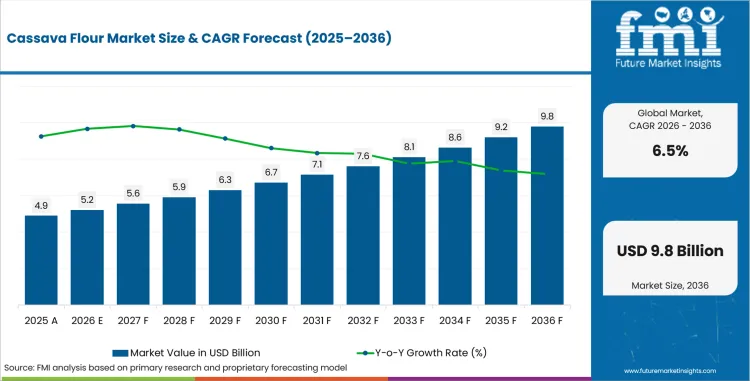
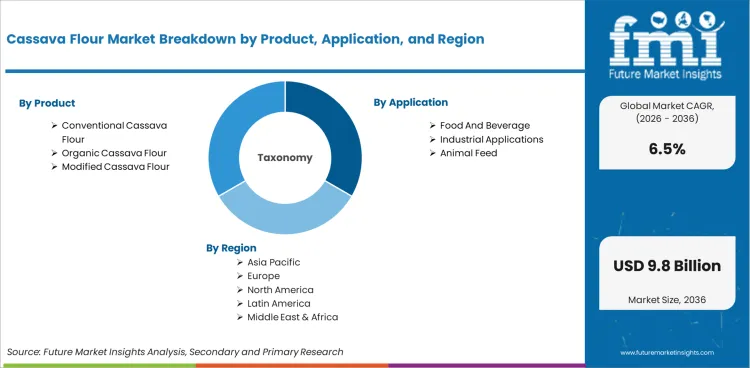
The cassava flour market was valued at USD 4.9 billion in 2025. The market is set to reach USD 5.2 billion by 2026-end and grow at a CAGR of 6.5% between 2026-2036 to reach USD 9.8 billion by 2036. Conventional Cassava Flour will dominate with a 60.0% share, while Food And Beverage will lead with a 70.0% share.
Key Takeaways, Market Size, and Forecast
- The cassava flour market was valued at USD 4.9 billion in 2025.
- By 2036, the Cassava Flour Market is expected to be worth USD 9.8 billion.
- From 2026 to 2036, the market is projected to expand at a CAGR of 6.5%.
- The market is projected to create an incremental opportunity of USD 4.58 billion between 2026 and 2036.
- In 2026, conventional cassava flour is expected to account for 60% of the product segment, driven by demand for standard-grade cassava flour used as a wheat alternative in bakery, confectionery, and processed food manufacturing across tropical and developing market economies.
- China (8.78%) and India (8.12%) are two of the fastest growing markets in the world.
Summary of the Cassava Flour Market
- Demand and Growth Drivers
- Gluten-free dietary demand is the primary premiumization driver in developed markets, with cassava flour positioned as a grain-free, allergen-friendly baking alternative that replicates wheat flour texture and functionality better than most gluten-free substitutes.
- African and Southeast Asian food security programs promote cassava flour as a locally produced wheat alternative, reducing import dependency and creating domestic value chains from farm-level root production to commercial flour manufacturing.
- Bakery and confectionery manufacturers in tropical regions adopt cassava flour as a cost-competitive wheat substitute when global wheat prices rise, creating counter-cyclical demand dynamics tied to grain commodity pricing.
- Product and Segment View
- Conventional Cassava Flour is likely to remain the leading product segment at 60% share, supported by established demand and procurement patterns.
- Based on buyer preference and consumption trends, Food And Beverage is expected to constitute 70% of the application segment.
- Food Manufacturers is likely to lead the end use segment with 65% share during the forecast period.
- Geography and Competitive Outlook
- China is likely to remain a key market at 8.78% CAGR, supported by strong demand fundamentals and expanding adoption.
- India is likely to sustain growth at 8.12% CAGR owing to rising investment and expanding infrastructure.
- Companies with integrated capabilities and multi-channel distribution are likely to gain traction during the forecast period.
- Analyst Opinion
- The cassava flour market is evolving with clear segment leaders, established supply chains, and distribution patterns shaping competitive dynamics.
- Adoption is increasing due to rising demand fundamentals, expanding infrastructure investment, and growing awareness of product benefits across end-user segments.
- Demand is further supported by product format diversification and geographic expansion into developing markets with consumption growth or infrastructure potential.
- Companies that can provide consistent quality while optimizing cost across key segments are likely to strengthen their position over the forecast period.
Cassava Flour Market Definition
The cassava flour market encompasses commercially traded flour products derived from cassava (manihot esculenta) root processing. Product categories include conventional cassava flour and organic cassava flour in standard and modified formats used across food and beverage, animal feed, and industrial applications.
Cassava Flour Market Inclusions
Market scope covers all commercially traded cassava flour products categorized by product (conventional cassava flour, organic cassava flour), application (food and beverage, animal feed, industrial), end use (food manufacturers, retail consumers, industrial users), distribution channel (offline retail, online retail), formulation (standard flour, modified flour, fortified flour), processing technology (dry processing, wet processing), and pricing tier (mid range, economy, premium). The revenue range spans from 2026 to 2036.
Cassava Flour Market Exclusions
The scope does not include fresh cassava root sold for direct consumption, cassava starch sold as a separate industrial product, or tapioca pearls and boba products marketed under distinct categories.
Cassava Flour Market Research Methodology
- Primary Research: FMI analysts engaged with cassava processors, flour manufacturers, bakery ingredient buyers, and agricultural development organizations across key markets.
- Desk Research: Combined data from agricultural commodity associations, cassava industry reports, and flour trade databases.
- Market sizing and forecasting: Bottom-up aggregation across application categories and end-user segments, with regional production curves adjusted for cassava root production volumes and processing capacity.
- Data validation: Cross-checked quarterly against FAO cassava production data and flour trade statistics.
Why is the Cassava Flour Market Growing?
- Developed markets - Gluten-free foods are the main driver of premiumization, with cassava flour positioned as a grain-free product.
- Food security programs in Africa and Southeast Asia are promoting cassava flour as an alternative to wheat that can be produced locally, thus reducing dependence on imports and creating domestic value chains from the production of roots at the farm level to the commercial manufacture of flour.
- When the global price of wheat rises, bakery and confectionery manufacturers in the tropical regions turn to cassava flour as a cost-competitive substitute for wheat. Thus, cassava flour demand is counter-cyclical to the price of grain commodities.
The global cassava flour market is forecast to grow at 6.5% CAGR on the back of the twin growth dynamics of growing demand for gluten-free diets in developed markets and wheat replacement in tropical economies. The product segment for conventional cassava flour accounts for 60.0% for both staple food and industrial uses. The food and beverage applications constitute 70.0% of demand with bakery, confectionery and traditional food preparation being the main consumption categories.
Food manufacturers drive 65.0% of end-user demand, using cassava flour in bread, pastries, snacks and processed food products. The primary distribution channel is offline retail, which represents 65.0% of distribution and provides consumer access through local markets and supermarkets. Capital cost and easier production systems suitable for small and medium scale processors in tropical production areas are driving the dry processing technology at 70.0%.
Market Segmentation Analysis
- Traditional cassava flour makes up 60% of the product segment, indicating consistent demand.
- In the end use segment, Food Manufacturers is the leader with 65% market share.
The cassava flour market is segmented based on product, application, end use, distribution channel, formulation, processing technology, pricing tier.
Insights into the Conventional Cassava Flour Product Segment
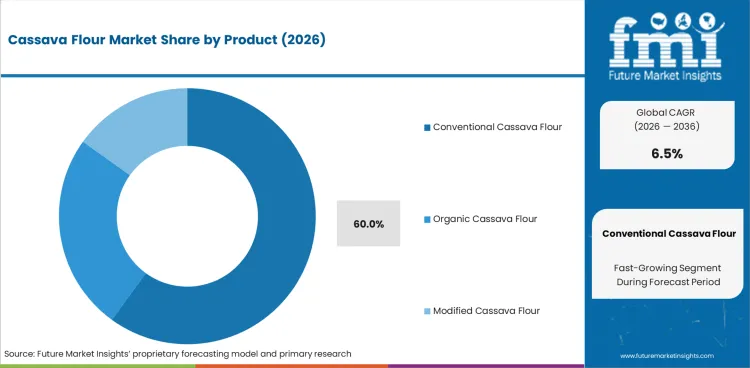
The conventional cassava flour segment is expected to hold the largest revenue share of 60.0% in the product segment in 2026. Standard grade flour for bakery, confectionery and staple food use from dry processing for tropical markets. Modified cassava flour has better functional properties for industrial food production. Organic cassava flour is priced at a premium in developed market retail channels where the gluten-free and clean-label positioning supports the premium.
Insights into the Food And Beverage Application Segment
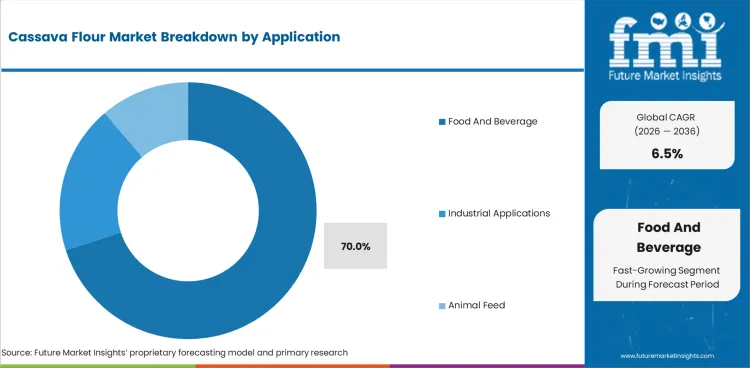
The application segment is food and beverage and it holds 70.0% of the market. The major application is in bakery products such as bread, pastries and flatbreads. In tropical markets cassava flour is used as a major ingredient while in developed markets it is used as a gluten free alternative. Confectionery and snack manufacturing and traditional food preparations (fufu, garri, farinha) complete the application base. Other applications are industrial starch and animal feed.
Cassava Flour Market Drivers, Restraints, and Opportunities
- Gluten-Free Diet demand is creating structured demand across key segments.
- Variability in root supply and is hampering growth in parts of the business.
The cassava flour market is shaped by a combination of demand-side drivers and supply-side constraints that differ across regions, applications and price points.
Gluten-Free Dietary Demand in Developed Markets
Demand is driven by the uptake of gluten-free diets in North America, Europe and Australia, and cassava flour is carving out its niche as a grain-free alternative with better baking properties than rice or almond flour. Buying trends are also fueled by an awareness of celiac disease and gluten sensitivity.
Food Security and Wheat Import Substitution
Government food security programmes in Africa and Southeast Asia that encourage the use of cassava flour as a locally produced substitute for wheat are driving the growth. Import substitution policies reduce foreign currency spending on wheat and build domestic agricultural value chains.
Root Supply Variability and Processing Infrastructure Gaps
Variability in cassava root supply because of seasonal availability, disease pressure and limited processing infrastructure in tropical production regions constrains consistent quality adoption. Food manufacturing is hindered by inconsistent quality among small-scale processors.
Wheat Price Volatility and Counter-Cyclical Demand
Growth is supported by volatility in wheat commodity prices which makes cassava flour cost competitive in periods of high wheat pricing. Tropical market bakery manufacturers partially switch to cassava flour blends when the cost of wheat imports rises, resulting in counter-cyclical demand dynamics.
Analysis of Cassava Flour Market By Key Countries
.webp "Top Country Growth Comparison Cassava Flour Market Cagr (2026 2036)")
| Country | CAGR |
|---|---|
| China | 8.78% |
| India | 8.12% |
| Germany | 7.48% |
| Brazil | 6.83% |
| USA | 6.18% |
| UK | 5.53% |
| Japan | 4.88% |
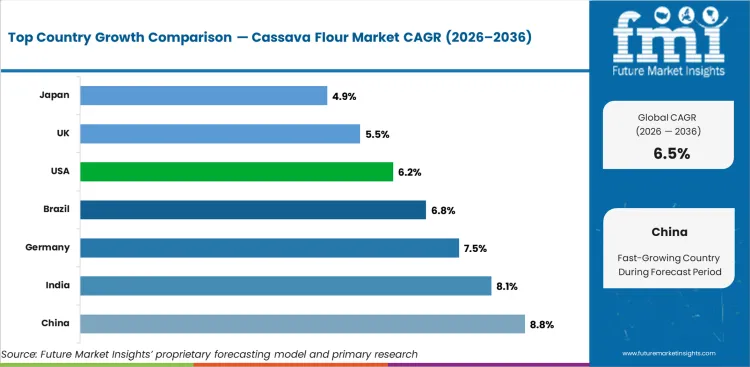
- China leads at 8.78% CAGR, supported by the largest demand base and expanding adoption.
- India at 8.12% shows strong demand supported by rising investment and infrastructure expansion.
- Germany (7.48%) and Brazil (6.83%) sustain growth through expanding market development.
The global cassava flour market is projected to expand at 6.5% per year from 2026 to 2036. The study covers more than 30 countries.
Sales Analysis of Cassava Flour Market in China
China is leading at 8.78% to 2036. China is a major importer of cassava root and starch from South East Asia for industrial and food processing uses. Urban consumers are increasingly interested in gluten-free products, which is driving premium retail demand for cassava flour.
- Cassava import from Southeast Asia is being supported by industrial and food processing applications.
- Urban consumers are interested in gluten-free products and retail demand is increasing.
- Cassava flour is increasingly being used as a functional ingredient in food manufacturing.
Demand Outlook for Cassava Flour Market in India
India is growing at 8.12% through 2036. Kerala, Tamil Nadu and Andhra Pradesh are domestic producers of cassava meeting the local demand. Market development is supported by government food security programs and the increasing interest of health conscious consumers to alternative flours.
- Local cassava root for flour production is supplied by domestic growing in southern states.
- The government programs on food security and nutrition promote the use of alternative flours.
- Increasing preference of health-conscious urban consumers for gluten-free and alternative flour products.
Future Outlook for Cassava Flour Market in the United States
“The USA is growing at 5.5 per cent to 2036. Demand for gluten-free diets drives retail sales of premium cassava flour. Cassava flour is a staple baking substitute thanks to the paleo and grain-free diet trends. Green Hills Natural Foods and speciality brands are for the premium retail segment.
- Cassava flour is a great baking option for those on gluten-free or paleo diets.
- Specialty brands are going after the premium retail segment through health food stores and online.
- Food Manufacturer Adoption for Gluten Free Product Formulation Demand for B2B Ingredients.
In-depth Analysis of Cassava Flour Market in Germany
Germany is expanding at 5.2% through 2036. EU gluten-free labeling regulations and consumer demand for alternative flours support market development. German consumers prioritize certified organic and sustainably sourced flour products.
- EU gluten-free labeling provides a regulatory framework supporting cassava flour product positioning.
- Consumer demand for alternative and organic flours supports premium product adoption.
- Bakery manufacturers incorporate cassava flour into gluten-free product formulations.
In-depth Analysis of Cassava Flour Market in Japan
Japan is growing at 4.8% through 2036. Growing interest in gluten-free and grain-free food products among health-conscious Japanese consumers supports cassava flour adoption. Tapioca heritage provides consumer familiarity with cassava-derived ingredients.
- Gluten-free and grain-free dietary interest supports cassava flour product adoption.
- Tapioca heritage provides consumer familiarity with cassava-derived food ingredients.
- Food manufacturing quality standards shape cassava flour procurement specifications.
Competitive Landscape and Strategic Positioning
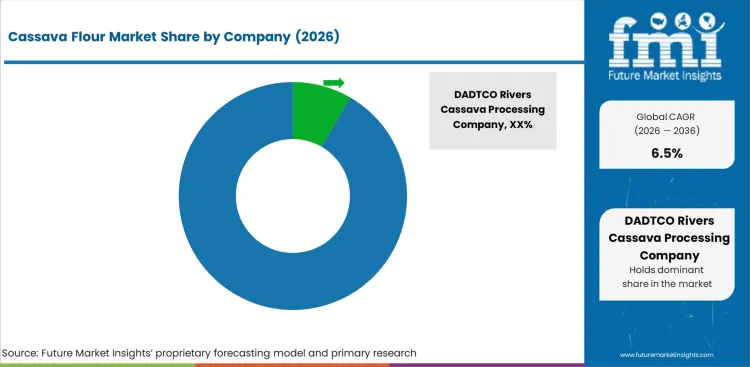
- DADTCO Rivers Cassava Processing Company is a leader in African markets due to its mobile processing technology for producing cassava flour closer to farm-level root supply, reducing transportation losses and improving the freshness of raw material.
- Psaltry International and MHOGO Foods compete with well established African cassava processing operations that supply high quality cassava flour products to both domestic food manufacturing and export markets.
- Southeast Asian processors such as PT Agromoda Solution Indonesia and Tapioca Vietnam sell cassava flour and starch products at competitive prices.
The competition is led by companies with integrated capabilities, well-established procurement relationships and with applications across multiple segments.
Key Companies in the Cassava Flour Market
Key global companies leading the cassava flour market include:
- DADTCO Rivers Cassava Processing Company (Nigeria), Psaltry International (Nigeria), and MHOGO Foods (Tanzania) lead through African production proximity, processing technology, and established supply relationships with local food manufacturers and export buyers.
- Green Hills Natural Foods (USA), Mocaf Factory (Indonesia), and PT Agromoda Solution Indonesia (Indonesia) serve through processing specialization, organic certification capability, and export distribution to developed market retail channels.
- Tapioca Vietnam (Vietnam), Tasuko (Japan), Tropical Food Industries (Nigeria), and Vaighai Agro (India) compete through regional processing, cost-competitive production, and diverse cassava product portfolios.
Competitive Benchmarking: Cassava Flour Market
| Company | Processing Scale | Quality Control | Export Capability | Organic Certification |
|---|---|---|---|---|
| DADTCO Rivers | High | Medium | Moderate | Low |
| Green Hills Natural | Medium | High | Strong | High |
| MHOGO Foods | Medium | Medium | Moderate | Medium |
| Mocaf Factory | Medium | Medium | Moderate | Medium |
| Psaltry International | High | Medium | Moderate | Low |
| PT Agromoda | High | Medium | Strong | Low |
| Tapioca Vietnam | High | Medium | Strong | Low |
| Tasuko | Medium | High | Moderate | Medium |
| Tropical Food Industries | Medium | Medium | Moderate | Low |
| Vaighai Agro | Medium | Medium | Moderate | Medium |
Source: Future Market Insights competitive analysis, 2026.
Key Developments in Cassava Flour Market
- In 2025, DADTCO Rivers Cassava Processing Company continued its mobile cassava processing operations in Nigeria, supporting rural farmers with high-quality cassava flour production and strengthening supply chains for commercial markets.
- In 2025, Green Hills Natural Foods maintained and promoted its established certified organic cassava flour product line, targeting health-conscious consumers through retail channels and online platforms in key markets including the United States.
Key Players in the Cassava Flour Market
Major Global Players
- DADTCO Rivers Cassava Processing Company
- Green Hills Natural Foods
- MHOGO Foods
- Mocaf Factory
- Psaltry International
Emerging Players/Startups
- PT Agromoda Solution Indonesia
- Tapioca Vietnam
- Tasuko
- Tropical Food Industries
- Vaighai Agro
Report Scope and Coverage
| Parameter | Details |
|---|---|
| Quantitative Units | USD 5.22 billion to USD 9.8 billion, at a CAGR of 6.5% |
| Market Definition | The cassava flour market encompasses commercially traded flour products derived from cassava (manihot esculenta) root processing. Product categories include conventional cassava flour and organic cassava flour in standard and modified formats used across food and beverage, animal feed, and industrial applications. |
| Regions Covered | North America, Latin America, Europe, East Asia, South Asia and Pacific, Middle East and Africa |
| Countries Covered | China, India, Germany, Brazil, USA, UK, Japan, 30 plus countries |
| Key Companies Profiled | DADTCO Rivers Cassava Processing Company, Green Hills Natural Foods, MHOGO Foods, Mocaf Factory, Psaltry International, PT Agromoda Solution Indonesia, Tapioca Vietnam, Tasuko |
| Forecast Period | 2026 to 2036 |
| Approach | Hybrid bottom-up and top-down methodology starting with verified transaction data, projecting adoption velocity across segments and regions. |
Market Segmentation Analysis
Cassava Flour Market Segmented by Product:
- Conventional Cassava Flour
- Standard Cassava Flour
- Food Grade Flour
- Industrial Grade Flour
- Refined Cassava Flour
- Fine Texture Flour
- Bleached Flour
- Standard Cassava Flour
- Organic Cassava Flour
- Certified Organic Flour
- Unprocessed Organic
- Clean Label Flour
- Whole Root Flour
- Minimally Processed
- Nutrient Rich Flour
- Certified Organic Flour
- Modified Cassava Flour
- Fermented Flour
- Traditional Fermentation
- Controlled Fermentation
- Functional Flour
- Resistant Starch Flour
- Gluten Free Blends
- Fermented Flour
Cassava Flour Market Segmented by Application:
- Food And Beverage
- Bakery Products
- Bread And Cakes
- Biscuits And Cookies
- Snacks And Convenience Foods
- Chips And Crackers
- Extruded Snacks
- Thickening Agent
- Soups And Sauces
- Gravies
- Bakery Products
- Industrial Applications
- Adhesives
- Paper Industry
- Packaging Industry
- Textile Industry
- Fabric Processing
- Starch Applications
- Adhesives
- Animal Feed
- Livestock Feed
- Cattle Feed
- Poultry Feed
- Aquaculture Feed
- Fish Feed
- Shrimp Feed
- Livestock Feed
Cassava Flour Market Segmented by End Use:
- Food Manufacturers
- Bakery Manufacturers
- Industrial Bakeries
- Artisan Bakeries
- Snack Manufacturers
- Packaged Snack Producers
- Extruded Snack Producers
- Bakery Manufacturers
- Household Consumers
- Urban Consumers
- Health Conscious Buyers
- Gluten Free Diet Users
- Rural Consumers
- Traditional Usage
- Bulk Consumption
- Urban Consumers
- Industrial Users
- Paper Manufacturers
- Packaging Paper Producers
- Specialty Paper Producers
- Textile Manufacturers
- Fabric Processors
- Industrial Textile Users
- Paper Manufacturers
Cassava Flour Market Segmented by Distribution Channel:
- Offline Retail
- Supermarkets And Hypermarkets
- Large Format Stores
- Discount Stores
- Traditional Grocery Stores
- Local Retailers
- Wholesale Markets
- Specialty Stores
- Health Food Stores
- Organic Stores
- Supermarkets And Hypermarkets
- Online Retail
- E Commerce Platforms
- Marketplace Platforms
- Brand Owned Websites
- Direct To Consumer
- Subscription Models
- Bulk Purchase Options
- E Commerce Platforms
Cassava Flour Market Segmented by Formulation:
- Standard Flour
- Unblended Flour
- Pure Cassava Flour
- Single Ingredient Flour
- Unblended Flour
- Blended Flour
- Cassava Wheat Blends
- Partial Substitution Blends
- Baking Blends
- Cassava Gluten Free Blends
- Multi Grain Blends
- Functional Flour Mixes
- Cassava Wheat Blends
Cassava Flour Market Segmented by Processing Technology:
- Dry Processing
- Sun Drying
- Traditional Drying
- Low Cost Processing
- Mechanical Drying
- Controlled Drying
- Industrial Scale Drying
- Sun Drying
- Wet Processing
- Soaking And Fermentation
- Traditional Methods
- Controlled Fermentation
- Starch Extraction
- Industrial Extraction
- High Purity Processing
- Soaking And Fermentation
Cassava Flour Market Segmented by Pricing Tier:
- Mid Range
- Standard Commercial Products
- Packaged Cassava Flour
- Standard Commercial Products
- Economy
- Bulk Commodity Products
- Loose Flour Supply
- Wholesale Supply
- Bulk Commodity Products
- Premium
- Organic And Specialty Products
- Certified Organic Flour
- High Quality Processing
- Organic And Specialty Products
Cassava Flour Market by Region:
- North America
- USA
- Canada
- Mexico
- Latin America
- Brazil
- Chile
- Rest of Latin America
- Western Europe
- Germany
- UK
- Italy
- Spain
- France
- Nordic
- BENELUX
- Rest of Western Europe
- Eastern Europe
- Russia
- Poland
- Hungary
- Balkan & Baltic
- Rest of Eastern Europe
- East Asia
- China
- Japan
- South Korea
- South Asia and Pacific
- India
- ASEAN
- Australia & New Zealand
- Rest of South Asia and Pacific
- Middle East & Africa
- Kingdom of Saudi Arabia
- Other GCC Countries
- Turkiye
- South Africa
- Other African Union
- Rest of Middle East & Africa
Research Sources and Bibliography
- 1. Food and Agriculture Organization. (2025). FAO Global Cassava Production and Utilization Report. FAO.
- 2. International Institute of Tropical Agriculture. (2025). IITA Cassava Value Chain Development Report. IITA.
- 3. European Commission. (2024). EU Gluten-Free Food Labeling Regulation. EC.
- 4. USA Department of Agriculture. (2025). USDA Import Data: Cassava Products. USDA.
- 5. World Bank. (2024). Cassava Value Chains and Food Security in Sub-Saharan Africa. World Bank.
This bibliography is provided for reader reference.
This Report Answers
- Estimating the market size and revenue generation from 2026 to 2036.
- Segmenting by product, application, end use, distribution channel, formulation, processing technology, and pricing tier.
- Providing regional insights across more than 30 markets.
- Analyzing gluten-free demand and wheat substitution dynamics.
- Assessing the competitive landscape across tropical and developed market segments.
- Identifying investment opportunities in processing technology and organic certification.
- Tracking food security policy and global wheat price impact trends.
- Delivering data in PDF and Excel formats.
Frequently Asked Questions
How big is the cassava flour market in 2026?
The global cassava flour market is estimated to be valued at USD 5.22 billion in 2026.
What will be the size of cassava flour market in 2036?
The market size for the cassava flour market is projected to reach USD 9.80 billion by 2036.
How much will be the cassava flour market growth between 2026 and 2036?
The cassava flour market is expected to grow at a 6.5% CAGR between 2026 and 2036.
What are the key product types in the cassava flour market?
The key product types in cassava flour market are conventional cassava flour, organic cassava flour and modified cassava flour.
Which application segment is expected to contribute significant share in the cassava flour market in 2026?
In terms of application, food and beverage segment is expected to command 70.0% share in the cassava flour market in 2026.
Preview the report firsthand - request a free sample
Get SampleGet the brochure for pricing and purchase details.
Get PDFTable of Content
- Executive Summary
- Global Market Outlook
- Demand-side Trends
- Supply-side Trends
- Technology Roadmap Analysis
- Analysis and Recommendations
- Market Overview
- Market Coverage / Taxonomy
- Market Definition / Scope / Limitations
- Research Methodology
- Chapter Orientation
- Analytical Lens and Working Hypotheses
- Market Structure, Signals, and Trend Drivers
- Benchmarking and Cross-market Comparability
- Market Sizing, Forecasting, and Opportunity Mapping
- Research Design and Evidence Framework
- Desk Research Programme (Secondary Evidence)
- Company Annual and Sustainability Reports
- Peer-reviewed Journals and Academic Literature
- Corporate Websites, Product Literature, and Technical Notes
- Earnings Decks and Investor Briefings
- Statutory Filings and Regulatory Disclosures
- Technical White Papers and Standards Notes
- Trade Journals, Industry Magazines, and Analyst Briefs
- Conference Proceedings, Webinars, and Seminar Materials
- Government Statistics Portals and Public Data Releases
- Press Releases and Reputable Media Coverage
- Specialist Newsletters and Curated Briefings
- Sector Databases and Reference Repositories
- FMI Internal Proprietary Databases and Historical Market Datasets
- Subscription Datasets and Paid Sources
- Social Channels, Communities, and Digital Listening Inputs
- Additional Desk Sources
- Expert Input and Fieldwork (Primary Evidence)
- Primary Modes
- Qualitative Interviews and Expert Elicitation
- Quantitative Surveys and Structured Data Capture
- Blended Approach
- Why Primary Evidence is Used
- Field Techniques
- Interviews
- Surveys
- Focus Groups
- Observational and In-context Research
- Social and Community Interactions
- Stakeholder Universe Engaged
- C-suite Leaders
- Board Members
- Presidents and Vice Presidents
- R&D and Innovation Heads
- Technical Specialists
- Domain Subject-matter Experts
- Scientists
- Physicians and Other Healthcare Professionals
- Governance, Ethics, and Data Stewardship
- Research Ethics
- Data Integrity and Handling
- Primary Modes
- Tooling, Models, and Reference Databases
- Desk Research Programme (Secondary Evidence)
- Data Engineering and Model Build
- Data Acquisition and Ingestion
- Cleaning, Normalisation, and Verification
- Synthesis, Triangulation, and Analysis
- Quality Assurance and Audit Trail
- Market Background
- Market Dynamics
- Drivers
- Restraints
- Opportunity
- Trends
- Scenario Forecast
- Demand in Optimistic Scenario
- Demand in Likely Scenario
- Demand in Conservative Scenario
- Opportunity Map Analysis
- Product Life Cycle Analysis
- Supply Chain Analysis
- Investment Feasibility Matrix
- Value Chain Analysis
- PESTLE and Porter’s Analysis
- Regulatory Landscape
- Regional Parent Market Outlook
- Production and Consumption Statistics
- Import and Export Statistics
- Market Dynamics
- Global Market Analysis 2021 to 2025 and Forecast, 2026 to 2036
- Historical Market Size Value (USD Million) Analysis, 2021 to 2025
- Current and Future Market Size Value (USD Million) Projections, 2026 to 2036
- Y-o-Y Growth Trend Analysis
- Absolute $ Opportunity Analysis
- Global Market Pricing Analysis 2021 to 2025 and Forecast 2026 to 2036
- Global Market Analysis 2021 to 2025 and Forecast 2026 to 2036, By Product
- Introduction / Key Findings
- Historical Market Size Value (USD Million) Analysis By Product , 2021 to 2025
- Current and Future Market Size Value (USD Million) Analysis and Forecast By Product , 2026 to 2036
- Conventional Cassava Flour
- Standard Cassava Flour
- Food Grade Flour
- Industrial Grade Flour
- Refined Cassava Flour
- Fine Texture Flour
- Bleached Flour
- Organic Cassava Flour
- Certified Organic Flour
- Unprocessed Organic
- Clean Label Flour
- Whole Root Flour
- Minimally Processed
- Modified Cassava Flour
- Fermented Flour
- Traditional Fermentation
- Controlled Fermentation
- Functional Flour
- Resistant Starch Flour
- Conventional Cassava Flour
- Y-o-Y Growth Trend Analysis By Product , 2021 to 2025
- Absolute $ Opportunity Analysis By Product , 2026 to 2036
- Global Market Analysis 2021 to 2025 and Forecast 2026 to 2036, By Application
- Introduction / Key Findings
- Historical Market Size Value (USD Million) Analysis By Application, 2021 to 2025
- Current and Future Market Size Value (USD Million) Analysis and Forecast By Application, 2026 to 2036
- Food And Beverage
- Bakery Products
- Bread And Cakes
- Biscuits And Cookies
- Snacks And Convenience Foods
- Chips And Crackers
- Extruded Snacks
- Thickening Agent
- Soups And Sauces
- Gravies
- Industrial Applications
- Adhesives
- Paper Industry
- Packaging Industry
- Textile Industry
- Fabric Processing
- Animal Feed
- Livestock Feed
- Cattle Feed
- Poultry Feed
- Aquaculture Feed
- Fish Feed
- Food And Beverage
- Y-o-Y Growth Trend Analysis By Application, 2021 to 2025
- Absolute $ Opportunity Analysis By Application, 2026 to 2036
- Global Market Analysis 2021 to 2025 and Forecast 2026 to 2036, By End Use
- Introduction / Key Findings
- Historical Market Size Value (USD Million) Analysis By End Use, 2021 to 2025
- Current and Future Market Size Value (USD Million) Analysis and Forecast By End Use, 2026 to 2036
- Food Manufacturers
- Bakery Manufacturers
- Industrial Bakeries
- Artisan Bakeries
- Snack Manufacturers
- Packaged Snack Producers
- Extruded Snack Producers
- Household Consumers
- Urban Consumers
- Health Conscious Buyers
- Gluten Free Diet Users
- Rural Consumers
- Traditional Usage
- Industrial Users
- Paper Manufacturers
- Packaging Paper Producers
- Specialty Paper Producers
- Textile Manufacturers
- Fabric Processors
- Food Manufacturers
- Y-o-Y Growth Trend Analysis By End Use, 2021 to 2025
- Absolute $ Opportunity Analysis By End Use, 2026 to 2036
- Global Market Analysis 2021 to 2025 and Forecast 2026 to 2036, By Distribution Channel
- Introduction / Key Findings
- Historical Market Size Value (USD Million) Analysis By Distribution Channel, 2021 to 2025
- Current and Future Market Size Value (USD Million) Analysis and Forecast By Distribution Channel, 2026 to 2036
- Offline Retail
- Supermarkets And Hypermarkets
- Large Format Stores
- Discount Stores
- Traditional Grocery Stores
- Local Retailers
- Wholesale Markets
- Specialty Stores
- Health Food Stores
- Organic Stores
- Online Retail
- E Commerce Platforms
- Marketplace Platforms
- Brand Owned Websites
- Direct To Consumer
- Subscription Models
- Offline Retail
- Y-o-Y Growth Trend Analysis By Distribution Channel, 2021 to 2025
- Absolute $ Opportunity Analysis By Distribution Channel, 2026 to 2036
- Global Market Analysis 2021 to 2025 and Forecast 2026 to 2036, By Formulation
- Introduction / Key Findings
- Historical Market Size Value (USD Million) Analysis By Formulation, 2021 to 2025
- Current and Future Market Size Value (USD Million) Analysis and Forecast By Formulation, 2026 to 2036
- Standard Flour
- Unblended Flour
- Pure Cassava Flour
- Single Ingredient Flour
- Blended Flour
- Cassava Wheat Blends
- Partial Substitution Blends
- Baking Blends
- Cassava Gluten Free Blends
- Multi Grain Blends
- Standard Flour
- Y-o-Y Growth Trend Analysis By Formulation, 2021 to 2025
- Absolute $ Opportunity Analysis By Formulation, 2026 to 2036
- Global Market Analysis 2021 to 2025 and Forecast 2026 to 2036, By Processing Technology
- Introduction / Key Findings
- Historical Market Size Value (USD Million) Analysis By Processing Technology, 2021 to 2025
- Current and Future Market Size Value (USD Million) Analysis and Forecast By Processing Technology, 2026 to 2036
- Dry Processing
- Sun Drying
- Traditional Drying
- Low Cost Processing
- Mechanical Drying
- Controlled Drying
- Industrial Scale Drying
- Wet Processing
- Soaking And Fermentation
- Traditional Methods
- Controlled Fermentation
- Starch Extraction
- Industrial Extraction
- Dry Processing
- Y-o-Y Growth Trend Analysis By Processing Technology, 2021 to 2025
- Absolute $ Opportunity Analysis By Processing Technology, 2026 to 2036
- Global Market Analysis 2021 to 2025 and Forecast 2026 to 2036, By Pricing Tier
- Introduction / Key Findings
- Historical Market Size Value (USD Million) Analysis By Pricing Tier, 2021 to 2025
- Current and Future Market Size Value (USD Million) Analysis and Forecast By Pricing Tier, 2026 to 2036
- Mid Range
- Standard Commercial Products
- Packaged Cassava Flour
- Economy
- Bulk Commodity Products
- Loose Flour Supply
- Wholesale Supply
- Premium
- Organic And Specialty Products
- Certified Organic Flour
- High Quality Processing
- Mid Range
- Y-o-Y Growth Trend Analysis By Pricing Tier, 2021 to 2025
- Absolute $ Opportunity Analysis By Pricing Tier, 2026 to 2036
- Global Market Analysis 2021 to 2025 and Forecast 2026 to 2036, By Region
- Introduction
- Historical Market Size Value (USD Million) Analysis By Region, 2021 to 2025
- Current Market Size Value (USD Million) Analysis and Forecast By Region, 2026 to 2036
- North America
- Latin America
- Western Europe
- Eastern Europe
- East Asia
- South Asia and Pacific
- Middle East & Africa
- Market Attractiveness Analysis By Region
- North America Market Analysis 2021 to 2025 and Forecast 2026 to 2036, By Country
- Historical Market Size Value (USD Million) Trend Analysis By Market Taxonomy, 2021 to 2025
- Market Size Value (USD Million) Forecast By Market Taxonomy, 2026 to 2036
- By Country
- USA
- Canada
- Mexico
- By Product
- By Application
- By End Use
- By Distribution Channel
- By Formulation
- By Processing Technology
- By Pricing Tier
- By Country
- Market Attractiveness Analysis
- By Country
- By Product
- By Application
- By End Use
- By Distribution Channel
- By Formulation
- By Processing Technology
- By Pricing Tier
- Key Takeaways
- Latin America Market Analysis 2021 to 2025 and Forecast 2026 to 2036, By Country
- Historical Market Size Value (USD Million) Trend Analysis By Market Taxonomy, 2021 to 2025
- Market Size Value (USD Million) Forecast By Market Taxonomy, 2026 to 2036
- By Country
- Brazil
- Chile
- Rest of Latin America
- By Product
- By Application
- By End Use
- By Distribution Channel
- By Formulation
- By Processing Technology
- By Pricing Tier
- By Country
- Market Attractiveness Analysis
- By Country
- By Product
- By Application
- By End Use
- By Distribution Channel
- By Formulation
- By Processing Technology
- By Pricing Tier
- Key Takeaways
- Western Europe Market Analysis 2021 to 2025 and Forecast 2026 to 2036, By Country
- Historical Market Size Value (USD Million) Trend Analysis By Market Taxonomy, 2021 to 2025
- Market Size Value (USD Million) Forecast By Market Taxonomy, 2026 to 2036
- By Country
- Germany
- UK
- Italy
- Spain
- France
- Nordic
- BENELUX
- Rest of Western Europe
- By Product
- By Application
- By End Use
- By Distribution Channel
- By Formulation
- By Processing Technology
- By Pricing Tier
- By Country
- Market Attractiveness Analysis
- By Country
- By Product
- By Application
- By End Use
- By Distribution Channel
- By Formulation
- By Processing Technology
- By Pricing Tier
- Key Takeaways
- Eastern Europe Market Analysis 2021 to 2025 and Forecast 2026 to 2036, By Country
- Historical Market Size Value (USD Million) Trend Analysis By Market Taxonomy, 2021 to 2025
- Market Size Value (USD Million) Forecast By Market Taxonomy, 2026 to 2036
- By Country
- Russia
- Poland
- Hungary
- Balkan & Baltic
- Rest of Eastern Europe
- By Product
- By Application
- By End Use
- By Distribution Channel
- By Formulation
- By Processing Technology
- By Pricing Tier
- By Country
- Market Attractiveness Analysis
- By Country
- By Product
- By Application
- By End Use
- By Distribution Channel
- By Formulation
- By Processing Technology
- By Pricing Tier
- Key Takeaways
- East Asia Market Analysis 2021 to 2025 and Forecast 2026 to 2036, By Country
- Historical Market Size Value (USD Million) Trend Analysis By Market Taxonomy, 2021 to 2025
- Market Size Value (USD Million) Forecast By Market Taxonomy, 2026 to 2036
- By Country
- China
- Japan
- South Korea
- By Product
- By Application
- By End Use
- By Distribution Channel
- By Formulation
- By Processing Technology
- By Pricing Tier
- By Country
- Market Attractiveness Analysis
- By Country
- By Product
- By Application
- By End Use
- By Distribution Channel
- By Formulation
- By Processing Technology
- By Pricing Tier
- Key Takeaways
- South Asia and Pacific Market Analysis 2021 to 2025 and Forecast 2026 to 2036, By Country
- Historical Market Size Value (USD Million) Trend Analysis By Market Taxonomy, 2021 to 2025
- Market Size Value (USD Million) Forecast By Market Taxonomy, 2026 to 2036
- By Country
- India
- ASEAN
- Australia & New Zealand
- Rest of South Asia and Pacific
- By Product
- By Application
- By End Use
- By Distribution Channel
- By Formulation
- By Processing Technology
- By Pricing Tier
- By Country
- Market Attractiveness Analysis
- By Country
- By Product
- By Application
- By End Use
- By Distribution Channel
- By Formulation
- By Processing Technology
- By Pricing Tier
- Key Takeaways
- Middle East & Africa Market Analysis 2021 to 2025 and Forecast 2026 to 2036, By Country
- Historical Market Size Value (USD Million) Trend Analysis By Market Taxonomy, 2021 to 2025
- Market Size Value (USD Million) Forecast By Market Taxonomy, 2026 to 2036
- By Country
- Kingdom of Saudi Arabia
- Other GCC Countries
- Turkiye
- South Africa
- Other African Union
- Rest of Middle East & Africa
- By Product
- By Application
- By End Use
- By Distribution Channel
- By Formulation
- By Processing Technology
- By Pricing Tier
- By Country
- Market Attractiveness Analysis
- By Country
- By Product
- By Application
- By End Use
- By Distribution Channel
- By Formulation
- By Processing Technology
- By Pricing Tier
- Key Takeaways
- Key Countries Market Analysis
- USA
- Pricing Analysis
- Market Share Analysis, 2025
- By Product
- By Application
- By End Use
- By Distribution Channel
- By Formulation
- By Processing Technology
- By Pricing Tier
- Canada
- Pricing Analysis
- Market Share Analysis, 2025
- By Product
- By Application
- By End Use
- By Distribution Channel
- By Formulation
- By Processing Technology
- By Pricing Tier
- Mexico
- Pricing Analysis
- Market Share Analysis, 2025
- By Product
- By Application
- By End Use
- By Distribution Channel
- By Formulation
- By Processing Technology
- By Pricing Tier
- Brazil
- Pricing Analysis
- Market Share Analysis, 2025
- By Product
- By Application
- By End Use
- By Distribution Channel
- By Formulation
- By Processing Technology
- By Pricing Tier
- Chile
- Pricing Analysis
- Market Share Analysis, 2025
- By Product
- By Application
- By End Use
- By Distribution Channel
- By Formulation
- By Processing Technology
- By Pricing Tier
- Germany
- Pricing Analysis
- Market Share Analysis, 2025
- By Product
- By Application
- By End Use
- By Distribution Channel
- By Formulation
- By Processing Technology
- By Pricing Tier
- UK
- Pricing Analysis
- Market Share Analysis, 2025
- By Product
- By Application
- By End Use
- By Distribution Channel
- By Formulation
- By Processing Technology
- By Pricing Tier
- Italy
- Pricing Analysis
- Market Share Analysis, 2025
- By Product
- By Application
- By End Use
- By Distribution Channel
- By Formulation
- By Processing Technology
- By Pricing Tier
- Spain
- Pricing Analysis
- Market Share Analysis, 2025
- By Product
- By Application
- By End Use
- By Distribution Channel
- By Formulation
- By Processing Technology
- By Pricing Tier
- France
- Pricing Analysis
- Market Share Analysis, 2025
- By Product
- By Application
- By End Use
- By Distribution Channel
- By Formulation
- By Processing Technology
- By Pricing Tier
- India
- Pricing Analysis
- Market Share Analysis, 2025
- By Product
- By Application
- By End Use
- By Distribution Channel
- By Formulation
- By Processing Technology
- By Pricing Tier
- ASEAN
- Pricing Analysis
- Market Share Analysis, 2025
- By Product
- By Application
- By End Use
- By Distribution Channel
- By Formulation
- By Processing Technology
- By Pricing Tier
- Australia & New Zealand
- Pricing Analysis
- Market Share Analysis, 2025
- By Product
- By Application
- By End Use
- By Distribution Channel
- By Formulation
- By Processing Technology
- By Pricing Tier
- China
- Pricing Analysis
- Market Share Analysis, 2025
- By Product
- By Application
- By End Use
- By Distribution Channel
- By Formulation
- By Processing Technology
- By Pricing Tier
- Japan
- Pricing Analysis
- Market Share Analysis, 2025
- By Product
- By Application
- By End Use
- By Distribution Channel
- By Formulation
- By Processing Technology
- By Pricing Tier
- South Korea
- Pricing Analysis
- Market Share Analysis, 2025
- By Product
- By Application
- By End Use
- By Distribution Channel
- By Formulation
- By Processing Technology
- By Pricing Tier
- Russia
- Pricing Analysis
- Market Share Analysis, 2025
- By Product
- By Application
- By End Use
- By Distribution Channel
- By Formulation
- By Processing Technology
- By Pricing Tier
- Poland
- Pricing Analysis
- Market Share Analysis, 2025
- By Product
- By Application
- By End Use
- By Distribution Channel
- By Formulation
- By Processing Technology
- By Pricing Tier
- Hungary
- Pricing Analysis
- Market Share Analysis, 2025
- By Product
- By Application
- By End Use
- By Distribution Channel
- By Formulation
- By Processing Technology
- By Pricing Tier
- Kingdom of Saudi Arabia
- Pricing Analysis
- Market Share Analysis, 2025
- By Product
- By Application
- By End Use
- By Distribution Channel
- By Formulation
- By Processing Technology
- By Pricing Tier
- Turkiye
- Pricing Analysis
- Market Share Analysis, 2025
- By Product
- By Application
- By End Use
- By Distribution Channel
- By Formulation
- By Processing Technology
- By Pricing Tier
- South Africa
- Pricing Analysis
- Market Share Analysis, 2025
- By Product
- By Application
- By End Use
- By Distribution Channel
- By Formulation
- By Processing Technology
- By Pricing Tier
- USA
- Market Structure Analysis
- Competition Dashboard
- Competition Benchmarking
- Market Share Analysis of Top Players
- By Regional
- By Product
- By Application
- By End Use
- By Distribution Channel
- By Formulation
- By Processing Technology
- By Pricing Tier
- Competition Analysis
- Competition Deep Dive
- DADTCO Rivers Cassava Processing Company
- Overview
- Product Portfolio
- Profitability by Market Segments (Product/Age /Sales Channel/Region)
- Sales Footprint
- Strategy Overview
- Marketing Strategy
- Product Strategy
- Channel Strategy
- Green Hills Natural Foods
- MHOGO Foods
- Mocaf Factory
- Psaltry International
- PT Agromoda Solution Indonesia
- Tapioca Vietnam
- Tasuko
- Tropical Food Industries
- Vaighai Agro
- DADTCO Rivers Cassava Processing Company
- Competition Deep Dive
- Assumptions & Acronyms Used


