

- Industry Size (2026)
- USD 1.90 Bn
- Forecast (2036)
- USD 3.21 Bn
- CAGR (2026 to 2036)
- 5.4%
Demand for Cassava Flour in USA Market Size, Market Forecast and Outlook By FMI
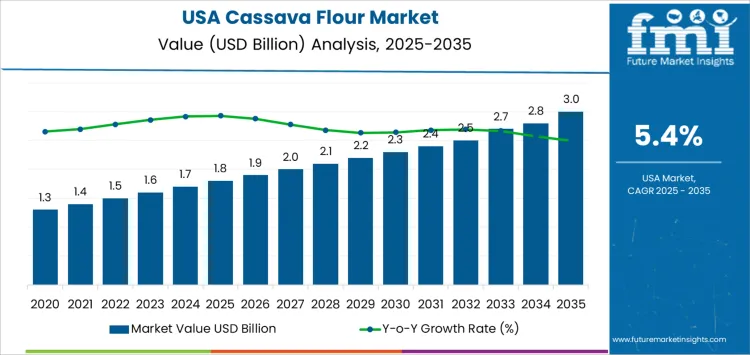
The demand for cassava flour in USA market was valued at USD 1.80 billion in 2025, projected to reach USD 1.90 billion in 2026, and is forecast to expand to USD 3.21 billion by 2036 at a 5.4% CAGR. Rising consumer preference for gluten-free and grain-alternative ingredients in the United States is propelling cassava flour into mainstream food manufacturing and retail distribution. Health-conscious consumers and individuals managing celiac disease, gluten sensitivity, and autoimmune dietary protocols are driving demand for cassava flour as a versatile baking and cooking ingredient. Food manufacturers are responding by reformulating product lines to incorporate cassava flour, recognizing its neutral flavor profile and functional similarity to wheat flour in texture and binding applications.
Summary of Demand for Cassava Flour in USA Market
- Market Overview
- The market is valued at USD 1.80 billion in 2025 and is projected to reach USD 3.21 billion by 2036.
- The industry is expected to grow at a 5.4% CAGR from 2026 to 2036, creating an incremental opportunity of USD 1.31 billion.
- The market is a grain-alternative ingredient category where gluten-free formulation demand, supply chain traceability, and retail distribution expansion define competitive positioning across the United States.
- Demand and Growth Drivers
- The FDA gluten-free labeling standard has established a regulatory framework that supports consumer trust in certified products, and cassava flour qualifies as a naturally gluten-free ingredient that requires no additional processing or certification steps beyond standard food safety compliance.
- Consumer adherence to paleo, Whole30, and autoimmune protocol diets in the USA is creating sustained demand for grain-free flour alternatives, with cassava flour preferred for its neutral taste and wheat-like baking performance in bread, tortilla, and pastry applications.
- Major food manufacturers and contract bakeries in the USA are investing in production line modifications to accommodate cassava flour processing, driven by retailer requests for expanded gluten-free product assortments and growing consumer willingness to pay premium pricing for grain-free formulations.
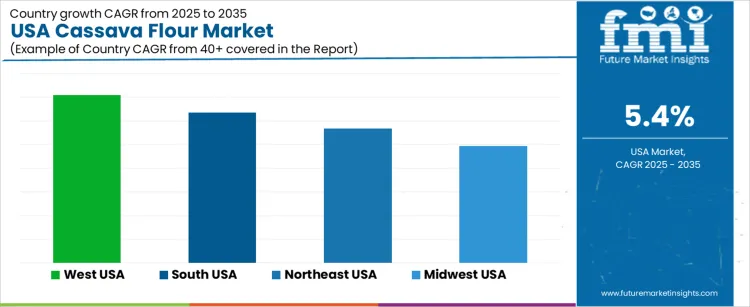
- Among key regions, West USA at 7.1%, South USA at 6.4%, Northeast USA at 5.7%, Midwest USA at 4.9%.
- Product and Segment View
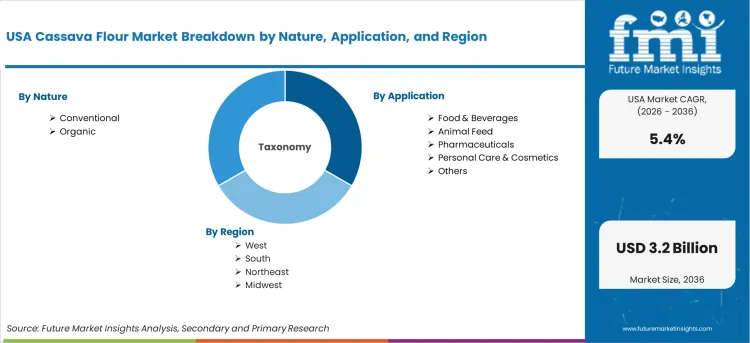
- The market includes products segmented by Nature, Application, Distribution Channel, covering Conventional, Organic under Nature and Food & Beverages, Animal Feed, Pharmaceuticals, Personal Care & Cosmetics, Others under Application.
- Conventional leads Nature segmentation with 79.0% share in 2026.
- Food & Beverages leads Application segmentation with 38.0% share in 2026.
- Geography and Competitive Outlook
- West USA is the fastest-growing area at 7.1% CAGR, while Midwest USA registers steady but lower expansion.
- Competition is shaped by product diversification, distribution reach, and pricing discipline, with key players including DADTCO Rivers Cassava Processing Company, Green Hills Natural Foods, MHOGO Foods, Mocaf Factory, Psaltry International.
- Analyst Opinion at FMI
- Nandini Roy Choudhury, Principal Consultant at FMI, opines: 'In my analysis, I have observed that the cassava flour market in the USA is at a supply chain maturation inflection where the bottleneck shifts from consumer awareness to processing capacity and consistent quality grading. Brands that secure vertically integrated supply arrangements with certified organic cassava farming operations will establish pricing advantages that late entrants cannot replicate.'
- Strategic Implications / Executive Takeaways
- Ingredient suppliers must secure vertically integrated organic cassava farming contracts to guarantee consistent quality and supply volumes for US food manufacturers.
- Product development teams should reformulate flagship bakery and snack lines to include cassava flour, targeting the growing paleo and grain-free consumer segments.
- Distribution strategists must transition from specialty health food channel dependence to mass grocery and warehouse club placement to capture mainstream demand.
Based on FMI analysis, the cassava flour category in the USA is moving beyond specialty health food stores into large-format grocery and mass retail distribution. Manufacturers are reformulating bakery mixes, snack products, and frozen food lines to include cassava flour as a primary starch, responding to consumer demand for grain-free and paleo-compatible ingredients. Contract farming arrangements in tropical source countries are being restructured to meet the quality and traceability specifications demanded by US food safety regulators. The price premium over conventional wheat flour remains a constraint for cost-sensitive food processors, though bulk pricing is narrowing as supply chains scale. The FDA gluten-free labeling framework provides a regulatory foundation that supports consumer confidence in cassava flour as a certified gluten-free ingredient.
Regional demand trajectories reflect distinct structural conditions within the United States. West USA leads with a 7.1% CAGR, followed by South USA at 6.4%, Northeast USA at 5.7%, Midwest USA at 4.9%. As per FMI, these regional variations are tied to local health food retail density, dietary trend adoption rates, and the concentration of food manufacturing facilities that incorporate alternative flour ingredients. West USA leads growth driven by the concentration of health-conscious consumers and natural food brands headquartered in California, Oregon, and Washington. South USA benefits from proximity to Latin American sourcing networks and a growing paleo diet consumer base. Northeast USA maintains steady demand anchored by urban specialty retail and food service channel adoption. Midwest USA registers the lowest growth rate as mainstream flour alternatives face slower consumer adoption in markets where conventional wheat-based products maintain deep cultural and price advantages.
Demand for Cassava Flour in USA Market Key Takeaways
| Metric | Details |
|---|---|
| Industry Size (2026) | USD 1.90 Billion |
| Industry Value (2036) | USD 3.21 Billion |
| CAGR (2026-2036) | 5.4% |
Source: Future Market Insights, 2026
Demand for Cassava Flour in USA Market Drivers, Restraints, and Opportunities
Future Market Insights analysis indicates the cassava flour market in the USA has evolved from a specialty dietary ingredient into a commercially viable alternative flour category capable of supporting large-scale food manufacturing applications. The structural demand base extends beyond celiac disease management into broader lifestyle dietary choices including paleo, grain-free, Whole30, and autoimmune protocol diets. The cassava flour category benefits from a neutral flavor profile that enables direct substitution in recipes traditionally using wheat flour, a technical advantage that competing gluten-free alternatives such as almond flour, coconut flour, and rice flour cannot consistently match across all baking applications.
Supply chain maturation is the critical variable determining the pace of cassava flour market expansion in the USA. FMI opines that the bottleneck is shifting from consumer awareness to processing capacity, quality grading consistency, and logistics infrastructure connecting tropical cassava farming regions to US import terminals. Certified organic cassava flour commands a premium that exceeds conventional grades by 40% to 60%, creating a segmented market where supply chain investment decisions differ materially between organic-focused brands and cost-competitive conventional suppliers. Import dependency on Nigeria, Thailand, Brazil, and Indonesia exposes the US market to trade policy shifts, port congestion, and foreign exchange fluctuations that affect landed cost predictability.
- Gluten-Free Mainstreaming: The FDA gluten-free labeling standard has established a regulatory framework that supports consumer trust in certified products, and cassava flour qualifies as a naturally gluten-free ingredient that requires no additional processing or certification steps beyond standard food safety compliance.
- Paleo and Grain-Free Diet Adoption: Consumer adherence to paleo, Whole30, and autoimmune protocol diets in the USA is creating sustained demand for grain-free flour alternatives, with cassava flour preferred for its neutral taste and wheat-like baking performance in bread, tortilla, and pastry applications.
- Manufacturing Reformulation Investments: Major food manufacturers and contract bakeries in the USA are investing in production line modifications to accommodate cassava flour processing, driven by retailer requests for expanded gluten-free product assortments and growing consumer willingness to pay premium pricing for grain-free formulations.
Demand for Cassava Flour in USA Market Definition
Cassava flour is a fine, white powder produced by peeling, drying, and milling cassava root tubers. It functions as a primary carbohydrate and binding agent in food manufacturing, serving as a direct substitute for wheat flour in gluten-free baking, snack production, and processed food formulation. Industrial applications extend to animal feed supplementation, pharmaceutical excipient production, and personal care product formulation. The product is commercially available in conventional and certified organic grades, with quality differentiation based on particle size, moisture content, cyanide residue levels, and microbial safety certifications.
Demand for Cassava Flour in USA Market Inclusions
Market scope includes conventional and organic cassava flour across all commercial grades. Application coverage spans food and beverages, animal feed, pharmaceuticals, personal care and cosmetics, and other industrial uses. Distribution channel analysis covers direct B2B and indirect B2C sales. Regional coverage spans West, South, Northeast, and Midwest USA with forecast projections from 2026 to 2036.
Demand for Cassava Flour in USA Market Exclusions
Cassava starch sold as a separate industrial chemical commodity is excluded. Tapioca pearls, tapioca starch marketed under separate product categories, and finished consumer food products manufactured from cassava flour are outside the scope. Raw cassava root sold as a fresh vegetable for direct consumption is excluded from the valuation.
Demand for Cassava Flour in USA Market Research Methodology
- Primary Research: Analysts conducted structured interviews with supply chain managers, product procurement leads, and distribution network operators to map decision triggers that shape purchasing volumes and vendor selection criteria.
- Desk Research: Data collection phases aggregated regulatory filings, trade body publications, national consumption surveys, and public procurement records from government statistical agencies.
- Market-Sizing and Forecasting: Baseline values derive from a bottom-up aggregation of category-level consumption volumes, applying region-specific penetration curves and pricing benchmarks to project future demand trajectories.
- Data Validation and Update Cycle: Projections are cross-checked against publicly reported trade statistics, manufacturer shipment disclosures, and import-export databases maintained by customs authorities.
Why is the Demand for Cassava Flour Growing in the USA?
Demand for cassava flour in the USA is increasing sharply as more Americans adopt gluten free, paleo, and plant based diets. Cassava flour is naturally gluten free, grain free, and nut free. These characteristics make it a strong alternative to wheat flour for people with gluten intolerance, celiac disease, or those simply seeking to reduce gluten in their diets. Its neutral flavor and ability to mimic the texture of wheat flour in many recipes-from breads and pancakes to tortillas and baked goods-make it appealing to home cooks, bakeries, and packaged food producers. As health awareness rises and dietary preferences shift toward clean label and allergy friendly ingredients, cassava flour is gaining widespread acceptance across households and food manufacturers.
At the same time the rise of the health food, specialty bakery, and natural foods segments supports growing consumption. Food producers are increasingly using cassava flour in gluten free breads, snacks, pasta, and ready-to-eat products aimed at health conscious consumers. Cassava flour’s carbohydrate and fiber profile appeals to those looking for nutritious, easily digestible, and grain free options. Also, as clean label and plant based diets become more popular, cassava flour fits well into trends demanding sustainable, allergen free, and simpler ingredient foods. With better processing technologies, easier import/distribution, and growing consumer acceptance, cassava flour is likely to consolidate its place in the USA flour substitute market in coming years.
What Are the Key Segments in Cassava Flour Market in the USA?
The cassava flour market in the USA is segmented by nature and application. Conventional cassava flour leads the market, representing 79% of the share, while organic cassava flour remains a smaller but growing segment. In terms of application, the food and beverages sector is the largest, holding 38% of the market share. The demand for cassava flour is primarily driven by its versatility in gluten-free and alternative baking applications.
Which Nature Drives Cassava Flour Demand in the USA?
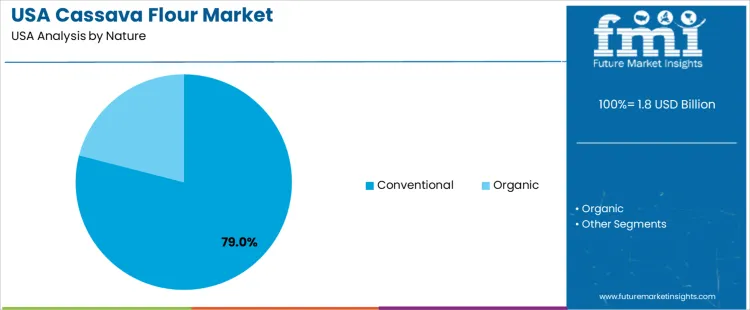
Conventional cassava flour is the dominant form in the USA market, accounting for 79% of the total demand. This is primarily due to its availability, affordability, and widespread use in various food applications. Conventional cassava flour is commonly used in gluten-free baking, as a thickener in soups and sauces, and as a substitute for wheat flour in various recipes. The demand for conventional cassava flour continues to rise due to the increasing number of consumers seeking gluten-free, grain-free, or allergen-friendly options. While organic cassava flour is gaining traction due to the rising preference for organic and natural products, conventional cassava flour remains the more widely used and accessible option.
Which Application Drives Cassava Flour Demand in the USA?
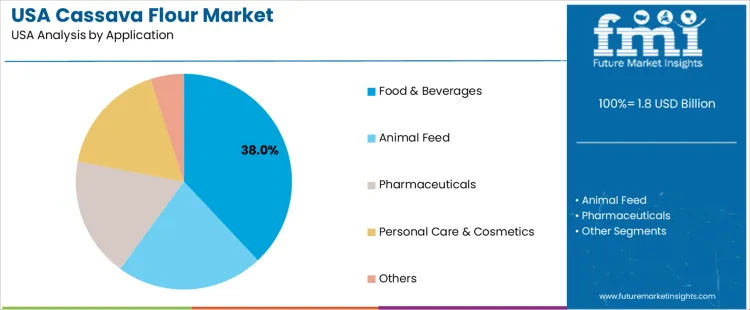
The food and beverages sector leads cassava flour demand in the USA, holding 38% of the market share. This growth is driven by the increasing popularity of gluten-free and alternative flour products. Cassava flour is particularly favored for its neutral flavor and fine texture, making it ideal for use in baked goods, snacks, and as a thickening agent in a variety of food products. The rise in consumer demand for gluten-free and healthy eating options has positioned cassava flour as a preferred ingredient in the food and beverage industry. Other applications, including animal feed, pharmaceuticals, and personal care & cosmetics, also contribute to the market, but the food and beverages sector remains the largest driver of cassava flour consumption in the USA.
What is the Summary of Demand for Cassava Flour in USA?
Demand for cassava flour in the USA is growing due to its rising popularity as a gluten free, grain free alternative to traditional flours. As more consumers adopt gluten free, paleo, and grain free diets, cassava flour is increasingly being used in baking, cooking, and food processing. Its versatility, neutral flavor, and ability to replicate the texture of wheat flour in recipes make it a preferred choice in gluten free products, particularly in baked goods such as bread, cakes, and cookies. As awareness of its benefits spreads, cassava flour is gaining wider acceptance among health conscious consumers and food manufacturers in the USA.
What are the Drivers of Demand for Cassava Flour in USA?
Several factors are driving the growing demand for cassava flour in the USA. First, the increasing prevalence of gluten free diets, driven by health concerns such as gluten intolerance and celiac disease, is fueling interest in gluten free alternatives like cassava flour. Second, the rise of the paleo diet, which excludes grains and processed foods, has contributed to the demand for cassava flour as a suitable substitute for traditional wheat flour. Third, cassava flour’s neutral taste and versatile texture make it ideal for a variety of applications, from baked goods to thickening sauces, increasing its appeal across multiple food categories. Finally, as awareness of its health benefits grows, particularly its high fiber content and low glycemic index, more consumers are turning to cassava flour as a healthier option for baking and cooking.
What are the Restraints on Demand for Cassava Flour in USA?
Despite its growing popularity, several challenges may limit the widespread adoption of cassava flour in the USA. One significant restraint is its relatively high cost compared to more commonly used flours, such as rice or potato flour. This can make products containing cassava flour less competitive in price sensitive markets. Second, while cassava flour is versatile, its texture and properties may not perfectly replicate wheat flour in all recipes, which can affect the final product’s quality and performance. Third, the limited availability of cassava flour in mainstream grocery stores, particularly in regions without large gluten free or health conscious consumer bases, may hinder its adoption. Finally, cassava flour’s reliance on cassava root as a raw material, which is primarily grown in tropical regions, can lead to supply chain challenges and price volatility.
What are the Key Trends Influencing Demand for Cassava Flour in USA?
Several trends are shaping the demand for cassava flour in the USA. One key trend is the growing consumer focus on health and wellness, which has driven increased interest in gluten free and grain free alternatives. As more consumers adopt these diets for digestive health and overall well being, cassava flour is gaining prominence as a nutritious, versatile option. Another trend is the rise of plant based and clean label foods, where cassava flour’s natural, minimally processed nature aligns well with consumer preferences for whole, unrefined ingredients. Additionally, innovations in gluten free and paleo baking, as well as the increasing popularity of international cuisines that use cassava, are driving growth in demand. Finally, the expansion of online grocery shopping and specialty food retailers is making cassava flour more accessible to a wider audience across the USA, supporting its continued adoption in both home kitchens and commercial food production.
What is the Regional Demand Outlook for the Cassava Flour Market in the USA?
The Cassava Flour market in the USA is projected to grow steadily across various regions, with the West USA leading the way at a CAGR of 7.1%. South USA follows closely with a growth rate of 6.4%, while the Northeast USA is expected to grow at 5.7%. The Midwest USA shows more moderate growth with a CAGR of 4.9%. Cassava flour, known for its gluten-free, high-fiber, and plant-based properties, is gaining popularity due to the increasing consumer preference for healthier, gluten-free alternatives. As demand for sustainable and clean-label food products rises, cassava flour is becoming a favored ingredient in various culinary applications.
| Region | CAGR (%) |
|---|---|
| West USA | 7.1 |
| South USA | 6.4 |
| Northeast USA | 5.7 |
| Midwest USA | 4.9 |
What is Driving the Growth of Cassava Flour in the West USA?
The West USA is projected to experience the highest growth in the Cassava Flour market, with a CAGR of 7.1%. The region is known for its diverse and health-conscious population, which is increasingly adopting plant-based, gluten-free diets. As consumers in the West embrace clean-label, sustainable food options, cassava flour’s versatility as a gluten-free and high-fiber alternative to traditional wheat flour is driving its adoption in cooking and baking. The West’s strong focus on health, wellness, and environmental sustainability is contributing to the growing demand for cassava flour in a variety of food products, including gluten-free bread, snacks, and baked goods. Additionally, the West’s vibrant food culture and openness to global cuisine further fuel the integration of cassava flour into both traditional and innovative recipes.
Why is the Cassava Flour Market Expanding in South USA?
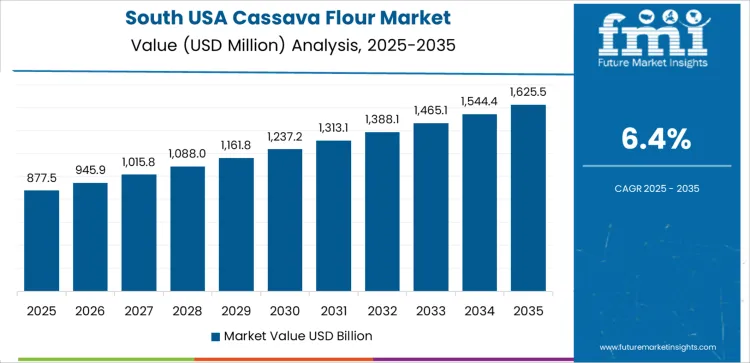
In South USA, the demand for cassava flour is projected to grow at a CAGR of 6.4%. The region’s growing interest in healthy eating, particularly among those following gluten-free and plant-based diets, is contributing to the rising adoption of cassava flour. As more consumers in the South look for alternatives to traditional wheat flour due to dietary restrictions or health concerns, cassava flour is emerging as a popular choice. The region’s diverse food culture, which incorporates elements from various cuisines, is also supporting the integration of cassava flour into traditional dishes. The availability of cassava flour in supermarkets and online platforms is increasing, making it more accessible to Southern consumers. As awareness of the nutritional benefits of cassava flour grows, its use in cooking, baking, and prepared foods is expected to expand further.
How is the Cassava Flour Market Growing in Northeast USA?
In Northeast USA, the Cassava Flour market is projected to grow at a CAGR of 5.7%. The Northeast’s urban population, particularly in cities like New York and Boston, is becoming more ingredient-conscious and open to alternative food products, including gluten-free and plant-based ingredients. As more people in the region embrace gluten-free and allergen-free diets, cassava flour is increasingly being used as a substitute for wheat flour in baking and cooking. The demand for clean-label, sustainable products is driving the growth of cassava flour in this region, where consumers prioritize healthier options. The Northeast’s focus on innovative, health-forward food trends, along with a growing interest in global cuisine, further supports the rising popularity of cassava flour in both home kitchens and restaurants.
What is Contributing to the Growth of Cassava Flour in Midwest USA?
In Midwest USA, the Cassava Flour market is expected to grow at a more moderate rate of 4.9%. While the Midwest has traditionally been known for its wheat-based products, there is a rising shift toward gluten-free and health-conscious eating habits. As consumers in the region become more aware of dietary restrictions and seek healthier alternatives, cassava flour is emerging as a suitable option for those looking to reduce gluten in their diets. The Midwest’s growing interest in plant-based diets and the rising demand for gluten-free products in grocery stores are contributing to the steady adoption of cassava flour. As more consumers turn to online shopping for specialty food products, the availability of cassava flour is increasing, further driving its use in gluten-free baking and cooking.
Competitive Aligners for Market Players
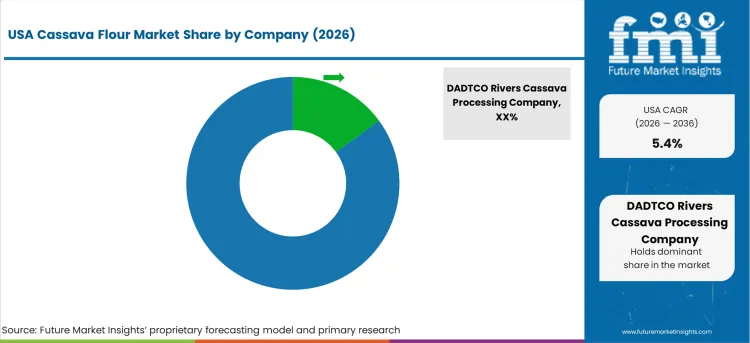
The competitive structure of the cassava flour market in the USA is fragmented, with a mix of international sourcing companies, domestic natural food brands, and specialty ingredient distributors competing for retail and food manufacturing accounts. DADTCO Rivers Cassava Processing Company, Green Hills Natural Foods, MHOGO Foods, Mocaf Factory, and Psaltry International represent the primary supply chain participants, operating across farming, processing, import, and distribution stages. Competitive differentiation is driven by supply chain reliability, organic certification status, particle size consistency, and the ability to guarantee traceability from farm to retail shelf.
Companies with vertically integrated operations spanning cassava farming, drying, milling, and export logistics achieve cost advantages and quality control capabilities that intermediary-dependent competitors cannot replicate. Buyer leverage in the US market is concentrated among large natural food retailers and food manufacturing companies that negotiate annual supply contracts based on volume commitments, quality specifications, and certification documentation requirements.
Entry barriers include the capital investment required to establish reliable tropical sourcing networks, the time required to achieve organic certification for farming operations, and the regulatory compliance costs associated with FDA food safety documentation for imported food ingredients. Domestic value-added processing facilities that perform final milling, testing, and packaging within the USA are emerging as a competitive differentiator for brands targeting food manufacturing customers that require short lead times and documented domestic processing provenance.
Key Players in Demand for Cassava Flour in USA Market
- DADTCO Rivers Cassava Processing Company
- Green Hills Natural Foods
- MHOGO Foods
- Mocaf Factory
- Psaltry International
Scope of the Report
| Metric | Value |
|---|---|
| Quantitative Units | USD 1.90 Billion to USD 3.21 Billion, at a CAGR of 5.4% |
| Market Definition | Cassava flour is a fine, white powder produced by peeling, drying, and milling cassava root tubers. It functions as a primary carbohydrate and binding agent in food manufacturing, serving as a direct substitute for wheat flour in gluten-free baking, snack production, and processed food formulation. |
| Nature Segmentation | Conventional, Organic |
| Application Segmentation | Food & Beverages, Animal Feed, Pharmaceuticals, Personal Care & Cosmetics, Others |
| Distribution Channel Segmentation | Direct / B2B, Indirect / B2C |
| Regions Covered | West USA, South USA, Northeast USA, Midwest USA |
| Key Companies Profiled | DADTCO Rivers Cassava Processing Company, Green Hills Natural Foods, MHOGO Foods, Mocaf Factory, Psaltry International |
| Forecast Period | 2026 to 2036 |
| Approach | Bottom-up methodology starting with category-level consumption data and applying regional penetration assumptions. |
Demand for Cassava Flour in USA Market Analysis by Segments
By Nature:
Conventional, Organic
By Application:
Food & Beverages, Animal Feed, Pharmaceuticals, Personal Care & Cosmetics, Others
By Distribution Channel:
Direct / B2B, Indirect / B2C
By Region:
West USA, South USA, Northeast USA, Midwest USA
Bibliography
- 1. United States Department of Agriculture. (2024). Global Agricultural Trade System: Cassava and Cassava Products Import Data. USDA.
- 2. Food and Drug Administration. (2024). Gluten-Free Food Labeling Compliance Guidance. FDA.
- 3. Food and Agriculture Organization of the United Nations. (2024). Cassava: Global Production and Trade Statistics. FAO.
- 4. International Institute of Tropical Agriculture. (2024). Cassava Processing and Value Chain Development Report. IITA.
- 5. United States International Trade Commission. (2024). Harmonized Tariff Schedule: Cassava Flour and Meal. USITC.
This bibliography is provided for reader reference. The full Future Market Insights report contains the complete reference list with primary research documentation.
Frequently Asked Questions
How large is the Demand for Cassava Flour in USA Market in 2026?
The Demand for Cassava Flour in USA market is estimated to be valued at USD 1.90 billion in 2026.
What will be the market size of Demand for Cassava Flour in USA by 2036?
The Demand for Cassava Flour in USA market is projected to reach USD 3.21 billion by 2036.
What is the expected CAGR for Demand for Cassava Flour in USA between 2026 and 2036?
The Demand for Cassava Flour in USA market is expected to grow at a CAGR of 5.4% between 2026 and 2036.
Which Nature is poised to lead in 2026?
Conventional accounts for 79.0% share in 2026, maintaining its position as the leading nature segment.
Which region is projected to grow the fastest?
West USA is projected to grow at a CAGR of 7.1% during 2026 to 2036, the fastest among all covered regions.
What does Demand for Cassava Flour in USA mean in this report?
Cassava flour is a fine, white powder produced by peeling, drying, and milling cassava root tubers. It functions as a primary carbohydrate and binding agent in food manufacturing, serving as a direct substitute for wheat flour in gluten-free baking, snack production, and processed food formulation.
What is included in the scope of this report?
Market scope includes conventional and organic cassava flour across all commercial grades. Application coverage spans food and beverages, animal feed, pharmaceuticals, personal care and cosmetics, and other industrial uses.
How does FMI build and validate the Demand for Cassava Flour in USA forecast?
Forecasting models apply a bottom-up methodology starting with category-level consumption data and cross-validate projections against trade statistics, manufacturer shipment disclosures, and regulatory filings.
Preview the report firsthand - request a free sample
Get SampleGet the brochure for pricing and purchase details.
Get PDFTable of Content
- Executive Summary
- USA Market Outlook
- Demand-side Trends
- Supply-side Trends
- Technology Roadmap Analysis
- Analysis and Recommendations
- Market Overview
- Market Coverage / Taxonomy
- Market Definition / Scope / Limitations
- Research Methodology
- Chapter Orientation
- Analytical Lens and Working Hypotheses
- Market Structure, Signals, and Trend Drivers
- Benchmarking and Cross-market Comparability
- Market Sizing, Forecasting, and Opportunity Mapping
- Research Design and Evidence Framework
- Desk Research Programme (Secondary Evidence)
- Company Annual and Sustainability Reports
- Peer-reviewed Journals and Academic Literature
- Corporate Websites, Product Literature, and Technical Notes
- Earnings Decks and Investor Briefings
- Subscription Datasets and Paid Sources
- Social Channels, Communities, and Digital Listening Inputs
- Additional Desk Sources
- Expert Input and Fieldwork (Primary Evidence)
- Primary Modes
- Qualitative Interviews and Expert Elicitation
- Quantitative Surveys and Structured Data Capture
- Blended Approach
- Why Primary Evidence is Used
- Field Techniques
- Interviews
- Surveys
- Focus Groups
- Observational and In-context Research
- Social and Community Interactions
- Stakeholder Universe Engaged
- C-suite Leaders
- Board Members
- Presidents and Vice Presidents
- R&D and Innovation Heads
- Technical Specialists
- Domain Subject-matter Experts
- Scientists
- Physicians and Other Healthcare Professionals
- Governance, Ethics, and Data Stewardship
- Research Ethics
- Data Integrity and Handling
- Primary Modes
- Tooling, Models, and Reference Databases
- Desk Research Programme (Secondary Evidence)
- Data Engineering and Model Build
- Data Acquisition and Ingestion
- Cleaning, Normalisation, and Verification
- Synthesis, Triangulation, and Analysis
- Quality Assurance and Audit Trail
- Market Background
- Market Dynamics
- Drivers
- Restraints
- Opportunity
- Trends
- Scenario Forecast
- Demand in Optimistic Scenario
- Demand in Likely Scenario
- Demand in Conservative Scenario
- Opportunity Map Analysis
- Product Life Cycle Analysis
- Supply Chain Analysis
- Investment Feasibility Matrix
- Value Chain Analysis
- PESTLE and Porter’s Analysis
- Regulatory Landscape
- Regional Parent Market Outlook
- Production and Consumption Statistics
- Import and Export Statistics
- Market Dynamics
- USA Market Analysis 2021 to 2025 and Forecast, 2026 to 2036
- Historical Market Size Value (USD Million) Analysis, 2021 to 2025
- Current and Future Market Size Value (USD Million) Projections, 2026 to 2036
- Y-o-Y Growth Trend Analysis
- Absolute $ Opportunity Analysis
- USA Market Pricing Analysis 2021 to 2025 and Forecast 2026 to 2036
- USA Market Analysis 2021 to 2025 and Forecast 2026 to 2036, By Nature
- Introduction / Key Findings
- Historical Market Size Value (USD Million) Analysis By Nature , 2021 to 2025
- Current and Future Market Size Value (USD Million) Analysis and Forecast By Nature , 2026 to 2036
- Conventional
- Organic
- Conventional
- Y-o-Y Growth Trend Analysis By Nature , 2021 to 2025
- Absolute $ Opportunity Analysis By Nature , 2026 to 2036
- USA Market Analysis 2021 to 2025 and Forecast 2026 to 2036, By Application
- Introduction / Key Findings
- Historical Market Size Value (USD Million) Analysis By Application, 2021 to 2025
- Current and Future Market Size Value (USD Million) Analysis and Forecast By Application, 2026 to 2036
- Food & Beverages
- Animal Feed
- Pharmaceuticals
- Personal Care & Cosmetics
- Others
- Food & Beverages
- Y-o-Y Growth Trend Analysis By Application, 2021 to 2025
- Absolute $ Opportunity Analysis By Application, 2026 to 2036
- USA Market Analysis 2021 to 2025 and Forecast 2026 to 2036, By Distribution Channel
- Introduction / Key Findings
- Historical Market Size Value (USD Million) Analysis By Distribution Channel, 2021 to 2025
- Current and Future Market Size Value (USD Million) Analysis and Forecast By Distribution Channel, 2026 to 2036
- Direct / B2B
- Indirect / B2C
- Direct / B2B
- Y-o-Y Growth Trend Analysis By Distribution Channel, 2021 to 2025
- Absolute $ Opportunity Analysis By Distribution Channel, 2026 to 2036
- USA Market Analysis 2021 to 2025 and Forecast 2026 to 2036, By Region
- Introduction
- Historical Market Size Value (USD Million) Analysis By Region, 2021 to 2025
- Current Market Size Value (USD Million) Analysis and Forecast By Region, 2026 to 2036
- West
- South
- Northeast
- Midwest
- Market Attractiveness Analysis By Region
- West Market Analysis 2021 to 2025 and Forecast 2026 to 2036, By Country
- Historical Market Size Value (USD Million) Trend Analysis By Market Taxonomy, 2021 to 2025
- Market Size Value (USD Million) Forecast By Market Taxonomy, 2026 to 2036
- By Country
- By Nature
- By Application
- By Distribution Channel
- By Country
- Market Attractiveness Analysis
- By Country
- By Nature
- By Application
- By Distribution Channel
- Key Takeaways
- South Market Analysis 2021 to 2025 and Forecast 2026 to 2036, By Country
- Historical Market Size Value (USD Million) Trend Analysis By Market Taxonomy, 2021 to 2025
- Market Size Value (USD Million) Forecast By Market Taxonomy, 2026 to 2036
- By Country
- By Nature
- By Application
- By Distribution Channel
- By Country
- Market Attractiveness Analysis
- By Country
- By Nature
- By Application
- By Distribution Channel
- Key Takeaways
- Northeast Market Analysis 2021 to 2025 and Forecast 2026 to 2036, By Country
- Historical Market Size Value (USD Million) Trend Analysis By Market Taxonomy, 2021 to 2025
- Market Size Value (USD Million) Forecast By Market Taxonomy, 2026 to 2036
- By Country
- By Nature
- By Application
- By Distribution Channel
- By Country
- Market Attractiveness Analysis
- By Country
- By Nature
- By Application
- By Distribution Channel
- Key Takeaways
- Midwest Market Analysis 2021 to 2025 and Forecast 2026 to 2036, By Country
- Historical Market Size Value (USD Million) Trend Analysis By Market Taxonomy, 2021 to 2025
- Market Size Value (USD Million) Forecast By Market Taxonomy, 2026 to 2036
- By Country
- By Nature
- By Application
- By Distribution Channel
- By Country
- Market Attractiveness Analysis
- By Country
- By Nature
- By Application
- By Distribution Channel
- Key Takeaways
- Key Countries Market Analysis
- West
- Pricing Analysis
- Market Share Analysis, 2025
- By Nature
- By Application
- By Distribution Channel
- South
- Pricing Analysis
- Market Share Analysis, 2025
- By Nature
- By Application
- By Distribution Channel
- Northeast
- Pricing Analysis
- Market Share Analysis, 2025
- By Nature
- By Application
- By Distribution Channel
- Midwest
- Pricing Analysis
- Market Share Analysis, 2025
- By Nature
- By Application
- By Distribution Channel
- West
- Market Structure Analysis
- Competition Dashboard
- Competition Benchmarking
- Market Share Analysis of Top Players
- By Regional
- By Nature
- By Application
- By Distribution Channel
- Competition Analysis
- Competition Deep Dive
- DADTCO Rivers Cassava Processing Company
- Overview
- Product Portfolio
- Profitability by Market Segments (Product/Age /Sales Channel/Region)
- Sales Footprint
- Strategy Overview
- Marketing Strategy
- Product Strategy
- Channel Strategy
- Green Hills Natural Foods
- MHOGO Foods
- Mocaf Factory
- Psaltry International
- DADTCO Rivers Cassava Processing Company
- Competition Deep Dive
- Assumptions & Acronyms Used


