

- Industry Size (2026)
- USD 419.5 Mn
- Forecast (2036)
- USD 765.5 Mn
- CAGR (2026 to 2036)
- 6.2%
Cassava Syrup Market Size, Market Forecast and Outlook By FMI
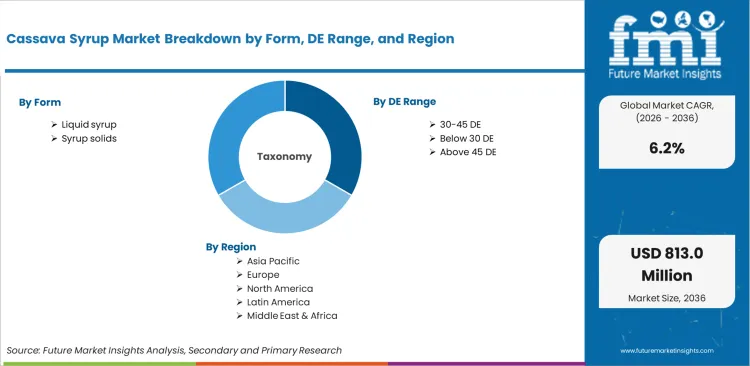
The cassava syrup market was valued at USD 395.0 million in 2025. Industry valuation is estimated to reach USD 419.5 million in 2026 and is projected to expand at a CAGR of 6.2% from 2026 to 2036. The market is expected to attain USD 765.5 million by 2036 as clean-label reformulation programs push more food manufacturers to reduce dependence on conventional corn-based sweeteners and related starch derivatives.
Summary of Cassava Syrup Market
- The market is forecast to reach USD 765.5 million by 2036.
- The market is expected to grow at a CAGR of 6.2% from 2026 to 2036.
- The market was estimated at USD 395.0 million in 2025.
- The market is projected to generate an incremental opportunity of USD 345.5 million over the forecast period.
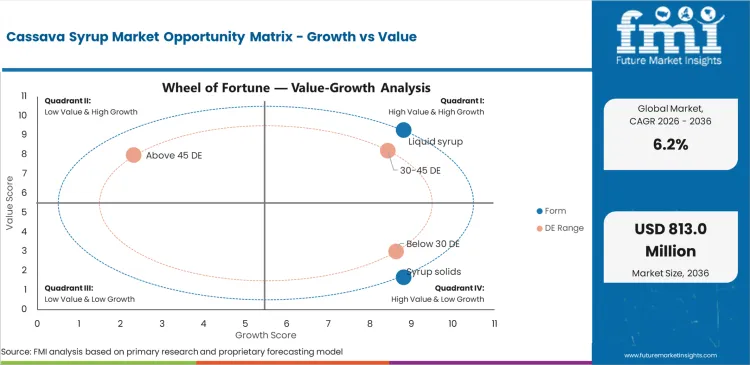
- Liquid syrup leads by form with a 71.0% share.
- 30-45 DE leads by DE range with a 46.0% share.
- Conventional dominates by nature with a 74.0% share.
- Confectionery leads by application with a 29.0% share.
- Direct B2B leads by channel with a 67.0% share.
- India is the fastest-growing market at 7.2%, followed by Thailand at 6.8% and Indonesia at 6.6%.
- The market is driven by clean-label reformulation trends, rising demand for non-GMO and gluten-free sweeteners, and functional benefits such as binding, gloss, and texture in food applications.
- Key companies in the market include Cargill, Ingredion, Ciranda, and Sweetener Products Co.
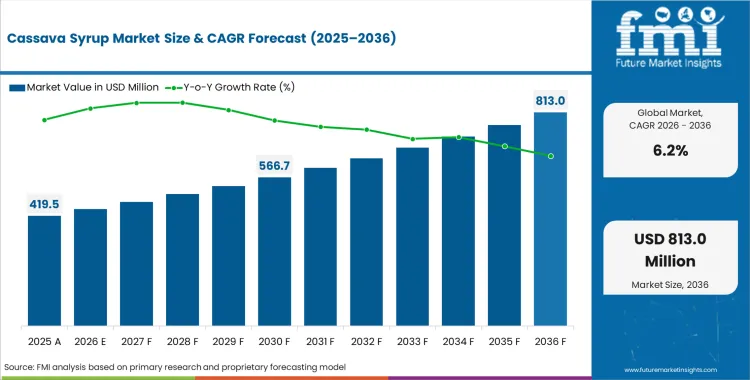
Food manufacturers need cleaner ingredient declarations without losing sweetness balance, viscosity, or processing stability across confectionery, bakery, and prepared food lines. Cassava syrup is drawing interest because it gives brands a non-GMO, allergy-conscious option that fits premium and export-focused retail positioning. Most evaluations start with a comparison against corn syrup, especially when manufacturers need to retain binding performance and mouthfeel in established formulations. Tapioca maltodextrin is often reviewed within the same reformulation cycle, as it can serve as an initial entry point for wider cassava-based ingredient use across processing operations.
Commercial adoption is expected to improve as processors gain tighter control over yield stability and batch-to-batch quality across harvest cycles. Lower input variability makes pricing easier to plan and gives manufacturers more confidence to move beyond spot purchases into longer-term supply arrangements. Wider conversion across product portfolios becomes easier to support once supply consistency improves, since formulation teams can scale cassava syrup use with fewer operational risks.
India is projected to expand at a CAGR of 7.2% through 2036, supported by rising domestic processing investment and broader cassava-based ingredient development. Thailand is estimated to rise at 6.8%, backed by strong export capability and an established tapioca processing base. Indonesia is likely to record 6.6% CAGR during the forecast period, while Vietnam is anticipated to grow at 6.5% as raw material availability continues to support processing expansion. The United States is expected to register 5.4%, where demand is being shaped more by non-GMO reformulation priorities than by domestic feedstock strength. Germany is set to post 4.9%, and Japan is projected to witness 4.7% CAGR in the market through 2036, with both markets using cassava syrup mainly in formulation-led applications rather than supply-driven production systems. Country-level differences will continue to reflect the divide between feedstock-centered Asian production hubs and Western markets led by downstream ingredient reformulation needs.
Segmental Analysis
Cassava Syrup Market Analysis by Form
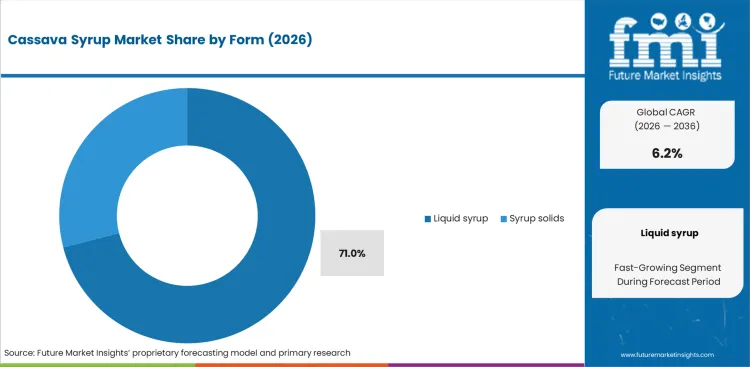
Existing food processing infrastructure continues to favor fluid sweetener systems over dehydrated alternatives. Liquid syrup remains the preferred format because most manufacturing lines already operate with tanks, pumps, and flow-control systems built for bulk liquid handling. FMI estimates liquid syrup to account for 71.0% share in 2026. That lead reflects plant compatibility and operating familiarity more than a clear cost advantage once freight is fully accounted for. Viscosity stability also carries weight during storage and transfer, especially in applications where performance must remain consistent under conditions linked to stabilized starch handling. Powder alternatives can reduce the burden of transporting water, though they also introduce hydration errors, clumping risk, and additional equipment requirements in humid factory environments. Similar operating caution appears in systems shaped by cold water swelling starch performance expectations, where poor dispersion can disrupt line consistency quickly.
- Storage Infrastructure Lock-in: Fluid handling systems rely on heated tanks, pumps, and transfer lines already installed across existing plants. Manufacturers avoid changing format when legacy assets continue to support efficient operations.
- Hydration Friction: Powder conversion demands tighter measurement and mixing control than liquid input. Inconsistency at this stage can create avoidable viscosity variation.
- Freight Exposure: Shipping liquid sweetener means absorbing the cost of moving substantial water weight. Regional processing and shorter transport distances improve delivered cost control.
Cassava Syrup Market Analysis by DE Range
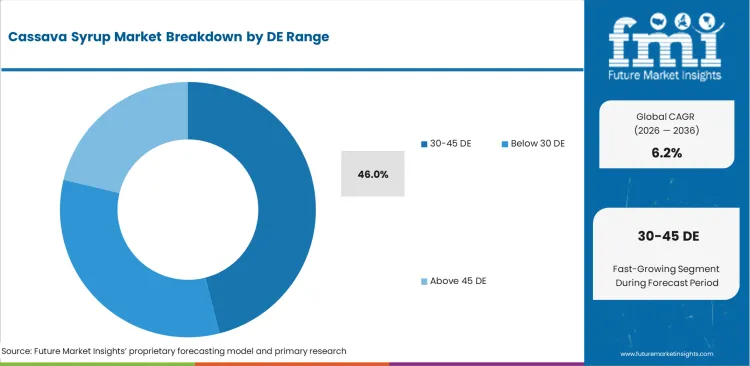
DE selection comes down to how well one syrup grade can manage sweetness, browning, texture, and batch consistency across multiple food applications. Mid-DE grades remain the most practical choice for manufacturers because they work across bakery, confectionery, and snack lines without adding avoidable product complexity. Very low or very high DE options can create formulation compromises when glucose fructose syrup is being replaced, especially around chewiness, browning control, and shelf stability. FMI estimates the 30-45 DE range to account for 46.0% share in 2026. Demand stays concentrated in this range because it fits mainstream processing requirements and gives formulators a more reliable balance between performance and flexibility. Similar thinking applies when syrup behavior is compared with adjacent carbohydrate ingredients such as granulated tapioca, where repeatability in production matters more than specification values alone.
- Maillard Reaction Control: Mid-range DE allows browning to stay more predictable during baking and thermal processing. Manufacturers get better control over finished product color from batch to batch.
- Crystallization Prevention: Very low-DE grades can firm up more easily during storage. Mid-range material helps preserve softer texture in products that rely on chew stability.
- SKU Consolidation: A broader-use DE range reduces complexity across production lines and warehouse planning. Manufacturers can apply one specification across a wider set of end uses.
Cassava Syrup Market Analysis by Nature
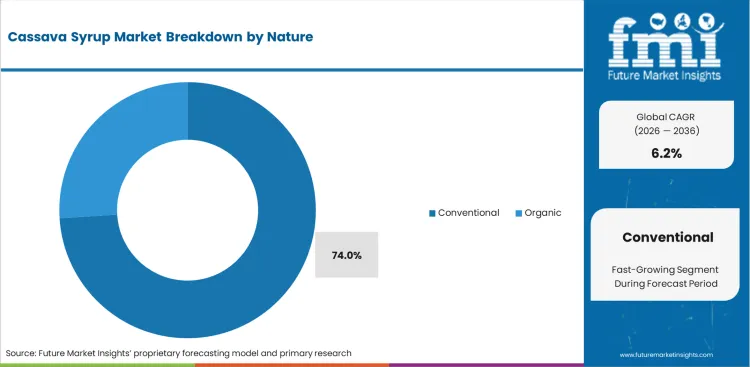
Nature-based positioning remains limited by the volume discipline of industrial food manufacturing. Conventional supply continues to lead because beverage, snack, and confectionery processors need steady availability to support continuous production schedules. FMI estimates conventional cassava syrup to represent 74.0% share in 2026. Organic options continue to draw interest, yet uneven yields and higher input costs keep them from moving easily into large-volume programs. Many buyers instead prioritize non-GMO or cleaner-label claims while maintaining conventional sourcing to protect supply continuity. Similar tradeoffs appear in ingredient systems competing with acetylated starch, where label preference does not always align with process practicality. Weak supplier verification also raises residue and compliance exposure, which can create more risk than any short-term purchasing gain.
- Volume Requirements: Large food plants depend on reliable weekly supply at industrial scale. Conventional farming networks remain better equipped to support that continuity.
- Margin Preservation: Certified organic input usually carries a noticeable cost premium. Many manufacturers keep that exposure limited to smaller, higher-margin product lines.
- Certification Friction: Separate organic and conventional streams add complexity inside the plant. Dual-track handling also increases segregation requirements and compliance burden.
Cassava Syrup Market Analysis by Application
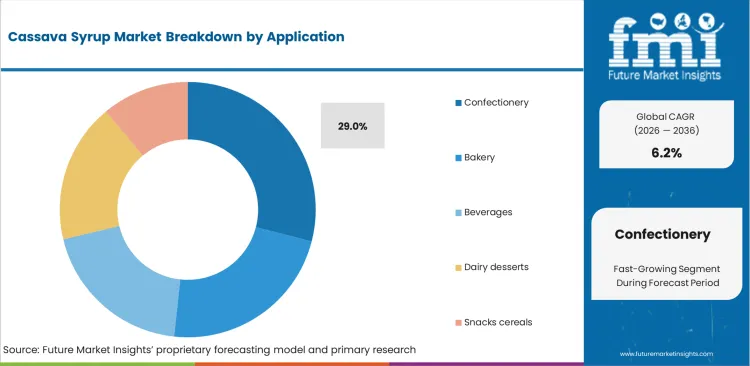
Application demand is strongest in end uses where cassava syrup contributes structure, binding, and process control alongside sweetness. Confectionery remains the leading outlet because syrup performance directly shapes extrusion efficiency, moisture balance, and final texture across candy products. FMI expects confectionery to account for 29.0% share in 2026. That position comes from the syrup’s functional role inside sugar matrices, where handling behavior and product stability matter as much as taste. Hard candy and related formats also benefit when cassava-derived ingredients support gluten-free positioning. Processing errors around viscosity or hygroscopic response can quickly lead to blocked equipment, unstable shapes, or sticky finished goods. Similar formulation pressure appears in Asian ingredient comparisons linked to Japan cassava flour, where process fit often carries more weight than simple ingredient replacement logic.
- Extrusion Compatibility: Syrup needs to move smoothly through high-pressure confectionery equipment. Poor flow behavior can interrupt forming and increase material waste.
- Gluten-free Positioning: Cassava-based sweetening systems support allergen-sensitive product development. That improves shelf relevance in health-focused retail channels.
- Hygroscopic Control: Moisture pickup can damage hard candy texture during storage and transit. Grade selection therefore needs to reflect actual distribution conditions.
Cassava Syrup Market Analysis by Channel
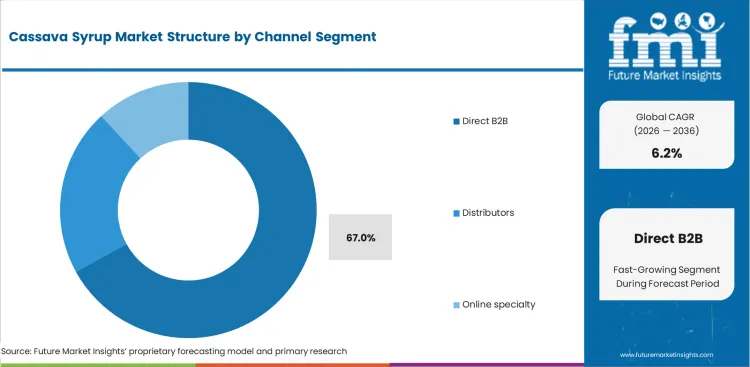
Large buyers increasingly prefer direct processor relationships when traceability, audit access, and pricing control carry more weight at scale. Direct B2B remains the leading channel because major food manufacturers want closer coordination with processing schedules and clearer origin documentation. FMI projects direct B2B transactions to account for 67.0% share in 2026. This channel structure also improves response speed when supply disruptions or recall issues appear, while reducing intermediary markups in the process. Smaller manufacturers may still depend on traders or grouped purchasing arrangements, though direct engagement becomes more compelling as annual procurement volume rises.
- Audit Transparency: Direct sourcing improves access to factory-level processing and safety records. Internal compliance review becomes easier to manage with that level of visibility.
- Volume Negotiation: Processor-level engagement gives larger buyers greater room to secure favorable pricing tiers. Scale translates more efficiently into commercial advantage.
- Traceability Mandates: Recall management depends on quick batch identification back to source. Direct B2B relationships provide stronger control on that front.
Cassava Syrup Market Drivers, Restraints, and Opportunities
Clean-label mandates force R&D formulation chemists to strip artificial identifiers from ingredient panels immediately. Delaying substitution risks complete exclusion from premium retail environments demanding non-GMO verification. Traditional corn derivatives carry deep consumer stigma, pushing buyers toward cassava syrup clean label sweetener alternatives offering identical technical performance. Supermarket chains demanding eco-friendly cassava packaging also penalize brands utilizing artificial sweeteners. Urgency accelerates as major supermarket chains implement strict supplier guidelines banning specific synthesized additives by specific upcoming deadlines.
Lengthy technical requalification cycles paralyze adoption timelines even when organizations are eager to transition.
Formulators cannot simply swap identical volumes of different sweeteners; varying water activity metrics requires total recipe recalibration. This engineering friction delays commercialization by six to twelve months per product line. Leading modified starch experts provide partial formulation assistance, yet final stability testing remains an unavoidable internal bottleneck for every major food brand.
Opportunities in the Cassava Syrup Market
- Plant-based dairy expansion: Vegan ice cream formulators require neutral-tasting binders. Innovative suppliers offering ultra-mild extracts capture exclusive contracts within this rapidly expanding category.
- Infant nutrition applications: Pediatric food scientists demand hypoallergenic energy sources. Processors achieving strict pharmaceutical-grade purity thresholds unlock massive margins supplying baby formula manufacturers.
- Sports nutrition gels: Endurance athletes consume liquid carbohydrates during competition. Formulators blending rolled dried starch with specific DE sweeteners create easily digestible energy products. Beverage directors scaling bubble tea retail networks exploring cassava syrup for beverages require customized viscosity profiles.
Regional Analysis
Based on regional analysis, cassava syrup market is segmented into North America, Europe, Asia Pacific, and other key regions across 40 plus countries.
.webp "Top Country Growth Comparison Cassava Syrup Market Cagr (2026 2036)")
| Country | CAGR (2026 to 2036) |
|---|---|
| India | 7.2% |
| Thailand | 6.8% |
| Indonesia | 6.6% |
| Vietnam | 6.5% |
| United States | 5.4% |
| Germany | 4.9% |
| Japan | 4.7% |
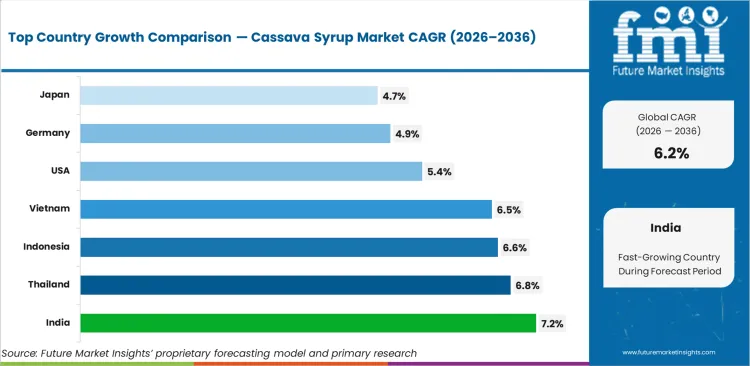
Source: Future Market Insights (FMI) analysis, based on proprietary forecasting model and primary research
Asia Pacific Cassava Syrup Market Analysis
Subsidized extraction facilities across Southeast Asia are currently transforming regional agricultural yields into sophisticated ingredient manufacturing networks. Companies actively upgrade obsolete processing equipment to produce high-margin pharmaceutical-grade sweeteners. Eliminating international freight exposure through raw material proximity stabilizes the cassava syrup demand outlook across the broader region. FMI notes this localization strategy allows regional food brands to secure dedicated supply lines without facing volatile import tariffs.
- India: Domestic processing subsidies heavily incentivize rapid facility modernization across the country. Food manufacturers increasingly source ingredients locally to bypass volatile import tariffs and currency fluctuations. Sales of cassava syrup in India are expected to increase at a CAGR of 7.2% during the forecast period. Selecting a dedicated cassava syrup supplier in India early provides mid-tier manufacturers with long-term volume stability.
- Thailand: Thailand is anticipated to witness demand grow at a CAGR of 6.8% over the forecast period, supported by unmatched raw root volumes and advanced extraction infrastructure. Exporting manufacturers utilize established logistics chains to supply global food brands efficiently. Strategic geographic positioning enables any major cassava syrup supplier Thailand to dictate baseline pricing across neighboring markets. This export dominance effectively anchors the broader regional supply chain.
- Indonesia: Foreign direct investment continues to modernize outdated extraction infrastructure, allowing multinational brands to finance local capacity upgrades directly. Cassava syrup sales in Indonesia are poised to expand at a CAGR of 6.6% from 2026 to 2036. This ongoing capital influx permanently alters regional production capabilities, transitioning the country from a raw material exporter to a sophisticated, high-volume sweetener processing hub.
- Vietnam: Favorable international trade agreements accelerate export volumes directed toward Western manufacturing centers. Buyers actively utilize Vietnamese processing output to diversify sourcing away from traditional dominant hubs and mitigate single-country reliance. Vietnam is projected to witness a 6.5% CAGR in the cassava syrup market from 2026 to 2036. Sustained demand from foreign confectionery brands ensures continuous utilization of newly built extraction capacity.
- Japan: Stringent national quality standards force domestic suppliers to achieve pharmaceutical-grade purity thresholds. Cassava syrup is anticipated to gain momentum in Japan, with demand rising at a CAGR of 4.7% over the forecast period as confectionery formulators require ultra-refined inputs for premium product lines. Manufacturers meeting these exacting purity specifications routinely unlock lucrative long-term contracts, offsetting moderate volume growth with exceptional unit margins.
FMI's report incorporates qualitative assessments of emerging processing hubs scaling across Malaysia and the Philippines. Regional regulatory integration gradually standardizes quality testing protocols across borders, further reducing cross-market sourcing friction for multinational food brands.
North America Cassava Syrup Market Analysis
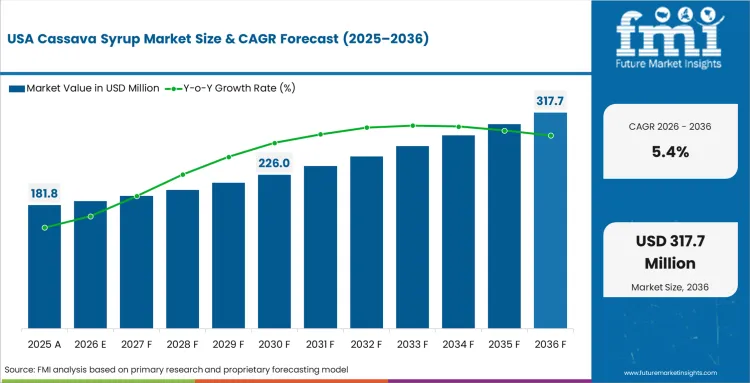
Clean-label consumer pressure dictates ingredient sourcing strategies across major North American food conglomerates. Supermarket purchasing boards actively penalize brands utilizing traditional high-fructose corn sweeteners, forcing rapid recipe alterations. Formulation chemists scramble to secure non-GMO alternatives possessing identical functional properties. FMI's analysis indicates this immediate need for drop-in replacements accelerates substitution timelines significantly across both confectionery and bakery applications.
- United States: Immediate supermarket mandates compel food manufacturers to substitute contentious ingredients rapidly to maintain premium shelf placements. Cassava syrup demand across the United States is set to rise at a 5.4% CAGR through 2036. Early adopters utilizing these alternative sweeteners successfully position themselves as premium clean-label brands. This strategic ingredient swap directly protects market share against emerging allergy-conscious competitor products.
FMI's report includes analysis detailing Canadian formulation trends and parallel clean-label transitions. Cross-border ingredient standards largely mirror United States trajectories, ensuring uniform sourcing strategies across North American food manufacturing networks.
Europe Cassava Syrup Market Analysis
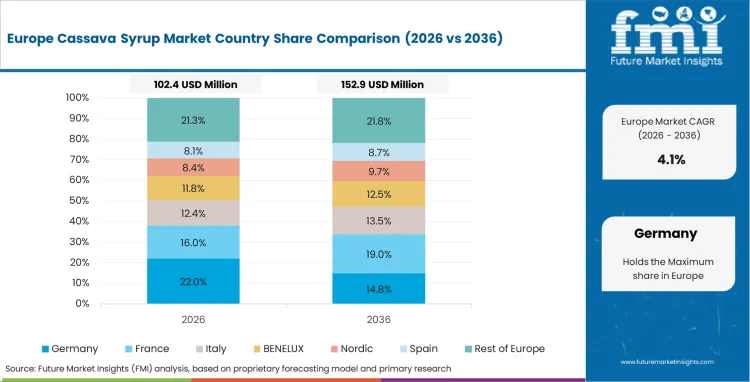
Strict genetically modified organism regulations effectively ban cheap traditional sweeteners from European retail shelves. Confectionery formulators rely entirely on imported alternative syrups to manufacture compliant consumer goods, as domestic root cultivation remains unviable. FMI notes this absolute reliance on foreign processing creates significant cassava syrup sourcing challenges and leaves continental supply chains highly vulnerable to global shipping disruptions.
- Germany: Downstream food manufacturing dominates regional activity, forcing buyers to aggregate massive import volumes to satisfy domestic confectionery production. Germany is expected to register a CAGR of 4.9% through 2036. Managing long-distance logistics remains an ongoing operational hurdle for local facility managers. Securing consistent inbound shipments is critical to preventing costly factory downtime across major industrial bakeries.
FMI's report covers localized import volume analysis spanning France and Italy. Rigid regulatory alignment across European Union member states ensures consistent sweetener substitution patterns and unified clean-label demand profiles across the continent.
Competitive Aligners for Market Players
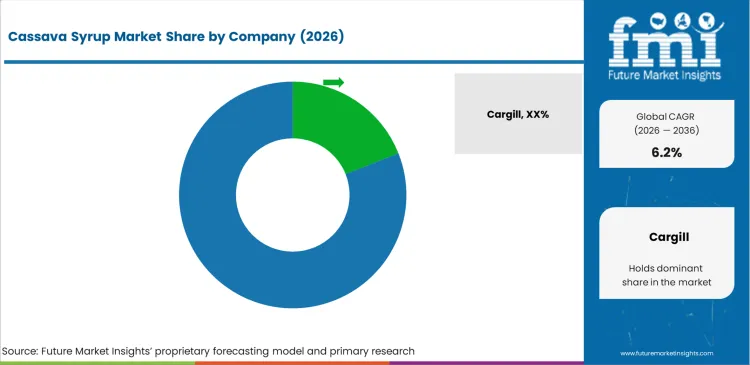
Regional agricultural supply remains fragmented, yet global ingredient distribution is concentrated in the hands of a few multinational suppliers. Cargill, Ingredion maintain strong positions in worldwide distribution because large food manufacturers value logistical dependability, documentation discipline, and consistent delivery windows. Product quality still matters, though mid-tier buyers often stay with established cassava syrup market key players because missed deliveries create more commercial damage than modest price differences. Smaller processors working on their own face a clear disadvantage when global brands require large annual volumes with dependable fulfillment.
Incumbents also benefit from years of accumulated formulation knowledge. When manufacturers change sweetener systems, established application teams can address processing issues quickly and reduce the burden on internal product development teams. Liquid handling adds another barrier for challengers, since safe transport depends on suitable cassava bags, heated storage, and controlled transfer conditions. Suppliers offering similar extracts without deep technical records or troubleshooting experience remain harder to qualify. Buyers are purchasing supply assurance and process support along with the sweetener itself, especially in applications where extrusion or baking performance can fail under tight production conditions.
Large buyers still avoid overdependence on one supplier by qualifying secondary regional processors alongside primary partners. Secondary suppliers, including those testing Japan cassava bags innovations, give buyers added leverage during pricing discussions and contract renewal cycles. Contract allocation is often split across vendors to preserve supply security and keep commercial discipline in place. By 2036, cassava syrup industry analysis is likely to show a clearer divide in processing roles, with large agricultural cooperatives focused on raw extraction and specialized refiners concentrating on complex enzymatic modification and narrower DE profiles.
Key Players in Cassava Syrup Market
- Cargill
- Ingredion
- Ciranda
- Sweetener Products Co.
Scope of the Report
| Metric | Value |
|---|---|
| Quantitative Units | USD 419.5 million to USD 765.5 million, at a CAGR of 6.2% |
| Market Definition | Enzymatically hydrolyzed root starch serves as a clean-label sweetening and binding solution. Buyers specify varying dextrose equivalent grades to replace traditional corn or wheat derivatives in allergy-conscious formulations. |
| Segmentation | Form, DE range, Nature, Application, Channel, Region |
| Regions Covered | North America, Latin America, Europe, East Asia, South Asia, Oceania, Middle East and Africa |
| Countries Covered | India, Thailand, Indonesia, Vietnam, United States, Germany, Japan |
| Key Companies Profiled | Cargill, Ingredion, Ciranda, Sweetener Products Co. |
| Forecast Period | 2026 to 2036 |
| Approach | Commercial starch-processing output volumes tracked against global non-GMO ingredient purchase contracts. |
Source: Future Market Insights (FMI) analysis, based on proprietary forecasting model and primary research
Cassava Syrup Market Analysis by Segments
Form
- Liquid syrup
- Syrup solids
DE range
- 30-45 DE
- Below 30 DE
- Above 45 DE
Nature
- Conventional
- Organic
Application
- Confectionery
- Bakery
- Beverages
- Dairy desserts
- Snacks cereals
Channel
- Direct B2B
- Distributors
- Online specialty
Region:
- North America
- United States
- Canada
- Europe
- Germany
- United Kingdom
- France
- Italy
- Spain
- Asia Pacific
- China
- Japan
- South Korea
- Taiwan
- Singapore
- Latin America
- Brazil
- Mexico
- Argentina
- Middle East & Africa
- GCC Countries
- South Africa
Bibliography
- Food and Agriculture Organization of the United Nations. (2024). Agricultural production statistics 2010-2023.
- Organization for Economic Co-operation and Development, & Food and Agriculture Organization of the United Nations. (2025). OECD-FAO Agricultural Outlook 2025-2034. OECD Publishing.
- Okpalanma, E. F., Ukpong, E. S., Ezegbe, C. C., Nwagbo, C. C., & Chude, C. O. C. (2024). Evaluation of the physico-chemical properties of cassava, cocoyam, sweet potato starches and glucose syrups produced from the hydrolysis of the starches with sorghum malt enzyme extract. Food Science and Applied Biotechnology, 7(1), 24-35.
- Sringarm, C., Numthuam, S., Jiamyangyuen, S., Kittiwachana, S., Saeys, W., & Rungchang, S. (2024). Classification of industrial tapioca starch hydrolysis products based on their brix and dextrose equivalent values using near-infrared spectroscopy. Journal of the Science of Food and Agriculture, 104(12), 7249-7257.
- Cabeza, C., El Gohary Ahmed, A., Minauf, M., Wieland, K., & Harasek, M. (2025). Starch hydrolysates, their impurities and the role of membrane-based technologies as a promising sustainable purification method at industrial scale. Food Research International, 209, 116300.
- Chamorro, A. F., Palencia, M., & Lerma, T. A. (2025). Physicochemical characterization and properties of cassava starch: A review. Polymers, 17(12), 1663.
This bibliography is provided for reader reference. The full FMI report contains the complete reference list with primary source documentation.
This Report Addresses
- Root extraction capacity across major Southeast Asian processing hubs.
- Dextrose equivalent specifications required for confectionery crystallization control.
- Volume differences between conventional farming output and certified organic supplies.
- Technical qualification timelines for replacing high-fructose corn sweeteners.
- Direct B2B purchasing strategies executed by multinational food conglomerates.
- Freight exposure risks associated with shipping bulk liquid formulations globally.
- Premium shelf space positioning enabled by non-GMO ingredient verification.
- Extrusion machinery compatibility metrics for high-viscosity binding agents.
Frequently Asked Questions
Is tapioca syrup the same as cassava syrup?
Yes, these terms describe the identical ingredient. Tapioca represents the extracted starch from the cassava root, which is then enzymatically treated to create the liquid sweetening agent known interchangeably under both names in the tapioca syrup market.
What is cassava syrup used for?
Food manufacturers utilize this ingredient primarily as a gluten-free, non-GMO sweetening and binding agent. It frequently replaces high-fructose corn syrup in confectionery, bakery items, and plant-based dairy formulations demanding clean-label verification.
What volume does liquid syrup represent?
Fluid formulations hold 71.0% share in 2026. Existing food manufacturing facilities possess extensive infrastructure specifically designed for fluid sweeteners, making conversion to powdered alternatives prohibitively expensive.
Why do mid-DE grades dominate purchasing?
Buyers standardizing around 30-45 DE specifications secure 46.0% share in 2026. These specific ranges provide optimal balances between required binding and necessary perceived sweetness.
How does conventional farming compare to organic supply?
Uncertified extracts maintain 74.0% share in 2026. Massive volume requirements at multinational food conglomerates far exceed current certified organic farming outputs available globally.
Which application consumes massive syrup volumes?
Confectionery manufacturing leads with 29.0% share in 2026. Hard candy formulators specifically utilize root derivatives to replace wheat-based glucose, instantly qualifying final products for gluten-free retail placements.
How do corporate buyers source sweetening agents?
Direct B2B transactions control 67.0% share in 2026. Companies demand total supply chain transparency, requiring direct access to agricultural processing facility audit records to satisfy stringent internal compliance mandates.
What advantage drives India?
Domestic processing subsidies incentivize rapid facility modernization, fueling 7.2% compound growth. Food safety directors increasingly source locally to bypass volatile import tariffs.
How does Thailand leverage export networks?
Established agricultural logistics chains supply global buyers efficiently, yielding 6.8% expansion. Strategic positioning allows Thai processors to dictate baseline pricing across neighboring markets.
Why does Indonesia attract foreign capital?
Multinational brands finance local capacity upgrades to secure dedicated supply lines. This direct investment generates 6.6% compound growth while permanently altering regional production capabilities.
How does Vietnam utilize trade agreements?
Favorable export protocols accelerate volume sent to Western markets, driving 6.5% expansion. Supply chain officers utilize Vietnamese production to diversify sourcing away from traditional dominant hubs.
What forces USA buyers toward root derivatives?
Supermarket mandates force immediate recipe alterations, causing steady 5.4% expansion. R&D directors rapidly substitute contentious ingredients to maintain premium shelf placements.
How does Germany manage domestic production?
Firms aggregate massive import volumes to satisfy domestic confectionery demands, resulting in 4.9% growth. Managing long-distance logistics remains an ongoing operational hurdle for German firms.
Why does Japan require specialized processing?
Stringent quality standards force suppliers to achieve pharmaceutical-grade purity, advancing at 4.7%. Buyers meeting exacting specifications unlock highly lucrative long-term contracts.
Why is tapioca syrup demand rising?
Retailers increasingly ban artificial identifiers from ingredient panels. Formulators facing exclusion from premium retail environments prioritize non-GMO verification above marginal pricing differences, driving rapid substitution away from traditional corn derivatives.
What advantage do incumbent distributors hold?
Massive companies possess deep formulation expertise libraries acquired over decades. Application teams provide immediate troubleshooting data, effectively doing technical homework for stretched client engineering departments.
How do mid-tier brands access premium shelves?
Substituting high-fructose corn sweeteners with root-based alternatives achieves verified non-GMO status. Brands leverage this cleaner ingredient deck to justify higher consumer pricing.
Why do powder formats struggle gaining traction?
Incorporating solids requires purchasing separate hydration equipment. Quality assurance supervisors reject formats introducing human error into precise viscosity measurements.
How does freight impact supplier selection?
Shipping fluid extracts means paying to transport heavy moisture content across oceans. Supply chain directors increasingly seek regional processing partners to minimize long-distance transit expenses.
What role does process control play during qualification?
Variable sweetness profiles destroy brand consistency faster than any other raw material defect. Formulators selecting suppliers with poor process control face product recalls.
Why do finance managers restrict organic purchasing?
Premium raw materials carry extreme price markups. Corporate controllers restrict organic purchasing to low-volume boutique product lines to protect overall corporate profitability.
How does viscosity affect extrusion machinery?
Running materials too thick jams forming nozzles, while overly thin mixtures fail to hold shape. Manufacturers misjudging viscosity parameters face millions in wasted production runs.
What risk accompanies generic distributor reliance?
Utilizing intermediaries introduces unacceptable trace-back risks during food safety investigations. Quality assurance directors require primary facility relationships to guarantee immediate batch-tracking capabilities.
How does the cassava starch derivatives market influence syrup production?
Syrup represents a high-value downstream application of raw starch derivatives. When industrial starch processors expand capacity, it directly lowers the input costs for enzymatic hydrolysis, accelerating overall sweetener production scale.
Preview the report firsthand - request a free sample
Get SampleGet the brochure for pricing and purchase details.
Get PDFTable of Content
- Executive Summary
- Global Market Outlook
- Demand-side Trends
- Supply-side Trends
- Technology Roadmap Analysis
- Analysis and Recommendations
- Market Overview
- Market Coverage / Taxonomy
- Market Definition / Scope / Limitations
- Research Methodology
- Chapter Orientation
- Analytical Lens and Working Hypotheses
- Market Structure, Signals, and Trend Drivers
- Benchmarking and Cross-market Comparability
- Market Sizing, Forecasting, and Opportunity Mapping
- Research Design and Evidence Framework
- Desk Research Programme (Secondary Evidence)
- Company Annual and Sustainability Reports
- Peer-reviewed Journals and Academic Literature
- Corporate Websites, Product Literature, and Technical Notes
- Earnings Decks and Investor Briefings
- Statutory Filings and Regulatory Disclosures
- Technical White Papers and Standards Notes
- Trade Journals, Industry Magazines, and Analyst Briefs
- Conference Proceedings, Webinars, and Seminar Materials
- Government Statistics Portals and Public Data Releases
- Press Releases and Reputable Media Coverage
- Specialist Newsletters and Curated Briefings
- Sector Databases and Reference Repositories
- FMI Internal Proprietary Databases and Historical Market Datasets
- Subscription Datasets and Paid Sources
- Social Channels, Communities, and Digital Listening Inputs
- Additional Desk Sources
- Expert Input and Fieldwork (Primary Evidence)
- Primary Modes
- Qualitative Interviews and Expert Elicitation
- Quantitative Surveys and Structured Data Capture
- Blended Approach
- Why Primary Evidence is Used
- Field Techniques
- Interviews
- Surveys
- Focus Groups
- Observational and In-context Research
- Social and Community Interactions
- Stakeholder Universe Engaged
- C-suite Leaders
- Board Members
- Presidents and Vice Presidents
- R&D and Innovation Heads
- Technical Specialists
- Domain Subject-matter Experts
- Scientists
- Physicians and Other Healthcare Professionals
- Governance, Ethics, and Data Stewardship
- Research Ethics
- Data Integrity and Handling
- Primary Modes
- Tooling, Models, and Reference Databases
- Desk Research Programme (Secondary Evidence)
- Data Engineering and Model Build
- Data Acquisition and Ingestion
- Cleaning, Normalisation, and Verification
- Synthesis, Triangulation, and Analysis
- Quality Assurance and Audit Trail
- Market Background
- Market Dynamics
- Drivers
- Restraints
- Opportunity
- Trends
- Scenario Forecast
- Demand in Optimistic Scenario
- Demand in Likely Scenario
- Demand in Conservative Scenario
- Opportunity Map Analysis
- Product Life Cycle Analysis
- Supply Chain Analysis
- Investment Feasibility Matrix
- Value Chain Analysis
- PESTLE and Porter’s Analysis
- Regulatory Landscape
- Regional Parent Market Outlook
- Production and Consumption Statistics
- Import and Export Statistics
- Market Dynamics
- Global Market Analysis 2021 to 2025 and Forecast, 2026 to 2036
- Historical Market Size Value (USD Million) Analysis, 2021 to 2025
- Current and Future Market Size Value (USD Million) Projections, 2026 to 2036
- Y-o-Y Growth Trend Analysis
- Absolute $ Opportunity Analysis
- Global Market Pricing Analysis 2021 to 2025 and Forecast 2026 to 2036
- Global Market Analysis 2021 to 2025 and Forecast 2026 to 2036, By Form
- Introduction / Key Findings
- Historical Market Size Value (USD Million) Analysis By Form , 2021 to 2025
- Current and Future Market Size Value (USD Million) Analysis and Forecast By Form , 2026 to 2036
- Liquid syrup
- Syrup solids
- Liquid syrup
- Y-o-Y Growth Trend Analysis By Form , 2021 to 2025
- Absolute $ Opportunity Analysis By Form , 2026 to 2036
- Global Market Analysis 2021 to 2025 and Forecast 2026 to 2036, By DE Range
- Introduction / Key Findings
- Historical Market Size Value (USD Million) Analysis By DE Range, 2021 to 2025
- Current and Future Market Size Value (USD Million) Analysis and Forecast By DE Range, 2026 to 2036
- 30-45 DE
- Below 30 DE
- Above 45 DE
- 30-45 DE
- Y-o-Y Growth Trend Analysis By DE Range, 2021 to 2025
- Absolute $ Opportunity Analysis By DE Range, 2026 to 2036
- Global Market Analysis 2021 to 2025 and Forecast 2026 to 2036, By Nature
- Introduction / Key Findings
- Historical Market Size Value (USD Million) Analysis By Nature, 2021 to 2025
- Current and Future Market Size Value (USD Million) Analysis and Forecast By Nature, 2026 to 2036
- Conventional
- Organic
- Conventional
- Y-o-Y Growth Trend Analysis By Nature, 2021 to 2025
- Absolute $ Opportunity Analysis By Nature, 2026 to 2036
- Global Market Analysis 2021 to 2025 and Forecast 2026 to 2036, By Application
- Introduction / Key Findings
- Historical Market Size Value (USD Million) Analysis By Application, 2021 to 2025
- Current and Future Market Size Value (USD Million) Analysis and Forecast By Application, 2026 to 2036
- Confectionery
- Bakery
- Beverages
- Dairy desserts
- Snacks cereals
- Confectionery
- Y-o-Y Growth Trend Analysis By Application, 2021 to 2025
- Absolute $ Opportunity Analysis By Application, 2026 to 2036
- Global Market Analysis 2021 to 2025 and Forecast 2026 to 2036, By Channel
- Introduction / Key Findings
- Historical Market Size Value (USD Million) Analysis By Channel, 2021 to 2025
- Current and Future Market Size Value (USD Million) Analysis and Forecast By Channel, 2026 to 2036
- Direct B2B
- Distributors
- Online specialty
- Direct B2B
- Y-o-Y Growth Trend Analysis By Channel, 2021 to 2025
- Absolute $ Opportunity Analysis By Channel, 2026 to 2036
- Global Market Analysis 2021 to 2025 and Forecast 2026 to 2036, By Region
- Introduction
- Historical Market Size Value (USD Million) Analysis By Region, 2021 to 2025
- Current Market Size Value (USD Million) Analysis and Forecast By Region, 2026 to 2036
- North America
- Latin America
- Western Europe
- Eastern Europe
- East Asia
- South Asia and Pacific
- Middle East & Africa
- Market Attractiveness Analysis By Region
- North America Market Analysis 2021 to 2025 and Forecast 2026 to 2036, By Country
- Historical Market Size Value (USD Million) Trend Analysis By Market Taxonomy, 2021 to 2025
- Market Size Value (USD Million) Forecast By Market Taxonomy, 2026 to 2036
- By Country
- USA
- Canada
- Mexico
- By Form
- By DE Range
- By Nature
- By Application
- By Channel
- By Country
- Market Attractiveness Analysis
- By Country
- By Form
- By DE Range
- By Nature
- By Application
- By Channel
- Key Takeaways
- Latin America Market Analysis 2021 to 2025 and Forecast 2026 to 2036, By Country
- Historical Market Size Value (USD Million) Trend Analysis By Market Taxonomy, 2021 to 2025
- Market Size Value (USD Million) Forecast By Market Taxonomy, 2026 to 2036
- By Country
- Brazil
- Chile
- Rest of Latin America
- By Form
- By DE Range
- By Nature
- By Application
- By Channel
- By Country
- Market Attractiveness Analysis
- By Country
- By Form
- By DE Range
- By Nature
- By Application
- By Channel
- Key Takeaways
- Western Europe Market Analysis 2021 to 2025 and Forecast 2026 to 2036, By Country
- Historical Market Size Value (USD Million) Trend Analysis By Market Taxonomy, 2021 to 2025
- Market Size Value (USD Million) Forecast By Market Taxonomy, 2026 to 2036
- By Country
- Germany
- UK
- Italy
- Spain
- France
- Nordic
- BENELUX
- Rest of Western Europe
- By Form
- By DE Range
- By Nature
- By Application
- By Channel
- By Country
- Market Attractiveness Analysis
- By Country
- By Form
- By DE Range
- By Nature
- By Application
- By Channel
- Key Takeaways
- Eastern Europe Market Analysis 2021 to 2025 and Forecast 2026 to 2036, By Country
- Historical Market Size Value (USD Million) Trend Analysis By Market Taxonomy, 2021 to 2025
- Market Size Value (USD Million) Forecast By Market Taxonomy, 2026 to 2036
- By Country
- Russia
- Poland
- Hungary
- Balkan & Baltic
- Rest of Eastern Europe
- By Form
- By DE Range
- By Nature
- By Application
- By Channel
- By Country
- Market Attractiveness Analysis
- By Country
- By Form
- By DE Range
- By Nature
- By Application
- By Channel
- Key Takeaways
- East Asia Market Analysis 2021 to 2025 and Forecast 2026 to 2036, By Country
- Historical Market Size Value (USD Million) Trend Analysis By Market Taxonomy, 2021 to 2025
- Market Size Value (USD Million) Forecast By Market Taxonomy, 2026 to 2036
- By Country
- China
- Japan
- South Korea
- By Form
- By DE Range
- By Nature
- By Application
- By Channel
- By Country
- Market Attractiveness Analysis
- By Country
- By Form
- By DE Range
- By Nature
- By Application
- By Channel
- Key Takeaways
- South Asia and Pacific Market Analysis 2021 to 2025 and Forecast 2026 to 2036, By Country
- Historical Market Size Value (USD Million) Trend Analysis By Market Taxonomy, 2021 to 2025
- Market Size Value (USD Million) Forecast By Market Taxonomy, 2026 to 2036
- By Country
- India
- ASEAN
- Australia & New Zealand
- Rest of South Asia and Pacific
- By Form
- By DE Range
- By Nature
- By Application
- By Channel
- By Country
- Market Attractiveness Analysis
- By Country
- By Form
- By DE Range
- By Nature
- By Application
- By Channel
- Key Takeaways
- Middle East & Africa Market Analysis 2021 to 2025 and Forecast 2026 to 2036, By Country
- Historical Market Size Value (USD Million) Trend Analysis By Market Taxonomy, 2021 to 2025
- Market Size Value (USD Million) Forecast By Market Taxonomy, 2026 to 2036
- By Country
- Kingdom of Saudi Arabia
- Other GCC Countries
- Turkiye
- South Africa
- Other African Union
- Rest of Middle East & Africa
- By Form
- By DE Range
- By Nature
- By Application
- By Channel
- By Country
- Market Attractiveness Analysis
- By Country
- By Form
- By DE Range
- By Nature
- By Application
- By Channel
- Key Takeaways
- Key Countries Market Analysis
- USA
- Pricing Analysis
- Market Share Analysis, 2025
- By Form
- By DE Range
- By Nature
- By Application
- By Channel
- Canada
- Pricing Analysis
- Market Share Analysis, 2025
- By Form
- By DE Range
- By Nature
- By Application
- By Channel
- Mexico
- Pricing Analysis
- Market Share Analysis, 2025
- By Form
- By DE Range
- By Nature
- By Application
- By Channel
- Brazil
- Pricing Analysis
- Market Share Analysis, 2025
- By Form
- By DE Range
- By Nature
- By Application
- By Channel
- Chile
- Pricing Analysis
- Market Share Analysis, 2025
- By Form
- By DE Range
- By Nature
- By Application
- By Channel
- Germany
- Pricing Analysis
- Market Share Analysis, 2025
- By Form
- By DE Range
- By Nature
- By Application
- By Channel
- UK
- Pricing Analysis
- Market Share Analysis, 2025
- By Form
- By DE Range
- By Nature
- By Application
- By Channel
- Italy
- Pricing Analysis
- Market Share Analysis, 2025
- By Form
- By DE Range
- By Nature
- By Application
- By Channel
- Spain
- Pricing Analysis
- Market Share Analysis, 2025
- By Form
- By DE Range
- By Nature
- By Application
- By Channel
- France
- Pricing Analysis
- Market Share Analysis, 2025
- By Form
- By DE Range
- By Nature
- By Application
- By Channel
- India
- Pricing Analysis
- Market Share Analysis, 2025
- By Form
- By DE Range
- By Nature
- By Application
- By Channel
- ASEAN
- Pricing Analysis
- Market Share Analysis, 2025
- By Form
- By DE Range
- By Nature
- By Application
- By Channel
- Australia & New Zealand
- Pricing Analysis
- Market Share Analysis, 2025
- By Form
- By DE Range
- By Nature
- By Application
- By Channel
- China
- Pricing Analysis
- Market Share Analysis, 2025
- By Form
- By DE Range
- By Nature
- By Application
- By Channel
- Japan
- Pricing Analysis
- Market Share Analysis, 2025
- By Form
- By DE Range
- By Nature
- By Application
- By Channel
- South Korea
- Pricing Analysis
- Market Share Analysis, 2025
- By Form
- By DE Range
- By Nature
- By Application
- By Channel
- Russia
- Pricing Analysis
- Market Share Analysis, 2025
- By Form
- By DE Range
- By Nature
- By Application
- By Channel
- Poland
- Pricing Analysis
- Market Share Analysis, 2025
- By Form
- By DE Range
- By Nature
- By Application
- By Channel
- Hungary
- Pricing Analysis
- Market Share Analysis, 2025
- By Form
- By DE Range
- By Nature
- By Application
- By Channel
- Kingdom of Saudi Arabia
- Pricing Analysis
- Market Share Analysis, 2025
- By Form
- By DE Range
- By Nature
- By Application
- By Channel
- Turkiye
- Pricing Analysis
- Market Share Analysis, 2025
- By Form
- By DE Range
- By Nature
- By Application
- By Channel
- South Africa
- Pricing Analysis
- Market Share Analysis, 2025
- By Form
- By DE Range
- By Nature
- By Application
- By Channel
- USA
- Market Structure Analysis
- Competition Dashboard
- Competition Benchmarking
- Market Share Analysis of Top Players
- By Region
- By Form
- By DE Range
- By Nature
- By Application
- By Channel
- Competition Analysis
- Competition Deep Dive
- Cargill
- Overview
- Product Portfolio
- Profitability by Market Segments (Product/Age /Sales Channel/Region)
- Sales Footprint
- Strategy Overview
- Marketing Strategy
- Product Strategy
- Channel Strategy
- Ingredion
- Ciranda
- Sweetener Products Co.
- Cargill
- Competition Deep Dive
- Assumptions & Acronyms Used


