

- Market Size (2026)
- USD 3.2 Bn
- Forecast (2036)
- USD 4.9 Bn
- CAGR (2026 to 2036)
- 4.3%
Chocolate Syrup Market Size, Market Forecast and Outlook By FMI
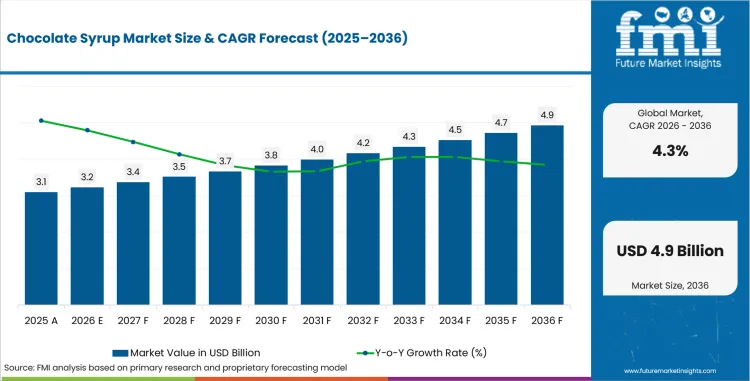
The chocolate syrup market was valued at USD 3.1 billion in 2025. The market is set to reach USD 3.2 billion by 2026-end and grow at a CAGR of 4.3% between 2026-2036 to reach USD 4.9 billion by 2036. Chocolate Syrup will dominate with a 48.0% share, while Dessert Toppings will lead with a 46.0% share.
Key Takeaways, Market Size, and Forecast
- 2026 Market Size: USD 3.2 Billion
- 2036 Market Size: USD 4.9 Billion
- Compound Annual Growth Rate (CAGR): 4.3% from 2026 to 2036
- Absolute $ Opportunity: USD 1.7 Billion between 2026 and 2036
- Leading Product Segment: Chocolate Syrup
- Chocolate Syrup Share in 2026: 48.0%
- Fastest-growing Country: China
- China CAGR: 5.8% through 2036
| Parameter | Details |
|---|---|
| Market Size in 2026 (Value) | USD 3.2 Billion |
| Market Forecast in 2036 (Value) | USD 4.9 Billion |
| CAGR (2026 to 2036) | 4.3% |
| Years Considered | 2021 to 2036 |
| Base Year | 2025 |
| Forecast Period | 2026 to 2036 |
| Units Considered | Value (USD Billion) |
| Leading Sub-Region | China |
Summary of the Chocolate Syrup Market
- Demand and Growth Drivers
- Retail consumer demand for chocolate syrup is shaped by dessert topping usage in household ice cream, pancake, and beverage applications, with mid-range pricing positioning the category as an accessible indulgence product across income segments.
- Foodservice and QSR channel procurement is supporting steady demand for portion-controlled chocolate syrup formats used in beverage preparation, dessert finishing, and bakery applications across coffee chains and restaurant operators.
- Growth reflects the premiumization of chocolate syrup product lines, with clean-label, organic, and sugar-free variants expanding shelf presence in health-conscious consumer segments.
- Product and Segment View
- Chocolate Syrup accounts for 48.0% of the product segment in 2026, with traditional chocolate syrup maintaining the dominant position across household and foodservice dessert topping applications.
- Dessert Toppings is likely to remain the leading application category, with dessert toppings accounting for the largest application volume across retail consumer and foodservice channels.
- Retail Consumers is expected to account for 51.0% of the end use segment, with household consumers representing the primary purchasing demographic for retail-packaged chocolate syrup products.
- Geography and Competitive Outlook
- China is expected to lead growth at 5.8% through 2036, reflecting the expansion of Western-style dessert culture, cafe chain proliferation, and increasing household penetration of chocolate syrup products.
- India at 5.4% reflects demand shaped by urbanization, organized retail expansion, and the adoption of chocolate syrup in emerging dessert and beverage applications.
- Companies with established retail brand recognition, foodservice packaging capability, and the ability to offer clean-label and sugar-free variants across price tiers are positioned to capture share.
- Analyst Opinion
- Nandini Roy Choudhury, Principal Consultant at FMI says, 'Chocolate syrup brands that can maintain mid-range price accessibility while introducing clean-label and reduced-sugar variants are positioned to expand household penetration in emerging markets where dessert culture adoption is accelerating.'
- The chocolate syrup market is evolving from a commodity dessert condiment to a segmented category with premium, organic, and functional variants competing alongside traditional formulations.
- Adoption is supported by the global expansion of coffee chain and dessert cafe culture, which creates foodservice demand for portion-controlled chocolate syrup in beverage and dessert preparation.
- Indirect sales channels dominate distribution, reflecting the retail grocery procurement structure where supermarket and hypermarket shelf placement drives the majority of household purchasing volume.
Chocolate Syrup Market Definition
The chocolate syrup market encompasses commercially traded products categorized by product, application, end use, technology, distribution channel, pricing tier. Core categories include chocolate syrup, dessert toppings, beverages, household consumption, retail consumers, food service industry, food processing industry, processing technology, and related formulations. The market covers revenue from 2026 to 2036 across all distribution and end-use channels.
Chocolate Syrup Market Inclusions
Market scope encompasses all commercially traded chocolate syrup products categorized by product (chocolate syrup), application (dessert toppings, beverages, household consumption, food service), end use (retail consumers, food service industry, food processing industry), technology (processing technology, formulation technology, preservation technology), distribution channel (indirect sales, direct sales), pricing tier (mid range pricing, economy pricing, premium pricing). Revenue coverage spans 2026 to 2036.
Chocolate Syrup Market Exclusions
The scope does not include raw unprocessed or non-commercial-grade chocolate syrup products sold outside organized trade channels. Products intended exclusively for non-commercial research or laboratory use are excluded.
Chocolate Syrup Market Research Methodology
- Primary Research: FMI analysts conducted interviews with chocolate syrup producers, processors, distributors, and end-use specialists in key markets.
- Desk Research: Combined data from industry associations, regulatory databases, certification bodies, and manufacturer disclosures.
- Market Sizing and Forecasting: Bottom-up aggregation across product, application, end use, technology, distribution channel, pricing tier segments, triangulated with trade and production data.
- Data Validation: Cross-checked quarterly against production data, trade statistics, and manufacturer capacity utilization.
Why is the Chocolate Syrup Market Growing?
- Western-style dessert culture adoption and cafe chain expansion in emerging markets are creating new consumption occasions for chocolate syrup in household and foodservice applications.
- Clean-label and sugar-free product development is expanding the addressable market for chocolate syrup among health-conscious consumers who previously avoided traditional formulations.
- China leads growth at 5.8%, reflecting rapid dessert culture adoption, cafe chain proliferation, and increasing household penetration of chocolate syrup through organized retail and e-commerce channels.
The chocolate syrup market is expanding as dessert consumption patterns evolve across developing economies and product premiumization creates new segments in mature markets. Traditional chocolate syrup maintains the dominant product position, serving household ice cream topping, beverage mixing, and pancake applications. Dessert toppings lead application demand, with retail consumers purchasing chocolate syrup primarily for home dessert preparation. Mid-range pricing positions the category as accessible across income segments, supporting household penetration growth in urbanizing markets.
Growth is further supported by the foodservice channel, where coffee chains, dessert cafes, and QSR operators specify chocolate syrup in standardized beverage and dessert preparation protocols. Indirect sales through supermarkets and hypermarkets dominate retail distribution. Regional demand variation reflects differences in chocolate consumption culture, dessert tradition maturity, and the pace of Western-style food culture adoption. China and India represent the strongest growth corridors, driven by urbanization, organized retail expansion, and the proliferation of cafe and dessert culture in urban centers.
Market Segmentation Analysis
- Chocolate Syrup accounts for 48.0% of the product segment in 2026.
- Retail Consumers leads the end use segment at 51.0% share.
- Processing Technology accounts for 57.0% of the technology segment.
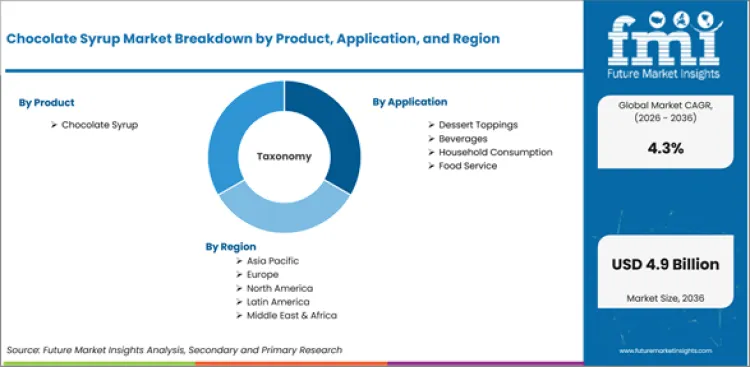
The chocolate syrup market is segmented by product, application, end use, technology, distribution channel, pricing tier. By product, segments include Chocolate Syrup. By application, segments include Dessert Toppings, Beverages, Household Consumption, Food Service. By end use, segments include Retail Consumers, Food Service Industry, Food Processing Industry. By technology, segments include Processing Technology, Formulation Technology, Preservation Technology. By distribution channel, segments include Indirect Sales, Direct Sales. By pricing tier, segments include Mid Range Pricing, Economy Pricing, Premium Pricing.
Insights into the Chocolate Syrup Product Segment
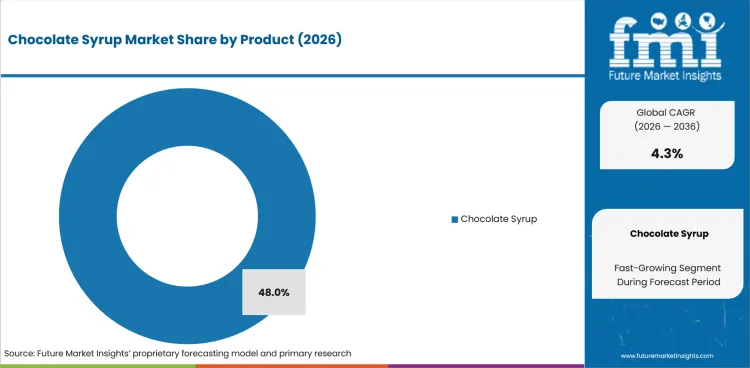
Chocolate Syrup is expected to account for 48.0% of the product segment in 2026. Key sub-categories include regular chocolate syrup, sugar free chocolate syrup, organic chocolate syrup, each serving distinct requirements. Demand is concentrated in commercial and institutional channels where consistency and compliance are primary criteria.
Procurement for chocolate syrup products is shaped by downstream requirements, performance targets, and compatibility with existing systems. Suppliers with certified quality management and consistent output are gaining preference.
Insights into the Dessert Toppings Application Segment
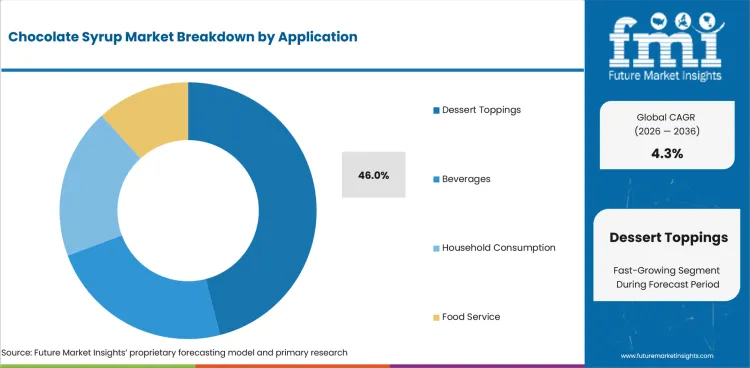
Dessert Toppings is expected to account for 46.0% of the application segment in 2026. Key sub-categories include ice cream toppings, bakery and confectionery, milk based drinks, each serving distinct requirements. Demand is concentrated in commercial and institutional channels where consistency and compliance are primary criteria.
Procurement for dessert toppings products is shaped by downstream requirements, performance targets, and compatibility with existing systems. Suppliers with certified quality management and consistent output are gaining preference.
Chocolate Syrup Market Drivers, Restraints, and Opportunities
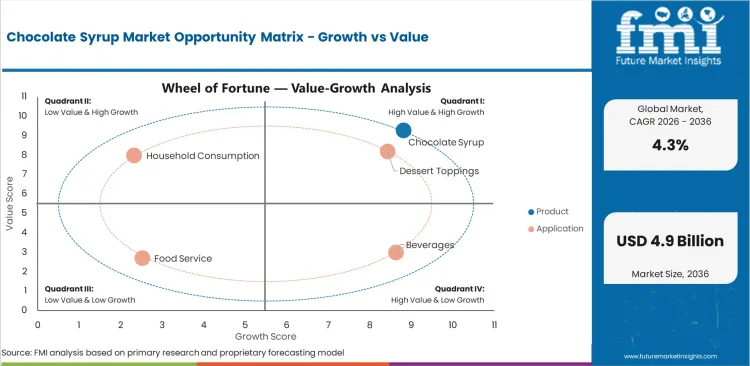
- Dessert Culture Adoption in Emerging Markets is the primary structural demand driver for chocolate syrup products across commercial channels.
- Clean-Label and Sugar-Free Reformulation constrains adoption in certain segments, concentrating procurement among established suppliers.
- Foodservice Channel Standardization is expanding higher-value application segments.
The chocolate syrup market is expanding on the basis of dessert culture adoption in emerging markets, foodservice channel standardization, and evolving distribution patterns. Clean-Label and Sugar-Free Reformulation remains a constraining factor.
Dessert Culture Adoption in Emerging Markets
Demand is shaped by the adoption of Western-style dessert traditions in urbanizing Asian and Latin American markets, where chocolate syrup consumption is expanding from imported specialty to mainstream household pantry staple.
Clean-Label and Sugar-Free Reformulation
Adoption is supported by the development of organic, sugar-free, and reduced-calorie chocolate syrup variants that address health-conscious consumer segments. These premium products command higher retail prices while expanding the category beyond traditional indulgence positioning.
Foodservice Channel Standardization
Growth reflects the expansion of cafe chains, dessert shops, and QSR operators that specify chocolate syrup in standardized preparation protocols. Portion-controlled packaging and consistent viscosity requirements drive foodservice procurement specifications.
Cocoa Price Volatility and Input Cost Pressure
Procurement is constrained by cocoa commodity price fluctuations that directly affect chocolate syrup manufacturing costs. Mid-range pricing positioning limits the ability to pass through input cost increases, creating margin pressure during cocoa price spikes.
Analysis of Chocolate Syrup Market By Key Countries
.webp "Top Country Growth Comparison Chocolate Syrup Market Cagr (2026 2036)")
| Country | CAGR |
|---|---|
| China | 5.8% |
| India | 5.4% |
| Germany | 5.0% |
| Brazil | 4.5% |
| USA | 4.1% |
| UK | 3.7% |
| Japan | 3.2% |
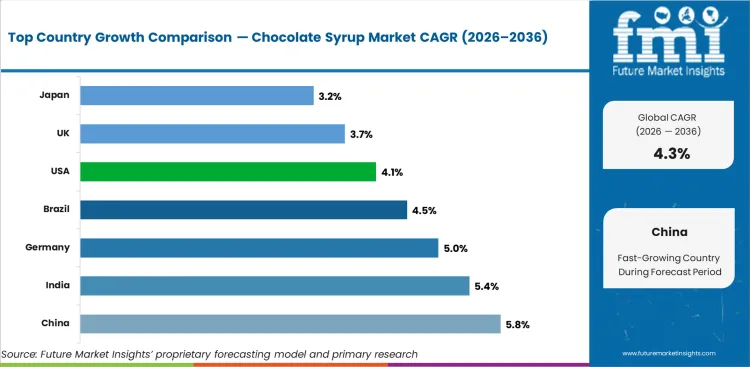
- China leads at 5.8%, reflecting strong domestic demand and expanding commercial channels for chocolate syrup products.
- India at 5.4% reflects steady demand shaped by regulatory compliance and institutional procurement.
- Germany (5.0%) shows growth driven by market modernization and specification-led sourcing.
- Brazil (4.5%) shows growth driven by market modernization and specification-led sourcing.
The global chocolate syrup market is projected to expand at 4.3% CAGR from 2026 to 2036. The analysis covers more than 30 countries, with key markets listed below.
Opportunity Analysis of Chocolate Syrup Market in China
The scale of China's cafe and dessert culture expansion is supporting growth at 5.8% through 2036. E-commerce logistics platforms and food delivery infrastructure are broadening distribution for retail chocolate syrup products, while domestic manufacturers offer cost-competitive alternatives to imported premium brands.
- Cafe chain proliferation and dessert culture adoption are creating new consumption occasions for chocolate syrup in urban centers.
- E-commerce and food delivery platforms are the fastest-growing distribution channels for retail chocolate syrup products.
- Domestic manufacturer cost advantages enable competitive mid-range pricing that supports household penetration growth.
In-depth Analysis of Chocolate Syrup Market in India
Demand for chocolate syrup in India is expanding at 5.4% through 2036, shaped by urbanization, organized retail growth, and the adoption of chocolate as a mainstream dessert flavor beyond traditional confectionery. Tier-2 and tier-3 city distribution expansion and e-commerce channels are broadening consumer access to branded chocolate syrup products.
- Urbanization and rising disposable incomes are supporting adoption of chocolate syrup as a household dessert staple in metro and tier-2 cities.
- E-commerce and organized retail channels are broadening distribution beyond metro areas into semi-urban consumer markets.
- Domestic manufacturing and PLI scheme support for food processing are enabling competitive retail pricing for chocolate syrup products.
Sales Analysis of Chocolate Syrup Market in Germany
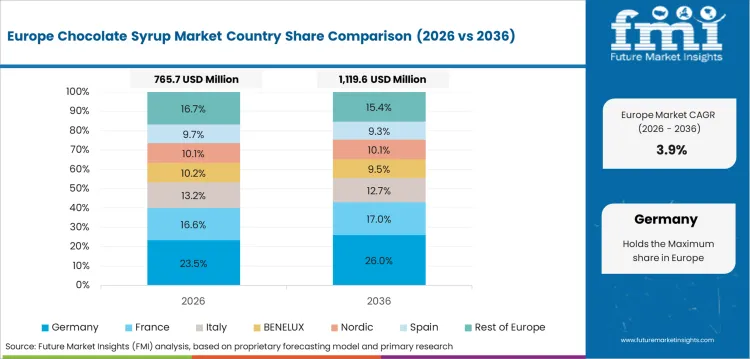
Regulatory standards shaped by EU food labeling and organic certification requirements are influencing chocolate syrup procurement in Germany, projected to grow at 5.0% through 2036. Retailer sustainability commitments and consumer preference for premium and organic chocolate products shape product positioning and sourcing decisions.
- EU organic certification and clean-label requirements are shaping premium chocolate syrup product development and retail positioning.
- Retailer consolidation and sustainability commitments drive procurement toward suppliers with documented cocoa sourcing traceability.
- EPR and Ecodesign compliance are influencing packaging decisions for chocolate syrup across retail and foodservice channels.
Growth Analysis of Chocolate Syrup Market in Brazil
Brazil is projected to grow at 4.5% through 2036. A large domestic chocolate consumption base and modern retail expansion are supporting volume growth for chocolate syrup in household and foodservice applications. Price sensitivity in commodity segments shapes product positioning toward mid-range formulations.
- Large domestic chocolate consumption culture provides a structural volume base for chocolate syrup across household applications.
- Modern retail expansion and supermarket chain growth are broadening chocolate syrup shelf access in urban and semi-urban markets.
- Price sensitivity in the consumer market favors mid-range chocolate syrup positioning with accessible packaging sizes.
Demand Outlook for Chocolate Syrup Market in USA
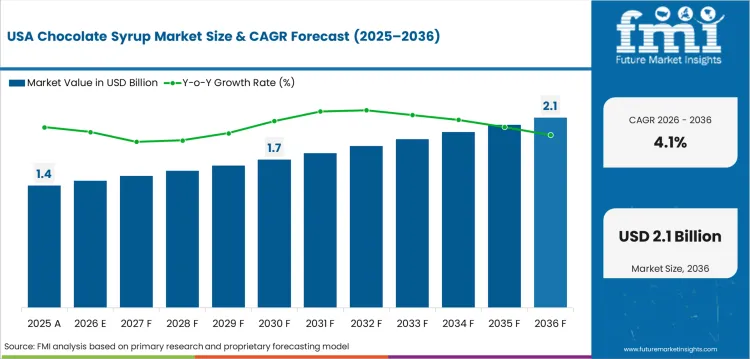
The USA is projected to register a CAGR of 4.1% through 2036. The mature domestic market is evolving through clean-label, organic, and sugar-free product innovation that expands the addressable consumer base. Sustainability mandates and retailer requirements are reshaping ingredient specifications and packaging standards for chocolate syrup brands.
- Clean-label and sugar-free reformulation is expanding the addressable consumer base beyond traditional chocolate syrup households.
- Sustainability mandates and recyclability targets are influencing packaging decisions for retail chocolate syrup products.
- Foodservice channel demand from coffee chains and dessert operators supports steady volume for portion-controlled formats.
Future Outlook for Chocolate Syrup Market in UK
Post-Brexit packaging regulations and retailer sustainability targets are reshaping chocolate syrup procurement in the UK, projected to grow at 3.7% through 2036. Clean-label consumer demand and the premium chocolate culture support product innovation in organic and sugar-free chocolate syrup variants.
- UK Plastics Tax and post-Brexit labeling regulations are reshaping packaging standards for imported chocolate syrup brands.
- Retailer sustainability targets are influencing cocoa sourcing traceability requirements for chocolate syrup suppliers.
- Premium chocolate culture and health-conscious consumer segments support demand for organic and reduced-sugar variants.
Competitive Landscape and Strategic Positioning
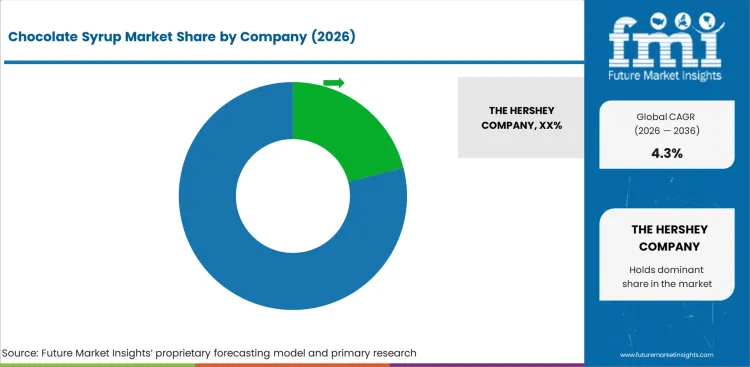
- THE HERSHEY COMPANY leads through established brand recognition, distribution reach, and product portfolio breadth across key end use channels.
- Nestlé S.A. and Bosco Products, Inc. compete on product specialization, regional coverage, and formulation expertise.
- Emerging players target niche segments, clean-label positioning, and regional specialty applications.
THE HERSHEY COMPANY maintains a strong position through brand equity, distribution infrastructure, and established procurement relationships. Nestlé S.A. offers a complementary portfolio.
Bosco Products, Inc. competes on quality, certification, and regional distribution. Mid-tier players focus on niche segments or specific application expertise.
Barriers include brand development investment, regulatory compliance, established retailer relationships, and distribution infrastructure. Strategic priorities include premiumization, emerging market expansion, and product innovation.
Key Companies in the Chocolate Syrup Market
Key global companies leading the chocolate syrup market include:
- THE HERSHEY COMPANY, Nestlé S.A., Bosco Products, Inc., Walden Farms maintain leading positions through scale, brand recognition, and distribution infrastructure.
- AH!LASKA, THE J. M. SMUCKER COMPANY, Santa Cruz Natural Incorporated have established regional leadership through focused distribution and product specialization.
Competitive Benchmarking: Chocolate Syrup Market
| Company | Brand Portfolio | Foodservice Capability | Clean-Label Range | Geographic Footprint |
|---|---|---|---|---|
| THE HERSHEY COMPANY | High | Medium | Strong | Global |
| Nestlé S.A. | High | Medium | Strong | Global |
| Bosco Products, Inc. | High | Medium | Strong | Global |
| Walden Farms | Medium | Medium | Moderate | Multi-regional |
| AH!LASKA | Medium | High | Moderate | Multi-regional |
| THE J. M. SMUCKER COMPANY | Medium | High | Moderate | Multi-regional |
| Santa Cruz Natural Incorporated | Low | High | Low | Regional |
Source: Future Market Insights competitive analysis, 2026.
Key Developments in Chocolate Syrup Market
- In 2025, THE HERSHEY COMPANY expanded its chocolate syrup portfolio with new formulations targeting end use applications.
- In 2025, Nestlé S.A. invested in capacity expansion to support growing demand for certified chocolate syrup products across key regional markets.
Key Players in the Chocolate Syrup Market
Major Global Players
- THE HERSHEY COMPANY
- Nestlé S.A.
- Bosco Products, Inc.
- Walden Farms
- AH!LASKA
Emerging Players/Startups
- RxSugar
- ChocZero
- Moka Origins
Report Scope and Coverage
| Parameter | Details |
|---|---|
| Market size by 2036 | USD 4.9 Billion |
| Growth rate | 4.3% CAGR (2026 to 2036) |
| Forecast period | 2026 to 2036 |
| Base year value (2025) | USD 3.1 Billion |
| Key Segment Covered | Product, Application, End Use, Technology, Distribution Channel, Pricing Tier |
| Regions covered | North America, Latin America, Western Europe, Eastern Europe, East Asia, South Asia and Pacific, Middle East and Africa |
| Countries covered | USA, China, India, Germany, Brazil, UK, Japan, 30 plus countries |
| Key companies profiled | THE HERSHEY COMPANY, Nestlé S.A., Bosco Products, Inc., Walden Farms, AH!LASKA, THE J. M. SMUCKER COMPANY, Santa Cruz Natural Incorporated |
| Approach | Hybrid bottom-up and top-down methodology starting with verified transaction data, projecting adoption velocity across segments and regions. |
Market Segmentation Analysis
Chocolate Syrup Market Segmented by Product:
- Chocolate Syrup
- Regular Chocolate Syrup
- Standard Cocoa Based
- Blended Cocoa Formulations
- Sugar Free Chocolate Syrup
- Artificial Sweetener Based
- Natural Sweetener Based
- Organic Chocolate Syrup
- Certified Organic
- Clean Label Formulations
- Functional Chocolate Syrup
- Protein Enriched
- Fortified Syrups
- Regular Chocolate Syrup
Chocolate Syrup Market Segmented by Application:
- Dessert Toppings
- Ice Cream Toppings
- Retail Ice Cream Use
- Food Service Use
- Bakery and Confectionery
- Cakes and Pastries
- Donuts and Muffins
- Ice Cream Toppings
- Beverages
- Milk Based Drinks
- Chocolate Milk
- Flavored Milkshakes
- Coffee and Specialty Drinks
- Mocha Beverages
- Cold Coffee Drinks
- Milk Based Drinks
- Household Consumption
- Home Usage
- Direct Consumption
- Recipe Ingredient Use
- Home Usage
- Food Service
- Quick Service Restaurants
- Dessert Chains
- Beverage Chains
- Full Service Restaurants
- Casual Dining
- Fine Dining
- Quick Service Restaurants
Chocolate Syrup Market Segmented by End Use:
- Retail Consumers
- Individual Buyers
- Urban Consumers
- Family Consumption
- Health Conscious Consumers
- Low Sugar Preference
- Organic Preference
- Individual Buyers
- Food Service Industry
- Restaurants and Cafes
- Quick Service Restaurants
- Specialty Cafes
- Ice Cream Parlors
- Chain Outlets
- Independent Stores
- Restaurants and Cafes
- Food Processing Industry
- Bakery Manufacturers
- Industrial Bakeries
- Artisan Bakeries
- Beverage Manufacturers
- Dairy Beverage Producers
- Ready to Drink Producers
- Bakery Manufacturers
Chocolate Syrup Market Segmented by Technology:
- Processing Technology
- Conventional Processing 57%
- Batch Processing
- Continuous Processing
- Advanced Processing
- High Shear Mixing
- Homogenization
- Conventional Processing 57%
- Formulation Technology
- Liquid Syrup Formulation 64%
- Ready to Use Syrups
- Concentrated Syrups
- Clean Label Formulation
- Natural Ingredients
- Additive Free Formulations
- Liquid Syrup Formulation 64%
- Preservation Technology
- Conventional Preservation
- Chemical Preservatives
- Shelf Life Stabilizers
- Advanced Preservation
- Aseptic Processing
- Natural Preservation Methods
- Conventional Preservation
Chocolate Syrup Market Segmented by Distribution Channel:
- Indirect Sales
- Supermarkets and Hypermarkets
- Large Retail Chains
- Regional Retail Chains
- Convenience Stores
- Urban Stores
- Fuel Station Stores
- Online Retail
- E Commerce Platforms
- Brand Websites
- Supermarkets and Hypermarkets
- Direct Sales
- Manufacturer Direct
- Bulk Supply
- Food Service Contracts
- Manufacturer Direct
Chocolate Syrup Market Segmented by Pricing Tier:
- Mid Range Pricing
- Standard Products
- Mainstream Flavors
- Balanced Quality
- Standard Products
- Economy Pricing
- Value Products
- Low Cost Formulations
- Bulk Packs
- Value Products
- Premium Pricing
- Premium Chocolate Syrups
- High Cocoa Content
- Organic and Specialty Syrups
- Premium Chocolate Syrups
Chocolate Syrup Market by Region:
- North America
- USA
- Canada
- Mexico
- Latin America
- Brazil
- Chile
- Rest of Latin America
- Western Europe
- Germany
- UK
- Italy
- Spain
- France
- Nordic
- BENELUX
- Rest of Western Europe
- Eastern Europe
- Russia
- Poland
- Hungary
- Balkan & Baltic
- Rest of Eastern Europe
- East Asia
- China
- Japan
- South Korea
- South Asia and Pacific
- India
- ASEAN
- Australia & New Zealand
- Rest of South Asia and Pacific
- Middle East & Africa
- Kingdom of Saudi Arabia
- Other GCC Countries
- Türkiye
- South Africa
- Other African Union
- Rest of Middle East & Africa
Research Sources and Bibliography
- 1. Food and Agriculture Organization. (2025). FAO Global Food and Agriculture Statistics. FAO.
- 2. World Health Organization. (2025). WHO Global Health Observatory Data Repository. WHO.
- 3. International Organization for Standardization. (2025). ISO Food Safety Management Standards. ISO.
- 4. USA Food and Drug Administration. (2025). FDA Food Safety Modernization Act Compliance Guide. FDA.
- 5. European Commission. (2025). EU Food Safety and Quality Standards Framework. EC.
This bibliography is provided for reader reference.
This Report Answers
- Estimating the size of the market and revenue from 2026 to 2036.
- Segmenting by product, application, end use, technology, distribution channel, pricing tier.
- Insights about more than 30 markets in the region.
- Analysis of demand drivers, restraints, and growth opportunities.
- Assessment of the competitive landscape.
- Finding investment opportunities across key application and end-use segments.
- Tracking supply chain and distribution channel developments.
- Delivery of data in PDF and Excel formats.
Frequently Asked Questions
How big is the chocolate syrup market in 2026?
The global chocolate syrup market is estimated to be valued at USD 3.2 billion in 2026.
What will be the size of the chocolate syrup market in 2036?
The market size for the chocolate syrup market is projected to reach USD 4.9 billion by 2036.
How much will the chocolate syrup market growth be between 2026 and 2036?
The chocolate syrup market is expected to grow at a 4.3% CAGR between 2026 and 2036.
What are the key products in the chocolate syrup market?
The key products in the chocolate syrup market are Chocolate Syrup.
Which application segment is expected to contribute a significant share in the chocolate syrup market in 2026?
In terms of application, the dessert toppings segment is expected to command 46.0% share in the chocolate syrup market in 2026.
Preview the report firsthand - request a free sample
Get SampleGet the brochure for pricing and purchase details.
Get PDFTable of Content
- Key Takeaways
- Market Size and CAGR
- Top Growth Driver
- Fastest Growing Segment
- Leading Region
- Key Companies
- Emerging Opportunities
- Executive Summary
- Global Market Outlook
- Demand-side Trends
- Supply-side Trends
- Technology Roadmap Analysis
- Analysis and Recommendations
- Analyst Perspective (What is happening? Why now? What should investors know?)
- Key Questions Answered
- How large is the market?
- What is the CAGR?
- What are key trends?
- Which region dominates?
- Who are the leaders?
- Market Overview
- Market Coverage / Taxonomy
- Market Definition / Scope / Limitations
- Research Methodology
- Chapter Orientation
- Analytical Lens and Working Hypotheses
- Market Structure, Signals, and Trend Drivers
- Benchmarking and Cross-market Comparability
- Market Sizing, Forecasting, and Opportunity Mapping
- Research Design and Evidence Framework
- Desk Research Programme (Secondary Evidence)
- Expert Input and Fieldwork (Primary Evidence)
- Tooling, Models, and Reference Databases
- Data Engineering and Model Build
- Quality Assurance and Audit Trail
- Market Background
- Market Dynamics (Drivers, Restraints, Opportunity, Trends)
- Scenario Forecast (Optimistic, Likely, Conservative)
- Impact Analysis
- AI Impact
- Sustainability Impact
- Regulatory Impact
- Technology Impact
- Consumer / Buyer Analysis
- Purchase Drivers
- Adoption Barriers
- Buyer Journey
- Opportunity Map Analysis
- Product Life Cycle Analysis
- Supply Chain Analysis
- Investment Feasibility Matrix
- Value Chain Analysis
- PESTLE and Porter's Analysis
- Regulatory Landscape
- Regional Parent Market Outlook
- Production and Consumption Statistics
- Import and Export Statistics
- Global Market Analysis and Forecast, 2021 to 2036
- Historical Market Size Value (USD Million) Analysis, 2021 to 2025
- Current and Future Market Size Value (USD Million) Projections, 2026 to 2036
- Y-o-Y Growth Trend Analysis
- Absolute $ Opportunity Analysis
- Global Market Pricing Analysis, 2021 to 2036
- Global Market Analysis and Forecast, By Product, 2021 to 2036
- Introduction / Key Findings
- Historical Market Size Value (USD Million) Analysis By Product, 2021 to 2025
- Current and Future Market Size Value (USD Million) Analysis and Forecast By Product, 2026 to 2036
- Chocolate Syrup
- Regular Chocolate Syrup
- Sugar Free Chocolate Syrup
- Organic Chocolate Syrup
- Functional Chocolate Syrup
- Chocolate Syrup
- Y-o-Y Growth Trend Analysis By Product, 2021 to 2025
- Absolute $ Opportunity Analysis By Product, 2026 to 2036
- Global Market Analysis and Forecast, By Application, 2021 to 2036
- Introduction / Key Findings
- Historical Market Size Value (USD Million) Analysis By Application, 2021 to 2025
- Current and Future Market Size Value (USD Million) Analysis and Forecast By Application, 2026 to 2036
- Dessert Toppings
- Ice Cream Toppings
- Bakery and Confectionery
- Beverages
- Milk Based Drinks
- Coffee and Specialty Drinks
- Household Consumption
- Home Usage
- Food Service
- Quick Service Restaurants
- Full Service Restaurants
- Dessert Toppings
- Y-o-Y Growth Trend Analysis By Application, 2021 to 2025
- Absolute $ Opportunity Analysis By Application, 2026 to 2036
- Global Market Analysis and Forecast, By End Use, 2021 to 2036
- Introduction / Key Findings
- Historical Market Size Value (USD Million) Analysis By End Use, 2021 to 2025
- Current and Future Market Size Value (USD Million) Analysis and Forecast By End Use, 2026 to 2036
- Retail Consumers
- Individual Buyers
- Health Conscious Consumers
- Food Service Industry
- Restaurants and Cafes
- Ice Cream Parlors
- Food Processing Industry
- Bakery Manufacturers
- Beverage Manufacturers
- Retail Consumers
- Y-o-Y Growth Trend Analysis By End Use, 2021 to 2025
- Absolute $ Opportunity Analysis By End Use, 2026 to 2036
- Global Market Analysis and Forecast, By Technology, 2021 to 2036
- Introduction / Key Findings
- Historical Market Size Value (USD Million) Analysis By Technology, 2021 to 2025
- Current and Future Market Size Value (USD Million) Analysis and Forecast By Technology, 2026 to 2036
- Processing Technology
- Conventional Processing 57%
- Advanced Processing
- Formulation Technology
- Liquid Syrup Formulation 64%
- Clean Label Formulation
- Preservation Technology
- Conventional Preservation
- Advanced Preservation
- Processing Technology
- Y-o-Y Growth Trend Analysis By Technology, 2021 to 2025
- Absolute $ Opportunity Analysis By Technology, 2026 to 2036
- Global Market Analysis and Forecast, By Distribution Channel, 2021 to 2036
- Introduction / Key Findings
- Historical Market Size Value (USD Million) Analysis By Distribution Channel, 2021 to 2025
- Current and Future Market Size Value (USD Million) Analysis and Forecast By Distribution Channel, 2026 to 2036
- Indirect Sales
- Supermarkets and Hypermarkets
- Convenience Stores
- Online Retail
- Direct Sales
- Manufacturer Direct
- Indirect Sales
- Y-o-Y Growth Trend Analysis By Distribution Channel, 2021 to 2025
- Absolute $ Opportunity Analysis By Distribution Channel, 2026 to 2036
- Global Market Analysis and Forecast, By Pricing Tier
- Introduction / Key Findings
- Historical Market Size Value (USD Million) Analysis By Pricing Tier, 2021 to 2025
- Current and Future Market Size Value (USD Million) Analysis and Forecast By Pricing Tier, 2026 to 2036
- Mid Range Pricing
- Standard Products
- Economy Pricing
- Value Products
- Premium Pricing
- Premium Chocolate Syrups
- Mid Range Pricing
- Y-o-Y Growth Trend Analysis By Pricing Tier, 2021 to 2025
- Absolute $ Opportunity Analysis By Pricing Tier, 2026 to 2036
- Global Market Analysis and Forecast, By Region, 2021 to 2036
- Introduction
- Historical Market Size Value (USD Million) Analysis By Region, 2021 to 2025
- Current Market Size Value (USD Million) Analysis and Forecast By Region, 2026 to 2036
- North America
- Latin America
- Western Europe
- Eastern Europe
- East Asia
- South Asia and Pacific
- Middle East & Africa
- Market Attractiveness Analysis By Region
- North America Market Analysis and Forecast, By Country, 2021 to 2036
- Historical Market Size Value (USD Million) Trend Analysis By Market Taxonomy, 2021 to 2025
- Market Size Value (USD Million) Forecast By Market Taxonomy, 2026 to 2036
- By Country
- USA
- Canada
- Mexico
- By Product
- By Application
- By End Use
- By Technology
- By Distribution Channel
- By Pricing Tier
- By Country
- Market Attractiveness Analysis
- By Country
- By Product
- By Application
- By End Use
- By Technology
- By Distribution Channel
- By Pricing Tier
- Key Takeaways
- Latin America Market Analysis and Forecast, By Country
- Historical Market Size Value (USD Million) Trend Analysis By Market Taxonomy, 2021 to 2025
- Market Size Value (USD Million) Forecast By Market Taxonomy, 2026 to 2036
- By Country
- Brazil
- Chile
- Rest of Latin America
- By Product
- By Application
- By End Use
- By Technology
- By Distribution Channel
- By Pricing Tier
- By Country
- Market Attractiveness Analysis
- By Country
- By Product
- By Application
- By End Use
- By Technology
- By Distribution Channel
- By Pricing Tier
- Key Takeaways
- Western Europe Market Analysis and Forecast, By Country
- Historical Market Size Value (USD Million) Trend Analysis By Market Taxonomy, 2021 to 2025
- Market Size Value (USD Million) Forecast By Market Taxonomy, 2026 to 2036
- By Country
- Germany
- UK
- Italy
- Spain
- France
- Nordic
- BENELUX
- Rest of Western Europe
- By Product
- By Application
- By End Use
- By Technology
- By Distribution Channel
- By Pricing Tier
- By Country
- Market Attractiveness Analysis
- By Country
- By Product
- By Application
- By End Use
- By Technology
- By Distribution Channel
- By Pricing Tier
- Key Takeaways
- Eastern Europe Market Analysis and Forecast, By Country
- Historical Market Size Value (USD Million) Trend Analysis By Market Taxonomy, 2021 to 2025
- Market Size Value (USD Million) Forecast By Market Taxonomy, 2026 to 2036
- By Country
- Russia
- Poland
- Hungary
- Balkan & Baltic
- Rest of Eastern Europe
- By Product
- By Application
- By End Use
- By Technology
- By Distribution Channel
- By Pricing Tier
- By Country
- Market Attractiveness Analysis
- By Country
- By Product
- By Application
- By End Use
- By Technology
- By Distribution Channel
- By Pricing Tier
- Key Takeaways
- East Asia Market Analysis and Forecast, By Country
- Historical Market Size Value (USD Million) Trend Analysis By Market Taxonomy, 2021 to 2025
- Market Size Value (USD Million) Forecast By Market Taxonomy, 2026 to 2036
- By Country
- China
- Japan
- South Korea
- By Product
- By Application
- By End Use
- By Technology
- By Distribution Channel
- By Pricing Tier
- By Country
- Market Attractiveness Analysis
- By Country
- By Product
- By Application
- By End Use
- By Technology
- By Distribution Channel
- By Pricing Tier
- Key Takeaways
- South Asia and Pacific Market Analysis and Forecast, By Country
- Historical Market Size Value (USD Million) Trend Analysis By Market Taxonomy, 2021 to 2025
- Market Size Value (USD Million) Forecast By Market Taxonomy, 2026 to 2036
- By Country
- India
- ASEAN
- Australia & New Zealand
- Rest of South Asia and Pacific
- By Product
- By Application
- By End Use
- By Technology
- By Distribution Channel
- By Pricing Tier
- By Country
- Market Attractiveness Analysis
- By Country
- By Product
- By Application
- By End Use
- By Technology
- By Distribution Channel
- By Pricing Tier
- Key Takeaways
- Middle East & Africa Market Analysis and Forecast, By Country
- Historical Market Size Value (USD Million) Trend Analysis By Market Taxonomy, 2021 to 2025
- Market Size Value (USD Million) Forecast By Market Taxonomy, 2026 to 2036
- By Country
- Kingdom of Saudi Arabia
- Other GCC Countries
- Türkiye
- South Africa
- Other African Union
- Rest of Middle East & Africa
- By Product
- By Application
- By End Use
- By Technology
- By Distribution Channel
- By Pricing Tier
- By Country
- Market Attractiveness Analysis
- By Country
- By Product
- By Application
- By End Use
- By Technology
- By Distribution Channel
- By Pricing Tier
- Key Takeaways
- Key Countries Market Analysis
- USA
- Pricing Analysis
- Market Share Analysis, 2025
- By Product
- By Application
- By End Use
- By Technology
- By Distribution Channel
- By Pricing Tier
- Canada
- Pricing Analysis
- Market Share Analysis, 2025
- By Product
- By Application
- By End Use
- By Technology
- By Distribution Channel
- By Pricing Tier
- Mexico
- Pricing Analysis
- Market Share Analysis, 2025
- By Product
- By Application
- By End Use
- By Technology
- By Distribution Channel
- By Pricing Tier
- Brazil
- Pricing Analysis
- Market Share Analysis, 2025
- By Product
- By Application
- By End Use
- By Technology
- By Distribution Channel
- By Pricing Tier
- Chile
- Pricing Analysis
- Market Share Analysis, 2025
- By Product
- By Application
- By End Use
- By Technology
- By Distribution Channel
- By Pricing Tier
- Germany
- Pricing Analysis
- Market Share Analysis, 2025
- By Product
- By Application
- By End Use
- By Technology
- By Distribution Channel
- By Pricing Tier
- UK
- Pricing Analysis
- Market Share Analysis, 2025
- By Product
- By Application
- By End Use
- By Technology
- By Distribution Channel
- By Pricing Tier
- Italy
- Pricing Analysis
- Market Share Analysis, 2025
- By Product
- By Application
- By End Use
- By Technology
- By Distribution Channel
- By Pricing Tier
- Spain
- Pricing Analysis
- Market Share Analysis, 2025
- By Product
- By Application
- By End Use
- By Technology
- By Distribution Channel
- By Pricing Tier
- France
- Pricing Analysis
- Market Share Analysis, 2025
- By Product
- By Application
- By End Use
- By Technology
- By Distribution Channel
- By Pricing Tier
- India
- Pricing Analysis
- Market Share Analysis, 2025
- By Product
- By Application
- By End Use
- By Technology
- By Distribution Channel
- By Pricing Tier
- ASEAN
- Pricing Analysis
- Market Share Analysis, 2025
- By Product
- By Application
- By End Use
- By Technology
- By Distribution Channel
- By Pricing Tier
- Australia & New Zealand
- Pricing Analysis
- Market Share Analysis, 2025
- By Product
- By Application
- By End Use
- By Technology
- By Distribution Channel
- By Pricing Tier
- China
- Pricing Analysis
- Market Share Analysis, 2025
- By Product
- By Application
- By End Use
- By Technology
- By Distribution Channel
- By Pricing Tier
- Japan
- Pricing Analysis
- Market Share Analysis, 2025
- By Product
- By Application
- By End Use
- By Technology
- By Distribution Channel
- By Pricing Tier
- South Korea
- Pricing Analysis
- Market Share Analysis, 2025
- By Product
- By Application
- By End Use
- By Technology
- By Distribution Channel
- By Pricing Tier
- Russia
- Pricing Analysis
- Market Share Analysis, 2025
- By Product
- By Application
- By End Use
- By Technology
- By Distribution Channel
- By Pricing Tier
- Poland
- Pricing Analysis
- Market Share Analysis, 2025
- By Product
- By Application
- By End Use
- By Technology
- By Distribution Channel
- By Pricing Tier
- Hungary
- Pricing Analysis
- Market Share Analysis, 2025
- By Product
- By Application
- By End Use
- By Technology
- By Distribution Channel
- By Pricing Tier
- Kingdom of Saudi Arabia
- Pricing Analysis
- Market Share Analysis, 2025
- By Product
- By Application
- By End Use
- By Technology
- By Distribution Channel
- By Pricing Tier
- Türkiye
- Pricing Analysis
- Market Share Analysis, 2025
- By Product
- By Application
- By End Use
- By Technology
- By Distribution Channel
- By Pricing Tier
- South Africa
- Pricing Analysis
- Market Share Analysis, 2025
- By Product
- By Application
- By End Use
- By Technology
- By Distribution Channel
- By Pricing Tier
- USA
- Market Structure Analysis
- Competition Dashboard
- Competition Benchmarking
- Market Share Analysis of Top Players
- By Regional
- By Product
- By Application
- By End Use
- By Technology
- By Distribution Channel
- By Pricing Tier
- Emerging Startups
- Innovation Benchmarking
- Competition Analysis
- Competition Deep Dive
- THE HERSHEY COMPANY
- Overview
- Product Portfolio
- Profitability by Market Segments (Product/Region/Sales Channel)
- Sales Footprint
- Strategy Overview
- Marketing Strategy
- Product Strategy
- Channel Strategy
- Nestlé S.A.
- Bosco Products, Inc.
- Walden Farms
- AH!LASKA
- THE J. M. SMUCKER COMPANY
- Santa Cruz Natural Incorporated
- THE HERSHEY COMPANY
- Case Studies
- Success Stories
- Recent Developments
- Competition Deep Dive
- Assumptions & Acronyms Used


