

- Industry Size (2026)
- USD 23.83 Bn
- Forecast (2036)
- USD 70.13 Bn
- CAGR (2026 to 2036)
- 11.4%
High Protein Flour Market Size, Market Forecast and Outlook By FMI
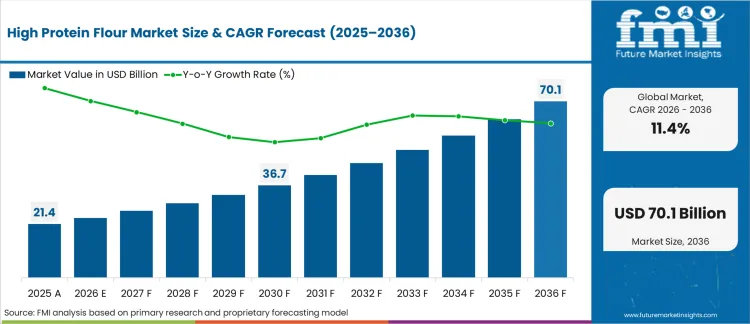
The High Protein Flour market was valued at USD 21.38 billion in 2025, projected to reach USD 23.83 billion in 2026, and is forecast to expand to USD 70.13 billion by 2036 at a 11.4% CAGR. High protein flour, encompassing wheat-derived and alternative-source flour products with elevated protein content relative to standard commodity grades, is positioned at the intersection of two durable consumer demand trends: the shift toward protein-enriched bakery and packaged food products, and the expansion of functional food formulation across fitness, clinical nutrition, and general wellness categories. What began as a specialty ingredient for sports nutrition applications has matured into a mainstream food manufacturing input with broad retail and food service channel penetration.
Absolute dollar growth of USD 46.30 billion across the forecast period reflects one of the largest absolute growth pools among specialised food ingredient categories globally. FMI analysts observe that the wheat source segment, which holds 78.0% of Source segment demand in 2026, will face progressive competitive pressure from almond and other alternative protein flour sources as consumer dietary pattern diversification accelerates. However, wheat-based high protein flour benefits from established food manufacturing process compatibility, flour milling infrastructure, and regulatory approval status that alternative source flours will require additional years to replicate at commercial scale.
Summary of High Protein Flour Market
- High Protein Flour Market Definition
- The High Protein Flour market covers flour products with above-commodity protein content specifications serving bakery, food and beverage manufacturing, retail, food service, and animal feed applications across conventional and organic formulations.
- Demand Drivers in the Market
- Consumer demand for protein-enriched bakery and packaged food products in North America, Europe, and Asia Pacific is driving food manufacturers to reformulate with high protein flour inputs to meet evolving front-of-pack nutritional labelling requirements.
- India's expanding organised bakery and packaged food manufacturing sector, supported by domestic high-protein wheat variety development programmes, creates substantial volume demand as per capita packaged food consumption increases.
- Food service channel requirements for consistent high-protein pizza dough, artisan bread, and specialty pastry formulations sustain premium demand from restaurant and commercial kitchen operators.
- Key Segments Analyzed in the FMI Report
- Conventional Nature holds 87.5% of Nature segment demand in 2026, reflecting established commercial milling infrastructure and food manufacturing process compatibility that organic flour cannot match at equivalent scale.
- UnBleached Type commands 64.0% of Type segment demand in 2026, as food manufacturers and retail consumers increasingly specify minimally processed flour formats that preserve natural protein functionality.
- Wheat Source accounts for 78.0% of Source demand in 2026, maintaining market share through established food manufacturing compatibility, regulatory approval status, and ingredient cost economics.
- Analyst Opinion at FMI
- Nandini Roy Choudhury, Principal Consultant for Food & Beverage is of the opinion that the High Protein Flour market's exceptional growth rate through 2036 is underpinned by a structural consumer shift toward protein-aware purchasing behaviour that affects bakery and packaged food categories across all income segments, not just premium wellness consumers. Food manufacturers that reformulate core product lines with high protein flour specifications rather than launching dedicated protein-positioned variants will capture the broader volume opportunity, but require supplier relationships that deliver consistent protein specification at commodity-competitive pricing.
- Strategic Implications / Executive Takeaways
- Food manufacturers should establish long-term supply agreements with high-protein wheat variety specialists in Australia and North America to secure specification-grade volume ahead of demand growth that is expected to tighten premium wheat availability through the forecast period.
- Specialty flour millers should invest in protein specification consistency testing infrastructure to qualify for pharmaceutical and clinical nutrition supply chains, where protein content variance tolerances are tighter than standard food manufacturing requirements.
- Retail brands entering the high protein flour category should prioritise unbleached, non-additive product positioning to align with the clean-label ingredient preferences of the primary consumer segments driving above-average growth in specialty flour retail channels.
As per FMI, India records the fastest country-level CAGR at 12.3% through 2036, driven by expanding bakery and packaged food manufacturing capacity, rising consumer protein awareness, and favourable domestic wheat production economics. Australia registers 10.2% growth, supported by high domestic protein wheat production volumes and export-oriented food manufacturing sector investment. China advances at 9.5%, combining a large food manufacturing base with rapidly growing consumer interest in protein-fortified packaged food products. Germany records 8.8% growth, anchored by pharmaceutical-grade flour specifications for clinical nutrition applications and strong retail organic flour demand. The United States grows at 8.0%, with food service and direct-to-consumer channels driving continued volume expansion.
High Protein Flour Market Definition
The High Protein Flour market encompasses wheat-derived and alternative-source flour products with protein content specifications above standard commodity grade thresholds, typically exceeding 12% protein by dry weight for wheat-based products. Applications span bakery and confectionery manufacturing, dairy and beverage food formulation, retail consumer flour products, food service operations, and animal feed compound formulation.
High Protein Flour Market Inclusions
Market scope covers global and regional revenue estimates for high protein flour products across all nature types, processing categories, source materials, and end-user applications. The forecast period spans 2026 to 2036, with country-level CAGR analysis and distribution channel segmentation. Pricing dynamics and protein specification premium analysis are incorporated as supplementary dimensions.
High Protein Flour Market Exclusions
Standard commodity wheat flour products meeting only baseline protein specifications are excluded from market sizing. Isolated protein concentrates, protein isolates, and texturised vegetable protein products fall outside the defined scope. Flour milling equipment, processing machinery, and grain storage infrastructure are not included in market valuation. Gluten-free flour products formulated primarily for coeliac dietary compliance rather than protein enrichment are excluded.
High Protein Flour Market Research Methodology
- Primary Research: Primary Research: FMI analysts conducted interviews with procurement managers at major bakery manufacturers, product development teams at food service companies, and specialty flour distributors across the United States, Germany, India, Australia, and China.
- Desk Research: Desk Research: USDA Wheat Quality Survey data, European Commission agricultural market reports, Australian Grain Technologies variety performance publications, and India's Ministry of Agriculture wheat production statistics were reviewed.
- Market-Sizing and Forecasting: Market-Sizing and Forecasting: A bottom-up model aggregates commercial flour milling production capacity by protein grade and source type, weighted against end-user application demand forecasts from food manufacturing output data.
- Data Validation and Update Cycle: Data Validation and Update Cycle: Projections were cross-validated against retail scanner data from grocery channel partners, food service purchasing data from national restaurant association surveys, and wheat trade flow statistics from FAO.
High Protein Flour Market Key Takeaways
| Metric | Details |
|---|---|
| Industry Size (2026) | USD 23.83 Billion |
| Industry Value (2036) | USD 70.13 Billion |
| CAGR (2026-2036) | 11.4% |
| Source | Future Market Insights, 2026 |
Key Industry Highlights
Product Diversification Fuelling the Rapid Growth of the Industry
To gain an edge over their competitors and cater to evolving consumer preferences, manufacturers need to continuously invest in research and development to innovate products with extensive utilization.
Manufacturers such as ADM and Bob’s Red Mill offer a wide variety of flours ranging from almond to chickpea varieties. In addition, the company is also introducing products with special dietary needs such as keto-friendly and gluten-free alternatives.
Targeted Marketing and Consumer Education Accelerating the Acceptance.
Big brands are investing in creating more consumer awareness about the consumption of these ingredients. King Arthur Baking Company heavily uses its website to showcase recipes and baking tips to its customers, educating them on the uses of its products. It also positions its products in the premium segment, emphasizing quality.
These strategies not only increase its visibility in the sector but also instill brand loyalty and consumer trust. Packaging also plays a crucial role in the advertisement of a product. The clear and appealing packaging of Bob's Red Mill highlights the advantages of its products.
Widening Applications in the Snacks and Baking Industry
The rising snacks and baking industry is pointing towards the strong growth of the industry. There has been an accelerated use of such flour in ready-to-eat foods and convenience foods such as protein bars, cookies, and chips. Such flours enhance the nutrition profile of such items, targeting consumers who prioritize health and wellness.
Combining wheat flour with other high protein grains such as quinoa, enhances the protein content while providing a stronger flour for baking purposes. The high gluten content also helps in making the cakes fluffier and appealing.
Transforming Waste into Wellness with Upcycled High Protein Flour
Companies are now able to reduce waste as well as develop more sustainable methods of production by making flour with high amounts of protein from upcycled materials like food by-products and surplus grains. These abandoned ingredients become repurposed into nutritious flours thus offering double benefits for both environment and health.
Therefore, these businesses should recycle such items instead of throwing them away where they will rot and produce methane gas which contributes to global warming, or take them through their systems over and over again until they lose all value hence reducing significantly their lifespan of usage.
Those purchasing products manufactured out of these components understand themselves as sustainable living individuals who think before buying anything thus helping create an environment that will benefit all in days to come with each purchase made.
Also, it is a real manifestation of commitment towards sustainability to use this product made from upcycling. This shows their ability to think outside the box and be innovative in terms of coming up with methods through which we can utilize our natural resources best so far without necessarily limiting them only to nutrition but rather seeing them as whole foods.
2021 to 2025 Global High Protein Flour Sales Analysis Compared to Demand Forecasts for 2026 to 2036
Slow and steady sales in recent years can be attributed to the rising fitness and nutrition industry. With the rising consciousness about health and wellness among consumers and the expanding fitness industry, the demand for such flours has skyrocketed. The limited protein sources for vegetarians have also propelled sales.
With the evolving flour milling methods and the rise of advanced processing techniques, it has become easier for companies to produce high amounts of good quality flour in a shorter period, catering to the diverse consumer demands.
Also, partnering with wholesalers and retailers helps the brands to better position their products in the marketplace and make them available on shelves of supermarkets and hypermarkets. This ensures the availability for not only retail purposes but also food service and industrial applications.
Market Concentration
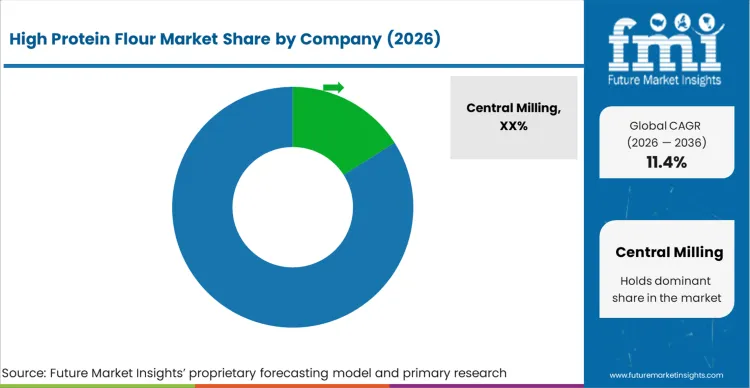
The global trade has many big players or MNCs such as Central Milling, Miller Milling Company, Ardent Mills, Archer Daniels Midland Company, King Arthur Baking Company, Inc., General Mills, and many more that comprise a significant share of the industry. These companies have numerous manufacturing facilities.
These distinguish themselves based on supply chains or distribution networks that allow them to supply their products worldwide. They maintain quality checks and reduce costs. These big players often engage in partnership and collaboration. For instance, DuPont Nutrition & Health collaborated with food manufacturers to develop tailored flour solutions that meet specific consumer needs and industry trends.
Local players on the other hand, often concentrate on certain segments of the sector such as gluten-free or organic flour, and have formed strategic partnerships with other companies to expand their reach. They may not have advanced technology and wide global reach. They operate with a local presence and serve a niche community. Such players focus on product quality and customer satisfaction rather than commercialization.
However, the industry is proceeding towards fragmentation as more and more players are entering the business ecosystem from various parts of the globe. The industry is also heavily influenced by government regulations. Overall, the ecosystem comprises a dynamic and complex nature, with MNCs playing the role of a trendsetter.
Country-wise Insights
The following table shows the estimated growth rates of the top three industries. China and India are set to exhibit high protein flour consumption, recording CAGRs of 9.5% and 12.3%, respectively, through 2036.
.webp "Top Country Growth Comparison High Protein Flour Market Cagr (2026 2036)")
| Countries | CAGR |
|---|---|
| United States | 8.0% |
| Germany | 8.8% |
| China | 9.5% |
| India | 12.3% |
| Australia | 10.2% |
Source: FMI analysis based on primary research and proprietary forecasting model 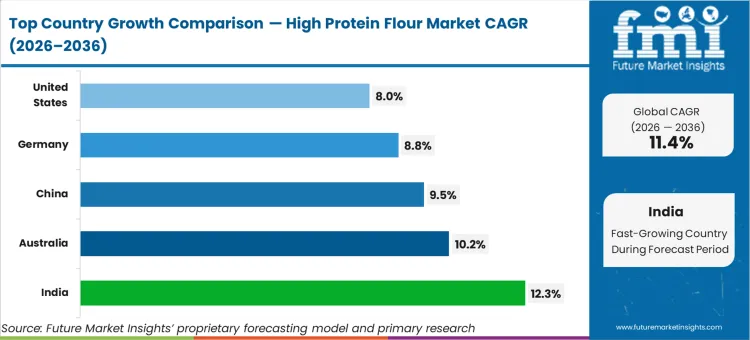
United States Leading the Global Arena.
The commercial sector for flours with high protein content in the United States is projected to exhibit a CAGR of 8.0% during the assessment period of 2026 to 2036. By 2036, revenue from the sales of this product in the country is expected to reach USD 3.6 billion.
Customers in the United States are well aware of nutrition due to widespread access to health information. With high disposable income, they are willing to spend on premium health-oriented products. The robust food industry with many food stores, retailers, supermarkets, and online retailers provides easy access to such products.
Also, Social media applications such as Instagram and Facebook and influencers play a crucial role in popularizing such diets and creating more buzz in the community. The USA fitness industry has a lot of gyms and fitness centers that emphasize the importance of regular consumption of protein-rich diets for better muscle building and strength.
Demand Outlook for High Protein Flours in Germany.
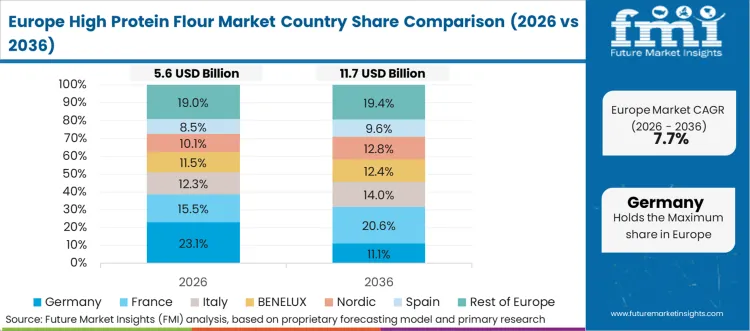
The demand in Germany is calculated to rise at a value CAGR of 8.8% during the forecast period (2026 to 2036). The sales are estimated to increase by 2 folds in the upcoming 5 years. By 2036, Germany is expected to account for 4.0% of total sales in the world.
German customers showcase a strong inclination towards sustainability and ethical sourcing of ingredients. They prefer products that are certified with organic or non-GMO labels. High purchasing power allows them to indulge in premium products that align well with their preferences. Also, the government supports sustainable agricultural practices, which benefit the production and highlight the sustainably produced products.
The ecosystem has also benefitted from growing trends of veganism and vegetarianism in Germany. Plant-based flours made from legumes, grains, and nuts are readily looked upon by German consumers, as an easy source of protein.
Expanding Distribution Channels Elevating the Sales in China.
Consumption of such flour in China is projected to increase at a value CAGR of 9.5% over the next ten years. By 2036, the size is forecasted to reach USD 2.8 billion, with China expected to account for a share of 14.5% globally.
The multiplication of retail channels such as supermarkets, convenience stores, and e-commerce has made it easier for consumers to access and choose from plenty of varieties of flours, offering convenience. This also enhances the visibility of products.
Also, High protein flours are being readily used in traditional Chinese cooking, such as steamed buns and dumplings, offering ease to consumers to not change their diets for sufficient nutrition. Such factors point towards an upward trajectory of sales.
Category-Wise Insights
Ready Availability Making Conventional Flours Popular
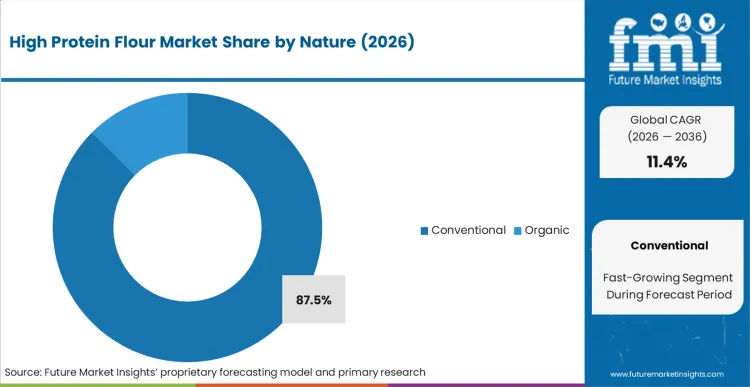
| Segment | Conventional (By Nature) |
|---|---|
| Value Share (2026) | 87.5% |
The conventional category is anticipated to register a CAGR of 8.1% during the assessment period of 2026 to 2036, to reach a valuation of USD 30.4 billion in 2036.
Conventional flours have been in the commercial segment for long. Many consumers prefer to stick to what they have been using for ages and do not want to experiment with newly introduced organic or vegan alternatives.
These varieties are usually less expensive, making them more appealing to consumers, particularly on a budget. They are readily available in supermarkets and grocery stores when compared to their counterparts. All these factors play a key role in triggering the growth of this segment.
Animal Feed Industry Benefitting the Flour Sales
| Segment | Animal Feed (By End User) |
|---|---|
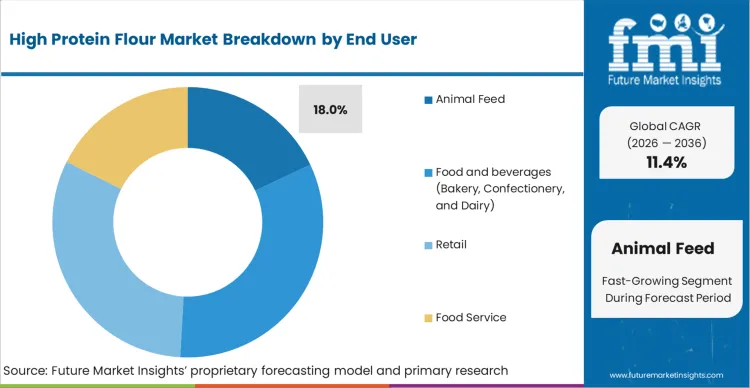
| Value Share (2026) | 18.0% |
Based on the end user, the animal feed segment is expected to grow during the assessment period. As per Future Market Insights, with a share of around 18.0%, the animal feed segment is projected to reach a valuation of USD 8.1 billion in 2036.
High-protein flour is a key component in animal feed, particularly for poultry and swine. It provides the necessary nutrients for animal growth and health. It offers a balanced dietary amino acid content, needed for optimal development of animals. Therefore, the growing animal feed industry is likely to elevate sales.
Competition Outlook
The key players in the high-protein flour industry are continuously innovating to introduce newer formulations and flavors into the ecosystem. They are employing strategies such as partnering collaboration and mergers and acquisitions to expand their production capacity and cater to a wider audience. They are also educating the consumers and advertising their products through social media and websites to engage the consumers into using their products.
Brands must strategize ways to retain their share by prioritizing sustainability, ethical sourcing, and reducing their carbon footprint. Collaborating with retailers and distributors gives them an advantage over their competitors to better position their products in the ecosystem.
Leading High Protein Flour Brands
- Central Milling
- Miller Milling Company
- Ardent Mills
- Siemer Milling Company
- Weisenberger Mill
- Archer Daniels Midland Company
- King Arthur Baking Company, Inc.
- Janie's Mill
- General Mills Inc.
- The White Lily Foods Company
- Khandesh Roller Flour Mills Pvt. Ltd.
- Weatherbury Farm
- Giusto's
- Kaizen Food Company
- New Hope Mills
- Others
Scope of the Report
| Metric | Value |
|---|---|
| Quantitative Units | USD 23.83 Billion to USD 70.13 Billion, at a CAGR of 11.4% |
| Market Definition | Flour products with above-commodity protein content specifications serving bakery, food manufacturing, retail, food service, and animal feed applications across conventional and organic formulations. |
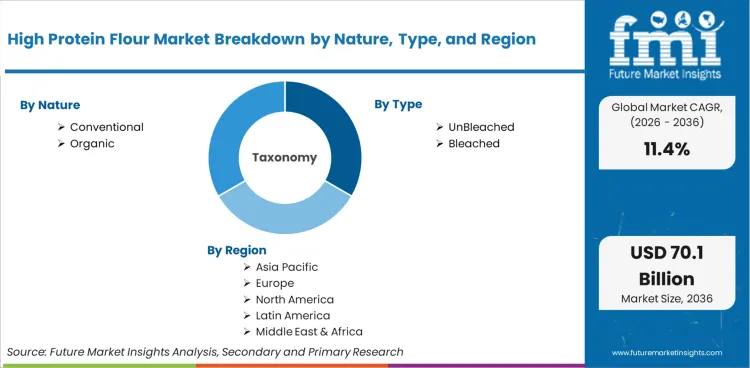
| Nature Segmentation | Conventional, Organic |
| Type Segmentation | UnBleached, Bleached |
| Source Segmentation | Wheat, Almond |
| End User Segmentation | Animal Feed, Food and Beverages (Bakery, Confectionery, and Dairy), Retail, Food Service |
| Distribution Channel | Supermarkets, Hypermarkets, Specialty Stores, Retail Stores, Online Stores |
| Regions Covered | North America, Latin America, Europe, East Asia, South Asia, Oceania, Middle East & Africa |
| Countries Covered | United States, Germany, China, India, Australia, and 40 plus countries |
| Key Companies Profiled | Central Milling, Miller Milling Company, Ardent Mills, Siemer Milling Company, Weisenberger Mill, Archer Daniels Midland Company, King Arthur Baking Company Inc., Janie's Mill, General Mills Inc., The White Lily Foods Company |
| Forecast Period | 2026 to 2036 |
| Approach | Bottom-up aggregation of flour milling production capacity by protein grade and source type, cross-validated against food manufacturing output data and retail channel sales benchmarks |
Key Segments of the Report
By Nature:
As per Nature, it has been categorized into Organic and Conventional.
By Type:
This segment is further categorized into Bleached and Unbleached.
By Source:
As per Source, it has been categorized into Wheat and Almond.
By End User:
This segment is further categorized into Food and beverages (Bakery, Confectionery, and Dairy), Animal feed, Retail, and food service.
By Distribution Channel:
As per the Distribution Channel, the industry has been categorized into Hypermarkets, Supermarkets, Specialty Stores, Retail Stores, and Online Stores.
By Region:
Industry analysis has been carried out in key countries of North America, Latin America, Europe, East Asia, South Asia, Oceania, and the Middle East & Africa.
Bibliography
- 1. United States Department of Agriculture. (2024). Wheat Quality Survey: Hard Red Winter and Hard Red Spring Varieties. USDA Agricultural Marketing Service.
- 2. Food and Agriculture Organization of the United Nations. (2024). Cereal Supply and Demand Brief. FAO Global Information and Early Warning System.
- 3. European Commission. (2024). Cereals, Oilseeds and Protein Crops Market Situation. European Commission Directorate-General for Agriculture.
- 4. Ministry of Agriculture, Government of India. (2024). Wheat Production and Trade Statistics Annual Report. Department of Agriculture and Farmers Welfare.
- 5. Australian Grain Technologies. (2024). High Protein Wheat Variety Performance Report. Australian Grain Technologies Pty Ltd.
- 6. Grains and Legumes Nutrition Council. (2024). Dietary Protein Requirements and Food Source Contribution Analysis. GLNC.
This bibliography is provided for reader reference. The full FMI report contains the complete reference list with primary research documentation.
Frequently Asked Questions
How large is the High Protein Flour market in 2026?
The High Protein Flour market is estimated at USD 23.83 billion in 2026.
What will the High Protein Flour market reach by 2036?
The High Protein Flour market is projected to reach USD 70.13 billion by 2036.
What CAGR is projected for the High Protein Flour market?
The High Protein Flour market is expected to grow at a CAGR of 11.4% from 2026 to 2036.
Which Nature segment leads in 2026?
Conventional Nature holds 87.5% of Nature segment demand in 2026, reflecting the established commercial milling infrastructure and food manufacturing process compatibility of conventional high protein flour.
Which Type segment is largest in 2026?
UnBleached Type commands 64.0% of Type segment demand in 2026, as food manufacturers and retail consumers increasingly specify minimally processed flour formats.
Which Source dominates the High Protein Flour market?
Wheat Source accounts for 78.0% of Source segment demand in 2026, maintaining market leadership through established food manufacturing compatibility, regulatory approval, and cost economics.
Which country is growing fastest?
India is projected to grow at a 12.3% CAGR through 2036, driven by expanding bakery and packaged food manufacturing capacity and rising domestic consumer protein awareness.
Which distribution channel leads in 2026?
Supermarkets account for 28.0% of Distribution Channel demand in 2026, reflecting their role as the primary retail touchpoint for consumer-facing high protein flour products.
What is excluded from this report?
Standard commodity wheat flour, protein isolates and concentrates, texturised vegetable protein, flour milling equipment, gluten-free specialty flour, and grain storage infrastructure fall outside the defined market scope.
How does FMI forecast the High Protein Flour market?
FMI applies a bottom-up model aggregating flour milling production capacity by protein grade and source type, weighted against end-user application demand forecasts derived from food manufacturing output data and retail channel sales benchmarks.
Preview the report firsthand - request a free sample
Get SampleGet the brochure for pricing and purchase details.
Get PDFTable of Content
- Executive Summary
- Global Market Outlook
- Demand-side Trends
- Supply-side Trends
- Technology Roadmap Analysis
- Analysis and Recommendations
- Market Overview
- Market Coverage / Taxonomy
- Market Definition / Scope / Limitations
- Research Methodology
- Chapter Orientation
- Analytical Lens and Working Hypotheses
- Market Structure, Signals, and Trend Drivers
- Benchmarking and Cross-market Comparability
- Market Sizing, Forecasting, and Opportunity Mapping
- Research Design and Evidence Framework
- Desk Research Programme (Secondary Evidence)
- Company Annual and Sustainability Reports
- Peer-reviewed Journals and Academic Literature
- Corporate Websites, Product Literature, and Technical Notes
- Earnings Decks and Investor Briefings
- Statutory Filings and Regulatory Disclosures
- Technical White Papers and Standards Notes
- Trade Journals, Industry Magazines, and Analyst Briefs
- Conference Proceedings, Webinars, and Seminar Materials
- Government Statistics Portals and Public Data Releases
- Press Releases and Reputable Media Coverage
- Specialist Newsletters and Curated Briefings
- Sector Databases and Reference Repositories
- FMI Internal Proprietary Databases and Historical Market Datasets
- Subscription Datasets and Paid Sources
- Social Channels, Communities, and Digital Listening Inputs
- Additional Desk Sources
- Expert Input and Fieldwork (Primary Evidence)
- Primary Modes
- Qualitative Interviews and Expert Elicitation
- Quantitative Surveys and Structured Data Capture
- Blended Approach
- Why Primary Evidence is Used
- Field Techniques
- Interviews
- Surveys
- Focus Groups
- Observational and In-context Research
- Social and Community Interactions
- Stakeholder Universe Engaged
- C-suite Leaders
- Board Members
- Presidents and Vice Presidents
- R&D and Innovation Heads
- Technical Specialists
- Domain Subject-matter Experts
- Scientists
- Physicians and Other Healthcare Professionals
- Governance, Ethics, and Data Stewardship
- Research Ethics
- Data Integrity and Handling
- Primary Modes
- Tooling, Models, and Reference Databases
- Desk Research Programme (Secondary Evidence)
- Data Engineering and Model Build
- Data Acquisition and Ingestion
- Cleaning, Normalisation, and Verification
- Synthesis, Triangulation, and Analysis
- Quality Assurance and Audit Trail
- Market Background
- Market Dynamics
- Drivers
- Restraints
- Opportunity
- Trends
- Scenario Forecast
- Demand in Optimistic Scenario
- Demand in Likely Scenario
- Demand in Conservative Scenario
- Opportunity Map Analysis
- Product Life Cycle Analysis
- Supply Chain Analysis
- Investment Feasibility Matrix
- Value Chain Analysis
- PESTLE and Porter’s Analysis
- Regulatory Landscape
- Regional Parent Market Outlook
- Production and Consumption Statistics
- Import and Export Statistics
- Market Dynamics
- Global Market Analysis 2021 to 2025 and Forecast, 2026 to 2036
- Historical Market Size Value (USD Million) Analysis, 2021 to 2025
- Current and Future Market Size Value (USD Million) Projections, 2026 to 2036
- Y-o-Y Growth Trend Analysis
- Absolute $ Opportunity Analysis
- Global Market Pricing Analysis 2021 to 2025 and Forecast 2026 to 2036
- Global Market Analysis 2021 to 2025 and Forecast 2026 to 2036, By Nature
- Introduction / Key Findings
- Historical Market Size Value (USD Million) Analysis By Nature , 2021 to 2025
- Current and Future Market Size Value (USD Million) Analysis and Forecast By Nature , 2026 to 2036
- Conventional
- Organic
- Conventional
- Y-o-Y Growth Trend Analysis By Nature , 2021 to 2025
- Absolute $ Opportunity Analysis By Nature , 2026 to 2036
- Global Market Analysis 2021 to 2025 and Forecast 2026 to 2036, By Type
- Introduction / Key Findings
- Historical Market Size Value (USD Million) Analysis By Type, 2021 to 2025
- Current and Future Market Size Value (USD Million) Analysis and Forecast By Type, 2026 to 2036
- UnBleached
- Bleached
- UnBleached
- Y-o-Y Growth Trend Analysis By Type, 2021 to 2025
- Absolute $ Opportunity Analysis By Type, 2026 to 2036
- Global Market Analysis 2021 to 2025 and Forecast 2026 to 2036, By Source
- Introduction / Key Findings
- Historical Market Size Value (USD Million) Analysis By Source, 2021 to 2025
- Current and Future Market Size Value (USD Million) Analysis and Forecast By Source, 2026 to 2036
- Wheat
- Almond
- Wheat
- Y-o-Y Growth Trend Analysis By Source, 2021 to 2025
- Absolute $ Opportunity Analysis By Source, 2026 to 2036
- Global Market Analysis 2021 to 2025 and Forecast 2026 to 2036, By End User
- Introduction / Key Findings
- Historical Market Size Value (USD Million) Analysis By End User, 2021 to 2025
- Current and Future Market Size Value (USD Million) Analysis and Forecast By End User, 2026 to 2036
- Animal Feed
- Food and beverages (Bakery, Confectionery, and Dairy)
- Retail
- Food Service
- Animal Feed
- Y-o-Y Growth Trend Analysis By End User, 2021 to 2025
- Absolute $ Opportunity Analysis By End User, 2026 to 2036
- Global Market Analysis 2021 to 2025 and Forecast 2026 to 2036, By Distribution Channel
- Introduction / Key Findings
- Historical Market Size Value (USD Million) Analysis By Distribution Channel, 2021 to 2025
- Current and Future Market Size Value (USD Million) Analysis and Forecast By Distribution Channel, 2026 to 2036
- Supermarkets
- Hypermarkets
- Specialty Stores
- Retail Stores
- Online Stores
- Supermarkets
- Y-o-Y Growth Trend Analysis By Distribution Channel, 2021 to 2025
- Absolute $ Opportunity Analysis By Distribution Channel, 2026 to 2036
- Global Market Analysis 2021 to 2025 and Forecast 2026 to 2036, By Region
- Introduction
- Historical Market Size Value (USD Million) Analysis By Region, 2021 to 2025
- Current Market Size Value (USD Million) Analysis and Forecast By Region, 2026 to 2036
- North America
- Latin America
- Western Europe
- Eastern Europe
- East Asia
- South Asia and Pacific
- Middle East & Africa
- Market Attractiveness Analysis By Region
- North America Market Analysis 2021 to 2025 and Forecast 2026 to 2036, By Country
- Historical Market Size Value (USD Million) Trend Analysis By Market Taxonomy, 2021 to 2025
- Market Size Value (USD Million) Forecast By Market Taxonomy, 2026 to 2036
- By Country
- USA
- Canada
- Mexico
- By Nature
- By Type
- By Source
- By End User
- By Distribution Channel
- By Country
- Market Attractiveness Analysis
- By Country
- By Nature
- By Type
- By Source
- By End User
- By Distribution Channel
- Key Takeaways
- Latin America Market Analysis 2021 to 2025 and Forecast 2026 to 2036, By Country
- Historical Market Size Value (USD Million) Trend Analysis By Market Taxonomy, 2021 to 2025
- Market Size Value (USD Million) Forecast By Market Taxonomy, 2026 to 2036
- By Country
- Brazil
- Chile
- Rest of Latin America
- By Nature
- By Type
- By Source
- By End User
- By Distribution Channel
- By Country
- Market Attractiveness Analysis
- By Country
- By Nature
- By Type
- By Source
- By End User
- By Distribution Channel
- Key Takeaways
- Western Europe Market Analysis 2021 to 2025 and Forecast 2026 to 2036, By Country
- Historical Market Size Value (USD Million) Trend Analysis By Market Taxonomy, 2021 to 2025
- Market Size Value (USD Million) Forecast By Market Taxonomy, 2026 to 2036
- By Country
- Germany
- UK
- Italy
- Spain
- France
- Nordic
- BENELUX
- Rest of Western Europe
- By Nature
- By Type
- By Source
- By End User
- By Distribution Channel
- By Country
- Market Attractiveness Analysis
- By Country
- By Nature
- By Type
- By Source
- By End User
- By Distribution Channel
- Key Takeaways
- Eastern Europe Market Analysis 2021 to 2025 and Forecast 2026 to 2036, By Country
- Historical Market Size Value (USD Million) Trend Analysis By Market Taxonomy, 2021 to 2025
- Market Size Value (USD Million) Forecast By Market Taxonomy, 2026 to 2036
- By Country
- Russia
- Poland
- Hungary
- Balkan & Baltic
- Rest of Eastern Europe
- By Nature
- By Type
- By Source
- By End User
- By Distribution Channel
- By Country
- Market Attractiveness Analysis
- By Country
- By Nature
- By Type
- By Source
- By End User
- By Distribution Channel
- Key Takeaways
- East Asia Market Analysis 2021 to 2025 and Forecast 2026 to 2036, By Country
- Historical Market Size Value (USD Million) Trend Analysis By Market Taxonomy, 2021 to 2025
- Market Size Value (USD Million) Forecast By Market Taxonomy, 2026 to 2036
- By Country
- China
- Japan
- South Korea
- By Nature
- By Type
- By Source
- By End User
- By Distribution Channel
- By Country
- Market Attractiveness Analysis
- By Country
- By Nature
- By Type
- By Source
- By End User
- By Distribution Channel
- Key Takeaways
- South Asia and Pacific Market Analysis 2021 to 2025 and Forecast 2026 to 2036, By Country
- Historical Market Size Value (USD Million) Trend Analysis By Market Taxonomy, 2021 to 2025
- Market Size Value (USD Million) Forecast By Market Taxonomy, 2026 to 2036
- By Country
- India
- ASEAN
- Australia & New Zealand
- Rest of South Asia and Pacific
- By Nature
- By Type
- By Source
- By End User
- By Distribution Channel
- By Country
- Market Attractiveness Analysis
- By Country
- By Nature
- By Type
- By Source
- By End User
- By Distribution Channel
- Key Takeaways
- Middle East & Africa Market Analysis 2021 to 2025 and Forecast 2026 to 2036, By Country
- Historical Market Size Value (USD Million) Trend Analysis By Market Taxonomy, 2021 to 2025
- Market Size Value (USD Million) Forecast By Market Taxonomy, 2026 to 2036
- By Country
- Kingdom of Saudi Arabia
- Other GCC Countries
- Turkiye
- South Africa
- Other African Union
- Rest of Middle East & Africa
- By Nature
- By Type
- By Source
- By End User
- By Distribution Channel
- By Country
- Market Attractiveness Analysis
- By Country
- By Nature
- By Type
- By Source
- By End User
- By Distribution Channel
- Key Takeaways
- Key Countries Market Analysis
- USA
- Pricing Analysis
- Market Share Analysis, 2025
- By Nature
- By Type
- By Source
- By End User
- By Distribution Channel
- Canada
- Pricing Analysis
- Market Share Analysis, 2025
- By Nature
- By Type
- By Source
- By End User
- By Distribution Channel
- Mexico
- Pricing Analysis
- Market Share Analysis, 2025
- By Nature
- By Type
- By Source
- By End User
- By Distribution Channel
- Brazil
- Pricing Analysis
- Market Share Analysis, 2025
- By Nature
- By Type
- By Source
- By End User
- By Distribution Channel
- Chile
- Pricing Analysis
- Market Share Analysis, 2025
- By Nature
- By Type
- By Source
- By End User
- By Distribution Channel
- Germany
- Pricing Analysis
- Market Share Analysis, 2025
- By Nature
- By Type
- By Source
- By End User
- By Distribution Channel
- UK
- Pricing Analysis
- Market Share Analysis, 2025
- By Nature
- By Type
- By Source
- By End User
- By Distribution Channel
- Italy
- Pricing Analysis
- Market Share Analysis, 2025
- By Nature
- By Type
- By Source
- By End User
- By Distribution Channel
- Spain
- Pricing Analysis
- Market Share Analysis, 2025
- By Nature
- By Type
- By Source
- By End User
- By Distribution Channel
- France
- Pricing Analysis
- Market Share Analysis, 2025
- By Nature
- By Type
- By Source
- By End User
- By Distribution Channel
- India
- Pricing Analysis
- Market Share Analysis, 2025
- By Nature
- By Type
- By Source
- By End User
- By Distribution Channel
- ASEAN
- Pricing Analysis
- Market Share Analysis, 2025
- By Nature
- By Type
- By Source
- By End User
- By Distribution Channel
- Australia & New Zealand
- Pricing Analysis
- Market Share Analysis, 2025
- By Nature
- By Type
- By Source
- By End User
- By Distribution Channel
- China
- Pricing Analysis
- Market Share Analysis, 2025
- By Nature
- By Type
- By Source
- By End User
- By Distribution Channel
- Japan
- Pricing Analysis
- Market Share Analysis, 2025
- By Nature
- By Type
- By Source
- By End User
- By Distribution Channel
- South Korea
- Pricing Analysis
- Market Share Analysis, 2025
- By Nature
- By Type
- By Source
- By End User
- By Distribution Channel
- Russia
- Pricing Analysis
- Market Share Analysis, 2025
- By Nature
- By Type
- By Source
- By End User
- By Distribution Channel
- Poland
- Pricing Analysis
- Market Share Analysis, 2025
- By Nature
- By Type
- By Source
- By End User
- By Distribution Channel
- Hungary
- Pricing Analysis
- Market Share Analysis, 2025
- By Nature
- By Type
- By Source
- By End User
- By Distribution Channel
- Kingdom of Saudi Arabia
- Pricing Analysis
- Market Share Analysis, 2025
- By Nature
- By Type
- By Source
- By End User
- By Distribution Channel
- Turkiye
- Pricing Analysis
- Market Share Analysis, 2025
- By Nature
- By Type
- By Source
- By End User
- By Distribution Channel
- South Africa
- Pricing Analysis
- Market Share Analysis, 2025
- By Nature
- By Type
- By Source
- By End User
- By Distribution Channel
- USA
- Market Structure Analysis
- Competition Dashboard
- Competition Benchmarking
- Market Share Analysis of Top Players
- By Regional
- By Nature
- By Type
- By Source
- By End User
- By Distribution Channel
- Competition Analysis
- Competition Deep Dive
- Central Milling
- Overview
- Product Portfolio
- Profitability by Market Segments (Product/Age /Sales Channel/Region)
- Sales Footprint
- Strategy Overview
- Marketing Strategy
- Product Strategy
- Channel Strategy
- Miller Milling Company
- Ardent Mills
- Siemer Milling Company
- Weisenberger Mill
- Archer Daniels Midland Company
- King Arthur Baking Company, Inc.
- Janie's Mill
- General Mills Inc.
- The White Lily Foods Company
- Khandesh Roller Flour Mills Pvt. Ltd.
- Weatherbury Farm
- Giusto's
- Kaizen Food Company
- New Hope Mills
- Others
- Central Milling
- Competition Deep Dive
- Assumptions & Acronyms Used


