

- Industry Size (2026)
- USD 1.5 Bn
- Forecast (2036)
- USD 3.4 Bn
- CAGR (2026 to 2036)
- 8.6%
Water Cannon Vehicle Market Forecast and Outlook 2026 to 2036
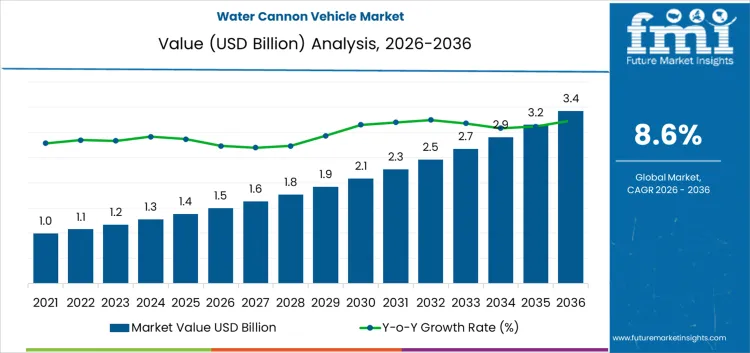
In 2026, the water cannon vehicle market stands at USD 1.5 billion and is projected to reach USD 3.4 billion by 2036, implying a CAGR of 8.6%. These vehicles are used primarily by police, internal security forces, and public order agencies, with demand tied to crowd control, riot management, and disaster response preparedness. Buying is dominated by government and public sector procurement, which frames requirements around reliability, crew protection, and sustained field operation. Long tender cycles and multi-year budget planning shape order timing. Fleet composition, training standards, and domestic assembly policies further influence specifications and supplier selection.
Procurement behavior reflects institutional risk management rather than tactical experimentation. Agencies favor platforms that integrate proven chassis, standardized pumps, and familiar control systems to simplify maintenance and operator training. Evaluation focuses on lifecycle support, spares availability, and upgrade paths more than on headline performance metrics. Local content rules and security clearances often narrow the supplier pool. Demand appears in concentrated batches linked to policy shifts, major events, or civil preparedness programs, not in steady annual increments. Market expansion therefore follows public security budgeting priorities and preparedness doctrines rather than commercial vehicle replacement cycles or routine fleet renewal.
Quick Stats for Water Cannon Vehicle Market
- Water Cannon Vehicle Market Value (2026): USD 1.5 billion
- Water Cannon Vehicle Market Forecast Value (2036): USD 3.4 billion
- Water Cannon Vehicle Market Forecast CAGR 2026 to 2036: 8.6%
- Leading Type in Water Cannon Vehicle Market: Mounted water cannon vehicles
- Key Growth Regions in Water Cannon Vehicle Market: Asia Pacific, North America, Europe
- Top Players in Water Cannon Vehicle Market: Rosenbauer International, Oshkosh Corporation (Pierce Manufacturing), WAP (Watercannon Manufacturing), Seagrave Fire Apparatus, Bucher Municipal, DFAC (Dongfeng Motor Corporation), BAE Systems (Hagglunds)
What is the Growth Forecast for Water Cannon Vehicle Market through 2036?
The water cannon vehicle market grows through procurement cycles rather than through continuous fleet turnover, which explains its stepwise expansion pattern. Starting near USD 0.8 billion, spending moves to about USD 1.0 billion and USD 1.2 billion as a limited number of countries refresh aging fleets or add capacity in response to policy shifts. By the time the market reaches roughly USD 1.5 billion and then USD 1.8 billion, most of the growth is still coming from discrete national tenders rather than from broad-based adoption. These vehicles are low-volume but high unit value assets, typically kept in service for many years, which means annual demand is lumpy and sensitive to budget timing. The move past USD 2.1 billion and toward USD 2.3 billion reflects more countries entering replacement cycles rather than any increase in usage intensity.
Further expansion toward USD 2.5 billion, USD 2.8 billion, and then into the USD 3.0 to 3.4 billion range is shaped by how differently governments approach crowd control and internal security. Some countries rely heavily on such vehicles and maintain sizeable fleets, while others restrict or avoid their use altogether, which keeps adoption structurally uneven. Where procurement does occur, it is usually tied to broader security modernization programs rather than to isolated vehicle purchases. Value growth therefore comes from occasional large contracts and from higher specification vehicles rather than from rising unit volumes. The market remains policy-driven and episodic, with long asset life and high capital cost ensuring that replacement cycles, not operational consumption, dominate demand patterns.
Water Cannon Vehicle Market Key Takeaways
| Metric | Value |
|---|---|
| Market Value (2026) | USD 1.5 billion |
| Forecast Value (2036) | USD 3.4 billion |
| Forecast CAGR 2026 to 2036 | 8.6% |
How Is the Water Cannon Vehicle Market Addressing Crowd Control and Public Safety Needs?
Water cannon vehicles are increasingly deployed to provide non-lethal crowd management, public order maintenance, and emergency response capabilities. Historically, law enforcement relied on manual crowd dispersal methods, which carried higher risks of injury and limited operational control. Modern water cannon vehicles integrate high-pressure pumping systems, armored chassis, and remote control or cabin-mounted targeting, enabling precise, controlled dispersal while maintaining operator safety. Law enforcement agencies, municipal authorities, and security service providers prioritize vehicle reliability, maneuverability, and compliance with safety regulations. Early adoption focused on riot-prone urban centers, while current demand spans public events, industrial site security, and border management, driven by crowd safety requirements, regulatory compliance, and operational efficiency. Vehicle pressure capacity, targeting precision, and mobility influence supplier selection.
Maintaining public safety while minimizing harm is shaping the water cannon vehicle market. Compared with conventional crowd control methods, modern vehicles emphasize accurate deployment, operational safety, and rapid response in dynamic situations. Cost structures depend on pump technology, vehicle armor, and control systems, concentrating margins among suppliers capable of delivering certified, high-performance vehicles. Security agencies adopt these vehicles to enhance crowd management, reduce injury risk, and ensure compliance with operational protocols. By 2036, water cannon vehicles are expected to remain essential assets in public safety and industrial security operations, supporting controlled response, rapid deployment, and enhanced operational oversight.
What Factors Are Shaping the Demand for Water Cannon Vehicles, Segment wise by Vehicle Type and Application, in 2026?
The water cannon vehicle market in 2026 is segmented by vehicle type and by application. By platform configuration, demand is divided into mounted water cannon vehicles, trailer mounted units, self-propelled water cannon vehicles, and portable or rapid deploy systems, each offering different balances between mobility, setup time, and operational reach. By application, demand is organized around law enforcement and riot control, firefighting support, industrial hazard response, and public event crowd management, which differ in readiness requirements, jurisdictional control, and frequency of deployment. These segments reflect how agencies prioritize reliability, deterrence capability, and logistical simplicity when selecting crowd control and emergency response equipment.
Why Do Mounted Water Cannon Vehicles Dominate Procurement?
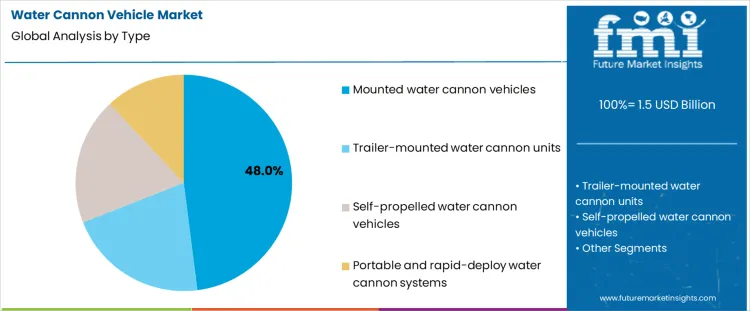
Mounted water cannon vehicles account for about 48% of demand in 2026, reflecting their role as standard equipment in many law enforcement fleets. These vehicles integrate the cannon, pump, and water tank into a single platform that can be deployed quickly without additional towing or assembly. This self-contained design reduces setup time and simplifies crew training. Many agencies already operate compatible truck or armored vehicle platforms, which allows upgrades without changing fleet structure. The visibility and perceived authority of these vehicles also fits crowd control doctrines that emphasize presence and deterrence. This combination of readiness, integration, and institutional familiarity keeps mounted vehicles as the primary procurement choice.
Trailer mounted, self-propelled, and portable systems address more specialized needs. Trailer units offer lower cost and higher water capacity, but they depend on a towing vehicle and take longer to deploy. Self-propelled specialized vehicles are used where off road or high mobility is needed, yet their cost and maintenance burden limit fleet size. Portable systems serve temporary events or backup roles, but they lack the sustained operation capability of full vehicles. These options fill important niches, yet they do not replace the central role of fully mounted platforms in routine readiness planning.
Why Does Law Enforcement and Riot Control Lead Application Demand?
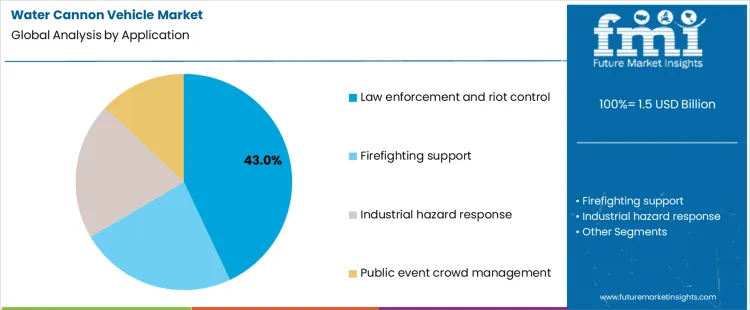
Law enforcement and riot control represent about 43% of demand in 2026 because these missions require visible, repeatable, and controllable crowd management tools. Water cannon vehicles are used as both a physical barrier and a graduated response option before more severe measures are considered. Many jurisdictions maintain such equipment as part of standard public order units even if it is deployed infrequently. Training, drills, and periodic equipment renewal create steady baseline demand. The political and legal emphasis on non-lethal methods in crowd control also supports continued investment in this category. These factors combine to make policing and public order management the largest and most consistent application segment.
Firefighting support, industrial hazard response, and event management follow different usage patterns. Fire services use water cannon vehicles mainly for specific industrial or large scale incidents rather than for daily operations. Industrial hazard teams deploy them in rare but high impact scenarios. Event organizers rely more on temporary or portable systems. These applications are important, but they are episodic and project based. In contrast, law enforcement agencies plan and budget for these vehicles as standing assets, which keeps this segment as the main driver of overall market demand.
How Are the Key Dynamics of Public Order Governance, Procurement Cycles, and Platform Modernization Reshaping the Water Cannon Vehicle Market through 2036?
The category is shaped by how governments plan for crowd control rather than by routine fleet replacement. Demand is episodic and politically sensitive, tied to shifts in public order policy and perceived risk environments. At the same time, long public procurement cycles and scrutiny slow decision making and favor proven platforms. When purchases do happen, they often coincide with broader fleet modernization programs that bundle communications, protection, and non-lethal systems. This creates a market driven by governance and funding windows, not steady replacement demand. Success depends on being qualified within national platforms and meeting compliance expectations more than on incremental technical differentiation.
Why Are Public Order Management Requirements Driving the Water Cannon Vehicle Market?
Demand is anchored in state capacity planning rather than in daily operations. Authorities maintain water cannon vehicles as part of contingency fleets for crowd control, prison disturbances, or major event security. The vehicles are rarely used but must be available and reliable. Changes in protest patterns, event scale, or political priorities can trigger sudden reassessment of readiness levels. Once a capability gap is identified, procurement is often urgent and program based. This ties volume to policy shifts and security assessments rather than to normal fleet aging. Replacement cycles are long, and purchases come in waves aligned with strategic reviews.
What Political Sensitivity, Budget Scrutiny, and Long Approval Chains Are Limiting Faster Procurement?
The main barrier is institutional and political, not technical. Water cannon vehicles are controversial and attract public and media attention, which makes approvals cautious and highly scrutinized. Budgets must often pass multiple layers of review, and legal frameworks for use vary by jurisdiction. Tender processes favor established suppliers with strong references and compliance records. Because vehicles are used infrequently, it is difficult to justify expenditure against other policing needs. These factors stretch timelines, reduce order frequency, and make demand unpredictable, even in regions where operational planners consider the capability necessary.
How Are Platform Modernization and Multi Role Vehicle Strategies Changing This Category?
The trend is toward integrating water cannon capability into broader security vehicle platforms. Instead of buying single purpose trucks, agencies increasingly look for modular systems that can be reconfigured for different roles, such as command, transport, or non-lethal response. This improves utilization and makes funding easier to justify. Standardized chassis, electronics, and protection packages reduce training and maintenance burden. Procurement shifts from one off specialty vehicles to families of vehicles under framework contracts. Over time, success in this category depends on fitting into wider fleet strategies and offering adaptable platforms rather than selling a standalone crowd control machine.
What is the Demand for Water Cannon Vehicles by Country?
| Country | CAGR (%) |
|---|---|
| US | 8.0% |
| UK | 7.5% |
| China | 9.5% |
| India | 10.2% |
| Brazil | 8.3% |
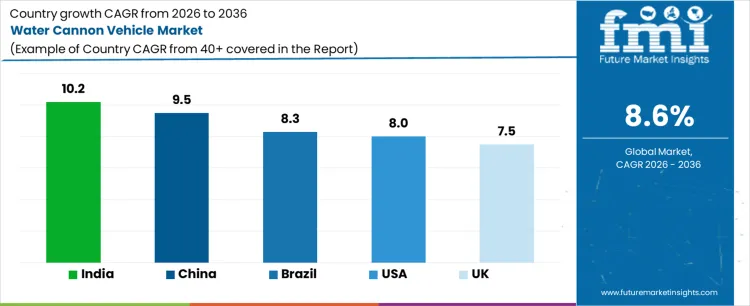
Demand for water cannon vehicles is rising as law enforcement and security agencies adopt specialized equipment for crowd control, riot management, and public safety operations. India leads with a 10.2% CAGR, driven by growing demand for modernized policing infrastructure and deployment in urban and high-security areas. China follows at 9.5%, supported by investments in law enforcement vehicles and public safety initiatives. Brazil records 8.3% growth, shaped by adoption in municipal and security operations. The US grows at 8.0%, influenced by fleet upgrades and strategic deployment in law enforcement. The UK shows 7.5% CAGR, reflecting steady adoption of water cannon vehicles for public safety and event management.
How is the United States experiencing growth in the water cannon vehicle market?
United States is experiencing growth at a CAGR of 8%, driven by demand from law enforcement, crowd control agencies, and municipal safety departments in major cities such as New York, Los Angeles, and Chicago. Regulatory strictness and certification culture require vehicles to meet safety and operational standards, influencing procurement. Market concentration is high among large metropolitan police forces, while regional agencies purchase selectively. Investments focus on durability, high-pressure performance, and integration with existing emergency response systems. Growth reflects increasing urban safety initiatives and modernization of public order equipment.
- Law enforcement and municipal safety agencies drive adoption.
- Metropolitan police forces concentrate demand.
- Vehicle durability and performance guide investment.
- Regulatory compliance influences procurement.
How is the United Kingdom witnessing growth in the water cannon vehicle market?
United Kingdom is witnessing growth at a CAGR of 7.5%, supported by public sector role and procurement weight in police and emergency response services in London, Manchester, and Birmingham. Centralized government procurement ensures standardized fleets for crowd control operations. Investments focus on vehicle performance, operator safety, and operational reliability. Growth reflects the influence of public sector requirements on adoption and deployment across key urban centers.
- Centralized public sector procurement drives adoption.
- Urban law enforcement agencies concentrate demand.
- Performance and safety standards guide investment.
- Standardized fleet requirements shape deployment.
How is China experiencing growth in the water cannon vehicle market?
China is experiencing growth at a CAGR of 9.5%, fueled by large-scale urban infrastructure and regional security needs in Beijing, Shanghai, and Guangzhou. Standard-setting influence versus rule-following drives adoption, with national and provincial authorities specifying vehicle standards while operators follow strict protocols. Demand is concentrated in densely populated urban areas. Investments focus on high-pressure capacity, operational reliability, and adherence to regulatory specifications. Growth reflects the integration of water cannon vehicles into broader public safety and civil defense planning.
- Urban security and infrastructure projects drive adoption.
- Major cities concentrate demand.
- Operational reliability and adherence to standards guide investment.
- Standardized specifications influence procurement.
How is India witnessing growth in the water cannon vehicle market?
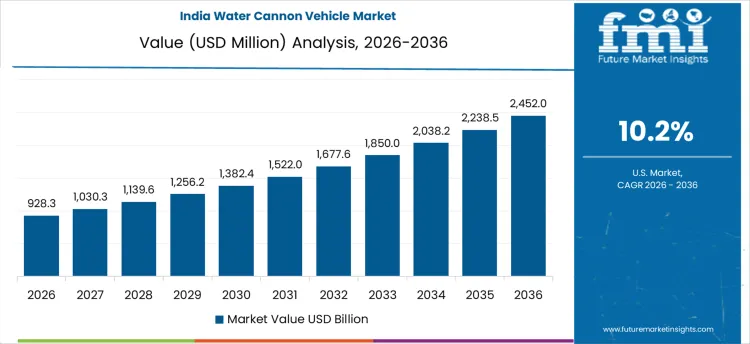
India is experiencing growth at a CAGR of 10.2%, supported by enforcement rigor and compliance behavior in police and paramilitary units across Delhi, Mumbai, and Bengaluru. Agencies require vehicles with proven operational safety, reliability, and effectiveness for crowd management. Demand is concentrated in high-density urban centers. Investments prioritize rugged construction, high-pressure performance, and compliance with national guidelines. Growth reflects increasing urban security challenges, government emphasis on crowd control capability, and operational risk mitigation.
- Police and paramilitary units drive adoption.
- High-density urban centers concentrate demand.
- Rugged construction and reliability guide investment.
- Enforcement rigor shapes procurement.
How is Brazil experiencing growth in the water cannon vehicle market?
Brazil is experiencing growth at a CAGR of 8.3%, fueled by trade policy, tariffs, and import rules that influence procurement of specialized vehicles in São Paulo, Rio de Janeiro, and Paraná. Local content and domestic manufacturing pressures affect supply decisions. Demand is concentrated in urban police forces and civil defense units. Investments focus on cost-effective performance, compliance with national regulations, and adaptation to regional operational conditions. Growth reflects balancing import dependence with domestic production capacity, operational reliability, and adherence to safety standards.
- Urban police and civil defense units drive adoption.
- Major cities concentrate demand.
- Domestic production and import rules influence procurement.
- Cost-effectiveness and compliance guide investment.
Water Cannon Vehicle Market: How Do Manufacturers Differentiate in Capabilities and Deployment?
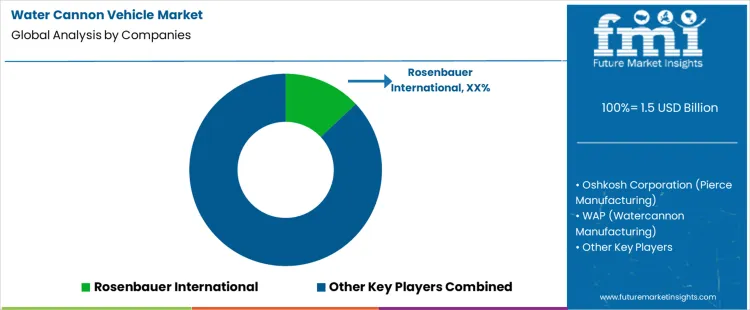
Competition in the water cannon vehicle market is defined by vehicle platform ruggedness, pump capacity, turret control precision, and integration with safety systems. Rosenbauer International supplies vehicles engineered for high-pressure water delivery with ergonomic control layouts and robust chassis options suited to crowd control, fire response, and industrial use. Oshkosh Corporation (Pierce Manufacturing) delivers water cannon platforms built on heavy-duty municipal and emergency response chassis, emphasising reliability and serviceability in complex operational environments. WAP (Watercannon Manufacturing) focuses on modular water cannon systems that can be integrated with varied base vehicles, supporting rapid deployment and maintenance. Seagrave Fire Apparatus develops custom integrated water cannon vehicles that balance flow performance with mobility and operator safety. Bucher Municipal offers vehicles adapted for urban environments, combining water cannon functionality with street cleaning and public safety roles.
DFAC (Dongfeng Motor Corporation) supplies water cannon vehicles based on commercial and military-grade truck platforms, incorporating high-capacity pumps and remote-controlled turret systems for enhanced operator protection. BAE Systems (Hagglunds) delivers armored water cannon solutions designed for security forces and high-risk deployments, with attention to vehicle protection, electronic control integration, and terrain mobility. Other regional manufacturers and integrators provide adaptations for local regulatory conditions, chassis availability, and specific use cases such as airport emergency response or riot control. Competitive differentiation arises from pump performance, turret control systems, chassis durability, ease of maintenance, and safety features including operator cabins and remote operation. Suppliers that combine proven field reliability, service support networks, and customization options maintain relevance across public safety, law enforcement, and industrial safety segments where water cannon vehicles serve both crowd management and emergency response functions.
Key Players in the Water Cannon Vehicle Market
- Rosenbauer International
- Oshkosh Corporation (Pierce Manufacturing)
- WAP (Watercannon Manufacturing)
- Seagrave Fire Apparatus
- Bucher Municipal
- DFAC (Dongfeng Motor Corporation)
- BAE Systems (Hagglunds)
Scope of the Report
| Items | Values |
|---|---|
| Quantitative Units (2026) | USD billion |
| Type | Mounted Water Cannon Vehicles, Trailer-Mounted Water Cannon Units, Self-Propelled Water Cannon Vehicles, Portable and Rapid-Deploy Water Cannon Systems |
| Application | Law Enforcement and Riot Control, Firefighting Support, Industrial Hazard Response, Public Event Crowd Management |
| Regions Covered | Asia Pacific, Europe, North America, Latin America, Middle East & Africa |
| Countries Covered | China, Japan, South Korea, India, Australia & New Zealand, ASEAN, Germany, United Kingdom, France, Italy, Spain, Nordic, BENELUX, United States, Canada, Mexico, Brazil, Chile, Saudi Arabia, Turkey, South Africa, and other regional markets |
| Key Companies Profiled | Rosenbauer International, Oshkosh Corporation (Pierce Manufacturing), WAP (Watercannon Manufacturing), Seagrave Fire Apparatus, Bucher Municipal, DFAC (Dongfeng Motor Corporation), BAE Systems (Hagglunds) |
| Additional Attributes | Dollar sales by vehicle type and application; mounted vehicles as the leading platform; law enforcement and riot control as the largest application; demand driven by public order policy, procurement cycles, and fleet modernization programs; purchasing shaped by lifecycle support, compliance, and platform standardization rather than annual replacement cycles. |
Water Cannon Vehicle Market Segmentation
Type:
- Mounted water cannon vehicles
- Trailer-mounted water cannon units
- Self-propelled water cannon vehicles
- Portable and rapid-deploy water cannon systems
Application:
- Law enforcement and riot control
- Firefighting support
- Industrial hazard response
- Public event crowd management
Region
- Asia Pacific
- China
- Japan
- South Korea
- India
- Australia & New Zealand
- ASEAN
- Rest of Asia Pacific
- Europe
- Germany
- United Kingdom
- France
- Italy
- Spain
- Nordic
- BENELUX
- Rest of Europe
- North America
- United States
- Canada
- Mexico
- Latin America
- Brazil
- Chile
- Rest of Latin America
- Middle East & Africa
- Kingdom of Saudi Arabia
- Other GCC Countries
- Turkey
- South Africa
- Other African Union
- Rest of Middle East & Africa
Bibliography
- United Nations Office on Drugs and Crime. (2024). United Nations human rights guidance on the use of less-lethal weapons and equipment in law enforcement (updated edition). United Nations.
- United Kingdom Home Office. (2024). Public order policing: Operational guidance for crowd management and use of less-lethal equipment (2024 revision). Government of the United Kingdom.
- United States Department of Justice, National Institute of Justice. (2024). Less-lethal technologies for law enforcement: Evaluation of water delivery and crowd management systems. U.S. Department of Justice.
Frequently Asked Questions
How big is the water cannon vehicle market in 2026?
The global water cannon vehicle market is estimated to be valued at USD 1.5 billion in 2026.
What will be the size of water cannon vehicle market in 2036?
The market size for the water cannon vehicle market is projected to reach USD 3.4 billion by 2036.
How much will be the water cannon vehicle market growth between 2026 and 2036?
The water cannon vehicle market is expected to grow at a 8.6% CAGR between 2026 and 2036.
What are the key product types in the water cannon vehicle market?
The key product types in water cannon vehicle market are mounted water cannon vehicles , trailer‑mounted water cannon units, self‑propelled water cannon vehicles and portable and rapid‑deploy water cannon systems.
Which application segment to contribute significant share in the water cannon vehicle market in 2026?
In terms of application, law enforcement and riot control segment to command 43.0% share in the water cannon vehicle market in 2026.
Preview the report firsthand - request a free sample
Get SampleGet the brochure for pricing and purchase details.
Get PDFTable of Content
- Executive Summary
- Global Market Outlook
- Demand-side Trends
- Supply-side Trends
- Technology Roadmap Analysis
- Analysis and Recommendations
- Market Overview
- Market Coverage / Taxonomy
- Market Definition / Scope / Limitations
- Market Background
- Market Dynamics
- Drivers
- Restraints
- Opportunity
- Trends
- Scenario Forecast
- Demand in Optimistic Scenario
- Demand in Likely Scenario
- Demand in Conservative Scenario
- Opportunity Map Analysis
- Product Life Cycle Analysis
- Supply Chain Analysis
- Investment Feasibility Matrix
- Value Chain Analysis
- PESTLE and Porter’s Analysis
- Regulatory Landscape
- Regional Parent Market Outlook
- Production and Consumption Statistics
- Import and Export Statistics
- Market Dynamics
- Global Market Analysis 2021 to 2025 and Forecast, 2026 to 2036
- Historical Market Size Value (USD Million) Analysis, 2021 to 2025
- Current and Future Market Size Value (USD Million) Projections, 2026 to 2036
- Y-o-Y Growth Trend Analysis
- Absolute $ Opportunity Analysis
- Global Market Pricing Analysis 2021 to 2025 and Forecast 2026 to 2036
- Global Market Analysis 2021 to 2025 and Forecast 2026 to 2036, By Type
- Introduction / Key Findings
- Historical Market Size Value (USD Million) Analysis By Type, 2021 to 2025
- Current and Future Market Size Value (USD Million) Analysis and Forecast By Type, 2026 to 2036
- Mounted water cannon vehicles
- Trailer‑mounted water cannon units
- Self‑propelled water cannon vehicles
- Portable and rapid‑deploy water cannon systems
- Mounted water cannon vehicles
- Y-o-Y Growth Trend Analysis By Type, 2021 to 2025
- Absolute $ Opportunity Analysis By Type, 2026 to 2036
- Global Market Analysis 2021 to 2025 and Forecast 2026 to 2036, By Application
- Introduction / Key Findings
- Historical Market Size Value (USD Million) Analysis By Application, 2021 to 2025
- Current and Future Market Size Value (USD Million) Analysis and Forecast By Application, 2026 to 2036
- Law enforcement and riot control
- Firefighting support
- Industrial hazard response
- Public event crowd management
- Law enforcement and riot control
- Y-o-Y Growth Trend Analysis By Application, 2021 to 2025
- Absolute $ Opportunity Analysis By Application, 2026 to 2036
- Global Market Analysis 2021 to 2025 and Forecast 2026 to 2036, By Region
- Introduction
- Historical Market Size Value (USD Million) Analysis By Region, 2021 to 2025
- Current Market Size Value (USD Million) Analysis and Forecast By Region, 2026 to 2036
- North America
- Latin America
- Western Europe
- Eastern Europe
- East Asia
- South Asia and Pacific
- Middle East & Africa
- Market Attractiveness Analysis By Region
- North America Market Analysis 2021 to 2025 and Forecast 2026 to 2036, By Country
- Historical Market Size Value (USD Million) Trend Analysis By Market Taxonomy, 2021 to 2025
- Market Size Value (USD Million) Forecast By Market Taxonomy, 2026 to 2036
- By Country
- USA
- Canada
- Mexico
- By Type
- By Application
- By Country
- Market Attractiveness Analysis
- By Country
- By Type
- By Application
- Key Takeaways
- Latin America Market Analysis 2021 to 2025 and Forecast 2026 to 2036, By Country
- Historical Market Size Value (USD Million) Trend Analysis By Market Taxonomy, 2021 to 2025
- Market Size Value (USD Million) Forecast By Market Taxonomy, 2026 to 2036
- By Country
- Brazil
- Chile
- Rest of Latin America
- By Type
- By Application
- By Country
- Market Attractiveness Analysis
- By Country
- By Type
- By Application
- Key Takeaways
- Western Europe Market Analysis 2021 to 2025 and Forecast 2026 to 2036, By Country
- Historical Market Size Value (USD Million) Trend Analysis By Market Taxonomy, 2021 to 2025
- Market Size Value (USD Million) Forecast By Market Taxonomy, 2026 to 2036
- By Country
- Germany
- UK
- Italy
- Spain
- France
- Nordic
- BENELUX
- Rest of Western Europe
- By Type
- By Application
- By Country
- Market Attractiveness Analysis
- By Country
- By Type
- By Application
- Key Takeaways
- Eastern Europe Market Analysis 2021 to 2025 and Forecast 2026 to 2036, By Country
- Historical Market Size Value (USD Million) Trend Analysis By Market Taxonomy, 2021 to 2025
- Market Size Value (USD Million) Forecast By Market Taxonomy, 2026 to 2036
- By Country
- Russia
- Poland
- Hungary
- Balkan & Baltic
- Rest of Eastern Europe
- By Type
- By Application
- By Country
- Market Attractiveness Analysis
- By Country
- By Type
- By Application
- Key Takeaways
- East Asia Market Analysis 2021 to 2025 and Forecast 2026 to 2036, By Country
- Historical Market Size Value (USD Million) Trend Analysis By Market Taxonomy, 2021 to 2025
- Market Size Value (USD Million) Forecast By Market Taxonomy, 2026 to 2036
- By Country
- China
- Japan
- South Korea
- By Type
- By Application
- By Country
- Market Attractiveness Analysis
- By Country
- By Type
- By Application
- Key Takeaways
- South Asia and Pacific Market Analysis 2021 to 2025 and Forecast 2026 to 2036, By Country
- Historical Market Size Value (USD Million) Trend Analysis By Market Taxonomy, 2021 to 2025
- Market Size Value (USD Million) Forecast By Market Taxonomy, 2026 to 2036
- By Country
- India
- ASEAN
- Australia & New Zealand
- Rest of South Asia and Pacific
- By Type
- By Application
- By Country
- Market Attractiveness Analysis
- By Country
- By Type
- By Application
- Key Takeaways
- Middle East & Africa Market Analysis 2021 to 2025 and Forecast 2026 to 2036, By Country
- Historical Market Size Value (USD Million) Trend Analysis By Market Taxonomy, 2021 to 2025
- Market Size Value (USD Million) Forecast By Market Taxonomy, 2026 to 2036
- By Country
- Kingdom of Saudi Arabia
- Other GCC Countries
- Turkiye
- South Africa
- Other African Union
- Rest of Middle East & Africa
- By Type
- By Application
- By Country
- Market Attractiveness Analysis
- By Country
- By Type
- By Application
- Key Takeaways
- Key Countries Market Analysis
- USA
- Pricing Analysis
- Market Share Analysis, 2025
- By Type
- By Application
- Canada
- Pricing Analysis
- Market Share Analysis, 2025
- By Type
- By Application
- Mexico
- Pricing Analysis
- Market Share Analysis, 2025
- By Type
- By Application
- Brazil
- Pricing Analysis
- Market Share Analysis, 2025
- By Type
- By Application
- Chile
- Pricing Analysis
- Market Share Analysis, 2025
- By Type
- By Application
- Germany
- Pricing Analysis
- Market Share Analysis, 2025
- By Type
- By Application
- UK
- Pricing Analysis
- Market Share Analysis, 2025
- By Type
- By Application
- Italy
- Pricing Analysis
- Market Share Analysis, 2025
- By Type
- By Application
- Spain
- Pricing Analysis
- Market Share Analysis, 2025
- By Type
- By Application
- France
- Pricing Analysis
- Market Share Analysis, 2025
- By Type
- By Application
- India
- Pricing Analysis
- Market Share Analysis, 2025
- By Type
- By Application
- ASEAN
- Pricing Analysis
- Market Share Analysis, 2025
- By Type
- By Application
- Australia & New Zealand
- Pricing Analysis
- Market Share Analysis, 2025
- By Type
- By Application
- China
- Pricing Analysis
- Market Share Analysis, 2025
- By Type
- By Application
- Japan
- Pricing Analysis
- Market Share Analysis, 2025
- By Type
- By Application
- South Korea
- Pricing Analysis
- Market Share Analysis, 2025
- By Type
- By Application
- Russia
- Pricing Analysis
- Market Share Analysis, 2025
- By Type
- By Application
- Poland
- Pricing Analysis
- Market Share Analysis, 2025
- By Type
- By Application
- Hungary
- Pricing Analysis
- Market Share Analysis, 2025
- By Type
- By Application
- Kingdom of Saudi Arabia
- Pricing Analysis
- Market Share Analysis, 2025
- By Type
- By Application
- Turkiye
- Pricing Analysis
- Market Share Analysis, 2025
- By Type
- By Application
- South Africa
- Pricing Analysis
- Market Share Analysis, 2025
- By Type
- By Application
- USA
- Market Structure Analysis
- Competition Dashboard
- Competition Benchmarking
- Market Share Analysis of Top Players
- By Regional
- By Type
- By Application
- Competition Analysis
- Competition Deep Dive
- Rosenbauer International
- Overview
- Product Portfolio
- Profitability by Market Segments (Product/Age /Sales Channel/Region)
- Sales Footprint
- Strategy Overview
- Marketing Strategy
- Product Strategy
- Channel Strategy
- Oshkosh Corporation (Pierce Manufacturing)
- WAP (Watercannon Manufacturing)
- Seagrave Fire Apparatus
- Bucher Municipal
- DFAC (Dongfeng Motor Corporation)
- BAE Systems (Hagglunds)
- Rosenbauer International
- Competition Deep Dive
- Assumptions & Acronyms Used
- Research Methodology


