

- Industry Size (2026)
- USD 3193.6 Mn
- Forecast (2036)
- USD 7287.5 Mn
- CAGR (2026 to 2036)
- 8.6%
Water Ionizer Market Forecast and Outlook 2026 to 2036
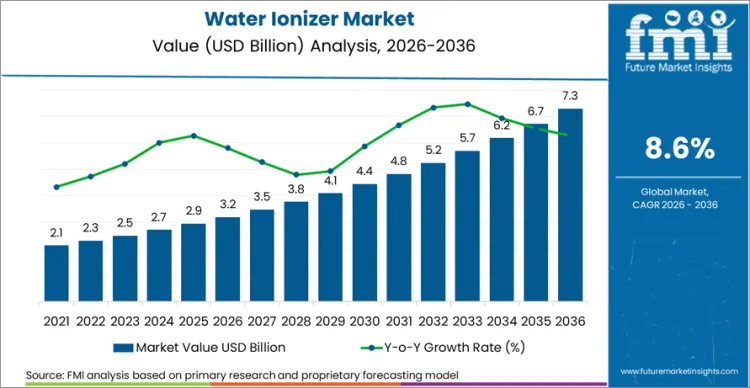
The global water ionizer market is on track to achieve a valuation of USD 7,287.5 Million by 2036, accelerating from USD 3,193.6 Million in 2026 at a CAGR of 8.6%. As per Future Market Insights, expansion is structurally underpinned by a growing consumer preference for alkaline and hydrogen-rich water systems combined with increased institutional adoption in hospitality and healthcare settings.
The World Health Organization published updated guidelines on drinking water quality in 2024 reaffirming the importance of pH balance and mineral content in potable water, a position that validates the core value proposition of ionizer technology. This compels manufacturers to invest in product certification and clinical validation to differentiate from unregulated competitors. Simultaneously the competitive environment is shifting from fragmented direct-sales networks to a more consolidated structure where tariff exposure and regulatory compliance determine market access.
Advait Kumar, Founder of Boon, stated: 'Water is the most fundamental of human needs and rights, and capital deployment to enable innovation in hydration is going to be key for our future.' FMI opines that this reflects a broader structural shift in the industry where capital is flowing toward water technology innovation, with ionizer manufacturers repositioning from wellness accessories to essential hydration infrastructure.
The operational reality for water ionizer producers is defined by a dual pressure of rising input costs from tariff adjustments and the need to secure medical-device certifications that grant access to premium distribution channels. Enagic USA announced a mandatory price increase for all Kangen water ionizer models in August 2025, a direct response to a new 15% US tariff on Japanese imports that is compressing distributor margins across North America. Fujiiryoki has used its Controlled Medical Device certification under Japan's PMDA standards to differentiate its alkaline ionizers from uncertified local brands in the Indian market, establishing a regulatory moat that competitors must now replicate to access health-conscious buyers.
AlkaViva launched a zero-installation, rechargeable portable ionizer in February 2025 targeting renters and travelers, with the product reaching 25,000 units sold within its first six months and validating a market shift toward compact modular designs. As per FMI, these moves confirm that the water ionizer sector is entering a phase of premiumization where clinical credibility, tariff management, and portable form factors determine which producers retain pricing power. Elkay (Zurn Elkay) launched the Liv EZ commercial-grade built-in filtered water dispenser in October 2025, extending its expertise from commercial hydration into the residential segment.
Summary of Water Ionizer Market
What Is Growth Outlook for Water Ionizer Market as per Future Market Insights Projection?
Future Market Insights projects the water ionizer market to expand at a CAGR of 8.6% from 2026 to 2036, increasing from USD 3,193.6 Million in 2026 to USD 7,287.5 Million by 2036.
FMI Research Approach: FMI proprietary forecasting model based on end-use demand correlation and distribution channel analysis.
How Do FMI Analysts Perceive Water Ionizer Market to Evolve?
FMI analysts perceive the market evolving toward a certification-driven structure where medical-device approvals and clinical validation separate premium producers from unregulated alternatives, with portable and modular formats gaining share against traditional under-counter installations.
FMI Research Approach: Regulatory convergence analysis across PMDA (Japan), FDA (USA), and BIS (India) certification frameworks.
Which Country Holds Largest Share in Global Water Ionizer Market?
The United States holds a significant share of the global water ionizer market by value, supported by a large installed base of residential water treatment systems and an established direct-to-consumer distribution network.
FMI Research Approach: FMI country-level revenue modelling by household penetration and distribution channel mapping.
How Large Will Water Ionizer Market Be by 2036?
The global water ionizer market is projected to reach USD 7,287.5 Million by 2036.
FMI Research Approach: FMI long-term revenue forecast derived from household water treatment adoption curves and macroeconomic indicators.
What Is Definition of Water Ionizer Market?
The water ionizer market includes revenue generated from the production and sale of electrolysis-based water treatment devices that alter water pH to produce alkaline or acidic output, covering countertop, under-counter, and portable formats for residential and commercial use.
FMI Research Approach: FMI market taxonomy and inclusion-exclusion framework.
What Are Globally Unique Trends Shaping Water Ionizer Market?
Globally unique trends include the rise of portable zero-installation ionizers targeting renters and travelers, the use of medical-device certifications as competitive differentiation in Asia, and tariff-driven pricing restructuring in the North American import channel.
FMI Research Approach: Trade policy analysis and competitive intelligence tracking.
Water Ionizer Market Key Takeaways
| Metric | Details |
|---|---|
| Industry Size (2026) | USD 3,193.6 Million |
| Industry Value (2036) | USD 7,287.5 Million |
| CAGR (2026 to 2036) | 8.6% |
Source: Future Market Insights (FMI) analysis, based on proprietary forecasting model and primary research
Key Points Covered in the Water Ionizer Market Survey
- Market Estimates and Forecast 2020 to 2035
- Key Drivers and Restraints Impacting Market Growth
- Regional Analysis, Segment-wise, and Country-wise Analysis
- Competition Mapping and Benchmarking
- Brand share and Market Share Analysis
- Key Product Innovations and Regulatory Climate
- Recommendation on Key Winning Strategies
Semi-Annual Industry Update
The following table presents the expected CAGR for the global water ionizer market over several semi-annual periods spanning from 2026 to 2036. In the first half (H1) of the decade from 2024 to 2034, the business is predicted to surge at a CAGR of 8.8%, followed by a slightly declined rate of 8.2% in the second half (H2) of the same decade.
| Particular | Value CAGR |
|---|---|
| H1 | 8.8% (2021 to 2035) |
| H2 | 8.2% (2025 to 2035) |
| H1 | 8.7% (2026 to 2036) |
| H2 | 8.5% (2026 to 2036) |
In the next period from H1 2025 to H2 2035, the CAGR is expected to rise slightly to 8.7% for the first half, however, for the second half, it will decrease to 8.5%. In the H1 it has increased by 87 BPS and in the H2 it has gone up by 85 BPS.
2021 to 2025 Global Water Ionizer Market Outlook Compared to 2026 to 2036 Forecast
The overall global water ionizer market showed impressive growth of around 4.5% during the historic period from 2020 to 2024 mainly due to rising consumer interest in the consumption of alkaline water for overall well-being. From this period, the market grew gradually, mainly because the residential population embraced the water ionizers and there is an increasing demand for higher quality water purification systems.
Further, the growth was accompanied by the enhancement of the marketing of water ionizers for their capacity to decrease the level of acidity and neutralize hazardous substances in the water, especially in developed countries.
The market from 2026 to 2036 may also experience significant growth due to technological development and the introduction of energy-efficient ease-to-use models. This period is expected to witness increased demand in the under-counter water ionizers department due to its demand in many modern kitchens due to its compact design.
Asian Pacific and Latin American markets are projected to exhibit the fastest growth over the forecast period due to increasing disposable incomes and health-conscious populations in the markets. Perhaps, manufacturing companies will shift their efforts towards the incorporation of special options and effectively low prices for penetrating unexplored regions.
The demand for water purification is expected to grow significantly due to new market regulations on water purification standards in regions such as North America & Europe. In addition, the incorporation of IoT in the water ionizers which facilitate the remote sensing and control of the devices seems to gain the attention of smart consumers.
In totality, the water ionizer market on an international level is on the brink of a revolution with technology, changing customer demands and distribution channels are the two major factors. This is forecasted to force companies to focus on product differentiation, regional strategies of penetration and sustainable practices to remain competitive during the periods.
Key Dynamics in the Water Ionizer Market Worldwide
Awareness Towards Better Health is a Key Driver for the Growth of the Market
There are multiple scientific claims that alkaline water helps in digestion, proper and effective water absorption, reducing indigestion, which happens due to the presence of other enzymes and soothing the acid refluxes. People are using water ionizers so that all these said benefits will keep them healthy. Proper hydration and digestion helps in the absorption of all the nutrients available in food, keeping immunity strong and ultimately helping in disease prevention.
There are other benefits of the alkalization of water, one of them being the removal of carbonate from water. When water is ionized in the ionizer, it separates the dissolved CO2 in water. This CO2 is in the form of carbonate with minerals. When carbonate is removed, minerals get into available form in water, improving the water quality for consumption. Such a factor has tremendously surged the target market to new heights.
Additionally, an increase in online sales of these ionizers is helping the market grow. Manufacturers are reaching customers from all over the world, due to improved online marketplaces and distribution chains. The ionizers are getting demand from different sectors like hospitals, commercial shops and outlets as well as for household use. Laboratories are using ionizers to carry out different tests and experiments.
The Lack of Efficacy On Soft Water and Overconsumption of Alkaline Water Is Limiting the Market
One restraining factor for the water ionizer is that it cannot ionize soft water. Soft water is demineralised water. Minerals are important as they carry positive and negative charges and carry out the ionization process. If filtered water is used for the ionization process, it will not have any effect on the water. Due to such limiting factors, the volume of sales of target products is getting hampered.
Another restraint to the market is the re-mineralization of ionized water. The minerals are reduced in ionized water, and to re-mineralize it, external filters are required. These filters are expensive and are not readily available.
Further, ionized water used in excess can potentially cause several health issues. Since water has a modest alkaline pH, excessive consumption may result in nausea and vomiting. Prolonged consumption may also result in mineral deficiencies and other health issues which is in turn hampering the growth of the market.
Country-wise Insights
How is the Target Market Faring in Japan?
Certifications and Consumer Preferences Contribute to the Market Expansion
Japan has initiated the trend of using water ionizers. The main reason for the increased use of ionizers in the country is consumer preferences for the said benefits of drinking alkaline water. Several manufacturers produce and sell different types of ionizers. Due to the initiation of certification and testing of ionizers in the country, the market is also growing.
Further, the significant manufacturing hub in the country especially reckoned for high-end and innovative products and efficient technology from the manufacturers is another key leading factor towards the growth of the target market.
What is the Demand Outlook for the Target Product in the USA Market?
Resident Health-Conscious Consumers On the Rise
The USA has a high number of consumers for water ionizers. There are multiple manufacturers providing countertops and under-counter ionizers. There are also additional attachments for these ionizers like carbon filters and pre-filtration systems, helping in purifying water and ultimately providing clean drinking water. The manufacturers also claim multiple health benefits from drinking alkaline water, attracting health-conscious customers.
Additionally, the trend of residents to adopt new and innovative products in the market is another factor leading to the growth of the market. The brands in the region are using unique differentiating strategies to capture the target consumer base and gain a competitive edge over other competitors in the market, in turn, leading to increased investment in R7D activities to cater to the increasing and versatile demand of the consumers.
Category-wise Insights
Which is the Leading Category in the Market Based on the Product Type Segment?
Countertop Water Ionizers Category to Lead the Market During the Forecast Period
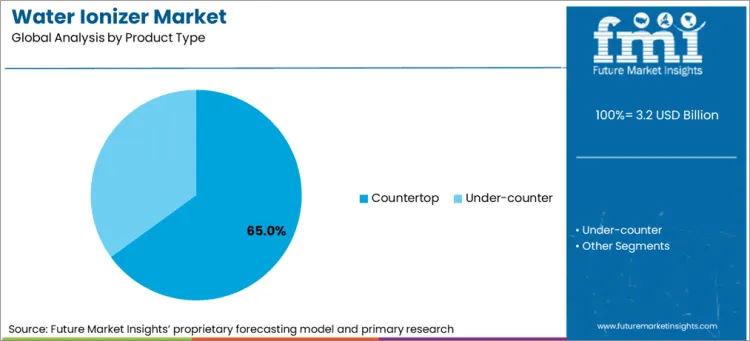
According to the study, the countertop water ionizer segment was the largest in the global market in 2025, with a market share of approximately 65%. The reason for this is that the material is cheap, easy to install and appropriate for use in homes. Portable countertop models are the most common ones currently on the market and suit any family on the hunt for a cheap and effective water filtration system in turn leading to increased volume of sales.
In the next ten years, the under-counter water ionizer is anticipated to register the highest CAGR of 7.5% during 2025 to 2035 due to the prevalence of the slim and sleek designs that are advantageous space-wise in the latest kitchen setups.
These units are available with some more sophisticated functions, consisting of multi-stage filters, improved ionization ability as well as compatibility with existing water systems. The increasing trend of using more expensive kitchen appliances in homes, especially in North America and European countries, will create stronger market demand for under-counter styles.
What is the Demand Outlook Based on the Type of Application?
Increased Awareness towards Health to Boost Sales in Residential Applications
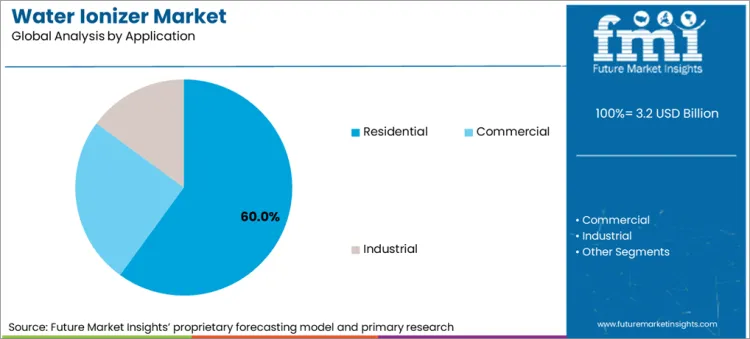
The residential category dominated the global water ionizer market with a 60% market share in 2024. This dominance is due to growing consumer awareness of the health benefits connected with the consumption of water with an alkaline pH level as well as the advances in the number of diseases. Consumers, especially homeowners in urban regions, are installing water ionizers as a way of having clean water enriched with minerals.
Analyzing the market over the forecast period, the commercial segment has the highest compound annual growth rate of 8% between 2025 and 2035. This growth is attributed to the emergence of more outlets with prerequisites such as cafes, restaurants, fitness centres and wellness clinics that prefer water ionizers that provide high-quality water. High-capacity commercial-grade ionizers are emerging in demand by businesses due to the trend of offering alkaline water to the health-conscious market.
Competitive Landscape
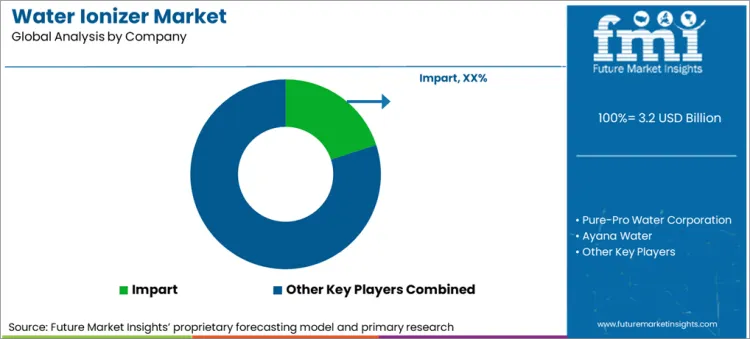
Some key players in the water ionizer market are Impart, VWA, Pure-Pro Water Corporation, Ayana Water, Emco Tech Co. Ltd, Enagic, Chanson Water Co. Ltd., Bawell Health Water LLC, AIR Water LIFE, Tyent USA, Vollara LLC., and KENT among others. These brands are anticipated to contribute to market growth.
Recent Developments:
- In January 2026, Enagic International announced a major pricing restructuring and a service-first expansion strategy for its Kangen Water network, rolling out a new distributor mentorship program focused on medical-grade product education and ethical business practices across its South American and Asian hubs.
- In April 2025, Panasonic Corporation published a study through its Living Appliances and Solutions division confirming that its alkaline water ionizers can increase green tea polyphenol extraction by up to 2.8 times, signalling a strategic shift toward nutritional enhancement and functional cooking technology.
- In February 2025, AlkaViva launched a zero-installation, rechargeable portable ionizer targeting the renter and traveler demographic, reaching 25,000 units sold within its first six months and validating demand for compact modular designs.
Market Definition
The water ionizer market represents revenue generated from the production and sale of electrolysis-based water treatment devices designed to alter the pH of drinking water for residential and commercial use. The market measures the value of countertop, under-counter, and portable ionizer units sold through direct-to-consumer networks, retail channels, and institutional procurement.
Inclusions cover alkaline water ionizers, hydrogen water generators, and hybrid ionizer-purifier systems across all installation formats. It includes replacement filters, electrodes, and consumable components sold as part of the ionizer ecosystem. Units certified as medical devices under national regulatory frameworks are also included.
Exclusions include standard water purifiers without electrolysis capability (RO, UV, gravity filters), alkaline water pitchers that rely on mineral cartridges rather than electrolysis, and bottled alkaline water products. Water treatment infrastructure for municipal or industrial applications is outside the scope.
Scope of Report
| Attribute | Details |
|---|---|
| Forecast Period | 2025 to 2035 |
| Historical Data Available for | 2020 to 2024 |
| Market Analysis | USD Million for Value |
| Report Coverage | Revenue Forecast, Volume Forecast, Company Ranking, Competitive Landscape, Growth Factors, and Trends, Pricing Analysis |
| Key Segments Covered | Product Type, Applications, Distribution Channel, Region |
| Key Regions Covered | North America; Latin America; Europe; South Asia; East Asia; Oceania; MEA |
| Key Companies Profiled | Impart; VWA; Pure-Pro Water Corporation; Ayana Water; Emco Tech Co. Ltd.; Enagic; Chanson Water Co. Ltd.; Bawell Health Water LLC; AIR Water LIFE; TyentUSA; Vollara LLC.; KENT; Others (as per request) |
| Customization & Pricing | Available upon Request |
| Pricing and Purchase Options | Avail Customized Purchase Options to Meet Your Exact Research Needs |
Key Segments Profiled in the Water Ionizer Market
By Product Type:
- Countertop
- Under-Counter
By Application:
- Residential
- Commercial
- Industrial
By Distribution Channel:
- Hypermarkets/Supermarkets
- Wholesalers/Distributors
- Specialty Stores
- Direct Sales
- Online Retailers
- Other Sales Channel
By Region:
- North America
- Latin America
- Europe
- East Asia
- South Asia
- Oceania
- Middle East and Africa
Bibliography
- Enagic USA. (2025, August). Price adjustment announcement for Kangen water ionizer models. Enagic USA corporate disclosure.
- Fujiiryoki. (Current). Medical device certification for alkaline water ionizers. Fujiiryoki India corporate disclosure.
- Elkay (Zurn Elkay). (2025, October). Liv EZ built-in filtered water dispenser launch. Elkay press room.
- Panasonic Corporation. (2025, April). Alkaline water ionizer polyphenol extraction study. Panasonic Living Appliances and Solutions.
- Boon (formerly Swajal). (2025). Series A funding announcement. Hotelier India.
- World Health Organization. (2024). Guidelines for drinking-water quality. WHO.
Frequently Asked Questions
What is the current global market size for the Water Ionizer Market?
The market is valued at USD 3,193.6 Million in 2026, driven by rising consumer preference for alkaline hydration and increased institutional adoption.
What is the projected Compound Annual Growth Rate (CAGR) for the market over the next 10 years?
The market is projected to grow at a CAGR of 8.6% from 2026 to 2036.
Which regions are experiencing the fastest expansion?
Asia Pacific leads with the highest growth rate, driven by rising health awareness and expanding distribution networks, followed by North America and Europe.
What are the primary market drivers?
Consumer health awareness, medical-device certification as a competitive differentiator, and the shift toward portable zero-installation formats are the primary drivers of adoption.
Who are the leading companies in the industry?
Enagic, Panasonic, Fujiiryoki, AlkaViva, and Elkay (Zurn Elkay) are key players, differentiating through certification credentials, distribution reach, and product format innovation.
Preview the report firsthand - request a free sample
Get SampleGet the brochure for pricing and purchase details.
Get PDFTable of Content
- Executive Summary
- Global Market Outlook
- Demand-side Trends
- Supply-side Trends
- Technology Roadmap Analysis
- Analysis and Recommendations
- Market Overview
- Market Coverage / Taxonomy
- Market Definition / Scope / Limitations
- Research Methodology
- Chapter Orientation
- Analytical Lens and Working Hypotheses
- Market Structure, Signals, and Trend Drivers
- Benchmarking and Cross-market Comparability
- Market Sizing, Forecasting, and Opportunity Mapping
- Research Design and Evidence Framework
- Desk Research Programme (Secondary Evidence)
- Company Annual and Sustainability Reports
- Peer-reviewed Journals and Academic Literature
- Corporate Websites, Product Literature, and Technical Notes
- Earnings Decks and Investor Briefings
- Statutory Filings and Regulatory Disclosures
- Technical White Papers and Standards Notes
- Trade Journals, Industry Magazines, and Analyst Briefs
- Conference Proceedings, Webinars, and Seminar Materials
- Government Statistics Portals and Public Data Releases
- Press Releases and Reputable Media Coverage
- Specialist Newsletters and Curated Briefings
- Sector Databases and Reference Repositories
- FMI Internal Proprietary Databases and Historical Market Datasets
- Subscription Datasets and Paid Sources
- Social Channels, Communities, and Digital Listening Inputs
- Additional Desk Sources
- Expert Input and Fieldwork (Primary Evidence)
- Primary Modes
- Qualitative Interviews and Expert Elicitation
- Quantitative Surveys and Structured Data Capture
- Blended Approach
- Why Primary Evidence is Used
- Field Techniques
- Interviews
- Surveys
- Focus Groups
- Observational and In-context Research
- Social and Community Interactions
- Stakeholder Universe Engaged
- C-suite Leaders
- Board Members
- Presidents and Vice Presidents
- R&D and Innovation Heads
- Technical Specialists
- Domain Subject-matter Experts
- Scientists
- Physicians and Other Healthcare Professionals
- Governance, Ethics, and Data Stewardship
- Research Ethics
- Data Integrity and Handling
- Primary Modes
- Tooling, Models, and Reference Databases
- Desk Research Programme (Secondary Evidence)
- Data Engineering and Model Build
- Data Acquisition and Ingestion
- Cleaning, Normalisation, and Verification
- Synthesis, Triangulation, and Analysis
- Quality Assurance and Audit Trail
- Market Background
- Market Dynamics
- Drivers
- Restraints
- Opportunity
- Trends
- Scenario Forecast
- Demand in Optimistic Scenario
- Demand in Likely Scenario
- Demand in Conservative Scenario
- Opportunity Map Analysis
- Product Life Cycle Analysis
- Supply Chain Analysis
- Investment Feasibility Matrix
- Value Chain Analysis
- PESTLE and Porter’s Analysis
- Regulatory Landscape
- Regional Parent Market Outlook
- Production and Consumption Statistics
- Import and Export Statistics
- Market Dynamics
- Global Market Analysis 2021 to 2025 and Forecast, 2026 to 2036
- Historical Market Size Value (USD Million) Analysis, 2021 to 2025
- Current and Future Market Size Value (USD Million) Projections, 2026 to 2036
- Y-o-Y Growth Trend Analysis
- Absolute $ Opportunity Analysis
- Global Market Pricing Analysis 2021 to 2025 and Forecast 2026 to 2036
- Global Market Analysis 2021 to 2025 and Forecast 2026 to 2036, By Product Type
- Introduction / Key Findings
- Historical Market Size Value (USD Million) Analysis By Product Type , 2021 to 2025
- Current and Future Market Size Value (USD Million) Analysis and Forecast By Product Type , 2026 to 2036
- Countertop
- Under-counter
- Countertop
- Y-o-Y Growth Trend Analysis By Product Type , 2021 to 2025
- Absolute $ Opportunity Analysis By Product Type , 2026 to 2036
- Global Market Analysis 2021 to 2025 and Forecast 2026 to 2036, By Application
- Introduction / Key Findings
- Historical Market Size Value (USD Million) Analysis By Application, 2021 to 2025
- Current and Future Market Size Value (USD Million) Analysis and Forecast By Application, 2026 to 2036
- Residential
- Commercial
- Industrial
- Residential
- Y-o-Y Growth Trend Analysis By Application, 2021 to 2025
- Absolute $ Opportunity Analysis By Application, 2026 to 2036
- Global Market Analysis 2021 to 2025 and Forecast 2026 to 2036, By Region
- Introduction
- Historical Market Size Value (USD Million) Analysis By Region, 2021 to 2025
- Current Market Size Value (USD Million) Analysis and Forecast By Region, 2026 to 2036
- North America
- Latin America
- Western Europe
- Eastern Europe
- East Asia
- South Asia and Pacific
- Middle East & Africa
- Market Attractiveness Analysis By Region
- North America Market Analysis 2021 to 2025 and Forecast 2026 to 2036, By Country
- Historical Market Size Value (USD Million) Trend Analysis By Market Taxonomy, 2021 to 2025
- Market Size Value (USD Million) Forecast By Market Taxonomy, 2026 to 2036
- By Country
- USA
- Canada
- Mexico
- By Product Type
- By Application
- By Country
- Market Attractiveness Analysis
- By Country
- By Product Type
- By Application
- Key Takeaways
- Latin America Market Analysis 2021 to 2025 and Forecast 2026 to 2036, By Country
- Historical Market Size Value (USD Million) Trend Analysis By Market Taxonomy, 2021 to 2025
- Market Size Value (USD Million) Forecast By Market Taxonomy, 2026 to 2036
- By Country
- Brazil
- Chile
- Rest of Latin America
- By Product Type
- By Application
- By Country
- Market Attractiveness Analysis
- By Country
- By Product Type
- By Application
- Key Takeaways
- Western Europe Market Analysis 2021 to 2025 and Forecast 2026 to 2036, By Country
- Historical Market Size Value (USD Million) Trend Analysis By Market Taxonomy, 2021 to 2025
- Market Size Value (USD Million) Forecast By Market Taxonomy, 2026 to 2036
- By Country
- Germany
- UK
- Italy
- Spain
- France
- Nordic
- BENELUX
- Rest of Western Europe
- By Product Type
- By Application
- By Country
- Market Attractiveness Analysis
- By Country
- By Product Type
- By Application
- Key Takeaways
- Eastern Europe Market Analysis 2021 to 2025 and Forecast 2026 to 2036, By Country
- Historical Market Size Value (USD Million) Trend Analysis By Market Taxonomy, 2021 to 2025
- Market Size Value (USD Million) Forecast By Market Taxonomy, 2026 to 2036
- By Country
- Russia
- Poland
- Hungary
- Balkan & Baltic
- Rest of Eastern Europe
- By Product Type
- By Application
- By Country
- Market Attractiveness Analysis
- By Country
- By Product Type
- By Application
- Key Takeaways
- East Asia Market Analysis 2021 to 2025 and Forecast 2026 to 2036, By Country
- Historical Market Size Value (USD Million) Trend Analysis By Market Taxonomy, 2021 to 2025
- Market Size Value (USD Million) Forecast By Market Taxonomy, 2026 to 2036
- By Country
- China
- Japan
- South Korea
- By Product Type
- By Application
- By Country
- Market Attractiveness Analysis
- By Country
- By Product Type
- By Application
- Key Takeaways
- South Asia and Pacific Market Analysis 2021 to 2025 and Forecast 2026 to 2036, By Country
- Historical Market Size Value (USD Million) Trend Analysis By Market Taxonomy, 2021 to 2025
- Market Size Value (USD Million) Forecast By Market Taxonomy, 2026 to 2036
- By Country
- India
- ASEAN
- Australia & New Zealand
- Rest of South Asia and Pacific
- By Product Type
- By Application
- By Country
- Market Attractiveness Analysis
- By Country
- By Product Type
- By Application
- Key Takeaways
- Middle East & Africa Market Analysis 2021 to 2025 and Forecast 2026 to 2036, By Country
- Historical Market Size Value (USD Million) Trend Analysis By Market Taxonomy, 2021 to 2025
- Market Size Value (USD Million) Forecast By Market Taxonomy, 2026 to 2036
- By Country
- Kingdom of Saudi Arabia
- Other GCC Countries
- Turkiye
- South Africa
- Other African Union
- Rest of Middle East & Africa
- By Product Type
- By Application
- By Country
- Market Attractiveness Analysis
- By Country
- By Product Type
- By Application
- Key Takeaways
- Key Countries Market Analysis
- USA
- Pricing Analysis
- Market Share Analysis, 2025
- By Product Type
- By Application
- Canada
- Pricing Analysis
- Market Share Analysis, 2025
- By Product Type
- By Application
- Mexico
- Pricing Analysis
- Market Share Analysis, 2025
- By Product Type
- By Application
- Brazil
- Pricing Analysis
- Market Share Analysis, 2025
- By Product Type
- By Application
- Chile
- Pricing Analysis
- Market Share Analysis, 2025
- By Product Type
- By Application
- Germany
- Pricing Analysis
- Market Share Analysis, 2025
- By Product Type
- By Application
- UK
- Pricing Analysis
- Market Share Analysis, 2025
- By Product Type
- By Application
- Italy
- Pricing Analysis
- Market Share Analysis, 2025
- By Product Type
- By Application
- Spain
- Pricing Analysis
- Market Share Analysis, 2025
- By Product Type
- By Application
- France
- Pricing Analysis
- Market Share Analysis, 2025
- By Product Type
- By Application
- India
- Pricing Analysis
- Market Share Analysis, 2025
- By Product Type
- By Application
- ASEAN
- Pricing Analysis
- Market Share Analysis, 2025
- By Product Type
- By Application
- Australia & New Zealand
- Pricing Analysis
- Market Share Analysis, 2025
- By Product Type
- By Application
- China
- Pricing Analysis
- Market Share Analysis, 2025
- By Product Type
- By Application
- Japan
- Pricing Analysis
- Market Share Analysis, 2025
- By Product Type
- By Application
- South Korea
- Pricing Analysis
- Market Share Analysis, 2025
- By Product Type
- By Application
- Russia
- Pricing Analysis
- Market Share Analysis, 2025
- By Product Type
- By Application
- Poland
- Pricing Analysis
- Market Share Analysis, 2025
- By Product Type
- By Application
- Hungary
- Pricing Analysis
- Market Share Analysis, 2025
- By Product Type
- By Application
- Kingdom of Saudi Arabia
- Pricing Analysis
- Market Share Analysis, 2025
- By Product Type
- By Application
- Turkiye
- Pricing Analysis
- Market Share Analysis, 2025
- By Product Type
- By Application
- South Africa
- Pricing Analysis
- Market Share Analysis, 2025
- By Product Type
- By Application
- USA
- Market Structure Analysis
- Competition Dashboard
- Competition Benchmarking
- Market Share Analysis of Top Players
- By Regional
- By Product Type
- By Application
- Competition Analysis
- Competition Deep Dive
- Impart
- Overview
- Product Portfolio
- Profitability by Market Segments (Product/Age /Sales Channel/Region)
- Sales Footprint
- Strategy Overview
- Marketing Strategy
- Product Strategy
- Channel Strategy
- Pure-Pro Water Corporation
- Ayana Water
- Emco Tech Co. Ltd
- Chanson Water Co. Ltd
- Impart
- Competition Deep Dive
- Assumptions & Acronyms Used


