

- Industry Size (2026)
- USD 17.3 Bn
- Forecast (2036)
- USD 32.2 Bn
- CAGR (2026 to 2036)
- 6.4%
Wax-Based Body Serums Market Forecast and Outlook 2026 to 2036
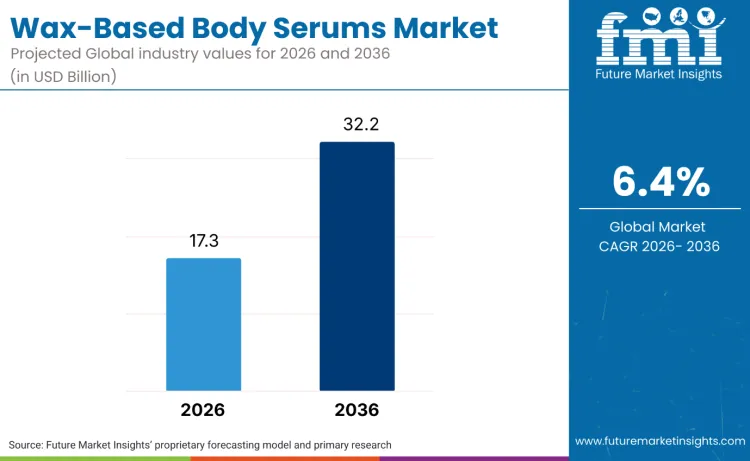
The global wax-based body serums market is forecasted to reach USD 17.3 billion in 2026 and expand to USD 32.2 billion by 2036, advancing at a CAGR of 6.4%. As per FMI, this outlook shows a transformation in personal care toward intensive hydration formulations, where traditional lightweight serums are transitioning toward wax-enriched therapeutic platforms. Expansion is driven by the rising demand for long-lasting moisture retention, with beauty brands and specialized skincare manufacturers embracing wax-based delivery systems across retail channels globally.
By leveraging advanced emulsification technology and natural wax extraction methods, formulators can now create sophisticated texture profiles that deliver prolonged hydration while maintaining elegant application properties. This technical innovation allows for the incorporation of high-concentration active ingredients within stable wax matrices, effectively extending skin contact time and improving therapeutic efficacy. Companies are also investing significantly in clean beauty formulations.
“By delivering superior offerings to our customers, we want to grow profitably and create value for shareholders. Our winning culture will be a key enabler for the successful execution of our strategy.”- Markus Kamieth CEO BASF SE
The industry's value proposition is shifting from volume-based product offerings toward precision-focused formulation positioning. Advanced manufacturers are integrating comprehensive texture optimization techniques, streamlined production systems, and flexible platform designs to reduce formulation complexity while improving skin penetration efficiency. Premium-positioned brands and specialized cosmetic manufacturers are gaining preference, enabling direct consumer partnerships and customized formulation services across beauty and personal care channels.
Summary of Wax-Based Body Serums Market
What is the growth outlook on the wax-based body serums market? Future Market Insights projects the market to grow at a 6.4% CAGR from 2026 to 2036, expanding from USD 17.3 billion to USD 32.2 billion.
FMI research approach: Bottom-up retail revenue modeling, product category analysis, consumer spending assessment, and premium formulation trend evaluation.
How do FMI analysts perceive the wax-based body serums market to evolve? The market is expected to move from conventional serum formulations toward wax-enhanced delivery platforms integrating natural ingredients, texture innovation, and targeted skincare benefits.
FMI research approach: Formulation technology transition analysis, ingredient trend mapping, consumer preference assessment, and retail channel performance evaluation.
Which country holds the largest share in the wax-based body serums market? China accounts for the largest global value share with an 8.64% growth rate.
FMI research approach: Country-level retail sales modeling, consumer spending analysis, beauty market penetration assessment, and regional preference evaluation.
How large will the wax-based body serums market be by 2036? The global market is forecast to reach USD 32.2 billion by 2036.
FMI research approach: Long-term forecasting by product category and distribution channel, premium segment scaling, mass market revenue inclusion, and historical consumption validation.
What is the market definition of wax-based body serums? It covers personal care products featuring wax-based formulations designed for body application, moisture retention, and targeted skincare benefits.
FMI research approach: Product taxonomy validation, inclusion-exclusion structuring, application mapping by skin concern, and formulation scope filtering.
What globally unique trends are shaping the wax-based body serums market? Key trends include natural wax ingredient adoption, multi-functional formulation development, and premium retail channel expansion.
FMI research approach: Ingredient preference tracking, formulation innovation analysis, retail distribution monitoring, and consumer behavior assessment.
Wax-Based Body Serums Market Key Takeaways
| Metric | Value |
|---|---|
| Market Value (2026) | USD 17.3 billion |
| Market Forecast Value (2036) | USD 32.2 billion |
| Forecast CAGR (2026-2036) | 6.4% |
Source: Future Market Insights (FMI) analysis, based on proprietary forecasting model and primary research
What is Driving the Demand for Wax-Based Body Serums?
Demand for wax-based body serums is being propelled by the consumer shift toward intensive moisturizing solutions and the growing preference for products that provide prolonged hydration benefits beyond traditional serum formulations. The integration of natural wax ingredients such as carnauba, candelilla, and beeswax has amplified consumer interest in clean beauty products, enabling manufacturers to develop formulations that offer superior skin barrier protection while maintaining luxurious application properties.
The retail momentum toward premium personal care products is driving widespread adoption of wax-based delivery systems that enhance ingredient stability and improve sensory experiences during application. At the same time, beauty industry investment patterns, including expanded distribution through online retail channels and specialty beauty stores, are shifting consumer access toward high-performance beauty and personal care product formulations, supporting a sustained demand trajectory rooted in texture innovation and functional skincare benefits.
How is the Wax-Based Body Serums Market Segmented?
The wax-based body serums market has been segmented based on wax type, formulation, distribution channel, and region. In terms of wax type, the market is divided into natural waxes, synthetic waxes, and modified/functional waxes. By formulation, the market is divided into hydrating/moisturizing serums, anti-aging serums, brightening/radiance serums, and sensitive skin/soothing serums. By distribution channel, the market is segmented into online retail/e-commerce, specialty beauty stores, pharmacies/drugstore chains, and luxury retail/department stores. Regionally, the market is divided into North America, Europe, East Asia, South Asia, Latin America, and Middle East and Africa.
Why Do Natural Waxes Dominate the Wax-Based Body Serums Market?
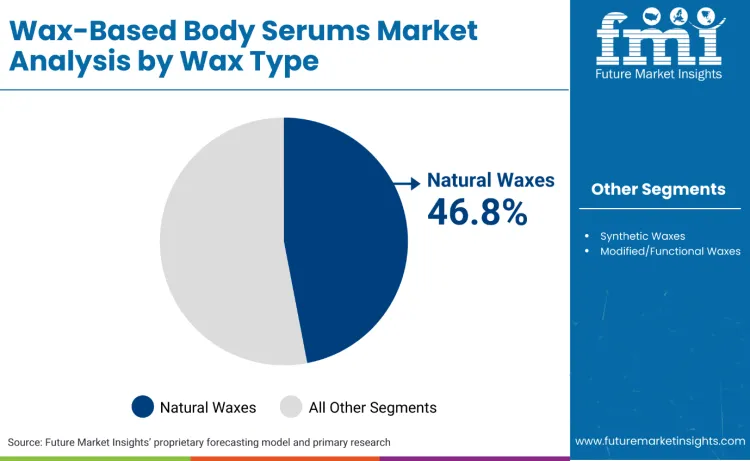
Natural waxes continue to lead the market, accounting for 46.8% of the share, driven by their widespread use in clean beauty formulations, consumer preference for botanical ingredients, and superior skin compatibility profiles. This wax category offers the foundation needed for premium product positioning, making it essential for luxury brands, specialty manufacturers, and natural personal care companies. Natural waxes provide excellent emollient properties while maintaining product stability and enabling the incorporation of additional botanical actives. Their appeal stems from consumer perception of safety and environmental responsibility, particularly among demographic segments prioritizing clean ingredient labels.
These ingredients are popular because they serve as a critical differentiation strategy in an increasingly competitive personal care market. Companies are also significantly investing in natural wax sourcing with ethical supply chain approaches. Specialized ingredient suppliers integrate advanced purification methods, sustainable extraction processes, and quality certification programs to deliver high-purity natural waxes while ensuring consistent performance characteristics. This approach reduces formulation challenges and extends product shelf life, allowing beauty brands to maintain premium positioning while meeting consumer expectations for natural ingredient transparency.
How Do Formulation Requirements Influence Wax-Based Body Serum Product Development?
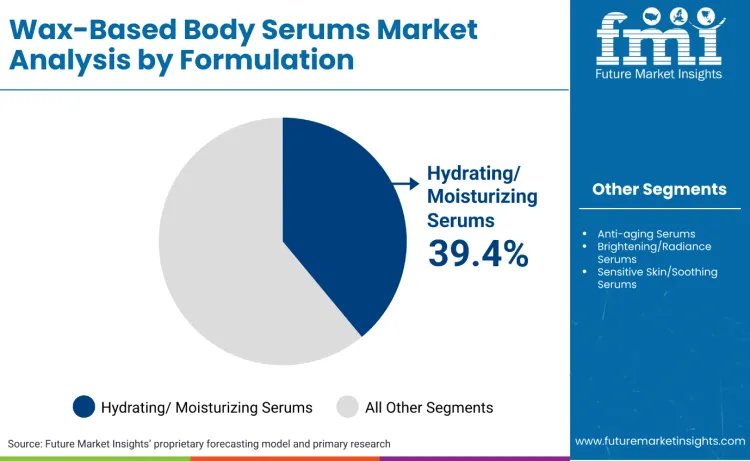
Hydrating/moisturizing serums stand as the dominant segment, commanding 39.4% of the market share. Wax-based body serum development remains centered on hydration formulations due to the exceptional moisture retention these products offer compared to traditional oil-based alternatives. Consumer preference for long-lasting hydration benefits drives demand for formulations that create protective barriers on skin surfaces, allowing for extended moisture delivery throughout daily wear periods. Formulation studies are essential in this category to validate how wax matrices interact with various skin types, ensuring they provide effective hydration without causing residue buildup or application difficulties.
The market is also heavily shaped by the development of multi-functional formulations that combine hydration with additional skincare benefits such as anti-aging compounds and brightening agents. Advanced formulation approaches help researchers optimize the balance between wax concentration and active ingredient delivery to prevent texture issues that could affect consumer acceptance. By using sophisticated emulsification techniques and compatibility testing protocols, manufacturers can predict consumer preferences and identify optimal formulation parameters before full-scale production, making these development services a critical investment for modern beauty product innovation.
How Is Technological Evolution Reshaping Wax-Based Body Serums Development?
The wax-based body serums sector is shifting from traditional emulsification methods to integrated formulation platforms that combine advanced wax processing, microencapsulation technology, and targeted delivery systems. Strategic partnerships between ingredient suppliers and cosmetic manufacturers are accelerating this transition.
This evolution brings wax-based formulations closer to therapeutic efficacy by enabling more predictable ingredient release patterns and improved skin penetration profiles using computational and laboratory optimization tools. Enhanced formulation characterization reduces product failure rates during stability testing and consumer acceptance trials. The ability to advance products with defined sensory profiles and performance attributes is reshaping portfolio strategies, allowing manufacturers to prioritize formulations with stronger market differentiation and consumer appeal.
What Role Does Regulatory and Standards Development Play in Product Innovation?
Greater regulatory clarity around cosmetic ingredient safety and labeling requirements is stabilizing investment conditions for wax-based formulation laboratories and enabling more confident product development expansion. In September 2025, Honeywell International received regulatory approval from multiple international markets for its new synthetic wax platform designed specifically for premium personal care applications.
Clearer regulatory expectations are lowering barriers for specialized manufacturers to deploy advanced wax processing technologies such as molecular distillation, selective crystallization, and controlled particle size modification. Laboratories are increasingly adopting validated testing methodologies that can be applied across product lines, supporting faster market entry pathways and continued innovation in complex wax-based formulation systems.
How Is the Wax-Based Body Serums Market Evolving Globally?
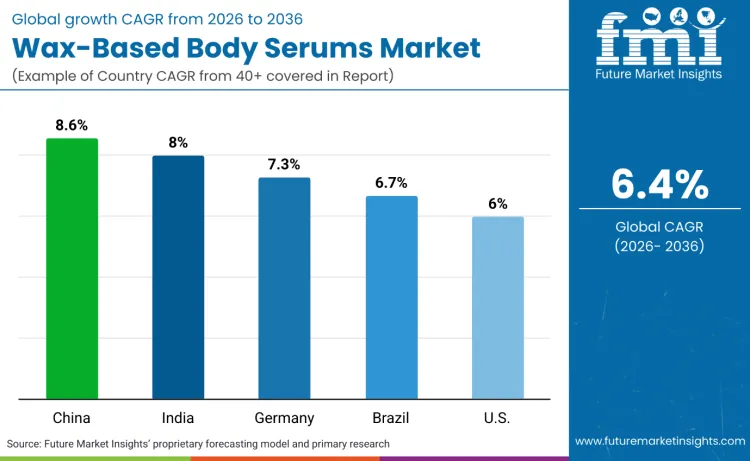
Global demand for wax-based body serums is increasing as consumers expand skincare routines while addressing hydration, anti-aging, and specialized skin concern requirements. Growth demonstrates rising adoption of premium formulation technologies, ingredient-specific product positioning, and performance-optimized delivery specifications across beauty retailers, specialty stores, and online platforms.
Product selection focuses on formulation efficacy, ingredient transparency, and application experience under various consumer usage scenarios. China records 8.6% growth, India records 8.0% growth, Germany records 7.3% growth, Brazil records 6.7% growth, U.S. records 6.0% growth, and U.K. records 5.4% growth. Adoption remains driven by premium positioning requirements and performance capabilities rather than price competition alone.
| Country | Growth Rate |
|---|---|
| China | 8.6% |
| India | 8.0% |
| Germany | 7.3% |
| Brazil | 6.7% |
| U.S. | 6.0% |
Source: FMI historical analysis and forecast data
China: How is the Rising Beauty Market Infrastructure Driving Premium Product Adoption?
The primary driver in China is the significant growth of premium beauty retail capabilities and specialized skincare consumer segments. With the expansion of beauty retail facilities and online platforms, Chinese metropolitan areas are now experiencing substantial increases in premium personal care product implementations, making conventional moisturizing products insufficient for evolving consumer expectations. This has promoted advanced formulation adoption for domestic beauty brands to ensure product differentiation and consumer satisfaction. Driven by this national scale of beauty market expansion, the Chinese wax-based body serums market is set to grow at an 8.6% rate during the study period, led by strong demand in luxury beauty and specialized skincare sectors.
Over the next five years, the most significant opportunity lies in the integration of traditional Chinese medicine ingredients with modern wax-based delivery platforms. As China targets leadership in premium beauty manufacturing, there is growing demand for specialized formulations that support traditional wellness approaches combined with contemporary skincare science. Companies are expanding their production capabilities in the country to boost their market presence.
India: Is the Premium Beauty Movement Elevating Product Standards?
In India, the market is dominated by the evolution toward premium beauty products and performance-positioned formulation categories. This quality-first approach is essential for Indian consumers currently seeking international beauty standards in domestic personal care applications. Reflecting this development, the Indian wax-based body serums market is projected to grow at an 8.0% rate during the study period.
Over the next five years, the rise of beauty retail infrastructure, supported by expanded online distribution networks, will necessitate high-quality wax-based formulations for diverse skin types and climate conditions. Second, India's growing role as a beauty manufacturing hub creates significant opportunities for cost-effective premium formulations tailored to local preferences. There is increasing demand for affordable luxury products that use validated formulation protocols, addressing the skincare needs of urban consumer segments while maintaining international quality benchmarks.
Germany: Will Engineering Excellence Accelerate Formulation Innovation?
Germany's wax-based body serums market is uniquely shaped by technical innovation and advanced manufacturing infrastructure development. German manufacturers are increasingly adopting precision formulation platforms, maintaining engineering excellence for quality assurance while using efficient production methods for broader market appeal. Consequently, the German wax-based body serums market is expected to grow at a 7.3% rate during the study period, as technology-focused organizations invest in validated formulation development and precision manufacturing categories.
Over the next five years, the market will pivot toward high-efficiency production methods and sustainable formulation practices. As domestic beauty leaders transition from traditional cosmetics to advanced skincare technologies, there is an immediate opportunity to provide high-precision manufacturing services for wax-based product development. The integration of Industry 4.0 principles into beauty manufacturing will likely redefine production timelines, allowing organizations to capitalize on automated quality control and real-time formulation optimization for enhanced product consistency.
Brazil: Is the Natural Beauty Strategy Revitalizing Market Growth?
In Brazil, the market is being driven by the natural beauty movement, which integrates botanical ingredients and traditional formulation knowledge into modern product positioning. A major development is beauty brands and manufacturers upgrading to natural wax-based platforms that feature biodiversity-derived excellence to compete against synthetic alternatives in domestic beauty applications. As Brazilian companies prioritize natural ingredients and environmental responsibility, the Brazilian wax-based body serums market is set to grow at a 6.7% rate during the study period, focusing heavily on natural sourcing and formulation authenticity.
Over the next five years, the most lucrative opportunities reside in the convergence of Amazonian botanicals and modern cosmetic science. As the Brazilian government supports sustainable beauty ingredient development, there is a significant opening for firms to develop naturally-sourced wax formulations that support biodiversity conservation while meeting international beauty standards. The mandate for environmental responsibility is creating demand for certified sustainable ingredients, offering a high-margin opportunity for providers of traceable, eco-friendly wax-based formulation platforms.
USA: How is the Clean Beauty Renaissance Driving Innovation?
The USA market is increasingly focused on the innovation and transparency of clean beauty applications. This transition aims at reducing dependence on synthetic ingredients while improving product performance and consumer trust. Supported by these clean beauty mandates, the U.S. wax-based body serums market is set to grow at a 6.08% rate during the study period.
Over the next five years, the most significant opportunity lies in the adoption of advanced natural ingredient processing and transparent supply chain management. As consumers increasingly demand ingredient transparency and ethical sourcing, there is a growing market for premium wax-based formulations that can demonstrate clear provenance and environmental responsibility. The integration of blockchain technology into ingredient tracking will allow U.S. firms to leverage secure, transparent supply networks to develop optimized formulations, effectively meeting consumer expectations for ethical beauty products and establishing new industry benchmarks for responsible cosmetic development.
Who are the Major Players Active in the Wax-Based Body Serums Market?
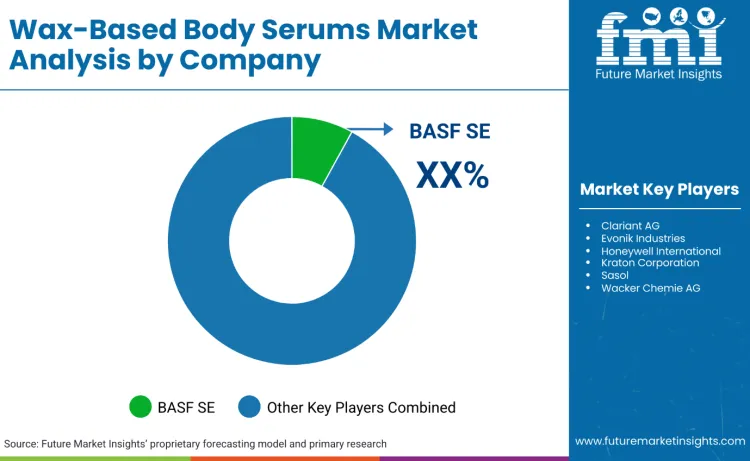
As beauty formulations become dominated by multi-functional products and premium positioning strategies, major players like BASF SE, Clariant AG, and Evonik Industries are competing on their ability to offer comprehensive ingredient solutions and technical support services. These industry leaders are aggressively integrating advanced processing technologies and application expertise to serve beauty brands, allowing smaller companies to access sophisticated wax-based formulation capabilities without extensive research infrastructure. Success in this landscape is no longer measured just by ingredient purity, but by the ability to provide complete formulation support and technical guidance, thereby enabling beauty brands to develop differentiated products with optimized performance characteristics.
The market is also witnessing distinct regional specialization in competitive approaches. While North American firms like Honeywell International maintain leadership through technical innovation and proximity to major beauty brands, European players, led by BASF SE and Clariant AG, are rapidly expanding their natural ingredient portfolios and sustainable processing capabilities. This has created an innovation competition where ingredient suppliers are diversifying into specialized areas such as microencapsulation technology and custom wax blending to address the complex requirements of modern beauty formulations.
Key Industry Developments:
- In January 2026, BASF unveiled to acquire gBiTech, which specializes in biological insect control solutions to broaden its offerings.
- In January 2025, Evonik inked a deal with ST Pharm to boost its portfolio.
Key Players in the Wax-Based Body Serums Market
- BASF SE
- Clariant AG
- Evonik Industries
- Honeywell International
- Kraton Corporation
- Sasol
- Wacker Chemie AG
Market Definition
The wax-based body serums market refers to the global personal care applications of specialized cosmetic formulations designed to support intensive moisturizing, anti-aging, and targeted skincare activities. It includes both premium and mass-market product offerings, with segments that cater to various skin concerns such as hydration, brightening, and sensitivity management. The market size is measured in USD billion and analyzed over the 2026 to 2036 period.
The wax-based body serums market includes formulation types such as hydrating serums, anti-aging treatments, and specialized skincare products, distributed through both retail channels and online platforms. The market is expanding due to growing consumer interest in premium skincare products, formulation technology innovations, and evolving beauty requirements toward higher-efficacy and more specialized moisturizing capabilities.
Market Inclusion
Included in the wax-based body serums market scope are personal care products categorized by wax type (natural, synthetic, functional), with segmentation based on formulation purpose (hydrating, anti-aging, brightening), distribution method (online retail, specialty stores, pharmacies), and consumer requirements (performance, ingredient transparency, application experience). The scope includes wax-based formulations with a focus on skincare efficacy, product innovation, and consumer satisfaction, particularly those marketed through specialized beauty retailers, online platforms, and luxury retail establishments.
Geographically, the market encompasses key regions such as North America, Europe, East Asia, South Asia, Latin America, and the Middle East and Africa, with country-level analysis for significant markets like China, India, Germany, Brazil, U.S., and U.K.
Market Exclusion
Excluded from the wax-based body serums market scope are non-wax-based personal care formulations and skincare products not designed for body application, such as facial serums without wax components, hair care products, and fragrance-only applications. Additionally, products not intended for skincare or personal care applications are not included.
The market excludes non-cosmetic wax applications, as well as wax-related products that are not marketed as body care formulations, such as industrial wax products or candle manufacturing materials. Products with non-compliant safety specifications or those that do not meet regional cosmetic regulatory standards are outside the market's defined scope.
Scope of the Report
| Items | Values |
|---|---|
| Quantitative Units | USD billion |
| Wax Type | Natural Waxes; Synthetic Waxes; Modified/Functional Waxes |
| Formulation | Hydrating/Moisturizing Serums; Anti-aging Serums; Brightening/Radiance Serums; Sensitive Skin/Soothing Serums |
| Distribution Channel | Online Retail/E-commerce; Specialty Beauty Stores; Pharmacies/Drugstore Chains; Luxury Retail/Department Stores |
| Regions Covered | North America, Europe, East Asia, South Asia, Latin America, Middle East & Africa |
| Countries Covered | China, India, Germany, Brazil, U.S., U.K., and 40+ countries |
| Key Companies Profiled | BASF SE; Clariant AG; Evonik Industries; Honeywell International; Kraton Corporation; Others |
| Additional Attributes | Revenue analysis by wax type, formulation, and distribution channel; performance in beauty applications and skincare effectiveness across retail establishments, online platforms, and specialty stores; formulation optimization, ingredient transparency, and product benefits under consumer applications; impact on skincare outcomes, product differentiation, and brand positioning during purchase processes; compatibility with consumer preferences and beauty routines; market dynamics driven by premium positioning, ingredient innovation programs, and long-term brand partnerships. |
Wax-Based Body Serums Market by Segment
Wax Type:
- Natural Waxes
- Synthetic Waxes
- Modified/Functional Waxes
Formulation:
- Hydrating/Moisturizing Serums
- Anti-aging Serums
- Brightening/Radiance Serums
- Sensitive Skin/Soothing Serums
Distribution Channel:
- Online Retail/E-commerce
- Specialty Beauty Stores
- Pharmacies/Drugstore Chains
- Luxury Retail/Department Stores
Region:
- East Asia
- China
- Japan
- South Korea
- Taiwan
- Rest of East Asia
- Europe
- Germany
- United Kingdom
- France
- Italy
- Spain
- BENELUX
- Nordic
- Rest of Europe
- North America
- USA
- Canada
- Mexico
- South Asia
- India
- Australia & New Zealand
- Southeast Asia
- Rest of South Asia
- Latin America
- Brazil
- Chile
- Colombia
- Argentina
- Rest of Latin America
- Middle East & Africa
- Kingdom of Saudi Arabia
- Other GCC Countries
- Turkey
- South Africa
- Other African Union
- Rest of Middle East & Africa
Bibliography
- International Beauty Industry Association. (2026). Formulation Standards for Wax-Based Personal Care Products: Quality Guidelines. IBIA.
- Global Cosmetics Research Council. (2026). Ingredient Specifications for Beauty Product Development: Safety and Performance Requirements. GCRC.
- Personal Care Technology Institute. (2027). PCTI Guidelines for Premium Positioning in Wax-Based Skincare (updated performance specifications for beauty and consumer applications). PCTI.
- Johnson, R. M., et al. (2026). Premium positioning effects of wax-based formulation platforms on skincare efficacy enhancement: A comprehensive analysis of ingredient performance and consumer beauty applications. Journal of Cosmetic Science Methods, 41, 203-220.
- Anderson, L. K., et al. (2026). Eighth annual wax-based body serums market report: Special focus on ingredient innovation and premium positioning in global beauty applications. International Beauty Industry Review, 28, 145-162.
Frequently Asked Questions
How big is the wax-based body serums market in 2026?
The global wax-based body serums market is estimated to be valued at USD 17.3 billion in 2026.
What will be the size of the wax-based body serums market in 2036?
The market size for the wax-based body serums market is projected to reach USD 32.2 billion by 2036.
How much will the wax-based body serums market grow between 2026 and 2036?
The wax-based body serums market is expected to grow at a 6.4% CAGR between 2026 and 2036.
What are the key wax types in the wax-based body serums market?
The key wax types in the wax-based body serums market include natural waxes, synthetic waxes, and modified/functional waxes.
Which distribution channel will contribute a significant share in the wax-based body serums market in 2026?
In terms of distribution channel, the online retail/e-commerce segment is set to command a 42.6% share in the wax-based body serums market in 2026.
Preview the report firsthand - request a free sample
Get SampleGet the brochure for pricing and purchase details.
Get PDFTable of Content
- Wax-Based Body Serums Market Size and Share Forecast Outlook (2026 to 2036)
- Wax-Based Body Serums Market Forecast and Outlook (2026-2036)
- Wax-Based Body Serums Market Key Takeaways
- Key Shifts in the Wax-Based Body Serums Market from 2026 to 2036
- Wax-Based Body Serums Market Segmentation Analysis
- By Wax Type
- Natural Waxes
- Synthetic Waxes
- Modified / Functional Waxes
- By Formulation
- Hydrating / Moisturizing Serums
- Anti-aging Serums
- Brightening / Radiance Serums
- Sensitive Skin / Soothing Serums
- By Distribution Channel
- Online Retail / E-commerce
- Specialty Beauty Stores
- Pharmacies / Drugstore Chains
- Luxury Retail / Department Stores
- By Region
- By Wax Type
- Market Dynamics and Growth Analysis
- Growth Drivers
- Market Restraints
- Strategic Trends
- Wax-Based Body Serums Market Global Analysis
- East Asia
- South Asia
- North America
- Europe
- Latin America
- Middle East & Africa
- Competitive Landscape Analysis
- Key Players in the Wax-Based Body Serums Market
- Market Definition, Inclusion, and Exclusion Criteria
- Scope of the Wax-Based Body Serums Market Report
- Wax-Based Body Serums Market by Segment
- Bibliography
- Frequently Asked Questions (FAQs)


