

- Industry Size (2026)
- USD 17.0 Bn
- Forecast (2036)
- USD 24.9 Bn
- CAGR (2026 to 2036)
- 3.90%
Stick-Based Body Lotions Market Forecast and Outlook 2026 to 2036
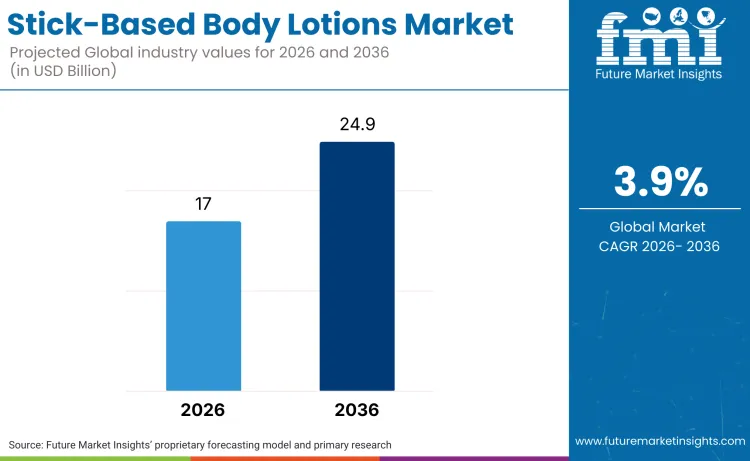
The stick-based body lotion market is valued at USD 17.0 billion in 2026 and is projected to reach USD 24.9 billion by 2036, expanding at a 3.9% CAGR. As per Future Market Insights, market expansion is being driven by the ongoing skinification of body care and growing consumer preference for portable, solid-state moisturizers that allow more precise and targeted application than conventional liquid lotions. Stick-based formats overcome several structural drawbacks associated with bottled lotions, including spillage risk, higher water content, and limited usability in mobile or on-the-go settings.
Product activity between 2025 and 2026 highlights a pronounced shift toward hyper-targeted stick formulations incorporating facial-grade actives such as AHAs, ceramides, and calming botanicals to address concerns including keratosis pilaris, dryness, and uneven texture. Established skincare companies are extending clinical and dermocosmetic portfolios into stick formats to protect category relevance, while emerging brands are leveraging solid lotions to attract younger, convenience-oriented consumers.
The shift toward water-efficient formulations and localized treatment delivery is contributing to stronger uptake of stick-based lotion formats across routine body care use. These products align with mobile lifestyles, localized treatment needs, and reduced packaging intensity, strengthening their appeal across travel, gym, and everyday use scenarios. Targeted treatment narratives are increasingly influencing how brands position new launches. As stated by a spokesperson for Cetaphil (Galderma), “the dermatologist-recommended brand trusted by millions with sensitive skin, is redefining daily skincare with its new Skin Activator Hydrating & Firming line.
The launch marks an entirely new skincare segment of advanced hydration and firming solutions designed specifically for improving the appearance of aging, thinning, and fragile skin.” Future Market Insights notes that e-commerce and social commerce continue to play a central role in category visibility, as stick-based products are highly demonstrable and well suited for digital discovery. Growing acceptance of targeted, waterless body care formats is expected to support steady value growth and broader brand participation through 2036.
Summary of the Stick-Based Body Lotions Market
What Is Growth Outlook for the Stick-Based Body Lotions Market as per Future Market Insights Projection?
Future Market Insights projects the stick-based body lotions market to grow at a 3.9% CAGR from 2026 to 2036, expanding from USD 17.01 billion in 2026 to USD 24.94 billion by 2036.
FMI Research Approach: FMI proprietary forecasting model based on bottom-up revenue estimation, tracking penetration of solid and stick-format body moisturizers across personal care portfolios, and demand modeling linked to daily moisturizing, dry skin management, and convenience-driven body care routines.
How Do FMI Analysts Perceive Stick-Based Body Lotions Market to Evolve?
FMI analysts perceive the market shifting from niche portability-led usage toward routine daily body care adoption, supported by preference for mess-free, targeted application formats.
FMI Research Approach: Assessment of product positioning centered on dry and sensitive skin relief, expansion of stick-based lotions within mainstream body care assortments, and evaluation of consumer acceptance of solid moisturization formats.
Which Country Holds Largest Share in the Global Stick-Based Body Lotions Market?
China holds the largest share of the global stick-based body lotions market by value, supported by strong uptake of compact personal care formats and rising demand for convenient daily moisturization products.
FMI Research Approach: FMI country-level demand assessment across urban consumers, evaluation of daily moisturizing frequency, and tracking of domestic and international brand expansion within Chinese body care retail.
How Large Will the Stick-Based Body Lotions Market Be by 2036?
The global stick-based body lotions market is projected to reach USD 24.94 billion by 2036.
FMI Research Approach: FMI long-term forecast by country, skin concern, and distribution channel, incorporating scaling assumptions for daily moisturizing stick adoption and cross-checking against broader solid personal care growth trends.
What Is Definition of Stick-Based Body Lotions Market?
The stick-based body lotions market comprises solid or semi-solid body moisturizers formulated in stick formats designed for direct application to the skin, targeting hydration, soothing, and daily moisturization needs.
FMI Research Approach: FMI market taxonomy and inclusion-exclusion framework covering dry, sensitive, anti-aging, and daily moisturizing sticks, while excluding liquid body lotions, creams, and pump-dispensed moisturizers.
What Are Globally Unique Trends Shaping Stick-Based Body Lotions Market?
Globally unique trends include rising demand for dry and ultra-hydrating solutions, growth of online retail as a primary channel, and Asia-led adoption driven by China and India.
FMI Research Approach: Analysis of skin-concern-level demand shares, distribution channel contribution trends, country-wise growth differentials, and expansion of stick-based lotions across routine daily body care use.
Stick-Based Body Lotions Market Key Takeaways
| Metric | Details |
|---|---|
| Industry Size (2026) | USD 17.0 Billion |
| Industry Value (2036) | USD 24.9 Billion |
| CAGR (2026-2036) | 3.90% |
Source: Future Market Insights (FMI) analysis, based on proprietary forecasting model and primary research.
Why Is the Demand for Stick-Based Body Lotions Growing?
Expectations around body moisturization are changing as stick-based body lotions move beyond niche or travel-oriented use into regular daily care routines. According to Future Market Insights, consumers are placing increasing value on ease of application, non-greasy skin feel, and suitability for frequent use across different body areas. Earlier stick formats were often perceived as convenience products or add-ons, which limited their role in everyday moisturizing. That perception is shifting as stick-based lotions gain visibility within standard body care assortments.
Brand portfolio strategies illustrate this shift. Neutrogena includes stick-format moisturizers within its broader body care lineup, positioned alongside traditional lotions and creams rather than as specialty items. These products are designed for direct, mess-free application and quick absorption, aligning with established moisturizing habits rather than altering usage behavior. FMI notes that brands integrating stick-based lotions into core body care ranges, with consistent performance and routine-use positioning, are better placed to encourage repeat beauty subscription purchase as the category expands beyond limited-use adoption.
How Is the Stick-Based Body Lotions Market Segmented?
The stick-based body lotions market is segmented by skin concern and distribution channel, reflecting routine body care usage patterns. By skin concern, the market includes dry or ultra-hydrating, sensitive or soothing, anti-aging or rejuvenating, and daily moisturizing formulations, with dry and ultra-hydrating variants holding the largest share due to frequent use for climate-related and chronic dryness concerns. Sensitive and soothing products address comfort-focused needs, while anti-aging and daily moisturizing sticks support targeted and maintenance care. By distribution channel, online retail leads sales, driven by convenience and repeat purchasing, followed by supermarkets and hypermarkets, beauty and specialty stores, and pharmacies, which support product visibility, trial, and routine replenishment.
Why Do Dry and Ultra-Hydrating Stick-Based Body Lotions Hold a Dominant Share?
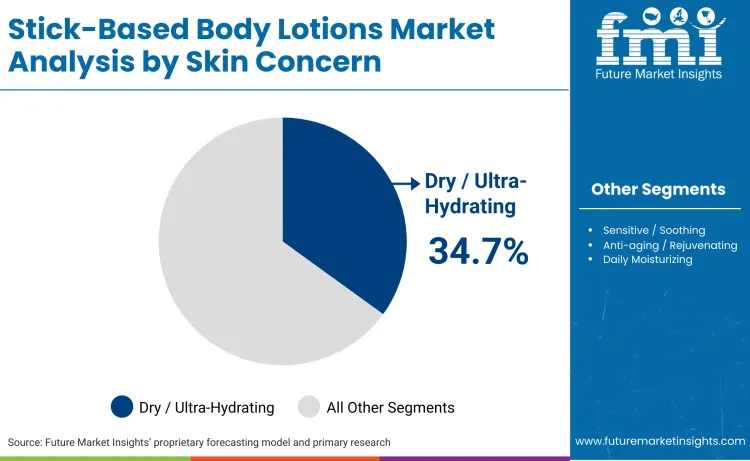
Dry and ultra-hydrating formulations account for 34.7% of the stick-based body lotions market, driven by their relevance to everyday skin comfort and climate-related dryness. These products are designed to deliver concentrated moisturization through targeted, mess-free application, making them suitable for frequent use on areas prone to dryness such as elbows, knees, heels, and arms. Consumers associate ultra-hydrating sticks with convenience, longer usage cycles, and effective moisture delivery without the heaviness of creams. Their compatibility with daily routines lowers resistance to repeat use, especially in colder or low-humidity environments. FMI observes that dry-skin-focused sticks are positioned as essential body care solutions rather than occasional treatments, allowing them to capture higher usage frequency and anchor demand within the category.
Why Does Online Retail Lead the Distribution Channel?
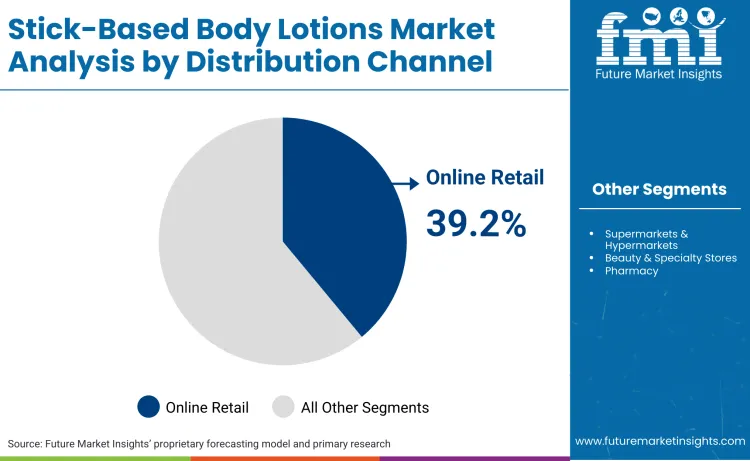
Online retail represents 39.2% of stick-based body lotion sales, reflecting the category’s strong fit with digital purchasing behavior. Stick formats are compact, leak-resistant, and easy to ship, which reduces logistics challenges compared with liquid lotions. E-commerce platforms also support repeat purchasing, subscription models, and discovery of targeted skin-concern products. Consumers frequently replenish stick-based moisturizers online due to their portability and routine-use nature. Supermarkets and hypermarkets support volume-driven replenishment, while beauty stores and pharmacies cater to trust-led and need-based purchases. FMI notes that online channels continue to lead as consumers prioritize convenience, product comparison, and consistent access to specialized body care formats designed for daily moisturization.
What Trends Are Shaping Industry Evolution Through Stick-Based Body Care Formats?
Stick-based body care formats are gaining momentum as brands respond to demand for targeted application, portability, and cleaner usage experiences compared with traditional pump or bottle lotions. Stick-based lotions support controlled dosing, reduce spillage, and are easier to apply to specific areas such as elbows, heels, and dry patches. Brands such as Oars + Alps are strengthening this movement by offering solid lotion sticks designed for precise hydration and cleaner application. As per Future Market Insights, these formats are increasingly positioned for regular daily moisturizing rather than limited travel use. Their compact form factor lowers handling complexity and improves convenience, which is contributing to wider acceptance of stick-based lotions as practical alternatives within routine body care.
How Is Portfolio Expansion Creating Stronger Body Care Platforms?
Portfolio expansion is strengthening competitive positioning by allowing companies to integrate stick-based lotions into existing body care lines alongside creams and liquids. Large personal care brands are extending their moisturizing portfolios to include stick formats, focusing on functionality and usage flexibility rather than volume replacement. This strategy improves consistency in formulation standards, distribution coverage, and consumer familiarity. According to FMI, integrating stick-based lotions into established portfolios accelerates adoption by leveraging existing trust and retail presence, enabling these products to scale across mass and premium channels without disrupting established moisturizing habits.
Why Is Formulation Refinement Driving Product and Format Innovation?
Cost sensitivity and rising performance expectations are pushing manufacturers to refine stick-based lotion formulations while maintaining skin comfort and efficacy. Stick formats require careful balance of waxes, oils, and emollients to ensure smooth glide, even coverage, and reliable absorption. Minor formulation variations can affect user experience during repeated application. FMI notes that increasing competition is placing greater emphasis on formulation discipline, supporting consistent performance across climates and skin types. This focus on formulation efficiency enables scalability and positions stick-based lotions as dependable, everyday moisturizing solutions rather than niche convenience products.
What Is the Country-wise Outlook for the Stick-Based Body Lotions Market?
Country-level growth for stick-based body lotions shows clear variation, influenced by local body care habits, climate, and willingness to adopt alternative moisturizing formats. China leads with a 5.27% CAGR, supported by rising urban demand for compact, targeted moisturizers suited for daily use. India follows at 4.88%, driven by expanding personal care consumption and increased use of stick formats for managing dryness in warm conditions. Germany records 4.49% growth, reflecting preference for controlled application and structured skincare routines. Brazil grows at 4.10%, supported by frequent moisturization needs in humid climates. The United States posts 3.71%, indicating steady uptake in a mature market. The United Kingdom reaches 3.32%, while Japan trails at 2.93%, shaped by conservative adoption and continued reliance on traditional body lotion formats.
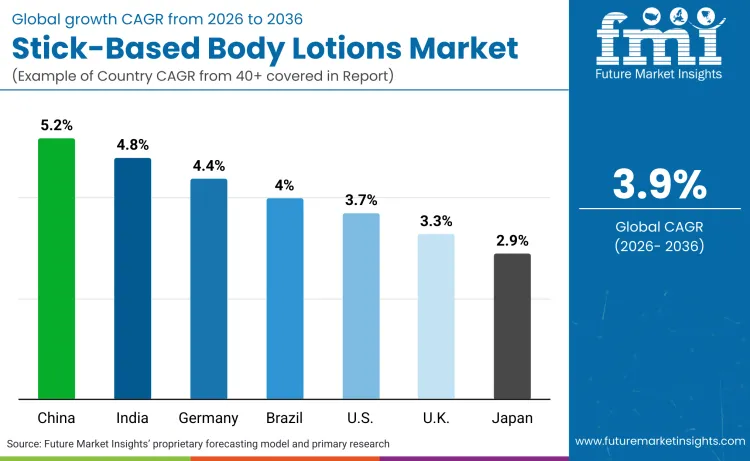
| Country | CAGR (2026 to 2036) |
|---|---|
| China | 5.2% |
| India | 4.8% |
| Germany | 4.4% |
| Brazil | 4.0% |
| United States | 3.7% |
| UK | 3.3% |
| Japan | 2.9% |
Source: FMI historical analysis and forecast data.
Why Is China Leading Growth in Stick-Based Body Lotions?
China’s 5.27% CAGR is driven by rising demand for compact, targeted body care solutions among urban consumers with fast-paced lifestyles. Stick-based body lotions align well with dense living environments where portability, controlled application, and reduced mess are valued. These formats are commonly used for localized moisturization, such as dry elbows, heels, or hands, rather than full-body application. Strong e-commerce penetration further supports growth, as compact stick formats are easy to ship, store, and reorder online. Adoption is being shaped more by increased usage frequency and selective substitution from traditional lotions for specific skin concerns than by overall population growth. As consumers prioritize convenience and precision, stick-based lotions are becoming a practical addition to everyday body care routines.
What Is Supporting Growth in India’s Stick-Based Body Lotions Market?
India’s 4.88% CAGR reflects expanding urban personal care awareness and growing acceptance of alternative moisturizing formats. Stick-based body lotions appeal due to ease of storage, portability, and suitability for warm and humid climates where liquid lotions can feel heavy. Younger consumers increasingly use stick formats for targeted application on dry or irritated areas, supporting repeat use. Improved access through online platforms is enabling trial purchases beyond major cities, while broader availability across price tiers supports gradual mainstream adoption. Growth is reinforced by changing grooming habits, higher engagement with daily moisturization, and rising preference for formats that offer convenience without altering established body care routines, supporting steady expansion across urban and semi-urban markets.
Why Is Germany Showing Steady Expansion in Stick-Based Body Lotions?
Germany records a 4.49% CAGR, supported by structured body care routines and preference for precise, efficient application formats. Consumers value controlled dosing, product longevity, and reduced waste, which aligns well with stick-based lotions designed for targeted use. Adoption is measured and deliberate, driven by informed purchasing decisions rather than trend-led experimentation. Stick formats are commonly integrated into existing routines for dry or sensitive skin management rather than replacing traditional lotions entirely. Growth is supported by steady retail availability and consumer emphasis on functionality and reliability.
What Is Driving Growth in Brazil’s Stick-Based Body Lotions Market?
Brazil’s 4.10% CAGR is shaped by climate-driven skincare needs and rising middle-income consumption. Warm temperatures and high humidity increase the frequency of body care application, favoring formats that are easy to carry and apply throughout the day. Stick-based lotions suit urban lifestyles where portability and ease of use are important for work, travel, and outdoor activity. Improved availability through online platforms and beauty retail is expanding awareness and encouraging repeat usage. Adoption remains gradual but reliable, as consumers increasingly view stick-based lotions as functional complements to traditional creams for targeted moisturization, supporting balanced growth across major population centers.
Why Is Growth More Moderate in the United States?
The United States posts a 3.71% CAGR, reflecting selective adoption within a mature body care market dominated by traditional lotions and creams. Stick-based body lotions are often used alongside existing products rather than as primary moisturizers, limiting rapid volume expansion. Growth is concentrated among consumers seeking convenience, targeted application, and portability, such as frequent travelers and on-the-go users. Digital retail supports experimentation and replenishment, but strong brand loyalty to liquid formats slows widespread switching. As familiarity with stick formats increases and use cases expand, adoption continues at a steady pace without major disruption to established body care habits.
What Is the Competitive Outlook for the Stick-Based Body Lotions Market?
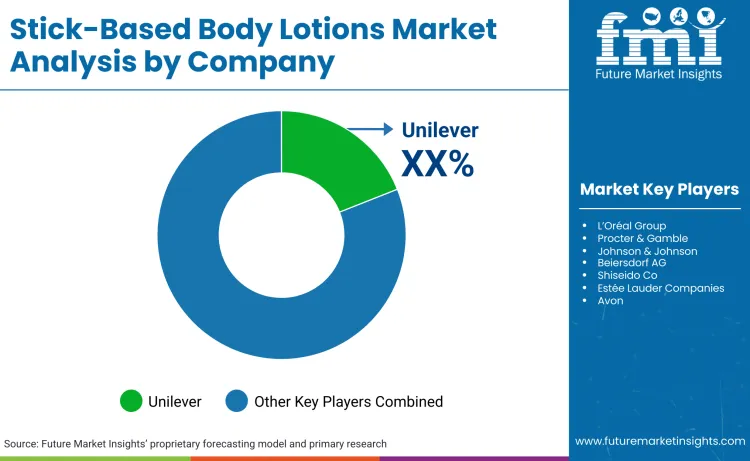
The competitive landscape for stick-based body lotions is led by large personal care and beauty companies that are extending beyond traditional creams and liquids to maintain format relevance and portfolio flexibility. Players such as Unilever, L’Oréal Group, Procter & Gamble, and Johnson & Johnson benefit from broad distribution, strong consumer trust, and established body care franchises. Unilever holds an estimated 18.9% share, reflecting its ability to introduce stick formats within widely used moisturizing brands while leveraging scale and retail reach. Competitive positioning in this market is less about immediate volume leadership and more about offering alternative application formats within existing body care systems.
Future Market Insights observes that competition is increasingly centered on formulation reliability, skin comfort, and usage convenience rather than aggressive expansion. Companies such as Beiersdorf AG, Shiseido Co., and Estée Lauder Companies emphasize skin tolerance, targeted care, and premium positioning. Brands including Avon, Coty (including Calvin Klein), and Amway support adoption through accessibility and lifestyle-led portfolios. FMI notes that long-term advantage will depend on seamless integration of stick-based lotions into broader body care routines rather than treating them as standalone convenience products.
Recent Developments:
- In September 2025, Propedix introduced Dryello™, a new product based on its Stick-based DryStik Technology Platform aimed at delivering targeted anti-infective care in stick format. This launch marks one of the latest innovations in stick application technology, highlighting the broader move toward convenient, mess-free product formats in personal care.
- In January 2026, Hibiscus Monkey expanded its body care range in India by launching a Foot Balm Stick, a solid stick product designed for fast absorption and daily use on dry foot skin. Although focused on foot care, the release demonstrates increasing interest in stick formats within the Indian personal care market, especially for targeted skin concerns.
- In September 2025, Palmer’s broadened its skincare portfolio with the Palmer’s Cocoa Butter Formula Shimmer Stick, which delivers a moisturizing body application in a solid stick form, reinforcing the popularity of stick products for hydration and radiance.
Key Players in Stick-Based Body Lotions Market
- Unilever
- L’Oréal Group
- Procter & Gamble
- Johnson & Johnson
- Beiersdorf AG
- Shiseido Co.
- Estée Lauder Companies
- Avon
- Coty / Calvin Klein Group
- Amway
Market Definition
The stick-based body lotions market captures revenue from solid-format body moisturizers designed for direct, on-skin application. In this assessment, the market covers commercially available lotion sticks positioned for everyday body hydration, targeted moisture delivery, soothing care, or skin maintenance. Market sizing reflects the value of finished consumer products sold through physical retail and online platforms, analyzed by skin concern, sales channel, and region, and reported in USD billion.
The scope includes stick-based lotions developed for dry or intensive hydration, sensitive skin comfort, anti-aging or rejuvenation, and general daily moisturizing. Products intended for localized use on areas such as hands, feet, elbows, knees, and legs are included when marketed specifically as body lotion sticks. Sales through e-commerce platforms, supermarkets and hypermarkets, beauty and specialty retailers, and pharmacies are counted. Geographic coverage spans North America, Europe, Asia Pacific, Latin America, and the Middle East & Africa.
The market excludes bottled or jarred body lotions, creams, gels, body butters, deodorant sticks, sunscreen sticks, medicated ointments, and cosmetic balms not positioned for body moisturization. Revenues from bulk ingredients, private-label raw materials, contract manufacturing, packaging supply, and logistics services are excluded. Products sold solely for professional spa or clinical use without retail availability are outside the defined market scope.
Scope of Report
| Items | Values |
|---|---|
| Quantitative Units (2026) | USD 17.0 Billion |
| Skin Concern | Dry / Ultra-Hydrating; Sensitive / Soothing; Anti-aging / Rejuvenating; Daily Moisturizing |
| Distribution Channel | Online retail; Supermarkets & Hypermarkets; Beauty & Specialty Stores; Pharmacy |
| Regions Covered | North America, Europe, Asia Pacific, Latin America, Middle East & Africa |
| Countries Covered | United States, Germany, United Kingdom, India, China, Brazil, and 40+ countries |
| Key Companies Profiled | Unilever; L’Oréal Group; Procter & Gamble; Johnson & Johnson; Beiersdorf AG; Shiseido Co.; Estée Lauder Companies; Avon; Coty; Amway |
| Additional Attributes | Dollar sales by skin concern and distribution channel; country-wise growth analysis; adoption trends for stick-format and targeted body moisturization; application patterns for dry, sensitive, and daily care needs; competitive brand positioning across mass, premium, and dermatology-aligned channels |
Source: FMI historical analysis and forecast data
Stick-Based Body Lotions Market by Segments
By Skin Concern:
- Dry / Ultra-Hydrating
- Sensitive / Soothing
- Anti-aging / Rejuvenating
- Daily Moisturizing
By Distribution Channel:
- Online retail
- Supermarkets & Hypermarkets
- Beauty & Specialty Stores
- Pharmacy
By Region:
- North America
- Europe
- Asia Pacific
- Latin America
- Middle East & Africa
Bibliography
- American Academy of Dermatology Association. (2023). Dry skin, barrier repair, and daily moisturization practices. AAD Clinical Guidance Series, 1-34.
- Cosmetic Ingredient Review Expert Panel. (2024). Safety assessment of emollients, waxes, and occlusives used in solid and stick cosmetic formulations. Cosmetic Ingredient Review, 1-88.
- Personal Care Products Council. (2024). Solid and stick-format moisturizers: Formulation, performance, and consumer use considerations. PCPC Scientific Affairs Report, 1-47.
Frequently Asked Questions
What is the current global market size for Stick-Based Body Lotions?
The global stick-based body lotions market is valued at USD 17.0 billion in 2026, supported by growing demand for targeted moisturization, mess-free application, and convenient body care formats.
What is the projected CAGR for the Stick-Based Body Lotions market?
Market revenues are projected to grow at a 3.9% CAGR from 2026 to 2036, reaching USD 24.94 billion by the end of the forecast period.
Which segment currently dominates the industry?
Dry and ultra-hydrating formulations dominate the market with a 34.7% share, driven by frequent use for climate-related dryness and localized skin concerns.
What are the primary risks or barriers to adoption?
Key barriers include strong consumer preference for traditional liquid lotions, limited awareness of stick formats for full-body use, and slower adoption in markets with entrenched moisturizing routines.
Who are the leading players in the Stick-Based Body Lotions space?
Leading companies include Unilever, L’Oréal Group, Procter & Gamble, Johnson & Johnson, Beiersdorf AG, and Shiseido Co., leveraging established body care portfolios and broad retail distribution.
Preview the report firsthand - request a free sample
Get SampleGet the brochure for pricing and purchase details.
Get PDFTable of Content
- Executive Summary
- Global Market Outlook
- Demand Side Trends
- Supply Side Trends
- Technology Roadmap Analysis
- Analysis and Recommendations
- Market Overview
- Market Coverage / Taxonomy
- Market Definition / Scope / Limitations
- Research Methodology
- Chapter Orientation
- Analytical Lens and Working Hypotheses
- Market Structure, Signals, and Trend Drivers
- Benchmarking and Cross-market Comparability
- Market Sizing, Forecasting, and Opportunity Mapping
- Research Design and Evidence Framework
- Desk Research Programme (Secondary Evidence)
- Expert Input and Fieldwork (Primary Evidence)
- Governance, Ethics, and Data Stewardship
- Tooling, Models, and Reference Databases
- Data Engineering and Model Build
- Data Acquisition and Ingestion
- Cleaning, Normalisation, and Verification
- Synthesis, Triangulation, and Analysis
- Quality Assurance and Audit Trail
- Market Background
- Market Dynamics
- Drivers
- Restraints
- Opportunities
- Trends
- Scenario Forecast
- Demand in Optimistic Scenario
- Demand in Likely Scenario
- Demand in Conservative Scenario
- Opportunity Map Analysis
- Product Life Cycle Analysis
- Supply Chain Analysis
- Investment Feasibility Matrix
- Value Chain Analysis
- PESTLE and Porter's Analysis
- Regulatory Landscape
- Regional Parent Market Outlook
- Production and Consumption Statistics
- Import and Export Statistics
- Market Dynamics
- Global Market Analysis 2021 to 2025 and Forecast, 2026 to 2036
- Historical Market Size Value (USD Billion) Analysis, 2021 to 2025
- Current and Future Market Size Value (USD Billion) Projections, 2026 to 2036
- Y-o-Y Growth Trend Analysis
- Absolute $ Opportunity Analysis
- Global Market Pricing Analysis 2021 to 2025 and Forecast 2026 to 2036
- Y-o-Y Growth Trend Analysis 2021 to 2025
- Absolute $ Opportunity Analysis 2026 to 2036
- Global Market Analysis 2021 to 2025 and Forecast 2026 to 2036, By Skin Concern
- Dry / Ultra-Hydrating
- Sensitive / Soothing
- Anti-aging / Rejuvenating
- Daily Moisturizing
- Global Market Analysis 2021 to 2025 and Forecast 2026 to 2036, By Distribution Channel
- Online Retail
- Supermarkets & Hypermarkets
- Beauty & Specialty Stores
- Pharmacy
- Global Market Analysis 2021 to 2025 and Forecast 2026 to 2036, By Region
- North America
- Latin America
- Europe
- Asia Pacific
- Middle East & Africa
- Market Attractiveness Analysis By Region
- Key Countries Market Analysis
- Market Structure Analysis
- Competition Dashboard
- Competition Benchmarking
- Market Share Analysis of Top Players
- Competition Analysis
- Competition Deep Dive
- Unilever
- L’Oréal Group
- Procter & Gamble
- Johnson & Johnson
- Beiersdorf AG
- Shiseido Co.
- Estée Lauder Companies
- Avon
- Coty / Calvin Klein Group
- Amway
- Competition Deep Dive
- Assumptions & Acronyms Used


