

- Industry Size (2026)
- USD 980 Mn
- Forecast (2036)
- USD 2880 Mn
- CAGR (2026 to 2036)
- 11.4%
Line-Level AI Optimization Market Forecast and Outlook 2026 to 2036
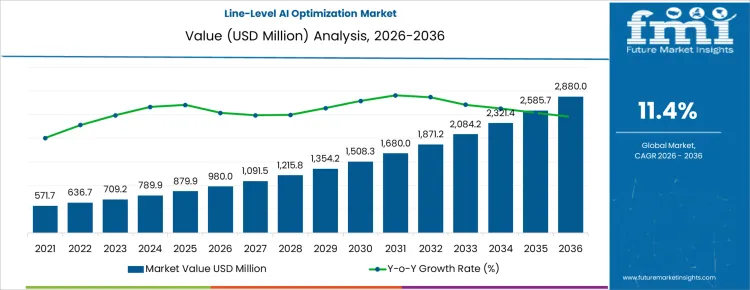
The line-level AI optimization market is expected to experience steady growth from 2026 to 2036. In 2026, the market value is projected at USD 980 million, with consistent growth anticipated, reaching USD 2,880 million by 2036. The compound annual growth rate (CAGR) for this market is forecasted at 11.4%, driven by increasing adoption of AI-driven optimization solutions in industries such as manufacturing, logistics, and energy. The need to enhance operational efficiency and reduce costs will continue to support the demand for line-level AI optimization technologies, which focus on optimizing performance at the individual line or process level.
As industries face increasing pressure to improve productivity and reduce energy consumption, the market for line-level AI optimization will expand. The adoption of AI tools and machine learning algorithms for process optimization will play a significant role in this growth. Over the forecast period, the market is expected to continue growing steadily as businesses leverage AI to fine-tune operations, increase throughput, and maintain competitive advantage.
Quick Stats of the Line-Level AI Optimization Market
- Line-Level AI Optimization Market Value (2026): USD 980 million
- Line-Level AI Optimization Market Forecast Value (2036): USD 2,880 million
- Line-Level AI Optimization Market Global Forecast CAGR (2026-2036): 11.4%
- Line-Level AI Optimization Market Leading Segment: Technology (AI/ML-based predictive optimisation) 55%
- Key Growth Regions in Line-Level AI Optimization Market: China
- Top Players in Line-Level AI Optimization Market: Rockwell Automation, Siemens, Huawei Industrial AI, Tata Technologies, Local system integrators, Fanuc, Cognex, Bosch
What is the Growth Forecast for the Line-Level AI Optimization Market through 2036?
The growth forecast for the line-level AI optimization market reflects a clear upward trend, with a projected CAGR of 11.4%. Starting at USD 980 million in 2026, the market is expected to experience steady increases, reaching USD 1,094 million in 2027, USD 1,213.2 million in 2028, and USD 1,350.2 million in 2029. By 2030, the market value will reach USD 1,506.7 million, continuing its gradual rise throughout the decade.
From 2031 to 2036, the market will experience consistent growth, reaching USD 1,675.1 million in 2031, USD 1,867.4 million in 2032, and USD 2,086.9 million in 2033. By 2034, the market will grow to USD 2,337.8 million, with further increases to USD 2,616.6 million in 2035. The market will reach USD 2,880 million by 2036, reflecting a steady rise in demand for line-level AI optimization solutions. The peak-to-trough analysis shows a consistent upward trajectory with a gradual, stable increase in market value throughout the forecast period.
Line-Level AI Optimization Market Key Takeaways
| Metric | Value |
|---|---|
| Industry Sales Value (2026) | USD 980 million |
| Industry Forecast Value (2036) | USD 2,880 million |
| Industry Forecast CAGR (2026-2036) | 11.4% |
What Is Driving the Demand for the Line-Level AI Optimization Market Globally?
The global demand for line-level AI optimization is being driven by the need for improved efficiency, quality, and flexibility in manufacturing and production operations. Line-level AI optimization refers to the use of artificial intelligence and machine learning tools to analyse and adjust individual production line processes in real time, enabling better control over parameters such as speed, throughput, energy use, and defect rates. As manufacturers face rising competition, tighter profit margins, and expectations for rapid product variation, traditional rule-based or manual process adjustments are proving insufficient. AI systems ingest data from sensors, equipment logs, and quality checks to identify patterns, forecast issues, and recommend or enact adjustments that reduce variability and improve overall equipment effectiveness (OEE). This capability is especially valuable in industries such as automotive, electronics, food and beverage, pharmaceuticals, and consumer packaged goods, where precision and throughput directly affect cost and competitiveness. The expansion of connected devices and Industrial Internet of Things (IIoT) infrastructure makes it easier to implement AI-driven solutions that support line-level visibility and control without major disruptions to operations.
Future demand for line-level AI optimization is expected to grow as digital transformation and smart manufacturing strategies deepen across sectors. Continued advances in machine learning, edge computing, and real-time analytics will make these systems more accessible and effective for companies of all sizes, enabling faster response to process drift, quality deviations, and supply variations. Integration with broader enterprise systems such as manufacturing execution systems (MES) and enterprise resource planning (ERP) will extend the value of line-level insights to planning, scheduling, and supply chain decisions. Regulatory pressure to improve energy efficiency and reduce waste, along with corporate sustainability goals, will further reinforce adoption, as AI can identify opportunities to cut energy use and scrap without sacrificing output. As manufacturers increasingly prioritise agility, resilience, and data-driven decision-making, line-level AI optimization is expected to expand steadily, helping operations remain competitive and responsive to market demands.
What are the Leading Segments in the Global Line-Level AI Optimization Market?
The global line-level AI optimization market is segmented by optimization scope and line type. Among optimization scopes, throughput & downtime optimization leads the market, accounting for 50% of the share, followed by quality & yield optimization, energy & speed optimization, and OEE (Overall Equipment Efficiency) improvement. Throughput and downtime optimization is crucial for improving the efficiency of manufacturing lines by minimizing unproductive time. On the line type side, filling & packing lines dominate the market, also capturing 50% of the share, followed by assembly & packaging, continuous lines, and semi-automated lines. Filling & packing lines are essential in industries like food and beverage, pharmaceuticals, and consumer goods, where optimization of speed and efficiency is critical.
What Drives the Growth of Throughput & Downtime Optimization in the Line-Level AI Optimization Market?
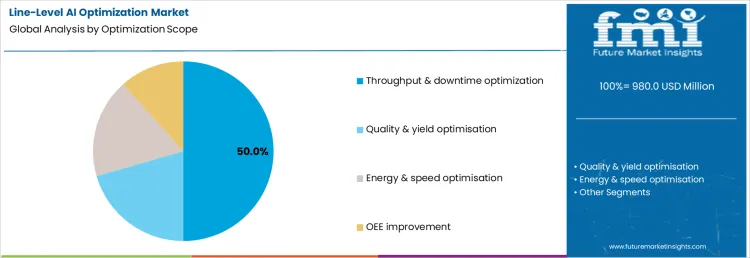
Throughput & downtime optimization is the leading optimization scope in the line-level AI optimization market, capturing 50% of the share. This growth is driven by the need for manufacturing lines to maximize their operational efficiency, minimize idle times, and increase production output. Downtime, whether planned or unplanned, can significantly impact the profitability and productivity of manufacturing operations. AI-based optimization systems can monitor machine performance in real time, predict potential failures, and optimize scheduling to reduce downtime. By improving throughput and minimizing downtime, manufacturers can enhance their operational efficiency, leading to faster production times and lower operational costs. As industries continue to focus on improving performance, reducing waste, and maximizing throughput, the demand for AI-driven optimization solutions in this area is expected to grow, making throughput & downtime optimization a dominant segment.
What is Driving the Demand for Filling & Packing Lines in the Line-Level AI Optimization Market?
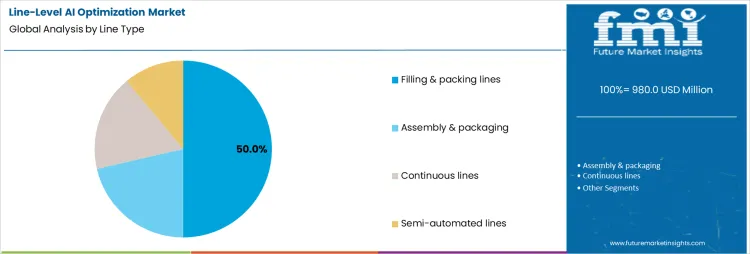
Filling & packing lines are the leading line type in the line-level AI optimization market, holding 50% of the share. These lines are critical in industries such as food and beverage, pharmaceuticals, and consumer goods, where the efficient and accurate filling and packaging of products is essential. AI optimization solutions are increasingly being applied to filling & packing lines to enhance speed, precision, and productivity, while reducing material waste and downtime. By leveraging AI for real-time monitoring and control, manufacturers can optimize the flow of goods, predict maintenance needs, and improve quality control during the packing process. The demand for AI optimization in these lines is further driven by the growing need for higher throughput, lower operational costs, and better quality assurance in packaging. As packaging demands increase with the rise of e-commerce and global supply chains, the need for optimized filling & packing lines will continue to drive this segment's growth in the market.
What is the Key Dynamics of the Global Line-Level AI Optimization Market?
The global line-level AI optimization market is expanding as manufacturers and supply chain operators adopt artificial intelligence tools that improve performance at individual production and logistics lines. Line-level AI solutions analyse real-time data to optimise throughput, reduce cycle times, minimise defects and balance workloads in discrete and process manufacturing. Growth is supported by Industry 4.0 initiatives, rising need for operational efficiency and demand for rapid adaptation to changing production schedules. Adoption spans automotive, electronics, consumer goods, pharmaceuticals and food and beverage sectors where granular, line-specific intelligence enables continuous improvement and competitiveness.
What are the Key Drivers for the Global Line-Level AI Optimization Market?
A key driver is pressure on manufacturers to maximise productivity and reduce waste in the face of tight margins and competitive markets. AI-driven optimisation at the line level enhances resource utilisation, identifies bottlenecks, and supports dynamic scheduling that responds to real-time conditions. Integration of IoT sensors, machine data streams and advanced analytics enables systems to detect patterns and prescribe actions that improve uptime and reduce defects. Expansion of digital transformation programs and investment in smart factory infrastructure encourage deployment of line-specific intelligence tools. Demand for traceability and quality assurance further motivates use of AI to support granular performance insight and proactive maintenance.
What are the Restraints for the Global Line-Level AI Optimization Market?
One restraint is the complexity and cost of integrating AI optimisation tools into heterogeneous production environments with legacy equipment and disparate data systems. Organisations often require data cleansing, standardisation and infrastructure upgrades before AI models can deliver reliable insights, which extends implementation timelines and resources. Smaller manufacturers may lack internal expertise or budget to deploy and maintain advanced analytics solutions. Concerns about data privacy, cybersecurity and intellectual property when connecting production assets to cloud or AI platforms may slow adoption. Variability in digital maturity across global operations influences how quickly line-level optimisation gains traction.
What is the Key Trends in the Global Line-Level AI Optimization Market?
A key trend is development of explainable and prescriptive AI models that not only predict outcomes but also recommend specific actions and adjustments for line operators. Solutions are increasingly embedding AI into edge computing devices to deliver faster decision support close to the point of production. Vendors are integrating AI optimisation with MES, ERP and quality systems to enable wider enterprise alignment and feedback loops. Cross-industry benchmarks and digital twin models help organisations compare performance and simulate changes before deployment. Focus on modular, scalable AI components that support phased implementation and local language interfaces is helping extend adoption across varied facilities and workforce skill levels.
What is the Country-Wise Analysis of the Line-Level AI Optimization Market?
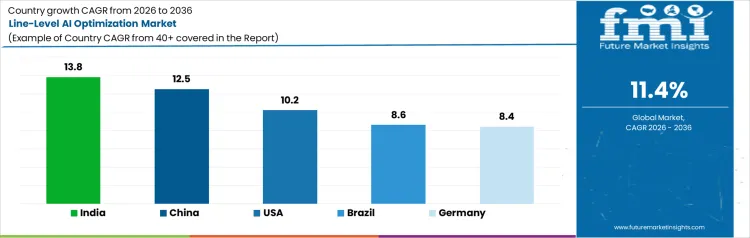
The line-level AI optimization market is expected to grow significantly, driven by the increasing demand for artificial intelligence (AI) solutions to optimize operational efficiencies across industries. These AI systems are used to optimize processes, enhance decision-making, and improve performance at the line level in manufacturing, retail, and other sectors. High-growth markets like China and India are seeing strong demand, fueled by rapid industrialization, digital transformation, and the increasing adoption of AI-driven solutions. Developed markets such as the USA, Germany, and Brazil are also experiencing steady growth, supported by advancements in AI technology and the need for smarter, more efficient business operations.
| Country | CAGR (%) |
|---|---|
| China | 12.5 |
| India | 13.8 |
| United States | 10.2 |
| Germany | 8.4 |
| Brazil | 8.6 |
What is the Growth Outlook for the Line-Level AI Optimization Market in China?
The line-level AI optimization market in China is expected to grow at a strong pace, with a projected CAGR of 12.5%. China’s rapidly expanding manufacturing sector, coupled with the government’s push for digital transformation and advanced technologies, is driving strong demand for AI optimization solutions. As industries in China strive to improve productivity, efficiency, and decision-making capabilities, AI-powered solutions are increasingly being adopted at the line level. The rising focus on smart factories, automation, and Industry 4.0 further accelerates the need for AI optimization. With China’s leading role in AI development and industrialization, the market for line-level AI optimization is set for significant growth.
What is the Market Outlook for the Line-Level AI Optimization Market in India?
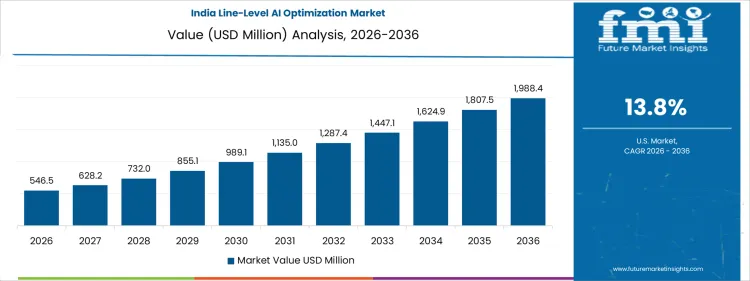
The line-level AI optimization market in India is projected to grow at the highest rate, with a projected CAGR of 13.8%. India’s growing manufacturing base, along with increasing investments in digitalization and AI technologies, is driving the demand for AI-powered optimization solutions. As India’s industries look to improve operational efficiency, reduce costs, and enhance decision-making, the adoption of AI solutions at the line level is gaining traction. The Indian government’s focus on smart manufacturing and Industry 4.0, along with the increasing presence of AI research and development, is expected to further boost market growth. With India’s rapidly evolving industrial landscape, the market for line-level AI optimization is expected to see substantial growth
What is the Growth Forecast for the Line-Level AI Optimization Market in the United States?
The line-level AI optimization market in the United States is expected to grow steadily, with a projected CAGR of 10.2%. The USA is a leader in AI technology, and industries across the country are increasingly adopting AI-driven solutions to enhance operations and decision-making at the line level. Sectors such as manufacturing, retail, and logistics are leveraging AI optimization to streamline processes, reduce costs, and improve overall performance. As the U.S. continues to invest in AI innovation and smart automation technologies, the market for line-level AI optimization is expected to expand steadily. With a growing focus on operational efficiency and smarter business solutions, the USA market is poised for continued growth.
What is the Market Outlook for the Line-Level AI Optimization Market in Germany?
The line-level AI optimization market in Germany is projected to grow steadily, with a projected CAGR of 8.4%. Germany’s strong industrial base, particularly in automotive manufacturing, machinery, and chemicals, is driving the demand for AI-powered solutions to optimize processes and improve operational efficiency. The country’s focus on Industry 4.0 and smart manufacturing is further fueling the adoption of AI optimization technologies. As German industries strive to improve their competitiveness and sustainability, line-level AI optimization solutions are increasingly being integrated into production lines to enhance decision-making and operational performance. As Germany continues to invest in digital transformation, the market for line-level AI optimization is expected to grow steadily.
What are the Growth Prospects for the Line-Level AI Optimization Market in Brazil?
The line-level AI optimization market in Brazil is expected to grow at a moderate pace, with a projected CAGR of 8.6%. Brazil’s manufacturing sector, particularly in industries like automotive, consumer goods, and agriculture, is becoming increasingly digitized, driving the demand for AI optimization solutions. As businesses in Brazil focus on enhancing efficiency, reducing costs, and improving decision-making, the adoption of AI technologies is gaining momentum. The government’s initiatives to support digital transformation and innovation in industries are further encouraging the use of AI optimization at the line level. While growth may be slower compared to other regions, Brazil’s market for line-level AI optimization is expected to expand as businesses continue to embrace smart manufacturing solutions.
What is the Competitive Landscape for the Line-Level AI Optimization Market?
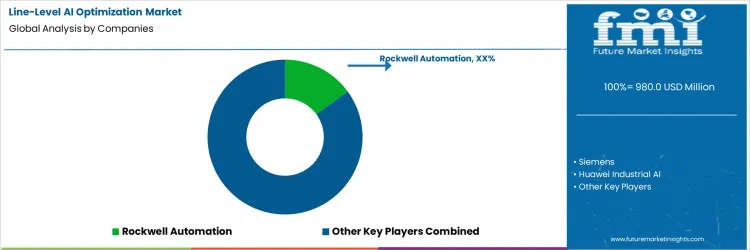
The line-level AI optimization market is growing as industries adopt advanced AI technologies to enhance production efficiency and streamline operations on manufacturing lines. Rockwell Automation leads the market with its cutting-edge AI optimization solutions, offering integrated technologies that enable real-time monitoring and decision-making to optimize line-level processes. Their focus on automation and smart manufacturing positions them as a dominant player. Siemens, Huawei Industrial AI, and Tata Technologies are key competitors, providing advanced AI-powered solutions that focus on improving operational efficiency, reducing downtime, and ensuring high-quality output. Siemens specializes in digitalization and industrial AI, while Huawei Industrial AI offers AI-driven solutions designed for smart manufacturing environments. Tata Technologies provides engineering and manufacturing expertise with a focus on AI-based optimization.
Local system integrators, Fanuc, Cognex, and Bosch further contribute to the competitive landscape. Fanuc focuses on robotics and automation, integrating AI for line-level optimization, while Cognex specializes in machine vision systems that leverage AI for process improvement and quality control. Bosch offers AI-driven technologies for industrial automation, enhancing manufacturing processes. These companies compete by focusing on AI integration, real-time optimization, and their ability to provide tailored solutions that meet the increasing demand for smart manufacturing and operational efficiency at the line level.
Key Players of the Line-Level AI Optimization Market
- Rockwell Automation
- Siemens
- Huawei Industrial AI
- Tata Technologies
- Local system integrators
- Fanuc
- Cognex
- Bosch
Scope of the Report
| Items | Values |
|---|---|
| Quantitative Units (2026) | USD Million |
| End-use / Application | High-Speed Packaging Lines, Automotive & F&B Lines, Large Manufacturing Plants, FMCG Plants, Industrial Operations, Precision Manufacturing |
| Optimization Scope | Throughput & Downtime Optimization, Quality & Yield Optimization, Energy & Speed Optimization, OEE Improvement |
| Line Type | Filling & Packing Lines, Assembly & Packaging, Continuous Lines, Semi-Automated Lines, Others |
| Technology | AI/ML-Based Predictive Optimization, Digital Twin Line Models, Real-Time AI Control, Cloud-Based AI Analytics |
| Companies | Rockwell Automation, Siemens, Huawei Industrial AI, Tata Technologies, Local System Integrators, Fanuc, Cognex, Bosch |
| Regions Covered | North America, Latin America, Western Europe, Eastern Europe, South Asia and Pacific, East Asia, Middle East & Africa |
| Countries Covered | United States, Canada, Mexico, Brazil, Argentina, Germany, France, United Kingdom, Italy, Spain, Netherlands, China, India, Japan, South Korea, ANZ, GCC Countries, South Africa |
| Additional Attributes | Dollar by sales by end-use/application, optimization scope, line type, technology, and region. Includes market trends in line-level AI optimization, focusing on throughput, downtime, quality, yield, and energy optimization. Highlights the role of predictive AI/ML-based systems, digital twin models, and real-time AI control in packaging, automotive, FMCG, and industrial operations. Focus on performance, sustainability, regulatory compliance, market share, and competitive positioning of key companies in the AI optimization market. |
Line-Level AI Optimization Market Segmentation
End-use / Application
- High-speed packaging lines
- Automotive & F&B lines
- Large manufacturing plants
- FMCG plants
- Industrial operations
- Precision manufacturing
Optimization Scope
- Throughput & downtime optimization
- Quality & yield optimization
- Energy & speed optimization
- OEE improvement
- Others
Line Type
- Filling & packing lines
- Assembly & packaging
- Continuous lines
- Semi-automated lines
- Others
Technology
- AI/ML-based predictive optimization
- Digital twin line models
- Real-time AI control
- Cloud-based AI analytics
- Others
Region
- Asia Pacific
- China
- Japan
- South Korea
- India
- Australia & New Zealand
- ASEAN
- Rest of Asia Pacific
- Europe
- Germany
- United Kingdom
- France
- Italy
- Spain
- Nordic
- BENELUX
- Rest of Europe
- North America
- United States
- Canada
- Mexico
- Latin America
- Brazil
- Chile
- Rest of Latin America
- Middle East & Africa
- Kingdom of Saudi Arabia
- Other GCC Countries
- Turkey
- South Africa
- Other African Union
- Rest of Middle East & Africa
Frequently Asked Questions
How big is the line-level ai optimization market in 2026?
The global line-level ai optimization market is estimated to be valued at USD 980.0 million in 2026.
What will be the size of line-level ai optimization market in 2036?
The market size for the line-level ai optimization market is projected to reach USD 2,880.0 million by 2036.
How much will be the line-level ai optimization market growth between 2026 and 2036?
The line-level ai optimization market is expected to grow at a 11.4% CAGR between 2026 and 2036.
What are the key product types in the line-level ai optimization market?
The key product types in line-level ai optimization market are high-speed packaging lines, automotive & f&b lines, large manufacturing plants, fmcg plants, industrial operations and precision manufacturing.
Which optimization scope segment to contribute significant share in the line-level ai optimization market in 2026?
In terms of optimization scope, throughput & downtime optimization segment to command 50.0% share in the line-level ai optimization market in 2026.
Preview the report firsthand - request a free sample
Get SampleGet the brochure for pricing and purchase details.
Get PDFTable of Content
- Executive Summary
- Global Market Outlook
- Demand-side Trends
- Supply-side Trends
- Technology Roadmap Analysis
- Analysis and Recommendations
- Market Overview
- Market Coverage / Taxonomy
- Market Definition / Scope / Limitations
- Market Background
- Market Dynamics
- Drivers
- Restraints
- Opportunity
- Trends
- Scenario Forecast
- Demand in Optimistic Scenario
- Demand in Likely Scenario
- Demand in Conservative Scenario
- Opportunity Map Analysis
- Product Life Cycle Analysis
- Supply Chain Analysis
- Investment Feasibility Matrix
- Value Chain Analysis
- PESTLE and Porter’s Analysis
- Regulatory Landscape
- Regional Parent Market Outlook
- Production and Consumption Statistics
- Import and Export Statistics
- Market Dynamics
- Global Market Analysis 2021 to 2025 and Forecast, 2026 to 2036
- Historical Market Size Value (USD Million) Analysis, 2021 to 2025
- Current and Future Market Size Value (USD Million) Projections, 2026 to 2036
- Y-o-Y Growth Trend Analysis
- Absolute $ Opportunity Analysis
- Global Market Pricing Analysis 2021 to 2025 and Forecast 2026 to 2036
- Global Market Analysis 2021 to 2025 and Forecast 2026 to 2036, By End-use or Application
- Introduction / Key Findings
- Historical Market Size Value (USD Million) Analysis By End-use or Application , 2021 to 2025
- Current and Future Market Size Value (USD Million) Analysis and Forecast By End-use or Application , 2026 to 2036
- High-speed packaging lines
- Automotive & F&B lines
- Large manufacturing plants
- FMCG plants
- Industrial operations
- Precision manufacturing
- Y-o-Y Growth Trend Analysis By End-use or Application , 2021 to 2025
- Absolute $ Opportunity Analysis By End-use or Application , 2026 to 2036
- Global Market Analysis 2021 to 2025 and Forecast 2026 to 2036, By Optimization Scope
- Introduction / Key Findings
- Historical Market Size Value (USD Million) Analysis By Optimization Scope, 2021 to 2025
- Current and Future Market Size Value (USD Million) Analysis and Forecast By Optimization Scope, 2026 to 2036
- Throughput & downtime optimization
- Quality & yield optimisation
- Energy & speed optimisation
- OEE improvement
- Y-o-Y Growth Trend Analysis By Optimization Scope, 2021 to 2025
- Absolute $ Opportunity Analysis By Optimization Scope, 2026 to 2036
- Global Market Analysis 2021 to 2025 and Forecast 2026 to 2036, By Line Type
- Introduction / Key Findings
- Historical Market Size Value (USD Million) Analysis By Line Type, 2021 to 2025
- Current and Future Market Size Value (USD Million) Analysis and Forecast By Line Type, 2026 to 2036
- Filling & packing lines
- Assembly & packaging
- Continuous lines
- Semi-automated lines
- Y-o-Y Growth Trend Analysis By Line Type, 2021 to 2025
- Absolute $ Opportunity Analysis By Line Type, 2026 to 2036
- Global Market Analysis 2021 to 2025 and Forecast 2026 to 2036, By Technology
- Introduction / Key Findings
- Historical Market Size Value (USD Million) Analysis By Technology, 2021 to 2025
- Current and Future Market Size Value (USD Million) Analysis and Forecast By Technology, 2026 to 2036
- AI/ML-based predictive optimisation
- Digital twin line models
- Real-time AI control
- Cloud-based AI analytics
- Y-o-Y Growth Trend Analysis By Technology, 2021 to 2025
- Absolute $ Opportunity Analysis By Technology, 2026 to 2036
- Global Market Analysis 2021 to 2025 and Forecast 2026 to 2036, By Region
- Introduction
- Historical Market Size Value (USD Million) Analysis By Region, 2021 to 2025
- Current Market Size Value (USD Million) Analysis and Forecast By Region, 2026 to 2036
- North America
- Latin America
- Western Europe
- Eastern Europe
- East Asia
- South Asia and Pacific
- Middle East & Africa
- Market Attractiveness Analysis By Region
- North America Market Analysis 2021 to 2025 and Forecast 2026 to 2036, By Country
- Historical Market Size Value (USD Million) Trend Analysis By Market Taxonomy, 2021 to 2025
- Market Size Value (USD Million) Forecast By Market Taxonomy, 2026 to 2036
- By Country
- USA
- Canada
- Mexico
- By End-use or Application
- By Optimization Scope
- By Line Type
- By Technology
- By Country
- Market Attractiveness Analysis
- By Country
- By End-use or Application
- By Optimization Scope
- By Line Type
- By Technology
- Key Takeaways
- Latin America Market Analysis 2021 to 2025 and Forecast 2026 to 2036, By Country
- Historical Market Size Value (USD Million) Trend Analysis By Market Taxonomy, 2021 to 2025
- Market Size Value (USD Million) Forecast By Market Taxonomy, 2026 to 2036
- By Country
- Brazil
- Chile
- Rest of Latin America
- By End-use or Application
- By Optimization Scope
- By Line Type
- By Technology
- By Country
- Market Attractiveness Analysis
- By Country
- By End-use or Application
- By Optimization Scope
- By Line Type
- By Technology
- Key Takeaways
- Western Europe Market Analysis 2021 to 2025 and Forecast 2026 to 2036, By Country
- Historical Market Size Value (USD Million) Trend Analysis By Market Taxonomy, 2021 to 2025
- Market Size Value (USD Million) Forecast By Market Taxonomy, 2026 to 2036
- By Country
- Germany
- UK
- Italy
- Spain
- France
- Nordic
- BENELUX
- Rest of Western Europe
- By End-use or Application
- By Optimization Scope
- By Line Type
- By Technology
- By Country
- Market Attractiveness Analysis
- By Country
- By End-use or Application
- By Optimization Scope
- By Line Type
- By Technology
- Key Takeaways
- Eastern Europe Market Analysis 2021 to 2025 and Forecast 2026 to 2036, By Country
- Historical Market Size Value (USD Million) Trend Analysis By Market Taxonomy, 2021 to 2025
- Market Size Value (USD Million) Forecast By Market Taxonomy, 2026 to 2036
- By Country
- Russia
- Poland
- Hungary
- Balkan & Baltic
- Rest of Eastern Europe
- By End-use or Application
- By Optimization Scope
- By Line Type
- By Technology
- By Country
- Market Attractiveness Analysis
- By Country
- By End-use or Application
- By Optimization Scope
- By Line Type
- By Technology
- Key Takeaways
- East Asia Market Analysis 2021 to 2025 and Forecast 2026 to 2036, By Country
- Historical Market Size Value (USD Million) Trend Analysis By Market Taxonomy, 2021 to 2025
- Market Size Value (USD Million) Forecast By Market Taxonomy, 2026 to 2036
- By Country
- China
- Japan
- South Korea
- By End-use or Application
- By Optimization Scope
- By Line Type
- By Technology
- By Country
- Market Attractiveness Analysis
- By Country
- By End-use or Application
- By Optimization Scope
- By Line Type
- By Technology
- Key Takeaways
- South Asia and Pacific Market Analysis 2021 to 2025 and Forecast 2026 to 2036, By Country
- Historical Market Size Value (USD Million) Trend Analysis By Market Taxonomy, 2021 to 2025
- Market Size Value (USD Million) Forecast By Market Taxonomy, 2026 to 2036
- By Country
- India
- ASEAN
- Australia & New Zealand
- Rest of South Asia and Pacific
- By End-use or Application
- By Optimization Scope
- By Line Type
- By Technology
- By Country
- Market Attractiveness Analysis
- By Country
- By End-use or Application
- By Optimization Scope
- By Line Type
- By Technology
- Key Takeaways
- Middle East & Africa Market Analysis 2021 to 2025 and Forecast 2026 to 2036, By Country
- Historical Market Size Value (USD Million) Trend Analysis By Market Taxonomy, 2021 to 2025
- Market Size Value (USD Million) Forecast By Market Taxonomy, 2026 to 2036
- By Country
- Kingdom of Saudi Arabia
- Other GCC Countries
- Turkiye
- South Africa
- Other African Union
- Rest of Middle East & Africa
- By End-use or Application
- By Optimization Scope
- By Line Type
- By Technology
- By Country
- Market Attractiveness Analysis
- By Country
- By End-use or Application
- By Optimization Scope
- By Line Type
- By Technology
- Key Takeaways
- Key Countries Market Analysis
- USA
- Pricing Analysis
- Market Share Analysis, 2025
- By End-use or Application
- By Optimization Scope
- By Line Type
- By Technology
- Canada
- Pricing Analysis
- Market Share Analysis, 2025
- By End-use or Application
- By Optimization Scope
- By Line Type
- By Technology
- Mexico
- Pricing Analysis
- Market Share Analysis, 2025
- By End-use or Application
- By Optimization Scope
- By Line Type
- By Technology
- Brazil
- Pricing Analysis
- Market Share Analysis, 2025
- By End-use or Application
- By Optimization Scope
- By Line Type
- By Technology
- Chile
- Pricing Analysis
- Market Share Analysis, 2025
- By End-use or Application
- By Optimization Scope
- By Line Type
- By Technology
- Germany
- Pricing Analysis
- Market Share Analysis, 2025
- By End-use or Application
- By Optimization Scope
- By Line Type
- By Technology
- UK
- Pricing Analysis
- Market Share Analysis, 2025
- By End-use or Application
- By Optimization Scope
- By Line Type
- By Technology
- Italy
- Pricing Analysis
- Market Share Analysis, 2025
- By End-use or Application
- By Optimization Scope
- By Line Type
- By Technology
- Spain
- Pricing Analysis
- Market Share Analysis, 2025
- By End-use or Application
- By Optimization Scope
- By Line Type
- By Technology
- France
- Pricing Analysis
- Market Share Analysis, 2025
- By End-use or Application
- By Optimization Scope
- By Line Type
- By Technology
- India
- Pricing Analysis
- Market Share Analysis, 2025
- By End-use or Application
- By Optimization Scope
- By Line Type
- By Technology
- ASEAN
- Pricing Analysis
- Market Share Analysis, 2025
- By End-use or Application
- By Optimization Scope
- By Line Type
- By Technology
- Australia & New Zealand
- Pricing Analysis
- Market Share Analysis, 2025
- By End-use or Application
- By Optimization Scope
- By Line Type
- By Technology
- China
- Pricing Analysis
- Market Share Analysis, 2025
- By End-use or Application
- By Optimization Scope
- By Line Type
- By Technology
- Japan
- Pricing Analysis
- Market Share Analysis, 2025
- By End-use or Application
- By Optimization Scope
- By Line Type
- By Technology
- South Korea
- Pricing Analysis
- Market Share Analysis, 2025
- By End-use or Application
- By Optimization Scope
- By Line Type
- By Technology
- Russia
- Pricing Analysis
- Market Share Analysis, 2025
- By End-use or Application
- By Optimization Scope
- By Line Type
- By Technology
- Poland
- Pricing Analysis
- Market Share Analysis, 2025
- By End-use or Application
- By Optimization Scope
- By Line Type
- By Technology
- Hungary
- Pricing Analysis
- Market Share Analysis, 2025
- By End-use or Application
- By Optimization Scope
- By Line Type
- By Technology
- Kingdom of Saudi Arabia
- Pricing Analysis
- Market Share Analysis, 2025
- By End-use or Application
- By Optimization Scope
- By Line Type
- By Technology
- Turkiye
- Pricing Analysis
- Market Share Analysis, 2025
- By End-use or Application
- By Optimization Scope
- By Line Type
- By Technology
- South Africa
- Pricing Analysis
- Market Share Analysis, 2025
- By End-use or Application
- By Optimization Scope
- By Line Type
- By Technology
- USA
- Market Structure Analysis
- Competition Dashboard
- Competition Benchmarking
- Market Share Analysis of Top Players
- By Regional
- By End-use or Application
- By Optimization Scope
- By Line Type
- By Technology
- Competition Analysis
- Competition Deep Dive
- Rockwell Automation
- Overview
- Product Portfolio
- Profitability by Market Segments (Product/Age /Sales Channel/Region)
- Sales Footprint
- Strategy Overview
- Marketing Strategy
- Product Strategy
- Channel Strategy
- Siemens
- Huawei Industrial AI
- Tata Technologies
- Local system integrators
- Fanuc
- Cognex
- Bosch
- Rockwell Automation
- Competition Deep Dive
- Assumptions & Acronyms Used
- Research Methodology


