

- Market Size (2026)
- USD 12.3 Bn
- Forecast (2036)
- SD 75.94 Bn
- CAGR (2026 to 2036)
- 20.0%
AI Health and Fitness Products Market Size, Market Forecast and Outlook By FMI
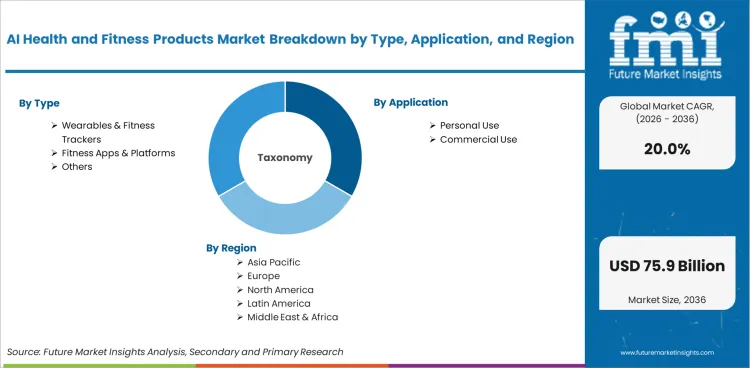
The AI health and fitness products market was valued at USD 10.2 billion in 2025. The market is set to reach USD 12.3 billion by 2026-end and grow at a CAGR of 20.0% between 2026–2036 to reach USD 75.9 billion by 2036. Wearables & Fitness Trackers will dominate with a 65.0% share, while Personal Use will lead with a 78.0%% share.
Summary of the AI Health and Fitness Products Market Size, Market Forecast and Outlook By FMI
- Demand and Growth Drivers
- Consumer health awareness is accelerating demand for AI-enabled fitness products that provide personalized workout recommendations, real-time biometric feedback, and adaptive training programs tailored to individual physiological profiles.
- Chronic disease prevention strategies are shifting consumer spending toward proactive health monitoring devices that leverage AI algorithms to detect early warning signs in heart rate variability, sleep patterns, and activity metrics.
- Integration of AI with wearable sensor technology has expanded the capability of consumer fitness products beyond step counting to continuous health monitoring, creating a new category of preventive health tools.
- Product and Segment View
- Wearables and fitness trackers hold 65.0% of the product type segment in 2026, supported by sensor miniaturization, extended battery life, and AI-powered health analytics that deliver clinical-grade insights through consumer devices.
- Personal use accounts for 78.0% of the application segment, reflecting the consumer-driven nature of AI fitness product adoption, with individual health optimization as the primary purchase motivation.
- Connected fitness equipment, including AI-powered smart bikes, mirrors, and strength training systems, represents the fastest-growing product subcategory within the market.
- Geography and Competitive Outlook
- India leads country-level growth at 25.0% CAGR, supported by rising disposable incomes, expanding smartphone penetration, and increasing health consciousness among urban consumers.
- North America maintains the largest revenue share, with the USA growing at 19.0% CAGR as premium wearable brands integrate advanced AI health features including ECG monitoring, blood oxygen tracking, and stress management.
- Competition is intensifying between consumer electronics companies expanding into health features and specialized fitness technology firms developing dedicated AI training platforms.
- Analyst Opinion
- The AI health and fitness products market is transitioning from basic activity tracking to comprehensive health management platforms. Wearable devices now function as continuous health monitoring systems, while AI algorithms transform raw sensor data into actionable wellness recommendations. Companies that successfully bridge the gap between fitness tracking and preventive healthcare will capture the highest-value segments of this market.
- Consumer willingness to pay premium prices for AI-enhanced health features is increasing as device accuracy and personalization quality improve.
- Regulatory pathways for consumer health devices with clinical-grade AI features are expanding, creating new market opportunities at the intersection of consumer electronics and digital health.
- Subscription-based AI coaching and health analytics services are becoming a significant revenue stream alongside hardware sales, improving customer lifetime value.
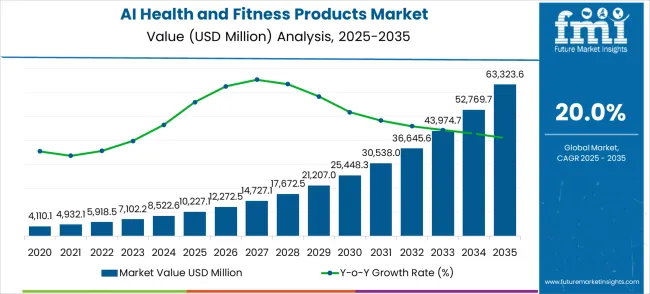
Key Takeaways, Market Size, and Forecast
- The AI Health and Fitness Products Market was valued at USD 10.22 billion in 2025.
- By 2036, the AI Health and Fitness Products Market is expected to be worth USD 75.94 billion.
- From 2026 to 2036, the market is projected to expand at a CAGR of 20.0%.
- The market is projected to create an incremental opportunity of USD 63.68 billion between 2026 and 2036.
- In 2026, wearables and fitness trackers are expected to account for 65.0% of the product type segment, driven by consumer demand for real-time biometric monitoring and personalized health insights.
- India (25.0%) and Germany (23.0%) are two of the fastest growing markets in the world.
AI Health and Fitness Products Market Definition
The AI health and fitness products market encompasses hardware devices, software platforms, and integrated systems that use artificial intelligence to monitor physical activity, analyze biometric data, provide personalized fitness recommendations, and support proactive health management for consumers and commercial fitness operators.
AI Health and Fitness Products Market Inclusions
Market scope covers AI-enabled wearables and fitness trackers, smart fitness equipment, AI coaching platforms, connected gym systems, and health analytics applications segmented by product type (wearables and fitness trackers, smart fitness equipment, AI coaching platforms), application (personal use, commercial/gym use), and geography. The revenue range extends from 2026 to 2036.
AI Health and Fitness Products Market Exclusions
The scope does not include traditional fitness equipment without AI or connected features, basic pedometers or non-smart activity trackers, medical-grade diagnostic devices regulated as Class III medical devices, or pharmaceutical wellness products.
AI Health and Fitness Products Market Research Methodology
- Primary Research: FMI analysts conducted interviews with fitness technology product managers, wearable device manufacturers, gym chain operators, and health-tech investors across key markets.
- Desk Research: Integrated data from consumer electronics industry reports, fitness industry association publications, and wearable technology patent filings.
- Market Sizing and Forecasting: Bottom-up aggregation across product types, application segments, and regional adoption curves with cross-validation against consumer electronics shipment data.
- Data Validation: Cross-checked quarterly against manufacturer shipment reports, app store download data, and consumer health technology spending surveys.
Why is the AI Health and Fitness Products Market Growing?
- Rising health consciousness among global consumers is driving demand for AI-powered devices that transform passive health data into personalized, actionable wellness guidance.
- Advances in wearable sensor technology and edge AI processing have enabled real-time biometric analysis in compact consumer devices, expanding the addressable market beyond fitness enthusiasts to general health-conscious consumers.
- The shift toward preventive healthcare economics is encouraging consumers and insurers to invest in continuous health monitoring tools that can detect early warning signs and reduce long-term healthcare costs.
The AI health and fitness products market is experiencing growth driven by converging trends in consumer health awareness, sensor technology advancement, and AI algorithm sophistication. Consumers are increasingly treating wearable health devices as essential personal technology rather than discretionary fitness accessories.
Wearable devices have evolved from simple step counters to sophisticated health monitoring platforms capable of tracking heart rate variability, blood oxygen saturation, skin temperature, and sleep architecture. AI algorithms process these continuous data streams to generate personalized health insights, workout recommendations, and early warning alerts that were previously available only through clinical monitoring.
The commercial fitness segment is also undergoing AI-driven transformation. Connected fitness equipment integrates AI coaching that adapts workout intensity and form guidance in real time. Gym operators are deploying AI-powered member engagement platforms that reduce churn by delivering personalized training experiences at scale.
Market Segmentation Analysis
- Wearables and fitness trackers hold 65.0% of the product type segment, reflecting consumer preference for continuous, passive health monitoring through wrist-worn and body-worn devices.
- Personal use accounts for 78.0% of the application segment, driven by individual consumer demand for health optimization and fitness performance tracking.
- Smart fitness equipment is the fastest-growing subcategory, supported by demand for AI-guided home and commercial workout experiences.
The AI health and fitness products market is segmented by product type (wearables and fitness trackers, smart fitness equipment, AI coaching platforms), application (personal use, commercial/gym use), and geography.
Insights into the Wearables and Fitness Trackers Segment
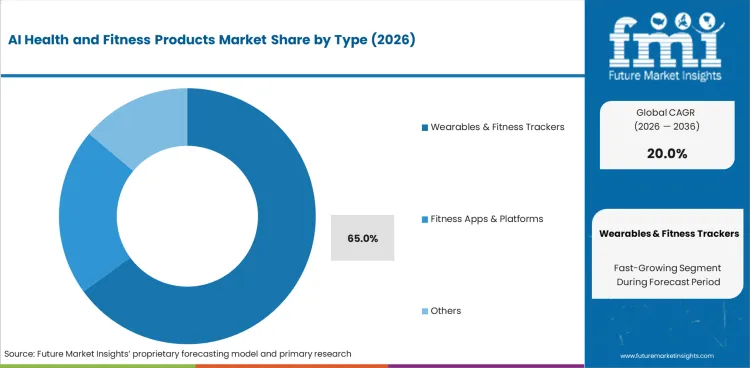
Wearables and fitness trackers command 65.0% of the product type segment in 2026. Consumer adoption is driven by devices that combine activity tracking with health monitoring features including continuous heart rate measurement, sleep quality analysis, and stress level assessment. AI algorithms running on-device and in the cloud process sensor data to deliver personalized recommendations.
Premium wearables are increasingly incorporating clinical-grade health features such as ECG monitoring, blood oxygen measurement, and atrial fibrillation detection. These features expand the addressable market to health-conscious consumers beyond the traditional fitness enthusiast demographic, positioning wearables as everyday health management tools.
Insights into the Personal Use Application Segment
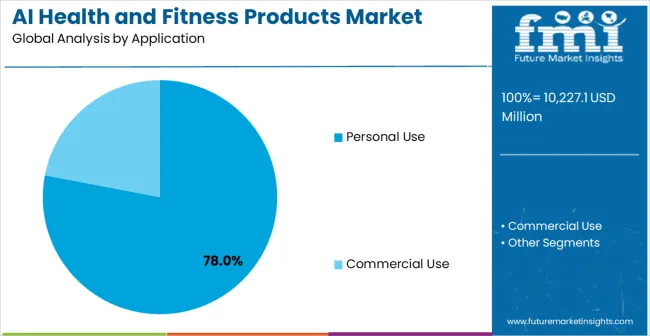
Personal use accounts for 78.0% of the application segment in 2026, reflecting the consumer-driven nature of AI fitness product adoption. Individual consumers purchase AI health and fitness products primarily for daily activity monitoring, workout optimization, and long-term health trend tracking.
The subscription economy model has strengthened personal use engagement, with AI coaching services, premium health analytics dashboards, and personalized training programs generating recurring revenue alongside device sales. Average revenue per user is increasing as consumers adopt multiple AI health products across wearables, smart equipment, and coaching platforms.
AI Health and Fitness Products Market Drivers, Restraints, and Opportunities
- Rising global health consciousness and the shift toward preventive healthcare are the primary structural drivers, converting AI fitness products from discretionary purchases to perceived health necessities.
- Data privacy concerns and sensor accuracy limitations constrain adoption among consumers skeptical about continuous biometric data collection and the reliability of AI-generated health recommendations.
- Insurance integration and corporate wellness programs present growth opportunities, with employers and insurers subsidizing AI health devices as preventive care investments.
The AI health and fitness products market is shaped by consumer demand for personalized health management tools that deliver measurable wellness outcomes. The convergence of sensor technology, AI analytics, and connected device ecosystems has created products that address both fitness performance and broader health monitoring needs.
Health Consciousness as a Structural Demand Driver
Consumer spending on personal health and wellness has increased steadily over the past decade, with AI-powered fitness products capturing a growing share of this spending. Wearable devices that provide continuous health feedback satisfy consumer demand for proactive health management.
Data Privacy and Accuracy Concerns
Consumer concerns about biometric data collection, storage, and sharing practices create adoption friction, particularly in markets with strong data privacy regulations. Device manufacturers must balance data collection breadth with transparent privacy practices to maintain consumer trust.
Insurance and Corporate Wellness Integration
Health insurers and corporate wellness programs are increasingly incorporating AI wearable data into preventive care incentive programs. This integration creates a subsidized distribution channel that reduces consumer acquisition costs and increases device utilization rates.
Analysis of AI Health and Fitness Products Market by Key Countries
.webp "Top Country Growth Comparison Ai Health And Fitness Products Market Cagr (2026 2036)")
| Country | CAGR |
|---|---|
| India | 25.0% |
| Germany | 23.0% |
| Brazil | 21.0% |
| USA | 19.0% |
| UK | 17.0% |
| Japan | 15.0% |
| China | 14.5% |
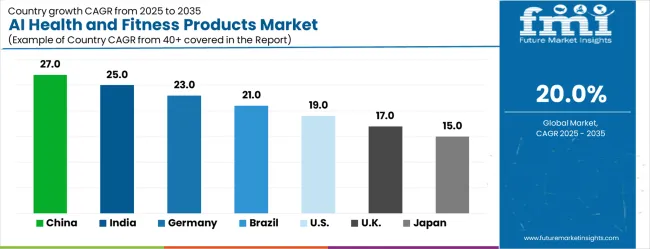
- India leads at 25.0% CAGR through 2036, supported by rising disposable incomes, expanding smartphone penetration, and growing urban health consciousness.
- Germany at 23.0% CAGR reflects strong demand for precision-engineered health monitoring devices and corporate wellness adoption across major employers.
- Brazil at 21.0% CAGR benefits from a fitness-oriented consumer culture and expanding middle-class spending on health technology products.
- The USA at 19.0% CAGR maintains the largest revenue base, with premium wearable adoption and connected fitness equipment driving market expansion.
The AI health and fitness products market is projected to expand at 20.0% CAGR globally from 2026 to 2036. The analysis covers more than 30 countries, with the leading markets detailed below.
Demand Outlook for AI Health and Fitness Products Market in India
India is growing at 25.0% CAGR through 2036, making it the fastest-growing country market. Rising disposable incomes among urban professionals, combined with increasing smartphone penetration, are creating a large addressable market for AI-enabled health and fitness devices.
- Urban fitness culture is expanding rapidly, with gym memberships and home fitness equipment adoption creating demand for AI coaching integration.
- Affordable wearable devices from domestic and international brands are driving mass-market penetration beyond premium consumer segments.
- Health insurance companies are beginning to incorporate wearable data into wellness programs, creating incentive-driven adoption channels.
Future Outlook for AI Health and Fitness Products Market in Germany
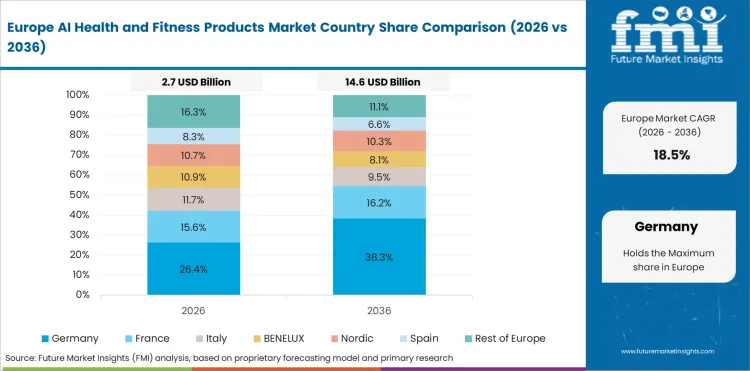
Germany is expanding at 23.0% CAGR through 2036, supported by strong consumer preference for precision-engineered health monitoring technology and widespread corporate wellness program adoption. German consumers demonstrate high willingness to pay for devices with clinical-grade accuracy.
- Corporate wellness programs are driving employer-subsidized adoption of AI health wearables across major industries.
- Consumer demand for data transparency and privacy compliance favors manufacturers with strong European data governance practices.
- Integration with the German healthcare system through digital health application regulations creates pathways for reimbursable AI health products.
Opportunity Analysis of AI Health and Fitness Products Market in Brazil
Brazil is growing at 21.0% CAGR through 2036, reflecting a deeply rooted fitness culture combined with expanding middle-class technology adoption. Brazilian consumers are early adopters of connected fitness products, supported by strong social media fitness communities.
- Fitness culture penetration is among the highest globally, creating strong consumer receptivity for AI-enhanced workout products.
- Expanding e-commerce infrastructure improves access to international and domestic AI fitness brands across tier-2 and tier-3 cities.
- Social media fitness influencer ecosystem drives consumer awareness and adoption of AI-powered training platforms.
In-depth Analysis of AI Health and Fitness Products Market in the USA
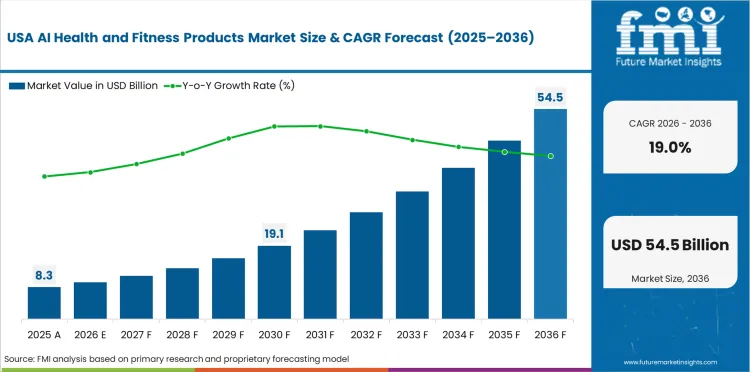
The USA is growing at 19.0% CAGR through 2036, maintaining the largest revenue concentration globally. Premium wearable adoption is near saturation in high-income demographics, with growth shifting toward mid-market consumers and specialized health monitoring applications.
- Premium wearable brands are expanding AI health features to attract health-conscious consumers beyond the fitness enthusiast demographic.
- Connected home fitness equipment market continues to grow as AI coaching quality approaches in-person personal training effectiveness.
- Health insurance integration is accelerating, with major insurers offering premium discounts for policyholders who meet AI-tracked wellness targets.
Competitive Landscape of the AI Health and Fitness Products Market
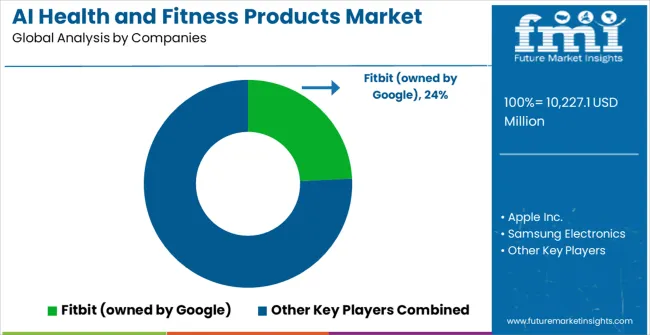
The AI health and fitness products market is characterized by competition between established consumer electronics companies, specialized fitness technology firms, and emerging AI health startups. Differentiation is driven by sensor accuracy, AI algorithm quality, ecosystem integration, and subscription service value.
Market Positioning Overview
Market leaders include global consumer electronics companies that leverage existing hardware manufacturing scale and software ecosystem advantages. Specialized fitness technology firms compete through superior AI coaching algorithms and dedicated training experiences. Emerging players focus on niche health monitoring capabilities and clinical-grade accuracy.
Key Company Analysis
Apple and Google (Fitbit) dominate the premium wearable segment through integrated hardware-software ecosystems. Samsung competes on sensor hardware innovation. Garmin maintains strength in sports-specific AI coaching. Whoop and Oura differentiate through subscription-based health analytics. Peloton and Tonal lead in AI-powered connected fitness equipment.
| Company | Product Focus | AI Capability | Market Position |
|---|---|---|---|
| Apple | Smartwatch, Health | Advanced health AI | Market Leader |
| Fitbit (Google) | Wearables, Trackers | Health analytics AI | Market Leader |
| Samsung | Wearables, Rings | Sensor AI | Strong Contender |
| Garmin | Sports Wearables | Training AI | Niche Leader |
| Whoop | Health Band | Recovery AI | Premium Niche |
| Oura | Smart Ring | Sleep/Health AI | Premium Niche |
| Peloton | Connected Bikes | Coaching AI | Equipment Leader |
| Tonal | Smart Strength | Form AI | Equipment Innovator |
Key Players in the AI Health and Fitness Products Market
Major Players
- Fitbit (Google)
- Apple
- Samsung
- Garmin
- Whoop
- Oura
- Peloton
- Tonal
Emerging Players
- Speediance
- EGYM
- Polar
- Wahoo
- ClassPass
- Virtuagym
- Zwift
- Technogym
Report Scope
| Parameter | Details |
|---|---|
| Report Title | AI Health and Fitness Products Market |
| Forecast Period | 2026 – 2036 |
| Base Year | 2025 |
| Market Value (2025) | USD 10.22 billion |
| Market Value (2036) | USD 75.94 billion |
| CAGR | 20.0% |
| Segments Covered | Product Type, Application, Geography |
| Key Companies | Apple, Fitbit (Google), Samsung, Garmin, Whoop, Oura, Peloton, Tonal, Speediance, EGYM |
| Regions Covered | North America, Europe, Asia-Pacific, Latin America, Middle East & Africa |
Market Segmentation Analysis
AI Health and Fitness Products Market Segmented by Type:
- Wearables & Fitness Trackers
- Fitness Apps & Platforms
- Others
AI Health and Fitness Products Market Segmented by Application:
- Personal Use
- Commercial Use
AI Health and Fitness Products Market by Region:
- North America
- USA
- Canada
- Mexico
- Latin America
- Brazil
- Chile
- Rest of Latin America
- Western Europe
- Germany
- UK
- Italy
- Spain
- France
- Nordic
- BENELUX
- Rest of Western Europe
- Eastern Europe
- Russia
- Poland
- Hungary
- Balkan & Baltic
- Rest of Eastern Europe
- East Asia
- China
- Japan
- South Korea
- South Asia and Pacific
- India
- ASEAN
- Australia & New Zealand
- Rest of South Asia and Pacific
- Middle East & Africa
- Kingdom of Saudi Arabia
- Other GCC Countries
- Turkiye
- South Africa
- Other African Union
- Rest of Middle East & Africa
Bibliography
- Global wearable technology shipment reports and market sizing data from consumer electronics industry associations.
- Fitness industry association publications covering connected equipment adoption and gym technology integration trends.
- Digital health regulatory frameworks and approval databases across key markets.
- Wearable device manufacturer annual reports and technology roadmap presentations.
- Consumer health technology spending surveys and adoption studies from major research organizations.
This Report Answers
- What is the projected market size of AI health and fitness products by 2036?
- Which product type segment holds the largest share in 2026?
- What are the key drivers of growth in the AI health and fitness products market?
- Which countries are expected to grow fastest during the forecast period?
- How are competitive dynamics evolving between consumer electronics companies and specialized fitness technology firms?
Frequently Asked Questions
What is the total market size of AI health and fitness products?
The AI health and fitness products market is valued at USD 10.22 billion in 2025 and is projected to reach USD 75.94 billion by 2036.
What is the expected CAGR of the AI health and fitness products market from 2026 to 2036?
The AI health and fitness products market is projected to expand at a CAGR of 20.0% from 2026 to 2036.
Which companies are key players in the AI health and fitness products market?
Key players include Apple, Fitbit (Google), Samsung, Garmin, Whoop, Oura, Peloton, Tonal, Speediance, and EGYM.
Which country is expected to lead growth in AI health and fitness products during the forecast period?
India is expected to lead growth at 25.0% CAGR through 2036, driven by rising disposable incomes, smartphone penetration, and expanding urban health consciousness.
How much is demand for AI health and fitness products expected to grow between 2026 and 2036?
Between 2026 and 2036, the demand for AI health and fitness products is expected to grow at a CAGR of 20.0%.
Which product type segment is expected to lead globally in 2026?
Wearables and fitness trackers are expected to hold 65.0% of the product type segment in 2026, reflecting consumer preference for continuous, passive health monitoring through wrist-worn and body-worn devices.
What is driving demand growth in India?
India is growing at 25.0% CAGR through 2036, supported by rising disposable incomes among urban professionals, expanding smartphone penetration, and increasing health consciousness.
What does this report mean by AI Health and Fitness Products Market definition?
The AI health and fitness products market encompasses AI-enabled wearables, smart fitness equipment, AI coaching platforms, and health analytics applications for personal and commercial fitness use.
Preview the report firsthand - request a free sample
Get SampleGet the brochure for pricing and purchase details.
Get PDFTable of Content
- Executive Summary
- Global Market Outlook
- Demand-side Trends
- Supply-side Trends
- Technology Roadmap Analysis
- Market Coverage / Taxonomy
- Market Definition / Scope / Limitations
- Research Methodology
- Chapter Orientation
- Market Sizing, Forecasting, and Opportunity Mapping
- Research Design and Evidence Framework
- Desk Research Programme (Secondary Evidence)
- Company Annual and Sustainability Reports
- Peer-reviewed Journals and Academic Literature
- Corporate Websites, Product Literature, and Technical Notes
- Earnings Decks and Investor Briefings
- Statutory Filings and Regulatory Disclosures
- Technical White Papers and Standards Notes
- Trade Journals, Industry Magazines, and Analyst Briefs
- Conference Proceedings, Webinars, and Seminar Materials
- Government Statistics Portals and Public Data Releases
- Press Releases and Reputable Media Coverage
- Specialist Newsletters and Curated Briefings
- Sector Databases and Reference Repositories
- FMI Internal Proprietary Databases and Historical Market Datasets
- Subscription Datasets and Paid Sources
- Social Channels, Communities, and Digital Listening Inputs
- Additional Desk Sources
- Expert Input and Fieldwork (Primary Evidence)
- Primary Modes
- Qualitative Interviews and Expert Elicitation
- Quantitative Surveys and Structured Data Capture
- Blended Approach
- Why Primary Evidence is Used
- Field Techniques
- Interviews
- Surveys
- Focus Groups
- Observational and In-context Research
- Social and Community Interactions
- Stakeholder Universe Engaged
- C-suite Leaders
- Board Members
- Presidents and Vice Presidents
- R&D and Innovation Heads
- Technical Specialists
- Domain Subject-matter Experts
- Scientists
- Physicians and Other Healthcare Professionals
- Governance, Ethics, and Data Stewardship
- Research Ethics
- Data Integrity and Handling
- Primary Modes
- Tooling, Models, and Reference Databases
- Desk Research Programme (Secondary Evidence)
- Data Engineering and Model Build
- Data Acquisition and Ingestion
- Cleaning, Normalisation, and Verification
- Synthesis, Triangulation, and Analysis
- Quality Assurance and Audit Trail
- Market Background
- Market Dynamics
- Drivers
- Restraints
- Opportunity
- Trends
- Scenario Forecast
- Demand in Optimistic Scenario
- Demand in Likely Scenario
- Demand in Conservative Scenario
- Opportunity Map Analysis
- Product Life Cycle Analysis
- Supply Chain Analysis
- Investment Feasibility Matrix
- Value Chain Analysis
- PESTLE and Porter’s Analysis
- Regulatory Landscape
- Regional Parent Market Outlook
- Production and Consumption Statistics
- Import and Export Statistics
- Market Dynamics
- Global Market Analysis 2021 to 2025 and Forecast, 2026 to 2036
- Historical Market Size Value (USD Million) Analysis, 2021 to 2025
- Current and Future Market Size Value (USD Million) Projections, 2026 to 2036
- Y-o-Y Growth Trend Analysis
- Absolute $ Opportunity Analysis
- Global Market Pricing Analysis 2021 to 2025 and Forecast 2026 to 2036
- Global Market Analysis 2021 to 2025 and Forecast 2026 to 2036, By Type
- Introduction / Key Findings
- Historical Market Size Value (USD Million) Analysis By Type , 2021 to 2025
- Current and Future Market Size Value (USD Million) Analysis and Forecast By Type , 2026 to 2036
- Wearables & Fitness Trackers
- Fitness Apps & Platforms
- Others
- Wearables & Fitness Trackers
- Y-o-Y Growth Trend Analysis By Type , 2021 to 2025
- Absolute $ Opportunity Analysis By Type , 2026 to 2036
- Global Market Analysis 2021 to 2025 and Forecast 2026 to 2036, By Application
- Introduction / Key Findings
- Historical Market Size Value (USD Million) Analysis By Application, 2021 to 2025
- Current and Future Market Size Value (USD Million) Analysis and Forecast By Application, 2026 to 2036
- Personal Use
- Commercial Use
- Personal Use
- Y-o-Y Growth Trend Analysis By Application, 2021 to 2025
- Absolute $ Opportunity Analysis By Application, 2026 to 2036
- Global Market Analysis 2021 to 2025 and Forecast 2026 to 2036, By Region
- Introduction
- Historical Market Size Value (USD Million) Analysis By Region, 2021 to 2025
- Current Market Size Value (USD Million) Analysis and Forecast By Region, 2026 to 2036
- North America
- Latin America
- Western Europe
- Eastern Europe
- East Asia
- South Asia and Pacific
- Middle East & Africa
- Market Attractiveness Analysis By Region
- North America Market Analysis 2021 to 2025 and Forecast 2026 to 2036, By Country
- Historical Market Size Value (USD Million) Trend Analysis By Market Taxonomy, 2021 to 2025
- Market Size Value (USD Million) Forecast By Market Taxonomy, 2026 to 2036
- By Country
- USA
- Canada
- Mexico
- By Type
- By Application
- By Country
- Market Attractiveness Analysis
- By Country
- By Type
- By Application
- Key Takeaways
- Latin America Market Analysis 2021 to 2025 and Forecast 2026 to 2036, By Country
- Historical Market Size Value (USD Million) Trend Analysis By Market Taxonomy, 2021 to 2025
- Market Size Value (USD Million) Forecast By Market Taxonomy, 2026 to 2036
- By Country
- Brazil
- Chile
- Rest of Latin America
- By Type
- By Application
- By Country
- Market Attractiveness Analysis
- By Country
- By Type
- By Application
- Key Takeaways
- Western Europe Market Analysis 2021 to 2025 and Forecast 2026 to 2036, By Country
- Historical Market Size Value (USD Million) Trend Analysis By Market Taxonomy, 2021 to 2025
- Market Size Value (USD Million) Forecast By Market Taxonomy, 2026 to 2036
- By Country
- Germany
- UK
- Italy
- Spain
- France
- Nordic
- BENELUX
- Rest of Western Europe
- By Type
- By Application
- By Country
- Market Attractiveness Analysis
- By Country
- By Type
- By Application
- Key Takeaways
- Eastern Europe Market Analysis 2021 to 2025 and Forecast 2026 to 2036, By Country
- Historical Market Size Value (USD Million) Trend Analysis By Market Taxonomy, 2021 to 2025
- Market Size Value (USD Million) Forecast By Market Taxonomy, 2026 to 2036
- By Country
- Russia
- Poland
- Hungary
- Balkan & Baltic
- Rest of Eastern Europe
- By Type
- By Application
- By Country
- Market Attractiveness Analysis
- By Country
- By Type
- By Application
- Key Takeaways
- East Asia Market Analysis 2021 to 2025 and Forecast 2026 to 2036, By Country
- Historical Market Size Value (USD Million) Trend Analysis By Market Taxonomy, 2021 to 2025
- Market Size Value (USD Million) Forecast By Market Taxonomy, 2026 to 2036
- By Country
- China
- Japan
- South Korea
- By Type
- By Application
- By Country
- Market Attractiveness Analysis
- By Country
- By Type
- By Application
- Key Takeaways
- South Asia and Pacific Market Analysis 2021 to 2025 and Forecast 2026 to 2036, By Country
- Historical Market Size Value (USD Million) Trend Analysis By Market Taxonomy, 2021 to 2025
- Market Size Value (USD Million) Forecast By Market Taxonomy, 2026 to 2036
- By Country
- India
- ASEAN
- Australia & New Zealand
- Rest of South Asia and Pacific
- By Type
- By Application
- By Country
- Market Attractiveness Analysis
- By Country
- By Type
- By Application
- Key Takeaways
- Middle East & Africa Market Analysis 2021 to 2025 and Forecast 2026 to 2036, By Country
- Historical Market Size Value (USD Million) Trend Analysis By Market Taxonomy, 2021 to 2025
- Market Size Value (USD Million) Forecast By Market Taxonomy, 2026 to 2036
- By Country
- Kingdom of Saudi Arabia
- Other GCC Countries
- Turkiye
- South Africa
- Other African Union
- Rest of Middle East & Africa
- By Type
- By Application
- By Country
- Market Attractiveness Analysis
- By Country
- By Type
- By Application
- Key Takeaways
- Key Countries Market Analysis
- USA
- Pricing Analysis
- Market Share Analysis, 2025
- By Type
- By Application
- Canada
- Pricing Analysis
- Market Share Analysis, 2025
- By Type
- By Application
- Mexico
- Pricing Analysis
- Market Share Analysis, 2025
- By Type
- By Application
- Brazil
- Pricing Analysis
- Market Share Analysis, 2025
- By Type
- By Application
- Chile
- Pricing Analysis
- Market Share Analysis, 2025
- By Type
- By Application
- Germany
- Pricing Analysis
- Market Share Analysis, 2025
- By Type
- By Application
- UK
- Pricing Analysis
- Market Share Analysis, 2025
- By Type
- By Application
- Italy
- Pricing Analysis
- Market Share Analysis, 2025
- By Type
- By Application
- Spain
- Pricing Analysis
- Market Share Analysis, 2025
- By Type
- By Application
- France
- Pricing Analysis
- Market Share Analysis, 2025
- By Type
- By Application
- India
- Pricing Analysis
- Market Share Analysis, 2025
- By Type
- By Application
- ASEAN
- Pricing Analysis
- Market Share Analysis, 2025
- By Type
- By Application
- Australia & New Zealand
- Pricing Analysis
- Market Share Analysis, 2025
- By Type
- By Application
- China
- Pricing Analysis
- Market Share Analysis, 2025
- By Type
- By Application
- Japan
- Pricing Analysis
- Market Share Analysis, 2025
- By Type
- By Application
- South Korea
- Pricing Analysis
- Market Share Analysis, 2025
- By Type
- By Application
- Russia
- Pricing Analysis
- Market Share Analysis, 2025
- By Type
- By Application
- Poland
- Pricing Analysis
- Market Share Analysis, 2025
- By Type
- By Application
- Hungary
- Pricing Analysis
- Market Share Analysis, 2025
- By Type
- By Application
- Kingdom of Saudi Arabia
- Pricing Analysis
- Market Share Analysis, 2025
- By Type
- By Application
- Turkiye
- Pricing Analysis
- Market Share Analysis, 2025
- By Type
- By Application
- South Africa
- Pricing Analysis
- Market Share Analysis, 2025
- By Type
- By Application
- USA
- Market Structure Analysis
- Competition Dashboard
- Competition Benchmarking
- Market Share Analysis of Top Players
- By Regional
- By Type
- By Application
- Competition Analysis
- Competition Deep Dive
- Fitbit (owned by Google)
- Overview
- Product Portfolio
- Profitability by Market Segments (Product/Age /Sales Channel/Region)
- Sales Footprint
- Strategy Overview
- Marketing Strategy
- Product Strategy
- Channel Strategy
- Apple Inc.
- Samsung Electronics
- Garmin Ltd.
- Whoop
- Oura Health
- Peloton Interactive
- Tonal Systems
- Speediance
- EGYM
- Polar Electro Oy
- Wahoo Fitness
- ClassPass
- Virtuagym
- Zwift
- Technogym
- Fitbit (owned by Google)
- Competition Deep Dive
- Assumptions & Acronyms Used


