

- Market Size (2026)
- USD 2.1 Bn
- Forecast (2036)
- USD 3.0 Bn
- CAGR (2026 to 2036)
- 4.0%
Tire Changers Market Size, Market Forecast and Outlook By FMI
The tire changers market was valued at USD 2.0 billion in 2025. The market is set to reach USD 2.1 billion by 2026-end and grow at a CAGR of 4.0% between 2026-2036 to reach USD 3.0 billion by 2036. Automatic Tire Changers will dominate with a 55.0% share, while Automotive Service Centers will lead with a 60.0% share.
Summary of the Tire Changers Market
- Demand and Growth Drivers
- Automotive service centers account for 60.0% of application demand, reflecting the essential role of tire changers as workshop equipment for seasonal tire swaps, tire replacement, and new vehicle tire fitment services.
- Automatic tire changers account for 55.0% of product demand, as automated clamping, bead breaking, and mounting capabilities improve technician efficiency and reduce tire and rim damage during service.
- Passenger vehicles represent 55.0% of vehicle type demand, reflecting the largest tire service volume segment across automotive workshops globally.
- Product and Segment View
- Automatic tire changers are expected to account for 55.0% of product demand, reflecting workshop efficiency requirements and the trend toward automated equipment reducing technician physical effort.
- Passenger vehicles represent 55.0% of vehicle type demand, with seasonal tire changes and replacement tire fitment creating the largest service volume.
- Automotive workshops account for 65.0% of end-use demand, with tire service providers and vehicle manufacturers completing the balance.
- Geography and Competitive Outlook
- South Korea (4.4%) and Europe (4.0%) lead growth, supported by advanced automotive service infrastructure and equipment replacement cycles.
- North America sustains demand through large vehicle fleet size and established workshop equipment distribution.
- Hunter Engineering Company (24.0%) leads through integrated wheel service equipment portfolio and established dealer distribution network.
- Analyst Opinion
- Nikhil Kaitwade, Principal Consultant at FMI says, 'Equipment manufacturers that develop tire changers capable of handling run-flat tires, low-profile tires, and large-diameter wheels without rim damage are likely to capture share as the vehicle fleet shifts toward performance-oriented tire specifications.'
- The tire changers market is shaped by vehicle fleet growth, tire service frequency, and the evolution of tire and wheel specifications that require more sophisticated mounting equipment.
- Run-flat tire and low-profile tire adoption is creating demand for upgraded tire changers with enhanced bead handling and rim protection capabilities.
- Workshop consolidation in mature markets is shifting procurement toward higher-specification automatic equipment with longer service lives.
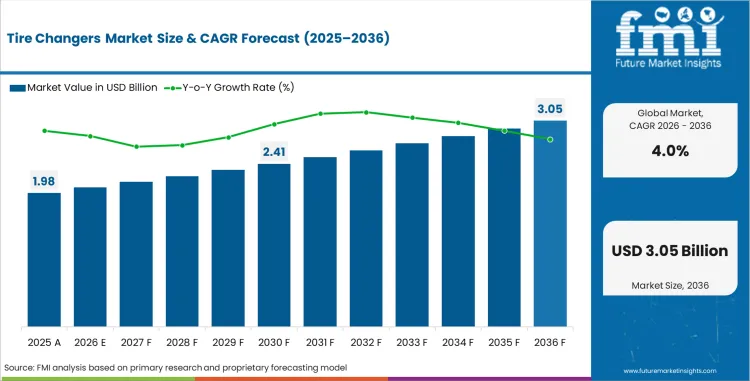
Key Takeaways, Market Size, and Forecast
- The tire changers market was valued at USD 1.98 billion in 2025.
- By 2036, the Tire Changers Market is expected to be worth USD 3.05 billion.
- From 2026 to 2036, the market is projected to expand at a CAGR of 4%.
- The market is projected to create an incremental opportunity of USD 0.99 billion between 2026 and 2036.
- In 2026, automotive service centers is expected to account for 60% of the application segment, driven by growing vehicle fleet size and tire service frequency requiring efficient mechanical tire mounting and demounting equipment in automotive workshops.
- South Korea (4.4%) and Europe (4%) are two of the fastest growing markets in the world.
Tire Changers Market Definition
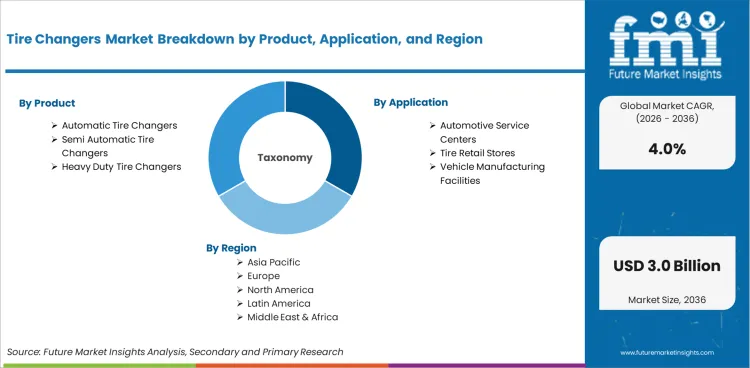
The tire changers market includes automatic, semi-automatic, and heavy-duty tire mounting and demounting machines used in automotive workshops, tire retail stores, and vehicle manufacturing facilities for passenger, commercial, and off-road vehicle tire service.
Tire Changers Market Inclusions
Market scope encompasses all commercially traded tire changers categorized by product (automatic tire changers, semi-automatic tire changers, heavy-duty tire changers), application (automotive service centers, tire retail stores, vehicle manufacturing facilities), end use (automotive workshops, tire service providers, vehicle manufacturers), distribution channel (direct sales, distributors), and vehicle type (passenger vehicles, commercial vehicles, off-road vehicles). Revenue estimates cover the period from 2026 to 2036.
Tire Changers Market Exclusions
The scope does not include manual tire irons, portable tire repair kits, tire balancing machines, or wheel alignment equipment.
Tire Changers Market Research Methodology
- Primary Research: FMI analysts conducted interviews with tire changer manufacturers, automotive workshop operators, tire retail chain managers, and workshop equipment distributors across key markets.
- Desk Research: Combined data from automotive service equipment industry associations, vehicle fleet statistics, and tire service frequency databases.
- Market sizing and forecasting: Bottom-up aggregation from tire changer sales data across workshop, tire retail, and manufacturing segments, with regional vehicle fleet and equipment lifecycle adjustments.
- Data validation: Cross-checked quarterly against automotive equipment market tracking, manufacturer shipment data, and workshop count statistics.
Why is the Tire Changers Market Growing?
- Vehicle fleet growth and tire service frequency create proportional demand for workshop tire changing equipment across both new workshop installations and equipment replacement cycles.
- Evolving tire specifications including run-flat, low-profile, and large-diameter wheels require upgraded tire changers with enhanced bead handling capabilities.
The tire changers market is estimated to be USD 2.06 billion in 2026 and projected to reach USD 3.05 billion by 2036, at a CAGR of 4.0%. The demand depends on the size of the vehicle fleet, the frequency of tire service and the replacement cycles of the workshop equipment. Product demand is 55.0% for automatic tire changers.
Hunter Engineering Company is the market leader with a 24.0% share with its integrated wheel service equipment portfolio and established dealer distribution. Workshop equipment ecosystems are being used by Bosch Automotive Service Solutions and Snap-on (John Bean) to sustain their competitive advantage.
South Korea leads the way with a CAGR of 4.4% due to its high vehicle density and workshop automation. Europe at 4.0% CAGR on account of established service networks, demand for seasonal tire change.
Market Segmentation Analysis
- Automated tire changers with 55.0% product share; automated clamping and mounting minimize technician effort and risk of tire damage.
- 60.0% of application demand is from automotive service centers, followed by tire retail stores and manufacturing facilities.
- Distribution is led by direct sales (60.0%) based on equipment specification needs and manufacturer-dealer distribution models.
Based on product, application, end use, distribution channel and vehicle type, the tire changers market is segmented as follows: Demand patterns are influenced by vehicle fleet demographics, tire service practices and workshop equipment investment cycles.
Insights into the Automatic Tire Changers Product Segment
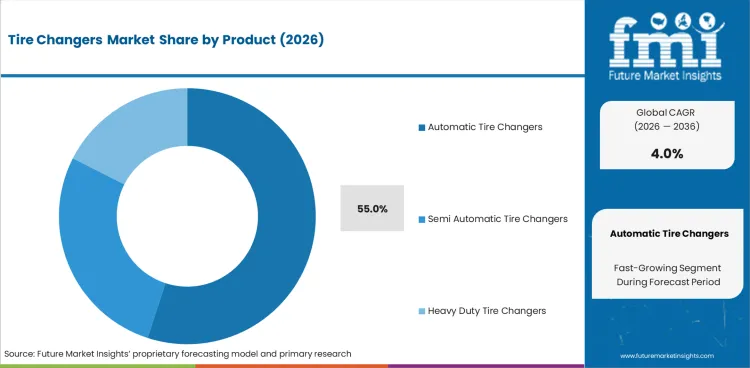
Demand for automatic tire changers is projected to account for 55.0% of all product demand by 2026. Automated bead breaking, clamping and mounting abilities increase throughput and minimize rim and tire damage compared to semi-automatic alternatives.
Commercial vehicle workshops, mining operations and agricultural equipment service, where larger tire sizes require higher capacity equipment, are a niche segment for heavy-duty tire changers.
Insights into the Passenger Vehicles Type Segment
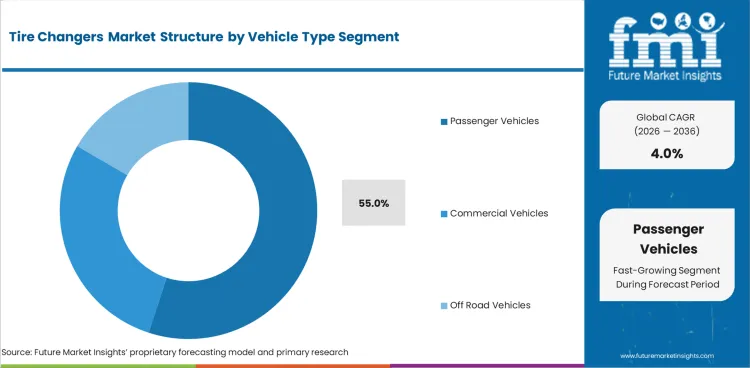
The demand for vehicle types is 55.0% passenger vehicles. Seasonal tire changes in cold-climate markets, replacement tire fitment and new vehicle tire mounting generate the largest service volume.
Commercial vehicles are a major part of residual demand, since fleet maintenance activities require heavy-duty tire changers for truck, bus and trailer tire service.
Tire Changers Market Drivers, Restraints, and Opportunities
- Vehicle fleet growth creates proportional demand for tire service capacity and workshop equipment investment.
- Equipment replacement cycles of 10 to 15 years create predictable procurement windows in mature markets.
- Run-flat and low-profile tire adoption requires upgraded equipment with enhanced rim protection.
The market is driven by vehicle fleet growth and tire service demand, sustained by equipment replacement cycles, and evolving through tire specification changes requiring upgraded equipment.
Vehicle Fleet Growth
Growing vehicle populations across global markets create proportional demand for tire service capacity. Each workshop addition or expansion requires tire changer equipment investment.
Equipment Replacement Cycles
Tire changers have typical service lives of 10 to 15 years, creating predictable replacement procurement windows. Workshops upgrading from semi-automatic to automatic equipment drive per-unit value growth.
Tire Specification Evolution
Run-flat tires, low-profile tires, and large-diameter wheels (19 to 22 inches) require tire changers with enhanced bead handling, rim protection, and clamping capabilities that legacy equipment cannot provide.
Seasonal Tire Change Demand
Cold-climate markets with mandatory or common winter tire usage generate seasonal tire service peaks that drive workshop capacity investment and equipment utilization.
Analysis of Tire Changers Market By Key Countries
.webp "Top Country Growth Comparison Tire Changers Market Cagr (2026 2036)")
| Country | CAGR |
|---|---|
| South Korea | 4.4% |
| Europe | 4% |
| UK | 3.8% |
| USA | 3.7% |
| Japan | 3.5% |
| Brazil | 3.5% |
| India | 3.1% |
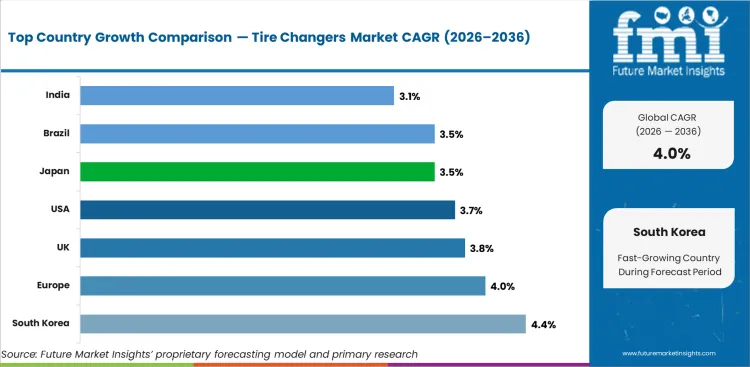
- South Korea is in first place with a 4.4% CAGR, supported by high vehicle density, advanced automotive service infrastructure, and workshop automation adoption.
- Europe at 4% shows strong demand supported by established automotive service network and equipment replacement cycles across EU markets.
Demand Outlook for Tire Changers Market in South Korea
South Korea leads at 4.4% CAGR through 2036. High vehicle density, advanced automotive service infrastructure, and workshop automation adoption drive demand.
- High vehicle density creates large tire service volumes requiring efficient workshop equipment.
- Advanced automotive service infrastructure supports adoption of automated tire changer specifications.
- Seasonal tire change practices sustain equipment utilization and capacity investment.
Future Outlook for Tire Changers Market in the United States
The USA is projected to grow at 3.7% CAGR through 2036. Large vehicle fleet, established workshop infrastructure, and equipment replacement cycles sustain demand.
- Large vehicle fleet size creates the largest tire service volume in North America.
- Hunter Engineering and Snap-on maintain distribution network advantages in US workshop equipment.
- Equipment replacement cycles sustain steady procurement across the established workshop base.
Opportunity Analysis of Tire Changers Market in the United Kingdom
The UK is projected to grow at 3.8% CAGR through 2036. Vehicle fleet growth and workshop modernization sustain demand.
- Vehicle fleet growth creates proportional tire service demand requiring workshop equipment investment.
- Workshop modernization programs drive upgrades from semi-automatic to automatic tire changers.
- MOT and seasonal service requirements sustain steady tire service volumes.
In-depth Analysis of Tire Changers Market in Japan
Japan is projected to grow at 3.5% CAGR through 2036. Mature market with established workshop infrastructure and quality equipment preference.
- Established workshop infrastructure sustains equipment replacement cycle procurement.
- Quality equipment preference supports higher-specification automatic tire changer adoption.
- Compact workshop designs require space-efficient tire changer configurations.
Sales Analysis of Tire Changers Market in Brazil
Brazil is projected to grow at 3.5% CAGR through 2036. Vehicle fleet growth and service sector development create demand.
- Vehicle fleet growth creates expanding tire service volumes requiring workshop equipment.
- Automotive service sector formalization drives investment in professional tire changing equipment.
- Price sensitivity favors semi-automatic equipment in small and medium workshops.
Growth Analysis of Tire Changers Market in India
India is projected to grow at 3.1% CAGR through 2036. Growing organized automotive service sector creates gradual demand.
- Organized automotive service sector growth creates demand for professional tire changing equipment.
- Multi-brand service chains drive workshop standardization including equipment specifications.
- Vehicle fleet growth creates expanding tire service demand in urban and semi-urban markets.
Competitive Landscape and Strategic Positioning
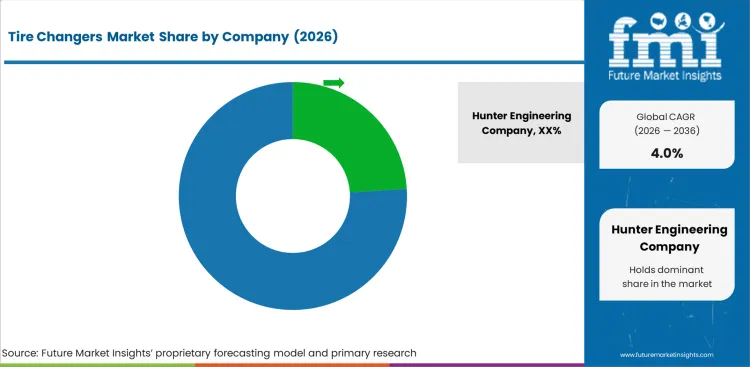
- Hunter Engineering Company (24.0%) is the leader with its integrated wheel service equipment portfolio and a well-established dealer distribution network across North America and global markets.
- Bosch Automotive Service Solutions and Snap-on (John Bean) compete with workshop equipment ecosystems and mature automotive aftermarket distribution.
- Strong positions of Italian manufacturers Ravaglioli and Corghi based on the tradition of European workshop equipment and export distribution.
Key Companies in the Tire Changers Market
Key global companies leading the tire changers market include:
- Hunter Engineering Company, Bosch Automotive Service Solutions, Snap-on Incorporated (John Bean) maintain leading positions through established manufacturing infrastructure, distribution networks, and product breadth.
- Hennessy Industries, Inc. (COATS), Ravaglioli S.p.A., Corghi S.p.A. hold strong regional or segment-specific positions with specialized capabilities.
- Mondolfo Ferro S.p.A., Giuliano Industrial S.p.A., CEMB S.p.A. represent emerging players expanding through technology innovation and niche market positioning.
Competitive Benchmarking: Tire Changers Market
| Company | Equipment Range | Distribution Network | Technology Innovation | Geographic Coverage |
|---|---|---|---|---|
| Hunter Engineering | Very High | Very Strong | Strong | Global |
| Bosch Automotive | Very High | Very Strong | Strong | Global |
| Snap-on (John Bean) | High | Very Strong | Strong | Global |
| Hennessy (COATS) | High | Strong | Moderate | N. America, Global |
| Ravaglioli S.p.A. | High | Strong | Strong | Europe, Global |
| Corghi S.p.A. | High | Strong | Strong | Europe, Global |
Source: Future Market Insights competitive analysis, 2026.
Key Developments in Tire Changers Market
- In 2025, Hunter Engineering introduced an automatic tire changer with enhanced rim protection technology designed for low-profile and run-flat tire specifications.
- In 2025, Corghi launched an updated heavy-duty tire changer series targeting commercial vehicle fleet maintenance operations.
Key Players in the Tire Changers Market
Major Global Players
- Hunter Engineering Company
- Bosch Automotive Service Solutions
- Snap-on Incorporated (John Bean)
- Hennessy Industries, Inc. (COATS)
- Ravaglioli S.p.A.
- Corghi S.p.A.
Emerging Players/Startups
- Mondolfo Ferro S.p.A.
- Giuliano Industrial S.p.A.
- CEMB S.p.A.
- Rotary Lift
- BendPak Inc.
Report Scope and Coverage
| Parameter | Details |
|---|---|
| Quantitative Units | USD 2.06 billion to USD 3.05 billion, at a CAGR of 4% |
| Market Definition | The tire changers market includes automatic, semi-automatic, and heavy-duty tire mounting and demounting machines used in automotive workshops, tire retail stores, and vehicle manufacturing facilities for passenger, commercial, and off-road vehicle tire service. |
| Regions Covered | North America, Latin America, Europe, East Asia, South Asia and Pacific, Middle East and Africa |
| Countries Covered | South Korea, Europe, UK, USA, Japan, Brazil, India, 30 plus countries |
| Key Companies Profiled | Hunter Engineering Company, Bosch Automotive Service Solutions, Snap-on Incorporated (John Bean), Hennessy Industries, Inc. (COATS), Ravaglioli S.p.A., Corghi S.p.A., Other Companies (combined) |
| Forecast Period | 2026 to 2036 |
| Approach | Hybrid bottom-up and top-down methodology starting with verified transaction data, projecting adoption velocity across segments and regions. |
Market Segmentation Analysis
Tire Changers Market Segmented by Product:
- Automatic Tire Changers
- Tilt Back Tire Changers
- Passenger Vehicle Tire Changers
- High Volume Workshop Systems
- Leverless Tire Changers
- Premium Alloy Wheel Handling
- Low Profile Tire Applications
- Tilt Back Tire Changers
- Semi Automatic Tire Changers
- Swing Arm Tire Changers
- General Workshop Applications
- Standard Tire Replacement
- Manual Assist Tire Changers
- Small Garage Applications
- Low Volume Tire Service
- Swing Arm Tire Changers
- Heavy Duty Tire Changers
- Truck Tire Changers
- Commercial Vehicle Tire Service
- Fleet Maintenance Applications
- Off Road Tire Changers
- Agricultural Tire Service
- Construction Equipment Tire Service
- Truck Tire Changers
Tire Changers Market Segmented by Application:
- Automotive Service Centers
- Passenger Vehicle Tire Service
- Routine Tire Replacement
- Wheel Balancing Applications
- Commercial Vehicle Tire Service
- Truck Tire Maintenance
- Fleet Tire Service
- Passenger Vehicle Tire Service
- Tire Retail Stores
- Independent Tire Shops
- Consumer Tire Replacement
- Seasonal Tire Change Services
- Retail Chains
- Multi Outlet Tire Stores
- Franchise Tire Centers
- Independent Tire Shops
- Vehicle Manufacturing Facilities
- Original Equipment Installation
- Passenger Vehicle Assembly
- Commercial Vehicle Assembly
- Original Equipment Installation
Tire Changers Market Segmented by End Use:
- Automotive Workshops
- Independent Workshops
- Local Service Garages
- Multi Brand Workshops
- Authorized Service Centers
- Dealer Service Centers
- Original Equipment Manufacturer Workshops
- Independent Workshops
- Tire Service Providers
- Tire Retail Chains
- Urban Tire Centers
- High Volume Service Centers
- Fleet Maintenance Providers
- Commercial Fleet Operators
- Logistics Fleet Service Providers
- Tire Retail Chains
- Vehicle Manufacturers
- Passenger Vehicle Manufacturers
- Assembly Line Installations
- Testing Facilities
- Commercial Vehicle Manufacturers
- Truck Assembly Plants
- Bus Manufacturing Facilities
- Passenger Vehicle Manufacturers
Tire Changers Market Segmented by Distribution Channel:
- Direct Sales
- Manufacturer To Workshops
- Bulk Equipment Supply
- Long Term Service Agreements
- Original Equipment Supply
- Factory Installations
- Dealer Network Supply
- Manufacturer To Workshops
- Distributors
- Automotive Equipment Distributors
- Regional Distributors
- Global Distributors
- Online Industrial Platforms
- Automotive Equipment Portals
- B2B Marketplaces
- Automotive Equipment Distributors
Tire Changers Market Segmented by Vehicle Type:
- Passenger Vehicles
- Sedans And Hatchbacks
- Compact Vehicle Tire Service
- Mid Size Vehicle Tire Service
- Sport Utility Vehicles
- Utility Vehicle Tire Applications
- Premium Vehicle Tire Applications
- Sedans And Hatchbacks
- Commercial Vehicles
- Light Commercial Vehicles
- Delivery Van Tire Service
- Pickup Truck Tire Service
- Heavy Commercial Vehicles
- Truck Tire Service
- Bus Tire Service
- Light Commercial Vehicles
- Off Road Vehicles
- Agricultural Vehicles
- Tractor Tire Service
- Harvester Tire Applications
- Construction Equipment
- Loader Tire Service
- Excavator Tire Applications
- Agricultural Vehicles
Tire Changers Market by Region:
- North America
- USA
- Canada
- Mexico
- Latin America
- Brazil
- Chile
- Rest of Latin America
- Western Europe
- Germany
- UK
- Italy
- Spain
- France
- Nordic
- BENELUX
- Rest of Western Europe
- Eastern Europe
- Russia
- Poland
- Hungary
- Balkan & Baltic
- Rest of Eastern Europe
- East Asia
- China
- Japan
- South Korea
- South Asia and Pacific
- India
- ASEAN
- Australia & New Zealand
- Rest of South Asia and Pacific
- Middle East & Africa
- Kingdom of Saudi Arabia
- Other GCC Countries
- Turkiye
- South Africa
- Other African Union
- Rest of Middle East & Africa
Research Sources and Bibliography
- 1. International Organization of Motor Vehicle Manufacturers. (2025). OICA Global Vehicle Fleet and Registration Statistics. OICA.
- 2. European Garage Equipment Association. (2024). EGEA Workshop Equipment Market Report. EGEA.
- 3. Automotive Service Association. (2025). ASA Automotive Service Industry Standards and Equipment Survey. ASA.
- 4. Tire Industry Association. (2024). TIA Tire Service Equipment Standards and Best Practices. TIA.
- 5. Society of Automotive Engineers. (2025). SAE Standards for Automotive Service Equipment. SAE.
This bibliography is provided for reader reference. The full Future Market Insights report contains the complete reference list with publication dates, URLs, and supporting data for all cited works.
This Report Answers
- Estimating the size of the market and revenue projections from 2026 to 2036.
- Segmentation by product, application, end use, distribution channel, and vehicle type.
- Insights about more than 30 country markets.
- Analysis of tire specification evolution and equipment capability requirements.
- Assessment of the competitive landscape and distribution network positioning.
- Finding investment opportunities in automatic equipment, heavy-duty, and emerging markets.
- Tracking vehicle fleet growth and workshop equipment replacement trends.
- Delivery of data in PDF and Excel formats.
Frequently Asked Questions
How big is the tire changers market in 2026?
The global tire changers market is estimated to be valued at USD 2.06 billion in 2026.
What will be the size of tire changers market in 2036?
The market size for the tire changers market is projected to reach USD 3.05 billion by 2036.
How much will be the tire changers market growth between 2026 and 2036?
The tire changers market is expected to grow at a 4.0% CAGR between 2026 and 2036.
What are the key product types in the tire changers market?
The key product types in tire changers market are automatic tire changers, semi automatic tire changers and heavy duty tire changers.
Which application segment is expected to contribute significant share in the tire changers market in 2026?
In terms of application, automotive service centers segment is expected to command 60.0% share in the tire changers market in 2026.
Preview the report firsthand - request a free sample
Get SampleGet the brochure for pricing and purchase details.
Get PDFTable of Content
- Executive Summary
- Global Market Outlook
- Demand-side Trends
- Supply-side Trends
- Technology Roadmap Analysis
- Analysis and Recommendations
- Market Overview
- Market Coverage / Taxonomy
- Market Definition / Scope / Limitations
- Research Methodology
- Chapter Orientation
- Analytical Lens and Working Hypotheses
- Market Structure, Signals, and Trend Drivers
- Benchmarking and Cross-market Comparability
- Market Sizing, Forecasting, and Opportunity Mapping
- Research Design and Evidence Framework
- Desk Research Programme (Secondary Evidence)
- Company Annual and Sustainability Reports
- Peer-reviewed Journals and Academic Literature
- Corporate Websites, Product Literature, and Technical Notes
- Earnings Decks and Investor Briefings
- Statutory Filings and Regulatory Disclosures
- Technical White Papers and Standards Notes
- Trade Journals, Industry Magazines, and Analyst Briefs
- Conference Proceedings, Webinars, and Seminar Materials
- Government Statistics Portals and Public Data Releases
- Press Releases and Reputable Media Coverage
- Specialist Newsletters and Curated Briefings
- Sector Databases and Reference Repositories
- FMI Internal Proprietary Databases and Historical Market Datasets
- Subscription Datasets and Paid Sources
- Social Channels, Communities, and Digital Listening Inputs
- Additional Desk Sources
- Expert Input and Fieldwork (Primary Evidence)
- Primary Modes
- Qualitative Interviews and Expert Elicitation
- Quantitative Surveys and Structured Data Capture
- Blended Approach
- Why Primary Evidence is Used
- Field Techniques
- Interviews
- Surveys
- Focus Groups
- Observational and In-context Research
- Social and Community Interactions
- Stakeholder Universe Engaged
- C-suite Leaders
- Board Members
- Presidents and Vice Presidents
- R&D and Innovation Heads
- Technical Specialists
- Domain Subject-matter Experts
- Scientists
- Physicians and Other Healthcare Professionals
- Governance, Ethics, and Data Stewardship
- Research Ethics
- Data Integrity and Handling
- Primary Modes
- Tooling, Models, and Reference Databases
- Desk Research Programme (Secondary Evidence)
- Data Engineering and Model Build
- Data Acquisition and Ingestion
- Cleaning, Normalisation, and Verification
- Synthesis, Triangulation, and Analysis
- Quality Assurance and Audit Trail
- Market Background
- Market Dynamics
- Drivers
- Restraints
- Opportunity
- Trends
- Scenario Forecast
- Demand in Optimistic Scenario
- Demand in Likely Scenario
- Demand in Conservative Scenario
- Opportunity Map Analysis
- Product Life Cycle Analysis
- Supply Chain Analysis
- Investment Feasibility Matrix
- Value Chain Analysis
- PESTLE and Porter’s Analysis
- Regulatory Landscape
- Regional Parent Market Outlook
- Production and Consumption Statistics
- Import and Export Statistics
- Market Dynamics
- Global Market Analysis 2021 to 2025 and Forecast, 2026 to 2036
- Historical Market Size Value (USD Million) Analysis, 2021 to 2025
- Current and Future Market Size Value (USD Million) Projections, 2026 to 2036
- Y-o-Y Growth Trend Analysis
- Absolute $ Opportunity Analysis
- Global Market Pricing Analysis 2021 to 2025 and Forecast 2026 to 2036
- Global Market Analysis 2021 to 2025 and Forecast 2026 to 2036, By Product
- Introduction / Key Findings
- Historical Market Size Value (USD Million) Analysis By Product , 2021 to 2025
- Current and Future Market Size Value (USD Million) Analysis and Forecast By Product , 2026 to 2036
- Automatic Tire Changers
- Tilt Back Tire Changers
- Passenger Vehicle Tire Changers
- High Volume Workshop Systems
- Leverless Tire Changers
- Premium Alloy Wheel Handling
- Low Profile Tire Applications
- Semi Automatic Tire Changers
- Swing Arm Tire Changers
- General Workshop Applications
- Standard Tire Replacement
- Manual Assist Tire Changers
- Small Garage Applications
- Heavy Duty Tire Changers
- Truck Tire Changers
- Commercial Vehicle Tire Service
- Fleet Maintenance Applications
- Off Road Tire Changers
- Agricultural Tire Service
- Automatic Tire Changers
- Y-o-Y Growth Trend Analysis By Product , 2021 to 2025
- Absolute $ Opportunity Analysis By Product , 2026 to 2036
- Global Market Analysis 2021 to 2025 and Forecast 2026 to 2036, By Application
- Introduction / Key Findings
- Historical Market Size Value (USD Million) Analysis By Application, 2021 to 2025
- Current and Future Market Size Value (USD Million) Analysis and Forecast By Application, 2026 to 2036
- Automotive Service Centers
- Passenger Vehicle Tire Service
- Routine Tire Replacement
- Wheel Balancing Applications
- Commercial Vehicle Tire Service
- Truck Tire Maintenance
- Fleet Tire Service
- Tire Retail Stores
- Independent Tire Shops
- Consumer Tire Replacement
- Seasonal Tire Change Services
- Retail Chains
- Multi Outlet Tire Stores
- Vehicle Manufacturing Facilities
- Original Equipment Installation
- Passenger Vehicle Assembly
- Commercial Vehicle Assembly
- Automotive Service Centers
- Y-o-Y Growth Trend Analysis By Application, 2021 to 2025
- Absolute $ Opportunity Analysis By Application, 2026 to 2036
- Global Market Analysis 2021 to 2025 and Forecast 2026 to 2036, By End Use
- Introduction / Key Findings
- Historical Market Size Value (USD Million) Analysis By End Use, 2021 to 2025
- Current and Future Market Size Value (USD Million) Analysis and Forecast By End Use, 2026 to 2036
- Automotive Workshops
- Independent Workshops
- Local Service Garages
- Multi Brand Workshops
- Authorized Service Centers
- Dealer Service Centers
- Original Equipment Manufacturer Workshops
- Tire Service Providers
- Tire Retail Chains
- Urban Tire Centers
- High Volume Service Centers
- Fleet Maintenance Providers
- Commercial Fleet Operators
- Vehicle Manufacturers
- Passenger Vehicle Manufacturers
- Assembly Line Installations
- Testing Facilities
- Commercial Vehicle Manufacturers
- Truck Assembly Plants
- Automotive Workshops
- Y-o-Y Growth Trend Analysis By End Use, 2021 to 2025
- Absolute $ Opportunity Analysis By End Use, 2026 to 2036
- Global Market Analysis 2021 to 2025 and Forecast 2026 to 2036, By Distribution Channel
- Introduction / Key Findings
- Historical Market Size Value (USD Million) Analysis By Distribution Channel, 2021 to 2025
- Current and Future Market Size Value (USD Million) Analysis and Forecast By Distribution Channel, 2026 to 2036
- Direct Sales
- Manufacturer To Workshops
- Bulk Equipment Supply
- Long Term Service Agreements
- Original Equipment Supply
- Factory Installations
- Dealer Network Supply
- Distributors
- Automotive Equipment Distributors
- Regional Distributors
- Global Distributors
- Online Industrial Platforms
- Automotive Equipment Portals
- Direct Sales
- Y-o-Y Growth Trend Analysis By Distribution Channel, 2021 to 2025
- Absolute $ Opportunity Analysis By Distribution Channel, 2026 to 2036
- Global Market Analysis 2021 to 2025 and Forecast 2026 to 2036, By Vehicle Type
- Introduction / Key Findings
- Historical Market Size Value (USD Million) Analysis By Vehicle Type, 2021 to 2025
- Current and Future Market Size Value (USD Million) Analysis and Forecast By Vehicle Type, 2026 to 2036
- Passenger Vehicles
- Sedans And Hatchbacks
- Compact Vehicle Tire Service
- Mid Size Vehicle Tire Service
- Sport Utility Vehicles
- Utility Vehicle Tire Applications
- Premium Vehicle Tire Applications
- Commercial Vehicles
- Light Commercial Vehicles
- Delivery Van Tire Service
- Pickup Truck Tire Service
- Heavy Commercial Vehicles
- Truck Tire Service
- Off Road Vehicles
- Agricultural Vehicles
- Tractor Tire Service
- Harvester Tire Applications
- Construction Equipment
- Loader Tire Service
- Passenger Vehicles
- Y-o-Y Growth Trend Analysis By Vehicle Type, 2021 to 2025
- Absolute $ Opportunity Analysis By Vehicle Type, 2026 to 2036
- Global Market Analysis 2021 to 2025 and Forecast 2026 to 2036, By Region
- Introduction
- Historical Market Size Value (USD Million) Analysis By Region, 2021 to 2025
- Current Market Size Value (USD Million) Analysis and Forecast By Region, 2026 to 2036
- North America
- Latin America
- Western Europe
- Eastern Europe
- East Asia
- South Asia and Pacific
- Middle East & Africa
- Market Attractiveness Analysis By Region
- North America Market Analysis 2021 to 2025 and Forecast 2026 to 2036, By Country
- Historical Market Size Value (USD Million) Trend Analysis By Market Taxonomy, 2021 to 2025
- Market Size Value (USD Million) Forecast By Market Taxonomy, 2026 to 2036
- By Country
- USA
- Canada
- Mexico
- By Product
- By Application
- By End Use
- By Distribution Channel
- By Vehicle Type
- By Country
- Market Attractiveness Analysis
- By Country
- By Product
- By Application
- By End Use
- By Distribution Channel
- By Vehicle Type
- Key Takeaways
- Latin America Market Analysis 2021 to 2025 and Forecast 2026 to 2036, By Country
- Historical Market Size Value (USD Million) Trend Analysis By Market Taxonomy, 2021 to 2025
- Market Size Value (USD Million) Forecast By Market Taxonomy, 2026 to 2036
- By Country
- Brazil
- Chile
- Rest of Latin America
- By Product
- By Application
- By End Use
- By Distribution Channel
- By Vehicle Type
- By Country
- Market Attractiveness Analysis
- By Country
- By Product
- By Application
- By End Use
- By Distribution Channel
- By Vehicle Type
- Key Takeaways
- Western Europe Market Analysis 2021 to 2025 and Forecast 2026 to 2036, By Country
- Historical Market Size Value (USD Million) Trend Analysis By Market Taxonomy, 2021 to 2025
- Market Size Value (USD Million) Forecast By Market Taxonomy, 2026 to 2036
- By Country
- Germany
- UK
- Italy
- Spain
- France
- Nordic
- BENELUX
- Rest of Western Europe
- By Product
- By Application
- By End Use
- By Distribution Channel
- By Vehicle Type
- By Country
- Market Attractiveness Analysis
- By Country
- By Product
- By Application
- By End Use
- By Distribution Channel
- By Vehicle Type
- Key Takeaways
- Eastern Europe Market Analysis 2021 to 2025 and Forecast 2026 to 2036, By Country
- Historical Market Size Value (USD Million) Trend Analysis By Market Taxonomy, 2021 to 2025
- Market Size Value (USD Million) Forecast By Market Taxonomy, 2026 to 2036
- By Country
- Russia
- Poland
- Hungary
- Balkan & Baltic
- Rest of Eastern Europe
- By Product
- By Application
- By End Use
- By Distribution Channel
- By Vehicle Type
- By Country
- Market Attractiveness Analysis
- By Country
- By Product
- By Application
- By End Use
- By Distribution Channel
- By Vehicle Type
- Key Takeaways
- East Asia Market Analysis 2021 to 2025 and Forecast 2026 to 2036, By Country
- Historical Market Size Value (USD Million) Trend Analysis By Market Taxonomy, 2021 to 2025
- Market Size Value (USD Million) Forecast By Market Taxonomy, 2026 to 2036
- By Country
- China
- Japan
- South Korea
- By Product
- By Application
- By End Use
- By Distribution Channel
- By Vehicle Type
- By Country
- Market Attractiveness Analysis
- By Country
- By Product
- By Application
- By End Use
- By Distribution Channel
- By Vehicle Type
- Key Takeaways
- South Asia and Pacific Market Analysis 2021 to 2025 and Forecast 2026 to 2036, By Country
- Historical Market Size Value (USD Million) Trend Analysis By Market Taxonomy, 2021 to 2025
- Market Size Value (USD Million) Forecast By Market Taxonomy, 2026 to 2036
- By Country
- India
- ASEAN
- Australia & New Zealand
- Rest of South Asia and Pacific
- By Product
- By Application
- By End Use
- By Distribution Channel
- By Vehicle Type
- By Country
- Market Attractiveness Analysis
- By Country
- By Product
- By Application
- By End Use
- By Distribution Channel
- By Vehicle Type
- Key Takeaways
- Middle East & Africa Market Analysis 2021 to 2025 and Forecast 2026 to 2036, By Country
- Historical Market Size Value (USD Million) Trend Analysis By Market Taxonomy, 2021 to 2025
- Market Size Value (USD Million) Forecast By Market Taxonomy, 2026 to 2036
- By Country
- Kingdom of Saudi Arabia
- Other GCC Countries
- Turkiye
- South Africa
- Other African Union
- Rest of Middle East & Africa
- By Product
- By Application
- By End Use
- By Distribution Channel
- By Vehicle Type
- By Country
- Market Attractiveness Analysis
- By Country
- By Product
- By Application
- By End Use
- By Distribution Channel
- By Vehicle Type
- Key Takeaways
- Key Countries Market Analysis
- USA
- Pricing Analysis
- Market Share Analysis, 2025
- By Product
- By Application
- By End Use
- By Distribution Channel
- By Vehicle Type
- Canada
- Pricing Analysis
- Market Share Analysis, 2025
- By Product
- By Application
- By End Use
- By Distribution Channel
- By Vehicle Type
- Mexico
- Pricing Analysis
- Market Share Analysis, 2025
- By Product
- By Application
- By End Use
- By Distribution Channel
- By Vehicle Type
- Brazil
- Pricing Analysis
- Market Share Analysis, 2025
- By Product
- By Application
- By End Use
- By Distribution Channel
- By Vehicle Type
- Chile
- Pricing Analysis
- Market Share Analysis, 2025
- By Product
- By Application
- By End Use
- By Distribution Channel
- By Vehicle Type
- Germany
- Pricing Analysis
- Market Share Analysis, 2025
- By Product
- By Application
- By End Use
- By Distribution Channel
- By Vehicle Type
- UK
- Pricing Analysis
- Market Share Analysis, 2025
- By Product
- By Application
- By End Use
- By Distribution Channel
- By Vehicle Type
- Italy
- Pricing Analysis
- Market Share Analysis, 2025
- By Product
- By Application
- By End Use
- By Distribution Channel
- By Vehicle Type
- Spain
- Pricing Analysis
- Market Share Analysis, 2025
- By Product
- By Application
- By End Use
- By Distribution Channel
- By Vehicle Type
- France
- Pricing Analysis
- Market Share Analysis, 2025
- By Product
- By Application
- By End Use
- By Distribution Channel
- By Vehicle Type
- India
- Pricing Analysis
- Market Share Analysis, 2025
- By Product
- By Application
- By End Use
- By Distribution Channel
- By Vehicle Type
- ASEAN
- Pricing Analysis
- Market Share Analysis, 2025
- By Product
- By Application
- By End Use
- By Distribution Channel
- By Vehicle Type
- Australia & New Zealand
- Pricing Analysis
- Market Share Analysis, 2025
- By Product
- By Application
- By End Use
- By Distribution Channel
- By Vehicle Type
- China
- Pricing Analysis
- Market Share Analysis, 2025
- By Product
- By Application
- By End Use
- By Distribution Channel
- By Vehicle Type
- Japan
- Pricing Analysis
- Market Share Analysis, 2025
- By Product
- By Application
- By End Use
- By Distribution Channel
- By Vehicle Type
- South Korea
- Pricing Analysis
- Market Share Analysis, 2025
- By Product
- By Application
- By End Use
- By Distribution Channel
- By Vehicle Type
- Russia
- Pricing Analysis
- Market Share Analysis, 2025
- By Product
- By Application
- By End Use
- By Distribution Channel
- By Vehicle Type
- Poland
- Pricing Analysis
- Market Share Analysis, 2025
- By Product
- By Application
- By End Use
- By Distribution Channel
- By Vehicle Type
- Hungary
- Pricing Analysis
- Market Share Analysis, 2025
- By Product
- By Application
- By End Use
- By Distribution Channel
- By Vehicle Type
- Kingdom of Saudi Arabia
- Pricing Analysis
- Market Share Analysis, 2025
- By Product
- By Application
- By End Use
- By Distribution Channel
- By Vehicle Type
- Turkiye
- Pricing Analysis
- Market Share Analysis, 2025
- By Product
- By Application
- By End Use
- By Distribution Channel
- By Vehicle Type
- South Africa
- Pricing Analysis
- Market Share Analysis, 2025
- By Product
- By Application
- By End Use
- By Distribution Channel
- By Vehicle Type
- USA
- Market Structure Analysis
- Competition Dashboard
- Competition Benchmarking
- Market Share Analysis of Top Players
- By Regional
- By Product
- By Application
- By End Use
- By Distribution Channel
- By Vehicle Type
- Competition Analysis
- Competition Deep Dive
- Hunter Engineering Company
- Overview
- Product Portfolio
- Profitability by Market Segments (Product/Age /Sales Channel/Region)
- Sales Footprint
- Strategy Overview
- Marketing Strategy
- Product Strategy
- Channel Strategy
- Bosch Automotive Service Solutions
- Snap-on Incorporated (John Bean)
- Hennessy Industries, Inc. (COATS)
- Ravaglioli S.p.A.
- Corghi S.p.A.
- Other Companies (combined)
- Hunter Engineering Company
- Competition Deep Dive
- Assumptions & Acronyms Used


