

- Industry Size (2026)
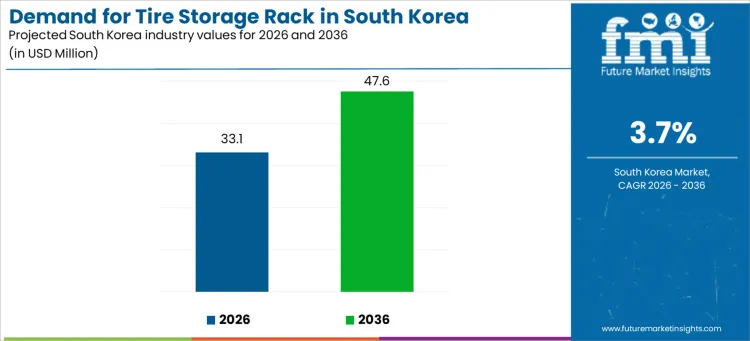
- USD 33.1 Mn
- Forecast (2036)
- USD 47.6 Mn
- CAGR (2026 to 2036)
- 3.7%
Demand for Tire Storage Rack in South Korea Forecast and Outlook 2026 to 2036
Demand for tire storage rack solutions in South Korea is projected to be valued at USD 33.1 million in 2026. The industry is poised to reach USD 47.6 million by 2036, advancing at a compound annual growth rate of 3.7%. The nation's dense urban environment and high vehicle ownership rates have necessitated efficient vertical storage solutions for automotive service centers and dedicated "tire hotels." Space optimization is a critical operational requirement for South Korean auto workshops, where real estate costs are premium, driving the adoption of specialized racking systems that maximize inventory density without compromising accessibility.
Growth is anchored in the seasonal tire swap culture prevalent in the country, where drivers alternate between summer and winter sets. This practice creates a massive demand for off-season storage services, compelling dealerships and tire retailers to invest in high-capacity storage and handling equipment. Auto service franchises are increasingly standardizing their back-of-house operations with modular racking to handle the logistics of storing thousands of customer wheel sets, transforming storage from a passive necessity into a revenue-generating service.
Quick Stats for Demand for Tire Storage Rack in South Korea
- Industry Value (2026): USD 33.1 million
- Industry Forecast Value (2036): USD 47.6 million
- Industry Forecast CAGR: 3.7%
- Leading Material: Steel (82.0%)
- Leading Design: Stationary (58.0%)
- Leading Tire Type: Passenger Car Tires (68.0%)
- Key Growth Regions: Jeju, South Gyeongsang, South Jeolla, North Jeolla
- Key Players: FEMCO Holdings, LLC, Steel King Industries, Inc., Martins Industries, Meiser GmbH, Tier-Rack Corporation
Technological integration in warehouse management is influencing hardware design, with racks now being designed to accommodate RFID tracking and automated retrieval systems. Material advancements are focusing on high-tensile steel alloys that offer superior load-bearing capacities while reducing the structural weight of the racks. This evolution aligns with the broader trend in tires and wheels logistics toward safety and ergonomic handling, ensuring that heavy SUV and EV tires can be stored and retrieved with minimal physical strain on technicians.
Domestic steel fabricators maintain a strong foothold by offering customized dimensions suited to the constrained layouts of Korean workshops, while global players like FEMCO Holdings and Steel King leverage their reputation for durability to capture contracts with major automotive OEMs and logistics centers. The sector is witnessing a shift towards modular and portable designs, catering to the dynamic needs of tire retreading facilities and large-scale distribution hubs through 2036.
Demand for Tire Storage Rack in South Korea Key Takeaways
| Metric | Value |
|---|---|
| Industry Size (2026) | USD 33.1 million |
| Industry Value (2036) | USD 47.6 million |
| CAGR (2026 to 2036) | 3.7% |
What Catalysts Are Driving Vertical Storage Adoption?
The primary driver is the widespread "tire hotel" service model, where service centers store off-season tires for customers. Limited land availability in metropolitan areas like Seoul and Busan forces businesses to utilize vertical space efficiently. High-density racks allow workshops to triple their storage capacity within the same footprint, directly impacting their potential revenue from storage fees. Safety regulations regarding workplace hazards also push facility managers to replace makeshift stacking methods with certified tire and wheel handling equipment, reducing the risk of toppling accidents and ensuring compliance with industrial safety standards.
How is the Sector Structured Across Key Segments?
The sector is segmented to address the diverse scale of operations, from small neighborhood garages to massive logistics centers. It is primarily categorized by capacity, reflecting the volume of storage required. The design segment distinguishes between fixed infrastructure and flexible mobile units, while the tire type segment highlights the specific load requirements. Each segment plays a vital role, where passenger car tire racks drive volume in retail and heavy-duty racks support the logistics backbone.
Why Do Passenger Car Tire Racks Command the Volume?
The passenger car tires segment commands a 68.0% share of the industry. This prevalence is attributed to the high volume of sedan and SUV ownership in South Korea. Dealerships and service chains prioritize racks designed specifically for the dimensions of standard automotive tires, optimizing spacing to fit the maximum number of units. The growing popularity of larger rim sizes and heavier EV tires is influencing design specifications, pushing for wider and more reinforced shelving tiers to accommodate evolving vehicle trends.
Why is Steel the Material of Choice?
Steel holds the overwhelming majority share of 82.0% within the material segment. The heavy load-bearing requirements of storing rubber and metal assemblies necessitate the structural integrity that only steel can provide. South Korea's robust domestic steel industry ensures a steady supply of cost-effective raw materials for rack fabrication. While tire materials themselves are evolving, the storage infrastructure remains reliant on galvanized or powder-coated steel to resist corrosion and withstand the wear and tear of daily industrial use.
How Does Stationary Design Anchor Operations?
Stationary racks account for 58.0% of installations in warehouses and large service centers. These fixed structures offer the highest stability and height utilization, essential for facilities managing long-term inventory. The permanence of stationary systems allows for integration with sprinkler systems and aisle designations, supporting organized inventory management. Facilities dealing with tire cord and tire fabrics or raw materials also utilize these heavy-duty static racks for safe bulk storage.
Are Portable Racks Gaining Traction?
Portable and mobile rack designs are finding a niche in flexible workshop environments. Auto repair shops with limited bays use racks on casters to move seasonal inventory out of the way when not needed or to transport sets directly to tire changers. This flexibility reduces the physical handling of tires by technicians, improving workflow efficiency. Logistics providers also utilize stackable portable racks to optimize truck loading during the distribution of new tires to retailers.
Will Automation Transform Warehouse Configurations?
A significant trend is the adaptation of racking systems for automated guided vehicles (AGVs) and robotic retrieval. Modern logistics centers are moving away from manual picking to automated solutions to combat labor shortages. Racks are being redesigned with precise tolerances and machine-readable markers to interface seamlessly with robotic forklifts. This shift drives investment in precision-engineered storage solutions that ensure high throughput and accuracy in inventory tracking.
Does the Durability of Racks Limit Replacement Sales?
A major restraint is the long lifecycle of high-quality steel racks. Once installed, these structures can last for decades with minimal maintenance, leading to long replacement cycles. Manufacturers face the challenge of generating recurring revenue from established clients. Overcoming this requires innovation in modular expandability or offering tire retreading equipment compatible accessories that add value to existing installations, such as integrated rollers or tire washing stations.
How Can Modular Design Unlock New Revenue?
The emerging field of modular and collapsible racks presents a frontier of opportunity. Seasonal fluctuations mean that storage needs peak in winter and summer; collapsible racks allow facilities to reclaim floor space during low-demand periods. Suppliers who offer versatile systems that can be easily reconfigured or stored away when empty stand to capture significant revenue from multi-purpose service centers. This adaptability appeals to businesses looking to maximize the utility of their expensive real estate year-round.
How is the Tire Storage Landscape Evolving Across South Korea's Regions?
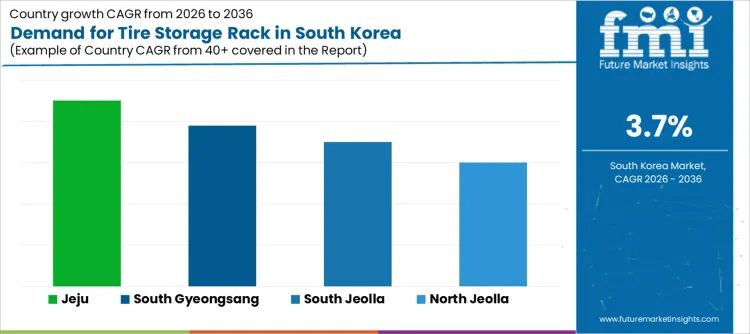
The regional sphere shows a distinct pattern where automotive manufacturing hubs drive industrial demand, while tourist-heavy islands focus on rental fleet management. High-growth areas are characterizing their development by upgrading logistics infrastructure. As distinct provinces modernize their automotive service sectors, the utilization of storage solutions is becoming tailored to local fleet characteristics.
| Region | CAGR (2026 to 2036) |
|---|---|
| Jeju | 4.45% |
| South Gyeongsang | 3.89% |
| South Jeolla | 3.52% |
| North Jeolla | 2.96% |
Why is Rental Fleet Management Driving Demand in Jeju?
Adoption of tire storage solutions in Jeju is projected to expand at a CAGR of 4.45%. As the nation's primary rental car hub, Jeju maintains a massive fleet of passenger vehicles that require regular maintenance and tire rotation. Rental agencies utilize large-scale racking systems to manage the inventory of spare tires and seasonal replacements. The high turnover of vehicles and the need for rapid servicing drive the demand for efficient, high-capacity storage layouts near the airport and major tourist centers.
How is Manufacturing Density Influencing South Gyeongsang?
Sales of industrial racks in South Gyeongsang are likely to reach a CAGR of 3.89%. Home to automotive clusters in Ulsan and Changwon, this region has a high concentration of tier-1 suppliers and logistics centers. The demand is driven by the need to store OEM tires and wheels before they are assembled onto new vehicles or shipped to dealerships. Heavy-duty, high-stacking racks are essential here to manage the massive throughput of the manufacturing supply chain.
What Role Does Logistics Play in South Jeolla?
The storage equipment sector in South Jeolla is anticipated to rise at a CAGR of 3.52%. With the presence of major ports and industrial complexes, the region serves as a logistics node for automotive parts distribution. Warehousing facilities in this area are upgrading to modern racking systems to improve inventory visibility and handling speed. The focus is on durable, corrosion-resistant racks capable of withstanding the humid coastal environment while protecting valuable tire inventory.
How is Service Sector Modernization Shaping North Jeolla?
Deployment of workshop equipment in North Jeolla is expected to increase at a CAGR of 2.96%. The region's automotive service sector is undergoing modernization, with independent garages upgrading to franchise standards. This transition fuels the adoption of professional tire storage racks to replace informal stacking methods, improving shop aesthetics and safety. Small-capacity, wall-mounted or mezzanine racks are popular choices to maximize space in smaller provincial workshops.
How Are Companies Competing and Strengthening Their Positions in the South Korean Storage Industry?
The competitive landscape is defined by the ability to offer customized space planning alongside hardware sales. Industry leaders like FEMCO Holdings and Steel King Industries are strengthening their positions by providing consultancy services that help workshop owners optimize their floor plans for maximum storage density. There is also a marked trend toward establishing local distribution partnerships to reduce shipping lead times for heavy steel components.
Mergers and acquisitions are less common than strategic alliances with automotive lift and equipment suppliers to offer turnkey workshop fit-outs. Leading companies are actively investing in eco-friendly powder coating technologies to align with green procurement trends. Furthermore, competitive intensity is driving a shift toward online configuration tools, allowing facility managers to design and order modular rack systems directly, streamlining the procurement process.
Key Companies
- FEMCO Holdings, LLC
- Steel King Industries, Inc.
- Martins Industries
- Meiser GmbH
- Tier-Rack Corporation
- Spacesaver Corporation
- Gonvarri Material Handling
- Kardex Remstar
Scope of Report
| Items | Values |
|---|---|
| Quantitative Units | USD Million |
| Capacity | Up to 10 Tires, 10-50 Tires, 50-150 Tires, 150-300 Tires, 300-500 Tires, Above 500 Tires |
| Orientation | Horizontal, Vertical |
| Design | Stationary, Portable, Foldable/Stackable |
| Tire Type | Passenger Car Tires, LCV Tires, Truck Tires, 2 Wheeler Tires, Bicycle Tires |
| Material | Steel, Aluminium, Wire Mesh, Plastic Composite |
| Regions Covered | Jeju, South Gyeongsang, South Jeolla, North Jeolla |
| Key Companies Profiled | FEMCO, Steel King, Martins Industries, Meiser, Tier-Rack, and others. |
Demand for Tire Storage Rack in South Korea by Segments
By Capacity:
- Up to 10 Tires
- 10-50 Tires
- 50-150 Tires
- 150-300 Tires
- 300-500 Tires
- Above 500 Tires
By Orientation:
- Horizontal
- Vertical
By Design:
- Stationary
- Portable
- Foldable/Stackable
By Tire Type:
- Passenger Car Tires
- LCV Tires
- Truck Tires
- 2 Wheeler Tires
- Bicycle Tires
By Material:
- Steel
- Aluminium
- Wire Mesh
- Plastic Composite
By Region:
- Jeju
- South Gyeongsang
- South Jeolla
- North Jeolla
Bibliography
- Korea Transport Institute (KOTI). (2025, September 29). National Logistics Facility System Improvement Measures in Response to Changes in the Logistics Industry Environment.
- Korea Transport Institute. (n.d.). Excellent Logistics Company Certification Center Inspection Standards for Logistics Warehouse Companies.
- Korea Automobile Importers and Distributors Association. (2025). Showroom and Service Center.
- Korea Automobile Importers and Distributors Association. (2025). KAIDA Factbook.
- Small Enterprise and Market Service. (2025, February 3). Survey on the Actual Conditions of Small Business Owners.
Frequently Asked Questions
How big is the demand for tire storage rack in south korea in 2026?
The demand for tire storage rack in south korea is estimated to be valued at USD 33.1 million in 2026.
What will be the size of tire storage rack in south korea in 2036?
The market size for the tire storage rack in south korea is projected to reach USD 47.6 million by 2036.
How much will be the demand for tire storage rack in south korea growth between 2026 and 2036?
The demand for tire storage rack in south korea is expected to grow at a 3.7% CAGR between 2026 and 2036.
What are the key product types in the tire storage rack in south korea?
The key product types in tire storage rack in south korea are 0.15, 0.1, 0.05 and 0.02.
Which 0.82 segment is expected to contribute significant share in the tire storage rack in south korea in 2026?
In terms of 0.82, 0.1 segment is expected to command 0.0% share in the tire storage rack in south korea in 2026.
Preview the report firsthand - request a free sample
Get SampleGet the brochure for pricing and purchase details.
Get PDFTable of Content
- Executive Summary
- South Korea Market Outlook
- Demand-side Trends
- Supply-side Trends
- Technology Roadmap Analysis
- Analysis and Recommendations
- Market Overview
- Market Coverage / Taxonomy
- Market Definition / Scope / Limitations
- Market Background
- Market Dynamics
- Drivers
- Restraints
- Opportunity
- Trends
- Scenario Forecast
- Demand in Optimistic Scenario
- Demand in Likely Scenario
- Demand in Conservative Scenario
- Opportunity Map Analysis
- Product Life Cycle Analysis
- Supply Chain Analysis
- Investment Feasibility Matrix
- Value Chain Analysis
- PESTLE and Porter’s Analysis
- Regulatory Landscape
- Regional Parent Market Outlook
- Production and Consumption Statistics
- Import and Export Statistics
- Market Dynamics
- South Korea Market Analysis 2021 to 2025 and Forecast, 2026 to 2036
- Historical Market Size Value (USD Million) Analysis, 2021 to 2025
- Current and Future Market Size Value (USD Million) Projections, 2026 to 2036
- Y-o-Y Growth Trend Analysis
- Absolute $ Opportunity Analysis
- South Korea Market Pricing Analysis 2021 to 2025 and Forecast 2026 to 2036
- South Korea Market Analysis 2021 to 2025 and Forecast 2026 to 2036, By 0.68
- Introduction / Key Findings
- Historical Market Size Value (USD Million) Analysis By 0.68 , 2021 to 2025
- Current and Future Market Size Value (USD Million) Analysis and Forecast By 0.68 , 2026 to 2036
- 0.15
- 0.1
- 0.05
- 0.02
- 0.15
- Y-o-Y Growth Trend Analysis By 0.68 , 2021 to 2025
- Absolute $ Opportunity Analysis By 0.68 , 2026 to 2036
- South Korea Market Analysis 2021 to 2025 and Forecast 2026 to 2036, By 0.82
- Introduction / Key Findings
- Historical Market Size Value (USD Million) Analysis By 0.82, 2021 to 2025
- Current and Future Market Size Value (USD Million) Analysis and Forecast By 0.82, 2026 to 2036
- 0.1
- 0.05
- 0.03
- 0.1
- Y-o-Y Growth Trend Analysis By 0.82, 2021 to 2025
- Absolute $ Opportunity Analysis By 0.82, 2026 to 2036
- South Korea Market Analysis 2021 to 2025 and Forecast 2026 to 2036, By 0.58
- Introduction / Key Findings
- Historical Market Size Value (USD Million) Analysis By 0.58, 2021 to 2025
- Current and Future Market Size Value (USD Million) Analysis and Forecast By 0.58, 2026 to 2036
- 0.25
- 0.17
- 0.25
- Y-o-Y Growth Trend Analysis By 0.58, 2021 to 2025
- Absolute $ Opportunity Analysis By 0.58, 2026 to 2036
- Market Structure Analysis
- Competition Dashboard
- Competition Benchmarking
- Market Share Analysis of Top Players
- By Regional
- By 0.68
- By 0.82
- By 0.58
- Competition Analysis
- Competition Deep Dive
- Competition Deep Dive
- Assumptions & Acronyms Used
- Research Methodology


