

- Industry Size (2026)
- USD 420.0 Mn
- Forecast (2036)
- USD 710.6 Mn
- CAGR (2026 to 2036)
- 5.4%
Primary Charge Roller Market Forecast and Outlook 2026 to 2036
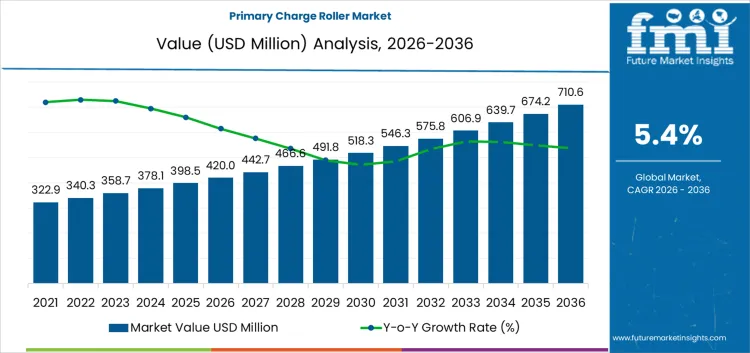
The primary charge roller market is likely to be valued at USD 420.0 million in 2026 and is forecasted to reach USD 710.6 million by 2036 at a CAGR of 5.4%. Value formation is anchored in consumable replacement economics rather than expansion of printer hardware shipments. Primary charge rollers function as wear components within electrophotographic engines, and demand is structurally tied to installed device base, duty cycle intensity, and cartridge replacement frequency. Pricing discipline reflects high specification sensitivity, where electrical resistivity tolerance, surface finish stability, and coating uniformity determine qualification status across OEM and certified aftermarket channels.
Growth quality is shaped by servicing intensity across office, institutional, and commercial print environments. Managed print services and cartridge remanufacturing programs sustain predictable replacement volumes, while OEM-aligned supply streams retain share through warranty and performance assurance. Substitution risk remains limited because charge uniformity directly affects print density and defect rates, making performance deviation immediately visible. Cost pressure persists due to elastomer input volatility and tight manufacturing tolerances, constraining margin expansion. Demand progression remains maintenance-led, supported by lifecycle servicing and refurbishment rather than incremental proliferation of laser printing devices.
Quick Stats for Primary Charge Roller Market
- Primary Charge Roller Market Value (2026): USD 420.0 million
- Primary Charge Roller Market Forecast Value (2036): USD 710.6 million
- Primary Charge Roller Market Forecast CAGR 2026 to 2036: 5.4%
- Leading Printing Platform by Demand Share: Laser Printers
- Fastest-Growing Countries: India, Indonesia, Vietnam, Mexico, Brazil
- Top Players in Global Demand: Mitsubishi Chemical Group, Sumitomo Riko, CET Group, Katun, Static Control (SCC), Nippon Carbide Industries, Huaguang (HG) Photoconductor, Dinglong, UniNet, Aster Graphics
Primary Charge Roller Market Key Takeaways
| Metric | Value |
|---|---|
| Market Value (2026) | USD 420.0 million |
| Market Forecast Value (2036) | USD 710.6 million |
| Forecast CAGR 2026 to 2036 | 5.4% |
Why is the Demand for Primary Charge Roller Growing?
Demand for primary charge rollers is increasing as laser printer and photocopier manufacturers require components that deliver uniform electrostatic charge on photoconductor drums to support high quality image formation. The primary charge roller conditions the surface potential before exposure by the laser, and consistent charge distribution directly affects toner adhesion, print density uniformity, and defect reduction. OEM engineers specify rollers with precise coating resistivity and dimensional accuracy because variations can lead to inconsistent print quality or premature wear of the photoconductor. Procurement teams evaluate roller material formulations, resistance to abrasion, and compatibility with toner chemistries to ensure parts meet product reliability targets and maintenance interval expectations.
Market growth in high volume production and multifunction office equipment intensifies demand because reliable charge control supports throughput and reduces recalibration cycles in commercial print environments. Replacement and aftermarket demand is reinforced by business continuity needs in office and production printing segments where downtime leads to operational delays. Service providers and national accounts require ready availability of certified primary charge rollers that match equipment model specifications to support routine maintenance and reduce mean time to repair. Technical development in elastomer coatings and precision shafts improves roller lifespan under extended duty cycles and variable humidity conditions. These product-specific performance and serviceability factors are contributing to sustained growth in the primary charge roller market.
How Are the Segments Classified in the Primary Charge Roller Market?
Demand for primary charge rollers is shaped by electrophotographic printing stability requirements, image quality consistency, and component replacement cycles. These rollers play a critical role in uniform charge distribution across photoconductors during printing operations. Adoption aligns with installed base of laser-based printing platforms across office, enterprise, and production environments. Product selection prioritizes electrical conductivity control, wear resistance, and compatibility with toner systems. Segment classification reflects differentiation by printing platform deployment, roller construction design, and supply stream orientation influencing replacement frequency, qualification standards, and procurement behavior.
Which Printing Platform Represents the Largest Share of Demand?
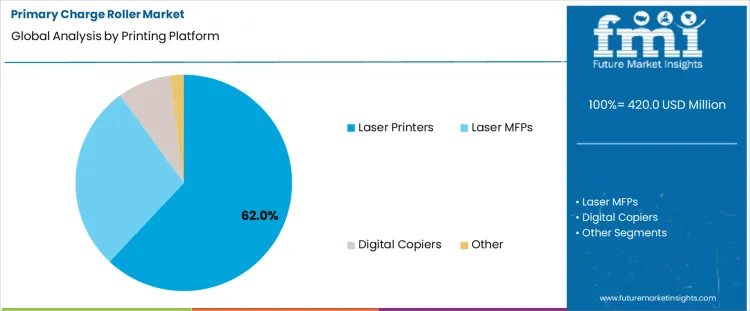
Laser printers hold 62.0%, representing the largest share among printing platforms due to extensive installed base. Office and enterprise environments rely on laser printers for consistent output quality and high-duty cycles. Primary charge rollers in these systems experience regular wear due to continuous contact and charge cycling. Standardized printer architectures support predictable component specifications and replacement intervals. Laser multifunction printers integrate similar charging systems with lower unit penetration. Digital copiers apply charge rollers within limited-volume production environments. Printing platform segmentation reflects concentration of component demand where device population and usage intensity remain highest.
Key Points
- Laser printers dominate installed electrophotographic device base.
- High-duty usage increases replacement frequency.
- Other platforms contribute lower aggregate volume demand.
Which Roller Construction Accounts for the Highest Share of Demand?
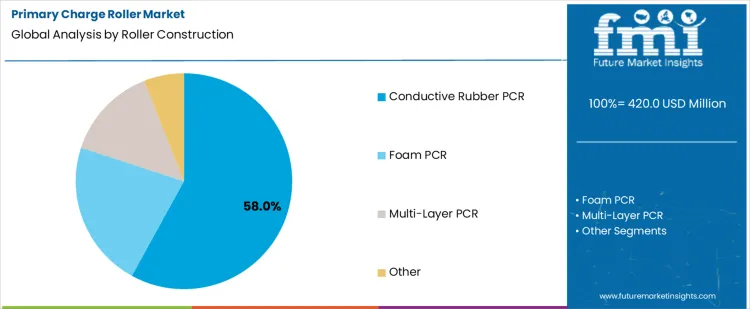
Conductive rubber PCRs hold 58.0%, representing the largest share among roller construction types due to stable electrical properties. These rollers provide controlled surface resistivity supporting uniform photoconductor charging. Material durability supports extended service life under repetitive cycling. Manufacturing processes enable consistent dimensional and electrical performance at scale. Foam PCRs offer lighter construction with different charge characteristics. Multi-layer PCRs enhance performance tuning with added complexity. Roller construction segmentation reflects preference for proven materials balancing conductivity control, durability, and cost efficiency.
Key Points
- Conductive rubber ensures consistent charge uniformity.
- Durable material supports long service life.
- Other constructions address specialized performance needs.
Which Supply Stream Drives the Largest Share of Demand?
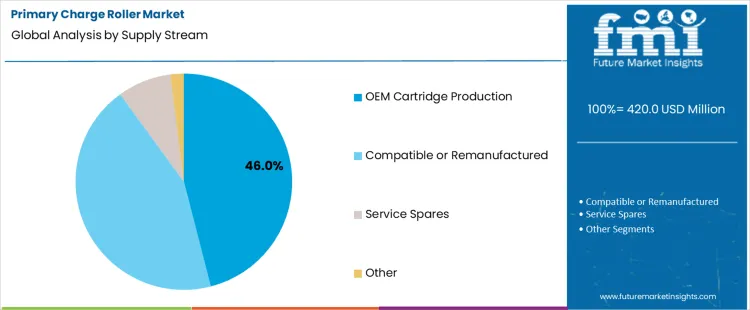
OEM cartridge production holds 46.0%, representing the largest share among supply streams due to quality control requirements. Original equipment manufacturers specify charge rollers as integral cartridge components. Qualification processes ensure compatibility with printer engines and toner chemistry. Predictable production volumes support stable procurement. Compatible and remanufactured streams supply replacement demand with cost sensitivity. Service spares support maintenance activities with limited volume. Supply stream segmentation reflects dominance of OEM-aligned sourcing where performance consistency and warranty considerations remain critical.
Key Points
- OEM production emphasizes specification compliance and consistency.
- Integrated cartridges drive steady component demand.
- Other streams support replacement and service requirements.
What are the Key Dynamics in the Primary Charge Roller Market?
Demand for primary charge rollers reflects electrophotographic process requirements within laser printers, copiers, and multifunction devices. Adoption concentrates in office printing equipment, production printers, and industrial imaging systems. Global scope aligns with installed base maintenance, consumables replacement cycles, and print quality control. Usage centers on elastomer-coated rollers applying uniform electrostatic charge to photoconductor drums under controlled voltage conditions.
How do print quality control and equipment reliability requirements shape adoption?
Primary charge rollers directly influence image density, background suppression, and toner transfer consistency. Demand increases as printers operate at higher speeds and resolutions requiring stable, uniform charging across drum surfaces. OEMs specify roller materials with controlled resistivity to maintain charge uniformity across temperature and humidity variation. Surface finish and hardness affect contact consistency and wear rate, impacting long-run image stability. Production printing environments require rollers capable of extended duty cycles without charge drift. Compatibility with organic photoconductor drums remains critical to avoid surface damage and ghosting defects. Adoption reflects operational dependence on predictable electrostatic behavior rather than optional performance enhancement.
How do material sensitivity, contamination exposure, and cost pressure influence market scalability?
Primary charge roller performance depends on precise elastomer formulation and conductive additive dispersion. Demand sensitivity rises where material cost fluctuations affect consumable pricing. Exposure to toner additives, paper dust, and ozone accelerates surface degradation and resistivity shift. Manufacturing requires tight tolerance control, increasing yield risk and quality screening cost. Device-specific designs limit cross-platform standardization. Aftermarket alternatives face variability in charge stability, affecting acceptance in quality-sensitive environments. Replacement frequency ties closely to device duty cycle, constraining volume predictability. Supply chain dependence on specialty polymers and coating processes limits rapid scaling across diverse printer models.
How Is Demand for Primary Charge Rollers Evolving Globally?
Demand for primary charge rollers is expanding globally due to sustained use of electrophotographic printing systems and maintenance-led replacement cycles. Laser printers and multifunction devices rely on consistent charging performance to maintain image quality and toner transfer accuracy. Office printing, commercial print services, and institutional document handling support steady equipment utilization. Transition toward managed print environments increases emphasis on predictable component lifecycles. Growth rates in India at 6.1%, Indonesia at 5.6%, Vietnam at 5.4%, Mexico at 4.6%, and Brazil at 4.3% indicate sustained expansion driven by installed base servicing, print volume stability, and consumables replacement rather than new hardware proliferation.
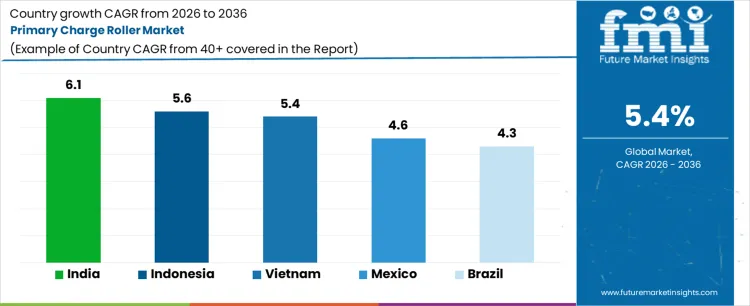
| Country | CAGR (%) |
|---|---|
| India | 6.1% |
| Indonesia | 5.6% |
| Vietnam | 5.4% |
| Mexico | 4.6% |
| Brazil | 4.3% |
What Is Driving Growth of Primary Charge Roller Demand in India?
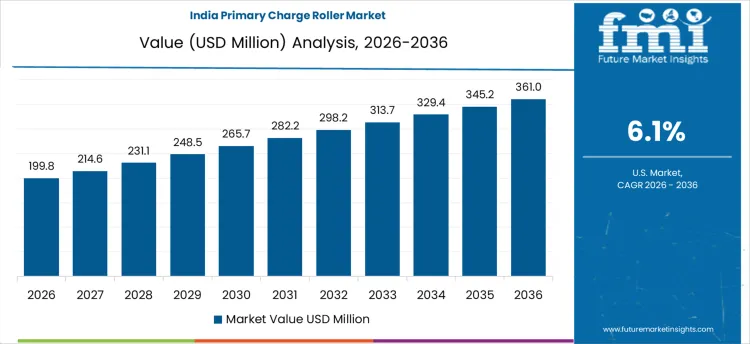
Primary charge roller demand in India is growing at a CAGR of 6.1%, supported by high utilization of office printers and institutional printing infrastructure. Government offices, education systems, and financial services maintain large installed printer bases requiring regular consumables replacement. Print volumes remain stable due to documentation and compliance needs. Cost sensitivity favors refurbishment and component-level servicing over full device replacement. Local remanufacturing and cartridge recycling ecosystems support roller replacement demand. Growth reflects maintenance intensity and installed base servicing rather than expansion of desktop printer ownership.
- Large institutional and government printer installed base
- Stable documentation-driven print volumes
- Preference for component-level maintenance
- Growth of remanufactured cartridge ecosystems
Why Is Indonesia Sustaining Expansion in Primary Charge Roller Demand?
Indonesia is expanding at a CAGR of 5.6%, driven by office printing reliance and service-led maintenance practices. Small and medium enterprises maintain shared printer usage for administrative workflows. Education and public sector institutions sustain recurring print requirements. Humidity and temperature conditions influence component wear, increasing replacement frequency. Third-party service providers support cartridge refurbishment and parts replacement. Demand growth reflects environmental wear factors and servicing intensity rather than increases in printer shipments.
- Shared office printer usage across SMEs
- Education and public sector print dependence
- Climate-related component wear acceleration
- Active third-party servicing and refurbishment
How Is Vietnam Influencing Demand for Primary Charge Rollers?
Primary charge roller demand in Vietnam is growing at a CAGR of 5.4%, shaped by expanding administrative printing and localized service networks. Manufacturing firms and export-oriented offices maintain documentation printing for compliance and logistics. Cartridge remanufacturing businesses increase replacement of wear components. Office consolidation sustains centralized printer usage with high duty cycles. Import substitution initiatives support local servicing capabilities. Demand growth reflects servicing ecosystem development and print workflow continuity rather than device fleet expansion.
- Administrative printing in manufacturing offices
- Growth of cartridge remanufacturing services
- Centralized printer usage with high duty cycles
- Development of local servicing capabilities
What Factors Are Supporting Primary Charge Roller Demand in Mexico?
Mexico is expanding at a CAGR of 4.6%, influenced by stable office printing and managed print service adoption. Corporate offices and shared service centers maintain consistent printer utilization. Managed service contracts emphasize timely replacement of wear components to ensure output quality. Cartridge recycling programs contribute to component replacement cycles. Import-based supply chains support availability of standardized rollers. Growth reflects servicing discipline and lifecycle replacement rather than growth in standalone printer deployments.
- Managed print service contract penetration
- Consistent printer utilization in corporate offices
- Cartridge recycling supporting replacement cycles
- Standardized component availability through imports
Why Is Brazil Experiencing Moderate Growth in Primary Charge Roller Demand?
Primary charge roller demand in Brazil is growing at a CAGR of 4.3%, supported by institutional printing needs and aftermarket servicing. Public administration, healthcare, and education maintain recurring print workloads. Economic considerations favor maintenance of existing devices over capital replacement. Environmental conditions contribute to gradual component degradation. Independent service providers sustain demand through refurbishment and consumables replacement. Growth remains measured, reflecting installed base maintenance and cost-controlled servicing practices rather than expansion of printing infrastructure.
- Institutional printing across public sectors
- Cost-driven preference for device maintenance
- Environmental impact on component lifespan
- Independent aftermarket service provider activity
What is the competitive landscape of demand for the primary charge roller market globally?
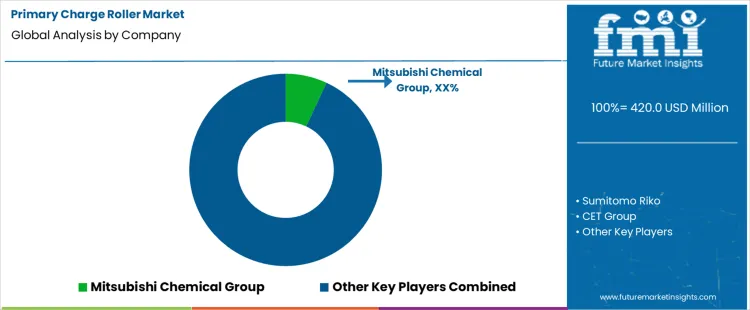
Demand for primary charge rollers (PCRs) is driven by global printer, copier, and multifunction peripheral production across office, commercial, and industrial segments. PCRs are essential in electrophotographic imaging systems to uniformly charge the photoconductor drum prior to image exposure, affecting print quality, consistency, and toner adhesion. Buyers evaluate surface resistivity, durability, material wear performance, electrical stability, and compatibility with OEM imaging assemblies. Procurement teams prioritize suppliers with strong quality control, validated performance data, broad product portfolios covering key printer platforms, and global distribution networks. Trend in the global market reflects growth of digital printing, higher print duty cycles, and demand for replacement components that maintain OEM print quality while extending service life.
Mitsubishi Chemical Group holds leading positioning through engineered PCR materials and components widely adopted by OEMs and aftermarket suppliers supported by advanced polymer and coating technologies. Sumitomo Riko supports demand with high-performance rollers and elastomer formulations optimized for extended life and consistent electrical properties. CET Group participates with PCR and imaging components used in printers, copiers, and MFPs with emphasis on reliability and cost-performance balance. Static Control (SCC) contributes aftermarket PCR solutions and imaging supplies aligned with varied machine platforms and global distribution. Katun supplies primary charge rollers and complementary consumables designed for broad compatibility and consistent print performance. Competitive differentiation depends on material resistivity control, durability under high duty cycles, OEM cross-referencing support, and ability to meet diverse device specifications.
Key Players in the Primary Charge Roller Market
- Mitsubishi Chemical Group
- Sumitomo Riko
- CET Group
- Katun
- Static Control (SCC)
- Nippon Carbide Industries
- Huaguang (HG) Photoconductor
- Dinglong
- UniNet
- Aster Graphics
Scope of the Report
| Items | Values |
|---|---|
| Quantitative Units | USD million |
| Printing Platform | Laser Printers; Laser MFPs; Digital Copiers; Other |
| Roller Construction | Conductive Rubber PCR; Foam PCR; Multi-Layer PCR; Other |
| Supply Stream | OEM Cartridge Production; Compatible or Remanufactured; Service Spares; Other |
| Regions Covered | Asia Pacific, Europe, North America, Latin America, Middle East & Africa |
| Countries Covered | India, Indonesia, Vietnam, Mexico, Brazil, and 40+ countries |
| Key Companies Profiled | Mitsubishi Chemical Group; Sumitomo Riko; CET Group; Katun; Static Control; Nippon Carbide Industries; Huaguang Photoconductor; Dinglong; UniNet; Aster Graphics |
| Additional Attributes | Dollar sales by printing platform, roller construction, and supply stream; electrical resistivity stability, surface roughness, and charge uniformity requirements for monochrome and color engines; durability and wear-life benchmarks tied to cartridge yield expectations; compatibility with OEM toner chemistries and OPC drum coatings; quality differentiation between OEM-grade and remanufactured PCRs; sourcing patterns influenced by regional remanufacturing hubs and cost-sensitive aftermarket demand. |
Primary Charge Roller Market by Segment
Printing Platform:
- Laser Printers
- Laser MFPs
- Digital Copiers
- Other
Roller Construction:
- Conductive Rubber PCR
- Foam PCR
- Multi-Layer PCR
- Other
Supply Stream:
- OEM Cartridge Production
- Compatible or Remanufactured
- Service Spares
- Other
Region:
- Asia Pacific
- China
- Japan
- South Korea
- India
- Australia & New Zealand
- ASEAN
- Rest of Asia Pacific
- Europe
- Germany
- United Kingdom
- France
- Italy
- Spain
- Nordic
- BENELUX
- Rest of Europe
- North America
- United States
- Canada
- Mexico
- Latin America
- Brazil
- Chile
- Rest of Latin America
- Middle East & Africa
- Kingdom of Saudi Arabia
- Other GCC Countries
- Turkey
- South Africa
- Other African Union
- Rest of Middle East & Africa
Bibliography
- American Society for Testing and Materials. (2024). ASTM D2240: Standard test method for rubber property-Durometer hardness; ASTM D412: Standard test methods for vulcanized rubber and thermoplastic elastomers-Tension. ASTM International.
- Japan Business Machine and Information System Industries Association. (2023). Guidelines for electrophotographic charging components: Primary charge roller material properties, resistivity control, and durability considerations. JBMIA.
- International Electrotechnical Commission. (2023). Electrophotographic office equipment-Material interaction, electrical stability, and durability considerations for imaging subsystems. IEC.
- Society for Imaging Science and Technology. (2023). Charging uniformity, elastomer degradation, and component wear behavior in electrophotographic imaging systems. Journal of Imaging Science and Technology, 67(3).
- Organisation for Economic Co-operation and Development. (2024). Lifecycle management and reuse considerations for polymer-based consumable components in office equipment. OECD Publishing.
Frequently Asked Questions
How big is the primary charge roller market in 2026?
The global primary charge roller market is estimated to be valued at USD 420.0 million in 2026.
What will be the size of primary charge roller market in 2036?
The market size for the primary charge roller market is projected to reach USD 710.6 million by 2036.
How much will be the primary charge roller market growth between 2026 and 2036?
The primary charge roller market is expected to grow at a 5.4% CAGR between 2026 and 2036.
What are the key product types in the primary charge roller market?
The key product types in primary charge roller market are laser printers, laser mfps, digital copiers and other.
Which roller construction segment to contribute significant share in the primary charge roller market in 2026?
In terms of roller construction, conductive rubber pcr segment to command 58.0% share in the primary charge roller market in 2026.
Preview the report firsthand - request a free sample
Get SampleGet the brochure for pricing and purchase details.
Get PDFTable of Content
- Executive Summary
- Global Market Outlook
- Demand-side Trends
- Supply-side Trends
- Technology Roadmap Analysis
- Analysis and Recommendations
- Market Overview
- Market Coverage / Taxonomy
- Market Definition / Scope / Limitations
- Market Background
- Market Dynamics
- Drivers
- Restraints
- Opportunity
- Trends
- Scenario Forecast
- Demand in Optimistic Scenario
- Demand in Likely Scenario
- Demand in Conservative Scenario
- Opportunity Map Analysis
- Product Life Cycle Analysis
- Supply Chain Analysis
- Investment Feasibility Matrix
- Value Chain Analysis
- PESTLE and Porter’s Analysis
- Regulatory Landscape
- Regional Parent Market Outlook
- Production and Consumption Statistics
- Import and Export Statistics
- Market Dynamics
- Global Market Analysis 2021 to 2025 and Forecast, 2026 to 2036
- Historical Market Size Value (USD Million) Analysis, 2021 to 2025
- Current and Future Market Size Value (USD Million) Projections, 2026 to 2036
- Y-o-Y Growth Trend Analysis
- Absolute $ Opportunity Analysis
- Global Market Pricing Analysis 2021 to 2025 and Forecast 2026 to 2036
- Global Market Analysis 2021 to 2025 and Forecast 2026 to 2036, By Printing Platform
- Introduction / Key Findings
- Historical Market Size Value (USD Million) Analysis By Printing Platform , 2021 to 2025
- Current and Future Market Size Value (USD Million) Analysis and Forecast By Printing Platform , 2026 to 2036
- Laser Printers
- Laser MFPs
- Digital Copiers
- Other
- Laser Printers
- Y-o-Y Growth Trend Analysis By Printing Platform , 2021 to 2025
- Absolute $ Opportunity Analysis By Printing Platform , 2026 to 2036
- Global Market Analysis 2021 to 2025 and Forecast 2026 to 2036, By Roller Construction
- Introduction / Key Findings
- Historical Market Size Value (USD Million) Analysis By Roller Construction, 2021 to 2025
- Current and Future Market Size Value (USD Million) Analysis and Forecast By Roller Construction, 2026 to 2036
- Conductive Rubber PCR
- Foam PCR
- Multi-Layer PCR
- Other
- Conductive Rubber PCR
- Y-o-Y Growth Trend Analysis By Roller Construction, 2021 to 2025
- Absolute $ Opportunity Analysis By Roller Construction, 2026 to 2036
- Global Market Analysis 2021 to 2025 and Forecast 2026 to 2036, By Supply Stream
- Introduction / Key Findings
- Historical Market Size Value (USD Million) Analysis By Supply Stream, 2021 to 2025
- Current and Future Market Size Value (USD Million) Analysis and Forecast By Supply Stream, 2026 to 2036
- OEM Cartridge Production
- Compatible or Remanufactured
- Service Spares
- Other
- OEM Cartridge Production
- Y-o-Y Growth Trend Analysis By Supply Stream, 2021 to 2025
- Absolute $ Opportunity Analysis By Supply Stream, 2026 to 2036
- Global Market Analysis 2021 to 2025 and Forecast 2026 to 2036, By Region
- Introduction
- Historical Market Size Value (USD Million) Analysis By Region, 2021 to 2025
- Current Market Size Value (USD Million) Analysis and Forecast By Region, 2026 to 2036
- North America
- Latin America
- Western Europe
- Eastern Europe
- East Asia
- South Asia and Pacific
- Middle East & Africa
- Market Attractiveness Analysis By Region
- North America Market Analysis 2021 to 2025 and Forecast 2026 to 2036, By Country
- Historical Market Size Value (USD Million) Trend Analysis By Market Taxonomy, 2021 to 2025
- Market Size Value (USD Million) Forecast By Market Taxonomy, 2026 to 2036
- By Country
- USA
- Canada
- Mexico
- By Printing Platform
- By Roller Construction
- By Supply Stream
- By Country
- Market Attractiveness Analysis
- By Country
- By Printing Platform
- By Roller Construction
- By Supply Stream
- Key Takeaways
- Latin America Market Analysis 2021 to 2025 and Forecast 2026 to 2036, By Country
- Historical Market Size Value (USD Million) Trend Analysis By Market Taxonomy, 2021 to 2025
- Market Size Value (USD Million) Forecast By Market Taxonomy, 2026 to 2036
- By Country
- Brazil
- Chile
- Rest of Latin America
- By Printing Platform
- By Roller Construction
- By Supply Stream
- By Country
- Market Attractiveness Analysis
- By Country
- By Printing Platform
- By Roller Construction
- By Supply Stream
- Key Takeaways
- Western Europe Market Analysis 2021 to 2025 and Forecast 2026 to 2036, By Country
- Historical Market Size Value (USD Million) Trend Analysis By Market Taxonomy, 2021 to 2025
- Market Size Value (USD Million) Forecast By Market Taxonomy, 2026 to 2036
- By Country
- Germany
- UK
- Italy
- Spain
- France
- Nordic
- BENELUX
- Rest of Western Europe
- By Printing Platform
- By Roller Construction
- By Supply Stream
- By Country
- Market Attractiveness Analysis
- By Country
- By Printing Platform
- By Roller Construction
- By Supply Stream
- Key Takeaways
- Eastern Europe Market Analysis 2021 to 2025 and Forecast 2026 to 2036, By Country
- Historical Market Size Value (USD Million) Trend Analysis By Market Taxonomy, 2021 to 2025
- Market Size Value (USD Million) Forecast By Market Taxonomy, 2026 to 2036
- By Country
- Russia
- Poland
- Hungary
- Balkan & Baltic
- Rest of Eastern Europe
- By Printing Platform
- By Roller Construction
- By Supply Stream
- By Country
- Market Attractiveness Analysis
- By Country
- By Printing Platform
- By Roller Construction
- By Supply Stream
- Key Takeaways
- East Asia Market Analysis 2021 to 2025 and Forecast 2026 to 2036, By Country
- Historical Market Size Value (USD Million) Trend Analysis By Market Taxonomy, 2021 to 2025
- Market Size Value (USD Million) Forecast By Market Taxonomy, 2026 to 2036
- By Country
- China
- Japan
- South Korea
- By Printing Platform
- By Roller Construction
- By Supply Stream
- By Country
- Market Attractiveness Analysis
- By Country
- By Printing Platform
- By Roller Construction
- By Supply Stream
- Key Takeaways
- South Asia and Pacific Market Analysis 2021 to 2025 and Forecast 2026 to 2036, By Country
- Historical Market Size Value (USD Million) Trend Analysis By Market Taxonomy, 2021 to 2025
- Market Size Value (USD Million) Forecast By Market Taxonomy, 2026 to 2036
- By Country
- India
- ASEAN
- Australia & New Zealand
- Rest of South Asia and Pacific
- By Printing Platform
- By Roller Construction
- By Supply Stream
- By Country
- Market Attractiveness Analysis
- By Country
- By Printing Platform
- By Roller Construction
- By Supply Stream
- Key Takeaways
- Middle East & Africa Market Analysis 2021 to 2025 and Forecast 2026 to 2036, By Country
- Historical Market Size Value (USD Million) Trend Analysis By Market Taxonomy, 2021 to 2025
- Market Size Value (USD Million) Forecast By Market Taxonomy, 2026 to 2036
- By Country
- Kingdom of Saudi Arabia
- Other GCC Countries
- Turkiye
- South Africa
- Other African Union
- Rest of Middle East & Africa
- By Printing Platform
- By Roller Construction
- By Supply Stream
- By Country
- Market Attractiveness Analysis
- By Country
- By Printing Platform
- By Roller Construction
- By Supply Stream
- Key Takeaways
- Key Countries Market Analysis
- USA
- Pricing Analysis
- Market Share Analysis, 2025
- By Printing Platform
- By Roller Construction
- By Supply Stream
- Canada
- Pricing Analysis
- Market Share Analysis, 2025
- By Printing Platform
- By Roller Construction
- By Supply Stream
- Mexico
- Pricing Analysis
- Market Share Analysis, 2025
- By Printing Platform
- By Roller Construction
- By Supply Stream
- Brazil
- Pricing Analysis
- Market Share Analysis, 2025
- By Printing Platform
- By Roller Construction
- By Supply Stream
- Chile
- Pricing Analysis
- Market Share Analysis, 2025
- By Printing Platform
- By Roller Construction
- By Supply Stream
- Germany
- Pricing Analysis
- Market Share Analysis, 2025
- By Printing Platform
- By Roller Construction
- By Supply Stream
- UK
- Pricing Analysis
- Market Share Analysis, 2025
- By Printing Platform
- By Roller Construction
- By Supply Stream
- Italy
- Pricing Analysis
- Market Share Analysis, 2025
- By Printing Platform
- By Roller Construction
- By Supply Stream
- Spain
- Pricing Analysis
- Market Share Analysis, 2025
- By Printing Platform
- By Roller Construction
- By Supply Stream
- France
- Pricing Analysis
- Market Share Analysis, 2025
- By Printing Platform
- By Roller Construction
- By Supply Stream
- India
- Pricing Analysis
- Market Share Analysis, 2025
- By Printing Platform
- By Roller Construction
- By Supply Stream
- ASEAN
- Pricing Analysis
- Market Share Analysis, 2025
- By Printing Platform
- By Roller Construction
- By Supply Stream
- Australia & New Zealand
- Pricing Analysis
- Market Share Analysis, 2025
- By Printing Platform
- By Roller Construction
- By Supply Stream
- China
- Pricing Analysis
- Market Share Analysis, 2025
- By Printing Platform
- By Roller Construction
- By Supply Stream
- Japan
- Pricing Analysis
- Market Share Analysis, 2025
- By Printing Platform
- By Roller Construction
- By Supply Stream
- South Korea
- Pricing Analysis
- Market Share Analysis, 2025
- By Printing Platform
- By Roller Construction
- By Supply Stream
- Russia
- Pricing Analysis
- Market Share Analysis, 2025
- By Printing Platform
- By Roller Construction
- By Supply Stream
- Poland
- Pricing Analysis
- Market Share Analysis, 2025
- By Printing Platform
- By Roller Construction
- By Supply Stream
- Hungary
- Pricing Analysis
- Market Share Analysis, 2025
- By Printing Platform
- By Roller Construction
- By Supply Stream
- Kingdom of Saudi Arabia
- Pricing Analysis
- Market Share Analysis, 2025
- By Printing Platform
- By Roller Construction
- By Supply Stream
- Turkiye
- Pricing Analysis
- Market Share Analysis, 2025
- By Printing Platform
- By Roller Construction
- By Supply Stream
- South Africa
- Pricing Analysis
- Market Share Analysis, 2025
- By Printing Platform
- By Roller Construction
- By Supply Stream
- USA
- Market Structure Analysis
- Competition Dashboard
- Competition Benchmarking
- Market Share Analysis of Top Players
- By Regional
- By Printing Platform
- By Roller Construction
- By Supply Stream
- Competition Analysis
- Competition Deep Dive
- Mitsubishi Chemical Group
- Overview
- Product Portfolio
- Profitability by Market Segments (Product/Age /Sales Channel/Region)
- Sales Footprint
- Strategy Overview
- Marketing Strategy
- Product Strategy
- Channel Strategy
- Sumitomo Riko
- CET Group
- Katun
- Static Control (SCC)
- Nippon Carbide Industries
- Huaguang (HG) Photoconductor
- Dinglong
- UniNet
- Aster Graphics
- Mitsubishi Chemical Group
- Competition Deep Dive
- Assumptions & Acronyms Used
- Research Methodology


