

- Industry Size (2026)
- USD 1099.2 Mn
- Forecast (2036)
- USD 1580.8 Mn
- CAGR (2026 to 2036)
- 3.7%
Suspension Arm and Control Link Fasteners Market Forecast and Outlook 2026 to 2036
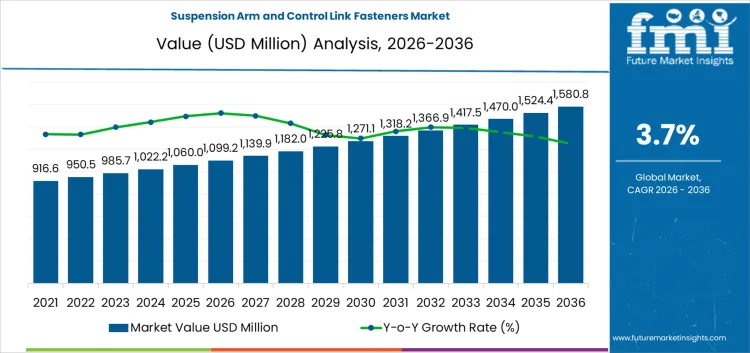
The suspension arm and control link fasteners market is valued at USD 1,099.2 million in 2026 and is projected to reach USD 1,580.8 million by 2036, expanding at a CAGR of 3.7%. Value behavior is anchored in the structural role these fasteners play within load-bearing suspension joints rather than in discretionary component substitution. Each vehicle architecture defines a fixed population of arm and link joints, tying demand directly to suspension geometry, axle layout, and durability targets. Fasteners specified for these locations must sustain cyclic tensile and shear loads while preserving alignment under braking, cornering, and vertical articulation.
Expansion across the period reflects tightening tolerance control, rising curb weight, and sustained exposure to fatigue environments rather than abrupt design shifts. Electrified platforms increase static and dynamic loads at suspension joints, raising specification thresholds for clamp force retention and material performance. Corrosion exposure from water, debris, and road treatments elevates coating and surface treatment requirements, limiting interchangeability across applications. Validation intensity for fatigue life, slip resistance, and torque retention constrains rapid standardization and reinforces platform-specific sourcing. Replacement demand concentrates in service intervals tied to suspension wear and alignment correction, where reuse is restricted by safety protocols. Procurement remains governed by reliability history, traceability, and consistency under high cycle loading, supporting steady value formation linked to chassis durability and lifecycle servicing.
Quick Stats for Suspension Arm and Control Link Fasteners Market
- Suspension Arm and Control Link Fasteners Market Value (2026): USD 1,099.2 million
- Suspension Arm and Control Link Fasteners Market Forecast Value (2036): USD 1,580.8 million
- Suspension Arm and Control Link Fasteners Market Forecast CAGR 2026 to 2036: 3.7%
- Leading Fastener Type by Demand Share: High-Strength Bolts
- Fastest-Growing Countries: India, China, Indonesia, Brazil, Mexico
- Top Players in Global Demand: Sundram Fasteners, Bulten, Meidoh, Nifco, SFS Group, KAMAX, Chun Yu Group, LISI Automotive, Bossard Group, Fontana Gruppo
Suspension Arm and Control Link Fasteners Market Key Takeaways
| Metric | Value |
|---|---|
| Market Value (2026) | USD 1,099.2 million |
| Market Forecast Value (2036) | USD 1,580.8 million |
| Forecast CAGR 2026 to 2036 | 3.7% |
Why is the Demand for Suspension Arm and Control Link Fasteners Growing?
Demand for suspension arm and control link fasteners is rising as vehicle manufacturers and fleet operators require components that support structural integrity and predictable performance of suspension systems under variable loads. Suspension arms and control links transmit forces that affect handling, steering responsiveness, and ride comfort, and fasteners specified for these assemblies must meet criteria for tensile strength, fatigue resistance, and corrosion protection to maintain joint stability over prolonged use. Engineers evaluate thread precision, material grade, and coating performance to ensure fasteners align with design tolerances and service environment expectations in passenger cars, commercial trucks, and specialty vehicles. Procurement teams emphasize certified quality standards and supplier traceability when selecting components that support long term durability and safety compliance across vehicle platforms.
Assembly planners coordinate fastener selection with suspension geometry and torque specifications to maintain alignment and reduce vibration at connection points. Growth in electrified and high performance drivetrains reinforces uptake of precise fasteners that support advanced suspension architectures where dynamic load distribution is critical. Workshops and maintenance networks require ready availability of replacement fasteners that match engineering specifications to support scheduled service and unplanned repairs. Technical training for service technicians on correct installation and torque practices enhances component life and supports fleet reliability objectives. These operational, engineering, and service considerations sustain demand for suspension arm and control link fasteners in evolving mobility segments.
How Are the Segments Classified in the Suspension Arm and Control Link Fasteners Market?
Demand for suspension arm and control link fasteners is shaped by chassis load transfer requirements, alignment stability expectations, and long-term fatigue resistance needs. These fasteners secure critical suspension joints exposed to dynamic forces, vibration, and road-induced stress. Adoption aligns with increasing vehicle weight, ride refinement targets, and tighter handling tolerances. Design selection prioritizes clamping force retention, corrosion protection, and compatibility with suspension geometry adjustment. Segment classification reflects differentiation by fastener design, material composition, and vehicle application. Structure highlights how joint function, material strength, and vehicle class influence specification rigor, service life expectations, and installation consistency across suspension systems.
Which Fastener Type Represents the Largest Share of Demand?
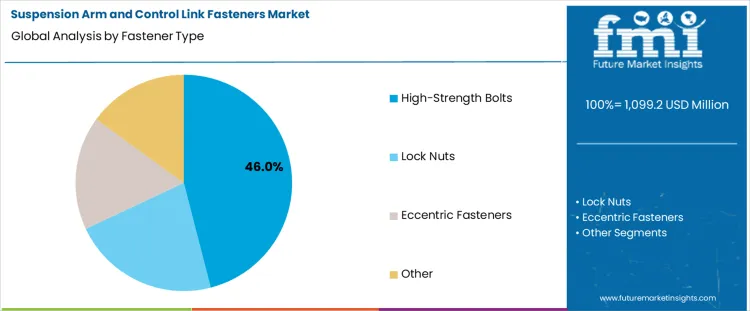
High-strength bolts hold 46.0%, representing the largest share among fastener types due to primary load-bearing responsibility. These bolts secure suspension arms and control links to subframes and knuckles under continuous dynamic loading. High tensile capacity ensures joint integrity during braking, cornering, and uneven road contact. Precision torque control supports alignment stability and predictable handling characteristics. Lock nuts provide secondary retention against loosening. Eccentric fasteners enable camber and toe adjustment with lower unit usage. Fastener type segmentation reflects reliance on structural bolts where strength, repeatability, and joint stability remain fundamental.
Key Points
- High-strength bolts manage primary suspension load transfer.
- Torque control supports alignment and handling stability.
- Other fasteners address retention or adjustment functions.
Which Material Accounts for the Highest Share of Demand?
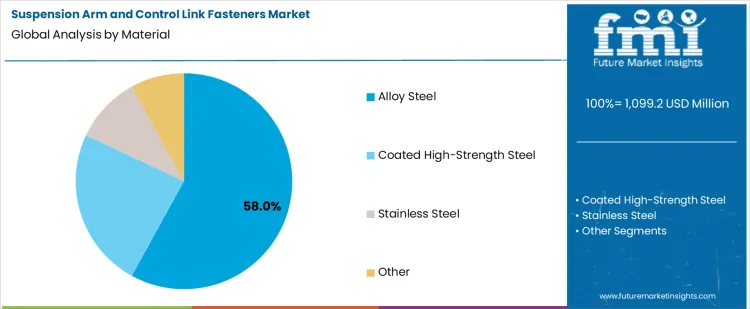
Alloy steel holds 58.0%, representing the largest share among materials used for suspension fasteners. Alloy steels provide high tensile strength and fatigue resistance under cyclic suspension loads. Mechanical properties remain stable across temperature variation and long service intervals. Established heat treatment processes support consistent performance at scale. Coated high-strength steel enhances corrosion resistance with similar strength characteristics. Stainless steel supports corrosion protection with lower strength margins. Material segmentation reflects preference for high-performance alloys where durability and load endurance remain critical for suspension joint reliability.
Key Points
- Alloy steel delivers strength and fatigue resistance.
- Stable properties support long-term suspension durability.
- Other materials balance corrosion protection and strength needs.
Which Vehicle Class Drives the Largest Share of Demand?
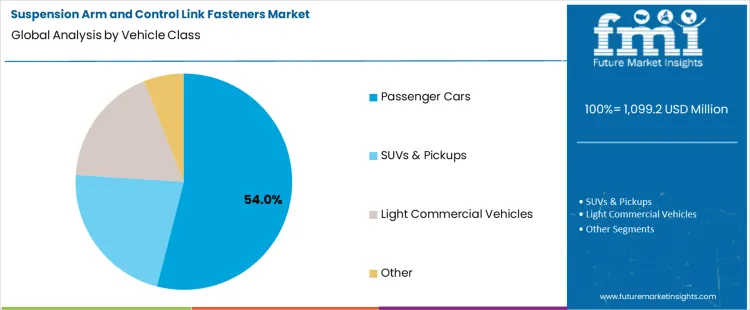
Passenger cars hold 54.0%, representing the largest share among vehicle classes using suspension arm and control link fasteners. High production volumes and multi-link suspension adoption drive consistent fastener demand. Ride comfort and handling expectations require precise joint retention and alignment control. Platform standardization supports scalable fastener specifications across models. SUVs, pickups, and light commercial vehicles apply similar fasteners under higher load conditions with lower unit volumes. Vehicle class segmentation reflects concentration of fastener consumption within passenger-focused platforms emphasizing ride quality, safety, and manufacturing scale.
Key Points
- Passenger cars drive volume-based suspension fastener demand.
- Handling and comfort expectations increase specification precision.
- Other vehicle classes operate under higher load profiles.
What are the Key Dynamics in the Suspension Arm and Control Link Fasteners Market?
Demand for suspension arm and control link fasteners reflects safety-critical requirements for joint integrity within vehicle suspension systems. Adoption spans passenger vehicles, commercial vehicles, and off-highway platforms operating under varied load and road conditions. Global scope aligns with chassis durability targets, ride and handling performance, and regulatory safety compliance. Usage centers on high-strength bolts, nuts, and washers designed to maintain clamp force under cyclic stress.
How do suspension kinematics and fatigue resistance requirements shape adoption?
Suspension arms and control links transmit braking, cornering, and vertical loads to vehicle frames. Demand increases as modern suspensions adopt lightweight arms with tighter tolerance requirements. Fasteners must maintain preload despite vibration, thermal cycling, and elastic movement at joints. Alignment accuracy directly affects wheel geometry, tire wear, and vehicle stability, increasing reliance on precision fasteners. Electrified vehicles introduce higher curb weight, elevating joint load intensity. Use of aluminum arms requires fasteners with controlled friction and corrosion mitigation. Automated assembly favors torque-angle controlled fasteners supporting repeatable clamp force. Adoption reflects non-discretionary linkage between fastener performance and suspension safety.
How do material selection, service exposure, and cost pressure influence market scalability?
Fasteners face high fatigue stress and environmental exposure from water, salt, and debris. Demand sensitivity rises where corrosion protection and high-strength alloys increase component cost. Replacement requires strict torque control, affecting service complexity and warranty risk. Platform-specific joint designs limit fastener standardization across vehicle lines. Validation testing for fatigue, slip resistance, and corrosion extends qualification timelines. Weight reduction targets constrain material choices. Supply chain dependence on heat treatment and coating capacity affects lead time stability. Safety liability associated with joint failure constrains aggressive cost optimization.
How Is Demand for Suspension Arm and Control Link Fasteners Evolving Globally?
Demand for suspension arm and control link fasteners is expanding globally due to chassis durability requirements, road condition exposure, and maintenance-led replacement across vehicle fleets. Usage aligns with load transfer accuracy, joint integrity, and vibration resistance within suspension architectures. OEMs specify high-strength fasteners supporting precise torque retention and corrosion protection. Electrification adds mass, increasing suspension loading and fastener performance requirements. Growth rates in India at 4.6%, China at 4.3%, Indonesia at 4.2%, Brazil at 3.9%, and Mexico at 3.7% indicate steady expansion driven by operating intensity, infrastructure conditions, and lifecycle servicing rather than rapid platform redesign.
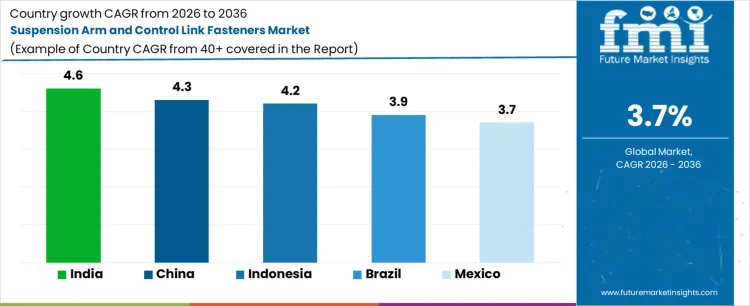
| Country | CAGR (%) |
|---|---|
| India | 4.6% |
| China | 4.3% |
| Indonesia | 4.2% |
| Brazil | 3.9% |
| Mexico | 3.7% |
What Is Driving Suspension Fastener Demand Growth Across India?
Suspension arm and control link fastener demand in India is growing at a CAGR of 4.6%, supported by mixed road quality and high vehicle utilization. Uneven surfaces increase dynamic loads on suspension joints, accelerating fastener fatigue. OEMs reinforce specifications to maintain alignment and handling stability. Growth in compact SUVs and light commercial vehicles raises suspension articulation frequency. Localization of chassis components supports scalable sourcing. Service networks emphasize preventive replacement to manage noise and wear complaints. Demand growth reflects operating stress and maintenance practices rather than increases in premium suspension complexity.
- Variable road conditions increasing joint loading
- Higher SUV and LCV penetration rates
- Reinforced fastener specifications for durability
- Preventive maintenance reducing NVH issues
Why Is China Sustaining Steady Expansion in Suspension Fasteners?
Suspension arm and control link fastener demand in China is expanding at a CAGR of 4.3%, driven by high mileage accumulation across urban and intercity use. Dense traffic and frequent braking increase cyclic stress on suspension joints. Platform refresh cycles introduce mixed-material arms requiring compatible fasteners. Electrified vehicles add curb weight, elevating clamp load requirements. Large production volumes sustain OEM demand, while inspection regimes support timely replacement. Demand growth remains maintenance-led, reflecting utilization intensity and chassis durability standards.
- High urban mileage and cyclic loading
- Mixed-material suspension arm adoption
- EV weight increasing clamp load needs
- Stable OEM volumes with inspection oversight
How Is Indonesia Influencing Demand for Control Link Fasteners?
Suspension arm and control link fastener demand in Indonesia is growing at a CAGR of 4.2%, shaped by infrastructure variability and expanding vehicle usage. Road surface inconsistency increases articulation and joint wear. Compact vehicles dominate, concentrating loads on fewer suspension links. Humidity and rainfall accelerate corrosion exposure, influencing coating specifications. Local assembly growth supports OEM fitment, while aftermarket demand rises from wear-driven servicing. Demand growth reflects environmental exposure and usage patterns rather than changes in suspension design complexity.
- Road variability increasing articulation cycles
- Compact vehicle dominance concentrating loads
- High humidity driving corrosion protection needs
- Local assembly supporting OEM and aftermarket demand
What Factors Are Supporting Growth in Brazil’s Suspension Fastener Segment?
Suspension arm and control link fastener demand in Brazil is expanding at a CAGR of 3.9%, influenced by long-distance travel and road vibration exposure. Freight and passenger vehicles accumulate sustained suspension stress. Climate conditions affect fastener coatings and torque retention. OEMs favor robust designs to reduce service interruptions. Aging fleets contribute to replacement demand through scheduled maintenance. Growth reflects operating environment stress and lifecycle replacement rather than expansion of suspension architectures.
- Long-distance travel increasing vibration exposure
- Climate effects on coatings and retention
- Robust OEM specifications for durability
- Aging fleets supporting replacement cycles
Why Is Mexico Experiencing Measured Growth in Suspension Fasteners?
Suspension arm and control link fastener demand in Mexico is growing at a CAGR of 3.7%, supported by export-oriented vehicle production and consistent quality standards. Assembly plants follow global chassis specifications, sustaining predictable OEM demand. Road usage patterns generate steady wear without extreme variability. Supplier integration within regional supply chains supports standardized fastener designs. Aftermarket replacement remains stable due to long service intervals. Growth remains measured, reflecting production continuity and disciplined maintenance rather than rapid vehicle parc expansion.
- Export-focused assembly sustaining OEM volumes
- Global chassis specifications standardizing fasteners
- Moderate wear patterns on suspension joints
- Stable aftermarket replacement intervals
What is the competitive landscape of demand for the suspension arm and control link fasteners market globally?
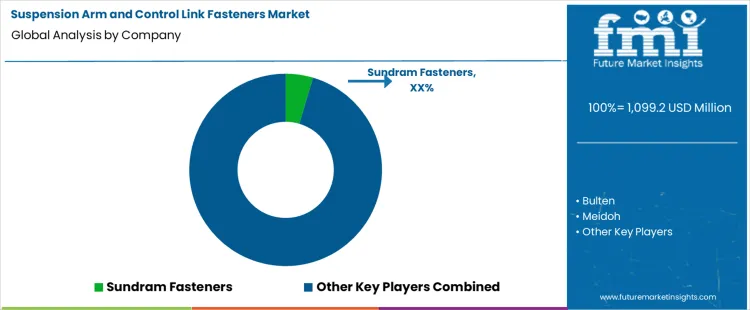
Demand for suspension arm and control link fasteners is driven by growth in vehicle production, increasing complexity of suspension designs, and stringent performance requirements for ride comfort and handling stability. Fasteners used in suspension arms and control links must withstand dynamic loads, fatigue stress, and corrosion over long service life while maintaining joint integrity under road irregularities. Buyers evaluate tensile and shear strength, dimensional accuracy, surface protection, and compatibility with automated assembly processes. Procurement teams prioritize suppliers with validated OEM qualifications, global manufacturing capabilities, quality certifications such as IATF 16949, and engineering support for application-specific fastening solutions. Trend in the global market reflects adoption of lightweight and multi-material suspension components, stricter NVH and durability expectations, and integration of advanced driver assistance systems that influence suspension loads.
Sundram Fasteners holds leading positioning through a broad portfolio of high-performance automotive fasteners and structural joining systems used in suspension arm and control link assemblies backed by global supply networks. Bulten supports demand with engineered fasteners tailored for dynamic load resistance and fatigue durability in chassis and suspension applications. KAMAX contributes precision-manufactured fasteners and joint solutions optimized for high-stress environments and stringent automotive validation protocols. LISI Automotive participates with high-strength fasteners and fastening systems designed for mixed-material suspension architectures. Meidoh supplies suspension fasteners and related components supported by regional OEM relationships and production quality systems. Competitive differentiation depends on mechanical performance under dynamic loads, corrosion protection, dimensional consistency, and ability to support automated assembly and global logistics.
Key Players in the Suspension Arm and Control Link Fasteners Market
- Sundram Fasteners
- Bulten
- Meidoh
- Nifco
- SFS Group
- KAMAX
- Chun Yu Group
- LISI Automotive
- Bossard Group
- Fontana Gruppo
Scope of the Report
| Items | Values |
|---|---|
| Quantitative Units | USD million |
| Fastener Type | High-Strength Bolts; Lock Nuts; Eccentric Fasteners; Other |
| Material | Alloy Steel; Coated High-Strength Steel; Stainless Steel; Other |
| Vehicle Class | Passenger Cars; SUVs & Pickups; Light Commercial Vehicles; Other |
| Sales Channel | OEM Direct; Tier-1 Modules; Aftermarket; Other |
| Regions Covered | Asia Pacific, Europe, North America, Latin America, Middle East & Africa |
| Countries Covered | India, China, Indonesia, Brazil, Mexico, and 40+ countries |
| Key Companies Profiled | Sundram Fasteners; Bulten; Meidoh; Nifco; SFS Group; KAMAX; Chun Yu Group; LISI Automotive; Bossard Group; Fontana Gruppo |
| Additional Attributes | Dollar sales by fastener type and vehicle class; adoption trends for eccentric fasteners supporting wheel alignment and suspension tuning; clamp load retention, fatigue resistance, and joint stiffness performance metrics; coating durability, corrosion protection, and hydrogen embrittlement risk management; compatibility with steel and aluminum suspension architectures; assembly accuracy, torque-angle control, and traceability requirements; aftermarket replacement demand linked to suspension wear cycles; compliance with OEM durability targets, NVH requirements, and regional safety standards influencing suspension arm and control link fastener specification. |
Suspension Arm and Control Link Fasteners Market by Segment
Fastener Type:
- High-Strength Bolts
- Lock Nuts
- Eccentric Fasteners
- Other
Material:
- Alloy Steel
- Coated High-Strength Steel
- Stainless Steel
- Other
Vehicle Class:
- Passenger Cars
- SUVs & Pickups
- Light Commercial Vehicles
- Other
Sales Channel:
- OEM Direct
- Tier-1 Modules
- Aftermarket
- Other
Region:
- Asia Pacific
- China
- Japan
- South Korea
- India
- Australia & New Zealand
- ASEAN
- Rest of Asia Pacific
- Europe
- Germany
- United Kingdom
- France
- Italy
- Spain
- Nordic
- BENELUX
- Rest of Europe
- North America
- United States
- Canada
- Mexico
- Latin America
- Brazil
- Chile
- Rest of Latin America
- Middle East & Africa
- Kingdom of Saudi Arabia
- Other GCC Countries
- Turkey
- South Africa
- Other African Union
- Rest of Middle East & Africa
Bibliography
-
European Commission. (2023). Regulation (EU) 2019/2144 of the European Parliament and of the Council on type-approval requirements for motor vehicles and their components, including suspension systems, steering integrity, and mechanical joint performance (consolidated version 2023). Official Journal of the European Union.
-
European Commission. (2024). Commission Implementing Regulation (EU) 2023/2591 detailing technical requirements for vehicle safety systems, including chassis, suspension mounting, and fastener integrity under dynamic loading (applicable from 2024). Official Journal of the European Union.
-
United Nations Economic Commission for Europe. (2023). UNECE Regulation No. 79: Uniform provisions concerning the approval of steering equipment, including interaction with suspension systems and joint fastening performance (consolidated text 2023). United Nations.
-
United Nations Economic Commission for Europe. (2023). UNECE Regulation No. 13-H: Uniform provisions concerning the approval of passenger cars with regard to braking, including suspension load transfer and mechanical joint integrity (consolidated version 2023). United Nations.
-
United Nations Economic Commission for Europe. (2024). UNECE Regulation No. 140: Uniform provisions concerning the approval of electronic stability control systems and their interaction with suspension components and structural joints (amendments applicable from 2024). United Nations.
Frequently Asked Questions
How big is the suspension arm and control link fasteners market in 2026?
The global suspension arm and control link fasteners market is estimated to be valued at USD 1,099.2 million in 2026.
What will be the size of suspension arm and control link fasteners market in 2036?
The market size for the suspension arm and control link fasteners market is projected to reach USD 1,580.8 million by 2036.
How much will be the suspension arm and control link fasteners market growth between 2026 and 2036?
The suspension arm and control link fasteners market is expected to grow at a 3.7% CAGR between 2026 and 2036.
What are the key product types in the suspension arm and control link fasteners market?
The key product types in suspension arm and control link fasteners market are high-strength bolts, lock nuts, eccentric fasteners and other.
Which material segment to contribute significant share in the suspension arm and control link fasteners market in 2026?
In terms of material, alloy steel segment to command 58.0% share in the suspension arm and control link fasteners market in 2026.
Preview the report firsthand - request a free sample
Get SampleGet the brochure for pricing and purchase details.
Get PDFTable of Content
- Executive Summary
- Global Market Outlook
- Demand-side Trends
- Supply-side Trends
- Technology Roadmap Analysis
- Analysis and Recommendations
- Market Overview
- Market Coverage / Taxonomy
- Market Definition / Scope / Limitations
- Market Background
- Market Dynamics
- Drivers
- Restraints
- Opportunity
- Trends
- Scenario Forecast
- Demand in Optimistic Scenario
- Demand in Likely Scenario
- Demand in Conservative Scenario
- Opportunity Map Analysis
- Product Life Cycle Analysis
- Supply Chain Analysis
- Investment Feasibility Matrix
- Value Chain Analysis
- PESTLE and Porter’s Analysis
- Regulatory Landscape
- Regional Parent Market Outlook
- Production and Consumption Statistics
- Import and Export Statistics
- Market Dynamics
- Global Market Analysis 2021 to 2025 and Forecast, 2026 to 2036
- Historical Market Size Value (USD Million) Analysis, 2021 to 2025
- Current and Future Market Size Value (USD Million) Projections, 2026 to 2036
- Y-o-Y Growth Trend Analysis
- Absolute $ Opportunity Analysis
- Global Market Pricing Analysis 2021 to 2025 and Forecast 2026 to 2036
- Global Market Analysis 2021 to 2025 and Forecast 2026 to 2036, By Fastener Type
- Introduction / Key Findings
- Historical Market Size Value (USD Million) Analysis By Fastener Type , 2021 to 2025
- Current and Future Market Size Value (USD Million) Analysis and Forecast By Fastener Type , 2026 to 2036
- High-Strength Bolts
- Lock Nuts
- Eccentric Fasteners
- Other
- High-Strength Bolts
- Y-o-Y Growth Trend Analysis By Fastener Type , 2021 to 2025
- Absolute $ Opportunity Analysis By Fastener Type , 2026 to 2036
- Global Market Analysis 2021 to 2025 and Forecast 2026 to 2036, By Material
- Introduction / Key Findings
- Historical Market Size Value (USD Million) Analysis By Material, 2021 to 2025
- Current and Future Market Size Value (USD Million) Analysis and Forecast By Material, 2026 to 2036
- Alloy Steel
- Coated High-Strength Steel
- Stainless Steel
- Other
- Alloy Steel
- Y-o-Y Growth Trend Analysis By Material, 2021 to 2025
- Absolute $ Opportunity Analysis By Material, 2026 to 2036
- Global Market Analysis 2021 to 2025 and Forecast 2026 to 2036, By Vehicle Class
- Introduction / Key Findings
- Historical Market Size Value (USD Million) Analysis By Vehicle Class, 2021 to 2025
- Current and Future Market Size Value (USD Million) Analysis and Forecast By Vehicle Class, 2026 to 2036
- Passenger Cars
- SUVs & Pickups
- Light Commercial Vehicles
- Other
- Passenger Cars
- Y-o-Y Growth Trend Analysis By Vehicle Class, 2021 to 2025
- Absolute $ Opportunity Analysis By Vehicle Class, 2026 to 2036
- Global Market Analysis 2021 to 2025 and Forecast 2026 to 2036, By Sales Channel
- Introduction / Key Findings
- Historical Market Size Value (USD Million) Analysis By Sales Channel, 2021 to 2025
- Current and Future Market Size Value (USD Million) Analysis and Forecast By Sales Channel, 2026 to 2036
- OEM Direct
- Tier-1 Modules
- Aftermarket
- Other
- OEM Direct
- Y-o-Y Growth Trend Analysis By Sales Channel, 2021 to 2025
- Absolute $ Opportunity Analysis By Sales Channel, 2026 to 2036
- Global Market Analysis 2021 to 2025 and Forecast 2026 to 2036, By Region
- Introduction
- Historical Market Size Value (USD Million) Analysis By Region, 2021 to 2025
- Current Market Size Value (USD Million) Analysis and Forecast By Region, 2026 to 2036
- North America
- Latin America
- Western Europe
- Eastern Europe
- East Asia
- South Asia and Pacific
- Middle East & Africa
- Market Attractiveness Analysis By Region
- North America Market Analysis 2021 to 2025 and Forecast 2026 to 2036, By Country
- Historical Market Size Value (USD Million) Trend Analysis By Market Taxonomy, 2021 to 2025
- Market Size Value (USD Million) Forecast By Market Taxonomy, 2026 to 2036
- By Country
- USA
- Canada
- Mexico
- By Fastener Type
- By Material
- By Vehicle Class
- By Sales Channel
- By Country
- Market Attractiveness Analysis
- By Country
- By Fastener Type
- By Material
- By Vehicle Class
- By Sales Channel
- Key Takeaways
- Latin America Market Analysis 2021 to 2025 and Forecast 2026 to 2036, By Country
- Historical Market Size Value (USD Million) Trend Analysis By Market Taxonomy, 2021 to 2025
- Market Size Value (USD Million) Forecast By Market Taxonomy, 2026 to 2036
- By Country
- Brazil
- Chile
- Rest of Latin America
- By Fastener Type
- By Material
- By Vehicle Class
- By Sales Channel
- By Country
- Market Attractiveness Analysis
- By Country
- By Fastener Type
- By Material
- By Vehicle Class
- By Sales Channel
- Key Takeaways
- Western Europe Market Analysis 2021 to 2025 and Forecast 2026 to 2036, By Country
- Historical Market Size Value (USD Million) Trend Analysis By Market Taxonomy, 2021 to 2025
- Market Size Value (USD Million) Forecast By Market Taxonomy, 2026 to 2036
- By Country
- Germany
- UK
- Italy
- Spain
- France
- Nordic
- BENELUX
- Rest of Western Europe
- By Fastener Type
- By Material
- By Vehicle Class
- By Sales Channel
- By Country
- Market Attractiveness Analysis
- By Country
- By Fastener Type
- By Material
- By Vehicle Class
- By Sales Channel
- Key Takeaways
- Eastern Europe Market Analysis 2021 to 2025 and Forecast 2026 to 2036, By Country
- Historical Market Size Value (USD Million) Trend Analysis By Market Taxonomy, 2021 to 2025
- Market Size Value (USD Million) Forecast By Market Taxonomy, 2026 to 2036
- By Country
- Russia
- Poland
- Hungary
- Balkan & Baltic
- Rest of Eastern Europe
- By Fastener Type
- By Material
- By Vehicle Class
- By Sales Channel
- By Country
- Market Attractiveness Analysis
- By Country
- By Fastener Type
- By Material
- By Vehicle Class
- By Sales Channel
- Key Takeaways
- East Asia Market Analysis 2021 to 2025 and Forecast 2026 to 2036, By Country
- Historical Market Size Value (USD Million) Trend Analysis By Market Taxonomy, 2021 to 2025
- Market Size Value (USD Million) Forecast By Market Taxonomy, 2026 to 2036
- By Country
- China
- Japan
- South Korea
- By Fastener Type
- By Material
- By Vehicle Class
- By Sales Channel
- By Country
- Market Attractiveness Analysis
- By Country
- By Fastener Type
- By Material
- By Vehicle Class
- By Sales Channel
- Key Takeaways
- South Asia and Pacific Market Analysis 2021 to 2025 and Forecast 2026 to 2036, By Country
- Historical Market Size Value (USD Million) Trend Analysis By Market Taxonomy, 2021 to 2025
- Market Size Value (USD Million) Forecast By Market Taxonomy, 2026 to 2036
- By Country
- India
- ASEAN
- Australia & New Zealand
- Rest of South Asia and Pacific
- By Fastener Type
- By Material
- By Vehicle Class
- By Sales Channel
- By Country
- Market Attractiveness Analysis
- By Country
- By Fastener Type
- By Material
- By Vehicle Class
- By Sales Channel
- Key Takeaways
- Middle East & Africa Market Analysis 2021 to 2025 and Forecast 2026 to 2036, By Country
- Historical Market Size Value (USD Million) Trend Analysis By Market Taxonomy, 2021 to 2025
- Market Size Value (USD Million) Forecast By Market Taxonomy, 2026 to 2036
- By Country
- Kingdom of Saudi Arabia
- Other GCC Countries
- Turkiye
- South Africa
- Other African Union
- Rest of Middle East & Africa
- By Fastener Type
- By Material
- By Vehicle Class
- By Sales Channel
- By Country
- Market Attractiveness Analysis
- By Country
- By Fastener Type
- By Material
- By Vehicle Class
- By Sales Channel
- Key Takeaways
- Key Countries Market Analysis
- USA
- Pricing Analysis
- Market Share Analysis, 2025
- By Fastener Type
- By Material
- By Vehicle Class
- By Sales Channel
- Canada
- Pricing Analysis
- Market Share Analysis, 2025
- By Fastener Type
- By Material
- By Vehicle Class
- By Sales Channel
- Mexico
- Pricing Analysis
- Market Share Analysis, 2025
- By Fastener Type
- By Material
- By Vehicle Class
- By Sales Channel
- Brazil
- Pricing Analysis
- Market Share Analysis, 2025
- By Fastener Type
- By Material
- By Vehicle Class
- By Sales Channel
- Chile
- Pricing Analysis
- Market Share Analysis, 2025
- By Fastener Type
- By Material
- By Vehicle Class
- By Sales Channel
- Germany
- Pricing Analysis
- Market Share Analysis, 2025
- By Fastener Type
- By Material
- By Vehicle Class
- By Sales Channel
- UK
- Pricing Analysis
- Market Share Analysis, 2025
- By Fastener Type
- By Material
- By Vehicle Class
- By Sales Channel
- Italy
- Pricing Analysis
- Market Share Analysis, 2025
- By Fastener Type
- By Material
- By Vehicle Class
- By Sales Channel
- Spain
- Pricing Analysis
- Market Share Analysis, 2025
- By Fastener Type
- By Material
- By Vehicle Class
- By Sales Channel
- France
- Pricing Analysis
- Market Share Analysis, 2025
- By Fastener Type
- By Material
- By Vehicle Class
- By Sales Channel
- India
- Pricing Analysis
- Market Share Analysis, 2025
- By Fastener Type
- By Material
- By Vehicle Class
- By Sales Channel
- ASEAN
- Pricing Analysis
- Market Share Analysis, 2025
- By Fastener Type
- By Material
- By Vehicle Class
- By Sales Channel
- Australia & New Zealand
- Pricing Analysis
- Market Share Analysis, 2025
- By Fastener Type
- By Material
- By Vehicle Class
- By Sales Channel
- China
- Pricing Analysis
- Market Share Analysis, 2025
- By Fastener Type
- By Material
- By Vehicle Class
- By Sales Channel
- Japan
- Pricing Analysis
- Market Share Analysis, 2025
- By Fastener Type
- By Material
- By Vehicle Class
- By Sales Channel
- South Korea
- Pricing Analysis
- Market Share Analysis, 2025
- By Fastener Type
- By Material
- By Vehicle Class
- By Sales Channel
- Russia
- Pricing Analysis
- Market Share Analysis, 2025
- By Fastener Type
- By Material
- By Vehicle Class
- By Sales Channel
- Poland
- Pricing Analysis
- Market Share Analysis, 2025
- By Fastener Type
- By Material
- By Vehicle Class
- By Sales Channel
- Hungary
- Pricing Analysis
- Market Share Analysis, 2025
- By Fastener Type
- By Material
- By Vehicle Class
- By Sales Channel
- Kingdom of Saudi Arabia
- Pricing Analysis
- Market Share Analysis, 2025
- By Fastener Type
- By Material
- By Vehicle Class
- By Sales Channel
- Turkiye
- Pricing Analysis
- Market Share Analysis, 2025
- By Fastener Type
- By Material
- By Vehicle Class
- By Sales Channel
- South Africa
- Pricing Analysis
- Market Share Analysis, 2025
- By Fastener Type
- By Material
- By Vehicle Class
- By Sales Channel
- USA
- Market Structure Analysis
- Competition Dashboard
- Competition Benchmarking
- Market Share Analysis of Top Players
- By Regional
- By Fastener Type
- By Material
- By Vehicle Class
- By Sales Channel
- Competition Analysis
- Competition Deep Dive
- Sundram Fasteners
- Overview
- Product Portfolio
- Profitability by Market Segments (Product/Age /Sales Channel/Region)
- Sales Footprint
- Strategy Overview
- Marketing Strategy
- Product Strategy
- Channel Strategy
- Bulten
- Meidoh
- Nifco
- SFS Group
- KAMAX
- Chun Yu Group
- LISI Automotive
- Bossard Group
- Fontana Gruppo
- Sundram Fasteners
- Competition Deep Dive
- Assumptions & Acronyms Used
- Research Methodology


