

- Industry Size (2026)
- USD 542.9 Mn
- Forecast (2036)
- USD 1118 Mn
- CAGR (2026 to 2036)
- 7.5%
High-Density Data Center SSD Connectors Market Forecast and Outlook 2026 to 2036
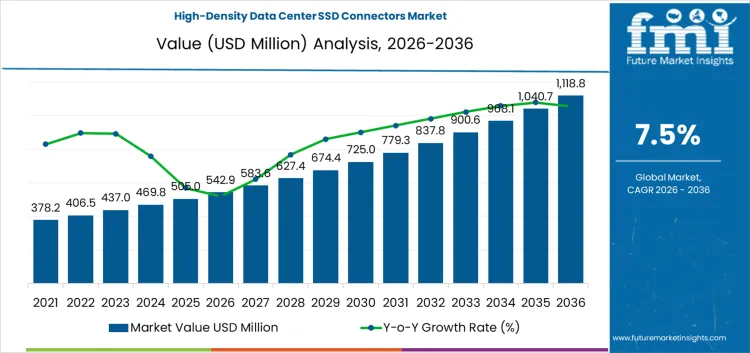
The high-density data center SSD connectors market is likely to be valued at USD 542.9 million in 2026 and is projected to reach USD 1,118.0 million by 2036, reflecting a CAGR of 7.5%. Market performance is shaped by concentration in hyperscale and enterprise data centers that require high-speed, high-reliability connectors. Regional manufacturing control affects component supply, quality testing, and logistics timelines. Adoption varies according to data center expansion, storage density requirements, and compliance with interconnect standards. Smaller suppliers face limitations in delivering validated connectors capable of sustaining thermal and operational loads across multiple platforms. Cost structures and reliability requirements influence supplier positioning.
Margin concentration favors operators providing certified, multi-platform connectors with validated performance, integration support, and long-term reliability testing. Fragmentation persists among regional and niche producers, while leading companies capture concentrated value through production control, standardized testing, and alignment with major data center OEM programs. Market outcomes are determined by connector reliability, operational performance, and platform integration rather than unit output alone. Geographic adoption varies depending on regional data center growth, regulatory compliance, and infrastructure investment, shaping supplier strategy and long-term financial returns.
Quick Stats of the High-Density Data Center SSD Connectors Market
- High-Density Data Center SSD Connectors Market Value (2026): USD 542.9 million
- High-Density Data Center SSD Connectors Forecast Value (2036): USD 1,118 million
- High-Density Data Center SSD Connectors Forecast CAGR 2026 to 2036: 7.5%
- Leading Interface in High-Density Data Center SSD Connectors Market: PCIe Gen5 (48 % share)
- Leading Data Center Type in High-Density Data Center SSD Connectors Market: Hyperscale (63 % share)
- Key Growth Regions in High-Density Data Center SSD Connectors Market: USA, China, Netherlands, Singapore
- Top Players in High-Density Data Center SSD Connectors Market: TE Connectivity, Amphenol, Molex, Foxconn Interconnect, JAE, Luxshare
What is the Growth Forecast for High-Density Data Center SSD Connectors Market through 2036?
Between 2026 and 2031, the high-density data center SSD connectors market is projected to grow from USD 542.9 million to USD 725.8 million, generating an absolute increase of USD 182.9 million and reflecting a CAGR of 7.5%. Growth is driven by adoption of PCIe Gen5, PCIe Gen4, and custom/proprietary interfaces across hyperscale and enterprise data centers. EDSFF, U.2, and legacy SSD form factors are primary applications. Expansion is supported by increasing demand for high-speed storage, server density, and low-latency data transfer. Suppliers focus on connector reliability, high data throughput, and compatibility with evolving SSD technologies.
From 2031 to 2036, the market is expected to expand from USD 725.8 million to USD 1,118 million, adding USD 392.2 million. Growth is fueled by broader adoption of PCIe Gen5 connectors, hyperscale expansion, and increasing data center workloads. Market drivers include faster storage requirements, higher server utilization, and need for scalable high-density solutions. Competitive advantage favors suppliers providing validated performance, compatibility with multiple SSD form factors, and strong relationships with data center operators. Leading companies include TE Connectivity, Amphenol, Molex, Foxconn Interconnect, JAE, and Luxshare.
High Density Data Center SSD Connectors Market Key Takeaways
| Metric | Value |
|---|---|
| Market Value (2026) | USD 542.9 million |
| Forecast Value (2036) | USD 1,118.00 million |
| Forecast CAGR 2026 to 2036 | 7.50% |
Source: FMI analysis based on primary research and proprietary forecasting model
How Are High-Density SSD Connectors Enabling Next-Generation Data Centers?
High-density data center SSD connectors are increasingly adopted to support high-speed, high-capacity solid-state drives in modern server infrastructures. Historically, storage connectivity relied on standard connectors, which limited bandwidth, density, and thermal management in enterprise data centers. Modern high-density connectors provide compact form factors, high signal integrity, and robust thermal performance, enabling efficient SSD integration in dense server racks. Data center operators, cloud service providers, and storage hardware manufacturers prioritize reliability, electrical performance, and compliance with industry standards. Early adoption focused on hyperscale and high-performance computing environments, while current demand extends to enterprise, colocation, and edge data centers driven by increasing data volumes, low-latency requirements, and storage density optimization. Connector durability, signal integrity, and insertion cycles influence supplier selection.
Rising data traffic, cloud adoption, and storage-intensive applications are shaping market growth. Compared with conventional connectors, high-density SSD connectors emphasize compact design, high-speed signal transmission, and thermal stability under continuous operation. Cost structures depend on material quality, precision manufacturing, and testing, concentrating margins among suppliers capable of delivering reliable, high-performance solutions. Data center operators adopt these connectors to enhance storage density, improve performance, and maintain operational reliability. By 2036, high-density SSD connectors are expected to become standard in enterprise and hyperscale data centers, supporting efficient, high-speed storage architectures and scalable infrastructure deployment.
What Factors Are Shaping the Demand for High-Density Data Center SSD Connectors in Terms of Interface and Data Center Type?
The demand for high-density data center SSD connectors is segmented by interface type and data center type. Interface types include PCIe Gen5, PCIe Gen4, and custom or proprietary connectors. Data center types include hyperscale facilities and enterprise data centers. Adoption is influenced by bandwidth requirements, signal integrity, and high-density integration needs. Uptake is driven by increasing data throughput, low-latency storage applications, and server scalability. Interface and data center type selection depend on SSD form factor, workload demands, and interoperability, ensuring reliable, high-performance, and scalable connectivity for modern storage systems in hyperscale and enterprise environments.
Why Is PCIe Gen5 Leading the Interface Segment in High-Density Data Center SSD Connectors?
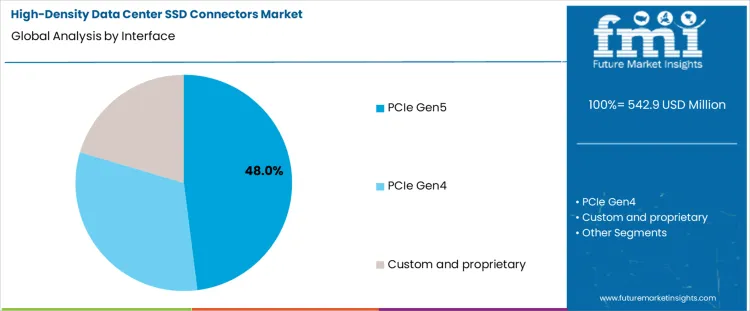
PCIe Gen5 accounts for approximately 48% of total interface demand, making it the leading category. Adoption is driven by increasing bandwidth requirements, low-latency storage applications, and next-generation SSD performance demands. These connectors support high-speed data transmission, signal integrity, and compatibility with modern servers. Operational procedures include precise alignment, insertion force verification, and thermal and electrical testing to ensure performance under continuous operation. PCIe Gen5 connectors enable high throughput, reduce bottlenecks, and maintain reliability under heavy workloads. The segment leads because it provides predictable performance, high-density integration, and scalability for hyperscale and enterprise storage deployments.
Operational factors further reinforce adoption. Connectors must withstand repeated insertions, maintain low contact resistance, and operate in high-temperature, high-vibration environments. Integration with SSD modules and backplanes ensures full compatibility and signal integrity. PCIe Gen5 leads because it delivers operational reliability, high bandwidth, and future-proof performance for modern data centers, supporting both hyperscale and enterprise storage growth.
Why Are Hyperscale Data Centers Representing the Largest Segment in High-Density Data Center SSD Connectors?
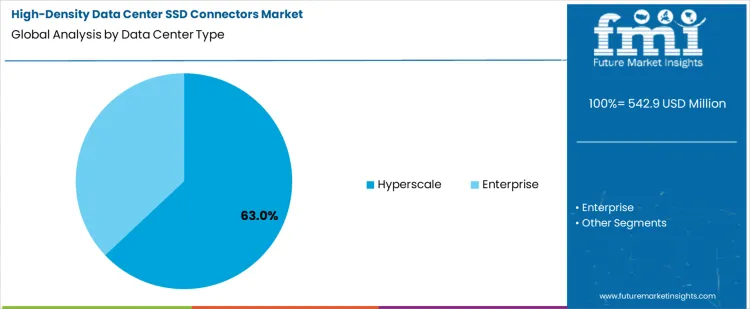
Hyperscale data centers account for approximately 63% of total data center type demand, making them the largest category. Adoption is driven by massive storage requirements, high-density server racks, and continuous workload demands. SSD connectors in hyperscale environments must provide reliable, high-speed connectivity while supporting large-scale deployments. Operational procedures include connector testing, alignment verification, and thermal management to prevent performance degradation.
Functional and operational factors further reinforce adoption. Connectors must handle high insertion cycles, maintain signal integrity, and integrate seamlessly with backplanes and SSD modules. Hyperscale data centers lead because high-density connectors deliver predictable performance, scalability, and reliability, enabling efficient storage expansion and supporting large-scale cloud, AI, and high-performance computing workloads.
How Are High-Density SSD Connectors Supporting Next-Generation Data Centers?
High-density data center SSD connectors are increasingly adopted to enable faster, higher-bandwidth storage interfaces while minimizing physical footprint in enterprise and hyperscale facilities. Adoption is strongest in regions with advanced cloud infrastructure, large-scale storage deployments, and high data throughput requirements. Connectors are selected for signal integrity, thermal performance, and mechanical reliability under repeated mating cycles. Growth is driven by increasing data center workloads, rising SSD adoption, and demand for high-speed interconnects. Investment focuses on miniaturization, low-latency transmission, and material reliability. Operators prioritize connectors that maintain consistent performance, withstand high-density deployments, and integrate with existing server and storage architectures.
Why Are Regional Data Center Expansion and Bandwidth Requirements Driving Adoption?
Demand is influenced by local cloud computing growth, enterprise storage needs, and performance standards for low-latency applications. Data center operators adopt high-density SSD connectors to improve storage throughput, reduce interconnect bottlenecks, and support next-generation workloads. Connectors offering low insertion loss, high mating cycles, and thermal tolerance gain preference. Adoption is concentrated in regions with large-scale hyperscale data centers and high enterprise storage demand. Operational reliability, performance consistency, and scalability drive procurement more than cost. Suppliers providing validated, high-performance connectors gain advantage among storage OEMs and data center integrators.
What Operational and Technical Challenges Limit Broader Deployment?
High manufacturing costs, precision engineering requirements, and signal integrity constraints restrict adoption. Performance can degrade under thermal stress, vibration, or high-density stacking. Integration with existing server architectures and high-speed storage protocols requires technical expertise. Smaller data centers or regions with limited infrastructure adopt connectors more slowly. These factors concentrate early deployment among hyperscale operators, cloud service providers, and regions with advanced data center ecosystems.
How Are Material Innovation and Collaborative Development Shaping Market Growth?
Recent developments include miniaturized connector designs, high-conductivity alloys, and improved EMI shielding for signal fidelity in dense storage arrays. Collaboration between connector manufacturers, SSD suppliers, and server integrators ensures performance validation, thermal reliability, and compatibility with emerging storage standards. Pilot installations evaluate insertion cycles, data integrity, and thermal performance before large-scale deployment. Quality monitoring, standardization, and traceability maintain reliability. Focus is on high-speed performance, durability, and integration rather than cost or volume. Collaborative initiatives enable broader adoption of high-density SSD connectors across hyperscale and enterprise data center infrastructures.
What is the Demand for High-Density Data Center SSD Connectors by Country?
| Country | CAGR (%) |
|---|---|
| USA | 7.5% |
| China | 7.0% |
| Netherlands | 6.8% |
| Singapore | 6.5% |
Source: FMI analysis based on primary research and proprietary forecasting model
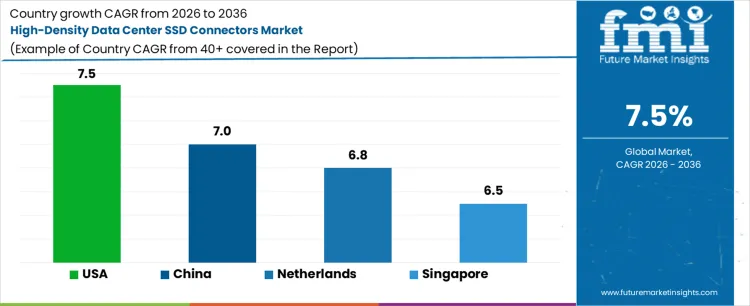
Demand for high-density data center SSD connectors is rising as cloud service providers, hyperscale data centers, and enterprise IT infrastructures adopt advanced storage solutions to enhance performance, scalability, and reliability. The USA leads with a 7.5% CAGR, driven by rapid expansion of hyperscale data centers, adoption of high-speed storage technologies, and increasing SSD deployment. China follows at 7.0%, supported by growing cloud computing infrastructure and enterprise IT upgrades. The Netherlands records 6.8% growth, shaped by European data center expansion and adoption of high-density storage interconnects. Singapore shows 6.5% CAGR, reflecting steady adoption in regional data centers and growth in enterprise and cloud storage requirements.
How Is the United States Experiencing Growth in the High-Density Data Center SSD Connectors Market?
United States is experiencing growth at a CAGR of 7.5%, supported by adoption of High-Density Data Center SSD Connectors Market solutions to enhance storage density, signal integrity, and reliability in enterprise and hyperscale data centers. Manufacturers and technology providers are producing connectors optimized for high-speed data transfer, thermal performance, and durability under continuous operation. Demand is concentrated in data center hubs, cloud computing facilities, and storage hardware R&D centers. Investments focus on material quality, signal performance, and compliance with data center standards rather than large-scale deployment. Growth reflects increasing cloud adoption, industrial demand for high-performance storage solutions, and data center modernization initiatives.
- Data center modernization drives adoption.
- Connectors optimize data transfer, thermal performance, and reliability.
- Data center hubs and R&D centers concentrate demand.
- Material quality and signal integrity guide investment.
How Is China Witnessing Growth in the High-Density Data Center SSD Connectors Market?
China is witnessing growth at a CAGR of 7%, fueled by adoption of High-Density Data Center SSD Connectors Market solutions to support high-speed storage and scalability in enterprise and hyperscale data centers. Manufacturers and suppliers are deploying connectors optimized for thermal stability, signal integrity, and long-term durability. Demand is concentrated in cloud computing hubs, industrial data centers, and R&D facilities. Investments prioritize connector performance, integration with storage hardware, and compliance with data center standards rather than mass-scale deployment. Growth reflects industrial adoption of high-performance storage systems, expanding cloud infrastructure, and government support for digital economy initiatives.
- High-performance storage drives adoption.
- Connectors ensure thermal stability and signal integrity.
- Cloud computing hubs and data centers concentrate demand.
- Connector performance and hardware integration guide investment.
How Is the Netherlands Experiencing Growth in the High-Density Data Center SSD Connectors Market?
Netherlands is experiencing growth at a CAGR of 6.8%, supported by adoption of High-Density Data Center SSD Connectors Market solutions to optimize storage systems in hyperscale and enterprise data centers. Manufacturers and technology providers are producing connectors designed for high-speed data transfer, thermal management, and long-term reliability. Demand is concentrated in data center clusters, cloud infrastructure hubs, and R&D centers. Investments focus on material performance, signal quality, and compliance with data center standards rather than large-scale deployment. Growth reflects the industrial push for storage optimization, increasing data traffic, and adoption of high-performance data center architectures.
- Data storage optimization drives adoption.
- Connectors enhance high-speed data transfer and durability.
- Data center clusters and cloud hubs concentrate demand.
- Material performance and signal quality guide investment.
How Is Singapore Witnessing Growth in the High-Density Data Center SSD Connectors Market?
Singapore is witnessing growth at a CAGR of 6.5%, fueled by adoption of High-Density Data Center SSD Connectors Market solutions in enterprise and hyperscale data centers to enhance storage efficiency, thermal stability, and operational reliability. Manufacturers and suppliers are deploying connectors optimized for high-speed signal transmission, durability, and integration with storage hardware. Demand is concentrated in data center hubs, cloud computing facilities, and R&D centers. Investments prioritize connector performance, thermal management, and compliance with data center standards rather than fleet-scale deployment. Growth reflects industrial adoption of advanced storage solutions, increasing cloud services, and data traffic growth across the region.
- Storage efficiency drives adoption.
- Connectors optimize signal transmission and thermal stability.
- Data center hubs and cloud facilities concentrate demand.
- Connector performance and operational reliability guide investment.
Who Competes in the High-Density Data Center SSD Connectors Market and What Defines Their Capabilities?
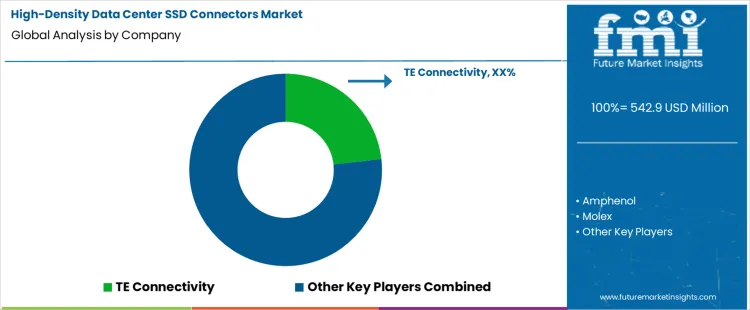
Competition in the high-density data center SSD connectors market is defined by signal integrity, thermal management, and scalability for high-performance storage applications. TE Connectivity supplies high-density connectors engineered for reliable data transmission, low insertion loss, and compatibility with enterprise SSD form factors. Amphenol develops connectors optimized for high-speed SSDs, emphasizing mechanical stability and thermal resilience in data center environments. Molex provides modular connector platforms designed for high-density deployment and signal integrity across multiple lanes. Foxconn Interconnect delivers connectors engineered for dense server architectures, supporting high data throughput and thermal management. JAE supplies SSD connectors with robust mechanical design and low-profile integration for rack-mounted storage systems.
Luxshare focuses on high-density connectors compatible with enterprise SSDs and high-speed serial interfaces. Other participants include regional and specialty interconnect providers offering compact, high-reliability connectors for server and storage systems. Differentiation arises from signal performance, insertion durability, thermal tolerance, material quality, and ease of integration with existing server architectures. Market relevance is shaped by ability to support higher lane counts, maintain low signal loss, ensure mechanical reliability under repeated insertion cycles, and integrate with dense data center environments while enabling efficient cooling and high-speed data transmission.
Key Players in the High-Density Data Center SSD Connectors Market
- TE Connectivity
- Amphenol
- Molex
- Foxconn Interconnect
- JAE
- Luxshare
Scope of the Report
| Items | Values |
|---|---|
| Quantitative Units (2026) | USD million |
| Interface | PCIe Gen5, PCIe Gen4, Custom and proprietary |
| Data Center Type | Hyperscale, Enterprise |
| SSD Form Factor | EDSFF, U.2 and legacy |
| Region | Asia Pacific, Europe, North America, Latin America, Middle East & Africa |
| Key Countries Covered | USA, China, Netherlands, Singapore |
| Key Companies Profiled | TE Connectivity, Amphenol, Molex, Foxconn Interconnect, JAE, Luxshare |
| Additional Attributes | Dollar sales by interface, data center type, and SSD form factor; regional CAGR, volume and value growth projections; adoption across hyperscale and enterprise data centers; validated high-speed performance, thermal stability, and mechanical reliability; integration with PCIe Gen4/Gen5, EDSFF, U.2, and legacy SSD modules; focus on high-density connectivity, low insertion loss, and signal integrity; concentration of margins among suppliers delivering validated, high-performance connectors with multi-platform certification and data center integration support. |
High-Density Data Center SSD Connectors Market Segmentation
Interface:
- PCIe Gen5
- PCIe Gen4
- Custom and proprietary
Data Center Type:
- Hyperscale
- Enterprise
SSD Form Factor:
- EDSFF
- U.2 and legacy
Region:
- Asia Pacific
- China
- Japan
- South Korea
- India
- Australia & New Zealand
- ASEAN
- Rest of Asia Pacific
- Europe
- Germany
- United Kingdom
- France
- Italy
- Spain
- Nordic
- BENELUX
- Rest of Europe
- North America
- United States
- Canada
- Mexico
- Latin America
- Brazil
- Chile
- Rest of Latin America
- Middle East & Africa
- Kingdom of Saudi Arabia
- Other GCC Countries
- Turkey
- South Africa
- Other African Union
- Rest of Middle East & Africa
Bibliography
- Uptime Institute. (2023). Data center infrastructure standards and operational resilience. Uptime Institute.
- National Institute of Standards and Technology. (2024). Data center infrastructure reliability and performance measurement. NIST.
- International Electrotechnical Commission. (2024). Connectors for electronic equipment - Performance and reliability standards (IEC Standard). IEC.
- Storage Networking Industry Association (SNIA). (2023). Enterprise and Datacenter SSD Form Factors (EDSFF) specification resources. SNIA.
Frequently Asked Questions
How big is the high-density data center ssd connectors market in 2026?
The global high-density data center ssd connectors market is estimated to be valued at USD 542.9 million in 2026.
What will be the size of high-density data center ssd connectors market in 2036?
The market size for the high-density data center ssd connectors market is projected to reach USD 1,118.8 million by 2036.
How much will be the high-density data center ssd connectors market growth between 2026 and 2036?
The high-density data center ssd connectors market is expected to grow at a 7.5% CAGR between 2026 and 2036.
What are the key product types in the high-density data center ssd connectors market?
The key product types in high-density data center ssd connectors market are pcie gen5, pcie gen4 and custom and proprietary.
Which data center type segment to contribute significant share in the high-density data center ssd connectors market in 2026?
In terms of data center type, hyperscale segment to command 63.0% share in the high-density data center ssd connectors market in 2026.
Preview the report firsthand - request a free sample
Get SampleGet the brochure for pricing and purchase details.
Get PDFTable of Content
- Executive Summary
- Global Market Outlook
- Demand-side Trends
- Supply-side Trends
- Technology Roadmap Analysis
- Analysis and Recommendations
- Market Overview
- Market Coverage / Taxonomy
- Market Definition / Scope / Limitations
- Market Background
- Market Dynamics
- Drivers
- Restraints
- Opportunity
- Trends
- Scenario Forecast
- Demand in Optimistic Scenario
- Demand in Likely Scenario
- Demand in Conservative Scenario
- Opportunity Map Analysis
- Product Life Cycle Analysis
- Supply Chain Analysis
- Investment Feasibility Matrix
- Value Chain Analysis
- PESTLE and Porter’s Analysis
- Regulatory Landscape
- Regional Parent Market Outlook
- Production and Consumption Statistics
- Import and Export Statistics
- Market Dynamics
- Global Market Analysis 2021 to 2025 and Forecast, 2026 to 2036
- Historical Market Size Value (USD Million) Analysis, 2021 to 2025
- Current and Future Market Size Value (USD Million) Projections, 2026 to 2036
- Y-o-Y Growth Trend Analysis
- Absolute $ Opportunity Analysis
- Global Market Pricing Analysis 2021 to 2025 and Forecast 2026 to 2036
- Global Market Analysis 2021 to 2025 and Forecast 2026 to 2036, By Interface
- Introduction / Key Findings
- Historical Market Size Value (USD Million) Analysis By Interface , 2021 to 2025
- Current and Future Market Size Value (USD Million) Analysis and Forecast By Interface , 2026 to 2036
- PCIe Gen5
- PCIe Gen4
- Custom and proprietary
- PCIe Gen5
- Y-o-Y Growth Trend Analysis By Interface , 2021 to 2025
- Absolute $ Opportunity Analysis By Interface , 2026 to 2036
- Global Market Analysis 2021 to 2025 and Forecast 2026 to 2036, By Data Center Type
- Introduction / Key Findings
- Historical Market Size Value (USD Million) Analysis By Data Center Type, 2021 to 2025
- Current and Future Market Size Value (USD Million) Analysis and Forecast By Data Center Type, 2026 to 2036
- Hyperscale
- Enterprise
- Hyperscale
- Y-o-Y Growth Trend Analysis By Data Center Type, 2021 to 2025
- Absolute $ Opportunity Analysis By Data Center Type, 2026 to 2036
- Global Market Analysis 2021 to 2025 and Forecast 2026 to 2036, By SSD Form Factor
- Introduction / Key Findings
- Historical Market Size Value (USD Million) Analysis By SSD Form Factor, 2021 to 2025
- Current and Future Market Size Value (USD Million) Analysis and Forecast By SSD Form Factor, 2026 to 2036
- EDSFF
- U.2 and legacy
- EDSFF
- Y-o-Y Growth Trend Analysis By SSD Form Factor, 2021 to 2025
- Absolute $ Opportunity Analysis By SSD Form Factor, 2026 to 2036
- Global Market Analysis 2021 to 2025 and Forecast 2026 to 2036, By Region
- Introduction
- Historical Market Size Value (USD Million) Analysis By Region, 2021 to 2025
- Current Market Size Value (USD Million) Analysis and Forecast By Region, 2026 to 2036
- North America
- Latin America
- Western Europe
- Eastern Europe
- East Asia
- South Asia and Pacific
- Middle East & Africa
- Market Attractiveness Analysis By Region
- North America Market Analysis 2021 to 2025 and Forecast 2026 to 2036, By Country
- Historical Market Size Value (USD Million) Trend Analysis By Market Taxonomy, 2021 to 2025
- Market Size Value (USD Million) Forecast By Market Taxonomy, 2026 to 2036
- By Country
- USA
- Canada
- Mexico
- By Interface
- By Data Center Type
- By SSD Form Factor
- By Country
- Market Attractiveness Analysis
- By Country
- By Interface
- By Data Center Type
- By SSD Form Factor
- Key Takeaways
- Latin America Market Analysis 2021 to 2025 and Forecast 2026 to 2036, By Country
- Historical Market Size Value (USD Million) Trend Analysis By Market Taxonomy, 2021 to 2025
- Market Size Value (USD Million) Forecast By Market Taxonomy, 2026 to 2036
- By Country
- Brazil
- Chile
- Rest of Latin America
- By Interface
- By Data Center Type
- By SSD Form Factor
- By Country
- Market Attractiveness Analysis
- By Country
- By Interface
- By Data Center Type
- By SSD Form Factor
- Key Takeaways
- Western Europe Market Analysis 2021 to 2025 and Forecast 2026 to 2036, By Country
- Historical Market Size Value (USD Million) Trend Analysis By Market Taxonomy, 2021 to 2025
- Market Size Value (USD Million) Forecast By Market Taxonomy, 2026 to 2036
- By Country
- Germany
- UK
- Italy
- Spain
- France
- Nordic
- BENELUX
- Rest of Western Europe
- By Interface
- By Data Center Type
- By SSD Form Factor
- By Country
- Market Attractiveness Analysis
- By Country
- By Interface
- By Data Center Type
- By SSD Form Factor
- Key Takeaways
- Eastern Europe Market Analysis 2021 to 2025 and Forecast 2026 to 2036, By Country
- Historical Market Size Value (USD Million) Trend Analysis By Market Taxonomy, 2021 to 2025
- Market Size Value (USD Million) Forecast By Market Taxonomy, 2026 to 2036
- By Country
- Russia
- Poland
- Hungary
- Balkan & Baltic
- Rest of Eastern Europe
- By Interface
- By Data Center Type
- By SSD Form Factor
- By Country
- Market Attractiveness Analysis
- By Country
- By Interface
- By Data Center Type
- By SSD Form Factor
- Key Takeaways
- East Asia Market Analysis 2021 to 2025 and Forecast 2026 to 2036, By Country
- Historical Market Size Value (USD Million) Trend Analysis By Market Taxonomy, 2021 to 2025
- Market Size Value (USD Million) Forecast By Market Taxonomy, 2026 to 2036
- By Country
- China
- Japan
- South Korea
- By Interface
- By Data Center Type
- By SSD Form Factor
- By Country
- Market Attractiveness Analysis
- By Country
- By Interface
- By Data Center Type
- By SSD Form Factor
- Key Takeaways
- South Asia and Pacific Market Analysis 2021 to 2025 and Forecast 2026 to 2036, By Country
- Historical Market Size Value (USD Million) Trend Analysis By Market Taxonomy, 2021 to 2025
- Market Size Value (USD Million) Forecast By Market Taxonomy, 2026 to 2036
- By Country
- India
- ASEAN
- Australia & New Zealand
- Rest of South Asia and Pacific
- By Interface
- By Data Center Type
- By SSD Form Factor
- By Country
- Market Attractiveness Analysis
- By Country
- By Interface
- By Data Center Type
- By SSD Form Factor
- Key Takeaways
- Middle East & Africa Market Analysis 2021 to 2025 and Forecast 2026 to 2036, By Country
- Historical Market Size Value (USD Million) Trend Analysis By Market Taxonomy, 2021 to 2025
- Market Size Value (USD Million) Forecast By Market Taxonomy, 2026 to 2036
- By Country
- Kingdom of Saudi Arabia
- Other GCC Countries
- Turkiye
- South Africa
- Other African Union
- Rest of Middle East & Africa
- By Interface
- By Data Center Type
- By SSD Form Factor
- By Country
- Market Attractiveness Analysis
- By Country
- By Interface
- By Data Center Type
- By SSD Form Factor
- Key Takeaways
- Key Countries Market Analysis
- USA
- Pricing Analysis
- Market Share Analysis, 2025
- By Interface
- By Data Center Type
- By SSD Form Factor
- Canada
- Pricing Analysis
- Market Share Analysis, 2025
- By Interface
- By Data Center Type
- By SSD Form Factor
- Mexico
- Pricing Analysis
- Market Share Analysis, 2025
- By Interface
- By Data Center Type
- By SSD Form Factor
- Brazil
- Pricing Analysis
- Market Share Analysis, 2025
- By Interface
- By Data Center Type
- By SSD Form Factor
- Chile
- Pricing Analysis
- Market Share Analysis, 2025
- By Interface
- By Data Center Type
- By SSD Form Factor
- Germany
- Pricing Analysis
- Market Share Analysis, 2025
- By Interface
- By Data Center Type
- By SSD Form Factor
- UK
- Pricing Analysis
- Market Share Analysis, 2025
- By Interface
- By Data Center Type
- By SSD Form Factor
- Italy
- Pricing Analysis
- Market Share Analysis, 2025
- By Interface
- By Data Center Type
- By SSD Form Factor
- Spain
- Pricing Analysis
- Market Share Analysis, 2025
- By Interface
- By Data Center Type
- By SSD Form Factor
- France
- Pricing Analysis
- Market Share Analysis, 2025
- By Interface
- By Data Center Type
- By SSD Form Factor
- India
- Pricing Analysis
- Market Share Analysis, 2025
- By Interface
- By Data Center Type
- By SSD Form Factor
- ASEAN
- Pricing Analysis
- Market Share Analysis, 2025
- By Interface
- By Data Center Type
- By SSD Form Factor
- Australia & New Zealand
- Pricing Analysis
- Market Share Analysis, 2025
- By Interface
- By Data Center Type
- By SSD Form Factor
- China
- Pricing Analysis
- Market Share Analysis, 2025
- By Interface
- By Data Center Type
- By SSD Form Factor
- Japan
- Pricing Analysis
- Market Share Analysis, 2025
- By Interface
- By Data Center Type
- By SSD Form Factor
- South Korea
- Pricing Analysis
- Market Share Analysis, 2025
- By Interface
- By Data Center Type
- By SSD Form Factor
- Russia
- Pricing Analysis
- Market Share Analysis, 2025
- By Interface
- By Data Center Type
- By SSD Form Factor
- Poland
- Pricing Analysis
- Market Share Analysis, 2025
- By Interface
- By Data Center Type
- By SSD Form Factor
- Hungary
- Pricing Analysis
- Market Share Analysis, 2025
- By Interface
- By Data Center Type
- By SSD Form Factor
- Kingdom of Saudi Arabia
- Pricing Analysis
- Market Share Analysis, 2025
- By Interface
- By Data Center Type
- By SSD Form Factor
- Turkiye
- Pricing Analysis
- Market Share Analysis, 2025
- By Interface
- By Data Center Type
- By SSD Form Factor
- South Africa
- Pricing Analysis
- Market Share Analysis, 2025
- By Interface
- By Data Center Type
- By SSD Form Factor
- USA
- Market Structure Analysis
- Competition Dashboard
- Competition Benchmarking
- Market Share Analysis of Top Players
- By Regional
- By Interface
- By Data Center Type
- By SSD Form Factor
- Competition Analysis
- Competition Deep Dive
- TE Connectivity
- Overview
- Product Portfolio
- Profitability by Market Segments (Product/Age /Sales Channel/Region)
- Sales Footprint
- Strategy Overview
- Marketing Strategy
- Product Strategy
- Channel Strategy
- Amphenol
- Molex
- Foxconn Interconnect
- JAE
- Luxshare
- TE Connectivity
- Competition Deep Dive
- Assumptions & Acronyms Used
- Research Methodology


