

- Industry Size (2026)
- USD 614.9 Mn
- Forecast (2036)
- USD 1566.1 Mn
- CAGR (2026 to 2036)
- 9.80%
Catalysts for Bio-Jet Fuel Market Forecast and Outlook 2026 to 2036
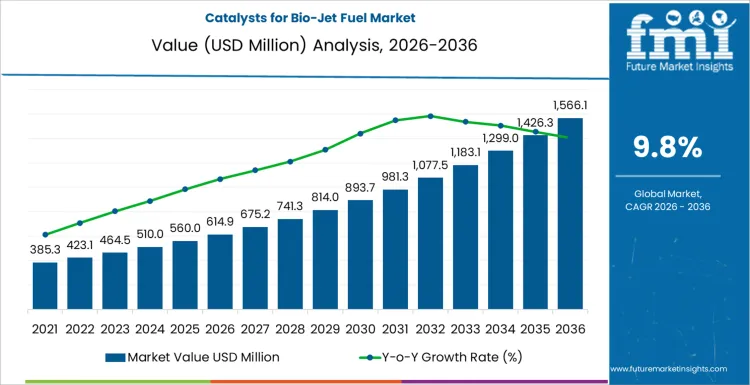
The catalysts for bio-jet fuel market is projected to grow from USD 614.9 million in 2026 to USD 1,566.1 million by 2036, at a CAGR of 9.80%. Procurement decisions in this market are largely shaped by risk mitigation rather than unit cost optimization. Catalysts are typically qualified alongside licensed process technologies, resulting in conservative buyer behavior and long evaluation timelines. Preference is given to suppliers with proven performance data under certified SAF pathways, as operational failure carries regulatory and reputational consequences.
Vendor lock-in is commonly established through catalyst-process co-development, where switching would require revalidation of fuel certification, operating conditions, and offtake agreements. Switching costs are therefore elevated by extended testing cycles, potential yield variability, and disruption to hydrogen and feedstock balances. Purchasing strategies are influenced by catalyst longevity, regeneration capability, and alignment with long-term airline offtake contracts rather than spot pricing. As a result, value is increasingly captured by suppliers embedded early in project design, reinforcing stable but selective demand patterns across the forecast period.
Quick Stats for Catalysts for Bio-Jet Fuel Market
- Catalysts for Bio-Jet Fuel Market Value (2026): USD 614.9 Million
- Catalysts for Bio-Jet Fuel Market Forecast Value (2036): USD 1,566.1 Million
- Catalysts for Bio-Jet Fuel Market Forecast CAGR 2026 to 2036: 9.80%
- Leading Catalyst Type in Catalysts for Bio-Jet Fuel Market: Hydrotreating & Hydrocracking Catalysts (42% share)
- Key Growth Regions in Catalysts for Bio-Jet Fuel Market: Asia Pacific, Europe, North America, Latin America, Middle East & Africa
- Top Key Players in Catalysts for Bio-Jet Fuel Market: Clariant AG, Johnson Matthey, BASF SE, Topsoe, UOP (Honeywell), Shell Catalysts & Technologies, Axens, Albemarle Corporation, Chevron Lummus Global, ExxonMobil Catalysts and Licensing
Catalysts for Bio-Jet Fuel Market Key Takeaways
| Metric | Value |
|---|---|
| Catalysts for Bio-Jet Fuel Market Value (2026) | USD 614.9 Million |
| Catalysts for Bio-Jet Fuel Market Forecast Value (2036) | USD 1,566.1 Million |
| Catalysts for Bio-Jet Fuel Market Forecast CAGR 2026 to 2036 | 9.80% |
How are Aviation Decarbonization Targets and Fuel Certification Requirements Shaping the Catalysts for Bio-Jet Fuel Market?
The catalysts for bio-jet fuel market is expanding as the aviation sector accelerates efforts to reduce lifecycle carbon emissions while maintaining strict performance and safety standards. Sustainable aviation fuel (SAF) pathways such as hydroprocessed esters and fatty acids (HEFA), alcohol-to-jet (ATJ), and Fischer-Tropsch synthesis rely on advanced catalytic systems to convert diverse bio-based feedstocks into drop-in jet fuel. Catalysts play a critical role in hydrogenation, deoxygenation, isomerization, and cracking steps, ensuring fuel properties such as energy density, freezing point, and thermal stability meet aviation specifications.
ACATALYST performance and process flexibility are key adoption factors for fuel producers. End users evaluate catalysts based on conversion efficiency, selectivity toward jet-range hydrocarbons, resistance to deactivation, and tolerance to feedstock impurities commonly found in waste oils, fats, and biomass-derived intermediates. The ability to operate under continuous, high-pressure conditions with extended catalyst lifetimes directly influences production economics. Tailored catalyst formulations enable refiners and biofuel producers to optimize yields while accommodating variable feedstock quality and evolving process configurations.
Policy incentives and airline offtake commitments are further reinforcing market growth. Blending mandates, carbon offset programs, and long-term procurement agreements are accelerating investment in commercial-scale SAF facilities. At the same time, certification frameworks and sustainability criteria require consistent, traceable fuel quality, placing greater emphasis on robust catalytic systems. For catalyst suppliers, competitive advantage increasingly depends on process integration expertise, collaboration with technology licensors, and the ability to deliver catalysts that support scalable, certified bio-jet fuel production positioning catalysts as a foundational enabler of the sustainable aviation fuel value chain.
How is the Catalysts for Bio-Jet Fuel Market Organized by Process Route and Catalyst Type?
The catalysts for bio-jet fuel market is organized by process route and catalyst type, reflecting how feedstock conversion pathways and upgrading severity determine catalyst requirements. By process route, HEFA or HVO pathways form the leading segment, as they are commercially established and compatible with existing refinery infrastructure. Other routes include alcohol-to-jet (ATJ), Fischer-Tropsch (FT) and gasification pathways, and emerging conversion technologies under development. By catalyst type, hydrotreating and hydrocracking catalysts dominate demand, supported by zeolite and oxide-based catalysts and other tailored systems designed for specific conversion steps and feedstock profiles.
Why Do HEFA Or HVO Pathways Drive Catalyst Demand In The Bio-Jet Fuel Market?
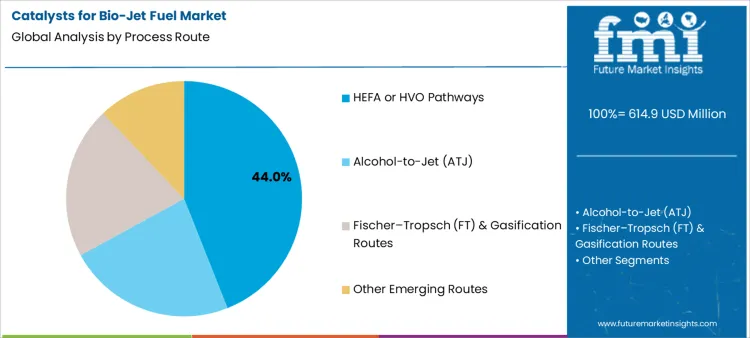
HEFA or HVO pathways account for 44% share of the catalysts for bio-jet fuel market because they efficiently convert lipid-based feedstocks into drop-in aviation fuels. These routes rely on hydrogenation, deoxygenation, and isomerization steps that are well understood at industrial scale. Refiners favor HEFA processes due to compatibility with existing hydrotreating units and predictable fuel quality outcomes. High conversion yields and proven certification for aviation use support widespread adoption. These operational maturity and infrastructure alignment advantages explain why HEFA and HVO pathways remain the primary driver of catalyst demand.
Why Do Hydrotreating and Hydrocracking Catalysts Lead Catalyst Type Adoption in the Bio-Jet Fuel Market?
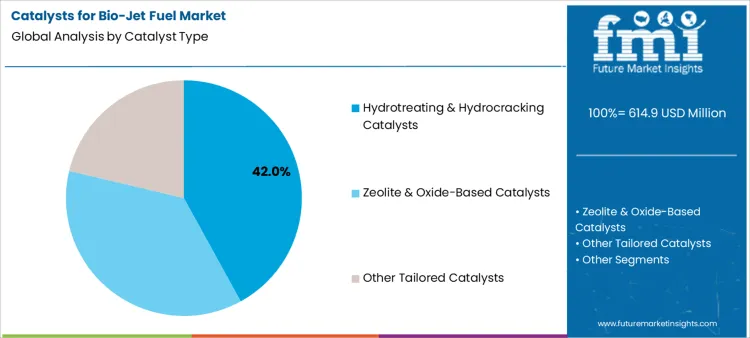
Hydrotreating and hydrocracking catalysts hold 42% share of the catalysts for bio-jet fuel market because they are essential for removing oxygen, sulfur, and nitrogen from bio-based feedstocks. These catalysts enable precise control of molecular structure to meet jet fuel specifications for energy density and cold-flow properties. Producers value their robustness under high pressure and temperature conditions typical of fuel upgrading processes. Compatibility with refinery operations and established regeneration practices further support adoption. These performance reliability and scalability benefits explain why hydrotreating and hydrocracking catalysts remain the dominant catalyst type.
What are the Key Dynamics of the Catalysts for Bio-Jet Fuel Market?
The catalysts for bio-jet fuel market is driven by increasing adoption of sustainable aviation fuel (SAF) as airlines and fuel producers seek to reduce lifecycle carbon emissions while maintaining performance parity with conventional jet fuel. Catalysts play a central role in converting bio-based feedstocks such as vegetable oils, waste fats, used cooking oil, and biomass-derived intermediates into drop-in jet fuel through processes including hydroprocessing, isomerization, and upgrading. For catalyst suppliers and SAF producers, activity, selectivity toward jet-range hydrocarbons, resistance to deactivation, and compatibility with variable feedstock quality are critical factors influencing commercial deployment and long-term operational efficiency.
How Do Application Trends and Industry Requirements Shape This Market?
Application trends and industry requirements are shaping the catalysts for bio-jet fuel market as aviation stakeholders prioritize fuel certification, process scalability, and refinery integration. Catalysts must enable production of fuels that meet stringent aviation standards while supporting consistent product quality across different production pathways. Integration with existing refinery infrastructure requires catalysts that perform reliably under established operating conditions and tolerate impurities present in waste-derived feedstocks. Growing investment in SAF production capacity, co-processing with fossil feedstocks, and multi-feedstock flexibility increases demand for robust catalyst systems tailored to specific conversion routes and plant configurations.
Why Do Technical and Economic Challenges Restrain Market Growth?
Technical and economic challenges restrain growth in the catalysts for bio-jet fuel market, particularly related to feedstock variability and process economics. Impurities such as sulfur, metals, and oxygenated compounds can accelerate catalyst deactivation, increasing replacement frequency and operating costs. Achieving high yields of jet-range hydrocarbons while minimizing hydrogen consumption and energy intensity remains technically demanding. In addition, high capital investment for SAF facilities, uncertainty in long-term feedstock availability, and sensitivity to policy incentives influence project viability. Lengthy certification and qualification processes further extend commercialization timelines for new catalyst formulations
How is the Catalysts for Bio-Jet Fuel Market Growing across Key Countries?
The catalysts for bio-jet fuel market is expanding rapidly as aviation fuel producers and refiners invest in alternative fuel pathways to support long-term decarbonization of air transport. These catalysts are critical in processes such as hydroprocessed esters and fatty acids (HEFA), alcohol-to-jet (ATJ), and Fischer-Tropsch synthesis, enabling efficient conversion of biomass-derived feedstocks into drop-in jet fuel. Country-wise growth varies based on aviation fuel demand, availability of bio-feedstocks, and integration of bio-refining technologies. High-growth markets are driven by aggressive fuel transition programs and refinery upgrades, while mature regions emphasize catalyst efficiency, selectivity, and long-term operational stability.
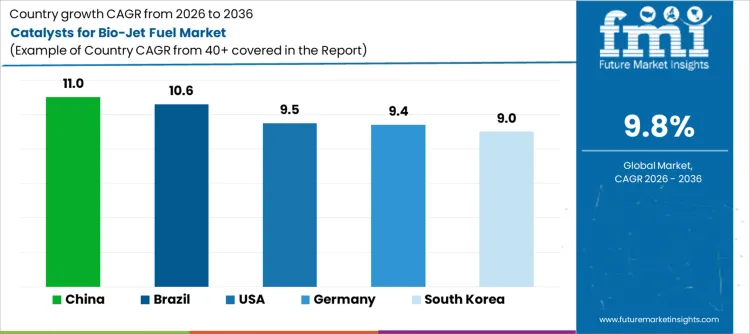
| Country | CAGR (%) |
|---|---|
| China | 11.0 |
| Brazil | 10.6 |
| United States | 9.5 |
| Germany | 9.4 |
| South Korea | 9.0 |
Why is China Leading the Catalysts for Bio-Jet Fuel Market?
China’s catalysts for bio-jet fuel market is expanding at a CAGR of 11.0% during 2026 to 2036, driven by rapid growth in aviation fuel consumption and increasing investment in alternative fuel technologies. As domestic airlines expand fleets and long-haul routes, refiners are exploring bio-jet fuel production to diversify fuel supply and improve energy security. Catalysts are central to upgrading vegetable oils, waste fats, and biomass-derived intermediates into aviation-grade fuels. Chinese refiners prioritize catalysts with high hydrogenation activity, resistance to feedstock impurities, and long cycle life under continuous operation. Integration of bio-jet fuel units within existing refinery complexes supports rapid adoption and scale-up. Domestic catalyst producers benefit from close collaboration with state-owned refiners and technology licensors. Procurement decisions emphasize catalyst durability, conversion efficiency, and adaptability to mixed feedstocks.
Why is Brazil Emerging as a High-Growth Market for Bio-Jet Fuel Catalysts?
Brazil’s catalysts for bio-jet fuel market is growing at a CAGR of 10.6% during 2026 to 2036, supported by abundant biomass feedstocks and a strong biofuels industry. The country’s experience with bio-ethanol and renewable diesel provides a foundation for scaling bio-jet fuel production. Catalysts are required to convert agricultural residues, oils, and alcohols into jet-grade hydrocarbons. Brazilian producers value catalysts that offer flexibility across feedstock types and stable performance under variable operating conditions. Adoption is concentrated in refinery-integrated projects and bio-refineries exploring aviation fuel pathways. Procurement decisions often favor suppliers offering technical support and catalysts compatible with existing hydrotreating infrastructure. Market growth is supported by aviation sector demand, export potential, and gradual scale-up of bio-jet fuel facilities.
What Is Driving Demand for Catalysts for Bio-Jet Fuel in the United States?
The United States catalysts for bio-jet fuel market is expanding at a CAGR of 9.5% during 2026 to 2036, driven by strong airline participation in alternative fuel programs and increasing deployment of sustainable aviation fuel (SAF) production facilities. Refiners and technology developers are investing in HEFA, ATJ, and synthetic fuel routes, all of which rely heavily on advanced catalysts. USA. producers emphasize catalyst selectivity, long operating cycles, and compatibility with large-scale continuous processing. Demand is strongest from commercial-scale SAF plants and refinery retrofits targeting aviation fuel production. Procurement decisions prioritize performance validation, supplier reliability, and integration with licensed process technologies. Market growth is reinforced by expanding SAF capacity and increasing offtake agreements between airlines and fuel producers.
How is Germany Supporting Growth in the Catalysts for Bio-Jet Fuel Market?
Germany’s catalysts for bio-jet fuel market is growing at a CAGR of 9.4% during 2026 to 2036, supported by advanced refining capabilities and strong participation in alternative aviation fuel research and deployment. German refiners focus on high-efficiency catalytic systems that enable precise conversion and tight fuel specification control. Catalysts are selected for their activity, resistance to deactivation, and ability to support synthetic fuel pathways. Adoption is driven by technology validation and long-term operational performance rather than rapid volume expansion. Procurement decisions favor suppliers with strong technical documentation and proven industrial references. Market growth is reinforced by Germany’s leadership in fuel technology development and refinery process optimization.
How is South Korea Expanding Use of Catalysts for Bio-Jet Fuel?
South Korea’s catalysts for bio-jet fuel market is expanding at a CAGR of 9.0% during 2026 to 2036, driven by rising aviation fuel demand and strategic investment in alternative fuel technologies. Refiners and energy companies are evaluating bio-jet fuel pathways to diversify fuel supply and support export-oriented aviation growth. Buyers emphasize catalyst efficiency, compatibility with existing refining units, and suitability for long-term continuous operation. Adoption is strongest in refinery-linked pilot and early commercial projects. Procurement decisions are influenced by supplier technical capability, catalyst life cycle performance, and alignment with international aviation fuel standards. Market growth is supported by continued investment in refining upgrades and alternative fuel development.
How are Companies Competing in the Catalysts for Bio-Jet Fuel Market?
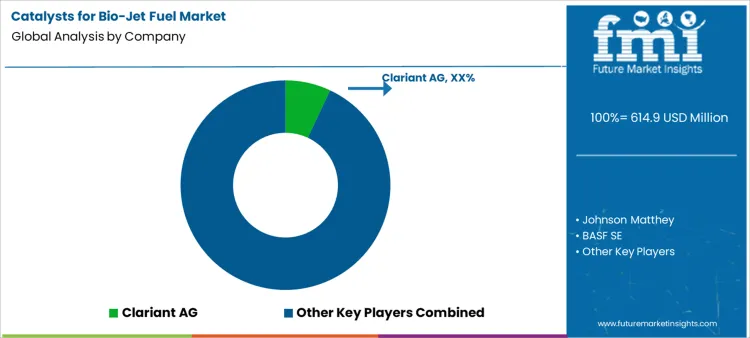
Competition in the catalysts for bio-jet fuel market is built on catalytic activity, selectivity toward jet-range hydrocarbons, feedstock flexibility, and process integration performance - attributes that matter to fuel producers, licensors, and airlines aiming to scale sustainable aviation fuels (SAF). Bio-jet fuel production often relies on catalytic upgrading pathways such as hydrodeoxygenation (HDO), hydrocracking, and Fischer-Tropsch synthesis, where catalysts must deliver high conversion, low coke formation, and longevity under severe conditions.
Clariant AG competes by offering tailored hydroprocessing catalysts designed for renewable feedstocks, with formulations focused on stable activity and resistance to deactivation from oxygenates. Its positioning emphasizes compatibility with existing refinery infrastructure and flexible feedstock profiles. Johnson Matthey differentiates through high-performance supported metal catalysts optimized for HDO and hydrotreating steps, with documented performance in pilot and commercial SAF pathways.
Large integrated technology providers and licensors strengthen competitive range through broad process suites. BASF SE, Topsoe, and UOP (Honeywell) position catalyst technologies alongside licensable process packages aimed at converting fats, oils, and greases (FOGs) and lignocellulosic intermediates into jet-range hydrocarbons with high yields. Their strategies emphasize strong catalyst life, low regeneration needs, and tight integration with proprietary reactor designs.
Refinery catalyst brands bring additional competitive depth. Shell Catalysts & Technologies and Axens leverage global refinery networks and catalyst support services to deliver bio-jet catalyst systems validated across regional feedstock mixes. Albemarle Corporation focuses on metal-based hydrotreating catalysts with strong activity and long cycle life. Integrated energy players like Chevron Lummus Global and ExxonMobil Catalysts and Licensing compete by bundling catalyst technologies with SAF process licensing, emphasizing refinery compatibility and lifecycle performance. Across the market, competitive advantage is defined by catalyst efficiency, robustness under renewable feedstock variability, and process integration rather than cost alone.
Key Players in Catalysts for Bio-Jet Fuel Market
- Clariant AG
- Johnson Matthey
- BASF SE
- Topsoe
- UOP (Honeywell)
- Shell Catalysts & Technologies
- Axens
- Albemarle Corporation
- Chevron Lummus Global
- ExxonMobil Catalysts and Licensing
Scope of Report
| Attribute | Details |
|---|---|
| Market Size Unit | USD Million |
| Process Route Covered | HEFA or HVO Pathways, Alcohol-to-Jet (ATJ), Fischer-Tropsch (FT) & Gasification Routes, Other Emerging Routes |
| Catalyst Type Covered | Hydrotreating & Hydrocracking Catalysts, Zeolite & Oxide-Based Catalysts, Other Tailored Catalysts |
| Countries Covered | China, Japan, South Korea, India, Australia & New Zealand, ASEAN, Rest of Asia Pacific, Germany, United Kingdom, France, Italy, Spain, Nordic, BENELUX, Rest of Europe, United States, Canada, Mexico, Brazil, Chile, Rest of Latin America, Kingdom of Saudi Arabia, Other GCC Countries, Turkey, South Africa, Other African Union, Rest of Middle East & Africa |
| Regions Covered | Asia Pacific, Europe, North America, Latin America, Middle East & Africa |
| Key Companies Profiled | Clariant AG, Johnson Matthey, BASF SE, Topsoe, UOP (Honeywell), Shell Catalysts & Technologies, Axens, Albemarle Corporation, Chevron Lummus Global, ExxonMobil Catalysts and Licensing |
| Additional Attributes | Dollar sales of catalysts for bio-jet fuel production are analyzed by conversion pathway and catalyst technology across sustainable aviation fuel value chains. The scope evaluates catalyst activity, selectivity, feedstock flexibility, resistance to deactivation, and suitability for continuous refining operations. Country-level analysis reflects SAF blending mandates, airline decarbonization targets, refinery co-processing investments, availability of biogenic feedstocks, and regulatory certification frameworks influencing commercial adoption of bio-jet fuel technologies. |
Catalysts for Bio-Jet Fuel Market by Key Segments
Process Route
- HEFA or HVO Pathways
- Alcohol-to-Jet (ATJ)
- Fischer-Tropsch (FT) & Gasification Routes
- Other Emerging Routes
Catalyst Type
- Hydrotreating & Hydrocracking Catalysts
- Zeolite & Oxide-Based Catalysts
- Other Tailored Catalysts
Region
- Asia Pacific
- China
- Japan
- South Korea
- India
- Australia & New Zealand
- ASEAN
- Rest of Asia Pacific
- Europe
- Germany
- United Kingdom
- France
- Italy
- Spain
- Nordic
- BENELUX
- Rest of Europe
- North America
- United States
- Canada
- Mexico
- Latin America
- Brazil
- Chile
- Rest of Latin America
- Middle East & Africa
- Kingdom of Saudi Arabia
- Other GCC Countries
- Turkey
- South Africa
- Other African Union
- Rest of Middle East & Africa
Bibliography
- International Energy Agency. (2024). net zero roadmap: Aviation sector update. IEA.
- European Union Aviation Safety Agency. (2024). Sustainable aviation fuel implementation and certification overview. EASA.
- National Renewable Energy Laboratory. (2024). Process design and techno‑economic analysis of sustainable aviation fuel pathways. USA. Department of Energy.
- Wang, W., et al. (2024). Catalytic upgrading of biomass‑derived intermediates to aviation fuels. Renewable and Sustainable Energy Reviews, 187, 113741.
- ASTM International. (2024). ASTM D7566: Standard specification for aviation turbine fuel containing synthesized hydrocarbons. ASTM.
Frequently Asked Questions
How big is the catalysts for bio-jet fuel market in 2026?
The global catalysts for bio-jet fuel market is estimated to be valued at USD 614.9 million in 2026.
What will be the size of catalysts for bio-jet fuel market in 2036?
The market size for the catalysts for bio-jet fuel market is projected to reach USD 1,566.1 million by 2036.
How much will be the catalysts for bio-jet fuel market growth between 2026 and 2036?
The catalysts for bio-jet fuel market is expected to grow at a 9.8% CAGR between 2026 and 2036.
What are the key product types in the catalysts for bio-jet fuel market?
The key product types in catalysts for bio-jet fuel market are hefa or hvo pathways, alcohol-to-jet (atj), fischer-tropsch (ft) & gasification routes and other emerging routes.
Which catalyst type segment to contribute significant share in the catalysts for bio-jet fuel market in 2026?
In terms of catalyst type, hydrotreating & hydrocracking catalysts segment to command 42.0% share in the catalysts for bio-jet fuel market in 2026.
Preview the report firsthand - request a free sample
Get SampleGet the brochure for pricing and purchase details.
Get PDFTable of Content
- Executive Summary
- Global Market Outlook
- Demand-side Trends
- Supply-side Trends
- Technology Roadmap Analysis
- Analysis and Recommendations
- Market Overview
- Market Coverage / Taxonomy
- Market Definition / Scope / Limitations
- Market Background
- Market Dynamics
- Drivers
- Restraints
- Opportunity
- Trends
- Scenario Forecast
- Demand in Optimistic Scenario
- Demand in Likely Scenario
- Demand in Conservative Scenario
- Opportunity Map Analysis
- Product Life Cycle Analysis
- Supply Chain Analysis
- Investment Feasibility Matrix
- Value Chain Analysis
- PESTLE and Porter’s Analysis
- Regulatory Landscape
- Regional Parent Market Outlook
- Production and Consumption Statistics
- Import and Export Statistics
- Market Dynamics
- Global Market Analysis 2021 to 2025 and Forecast, 2026 to 2036
- Historical Market Size Value (USD Million) Analysis, 2021 to 2025
- Current and Future Market Size Value (USD Million) Projections, 2026 to 2036
- Y-o-Y Growth Trend Analysis
- Absolute $ Opportunity Analysis
- Global Market Pricing Analysis 2021 to 2025 and Forecast 2026 to 2036
- Global Market Analysis 2021 to 2025 and Forecast 2026 to 2036, By Process Route
- Introduction / Key Findings
- Historical Market Size Value (USD Million) Analysis By Process Route, 2021 to 2025
- Current and Future Market Size Value (USD Million) Analysis and Forecast By Process Route, 2026 to 2036
- HEFA or HVO Pathways
- Alcohol-to-Jet (ATJ)
- Fischer-Tropsch (FT) & Gasification Routes
- Other Emerging Routes
- HEFA or HVO Pathways
- Y-o-Y Growth Trend Analysis By Process Route, 2021 to 2025
- Absolute $ Opportunity Analysis By Process Route, 2026 to 2036
- Global Market Analysis 2021 to 2025 and Forecast 2026 to 2036, By Catalyst Type
- Introduction / Key Findings
- Historical Market Size Value (USD Million) Analysis By Catalyst Type, 2021 to 2025
- Current and Future Market Size Value (USD Million) Analysis and Forecast By Catalyst Type, 2026 to 2036
- Hydrotreating & Hydrocracking Catalysts
- Zeolite & Oxide-Based Catalysts
- Other Tailored Catalysts
- Hydrotreating & Hydrocracking Catalysts
- Y-o-Y Growth Trend Analysis By Catalyst Type, 2021 to 2025
- Absolute $ Opportunity Analysis By Catalyst Type, 2026 to 2036
- Global Market Analysis 2021 to 2025 and Forecast 2026 to 2036, By Region
- Introduction
- Historical Market Size Value (USD Million) Analysis By Region, 2021 to 2025
- Current Market Size Value (USD Million) Analysis and Forecast By Region, 2026 to 2036
- North America
- Latin America
- Western Europe
- Eastern Europe
- East Asia
- South Asia and Pacific
- Middle East & Africa
- Market Attractiveness Analysis By Region
- North America Market Analysis 2021 to 2025 and Forecast 2026 to 2036, By Country
- Historical Market Size Value (USD Million) Trend Analysis By Market Taxonomy, 2021 to 2025
- Market Size Value (USD Million) Forecast By Market Taxonomy, 2026 to 2036
- By Country
- USA
- Canada
- Mexico
- By Process Route
- By Catalyst Type
- By Country
- Market Attractiveness Analysis
- By Country
- By Process Route
- By Catalyst Type
- Key Takeaways
- Latin America Market Analysis 2021 to 2025 and Forecast 2026 to 2036, By Country
- Historical Market Size Value (USD Million) Trend Analysis By Market Taxonomy, 2021 to 2025
- Market Size Value (USD Million) Forecast By Market Taxonomy, 2026 to 2036
- By Country
- Brazil
- Chile
- Rest of Latin America
- By Process Route
- By Catalyst Type
- By Country
- Market Attractiveness Analysis
- By Country
- By Process Route
- By Catalyst Type
- Key Takeaways
- Western Europe Market Analysis 2021 to 2025 and Forecast 2026 to 2036, By Country
- Historical Market Size Value (USD Million) Trend Analysis By Market Taxonomy, 2021 to 2025
- Market Size Value (USD Million) Forecast By Market Taxonomy, 2026 to 2036
- By Country
- Germany
- UK
- Italy
- Spain
- France
- Nordic
- BENELUX
- Rest of Western Europe
- By Process Route
- By Catalyst Type
- By Country
- Market Attractiveness Analysis
- By Country
- By Process Route
- By Catalyst Type
- Key Takeaways
- Eastern Europe Market Analysis 2021 to 2025 and Forecast 2026 to 2036, By Country
- Historical Market Size Value (USD Million) Trend Analysis By Market Taxonomy, 2021 to 2025
- Market Size Value (USD Million) Forecast By Market Taxonomy, 2026 to 2036
- By Country
- Russia
- Poland
- Hungary
- Balkan & Baltic
- Rest of Eastern Europe
- By Process Route
- By Catalyst Type
- By Country
- Market Attractiveness Analysis
- By Country
- By Process Route
- By Catalyst Type
- Key Takeaways
- East Asia Market Analysis 2021 to 2025 and Forecast 2026 to 2036, By Country
- Historical Market Size Value (USD Million) Trend Analysis By Market Taxonomy, 2021 to 2025
- Market Size Value (USD Million) Forecast By Market Taxonomy, 2026 to 2036
- By Country
- China
- Japan
- South Korea
- By Process Route
- By Catalyst Type
- By Country
- Market Attractiveness Analysis
- By Country
- By Process Route
- By Catalyst Type
- Key Takeaways
- South Asia and Pacific Market Analysis 2021 to 2025 and Forecast 2026 to 2036, By Country
- Historical Market Size Value (USD Million) Trend Analysis By Market Taxonomy, 2021 to 2025
- Market Size Value (USD Million) Forecast By Market Taxonomy, 2026 to 2036
- By Country
- India
- ASEAN
- Australia & New Zealand
- Rest of South Asia and Pacific
- By Process Route
- By Catalyst Type
- By Country
- Market Attractiveness Analysis
- By Country
- By Process Route
- By Catalyst Type
- Key Takeaways
- Middle East & Africa Market Analysis 2021 to 2025 and Forecast 2026 to 2036, By Country
- Historical Market Size Value (USD Million) Trend Analysis By Market Taxonomy, 2021 to 2025
- Market Size Value (USD Million) Forecast By Market Taxonomy, 2026 to 2036
- By Country
- Kingdom of Saudi Arabia
- Other GCC Countries
- Turkiye
- South Africa
- Other African Union
- Rest of Middle East & Africa
- By Process Route
- By Catalyst Type
- By Country
- Market Attractiveness Analysis
- By Country
- By Process Route
- By Catalyst Type
- Key Takeaways
- Key Countries Market Analysis
- USA
- Pricing Analysis
- Market Share Analysis, 2025
- By Process Route
- By Catalyst Type
- Canada
- Pricing Analysis
- Market Share Analysis, 2025
- By Process Route
- By Catalyst Type
- Mexico
- Pricing Analysis
- Market Share Analysis, 2025
- By Process Route
- By Catalyst Type
- Brazil
- Pricing Analysis
- Market Share Analysis, 2025
- By Process Route
- By Catalyst Type
- Chile
- Pricing Analysis
- Market Share Analysis, 2025
- By Process Route
- By Catalyst Type
- Germany
- Pricing Analysis
- Market Share Analysis, 2025
- By Process Route
- By Catalyst Type
- UK
- Pricing Analysis
- Market Share Analysis, 2025
- By Process Route
- By Catalyst Type
- Italy
- Pricing Analysis
- Market Share Analysis, 2025
- By Process Route
- By Catalyst Type
- Spain
- Pricing Analysis
- Market Share Analysis, 2025
- By Process Route
- By Catalyst Type
- France
- Pricing Analysis
- Market Share Analysis, 2025
- By Process Route
- By Catalyst Type
- India
- Pricing Analysis
- Market Share Analysis, 2025
- By Process Route
- By Catalyst Type
- ASEAN
- Pricing Analysis
- Market Share Analysis, 2025
- By Process Route
- By Catalyst Type
- Australia & New Zealand
- Pricing Analysis
- Market Share Analysis, 2025
- By Process Route
- By Catalyst Type
- China
- Pricing Analysis
- Market Share Analysis, 2025
- By Process Route
- By Catalyst Type
- Japan
- Pricing Analysis
- Market Share Analysis, 2025
- By Process Route
- By Catalyst Type
- South Korea
- Pricing Analysis
- Market Share Analysis, 2025
- By Process Route
- By Catalyst Type
- Russia
- Pricing Analysis
- Market Share Analysis, 2025
- By Process Route
- By Catalyst Type
- Poland
- Pricing Analysis
- Market Share Analysis, 2025
- By Process Route
- By Catalyst Type
- Hungary
- Pricing Analysis
- Market Share Analysis, 2025
- By Process Route
- By Catalyst Type
- Kingdom of Saudi Arabia
- Pricing Analysis
- Market Share Analysis, 2025
- By Process Route
- By Catalyst Type
- Turkiye
- Pricing Analysis
- Market Share Analysis, 2025
- By Process Route
- By Catalyst Type
- South Africa
- Pricing Analysis
- Market Share Analysis, 2025
- By Process Route
- By Catalyst Type
- USA
- Market Structure Analysis
- Competition Dashboard
- Competition Benchmarking
- Market Share Analysis of Top Players
- By Regional
- By Process Route
- By Catalyst Type
- Competition Analysis
- Competition Deep Dive
- Clariant AG
- Overview
- Product Portfolio
- Profitability by Market Segments (Product/Age /Sales Channel/Region)
- Sales Footprint
- Strategy Overview
- Marketing Strategy
- Product Strategy
- Channel Strategy
- Johnson Matthey
- BASF SE
- Topsoe
- UOP (Honeywell)
- Shell Catalysts & Technologies
- Axens
- Albemarle Corporation
- Chevron Lummus Global
- ExxonMobil Catalysts and Licensing
- Clariant AG
- Competition Deep Dive
- Assumptions & Acronyms Used
- Research Methodology


