

- Industry Size (2026)
- USD 1.9 Bn
- Forecast (2036)
- USD 3.8 Bn
- CAGR (2026 to 2036)
- 7.20%
High-Purity Silane Gases Market Forecast and Outlook 2026 to 2036
Global demand places the high-purity silane gases market at USD 1.9 billion in 2026, with forecasts indicating growth to USD 3.8 billion by 2036 at a 7.20% CAGR. Competitive power in this market is concentrated among a limited group of global gas suppliers that control purification know-how, safety-critical infrastructure, and long-term customer qualification pathways. Pricing authority is defended through deep technical integration with semiconductor and photovoltaic fabs, where silane purity, delivery stability, and safety compliance directly influence yield and uptime.
Entry barriers remain high due to the pyrophoric nature of silane, which necessitates specialized production assets, certified cylinder handling systems, and extensive regulatory approvals. Lengthy customer qualification cycles further discourage supplier switching, reinforcing incumbent positions. While regional suppliers continue to emerge, fragmentation remains constrained because large device manufacturers prefer proven vendors with global logistics reach and audited safety systems. As deposition processes become more yield-sensitive, market control is expected to remain aligned with suppliers capable of sustaining ultra-high purity and uninterrupted delivery rather than those competing on volume expansion alone.
Quick Stats for High-Purity Silane Gases Market
- High-Purity Silane Gases Market Value (2026): USD 1.9 Billion
- High-Purity Silane Gases Market Forecast Value (2036): USD 3.8 Billion
- High-Purity Silane Gases Market Forecast CAGR 2026 to 2036: 7.20%
- Leading Silane Type in High-Purity Silane Gases Market: Electronic-Grade Silane (SiH₄) - ~46% share
- Key Growth Regions in High-Purity Silane Gases Market: Asia Pacific, Europe, North America, Latin America, Middle East & Africa
- Fastest-Growing Countries: China, Brazil, United States, Germany, South Korea
- Key End-Use Industries: Semiconductors, Displays, Photovoltaics, Specialty Coatings & Glass
- Top Key Players in High-Purity Silane Gases Market: Air Liquide, Linde plc, Mitsui Chemicals, REC Silicon, SK Materials, Wacker Chemie AG, Shin-Etsu Chemical, Sumitomo Chemical, Dow, KCC Corporation
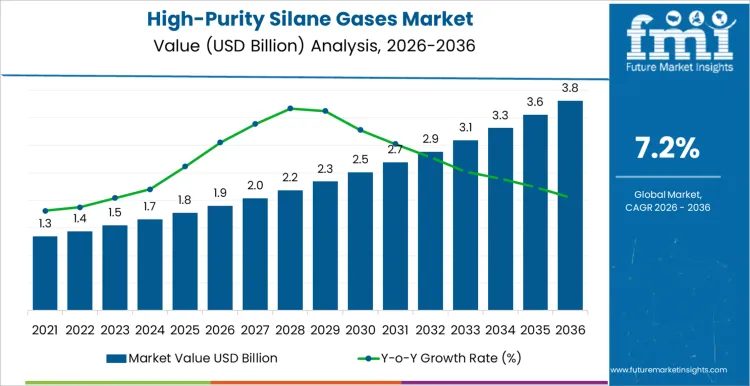
High-Purity Silane Gases Market Key Takeaways
| Metric | Value |
|---|---|
| High-Purity Silane Gases Market Value (2026) | USD 1.9 Billion |
| High-Purity Silane Gases Market Forecast Value (2036) | USD 3.8 Billion |
| High-Purity Silane Gases Market Forecast CAGR 2026 to 2036 | 7.20% |
How are Advanced Deposition Technologies and Yield Sensitivity Driving the High-Purity Silane Gases Market?
The high-purity silane gases market is expanding as semiconductor and photovoltaic manufacturers adopt increasingly advanced deposition processes that demand strict control over gas quality. High-purity silane is a critical precursor in chemical vapor deposition (CVD) and plasma-enhanced CVD used to deposit silicon-based thin films, dielectric layers, and passivation coatings. As device geometries shrink and layer uniformity requirements tighten, even trace contaminants in process gases can lead to defects, reduced yields, or compromised device performance making gas purity a central factor in fab operations.
Procurement decisions are strongly influenced by impurity control, delivery reliability, and process compatibility. End users evaluate silane gases based on metal and moisture content, stability during storage and transport, and consistency across high-volume manufacturing cycles. In semiconductor fabs, silane must integrate seamlessly with automated gas handling systems while maintaining uniform deposition rates across wafers. For photovoltaic manufacturing, particularly thin-film and advanced crystalline silicon technologies, high-purity silane supports improved conversion efficiency and consistent cell quality at scale.
Capacity expansion in electronics manufacturing and stricter safety and quality standards are further reinforcing market growth. New semiconductor fabs and solar manufacturing facilities require long-term supply agreements for ultra-high-purity process gases, supported by robust logistics and safety management systems due to silane’s pyrophoric nature. At the same time, regulatory oversight and customer audits are increasing the emphasis on traceability, cylinder management, and on-site gas delivery solutions. For gas suppliers, competitive advantage increasingly depends on purification expertise, secure supply infrastructure, and close collaboration with device manufacturers positioning high-purity silane gases as an indispensable input for next-generation electronic and energy technologies.
How is the High-Purity Silane Gases Market Structured by Silane Type and Application?
The high-purity silane gases market is structured by silane type and application, reflecting how deposition purity and process sensitivity determine gas selection. By silane type, electronic-grade silane (SiH₄) represents the leading segment, as it is widely used in advanced thin-film deposition processes. Other silane types include chlorosilanes and organosilanes and additional high-purity silane derivatives formulated for specialized deposition and surface treatment needs. By application, semiconductor and logic device manufacturing accounts for the largest demand, followed by display and photovoltaic production, specialty coatings and glass, and other uses requiring controlled silicon delivery.
Why Does Electronic-Grade Silane (SiH₄) Lead Silane Type Adoption in the High-Purity Silane Gases Market?
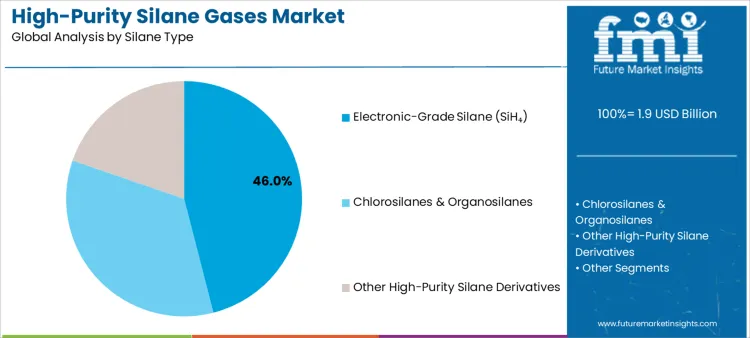
Electronic-grade silane (SiH₄) accounts for 46% share of the high-purity silane gases market because it provides a highly reactive and controllable silicon source for chemical vapor deposition processes. It is essential for depositing silicon, silicon nitride, and related films with precise thickness and uniformity. Semiconductor manufacturers require extremely low impurity levels to avoid defects and maintain device performance. Consistent gas purity and predictable decomposition behavior support high-yield production. These precision-driven and process-critical requirements explain why electronic-grade silane remains the most widely adopted silane type.
Why Do Semiconductor And Logic Devices Dominate Application Demand In The High-Purity Silane Gases Market?
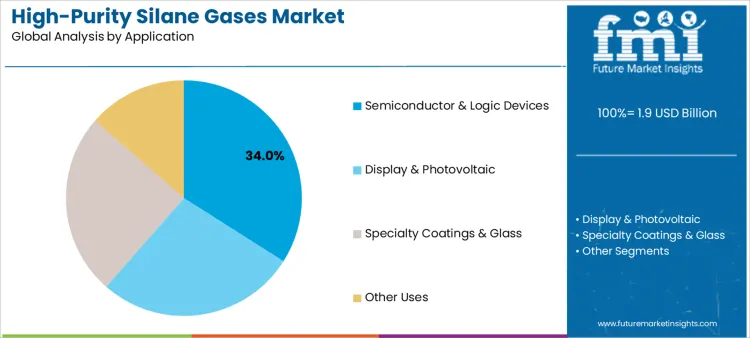
Semiconductor and logic devices hold 34% share of the high-purity silane gases market because silane gases are consumed repeatedly across multiple deposition steps in chip fabrication. Logic device manufacturing relies on thin silicon-based films for transistors, interconnects, and insulating layers. High wafer throughput and continuous fab operation drive steady gas consumption. As device geometries shrink, tolerance for impurities decreases, increasing reliance on high-purity silane sources. These high-frequency usage patterns and stringent process requirements explain why semiconductor and logic device manufacturing remains the leading application segment.
What are the Key Dynamics of the High-Purity Silane Gases Market?
The high-purity silane gases market is driven by growing demand from semiconductor fabrication, photovoltaic manufacturing, and advanced electronics applications that require precise silicon deposition processes. High-purity silane gases are used in chemical vapor deposition (CVD), plasma-enhanced CVD, and thin-film manufacturing, where impurity control directly affects film quality, device performance, and yield. For gas suppliers and device manufacturers, purity level, moisture and oxygen control, delivery reliability, and safety management are critical factors influencing procurement and long-term supply agreements. Expansion of advanced node semiconductor production and thin-film solar technologies continues to support market growth.
How Do Application Trends and Industry Requirements Shape This Market?
Application trends and industry requirements are shaping the high-purity silane gases market as device architectures become more complex and tolerance for contamination decreases. In semiconductor manufacturing, silane gases must meet ultra-high purity specifications to enable consistent deposition of polysilicon and dielectric layers. Advanced Packaging, memory devices, and logic nodes require tighter process control and repeatability. In photovoltaic applications, high-purity silane supports uniform thin-film deposition and improved cell efficiency. Manufacturers prioritize suppliers capable of delivering consistent gas quality, robust cylinder handling, and integration with automated gas delivery systems in cleanroom environments.
Why Do Safety, Handling, and Qualification Challenges Restrain Market Growth?
Safety, handling, and qualification challenges restrain growth in the high-purity silane gases market due to the hazardous nature of silane and the strict requirements of electronics manufacturing. Silane is pyrophoric, requiring specialized storage, transport, and delivery infrastructure to mitigate risk. Establishing and maintaining these systems increases capital and operating costs for suppliers and end users. Lengthy qualification processes, audits, and safety validations at semiconductor fabs extend timelines for new suppliers. Regulatory compliance, training requirements, and regional safety standards further add complexity, slowing market entry and capacity expansion.
How is the High-Purity Silane Gases Market Growing across Key Countries?
The high-purity silane gases market is expanding steadily as semiconductor, photovoltaic, and advanced electronics manufacturers increase demand for ultra-clean precursor gases. High-purity silane gases are essential for thin-film deposition, chemical vapor deposition (CVD), and plasma-enhanced processes used in semiconductors, flat-panel displays, and solar cells. Country-wise growth varies depending on fab expansion, solar manufacturing capacity, and localization of electronic gas supply chains. High-growth markets are driven by aggressive capacity additions, while mature regions focus on purity control, supply security, and qualification stability.
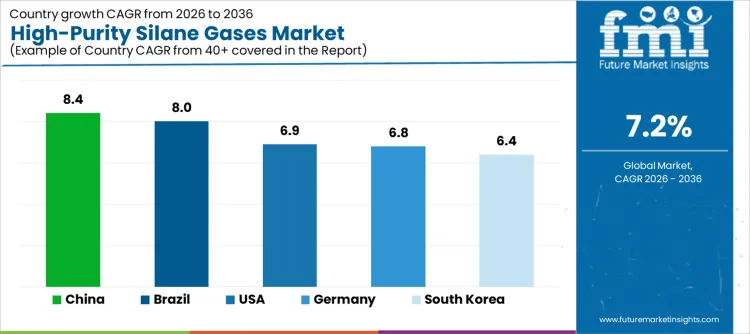
| Country | CAGR (%) |
|---|---|
| China | 8.4 |
| Brazil | 8.0 |
| United States | 6.9 |
| Germany | 6.8 |
| South Korea | 6.4 |
Why Is China Leading the High-Purity Silane Gases Market?
China’s high-purity silane gases market is expanding at a CAGR of 8.4% during 2026 to 2036, driven by rapid expansion of semiconductor fabrication, photovoltaic cell manufacturing, and display panel production. High-purity silane is widely used in deposition of silicon layers, dielectric films, and passivation coatings. China’s dominant position in solar module manufacturing and accelerating investments in domestic semiconductor fabs continue to generate strong demand. Chinese manufacturers prioritize silane gases with ultra-low moisture and oxygen content, stable delivery performance, and compatibility with high-throughput CVD and PECVD systems. Domestic gas suppliers benefit from proximity to fabs and solar plants, enabling localized supply and rapid response. Investments in purification and cylinder handling infrastructure further support adoption. Procurement decisions emphasize purity certification, supply continuity, and compliance with semiconductor-grade specifications.
Why is Brazil Emerging as a High-Growth Market for High-Purity Silane Gases?
Brazil’s high-purity silane gases market is growing at a CAGR of 8.0% during 2026 to 2036, supported by expansion of solar energy manufacturing, electronics assembly, and specialty semiconductor-related activities. While Brazil does not host large advanced logic fabs, demand is rising from photovoltaic module production and electronics manufacturing where silane gases are used for thin-film deposition and surface treatments. Brazilian buyers value reliable gas purity, consistent cylinder quality, and stable supply for continuous operations. Adoption is strongest in solar manufacturing facilities and emerging electronics production clusters. Cost efficiency and supplier support remain important considerations. Procurement decisions often favor suppliers with regional distribution, technical gas-handling support, and compliance with international electronic gas standards. Market growth is supported by renewable energy expansion, increasing localization of electronics manufacturing, and gradual upgrades in advanced material processing.
What is Driving Demand for High-Purity Silane Gases in the United States?
The United States high-purity silane gases market is expanding at a CAGR of 6.9% during 2026 to 2036, driven by renewed investment in semiconductor manufacturing and growth in advanced photovoltaic technologies. High-purity silane gases are critical for deposition processes in logic, memory, and power semiconductor fabs, as well as thin-film solar cell production. USA. manufacturers emphasize ultra-high purity, controlled impurity profiles, and reliable gas delivery systems to support advanced node manufacturing. Demand is strongest from semiconductor fabs, research facilities, and next-generation solar technology developers. Procurement decisions prioritize long-term supply agreements, rigorous quality documentation, and domestic supply security. Market growth is reinforced by fab construction programs, government-backed semiconductor initiatives, and increasing complexity of thin-film deposition processes.
How is Germany Supporting Growth in the High-Purity Silane Gases Market?
Germany’s high-purity silane gases market is growing at a CAGR of 6.8% during 2026 to 2036, supported by demand from power semiconductors, automotive electronics, industrial chips, and advanced photovoltaic research. German manufacturers focus on precision deposition and defect minimization, driving steady demand for high-purity precursor gases. Buyers prioritize silane gases with reproducible purity, stable flow characteristics, and compliance with strict handling and safety standards. Adoption is concentrated in specialty semiconductor fabs and advanced materials research rather than mass-volume production. Procurement decisions favor suppliers with certified quality systems, traceability, and reliable European supply chains. Market growth is reinforced by Germany’s leadership in industrial electronics, automotive semiconductors, and advanced energy technologies.
How is South Korea Expanding Use of High-Purity Silane Gases?
South Korea’s high-purity silane gases market is expanding at a CAGR of 6.4% during 2026 to 2036, driven by strong demand from memory semiconductor manufacturing and display panel production. High wafer throughput and advanced deposition processes require consistent supply of ultra-high-purity silane gases. South Korean manufacturers emphasize impurity control, delivery stability, and compatibility with high-speed CVD and PECVD tools. Adoption is strongest in memory fabs, OLED display manufacturing, and export-oriented electronics production. Procurement decisions are influenced by supplier reliability, ability to meet tight quality specifications, and continuity of supply at scale. Market growth is supported by continued investment in memory and display fabs and increasing deposition complexity.
How are Companies Competing in the High-Purity Silane Gases Market?
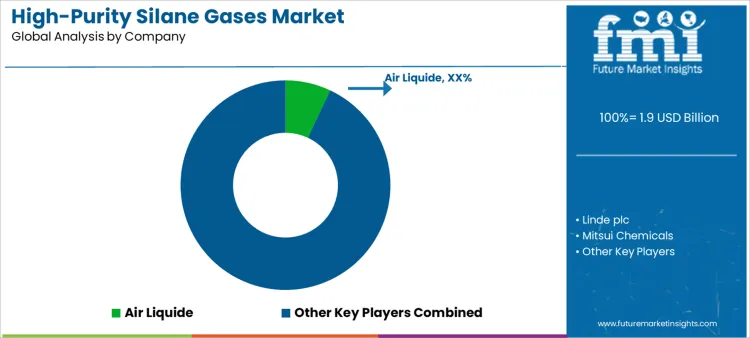
Competition in the high-purity silane gases market is shaped by gas purity, delivery reliability, and alignment with advanced semiconductor, photovoltaics, and display manufacturing processes. Silane (SiH₄) is a critical precursor for silicon deposition, including LPCVD/PECVD, epitaxial growth, and dopant incorporation, where ultra-low impurity levels and stable supply are essential to protect wafer yields and tool uptime. Air Liquide positions its high-purity silane offerings around rigorous purification protocols, validated impurity profiles in parts-per-billion ranges, and integrated delivery solutions that support continuous fab operations. Linde plc competes through global manufacturing scale, consistency in batch analytics, and coordinated on-site support tailored to semiconductor and PV fabs.
Specialty chemical and materials producers differentiate through tailored silane gas grades and regional supply frameworks. Mitsui Chemicals, Shin Etsu Chemical, and Sumitomo Chemical emphasize ultra-high purity control and deep integration with local manufacturing ecosystems in Asia. Their positioning underscores stable delivery, robust quality assurance, and documentation that supports stringent fab qualification protocols.
Manufacturers with core silane expertise add further competitive depth. Wacker Chemie AG and SK Materials focus on precisely specified gas grades matched to specific deposition processes, while REC Silicon differentiates through integrated silane production tied to polysilicon and PV fabrication supply chains. Dow and KCC Corporation complete the market with high-purity silane options backed by global logistics and analytical traceability. Across suppliers, competitive advantage is defined by impurity control, delivery consistency, and documented process compatibility rather than silane pricing alone.
Key Players in High-Purity Silane Gases Market
- Air Liquide
- Linde plc
- Mitsui Chemicals
- REC Silicon
- SK Materials
- Wacker Chemie AG
- Shin-Etsu Chemical
- Sumitomo Chemical
- Dow
- KCC Corporation
Scope of Report
| Attribute | Details |
|---|---|
| Market Size Unit | USD Billion |
| Silane Type Covered | Electronic-Grade Silane (SiH₄), Chlorosilanes & Organosilanes, Other High-Purity Silane Derivatives |
| Application Covered | Semiconductor & Logic Devices, Display & Photovoltaic, Specialty Coatings & Glass, Other Uses |
| Countries Covered | China, Japan, South Korea, India, Australia & New Zealand, ASEAN, Rest of Asia Pacific, Germany, United Kingdom, France, Italy, Spain, Nordic, BENELUX, Rest of Europe, United States, Canada, Mexico, Brazil, Chile, Rest of Latin America, Kingdom of Saudi Arabia, Other GCC Countries, Turkey, South Africa, Other African Union, Rest of Middle East & Africa |
| Regions Covered | Asia Pacific, Europe, North America, Latin America, Middle East & Africa |
| Key Companies Profiled | Air Liquide, Linde plc, Mitsui Chemicals, REC Silicon, SK Materials, Wacker Chemie AG, Shin-Etsu Chemical, Sumitomo Chemical, Dow, KCC Corporation |
| Additional Attributes | Dollar sales of high-purity silane gases are analyzed by silane type and end-use application across advanced semiconductor, display, photovoltaic, and specialty materials manufacturing. The scope evaluates purity levels, moisture and oxygen contamination thresholds, handling and storage requirements, and compatibility with CVD and PECVD processes. Country-level analysis reflects semiconductor fabrication capacity expansion, investments in display and solar manufacturing, tightening process gas quality standards, and the growing use of silane derivatives in high-performance coatings and glass applications. |
High-Purity Silane Gases Market by Key Segments
Silane Type:
- Electronic-Grade Silane (SiH₄)
- Chlorosilanes & Organosilanes
- Other High-Purity Silane Derivatives
Application:
- Semiconductor & Logic Devices
- Display & Photovoltaic
- Specialty Coatings & Glass
- Other Uses
Region:
- Asia Pacific
- China
- Japan
- South Korea
- India
- Australia & New Zealand
- ASEAN
- Rest of Asia Pacific
- Europe
- Germany
- United Kingdom
- France
- Italy
- Spain
- Nordic
- BENELUX
- Rest of Europe
- North America
- United States
- Canada
- Mexico
- Latin America
- Brazil
- Chile
- Rest of Latin America
- Middle East & Africa
- Kingdom of Saudi Arabia
- Other GCC Countries
- Turkey
- South Africa
- Other African Union
- Rest of Middle East & Africa
Bibliography
- European Commission. (2024). Advanced semiconductor manufacturing materials and precursor gases. Publications Office of the European Union.
- National Institute of Standards and Technology. (2024). Process gas purity requirements for chemical vapor deposition in semiconductor fabrication. USA. Department of Commerce.
- International Organization for Standardization. (2024). ISO 21010: Cryogenic vessels and gas containment systems. ISO.
- Kim, J., Park, S., & Lee, H. (2023). Purity control of silane precursor gases for semiconductor CVD processes.
- Müller, R., & Vogel, T. (2024). Thin‑film silicon deposition using high‑purity silane gases in electronic and photovoltaic applications.
Frequently Asked Questions
How big is the high-purity silane gases market in 2026?
The global high-purity silane gases market is estimated to be valued at USD 1.9 billion in 2026.
What will be the size of high-purity silane gases market in 2036?
The market size for the high-purity silane gases market is projected to reach USD 3.8 billion by 2036.
How much will be the high-purity silane gases market growth between 2026 and 2036?
The high-purity silane gases market is expected to grow at a 7.2% CAGR between 2026 and 2036.
What are the key product types in the high-purity silane gases market?
The key product types in high-purity silane gases market are electronic-grade silane (sih₄), chlorosilanes & organosilanes and other high-purity silane derivatives.
Which application segment to contribute significant share in the high-purity silane gases market in 2026?
In terms of application, semiconductor & logic devices segment to command 34.0% share in the high-purity silane gases market in 2026.
Preview the report firsthand - request a free sample
Get SampleGet the brochure for pricing and purchase details.
Get PDFTable of Content
- Executive Summary
- Global Market Outlook
- Demand-side Trends
- Supply-side Trends
- Technology Roadmap Analysis
- Analysis and Recommendations
- Market Overview
- Market Coverage / Taxonomy
- Market Definition / Scope / Limitations
- Market Background
- Market Dynamics
- Drivers
- Restraints
- Opportunity
- Trends
- Scenario Forecast
- Demand in Optimistic Scenario
- Demand in Likely Scenario
- Demand in Conservative Scenario
- Opportunity Map Analysis
- Product Life Cycle Analysis
- Supply Chain Analysis
- Investment Feasibility Matrix
- Value Chain Analysis
- PESTLE and Porter’s Analysis
- Regulatory Landscape
- Regional Parent Market Outlook
- Production and Consumption Statistics
- Import and Export Statistics
- Market Dynamics
- Global Market Analysis 2021 to 2025 and Forecast, 2026 to 2036
- Historical Market Size Value (USD Million) Analysis, 2021 to 2025
- Current and Future Market Size Value (USD Million) Projections, 2026 to 2036
- Y-o-Y Growth Trend Analysis
- Absolute $ Opportunity Analysis
- Global Market Pricing Analysis 2021 to 2025 and Forecast 2026 to 2036
- Global Market Analysis 2021 to 2025 and Forecast 2026 to 2036, By Silane Type
- Introduction / Key Findings
- Historical Market Size Value (USD Million) Analysis By Silane Type, 2021 to 2025
- Current and Future Market Size Value (USD Million) Analysis and Forecast By Silane Type, 2026 to 2036
- Electronic-Grade Silane (SiH₄)
- Chlorosilanes & Organosilanes
- Other High-Purity Silane Derivatives
- Electronic-Grade Silane (SiH₄)
- Y-o-Y Growth Trend Analysis By Silane Type, 2021 to 2025
- Absolute $ Opportunity Analysis By Silane Type, 2026 to 2036
- Global Market Analysis 2021 to 2025 and Forecast 2026 to 2036, By Application
- Introduction / Key Findings
- Historical Market Size Value (USD Million) Analysis By Application, 2021 to 2025
- Current and Future Market Size Value (USD Million) Analysis and Forecast By Application, 2026 to 2036
- Semiconductor & Logic Devices
- Display & Photovoltaic
- Specialty Coatings & Glass
- Other Uses
- Semiconductor & Logic Devices
- Y-o-Y Growth Trend Analysis By Application, 2021 to 2025
- Absolute $ Opportunity Analysis By Application, 2026 to 2036
- Global Market Analysis 2021 to 2025 and Forecast 2026 to 2036, By Region
- Introduction
- Historical Market Size Value (USD Million) Analysis By Region, 2021 to 2025
- Current Market Size Value (USD Million) Analysis and Forecast By Region, 2026 to 2036
- North America
- Latin America
- Western Europe
- Eastern Europe
- East Asia
- South Asia and Pacific
- Middle East & Africa
- Market Attractiveness Analysis By Region
- North America Market Analysis 2021 to 2025 and Forecast 2026 to 2036, By Country
- Historical Market Size Value (USD Million) Trend Analysis By Market Taxonomy, 2021 to 2025
- Market Size Value (USD Million) Forecast By Market Taxonomy, 2026 to 2036
- By Country
- USA
- Canada
- Mexico
- By Silane Type
- By Application
- By Country
- Market Attractiveness Analysis
- By Country
- By Silane Type
- By Application
- Key Takeaways
- Latin America Market Analysis 2021 to 2025 and Forecast 2026 to 2036, By Country
- Historical Market Size Value (USD Million) Trend Analysis By Market Taxonomy, 2021 to 2025
- Market Size Value (USD Million) Forecast By Market Taxonomy, 2026 to 2036
- By Country
- Brazil
- Chile
- Rest of Latin America
- By Silane Type
- By Application
- By Country
- Market Attractiveness Analysis
- By Country
- By Silane Type
- By Application
- Key Takeaways
- Western Europe Market Analysis 2021 to 2025 and Forecast 2026 to 2036, By Country
- Historical Market Size Value (USD Million) Trend Analysis By Market Taxonomy, 2021 to 2025
- Market Size Value (USD Million) Forecast By Market Taxonomy, 2026 to 2036
- By Country
- Germany
- UK
- Italy
- Spain
- France
- Nordic
- BENELUX
- Rest of Western Europe
- By Silane Type
- By Application
- By Country
- Market Attractiveness Analysis
- By Country
- By Silane Type
- By Application
- Key Takeaways
- Eastern Europe Market Analysis 2021 to 2025 and Forecast 2026 to 2036, By Country
- Historical Market Size Value (USD Million) Trend Analysis By Market Taxonomy, 2021 to 2025
- Market Size Value (USD Million) Forecast By Market Taxonomy, 2026 to 2036
- By Country
- Russia
- Poland
- Hungary
- Balkan & Baltic
- Rest of Eastern Europe
- By Silane Type
- By Application
- By Country
- Market Attractiveness Analysis
- By Country
- By Silane Type
- By Application
- Key Takeaways
- East Asia Market Analysis 2021 to 2025 and Forecast 2026 to 2036, By Country
- Historical Market Size Value (USD Million) Trend Analysis By Market Taxonomy, 2021 to 2025
- Market Size Value (USD Million) Forecast By Market Taxonomy, 2026 to 2036
- By Country
- China
- Japan
- South Korea
- By Silane Type
- By Application
- By Country
- Market Attractiveness Analysis
- By Country
- By Silane Type
- By Application
- Key Takeaways
- South Asia and Pacific Market Analysis 2021 to 2025 and Forecast 2026 to 2036, By Country
- Historical Market Size Value (USD Million) Trend Analysis By Market Taxonomy, 2021 to 2025
- Market Size Value (USD Million) Forecast By Market Taxonomy, 2026 to 2036
- By Country
- India
- ASEAN
- Australia & New Zealand
- Rest of South Asia and Pacific
- By Silane Type
- By Application
- By Country
- Market Attractiveness Analysis
- By Country
- By Silane Type
- By Application
- Key Takeaways
- Middle East & Africa Market Analysis 2021 to 2025 and Forecast 2026 to 2036, By Country
- Historical Market Size Value (USD Million) Trend Analysis By Market Taxonomy, 2021 to 2025
- Market Size Value (USD Million) Forecast By Market Taxonomy, 2026 to 2036
- By Country
- Kingdom of Saudi Arabia
- Other GCC Countries
- Turkiye
- South Africa
- Other African Union
- Rest of Middle East & Africa
- By Silane Type
- By Application
- By Country
- Market Attractiveness Analysis
- By Country
- By Silane Type
- By Application
- Key Takeaways
- Key Countries Market Analysis
- USA
- Pricing Analysis
- Market Share Analysis, 2025
- By Silane Type
- By Application
- Canada
- Pricing Analysis
- Market Share Analysis, 2025
- By Silane Type
- By Application
- Mexico
- Pricing Analysis
- Market Share Analysis, 2025
- By Silane Type
- By Application
- Brazil
- Pricing Analysis
- Market Share Analysis, 2025
- By Silane Type
- By Application
- Chile
- Pricing Analysis
- Market Share Analysis, 2025
- By Silane Type
- By Application
- Germany
- Pricing Analysis
- Market Share Analysis, 2025
- By Silane Type
- By Application
- UK
- Pricing Analysis
- Market Share Analysis, 2025
- By Silane Type
- By Application
- Italy
- Pricing Analysis
- Market Share Analysis, 2025
- By Silane Type
- By Application
- Spain
- Pricing Analysis
- Market Share Analysis, 2025
- By Silane Type
- By Application
- France
- Pricing Analysis
- Market Share Analysis, 2025
- By Silane Type
- By Application
- India
- Pricing Analysis
- Market Share Analysis, 2025
- By Silane Type
- By Application
- ASEAN
- Pricing Analysis
- Market Share Analysis, 2025
- By Silane Type
- By Application
- Australia & New Zealand
- Pricing Analysis
- Market Share Analysis, 2025
- By Silane Type
- By Application
- China
- Pricing Analysis
- Market Share Analysis, 2025
- By Silane Type
- By Application
- Japan
- Pricing Analysis
- Market Share Analysis, 2025
- By Silane Type
- By Application
- South Korea
- Pricing Analysis
- Market Share Analysis, 2025
- By Silane Type
- By Application
- Russia
- Pricing Analysis
- Market Share Analysis, 2025
- By Silane Type
- By Application
- Poland
- Pricing Analysis
- Market Share Analysis, 2025
- By Silane Type
- By Application
- Hungary
- Pricing Analysis
- Market Share Analysis, 2025
- By Silane Type
- By Application
- Kingdom of Saudi Arabia
- Pricing Analysis
- Market Share Analysis, 2025
- By Silane Type
- By Application
- Turkiye
- Pricing Analysis
- Market Share Analysis, 2025
- By Silane Type
- By Application
- South Africa
- Pricing Analysis
- Market Share Analysis, 2025
- By Silane Type
- By Application
- USA
- Market Structure Analysis
- Competition Dashboard
- Competition Benchmarking
- Market Share Analysis of Top Players
- By Regional
- By Silane Type
- By Application
- Competition Analysis
- Competition Deep Dive
- Air Liquide
- Overview
- Product Portfolio
- Profitability by Market Segments (Product/Age /Sales Channel/Region)
- Sales Footprint
- Strategy Overview
- Marketing Strategy
- Product Strategy
- Channel Strategy
- Linde plc
- Mitsui Chemicals
- REC Silicon
- SK Materials
- Wacker Chemie AG
- Shin-Etsu Chemical
- Sumitomo Chemical
- Dow
- KCC Corporation
- Air Liquide
- Competition Deep Dive
- Assumptions & Acronyms Used
- Research Methodology


