

- Market Size (2026)
- USD 1.5 Bn
- Forecast (2036)
- USD 2.5 Bn
- CAGR (2026 to 2036)
- 5.2%
Crack-Bridging Flexible Polymer Additives for Repair Mortars Market Size, Forecast, and Outlook By FMI
Summary of the Crack-Bridging Flexible Polymer Additives for Repair Mortars Market
- Demand and Growth Drivers
- Infrastructure owners are expected to use polymer-modified repair mortars to reduce early shrinkage cracks in repaired concrete.
- Contractors need additives that improve bond on old substrates without changing normal trowel and spray routines.
- Bridge and parking deck repair programs are pushing mortar suppliers toward higher flexural strength and lower permeability.
- Product and Segment View
- Powder form is projected to hold 44.0% share in 2026 because of low spill risk and easier plant dosing.
- Structural repair mortars are expected to secure 35.0% share in 2026 as bridge and deck repairs need higher movement tolerance.
- Direct supply is anticipated to account for 52.5% share in 2026 as large accounts ask for trial batches and dosage support.
- Geography and Competitive Outlook
- China is projected to record 6.3% CAGR by 2036 as large bridge and high-rise repair activity.
- India is expected to expand at 6.1% CAGR by 2036 as highway and metro repair cycles expand across large cities.
- Sika and Master Builders Solutions compete on repair mortar systems as Wacker and Synthomer compete on polymer binder depth.
- Analyst Opinion
- Nikhil Kaitwade, Principal Analyst for Chemicals and Materials at FMI, observes, “Flexible polymer additives are becoming a repair risk-control input. Buyers compare bond strength and crack movement evidence before approving a formulation. Suppliers with dry-mix knowledge base and site training should gain better access to bridge decks and industrial floors. Demand is expected to follow repair programs that measure service life by 2036.”
- Crack-Bridging Flexible Polymer Additives for Repair Mortars Market Value Analysis
- Repair mortar polymer additives are moving from optional modifiers into a defined durability input for cementitious repairs.
- Infrastructure owners are expected to increase additive use as repair projects aim to delay repeat patching.
- Powder formats are preferred because of easier dosing across dry-mix plants and bagged repair products.
- Demand is supported by crack-bridging requirements in bridges and parking decks exposed to movement and moisture.
Key Takeaways, Market Size, and Forecast
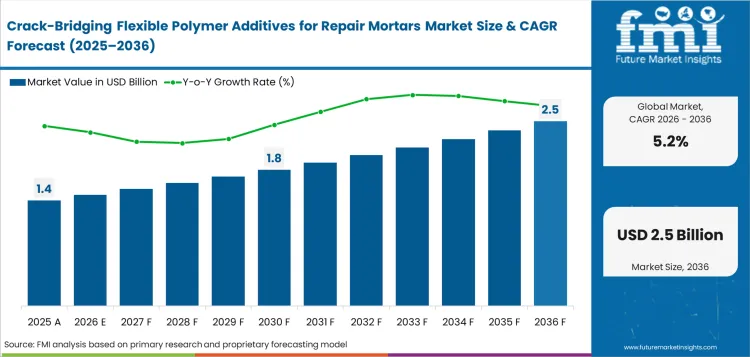
- The crack-bridging flexible polymer additives for repair mortars market value stood at USD 1.43 billion in 2025.
- Industry revenue is projected to reach USD 2.5 billion by 2036 as repair buyers specify better crack movement control.
- The market is expected to expand at 5.2% CAGR from 2026 to 2036 through infrastructure and building repair channels.
- The sector is forecast to offer an incremental opportunity of USD 1.0 billion between 2026 and 2036.
- Direct supply is projected to account for 52.5% share in 2026 as contractors need faster technical support and account-level supply control.
- Powder form is expected to hold 44.0% share in 2026 as bagged repair mortars need stable storage and controlled dosage.
- China at 6.3% CAGR and India at 6.1% CAGR are expected to record the fastest pace by 2036.
Cracked concrete repairs depend on bond strength and movement tolerance after the damaged area is patched. Sika stated in September 2024 that SikaCeram® A 200 is an SBR latex additive for cementitious mortars. Its data sheet lists about 13 N/mm² flexural strength. Site-mixed repair mortars therefore gain a clearer route to improved flexibility. Sika’s 2025 refurbishment chart listed Sika MonoTop® R as polymer modified with 3 mm to 20 mm layer thickness. The same chart listed 50 N/mm² 28-day compressive strength.
Repair suppliers can use system guidance to reduce jobsite variability in patch work. The modified mineral mortar EPD published in October 2024 also referenced EN 14891 crack-bridging ability. Test-linked flexibility is expected to matter more when buyers compare polymer packages. Saint-Gobain stated in June 2024 that Fosroc had 20 manufacturing plants. Wider regional coverage supports bundled supply of additives and repair mortar systems.
Crack-Bridging Flexible Polymer Additives for Repair Mortars Market Definition
Sector scope covers polymer additives used to improve flexibility and crack resistance in repair mortars. Included products cover redispersible polymer powders and acrylic latex systems. SBR latex and EVA copolymers complete the polymer scope. Materials are sold to dry-mix producers and contractors making repair mortars for concrete and masonry restoration. Finished repair mortar bags and full composite reinforcement systems remain outside this study.
Crack-Bridging Flexible Polymer Additives for Repair Mortars Market Inclusions
Market scope covers all commercially traded crack-bridging flexible polymer additives for repair mortars categorized by polymer type such as redispersible polymer powder and acrylic polymer. Scope also covers form such as powder and liquid dispersion; application such as concrete repair and masonry repair; end user such as contractors and infrastructure owners; and sales channel such as direct supply and distributors. Revenue scope covers 2026 to 2036. The key stakeholders include polymer additive manufacturers, repair mortar producers, construction chemical suppliers, contractors, infrastructure owners, building repair firms, distributors, testing laboratories, standards bodies, and regulatory agencies.
Crack-Bridging Flexible Polymer Additives for Repair Mortars Market Exclusions
Study scope excludes finished ready-mix concrete and non-polymer cement additives. Fiber wraps and carbon laminates are excluded unless supplied as additives inside repair mortar systems. Epoxy injection resins and sealants are treated as adjacent repair products. Tools and application equipment sold without additive supply are outside the revenue scope.
Crack-Bridging Flexible Polymer Additives for Repair Mortars Market Research Methodology
- Primary Research: FMI analysts reviewed polymer producers and repair mortar formulators using RDP plus latex systems. Interviews focused on dosage stability and crack-control proof.
- Desk Research: Desk review used infrastructure condition data and official renovation programs. Standards references and official company actions after January 2024 were checked.
- Market Sizing and Forecasting: Forecast work combined parent repair mortar value with additive loading rates and polymer type shares.
- Data Validation: Segment shares were checked against dry-mix handling needs and repair project specifications before country demand review.
Why is the Crack-Bridging Flexible Polymer Additives for Repair Mortars Market Growing?
- USA. bridge repair need supports polymer-modified repair mortar use as 6.8% of bridges were in poor condition in 2024.
- European Union renovation policy creates repair-material pull as the Renovation Wave targets 35 million building renovations by 2030.
- India’s National Highway network reached 146,560 km in December 2025, creating a wider asset stock for maintenance work.
- Japan’s road maintenance need is visible across 730,000 road bridges, with 48% expected to be 50 years or older in ten years.
Repair buyers are replacing simple cement patches with polymer-modified mortars when failed repairs raise closure costs. Bridge decks and ramps expose mortar to vibration and water. Polymer film formation improves adhesion and flexibility inside cementitious repair layers. The practical result is higher use in redispersible polymer powder and latex systems where repeat repair work disrupts traffic or production.
Specification pressure is a constraint on adoption. Concrete repair buyers judge repair chemistry with service life and asset cost. Additive makers with substrate testing and documented dosage windows can reduce trial failures. Smaller suppliers can compete when they provide local technical support and consistent batch quality.
Market Segmentation Analysis
- Redispersible polymer powder is anticipated to lead with 38.0% share in 2026 since dry-mix compatibility lowers dosing errors.
- Powder is expected to lead with 44.0% share in 2026 as bagged repair mortars favor shelf-stable additives.
- Structural repair mortars are estimated to reach 35.0% share in 2026 with bridge decks requiring movement tolerance.
- Construction contractors are expected to hold 42.0% share in 2026 since field application teams influence additive approval.
- Direct supply is projected to secure 52.5% share in 2026 led by major mortar accounts requiring formulation support.
The market is segmented by polymer type, including redispersible polymer powder, acrylic polymer, styrene-butadiene latex, vinyl acetate ethylene, polyurethane dispersions, and other flexible polymers. Redispersible polymer powder leads because of dry-mix compatibility and predictable film formation. Form segmentation covers powder, liquid dispersion, and emulsion systems. Powder remains dominant because bagged repair mortars need stable storage and controlled dosage. Application and end-user segmentation covers concrete repair, masonry repair, bridge deck repair, industrial floor repair, and facade repair. Contractors and infrastructure owners support repeat repair cycles. Sales channel segmentation covers direct supply, distributors, and retail channels. Direct supply leads because repair-mortar buyers need technical guidance and batch consistency before project use.
Insights into the Redispersible Polymer Powder Polymer Type Segment
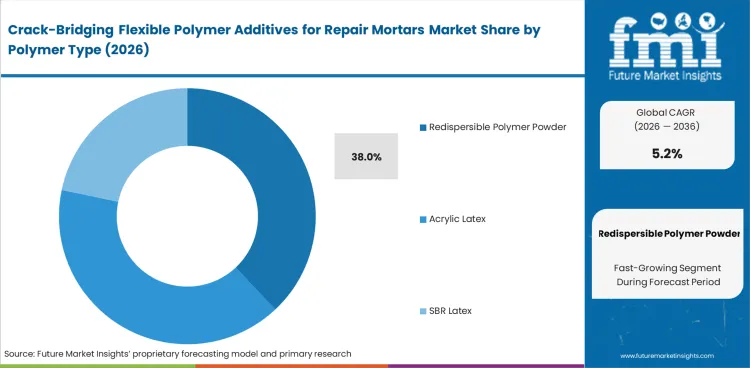
- Redispersible polymer powder is expected to account for 38.0% share in 2026 as dry mixes require consistent rehydration and film formation.
- Acrylic latex suppliers gain specialty use where repair teams need better weathering and adhesion on exposed surfaces.
Insights into the Powder Form Segment
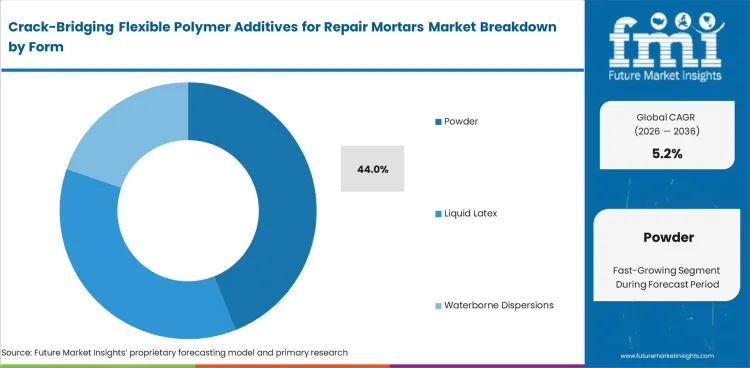
- Powder is projected to represent 44.0% share in 2026 with bagged mortars favoring stable transport and lower storage risk.
- Liquid latex keeps a role in site-adjusted repairs where crews depend on bond coats and controlled workability.
Insights into the Structural Repair Mortars Application Segment
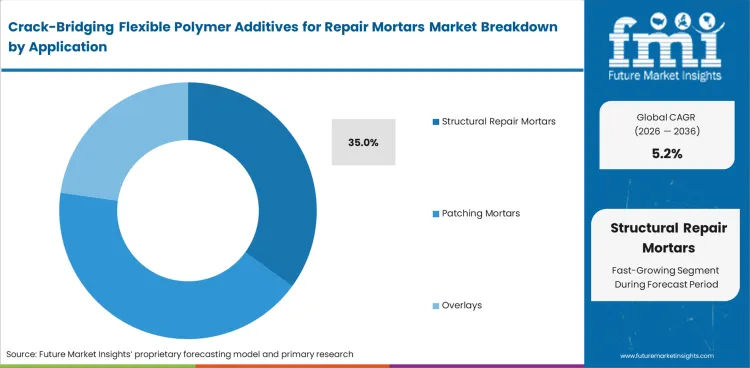
- Structural repair mortars are anticipated to account for 35.0% share in 2026. Bridge decks and parking structures need flexible repair layers that tolerate vibration and water exposure. Repeated load stress adds a second performance requirement.
- Patching mortars use flexible additives when shrinkage cracks could reopen around repaired edges and joints.
Insights into the Contractors End User Segment
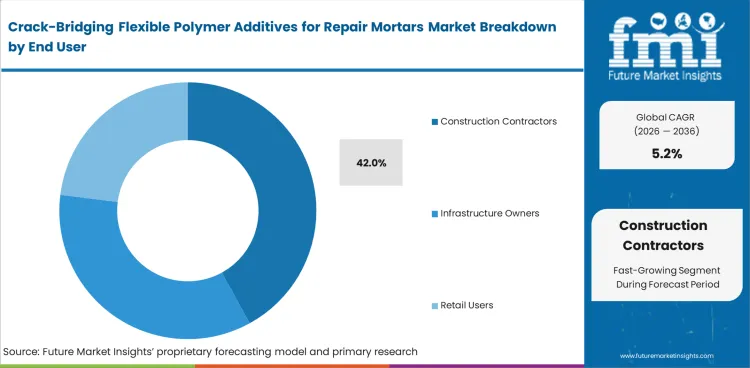
- Construction contractors are expected to hold 42.0% share in 2026 as applicators influence product trials and field acceptance.
- Infrastructure owners value polymer-modified repairs when traffic access and asset downtime make repeat repairs costly.
Insights into the Direct Supply Sales Channel Segment
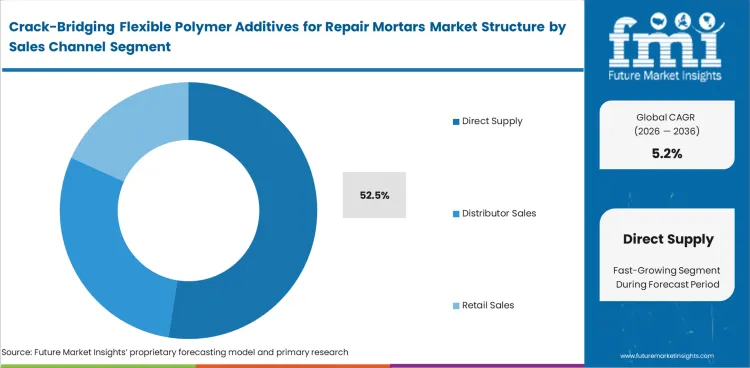
- Direct supply is projected to represent 52.5% share in 2026 with large accounts needing formulation checks before wider rollout.
- Distributor sales serve local contractors requiring smaller batches and quick replenishment for repair schedules.
Crack-Bridging Flexible Polymer Additives for Repair Mortars Market Drivers, Restraints, and Opportunities
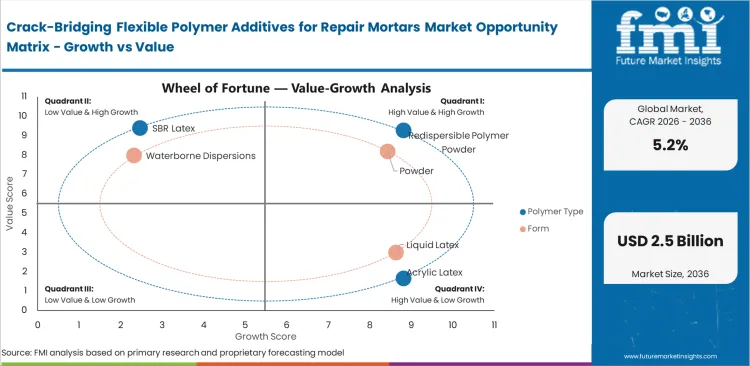
- Bridge deck movement is expected to lift additive adoption because repair mortars depend on stronger bond and flexural response after curing.
- Cement compatibility testing is anticipated to slow supplier switching since polymer behavior changes with cement chemistry and jobsite water.
- Repair-and-reuse planning is likely to support demand as asset owners choose durable repair instead of full concrete replacement.
Repair programs are likely to favor polymer additives extending mortar service life on older concrete. ARTBA bridge data shows a clear repair backlog. Bridges in poor condition represented 6.8% of the 2024 USA bridge inventory. Bridge decks and parking structures expose repairs to water and repeated movement. Polymer-modified mortars are better suited to these areas since bond strength and flexibility influence repair life. Suppliers with freeze-thaw data and wet-substrate test results should gain stronger approval. Clear dosage guidance will support public infrastructure work.
Specification control is likely to remain a restraint during the forecast period. Polymer additives raise material cost and often require trial batches before use in structural repair mortars. Poor water addition can weaken patches or cause segregation at the jobsite. Buyers will prefer suppliers able to provide simple mixing rules and documented bond tests. Opportunity will favor additive makers able to prove performance across older concrete and vibration-prone repair areas.
Production Capacity and Utilization Analysis
Production capacity is likely to expand through polymer dispersion assets and dry powder processing lines. Wacker’s 2025 European Coatings Show materials presented VINNAPAS dispersible polymer powders for dry-mix mortar formulations using Portland composite cements. WACKER’s product focus supports the shift toward powder additives rehydrating predictably in bagged mortar systems. Production capacity should stay higher among suppliers serving tile adhesives and repair mortars from shared dry-mix formulation assets. Buyers are expected to place greater weight on batch consistency as repair contractors move toward specified polymer-modified systems.
Channel and Distribution Structure Analysis
Channel structure is expected to favor direct technical selling for large repair mortar accounts. Contractors and mortar producers need supplier support for trial batches and dosage adjustment before approving a polymer package. Distributors will continue serving local repair crews able to purchase smaller volumes on short notice. Direct supply should gain share where additive compatibility affects field performance.
Regional Analysis
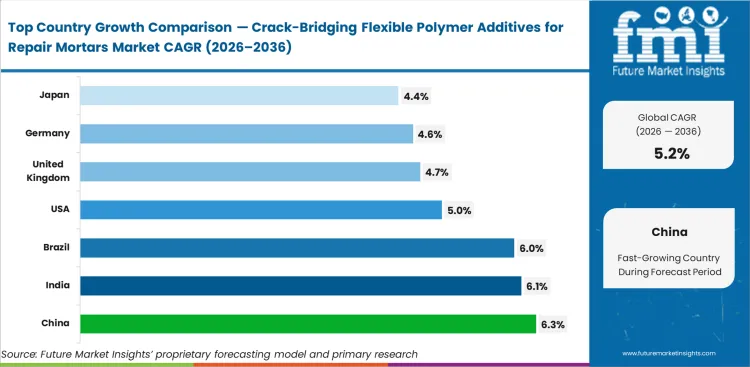
.webp "Top Country Growth Comparison Crack Bridging Flexible Polymer Additives For Repair Mortars Market Cagr (2026 2036)")
| Country | CAGR 2026 to 2036 |
|---|---|
| China | 6.3% |
| India | 6.1% |
| Brazil | 6.0% |
| United States | 5.0% |
| United Kingdom | 4.7% |
| Germany | 4.6% |
| Japan | 4.4% |
Source: Future Market Insights analysis based on repair mortar polymer additive adoption review in 2026.
Analysis of Crack-Bridging Flexible Polymer Additives for Repair Mortars Market by Key Countries
- China is expected to record 6.3% CAGR by 2036 as municipal repair cycles promoting wider implementation of polymer-enhanced mortars.
- India is projected to follow at 6.1% CAGR by 2036 as road and metro construction creating more repair points.
- Brazil is expected to advance at 6.0% CAGR by 2036 as urban building repair and infrastructure works influence mortar upgrades.
- United States is projected at 5.0% CAGR by 2036, led by bridge preservation programs sustaining steady polymer adoption.
- United Kingdom at 4.7% CAGR and Germany at 4.6% CAGR expand through mature repair specifications. Japan at 4.4% CAGR continues through preventive maintenance needs.
Country performance changes with repair backlog size and contractor readiness. China leads through large urban construction volumes and growing use of polymer-modified materials. India follows through highway and rail-adjacent repair needs. Brazil advances with infrastructure renewal and building maintenance in large cities. United States demand moves through bridge and parking deck preservation. Germany and United Kingdom progress through compliance-heavy repair specifications. Japan maintains steady uptake as aging infrastructure raises attention to preventive maintenance.
Demand Outlook for Crack-Bridging Flexible Polymer Additives for Repair Mortars in China
Chinese demand is projected to record 6.3% CAGR by 2036 as municipal repair contractors use polymer-enhanced mortars in bridges and high-rise buildings. Large urban construction volumes keep repair mortar use broad. Domestic RDP production improves local access to dry-mix compatible additives. Suppliers will face buyer requests for bond and crack-control evidence before plant approval.
- Eastern China dry-mix producers need additives able to maintain flow and adhesion during humid storage periods.
- Bridge and metro repair crews favor powders reducing measuring errors during night repair windows.
- Local contractors value Chinese technical support when polymer dosage aligns with local cement quality.
Sales Analysis for Crack-Bridging Flexible Polymer Additives for Repair Mortars in India
Indian demand is forecast to expand at 6.1% CAGR by 2036. Highway and metro assets are creating new repair work around dense cities. National Highways reached 146,560 km in December 2025 in the Ministry of Road Transport and Highways review. Wider road assets create more joints and patching zones requiring durable repair mortars. Suppliers with distributor reach and site training should gain faster conversion.
- Metro contractors in Delhi and Mumbai require repair products curing reliably on concrete surfaces exposed to constant vibration.
- Highway repair teams value bagged powders that help reduce dosing errors across dispersed job sites.
- Precast yards in Gujarat and Maharashtra use polymer modifiers where edge repairs must hold before dispatch.
Opportunity Analysis of Crack-Bridging Flexible Polymer Additives for Repair Mortars in Brazil
Industry sales in Brazil are forecast to grow at 6.0% CAGR by 2036 since urban repair work and transport assets influence polymer-modified mortar application. Infrastructure maintenance projects are receiving more budget attention in large cities. Flexible additives gain preference where moisture and thermal movement weaken ordinary patching mortars. Suppliers should balance price with application support for contractors serving public works.
- Sao Paulo building repair contractors require mortars bridging fine cracks in facades and parking decks.
- Port and logistics assets favor polymer-modified products resisting wear under heavy vehicle loads.
- Regional distributors remain important where contractors purchase small batches near active repair sites.
In-Depth Analysis of Crack-Bridging Flexible Polymer Additives for Repair Mortars in United States
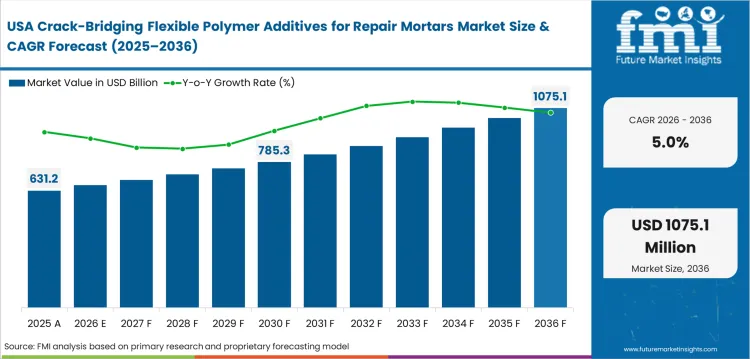
The market in United States is expected to advance at 5.0% CAGR by 2036 as bridge and parking deck owners continue preservation work. ARTBA bridge data for 2024 placed 6.8% of bridges in poor condition. Repair additives gain use when owners aim to extend service life without full replacement. Product approval depends on state specifications and contractor confidence in field performance.
- Bridge deck contractors require latex and RDP systems able to improve bond over aged concrete substrates.
- Parking structure repair crews value crack-control additives where freeze-thaw cycling damages patch edges.
- Direct technical service influences approval when public projects require documented repair performance.
Sales Analysis of Crack-Bridging Flexible Polymer Additives for Repair Mortars in United Kingdom
Industry in United Kingdom is projected to rise at 4.7% CAGR by 2036 as building repair and transport maintenance sustaining steady additive adoption. Public infrastructure work often requires proven repair materials and clear technical documentation. Polymer-modified mortars gain selection where facades and decks face moisture movement. Suppliers with local approvals and distributor coverage should hold stronger positions.
- Specialist distributors support smaller contractors needing repair-grade additives without full plant contracts.
- London commercial refurbishments need repair mortars reducing cracking on aged concrete and masonry interfaces.
- Rail and road maintenance contractors favor products with predictable curing during short work windows.
Demand Outlook for Crack-Bridging Flexible Polymer Additives for Repair Mortars in Germany
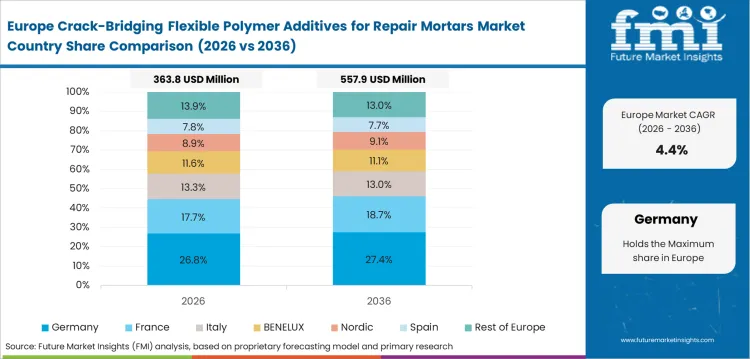
Germanyis forecast at 4.6% CAGR by 2036, influenced by regulated repair specifications maintaining strict product qualification. European building renovation policy aims to renovate 35 million buildings by 2030. Repair mortar suppliers face a steady pull from refurbishment work and infrastructure maintenance. Buyers are expected to prefer polymer systems backed by technical data and stable local supply.
- Bridge repair specialists value crack-bridging evidence where freeze-thaw exposure affects patch durability.
- German mortar formulators need RDP systems aligning dry-mix plants and EN repair product requirements.
- Industrial flooring repair contractors ask for low-shrinkage mortars limiting repeat shutdowns.
Opportunity Analysis of Crack-Bridging Flexible Polymer Additives for Repair Mortars in Japan
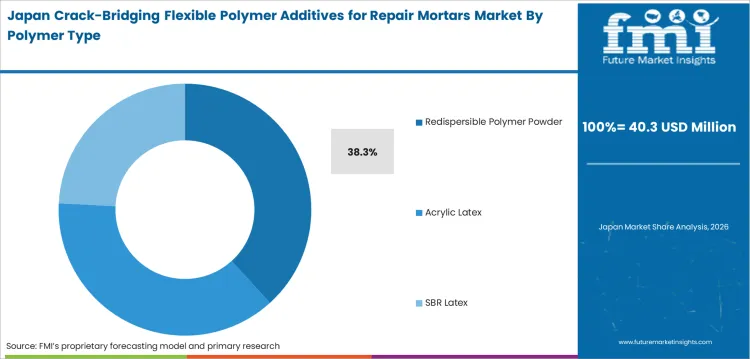
Japanis expected to post 4.4% CAGR by 2036 as aging bridges and tunnels keep maintenance on public agendas. Ministry of Land, Infrastructure, Transport and Tourism road materials describe aging infrastructure as a maintenance issue. Polymer additives fit repair work where crews need thin patching and durable bond on old concrete. Mature contractor practice keeps growth moderate but technically demanding.
- Tokyo and Osaka repair contractors need products performing in constrained sites and short closure windows.
- Municipal bridge owners value mortar systems reducing repeat interventions under workforce pressure.
- Japanese formulators often require stable documentation before changing from approved repair chemistries.
Competitive Positioning and Strategic Supplier Strength
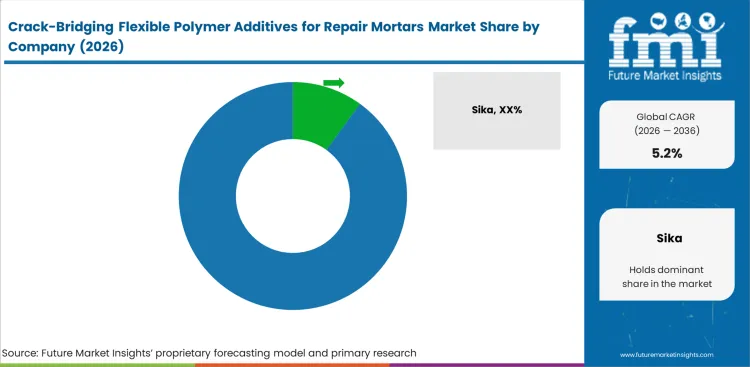
- Sika can gain repair mortar accounts by pairing polymer-modified mortar chemistry with system specifications and contractor training.
- Master Builders Solutions is expected to defend structural repair work led by cementitious repair mortar depth and project-level technical support.
- Wacker competes through VINNAPAS dispersible polymer powder base for dry-mix mortar producers serving repair and tile adhesive plants.
- Mapei holds contractor attention based on branded repair mortar systems used across horizontal or vertical and overhead concrete restoration work.
Competition is moving beyond product lists toward repair-site proof. Sika’s April 2025 Kazakhstan facility added mortar and concrete admixture lines with a modern laboratory, showing that larger suppliers are placing production closer to infrastructure and industrial repair work. Saint-Gobain’s February 2025 Fosroc acquisition gives it a wider construction chemicals platform across India and the Middle East. Repair mortar buyers should see faster local support as these suppliers connect manufacturing with testing and project advice more closely.
Large suppliers use system portfolios to protect large accounts once mortar makers approve a polymer package. Polymer additives become harder to replace when dosage and crack-bridging performance are written into site specifications. Regional suppliers can gain smaller accounts through quick delivery and field-level advice. Competitive pressure should rise around test data and application support, not additive price alone.
Key Companies in Crack-Bridging Flexible Polymer Additives for Repair Mortars Market
Competition spans polymer producers and construction chemical system suppliers serving mortar makers and contractors. Binder companies hold a role where RDP and latex portfolios support dry-mix repair mortars.
- Construction chemical system suppliers: Sika and Master Builders Solutions compete through repair mortar portfolios. Mapei and Saint-Gobain Fosroc compete through contractor support.
- Polymer binder suppliers: Wacker Chemie and Dow compete through RDP and latex chemistry. Celanese and Synthomer compete through waterborne dispersion depth.
- Specialty chemical platform suppliers: Arkema Bostik and Evonik connect specialty polymers with epoxy putty and construction chemicals along with bonding products used near repair mortar applications.
Competitive Benchmarking: Crack-Bridging Flexible Polymer Additives for Repair Mortars Market
| Company | Dry-Mix Binder Depth | Repair System Support | Local Technical Reach | Footprint |
|---|---|---|---|---|
| Sika | High | High | High | Global |
| Master Builders Solutions | High | High | Large | Global |
| Mapei | Large | High | High | Global |
| Wacker Chemie | High | Large | High | Global |
| Dow | Large | Large | High | Global |
| Celanese | Large | Moderate | Large | Global |
| Synthomer | Large | Moderate | Large | Global |
| Ashland | Moderate | Large | Moderate | Global |
Source: Future Market Insights competitive analysis based on public product portfolios and company activity in 2026.
Key Developments in the Crack-Bridging Flexible Polymer Additives for Repair Mortars Market
- In March 2025, Wacker presented VINNAPAS dispersible polymer powders for dry-mix mortar formulations at European Coatings Show 2025.
- In April 2025, Sika opened a Kazakhstan facility with production lines for mortar and concrete admixtures.
- In February 2025, Saint-Gobain completed the acquisition of Fosroc to expand its construction chemicals reach in Asia and emerging regions.
Key Players in the Crack-Bridging Flexible Polymer Additives for Repair Mortars Market
Construction chemical system suppliers
- Sika
- Master Builders Solutions
- Mapei
- Saint-Gobain Fosroc
- RPM International
Polymer binder suppliers
- Wacker Chemie
- Dow
- Celanese
- Synthomer
- Ashland
Specialty chemical platforms
- Arkema Bostik
- Evonik
- BASF
- Momentive
- H.B. Fuller
Report Scope and Coverage
| Item | Value |
|---|---|
| Market value in 2025 | USD 1.43 billion |
| Market value in 2026 | USD 1.5 billion |
| Market value in 2036 | USD 2.5 billion |
| CAGR from 2026 to 2036 | 5.2% |
| Quantitative units | USD billion |
| Market definition | Polymer additives used to improve flexibility and crack resistance in repair mortars |
| By polymer type | Redispersible polymer powder, acrylic latex, SBR latex, EVA copolymers |
| By form | Powder, liquid latex, waterborne dispersions, paste blends |
| By application | Structural repair mortars, patching mortars, overlays, waterproofing grouts |
| By end user | Construction contractors, infrastructure owners, precast producers, retail users |
| By sales channel | Direct supply, distributor sales, retail sales |
| Regions covered | North America, Latin America, Western Europe, Eastern Europe, East Asia, South Asia and Pacific, Middle East and Africa |
| Countries covered | China, India, Brazil, United States, United Kingdom, Germany, Japan |
| Key companies profiled | Sika, Master Builders Solutions, Mapei, Wacker Chemie, Dow, Celanese, Synthomer, Ashland |
| Forecast period | 2026 to 2036 |
| Approach | Bottom-up repair mortar additive modeling with country and segment cross-checks |
Source: Future Market Insights analysis, 2026.
Crack-Bridging Flexible Polymer Additives for Repair Mortars Market Breakdown by Polymer Type Form Application End User Sales Channel and Region
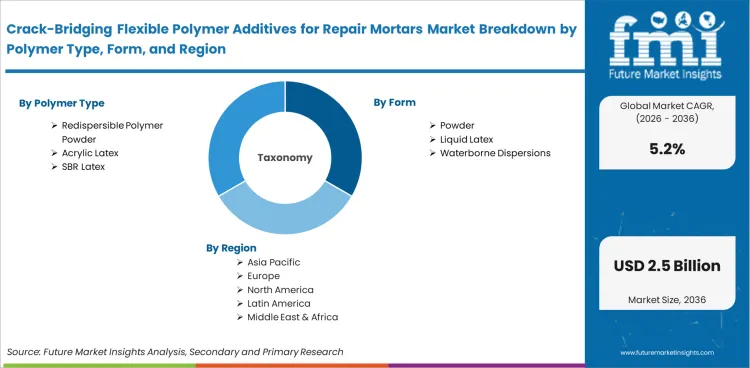
Crack-Bridging Flexible Polymer Additives for Repair Mortars Market Segmented by Polymer Type
- Redispersible Polymer Powder
- Acrylic Latex
- SBR Latex
- EVA Copolymers
Crack-Bridging Flexible Polymer Additives for Repair Mortars Market Segmented by Form
- Powder
- Liquid Latex
- Waterborne Dispersions
- Paste Blends
Crack-Bridging Flexible Polymer Additives for Repair Mortars Market Segmented by Application
- Structural Repair Mortars
- Patching Mortars
- Overlays
- Waterproofing Grouts
Crack-Bridging Flexible Polymer Additives for Repair Mortars Market Segmented by End User
- Construction Contractors
- Infrastructure Owners
- Precast Producers
- Retail Users
Crack-Bridging Flexible Polymer Additives for Repair Mortars Market Segmented by Sales Channel
- Direct Supply
- Distributor Sales
- Retail Sales
Crack-Bridging Flexible Polymer Additives for Repair Mortars Market by Region
- North America
- United States
- Canada
- Mexico
- Latin America
- Brazil
- Chile
- Rest of Latin America
- Western Europe
- Germany
- United Kingdom
- Italy
- Spain
- France
- Nordic
- BENELUX
- Rest of Western Europe
- Eastern Europe
- Poland
- Hungary
- Rest of Eastern Europe
- East Asia
- China
- Japan
- South Korea
- South Asia and Pacific
- India
- ASEAN
- Australia and New Zealand
- Rest of South Asia and Pacific
- Middle East and Africa
- Kingdom of Saudi Arabia
- Other GCC Countries
- Turkiye
- South Africa
- Rest of Middle East and Africa
Research Sources and Bibliography
- American Road & Transportation Builders Association. (2024, August 20). 2024 takeaways: ARTBA bridge report.
- European Parliament and Council of the European Union. (2024, April 24). Directive (EU) 2024/1275 of the European Parliament and of the Council on the energy performance of buildings. EUR-Lex.
- Federal Highway Administration. (2024, June 15). Bridge condition by highway system 2024. USA Department of Transportation.
- Ministry of Road Transport and Highways. (2025, December 30). Year-end review 2025: Ministry of Road Transport and Highways. Press Information Bureau.
- Ministry of Land, Infrastructure, Transport and Tourism. (2024). Roads in Japan 2024.
- Sika AG. (2025, April 8). Sika opens a new plant for concrete admixtures and mortars in Kazakhstan.
- Sika AG. (2025, June 27). Sika acquires renowned construction chemicals company in Qatar.
- Saint-Gobain. (2025, February 10). Saint-Gobain completes the acquisition of Fosroc, a leading player in construction chemicals in Asia and emerging markets, further strengthening its worldwide presence in the sector.
- Wacker Chemie AG. (2025, March 18). WACKER’s high-performance binders help construction industry reduce carbon footprint.
- MAPEI Corporation. (2026, April 14). MAPEI introduces Dynamon XTEND 4047.
Bibliography uses public infrastructure sources and official company publications. FMI pages are embedded only as body interlinks and are not listed as external evidence sources.
This Report Answers
- What is the current and future value of the crack-bridging flexible polymer additives for repair mortars market from 2026 to 2036?
- What CAGR is expected for the crack-bridging flexible polymer additives for repair mortars market during the forecast period?
- Which polymer type segment is projected to lead repair mortar additive demand in 2026?
- Which form segment is expected to hold the highest share in repair mortar polymer additives?
- What factors are driving polymer additive use in structural repair mortars?
- How do compatibility tests affect supplier selection for repair mortar additives?
- Which countries are expected to grow fastest in repair mortar polymer additives?
- Which companies are positioned across RDP and latex-based repair mortar additives?
- How does FMI define the repair mortar polymer additive revenue scope?
- What forecasting approach was used to estimate additive demand from 2026 to 2036?
Frequently Asked Questions
What is the global market demand for crack-bridging flexible polymer additives for repair mortars market in 2026?
The crack-bridging flexible polymer additives for repair mortars market is expected to be worth USD 1.5 billion in 2026 as mortar producers increase polymer modification.
What will the crack-bridging flexible polymer additives for repair mortars market be worth by 2036?
The crack-bridging flexible polymer additives for repair mortars industry is projected to reach USD 2.5 billion by 2036 as repair programs specify longer service life.
What is the expected CAGR for the crack-bridging flexible polymer additives for repair mortars market?
The sector is expected to expand at 5.2% CAGR from 2026 to 2036 across repair mortar channels.
Which polymer type leads the crack-bridging flexible polymer additives for repair mortars market?
Redispersible polymer powder is projected to account for 38.0% share in 2026 due to dry-mix compatibility.
Which form leads the crack-bridging flexible polymer additives for repair mortars market?
Powder is expected to hold 44.0% share in 2026 as repair mortar makers need stable storage and plant dosing.
Which country grows fastest in the crack-bridging flexible polymer additives for repair mortars market?
China is projected to record 6.3% CAGR by 2036 as urban infrastructure repair supports polymer-modified mortar use.
What does the crack-bridging flexible polymer additives for repair mortars market include?
Scope includes RDP and latex additives used in cementitious repair mortars. Finished mortar bags are outside additive revenue.
How was the crack-bridging flexible polymer additives for repair mortars market forecast prepared?
Forecast work used parent repair mortar values and additive loading assumptions. Country and segment checks were used for validation.
How do crack-bridging flexible polymer additives work in repair mortars?
Polymer additives form films inside cement mortar. Film formation improves adhesion and flexibility after the repair material cures.
Preview the report firsthand - request a free sample
Get SampleGet the brochure for pricing and purchase details.
Get PDFTable of Content
- Executive Summary
- Global Market Outlook
- Demand-side Trends
- Supply-side Trends
- Technology Roadmap Analysis
- Analysis and Recommendations
- Market Overview
- Market Coverage / Taxonomy
- Market Definition / Scope / Limitations
- Research Methodology
- Chapter Orientation
- Analytical Lens and Working Hypotheses
- Market Structure, Signals, and Trend Drivers
- Benchmarking and Cross-market Comparability
- Market Sizing, Forecasting, and Opportunity Mapping
- Research Design and Evidence Framework
- Desk Research Programme (Secondary Evidence)
- Company Annual and Sustainability Reports
- Peer-reviewed Journals and Academic Literature
- Corporate Websites, Product Literature, and Technical Notes
- Earnings Decks and Investor Briefings
- Statutory Filings and Regulatory Disclosures
- Technical White Papers and Standards Notes
- Trade Journals, Industry Magazines, and Analyst Briefs
- Conference Proceedings, Webinars, and Seminar Materials
- Government Statistics Portals and Public Data Releases
- Press Releases and Reputable Media Coverage
- Specialist Newsletters and Curated Briefings
- Sector Databases and Reference Repositories
- FMI Internal Proprietary Databases and Historical Market Datasets
- Subscription Datasets and Paid Sources
- Social Channels, Communities, and Digital Listening Inputs
- Additional Desk Sources
- Expert Input and Fieldwork (Primary Evidence)
- Primary Modes
- Qualitative Interviews and Expert Elicitation
- Quantitative Surveys and Structured Data Capture
- Blended Approach
- Why Primary Evidence is Used
- Field Techniques
- Interviews
- Surveys
- Focus Groups
- Observational and In-context Research
- Social and Community Interactions
- Stakeholder Universe Engaged
- C-suite Leaders
- Board Members
- Presidents and Vice Presidents
- R&D and Innovation Heads
- Technical Specialists
- Domain Subject-matter Experts
- Scientists
- Physicians and Other Healthcare Professionals
- Governance, Ethics, and Data Stewardship
- Research Ethics
- Data Integrity and Handling
- Primary Modes
- Tooling, Models, and Reference Databases
- Desk Research Programme (Secondary Evidence)
- Data Engineering and Model Build
- Data Acquisition and Ingestion
- Cleaning, Normalisation, and Verification
- Synthesis, Triangulation, and Analysis
- Quality Assurance and Audit Trail
- Market Background
- Market Dynamics
- Drivers
- Restraints
- Opportunity
- Trends
- Scenario Forecast
- Demand in Optimistic Scenario
- Demand in Likely Scenario
- Demand in Conservative Scenario
- Opportunity Map Analysis
- Product Life Cycle Analysis
- Supply Chain Analysis
- Investment Feasibility Matrix
- Value Chain Analysis
- PESTLE and Porter’s Analysis
- Regulatory Landscape
- Regional Parent Market Outlook
- Production and Consumption Statistics
- Import and Export Statistics
- Market Dynamics
- Global Market Analysis 2021 to 2025 and Forecast, 2026 to 2036
- Historical Market Size Value (USD Million) Analysis, 2021 to 2025
- Current and Future Market Size Value (USD Million) Projections, 2026 to 2036
- Y-o-Y Growth Trend Analysis
- Absolute $ Opportunity Analysis
- Global Market Pricing Analysis 2021 to 2025 and Forecast 2026 to 2036
- Global Market Analysis 2021 to 2025 and Forecast 2026 to 2036, By Polymer Type
- Introduction / Key Findings
- Historical Market Size Value (USD Million) Analysis By Polymer Type , 2021 to 2025
- Current and Future Market Size Value (USD Million) Analysis and Forecast By Polymer Type , 2026 to 2036
- Redispersible Polymer Powder
- Acrylic Latex
- SBR Latex
- Redispersible Polymer Powder
- Y-o-Y Growth Trend Analysis By Polymer Type , 2021 to 2025
- Absolute $ Opportunity Analysis By Polymer Type , 2026 to 2036
- Global Market Analysis 2021 to 2025 and Forecast 2026 to 2036, By Form
- Introduction / Key Findings
- Historical Market Size Value (USD Million) Analysis By Form, 2021 to 2025
- Current and Future Market Size Value (USD Million) Analysis and Forecast By Form, 2026 to 2036
- Powder
- Liquid Latex
- Waterborne Dispersions
- Powder
- Y-o-Y Growth Trend Analysis By Form, 2021 to 2025
- Absolute $ Opportunity Analysis By Form, 2026 to 2036
- Global Market Analysis 2021 to 2025 and Forecast 2026 to 2036, By Application
- Introduction / Key Findings
- Historical Market Size Value (USD Million) Analysis By Application, 2021 to 2025
- Current and Future Market Size Value (USD Million) Analysis and Forecast By Application, 2026 to 2036
- Structural Repair Mortars
- Patching Mortars
- Overlays
- Structural Repair Mortars
- Y-o-Y Growth Trend Analysis By Application, 2021 to 2025
- Absolute $ Opportunity Analysis By Application, 2026 to 2036
- Global Market Analysis 2021 to 2025 and Forecast 2026 to 2036, By End User
- Introduction / Key Findings
- Historical Market Size Value (USD Million) Analysis By End User, 2021 to 2025
- Current and Future Market Size Value (USD Million) Analysis and Forecast By End User, 2026 to 2036
- Construction Contractors
- Infrastructure Owners
- Retail Users
- Construction Contractors
- Y-o-Y Growth Trend Analysis By End User, 2021 to 2025
- Absolute $ Opportunity Analysis By End User, 2026 to 2036
- Global Market Analysis 2021 to 2025 and Forecast 2026 to 2036, By Sales Channel
- Introduction / Key Findings
- Historical Market Size Value (USD Million) Analysis By Sales Channel, 2021 to 2025
- Current and Future Market Size Value (USD Million) Analysis and Forecast By Sales Channel, 2026 to 2036
- Direct Supply
- Distributor Sales
- Retail Sales
- Direct Supply
- Y-o-Y Growth Trend Analysis By Sales Channel, 2021 to 2025
- Absolute $ Opportunity Analysis By Sales Channel, 2026 to 2036
- Global Market Analysis 2021 to 2025 and Forecast 2026 to 2036, By Region
- Introduction
- Historical Market Size Value (USD Million) Analysis By Region, 2021 to 2025
- Current Market Size Value (USD Million) Analysis and Forecast By Region, 2026 to 2036
- North America
- Latin America
- Western Europe
- Eastern Europe
- East Asia
- South Asia and Pacific
- Middle East & Africa
- Market Attractiveness Analysis By Region
- North America Market Analysis 2021 to 2025 and Forecast 2026 to 2036, By Country
- Historical Market Size Value (USD Million) Trend Analysis By Market Taxonomy, 2021 to 2025
- Market Size Value (USD Million) Forecast By Market Taxonomy, 2026 to 2036
- By Country
- USA
- Canada
- Mexico
- By Polymer Type
- By Form
- By Application
- By End User
- By Sales Channel
- By Country
- Market Attractiveness Analysis
- By Country
- By Polymer Type
- By Form
- By Application
- By End User
- By Sales Channel
- Key Takeaways
- Latin America Market Analysis 2021 to 2025 and Forecast 2026 to 2036, By Country
- Historical Market Size Value (USD Million) Trend Analysis By Market Taxonomy, 2021 to 2025
- Market Size Value (USD Million) Forecast By Market Taxonomy, 2026 to 2036
- By Country
- Brazil
- Chile
- Rest of Latin America
- By Polymer Type
- By Form
- By Application
- By End User
- By Sales Channel
- By Country
- Market Attractiveness Analysis
- By Country
- By Polymer Type
- By Form
- By Application
- By End User
- By Sales Channel
- Key Takeaways
- Western Europe Market Analysis 2021 to 2025 and Forecast 2026 to 2036, By Country
- Historical Market Size Value (USD Million) Trend Analysis By Market Taxonomy, 2021 to 2025
- Market Size Value (USD Million) Forecast By Market Taxonomy, 2026 to 2036
- By Country
- Germany
- UK
- Italy
- Spain
- France
- Nordic
- BENELUX
- Rest of Western Europe
- By Polymer Type
- By Form
- By Application
- By End User
- By Sales Channel
- By Country
- Market Attractiveness Analysis
- By Country
- By Polymer Type
- By Form
- By Application
- By End User
- By Sales Channel
- Key Takeaways
- Eastern Europe Market Analysis 2021 to 2025 and Forecast 2026 to 2036, By Country
- Historical Market Size Value (USD Million) Trend Analysis By Market Taxonomy, 2021 to 2025
- Market Size Value (USD Million) Forecast By Market Taxonomy, 2026 to 2036
- By Country
- Russia
- Poland
- Hungary
- Balkan & Baltic
- Rest of Eastern Europe
- By Polymer Type
- By Form
- By Application
- By End User
- By Sales Channel
- By Country
- Market Attractiveness Analysis
- By Country
- By Polymer Type
- By Form
- By Application
- By End User
- By Sales Channel
- Key Takeaways
- East Asia Market Analysis 2021 to 2025 and Forecast 2026 to 2036, By Country
- Historical Market Size Value (USD Million) Trend Analysis By Market Taxonomy, 2021 to 2025
- Market Size Value (USD Million) Forecast By Market Taxonomy, 2026 to 2036
- By Country
- China
- Japan
- South Korea
- By Polymer Type
- By Form
- By Application
- By End User
- By Sales Channel
- By Country
- Market Attractiveness Analysis
- By Country
- By Polymer Type
- By Form
- By Application
- By End User
- By Sales Channel
- Key Takeaways
- South Asia and Pacific Market Analysis 2021 to 2025 and Forecast 2026 to 2036, By Country
- Historical Market Size Value (USD Million) Trend Analysis By Market Taxonomy, 2021 to 2025
- Market Size Value (USD Million) Forecast By Market Taxonomy, 2026 to 2036
- By Country
- India
- ASEAN
- Australia & New Zealand
- Rest of South Asia and Pacific
- By Polymer Type
- By Form
- By Application
- By End User
- By Sales Channel
- By Country
- Market Attractiveness Analysis
- By Country
- By Polymer Type
- By Form
- By Application
- By End User
- By Sales Channel
- Key Takeaways
- Middle East & Africa Market Analysis 2021 to 2025 and Forecast 2026 to 2036, By Country
- Historical Market Size Value (USD Million) Trend Analysis By Market Taxonomy, 2021 to 2025
- Market Size Value (USD Million) Forecast By Market Taxonomy, 2026 to 2036
- By Country
- Kingdom of Saudi Arabia
- Other GCC Countries
- Turkiye
- South Africa
- Other African Union
- Rest of Middle East & Africa
- By Polymer Type
- By Form
- By Application
- By End User
- By Sales Channel
- By Country
- Market Attractiveness Analysis
- By Country
- By Polymer Type
- By Form
- By Application
- By End User
- By Sales Channel
- Key Takeaways
- Key Countries Market Analysis
- USA
- Pricing Analysis
- Market Share Analysis, 2025
- By Polymer Type
- By Form
- By Application
- By End User
- By Sales Channel
- Canada
- Pricing Analysis
- Market Share Analysis, 2025
- By Polymer Type
- By Form
- By Application
- By End User
- By Sales Channel
- Mexico
- Pricing Analysis
- Market Share Analysis, 2025
- By Polymer Type
- By Form
- By Application
- By End User
- By Sales Channel
- Brazil
- Pricing Analysis
- Market Share Analysis, 2025
- By Polymer Type
- By Form
- By Application
- By End User
- By Sales Channel
- Chile
- Pricing Analysis
- Market Share Analysis, 2025
- By Polymer Type
- By Form
- By Application
- By End User
- By Sales Channel
- Germany
- Pricing Analysis
- Market Share Analysis, 2025
- By Polymer Type
- By Form
- By Application
- By End User
- By Sales Channel
- UK
- Pricing Analysis
- Market Share Analysis, 2025
- By Polymer Type
- By Form
- By Application
- By End User
- By Sales Channel
- Italy
- Pricing Analysis
- Market Share Analysis, 2025
- By Polymer Type
- By Form
- By Application
- By End User
- By Sales Channel
- Spain
- Pricing Analysis
- Market Share Analysis, 2025
- By Polymer Type
- By Form
- By Application
- By End User
- By Sales Channel
- France
- Pricing Analysis
- Market Share Analysis, 2025
- By Polymer Type
- By Form
- By Application
- By End User
- By Sales Channel
- India
- Pricing Analysis
- Market Share Analysis, 2025
- By Polymer Type
- By Form
- By Application
- By End User
- By Sales Channel
- ASEAN
- Pricing Analysis
- Market Share Analysis, 2025
- By Polymer Type
- By Form
- By Application
- By End User
- By Sales Channel
- Australia & New Zealand
- Pricing Analysis
- Market Share Analysis, 2025
- By Polymer Type
- By Form
- By Application
- By End User
- By Sales Channel
- China
- Pricing Analysis
- Market Share Analysis, 2025
- By Polymer Type
- By Form
- By Application
- By End User
- By Sales Channel
- Japan
- Pricing Analysis
- Market Share Analysis, 2025
- By Polymer Type
- By Form
- By Application
- By End User
- By Sales Channel
- South Korea
- Pricing Analysis
- Market Share Analysis, 2025
- By Polymer Type
- By Form
- By Application
- By End User
- By Sales Channel
- Russia
- Pricing Analysis
- Market Share Analysis, 2025
- By Polymer Type
- By Form
- By Application
- By End User
- By Sales Channel
- Poland
- Pricing Analysis
- Market Share Analysis, 2025
- By Polymer Type
- By Form
- By Application
- By End User
- By Sales Channel
- Hungary
- Pricing Analysis
- Market Share Analysis, 2025
- By Polymer Type
- By Form
- By Application
- By End User
- By Sales Channel
- Kingdom of Saudi Arabia
- Pricing Analysis
- Market Share Analysis, 2025
- By Polymer Type
- By Form
- By Application
- By End User
- By Sales Channel
- Turkiye
- Pricing Analysis
- Market Share Analysis, 2025
- By Polymer Type
- By Form
- By Application
- By End User
- By Sales Channel
- South Africa
- Pricing Analysis
- Market Share Analysis, 2025
- By Polymer Type
- By Form
- By Application
- By End User
- By Sales Channel
- USA
- Market Structure Analysis
- Competition Dashboard
- Competition Benchmarking
- Market Share Analysis of Top Players
- By Regional
- By Polymer Type
- By Form
- By Application
- By End User
- By Sales Channel
- Competition Analysis
- Competition Deep Dive
- Sika
- Overview
- Product Portfolio
- Profitability by Market Segments (Product/Age /Sales Channel/Region)
- Sales Footprint
- Strategy Overview
- Marketing Strategy
- Product Strategy
- Channel Strategy
- Master Builders Solutions
- Mapei
- Saint-Gobain Fosroc
- RPM International
- Sika
- Competition Deep Dive
- Assumptions & Acronyms Used


