

- Market Size (2026)
- USD 1.3 Bn
- Forecast (2036)
- USD 2.0 Bn
- CAGR (2026 to 2036)
- 4.5%
Anti-Redeposition Polymer Additives for Short-Wash Cycles Market Size, Forecast, and Outlook By FMI
Summary of the Anti-Redeposition Polymer Additives for Short-Wash Cycles Market
- Demand and Growth Drivers
- Short household programs create higher soil concentration in wash liquor due to lower water use leaving less dilution room for suspended dirt.
- Cold water washing supports additive use as polymers help detergents keep loosened soil away from fabric before rinsing starts.
- Powder and liquid brands use polymer systems to protect whiteness in laundry care products sold for everyday fabric cleaning.
- Product and Segment View
- Polyacrylate maleic copolymers are estimated to hold 36.0% share of polymer chemistry demand in 2026 because of proven clay control in detergent formulas.
- Powder detergents are anticipated to represent 40.0% share of detergent format demand in 2026 led by dry formulas depending on CMC and acrylic systems.
- Soil suspension is expected to lead function demand with 38.0% share in 2026 since short cycles leave less time for rinse removal.
- Geography and Competitive Outlook
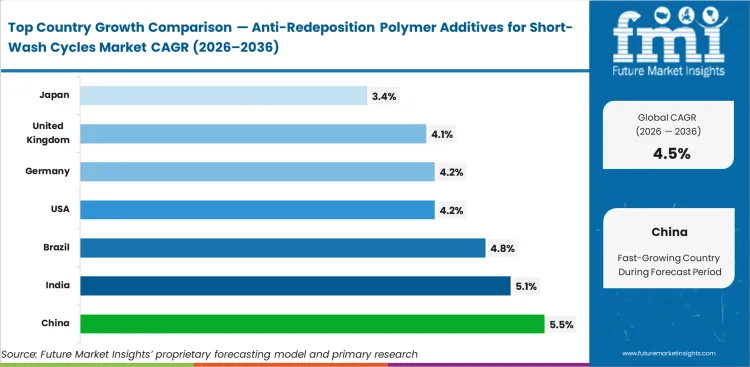
- China is projected to record 5.5% CAGR through 2036 as appliance replacement and home care upgrading raise additive intensity.
- The United States is forecast at 4.2% CAGR through 2036 since cold water washing keeps performance claims tied to detergent polymer systems.
- Competitive strength is shaped by polymer compatibility and formulation support for powder and liquid detergent brands.
- Analyst Opinion
- Nikhil Kaitwade, Principal Analyst for Chemical and Materials at FMI, observes that, "Short wash cycles change the additive task. Detergents get less time and water to keep soil away from fabric. I see polymer suppliers acquiring accounts through repeatable anti-graying results over large ingredient catalogs. Companies should watch cold wash claims and compact formulas as biobased CMC launches enter supplier trials. Cost pressure will stay present, so additives need to prove lower rewash risk and cleaner fabric appearance within normal detergent dosage."
- Anti-Redeposition Polymer Additives for Short-Wash Cycles Market Value Analysis
- Polyacrylate Maleic Copolymers remain the largest polymer chemistry as they disperse clay and mineral soil in compact detergent systems.
- Household Laundry influences the largest end use base since home detergent brands create repeat additive demand across powder and liquid formats.
- Direct Sales shape large accounts led by chemical suppliers providing documentation and stability support before detergent formula approval.
- Price sensitivity stays high in value detergent ranges influenced by polymer dosage competing with surfactants and builders in formula cost.
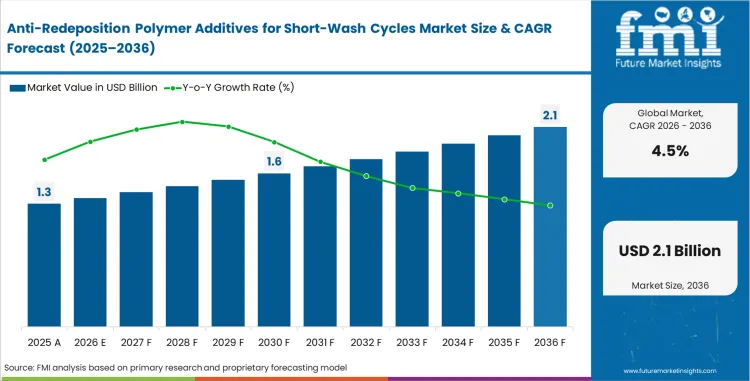
Key Takeaways, Market Size, and Forecast
- The anti-redeposition additives industry value stood at USD 1.2 billion in 2025.
- Industry value is projected to reach USD 2.0 billion by 2036 as detergent brands add soil suspension polymers for faster wash programs.
- The sector is expected to expand at a 4.5% CAGR from 2026 to 2036 based on FMI additives outlook.
- The sector is projected to create an incremental opportunity of USD 0.7 billion between 2026 and 2036.
- Household Laundry is expected to account for 62.0% share in 2026 since home users create the largest repeat base for short-wash detergent formats.
- China at 5.5% CAGR and India at 5.1% CAGR are expected to post the quickest rise through 2036.
Anti-Redeposition Polymer Additives for Short-Wash Cycles Market Definition
The sector covers polymer additives used in laundry detergents and fabric care products to keep released soil suspended during short wash programs. Included chemistries cover polyacrylate maleic copolymers, carboxymethyl cellulose, PVP polymers, soil release polyesters, biopolymer blends, and polyaspartates. Finished detergents, surfactant-only systems, enzymes sold as separate actives, fabric softeners without anti-redeposition claims, and washing machines stay outside the value counted in this study.
Anti-Redeposition Polymer Additives for Short-Wash Cycles Market Inclusions
The study includes polymer chemistry, detergent format, end use, wash condition, function, sales channel, and geography across global additive demand.
Anti-Redeposition Polymer Additives for Short-Wash Cycles Market Exclusions
Finished laundry detergents, washing machines, surfactants sold without anti-redeposition function, stand-alone enzymes, fragrances, bleaching agents, fabric softeners, and textile finishing chemicals stay outside this study.
Anti-Redeposition Polymer Additives for Short-Wash Cycles Market Research Methodology
- Primary Research: FMI analysts reviewed detergent formulators together with home care ingredient suppliers and laundry additive distributors active in polymer systems.
- Desk Research: The desk review used FMI datasets with detergent formulation references and public washing appliance efficiency sources.
- Market Sizing and Forecasting: The forecast aligned FMI additive values with polymer use intensity and short-cycle detergent penetration by country.
- Data Validation: Segment balance and country growth were checked against laundry care values and supplier product evidence in 2026.
Why is the Anti-Redeposition Polymer Additives for Short-Wash Cycles Market Growing?
- Short wash programs lift polymer need since lower contact time raises the risk of loosened soil settling back on fabric.
- Cold water settings support additive use as detergent brands require soil suspension after lower thermal cleaning input.
- Compact formats require stable polymer systems since unit doses and concentrates leave less room for corrective ingredients.
- Biobased CMC development adds revenue prospects for suppliers able to match synthetic anti-redeposition performance in powder formulas.
Short-cycle washing places more work on detergent additives. ENERGY STAR notes the average American family completes about 300 laundry loads each year and certified washers use about 20% less energy and 30% less water than regular washers. Lower water use can raise soil concentration inside the wash bath. Polymer additives help keep clay soil and loose dye particles suspended until rinse water removes them. This supports the forecast for low-temperature laundry chemicals and related short-cycle additive systems.
Cold water habits further influence the industry expansion during the forecast period. ACI reported in December 2024 a 46% share of USA respondents washing in cold water more than half the time. Brand claims for cold wash and quick wash need dependable anti-graying performance after fewer mechanical turns. Polymer suppliers achieve repeat formula work if additives remain stable in liquid detergents and disperse quickly in powder detergents.
Market Segmentation Analysis
- Household laundry is expected to account for 62.0% share in 2026 because of home detergent use creating the largest repeat base for short-cycle formulas.
- Direct sales are likely to secure 57.0% share in 2026 since large detergent makers need documentation and formula support before approval.
- Cold short cycles are estimated to represent 41.0% share in 2026 as quick programs need soil control during reduced wash time.
- Polyacrylate maleic copolymers are projected to contribute 36.0% share in 2026 as they give measurable particulate soil dispersion in powder detergents.
The anti-redeposition polymer additives for short-wash cycles market is segmented by polymer chemistry into polyacrylate maleic copolymers, carboxymethyl cellulose, soil release polyesters, PVP polymers, biopolymer blends, and polyaspartates. By detergent format, the sector is divided into powder detergents, liquid detergents, pods, tablets, sheets, and gels. Based on end use, the sector is segmented into household laundry, commercial laundry, hospitality laundry, healthcare laundry, textile care, and industrial cleaning. By wash condition, the sector is segmented into cold short cycles, warm quick cycles, low water cycles, mixed fabric cycles, stain prewash, and rinse saver cycles. By function, the sector is segmented into soil suspension, anti graying, dye transfer control, clay control, soil release, and whiteness care. By sales channel, the sector is divided into direct sales, distributors, formulation houses, contract blenders, and online B2B.
Anti-Redeposition Polymer Additives for Short-Wash Cycles Market Analysis by Polymer Chemistry
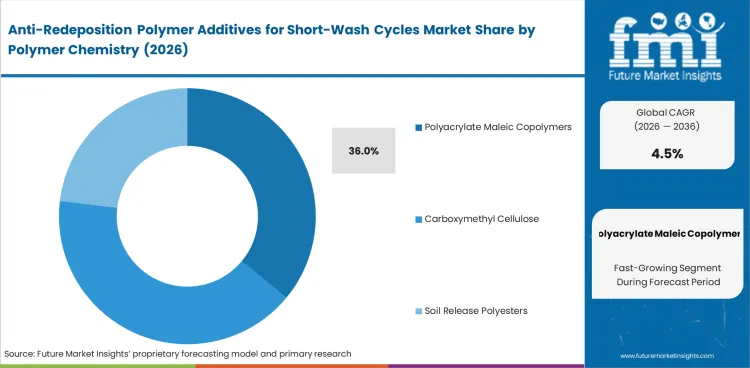
- Polyacrylate maleic copolymers are projected to account for 36.0% share in 2026 since detergent formulators use them to keep clay soil dispersed during faster wash cycles.
- Copolymer use remains high in compact detergent recipes as they help maintain wash bath stability after soil leaves the fabric surface.
Insights into the Carboxymethyl Cellulose Segment
- Carboxymethyl cellulose gains use in fabric detergents due to cotton and cellulose-rich fabrics requiring surface protection after loosened dirt enters the wash bath.
- Powder detergent makers continue to use this polymer since it supports anti-graying performance without adding a difficult handling step during dry blending.
Anti-Redeposition Polymer Additives for Short-Wash Cycles Market Analysis by Detergent Format
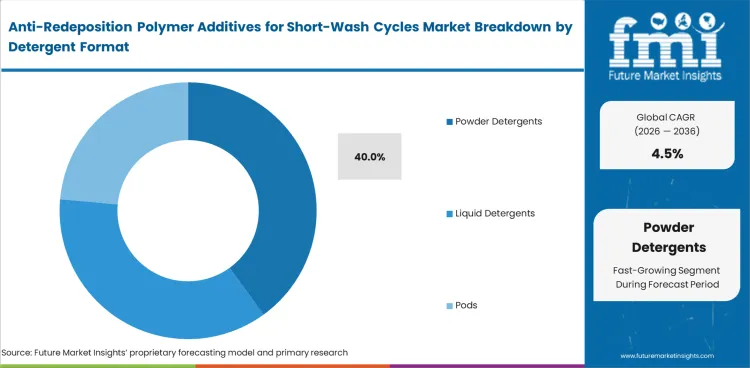
- Powder detergents are expected to hold 40.0% share in 2026 as dry formulations use acrylic polymers and cellulose derivatives for cost-controlled anti-redeposition performance.
- Powder formats remain important for mass laundry care because additive dosing can be managed through premixed dry blends used in standard detergent plants.
Insights into the Liquid Detergents Segment
- Liquid detergents need soluble polymer systems since cold wash claims lose strength if additives separate during storage or fail during short contact time.
- Concentrated liquid formats support polymer use as formulators must control soil suspension in smaller wash bath volumes and lower water temperatures.
Anti-Redeposition Polymer Additives for Short-Wash Cycles Market Analysis by End Use
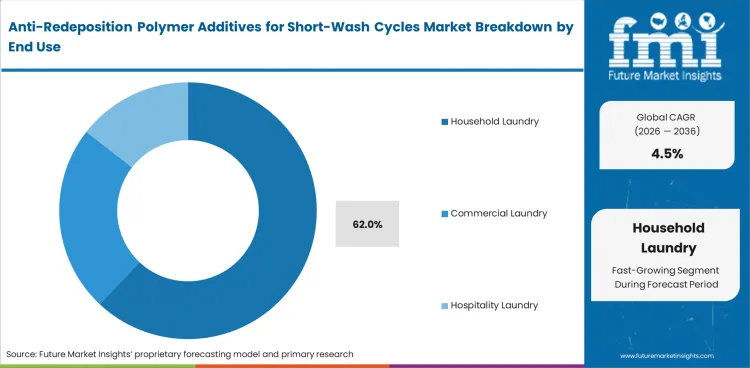
- Household laundry is anticipated to represent 62.0% share in 2026 influenced by frequent home washing leadin
- g to the largest repeat base for short-cycle detergent formulas.
- Home laundry users rely on quick programs more often because of energy saving and time saving wash habits raising the need for stable soil control.
Insights into the Commercial Laundry Segment
- Commercial laundry uses anti-redeposition additives since hotels and uniform services need cleaner fabric output with lower rewash risk across mixed soil loads.
- Short service timelines in institutional laundry increase the value of polymers as fabrics face faster washing and limited rinse time.
Anti-Redeposition Polymer Additives for Short-Wash Cycles Market Analysis by Wash Condition
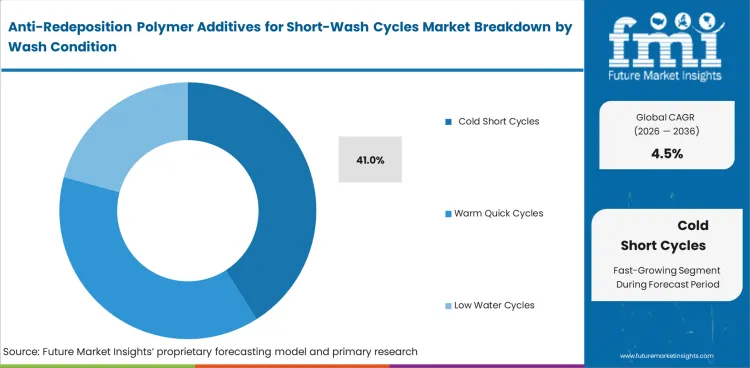
- Cold short cycles are estimated to secure 41.0% share of wash condition demand in 2026 as detergent brands need soil suspension without support from high wash temperature.
- Reduced wash time raises performance pressure on polymers as loosened dirt remains suspended before it can settle back onto fabric.
Insights into the Low Water Cycles Segment
- Low water cycles support polymer adoption as lower dilution can raise soil concentration inside the wash bath during compact machine programs.
- Detergent makers add stronger dispersant systems for low water washing because of fabric contact with suspended dirt increasing during short rinse steps.
Anti-Redeposition Polymer Additives for Short-Wash Cycles Market Analysis by Function
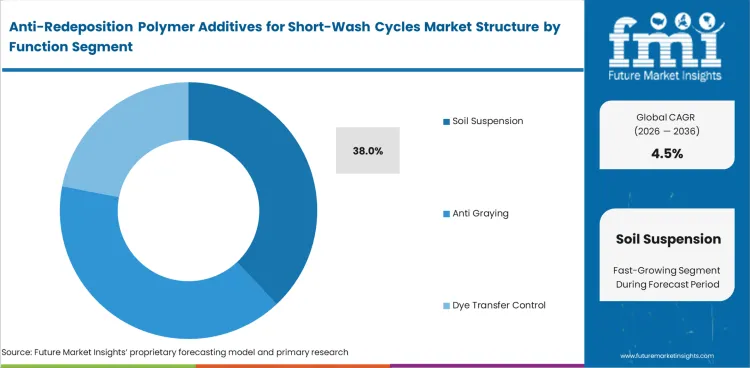
- Soil suspension is expected to account for 38.0% share of function demand in 2026 as short programs leave less rinse time for loosened dirt removal.
- Suspension performance remains the main product requirement since detergent formulas are required to stop clay and particulate soil from returning to fabrics.
Insights into the Dye Transfer Control Segment
- Dye transfer control serves color detergent formulas as mixed loads release dyes before rinse water clears the wash bath.
- Polymer selection in this segment is shaped by color-care claims influenced by users expecting bright fabrics after repeated quick wash programs.
Anti-Redeposition Polymer Additives for Short-Wash Cycles Market Analysis by Sales Channel
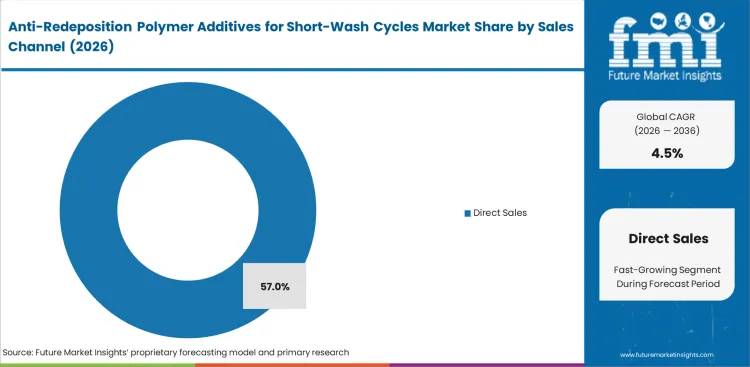
- Direct sales are likely to account for 57.0% share of sales channel demand in 2026 as major detergent makers require batch documents and compatibility support before approval.
- Direct contracts help additive suppliers manage repeat formulation trials because of detergent plants depending on steady grade behavior across approved product lines.
Insights into the Distributors Segment
- Distributors serve smaller detergent producers requiring standard polymer grades in lower volumes and shorter delivery cycles for new product trials.
- Local stock availability supports distributor demand as regional detergent brands often test short-wash additives before shifting to larger supply contracts.
Anti-Redeposition Polymer Additives for Short-Wash Cycles Market Drivers, Restraints and Opportunities
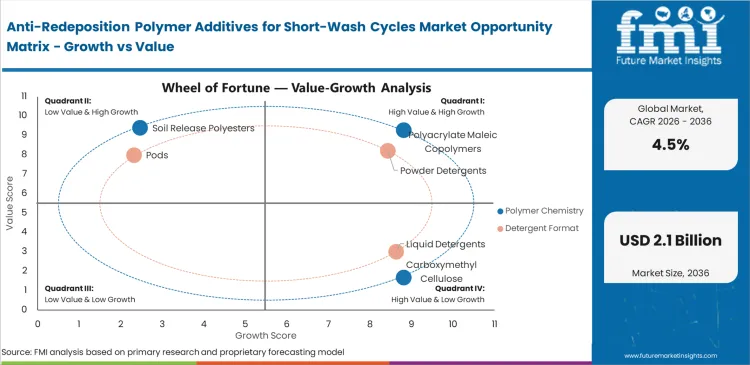
- Short wash claims will sustain additive use through 2036 as detergent makers need cleaner fabric appearance in reduced cycle time.
- High polymer cost can limit use in entry detergents since buyers may prefer higher surfactant loading at the same formula cost.
- Biobased CMC and biodegradable polymers may add revenue for suppliers able to prove anti-graying results without major reformulation.
Performance expectations are shifting toward faster cycles and lower wash temperatures. European washing machine rules require an eco 40-60 program and set requirements for water use with rinse performance. Detergent makers need additive packages able to protect fabric appearance inside appliance programs designed for efficiency. This raises the role of polymer dispersants alongside detergent hard-water tolerance builders and surfactants in compact formulas.
Cost remains the main restraint in value detergents. Polymer dosage competes with builders and surfactants inside each formula budget. Suppliers can defend price by proving fewer grayness complaints after repeated short cycles. Opportunity is strongest in concentrated liquids and pods since fabric care sector need performance claims without heavier dosage.
Price Trend and Benchmarking Analysis
Short-cycle polymer pricing is shaped by acrylic monomer costs and cellulose derivative supply with formulation support expense. Bio-based alternatives can price above standard acrylic systems if they reduce reformulation effort and support retailer sustainability requirements. Nouryon launched FinnFix PB MAX in February 2026 as a 100% biobased biodegradable CMC for laundry detergents. Products such as natural surfactants show the same buyer interest in renewable chemistry tied to cleaning performance.
Supply Risk and Sourcing Dependence Analysis
Supply risk comes from acrylic acid chains and cellulose feedstock quality across specialty polymer grades. Large chemical suppliers have an advantage because detergent brands need repeat batches and technical support before scale-up. Dow describes ACUSOL 505N as a detergent polymer for soil removal and soil anti-redeposition in industrial laundry formulations. Similar product positions connect this sector with fabric stain removers and low foaming surfactants used in cleaning systems.
Regional Analysis
.webp "Top Country Growth Comparison Anti Redeposition Polymer Additives For Short Wash Cycles Market Cagr (2026 2036)")
| Country | CAGR 2026 to 2036 |
|---|---|
| China | 5.5% |
| India | 5.1% |
| Brazil | 4.8% |
| United States | 4.2% |
| Germany | 4.2% |
| United Kingdom | 4.1% |
| Japan | 3.4% |
Source: Future Market Insights global country outlook and Future Market Insights analysis based on public source checks in 2026.
Analysis of Anti-Redeposition Polymer Additives for Short-Wash Cycles Market by Key Countries
- China is projected to record 5.5% CAGR through 2036 as urban detergent upgrades and appliance replacement support short-cycle cleaning claims.
- India is expected to expand at 5.1% CAGR through 2036 since washing machine use and liquid detergent trials rise from a smaller base.
- Brazil is forecast to grow at 4.8% CAGR through 2036 led by warm climate washing favoring lower-temperature detergent systems for frequent loads.
- United States is expected to advance at 4.2% CAGR through 2036 because of cold water use keeping polymer performance tied to mainstream detergent claims.
Country growth differs by wash habit and appliance efficiency across premium detergent uptake. China and India record higher pace because detergent formulation upgrades are still spreading across more households. The United States and Germany remain stable through cold water and efficiency-led washing. Japan records slower expansion as the household laundry base is already mature.
Demand Outlook for Anti-Redeposition Polymer Additives for Short-Wash Cycles Market in China
China is projected to record 5.5% CAGR through 2036 influenced by local detergent makers developing higher performance powders and liquids for machine washing. Urban homes use faster appliance programs to cut time and energy use. Local and multinational ingredient suppliers gain from polymer grades with fast dissolution and stable whiteness results.
- Detergent brands use acrylic copolymers and CMC to improve repeat wash appearance in mass household products.
- Compact homes and time-saving wash settings support short-cycle claims for liquid and powder formulas.
- Supplier advantage comes from local technical support because brands need fast reformulation after cost changes.
Demand Outlook for Anti-Redeposition Polymer Additives for Short-Wash Cycles Market in India
India is expected to expand at 5.1% CAGR through 2036 since liquid detergents and machine-wash powders integrate into more urban homes. Price-sensitive detergent brands require proven fabric appearance claims. Polymer additives gain if suppliers can balance low dosage with reliable performance in hard water.
- Hard-water washing increases the need for dispersant polymers able to hold mineral soil away from fabric.
- Urban consumers buying machine-wash detergents create openings for short-cycle and cold-wash positioning.
- Local blenders need distributor support since smaller brands often test additives before direct contracts.
Demand Outlook for Anti-Redeposition Polymer Additives for Short-Wash Cycles Market in the United States
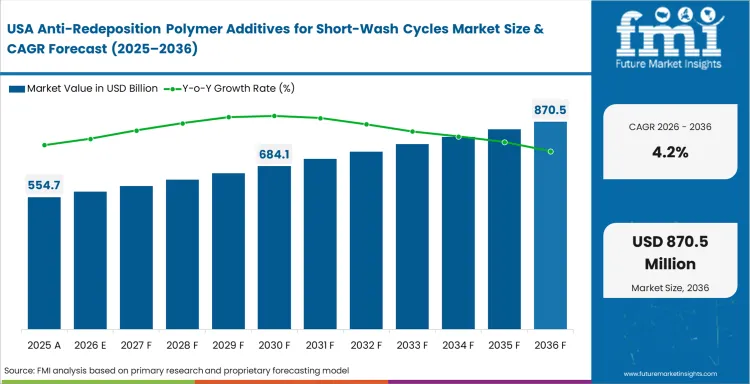
United States is expected to advance at 4.2% CAGR through 2036 due to cold water washing remaining common in household laundry. ENERGY STAR states full-sized certified washers use 14 gallons per load compared with 20 gallons for a standard machine. Lower water levels create a practical need for stronger soil suspension. Detergent polymer suppliers can gain through liquid stability and compatibility with stain-resistant fabric care claims.
- Cold water claims require polymer systems able to prevent grayness after repeated quick washes.
- Liquid detergents and pods raise the need for soluble additives with good storage stability.
- Premium home care brands use performance testing to defend higher ingredient cost.
Demand Outlook for Anti-Redeposition Polymer Additives for Short-Wash Cycles Market in Germany
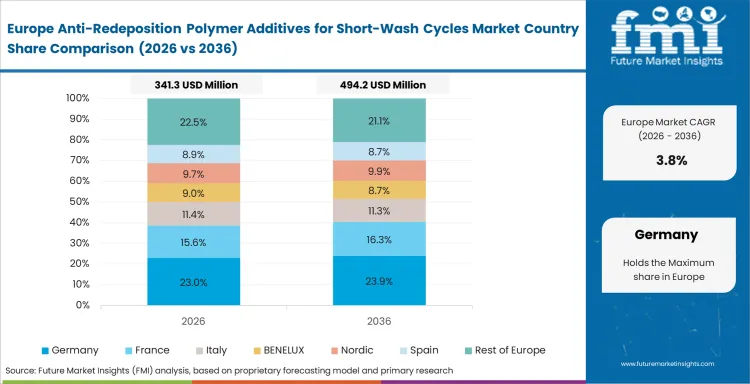
Germany is projected to rise at 4.2% CAGR through 2036 as efficient appliance programs shape detergent performance requirements. EU rules for washing machines include functional and duration requirements for eco 40-60 programs. German detergent brands need additives able to perform in standardized low-energy cycles. This supports specialist polymer demand in premium household formulas.
- Eco program use keeps formulation testing tied to water use and rinse performance.
- Powder detergents retain a measurable role since dry formats suit CMC and acrylic dispersant systems.
- Supplier selection favors biodegradability documentation and consistent batch quality.
Competitive Positioning and Strategic Supplier Strength
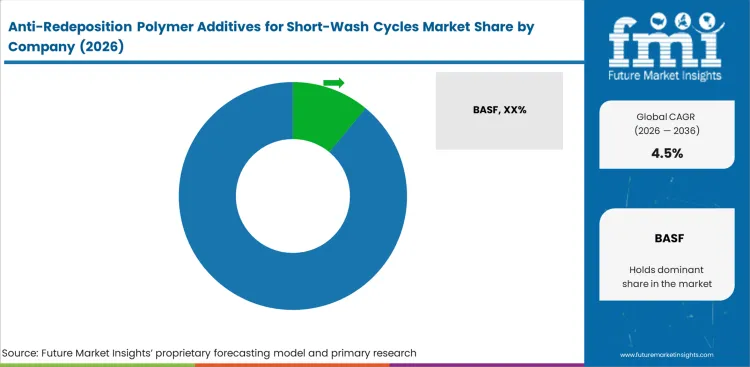
- Competition is moderately concentrated across suppliers with detergent polymer portfolios and technical labs serving global home care brands.
- BASF and Dow compete alongside Nouryon and Clariant as Ashland, Lubrizol and SNF add polymer chemistry depth.
- Specialist suppliers can win trials if their polymers dissolve fast and protect whiteness during short cold cycles.
- Entry barriers come from detergent compatibility testing and retailer documentation after account approval cycles.
Competitive positioning in this market is primarily driven by proven, real‑world detergent performance. BASF describes Sokalan HP grades as products able to stabilize soil removed from fibers and prevent redeposition on clean fabric. Dow positions ACUSOL 505N for soil removal and anti-redeposition in industrial laundry. These positions give established suppliers credibility with detergent makers seeking lower rewash risk.
Biobased chemistry is adding a new comparison point for detergent formulators. Nouryon launched FinnFix PB MAX in February 2026 for powdered laundry formulas and described it as a 100% biobased biodegradable CMC. Testing support is especially important for smart fabrics and synthetic blends exposed to repeated quick washing.
Smaller suppliers compete through local inventory and fast formulation trials. Distribution networks can serve regional detergent producers needing small volumes before scale-up. Larger firms remain stronger for global accounts since product stewardship files and application labs reduce reformulation risk. Technology overlap with functional agents and additives and low-foam dishwasher detergency boosters shows why multi-product cleaning portfolios can support account defense through glass cleaner additives.
Key Companies in the Anti-Redeposition Polymer Additives for Short-Wash Cycles Market
Competition spans integrated chemical suppliers and cellulose specialists alongside formulation polymer producers with different strengths.
- Global leaders: BASF, Dow, Nouryon, Clariant, Ashland, and Lubrizol compete through named detergent polymer ranges and global technical support. Their strengths center on liquid stability and powder dispersibility with biodegradability documentation for short-cycle detergent claims.
- Regional and specialty players: SNF, Kemira, Arkema, and selected distributors serve detergent makers through water-soluble polymers and local supply access. Their positions improve if customers need smaller trial volumes or faster regional deliveries.
- Application specialists: IFF and enzyme suppliers influence formulation choices through bio-based polysaccharides and detergent performance systems. Their role grows as brands combine polymers with enzymes and surfactants inside fabric care additive systems.
Competitive Benchmarking: Anti-Redeposition Polymer Additives for Short-Wash Cycles Market
| Company | Laundry Polymer Breadth | Short-Cycle Support | Biobased Route | Footprint |
|---|---|---|---|---|
| BASF | Large | Large | Moderate | Global |
| Dow | Large | Moderate | Limited | Global |
| Nouryon | Large | Moderate | Large | Global |
| Clariant | Large | Large | Large | Global |
| Ashland | Moderate | Moderate | Moderate | Global |
| Lubrizol | Moderate | Moderate | Limited | Global |
| SNF | Moderate | Moderate | Limited | Global |
| Kemira | Moderate | Limited | Moderate | Europe and North America |
| Arkema | Moderate | Limited | Moderate | Global |
Source: Future Market Insights competitive analysis based on company product evidence and covered country narratives in 2026.
Recent Developments in the Anti-Redeposition Polymer Additives for Short-Wash Cycles Market
- In September 2025, IFF announced first large-scale home care use of its Designed Enzymatic Biomaterials platform in a laundry detergent formulation, with anti-redeposition benefits and bio-based material positioning.
- In October 2025, Clariant launched TexCare™ One Terra for high-concentrate laundry liquids and capsules, with short-cycle and low-temperature cleaning support.
- In February 2026, Nouryon launched FinnFix® PB MAX as a 100% renewable-carbon carboxymethylcellulose for laundry detergents, with anti-redeposition performance for powdered formulations.
Key Players in the Anti-Redeposition Polymer Additives for Short-Wash Cycles Market
Major Global Companies
- BASF
- Dow
- Nouryon
- Clariant
- Ashland
- Lubrizol
Regional and Specialty Companies
- SNF
- Kemira
- Arkema
- IFF
Report Coverage and Scope
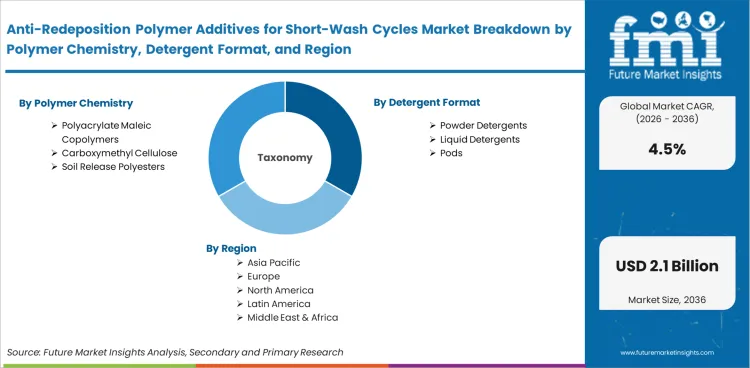
| Item | Value |
| Market value in 2025 | USD 1.2 billion |
| Market value in 2026 | USD 1.3 billion |
| Market value in 2036 | USD 2.0 billion |
| CAGR from 2026 to 2036 | 4.5% |
| Quantitative units | USD billion |
| Market definition | Polymer additives used to prevent soil redeposition in short-cycle laundry detergents and fabric care formulas |
| By polymer chemistry | Polyacrylate maleic copolymers, carboxymethyl cellulose, soil release polyesters, PVP polymers, biopolymer blends, polyaspartates |
| By detergent format | Powder detergents, liquid detergents, pods, tablets, sheets, gels |
| By end use | Household laundry, commercial laundry, hospitality laundry, healthcare laundry, textile care, industrial cleaning |
| By wash condition | Cold short cycles, warm quick cycles, low water cycles, mixed fabric cycles, stain prewash, rinse saver cycles |
| By function | Soil suspension, anti-graying, dye transfer control, clay control, soil release, whiteness care |
| By sales channel | Direct sales, distributors, formulation houses, contract blenders, online B2B |
| Regions covered | North America, Latin America, Europe, East Asia, South Asia and Pacific, Middle East and Africa |
| Countries covered | China, India, Brazil, United States, Germany, United Kingdom, Japan |
| Companies profiled | BASF, Dow, Nouryon, Clariant, Ashland, Lubrizol, SNF, Kemira, Arkema, IFF |
| Forecast period | 2026 to 2036 |
| Approach | FMI analysis based on additive values, public detergent performance signals, company product evidence, and segment checks |
Source: Future Market Insights analysis, 2026.
Anti-Redeposition Polymer Additives for Short-Wash Cycles Market Breakdown by Polymer Chemistry, Detergent Format, End Use, Wash Condition, Function, Sales Channel, and Region
Anti-Redeposition Polymer Additives for Short-Wash Cycles Market Segmented by Polymer Chemistry
- Polyacrylate Maleic Copolymers
- Carboxymethyl Cellulose
- Soil Release Polyesters
- PVP Polymers
- Biopolymer Blends
- Polyaspartates
Anti-Redeposition Polymer Additives for Short-Wash Cycles Market Segmented by Detergent Format
- Powder Detergents
- Liquid Detergents
- Pods
- Tablets
- Sheets
- Gels
Anti-Redeposition Polymer Additives for Short-Wash Cycles Market Segmented by End Use
- Household Laundry
- Commercial Laundry
- Hospitality Laundry
- Healthcare Laundry
- Textile Care
- Industrial Cleaning
Anti-Redeposition Polymer Additives for Short-Wash Cycles Market Segmented by Wash Condition
- Cold Short Cycles
- Warm Quick Cycles
- Low Water Cycles
- Mixed Fabric Cycles
- Stain Prewash
- Rinse Saver Cycles
Anti-Redeposition Polymer Additives for Short-Wash Cycles Market Segmented by Function
- Soil Suspension
- Anti Graying
- Dye Transfer Control
- Clay Control
- Soil Release
- Whiteness Care
Anti-Redeposition Polymer Additives for Short-Wash Cycles Market Segmented by Sales Channel
- Direct Sales
- Distributors
- Formulation Houses
- Contract Blenders
- Online B2B
Anti-Redeposition Polymer Additives for Short-Wash Cycles Market by Region
- North America
- United States
- Canada
- Latin America
- Brazil
- Mexico
- Europe
- Germany
- United Kingdom
- France
- Italy
- Spain
- East Asia
- China
- Japan
- South Korea
- South Asia and Pacific
- India
- ASEAN
- Australia and New Zealand
- Middle East and Africa
- Saudi Arabia
- Other GCC Countries
- South Africa
Research Sources and Bibliography
- American Cleaning Institute. (2024, December 4). American Cleaning Institute 2024 National Cleaning Survey results.
- American Cleaning Institute. (2025, April 10). Celebrating National Laundry Day with cold water washing.
- American Cleaning Institute. (2026, March 3). 2026 Spring Cleaning Survey.
- BASF. (2025, July 10). BASF strengthens liquid enzyme portfolio for the laundry and cleaning industries.
- Clariant. (2025, October 15). Clariant launches TexCare™ One Terra, a new polymer technology for ultra-concentrated laundry formulations.
- International Association for Soaps, Detergents and Maintenance Products. (2025, March 27). A.I.S.E. consumer research: Consumers’ understanding and washing and cleaning habits at home.
- International Flavors & Fragrances. (2025, September 4). IFF’s Designed Enzymatic Biomaterials™ platform sees first large-scale use in home care applications.
- Nouryon. (2026, February 2). Nouryon launches industry’s first 100% biobased biodegradable carboxymethylcellulose for laundry detergents.
- USA Environmental Protection Agency. (2024, August). EPA’s Safer Choice and Design for the Environment Standard.
- USA Environmental Protection Agency. (2025, September 30). Safer Chemical Ingredients List.
The bibliography is provided for reader reference and direct source checking.
This Report Addresses
- What is the value outlook for Anti-Redeposition Polymer Additives for Short-Wash Cycles Market through 2036?
- Which polymer chemistry leads use across short-wash detergent formulas?
- Which end use holds the highest dominant share in 2026?
- Which country records the fastest forecast pace through 2036?
- Which companies compete in short-cycle anti-redeposition polymer additives?
- How do cold water washing and efficient machines affect additive demand?
Frequently Asked Questions
How large is the anti-redeposition polymer additives for short-wash cycles market in 2026?
The anti-redeposition polymer additives for short-wash cycles market is estimated at USD 1.3 billion in 2026.
What is the anti-redeposition polymer additives for short-wash cycles market forecast value by 2036?
The anti-redeposition polymer additives for short-wash cycles market is projected to reach USD 2.0 billion by 2036 as short-cycle detergent use expands.
What is the forecast rate for the anti-redeposition polymer additives for short-wash cycles market?
The anti-redeposition polymer additives for short-wash cycles market is expected to expand at 4.5% CAGR between 2026 and 2036.
Which segment leads the anti-redeposition polymer additives for short-wash cycles market?
Household Laundry leads the Anti-Redeposition Polymer Additives for Short-Wash Cycles Market with 62.0% share in 2026 because of repeat home use.
Which country leads the anti-redeposition polymer additives for short-wash cycles market outlook?
China leads the anti-redeposition polymer additives for short-wash cycles market outlook at 5.5% CAGR through 2036 due to detergent upgrades.
Who are the main suppliers in the anti-redeposition polymer additives for short-wash cycles market?
BASF, Dow, Nouryon, Clariant, Ashland, Lubrizol, SNF, Kemira, Arkema, and IFF are active suppliers in this sector.
Preview the report firsthand - request a free sample
Get SampleGet the brochure for pricing and purchase details.
Get PDFTable of Content
- Executive Summary
- Global Market Outlook
- Demand-side Trends
- Supply-side Trends
- Technology Roadmap Analysis
- Analysis and Recommendations
- Market Overview
- Market Coverage / Taxonomy
- Market Definition / Scope / Limitations
- Research Methodology
- Chapter Orientation
- Analytical Lens and Working Hypotheses
- Market Structure, Signals, and Trend Drivers
- Benchmarking and Cross-market Comparability
- Market Sizing, Forecasting, and Opportunity Mapping
- Research Design and Evidence Framework
- Desk Research Programme (Secondary Evidence)
- Company Annual and Sustainability Reports
- Peer-reviewed Journals and Academic Literature
- Corporate Websites, Product Literature, and Technical Notes
- Earnings Decks and Investor Briefings
- Statutory Filings and Regulatory Disclosures
- Technical White Papers and Standards Notes
- Trade Journals, Industry Magazines, and Analyst Briefs
- Conference Proceedings, Webinars, and Seminar Materials
- Government Statistics Portals and Public Data Releases
- Press Releases and Reputable Media Coverage
- Specialist Newsletters and Curated Briefings
- Sector Databases and Reference Repositories
- FMI Internal Proprietary Databases and Historical Market Datasets
- Subscription Datasets and Paid Sources
- Social Channels, Communities, and Digital Listening Inputs
- Additional Desk Sources
- Expert Input and Fieldwork (Primary Evidence)
- Primary Modes
- Qualitative Interviews and Expert Elicitation
- Quantitative Surveys and Structured Data Capture
- Blended Approach
- Why Primary Evidence is Used
- Field Techniques
- Interviews
- Surveys
- Focus Groups
- Observational and In-context Research
- Social and Community Interactions
- Stakeholder Universe Engaged
- C-suite Leaders
- Board Members
- Presidents and Vice Presidents
- R&D and Innovation Heads
- Technical Specialists
- Domain Subject-matter Experts
- Scientists
- Physicians and Other Healthcare Professionals
- Governance, Ethics, and Data Stewardship
- Research Ethics
- Data Integrity and Handling
- Primary Modes
- Tooling, Models, and Reference Databases
- Desk Research Programme (Secondary Evidence)
- Data Engineering and Model Build
- Data Acquisition and Ingestion
- Cleaning, Normalisation, and Verification
- Synthesis, Triangulation, and Analysis
- Quality Assurance and Audit Trail
- Market Background
- Market Dynamics
- Drivers
- Restraints
- Opportunity
- Trends
- Scenario Forecast
- Demand in Optimistic Scenario
- Demand in Likely Scenario
- Demand in Conservative Scenario
- Opportunity Map Analysis
- Product Life Cycle Analysis
- Supply Chain Analysis
- Investment Feasibility Matrix
- Value Chain Analysis
- PESTLE and Porter’s Analysis
- Regulatory Landscape
- Regional Parent Market Outlook
- Production and Consumption Statistics
- Import and Export Statistics
- Market Dynamics
- Global Market Analysis 2021 to 2025 and Forecast, 2026 to 2036
- Historical Market Size Value (USD Million) Analysis, 2021 to 2025
- Current and Future Market Size Value (USD Million) Projections, 2026 to 2036
- Y-o-Y Growth Trend Analysis
- Absolute $ Opportunity Analysis
- Global Market Pricing Analysis 2021 to 2025 and Forecast 2026 to 2036
- Global Market Analysis 2021 to 2025 and Forecast 2026 to 2036, By Polymer Chemistry
- Introduction / Key Findings
- Historical Market Size Value (USD Million) Analysis By Polymer Chemistry , 2021 to 2025
- Current and Future Market Size Value (USD Million) Analysis and Forecast By Polymer Chemistry , 2026 to 2036
- Polyacrylate Maleic Copolymers
- Carboxymethyl Cellulose
- Soil Release Polyesters
- Polyacrylate Maleic Copolymers
- Y-o-Y Growth Trend Analysis By Polymer Chemistry , 2021 to 2025
- Absolute $ Opportunity Analysis By Polymer Chemistry , 2026 to 2036
- Global Market Analysis 2021 to 2025 and Forecast 2026 to 2036, By Detergent Format
- Introduction / Key Findings
- Historical Market Size Value (USD Million) Analysis By Detergent Format, 2021 to 2025
- Current and Future Market Size Value (USD Million) Analysis and Forecast By Detergent Format, 2026 to 2036
- Powder Detergents
- Liquid Detergents
- Pods
- Powder Detergents
- Y-o-Y Growth Trend Analysis By Detergent Format, 2021 to 2025
- Absolute $ Opportunity Analysis By Detergent Format, 2026 to 2036
- Global Market Analysis 2021 to 2025 and Forecast 2026 to 2036, By End Use
- Introduction / Key Findings
- Historical Market Size Value (USD Million) Analysis By End Use, 2021 to 2025
- Current and Future Market Size Value (USD Million) Analysis and Forecast By End Use, 2026 to 2036
- Household Laundry
- Commercial Laundry
- Hospitality Laundry
- Household Laundry
- Y-o-Y Growth Trend Analysis By End Use, 2021 to 2025
- Absolute $ Opportunity Analysis By End Use, 2026 to 2036
- Global Market Analysis 2021 to 2025 and Forecast 2026 to 2036, By Wash Condition
- Introduction / Key Findings
- Historical Market Size Value (USD Million) Analysis By Wash Condition, 2021 to 2025
- Current and Future Market Size Value (USD Million) Analysis and Forecast By Wash Condition, 2026 to 2036
- Cold Short Cycles
- Warm Quick Cycles
- Low Water Cycles
- Cold Short Cycles
- Y-o-Y Growth Trend Analysis By Wash Condition, 2021 to 2025
- Absolute $ Opportunity Analysis By Wash Condition, 2026 to 2036
- Global Market Analysis 2021 to 2025 and Forecast 2026 to 2036, By Function
- Introduction / Key Findings
- Historical Market Size Value (USD Million) Analysis By Function, 2021 to 2025
- Current and Future Market Size Value (USD Million) Analysis and Forecast By Function, 2026 to 2036
- Soil Suspension
- Anti Graying
- Dye Transfer Control
- Soil Suspension
- Y-o-Y Growth Trend Analysis By Function, 2021 to 2025
- Absolute $ Opportunity Analysis By Function, 2026 to 2036
- Global Market Analysis 2021 to 2025 and Forecast 2026 to 2036, By Sales Channel
- Introduction / Key Findings
- Historical Market Size Value (USD Million) Analysis By Sales Channel, 2021 to 2025
- Current and Future Market Size Value (USD Million) Analysis and Forecast By Sales Channel, 2026 to 2036
- Direct Sales
- Direct Sales
- Y-o-Y Growth Trend Analysis By Sales Channel, 2021 to 2025
- Absolute $ Opportunity Analysis By Sales Channel, 2026 to 2036
- Global Market Analysis 2021 to 2025 and Forecast 2026 to 2036, By Region
- Introduction
- Historical Market Size Value (USD Million) Analysis By Region, 2021 to 2025
- Current Market Size Value (USD Million) Analysis and Forecast By Region, 2026 to 2036
- North America
- Latin America
- Western Europe
- Eastern Europe
- East Asia
- South Asia and Pacific
- Middle East & Africa
- Market Attractiveness Analysis By Region
- North America Market Analysis 2021 to 2025 and Forecast 2026 to 2036, By Country
- Historical Market Size Value (USD Million) Trend Analysis By Market Taxonomy, 2021 to 2025
- Market Size Value (USD Million) Forecast By Market Taxonomy, 2026 to 2036
- By Country
- USA
- Canada
- Mexico
- By Polymer Chemistry
- By Detergent Format
- By End Use
- By Wash Condition
- By Function
- By Sales Channel
- By Country
- Market Attractiveness Analysis
- By Country
- By Polymer Chemistry
- By Detergent Format
- By End Use
- By Wash Condition
- By Function
- By Sales Channel
- Key Takeaways
- Latin America Market Analysis 2021 to 2025 and Forecast 2026 to 2036, By Country
- Historical Market Size Value (USD Million) Trend Analysis By Market Taxonomy, 2021 to 2025
- Market Size Value (USD Million) Forecast By Market Taxonomy, 2026 to 2036
- By Country
- Brazil
- Chile
- Rest of Latin America
- By Polymer Chemistry
- By Detergent Format
- By End Use
- By Wash Condition
- By Function
- By Sales Channel
- By Country
- Market Attractiveness Analysis
- By Country
- By Polymer Chemistry
- By Detergent Format
- By End Use
- By Wash Condition
- By Function
- By Sales Channel
- Key Takeaways
- Western Europe Market Analysis 2021 to 2025 and Forecast 2026 to 2036, By Country
- Historical Market Size Value (USD Million) Trend Analysis By Market Taxonomy, 2021 to 2025
- Market Size Value (USD Million) Forecast By Market Taxonomy, 2026 to 2036
- By Country
- Germany
- UK
- Italy
- Spain
- France
- Nordic
- BENELUX
- Rest of Western Europe
- By Polymer Chemistry
- By Detergent Format
- By End Use
- By Wash Condition
- By Function
- By Sales Channel
- By Country
- Market Attractiveness Analysis
- By Country
- By Polymer Chemistry
- By Detergent Format
- By End Use
- By Wash Condition
- By Function
- By Sales Channel
- Key Takeaways
- Eastern Europe Market Analysis 2021 to 2025 and Forecast 2026 to 2036, By Country
- Historical Market Size Value (USD Million) Trend Analysis By Market Taxonomy, 2021 to 2025
- Market Size Value (USD Million) Forecast By Market Taxonomy, 2026 to 2036
- By Country
- Russia
- Poland
- Hungary
- Balkan & Baltic
- Rest of Eastern Europe
- By Polymer Chemistry
- By Detergent Format
- By End Use
- By Wash Condition
- By Function
- By Sales Channel
- By Country
- Market Attractiveness Analysis
- By Country
- By Polymer Chemistry
- By Detergent Format
- By End Use
- By Wash Condition
- By Function
- By Sales Channel
- Key Takeaways
- East Asia Market Analysis 2021 to 2025 and Forecast 2026 to 2036, By Country
- Historical Market Size Value (USD Million) Trend Analysis By Market Taxonomy, 2021 to 2025
- Market Size Value (USD Million) Forecast By Market Taxonomy, 2026 to 2036
- By Country
- China
- Japan
- South Korea
- By Polymer Chemistry
- By Detergent Format
- By End Use
- By Wash Condition
- By Function
- By Sales Channel
- By Country
- Market Attractiveness Analysis
- By Country
- By Polymer Chemistry
- By Detergent Format
- By End Use
- By Wash Condition
- By Function
- By Sales Channel
- Key Takeaways
- South Asia and Pacific Market Analysis 2021 to 2025 and Forecast 2026 to 2036, By Country
- Historical Market Size Value (USD Million) Trend Analysis By Market Taxonomy, 2021 to 2025
- Market Size Value (USD Million) Forecast By Market Taxonomy, 2026 to 2036
- By Country
- India
- ASEAN
- Australia & New Zealand
- Rest of South Asia and Pacific
- By Polymer Chemistry
- By Detergent Format
- By End Use
- By Wash Condition
- By Function
- By Sales Channel
- By Country
- Market Attractiveness Analysis
- By Country
- By Polymer Chemistry
- By Detergent Format
- By End Use
- By Wash Condition
- By Function
- By Sales Channel
- Key Takeaways
- Middle East & Africa Market Analysis 2021 to 2025 and Forecast 2026 to 2036, By Country
- Historical Market Size Value (USD Million) Trend Analysis By Market Taxonomy, 2021 to 2025
- Market Size Value (USD Million) Forecast By Market Taxonomy, 2026 to 2036
- By Country
- Kingdom of Saudi Arabia
- Other GCC Countries
- Turkiye
- South Africa
- Other African Union
- Rest of Middle East & Africa
- By Polymer Chemistry
- By Detergent Format
- By End Use
- By Wash Condition
- By Function
- By Sales Channel
- By Country
- Market Attractiveness Analysis
- By Country
- By Polymer Chemistry
- By Detergent Format
- By End Use
- By Wash Condition
- By Function
- By Sales Channel
- Key Takeaways
- Key Countries Market Analysis
- USA
- Pricing Analysis
- Market Share Analysis, 2025
- By Polymer Chemistry
- By Detergent Format
- By End Use
- By Wash Condition
- By Function
- By Sales Channel
- Canada
- Pricing Analysis
- Market Share Analysis, 2025
- By Polymer Chemistry
- By Detergent Format
- By End Use
- By Wash Condition
- By Function
- By Sales Channel
- Mexico
- Pricing Analysis
- Market Share Analysis, 2025
- By Polymer Chemistry
- By Detergent Format
- By End Use
- By Wash Condition
- By Function
- By Sales Channel
- Brazil
- Pricing Analysis
- Market Share Analysis, 2025
- By Polymer Chemistry
- By Detergent Format
- By End Use
- By Wash Condition
- By Function
- By Sales Channel
- Chile
- Pricing Analysis
- Market Share Analysis, 2025
- By Polymer Chemistry
- By Detergent Format
- By End Use
- By Wash Condition
- By Function
- By Sales Channel
- Germany
- Pricing Analysis
- Market Share Analysis, 2025
- By Polymer Chemistry
- By Detergent Format
- By End Use
- By Wash Condition
- By Function
- By Sales Channel
- UK
- Pricing Analysis
- Market Share Analysis, 2025
- By Polymer Chemistry
- By Detergent Format
- By End Use
- By Wash Condition
- By Function
- By Sales Channel
- Italy
- Pricing Analysis
- Market Share Analysis, 2025
- By Polymer Chemistry
- By Detergent Format
- By End Use
- By Wash Condition
- By Function
- By Sales Channel
- Spain
- Pricing Analysis
- Market Share Analysis, 2025
- By Polymer Chemistry
- By Detergent Format
- By End Use
- By Wash Condition
- By Function
- By Sales Channel
- France
- Pricing Analysis
- Market Share Analysis, 2025
- By Polymer Chemistry
- By Detergent Format
- By End Use
- By Wash Condition
- By Function
- By Sales Channel
- India
- Pricing Analysis
- Market Share Analysis, 2025
- By Polymer Chemistry
- By Detergent Format
- By End Use
- By Wash Condition
- By Function
- By Sales Channel
- ASEAN
- Pricing Analysis
- Market Share Analysis, 2025
- By Polymer Chemistry
- By Detergent Format
- By End Use
- By Wash Condition
- By Function
- By Sales Channel
- Australia & New Zealand
- Pricing Analysis
- Market Share Analysis, 2025
- By Polymer Chemistry
- By Detergent Format
- By End Use
- By Wash Condition
- By Function
- By Sales Channel
- China
- Pricing Analysis
- Market Share Analysis, 2025
- By Polymer Chemistry
- By Detergent Format
- By End Use
- By Wash Condition
- By Function
- By Sales Channel
- Japan
- Pricing Analysis
- Market Share Analysis, 2025
- By Polymer Chemistry
- By Detergent Format
- By End Use
- By Wash Condition
- By Function
- By Sales Channel
- South Korea
- Pricing Analysis
- Market Share Analysis, 2025
- By Polymer Chemistry
- By Detergent Format
- By End Use
- By Wash Condition
- By Function
- By Sales Channel
- Russia
- Pricing Analysis
- Market Share Analysis, 2025
- By Polymer Chemistry
- By Detergent Format
- By End Use
- By Wash Condition
- By Function
- By Sales Channel
- Poland
- Pricing Analysis
- Market Share Analysis, 2025
- By Polymer Chemistry
- By Detergent Format
- By End Use
- By Wash Condition
- By Function
- By Sales Channel
- Hungary
- Pricing Analysis
- Market Share Analysis, 2025
- By Polymer Chemistry
- By Detergent Format
- By End Use
- By Wash Condition
- By Function
- By Sales Channel
- Kingdom of Saudi Arabia
- Pricing Analysis
- Market Share Analysis, 2025
- By Polymer Chemistry
- By Detergent Format
- By End Use
- By Wash Condition
- By Function
- By Sales Channel
- Turkiye
- Pricing Analysis
- Market Share Analysis, 2025
- By Polymer Chemistry
- By Detergent Format
- By End Use
- By Wash Condition
- By Function
- By Sales Channel
- South Africa
- Pricing Analysis
- Market Share Analysis, 2025
- By Polymer Chemistry
- By Detergent Format
- By End Use
- By Wash Condition
- By Function
- By Sales Channel
- USA
- Market Structure Analysis
- Competition Dashboard
- Competition Benchmarking
- Market Share Analysis of Top Players
- By Regional
- By Polymer Chemistry
- By Detergent Format
- By End Use
- By Wash Condition
- By Function
- By Sales Channel
- Competition Analysis
- Competition Deep Dive
- BASF
- Overview
- Product Portfolio
- Profitability by Market Segments (Product/Age /Sales Channel/Region)
- Sales Footprint
- Strategy Overview
- Marketing Strategy
- Product Strategy
- Channel Strategy
- Dow
- Nouryon
- Clariant
- Ashland
- Lubrizol
- BASF
- Competition Deep Dive
- Assumptions & Acronyms Used


