

- Industry Size (2026)
- USD 1.4 Bn
- Forecast (2036)
- USD 2.2 Bn
- CAGR (2026 to 2036)
- 4.8%
Low-Foam Dishwasher Detergency Boosters Market Forecast and Outlook 2026 to 2036
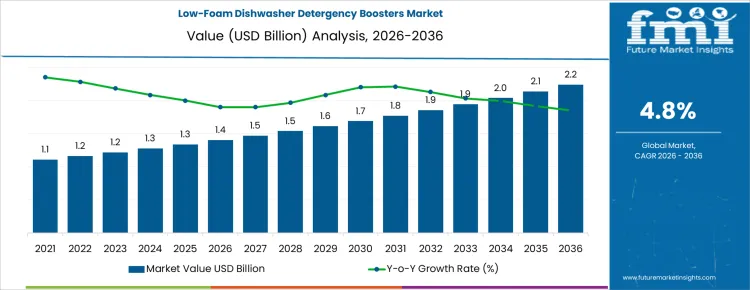
The low-foam dishwasher detergency boosters market is expected to grow from USD 1.4 billion in 2026 to USD 2.2 billion by 2036, reflecting a compound annual growth rate (CAGR) of 4.8%. These boosters are designed to enhance the cleaning performance of dishwasher detergents, particularly in industrial or home dishwashing applications. The low-foam formulation ensures efficient cleaning while minimizing foam build-up, which can interfere with the washing process. As demand for more effective and eco-friendly dishwasher detergents grows, low-foam boosters are increasingly integrated into detergents to improve performance while using less water and reducing chemical waste. The growth is also driven by consumer preference for products that offer superior cleaning with less environmental impact.
The market expansion is supported by the rise in demand for energy-efficient and water-saving household appliances, along with increasing awareness about environmental sustainability. As both residential and commercial dishwashing solutions become more performance-oriented, there is a rising need for detergent boosters that can ensure optimal cleaning with minimal foam. Additionally, innovations in ingredient formulations are expected to boost product efficiency and broaden the range of applications for low-foam detergency boosters in the coming years.
Quick Stats of the Low-Foam Dishwasher Detergency Boosters Market
- Low-Foam Dishwasher Detergency Boosters Market Value (2026): USD 1.4 billion
- Low-Foam Dishwasher Detergency Boosters Market Forecast Value (2036): USD 2.2 billion
- Low-Foam Dishwasher Detergency Boosters Market Global Forecast CAGR (2026 to 2036): 4.8%
- Low-Foam Dishwasher Detergency Boosters Market Leading Segment: End Use (Household Automatic Dishwashing) 56%
- Key Growth Regions in Low-Foam Dishwasher Detergency Boosters Market: United States and United Kingdom
- Top Players in Low-Foam Dishwasher Detergency Boosters Market: Ecolab, BASF, Evonik, Nouryon, Solvay, Clariant, Dow, Stepan, Huntsman, Kao Corporation, Croda
What is the Growth Forecast for the Low-Foam Dishwasher Detergency Boosters Market through 2036?
The market share erosion or gain analysis for the low-foam dishwasher detergency boosters market shows steady growth with modest fluctuations in market share over the forecast period. Starting at USD 1.4 billion in 2026, the market grows to USD 1.5 billion in 2027 and USD 1.6 billion in 2028, reflecting a steady increase driven by rising demand for more effective and eco-friendly dishwasher detergents. The early years show gradual expansion as consumers and manufacturers gradually adopt these products for enhanced cleaning performance.
From 2028 to 2030, the market continues to expand, reaching USD 1.7 billion in 2029 and USD 1.7 billion in 2030, marking a phase of stabilization where growth is sustained but at a moderate pace. This period reflects steady adoption as the market matures and the benefits of low-foam boosters become more recognized. Between 2030 and 2035, the market sees continued growth, reaching USD 1.8 billion in 2031, USD 1.9 billion in 2032, and USD 2 billion in 2033, indicating that market share is increasingly gained as awareness of eco-friendly detergency boosters grows. By 2035, the market is projected to reach USD 2.1 billion, with the final market value of USD 2.2 billion expected in 2036, reflecting continued growth in both volume and value.
Low-Foam Dishwasher Detergency Boosters Market Key Takeaways
| Metric | Value |
|---|---|
| Industry Sales Value (2026) | USD 1.4 billion |
| Industry Forecast Value (2036) | USD 2.2 billion |
| Industry Forecast CAGR (2026 to 2036) | 4.8% |
What Is Driving the Demand for the Low-Foam Dishwasher Detergency Boosters Market Globally?
The global demand for low-foam dishwasher detergency boosters is being driven by the continued shift toward energy- and water-efficient automatic dishwashing systems and rising consumer expectations for high-performance cleaning with minimal residue. Automatic dishwashers rely on controlled foam levels to ensure optimal spray action and complete cleaning cycles; excess foam can reduce mechanical cleaning efficiency and lead to ineffective rinsing.
Low-foam detergency boosters are formulation ingredients that enhance soil removal and grease breakdown without generating excessive suds, enabling detergents to perform well in shorter cycles, lower temperatures, and reduced water volumes. Manufacturers of household and commercial dishwashing products are incorporating these boosters into concentrated and eco-friendly formulations to meet rising interest in products that balance cleaning power with appliance compatibility.
The expanding penetration of dishwashers in urban and middle-income households across Asia Pacific, Latin America, the Middle East, and established markets in Europe reinforces demand. In commercial sectors such as hospitality, food service, and institutional kitchens, operators prioritise reliable detergency that does not undermine machine performance or cycle time, which further supports uptake of low-foam boosters. Increased awareness of appliance life-cycle costs and consumer preference for products that reduce spotting, filming, and re-washing contribute to sustained interest in these functional ingredients.
Future demand for low-foam dishwasher detergency boosters is expected to grow as formulation science and sustainability trends continue to evolve global dishwashing product portfolios. Advances in surfactant technology, enzyme systems, and co-solvents will improve the ability of boosters to deliver efficient soil removal under a range of water hardness and temperature conditions while maintaining low foaming profiles. Growth in energy-efficient and water-saving dishwasher models, driven by regulatory standards and consumer eco-preferences, will reinforce the need for boosters compatible with low-resource cleaning cycles.
As consumers and institutional buyers prioritise products that combine performance with environmental credentials, suppliers will invest in solutions that align with biodegradability, reduced aquatic impact, and safer ingredient profiles. Expansion of online retail and direct-to-consumer channels will broaden access to differentiated, performance-oriented dishwasher formulations that feature low-foam boosters. Regulatory pressure to reduce overall chemical load in wastewater and increasing adoption of green certification standards for cleaning products will also influence market dynamics. As manufacturers seek to deliver higher-efficiency detergency with minimal environmental trade-offs, low-foam dishwasher detergency boosters are expected to become a more central element of dishwasher formulation strategies worldwide.
What are the Leading Segments in the Global Low-Foam Dishwasher Detergency Boosters Market?
The global low-foam dishwasher detergency boosters market is segmented by end use and form. Household automatic dishwashing is the largest end-use segment, driven by the increasing demand for efficient and convenient cleaning solutions in residential settings. Other key segments include commercial warewashing, institutional/catering, and specialty/other applications, which cater to specific needs such as high-efficiency cleaning and grease removal. In terms of form, liquid concentrates dominate the market, followed by low-foam high-efficiency cleaning products. The growth of the market is driven by the need for detergent boosters that offer enhanced cleaning performance while minimizing foam, a critical factor in ensuring efficiency in both household and commercial dishwashing applications.
What Drives the Growth of Household Automatic Dishwashing in the Low-Foam Dishwasher Detergency Boosters Market?
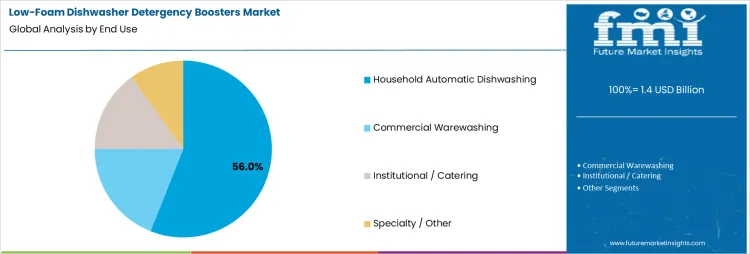
Household automatic dishwashing is the dominant end-use segment in the low-foam dishwasher detergency boosters market, accounting for a significant share due to the widespread adoption of dishwashers in residential kitchens. Consumers increasingly prefer automatic dishwashing solutions that provide superior cleaning performance with minimal effort. The demand for low-foam detergency boosters is driven by the need for products that can efficiently clean dishes while reducing excess foam, which can interfere with dishwasher performance.
These boosters are formulated to enhance grease removal, soil removal, and low-temperature performance, ensuring optimal results in household dishwashing cycles. Additionally, as consumers become more aware of the importance of eco-friendly products, low-foam dishwasher detergency boosters that offer improved cleaning at lower environmental costs are gaining popularity. Manufacturers are increasingly focusing on creating products that offer both effectiveness and sustainability, which further boosts the growth of this segment. As household dishwashing continues to be a common practice, the demand for low-foam detergency boosters that meet the needs of modern consumers is expected to remain strong, supporting the continued dominance of this segment in the market.
What is Driving the Demand for Liquid Concentrates in the Low-Foam Dishwasher Detergency Boosters Market?
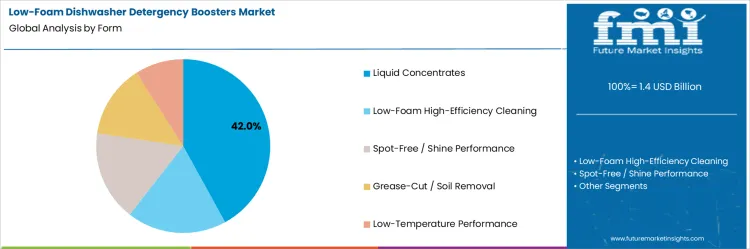
Liquid concentrates are the leading form in the low-foam dishwasher detergency boosters market, primarily due to their ease of use, high efficiency, and ability to deliver concentrated cleaning power in a compact format. Liquid concentrates provide consumers and businesses with the ability to use smaller amounts of product, reducing packaging waste and improving cost-effectiveness. The growing consumer preference for convenience, especially in household automatic dishwashing, further drives the demand for liquid concentrates, as they offer quick and efficient application.
Additionally, liquid concentrates are highly effective in delivering the desired cleaning performance, especially in grease-cutting, soil removal, and spot-free shine performance, making them suitable for both household and commercial applications. In the commercial warewashing and institutional sectors, liquid concentrates are valued for their high efficiency and ability to perform in high-demand environments, where consistent, powerful cleaning is necessary. As the trend toward sustainable, eco-friendly products continues to grow, liquid concentrates are also appealing because they tend to require less packaging and often use fewer chemical additives than traditional powdered or solid forms. As a result, liquid concentrates are expected to maintain their dominant position in the low-foam dishwasher detergency boosters market, supported by their convenience, performance, and environmental benefits.
What are the Key Dynamics of the Global Low-Foam Dishwasher Detergency Boosters Market?
The global low-foam dishwasher detergency boosters market is expanding as commercial and residential cleaning formulators seek ingredients that enhance cleaning performance in automatic dishwashing systems while minimising foam formation. These boosters help break down soils, improve grease removal and support sparkling results in high-temperature dishwasher cycles without excess suds that interfere with mechanical cleaning. Growth reflects rising demand for efficient detergents in foodservice, hospitality and household segments. Adoption aligns with consumer preference for powerful, machine-compatible detergents and industry focus on formulation optimisation across regions worldwide.
What are the Key Drivers for the Global Low-Foam Dishwasher Detergency Boosters Market?
Increasing utilisation of automatic dishwashers in commercial kitchens, restaurants and busy households motivates development of detergency boosters that deliver superior soil removal without generating foam that impedes machine function. Brands seek performance advantages that reduce cycle times and improve water efficiency, meeting evolving cleaning expectations. Technological advances in booster chemistries, including enzymes and polymer systems tailored for low-foam action, help formulators achieve targeted results. Growth of foodservice and hospitality sectors globally supports sustained demand. Consumer interest in products that preserve machine longevity and minimise residue also drives adoption.
What are the Restraints for the Global Low-Foam Dishwasher Detergency Boosters Market?
One restraint is formulation complexity, as boosting detergency while controlling foam requires careful balance of surfactants, enzymes and chelating agents to avoid performance trade-offs. Some boosters may add cost relative to basic dishwasher detergent ingredients, affecting pricing decisions in cost-sensitive market segments. Variability in water hardness and dishwasher models across regions can influence perceived efficacy and require tailored formulation approaches. Regulatory restrictions on certain surfactant classes or auxiliary chemicals in some markets add compliance planning for manufacturers. Consumer awareness of booster benefits may be lower in markets with slower dishwasher adoption, affecting uptake.
What is the Key Trends in the Global Low-Foam Dishwasher Detergency Boosters Market?
A key trend is innovation in enzyme-based and tailored polymer boosters that target specific food residues such as proteins, starches and fats while maintaining low foaming under high mechanical agitation. Ingredient suppliers are focusing on systems that integrate with mild surfactant platforms, supporting machine-safe performance and reduced spotting. Growth in concentrated and unit-dose dishwasher detergents encourages use of boosters that deliver effective cleaning in compact formats. Collaboration between formulation chemists and appliance manufacturers supports alignment of booster performance with machine cycles and sensor-driven wash programs. Interest in greener, biodegradable detergent enhancers also influences product design and selection.
What is the Country-Wise Analysis of the Low-Foam Dishwasher Detergency Boosters Market?
The low-foam dishwasher detergency boosters market is projected to experience steady growth, driven by increasing consumer demand for more efficient, eco-friendly, and high-performance dishwashing solutions. These boosters enhance the cleaning power of dishwasher detergents while minimizing foam production, which is particularly important in commercial and residential dishwashing settings. As the need for energy-efficient and sustainable cleaning solutions rises, consumers and businesses alike are adopting low-foam detergency boosters to improve performance and reduce water and energy consumption. High-growth regions like China are seeing strong demand driven by an expanding middle class and increasing interest in premium household products. Meanwhile, developed markets such as the USA, UK, and Germany are experiencing steady growth, fueled by the rising adoption of energy-efficient home appliances and a growing focus on sustainability.
| Country | CAGR (2026-2036) |
|---|---|
| China | 7.5% |
| United States | 6.2% |
| United Kingdom | 6.2% |
| Germany | 6.1% |
| Japan | 5.1% |
What is the Growth Outlook for the Low-Foam Dishwasher Detergency Boosters Market in China?
The low-foam dishwasher detergency boosters market in China is expected to grow at the highest rate, with a projected CAGR of 7.5%. China’s rapidly expanding household appliance market, coupled with growing demand for high-performance, eco-friendly dishwashing solutions, is driving the demand for low-foam detergency boosters. As Chinese consumers become more focused on efficiency and sustainability, there is increasing interest in products that improve dishwashing performance while reducing environmental impact. With a large and growing middle class, increased disposable income, and a rising preference for premium home cleaning products, China is positioned to lead the market for low-foam dishwasher detergency boosters.
What is the Market Outlook for the Low-Foam Dishwasher Detergency Boosters Market in the United States?
The low-foam dishwasher detergency boosters market in the United States is projected to grow steadily, with a projected CAGR of 6.2%. The USA market is driven by strong consumer demand for effective, sustainable, and energy-efficient cleaning solutions. As consumers prioritize high-quality and eco-friendly dishwashing products, the demand for low-foam detergency boosters is increasing. The growth is also supported by the rise of energy-efficient dishwashers that require specialized detergents and boosters to optimize performance. Additionally, the growing awareness of water and energy conservation is encouraging USA consumers to adopt products that enhance cleaning power while reducing foam and minimizing environmental impact.
What is the Growth Forecast for the Low-Foam Dishwasher Detergency Boosters Market in the United Kingdom?
The low-foam dishwasher detergency boosters market in the United Kingdom is expected to grow at a moderate pace, with a projected CAGR of 6.2%. The UK’s strong focus on sustainability and eco-friendly consumer products is driving the demand for low-foam detergency boosters. With consumers becoming more aware of environmental concerns, there is a growing preference for dishwashing products that are both effective and environmentally responsible. Additionally, the rising adoption of energy-efficient appliances in the UK is contributing to the demand for specialized detergency boosters. As the trend toward eco-conscious living continues, the market for low-foam dishwasher detergency boosters in the UK is expected to grow steadily.
What is the Market Outlook for the Low-Foam Dishwasher Detergency Boosters Market in Germany?
The low-foam dishwasher detergency boosters market in Germany is projected to grow at a steady pace, with a projected CAGR of 6.1%. Germany, known for its strong commitment to sustainability, is seeing increased demand for eco-friendly and energy-efficient household cleaning products. The rise in consumer awareness about water and energy conservation is driving the adoption of low-foam detergency boosters, which enhance the performance of dishwashing detergents while minimizing foam. As more German consumers embrace sustainable solutions, the market for low-foam dishwasher detergency boosters is expected to grow steadily, supported by both consumer demand for high-performance products and regulatory support for greener technologies.
What are the Growth Prospects for the Low-Foam Dishwasher Detergency Boosters Market in Japan?
The low-foam dishwasher detergency boosters market in Japan is expected to grow at a moderate pace, with a projected CAGR of 5.1%. Japan’s well-established consumer goods market is increasingly focused on efficiency, sustainability, and high-performance products. Japanese consumers are placing greater emphasis on energy-efficient and eco-friendly home appliances, which is driving the demand for low-foam detergency boosters. As the country continues to prioritize environmental impact reduction and sustainability in everyday products, the market for low-foam dishwasher detergency boosters is expected to grow steadily. Additionally, Japan’s strong interest in innovation and product quality is likely to support market expansion in the coming years.
What is the Competitive Landscape for the Low-Foam Dishwasher Detergency Boosters Market?
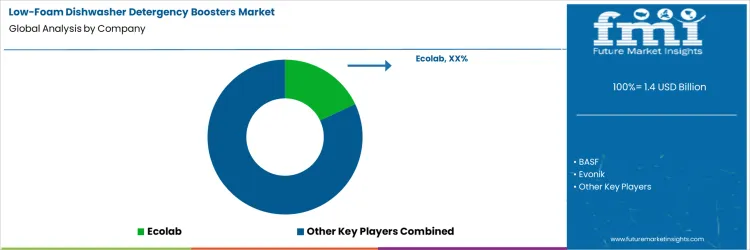
The low-foam dishwasher detergency boosters market is growing as manufacturers and consumers demand more efficient and eco-friendly solutions for dishwashing applications. Ecolab leads the market with its innovative low-foam detergent boosters, designed to enhance cleaning performance while minimizing foam, ensuring efficient washing in both residential and industrial dishwashers. Their focus on sustainability and performance has positioned them as a dominant player. BASF, Evonik, and Nouryon are major competitors, providing advanced detergency boosters that offer low-foam properties and effective cleaning performance. BASF focuses on high-performance, eco-friendly solutions, while Evonik and Nouryon offer tailored formulations that enhance detergency and optimize dishwashing efficiency.
Solvay, Clariant, Dow, Stepan, Huntsman, Kao Corporation, and Croda further contribute to the competitive landscape by offering specialized low-foam detergent boosters for both consumer and industrial applications. Solvay provides efficient, sustainable boosters that improve dishwashing results, while Clariant focuses on delivering high-performance solutions for cleaning and foaming control. Dow and Stepan offer robust solutions that enhance dishwashing efficiency while reducing foam production. Huntsman and Kao Corporation focus on the development of eco-friendly, effective detergency boosters, while Croda offers advanced ingredients that cater to sustainability-conscious consumers. These companies compete through their ability to offer performance-driven, sustainable, and low-foam solutions that meet the growing demand for high-efficiency dishwashing products.
Key Players of the Low-Foam Dishwasher Detergency Boosters Market
- Ecolab
- BASF
- Evonik
- Nouryon
- Solvay
- Clariant
- Dow
- Stepan
- Huntsman
- Kao Corporation
- Croda
Scope of the Report
| Items | Values |
|---|---|
| Quantitative Units (2026) | USD Billion |
| Booster Type | Low-Foam Nonionic Surfactants, Foam-Control Agents, Chelating / Builder Boosters, Enzyme & Performance Co-Boosters |
| Detergent Format | Powders, Tablets, Pods / Capsules, Liquids / Gels |
| End Use | Household Automatic Dishwashing, Commercial Warewashing, Institutional / Catering, Specialty / Other |
| Form | Liquid Concentrates, Low-Foam High-Efficiency Cleaning, Spot-Free / Shine Performance, Grease-Cut / Soil Removal, Low-Temperature Performance |
| Companies | Ecolab, BASF, Evonik, Nouryon, Solvay, Clariant, Dow, Stepan, Huntsman, Kao Corporation, Croda |
| Regions Covered | North America, Latin America, Western Europe, Eastern Europe, South Asia and Pacific, East Asia, Middle East & Africa |
| Countries Covered | United States, Canada, Mexico, Brazil, Argentina, Germany, France, United Kingdom, Italy, Spain, Netherlands, China, India, Japan, South Korea, ANZ, GCC Countries, South Africa |
| Additional Attributes | Dollar by sales by booster type, detergent format, end use, form, and region. Includes market trends in low-foam dishwasher detergency boosters, focusing on nonionic surfactants, foam-control agents, chelating boosters, and enzyme co-boosters. Highlights the role of low-foam and high-efficiency cleaning in household dishwashing, commercial warewashing, and institutional catering. Focus on performance needs like soil removal, shine, grease-cut, and low-temperature cleaning, as well as market share and competitive positioning of key companies. |
Low-Foam Dishwasher Detergency Boosters Market Segmentation
Booster Type
- Low-Foam Nonionic Surfactants
- Foam-Control Agents
- Chelating / Builder Boosters
- Enzyme & Performance Co-Boosters
Detergent Format
- Powders
- Tablets
- Pods / Capsules
- Liquids / Gels
End Use
- Household Automatic Dishwashing
- Commercial Warewashing
- Institutional / Catering
- Specialty / Other
Form
- Liquid Concentrates
- Low-Foam High-Efficiency Cleaning
- Spot-Free / Shine Performance
- Grease-Cut / Soil Removal
- Low-Temperature Performance
Region
- Asia Pacific
- China
- Japan
- South Korea
- India
- Australia & New Zealand
- ASEAN
- Rest of Asia Pacific
- Europe
- Germany
- United Kingdom
- France
- Italy
- Spain
- Nordic
- BENELUX
- Rest of Europe
- North America
- United States
- Canada
- Mexico
- Latin America
- Brazil
- Chile
- Rest of Latin America
- Middle East & Africa
- Kingdom of Saudi Arabia
- Other GCC Countries
- Turkey
- South Africa
- Other African Union
- Rest of Middle East & Africa
Frequently Asked Questions
How big is the low-foam dishwasher detergency boosters market in 2026?
The global low-foam dishwasher detergency boosters market is estimated to be valued at USD 1.4 billion in 2026.
What will be the size of low-foam dishwasher detergency boosters market in 2036?
The market size for the low-foam dishwasher detergency boosters market is projected to reach USD 2.2 billion by 2036.
How much will be the low-foam dishwasher detergency boosters market growth between 2026 and 2036?
The low-foam dishwasher detergency boosters market is expected to grow at a 4.8% CAGR between 2026 and 2036.
What are the key product types in the low-foam dishwasher detergency boosters market?
The key product types in low-foam dishwasher detergency boosters market are low-foam nonionic surfactants, foam-control agents, chelating / builder boosters and enzyme & performance co-boosters.
Which end-use segment to contribute significant share in the low-foam dishwasher detergency boosters market in 2026?
In terms of end-use, household automatic dishwashing segment to command 56% share in the low-foam dishwasher detergency boosters market in 2026.
Preview the report firsthand - request a free sample
Get SampleGet the brochure for pricing and purchase details.
Get PDFTable of Content
- Executive Summary
- Global Market Outlook
- Demand-side Trends
- Supply-side Trends
- Technology Roadmap Analysis
- Analysis and Recommendations
- Market Overview
- Market Coverage / Taxonomy
- Market Definition / Scope / Limitations
- Market Background
- Market Dynamics
- Drivers
- Restraints
- Opportunity
- Trends
- Scenario Forecast
- Demand in Optimistic Scenario
- Demand in Likely Scenario
- Demand in Conservative Scenario
- Opportunity Map Analysis
- Product Life Cycle Analysis
- Supply Chain Analysis
- Investment Feasibility Matrix
- Value Chain Analysis
- PESTLE and Porter’s Analysis
- Regulatory Landscape
- Regional Parent Market Outlook
- Production and Consumption Statistics
- Import and Export Statistics
- Market Dynamics
- Global Market Analysis 2021 to 2025 and Forecast, 2026 to 2036
- Historical Market Size Value (USD Million) Analysis, 2021 to 2025
- Current and Future Market Size Value (USD Million) Projections, 2026 to 2036
- Y-o-Y Growth Trend Analysis
- Absolute $ Opportunity Analysis
- Global Market Pricing Analysis 2021 to 2025 and Forecast 2026 to 2036
- Global Market Analysis 2021 to 2025 and Forecast 2026 to 2036, By Booster Type
- Introduction / Key Findings
- Historical Market Size Value (USD Million) Analysis By Booster Type , 2021 to 2025
- Current and Future Market Size Value (USD Million) Analysis and Forecast By Booster Type , 2026 to 2036
- Low-Foam Nonionic Surfactants
- Foam-Control Agents
- Chelating / Builder Boosters
- Enzyme & Performance Co-Boosters
- Y-o-Y Growth Trend Analysis By Booster Type , 2021 to 2025
- Absolute $ Opportunity Analysis By Booster Type , 2026 to 2036
- Global Market Analysis 2021 to 2025 and Forecast 2026 to 2036, By Detergent Format
- Introduction / Key Findings
- Historical Market Size Value (USD Million) Analysis By Detergent Format, 2021 to 2025
- Current and Future Market Size Value (USD Million) Analysis and Forecast By Detergent Format, 2026 to 2036
- Powders
- Tablets
- Pods / Capsules
- Liquids / Gels
- Y-o-Y Growth Trend Analysis By Detergent Format, 2021 to 2025
- Absolute $ Opportunity Analysis By Detergent Format, 2026 to 2036
- Global Market Analysis 2021 to 2025 and Forecast 2026 to 2036, By End Use
- Introduction / Key Findings
- Historical Market Size Value (USD Million) Analysis By End Use, 2021 to 2025
- Current and Future Market Size Value (USD Million) Analysis and Forecast By End Use, 2026 to 2036
- Household Automatic Dishwashing
- Commercial Warewashing
- Institutional / Catering
- Specialty / Other
- Y-o-Y Growth Trend Analysis By End Use, 2021 to 2025
- Absolute $ Opportunity Analysis By End Use, 2026 to 2036
- Global Market Analysis 2021 to 2025 and Forecast 2026 to 2036, By Form
- Introduction / Key Findings
- Historical Market Size Value (USD Million) Analysis By Form, 2021 to 2025
- Current and Future Market Size Value (USD Million) Analysis and Forecast By Form, 2026 to 2036
- Liquid Concentrates
- Low-Foam High-Efficiency Cleaning
- Spot-Free / Shine Performance
- Grease-Cut / Soil Removal
- Low-Temperature Performance
- Y-o-Y Growth Trend Analysis By Form, 2021 to 2025
- Absolute $ Opportunity Analysis By Form, 2026 to 2036
- Global Market Analysis 2021 to 2025 and Forecast 2026 to 2036, By Region
- Introduction
- Historical Market Size Value (USD Million) Analysis By Region, 2021 to 2025
- Current Market Size Value (USD Million) Analysis and Forecast By Region, 2026 to 2036
- North America
- Latin America
- Western Europe
- Eastern Europe
- East Asia
- South Asia and Pacific
- Middle East & Africa
- Market Attractiveness Analysis By Region
- North America Market Analysis 2021 to 2025 and Forecast 2026 to 2036, By Country
- Historical Market Size Value (USD Million) Trend Analysis By Market Taxonomy, 2021 to 2025
- Market Size Value (USD Million) Forecast By Market Taxonomy, 2026 to 2036
- By Country
- USA
- Canada
- Mexico
- By Booster Type
- By Detergent Format
- By End Use
- By Form
- By Country
- Market Attractiveness Analysis
- By Country
- By Booster Type
- By Detergent Format
- By End Use
- By Form
- Key Takeaways
- Latin America Market Analysis 2021 to 2025 and Forecast 2026 to 2036, By Country
- Historical Market Size Value (USD Million) Trend Analysis By Market Taxonomy, 2021 to 2025
- Market Size Value (USD Million) Forecast By Market Taxonomy, 2026 to 2036
- By Country
- Brazil
- Chile
- Rest of Latin America
- By Booster Type
- By Detergent Format
- By End Use
- By Form
- By Country
- Market Attractiveness Analysis
- By Country
- By Booster Type
- By Detergent Format
- By End Use
- By Form
- Key Takeaways
- Western Europe Market Analysis 2021 to 2025 and Forecast 2026 to 2036, By Country
- Historical Market Size Value (USD Million) Trend Analysis By Market Taxonomy, 2021 to 2025
- Market Size Value (USD Million) Forecast By Market Taxonomy, 2026 to 2036
- By Country
- Germany
- UK
- Italy
- Spain
- France
- Nordic
- BENELUX
- Rest of Western Europe
- By Booster Type
- By Detergent Format
- By End Use
- By Form
- By Country
- Market Attractiveness Analysis
- By Country
- By Booster Type
- By Detergent Format
- By End Use
- By Form
- Key Takeaways
- Eastern Europe Market Analysis 2021 to 2025 and Forecast 2026 to 2036, By Country
- Historical Market Size Value (USD Million) Trend Analysis By Market Taxonomy, 2021 to 2025
- Market Size Value (USD Million) Forecast By Market Taxonomy, 2026 to 2036
- By Country
- Russia
- Poland
- Hungary
- Balkan & Baltic
- Rest of Eastern Europe
- By Booster Type
- By Detergent Format
- By End Use
- By Form
- By Country
- Market Attractiveness Analysis
- By Country
- By Booster Type
- By Detergent Format
- By End Use
- By Form
- Key Takeaways
- East Asia Market Analysis 2021 to 2025 and Forecast 2026 to 2036, By Country
- Historical Market Size Value (USD Million) Trend Analysis By Market Taxonomy, 2021 to 2025
- Market Size Value (USD Million) Forecast By Market Taxonomy, 2026 to 2036
- By Country
- China
- Japan
- South Korea
- By Booster Type
- By Detergent Format
- By End Use
- By Form
- By Country
- Market Attractiveness Analysis
- By Country
- By Booster Type
- By Detergent Format
- By End Use
- By Form
- Key Takeaways
- South Asia and Pacific Market Analysis 2021 to 2025 and Forecast 2026 to 2036, By Country
- Historical Market Size Value (USD Million) Trend Analysis By Market Taxonomy, 2021 to 2025
- Market Size Value (USD Million) Forecast By Market Taxonomy, 2026 to 2036
- By Country
- India
- ASEAN
- Australia & New Zealand
- Rest of South Asia and Pacific
- By Booster Type
- By Detergent Format
- By End Use
- By Form
- By Country
- Market Attractiveness Analysis
- By Country
- By Booster Type
- By Detergent Format
- By End Use
- By Form
- Key Takeaways
- Middle East & Africa Market Analysis 2021 to 2025 and Forecast 2026 to 2036, By Country
- Historical Market Size Value (USD Million) Trend Analysis By Market Taxonomy, 2021 to 2025
- Market Size Value (USD Million) Forecast By Market Taxonomy, 2026 to 2036
- By Country
- Kingdom of Saudi Arabia
- Other GCC Countries
- Turkiye
- South Africa
- Other African Union
- Rest of Middle East & Africa
- By Booster Type
- By Detergent Format
- By End Use
- By Form
- By Country
- Market Attractiveness Analysis
- By Country
- By Booster Type
- By Detergent Format
- By End Use
- By Form
- Key Takeaways
- Key Countries Market Analysis
- USA
- Pricing Analysis
- Market Share Analysis, 2025
- By Booster Type
- By Detergent Format
- By End Use
- By Form
- Canada
- Pricing Analysis
- Market Share Analysis, 2025
- By Booster Type
- By Detergent Format
- By End Use
- By Form
- Mexico
- Pricing Analysis
- Market Share Analysis, 2025
- By Booster Type
- By Detergent Format
- By End Use
- By Form
- Brazil
- Pricing Analysis
- Market Share Analysis, 2025
- By Booster Type
- By Detergent Format
- By End Use
- By Form
- Chile
- Pricing Analysis
- Market Share Analysis, 2025
- By Booster Type
- By Detergent Format
- By End Use
- By Form
- Germany
- Pricing Analysis
- Market Share Analysis, 2025
- By Booster Type
- By Detergent Format
- By End Use
- By Form
- UK
- Pricing Analysis
- Market Share Analysis, 2025
- By Booster Type
- By Detergent Format
- By End Use
- By Form
- Italy
- Pricing Analysis
- Market Share Analysis, 2025
- By Booster Type
- By Detergent Format
- By End Use
- By Form
- Spain
- Pricing Analysis
- Market Share Analysis, 2025
- By Booster Type
- By Detergent Format
- By End Use
- By Form
- France
- Pricing Analysis
- Market Share Analysis, 2025
- By Booster Type
- By Detergent Format
- By End Use
- By Form
- India
- Pricing Analysis
- Market Share Analysis, 2025
- By Booster Type
- By Detergent Format
- By End Use
- By Form
- ASEAN
- Pricing Analysis
- Market Share Analysis, 2025
- By Booster Type
- By Detergent Format
- By End Use
- By Form
- Australia & New Zealand
- Pricing Analysis
- Market Share Analysis, 2025
- By Booster Type
- By Detergent Format
- By End Use
- By Form
- China
- Pricing Analysis
- Market Share Analysis, 2025
- By Booster Type
- By Detergent Format
- By End Use
- By Form
- Japan
- Pricing Analysis
- Market Share Analysis, 2025
- By Booster Type
- By Detergent Format
- By End Use
- By Form
- South Korea
- Pricing Analysis
- Market Share Analysis, 2025
- By Booster Type
- By Detergent Format
- By End Use
- By Form
- Russia
- Pricing Analysis
- Market Share Analysis, 2025
- By Booster Type
- By Detergent Format
- By End Use
- By Form
- Poland
- Pricing Analysis
- Market Share Analysis, 2025
- By Booster Type
- By Detergent Format
- By End Use
- By Form
- Hungary
- Pricing Analysis
- Market Share Analysis, 2025
- By Booster Type
- By Detergent Format
- By End Use
- By Form
- Kingdom of Saudi Arabia
- Pricing Analysis
- Market Share Analysis, 2025
- By Booster Type
- By Detergent Format
- By End Use
- By Form
- Turkiye
- Pricing Analysis
- Market Share Analysis, 2025
- By Booster Type
- By Detergent Format
- By End Use
- By Form
- South Africa
- Pricing Analysis
- Market Share Analysis, 2025
- By Booster Type
- By Detergent Format
- By End Use
- By Form
- USA
- Market Structure Analysis
- Competition Dashboard
- Competition Benchmarking
- Market Share Analysis of Top Players
- By Regional
- By Booster Type
- By Detergent Format
- By End Use
- By Form
- Competition Analysis
- Competition Deep Dive
- Ecolab
- Overview
- Product Portfolio
- Profitability by Market Segments (Product/Age /Sales Channel/Region)
- Sales Footprint
- Strategy Overview
- Marketing Strategy
- Product Strategy
- Channel Strategy
- BASF
- Evonik
- Nouryon
- Solvay
- Clariant
- Dow
- Stepan
- Huntsman
- Kao Corporation
- Croda
- Ecolab
- Competition Deep Dive
- Assumptions & Acronyms Used
- Research Methodology


