

- Industry Size (2026)
- USD 638.9 Mn
- Forecast (2036)
- USD 1001.7 Mn
- CAGR (2026 to 2036)
- 4.6%
Glass Cleaner Additives Market Forecast and Outlook 2026 to 2036
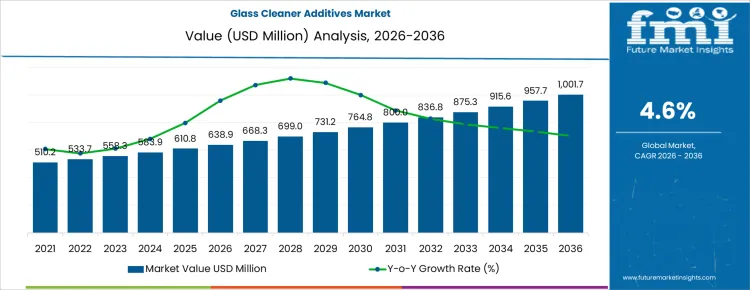
The glass cleaner additives market is expected to grow from USD 638.9 million in 2026 to USD 1,001.7 million by 2036, reflecting a compound annual growth rate (CAGR) of 4.6%. Glass cleaner additives are used to enhance the cleaning performance, streak-free finish, and long-lasting effects of glass cleaning products. The rising demand for high-performance, eco-friendly, and easy-to-use cleaning solutions is driving the adoption of these additives, particularly in residential and commercial cleaning applications. As consumers seek more efficient and effective ways to clean glass surfaces, manufacturers are focusing on innovations in additives that improve cleaning power and reduce the environmental impact of their products.
The market growth is also supported by the increasing focus on sustainability and environmental concerns, with manufacturers moving toward more biodegradable and non-toxic ingredients in their formulations. Additionally, the expanding commercial cleaning sector and the growing trend of home cleaning product innovations are expected to continue fueling demand for glass cleaner additives over the next decade.
Quick Stats of the Glass Cleaner Additives Market
- Glass Cleaner Additives Market Value (2026): USD 638.9 million
- Glass Cleaner Additives Market Forecast Value (2036): USD 1,001.7 million
- Glass Cleaner Additives Market Global Forecast CAGR (2026-2036): 4.6%
- Glass Cleaner Additives Market Leading Segment: End-Use (Household) 55%
- Key Growth Regions in Glass Cleaner Additives Market: United States and United Kingdom
- Top Players in Glass Cleaner Additives Market: Dow, BASF, Nouryon, Evonik, Clariant, Huntsman, Stepan Company, Kao Chemicals, Solvay, Sasol
What is the Growth Forecast for the Glass Cleaner Additives Market through 2036?
The breakpoint analysis for the glass cleaner additives market shows a steady growth pattern with periodic acceleration in specific phases of the forecast. Starting at USD 638.9 million in 2026, the market grows to USD 668.4 million in 2027 and USD 699 million in 2028, reflecting gradual growth driven by increasing consumer demand for more effective and environmentally friendly glass cleaning solutions. These early years show a consistent rise in market size, driven by innovations in glass cleaner formulations.
From 2028 to 2030, the market continues to grow, reaching USD 730.8 million in 2029 and USD 763.8 million in 2030. This period indicates a stable phase, with moderate growth reflecting the ongoing adoption of glass cleaner additives as manufacturers continue to meet consumer expectations for high-quality cleaning products. Between 2030 and 2035, the market sees continued expansion, reaching USD 798.3 million in 2031, USD 834.4 million in 2032, and USD 872.3 million in 2033. By 2035, the market is projected to reach USD 912.1 million, with the final value of USD 1,001.7 million expected in 2036. This breakpoint analysis shows that while the market grows steadily, there are phases of acceleration driven by the increasing preference for advanced, sustainable glass cleaning additives and ongoing product innovations.
Glass Cleaner Additives Market Key Takeaways
| Metric | Value |
|---|---|
| Industry Sales Value (2026) | USD 638.9 million |
| Industry Forecast Value (2036) | USD 1,001.7million |
| Industry Forecast CAGR (2026-2036) | 4.6% |
What Is Driving the Demand for the Glass Cleaner Additives Market Globally?
The global demand for glass cleaner additives is shaped by continued growth in residential, commercial, and industrial cleaning applications alongside rising expectations for surface performance and ease of use. Glass cleaner additives are formulation components that enhance streak-free shine, rapid drying, soil suspension, and residue reduction on glass, mirrors, windows, automotive surfaces, and electronic displays. Consumers and professional users increasingly prioritise convenience and visible results, preferring products that deliver clearer surfaces with minimal effort, especially on large glazed facades, windshields, solar panels, and touchscreen interfaces. Growth in construction activity, urban development, and infrastructure investment supports increased application of hard surface cleaners, including glass care products. In many regions, rising disposable incomes and awareness of hygiene and aesthetics in homes, offices, and public spaces are translating into higher consumption of branded and performance-oriented surface care solutions. In professional cleaning segments such as facility management, hospitality, and transportation maintenance, formulators are incorporating advanced additives that improve wetting, prevent water spotting, and resist re-soiling under varied environmental conditions.
Future demand for glass cleaner additives is expected to grow as formulation innovation and sustainability trends continue to influence product design and purchasing decisions. Advances in additive chemistry, including improved surfactants, solvent systems, and anti-fog or anti-static agents, will broaden performance attributes that address specific consumer needs and professional cleaning challenges. Eco-friendly and low-VOC additive systems are gaining importance as regulatory frameworks tighten around indoor air quality and environmental impact, encouraging brands to develop greener, safer formulations without compromising performance. Growth in automotive cleaning and maintenance, where clear visibility and residue-free surfaces are critical for safety, will also support uptake of specialised additive packages. Expansion of global e-commerce channels and increased penetration of premium surface care products in emerging markets will enhance access to performance-driven cleaners, reinforcing demand for high-quality additives. The continued emphasis on superior cleaning performance, combined with sustainability and health considerations, is expected to sustain steady expansion of the glass cleaner additives market across regions worldwide.
What are the Leading Segments in the Global Glass Cleaner Additives Market?
The global glass cleaner additives market is segmented by target surface and end-use. Among target surfaces, glass/windows lead the market, accounting for 44% of the share, followed by vehicle glass, mirrors, and stainless/fixtures. Glass cleaner additives are predominantly used for cleaning glass and windows due to their superior effectiveness in removing smudges, dirt, and streaks. On the end-use side, household is the leading segment, representing 55% of the market. Other significant end-use sectors include commercial facilities, automotive care, and hospitality/foodservice.
What Drives the Growth of Glass/Windows in the Glass Cleaner Additives Market?
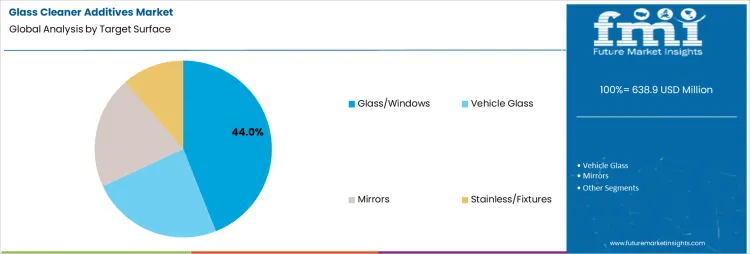
Glass and windows dominate the target surface segment in the glass cleaner additives market, capturing 44% of the market share. This is driven by the widespread need for effective cleaning solutions to maintain the clarity and appearance of glass surfaces in both residential and commercial settings. Glass cleaner additives formulated for windows and glass surfaces are highly effective in removing dirt, fingerprints, and streaks, which is critical for maintaining a clean, polished look. In the household segment, the demand for glass cleaner additives is driven by the need for easy-to-use, streak-free cleaning products for windows, mirrors, and other glass surfaces in homes. Additionally, the increasing focus on aesthetics and cleanliness in commercial facilities, such as office buildings and storefronts, fuels the demand for these additives. The growing preference for eco-friendly and non-toxic cleaning products has also led to innovations in glass cleaner additives, which are now available in more sustainable formulations. As glass and windows remain a critical focus for cleanliness and maintenance, the segment is expected to maintain its dominant share in the market.
What is Driving the Demand for Household in the Glass Cleaner Additives Market?
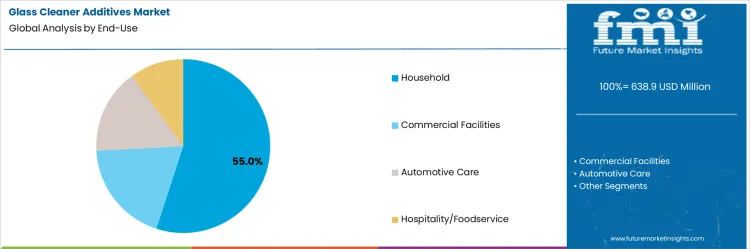
Household is the leading end-use segment in the glass cleaner additives market, accounting for 55% of the market share. This segment’s dominance is driven by the widespread need for effective cleaning solutions for household glass surfaces, including windows, mirrors, and other fixtures. Consumers increasingly seek glass cleaner products that offer ease of use, high-performance cleaning, and streak-free finishes. Household glass cleaner additives are essential for maintaining the clarity and cleanliness of glass surfaces in living rooms, bathrooms, kitchens, and other areas. The growing preference for multi-functional and eco-friendly cleaning products that are both safe and effective has further driven the demand for glass cleaner additives in the household sector. As consumers continue to prioritize cleanliness, aesthetics, and the environment, demand for glass cleaner additives in household products is expected to remain strong. Additionally, as urbanization increases and living spaces become more focused on design and functionality, the need for effective glass cleaning solutions is likely to continue driving market growth.
What are the Key Dynamics of the Global Glass Cleaner Additives Market?
The global glass cleaner additives market is expanding as formulators enhance cleaning solutions to deliver streak-free shine, rapid soil removal and improved surface compatibility. Additives boost performance of glass and hard-surface cleaners used in households, commercial facilities, automotive, and industrial settings. Growth reflects rising consumer demand for effective maintenance products, expansion of cleaning service sectors, and increased focus on spotless hygiene in retail, hospitality and workplace environments. Adoption spans spray formulations, wipes and concentrated systems where additives improve wetting, soil suspension, and evaporation control for clearer, residue-free finishes.
What are the Key Drivers for the Global Glass Cleaner Additives Market?
Increasing consumer expectations for high-performance cleaning outcomes drive demand for advanced additives that enhance wetting and soil removal on glass, mirrors and other reflective surfaces. Rising usage of automotive glass cleaners and interior/exterior detailing products supports market growth. Commercial cleaning and facility management sectors prioritise products that minimise streaks and reduce rework, encouraging formulators to adopt specialised additive systems. Growth in urban populations and home ownership boosts household cleaning product consumption. Technological advances in surfactants, solvents and wetting agents help brands differentiate formulations that deliver quick drying and superior clarity across applications.
What are the Restraints for the Global Glass Cleaner Additives Market?
One restraint is the need to balance strong cleaning performance with safety and regulatory compliance, especially for volatile organic compounds and solvent-based additives. Environmental and health regulations in some regions restrict use of certain chemicals, requiring reformulation that can increase development time and cost. Consumer sensitivity to strong odors or harsh chemistries may reduce acceptance of some high-performance additives. Pressure on manufacturers to offer low-cost products in value-oriented segments can limit incorporation of premium additive systems. Variability in water quality and surface conditions may influence perceived product performance, requiring tailored formulation approaches.
What is the Key Trends in the Global Glass Cleaner Additives Market?
A key trend is growth in eco-friendly and low-VOC additive systems that meet sustainability standards while delivering strong cleaning results. Formulators are developing bio-based surfactants and green solvents that minimise environmental impact and appeal to health-conscious consumers. Integration of multifunctional additives that support both cleaning and protective benefits is gaining attention, such as anti-fog and anti-static agents in automotive and specialty cleaners. Expansion of concentrated and refillable formats aligns with packaging waste reduction goals. Collaboration between ingredient suppliers and cleaning product brands accelerates innovation in additive technologies tailored for performance, safety and consumer preference trends.
What is the Country-Wise Analysis of the Glass Cleaner Additives Market?
The glass cleaner additives market is expected to grow steadily, driven by the increasing demand for effective and high-performance cleaning solutions, particularly for glass surfaces. These additives enhance the cleaning power of glass cleaners, providing streak-free shine, improved dirt removal, and longer-lasting effects. With growing consumer focus on convenience and superior cleaning performance, the market is seeing an uptick in demand. High-growth markets like China are experiencing strong demand driven by rapid urbanization, industrialization, and a growing middle class. Developed markets such as the USA, UK, and Germany are experiencing steady growth, driven by increasing consumer preferences for premium cleaning products and environmentally friendly formulations.
| Country | CAGR (2026 to 2036) |
|---|---|
| China | 5.6% |
| United States | 4.4% |
| United Kingdom | 4.4% |
| Germany | 4.3% |
| Japan | 3.6% |
What is the Growth Outlook for the Glass Cleaner Additives Market in China?
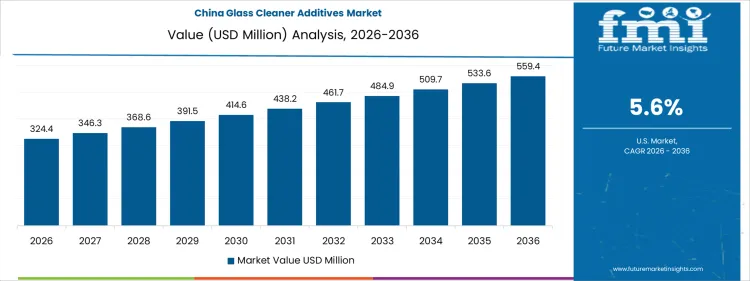
The glass cleaner additives market in China is expected to grow at the highest rate, with a projected CAGR of 5.6%. China’s rapidly expanding consumer goods and home care market is driving the demand for more effective glass cleaning products. As urbanization continues and consumer disposable incomes rise, Chinese consumers are increasingly seeking high-performance and premium cleaning solutions. The growing demand for cleaning products with superior results, such as streak-free finishes and longer-lasting effects, is fueling market growth. Additionally, China’s increasing focus on eco-friendly and sustainable formulations is likely to contribute to the growing demand for glass cleaner additives. The market in China is expected to lead the global demand for these additives in the coming years.
What is the Market Outlook for the Glass Cleaner Additives Market in the United States?
The glass cleaner additives market in the United States is projected to grow steadily, with a projected CAGR of 4.4%. The U.S. market is driven by strong consumer demand for high-quality, effective glass cleaning products. As the preference for convenience and superior cleaning performance increases, the demand for additives that enhance the functionality of glass cleaners is on the rise. Additionally, U.S. consumers are becoming more environmentally conscious, fueling the demand for green and sustainable cleaning products. The steady adoption of premium and highly effective cleaning solutions in both residential and commercial sectors is expected to continue driving growth in the glass cleaner additives market in the U.S.
What is the Growth Forecast for the Glass Cleaner Additives Market in the United Kingdom?
The glass cleaner additives market in the United Kingdom is expected to grow at a steady pace, with a projected CAGR of 4.4%. The UK’s market for cleaning products, including glass cleaners, is increasingly influenced by consumer demand for high-performance and eco-friendly solutions. Consumers are seeking cleaning products that not only deliver effective cleaning results but are also gentle on the environment. The demand for streak-free, long-lasting glass cleaners is pushing the adoption of glass cleaner additives that improve product performance. As consumers become more aware of the importance of sustainable ingredients, the UK market for glass cleaner additives is expected to experience steady growth in line with broader sustainability trends in the household care sector.
What is the Market Outlook for the Glass Cleaner Additives Market in Germany?
The glass cleaner additives market in Germany is projected to grow at a steady pace, with a projected CAGR of 4.3%. Germany’s strong consumer preference for high-quality and effective cleaning products is driving demand for glass cleaner additives that enhance product performance. German consumers are increasingly focusing on eco-friendly products, which is contributing to the growth of sustainable glass cleaning solutions. As the demand for streak-free finishes and long-lasting cleaning results increases, the adoption of additives to improve the performance of glass cleaners is rising. With Germany’s commitment to sustainability and environmental protection, the market for glass cleaner additives is expected to see steady growth.
What are the Growth Prospects for the Glass Cleaner Additives Market in Japan?
The glass cleaner additives market in Japan is expected to grow at a moderate pace, with a projected CAGR of 3.6%. Japan’s established consumer goods market, particularly in home care products, is increasingly demanding high-performance and eco-friendly solutions. While growth in Japan is expected to be slower compared to other regions, the market for glass cleaner additives is still expected to experience steady growth, driven by consumer interest in premium, streak-free, and long-lasting cleaning products. As Japanese consumers become more focused on sustainability and superior product performance, the demand for high-quality glass cleaner additives will continue to grow, albeit at a moderate pace compared to other countries.
What is the Competitive Landscape for the Glass Cleaner Additives Market?
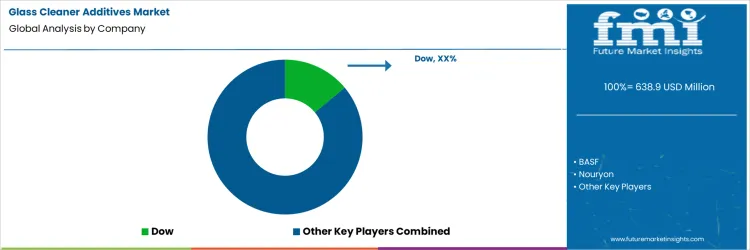
The glass cleaner additives market is growing as consumers and manufacturers demand more effective, eco-friendly cleaning solutions that provide superior performance without streaking. Dow leads the market with its high-performance glass cleaner additives, which enhance cleaning efficiency and ensure streak-free shine, positioning them as a dominant player. BASF, Nouryon, and Evonik are significant competitors, each offering specialized additives designed to improve the performance of glass cleaning products. BASF focuses on providing sustainable and effective solutions, while Nouryon offers eco-friendly additives that improve glass cleaner formulation and efficiency. Evonik specializes in high-performance additives that deliver exceptional results in cleaning and shine.
Clariant, Huntsman, Stepan Company, Kao Chemicals, Solvay, and Sasol further contribute to the competitive landscape by offering tailored solutions for glass cleaners. Clariant and Huntsman focus on developing innovative, sustainable additives for cleaning applications. Stepan Company provides high-quality, performance-enhancing additives, while Kao Chemicals and Solvay specialize in solutions that boost cleaning effectiveness and improve product stability. Sasol rounds out the competitive field by offering specialized chemical solutions that enhance glass cleaner performance. These companies compete by focusing on product innovation, sustainability, and their ability to meet the growing demand for high-performance, eco-friendly glass cleaner additives.
Key Players of the Glass Cleaner Additives Market
- Dow
- BASF
- Nouryon
- Evonik
- Clariant
- Huntsman
- Stepan Company
- Kao Chemicals
- Solvay
- Sasol
Scope of the Report
| Items | Values |
|---|---|
| Quantitative Units (2026) | USD Million |
| Functional Additive Type | Surfactants & Wetting Agents, Solvents & Co-Solvents, Chelants/Builders, Anti-Streak Polymers & Shine Agents |
| Finished Product Form | Ready-to-Use Sprays, Concentrates, Wipes, Foam/Aerosol Formats |
| Target Surface | Glass/Windows, Vehicle Glass, Mirrors, Stainless/Fixtures |
| End-Use | Household, Commercial Facilities, Automotive Care, Hospitality/Foodservice |
| Companies | Dow, BASF, Nouryon, Evonik, Clariant, Huntsman, Stepan Company, Kao Chemicals, Solvay, Sasol |
| Regions Covered | North America, Latin America, Western Europe, Eastern Europe, South Asia and Pacific, East Asia, Middle East & Africa |
| Countries Covered | United States, Canada, Mexico, Brazil, Argentina, Germany, France, United Kingdom, Italy, Spain, Netherlands, China, India, Japan, South Korea, ANZ, GCC Countries, South Africa |
| Additional Attributes | Dollar by sales by functional additive type, finished product form, target surface, end-use, and region. Includes market trends in glass cleaner additives, focusing on surfactants, solvents, chelants, and anti-streak polymers. Highlights the role of different formats (sprays, wipes, concentrates) in household, commercial, automotive, and hospitality sectors. Focus on performance, cost-effectiveness, sustainability, regulatory compliance, and market share of key companies in the glass cleaner additives market. |
Glass Cleaner Additives Market Segmentation
Functional Additive Type
- Surfactants & Wetting Agents
- Solvents & Co-Solvents
- Chelants/Builders
- Anti-Streak Polymers & Shine Agents
Finished Product Form
- Ready-to-Use Sprays
- Concentrates
- Wipes
- Foam/Aerosol Formats
Target Surface
- Glass/Windows
- Vehicle Glass
- Mirrors
- Stainless/Fixtures
End-Use
- Household
- Commercial Facilities
- Automotive Care
- Hospitality/Foodservice
Region
- Asia Pacific
- China
- Japan
- South Korea
- India
- Australia & New Zealand
- ASEAN
- Rest of Asia Pacific
- Europe
- Germany
- United Kingdom
- France
- Italy
- Spain
- Nordic
- BENELUX
- Rest of Europe
- North America
- United States
- Canada
- Mexico
- Latin America
- Brazil
- Chile
- Rest of Latin America
- Middle East & Africa
- Kingdom of Saudi Arabia
- Other GCC Countries
- Turkey
- South Africa
- Other African Union
- Rest of Middle East & Africa
Frequently Asked Questions
How big is the glass cleaner additives market in 2026?
The global glass cleaner additives market is estimated to be valued at USD 638.9 million in 2026.
What will be the size of glass cleaner additives market in 2036?
The market size for the glass cleaner additives market is projected to reach USD 1,001.7 million by 2036.
How much will be the glass cleaner additives market growth between 2026 and 2036?
The glass cleaner additives market is expected to grow at a 4.6% CAGR between 2026 and 2036.
What are the key product types in the glass cleaner additives market?
The key product types in glass cleaner additives market are surfactants & wetting agents, solvents & co-solvents, chelants/builders and anti-streak polymers & shine agents.
Which finished product form segment to contribute significant share in the glass cleaner additives market in 2026?
In terms of finished product form, ready-to-use sprays segment to command 46.0% share in the glass cleaner additives market in 2026.
Preview the report firsthand - request a free sample
Get SampleGet the brochure for pricing and purchase details.
Get PDFTable of Content
- Executive Summary
- Global Market Outlook
- Demand-side Trends
- Supply-side Trends
- Technology Roadmap Analysis
- Analysis and Recommendations
- Market Overview
- Market Coverage / Taxonomy
- Market Definition / Scope / Limitations
- Market Background
- Market Dynamics
- Drivers
- Restraints
- Opportunity
- Trends
- Scenario Forecast
- Demand in Optimistic Scenario
- Demand in Likely Scenario
- Demand in Conservative Scenario
- Opportunity Map Analysis
- Product Life Cycle Analysis
- Supply Chain Analysis
- Investment Feasibility Matrix
- Value Chain Analysis
- PESTLE and Porter’s Analysis
- Regulatory Landscape
- Regional Parent Market Outlook
- Production and Consumption Statistics
- Import and Export Statistics
- Market Dynamics
- Global Market Analysis 2021 to 2025 and Forecast, 2026 to 2036
- Historical Market Size Value (USD Million) Analysis, 2021 to 2025
- Current and Future Market Size Value (USD Million) Projections, 2026 to 2036
- Y-o-Y Growth Trend Analysis
- Absolute $ Opportunity Analysis
- Global Market Pricing Analysis 2021 to 2025 and Forecast 2026 to 2036
- Global Market Analysis 2021 to 2025 and Forecast 2026 to 2036, By Functional Additive Type
- Introduction / Key Findings
- Historical Market Size Value (USD Million) Analysis By Functional Additive Type , 2021 to 2025
- Current and Future Market Size Value (USD Million) Analysis and Forecast By Functional Additive Type , 2026 to 2036
- Surfactants & Wetting Agents
- Solvents & Co-Solvents
- Chelants/Builders
- Anti-Streak Polymers & Shine Agents
- Y-o-Y Growth Trend Analysis By Functional Additive Type , 2021 to 2025
- Absolute $ Opportunity Analysis By Functional Additive Type , 2026 to 2036
- Global Market Analysis 2021 to 2025 and Forecast 2026 to 2036, By Finished Product Form
- Introduction / Key Findings
- Historical Market Size Value (USD Million) Analysis By Finished Product Form, 2021 to 2025
- Current and Future Market Size Value (USD Million) Analysis and Forecast By Finished Product Form, 2026 to 2036
- Ready-to-Use Sprays
- Concentrates
- Wipes
- Foam/Aerosol Formats
- Y-o-Y Growth Trend Analysis By Finished Product Form, 2021 to 2025
- Absolute $ Opportunity Analysis By Finished Product Form, 2026 to 2036
- Global Market Analysis 2021 to 2025 and Forecast 2026 to 2036, By Target Surface
- Introduction / Key Findings
- Historical Market Size Value (USD Million) Analysis By Target Surface, 2021 to 2025
- Current and Future Market Size Value (USD Million) Analysis and Forecast By Target Surface, 2026 to 2036
- Glass/Windows
- Vehicle Glass
- Mirrors
- Stainless/Fixtures
- Y-o-Y Growth Trend Analysis By Target Surface, 2021 to 2025
- Absolute $ Opportunity Analysis By Target Surface, 2026 to 2036
- Global Market Analysis 2021 to 2025 and Forecast 2026 to 2036, By End-Use
- Introduction / Key Findings
- Historical Market Size Value (USD Million) Analysis By End-Use, 2021 to 2025
- Current and Future Market Size Value (USD Million) Analysis and Forecast By End-Use, 2026 to 2036
- Household
- Commercial Facilities
- Automotive Care
- Hospitality/Foodservice
- Y-o-Y Growth Trend Analysis By End-Use, 2021 to 2025
- Absolute $ Opportunity Analysis By End-Use, 2026 to 2036
- Global Market Analysis 2021 to 2025 and Forecast 2026 to 2036, By Region
- Introduction
- Historical Market Size Value (USD Million) Analysis By Region, 2021 to 2025
- Current Market Size Value (USD Million) Analysis and Forecast By Region, 2026 to 2036
- North America
- Latin America
- Western Europe
- Eastern Europe
- East Asia
- South Asia and Pacific
- Middle East & Africa
- Market Attractiveness Analysis By Region
- North America Market Analysis 2021 to 2025 and Forecast 2026 to 2036, By Country
- Historical Market Size Value (USD Million) Trend Analysis By Market Taxonomy, 2021 to 2025
- Market Size Value (USD Million) Forecast By Market Taxonomy, 2026 to 2036
- By Country
- USA
- Canada
- Mexico
- By Functional Additive Type
- By Finished Product Form
- By Target Surface
- By End-Use
- By Country
- Market Attractiveness Analysis
- By Country
- By Functional Additive Type
- By Finished Product Form
- By Target Surface
- By End-Use
- Key Takeaways
- Latin America Market Analysis 2021 to 2025 and Forecast 2026 to 2036, By Country
- Historical Market Size Value (USD Million) Trend Analysis By Market Taxonomy, 2021 to 2025
- Market Size Value (USD Million) Forecast By Market Taxonomy, 2026 to 2036
- By Country
- Brazil
- Chile
- Rest of Latin America
- By Functional Additive Type
- By Finished Product Form
- By Target Surface
- By End-Use
- By Country
- Market Attractiveness Analysis
- By Country
- By Functional Additive Type
- By Finished Product Form
- By Target Surface
- By End-Use
- Key Takeaways
- Western Europe Market Analysis 2021 to 2025 and Forecast 2026 to 2036, By Country
- Historical Market Size Value (USD Million) Trend Analysis By Market Taxonomy, 2021 to 2025
- Market Size Value (USD Million) Forecast By Market Taxonomy, 2026 to 2036
- By Country
- Germany
- UK
- Italy
- Spain
- France
- Nordic
- BENELUX
- Rest of Western Europe
- By Functional Additive Type
- By Finished Product Form
- By Target Surface
- By End-Use
- By Country
- Market Attractiveness Analysis
- By Country
- By Functional Additive Type
- By Finished Product Form
- By Target Surface
- By End-Use
- Key Takeaways
- Eastern Europe Market Analysis 2021 to 2025 and Forecast 2026 to 2036, By Country
- Historical Market Size Value (USD Million) Trend Analysis By Market Taxonomy, 2021 to 2025
- Market Size Value (USD Million) Forecast By Market Taxonomy, 2026 to 2036
- By Country
- Russia
- Poland
- Hungary
- Balkan & Baltic
- Rest of Eastern Europe
- By Functional Additive Type
- By Finished Product Form
- By Target Surface
- By End-Use
- By Country
- Market Attractiveness Analysis
- By Country
- By Functional Additive Type
- By Finished Product Form
- By Target Surface
- By End-Use
- Key Takeaways
- East Asia Market Analysis 2021 to 2025 and Forecast 2026 to 2036, By Country
- Historical Market Size Value (USD Million) Trend Analysis By Market Taxonomy, 2021 to 2025
- Market Size Value (USD Million) Forecast By Market Taxonomy, 2026 to 2036
- By Country
- China
- Japan
- South Korea
- By Functional Additive Type
- By Finished Product Form
- By Target Surface
- By End-Use
- By Country
- Market Attractiveness Analysis
- By Country
- By Functional Additive Type
- By Finished Product Form
- By Target Surface
- By End-Use
- Key Takeaways
- South Asia and Pacific Market Analysis 2021 to 2025 and Forecast 2026 to 2036, By Country
- Historical Market Size Value (USD Million) Trend Analysis By Market Taxonomy, 2021 to 2025
- Market Size Value (USD Million) Forecast By Market Taxonomy, 2026 to 2036
- By Country
- India
- ASEAN
- Australia & New Zealand
- Rest of South Asia and Pacific
- By Functional Additive Type
- By Finished Product Form
- By Target Surface
- By End-Use
- By Country
- Market Attractiveness Analysis
- By Country
- By Functional Additive Type
- By Finished Product Form
- By Target Surface
- By End-Use
- Key Takeaways
- Middle East & Africa Market Analysis 2021 to 2025 and Forecast 2026 to 2036, By Country
- Historical Market Size Value (USD Million) Trend Analysis By Market Taxonomy, 2021 to 2025
- Market Size Value (USD Million) Forecast By Market Taxonomy, 2026 to 2036
- By Country
- Kingdom of Saudi Arabia
- Other GCC Countries
- Turkiye
- South Africa
- Other African Union
- Rest of Middle East & Africa
- By Functional Additive Type
- By Finished Product Form
- By Target Surface
- By End-Use
- By Country
- Market Attractiveness Analysis
- By Country
- By Functional Additive Type
- By Finished Product Form
- By Target Surface
- By End-Use
- Key Takeaways
- Key Countries Market Analysis
- USA
- Pricing Analysis
- Market Share Analysis, 2025
- By Functional Additive Type
- By Finished Product Form
- By Target Surface
- By End-Use
- Canada
- Pricing Analysis
- Market Share Analysis, 2025
- By Functional Additive Type
- By Finished Product Form
- By Target Surface
- By End-Use
- Mexico
- Pricing Analysis
- Market Share Analysis, 2025
- By Functional Additive Type
- By Finished Product Form
- By Target Surface
- By End-Use
- Brazil
- Pricing Analysis
- Market Share Analysis, 2025
- By Functional Additive Type
- By Finished Product Form
- By Target Surface
- By End-Use
- Chile
- Pricing Analysis
- Market Share Analysis, 2025
- By Functional Additive Type
- By Finished Product Form
- By Target Surface
- By End-Use
- Germany
- Pricing Analysis
- Market Share Analysis, 2025
- By Functional Additive Type
- By Finished Product Form
- By Target Surface
- By End-Use
- UK
- Pricing Analysis
- Market Share Analysis, 2025
- By Functional Additive Type
- By Finished Product Form
- By Target Surface
- By End-Use
- Italy
- Pricing Analysis
- Market Share Analysis, 2025
- By Functional Additive Type
- By Finished Product Form
- By Target Surface
- By End-Use
- Spain
- Pricing Analysis
- Market Share Analysis, 2025
- By Functional Additive Type
- By Finished Product Form
- By Target Surface
- By End-Use
- France
- Pricing Analysis
- Market Share Analysis, 2025
- By Functional Additive Type
- By Finished Product Form
- By Target Surface
- By End-Use
- India
- Pricing Analysis
- Market Share Analysis, 2025
- By Functional Additive Type
- By Finished Product Form
- By Target Surface
- By End-Use
- ASEAN
- Pricing Analysis
- Market Share Analysis, 2025
- By Functional Additive Type
- By Finished Product Form
- By Target Surface
- By End-Use
- Australia & New Zealand
- Pricing Analysis
- Market Share Analysis, 2025
- By Functional Additive Type
- By Finished Product Form
- By Target Surface
- By End-Use
- China
- Pricing Analysis
- Market Share Analysis, 2025
- By Functional Additive Type
- By Finished Product Form
- By Target Surface
- By End-Use
- Japan
- Pricing Analysis
- Market Share Analysis, 2025
- By Functional Additive Type
- By Finished Product Form
- By Target Surface
- By End-Use
- South Korea
- Pricing Analysis
- Market Share Analysis, 2025
- By Functional Additive Type
- By Finished Product Form
- By Target Surface
- By End-Use
- Russia
- Pricing Analysis
- Market Share Analysis, 2025
- By Functional Additive Type
- By Finished Product Form
- By Target Surface
- By End-Use
- Poland
- Pricing Analysis
- Market Share Analysis, 2025
- By Functional Additive Type
- By Finished Product Form
- By Target Surface
- By End-Use
- Hungary
- Pricing Analysis
- Market Share Analysis, 2025
- By Functional Additive Type
- By Finished Product Form
- By Target Surface
- By End-Use
- Kingdom of Saudi Arabia
- Pricing Analysis
- Market Share Analysis, 2025
- By Functional Additive Type
- By Finished Product Form
- By Target Surface
- By End-Use
- Turkiye
- Pricing Analysis
- Market Share Analysis, 2025
- By Functional Additive Type
- By Finished Product Form
- By Target Surface
- By End-Use
- South Africa
- Pricing Analysis
- Market Share Analysis, 2025
- By Functional Additive Type
- By Finished Product Form
- By Target Surface
- By End-Use
- USA
- Market Structure Analysis
- Competition Dashboard
- Competition Benchmarking
- Market Share Analysis of Top Players
- By Regional
- By Functional Additive Type
- By Finished Product Form
- By Target Surface
- By End-Use
- Competition Analysis
- Competition Deep Dive
- Dow
- Overview
- Product Portfolio
- Profitability by Market Segments (Product/Age /Sales Channel/Region)
- Sales Footprint
- Strategy Overview
- Marketing Strategy
- Product Strategy
- Channel Strategy
- BASF
- Nouryon
- Evonik
- Clariant
- Huntsman
- Stepan Company
- Kao Chemicals
- Solvay
- Sasol
- Dow
- Competition Deep Dive
- Assumptions & Acronyms Used
- Research Methodology


