

- Industry Size (2026)
- USD 420.0 Mn
- Forecast (2036)
- USD 1040.8 Mn
- CAGR (2026 to 2036)
- 11.20%
High-Nickel NCM Cathode Binder Latex Market Size, Market Forecast and Outlook By FMI
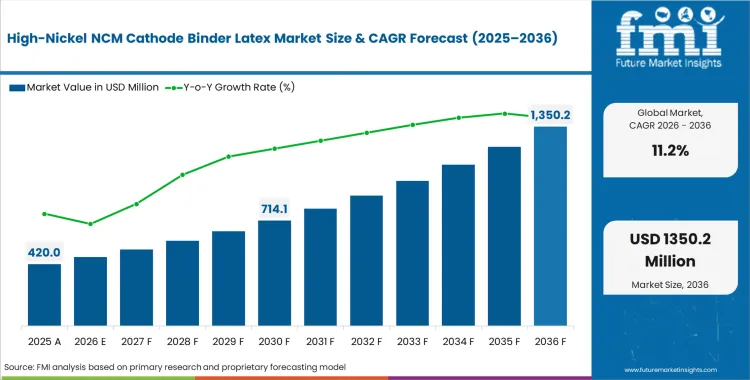
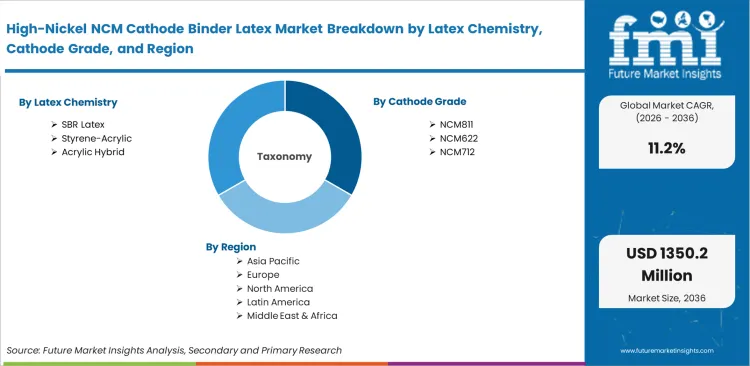
The high-nickel NCM cathode binder latex market was valued at USD 324.0 million in 2025. Demand is poised to cross USD 420.0 million in 2026 at a CAGR of 11.20% during the forecast period. Steady investment continues to lift revenue to USD 1,040.8 million through 2036 as cell manufacturers transition away from legacy solvent recovery systems toward fully aqueous slurry lines for highly reactive active materials.
Summary of High-Nickel NCM Cathode Binder Latex Market
- The market is estimated at USD 324.0 million in 2025.
- The market is projected to reach USD 1,040.8 million by 2036.
- The market is expected to grow at a CAGR of 11.2% from 2026 to 2036.
- The forecast period represents an incremental opportunity of USD 680.8 million.
- SBR latex leads the chemistry segment with a 43.0% share.
- NCM811 dominates the cathode grade segment with a 46.0% share.
- EV batteries lead the end-use segment with a 76.0% share.
- Water-based processing dominates the processing route segment with a 61.0% share.
- Cell OEMs lead the customer type segment with a 58.0% share.
- The United States (13.3%), South Korea (12.7%), and Poland (12.0%) are among the fastest-growing markets.
- Key companies in the market include Zeon, LG Chem, JSR, NIPPON A&L, ENEOS Materials, Arkema, and BASF.
Tier-1 battery cell manufacturers face a clear margin constraint because solvent recovery continues to add meaningful cost to existing coating lines. Adopting an advanced water-based binder for high-nickel NCM cathodes is not a simple substitution, since the material must prevent nickel dissolution while retaining adhesion under severe volumetric expansion. Delayed adoption leaves cell producers exposed to a structural cost burden that can reach fifteen percent in electrode manufacturing. Conventional aqueous systems do not adequately control rapid gelation in NCM811 and higher-nickel chemistries, which makes qualification more demanding and increases the need for battery binder resins that can tolerate high-alkalinity conditions. Factory configuration carries major commercial weight in the decision. Manufacturers evaluating alternatives to PVDF cathode binders can remove large solvent distillation towers entirely, changing the capital required for new gigafactory construction.
Once cathode manufacturers qualify a workable aqueous cathode binder for NCM systems, the capital threshold for new capacity drops sharply. Qualification of that chemistry also accelerates the phase-out of legacy recovery equipment across the production floor. The clearest sign of the shift appears when Specification decisions increasingly favor specify aqueous coating heads for next-generation pilot lines instead of dual-compatible systems. Hardware choices at that stage commit the supply chain to water-compatible cathode binder latex solutions over the coming decade.
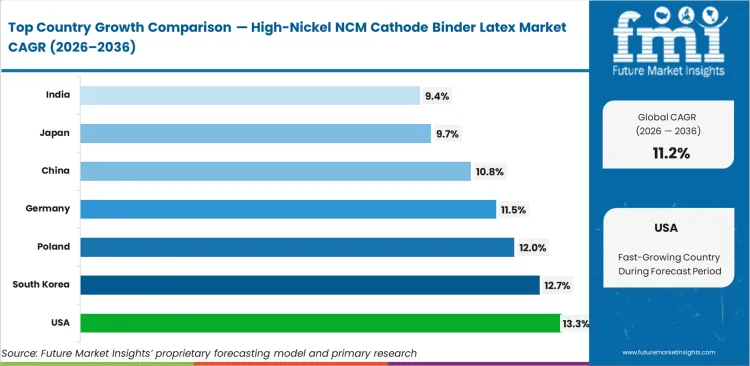
The United States cathode binder latex landscape is set to record 13.3% CAGR as domestic manufacturing incentives subsidize completely new localized gigafactory architectures optimized for aqueous processing from day one. South Korea's nickel-rich cathode binder demand is expected to advance at a CAGR of 12.7% because incumbent cell makers there aggressively retrofit domestic lines to validate water-based formulas before exporting the process to European subsidiaries. Poland's battery binder production is anticipated to rise at a CAGR of 12.0% on the back of regional capacity linked to Korean partners.
The Germany NCM cathode binder sector is poised to expand at a CAGR of 11.5% as legacy automotive platforms mandate lower-toxicity manufacturing bills of materials. China's high-nickel cathode binder volume is forecast to register 10.8% CAGR, trailing slightly due to a massive installed base of LFP chemistries dominating its current output. The Japan cathode binder industry is likely to advance at a CAGR of 9.7% through methodical premium-tier material upgrades. India is expected to post a CAGR of 9.4%, restrained by a persistent focus on cost-led platforms.
Segmental Analysis
High-Nickel NCM Cathode Binder Latex Market Analysis by Latex Chemistry
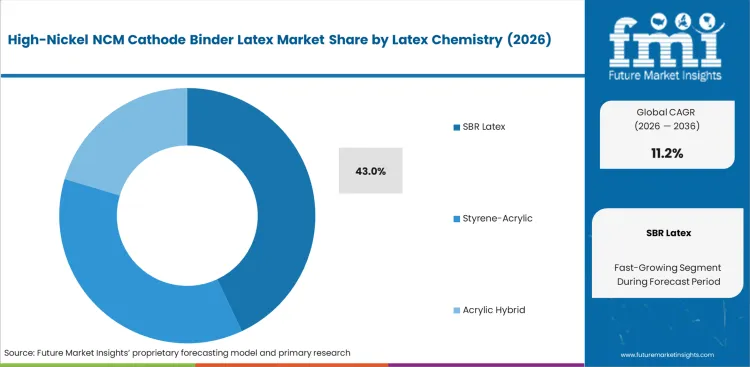
Legacy solvent systems do not meet the environmental compliance requirements tied to next-generation European gigafactories. SBR latex is expected to hold 43.0% share in 2026 because its butadiene backbone provides the elastomeric flexibility needed to withstand aggressive calendering. Leading battery manufacturers rely on that chemistry to reduce active material shedding when coated aluminum foil is compressed to very high densities. FMI’s analysis indicates that segment leadership comes from compatibility with thick electrode architectures. Commercial complexity sits there, because the generic SBR label hides a highly engineered battery-grade material. Attempts to replace these cathode binders with standard industrial latex often result in severe slurry gelation within hours of mixing. Suppliers need to deliver an optimized nickel-rich cathode slurry binder to keep production lines viable.
- Qualification trigger: Trial work begins with a polymer’s ability to maintain slurry viscosity within a tight ten-percent variance across a twenty-four-hour mixing cycle.
- Performance validation: Success is measured by the absence of micro-cracking during calendering. Formulations that clear that physical stress stage move forward to full-scale electrochemical evaluation.
- Expansion mechanism: Purchase volumes increase only after teardown analysis of cycled cells confirms that the conductive carbon network remains evenly distributed across the cathode matrix.
High-Nickel NCM Cathode Binder Latex Market Analysis by Cathode Grade
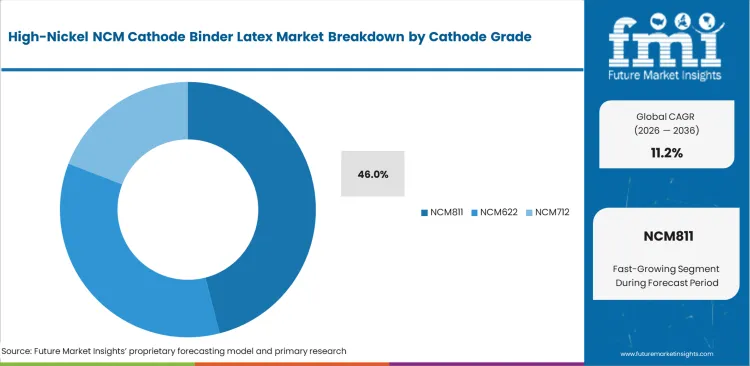
NCM811 is anticipated to capture 46.0% share in 2026 because automotive OEMs continue to favor the energy density delivered by this nickel-to-cobalt-to-manganese ratio. NCM811 binder latex consumption also rises disproportionately, as the chemistry requires nearly twenty percent more binder by weight than older cathode systems to coat the same surface area of lithium-ion battery material. Manufacturers that fail to recalibrate adhesive ratios often run into electrode delamination during early charging cycles. Nickel-rich NCM binder demand continues to expose those operating gaps across emerging gigafactories.
- Procurement baseline: Material selection centers on minimizing total cost per gigawatt-hour. Production line downtime often carries a higher cost than small unit-price differences in the raw polymer.
- Hidden operation cost: Gelation events during slurry mixing force complete equipment purges. Those flushing cycles waste expensive active materials and weaken factory throughput.
- Lifecycle economics: Capital savings from removing solvent recovery equipment are weighed against the scrap generated during the early shift to aqueous processing. Process maturity gradually tilts the economics toward water-based systems.
High-Nickel NCM Cathode Binder Latex Market Analysis by End Use
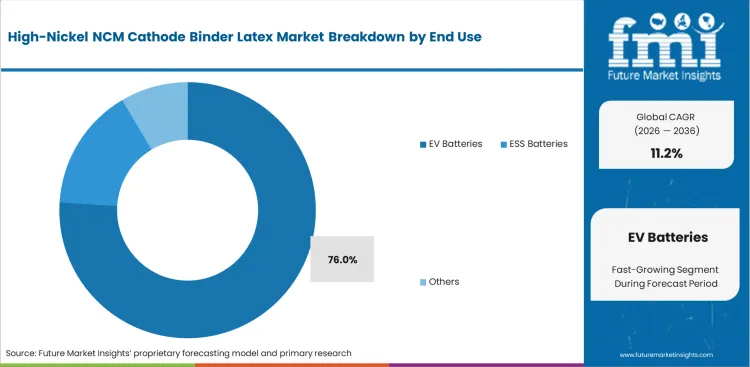
Automotive platform architects push for maximum driving range, while factory operators remain focused on high-speed manufacturing throughput. Those two requirements are steering the industry toward water-processed high-nickel cells. Solvent-based lines must operate at restricted speeds to control volatile organic compound buildup inside drying ovens. EV cathode binder latex is estimated to hold 76.0% share in 2026 because aqueous latex systems align energy-density targets more effectively with faster production economics. Water-based battery materials support faster roll-to-roll coating velocities. Cell manufacturers working with long-range EV battery materials can also use higher air volumes and temperatures without explosion-proof handling requirements. Ignoring that process shift leaves producers at a structural disadvantage on cell cost per kilowatt-hour.
- Failure prevention: Battery safety engineers set exact peel-strength metrics to ensure cathode material does not detach from the current collector during severe vehicle vibration. Detachment immediately creates internal micro-shorts that reduce capacity.
- Residual vulnerability: Quality control teams still detect occasional edge-curling on coated foils when drying temperatures fluctuate. That distortion remains a primary yield loss point in high-speed aqueous manufacturing lines.
- Yield capture: Coating line operators need precise thermal calibration across multiple oven zones. Accurate control removes blistering while preserving the line speed needed to capture the economic benefit of water-based formulations.
High-Nickel NCM Cathode Binder Latex Market Analysis by Processing Route
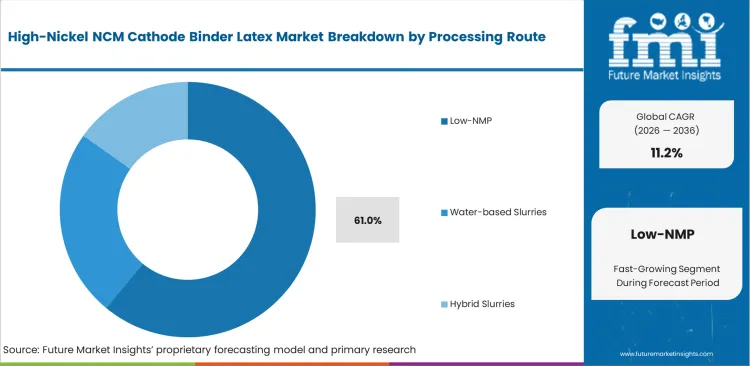
Environmental mandates across Europe and North America are forcing immediate operating changes inside gigafactories. Battery plant developers are finding it harder to secure permits for large solvent distillation towers in densely populated industrial zones. FMI’s assessment indicates that this regulatory push is reshaping lithium-ion battery supply chains at the materials level. Low-NMP cathode binder systems are poised to garner 61.0% share in 2026 because compliance pressure is now directly influencing plant design and material selection.
Chemical suppliers that historically sold pure PVDF are losing access unless they can offer aqueous alternatives for nickel-rich battery coatings. Water-based slurries also raise a separate operating challenge, as they accelerate the degradation of uncoated factory equipment. Corrosion-resistant mixing vessels and stainless steel piping become necessary secondary investments. Suppliers that fail to prepare buyers for that infrastructure requirement face severe backlash when mixing impellers begin to rust.
- Primary supplier capability: Chemical companies with strong emulsion polymerization expertise lead this space because they can produce tightly controlled latex particle sizes. Consistent particle distribution reduces binder migration during drying.
- Supply bottleneck: A shortage of customized core-shell latex variants continues to constrain qualification for high-nickel active materials. Standard off-the-shelf emulsions fail almost immediately.
- Long-term landscape: Factory planning committees increasingly treat solvent-based cathode processing as obsolete in Western markets by 2036. That view is pushing multi-year exclusive supply agreements for proven aqueous formulations.
High-Nickel NCM Cathode Binder Latex Market Analysis by Customer Type
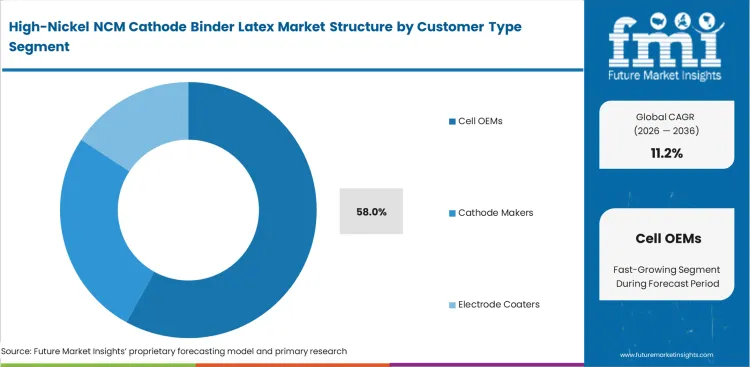
Vertical integration determines where technical risk sits across the battery value chain. Cell OEMs are set to record 58.0% share in 2026 because they retain control of the highly sensitive slurry mixing process to protect proprietary electrode recipes. These large manufacturers purchase raw binder latex and active materials separately, then absorb the engineering burden of making both systems work together. Internal teams treat the binder as more than a simple adhesive, since it directly affects yield across the production floor.
Custom polymer architectures are often designed to work only with selected active materials, which makes them difficult to transfer across competing platforms. That approach creates a major barrier for toll coaters trying to serve multiple customers through a single generic electric vehicle battery production line. Successful battery binder latex OEM qualification secures exclusive, high-volume production runs.
- Upper performance limit: Advanced formulation scientists push these binders to operate at solid loadings above seventy percent. Higher solids reduce the amount of water that must be evaporated and improve factory throughput.
- Edge condition gaps: Production line supervisors observe severe binder migration to the electrode surface when drying speeds exceed the polymer’s thermal tolerance. Loss of binder at the base foil sharply weakens adhesion.
- Acceptability standard: Quality assurance teams enforce peel strength minimums of twenty Newtons per meter before approving any new batch. Failure on that mechanical test results in immediate raw material quarantine.
High-Nickel NCM Cathode Binder Latex Market Drivers, Restraints, and Opportunities
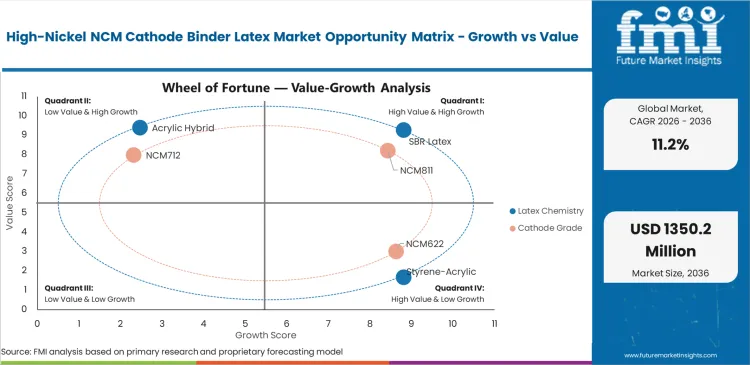
Capital expenditure ceilings force factory architects to completely redesign new gigafactory blueprints across Europe and North America. Overseeing these massive facility build-outs cannot justify the hundreds of millions of dollars required to install, operate, and maintain complex N-Methyl-2-pyrrolidone solvent recovery and distillation towers. Eliminating these toxic solvents entirely by shifting to aqueous high-nickel latex binders instantly shrinks the physical footprint of the factory. It also removes immense regulatory permitting hurdles.
The fundamental operational friction slowing water-based adoption is the rapid gelation of high-nickel slurries in the mixing tanks. When NCM811 powder contacts water, surface lithium compounds immediately dissolve, creating a highly alkaline environment that attacks the polymer binder. Mixing room supervisors find their low-viscosity slurries turning into solid uncoatable gels within a few hours. This very narrow processing window forces factories to mix smaller batches and immediately coat them, destroying the economies of scale typically found in massive continuous mixing operations.
Opportunities in the High-Nickel NCM Cathode Binder Latex Market
- Dry coating integration: Formulators who adapt their aqueous latex architectures into sprayable powders for battery electrode dry coating materials secure immediate pilot contracts. R&D directors view dry processing as the ultimate successor to slurry coating.
- High-energy-density integration: Chemical companies engineering latex binders that maintain ionic contact with sulfide solid electrolytes capture massive early-stage qualification premiums. Cell architects require flexible polymers for high-energy-density battery cathodes to buffer volumetric expansion.
- High-voltage stabilization: Suppliers developing fluorinated latex variants that resist oxidation above 4.4 volts win exclusive supply agreements. High-voltage cathode systems increasingly require adhesives for fast-charging battery electrodes that survive extreme voltage cycling without breaking down.
Regional Analysis
Based on regional analysis, High-Nickel NCM Cathode Binder Latex is segmented into North America, Europe, East Asia, and other regions across 40 plus countries.
.webp "Top Country Growth Comparison High Nickel Ncm Cathode Binder Latex Market Cagr (2026 2036)")
| Country | CAGR (2026 to 2036) |
|---|---|
| United States | 13.3% |
| South Korea | 12.7% |
| Poland | 12.0% |
| Germany | 11.5% |
| China | 10.8% |
| Japan | 9.7% |
| India | 9.4% |
Source: Future Market Insights (FMI) analysis, based on proprietary forecasting model and primary research
North America High-Nickel NCM Cathode Binder Latex Market Analysis
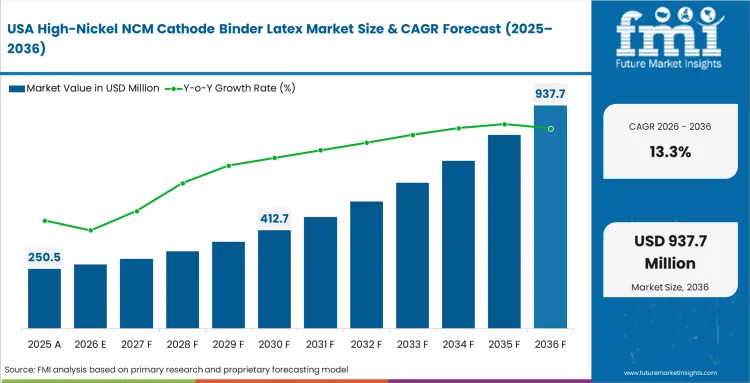
Massive federal supply chain subsidies in North America are reshaping facility design around aqueous processing from the outset. Factory directors in this region benefit from minimal reliance on legacy solvent-recovery infrastructure that requires long-term amortization. Greenfield gigafactories are being configured around water-based high-nickel coating lines to improve capital efficiency and meet strict domestic sourcing mandates. FMI’s assessment indicates a clean-slate approach removes complex retrofit engineering challenges that continue to slow adoption across established Asian production hubs. Ultra-fast charging EV battery platforms in the USA market demand precisely engineered latex binders to preserve electrode integrity under extreme thermal stress. Material suppliers are required to develop formulations capable of withstanding rapid lithium-ion insertion without structural degradation or micro-cracking.
- United States: Local manufacturing mandates are pushing battery producers to build new plants without toxic solvent infrastructure. Plant architects secure major capital savings by specifying water-based lines from the beginning. Demand for high-nickel NCM cathode binder latex in the United States is anticipated to rise at a CAGR of 13.3% through 2036. Localized access to these specialized polymers is essential in determining whether factories meet aggressive launch schedules.
FMI's report includes extended analysis of Canada and Mexico within the North American scope. Supply‑chain planners structuring these continental networks face a distinct logistical friction: while active material synthesis increasingly scales in Canadian mineral hubs, the temperature‑controlled transport of liquid aqueous binders across vast distances remains economically unviable. Brazil is emerging as a strategic opportunity, where recent investments in domestic binder synthesis, port modernization, and inland logistics corridors could shorten distribution distances and reduce cold‑chain exposure for aqueous chemistries.
East Asia High-Nickel NCM Cathode Binder Latex Market Analysis
Export readiness and process validation shape operating priorities for cell makers across East Asia. Korean and Japanese manufacturers use domestic production lines as proving grounds for next-generation aqueous high-nickel formulations before transferring those process blueprints to plants in Europe and North America. FMI’s analysis positions the region as the main engineering base for global battery process development. A large installed base of legacy equipment still complicates the shift, as older lines require careful retrofit work to handle water-based systems. Material volumes are so large that even minor slurry gelation events can lead to substantial scrap losses and immediate production inefficiencies.
- South Korea: Domestic production lines serve as the validation center for water-based high-nickel binder systems before those processes are rolled out globally. Sales of high-nickel NCM cathode binder latex in South Korea are expected to increase at a CAGR of 12.7% during the forecast period. Technical decisions made by battery developers here continue to influence binder specifications across global supply chains.
- China: Scale remains China’s biggest advantage, but the country’s large installed base of LFP production tempers the pace of high-nickel adoption. Demand for high-nickel NCM cathode binder latex in China is anticipated to rise at a 10.8% CAGR through 2036, as leading manufacturers allocate higher-nickel platforms to premium export programs. Premium vehicle programs require higher energy-density cathode systems than mass-market LFP platforms. China’s production base still makes even selective adoption material to raw material volumes.
- Japan: Materials development in Japan is centered more on precision upgrades than on rapid capacity additions. The high-nickel NCM cathode binder latex industry in Japan is likely to advance at a 9.7% CAGR during the assessment period, with supplier selection tied closely to defect control and long-cycle performance. Contract awards in this market depend heavily on batch-to-batch chemical consistency.
FMI's report includes specialized production hubs in Taiwan alongside the primary East Asian manufacturing centers. Highly concentrated technological zones aggressively protect their proprietary slurry mixing protocols, treating binder-to-active-material ratios as their highest-value intellectual property. The Philippines is emerging as a competitive contract‑manufacturing hub for precision electronics and medical‑device assembly, attracting OEMs with favorable labor costs and targeted investment incentives that increase demand for ultra‑cleanroom compatible formulations and validated anti‑corrosion coatings.
Europe High-Nickel NCM Cathode Binder Latex Market Analysis
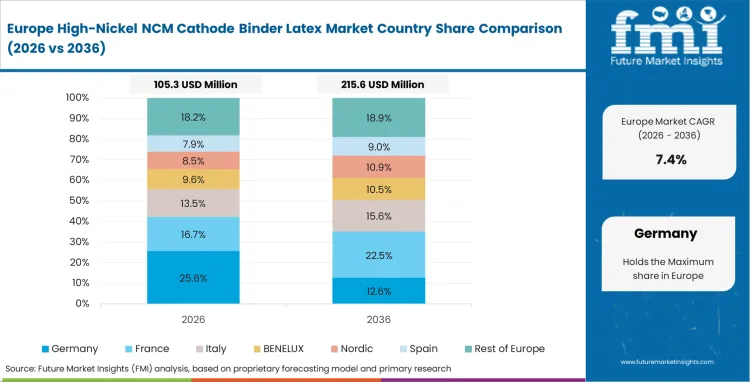
Environmental legislation across Europe is making further expansion of N-Methyl-2-pyrrolidone handling capacity difficult near populated manufacturing zones. Battery producers in the region face strict emission limits that are accelerating the move toward aqueous binder systems in all newly planned gigafactory projects. FMI’s view is that policy pressure is pushing European cell makers toward high-nickel latex formulations faster than the underlying technology might have moved on its own. Demand is concentrated around polymers that can support very high NCM mass loadings while still meeting the performance requirements of long-range electric vehicles. Automotive OEMs across the region are also pressing cell suppliers to reduce cost, which forces binder producers to show that their materials can improve coating-line efficiency as well as compliance.
- Poland: Manufacturing capacity tied to Korean joint ventures makes Poland a key battery production base for European vehicle programs. The industry for high-nickel NCM cathode binder latex in Poland is expected to expand at a 12.0% CAGR through 2036 as facilities implement aqueous process designs first validated in East Asia. Execution strength on those lines will shape long-term supply ties with German automotive customers.
- Germany: Automotive supply chains in Germany are under steady pressure to adopt lower-toxicity battery material systems. Manufacturers are integrating advanced latex binders that align with stricter sustainability documentation and tighter material traceability requirements. Adoption of high-nickel NCM cathode binder latex in Germany is anticipated to increase at a 11.5% CAGR through 2036. Supplier acceptance will depend on how completely organic solvents can be removed from the battery value chain.
FMI's report includes comprehensive tracking of emerging capacity in Hungary, France, and the United Kingdom. Sweden is emerging as a leader, where ambitious extended‑producer‑responsibility mandates and advanced recycling‑technology pilots are accelerating demand for chemically recyclable binders that simplify closed‑loop recovery.
Competitive Aligners for Market Players
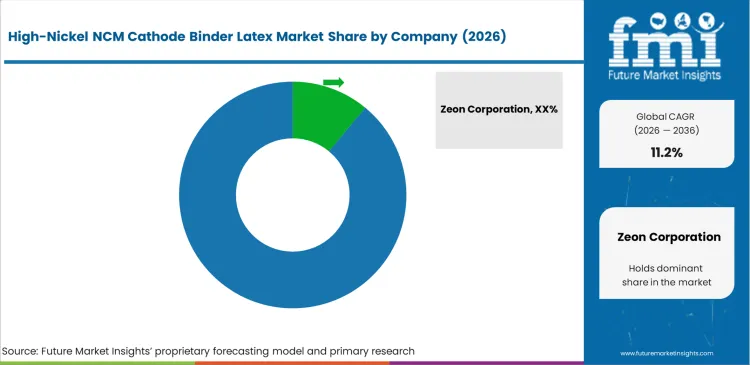
The competitive structure of cathode material industry adhesives is defined by tight chemical specialization and limited supplier interchangeability. Tier-1 cell manufacturers engage high-nickel cathode binder latex manufacturers through multi-year co-development programs. The segment move away from cost-based sourcing toward performance validation, with slurry stability emerging as the primary selection criterion. Companies such as Zeon Corporation and LG Chem Ltd. maintain strong positioning through proprietary core-shell polymer architectures that stabilize NCM811 systems during extended mixing cycles. Performance differentiation is determined by the binder’s ability to withstand high pH environments while retaining the elasticity required for high-speed electrode calendaring.
Incumbent suppliers hold a structural advantage through accumulated electrochemical cycle validation data. Even when alternative styrene acrylic binder for NCM cathodes demonstrate initial compatibility with NCM cathodes, cell manufacturers require extensive long-term charge-discharge data before approval. Established suppliers generate this data through direct integration with pilot production lines. Control over advanced emulsion polymerization processes enables them to maintain tight particle size distributions required for lithium-ion electrode compatibility, reinforcing entry barriers for new participants.
To avoid dependence on a single proprietary formulation, large battery manufacturers qualify dual-source supply chains. Gigafactory volumes across multiple vendors from their EV battery cathode binder vendor list, maintaining pricing control and reducing supply risk. Toward the end of the forecast period, issuing of cathode binder latex RFQ is increasingly demanding multi-functional binders that also contribute to the cell’s electrochemistry. This shift is pushing basic adhesive suppliers out of the premium segment.
Key Players in High-Nickel NCM Cathode Binder Latex Market
- Zeon Corporation
- LG Chem Ltd.
- JSR Corporation
- NIPPON A&L Inc.
- ENEOS Materials Corporation
- Arkema S.A.
- BASF SE
Scope of the Report
| Metric | Value |
|---|---|
| Quantitative Units | USD 0.4 Billion to USD 1.0 Billion, at a CAGR of 11.20% |
| Market Definition | High-Nickel NCM Cathode Binder Latex comprises aqueous polymer emulsions engineered to bind active materials to aluminum foils in lithium-ion batteries. These materials specifically withstand the harsh alkaline environment of cathode chemistries containing over sixty percent nickel. |
| Segmentation | Latex Chemistry, Cathode Grade, End Use, Processing Route, Customer Type |
| Regions Covered | North America, Latin America, Europe, East Asia, South Asia, Oceania, Middle East and Africa |
| Countries Covered | United States, South Korea, Poland, Germany, China, Japan, India |
| Key Companies Profiled | Zeon Corporation, LG Chem Ltd., JSR Corporation, NIPPON A&L Inc., ENEOS Materials Corporation, Arkema S.A., BASF SE |
| Forecast Period | 2026 to 2036 |
| Approach | Total gigawatt-hour capacity of high-nickel NCM cells planned for production minus the share committed to legacy solvent recovery systems. |
Source: Future Market Insights (FMI) analysis, based on proprietary forecasting model and primary research
High-Nickel NCM Cathode Binder Latex Market Analysis by Segments
Latex Chemistry
- SBR latex
- Styrene-acrylic
- Acrylic hybrid
- PVDF emulsion
- Others
Cathode Grade
- NCM811
- NCM622
- NCM712
- NCM90+
- Others
End Use
- EV batteries
- ESS batteries
- Electronics
Processing Route
- Water-based slurries
- Low-NMP systems
- Hybrid slurries
Customer Type
- Cell OEMs
- Cathode makers
- Electrode coaters
Region
- North America
- Latin America
- Europe
- East Asia
- South Asia
- Oceania
- Middle East and Africa
Bibliography
- Ajayi, S. O., Pillai, A. M., Kumar, P., & Ozoemena, K. I. (2026). A review of aqueous-based binders used for cathode fabrication in lithium-ion batteries. RSC Sustainability.
- International Energy Agency. (2025). Global EV Outlook 2025. IEA.
- International Energy Agency. (2025). Share of electric vehicle sales by battery chemistry in selected regions, 2022-2024. IEA.
- Qin, T., Yang, H., Li, Q., Yu, X., & Li, H. (2024). Design of functional binders for high-specific-energy lithium-ion batteries: From molecular structure to electrode properties. Industrial Chemistry & Materials.
- Tian, Y., Xie, J., Tian, M., Luo, X., Wang, L., Zhou, S., Feng, Y., & Hu, L. (2025). Advanced cathode binders for lithium-ion batteries: Molecular design and performance enhancement. Chemical Engineering Journal Advances.
- USA Department of Energy. (2024). 2021-2024 four-year review of supply chains for the advanced batteries sector.
- Zhou, J., Wu, S., Li, Q., & Wu, F. (2025). Biologically insoluble binder for high-performance cathodes in lithium-ion batteries. Advanced Energy Materials.
This bibliography is provided for reader reference. The full FMI report contains the complete reference list with primary source documentation.
This Report Addresses
- The structural shift away from NMP solvent recovery in tier-1 gigafactories.
- Gelation mechanisms and pH buffering requirements for NCM811 cathode slurries.
- Capital expenditure implications of adopting aqueous latex binder chemistries.
- Coating line speed improvements enabled by robust styrene-butadiene architectures.
- Migration resistance and peel strength metrics for high-speed electrode manufacturing.
- Dual-source qualification strategies employed by leading global cell manufacturers.
- Regional policy mandates eliminating toxic processing fluids across European hubs.
- Core-shell polymer innovations designed specifically to stabilize high-nickel interfaces.
Frequently Asked Questions
What is the high-nickel NCM cathode binder latex market size in 2025, 2026, and 2036?
Total revenue reached USD 324.0 million in 2025. Demand is poised to cross USD 420.0 million in 2026 and expand at a CAGR of 11.20% to hit USD 1,040.8 million by 2036. Sustained investment propels this cumulative revenue as cell manufacturers eliminate solvent recovery equipment from their gigafactories.
Why do high-nickel cathodes need different binders?
High nickel content fundamentally alters the surface chemistry of the cathode powder. This composition generates massive amounts of residual lithium hydroxide that immediately spikes the pH of any aqueous mixture. Standard polymers break down in this highly alkaline environment, causing the slurry to gel prematurely inside the mixing tanks.
Which latex chemistry leads the market today?
SBR latex commands 43.0% share in 2026. Its butadiene backbone provides the exact elastomeric flexibility required to survive aggressive calendering processes without micro-cracking. Formulation chemists rely on this chemistry to prevent active material shedding when the coated aluminum foil is compressed to extreme densities.
Is aqueous binder viable for NCM811 cathodes?
Yes, but it requires highly engineered core-shell latex formulations. NCM811 holds 46.0% share in 2026, and companies are successfully adopting water-based binders by utilizing polymers that chemically buffer the surface alkalinity. The commercial viability depends entirely on matching the binder to the specific molecular weight distribution of the active material.
Who makes latex binders for nickel-rich NCM cathodes?
The supply chain is dominated by highly specialized chemical firms with deep emulsion polymerization expertise. Leading manufacturers include Zeon Corporation, LG Chem Ltd., JSR Corporation, NIPPON A&L Inc., ENEOS Materials Corporation, Arkema S.A., and BASF SE. These companies secure positions through multi-year co-development agreements with tier-1 cell OEMs.
Which countries drive demand for nickel-rich cathode binders?
The United States leads with a 13.3% compound growth rate, fueled by localized supply chain subsidies supporting new greenfield gigafactories. South Korea tracks closely at 12.7% as incumbent cell makers retrofit domestic lines. Poland expands at 12.0% to support European automotive platforms, while China advances at 10.8% alongside its massive existing LFP base.
Compare SBR latex and PVDF emulsion for high-nickel cathodes
SBR latex relies on a styrene-butadiene network that offers superior flexibility for thick electrode calendering, but it requires heavy acrylic functionalization to survive NCM811 alkalinity. PVDF emulsion provides excellent chemical resistance and oxidative stability at high voltages, though it often requires more complex mixing dispersion to prevent particle agglomeration in water.
What triggers the adoption of aqueous binders in high-nickel cathodes?
Capital expenditure limits force the initial transition. Removing solvent distillation and recovery equipment from a gigafactory blueprint shrinks the physical footprint and cuts hundreds of millions of dollars from construction costs. Environmental compliance accelerates the timeline, but capital efficiency dictates the baseline strategy.
How large is EV battery exposure within the market?
EV batteries capture 76.0% share in 2026. Automotive platform architects demand maximum range while factory operators require high-speed manufacturing throughput. The sheer physical scale of automotive battery packs means that minor improvements in electrode manufacturing speed translate into millions of dollars in capital efficiency.
What are the main growth constraints in this market?
The fundamental operational friction is the rapid gelation of high-nickel slurries in the mixing tanks. This very narrow processing window forces factories to mix smaller batches and immediately coat them. The sensitivity of these alkaline suspensions destroys the economies of scale typically found in massive continuous mixing operations.
What happens when drying oven temperatures fluctuate during aqueous coating?
Temperature inconsistencies cause the latex binder to migrate toward the surface of the electrode rather than anchoring to the aluminum foil. This migration leaves the base layer starved of adhesion, leading to edge-curling and severe delamination during subsequent battery assembly stages.
How do cell OEMs protect their proprietary slurry recipes?
Major battery manufacturers internalize the slurry mixing process rather than relying on external toll coaters. These OEMs purchase raw latex and active materials separately, intentionally over-specifying binder requirements to ensure their custom polymer architectures remain incompatible with competitors' cell designs.
What role does peel strength play in qualification?
Qualification protocols typically enforce strict minimum peel strength metrics to guarantee electrode durability. If a water-based binder fails to hold the active material securely against the foil under vibration testing, the resulting micro-shorts will quickly degrade the battery's overall charge capacity in the field.
Why are solvent-based systems becoming obsolete in Europe?
Stringent environmental legislation restricts the expansion of N-Methyl-2-pyrrolidone handling facilities near populated industrial centers. Facility architects simply cannot secure the necessary emissions permits for massive distillation towers, forcing an immediate pivot to water-based formulations for all new capacity.
How do chemical suppliers differentiate their binder offerings?
Suppliers compete entirely on slurry stability windows rather than pure adhesive strength. The winning formulations allow battery manufacturers to run continuous roll-to-roll coating campaigns for twenty-four hours without having to stop the line to flush hardened, gelled slurry from the mixing equipment.
What drives the integration of dry coating technologies?
R&D directors view solvent-free dry coating as the ultimate evolution of electrode manufacturing. Chemical companies that successfully adapt their aqueous latex architectures into sprayable, electrically conductive powders capture immediate pilot contracts for next-generation solid-state and advanced lithium-ion cells.
Why does NCM811 require more binder than older chemistries?
High-nickel powders exhibit a significantly larger reactive surface area that demands more polymer coverage to maintain structural integrity. Manufacturers who fail to increase their adhesive ratios proportionately experience severe particle isolation and rapid capacity fade during the battery's initial cycling phase.
How do supply chain managers mitigate single-source risks?
Dual-source qualification remains a common risk-control practice dual-source qualification protocols, forcing multiple chemical suppliers to hit identical performance specifications using different molecular approaches. This strategy ensures supply security and maintains pricing leverage over highly specialized core-shell latex manufacturers.
What advantage do incumbent chemical companies hold?
Established suppliers possess massive libraries of validated electrochemical cycle data generated through deep partnerships with battery pilot lines. Cell makers refuse to qualify new binders without thousands of hours of charge-discharge evidence, creating an immense barrier for challengers lacking historical testing data.
Why is solid-state compatibility a premium opportunity?
Sulfide solid electrolytes require flexible polymer networks to buffer the massive volumetric expansion that occurs during charging. Binders that maintain continuous ionic contact between the solid electrolyte and the active material without degrading secure highly lucrative early-stage qualification contracts.
How does water-based processing affect factory infrastructure?
Aqueous slurries accelerate the corrosion of uncoated manufacturing equipment. Plant managers must invest heavily in specialized stainless steel piping and corrosion-resistant mixing vessels to prevent rust contamination from destroying the electrochemical purity of the high-nickel cathode batch.
How do high-voltage requirements change binder chemistry?
Automotive platforms pushing charging limits above 4.4 volts require binders that resist severe electrochemical oxidation. Chemical suppliers engineer fluorinated latex variants to survive these extreme voltage cycles without breaking down and releasing gaseous byproducts inside the sealed cell.
Why do cell manufacturers reject standard industrial emulsions?
Off-the-shelf latex polymers completely lack the proprietary functional groups necessary to survive high-nickel alkalinity. Attempting to substitute these generic adhesives results in immediate slurry gelation, wasting hundreds of thousands of dollars in expensive active materials and destroying factory throughput.
How does particle size distribution affect drying?
Chemical companies utilizing advanced emulsion polymerization synthesize precisely controlled latex particles. This uniformity ensures the binder disperses evenly throughout the conductive carbon matrix, preventing the polymer from aggregating and clogging the microscopic pores necessary for efficient lithium-ion transport.
Preview the report firsthand - request a free sample
Get SampleGet the brochure for pricing and purchase details.
Get PDFTable of Content
- Executive Summary
- Global Market Outlook
- Demand-side Trends
- Supply-side Trends
- Technology Roadmap Analysis
- Analysis and Recommendations
- Market Overview
- Market Coverage / Taxonomy
- Market Definition / Scope / Limitations
- Research Methodology
- Chapter Orientation
- Analytical Lens and Working Hypotheses
- Market Structure, Signals, and Trend Drivers
- Benchmarking and Cross-market Comparability
- Market Sizing, Forecasting, and Opportunity Mapping
- Research Design and Evidence Framework
- Desk Research Programme (Secondary Evidence)
- Company Annual and Sustainability Reports
- Peer-reviewed Journals and Academic Literature
- Corporate Websites, Product Literature, and Technical Notes
- Earnings Decks and Investor Briefings
- Statutory Filings and Regulatory Disclosures
- Technical White Papers and Standards Notes
- Trade Journals, Industry Magazines, and Analyst Briefs
- Conference Proceedings, Webinars, and Seminar Materials
- Government Statistics Portals and Public Data Releases
- Press Releases and Reputable Media Coverage
- Specialist Newsletters and Curated Briefings
- Sector Databases and Reference Repositories
- FMI Internal Proprietary Databases and Historical Market Datasets
- Subscription Datasets and Paid Sources
- Social Channels, Communities, and Digital Listening Inputs
- Additional Desk Sources
- Expert Input and Fieldwork (Primary Evidence)
- Primary Modes
- Qualitative Interviews and Expert Elicitation
- Quantitative Surveys and Structured Data Capture
- Blended Approach
- Why Primary Evidence is Used
- Field Techniques
- Interviews
- Surveys
- Focus Groups
- Observational and In-context Research
- Social and Community Interactions
- Stakeholder Universe Engaged
- C-suite Leaders
- Board Members
- Presidents and Vice Presidents
- R&D and Innovation Heads
- Technical Specialists
- Domain Subject-matter Experts
- Scientists
- Physicians and Other Healthcare Professionals
- Governance, Ethics, and Data Stewardship
- Research Ethics
- Data Integrity and Handling
- Primary Modes
- Tooling, Models, and Reference Databases
- Desk Research Programme (Secondary Evidence)
- Data Engineering and Model Build
- Data Acquisition and Ingestion
- Cleaning, Normalisation, and Verification
- Synthesis, Triangulation, and Analysis
- Quality Assurance and Audit Trail
- Market Background
- Market Dynamics
- Drivers
- Restraints
- Opportunity
- Trends
- Scenario Forecast
- Demand in Optimistic Scenario
- Demand in Likely Scenario
- Demand in Conservative Scenario
- Opportunity Map Analysis
- Product Life Cycle Analysis
- Supply Chain Analysis
- Investment Feasibility Matrix
- Value Chain Analysis
- PESTLE and Porter’s Analysis
- Regulatory Landscape
- Regional Parent Market Outlook
- Production and Consumption Statistics
- Import and Export Statistics
- Market Dynamics
- Global Market Analysis 2021 to 2025 and Forecast, 2026 to 2036
- Historical Market Size Value (USD Million) Analysis, 2021 to 2025
- Current and Future Market Size Value (USD Million) Projections, 2026 to 2036
- Y-o-Y Growth Trend Analysis
- Absolute $ Opportunity Analysis
- Global Market Pricing Analysis 2021 to 2025 and Forecast 2026 to 2036
- Global Market Analysis 2021 to 2025 and Forecast 2026 to 2036, By Latex Chemistry
- Introduction / Key Findings
- Historical Market Size Value (USD Million) Analysis By Latex Chemistry , 2021 to 2025
- Current and Future Market Size Value (USD Million) Analysis and Forecast By Latex Chemistry , 2026 to 2036
- SBR Latex
- Styrene-Acrylic
- Acrylic Hybrid
- SBR Latex
- Y-o-Y Growth Trend Analysis By Latex Chemistry , 2021 to 2025
- Absolute $ Opportunity Analysis By Latex Chemistry , 2026 to 2036
- Global Market Analysis 2021 to 2025 and Forecast 2026 to 2036, By Cathode Grade
- Introduction / Key Findings
- Historical Market Size Value (USD Million) Analysis By Cathode Grade, 2021 to 2025
- Current and Future Market Size Value (USD Million) Analysis and Forecast By Cathode Grade, 2026 to 2036
- NCM811
- NCM622
- NCM712
- NCM811
- Y-o-Y Growth Trend Analysis By Cathode Grade, 2021 to 2025
- Absolute $ Opportunity Analysis By Cathode Grade, 2026 to 2036
- Global Market Analysis 2021 to 2025 and Forecast 2026 to 2036, By End Use
- Introduction / Key Findings
- Historical Market Size Value (USD Million) Analysis By End Use, 2021 to 2025
- Current and Future Market Size Value (USD Million) Analysis and Forecast By End Use, 2026 to 2036
- EV Batteries
- ESS Batteries
- Others
- EV Batteries
- Y-o-Y Growth Trend Analysis By End Use, 2021 to 2025
- Absolute $ Opportunity Analysis By End Use, 2026 to 2036
- Global Market Analysis 2021 to 2025 and Forecast 2026 to 2036, By Processing Route
- Introduction / Key Findings
- Historical Market Size Value (USD Million) Analysis By Processing Route, 2021 to 2025
- Current and Future Market Size Value (USD Million) Analysis and Forecast By Processing Route, 2026 to 2036
- Low-NMP
- Water-based Slurries
- Hybrid Slurries
- Low-NMP
- Y-o-Y Growth Trend Analysis By Processing Route, 2021 to 2025
- Absolute $ Opportunity Analysis By Processing Route, 2026 to 2036
- Global Market Analysis 2021 to 2025 and Forecast 2026 to 2036, By Customer Type
- Introduction / Key Findings
- Historical Market Size Value (USD Million) Analysis By Customer Type, 2021 to 2025
- Current and Future Market Size Value (USD Million) Analysis and Forecast By Customer Type, 2026 to 2036
- Cell OEMs
- Cathode Makers
- Electrode Coaters
- Cell OEMs
- Y-o-Y Growth Trend Analysis By Customer Type, 2021 to 2025
- Absolute $ Opportunity Analysis By Customer Type, 2026 to 2036
- Global Market Analysis 2021 to 2025 and Forecast 2026 to 2036, By Region
- Introduction
- Historical Market Size Value (USD Million) Analysis By Region, 2021 to 2025
- Current Market Size Value (USD Million) Analysis and Forecast By Region, 2026 to 2036
- North America
- Latin America
- Western Europe
- Eastern Europe
- East Asia
- South Asia and Pacific
- Middle East & Africa
- Market Attractiveness Analysis By Region
- North America Market Analysis 2021 to 2025 and Forecast 2026 to 2036, By Country
- Historical Market Size Value (USD Million) Trend Analysis By Market Taxonomy, 2021 to 2025
- Market Size Value (USD Million) Forecast By Market Taxonomy, 2026 to 2036
- By Country
- USA
- Canada
- Mexico
- By Latex Chemistry
- By Cathode Grade
- By End Use
- By Processing Route
- By Customer Type
- By Country
- Market Attractiveness Analysis
- By Country
- By Latex Chemistry
- By Cathode Grade
- By End Use
- By Processing Route
- By Customer Type
- Key Takeaways
- Latin America Market Analysis 2021 to 2025 and Forecast 2026 to 2036, By Country
- Historical Market Size Value (USD Million) Trend Analysis By Market Taxonomy, 2021 to 2025
- Market Size Value (USD Million) Forecast By Market Taxonomy, 2026 to 2036
- By Country
- Brazil
- Chile
- Rest of Latin America
- By Latex Chemistry
- By Cathode Grade
- By End Use
- By Processing Route
- By Customer Type
- By Country
- Market Attractiveness Analysis
- By Country
- By Latex Chemistry
- By Cathode Grade
- By End Use
- By Processing Route
- By Customer Type
- Key Takeaways
- Western Europe Market Analysis 2021 to 2025 and Forecast 2026 to 2036, By Country
- Historical Market Size Value (USD Million) Trend Analysis By Market Taxonomy, 2021 to 2025
- Market Size Value (USD Million) Forecast By Market Taxonomy, 2026 to 2036
- By Country
- Germany
- UK
- Italy
- Spain
- France
- Nordic
- BENELUX
- Rest of Western Europe
- By Latex Chemistry
- By Cathode Grade
- By End Use
- By Processing Route
- By Customer Type
- By Country
- Market Attractiveness Analysis
- By Country
- By Latex Chemistry
- By Cathode Grade
- By End Use
- By Processing Route
- By Customer Type
- Key Takeaways
- Eastern Europe Market Analysis 2021 to 2025 and Forecast 2026 to 2036, By Country
- Historical Market Size Value (USD Million) Trend Analysis By Market Taxonomy, 2021 to 2025
- Market Size Value (USD Million) Forecast By Market Taxonomy, 2026 to 2036
- By Country
- Russia
- Poland
- Hungary
- Balkan & Baltic
- Rest of Eastern Europe
- By Latex Chemistry
- By Cathode Grade
- By End Use
- By Processing Route
- By Customer Type
- By Country
- Market Attractiveness Analysis
- By Country
- By Latex Chemistry
- By Cathode Grade
- By End Use
- By Processing Route
- By Customer Type
- Key Takeaways
- East Asia Market Analysis 2021 to 2025 and Forecast 2026 to 2036, By Country
- Historical Market Size Value (USD Million) Trend Analysis By Market Taxonomy, 2021 to 2025
- Market Size Value (USD Million) Forecast By Market Taxonomy, 2026 to 2036
- By Country
- China
- Japan
- South Korea
- By Latex Chemistry
- By Cathode Grade
- By End Use
- By Processing Route
- By Customer Type
- By Country
- Market Attractiveness Analysis
- By Country
- By Latex Chemistry
- By Cathode Grade
- By End Use
- By Processing Route
- By Customer Type
- Key Takeaways
- South Asia and Pacific Market Analysis 2021 to 2025 and Forecast 2026 to 2036, By Country
- Historical Market Size Value (USD Million) Trend Analysis By Market Taxonomy, 2021 to 2025
- Market Size Value (USD Million) Forecast By Market Taxonomy, 2026 to 2036
- By Country
- India
- ASEAN
- Australia & New Zealand
- Rest of South Asia and Pacific
- By Latex Chemistry
- By Cathode Grade
- By End Use
- By Processing Route
- By Customer Type
- By Country
- Market Attractiveness Analysis
- By Country
- By Latex Chemistry
- By Cathode Grade
- By End Use
- By Processing Route
- By Customer Type
- Key Takeaways
- Middle East & Africa Market Analysis 2021 to 2025 and Forecast 2026 to 2036, By Country
- Historical Market Size Value (USD Million) Trend Analysis By Market Taxonomy, 2021 to 2025
- Market Size Value (USD Million) Forecast By Market Taxonomy, 2026 to 2036
- By Country
- Kingdom of Saudi Arabia
- Other GCC Countries
- Turkiye
- South Africa
- Other African Union
- Rest of Middle East & Africa
- By Latex Chemistry
- By Cathode Grade
- By End Use
- By Processing Route
- By Customer Type
- By Country
- Market Attractiveness Analysis
- By Country
- By Latex Chemistry
- By Cathode Grade
- By End Use
- By Processing Route
- By Customer Type
- Key Takeaways
- Key Countries Market Analysis
- USA
- Pricing Analysis
- Market Share Analysis, 2025
- By Latex Chemistry
- By Cathode Grade
- By End Use
- By Processing Route
- By Customer Type
- Canada
- Pricing Analysis
- Market Share Analysis, 2025
- By Latex Chemistry
- By Cathode Grade
- By End Use
- By Processing Route
- By Customer Type
- Mexico
- Pricing Analysis
- Market Share Analysis, 2025
- By Latex Chemistry
- By Cathode Grade
- By End Use
- By Processing Route
- By Customer Type
- Brazil
- Pricing Analysis
- Market Share Analysis, 2025
- By Latex Chemistry
- By Cathode Grade
- By End Use
- By Processing Route
- By Customer Type
- Chile
- Pricing Analysis
- Market Share Analysis, 2025
- By Latex Chemistry
- By Cathode Grade
- By End Use
- By Processing Route
- By Customer Type
- Germany
- Pricing Analysis
- Market Share Analysis, 2025
- By Latex Chemistry
- By Cathode Grade
- By End Use
- By Processing Route
- By Customer Type
- UK
- Pricing Analysis
- Market Share Analysis, 2025
- By Latex Chemistry
- By Cathode Grade
- By End Use
- By Processing Route
- By Customer Type
- Italy
- Pricing Analysis
- Market Share Analysis, 2025
- By Latex Chemistry
- By Cathode Grade
- By End Use
- By Processing Route
- By Customer Type
- Spain
- Pricing Analysis
- Market Share Analysis, 2025
- By Latex Chemistry
- By Cathode Grade
- By End Use
- By Processing Route
- By Customer Type
- France
- Pricing Analysis
- Market Share Analysis, 2025
- By Latex Chemistry
- By Cathode Grade
- By End Use
- By Processing Route
- By Customer Type
- India
- Pricing Analysis
- Market Share Analysis, 2025
- By Latex Chemistry
- By Cathode Grade
- By End Use
- By Processing Route
- By Customer Type
- ASEAN
- Pricing Analysis
- Market Share Analysis, 2025
- By Latex Chemistry
- By Cathode Grade
- By End Use
- By Processing Route
- By Customer Type
- Australia & New Zealand
- Pricing Analysis
- Market Share Analysis, 2025
- By Latex Chemistry
- By Cathode Grade
- By End Use
- By Processing Route
- By Customer Type
- China
- Pricing Analysis
- Market Share Analysis, 2025
- By Latex Chemistry
- By Cathode Grade
- By End Use
- By Processing Route
- By Customer Type
- Japan
- Pricing Analysis
- Market Share Analysis, 2025
- By Latex Chemistry
- By Cathode Grade
- By End Use
- By Processing Route
- By Customer Type
- South Korea
- Pricing Analysis
- Market Share Analysis, 2025
- By Latex Chemistry
- By Cathode Grade
- By End Use
- By Processing Route
- By Customer Type
- Russia
- Pricing Analysis
- Market Share Analysis, 2025
- By Latex Chemistry
- By Cathode Grade
- By End Use
- By Processing Route
- By Customer Type
- Poland
- Pricing Analysis
- Market Share Analysis, 2025
- By Latex Chemistry
- By Cathode Grade
- By End Use
- By Processing Route
- By Customer Type
- Hungary
- Pricing Analysis
- Market Share Analysis, 2025
- By Latex Chemistry
- By Cathode Grade
- By End Use
- By Processing Route
- By Customer Type
- Kingdom of Saudi Arabia
- Pricing Analysis
- Market Share Analysis, 2025
- By Latex Chemistry
- By Cathode Grade
- By End Use
- By Processing Route
- By Customer Type
- Turkiye
- Pricing Analysis
- Market Share Analysis, 2025
- By Latex Chemistry
- By Cathode Grade
- By End Use
- By Processing Route
- By Customer Type
- South Africa
- Pricing Analysis
- Market Share Analysis, 2025
- By Latex Chemistry
- By Cathode Grade
- By End Use
- By Processing Route
- By Customer Type
- USA
- Market Structure Analysis
- Competition Dashboard
- Competition Benchmarking
- Market Share Analysis of Top Players
- By Regional
- By Latex Chemistry
- By Cathode Grade
- By End Use
- By Processing Route
- By Customer Type
- Competition Analysis
- Competition Deep Dive
- Zeon Corporation
- Overview
- Product Portfolio
- Profitability by Market Segments (Product/Age /Sales Channel/Region)
- Sales Footprint
- Strategy Overview
- Marketing Strategy
- Product Strategy
- Channel Strategy
- LG Chem Ltd.
- JSR Corporation
- NIPPON A&L Inc.
- ENEOS Materials Corporation
- Zeon Corporation
- Competition Deep Dive
- Assumptions & Acronyms Used


