

- Industry Size (2026)
- USD 1.2 Bn
- Forecast (2036)
- USD 2.2 Bn
- CAGR (2026 to 2036)
- 6.1%
Latex & Occupational Allergy Market Forecast and Outlook (2026-2036)
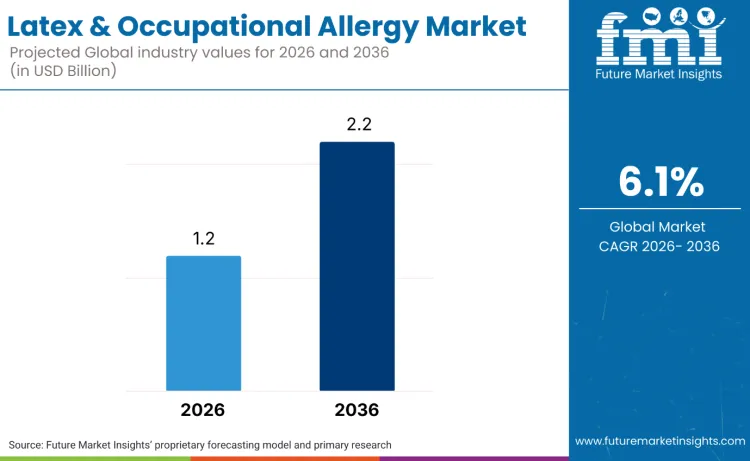
The global latex and occupational allergy market is projected to reach USD 1.2 billion in 2026 and advance to USD 2.2 billion by 2036, registering a CAGR of 6.1%. According to FMI, this trajectory shows the growing recognition of latex hypersensitivity as a significant occupational health concern, particularly within healthcare settings where repeated exposure to natural rubber latex proteins continues to affect workers across multiple specialties. Market expansion stems from increased implementation of comprehensive screening protocols, adoption of latex-free alternatives, and enhanced regulatory oversight of workplace exposure management.
Technological advances in immunoassay platforms and point-of-care diagnostic systems enable rapid identification of latex-specific IgE antibodies and facilitate early intervention before severe allergic reactions develop. Modern testing methodologies incorporate component-resolved diagnostics to distinguish between genuine latex allergy and cross-reactivity with other allergens, reducing false-positive results and unnecessary workplace restrictions. Healthcare institutions are implementing systematic occupational health surveillance programs that combine periodic testing with environmental monitoring to maintain latex-safe environments while preserving operational efficiency. Companies are focusing on advanced technologies for streamlined diagnostics. For instance, Thermo Fisher’s ImmunoCAP™ and Phadia™ allergy diagnostic systems form a globally recognized suite of instruments and assays for in-vitro allergy diagnostics, measuring specific IgE antibodies to help clinicians identify allergic sensitizations.
"Within Thermo Fisher, we see the value of AI in three primary areas-we can use it to enhance our products and services, create a better experience for our customers and help us work more efficiently across our company."-Ryan Snyder, Senior Vice President and Chief Information Officer, Thermo Fisher Scientific Inc.
The market's value proposition centers on risk mitigation and regulatory compliance rather than volume-driven service delivery. Advanced diagnostic providers integrate specialized testing protocols, comprehensive exposure assessment capabilities, and tailored intervention strategies to address the complex nature of occupational latex sensitization. Healthcare systems and industrial facilities prioritize evidence-based approaches that balance worker safety with operational requirements, driving demand for sophisticated testing platforms and expert consultation services.
Summary of Latex & Occupational Allergy Market
What is the growth outlook on the latex and occupational allergy market?
Future Market Insights projects the market to grow at a 6.1% CAGR from 2026 to 2036, expanding from USD 1.2 billion to USD 2.2 billion.
FMI research approach:Bottom-up diagnostic revenue modeling, occupational health service analysis, regulatory compliance assessment, and workplace intervention scenario evaluation.
How do FMI analysts perceive the latex and occupational allergy market to evolve?
The market is expected to advance from basic allergy testing toward comprehensive occupational health management platforms integrating predictive analytics and personalized safety protocols.
FMI research approach:Diagnostic technology transition analysis, workplace safety integration mapping, regulatory compliance demand assessment, and preventive care benchmarking.
Which country holds the largest share in the latex and occupational allergy market?
The United States accounts for the largest global value share.
FMI research approach:Country-level healthcare expenditure modeling, occupational safety regulation analysis, diagnostic adoption scoring, and workplace compliance evaluation.
How large will the latex and occupational allergy market be by 2036?
The global market is forecast to reach USD 2.2 billion by 2036.
FMI research approach: Long-term forecasting by diagnostic type and workplace setting, compliance demand scaling, regulatory evolution modeling, and historical safety trend validation.
What is the market definition of latex and occupational allergy?
It encompasses diagnostic testing, workplace assessment, and management services supporting identification and mitigation of latex-induced hypersensitivity reactions in occupational environments.
FMI research approach: Market taxonomy validation, inclusion-exclusion framework development, application mapping by industry sector, and service scope definition.
What globally unique trends are shaping the latex and occupational allergy market?
Key trends include point-of-care diagnostic adoption, integrated workplace safety platforms, and regulatory mandate expansion across healthcare and industrial sectors.
FMI research approach: Diagnostic technology uptake tracking, workplace safety system analysis, regulatory development monitoring, and compliance-focused competitive assessment.
Latex & Occupational Allergy Market Key Takeaways
| Metric | Value |
|---|---|
| Market Value (2026) | USD 1.2 billion |
| Market Forecast Value (2036) | USD 2.2 billion |
| Forecast CAGR (2026-2036) | 6.1% |
Source: Future Market Insights (FMI) analysis, based on proprietary forecasting model and primary research
How Do Workplace Safety Regulations Drive Demand in the Latex & Occupational Allergy Market?
The tightening of occupational safety regulations is reshaping how employers approach latex exposure management across healthcare and industrial settings. Updated workplace health standards increasingly emphasize systematic screening and substitution of latex-containing products to reduce sensitization risks among exposed workers. Diagnostic providers have responded by expanding latex-specific IgE testing and workplace assessment services tailored for compliance-driven occupational health programs. Service adoption is reinforced by steady growth in professional occupational health service utilization as organizations prioritize documented risk mitigation and worker protection outcomes. Under OSHA’s Clause and relevant standards (such as 29 CFR 1910.138 for hand protection), employers must furnish appropriate PPE (for example, hypoallergenic or non-latex glove alternatives) and minimize exposure for workers sensitized to latex.
How is the Latex & Occupational Allergy Market Segmented?
The latex and occupational allergy market has been segmented based on product type, application setting, end user, and region. By product type, the market encompasses latex-specific IgE testing, patch testing systems, latex-free product alternatives, occupational health screening programs, and clinical management solutions including emergency treatment protocols. Application settings include healthcare facilities, industrial manufacturing, food service operations, educational institutions, and other occupational environments where latex exposure occurs. End users comprise hospitals, occupational health clinics, diagnostic laboratories, industrial health services, and government regulatory agencies. Regionally, the market spans North America, Europe, East Asia, South Asia, Latin America, and Middle East & Africa.
Why Do Latex-Specific Diagnostic Testing Services Lead the Market?
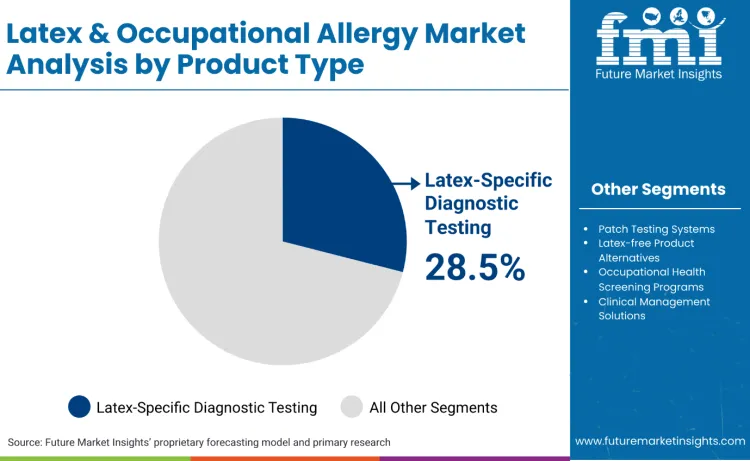
Latex-specific diagnostic testing maintains the largest market segment, capturing 28.5% of total revenue, driven by the fundamental requirement for accurate identification of latex sensitization before implementing workplace modifications or alternative product selections. These services provide the clinical foundation necessary for all subsequent management decisions, making them essential for healthcare institutions, industrial facilities, and occupational health programs seeking to protect workers while maintaining operational efficiency. Companies such as Thermo Fisher Scientific Inc. are specifically targeting latex allergies to create diagnostic devices.
Demand for latex-specific diagnostic testing is rising across healthcare and workplaces today. Latex exposure remains common in hospitals, dental clinics, laboratories, and manufacturing settings. Symptoms resemble dermatitis or asthma, so targeted testing confirms sensitization accurately. Clear diagnosis guides strict avoidance plans and safer product substitution decisions. Preoperative screening reduces perioperative anaphylaxis risk from gloves, catheters, or drains. Clinicians also need to distinguish latex allergy from cross reactive fruit syndromes. Rising use of complex devices increases contact opportunities and cumulative exposure burdens. Occupational health programs rely on results for accommodation, claims, and surveillance reporting.
Where are Latex & Occupational Allergies the Most Prevalent?
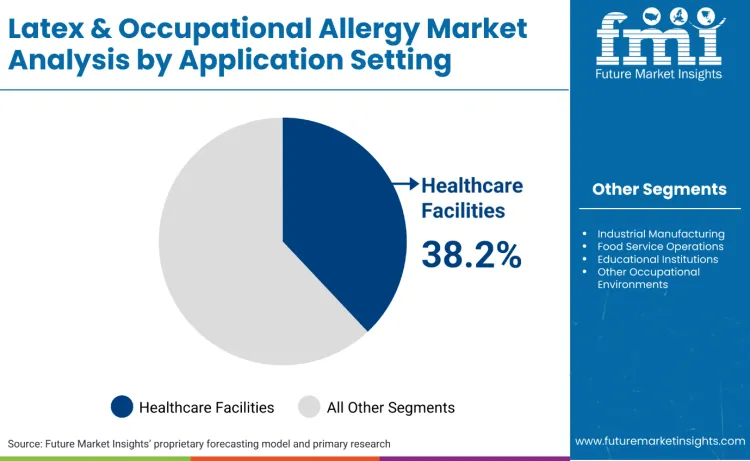
Healthcare facilities dominate market applications with 38.2% share, showing the concentrated risk environment where medical personnel encounter latex through gloves, catheters, and surgical equipment during routine patient care activities. As per the CDC, hospital infection affects atleast one in every 31 people. The healthcare sector requires specialized protocols that balance infection control requirements with allergy prevention, necessitating sophisticated testing and alternative product evaluation services.
Surgical and perioperative environments account for significant service utilization due to the critical nature of allergic reactions during procedures where immediate medical intervention may be complicated by ongoing surgical requirements. These settings demand comprehensive pre-procedure screening, latex-free operating room protocols, and emergency management capabilities specifically designed for perioperative allergic emergencies.
Industrial manufacturing represents a growing application segment as latex-containing products are used in various production processes, exposing workers to potential sensitization through repeated contact with natural rubber materials. These environments require specialized assessment protocols that account for different exposure patterns and workplace conditions compared to healthcare settings.
How Are Corporate Portfolio Shifts Accelerating Latex-Free Transitions?
Large healthcare suppliers are divesting or restructuring glove and PPE portfolios to reduce regulatory exposure and refocus on allergy-safe consumables. Ansell Limited has steadily expanded its latex-free surgical and examination glove lines across hospital procurement programs in North America and Europe, positioning nitrile and neoprene as default options in clinical workflows. Companies including Ansell Limited have steadily expanded its latex-free surgical and examination glove lines across hospital procurement programs in North America and Europe, positioning nitrile and neoprene as default options in clinical workflows. This portfolio shift allows manufacturers to concentrate capital on hypoallergenic materials, barrier performance, and cost-optimized synthetic polymers, while healthcare providers accelerate system-wide latex phase-outs across operating rooms, diagnostics, and frontline care environments.
How Is the Latex & Occupational Allergy Market Evolving Globally?
Global demand for latex and occupational allergy services reflects increasing recognition of workplace hypersensitivity management as an essential component of modern occupational health programs. Growth demonstrates expanding implementation of systematic screening protocols, evidence-based intervention strategies, and comprehensive documentation systems across healthcare institutions, industrial facilities, and regulatory agencies worldwide. Service adoption focuses on prevention effectiveness, diagnostic accuracy, and regulatory compliance rather than cost minimization alone. China records 8.2% CAGR, India records 7.8% CAGR, Brazil records 6.5% CAGR, USA records 6.3% CAGR, and Germany records 5.1% CAGR. Market expansion remains driven by workplace safety requirements and clinical effectiveness rather than volume considerations alone.
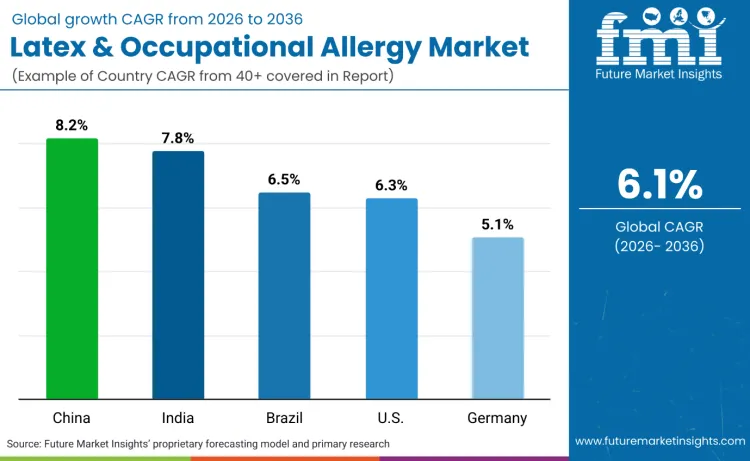
| Country | CAGR (2026-2036) |
|---|---|
| China | 8.2% |
| India | 7.8% |
| Brazil | 6.5% |
| USA | 6.3% |
| Germany | 5.1% |
Source: FMI historical analysis and forecast data
China: How is Expanding Healthcare Infrastructure Driving Latex-free Product Adoption?
China's latex and occupational allergy market is primarily driven by rapid expansion of healthcare infrastructure and implementation of international workplace safety standards across domestic medical facilities. The establishment of new hospitals and medical centers requires comprehensive occupational health programs that protect healthcare workers while meeting accreditation requirements for international partnerships. The ambitious vision of “Healthy China 2030” Initiative is set to bolster market growth. This infrastructure development has created substantial demand for professional allergy assessment services and latex-free equipment alternatives. Driven by this systematic healthcare modernization, the Chinese market is projected to grow at an 8.2% CAGR during the study period, led by healthcare sector expansion and regulatory compliance requirements.
The country is poised to witness significant opportunities in integrated occupational health platforms that combine latex allergy testing with broader workplace wellness programs. As China develops domestic medical device manufacturing capabilities, demand increases for validation services that ensure latex-free product alternatives meet international safety standards while supporting export market access.
India: Is Healthcare Worker Protection Awareness Driving Market Expansion?
India's market is characterized by growing emphasis on healthcare worker safety and implementation of evidence-based occupational health management across expanding medical infrastructure. This protection-focused approach addresses increasing recognition of latex sensitization risks among healthcare personnel while supporting professional development initiatives that enhance clinical care quality. Driven by this healthcare advancement, the Indian market is expected to grow at a 7.8% CAGR during the study period. Support under PM-ABHIM and other missions are also strengthening the country’s healthcare sector.
The next five years will see substantial opportunities in cost-effective diagnostic platforms that provide accurate testing results while accommodating budget constraints common in developing healthcare systems. India's position as a major medical tourism destination creates demand for internationally recognized allergy management protocols that ensure patient and staff safety while maintaining competitive service delivery.
Brazil: Will Healthcare System Modernization Accelerate Market Growth?
Brazil's market is shaped by healthcare system modernization initiatives and increasing adoption of comprehensive occupational health protocols within public and private medical facilities. Brazilian healthcare institutions are implementing systematic worker protection programs that combine allergy testing with environmental monitoring and alternative product evaluation. The Brazilian market is forecast to grow at a 6.5% CAGR during the study period, driven by healthcare quality improvement initiatives and worker safety enhancement programs.
The coming years offer significant opportunities in integrated health management platforms that address latex allergy alongside other occupational health concerns common in tropical healthcare environments. Brazil's expanding role in regional medical services creates demand for standardized protocols that ensure consistent worker protection across diverse facility types and geographic locations.
Germany: Is Advanced Occupational Medicine Leading Innovation?
Germany's market shows advanced occupational medicine practices and comprehensive regulatory frameworks that mandate systematic workplace allergy assessment and management. German healthcare institutions and industrial facilities implement sophisticated testing protocols that integrate with broader employee health monitoring systems, emphasizing prevention and early intervention. As German organizations prioritize evidence-based worker protection and regulatory compliance, the German market is set to grow at a 5.1% CAGR during the study period, focusing on diagnostic precision and comprehensive care coordination.
The country will observe opportunities in digitally integrated occupational health platforms that connect allergy management with electronic health records and workplace safety management systems. Germany's leadership in industrial automation creates demand for specialized assessment protocols that address latex exposure in advanced manufacturing environments while maintaining productivity and quality standards. Big German healthcare providers such as Siemens are working on product innovations. For instance, in September 2025, Siemens Healthineers broadened its 3gAllergy assay menu with nine new component allergens.
USA: How is Regulatory Compliance Shaping Market Development?
The USA market emphasizes regulatory compliance and liability mitigation through comprehensive occupational allergy management programs that protect both workers and organizations from legal and financial consequences of workplace-related allergic reactions. This approach prioritizes systematic documentation and evidence-based intervention strategies that demonstrate appropriate care standards. Supported by these regulatory requirements, the USA market is projected to grow at a 6.3% CAGR during the study period.
The next five years offer substantial opportunities in integrated digital platforms that streamline compliance reporting while providing real-time monitoring of exposure incidents and intervention effectiveness. The USA focus on value-based healthcare creates demand for allergy management programs that demonstrate measurable improvements in worker safety outcomes while controlling healthcare costs. Key players including Thermo Fisher Scientific Inc. are expanding their footprint in the country. For instance, in April 2025, the company invested USD 2 billion to boost its manufacturing presence in the country.
Who are the Major Players Active in the Latex & Occupational Allergy Market?
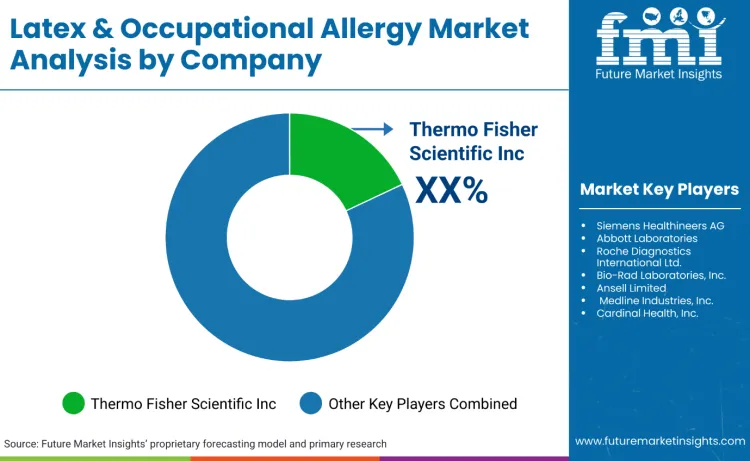
The competitive landscape of the latex & occupational allergy market is defined by established global diagnostics firms and healthcare product manufacturers that bring comprehensive portfolios and wide geographical reach. Thermo Fisher Scientific Inc., Siemens Healthineers AG, Abbott Laboratories, Roche Diagnostics International Ltd., and Bio-Rad Laboratories, Inc. compete intensely in the allergy testing and immunoassay segments. These players focus on expanding their diagnostic platforms, enhancing assay sensitivity, and securing regulatory approvals to strengthen their market positions. Their scale, research and development investments, and existing relationships with clinical laboratories and hospitals provide a competitive advantage.
In contrast, protective equipment specialists such as Ansell Limited, Medline Industries, Inc., Cardinal Health, Inc., 3M Company, and Honeywell International Inc. contribute to the occupational allergy segment through latex and non-latex gloves, protective clothing, and workplace safety solutions. These companies invest in material innovation, ergonomic design, and compliance with occupational health standards to address rising demand for latex alternative products. Competition among these manufacturers is driven by product quality, cost efficiency, and the ability to meet evolving regulatory and industry requirements for allergy prevention.
Key Industry Developments:
- In July 2024, Ansell acquired Kimberly-Clark’s Personal Protective Equipment business from Kimberly-Clark Corporation to broaden its personal protective offerings.
- In April 2024, Bio-Techne Corporation teamed up with Thermo Fisher Scientific to boost its scientific research and biotechnology capabilities.
Key Players in the Latex & Occupational Allergy Market
- Thermo Fisher Scientific Inc.
- Siemens Healthineers AG
- Abbott Laboratories
- Roche Diagnostics International Ltd.
- Bio-Rad Laboratories, Inc.
- Ansell Limited
- Medline Industries, Inc.
- Cardinal Health, Inc.
- 3M Company
- Honeywell International Inc.
Market Definition
The latex and occupational allergy market encompasses specialized diagnostic testing, workplace assessment, and management services designed to identify, prevent, and mitigate allergic reactions to natural rubber latex in occupational environments. The market includes diagnostic platforms for allergen-specific antibody detection, workplace exposure assessment tools, latex-free product alternatives, and comprehensive management protocols for sensitized workers. Market size is measured in USD billion and analyzed over the 2026 to 2036 period.
The market encompasses service categories including diagnostic testing, workplace assessment, alternative product provision, and ongoing management support, delivered through specialized laboratories, occupational health clinics, and integrated workplace safety programs. Market expansion reflects growing recognition of latex hypersensitivity as a significant occupational health concern requiring systematic prevention and management approaches.
Market Inclusion
The latex and occupational allergy market scope includes diagnostic testing services categorized by methodology (serum-based IgE testing, patch testing, component-resolved diagnostics), workplace assessment protocols (exposure monitoring, risk evaluation, alternative product testing), and management services (emergency protocols, ongoing monitoring, compliance documentation). Segmentation encompasses application settings (healthcare facilities, industrial environments, educational institutions), end users (hospitals, occupational health clinics, industrial safety departments), and geographic regions.
The scope includes professional services focused on occupational latex exposure management, evidence-based intervention protocols, and regulatory compliance support across healthcare, industrial, and institutional environments where latex exposure presents worker safety concerns.
Market Exclusion
The market excludes non-occupational latex allergy management, general allergy testing not specific to workplace latex exposure, and consumer products not designed for occupational protection. Food allergy testing, environmental allergen assessment, and residential latex exposure management fall outside the defined scope.
Non-therapeutic latex products, general personal protective equipment not specifically designed for latex-allergic individuals, and services not focused on occupational health applications are excluded from market analysis. Products and services that do not meet professional healthcare or industrial safety standards are outside the market scope.
Scope of the Report
| Items | Values |
|---|---|
| Quantitative Units | USD billion |
| Product Type | Latex-specific IgE Testing; Patch Testing Systems; Latex-free Alternatives; Occupational Health Screening; Clinical Management |
| Application Setting | Healthcare Facilities; Industrial Manufacturing; Food Service; Educational Institutions; Other Occupational Environments |
| End User | Hospitals; Occupational Health Clinics; Diagnostic Laboratories; Industrial Health Services; Government Agencies |
| Regions Covered | North America, Europe, East Asia, South Asia, Latin America, Middle East & Africa |
| Countries Covered | China, India, Brazil, USA, Germany, and 40+ countries |
| Key Companies Profiled | Thermo Fisher Scientific; Siemens Healthineers; Abbott Laboratories; Roche Diagnostics; Ansell Limited; Others |
| Additional Attributes | Revenue analysis by product type, application setting, and end user; performance in healthcare and industrial applications across hospitals, occupational health clinics, and industrial facilities; diagnostic accuracy enhancement, workplace safety optimization, and compliance benefits under occupational health applications; impact on worker safety outcomes, exposure reduction, and regulatory adherence during implementation processes; compatibility with existing safety protocols and health management systems; procurement dynamics driven by compliance requirements, safety performance programs, and long-term worker protection partnerships. |
Latex & Occupational Allergy Market by Segment
Product Type:
- Latex-specific IgE Testing
- Patch Testing Systems
- Latex-free Product Alternatives
- Occupational Health Screening Programs
- Clinical Management Solutions
Application Setting:
- Healthcare Facilities
- Industrial Manufacturing
- Food Service Operations
- Educational Institutions
- Other Occupational Environments
End User:
- Hospitals
- Occupational Health Clinics
- Diagnostic Laboratories
- Industrial Health Services
- Government Regulatory Agencies
Region:
- East Asia
- China
- Japan
- South Korea
- Taiwan
- Rest of East Asia
- Europe
- Germany
- United Kingdom
- France
- Italy
- Spain
- BENELUX
- Nordic Countries
- Rest of Europe
- North America
- USA
- Canada
- Mexico
- South Asia
- India
- Australia & New Zealand
- Southeast Asia
- Rest of South Asia
- Latin America
- Brazil
- Chile
- Colombia
- Argentina
- Rest of Latin America
- Middle East & Africa
- Kingdom of Saudi Arabia
- Other GCC Countries
- Turkey
- South Africa
- Other African Countries
- Rest of Middle East & Africa
Bibliography
- Centers for Disease Control and Prevention. (2023). Latex allergy: A prevention guide for healthcare workers. Centers for Disease Control and Prevention.
- World Health Organization. (2024). Occupational health and safety in healthcare settings: Risk management and prevention of allergic disease. World Health Organization.
- European Agency for Safety and Health at Work. (2024). Work-related asthma and allergies: Prevention, diagnosis, and workplace intervention strategies. EU-OSHA.
Frequently Asked Questions
How big is the latex and occupational allergy market in 2026?
The global latex and occupational allergy market is estimated to be valued at USD 1.2 billion in 2026.
What will be the size of the latex and occupational allergy market in 2036?
The market size for the latex and occupational allergy market is projected to reach USD 2.2 billion by 2036.
How much will the latex and occupational allergy market grow between 2026 and 2036?
The latex and occupational allergy market is expected to grow at a 6.1% CAGR between 2026 and 2036.
What are the key product types in the latex and occupational allergy market?
The key product types include latex-specific IgE testing, patch testing systems, latex-free product alternatives, and occupational health screening programs.
Which end user will contribute a significant share in the latex and occupational allergy market in 2026?
Hospitals are expected to command the largest share in the latex and occupational allergy market in 2026, driven by comprehensive worker protection requirements and regulatory compliance needs.
Preview the report firsthand - request a free sample
Get SampleGet the brochure for pricing and purchase details.
Get PDFTable of Content
- Latex & Occupational Allergy Market Size and Share Forecast Outlook (2026 to 2036)
- Latex & Occupational Allergy Market Forecast and Outlook (2026-2036)
- Latex & Occupational Allergy Market Key Takeaways
- Key Shifts in the Latex & Occupational Allergy Market from 2026 to 2036
- Latex & Occupational Allergy Market Segmentation Analysis
- By Product Type
- Latex-specific IgE Testing
- Patch Testing Systems
- Latex-free Product Alternatives
- Occupational Health Screening Programs
- Clinical Management Solutions
- By Application Setting
- Healthcare Facilities
- Industrial Manufacturing
- Food Service Operations
- Educational Institutions
- Other Occupational Environments
- By End User
- Hospitals
- Occupational Health Clinics
- Diagnostic Laboratories
- Industrial Health Services
- Government Regulatory Agencies
- By Region
- By Product Type
- Market Dynamics and Growth Analysis
- Growth Drivers
- Market Restraints
- Strategic Trends
- Latex & Occupational Allergy Market Global Analysis
- East Asia
- South Asia
- North America
- Europe
- Latin America
- Middle East & Africa
- Competitive Landscape Analysis
- Key Players in the Latex & Occupational Allergy Market
- Market Definition, Inclusion, and Exclusion Criteria
- Scope of the Latex & Occupational Allergy Market Report
- Latex & Occupational Allergy Market by Segment
- Bibliography
- Frequently Asked Questions (FAQs)


