

- Industry Size (2026)
- USD 2.2 Bn
- Forecast (2036)
- USD 5.2 Bn
- CAGR (2026 to 2036)
- 9.0%
Battery Binder Resins Market Forecast and Outlook 2026 to 2036
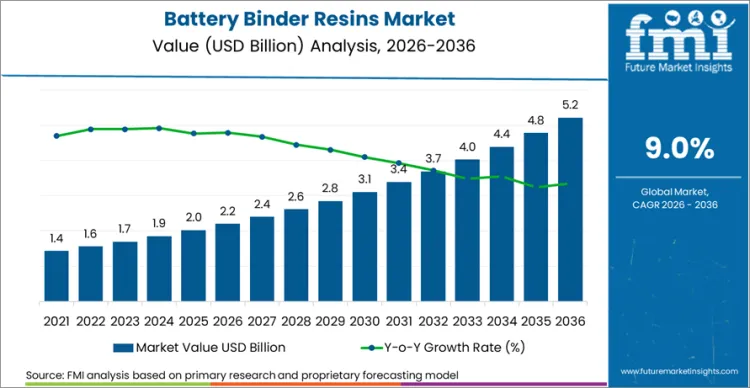
Battery binder resins market revenue is projected to total USD 2.2 billion in 2026, increasing to USD 5.2 billion by 2036, at a CAGR of 9.0%. FMI analysis indicates the market is undergoing a fundamental shift from generic adhesive supply to the provision of formulated chemistry systems tailored to specific cell chemistries and manufacturing processes. The 2026–2027 period will be defined by the industrialization of silicon-dominant anodes and cobalt-free cathodes, which require radically redesigned binder platforms to manage extreme volume expansion and enhance ionic conductivity.
Growth is anchored in the global push for battery supply chain sovereignty. In November 2025, the European Commission approved the Critical Raw Materials Act implementation guidelines, mandating that 25% of all battery materials consumed in EU gigafactories by 2030 originate from domestic recycling or extraction. This policy directly stimulates investment in local binder resin production, as these polymers are classified as strategic components for cell performance and recyclability.
BASF SE commenced operations at its integrated cathode materials and binders facility in Schwarzheide, Germany, in Q1 2026. The plant is dedicated to producing polyvinylidene fluoride (PVDF) and specialized aqueous binders for lithium iron phosphate (LFP) and sodium-ion cells, supporting a declared annual capacity of 100,000 metric tons by 2028.
Technical innovation is focused on eliminating toxic solvent systems and enhancing process sustainability. LG Chem Ltd. disclosed in its Q4 2025 earnings report the commercialization of its first fully aqueous processed anode binder system for high-silicon content anodes. This development responds to tightening environmental regulations on N-methyl-2-pyrrolidone (NMP) solvent emissions in Korea and China.
Arkema S.A. announced a strategic capital allocation in June 2025, directing EUR 700 million toward its Advanced Materials division to triple PVDF production capacity by 2030. This investment targets the demand surge for fluorinated binders in high-voltage nickel-rich NMC and solid-state battery prototypes.
Solvay S.A. completed the divestiture of its commodity polymers segment in late 2025 to consolidate resources around its specialty PVDF and sulfone-based polymer lines for energy storage. This move aligns with the company’s roadmap to serve only the premium segments of the EV and stationary storage markets.
Summary of Battery Binder Resins Market
What is the Long-Term Growth Outlook for the Battery Binder Resin Market?
FMI projects the global battery binder resin market to expand from USD 2.2 billion in 2026 to USD 5.2 billion by 2036, registering a 9.0% CAGR. Market expansion reflects the critical role binders play in enabling next-generation battery chemistries. Binders are no longer inert glue but are formulated components that directly influence electrode mechanical integrity, electrolyte compatibility, and fast-charging cycle life.
This growth is propelled by the global gigafactory build-out, the shift toward water-based processing, and the stringent need for longer battery warranties in commercial EVs and grid storage. Demand is accelerating for binders that can withstand the volumetric swings of silicon anodes, the oxidative environment of high-nickel cathodes, and the dry-processing requirements of solid-state cell manufacturing.
FMI Research Approach: This projection is derived from FMI’s proprietary forecasting framework integrating announced gigafactory capacity, cathode and anode material demand forecasts, regulatory timelines for solvent phase-outs, and primary interviews with cell manufacturers across Asia, Europe, and North America.
How do FMI Analysts Expect the Battery Binder Resin Market to Evolve Structurally?
FMI analysts anticipate a transition from a limited set of generic binders (PVDF, SBR, CMC) to a diverse landscape of engineered copolymer and composite systems. This evolution is driven by cell manufacturers’ need for application-specific solutions that address the limitations of incumbent chemistry. The market will fragment into specialized segments for silicon anode binders, lithium metal anode binders, dry electrode binders, and bio-based sustainable binders.
Innovations such as conductive polymer binders, self-healing binders, and binders with integrated electrolyte additives are reducing the reliance on conductive carbons and enabling thicker, higher-energy-density electrodes. Binders are becoming a key lever for cell designers to improve energy density without compromising durability or safety.
FMI Research Approach: Insights are informed by analysis of patent filings related to binder chemistry, cell manufacturer roadmaps for next-generation products, and material validation data from joint development agreements between chemical companies and OEMs.
Which Geographies Command the Largest Share of the Battery Binder Resin Market?
China leads the global battery binder resin market, advancing at an estimated 10.9% CAGR, driven by its dominant share of global cell production and early adoption of LFP and sodium-ion chemistries requiring specialized binders. The United States follows with a 10.4% CAGR, supported by Inflation Reduction Act incentives for domestic material sourcing and strong demand from domestic EV and stationary storage gigafactories.
The UK and Germany represent high-value innovation-centric markets in Europe, expanding at 9.4% and 9.3% CAGR, respectively. Growth is fueled by European Union sustainability mandates and concentrated R&D efforts on next-generation cell technologies within regional innovation clusters.
FMI Research Approach: Country-level forecasts are built using policy analysis of local content rules, tracking of gigafactory construction timelines, analysis of national battery research initiatives, and primary interviews with regional material suppliers.
What Will Be the Market Size of Battery Binder Resins by 2036?
By 2036, the battery binder resin market is expected to reach USD 5.2 billion. This growth will be supported by the exponential increase in global battery cell production capacity, the increasing binder intensity per cell from advanced chemistries, and the value premium for performance-enhancing functional binders. The market will see a disproportionate revenue shift toward engineered binders for solid-state and silicon anode cells, which command significantly higher price points per ton.
FMI Research Approach: Long-term market sizing incorporates cell production capacity forecasts, technology adoption curves for advanced anode and cathode chemistries, and pricing trend analysis for specialty polymers.
What are some Globally Distinct Trends Shaping the Battery Binder Resin Market?
Globally, the market is being shaped by the interplay of chemistry innovation, sustainability regulation, and manufacturing process evolution. The rapid scaling of LFP cells is driving demand for aqueous-based binder systems, while the pursuit of higher energy density is fueling R&D into binders for silicon and lithium metal anodes.
Sustainability regulations, particularly the EU Battery Regulation’s recycled content and carbon footprint rules, are accelerating the development of bio-based binders and binders derived from recycled feedstocks. Concurrently, the industry’s push for lower manufacturing costs and energy consumption is promoting the adoption of dry-process electrode technology, which requires entirely new binder formulations without solvents.
FMI Research Approach: Trend analysis is informed by regulatory tracking across major economies, sustainability reports from chemical majors, technology roadmaps from equipment suppliers for electrode drying, and lifecycle assessment studies of cell manufacturing.
Battery Binder Resins Market Key Takeaways
| Metrics | Values |
|---|---|
| Expected Value (2026E) | USD 2.2 billion |
| Projected Value (2036F) | USD 5.2 billion |
| CAGR (2026-2036) | 9.0% |
Source: Future Market Insights (FMI) analysis, based on proprietary forecasting model and primary research
Why is the Battery Binder Resins Market Growing?
The electrification of heavy transport is creating unprecedented demand for durable binder systems. Commercial vehicle OEMs are extending battery warranty terms to 10 years or 1 million miles, necessitating electrode designs that mitigate mechanical degradation over tens of thousands of cycles. Bindernet, a consortium of European chemical firms, published findings in Q1 2026 demonstrating that tailored copolymer binders can reduce cathode cracking by over 60% in high-nickel NMC cells under deep-cycling conditions, directly addressing this durability imperative.
Grid-scale storage is shifting toward non-lithium chemistries with unique binder requirements. The USA Department of Energy’s Long Duration Storage Shot initiative is channeling funding into flow battery and sodium-sulfur battery projects. These chemistries utilize aggressive electrolytes or molten active materials, creating a niche but high-value market for chemically resistant binder resins capable of long-term stability in non-aqueous or high-temperature environments.
Recycling economics are beginning to dictate primary material design. The launch of the Battery Passport in the European Union in February 2026 creates a digital record for every battery, including the material composition of its electrodes. Binder systems that facilitate electrode delamination during hydrometallurgical recycling processes are gaining commercial preference. Umicore’s 2026 closed-loop blueprint explicitly calls for binder formulations that do not contaminate the black mass with fluorine or other elements that complicate metal recovery, setting a new design criterion for resin suppliers.
How is Battery Binder Resins Market Segmented?
The battery binder resins segment landscape is defined by a trade-off between performance and processing cost. PVDF maintains dominance in high-performance cathode applications due to its electrochemical stability, while aqueous SBR and CMC systems anchor the high-volume LFP anode market. The emerging segment of engineered binders, including conductive polymers and hybrid organic-inorganic systems, is capturing value in silicon anode and solid-state battery prototyping.
How is Fluorinated Polymer Dominance Sustained in High-Voltage Cathodes?
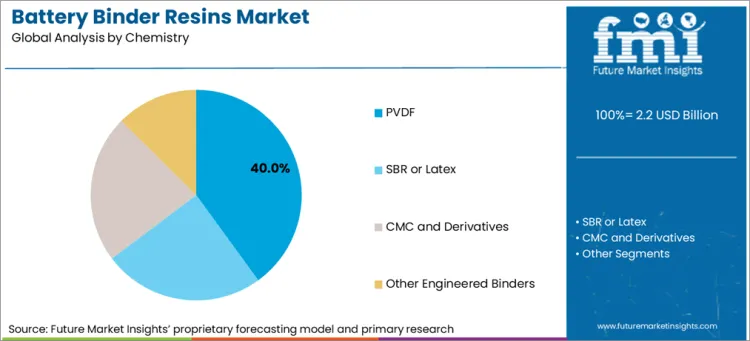
PVDF-based binders account for a leading revenue share, estimated at over 40%, due to their irreplaceable role in high-voltage nickel-rich NMC and NCA cathodes. PVDF’s resistance to oxidation at voltages above 4.3V makes it the default choice for maximizing energy density. In January 2026, Kureha Corporation announced the completion of a new PVDF production line in Fukushima, Japan, dedicated to a novel cross-linkable PVDF grade. This grade allows for partial curing after electrode coating, enhancing adhesion and reducing binder content by up to 30% without compromising cycle life, directly improving cell energy density and cost.
Which Processing and Cost Factors are Preserving the Dominance of Aqueous Anode Binders?
SBR/CMC aqueous binder systems command the largest volume share for anodes, exceeding 60% of anode binder consumption. This dominance is rooted in their low cost, non-toxic processing, and excellent compatibility with graphite and initial silicon-blended anodes. The Government of India’s PLI scheme for ACC battery storage, as updated in December 2025, specifically subsidizes the use of water-based electrode processing. This policy cements the position of SBR/CMC systems for the massive volume of LFP cells planned for production in India from 2027 onward.
What Role does the EV Cell Segment Play in Defining Global Innovation?
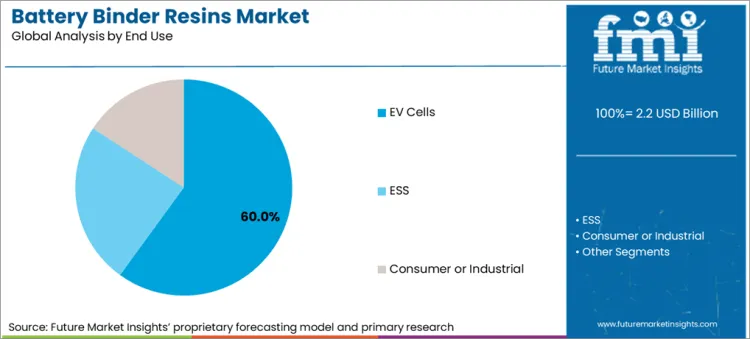
EV cells represent the dominant end-use segment, accounting for over 70% of binder resin demand by value. This segment acts as the primary driver for advanced binder innovation due to its extreme performance requirements.
During its Q4 2025 Capital Markets Day, Samsung SDI outlined its roadmap for all-solid-state batteries, revealing a partnership with ZEON Corporation to develop a specialized elastomeric binder for sulfide-based solid electrolytes.This collaboration highlights how EV-driven innovation in solid-state technology creates entirely new sub-segments within the binder market, far removed from conventional liquid electrolyte systems.
What Drivers, Restraints, Opportunities, and Trends Prevail in the Battery Binder Resins Market?
Market expansion is supported by binding sustainability legislation. The EU Battery Regulation’s mandatory minimum recycled content thresholds, effective from 2030, are prompting cell makers to evaluate binders derived from recycled plastics or bio-based sources. In October 2025, TotalEnergies Corbion and Showa Denko Materials announced a joint development agreement to commercialize a PLA-based binder for LFP cathodes. This bio-based, biodegradable polymer offers a pathway to reduce the carbon footprint of the binding system by over 50% compared to fossil-based alternatives.
While demand is robust, the industry faces significant raw material volatility and regulatory cost pressures. Financial disclosures from Wacker Chemie AG in early 2026 highlighted sustained pressure on VDF monomer margins due to supply constraints and environmental permitting delays for new VDF capacity in Europe. This monomer is the precursor for PVDF, and its cost volatility directly threatens the economic viability of high-performance fluorinated binders.
Technical innovation is defined by the integration of ancillary functions into the binder matrix. JSR Corporation’s 2026 R&D showcase featured a multi-functional binder for silicon oxide anodes. This binder incorporates tiny, dispersed ceramic particles that form a stable artificial SEI during initial cycling, reducing irreversible lithium loss and improving first-cycle efficiency by 4 percentage points. This trend moves the binder from a passive adhesive to an active participant in cell electrochemistry.
The shift toward dry electrode manufacturing represents a disruptive force. Tesla’s acquisition of dry battery electrode technology through its Maxwell Technologies acquisition is now moving toward volume implementation. This process eliminates the need for solvent-based slurries, instead using a PTFE fibrillization process as a binder. This trend threatens the incumbent solvent-based binder volume but opens a new frontier for specialty fibrillizable polymer suppliers, creating a market realignment.
Analysis of Battery Binder Resins Market by Key Countries
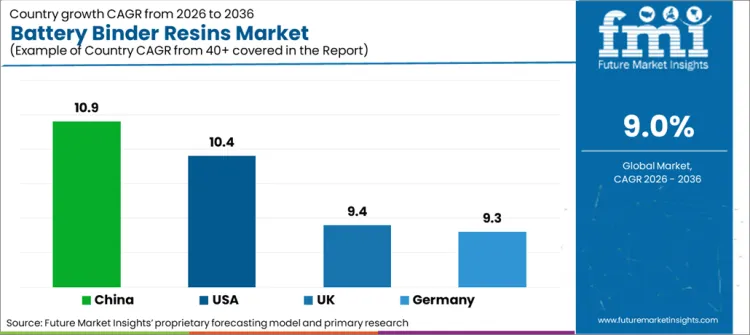
The following analysis examines the strategic evolution of the battery binder resin market in China (10.9%), USA (10.4%), UK (9.4%), and Germany (9.3%). These countries are the primary demand and innovation centers, each shaped by distinct industrial policies, research ecosystems, and sustainability frameworks that redefine material specifications.
| Country | CAGR (2026-2036) |
|---|---|
| China | 10.9% |
| USA | 10.4% |
| UK | 9.4% |
| Germany | 9.3% |
Source: Future Market Insights (FMI) analysis, based on proprietary forecasting model and primary research
How is Vertical Integration Shaping the Chinese Binder Market?
China is projected to expand at a 10.9% CAGR through 2036, driven by deep vertical integration within its battery ecosystem. Leading cell manufacturers like CATL and BYD are internalizing binder formulation expertise through dedicated material science divisions. The Ministry of Industry and Information Technology’s 2026-2030 technical guidance for the battery industry prioritizes the development of integrated electrode systems, encouraging cell makers to co-develop proprietary binders with domestic chemical firms. This policy reduces reliance on imported specialty polymers and creates captive, high-margin markets for Chinese resin producers, insulating them from global competition.
Which IRA Provisions are Accelerating USA Domestic Binder Production?
The US market is set for a 10.4% CAGR, fueled by the Inflation Reduction Act’s (IRA) critical mineral and battery component sourcing requirements. To qualify for the full USD 7,500 EV tax credit, vehicles must contain a battery with a growing percentage of components manufactured in North America. Binders are classified as battery components.
This has triggered a wave of onshoring announcements. Dow Inc. confirmed in March 2026 the groundbreaking of a battery binder production unit at its Texas operations, aiming to supply PVDF and acrylic binders to nearby gigafactories in the “Battery Belt.” This local-for-local production is a direct response to the IRA’s value-added calculation rules.
What Role does the UK’s Research Ecosystem Play in Advanced Binder Development?
The UK market, growing at a 9.4% CAGR, is characterized by its strength in foundational research rather than mass production. The Faraday Institution’s Battery Challenge program, specifically its Nextrode project, entered a new phase in early 2026 focused on electrode architecture. This project is pioneering the use of electrospinning and 3D printing to create structured electrodes with spatially graded binder concentrations.
Such architectures require novel thermo-plastic or UV-curable binder systems, creating a high-value niche for specialty chemical companies that can collaborate with UK universities and the UK Battery Industrialisation Centre (UKBIC) on pilot-scale production.
How are German Automotive OEMs Driving Binder Specifications?
Germany’s 9.3% CAGR is influenced by the direct material specification power of its automotive OEMs. Volkswagen Group’s unified cell concept, entering production in 2026, standardizes cell formats across its brands but allows for chemistry-specific material sets.
Volkswagen’s direct material contracts with chemical suppliers explicitly mandate binder performance parameters for fast-charging and low-temperature operation (-30°C). These stringent, performance-based specifications force binder suppliers to exceed industry standard data sheets and commit to rigorous, long-term validation testing, raising barriers to entry but securing premium pricing for compliant suppliers.
What is the Competition Outlook for Battery Binder Resins?
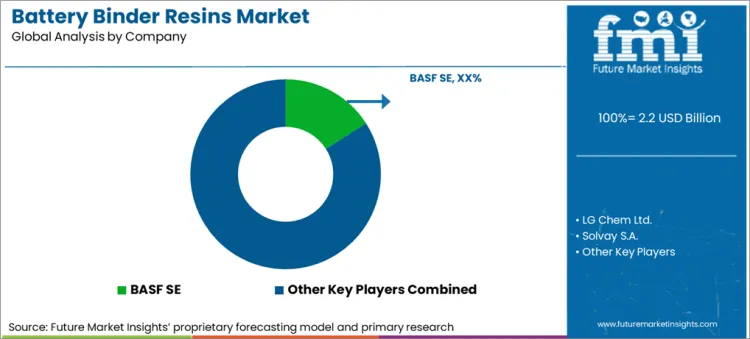
Competitive intensity reflects the strategic importance of binders in cell performance. The landscape is bifurcating into volume players serving the LFP and standard NMC markets and specialty innovators focused on next-generation chemistries. Competition is increasingly based on JDAs with top-tier cell manufacturers, where resin suppliers co-own intellectual property for customized binder systems. Success depends on deep electrochemistry expertise, application engineering support, and the ability to secure supply of critical monomers like VDF.
Chemical giants acquiring niche expertise defined strategic evolution prior to 2024. BASF’s earlier acquisition of battery materials assets from 3M and Merck KGaA provided it with a broad binder portfolio. Suppliers focused on establishing qualified products at major gigafactories, often competing on consistency and scale rather than breakthrough innovation.
The observable strategic direction for 2026 and beyond is the creation of dedicated business units for battery materials, separating them from legacy chemical operations. Dow Inc.’s formation of its MobilityScience platform in late 2025 exemplifies this trend, combining binders, adhesives, and thermal interface materials into a single customer-facing organization focused exclusively on the EV and storage supply chain.
Strategic leadership is shifting toward circularity integration. In early 2026, LG Chem Ltd. inaugurated its “Hydro-to-Binder” pilot plant in Daejeon. This facility uses green hydrogen to convert captured CO2 into ethylene oxide, a precursor for polyethylene oxide (PEO)-based binders for solid-state batteries. This move integrates the binder into a carbon-negative production loop, aligning with corporate net-zero goals and future regulatory carbon pricing mechanisms.
Recent Developments
- BASF SE and Ningbo Shanshan Co., Ltd. signed a comprehensive partnership in January 2026 to develop and commercialize integrated cathode active material and binder systems, aiming to optimize electrode performance through holistic design.
- Solvay S.A. received ISCC PLUS certification for its mass-balanced PVDF produced from circular raw materials in December 2025, allowing it to offer binder products with a certified reduced carbon footprint to European cell makers.
- Arkema S.A. launched a new family of “Kynar” PVDF grades in Q3 2025 specifically designed for extrusion-based electrode manufacturing processes, catering to the emerging trend of continuous, roll-to-roll electrode production.
Key Players Profiled
- BASF SE
- LG Chem Ltd.
- Solvay S.A.
- Dow Inc.
- Arkema S.A.
- Wacker Chemie AG
- ZEON Corporation
- JSR Corporation
- Kureha Corporation
- Showa Denko Materials Co., Ltd.
Market Definition
The battery binder resins market comprises revenue generated from the sale of polymeric materials used to bind electrode active materials, conductive additives, and current collectors into cohesive structures within battery cells. These resins provide mechanical integrity, ensure electrical connectivity, and influence electrochemical performance. The market includes binders such as PVDF, SBR, CMC, and other engineered polymers supplied as powders, dispersions, or solutions for use in lithium-ion, sodium-ion, and other advanced battery chemistries.
The market scope covers binders used in the manufacturing of electrodes for electric vehicle cells, stationary energy storage systems, and consumer electronics. Revenue includes value from tailored formulations, technical service, and licensing of application know-how. The market excludes generic industrial adhesives, separator coatings, and electrolyte polymers unless specifically formulated and sold as electrode binders.
Scope of Report
| Items | Values |
|---|---|
| Quantitative Units | USD 2.2 billion |
| Chemistry | PVDF, SBR or Latex, CMC and Derivatives, Other Engineered Binders |
| End Use | EV Cells, ESS, Consumer or Industrial |
| Regions Covered | North America, Western Europe, Eastern Europe, East Asia, South Asia & Pacific, Latin America, Middle East & Africa |
| Countries | China, USA, UK, Germany and 40+ countries |
| Key Companies | BASF SE, LG Chem Ltd., Solvay S.A., Dow Inc., Arkema S.A., Wacker Chemie AG, ZEON Corporation, JSR Corporation, Kureha Corporation, Showa Denko Materials Co., Ltd. |
Battery Binder Resins Market Key Segments
By Chemistry
- PVDF
- SBR or Latex
- CMC and Derivatives
- Other Engineered Binders
By End Use
- EV Cells
- ESS
- Consumer or Industrial
By Region
- North America
- Western Europe
- Eastern Europe
- East Asia
- South Asia & Pacific
- Latin America
- Middle East & Africa
Bibliography
- BASF SE. (2026). Innovation Report: Advanced Materials for Energy Storage. BASF Group.
- LG Chem Ltd. (2025). Annual Report and Sustainable Chemistry Roadmap. LG Chem.
- Solvay S.A. (2025). Strategic Update: Specialty Polymers Division. Solvay Group.
- USA Department of Energy. (2026). Blueprint for a Secure Energy Future: Battery Supply Chain
- Assessment.
- Faraday Institution. (2026). Nextrode Project: Annual Research Progress Report.
- European Commission. (2025). Implementing Regulation for the Critical Raw Materials Act.
- Volkswagen AG. (2026). Power Day 2026: Technology Deep Dive on Unified Cell.
Frequently Asked Questions
What is the expected value of the battery binder resins market in 2026?
The battery binder resins market is expected to reach USD 2.2 billion in 2026, supported by rising global cell production and the adoption of more binder-intensive advanced cell chemistries.
What is the projected value by 2036 and CAGR from 2026 to 2036?
By 2036, the market is projected to reach USD 5.2 billion, expanding at a CAGR of 9.0% between 2026 and 2036.
How is the shift to advanced anode chemistries influencing binder demand?
The commercialization of silicon-dominant and lithium metal anodes is driving demand for elastomeric and multifunctional binder systems that can accommodate severe volume expansion and form stable interphases, moving beyond conventional SBR/CMC systems.
What role does sustainability regulation play in shaping the market?
Regulations like the EU Battery Regulation are accelerating the adoption of bio-based binders, binders with recycled content, and solvent-free processing to reduce carbon footprint and facilitate end-of-life recycling.
Which chemistry segment dominates the market for high-performance applications?
PVDF-based binders dominate the cathode segment for high-performance, high-voltage lithium-ion cells due to their superior electrochemical stability and adhesion properties.
Preview the report firsthand - request a free sample
Get SampleGet the brochure for pricing and purchase details.
Get PDFTable of Content
- Executive Summary
- Global Market Outlook
- Demand-side Trends
- Supply-side Trends
- Technology Roadmap Analysis
- Analysis and Recommendations
- Market Overview
- Market Coverage / Taxonomy
- Market Definition / Scope / Limitations
- Research Methodology
- Chapter Orientation
- Analytical Lens and Working Hypotheses
- Market Structure, Signals, and Trend Drivers
- Company Annual and Sustainability Reports
- Peer-reviewed Journals and Academic Literature
- Corporate Websites, Product Literature, and Technical Notes
- Earnings Decks and Investor Briefings
- Statutory Filings and Regulatory Disclosures
- Technical White Papers and Standards Notes
- Trade Journals, Industry Magazines, and Analyst Briefs
- Conference Proceedings, Webinars, and Seminar Materials
- Government Statistics Portals and Public Data Releases
- Press Releases and Reputable Media Coverage
- Specialist Newsletters and Curated Briefings
- Sector Databases and Reference Repositories
- FMI Internal Proprietary Databases and Historical Market Datasets
- Subscription Datasets and Paid Sources
- Social Channels, Communities, and Digital Listening Inputs
- Additional Desk Sources
- Expert Input and Fieldwork (Primary Evidence)
- Primary Modes
- Qualitative Interviews and Expert Elicitation
- Quantitative Surveys and Structured Data Capture
- Blended Approach
- Why Primary Evidence is Used
- Field Techniques
- Interviews
- Surveys
- Focus Groups
- Observational and In-context Research
- Social and Community Interactions
- Stakeholder Universe Engaged
- C-suite Leaders
- Board Members
- Presidents and Vice Presidents
- R&D and Innovation Heads
- Technical Specialists
- Domain Subject-matter Experts
- Scientists
- Physicians and Other Healthcare Professionals
- Governance, Ethics, and Data Stewardship
- Research Ethics
- Data Integrity and Handling
- Primary Modes
- Tooling, Models, and Reference Databases
- Data Engineering and Model Build
- Data Acquisition and Ingestion
- Cleaning, Normalisation, and Verification
- Synthesis, Triangulation, and Analysis
- Quality Assurance and Audit Trail
- Market Background
- Market Dynamics
- Drivers
- Restraints
- Opportunity
- Trends
- Scenario Forecast
- Demand in Optimistic Scenario
- Demand in Likely Scenario
- Demand in Conservative Scenario
- Opportunity Map Analysis
- Product Life Cycle Analysis
- Supply Chain Analysis
- Investment Feasibility Matrix
- Value Chain Analysis
- PESTLE and Porter’s Analysis
- Regulatory Landscape
- Regional Parent Market Outlook
- Production and Consumption Statistics
- Import and Export Statistics
- Market Dynamics
- Global Market Analysis 2021 to 2025 and Forecast, 2026 to 2036
- Historical Market Size Value (USD Million) Analysis, 2021 to 2025
- Current and Future Market Size Value (USD Million) Projections, 2026 to 2036
- Y-o-Y Growth Trend Analysis
- Absolute $ Opportunity Analysis
- Global Market Pricing Analysis 2021 to 2025 and Forecast 2026 to 2036
- Global Market Analysis 2021 to 2025 and Forecast 2026 to 2036, By Chemistry
- Introduction / Key Findings
- Historical Market Size Value (USD Million) Analysis By Chemistry , 2021 to 2025
- Current and Future Market Size Value (USD Million) Analysis and Forecast By Chemistry , 2026 to 2036
- PVDF
- SBR or Latex
- CMC and Derivatives
- Other Engineered Binders
- PVDF
- Y-o-Y Growth Trend Analysis By Chemistry , 2021 to 2025
- Absolute $ Opportunity Analysis By Chemistry , 2026 to 2036
- Global Market Analysis 2021 to 2025 and Forecast 2026 to 2036, By End Use
- Introduction / Key Findings
- Historical Market Size Value (USD Million) Analysis By End Use, 2021 to 2025
- Current and Future Market Size Value (USD Million) Analysis and Forecast By End Use, 2026 to 2036
- EV Cells
- ESS
- Consumer or Industrial
- EV Cells
- Y-o-Y Growth Trend Analysis By End Use, 2021 to 2025
- Absolute $ Opportunity Analysis By End Use, 2026 to 2036
- Global Market Analysis 2021 to 2025 and Forecast 2026 to 2036, By Region
- Introduction
- Historical Market Size Value (USD Million) Analysis By Region, 2021 to 2025
- Current Market Size Value (USD Million) Analysis and Forecast By Region, 2026 to 2036
- North America
- Latin America
- Western Europe
- Eastern Europe
- East Asia
- South Asia and Pacific
- Middle East & Africa
- Market Attractiveness Analysis By Region
- North America Market Analysis 2021 to 2025 and Forecast 2026 to 2036, By Country
- Historical Market Size Value (USD Million) Trend Analysis By Market Taxonomy, 2021 to 2025
- Market Size Value (USD Million) Forecast By Market Taxonomy, 2026 to 2036
- By Country
- USA
- Canada
- Mexico
- By Chemistry
- By End Use
- By Country
- Market Attractiveness Analysis
- By Country
- By Chemistry
- By End Use
- Key Takeaways
- Latin America Market Analysis 2021 to 2025 and Forecast 2026 to 2036, By Country
- Historical Market Size Value (USD Million) Trend Analysis By Market Taxonomy, 2021 to 2025
- Market Size Value (USD Million) Forecast By Market Taxonomy, 2026 to 2036
- By Country
- Brazil
- Chile
- Rest of Latin America
- By Chemistry
- By End Use
- By Country
- Market Attractiveness Analysis
- By Country
- By Chemistry
- By End Use
- Key Takeaways
- Western Europe Market Analysis 2021 to 2025 and Forecast 2026 to 2036, By Country
- Historical Market Size Value (USD Million) Trend Analysis By Market Taxonomy, 2021 to 2025
- Market Size Value (USD Million) Forecast By Market Taxonomy, 2026 to 2036
- By Country
- Germany
- UK
- Italy
- Spain
- France
- Nordic
- BENELUX
- Rest of Western Europe
- By Chemistry
- By End Use
- By Country
- Market Attractiveness Analysis
- By Country
- By Chemistry
- By End Use
- Key Takeaways
- Eastern Europe Market Analysis 2021 to 2025 and Forecast 2026 to 2036, By Country
- Historical Market Size Value (USD Million) Trend Analysis By Market Taxonomy, 2021 to 2025
- Market Size Value (USD Million) Forecast By Market Taxonomy, 2026 to 2036
- By Country
- Russia
- Poland
- Hungary
- Balkan & Baltic
- Rest of Eastern Europe
- By Chemistry
- By End Use
- By Country
- Market Attractiveness Analysis
- By Country
- By Chemistry
- By End Use
- Key Takeaways
- East Asia Market Analysis 2021 to 2025 and Forecast 2026 to 2036, By Country
- Historical Market Size Value (USD Million) Trend Analysis By Market Taxonomy, 2021 to 2025
- Market Size Value (USD Million) Forecast By Market Taxonomy, 2026 to 2036
- By Country
- China
- Japan
- South Korea
- By Chemistry
- By End Use
- By Country
- Market Attractiveness Analysis
- By Country
- By Chemistry
- By End Use
- Key Takeaways
- South Asia and Pacific Market Analysis 2021 to 2025 and Forecast 2026 to 2036, By Country
- Historical Market Size Value (USD Million) Trend Analysis By Market Taxonomy, 2021 to 2025
- Market Size Value (USD Million) Forecast By Market Taxonomy, 2026 to 2036
- By Country
- India
- ASEAN
- Australia & New Zealand
- Rest of South Asia and Pacific
- By Chemistry
- By End Use
- By Country
- Market Attractiveness Analysis
- By Country
- By Chemistry
- By End Use
- Key Takeaways
- Middle East & Africa Market Analysis 2021 to 2025 and Forecast 2026 to 2036, By Country
- Historical Market Size Value (USD Million) Trend Analysis By Market Taxonomy, 2021 to 2025
- Market Size Value (USD Million) Forecast By Market Taxonomy, 2026 to 2036
- By Country
- Kingdom of Saudi Arabia
- Other GCC Countries
- Turkiye
- South Africa
- Other African Union
- Rest of Middle East & Africa
- By Chemistry
- By End Use
- By Country
- Market Attractiveness Analysis
- By Country
- By Chemistry
- By End Use
- Key Takeaways
- Key Countries Market Analysis
- USA
- Pricing Analysis
- Market Share Analysis, 2025
- By Chemistry
- By End Use
- Canada
- Pricing Analysis
- Market Share Analysis, 2025
- By Chemistry
- By End Use
- Mexico
- Pricing Analysis
- Market Share Analysis, 2025
- By Chemistry
- By End Use
- Brazil
- Pricing Analysis
- Market Share Analysis, 2025
- By Chemistry
- By End Use
- Chile
- Pricing Analysis
- Market Share Analysis, 2025
- By Chemistry
- By End Use
- Germany
- Pricing Analysis
- Market Share Analysis, 2025
- By Chemistry
- By End Use
- UK
- Pricing Analysis
- Market Share Analysis, 2025
- By Chemistry
- By End Use
- Italy
- Pricing Analysis
- Market Share Analysis, 2025
- By Chemistry
- By End Use
- Spain
- Pricing Analysis
- Market Share Analysis, 2025
- By Chemistry
- By End Use
- France
- Pricing Analysis
- Market Share Analysis, 2025
- By Chemistry
- By End Use
- India
- Pricing Analysis
- Market Share Analysis, 2025
- By Chemistry
- By End Use
- ASEAN
- Pricing Analysis
- Market Share Analysis, 2025
- By Chemistry
- By End Use
- Australia & New Zealand
- Pricing Analysis
- Market Share Analysis, 2025
- By Chemistry
- By End Use
- China
- Pricing Analysis
- Market Share Analysis, 2025
- By Chemistry
- By End Use
- Japan
- Pricing Analysis
- Market Share Analysis, 2025
- By Chemistry
- By End Use
- South Korea
- Pricing Analysis
- Market Share Analysis, 2025
- By Chemistry
- By End Use
- Russia
- Pricing Analysis
- Market Share Analysis, 2025
- By Chemistry
- By End Use
- Poland
- Pricing Analysis
- Market Share Analysis, 2025
- By Chemistry
- By End Use
- Hungary
- Pricing Analysis
- Market Share Analysis, 2025
- By Chemistry
- By End Use
- Kingdom of Saudi Arabia
- Pricing Analysis
- Market Share Analysis, 2025
- By Chemistry
- By End Use
- Turkiye
- Pricing Analysis
- Market Share Analysis, 2025
- By Chemistry
- By End Use
- South Africa
- Pricing Analysis
- Market Share Analysis, 2025
- By Chemistry
- By End Use
- USA
- Market Structure Analysis
- Competition Dashboard
- Competition Benchmarking
- Market Share Analysis of Top Players
- By Regional
- By Chemistry
- By End Use
- Competition Analysis
- Competition Deep Dive
- BASF SE
- Overview
- Product Portfolio
- Profitability by Market Segments (Product/Age /Sales Channel/Region)
- Sales Footprint
- Strategy Overview
- Marketing Strategy
- Product Strategy
- Channel Strategy
- LG Chem Ltd.
- Solvay S.A.
- Dow Inc.
- Arkema S.A.
- Wacker Chemie AG
- ZEON Corporation
- JSR Corporation
- Kureha Corporation
- BASF SE
- Competition Deep Dive
- Assumptions & Acronyms Used


