

- Industry Size (2026)
- USD 1.1 Bn
- Forecast (2036)
- USD 2.9 Bn
- CAGR (2026 to 2036)
- 10.2%
Fire Retardant PCR Fiber and Yarn Market Forecast and Outlook 2026 to 2036
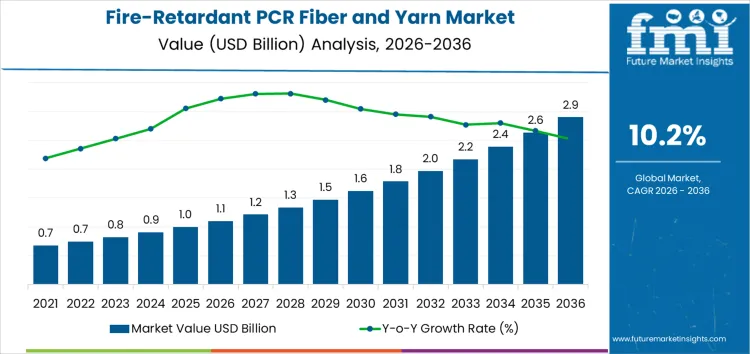
The fire retardant PCR fiber and yarn market is valued at USD 1.1 billion in 2026 and is projected to reach USD 2.9 billion by 2036, reflecting a CAGR of 10.2%. Market performance across this period is shaped by formulation complexity, additive compatibility, and consistency of flame resistance under recycled input conditions. Cost structures are influenced by specialty chemical dosing, processing yield losses, and testing requirements for fire performance certification. Producers with proprietary formulations and controlled compounding processes maintain stronger pricing discipline. Margin concentration favors suppliers serving regulated applications where performance thresholds limit substitution and restrict low cost competition.
From 2026 to 2036, value capture increasingly depends on qualification depth rather than production scale. Buyers in protective apparel, furnishings, and industrial interiors prioritize verified fire resistance and repeatable yarn behavior across production batches. Certification timelines and audit requirements raise switching barriers once materials are approved. Dependency on qualified PCR feedstock constrains sourcing flexibility and reinforces long term supply agreements. Strategic tradeoffs emerge between expanding recycled content and preserving fire performance stability. Firms integrating formulation control, testing capability, and customer qualification retain durable positioning and steadier margins over extended contract cycles.
Quick Stats for Fire Retardant PCR Fiber and Yarn Market
- Fire Retardant PCR Fiber and Yarn Market Value (2026): USD 1.1 billion
- Fire Retardant PCR Fiber and Yarn Market Forecast Value (2036): USD 2.9 billion
- Fire Retardant PCR Fiber and Yarn Market Forecast CAGR (2026 to 2036): 10.2%
- Leading Type in Fire Retardant PCR Fiber and Yarn Market: Staple fibres and filament yarns
- Key Growth Regions in Fire Retardant PCR Fiber and Yarn Market: Asia Pacific, Europe, North America
- Top Players in Fire Retardant PCR Fiber and Yarn Market: DuPont, Trevira, Zhejiang Hengyi, Reliance Industries, Toray, Unifi, Freudenberg
What Is the Growth Forecast for Fire Retardant PCR Fiber and Yarn Market through 2036?
Performance compliance requirements and certification lead times define the early growth profile of the fire retardant PCR fiber and yarn market between 2026 and 2031. Over this period, the market expands from USD 1.1 billion to USD 1.5 billion, adding USD 0.4 billion in value. Annual progression from USD 0.7 billion to USD 1.1 billion reflects cautious adoption across protective apparel, furnishings, and industrial textiles. Historical growth was limited by flame resistance validation and consistency challenges in recycled feedstock. Future expansion in this phase is supported by improved additive compatibility, wider testing approvals, and initial uptake by manufacturers supplying regulated end use environments.
Application breadth and supply reliability shape the growth trajectory from 2031 to 2036. During this phase, the market increases from USD 1.5 billion to USD 2.9 billion, adding USD 1.4 billion and representing the faster growth window. Annual values rise from USD 1.6 billion to USD 2.9 billion, indicating accelerating year over year momentum. Earlier demand focused on niche safety applications, while later expansion reflects broader use across workwear, transportation interiors, and building related textiles. Stable fire performance, scalable yarn production, and growing buyer confidence support sustained growth as adoption extends beyond early regulated segments.
Fire Retardant PCR Fiber and Yarn Market Key Takeaways
| Metric | Value |
|---|---|
| Market Value (2026) | USD 1.1 billion |
| Forecast Value (2036) | USD 2.9 billion |
| Forecast CAGR (2026 to 2036) | 10.2% |
What Is Driving Growth in the Fire-Retardant PCR Fiber and Yarn Market?
Growth in the fire-retardant post-consumer recycled (PCR) fiber and yarn market is being shaped by distinct performance, regulatory, and sustainability pressures rather than by general textile recycling trends alone. Industrial sectors such as automotive seating, public transportation interiors, protective apparel, and building materials require fibers and yarns that resist ignition and slow flame spread under defined test criteria. Historically, PCR fibers were valued for their environmental credentials but were limited in fire-critical applications because recycled polymers often exhibited inconsistent melting behaviour, residual contaminants, and reduced thermal stability compared with virgin materials. Manufacturers hesitated to use high PCR content where flame retardance and mechanical integrity could not be documented to meet stringent industry standards, confining early adoption to secondary or decorative textile segments rather than core safety-critical uses.
Future demand for fire-retardant PCR fiber and yarns is being driven by a convergence of stricter fire safety codes, extended producer responsibility mandates, and advances in material engineering that align recycled content with performance requirements. Regulatory bodies in major markets are tightening flame retardance thresholds for public spaces, mass transit, and workplace protective gear, making compliance a key procurement criterion rather than a discretionary feature. Fabric developers are integrating PCR feedstocks with tailored flame-retardant chemistries and compatibilisers that improve thermal decomposition behaviour, char formation, and ignition resistance without compromising tensile strength or processability. Automated quality control and traceability systems are enabling manufacturers to document compliance with both fire performance and recycled content standards, supporting broader use of recycled fibers in regulated applications.
What Factors Are Affecting the Demand for Fire Retardant PCR Fiber and Yarn Market in Terms of Yarn Type and Material?
The fire retardant PCR fiber and yarn market is shaped by safety regulations, recycled content mandates, and demand for flame resistant textiles in transport, construction, and industrial uses. Buyers focus on yarn formats and materials that deliver certified fire performance while maintaining mechanical reliability and process consistency. Adoption depends on compatibility with existing spinning, weaving, and finishing systems. Market leadership reflects scalability, certification feasibility, and balance between recycled content and functional safety rather than material novelty.
What Is Driving Leadership by Yarn Type in the Fire Retardant PCR Fiber and Yarn Market?
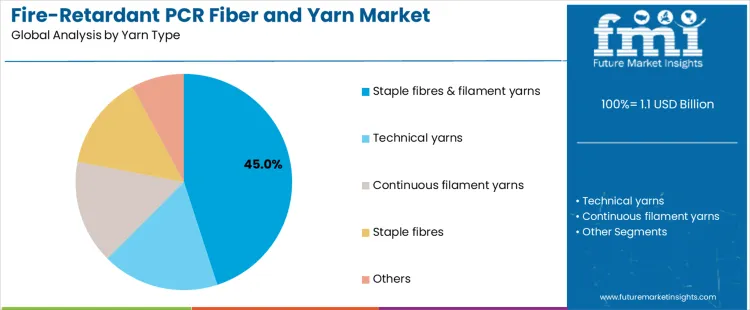
Staple fibres and filament yarns account for about 45% of demand because they offer flexibility across a wide range of textile constructions while supporting flame retardant treatment consistency. These yarn types are widely used in protective apparel, furnishings, and technical fabrics where fire performance standards are clearly defined. Manufacturers prefer staple and filament formats because they integrate easily into existing spinning and weaving lines without requiring major process modification. Their adaptability supports blending with virgin fibres to stabilize performance when PCR quality varies. Large end users value predictable tensile strength, elongation, and fabric handle, which these yarn types deliver reliably at scale. Established testing protocols and certification pathways further reinforce adoption. As recycled content requirements increase, producers prioritize yarn formats that minimize qualification risk and support repeatable fire performance, anchoring leadership for staple and filament yarns in regulated textile applications.
Technical yarns and continuous filament variants play important but secondary roles within the market. Technical yarns are used where enhanced thermal resistance or mechanical strength is required, but volumes are lower and specifications tighter. Continuous filament yarns support uniformity and smooth fabric surfaces but can be sensitive to PCR variability. Pure staple fibre formats serve insulation and nonwoven uses but face limitations in structural textiles. These subsegments expand application breadth yet do not displace the dominant role of staple and filament yarns. Yarn type leadership therefore reflects versatility, qualification ease, and manufacturing familiarity rather than specialization or premium performance niches alone.
What Is Driving Leadership by Material in the Fire Retardant PCR Fiber and Yarn Market?
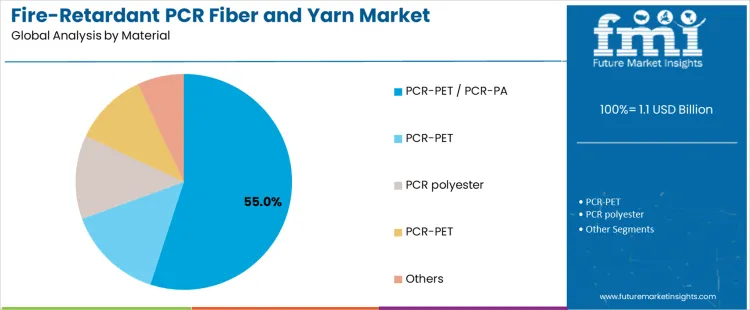
PCR-PET and PCR-PA account for about 55% of material demand because they provide a proven balance of flame retardant performance, mechanical strength, and recyclability. These polymers are widely available through established recycling streams and can be modified with fire retardant additives to meet transport and building safety standards. Manufacturers favor PCR-PET and PCR-PA because their thermal behavior and processing characteristics are well understood, reducing risk during spinning and finishing. Regulatory acceptance and existing test data further support use in certified applications such as automotive interiors, protective textiles, and public infrastructure fabrics. The ability to blend PCR grades with virgin resin helps manage property variability while maintaining recycled content targets. These factors concentrate demand around PET and polyamide based recycled materials.
PCR polyester variants beyond PET, including blended recycled polyesters, support additional applications but face tighter control requirements. Some formulations struggle with additive dispersion or long term flame resistance consistency. Other recycled materials remain limited by supply quality, fire performance uncertainty, or certification barriers. As a result, alternative materials are adopted selectively for non-critical uses. Material leadership therefore reflects feedstock availability, processing reliability, and certification confidence rather than the breadth of recyclable polymer options.
How Is the Fire-Retardant PCR Fiber and Yarn Market Being Applied Across Textiles and Industrial Fabrics?
Use appears in protective clothing, upholstery, construction materials, and transportation interiors where fire safety and recycled content are both required. Manufacturers adopt post-consumer recycled (PCR) fibers and yarns treated with fire-retardant chemistries to maintain flame resistance while supporting sustainability goals. Applications include firefighter apparel, insulation, curtains, and automotive seating. These implementations reflect operational and safety priorities rather than decorative purposes, with adoption driven by regulatory compliance, material performance, and recyclate integration.
What Operational and Material Conditions Support Adoption of Fire-Retardant PCR Fiber and Yarn?
Selection aligns with PCR feedstocks capable of consistent spinning, tensile strength, and thermal stability. Fire-retardant treatments are optimized for adhesion, durability, and wash resistance without compromising fiber flexibility or color. Manufacturers integrate fibers into weaving, knitting, or nonwoven processes while monitoring uniformity, tensile properties, and flammability performance. Quality control ensures compliance with standards such as NFPA, ISO, or EN for fire resistance. These conditions emerge from operational efficiency, safety performance, and regulatory adherence priorities in structured textile production workflows.
Which Practical Considerations Limit Wider Use of Fire-Retardant PCR Fiber and Yarn?
Variability in feedstock quality and residual contaminants can affect spinning, dyeing, and fire-retardant efficacy. Costs are typically higher than virgin fiber alternatives due to treatment and processing complexity. Compatibility with secondary treatments, coatings, or blends must be validated. Long-term durability under repeated laundering or exposure requires testing. Regulatory approvals differ by application and region. These factors lead to selective deployment where flame resistance, recyclate utilization, and compliance justify incremental cost and operational oversight.
What is the Demand for Fire Retardant PCR Fiber and Yarn by Country?
| Country | CAGR (%) |
|---|---|
| USA | 8.8% |
| Germany | 7.8% |
| China | 12.2% |
| India | 13.4% |
| Brazil | 8.4% |
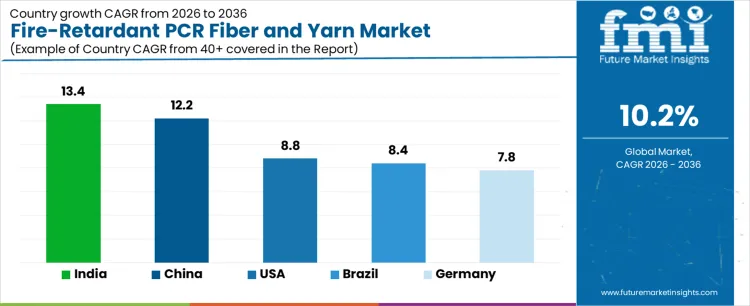
The demand for fire retardant PCR fiber and yarn varies across countries, driven by sustainable textile adoption, fire safety regulations, and industrial applications. India leads with a 13.4% CAGR, supported by growing industrial textile production, adoption of recycled fibers, and compliance with fire safety standards in construction, automotive, and protective clothing. China follows at 12.2%, driven by large scale textile manufacturing, regulatory compliance, and integration of PCR fibers in flame retardant applications. The USA grows at 8.8%, reflecting steady adoption in industrial, construction, and commercial applications. Brazil records 8.4%, shaped by expanding textile industry and sustainable fiber initiatives. Germany posts 7.8%, supported by mature industrial fiber markets and regulatory standards.
How Is the Fire-Retardant PCR Fiber and Yarn Market Expanding in the United States?
In the United States, the Fire-Retardant PCR Fiber and Yarn Market is growing at a CAGR of 8.8% through 2036, driven by increasing demand in construction, transportation, and industrial applications for fire-safe recycled-content textiles. Manufacturers are integrating PCR fibers and yarns treated with fire-retardant solutions to reduce virgin polymer usage while meeting NFPA and OSHA safety standards. Demand is concentrated in industrial textile production hubs, automotive component suppliers, and commercial building projects. Compared to Germany, where adoption is largely compliance-driven, the U.S. market emphasizes sustainability and performance. Domestic suppliers provide high-performance fibers suitable for recurring production cycles and industrial applications.
- Industrial textile hubs, automotive suppliers, and commercial construction projects drive adoption
- PCR fibers reduce virgin polymer usage while ensuring fire safety
- Domestic suppliers provide high-performance, fire-retardant recycled fibers
- Recurring production cycles sustain industrial adoption
How Are Compliance and Safety Standards Driving Growth in Germany?
In Germany, revenue is growing at a CAGR of 7.8% through 2036, supported by strict EU and national regulations on fire-retardant materials and recycled-content textiles. Industrial textile manufacturers, automotive component producers, and building material suppliers are adopting PCR fire-retardant fibers and yarns to meet compliance standards and reduce environmental impact. Demand is concentrated in industrial clusters, automotive production zones, and textile finishing facilities. Compared to the U.S., adoption emphasizes regulatory compliance over operational efficiency. Domestic suppliers provide EU-certified fibers compatible with automated production lines. Recurring production cycles and safety audits sustain steady adoption nationwide.
- Industrial clusters, automotive production zones, and textile finishing facilities drive adoption
- Fire-retardant PCR fibers meet regulatory and safety standards
- Domestic suppliers provide EU-certified, compliant fibers
- Recurring production cycles and audits sustain adoption
How Is Industrial Expansion Driving Adoption in China?
In China, the market is expanding at a CAGR of 12.2% through 2036, fueled by rapid industrialization, urban manufacturing growth, and rising demand for fire-retardant textiles in construction, automotive, and industrial applications. Companies are adopting PCR fibers and yarns with fire-retardant treatment to reduce virgin polymer use, enhance safety, and comply with local regulations. Demand is concentrated in urban industrial hubs, automotive component facilities, and commercial construction zones. Domestic suppliers are scaling high-performance, recycled-content fibers compatible with automated production systems. Compared to Brazil, adoption emphasizes large-scale industrial integration and urban manufacturing efficiency. Recurring production cycles sustain rapid adoption nationwide.
- Urban industrial hubs, automotive facilities, and construction zones drive adoption
- Fire-retardant PCR fibers reduce virgin polymer use and enhance safety
- Domestic suppliers scale high-performance, recycled fibers
- Recurring production cycles sustain rapid adoption
How Are Emerging Industrial Zones Driving Growth in India?
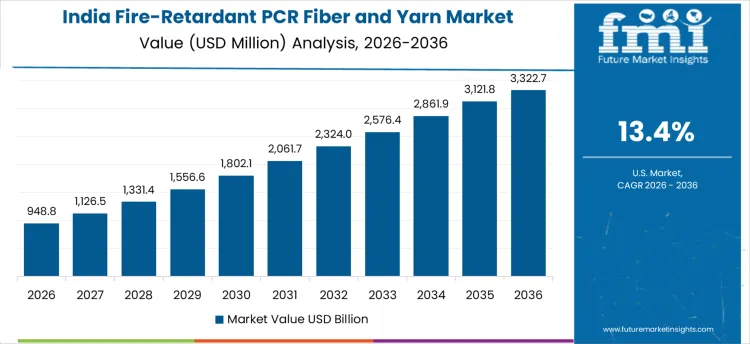
In India, revenue is growing at a CAGR of 13.4% through 2036, supported by expansion of industrial parks, textile manufacturing clusters, and fire-safe product demand in construction and transportation. Manufacturers are integrating PCR fibers and yarns treated with fire-retardant solutions to reduce environmental impact, meet safety standards, and comply with emerging regulations. Demand is concentrated in industrial clusters, urban textile production hubs, and automotive component facilities. Domestic suppliers provide cost-effective, high-performance fibers suitable for automated production and recurring operations. Compared to China, adoption is influenced more by emerging industrial zones and regulatory incentives. Recurring production cycles sustain robust adoption nationwide.
- Industrial clusters, textile hubs, and automotive facilities drive adoption
- Fire-retardant PCR fibers reduce environmental impact and ensure safety
- Domestic suppliers provide cost-effective, high-performance fibers
- Recurring production cycles sustain robust adoption
How Are Industrial Hubs Supporting Market Expansion in Brazil?
In Brazil, the market is growing at a CAGR of 8.4% through 2036, driven by adoption of fire-retardant PCR fibers and yarns in established industrial hubs, automotive suppliers, and commercial construction projects. Manufacturers are integrating recycled-content fibers to reduce virgin polymer usage, improve fire safety, and comply with environmental standards. Demand is concentrated in industrial clusters, automotive component facilities, and urban construction zones. Domestic suppliers provide high-performance, fire-retardant PCR fibers compatible with existing production lines. Compared to India and China, adoption is more concentrated in established hubs rather than emerging industrial zones. Recurring production cycles sustain steady adoption nationwide.
- Industrial clusters, automotive facilities, and construction projects drive adoption
- Fire-retardant PCR fibers reduce virgin polymer usage and improve safety
- Domestic suppliers provide high-performance, production-compatible fibers
- Recurring production cycles sustain steady adoption
Which Strategic Approaches Define Competition in the Fire Retardant PCR Fiber and Yarn Market through Certification Pathways and End Use Risk Profiles?
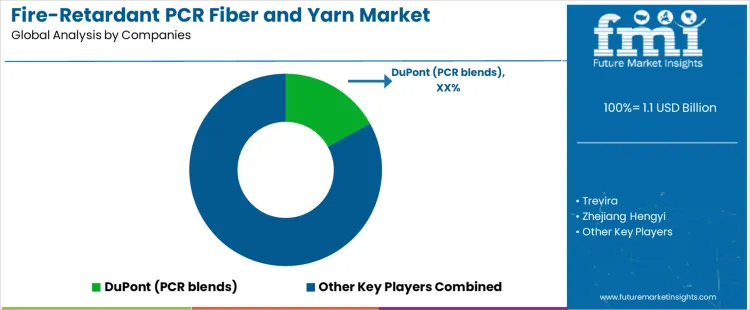
Competition in the fire retardant PCR fiber and yarn market is structured around certification strategy and liability management rather than material substitution alone. DuPont and Toray approach PCR integration cautiously, embedding recycled content within established flame retardant polymer systems to preserve compliance with apparel, transportation, and industrial safety standards. Their strategies emphasize maintaining proven fire performance benchmarks while introducing PCR content in controlled blends. Trevira and Freudenberg focus on application specific qualification, supplying fibers and yarns into interiors, filtration, and protective textiles where fire behavior must remain consistent across product lifecycles. Buyers prioritize traceable test data, repeatable fire performance, and alignment with end use regulations over recycled content claims.
Scale driven producers apply a different competitive logic centered on feedstock control and volume stability. Reliance Industries and Zhejiang Hengyi leverage upstream polymer production to manage PCR input quality, enabling cost effective fire retardant yarn supply for large industrial and infrastructure applications. Unifi competes through brand aligned recycled yarn platforms, positioning fire retardant PCR yarns for workwear and technical apparel markets where sustainability targets coexist with safety requirements. Across the market, competitive advantage depends on the ability to navigate fire certification regimes, manage variability in recycled inputs, and support long approval cycles. Success is defined by reliability under regulatory scrutiny and predictable performance in high risk environments rather than rapid expansion of recycled content levels.
Key Players in the Fire Retardant PCR Fiber and Yarn Market
- DuPont (PCR blends)
- Trevira
- Zhejiang Hengyi
- Reliance Industries
- Toray
- Unifi
- Freudenberg
Scope of the Report
| Items | Values |
|---|---|
| Quantitative Units (2026) | USD billion |
| Type | Staple Fibres and Filament Yarns, Technical Yarns, Continuous Filament Yarns, Other Types |
| Application | Protective Apparel and Uniforms, Automotive and Industrial Textiles, Construction and Transport Textiles, Workwear and Furnishings |
| End User | Protective Clothing Manufacturers, Automotive Textile Suppliers, Industrial Fabric Producers, Construction and Infrastructure Textile Users |
| Regions Covered | Asia Pacific, Europe, North America, Latin America, Middle East & Africa |
| Countries Covered | USA, Germany, China, India, Japan, South Korea, Brazil, United Kingdom, France, Italy, Canada, Mexico, ASEAN countries, GCC countries, and other global regions |
| Key Companies Profiled | DuPont, Trevira, Zhejiang Hengyi, Reliance Industries, Toray, Unifi, Freudenberg |
| Additional Attributes | Dollar sales by yarn type and material categories, regional adoption trends across Asia Pacific, Europe, and North America, competitive landscape across global and regional fire retardant fiber and yarn producers, fire performance certification and testing requirements, formulation control, additive compatibility, and qualification timelines for regulated end-use applications |
Fire Retardant PCR Fiber and Yarn Market Segmentation
End-use:
- Protective apparel & uniforms
- Automotive & industrial textiles
- Construction & transport
- Workwear & furnishings
- Industrial safety textiles
- High-performance textiles
Yarn Type:
- Staple fibres & filament yarns
- Technical yarns
- Continuous filament yarns
- Staple fibres
- Others
Material:
- PCR-PET / PCR-PA
- PCR-PET
- PCR polyester
- Others
Technology:
- Intrinsic & additive-based FR compounding
- Halogen-free flame-retardant systems
- High-volume FR masterbatch integration
- Cost-efficient FR fibre spinning
- Others
Region
- Asia Pacific
- China
- Japan
- South Korea
- India
- Australia & New Zealand
- ASEAN
- Rest of Asia Pacific
- Europe
- Germany
- United Kingdom
- France
- Italy
- Spain
- Nordic
- BENELUX
- Rest of Europe
- North America
- United States
- Canada
- Mexico
- Latin America
- Brazil
- Chile
- Rest of Latin America
- Middle East & Africa
- Kingdom of Saudi Arabia
- Other GCC Countries
- Turkey
- South Africa
- Other African Union
- Rest of Middle East & Africa
Frequently Asked Questions
How big is the fire-retardant PCR fiber and yarn market in 2026?
The global fire-retardant PCR fiber and yarn market is estimated to be valued at USD 1.1 billion in 2026.
What will be the size of fire-retardant PCR fiber and yarn market in 2036?
The market size for the fire-retardant PCR fiber and yarn market is projected to reach USD 2.9 billion by 2036.
How much will be the fire-retardant PCR fiber and yarn market growth between 2026 and 2036?
The fire-retardant PCR fiber and yarn market is expected to grow at a 10.2% CAGR between 2026 and 2036.
What are the key product types in the fire-retardant PCR fiber and yarn market?
The key product types in fire-retardant PCR fiber and yarn market are protective apparel & uniforms, automotive & industrial textiles, construction & transport, workwear & furnishings, industrial safety textiles and high-performance textiles.
Which yarn type segment to contribute significant share in the fire-retardant PCR fiber and yarn market in 2026?
In terms of yarn type, staple fibres & filament yarns segment to command 45.0% share in the fire-retardant PCR fiber and yarn market in 2026.
Preview the report firsthand - request a free sample
Get SampleGet the brochure for pricing and purchase details.
Get PDFTable of Content
- Executive Summary
- Global Market Outlook
- Demand-side Trends
- Supply-side Trends
- Technology Roadmap Analysis
- Analysis and Recommendations
- Market Overview
- Market Coverage / Taxonomy
- Market Definition / Scope / Limitations
- Market Background
- Market Dynamics
- Drivers
- Restraints
- Opportunity
- Trends
- Scenario Forecast
- Demand in Optimistic Scenario
- Demand in Likely Scenario
- Demand in Conservative Scenario
- Opportunity Map Analysis
- Product Life Cycle Analysis
- Supply Chain Analysis
- Investment Feasibility Matrix
- Value Chain Analysis
- PESTLE and Porter’s Analysis
- Regulatory Landscape
- Regional Parent Market Outlook
- Production and Consumption Statistics
- Import and Export Statistics
- Market Dynamics
- Global Market Analysis 2021 to 2025 and Forecast, 2026 to 2036
- Historical Market Size Value (USD Million) Analysis, 2021 to 2025
- Current and Future Market Size Value (USD Million) Projections, 2026 to 2036
- Y-o-Y Growth Trend Analysis
- Absolute $ Opportunity Analysis
- Global Market Pricing Analysis 2021 to 2025 and Forecast 2026 to 2036
- Global Market Analysis 2021 to 2025 and Forecast 2026 to 2036, By End-use
- Introduction / Key Findings
- Historical Market Size Value (USD Million) Analysis By End-use , 2021 to 2025
- Current and Future Market Size Value (USD Million) Analysis and Forecast By End-use , 2026 to 2036
- Protective apparel & uniforms
- Automotive & industrial textiles
- Construction & transport
- Workwear & furnishings
- Industrial safety textiles
- High-performance textiles
- Protective apparel & uniforms
- Y-o-Y Growth Trend Analysis By End-use , 2021 to 2025
- Absolute $ Opportunity Analysis By End-use , 2026 to 2036
- Global Market Analysis 2021 to 2025 and Forecast 2026 to 2036, By Yarn Type
- Introduction / Key Findings
- Historical Market Size Value (USD Million) Analysis By Yarn Type, 2021 to 2025
- Current and Future Market Size Value (USD Million) Analysis and Forecast By Yarn Type, 2026 to 2036
- Staple fibres & filament yarns
- Technical yarns
- Continuous filament yarns
- Staple fibres
- Others
- Staple fibres & filament yarns
- Y-o-Y Growth Trend Analysis By Yarn Type, 2021 to 2025
- Absolute $ Opportunity Analysis By Yarn Type, 2026 to 2036
- Global Market Analysis 2021 to 2025 and Forecast 2026 to 2036, By Material
- Introduction / Key Findings
- Historical Market Size Value (USD Million) Analysis By Material, 2021 to 2025
- Current and Future Market Size Value (USD Million) Analysis and Forecast By Material, 2026 to 2036
- PCR-PET / PCR-PA
- PCR-PET
- PCR polyester
- PCR-PET
- Others
- PCR-PET / PCR-PA
- Y-o-Y Growth Trend Analysis By Material, 2021 to 2025
- Absolute $ Opportunity Analysis By Material, 2026 to 2036
- Global Market Analysis 2021 to 2025 and Forecast 2026 to 2036, By Technology
- Introduction / Key Findings
- Historical Market Size Value (USD Million) Analysis By Technology, 2021 to 2025
- Current and Future Market Size Value (USD Million) Analysis and Forecast By Technology, 2026 to 2036
- Intrinsic & additive-based FR compounding
- Halogen-free flame-retardant systems
- High-volume FR masterbatch integration
- Cost-efficient FR fibre spinning
- Others
- Intrinsic & additive-based FR compounding
- Y-o-Y Growth Trend Analysis By Technology, 2021 to 2025
- Absolute $ Opportunity Analysis By Technology, 2026 to 2036
- Global Market Analysis 2021 to 2025 and Forecast 2026 to 2036, By Region
- Introduction
- Historical Market Size Value (USD Million) Analysis By Region, 2021 to 2025
- Current Market Size Value (USD Million) Analysis and Forecast By Region, 2026 to 2036
- North America
- Latin America
- Western Europe
- Eastern Europe
- East Asia
- South Asia and Pacific
- Middle East & Africa
- Market Attractiveness Analysis By Region
- North America Market Analysis 2021 to 2025 and Forecast 2026 to 2036, By Country
- Historical Market Size Value (USD Million) Trend Analysis By Market Taxonomy, 2021 to 2025
- Market Size Value (USD Million) Forecast By Market Taxonomy, 2026 to 2036
- By Country
- USA
- Canada
- Mexico
- By End-use
- By Yarn Type
- By Material
- By Technology
- By Country
- Market Attractiveness Analysis
- By Country
- By End-use
- By Yarn Type
- By Material
- By Technology
- Key Takeaways
- Latin America Market Analysis 2021 to 2025 and Forecast 2026 to 2036, By Country
- Historical Market Size Value (USD Million) Trend Analysis By Market Taxonomy, 2021 to 2025
- Market Size Value (USD Million) Forecast By Market Taxonomy, 2026 to 2036
- By Country
- Brazil
- Chile
- Rest of Latin America
- By End-use
- By Yarn Type
- By Material
- By Technology
- By Country
- Market Attractiveness Analysis
- By Country
- By End-use
- By Yarn Type
- By Material
- By Technology
- Key Takeaways
- Western Europe Market Analysis 2021 to 2025 and Forecast 2026 to 2036, By Country
- Historical Market Size Value (USD Million) Trend Analysis By Market Taxonomy, 2021 to 2025
- Market Size Value (USD Million) Forecast By Market Taxonomy, 2026 to 2036
- By Country
- Germany
- UK
- Italy
- Spain
- France
- Nordic
- BENELUX
- Rest of Western Europe
- By End-use
- By Yarn Type
- By Material
- By Technology
- By Country
- Market Attractiveness Analysis
- By Country
- By End-use
- By Yarn Type
- By Material
- By Technology
- Key Takeaways
- Eastern Europe Market Analysis 2021 to 2025 and Forecast 2026 to 2036, By Country
- Historical Market Size Value (USD Million) Trend Analysis By Market Taxonomy, 2021 to 2025
- Market Size Value (USD Million) Forecast By Market Taxonomy, 2026 to 2036
- By Country
- Russia
- Poland
- Hungary
- Balkan & Baltic
- Rest of Eastern Europe
- By End-use
- By Yarn Type
- By Material
- By Technology
- By Country
- Market Attractiveness Analysis
- By Country
- By End-use
- By Yarn Type
- By Material
- By Technology
- Key Takeaways
- East Asia Market Analysis 2021 to 2025 and Forecast 2026 to 2036, By Country
- Historical Market Size Value (USD Million) Trend Analysis By Market Taxonomy, 2021 to 2025
- Market Size Value (USD Million) Forecast By Market Taxonomy, 2026 to 2036
- By Country
- China
- Japan
- South Korea
- By End-use
- By Yarn Type
- By Material
- By Technology
- By Country
- Market Attractiveness Analysis
- By Country
- By End-use
- By Yarn Type
- By Material
- By Technology
- Key Takeaways
- South Asia and Pacific Market Analysis 2021 to 2025 and Forecast 2026 to 2036, By Country
- Historical Market Size Value (USD Million) Trend Analysis By Market Taxonomy, 2021 to 2025
- Market Size Value (USD Million) Forecast By Market Taxonomy, 2026 to 2036
- By Country
- India
- ASEAN
- Australia & New Zealand
- Rest of South Asia and Pacific
- By End-use
- By Yarn Type
- By Material
- By Technology
- By Country
- Market Attractiveness Analysis
- By Country
- By End-use
- By Yarn Type
- By Material
- By Technology
- Key Takeaways
- Middle East & Africa Market Analysis 2021 to 2025 and Forecast 2026 to 2036, By Country
- Historical Market Size Value (USD Million) Trend Analysis By Market Taxonomy, 2021 to 2025
- Market Size Value (USD Million) Forecast By Market Taxonomy, 2026 to 2036
- By Country
- Kingdom of Saudi Arabia
- Other GCC Countries
- Turkiye
- South Africa
- Other African Union
- Rest of Middle East & Africa
- By End-use
- By Yarn Type
- By Material
- By Technology
- By Country
- Market Attractiveness Analysis
- By Country
- By End-use
- By Yarn Type
- By Material
- By Technology
- Key Takeaways
- Key Countries Market Analysis
- USA
- Pricing Analysis
- Market Share Analysis, 2025
- By End-use
- By Yarn Type
- By Material
- By Technology
- Canada
- Pricing Analysis
- Market Share Analysis, 2025
- By End-use
- By Yarn Type
- By Material
- By Technology
- Mexico
- Pricing Analysis
- Market Share Analysis, 2025
- By End-use
- By Yarn Type
- By Material
- By Technology
- Brazil
- Pricing Analysis
- Market Share Analysis, 2025
- By End-use
- By Yarn Type
- By Material
- By Technology
- Chile
- Pricing Analysis
- Market Share Analysis, 2025
- By End-use
- By Yarn Type
- By Material
- By Technology
- Germany
- Pricing Analysis
- Market Share Analysis, 2025
- By End-use
- By Yarn Type
- By Material
- By Technology
- UK
- Pricing Analysis
- Market Share Analysis, 2025
- By End-use
- By Yarn Type
- By Material
- By Technology
- Italy
- Pricing Analysis
- Market Share Analysis, 2025
- By End-use
- By Yarn Type
- By Material
- By Technology
- Spain
- Pricing Analysis
- Market Share Analysis, 2025
- By End-use
- By Yarn Type
- By Material
- By Technology
- France
- Pricing Analysis
- Market Share Analysis, 2025
- By End-use
- By Yarn Type
- By Material
- By Technology
- India
- Pricing Analysis
- Market Share Analysis, 2025
- By End-use
- By Yarn Type
- By Material
- By Technology
- ASEAN
- Pricing Analysis
- Market Share Analysis, 2025
- By End-use
- By Yarn Type
- By Material
- By Technology
- Australia & New Zealand
- Pricing Analysis
- Market Share Analysis, 2025
- By End-use
- By Yarn Type
- By Material
- By Technology
- China
- Pricing Analysis
- Market Share Analysis, 2025
- By End-use
- By Yarn Type
- By Material
- By Technology
- Japan
- Pricing Analysis
- Market Share Analysis, 2025
- By End-use
- By Yarn Type
- By Material
- By Technology
- South Korea
- Pricing Analysis
- Market Share Analysis, 2025
- By End-use
- By Yarn Type
- By Material
- By Technology
- Russia
- Pricing Analysis
- Market Share Analysis, 2025
- By End-use
- By Yarn Type
- By Material
- By Technology
- Poland
- Pricing Analysis
- Market Share Analysis, 2025
- By End-use
- By Yarn Type
- By Material
- By Technology
- Hungary
- Pricing Analysis
- Market Share Analysis, 2025
- By End-use
- By Yarn Type
- By Material
- By Technology
- Kingdom of Saudi Arabia
- Pricing Analysis
- Market Share Analysis, 2025
- By End-use
- By Yarn Type
- By Material
- By Technology
- Turkiye
- Pricing Analysis
- Market Share Analysis, 2025
- By End-use
- By Yarn Type
- By Material
- By Technology
- South Africa
- Pricing Analysis
- Market Share Analysis, 2025
- By End-use
- By Yarn Type
- By Material
- By Technology
- USA
- Market Structure Analysis
- Competition Dashboard
- Competition Benchmarking
- Market Share Analysis of Top Players
- By Regional
- By End-use
- By Yarn Type
- By Material
- By Technology
- Competition Analysis
- Competition Deep Dive
- DuPont (PCR blends)
- Overview
- Product Portfolio
- Profitability by Market Segments (Product/Age /Sales Channel/Region)
- Sales Footprint
- Strategy Overview
- Marketing Strategy
- Product Strategy
- Channel Strategy
- Trevira
- Zhejiang Hengyi
- Reliance Industries
- Toray
- Unifi
- Freudenberg
- DuPont (PCR blends)
- Competition Deep Dive
- Assumptions & Acronyms Used
- Research Methodology


