

- Market Size (2026)
- USD 0.9 Bn
- Forecast (2036)
- USD 2.7 Bn
- CAGR (2026 to 2036)
- 11.6%
Low-Noise Bearings for EV Powertrains Market Size, Market Forecast and Outlook By FMI
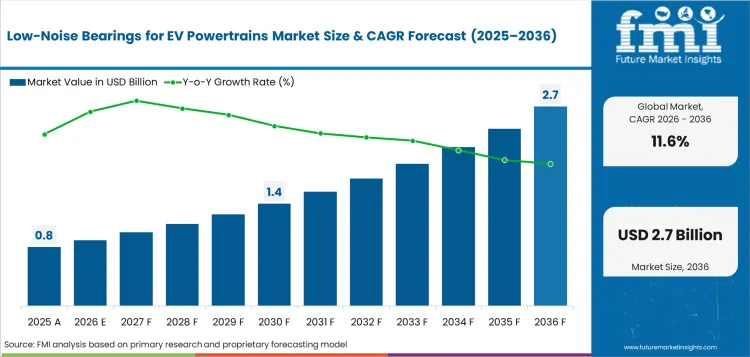
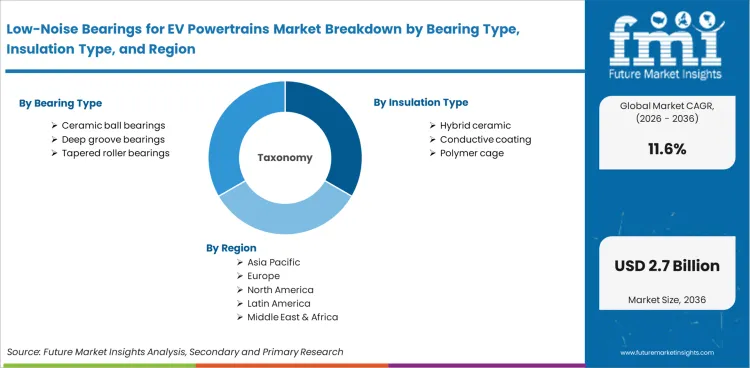
Low-noise bearings for EV powertrains market was valued at USD 0.8 billion in 2025. Revenue is estimated at USD 0.9 billion in 2026. The market is projected to reach USD 2.7 billion by 2036 at 11.6% CAGR during the forecast period. OEM line fit is expected to represent 63.0% of sales channel demand in 2026. Passenger BEVs are expected to hold 56.0% of vehicle type demand in 2026.
Summary of the Low-Noise Bearings for EV Powertrains Market
- Demand and Growth Drivers
- EV makers are focusing on quieter powertrains because cabin comfort affects the driving experience. Bearings help control sound inside the motor and e-axle.
- High-voltage systems can damage bearing surfaces through stray current. Ceramic and insulated bearings help protect the surface and reduce abnormal noise.
- Drive units are becoming more compact as automakers improve vehicle space and weight. Compact designs need bearings that can handle heat without raising vibration.
- Product and Segment View
- Ceramic ball bearings are preferred in EV motors with stricter noise targets, especially as electric vehicle motor design moves toward higher speed and tighter heat control.
- Hybrid ceramic insulation is useful for high-voltage e-axles. It helps protect the raceway and keeps bearing performance stable for longer use.
- OEM line fit leads demand because bearing choice must be fixed before vehicle launch. Testing happens early so the bearing can match motor speed and load.
- Geography and Competitive Outlook
- China supports demand through large EV production and fast model launches. Local validation support matters because suppliers must respond quickly to drive-unit changes.
- Germany and Japan support the market through precision bearing skills. Their suppliers can help with ceramic materials and acoustic testing.
- Competition depends on proof from real motor testing. Suppliers with low-vibration data and current-control designs are better positioned in EV powertrain programs.
- Analyst Opinion
- Nikhil Kaitwade, Principal Consultant at FMI states “Low-noise bearings are becoming a comfort and durability decision for EV powertrain programs. Quiet cabins make bearing vibration easier to hear. Suppliers able to prove low noise and current control will be preferred for e-axle and traction motor platforms.”
- Low-Noise Bearings for EV Powertrains Market Value Analysis
- The low-noise bearings for EV powertrains market is becoming more important as EV makers focus on quieter drive units.
- These bearings help reduce motor whine because EV cabins do not have engine sound to cover small noises.
- Demand is supported by high-voltage e-axles that need better protection from current damage.
- Suppliers can create more value by offering bearings that reduce vibration and support longer powertrain life.
Key Takeaways, Market Size, and Forecast
- Low-noise bearings for EV powertrains market was valued at USD 0.8 billion in 2025.
- Revenue is estimated at USD 0.9 billion in 2026.
- By 2036, the industry is projected to reach USD 2.7 billion.
- Market value is projected to rise at 11.6% CAGR from 2026 to 2036.
- Incremental opportunity is projected at USD 1.8 billion over the forecast period.
- OEM line fit is expected to represent 63.0% of sales channel demand in 2026.
- Passenger BEVs are expected to hold 56.0% of vehicle type demand in 2026.
- China is projected to post 13.2% CAGR by 2036 and India is projected to follow at 12.6% CAGR.
EV powertrains are getting quieter, so bearing noise is becoming easier for drivers and workshops to detect across EV Powertrain programs. In May 2024, Australia’s Office of Impact Analysis stated that UN Regulation 138/01 requires AVAS on new hybrid and electric vehicles. This makes sound control part of EV design. Low-noise bearing suppliers get value when their products help OEMs control unwanted drivetrain sound under a regulated acoustic profile. In March 2025, NSK developed a compact EV drive bearing that cut weight by 51% and torque by 25% versus conventional products. The development supports smaller eAxle layouts and gives OEMs a stronger reason to qualify bearing designs earlier in platform planning. Repair demand is also moving toward bearing-level fixes. In September 2024, Schaeffler introduced the E-Axle RepSystem-M for Hyundai Ioniq AE-EV models from 2016 to 2019 with the 88 kW EM09 motor. The kit lets garages replace damaged motor bearings instead of replacing the full motor or e-axle.
Low-Noise Bearings for EV Powertrains Market Definition
Low-noise bearings for EV powertrains are precision bearing parts used inside electric motors and e-axle systems. They help the motor rotate smoothly at high speed and reduce unwanted sound from the drive unit. These bearings are important because electric vehicles have quieter cabins than engine vehicles. Any small vibration from the motor can be heard more clearly by the driver and passengers.
Low-Noise Bearings for EV Powertrains Market Inclusions
Market scope covers low-noise bearing solutions categorized by bearing type, including ceramic ball bearings and deep groove bearings. Insulation type includes hybrid ceramic designs and conductive coating formats. Vehicle type includes passenger BEVs and passenger hybrids. Sales channel includes OEM line fit and aftermarket kits. Application scope includes e-axle motors and traction motors where traction motors adoption raises the need for quieter rotation and current protection. The scope also includes bearings used in reduction gearboxes where smooth rotation and low vibration support quieter EV powertrain operation. Revenue scope covers 2026 to 2036. The key stakeholders include bearing manufacturers, EV OEMs, e-axle suppliers, electric motor producers, tier-1 component suppliers, testing laboratories, distributors, repair kit providers and automotive service networks.
Low-Noise Bearings for EV Powertrains Market Exclusions
Scope excludes general wheel bearings unless sold for e-axle drive-unit integration. Industrial motor bearings and rail traction bearings are excluded from the market scope. Standalone lubricants and sensors are excluded unless bundled with the bearing package. Electric motors are outside scope unless a bearing supplier sells them as part of a complete drive-unit repair package.
Low-Noise Bearings for EV Powertrains Market Research Methodology
- Primary Research: FMI analysts reviewed EV drive-unit suppliers and bearing makers active in high-speed electric powertrains. The review focused on how low-noise bearings support motor speed, heat control and current protection.
- Desk Research: Public data from IEA and ACEA were used to understand EV demand. OICA data and official vehicle registration sources helped validate country-level market direction.
- Market Sizing and Forecasting: Market size was built using EV production volume and estimated bearing use per drive unit. Average bearing pricing was then applied across vehicle and application segments.
- Data Validation: Forecast checks compared EV sales trends with e-axle production plans. Supplier activity was reviewed to confirm demand across major automotive countries.
Why is the Low-Noise Bearings for EV Powertrains Market Growing?
- EV powertrains need quieter bearing designs as electric motors make small drive-unit sounds easier to hear inside the cabin.
- High-speed motors place more stress on cages and raceways. Lower friction reduces heat and supports smoother rotation.
- High-voltage systems raise electrical pitting risk. Ceramic balls and insulated layers help protect the bearing surface.
Electric drive units are becoming smaller and more powerful, so bearing design has a direct effect on motor life and cabin sound. In April 2025, Schaeffler presented 800 V electric motors with peak output up to 315 kW. The company said the motors reach efficiency above 97.0% in the 3,000 to 8,000 rpm range. Schaeffler also stated ceramic balls reduce bearing friction and prevent harmful current passage. Lower friction supports cooler running, which can reduce unwanted sound in compact EV drive units.
Market Segmentation Analysis
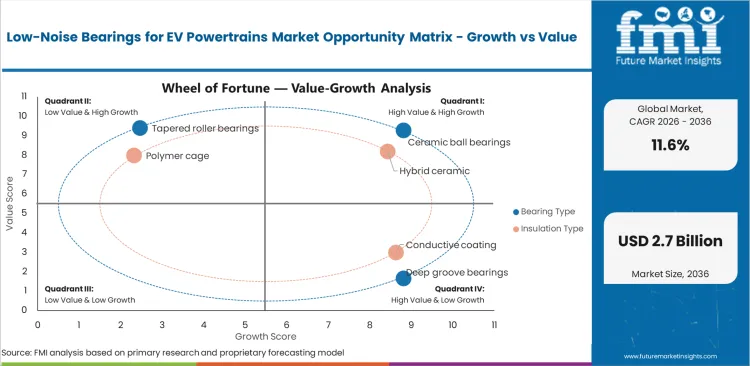
- Ceramic ball bearings are expected to lead bearing type demand with 39.0% share in 2026.
- In insulation type demand, hybrid ceramic insulation is expected to account for 42.0% share in 2026.
- Passenger BEVs are expected to hold 56.0% of vehicle type demand in 2026.
- OEM line fit is expected to represent 63.0% share in 2026.
- E-axle motors are expected to account for 48.0% of application demand in 2026.
The market is divided into five primary segment groups based on bearing type and insulation type. Vehicle type, sales channel and application complete the structure. Bearing type covers ceramic ball bearings and deep groove bearings. Tapered roller bearings and angular contact bearings complete the group. Insulation type covers hybrid ceramic formats and conductive coatings. Polymer cage designs and insulated rings are included. Vehicle type covers passenger BEVs and passenger hybrids. Light commercial EVs and performance EVs complete vehicle coverage. Sales channel covers OEM line fit and aftermarket kits. E-axle rebuild and distributor supply complete channel coverage. Application covers e-axle motors and reduction gearboxes. Traction motors and differential units complete application tracking.
Insights into Low-Noise Bearings for EV Powertrains Market by Bearing Type
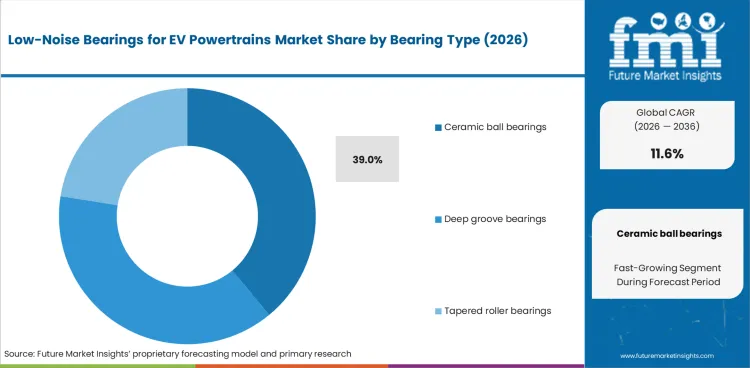
- Ceramic ball bearings are expected to hold 39.0% share in 2026 because EV motors need smoother rotation at high speed. The material helps reduce current damage, which supports quieter powertrain performance.
- Deep groove bearings support standard drive-unit layouts because they are easy to package and widely used in motor bearings. Ceramic designs are preferred in programs with stricter noise and current-control needs.
Insights into Low-Noise Bearings for EV Powertrains Market by Insulation Type
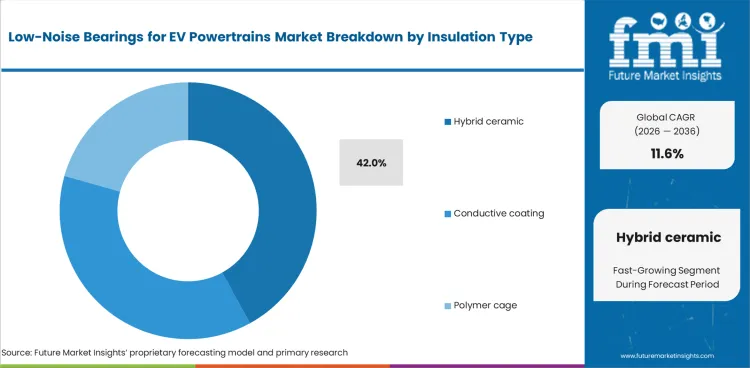
- Hybrid ceramic insulation is expected to account for 42.0% share in 2026 as high-voltage EV systems need better raceway protection. Ceramic balls help stop harmful current from passing through the bearing surface.
- Conductive coating designs serve EV platforms that need controlled current flow. Insulated bearing demand connects closely with ev powertrain design as voltage levels move up.
Insights into Low-Noise Bearings for EV Powertrains Market by Vehicle Type
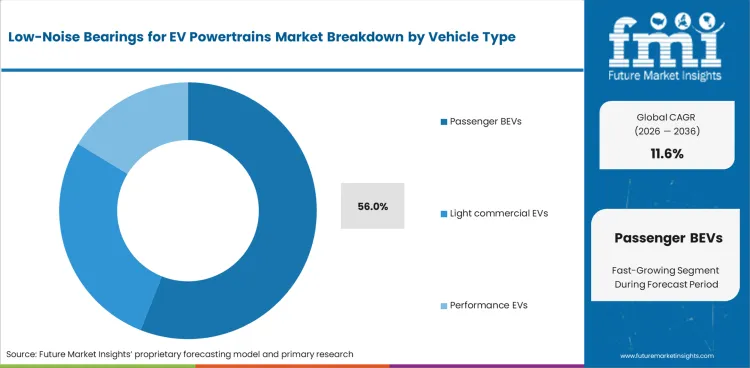
- Passenger BEVs are expected to represent 56.0% share in 2026 as quiet cabin feel becomes important for daily drivers. Bearing noise is easier to hear in BEVs because engine sound is absent.
- Performance EVs need bearings that can handle high motor speed and heat. Passenger BEVs create wider demand because they use low-noise bearings across more volume platforms.
Insights into Low-Noise Bearings for EV Powertrains Market by Sales Channel
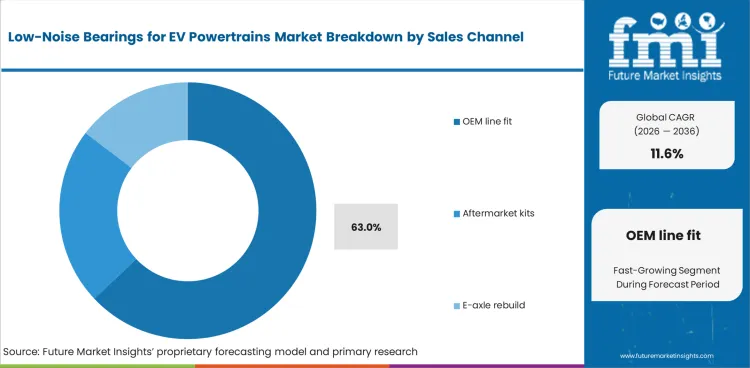
- OEM line fit is expected to hold 63.0% share in 2026 because bearing choice must match the motor before vehicle launch. Suppliers need test proof before an EV platform accepts the bearing package.
- Aftermarket kits are expected to grow as older EVs need powertrain repair support and e-axle remanufacturing and upgrade solutions demand can lift bearing-level service needs.
Insights into Low-Noise Bearings for EV Powertrains Market by Application
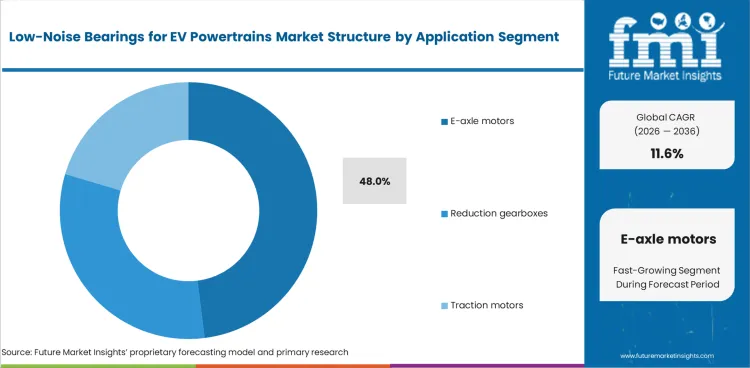
- E-axle motors are expected to account for 48.0% share in 2026 as compact drive units place bearings close to the motor shaft. Heat and current exposure make low-noise bearing design more important in e-axles.
- Traction motors need stable bearing motion because vibration can affect cabin sound and drive feel. The need connects with wider traction motors demand as EV production expands.
Low-Noise Bearings for EV Powertrains Market Drivers, Restraints, and Opportunities
- High-speed EV motors need bearing designs that reduce heat during daily driving and keep rotation smooth.
- Electrical pitting can raise service risk as current damage may create raceway wear and abnormal noise.
- Better bearing kits can support repair work as older EV powertrains move into higher-mileage service.
High-Speed EV Parts Need Quieter Motion
EV powertrain parts must run smoothly because engine sound no longer hides vibration. In May 2025, NTN developed a high-performance ball type sliding CVJ for EVs. NTN said the design improves quietness and efficiency by using newly developed grease. The product reduces torque loss by 25.0% compared with the conventional product. Lower torque loss means less heat during power transfer. Bearing suppliers can use the same low-friction direction for quieter EV powertrain parts.
Electrical Pitting Raises Bearing Risk
High-voltage e-axles need stronger bearing protection as current can damage the raceway surface. In May 2025, NTN started mass production of a resin mold insulated bearing for e-axles. NTN said the bearing has insulation resistance above 1,000 V. The same source states electrical pitting can lead to vibration and abnormal noise. A tested insulation layer gives EV powertrain engineers a safer route for high-voltage drive units.
Ceramic Bearings Create Better Upgrade Space
Ceramic bearing materials help reduce heat and current damage in high-speed motor use. JTEKT states hybrid ceramic bearings can prevent electric pitting and reduce bearing temperature rise. The same source says hybrid ceramic bearings can reduce temperature rise by 20.0% to 30.0% in selected high-speed applications. Cooler bearings protect grease life and support smoother rotation. Ceramic designs can support quieter drive units as e-axle packages become more compact.
Analysis of Low-Noise Bearings for EV Powertrains Market by Key Countries
.webp "Top Country Growth Comparison Low Noise Bearings For Ev Powertrains Market Cagr (2026 2036)")
| Country | CAGR |
|---|---|
| China | 13.2% |
| India | 12.6% |
| South Korea | 11.8% |
| Germany | 10.9% |
| United States | 10.4% |
| Japan | 9.8% |
| United Kingdom | 9.4% |
Source: Future Market Insights, 2026.
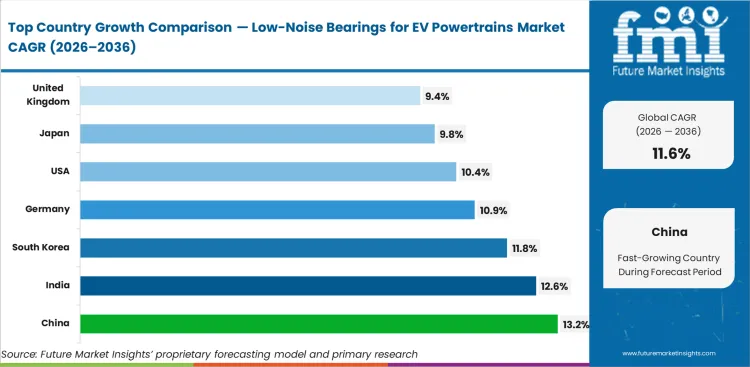
Low-Noise Bearings for EV Powertrains Market CAGR Analysis by Country
- The market in China is expected to expand at 13.2% CAGR through 2036 as high EV output increases demand for quiet e-axle bearings.
- India is projected to post 12.6% CAGR in the sector by 2036 with local assembly creating more drive-unit sourcing work.
- South Korea is expected to record 11.8% CAGR during the forecast period due to export BEV platforms needing precision bearings.
- The industry outlook in Germany points to 10.9% CAGR through 2036 as premium EV programs need tighter cabin-noise control.
- Demand in the United States is projected to advance at 10.4% CAGR during the forecast period as electric SUVs raise load needs.
- Japan is projected to register 9.8% CAGR in the market over the forecast period as domestic bearing technology supports EV programs.
- The United Kingdom is expected to move at 9.4% CAGR by 2036 with zero-emission rules supporting BEV demand.
Demand Outlook for Low-Noise Bearings for EV Powertrains Market in China
China remains the largest EV market, so bearing demand is tied to high vehicle output and drive-unit sourcing. Electric car sales exceeded 13.0 million units in 2025. China is projected to rise at 13.2% CAGR during the forecast period as local powertrain sourcing improves. Mass-market EV programs need bearings able to handle heat and rough road use. Local supply can help OEMs reduce lead time and support service-kit availability.
- Fleet EVs need durable bearing packages for high daily use and repeated stop-start driving.
- Local assembly raises demand for low-noise bearing kits matched to domestic drive-unit layouts.
- Price control is expected to shape supplier selection as EV programs move into wider use.
Demand Outlook for Low-Noise Bearings for EV Powertrains Market in India
India is moving from early EV use toward broader local assembly, so bearing demand is tied to cost and service life. IEA reported that India’s electric car sales rose 75.0% year on year in 2025 to reach 165,000 units, equal to nearly 4.0% of total car sales. India is forecast to rise at 12.6% CAGR during the forecast period as local powertrain sourcing improves. Mass-market EV programs need bearings able to handle heat and rough road use. Local supply can help OEMs reduce lead time and support service-kit availability.
- Fleet EVs need durable bearing packages for high daily use and repeated stop-start driving.
- Local assembly raises demand for low-noise bearing kits matched to domestic drive-unit layouts.
- Price control is expected to shape supplier selection as EV programs move into wider use.
Sales Analysis of Low-Noise Bearings for EV Powertrains Market in South Korea
South Korea has a useful position in this market because domestic automakers serve export EV platforms. Precision parts need to meet tight sound and durability targets before global shipment. South Korea is expected to record 11.8% CAGR by 2036 as export BEV programs need stable powertrain bearings. IEA reported that Korea’s electric car sales grew by around 65.0% year on year to more than 200,000 units in 2025, taking electric cars to 11.0% of sales for the first time. Higher EV share supports more demand for low-noise parts inside drive units.
- Export BEV platforms need repeatable bearing performance across many vehicle markets.
- Compact e-axles need low-noise bearings with stable heat behavior.
- Local engineering depth can support validation work for high-volume EV programs.
Opportunity Analysis of Low-Noise Bearings for EV Powertrains Market in Germany
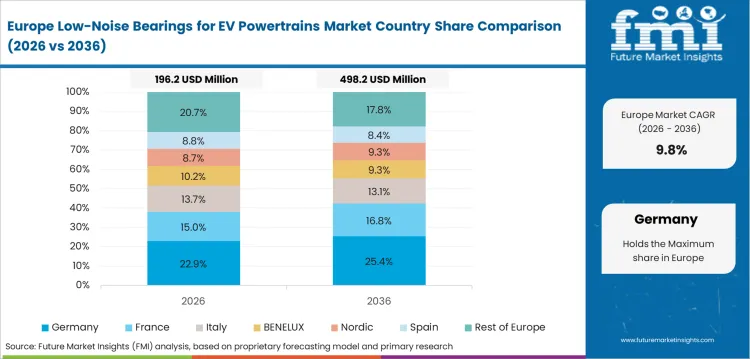
Germany is projected to move at 10.9% CAGR through 2036. Germany places high pressure on low-noise bearing performance because premium EV programs treat cabin sound as a product feature. IEA reported German electric car sales increased by 50.0% in 2025 to reach 850,000 units. Premium platforms need better vibration control for e-axle bearings and motor-side placements. Bearing makers with raceway finishing proof and acoustic test data will be better placed for launch programs.
- Premium EV programs need bearing designs able to control whine at higher road speeds.
- Engineering reviews place weight on acoustic testing and raceway finishing proof.
- Local powertrain programs favor suppliers able to support design changes before vehicle launch.
Demand Outlook for Low-Noise Bearings for EV Powertrains Market in the United States
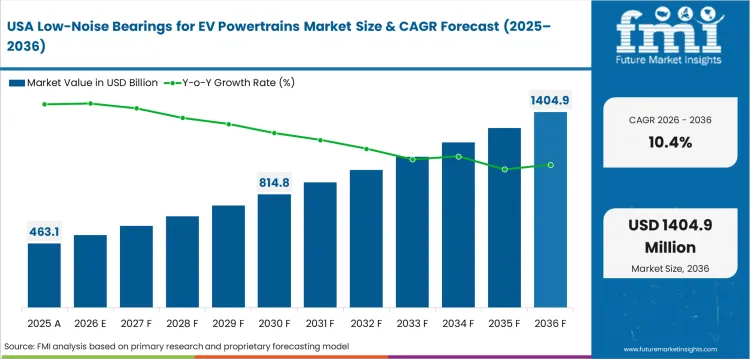
The United States needs heavier-duty low-noise bearing packages as electric SUVs and pickups take a larger role in EV planning. Argonne National Laboratory reported about 1.5 million plug-in electric vehicles sold in the United States during 2025. Heavier EVs place major torque load on e-axle bearings and can raise heat inside compact drive units. United States demand is forecast to advance at 10.4% CAGR during the forecast period. Quiet operation and load capacity will both guide supplier selection for larger EV platforms.
- Electric pickup programs need bearings able to handle torque without raising powertrain noise.
- Local testing support is important as powertrain validation cycles become shorter.
- Aftermarket planning will increase as early electric SUVs enter higher-mileage service.
Future Outlook for Low-Noise Bearings for EV Powertrains Market in Japan
Japan has a clear role in precision bearing design because local suppliers have deep ceramic and insulated bearing knowledge. The market in Japan is expected to register 9.8% CAGR by 2036 as EV drive units need better sound control. JTEKT’s 2025 engineering journal states electric pitting can cause noise during rotation and reduce bearing life in eAxle systems. Current protection becomes a practical buying point for EV motor bearings. Japanese suppliers can use ceramic material skill to support quiet and durable drive-unit programs.
- Ceramic bearing knowledge supports Japan’s role in low-noise EV powertrain parts.
- Local engineering depth helps suppliers meet e-axle speed and heat requirements.
- Export EV programs will favor suppliers with proven current-control and low-friction data.
Future Outlook for Low-Noise Bearings for EV Powertrains Market in the United Kingdom
The United Kingdom market is supported by zero-emission rules and demand for service-ready EV parts. UK transport statistics recorded 124,000 zero-emission cars registered for the first time in July to September 2025. Zero-emission cars made up 23.0% of all new car registrations in the same quarter. United Kingdom demand is projected to rise at 9.4% CAGR through 2036. Higher BEV use supports demand for quieter powertrain bearings and clearer repair guidance.
- Fleet operators need quiet drive units with predictable repair cost across high-mileage vehicles.
- Service channels require bearing kits with clear fitment guidance and safe repair steps.
- Zero-emission rules support BEV model flow and lift demand for low-noise powertrain parts.
Competitive Landscape and Strategic Positioning
- Competition is shifting toward bearings that can reduce vibration inside high-speed EV motors.
- Suppliers need motor test data to prove their bearings can keep cabin sound low.
- Ceramic and insulated bearing designs are gaining attention as high-voltage systems raise current damage risk.
- New suppliers face a tough entry path because OEMs need long validation data before approving drive-unit bearings.
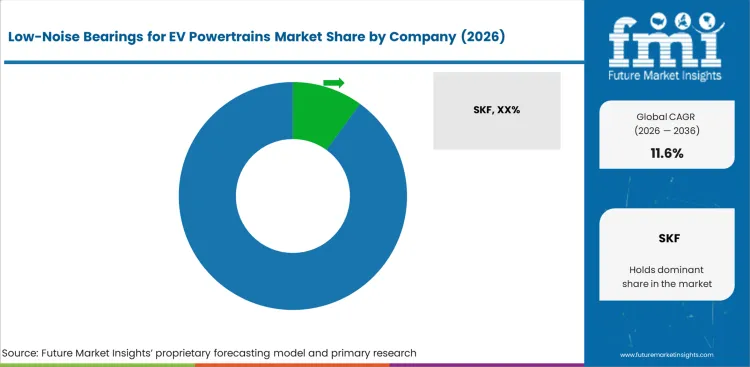
Competitive positioning depends on how well suppliers can prove bearing behavior inside EV drive units. SKF and Schaeffler have broad bearing portfolios with access to global EV programs. NTN has moved deeper into e-axle bearing insulation through its resin mold insulated bearing work. Timken states ePDFE bearings can help reduce noise and vibration in vehicles without engine rumble. That point fits EV powertrains because quieter vehicles make bearing sound easier to detect.
JTEKT adds technical depth through ceramic bearing materials for high-speed use. Its EXSEV ceramic bearing source says hybrid ceramic bearings can reduce temperature rise by 20.0% to 30.0% in selected high-speed applications. Lower heat can protect grease and reduce friction inside compact drive units. This gives ceramic bearing suppliers a stronger case when EV engineers review durability and cabin noise risk.
Key Companies in the Low-Noise Bearings for EV Powertrains Market
- Global Bearing Specialists: SKF and Schaeffler AG hold important positions through EV bearing portfolios. NSK Ltd. and NTN Corporation add powertrain engineering depth.
- Precision and Load Specialists: JTEKT Corporation and The Timken Company support demand through drivetrain bearing capability and load-focused designs.
- Miniature Precision Supplier: MinebeaMitsumi Inc. supports select precision motor bearing demand through small-format bearing capability.
- Active Market Relevance: All listed companies are active bearing or motion component suppliers with EV powertrain or electric motor bearing capability.
Competitive Benchmarking: Low-Noise Bearings for EV Powertrains Market
| Company | NVH Test Depth | Current Control Design | High-Speed Bearing Range | Geographic Footprint |
|---|---|---|---|---|
| SKF | High | High | High | Global with Europe and China strength |
| Schaeffler AG | High | Medium | High | Global with German engineering depth |
| NSK Ltd. | High | High | High | Japan centered with global supply |
| NTN Corporation | Medium | High | Medium | Japan and North America strength |
| JTEKT Corporation | Medium | Medium | Medium | Japan centered EV drivetrain supply |
| The Timken Company | Medium | Medium | High | North America and Europe strength |
| MinebeaMitsumi Inc. | Medium | Low | Medium | Asia centered precision bearing core |
Source: Future Market Insights competitive analysis, 2026.
Key Developments in Low-Noise Bearings for EV Powertrains Market
- March 2026, NSK developed a compact and lightweight deep groove ball bearing for electric vehicles. The bearing is designed for EV drive units and uses a narrow-width combined plastic cage.
- In April 2026, Schaeffler received the Sustainability Award in Automotive for its E-Axle Repair Tool. Schaeffler states the tool supports safe disassembly and assembly of electric motors. It can press bearings into place without damaging sensitive motor parts.
Key Players in the Low-Noise Bearings for EV Powertrains Market
Major Global Companies
- SKF
- Schaeffler AG
- NSK Ltd.
- NTN Corporation
- JTEKT Corporation
Specialist and Regional Companies
- The Timken Company
- MinebeaMitsumi Inc.
Report Scope and Coverage
| Parameter | Details |
|---|---|
| Quantitative Units | USD 0.9 billion to USD 2.7 billion at 11.6% CAGR |
| Market Definition | Precision bearings used inside EV motors and e-axle systems to reduce noise, heat and current damage |
| Segments Covered | Bearing type, insulation type, vehicle type, sales channel, application and region |
| Bearing Type | Ceramic ball bearings, deep groove bearings, tapered roller bearings and angular contact bearings |
| Insulation Type | Hybrid ceramic, conductive coating, polymer cage and insulated ring |
| Vehicle Type | Passenger BEVs, passenger hybrids, light commercial EVs and performance EVs |
| Sales Channel | OEM line fit, aftermarket kits, e-axle rebuild and distributor supply |
| Application | E-axle motors, reduction gearboxes, traction motors and differential units |
| Regions Covered | North America, Latin America, Western Europe, Eastern Europe, East Asia, South Asia and Pacific, Middle East and Africa |
| Countries Covered | China, India, South Korea, Germany, United States, Japan, United Kingdom and more than 30.0 countries |
| Key Companies Profiled | SKF, Schaeffler AG, NSK Ltd., NTN Corporation, JTEKT Corporation, The Timken Company and MinebeaMitsumi Inc. |
| Forecast Period | 2026 to 2036 |
| Approach | Hybrid bottom-up and top-down method using EV output, e-axle bearing use, bearing price bands and supplier activity |
Low-Noise Bearings for EV Powertrains Market Breakdown by Segment
Low-Noise Bearings for EV Powertrains Market Segmented by Bearing Type:
- Ceramic ball bearings
- Deep groove bearings
- Tapered roller bearings
- Angular contact bearings
Low-Noise Bearings for EV Powertrains Market Segmented by Insulation Type:
- Hybrid ceramic
- Conductive coating
- Polymer cage
- Insulated ring
Low-Noise Bearings for EV Powertrains Market Segmented by Vehicle Type:
- Passenger BEVs
- Passenger hybrids
- Light commercial EVs
- Performance EVs
Low-Noise Bearings for EV Powertrains Market Segmented by Sales Channel:
- OEM line fit
- Aftermarket kits
- E-axle rebuild
- Distributor supply
Low-Noise Bearings for EV Powertrains Market Segmented by Application:
- E-axle motors
- Reduction gearboxes
- Traction motors
- Differential units
Low-Noise Bearings for EV Powertrains Market Segmented by Region:
- North America
- Latin America
- Western Europe
- Eastern Europe
- East Asia
- South Asia and Pacific
- Middle East and Africa
Research Sources and Bibliography
- Australian Government Office of Impact Analysis. (2024, May 2). Acoustic Vehicle Alerting Systems for Quiet Road Transport Vehicles. Office of Impact Analysis.
- NSK Ltd. (2025, March 26). NSK develops compact, lightweight deep groove ball bearing for EVs: Helping to reduce EV drive unit size, weight, and electricity consumption. NSK Ltd.
- Schaeffler AG. (2024, September 6). Schaeffler Vehicle Lifetime Solutions presents first repair kit for electric motor for the Hyundai Ioniq. Schaeffler AG.
- Schaeffler AG. (2025, April 3). On the road to decarbonization: Schaeffler presents e-motors with outputs of up to 315 kW. Schaeffler AG.
- NTN Corporation. (2025, May 13). NTN develops high performance ball type sliding CVJ for EVs. NTN Corporation.
- NTN Corporation. (2025, May 21). NTN starts mass-production of “Resin Mold Insulated Bearing” for e-Axle. NTN Corporation.
- JTEKT Corporation. (n.d.). EXSEV bearings and ceramic bearings. Koyo Bearings / JTEKT Corporation.
- International Energy Agency. (2026, May). Global EV Outlook 2026: Trends in electric cars. International Energy Agency.
- Argonne National Laboratory. (2026). Light Duty Electric Drive Vehicles Monthly Sales Updates. Argonne National Laboratory.
- United Kingdom Department for Transport. (2026, January 15). Vehicle licensing statistics, United Kingdom: July to September 2025. GOV.UK.
- Schaeffler AG. (2026, April 23). Schaeffler receives Sustainability Award in the Automotive sector with E-Axle Repair Tool. Schaeffler AG.
- NSK Ltd. (2026, March). Compact, lightweight deep groove ball bearing for electric vehicles. NSK Technical Review No. 2604.
This Report Answers
- How big is the low-noise bearings for EV powertrains market in 2026?
- What revenue is the market projected to reach by 2036?
- What CAGR is expected for the market from 2026 to 2036?
- Which bearing type is expected to lead demand in 2026?
- Which vehicle type holds the leading position in 2026?
- Which countries are projected to record higher demand by 2036?
- How does OEM line fit shape low-noise bearing demand?
- Which companies are active in low-noise EV powertrain bearings?
- How does FMI size and validate the market?
Frequently Asked Questions
How big is the low-noise bearings for EV powertrains market in 2026?
The market is estimated at USD 0.9 billion in 2026 as EV drive-unit programs need quieter bearing packages.
What will be the size of the low-noise bearings for EV powertrains market by 2036?
The market is projected to reach USD 2.7 billion by 2036 as e-axle and traction motor use expands.
What CAGR is expected for the low-noise bearings for EV powertrains market?
Demand is projected to rise at 11.6% CAGR from 2026 to 2036 due to higher EV powertrain volume.
Which bearing type is expected to lead the market in 2026?
Ceramic ball bearings are expected to hold 39.0% share in 2026 due to lower vibration and current damage resistance.
Which sales channel is expected to lead demand in 2026?
OEM line fit is expected to represent 63.0% share in 2026 as bearing selection happens during drive-unit validation.
Which country is expected to record the faster pace by 2036?
China is projected to post 13.2% CAGR by 2036 as high EV output expands e-axle sourcing scale.
Preview the report firsthand - request a free sample
Get SampleGet the brochure for pricing and purchase details.
Get PDFTable of Content
- Executive Summary
- Global Market Outlook
- Demand-side Trends
- Supply-side Trends
- Technology Roadmap Analysis
- Analysis and Recommendations
- Market Overview
- Market Coverage / Taxonomy
- Market Definition / Scope / Limitations
- Research Methodology
- Chapter Orientation
- Analytical Lens and Working Hypotheses
- Market Structure, Signals, and Trend Drivers
- Benchmarking and Cross-market Comparability
- Market Sizing, Forecasting, and Opportunity Mapping
- Research Design and Evidence Framework
- Desk Research Programme (Secondary Evidence)
- Company Annual and Sustainability Reports
- Peer-reviewed Journals and Academic Literature
- Corporate Websites, Product Literature, and Technical Notes
- Earnings Decks and Investor Briefings
- Statutory Filings and Regulatory Disclosures
- Technical White Papers and Standards Notes
- Trade Journals, Industry Magazines, and Analyst Briefs
- Conference Proceedings, Webinars, and Seminar Materials
- Government Statistics Portals and Public Data Releases
- Press Releases and Reputable Media Coverage
- Specialist Newsletters and Curated Briefings
- Sector Databases and Reference Repositories
- FMI Internal Proprietary Databases and Historical Market Datasets
- Subscription Datasets and Paid Sources
- Social Channels, Communities, and Digital Listening Inputs
- Additional Desk Sources
- Expert Input and Fieldwork (Primary Evidence)
- Primary Modes
- Qualitative Interviews and Expert Elicitation
- Quantitative Surveys and Structured Data Capture
- Blended Approach
- Why Primary Evidence is Used
- Field Techniques
- Interviews
- Surveys
- Focus Groups
- Observational and In-context Research
- Social and Community Interactions
- Stakeholder Universe Engaged
- C-suite Leaders
- Board Members
- Presidents and Vice Presidents
- R&D and Innovation Heads
- Technical Specialists
- Domain Subject-matter Experts
- Scientists
- Physicians and Other Healthcare Professionals
- Governance, Ethics, and Data Stewardship
- Research Ethics
- Data Integrity and Handling
- Primary Modes
- Tooling, Models, and Reference Databases
- Desk Research Programme (Secondary Evidence)
- Data Engineering and Model Build
- Data Acquisition and Ingestion
- Cleaning, Normalisation, and Verification
- Synthesis, Triangulation, and Analysis
- Quality Assurance and Audit Trail
- Market Background
- Market Dynamics
- Drivers
- Restraints
- Opportunity
- Trends
- Scenario Forecast
- Demand in Optimistic Scenario
- Demand in Likely Scenario
- Demand in Conservative Scenario
- Opportunity Map Analysis
- Product Life Cycle Analysis
- Supply Chain Analysis
- Investment Feasibility Matrix
- Value Chain Analysis
- PESTLE and Porter’s Analysis
- Regulatory Landscape
- Regional Parent Market Outlook
- Production and Consumption Statistics
- Import and Export Statistics
- Market Dynamics
- Global Market Analysis 2021 to 2025 and Forecast, 2026 to 2036
- Historical Market Size Value (USD Million) Analysis, 2021 to 2025
- Current and Future Market Size Value (USD Million) Projections, 2026 to 2036
- Y-o-Y Growth Trend Analysis
- Absolute $ Opportunity Analysis
- Global Market Pricing Analysis 2021 to 2025 and Forecast 2026 to 2036
- Global Market Analysis 2021 to 2025 and Forecast 2026 to 2036, By Bearing Type
- Introduction / Key Findings
- Historical Market Size Value (USD Million) Analysis By Bearing Type , 2021 to 2025
- Current and Future Market Size Value (USD Million) Analysis and Forecast By Bearing Type , 2026 to 2036
- Ceramic ball bearings
- Deep groove bearings
- Tapered roller bearings
- Ceramic ball bearings
- Y-o-Y Growth Trend Analysis By Bearing Type , 2021 to 2025
- Absolute $ Opportunity Analysis By Bearing Type , 2026 to 2036
- Global Market Analysis 2021 to 2025 and Forecast 2026 to 2036, By Insulation Type
- Introduction / Key Findings
- Historical Market Size Value (USD Million) Analysis By Insulation Type, 2021 to 2025
- Current and Future Market Size Value (USD Million) Analysis and Forecast By Insulation Type, 2026 to 2036
- Hybrid ceramic
- Conductive coating
- Polymer cage
- Hybrid ceramic
- Y-o-Y Growth Trend Analysis By Insulation Type, 2021 to 2025
- Absolute $ Opportunity Analysis By Insulation Type, 2026 to 2036
- Global Market Analysis 2021 to 2025 and Forecast 2026 to 2036, By Vehicle Type
- Introduction / Key Findings
- Historical Market Size Value (USD Million) Analysis By Vehicle Type, 2021 to 2025
- Current and Future Market Size Value (USD Million) Analysis and Forecast By Vehicle Type, 2026 to 2036
- Passenger BEVs
- Light commercial EVs
- Performance EVs
- Passenger BEVs
- Y-o-Y Growth Trend Analysis By Vehicle Type, 2021 to 2025
- Absolute $ Opportunity Analysis By Vehicle Type, 2026 to 2036
- Global Market Analysis 2021 to 2025 and Forecast 2026 to 2036, By Sales Channel
- Introduction / Key Findings
- Historical Market Size Value (USD Million) Analysis By Sales Channel, 2021 to 2025
- Current and Future Market Size Value (USD Million) Analysis and Forecast By Sales Channel, 2026 to 2036
- OEM line fit
- Aftermarket kits
- E-axle rebuild
- OEM line fit
- Y-o-Y Growth Trend Analysis By Sales Channel, 2021 to 2025
- Absolute $ Opportunity Analysis By Sales Channel, 2026 to 2036
- Global Market Analysis 2021 to 2025 and Forecast 2026 to 2036, By Application
- Introduction / Key Findings
- Historical Market Size Value (USD Million) Analysis By Application, 2021 to 2025
- Current and Future Market Size Value (USD Million) Analysis and Forecast By Application, 2026 to 2036
- E-axle motors
- Reduction gearboxes
- Traction motors
- E-axle motors
- Y-o-Y Growth Trend Analysis By Application, 2021 to 2025
- Absolute $ Opportunity Analysis By Application, 2026 to 2036
- Global Market Analysis 2021 to 2025 and Forecast 2026 to 2036, By Region
- Introduction
- Historical Market Size Value (USD Million) Analysis By Region, 2021 to 2025
- Current Market Size Value (USD Million) Analysis and Forecast By Region, 2026 to 2036
- North America
- Latin America
- Western Europe
- Eastern Europe
- East Asia
- South Asia and Pacific
- Middle East & Africa
- Market Attractiveness Analysis By Region
- North America Market Analysis 2021 to 2025 and Forecast 2026 to 2036, By Country
- Historical Market Size Value (USD Million) Trend Analysis By Market Taxonomy, 2021 to 2025
- Market Size Value (USD Million) Forecast By Market Taxonomy, 2026 to 2036
- By Country
- USA
- Canada
- Mexico
- By Bearing Type
- By Insulation Type
- By Vehicle Type
- By Sales Channel
- By Application
- By Country
- Market Attractiveness Analysis
- By Country
- By Bearing Type
- By Insulation Type
- By Vehicle Type
- By Sales Channel
- By Application
- Key Takeaways
- Latin America Market Analysis 2021 to 2025 and Forecast 2026 to 2036, By Country
- Historical Market Size Value (USD Million) Trend Analysis By Market Taxonomy, 2021 to 2025
- Market Size Value (USD Million) Forecast By Market Taxonomy, 2026 to 2036
- By Country
- Brazil
- Chile
- Rest of Latin America
- By Bearing Type
- By Insulation Type
- By Vehicle Type
- By Sales Channel
- By Application
- By Country
- Market Attractiveness Analysis
- By Country
- By Bearing Type
- By Insulation Type
- By Vehicle Type
- By Sales Channel
- By Application
- Key Takeaways
- Western Europe Market Analysis 2021 to 2025 and Forecast 2026 to 2036, By Country
- Historical Market Size Value (USD Million) Trend Analysis By Market Taxonomy, 2021 to 2025
- Market Size Value (USD Million) Forecast By Market Taxonomy, 2026 to 2036
- By Country
- Germany
- UK
- Italy
- Spain
- France
- Nordic
- BENELUX
- Rest of Western Europe
- By Bearing Type
- By Insulation Type
- By Vehicle Type
- By Sales Channel
- By Application
- By Country
- Market Attractiveness Analysis
- By Country
- By Bearing Type
- By Insulation Type
- By Vehicle Type
- By Sales Channel
- By Application
- Key Takeaways
- Eastern Europe Market Analysis 2021 to 2025 and Forecast 2026 to 2036, By Country
- Historical Market Size Value (USD Million) Trend Analysis By Market Taxonomy, 2021 to 2025
- Market Size Value (USD Million) Forecast By Market Taxonomy, 2026 to 2036
- By Country
- Russia
- Poland
- Hungary
- Balkan & Baltic
- Rest of Eastern Europe
- By Bearing Type
- By Insulation Type
- By Vehicle Type
- By Sales Channel
- By Application
- By Country
- Market Attractiveness Analysis
- By Country
- By Bearing Type
- By Insulation Type
- By Vehicle Type
- By Sales Channel
- By Application
- Key Takeaways
- East Asia Market Analysis 2021 to 2025 and Forecast 2026 to 2036, By Country
- Historical Market Size Value (USD Million) Trend Analysis By Market Taxonomy, 2021 to 2025
- Market Size Value (USD Million) Forecast By Market Taxonomy, 2026 to 2036
- By Country
- China
- Japan
- South Korea
- By Bearing Type
- By Insulation Type
- By Vehicle Type
- By Sales Channel
- By Application
- By Country
- Market Attractiveness Analysis
- By Country
- By Bearing Type
- By Insulation Type
- By Vehicle Type
- By Sales Channel
- By Application
- Key Takeaways
- South Asia and Pacific Market Analysis 2021 to 2025 and Forecast 2026 to 2036, By Country
- Historical Market Size Value (USD Million) Trend Analysis By Market Taxonomy, 2021 to 2025
- Market Size Value (USD Million) Forecast By Market Taxonomy, 2026 to 2036
- By Country
- India
- ASEAN
- Australia & New Zealand
- Rest of South Asia and Pacific
- By Bearing Type
- By Insulation Type
- By Vehicle Type
- By Sales Channel
- By Application
- By Country
- Market Attractiveness Analysis
- By Country
- By Bearing Type
- By Insulation Type
- By Vehicle Type
- By Sales Channel
- By Application
- Key Takeaways
- Middle East & Africa Market Analysis 2021 to 2025 and Forecast 2026 to 2036, By Country
- Historical Market Size Value (USD Million) Trend Analysis By Market Taxonomy, 2021 to 2025
- Market Size Value (USD Million) Forecast By Market Taxonomy, 2026 to 2036
- By Country
- Kingdom of Saudi Arabia
- Other GCC Countries
- Turkiye
- South Africa
- Other African Union
- Rest of Middle East & Africa
- By Bearing Type
- By Insulation Type
- By Vehicle Type
- By Sales Channel
- By Application
- By Country
- Market Attractiveness Analysis
- By Country
- By Bearing Type
- By Insulation Type
- By Vehicle Type
- By Sales Channel
- By Application
- Key Takeaways
- Key Countries Market Analysis
- USA
- Pricing Analysis
- Market Share Analysis, 2025
- By Bearing Type
- By Insulation Type
- By Vehicle Type
- By Sales Channel
- By Application
- Canada
- Pricing Analysis
- Market Share Analysis, 2025
- By Bearing Type
- By Insulation Type
- By Vehicle Type
- By Sales Channel
- By Application
- Mexico
- Pricing Analysis
- Market Share Analysis, 2025
- By Bearing Type
- By Insulation Type
- By Vehicle Type
- By Sales Channel
- By Application
- Brazil
- Pricing Analysis
- Market Share Analysis, 2025
- By Bearing Type
- By Insulation Type
- By Vehicle Type
- By Sales Channel
- By Application
- Chile
- Pricing Analysis
- Market Share Analysis, 2025
- By Bearing Type
- By Insulation Type
- By Vehicle Type
- By Sales Channel
- By Application
- Germany
- Pricing Analysis
- Market Share Analysis, 2025
- By Bearing Type
- By Insulation Type
- By Vehicle Type
- By Sales Channel
- By Application
- UK
- Pricing Analysis
- Market Share Analysis, 2025
- By Bearing Type
- By Insulation Type
- By Vehicle Type
- By Sales Channel
- By Application
- Italy
- Pricing Analysis
- Market Share Analysis, 2025
- By Bearing Type
- By Insulation Type
- By Vehicle Type
- By Sales Channel
- By Application
- Spain
- Pricing Analysis
- Market Share Analysis, 2025
- By Bearing Type
- By Insulation Type
- By Vehicle Type
- By Sales Channel
- By Application
- France
- Pricing Analysis
- Market Share Analysis, 2025
- By Bearing Type
- By Insulation Type
- By Vehicle Type
- By Sales Channel
- By Application
- India
- Pricing Analysis
- Market Share Analysis, 2025
- By Bearing Type
- By Insulation Type
- By Vehicle Type
- By Sales Channel
- By Application
- ASEAN
- Pricing Analysis
- Market Share Analysis, 2025
- By Bearing Type
- By Insulation Type
- By Vehicle Type
- By Sales Channel
- By Application
- Australia & New Zealand
- Pricing Analysis
- Market Share Analysis, 2025
- By Bearing Type
- By Insulation Type
- By Vehicle Type
- By Sales Channel
- By Application
- China
- Pricing Analysis
- Market Share Analysis, 2025
- By Bearing Type
- By Insulation Type
- By Vehicle Type
- By Sales Channel
- By Application
- Japan
- Pricing Analysis
- Market Share Analysis, 2025
- By Bearing Type
- By Insulation Type
- By Vehicle Type
- By Sales Channel
- By Application
- South Korea
- Pricing Analysis
- Market Share Analysis, 2025
- By Bearing Type
- By Insulation Type
- By Vehicle Type
- By Sales Channel
- By Application
- Russia
- Pricing Analysis
- Market Share Analysis, 2025
- By Bearing Type
- By Insulation Type
- By Vehicle Type
- By Sales Channel
- By Application
- Poland
- Pricing Analysis
- Market Share Analysis, 2025
- By Bearing Type
- By Insulation Type
- By Vehicle Type
- By Sales Channel
- By Application
- Hungary
- Pricing Analysis
- Market Share Analysis, 2025
- By Bearing Type
- By Insulation Type
- By Vehicle Type
- By Sales Channel
- By Application
- Kingdom of Saudi Arabia
- Pricing Analysis
- Market Share Analysis, 2025
- By Bearing Type
- By Insulation Type
- By Vehicle Type
- By Sales Channel
- By Application
- Turkiye
- Pricing Analysis
- Market Share Analysis, 2025
- By Bearing Type
- By Insulation Type
- By Vehicle Type
- By Sales Channel
- By Application
- South Africa
- Pricing Analysis
- Market Share Analysis, 2025
- By Bearing Type
- By Insulation Type
- By Vehicle Type
- By Sales Channel
- By Application
- USA
- Market Structure Analysis
- Competition Dashboard
- Competition Benchmarking
- Market Share Analysis of Top Players
- By Regional
- By Bearing Type
- By Insulation Type
- By Vehicle Type
- By Sales Channel
- By Application
- Competition Analysis
- Competition Deep Dive
- SKF
- Overview
- Product Portfolio
- Profitability by Market Segments (Product/Age /Sales Channel/Region)
- Sales Footprint
- Strategy Overview
- Marketing Strategy
- Product Strategy
- Channel Strategy
- Schaeffler AG
- NSK Ltd.
- NTN Corporation
- JTEKT Corporation
- SKF
- Competition Deep Dive
- Assumptions & Acronyms Used


