

- Market Size (2026)
- USD 10.2 Bn
- Forecast (2036)
- USD 21.6 Bn
- CAGR (2026 to 2036)
- 7.8%
Low-Noise Driveline System Components Market Size, Market Forecast and Outlook By FMI
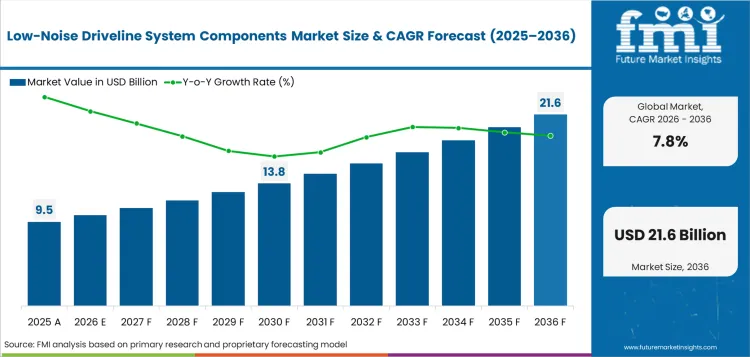
Low-noise driveline system components market was valued at USD 9.5 billion in 2025 and is expected to reach USD 10.2 billion in 2026. Demand is projected to reach USD 21.6 billion by 2036 at 7.8% CAGR during the forecast period. OEM fitment is expected to account for 68.0% share of sales channel demand in 2026. Passenger EVs are forecast to represent 51.0% share of vehicle type demand in 2026.
Key Takeaways, Market Size, and Forecast
- Low-noise driveline system components market stood at USD 9.5 billion in 2025.
- By 2036, the industry is projected to reach USD 21.6 billion.
- Market value is projected to expand at 7.8% CAGR during the forecast period.
- Incremental opportunity is projected at USD 11.4 billion over 2026 to 2036.
- OEM fitment is anticipated to represent 68.0% share of sales channel demand in 2026.
- Passenger EVs are expected to account for 51.0% share of vehicle type demand in 2026.
- China at 9.2% CAGR and India at 9.0% CAGR are forecast above the world average through 2036.
Summary of the Low-Noise Driveline System Components Market
- Demand and Growth Drivers
- EV cabins are much quieter than petrol or diesel vehicle cabins. Small sounds from gears and bearings are easier to hear, so automakers need driveline parts that reduce noise.
- Electric axles are becoming more compact. This creates demand for bearings and gears that can work smoothly in less space.
- Repair demand is also improving as older EVs enter workshops. Service providers need replacement parts that can reduce noise without changing the full electric drive unit.
- Product and Segment View
- Low-noise bearings are important because they support fast-moving shafts inside electric axles. Better bearing control helps reduce unwanted sound during daily driving.
- Precision gears support smoother power transfer in EV and hybrid drivetrains. Better gear finish helps reduce whine from compact reducer units.
- OEM fitment is the main route for these parts because noise control must be checked before vehicle launch. Aftermarket kits are gaining use as EV repair work becomes more common.
- Geography and Competitive Outlook
- China and India are important markets because local EV production is expanding. More electric vehicle programs create demand for quieter driveline parts.
- Germany and Japan have strong engineering depth in bearings and driveline systems. Suppliers in these countries can support more advanced noise testing.
- Competition is based on proof of performance. Suppliers with tested parts and repair-ready solutions are better placed with automakers and service networks.
- Analyst Opinion
- Nikhil Kaitwade, Principal Analyst at FMI, says, “Low-noise driveline parts are becoming important for vehicle comfort and durability. EVs need quieter bearings and reducers because motor sound makes small driveline noise easier to hear. Suppliers with better gear control and bearing data will be preferred in OEM programs and e-axle service networks.”
- Low-Noise Driveline System Components Market Value Analysis
- The low-noise driveline system components market is moving from a comfort-focused part area into a clearer EV performance requirement.
- Market value comes from bearings and gears that reduce cabin noise as electric motors make driveline sound easier to hear.
- OEM demand is supported by the need to approve quieter e-axles before vehicle launch.
- Aftermarket value is improving as workshops replace worn bearings and reducer parts in place of the full electric drive unit.
Low-noise driveline system components are gaining importance as transport-noise policy and EV cabin expectations push sound control deeper into vehicle design. In 2024, the European Environment Agency said road traffic remains the most widespread source of transport noise exposure in Europe, keeping noise reduction high on the mobility policy agenda. IEA reported that global electric car sales exceeded 20 million units in 2025, with electric models accounting for 25% of new car sales. This wider EV base makes reducer whine, bearing tone and driveline vibration easier to notice during daily driving.
In August 2025, AISIN, BluE Nexus and DENSO said Isuzu’s D-MAX EV adopted their eAxle system, with the release highlighting low noise and low vibration for BEV pickup use. These signals show that quieter driveline performance is moving from a comfort feature into a validation need for EV and hybrid platforms. Suppliers with NVH testing capability and proven low-noise component programs will be better placed as OEMs tighten launch approval and repair networks prepare for higher-mileage electric driveline service.
Low-Noise Driveline System Components Market Definition
Low-noise driveline system components are parts used to reduce unwanted sound and vibration in vehicle power transfer systems. These components help control gear whine with bearing tone and shaft vibration during cruising and load changes. They are becoming more important in electric and hybrid vehicles because quieter cabins make small driveline sounds easier to notice. Automakers use these parts to improve ride comfort and support smoother vehicle operation.
Low-Noise Driveline System Components Market Inclusions
Market scope covers low-noise driveline system components categorized by component type, including low-noise bearings and precision gears; vehicle type, including passenger EVs and hybrid cars; driveline type, including electric axles and hybrid drivetrains; sales channel, including OEM fitment and aftermarket kits; and application, including e-axle reducers and differential units. The scope also includes components used within electric and hybrid driveline systems where bearing stability, gear mesh control and vibration reduction operate as part of one quiet power transfer system.
Revenue scope covers 2026 to 2036. Key stakeholders include bearing manufacturers, gear suppliers, e-axle manufacturers, driveline system integrators, vehicle OEMs, EV repair networks, aftermarket kit suppliers, remanufacturing providers, NVH testing specialists and automotive service workshops.
Low-Noise Driveline System Components Market Exclusions
Scope excludes complete battery packs and traction inverters. Standalone vehicle software is outside the market boundary. General bearings are excluded unless sold for driveline NVH or high-speed e-axle duty. Pure driveline lubricants for EVs are excluded unless supplied with validated component kits.
Low-Noise Driveline System Components Market Research Methodology
- Primary Research: FMI analysts reviewed companies that supply bearings, gears and other driveline parts for electric powertrains. The review helped identify which components are most important for lower noise and smoother vehicle operation.
- Desk Research: Public data from IEA and OICA was used to check vehicle production and EV sales trends. These sources helped connect driveline component demand with real vehicle market activity.
- Market Sizing and Forecasting: Market size was estimated by studying vehicle output, e-drive use and component pricing. The forecast also considered how OEM fitment and aftermarket repair demand could change over time.
- Data Validation: Forecast checks compared EV sales trends with e-axle repair activity in major automotive countries. This helped confirm whether the demand outlook matched real production and service patterns.
Why is the Low-Noise Driveline System Components Market Expanding?
- EV cabins are quieter than petrol or diesel vehicle cabins, so gear noise and bearing sound are easier to notice during daily driving.
- Compact e-axle designs need smaller bearings that can stay stable at higher shaft speeds. This helps reduce vibration inside the drive unit.
- Repair demand is improving as older EVs enter workshops. Service providers need component-level fixes that avoid full electric drive replacement.
Vehicle electrification is changing how automakers manage driveline sound. Combustion engines once covered small gear and bearing noise, but EV cabins make those sounds easier to notice. In October 2025, AISIN with BluE Nexus and DENSO said the Toyota bZ4X eAxle improved transmission efficiency through better gear precision and lower oil agitation resistance. The same design direction supports quieter reducer gears and automotive electric drivetrain components. Suppliers with early noise-control proof can support vehicle launch programs more effectively.
High-speed e-axles are creating stricter component needs. Drive units are becoming smaller, so bearings and shafts must work with less space around them. JTEKT published a 2025 technical report on low-vibration and high-efficiency CVJ technology for drive shafts. Lower vibration in rotating driveline parts supports smoother motion and reduces friction loss. This design shift keeps motor bearings important in EV and hybrid driveline systems.
Market Segmentation Analysis
- Low-noise bearings are expected to lead component type demand in 2026 with 34.0% share.
- Passenger EVs are forecast to account for 51.0% share of vehicle type demand in 2026.
- Electric axles are expected to take 47.0% share during 2026.
- OEM fitment is anticipated to represent sales channel leadership in 2026 at 68.0% share.
- E-axle reducers are forecast to capture 39.0% share of application demand in 2026.
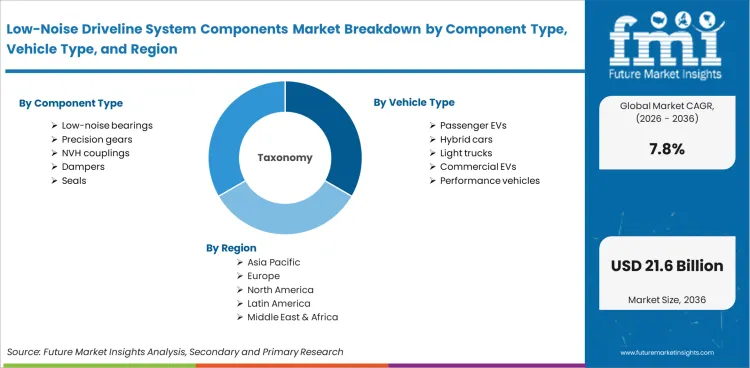
The market is divided into five primary segment groups based on component type and vehicle type. Driveline type, sales channel and application complete the structure. Component type covers low-noise bearings and precision gears. NVH couplings, dampers and seals complete the group. Vehicle type covers passenger EVs and hybrid cars. Light trucks, commercial EVs and performance vehicles complete the vehicle scope. Driveline type covers electric axles and hybrid drivetrains. Conventional axles and AWD systems are included. Sales channel covers OEM fitment and aftermarket kits. Remanufacturing programs and service workshops complete the channel scope. Application covers e-axle reducers and differential units. Motor shafts, drive shafts and wheel ends complete the application scope.
Insights into Low-Noise Driveline System Components Market by Component Type
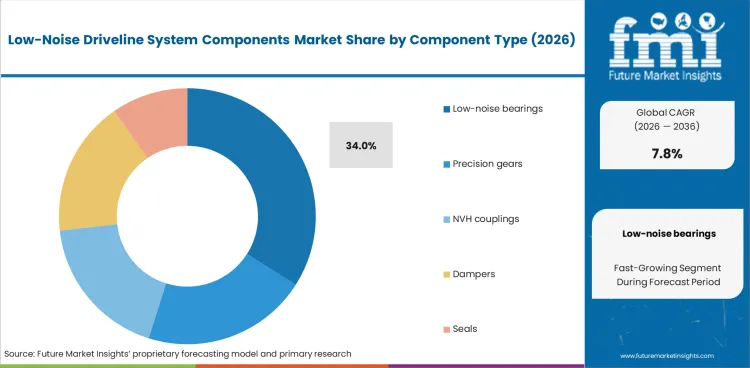
- Low-noise bearings are expected to hold 34.0% share in 2026 as high-speed e-axle shafts need lower friction and stable support. Better raceway control also helps reduce bearing tone inside quiet EV cabins.
- Precision gears support quieter reducer operation because tooth finish affects gear whine. Selected plain bearings are used where stable movement and lower package weight are important.
Insights into Low-Noise Driveline System Components Market by Vehicle Type
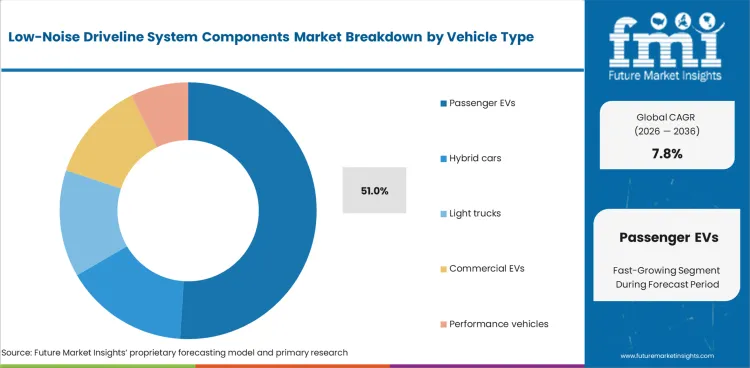
- Passenger EVs are forecast at 51.0% share in 2026. Cabin quietness has become a clear comfort need. Daily drivers notice gear tone more easily when engine sound is absent.
- Hybrid cars need low-noise couplings and gears because engine restart can create vibration. Selected polymer bearings support smoother movement in chosen driveline positions.
Insights into Low-Noise Driveline System Components Market by Driveline Type
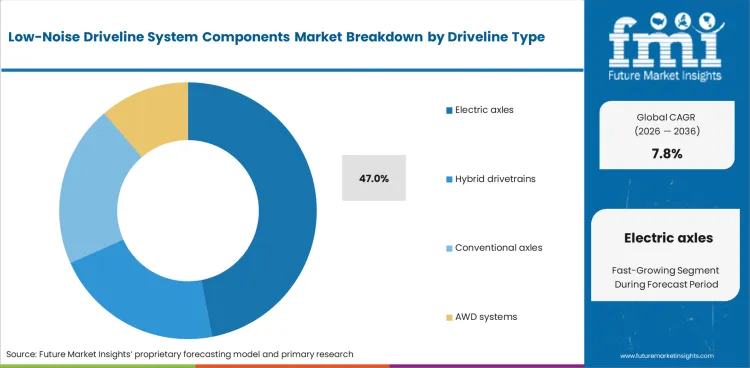
- Electric axles are expected to account for 47.0% share in 2026 with compact reducers placing gears and bearings close together. Better alignment becomes important because small vibration changes can affect cabin sound.
- Hybrid drivetrains need quiet gears as motor torque and engine power work together. The ev transmission system also needs quieter reducer parts as torque response becomes faster.
Insights into Low-Noise Driveline System Components Market by Sales Channel
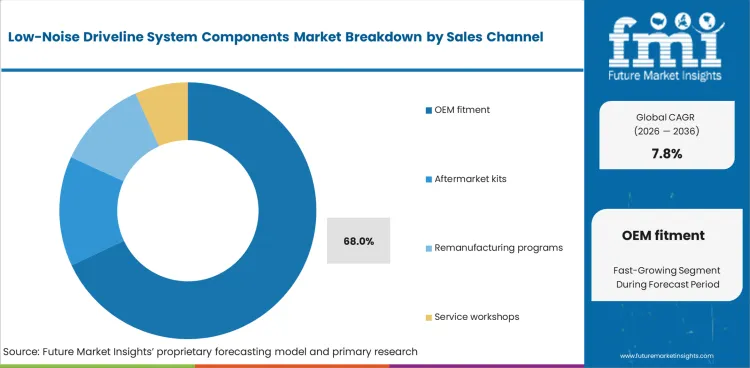
- OEM fitment is expected to hold 68.0% share in 2026 as driveline noise targets must be approved before vehicle launch. Early integration gives suppliers more control over bearing choice and gear design.
- Aftermarket kits support older EVs and hybrids as bearing tone appears with use. Some non-oem ev mro providers need validated parts for repeatable electric drive repairs.
Insights into Low-Noise Driveline System Components Market by Application
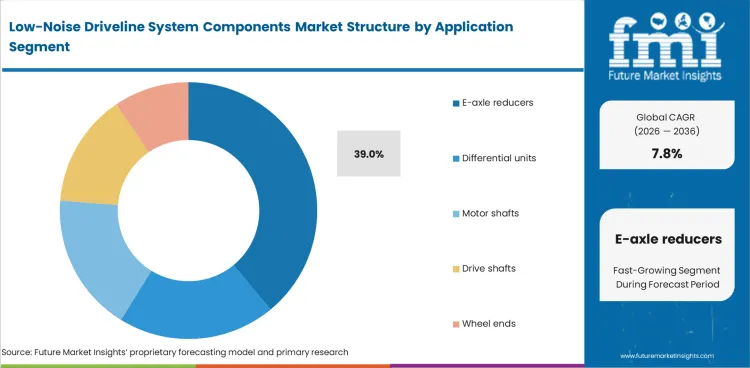
- E-axle reducers are forecast to represent 39.0% share in 2026 because gear mesh quality directly affects cabin sound. Quiet reducer design becomes more important as EV cabins expose small mechanical noise.
- Differential units need stable alignment under torque load to control vibration. Selected differential housing and carrier components support this need by helping keep driveline parts positioned correctly.
Low-Noise Driveline System Components Market Drivers, Barriers and Opportunities
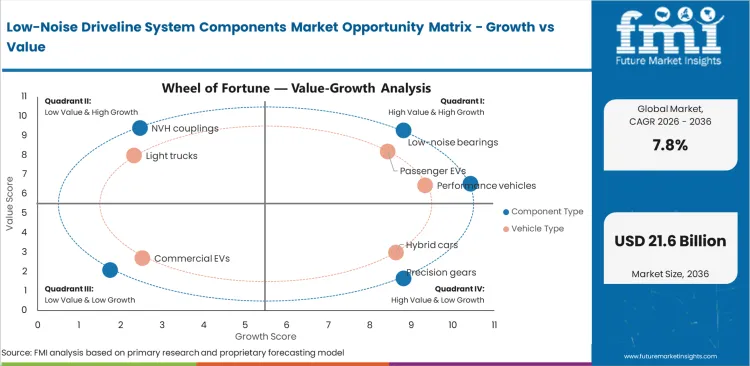
- Quiet EV powertrains make driveline noise more noticeable, so automakers need bearings and gears that reduce unwanted sound in compact electric drive units.
- Smaller suppliers face more pressure because OEMs need test data before approving parts. The data must prove stable noise control across speed and torque ranges.
- E-axle repair planning is creating a service route for quiet replacement parts. Workshops need components that reduce noise without replacing the full electric drive unit.
EV Cabin Quietness Raises Part Standards
Electric vehicles make driveline sound more noticeable during daily driving. Gear whine and bearing tone can reach the cabin more clearly at low and medium speeds. In August 2025, AISIN with BluE Nexus and DENSO said the Isuzu D-MAX EV adopted eAxles for front and rear drive. The release said the system supports low noise and low vibration for BEV pickup use. Large EV output gives axle and differential oil cooling systems more importance in quiet reducer design. Component suppliers with proven sound control can move closer to early sourcing discussions.
Validation Cost Slows Small Suppliers
Low-noise driveline parts must perform across wide speed and torque ranges. Smaller suppliers often struggle because OEMs need test proof before approving a part for launch. In March 2026, Bosch Limited and Tata AutoComp announced a joint venture for eAxle systems and electric motors in India. Local manufacturing will raise the need for repeatable test proof across bearings and gears. It will also increase demand for thermal control parts used with e-axle cooling and lubrication system components. Suppliers with strong test data will have a clearer route into vehicle programs.
Component-Level Service Creates a Repair Route
E-axle service is moving toward targeted repair as EVs age. Workshops need safe parts and clear repair steps to handle electric drive units. In January 2026, Schaeffler began the ReDriveS project to develop automated disassembly systems for electric axle drives. This supports future service work for motors and transmissions used in EV drive units. It also creates a clearer route for half-shaft assemblies and reducer parts in repair channels. Service networks will prefer parts that reduce noise complaints and keep repair work controlled.
Analysis of Low-Noise Driveline System Components Market by Key Countries
.webp "Top Country Growth Comparison Low Noise Driveline System Components Market Cagr (2026 2036)")
| Country | CAGR |
|---|---|
| United States | 6.8% |
| China | 9.2% |
| India | 9.0% |
| Germany | 7.6% |
| Japan | 6.5% |
| South Korea | 8.4% |
| Mexico | 7.9% |
Source: Future Market Insights, 2026.
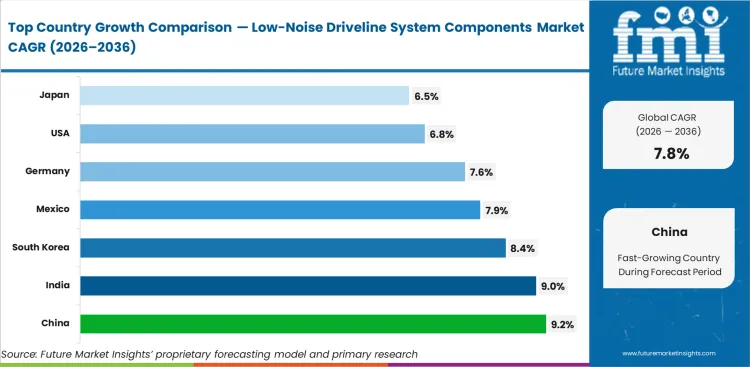
Low-Noise Driveline System Components Market CAGR Analysis by Country
- China is forecast to rise at 9.2% CAGR through 2036 as high EV output increases e-axle noise control needs.
- As local e-drive manufacturing improves component access, India is expected to expand at 9.0% CAGR by 2036.
- South Korea is projected to advance at 8.4% CAGR during the forecast period, with EV exports supporting high-speed driveline parts.
- Between 2026 and 2036, Mexico is forecast to register 7.9% CAGR as North American assembly capacity supports local sourcing.
- Industry outlook in Germany points to 7.6% CAGR through 2036 as premium vehicle programs need deeper NVH validation.
- From 2026 to 2036, United States demand is expected to move at 6.8% CAGR as service demand offsets slower EV sales in 2025.
- World demand for low-noise driveline system components is forecast to rise at 7.8% CAGR during the forecast period.
Demand Outlook for Low-Noise Driveline System Components Market in the United States
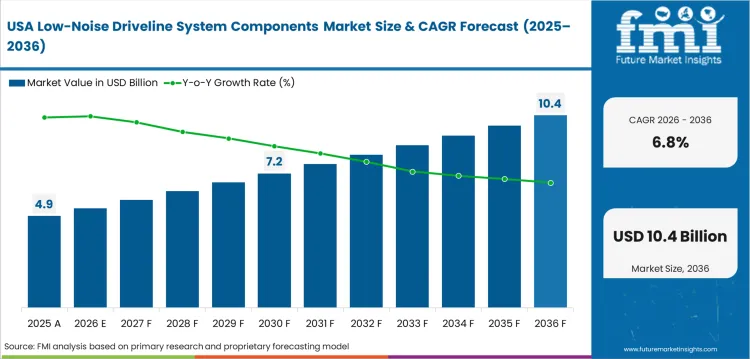
The United States has a large EV parc and a growing repair route for e-axles. Low-noise driveline system component demand is expected to move at 6.8% CAGR through 2036 as workshops prepare for more electric drive service. IEA placed USA electric car sales around 1.5 million in 2025 and near 10.0% of car sales for the year. A larger service pool supports bearing and reducer repairs as vehicles move beyond warranty cover. Suppliers need parts that fit repair kits and follow high-voltage safety needs.
- Electric drive axles for heavy-duty trucks need quiet parts because higher torque loads raise bearing stress.
- Independent workshops need bearing kits with clear repair steps for electric axle service.
- Parts distributors need catalog depth covering more than 1 e-drive platform.
Sales Analysis of Low-Noise Driveline System Components Market in China
China is the main volume center for low-noise e-drive parts. China is forecast to rise at 9.2% CAGR by 2036 as local EV programs keep high-speed reducers in heavy use. IEA reported above 13.0 million electric cars sold in China during 2025, with electric models near 55.0% of new car sales. Large production runs make noise control a platform-level cost and quality issue. Domestic suppliers can support automakers better through fast validation and closer launch support.
- High EV output raises repeat demand for quiet gears and bearings inside compact reducers.
- Local automakers need faster part updates as model cycles shorten and cabin comfort targets rise.
- Export programs push component makers toward lower noise variation across overseas duty cycles.
Demand Outlook for Low-Noise Driveline System Components Market in India
India is moving from small EV volumes toward local electric powertrain assembly. In April 2025, ZF secured a multi-year nomination to supply several thousand AxTrax 2 electric axles for intercity buses in India. During the forecast period, low-noise driveline component demand is expected to expand at 9.0% CAGR with the increasing use of local electric axle. Commercial EV programs need drive units with stable bearing behavior and quiet operation under high load. Local sourcing can shorten development cycles for bearings and gears used in Indian EV platforms.
- Cost-sensitive fleets will prefer repairable e-axles once early electric vehicles age into service networks.
- Domestic motor and e-axle programs support local validation of gear noise and bearing tone.
- Bus and light commercial vehicle programs add demand for quiet axle parts under repeated load cycles.
Opportunity Analysis of Low-Noise Driveline System Components Market in Germany
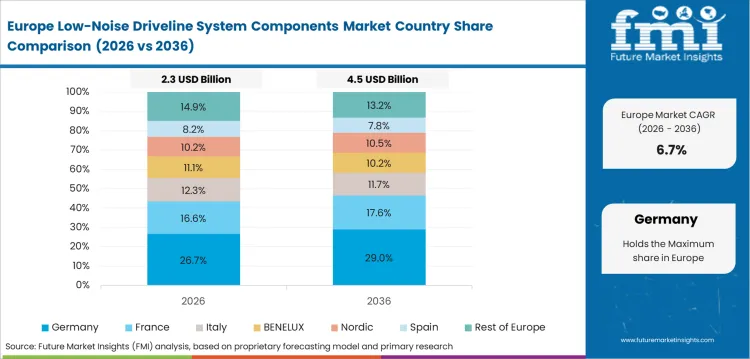
Premium vehicle engineering keeps Germany important for low-noise driveline validation. In June 2025, ZF said its CeTrax electric central drive passed the 10,000.0 unit production mark at Friedrichshafen. Industry outlook in Germany points to 7.6% CAGR through 2036 as electric drive production and testing depth support quiet component demand. Suppliers must prove noise control while keeping part cost under control. German programs can push stricter NVH checks into passenger EV and commercial vehicle platforms.
- Premium EV programs need tight gear mesh control across high-speed driving and cold-start conditions.
- Remanufacturing specialists require validated bearings designed to reduce noise after electric drive service.
- Supplier depth supports NVH testing and material improvement for reducers and differential parts.
Future Outlook for Low-Noise Driveline System Components Market in Japan
Japan has deep bearing and hybrid drivetrain expertise supporting low-noise component development. Adoption in Japan is expected to advance at 6.5% CAGR over 2026 to 2036 as hybrid programs and precision bearing exports support demand. In January 2025, AISIN said the Suzuki e VITARA adopted an eAxle using a small motor and inverter with loss reduction technology. This supports compact drive unit design and lower friction. Local suppliers can use hybrid bearing experience to serve EV reducers and high-speed shafts.
- Bearing makers can transfer low-friction designs from hub units into drive unit applications.
- Hybrid platforms need quiet gearing during engine restart and electric torque assist events.
- Export-focused suppliers benefit as automakers ask for compact and quiet powertrain parts.
Sales Analysis of Low-Noise Driveline System Components Market in South Korea
South Korea combines EV exports with local motor and driveline capability. Low-noise driveline system component demand is expected to record 8.4% CAGR by 2036 as vehicle makers refine electric platforms. IEA reported Korean electric car sales grew about 65.0% year over year to above 200.0 thousand in 2025. Electric share reached 11.0% for the first time. Market direction raises local demand for quiet reducers and bearing systems tied to export quality targets.
- Vehicle exporters need low-noise parts able to pass comfort targets in Europe and North America.
- Local EV platforms increase demand for shaft stability and reducer gear accuracy.
- Battery electric and hybrid lines give suppliers 2 routes for driveline NVH content.
Demand Outlook for Low-Noise Driveline System Components Market in Mexico
Mexico benefits from North American vehicle assembly and a rising Latin American EV mix. From 2026 to 2036, Mexico is forecast to register 7.9% CAGR in low-noise driveline system components as regional sourcing supports quiet parts for exported vehicles. IEA reported electric car sales in Latin America exceeded 350.0 thousand in 2025. Brazil and Mexico created over 75.0% of the regional sales increase. Local suppliers can benefit as EV and hybrid platforms need closer component support near assembly plants.
- North American sourcing favors suppliers able to serve axle programs near assembly lines.
- Hybrid vehicle demand creates steady need for couplings and gear parts designed to reduce vibration.
- Export programs need component traceability and repeatable noise performance across vehicle variants.
Competitive Landscape and Strategic Positioning
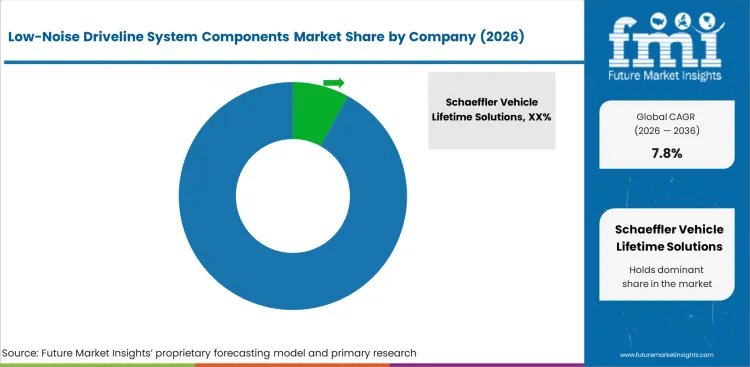
- Competition is based on quieter bearing design and better gear finishing for e-axle programs. Suppliers need to prove that their parts can reduce vibration inside compact drive units.
- Established suppliers have an advantage because they already work with OEM platforms. Their test data helps automakers approve parts with less risk.
- Specialist firms can serve repair channels by offering kits that replace worn e-drive parts. These kits help workshops reduce noise problems without replacing the full drive unit.
- New suppliers face high entry barriers because NVH testing is costly. Each part must also match the needs of a specific vehicle platform before approval.
Supplier position depends on proof over catalog breadth. Dauch Corporation completed its acquisition of Dowlais Group and its GKN Automotive units in February 2026. The combined supplier adds driveline scale and e-drive system depth across major automotive regions. Large groups can use drivetrain engineering data to build OEM trust faster than smaller suppliers. Advantage is clearest in high-speed shafts and reducer bearings.
Electric torque control is becoming part of low-noise driveline positioning. BorgWarner secured its first 48V electric cross differential program in February 2026 with a Chinese OEM. Selected automotive e-axle disconnect actuator work fits the shift toward compact torque control. Suppliers with cross-differential and actuator skill can help vehicle makers reduce harsh torque transfer. Smaller suppliers need focused NVH data or repair specialization to avoid pressure from larger groups.
Commercial vehicle electrification is creating another test field for low-noise driveline parts. In October 2025, ZF said its new electrified auxiliary systems reduce noise, vibration and harshness in electric buses. Selected axle breather and vent system components add value in service kits as oil control and sealing affect reducer durability. Suppliers with quieter auxiliaries and clean driveline packaging can support bus and coach platforms more effectively.
Key Companies in the Low-Noise Driveline System Components Market
- Global Leaders: Schaeffler Vehicle Lifetime Solutions and ZF Group hold positions through electric drive repair kits and OEM powertrain relationships. NSK Ltd. adds bearing engineering depth through low-friction designs for EV drive units.
- Precision Bearing Specialists: NTN Corporation and JTEKT Corporation stand out with automotive bearings and driveshaft parts. Their advantage comes from long experience in raceway finish and seal design.
- Integrated Driveline Players: BorgWarner Inc. and Dauch Corporation support electric and hybrid driveline content through torque control and eDrive systems.
Competitive Benchmarking: Low-Noise Driveline System Components Market
| Company | Bearing Noise Control | E-Drive Integration | Repair Kit Readiness | Geographic Footprint |
|---|---|---|---|---|
| Schaeffler Vehicle Lifetime Solutions | High | High | High | Europe with global service reach |
| ZF Group | Medium | High | High | Global with North American service depth |
| NSK Ltd. | High | Medium | Medium | Japan with global bearing supply |
| NTN Corporation | High | Medium | Medium | Japan and North America centered |
| JTEKT Corporation | High | Medium | Medium | Japan with global automotive reach |
| BorgWarner Inc. | Medium | High | Medium | North America and China centered |
| Dauch Corporation | Medium | High | Medium | North America with GKN Automotive reach |
Source: Future Market Insights competitive analysis, 2026.
Key Developments in Low-Noise Driveline System Components Market
- In March 2025, NSK Ltd. developed a compact and lightweight deep groove ball bearing for EV drive units. The bearing is designed for eAxles and hybrid vehicle drive units.
- In December 2025, Schaeffler Vehicle Lifetime Solutions expanded its E-Axle RepSystem-M and E-Axle RepSystem-G repair portfolio. The repair systems now cover electric vehicle models such as Hyundai Ioniq AE-EV, Volkswagen eGolf VII, Volkswagen eUp, BMW I3 and Nissan Leaf.
Key Players in the Low-Noise Driveline System Components Market
Major Global Players
- Schaeffler Vehicle Lifetime Solutions
- ZF Group
- NSK Ltd.
- NTN Corporation
- JTEKT Corporation
- BorgWarner Inc.
- Dauch Corporation
Specialist and Regional Players
- Bosch Mobility
- Dana Incorporated
- AISIN Corporation
- TE Connectivity
- ATC Drivetrain
Report Scope and Coverage
| Parameter | Details |
|---|---|
| Quantitative Units | USD 9.5 billion to USD 21.6 billion at 7.8% CAGR |
| Market Definition | Components designed to reduce vibration, gear whine and bearing tone in vehicle driveline systems |
| Segments Covered | Component type, vehicle type, driveline type, sales channel, application and region |
| Component Type | Low-noise bearings, precision gears, NVH couplings, dampers and seals |
| Vehicle Type | Passenger EVs, hybrid cars, light trucks, commercial EVs and performance vehicles |
| Driveline Type | Electric axles, hybrid drivetrains, conventional axles and AWD systems |
| Sales Channel | OEM fitment, aftermarket kits, remanufacturing programs and service workshops |
| Application | E-axle reducers, differential units, motor shafts, drive shafts and wheel ends |
| Regions Covered | North America, Latin America, Western Europe, Eastern Europe, East Asia, South Asia and Pacific, Middle East and Africa |
| Countries Covered | United States, China, India, Germany, Japan, South Korea, Mexico and more than 30.0 countries |
| Key Companies Profiled | Schaeffler Vehicle Lifetime Solutions, ZF Group, NSK Ltd., NTN Corporation, JTEKT Corporation, BorgWarner Inc. and Dauch Corporation |
| Forecast Period | 2026 to 2036 |
| Approach | Hybrid bottom-up and top-down method using vehicle production, EV sales, e-axle fitment, component pricing, repair kit activity and supplier developments |
Low-Noise Driveline System Components Market Breakdown by Segment and Region
Low-Noise Driveline System Components Market Segmented by Component Type
- Low-noise bearings
- Precision gears
- NVH couplings
- Dampers
- Seals
Low-Noise Driveline System Components Market Segmented by Vehicle Type
- Passenger EVs
- Hybrid cars
- Light trucks
- Commercial EVs
- Performance vehicles
Low-Noise Driveline System Components Market Segmented by Driveline Type
- Electric axles
- Hybrid drivetrains
- Conventional axles
- AWD systems
Low-Noise Driveline System Components Market Segmented by Sales Channel
- OEM fitment
- Aftermarket kits
- Remanufacturing programs
- Service workshops
Low-Noise Driveline System Components Market Segmented by Application
- E-axle reducers
- Differential units
- Motor shafts
- Drive shafts
- Wheel ends
Low-Noise Driveline System Components Market by Region
- North America
- Latin America
- Western Europe
- Eastern Europe
- East Asia
- South Asia and Pacific
- Middle East and Africa
Research Sources and Bibliography
- European Environment Agency. (2024, October 10). Transport noise. European Environment Agency.
- AISIN Corporation. (2025, August 1). Isuzu’s first battery-electric pickup “D-MAX EV” adopts eAxle. AISIN Corporation.
- NTN Corporation. (2025, May 21). NTN starts mass-production of “Resin Mold Insulated Bearing” for e-Axle. NTN Corporation.
- Nexteer Automotive. (2025, April 21). Nexteer debuts driveline innovations, expands portfolio. Nexteer Automotive.
- AISIN Corporation. (2025, October 10). Newly developed eAxle adopted for TOYOTA’s new “bZ4X”. AISIN Corporation.
- JTEKT Corporation. (2025). Development of low-vibration, high-efficiency CVJ for drive shafts. JTEKT Engineering Journal, No. 1021E.
- AISIN Corporation. (2025, August 1). Isuzu’s first battery-electric pickup “D-MAX EV” adopts eAxle. AISIN Corporation.
- Bosch Media Service India. (2026, March 23). Bosch Limited and Tata AutoComp Systems announce a joint venture to accelerate future growth in e-mobility. Bosch.
- Schaeffler AG. (2026, January 16). Schaeffler set to head ReDriveS research project for sustainable and circular use of electric axle drives. Schaeffler.
- International Energy Agency. (2026, May 20). Trends in electric cars. In Global EV Outlook 2026. International Energy Agency.
- ZF Friedrichshafen AG. (2025, April 16). India business win: ZF secures significant order for AxTrax 2 electric axle for commercial vehicles. ZF Friedrichshafen AG.
- ZF Friedrichshafen AG. (2025, June 10). Production milestone for CeTrax: Electric central drive for commercial vehicles passes the ten thousand mark. ZF Friedrichshafen AG.
- AISIN Corporation. (2025, January 20). Suzuki’s first BEV “e VITARA” adopts eAxle. AISIN Corporation.
- Dauch Corporation. (2026, February 3). Dauch Corporation (formerly AAM) and Dowlais Group (GKN) combination complete. Dauch Corporation.
- BorgWarner Inc. (2026, February 11). BorgWarner secures its first 48V electric cross differential program. BorgWarner Inc.
- ZF Friedrichshafen AG. (2025, October 3). Busworld 2025: ZF outpaces market growth with smart mobility solutions. ZF Friedrichshafen AG.
- NSK Ltd. (2025, March 26). NSK develops compact, lightweight deep groove ball bearing for EVs: Helping to reduce EV drive unit size, weight, and electricity consumption. NSK Ltd.
- Schaeffler Vehicle Lifetime Solutions Germany GmbH & Co. KG. (2025, December 17). Schaeffler expands repair solutions for electric drives: Comprehensive portfolio for e-axle repairs now available. Schaeffler.
This bibliography is provided for reader reference and is not exhaustive. The full report contains the complete reference list and detailed citations.
This Report Answers
- What is the 2026 value of the low-noise driveline system components market?
- What value is the market expected to reach by 2036?
- What CAGR is expected for the market between 2026 and 2036?
- Which component type is expected to lead demand in 2026?
- Which vehicle type is forecast to account for the leading demand share in 2026?
- Which countries are forecast above the world average through 2036?
- How does OEM fitment shape low-noise driveline component demand?
- Which companies are active in low-noise driveline system components?
- How do repair kits affect e-axle bearing and reducer part demand?
- How does FMI size and validate the market forecast?
Frequently Asked Questions
What is the global market demand for low-noise driveline system components in 2026?
In 2026, the global low-noise driveline system components market is forecast at USD 10.2 billion as OEM fitment widens across EV and hybrid platforms.
How big will the low-noise driveline system components market be in 2036?
By 2036, the low-noise driveline system components market is projected to reach USD 21.6 billion as quieter e-axles and repair kits see wider use.
How much will low-noise driveline system component demand expand during the forecast period?
Low-noise driveline system component demand is expected to expand at 7.8% CAGR during the forecast period.
Which component type is forecast to lead the low-noise driveline system components market in 2026?
Low-noise bearings are forecast to lead with 34.0% share in 2026 due to high-speed shaft support needs in e-axles.
Which sales channel is forecast to lead low-noise driveline system components demand?
OEM fitment is forecast to lead with 68.0% share in 2026 as noise targets need validation before platform launch.
Which country is forecast to advance faster in the low-noise driveline system components market?
China is forecast to rise at 9.2% CAGR through 2036 as high EV output increases quiet e-drive component demand.
What does the low-noise driveline system components market include?
The market includes low-noise bearings and precision gears. NVH couplings and dampers are used in vehicle driveline systems.
How does FMI estimate the low-noise driveline system components market forecast?
FMI uses vehicle output, EV sales, e-axle adoption, and component pricing to validate the forecast.
Why are low-noise driveline components important for EVs?
Low-noise driveline components reduce gear whine and bearing tone drivers can hear more clearly in quiet EV cabins.
Are low-noise driveline components used in hybrid vehicles?
Yes. Hybrid vehicles use low-noise gears and couplings to manage vibration during engine restart and electric torque assist.
Preview the report firsthand - request a free sample
Get SampleGet the brochure for pricing and purchase details.
Get PDFTable of Content
- Executive Summary
- Global Market Outlook
- Demand-side Trends
- Supply-side Trends
- Technology Roadmap Analysis
- Analysis and Recommendations
- Market Overview
- Market Coverage / Taxonomy
- Market Definition / Scope / Limitations
- Research Methodology
- Chapter Orientation
- Analytical Lens and Working Hypotheses
- Market Structure, Signals, and Trend Drivers
- Benchmarking and Cross-market Comparability
- Market Sizing, Forecasting, and Opportunity Mapping
- Research Design and Evidence Framework
- Desk Research Programme (Secondary Evidence)
- Company Annual and Sustainability Reports
- Peer-reviewed Journals and Academic Literature
- Corporate Websites, Product Literature, and Technical Notes
- Earnings Decks and Investor Briefings
- Statutory Filings and Regulatory Disclosures
- Technical White Papers and Standards Notes
- Trade Journals, Industry Magazines, and Analyst Briefs
- Conference Proceedings, Webinars, and Seminar Materials
- Government Statistics Portals and Public Data Releases
- Press Releases and Reputable Media Coverage
- Specialist Newsletters and Curated Briefings
- Sector Databases and Reference Repositories
- FMI Internal Proprietary Databases and Historical Market Datasets
- Subscription Datasets and Paid Sources
- Social Channels, Communities, and Digital Listening Inputs
- Additional Desk Sources
- Expert Input and Fieldwork (Primary Evidence)
- Primary Modes
- Qualitative Interviews and Expert Elicitation
- Quantitative Surveys and Structured Data Capture
- Blended Approach
- Why Primary Evidence is Used
- Field Techniques
- Interviews
- Surveys
- Focus Groups
- Observational and In-context Research
- Social and Community Interactions
- Stakeholder Universe Engaged
- C-suite Leaders
- Board Members
- Presidents and Vice Presidents
- R&D and Innovation Heads
- Technical Specialists
- Domain Subject-matter Experts
- Scientists
- Physicians and Other Healthcare Professionals
- Governance, Ethics, and Data Stewardship
- Research Ethics
- Data Integrity and Handling
- Primary Modes
- Tooling, Models, and Reference Databases
- Desk Research Programme (Secondary Evidence)
- Data Engineering and Model Build
- Data Acquisition and Ingestion
- Cleaning, Normalisation, and Verification
- Synthesis, Triangulation, and Analysis
- Quality Assurance and Audit Trail
- Market Background
- Market Dynamics
- Drivers
- Restraints
- Opportunity
- Trends
- Scenario Forecast
- Demand in Optimistic Scenario
- Demand in Likely Scenario
- Demand in Conservative Scenario
- Opportunity Map Analysis
- Product Life Cycle Analysis
- Supply Chain Analysis
- Investment Feasibility Matrix
- Value Chain Analysis
- PESTLE and Porter’s Analysis
- Regulatory Landscape
- Regional Parent Market Outlook
- Production and Consumption Statistics
- Import and Export Statistics
- Market Dynamics
- Global Market Analysis 2021 to 2025 and Forecast, 2026 to 2036
- Historical Market Size Value (USD Million) Analysis, 2021 to 2025
- Current and Future Market Size Value (USD Million) Projections, 2026 to 2036
- Y-o-Y Growth Trend Analysis
- Absolute $ Opportunity Analysis
- Global Market Pricing Analysis 2021 to 2025 and Forecast 2026 to 2036
- Global Market Analysis 2021 to 2025 and Forecast 2026 to 2036, By Component Type
- Introduction / Key Findings
- Historical Market Size Value (USD Million) Analysis By Component Type , 2021 to 2025
- Current and Future Market Size Value (USD Million) Analysis and Forecast By Component Type , 2026 to 2036
- Low-noise bearings
- Precision gears
- NVH couplings
- Dampers
- Seals
- Low-noise bearings
- Y-o-Y Growth Trend Analysis By Component Type , 2021 to 2025
- Absolute $ Opportunity Analysis By Component Type , 2026 to 2036
- Global Market Analysis 2021 to 2025 and Forecast 2026 to 2036, By Vehicle Type
- Introduction / Key Findings
- Historical Market Size Value (USD Million) Analysis By Vehicle Type, 2021 to 2025
- Current and Future Market Size Value (USD Million) Analysis and Forecast By Vehicle Type, 2026 to 2036
- Passenger EVs
- Hybrid cars
- Light trucks
- Commercial EVs
- Performance vehicles
- Passenger EVs
- Y-o-Y Growth Trend Analysis By Vehicle Type, 2021 to 2025
- Absolute $ Opportunity Analysis By Vehicle Type, 2026 to 2036
- Global Market Analysis 2021 to 2025 and Forecast 2026 to 2036, By Driveline Type
- Introduction / Key Findings
- Historical Market Size Value (USD Million) Analysis By Driveline Type, 2021 to 2025
- Current and Future Market Size Value (USD Million) Analysis and Forecast By Driveline Type, 2026 to 2036
- Electric axles
- Hybrid drivetrains
- Conventional axles
- AWD systems
- Electric axles
- Y-o-Y Growth Trend Analysis By Driveline Type, 2021 to 2025
- Absolute $ Opportunity Analysis By Driveline Type, 2026 to 2036
- Global Market Analysis 2021 to 2025 and Forecast 2026 to 2036, By Sales Channel
- Introduction / Key Findings
- Historical Market Size Value (USD Million) Analysis By Sales Channel, 2021 to 2025
- Current and Future Market Size Value (USD Million) Analysis and Forecast By Sales Channel, 2026 to 2036
- OEM fitment
- Aftermarket kits
- Remanufacturing programs
- Service workshops
- OEM fitment
- Y-o-Y Growth Trend Analysis By Sales Channel, 2021 to 2025
- Absolute $ Opportunity Analysis By Sales Channel, 2026 to 2036
- Global Market Analysis 2021 to 2025 and Forecast 2026 to 2036, By Application
- Introduction / Key Findings
- Historical Market Size Value (USD Million) Analysis By Application, 2021 to 2025
- Current and Future Market Size Value (USD Million) Analysis and Forecast By Application, 2026 to 2036
- E-axle reducers
- Differential units
- Motor shafts
- Drive shafts
- Wheel ends
- E-axle reducers
- Y-o-Y Growth Trend Analysis By Application, 2021 to 2025
- Absolute $ Opportunity Analysis By Application, 2026 to 2036
- Global Market Analysis 2021 to 2025 and Forecast 2026 to 2036, By Region
- Introduction
- Historical Market Size Value (USD Million) Analysis By Region, 2021 to 2025
- Current Market Size Value (USD Million) Analysis and Forecast By Region, 2026 to 2036
- North America
- Latin America
- Western Europe
- Eastern Europe
- East Asia
- South Asia and Pacific
- Middle East & Africa
- Market Attractiveness Analysis By Region
- North America Market Analysis 2021 to 2025 and Forecast 2026 to 2036, By Country
- Historical Market Size Value (USD Million) Trend Analysis By Market Taxonomy, 2021 to 2025
- Market Size Value (USD Million) Forecast By Market Taxonomy, 2026 to 2036
- By Country
- USA
- Canada
- Mexico
- By Component Type
- By Vehicle Type
- By Driveline Type
- By Sales Channel
- By Application
- By Country
- Market Attractiveness Analysis
- By Country
- By Component Type
- By Vehicle Type
- By Driveline Type
- By Sales Channel
- By Application
- Key Takeaways
- Latin America Market Analysis 2021 to 2025 and Forecast 2026 to 2036, By Country
- Historical Market Size Value (USD Million) Trend Analysis By Market Taxonomy, 2021 to 2025
- Market Size Value (USD Million) Forecast By Market Taxonomy, 2026 to 2036
- By Country
- Brazil
- Chile
- Rest of Latin America
- By Component Type
- By Vehicle Type
- By Driveline Type
- By Sales Channel
- By Application
- By Country
- Market Attractiveness Analysis
- By Country
- By Component Type
- By Vehicle Type
- By Driveline Type
- By Sales Channel
- By Application
- Key Takeaways
- Western Europe Market Analysis 2021 to 2025 and Forecast 2026 to 2036, By Country
- Historical Market Size Value (USD Million) Trend Analysis By Market Taxonomy, 2021 to 2025
- Market Size Value (USD Million) Forecast By Market Taxonomy, 2026 to 2036
- By Country
- Germany
- UK
- Italy
- Spain
- France
- Nordic
- BENELUX
- Rest of Western Europe
- By Component Type
- By Vehicle Type
- By Driveline Type
- By Sales Channel
- By Application
- By Country
- Market Attractiveness Analysis
- By Country
- By Component Type
- By Vehicle Type
- By Driveline Type
- By Sales Channel
- By Application
- Key Takeaways
- Eastern Europe Market Analysis 2021 to 2025 and Forecast 2026 to 2036, By Country
- Historical Market Size Value (USD Million) Trend Analysis By Market Taxonomy, 2021 to 2025
- Market Size Value (USD Million) Forecast By Market Taxonomy, 2026 to 2036
- By Country
- Russia
- Poland
- Hungary
- Balkan & Baltic
- Rest of Eastern Europe
- By Component Type
- By Vehicle Type
- By Driveline Type
- By Sales Channel
- By Application
- By Country
- Market Attractiveness Analysis
- By Country
- By Component Type
- By Vehicle Type
- By Driveline Type
- By Sales Channel
- By Application
- Key Takeaways
- East Asia Market Analysis 2021 to 2025 and Forecast 2026 to 2036, By Country
- Historical Market Size Value (USD Million) Trend Analysis By Market Taxonomy, 2021 to 2025
- Market Size Value (USD Million) Forecast By Market Taxonomy, 2026 to 2036
- By Country
- China
- Japan
- South Korea
- By Component Type
- By Vehicle Type
- By Driveline Type
- By Sales Channel
- By Application
- By Country
- Market Attractiveness Analysis
- By Country
- By Component Type
- By Vehicle Type
- By Driveline Type
- By Sales Channel
- By Application
- Key Takeaways
- South Asia and Pacific Market Analysis 2021 to 2025 and Forecast 2026 to 2036, By Country
- Historical Market Size Value (USD Million) Trend Analysis By Market Taxonomy, 2021 to 2025
- Market Size Value (USD Million) Forecast By Market Taxonomy, 2026 to 2036
- By Country
- India
- ASEAN
- Australia & New Zealand
- Rest of South Asia and Pacific
- By Component Type
- By Vehicle Type
- By Driveline Type
- By Sales Channel
- By Application
- By Country
- Market Attractiveness Analysis
- By Country
- By Component Type
- By Vehicle Type
- By Driveline Type
- By Sales Channel
- By Application
- Key Takeaways
- Middle East & Africa Market Analysis 2021 to 2025 and Forecast 2026 to 2036, By Country
- Historical Market Size Value (USD Million) Trend Analysis By Market Taxonomy, 2021 to 2025
- Market Size Value (USD Million) Forecast By Market Taxonomy, 2026 to 2036
- By Country
- Kingdom of Saudi Arabia
- Other GCC Countries
- Turkiye
- South Africa
- Other African Union
- Rest of Middle East & Africa
- By Component Type
- By Vehicle Type
- By Driveline Type
- By Sales Channel
- By Application
- By Country
- Market Attractiveness Analysis
- By Country
- By Component Type
- By Vehicle Type
- By Driveline Type
- By Sales Channel
- By Application
- Key Takeaways
- Key Countries Market Analysis
- USA
- Pricing Analysis
- Market Share Analysis, 2025
- By Component Type
- By Vehicle Type
- By Driveline Type
- By Sales Channel
- By Application
- Canada
- Pricing Analysis
- Market Share Analysis, 2025
- By Component Type
- By Vehicle Type
- By Driveline Type
- By Sales Channel
- By Application
- Mexico
- Pricing Analysis
- Market Share Analysis, 2025
- By Component Type
- By Vehicle Type
- By Driveline Type
- By Sales Channel
- By Application
- Brazil
- Pricing Analysis
- Market Share Analysis, 2025
- By Component Type
- By Vehicle Type
- By Driveline Type
- By Sales Channel
- By Application
- Chile
- Pricing Analysis
- Market Share Analysis, 2025
- By Component Type
- By Vehicle Type
- By Driveline Type
- By Sales Channel
- By Application
- Germany
- Pricing Analysis
- Market Share Analysis, 2025
- By Component Type
- By Vehicle Type
- By Driveline Type
- By Sales Channel
- By Application
- UK
- Pricing Analysis
- Market Share Analysis, 2025
- By Component Type
- By Vehicle Type
- By Driveline Type
- By Sales Channel
- By Application
- Italy
- Pricing Analysis
- Market Share Analysis, 2025
- By Component Type
- By Vehicle Type
- By Driveline Type
- By Sales Channel
- By Application
- Spain
- Pricing Analysis
- Market Share Analysis, 2025
- By Component Type
- By Vehicle Type
- By Driveline Type
- By Sales Channel
- By Application
- France
- Pricing Analysis
- Market Share Analysis, 2025
- By Component Type
- By Vehicle Type
- By Driveline Type
- By Sales Channel
- By Application
- India
- Pricing Analysis
- Market Share Analysis, 2025
- By Component Type
- By Vehicle Type
- By Driveline Type
- By Sales Channel
- By Application
- ASEAN
- Pricing Analysis
- Market Share Analysis, 2025
- By Component Type
- By Vehicle Type
- By Driveline Type
- By Sales Channel
- By Application
- Australia & New Zealand
- Pricing Analysis
- Market Share Analysis, 2025
- By Component Type
- By Vehicle Type
- By Driveline Type
- By Sales Channel
- By Application
- China
- Pricing Analysis
- Market Share Analysis, 2025
- By Component Type
- By Vehicle Type
- By Driveline Type
- By Sales Channel
- By Application
- Japan
- Pricing Analysis
- Market Share Analysis, 2025
- By Component Type
- By Vehicle Type
- By Driveline Type
- By Sales Channel
- By Application
- South Korea
- Pricing Analysis
- Market Share Analysis, 2025
- By Component Type
- By Vehicle Type
- By Driveline Type
- By Sales Channel
- By Application
- Russia
- Pricing Analysis
- Market Share Analysis, 2025
- By Component Type
- By Vehicle Type
- By Driveline Type
- By Sales Channel
- By Application
- Poland
- Pricing Analysis
- Market Share Analysis, 2025
- By Component Type
- By Vehicle Type
- By Driveline Type
- By Sales Channel
- By Application
- Hungary
- Pricing Analysis
- Market Share Analysis, 2025
- By Component Type
- By Vehicle Type
- By Driveline Type
- By Sales Channel
- By Application
- Kingdom of Saudi Arabia
- Pricing Analysis
- Market Share Analysis, 2025
- By Component Type
- By Vehicle Type
- By Driveline Type
- By Sales Channel
- By Application
- Turkiye
- Pricing Analysis
- Market Share Analysis, 2025
- By Component Type
- By Vehicle Type
- By Driveline Type
- By Sales Channel
- By Application
- South Africa
- Pricing Analysis
- Market Share Analysis, 2025
- By Component Type
- By Vehicle Type
- By Driveline Type
- By Sales Channel
- By Application
- USA
- Market Structure Analysis
- Competition Dashboard
- Competition Benchmarking
- Market Share Analysis of Top Players
- By Regional
- By Component Type
- By Vehicle Type
- By Driveline Type
- By Sales Channel
- By Application
- Competition Analysis
- Competition Deep Dive
- Schaeffler Vehicle Lifetime Solutions
- Overview
- Product Portfolio
- Profitability by Market Segments (Product/Age /Sales Channel/Region)
- Sales Footprint
- Strategy Overview
- Marketing Strategy
- Product Strategy
- Channel Strategy
- ZF Group
- NSK Ltd.
- NTN Corporation
- JTEKT Corporation
- BorgWarner Inc.
- Dauch Corporation
- Schaeffler Vehicle Lifetime Solutions
- Competition Deep Dive
- Assumptions & Acronyms Used


