

- Industry Size (2026)
- USD 13.8 Bn
- Forecast (2036)
- USD 18.7 Bn
- CAGR (2026 to 2036)
- 3.1%
Half-Shaft Assemblies Market Size, Market Forecast and Outlook By FMI
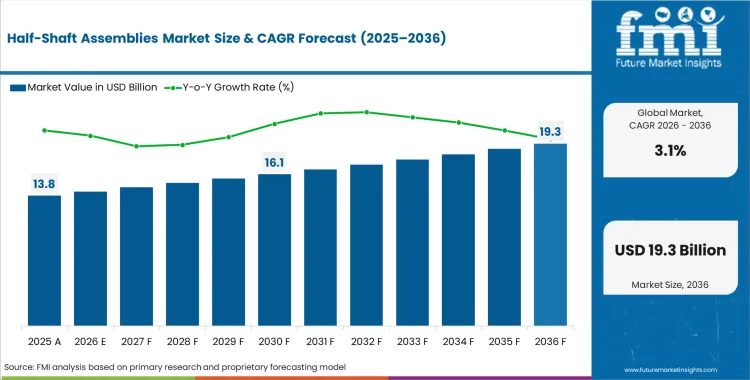
The half-shaft assemblies market crossed a valuation of USD 13.4 billion in 2025. The industry is expected to reach USD 13.8 billion in 2026 at a CAGR of 3.1% during the forecast period. Demand outlook carries the market valuation to USD 18.7 billion by 2036 as automotive platforms evolve toward heavier architectures requiring improved torque transmission efficiency.
Summary of Half-Shaft Assemblies Market
- Market Snapshot
- The global market is valued at USD 13.4 billion in 2025 and is projected to reach USD 18.7 billion by 2036, as automakers continue updating chassis architectures.
- Expansion across the industry should stabilize at a 3.1% CAGR between 2026 and 2036, opening up USD 4.9 billion in new revenue potential for parts suppliers.
- Winning supply contracts comes down to meeting strict technical specifications rather than competing solely on price. Car manufacturers demand proven metal durability and exact fitment for specific vehicle layouts before signing long-term deals.
- High-volume commuter vehicles generate the bulk of sector revenue. Passenger Cars secure a 68% share, pushing factory-direct First Fit (OEM) installations to dominate with 81% of total demand.
- Legacy manufacturing setups dictate current material and powertrain choices. Internal combustion and hybrid systems (ICE/HEV) claim a 79% share, while proven Steel components command a 72% share because factories already own the expensive equipment needed to heat-treat traditional metals.
- Front-wheel-drive configurations (FWD) capture the lead with a 47% share, beating out both AWD/4WD at 35% and RWD at 18%. Grouping the engine and transmission together sideways at the front of a compact car simply requires shorter, highly efficient connection points.
- Demand and Growth Drivers
- Global demand continues to be anchored by the large installed base of conventional vehicles. Long production runs tied to existing engine platforms keep order flow steady for driveline components, while replacement demand remains active across the full vehicle life cycle.
- Material selection still comes down to cost, durability, and production practicality. Composite alternatives attract interest for weight reduction, yet steel remains the preferred option because it performs predictably under daily operating stress and can be formed at far lower cost in high-volume manufacturing.
- Electrification is changing performance requirements rather than reducing the need for drivetrain hardware. Electric vehicles place heavier instantaneous torque loads on connecting shafts, which raises the bar for strength and durability. ICE and HEV platforms are still expected to account for 79% of the current market, with BEVs representing the remaining 21%, so suppliers must support both legacy volume demand and newer high-load applications.
- Growth rates differ meaningfully by country, reflecting variations in industrial policy, local production investment, and supplier localization. India is set to record a CAGR of 6.2% through 2036, followed by China at 5.0%. Mexico is forecast to expand at 4.5%, while the United States is expected to post 4.1%, South Korea 3.9%, Germany 3.6%, and Japan 3.1% over the same period.
- Supply chain localization is giving Asian markets a stronger expansion path. India and China continue to benefit as automakers place component manufacturing closer to vehicle assembly operations. Germany and Japan remain important production centers, though current investment there is directed more toward process refinement and platform optimization than large-scale greenfield capacity creation.
- Product and Segment View
- Complete mechanical linkages connecting the differential directly to the wheels define this sector. These specific parts must effectively transfer power while constantly adjusting to suspension movement across all drive layouts.
- Passenger cars consume the vast majority of these units due to sheer production numbers. Light and heavy commercial trucks use similar heavy-duty components, but their lower assembly volumes make them a smaller target for high-volume parts suppliers.
- Engineering teams lock in exact part dimensions years before a car hits the showroom. This early integration allows First Fit (OEM) channels to forecast capturing an 81% share, as automakers refuse to risk factory delays by waiting on unverified aftermarket joints.
- Front-wheel-drive architectures predicted to dominate with a 47% share because compact cars rely heavily on transverse engine layouts. This space-saving design leaves very little physical room for the driveline, requiring specialized articulation joints.
- Tracking light-vehicle assembly numbers directly maps to component demand. Passenger Cars likely to represent a massive 68% share simply because global factories produce millions of identical commuter chassis worldwide every single year.
- Balancing manufacturing costs with metal fatigue limits keeps steel firmly in the lead at an anticipated 72% share. Global forging equipment is already calibrated for carbon steel alloys, making alternative materials financially difficult to justify for economy cars.
- Standard gas and hybrid engines still power the vast majority of vehicles rolling off assembly lines today. The ICE/HEV category is expected to hold a 79% share because decades of established infrastructure continue supporting fluid-coupled drivetrains.
- Analytical boundaries strictly cover fully built shaft units ready for installation. Individual replacement boots, bare differential housings, long propeller shafts, and loose joint bearings do not count toward these specific valuation metrics.
- Geography and Competitive Outlook
- Factory locations directly dictate regional expansion speeds across the globe. Developing industrial centers like India and Mexico build parts faster to meet rising local demand, while established engineering hubs like the USA and Germany focus on supplying high-margin, complex designs.
- A select group of specialized metal-forming companies controls the majority of high-volume contracts. Industry veterans like GKN, Dana, NTN, and Schaeffler leverage their massive historical test data to box out smaller competitors from bidding on new vehicle platforms.
- Car manufacturers refuse to gamble their assembly lines on unproven suppliers. Bidding for a major contract requires owning massive heat-treatment facilities and proving one can deliver thousands of perfectly balanced joints exactly when the factory needs them.
- Winning in this space requires solving complex engineering problems rather than just pouring metal into molds. Suppliers secure long-term contracts by proving their sealed boots will not leak under warranty and by designing custom joints that can survive the violent acceleration of heavy electric vehicles.
Automakers now have to build gasoline and electric vehicles within the same manufacturing system, and that is changing how half shaft programs are designed. Running separate component streams for each powertrain adds cost at every stage. Purchasing teams lose volume leverage, plant layouts become harder to manage, and even small differences in joint dimensions create added fitment and tooling burden across vehicle lines. That pressure is pushing manufacturers toward standardized half shaft assemblies that can absorb the higher torque loads of electric drivetrains without losing compatibility with conventional platforms. The savings are meaningful, though the engineering penalty is real. Universal assemblies tend to add weight, leaving chassis and suspension teams to recover that mass elsewhere. An integrated AWD coupling system can reduce inventory complexity and ease warehouse handling, yet those gains disappear quickly if shared connection points fail under load and turn into warranty claims.
Standardization remains one of the more practical ways to defend margins during the shift to mixed powertrains. Once engineers prove that one joint architecture can perform across light, medium, and heavy vehicle applications, suppliers can run production with far less interruption. Tooling changes become less frequent, line utilization improves, and larger production volumes support better purchasing terms on materials and components. That cost advantage is hard to ignore. Older single-purpose shaft designs start to lose their place when they add manufacturing complexity without delivering enough added value in vehicle performance or durability.
Mexico is anticipated to register at 4.5% due to North American nearshoring mandates for drivetrain components, with USA likely to record a 4.1% CAGR driven by heavy-duty pickup torque requirements. South Korea expected to register a 3.9% as export-oriented assembly plants standardize splines. India estimated to advance at 6.2% as domestic automakers localize high-torque joint manufacturing, as China is likely to follow at 5.0%, based on rapid scaling of independent suspension architectures in economy segments. Germany expected to post a 3.6% relying on premium torque-vectoring applications. Japan sees a predicted 3.1%, resulting from mature domestic production cycles. Divergent growth rates stem directly from regional differences in electric vehicle architecture adoption speeds.
Segmental Analysis
Half-Shaft Assemblies Market Analysis by Sales Channel
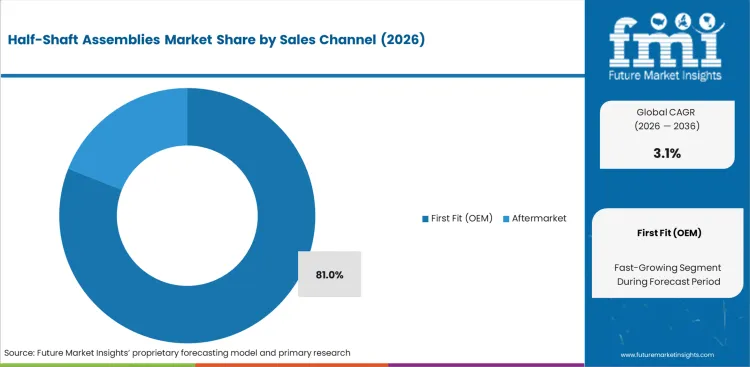
Car manufacturers need exact parts to keep their assembly lines moving without delays. Sourcing these complex mechanical links directly from approved suppliers ensures every piece fits the transmission splines perfectly. As factory-level validation prevents expensive line stoppages, the First Fit (OEM) segment is poised to garner 81% share in 2026, driven by multi-year constant velocity joint contracts. Quality teams reject unverified aftermarket parts for initial builds to avoid vibration issues and early part failures. Financial managers know that saving a few cents on unapproved components usually leads to massive warranty claims later.
- Contract Lock-In: Platform architectures require specialized length specifications unique to each vehicle stance. Sourcing directors negotiate exclusive supplier agreements spanning five years.
- Aftermarket Fragmentation: Independent repair shops struggle to stock massive exact shaft length varieties. Distribution managers resort to consolidating inventory around fast-moving applications.
- Warranty Validation: Dealership service centers must use OEM half shaft assembly suppliers for warranty repairs. Service directors face severe penalties if installing unapproved aftermarket units during covered periods.
Half-Shaft Assemblies Market Analysis by Drive
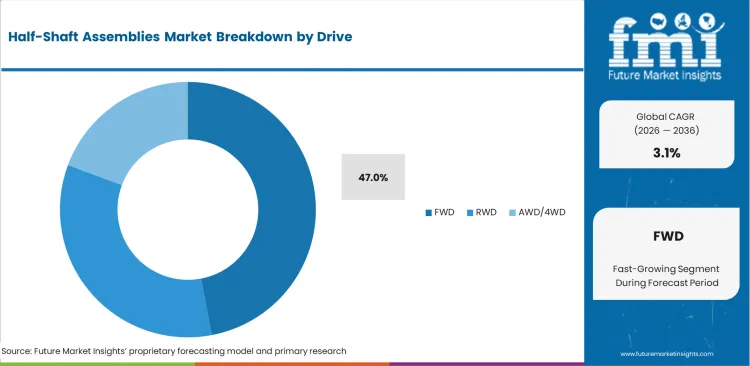
In 2026, the FWD category is expected to contribute 47% of total market share, largely due to strict interior space limits. Car designers mount engines sideways to give passengers more room inside the cabin. This tight layout requires short internal CV joints and constant velocity couplings to send power straight to the front wheels. Suspension engineers constantly fight against binding angles when the wheels turn and hit bumps at the same time. Using advanced limited slip differential units forces builders to adopt unequal shaft lengths. Failing to add intermediate support bearings for the longer side guarantees drivers will feel the steering wheel pull hard during acceleration.
- Packaging Constraint: Transverse engine placement leaves minimal physical space for driveline routing. Design leads must specify extreme articulation joints to clear steering components.
- Torque Steer Mitigation: Unequal shaft angles cause vehicles to pull laterally under hard acceleration. Chassis engineers combat this by designing stiffer intermediate shafts.
- Maintenance Accessibility: Front shafts endure severe environmental exposure behind front wheels. Service technicians require specialized tools to extract rusted splines from wheel hubs.
Half-Shaft Assemblies Market Analysis by Vehicle Type
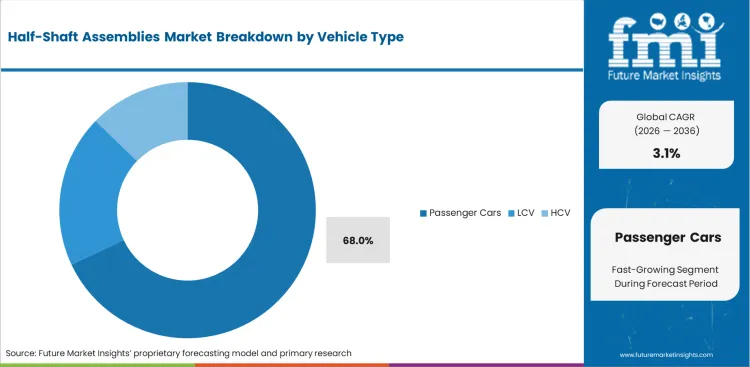
Global assembly plants build millions of identical automotive axle and propeller shaft setups every single day. Fleet buyers choose standard sedans because their driveline parts have a long history of running without issues. A major blind spot in evaluating passenger car axle shaft demand involves the rapid industry shift toward crossover vehicles. Taking a standard car platform and lifting it two inches changes the operating angles of the internal joints. Reusing older car shafts on taller crossovers forces the internal bearings to work harder and wear out faster. Despite these wear challenges, sheer production volume means the Passenger Cars segment is estimated to account for 68% share in 2026. Warranty departments are already setting aside extra money to cover these early boot failures.
- Volume Economics: Millions of identical units allow extreme manufacturing efficiency. Plant managers negotiate fraction-of-a-cent reductions on retaining clips.
- Load Profile: Commuter vehicles rarely experience maximum torque stress. Driveline engineers specify smaller diameter splines knowing drivers gently accelerate.
- Electrification Impact: Adding heavy battery packs to standard car chassis strains existing shaft designs. Product planners must approve upgraded metallurgy for next-generation sedans.
Half-Shaft Assemblies Market Analysis by Material
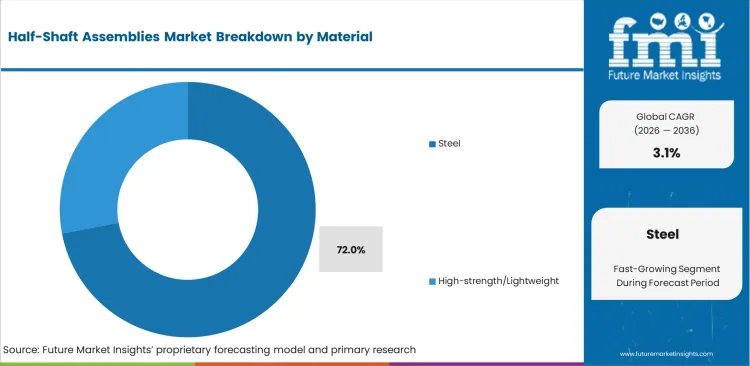
Forging plants rely heavily on induction-hardened carbon steel because it handles twisting stress predictably. Engineers specify traditional metal alloys for internal automotive axle cages so they know exactly when a part might break under load. This established metallurgical baseline means the market is expected to see steel account for 72% share in 2026 as manufacturers avoid untested materials. Executives pushing for lightweight composites often ignore basic crash safety rules. Standard metal bends safely during a side impact, while stiff carbon fiber tends to shatter without warning. Switching to lighter materials also requires expensive changes to factory heat-treating equipment that operations managers prefer to avoid.
- Fatigue Predictability: Carbon steel exhibits defined stress cycle limits. Metallurgists accurately predict when steel half shaft assemblies will snap under repeated launches.
- Manufacturing Infrastructure: Global induction hardening equipment is universally calibrated for standard steel grades. Operations managers avoid recalibrating entire heat-treat lines for novel alloys.
- Weight Penalty: Traditional steel adds significant unsprung mass to suspension systems. Dynamics engineers fight to shave ounces off other components to compensate.
Half-Shaft Assemblies Market Analysis by Powertrain
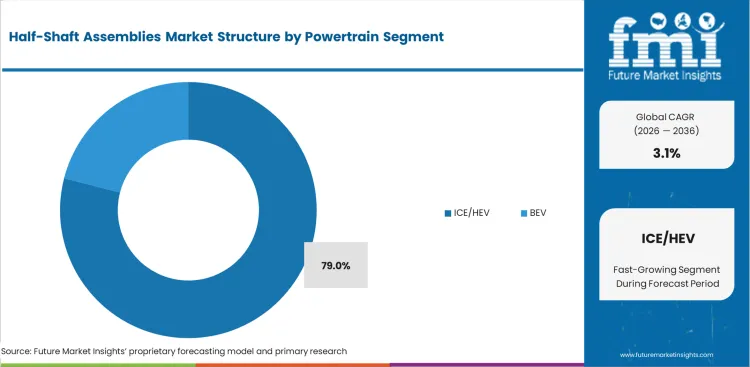
ICE/HEV is anticipated to emerge with 79% market share in 2026, reflecting the massive scale of existing combustion engine production lines. Traditional engines send power through fluid torque converters or slipping clutches that naturally absorb sudden mechanical shocks. Driveline engineers use automotive differential designs proven over decades of road use. Designing shafts for hybrid vehicles introduces a new problem where smooth gas power meets harsh regenerative braking forces. Connecting standard parts to hybrid systems requires specific EV driveline NVH dampers to stop the gears from clunking. Ignoring these braking stresses leads to sloppy pedal feel and direct customer complaints.
- Damping Profile: Fluid couplings soften power delivery spikes. Design engineers specify thinner shafts knowing transmission fluids absorb shock.
- Thermal Environment: Exhaust routing creates localized heat zones near inner CV boots. Packaging teams must add aluminum heat shields to prevent grease liquefaction.
- Regenerative Stress: Braking through electric traction motors reverses torque direction through connecting shafts. Calibration engineers struggle to tune out harsh clunks during pedal transitions.
Half-Shaft Assemblies Market Drivers, Restraints, and Opportunities
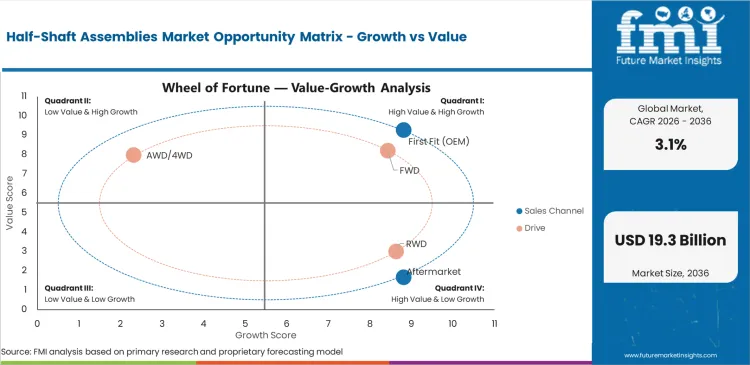
Instantaneous torque delivery from electric traction motors forces platform engineering leads to specify heavier-duty driveline components immediately. Electric vehicles lack traditional fluid couplings, meaning maximum rotational force hits automotive counter shaft geometries and joints within milliseconds of pedal application. Driveline directors face severe pressure to optimize EV driveline half shaft design to survive these violent load spikes. Delaying this architectural upgrade guarantees snapped shafts during aggressive acceleration events. Customers immediately abandon brands known for leaving drivers stranded with broken splines. Analyzing half shaft assembly torque capacity requirements confirms that engineering specifications must drastically increase to accommodate electrification.
Packaging constraints around heavy battery enclosures restrict suspension articulation geometry. Chassis engineers struggle to route standard length shafts past widened structural crash rails. Moving drive units off-center to clear batteries forces severe operating angles on inner joints. Constant running at high angles generates excessive internal friction, liquefying CV grease and reducing overall half shaft assembly fatigue life prematurely. Specifying replacement parts through the automotive bearing aftermarket frustrates technicians dealing with proprietary spline counts. Tooling novel compact joint designs requires massive capital expenditure that purchasing departments aggressively resist approving.
- Hollow tube construction: Friction welding hollow center sections reduces rotational mass. Dynamics engineers improve suspension response.
- Thermoplastic elastomer boots: Upgrading boot material prevents cold-weather tearing. Warranty managers eliminate seasonal replacement spikes.
- High-speed balancing: Precision balancing eliminates harmonic vibrations in high speed e-drive applications. NVH engineers achieve required silent cabin metrics.
Regional Analysis
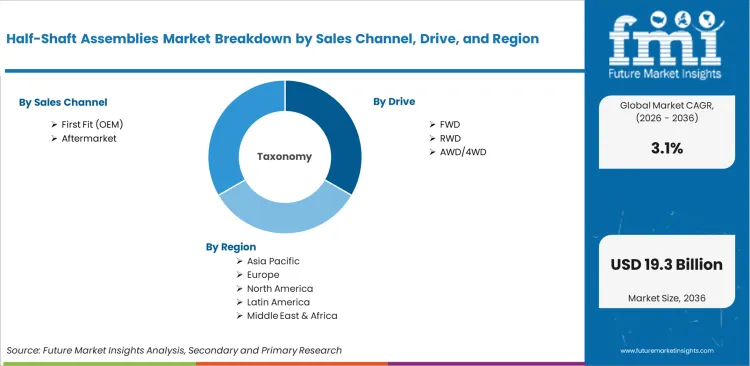
Based on regional analysis, half-shaft assemblies market is segmented into North America, Latin America, Europe, Asia-Pacific, and Middle East & Africa across 40 plus countries.
.webp "Top Country Growth Comparison Half Shaft Assemblies Market Cagr (2026 2036)")
| Country | CAGR (2026 to 2036) |
|---|---|
| India | 6.2% |
| China | 5.0% |
| Mexico | 4.5% |
| USA | 4.1% |
| South Korea | 3.9% |
| Germany | 3.6% |
| Japan | 3.1% |
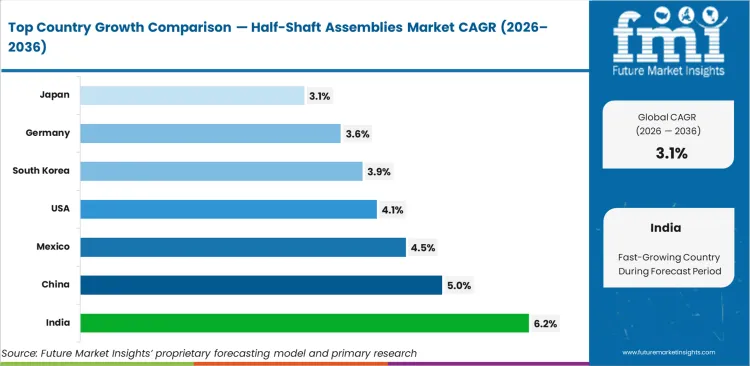
Source: Future Market Insights (FMI) analysis, based on proprietary forecasting model and primary research
Asia-Pacific Half-Shaft Assemblies Market Analysis
Car makers across Asia are abandoning basic rigid axles in favor of independent rear suspensions to meet consumer expectations for better ride quality. This shift requires double the number of half-shafts per vehicle. Local forging factories are upgrading their heat-treatment equipment to meet global quality standards and prevent relying on imported parts.
- India: Domestic sourcing rules are playing a central role in shaping half shaft assembly demand in India. Global suppliers often need local forging partnerships to qualify for vehicle programs, especially when procurement teams are under pressure to raise domestic content. India is expected to post a CAGR of 6.2% in the half shaft assembly market through 2036. Product design adds another layer to that demand because vehicles built for Indian road conditions need inner joints with greater plunge travel to manage potholes and surface irregularities. Suppliers that can combine local manufacturing with application-specific engineering are in a stronger position than those offering imported standard designs. Driveline control integration further strengthens that advantage in rough-road vehicle platforms.
- China: China continues to expand its half shaft assembly demand on the back of fast-moving EV platform development. Independent rear suspension systems are becoming more common even in lower-cost electric vehicles, which pushes suppliers to deliver better driveline refinement at budget price points. The half shaft assembly market in China is forecast to grow at a CAGR of 5.0% through 2036. Domestic steel availability keeps material economics favorable, and that cost position allows manufacturers to automate more of the assembly process while keeping standard joint products competitively priced in both local and export markets.
- South Korea: Half shaft assembly sales in South Korea are supported by an export manufacturing model that rewards platform commonality. Automakers and suppliers are aligning spline counts and connection specifications across multiple vehicle programs so factories can switch between combustion and electric driveline layouts with less disruption. South Korea is set to register a CAGR of 3.9% in the half shaft assembly market during the study period. This approach reduces warehouse complexity, cuts part proliferation, and helps local producers protect cost discipline in export programs where margin control matters as much as engineering performance.
- Japan: Japan is sustaining half shaft assembly demand through precision-led design priorities rather than large capacity expansion. Vehicle manufacturers remain focused on compact packaging, especially in urban-oriented models where steering angle, space efficiency, and handling balance carry more weight than scale output alone. The half shaft assembly market in Japan is anticipated to rise at a CAGR of 3.1% through 2036. Smaller joint architectures, though, place tighter demands on grease quality and lubrication stability, so suppliers still need strong materials engineering to meet long-life durability targets in compact driveline systems.
FMI reports, consolidating parts manufacturing within the Asia-Pacific region allows major automotive brands to keep production costs down while meeting the increasing demand for independent suspension layouts.
North America Half-Shaft Assemblies Market Analysis
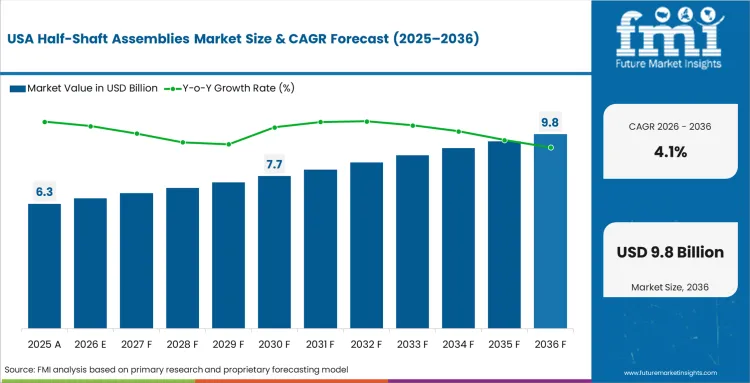
Engineering teams in North America focus heavily on the extreme torque requirements of heavy-duty pickup trucks. Diesel engines pulling heavy trailers up steep hills create intense heat and stress that would easily break standard passenger car parts. Driveline engineers must design massively oversized splines and cages to survive these specific towing conditions.
- Mexico: Mexico’s half shaft assembly market is benefiting from trade rules that are pushing global suppliers to place forging capacity closer to North American vehicle production. New metal forging investments south of the USA border improve tariff-efficient access to regional assembly plants and strengthen Mexico’s role in cross-border supply chains. The country is forecast to grow at a CAGR of 4.5% through 2036 in the half shaft assembly market. Plant operators also value Mexico for its established labor base in assembly-intensive processes such as protective boot installation, where execution quality still depends heavily on trained manual handling.
- USA: Demand for half shaft assemblies in USA is closely tied to the requirements of heavy-duty vehicle platforms, where fatigue resistance and torque durability remain central design concerns. Truck manufacturers are specifying specialized alloys that can withstand sustained load cycles without premature failure, particularly as commercial vehicle architectures evolve. Sales of half shaft assemblies in the United States are expected to rise at a CAGR of 4.1% during the forecast period. Suppliers that can meet these heavy-load requirements are also better positioned to support the shift into electric commercial vehicles, where torque delivery is immediate and driveline durability becomes even more important for fleet uptime.
FMI assesses, the North American supply chain relies on placing heavy manufacturing close to final assembly lines to avoid shipping heavy steel parts over long distances.
Europe Half-Shaft Assemblies Market Analysis
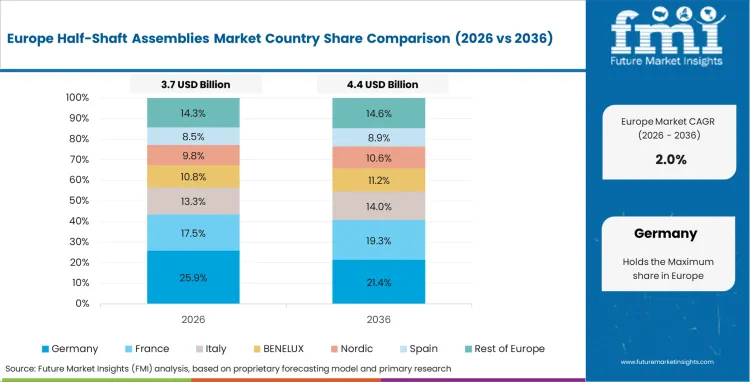
European car manufacturers prioritize high-speed stability and complex torque-vectoring systems in their premium vehicle lines. Engineering teams specify precise internal joint tolerances to eliminate any vibration that could affect the driving experience on unrestricted highways.
- Germany: Germany’s half shaft assembly market remains shaped by the demands of premium automotive engineering. High-performance electric sedans require precise balancing, tight dimensional control, and stronger alloy selection to manage rapid acceleration without compromising refinement. Germany is expected to record a CAGR of 3.6% through 2036 in the half shaft assembly market. Local sourcing still carries weight because vehicle development teams prefer nearby suppliers that can adjust shaft dimensions and joint geometry quickly during prototype iteration, especially when premium platforms move through repeated validation cycles.
FMI's report includes Canada, Brazil, United Kingdom, France, Italy, Spain, Russia, ASEAN, and GCC Countries. Rural infrastructure upgrades across emerging economies consistently drive demand for durable articulating suspension setups. European buyers expect a refined driving experience, forcing regional suppliers to maintain strict quality control over every mechanical linkage leaving their forging plants.
Competitive Aligners for Market Players
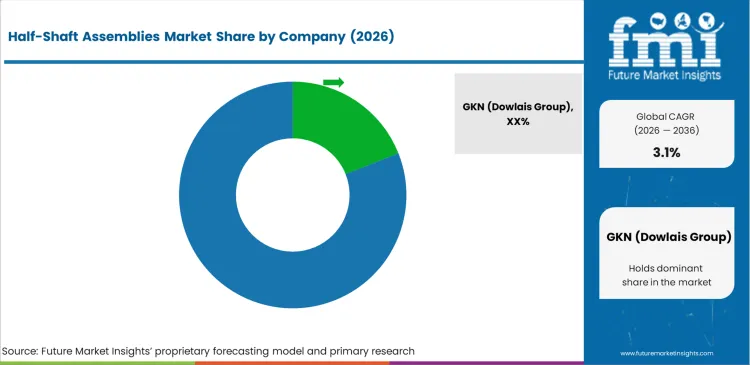
Winning contracts to supply new vehicle platforms requires passing strict material testing. Companies like GKN and Dana hold top spots because they use specific metal-forming methods that stop tiny cracks from forming during production. Car makers rarely change their half-shaft suppliers in the middle of a vehicle's life cycle. Testing a new company's metal heating process costs too much money. This reluctance to change looks like brand loyalty, but it is simply a way to avoid risk. Approving a new propeller shaft couplings supplier involves millions of miles of road testing. Competing in this space requires deep pockets to pay for these long approval processes.
Established half shaft assembly manufacturers own years of test data on part sizes and suspension movement. New companies trying to win contracts for upcoming electric vehicles do not have this wear history. Using specific driveline lubricants for EVS gives older companies like NTN and Schaeffler a clear edge in fixing high-speed noise and vibration issues. A new startup cannot quickly create custom grease that stays together while spinning at 15,000 revolutions per minute inside an electric motor.
Car manufacturers actively work to avoid getting stuck with a single supplier. Engineers set common sizes for connection points, such as sealed wheel hub splines. This forces parts makers to compete on price and lifespan instead of relying on unique designs that only fit one car model. Large automakers combine their global buying power to make different regional factories compete for production orders. A smart half shaft assembly procurement strategy includes buying from at least two different suppliers. This backup plan keeps the assembly line moving even if one factory faces equipment breakdowns.
Key Players in Half-Shaft Assemblies Market
- GKN (Dowlais Group)
- Dana
- NTN
- Schaeffler
- Hyundai WIA
- JTEKT
- Nexteer
- SKF
Scope of the Report
| Metric | Value |
|---|---|
| Quantitative Units | USD 13.8 billion to USD 18.7 billion, at a CAGR of 3.1% |
| Market Definition | Mechanical driveline linkages transferring torque from central differentials to driving wheels while accommodating suspension travel and steering angles. |
| Segmentation | By Sales Channel, By Drive, By Vehicle Type, By Material, By Powertrain, and Region |
| Regions Covered | North America, Latin America, Western Europe, Eastern Europe, East Asia, South Asia & Pacific, Middle East & Africa |
| Countries Covered | USA, China, India, Germany, Japan, South Korea, Mexico |
| Key Companies Profiled | GKN (Dowlais Group), Dana, NTN, Schaeffler, Hyundai WIA, JTEKT, Nexteer, SKF |
| Forecast Period | 2026 to 2036 |
| Approach | Global vehicle production volumes cross-referenced against independent suspension fitment rates. |
Source: Future Market Insights (FMI) analysis, based on proprietary forecasting model and primary research
Segments
Sales Channel
- First Fit (OEM)
- Aftermarket
Drive
- FWD
- RWD
- AWD/4WD
Vehicle Type
- Passenger Cars
- LCV
- HCV
Material
- Steel
- High-strength/Lightweight
Powertrain
- ICE/HEV
- BEV
Regions:
- Asia Pacific
- India
- China
- Japan
- South Korea
- Indonesia
- Australia & New Zealand
- ASEAN
- Rest of Asia Pacific
- Europe
- Germany
- Italy
- France
- United Kingdom
- Spain
- Benelux
- Nordics
- Central & Eastern Europe
- Rest of Europe
- North America
- United States
- Canada
- Mexico
- Latin America
- Brazil
- Argentina
- Chile
- Rest of Latin America
- Middle East & Africa
- Kingdom of Saudi Arabia
- United Arab Emirates
- South Africa
- Turkey
- Rest of Middle East & Africa
Bibliography
- Mendes, I., Lopes, J. H., Almas, E. M., & Reis, L. (2024). Failure analysis of the half-shafts belonging to a three-wheeled electric vehicle. Metals, 14(6), 727.
- S, N., Rao, M., & Raghavendran, P. (2024). Driveline vibration reduction in light weight all wheel drive vehicle (SAE Technical Paper 2024-26-0229). SAE International.
- Madireddy, K. C., Verhun, B., Xu, C., Sha, H., Tuller, Z., & Patel, N. (2024). Wheel & axle disconnect controls on hybrid electric powertrains (SAE Technical Paper 2024-01-2776). SAE International.
- Suciu, C. C., Stoica, V., Ilie, M., Ionel, I., & Ionel, R. (2025). A low-cost IoT-based bidirectional torque measurement system with strain gauge technology. Applied Sciences, 15(15), 8158.
- European Automobile Manufacturers’ Association. (2026). New car registrations: +1.8% in 2025; battery-electric 17.4% market share.
This bibliography is provided for reader reference. The full FMI report contains the complete reference list with primary source documentation.
This Report Addresses
- Driveline torque constraints forcing immediate material upgrades across electric platforms.
- Packaging limits dictating extreme articulation angles for transverse engine layouts.
- Boot sealing failures generating massive warranty liabilities during winter driving conditions.
- Independent rear suspension adoption replacing legacy rigid axles in economy classes.
- Torsional fatigue profiles necessitating induction hardened steel over composite alternatives.
- Heavy-duty pickup applications demanding specialized spline sizing and cage architecture.
- Nearshoring mandates driving production footprint shifts toward North American suppliers.
- Regenerative braking loads introducing complex bidirectional stress into driveline geometry.
Frequently Asked Questions
What was the global valuation of the half-shaft assemblies sector in 2025?
FMI assessed the global valuation at USD 13.4 billion in 2025.
What is the projected revenue expectation by 2036?
Revenue is poised to reach USD 18.7 billion by 2036.
What compound annual growth rate is anticipated?
Demand is expected to expand at a CAGR of 3.1% during the forecast period.
What is a half-shaft assembly?
It is a mechanical driveline component responsible for transferring rotational torque from differential outputs directly to wheel hubs while managing variable suspension geometry.
How do half shaft assemblies differ from drive shafts?
Half-shafts connect the differential to the wheels and articulate with the suspension, whereas drive shafts (propeller shafts) connect the transmission to the differential longitudinally.
When evaluating half shaft assembly vs propeller shaft functionality, what is the primary distinction?
Propeller shafts handle pure rotational transfer along the chassis spine, while half shafts must manage simultaneous steering angles and vertical suspension droop.
When comparing half shaft assembly vs CV joint usage, how are they related?
A half-shaft assembly is the complete unit, which integrates the inner and outer constant velocity (CV) joints along with the connecting bar and protective boots.
Why does steel dominate half shaft assemblies?
Induction-hardened carbon steel delivers predictable fatigue resistance under extreme torsional loads without shattering during impacts.
Which sales channel controls the largest share?
First Fit (OEM) is anticipated to garner 81% share in 2026.
Why does the OEM channel maintain such dominance?
Automotive supply chain managers structure long-term supply contracts tied directly to vehicle platform lifecycles.
Which drive type leads the current installation rate?
FWD is estimated to account for 47% share in 2026.
What forces front-wheel-drive configurations to remain dominant?
Transverse engine placement maximizes interior cabin space while requiring short direct-drive linkages.
Which vehicle type demands the highest component volume?
Passenger Cars are expected to represent 68% share in 2026.
Why do passenger cars consume the most assemblies?
Global assembly plants output millions of commuter units requiring independent suspension components per corner.
Which material formulation currently holds majority usage?
Steel is projected to capture 72% share in 2026.
Which powertrain architecture retains the largest fitment share?
ICE/HEV is set to hold 79% share in 2026.
How does the legacy fleet impact powertrain component splits?
Decades of established combustion engine production lines continue outputting millions of traditional fluid-coupled drivetrains.
Which country demonstrates the fastest expansion speed?
India is anticipated to see sales grow at a CAGR of 6.2% over the forecast period.
What structural shift pushes India ahead of other regions?
Domestic automakers mandate strict localized sourcing for complex driveline components.
How does China rank in projected adoption?
China is projected to witness 5.0% CAGR through 2036.
What drives massive component volume across Chinese factories?
Independent rear suspension architectures rapidly penetrate budget-friendly electric platforms targeting middle-class buyers.
Why do Mexican facilities show accelerated output?
North American nearshoring mandates force global suppliers to build dedicated forging facilities.
What specific operational pressure faces component procurement directors?
Managing dual supply chains for both electric and combustion architectures fractures volume purchasing advantages.
How does electric motor torque alter component lifespan?
Instantaneous power delivery bypasses traditional fluid coupling damping and applies immediate torsional stress to splines.
Preview the report firsthand - request a free sample
Get SampleGet the brochure for pricing and purchase details.
Get PDFTable of Content
- Executive Summary
- Global Market Outlook
- Demand-side Trends
- Supply-side Trends
- Technology Roadmap Analysis
- Analysis and Recommendations
- Market Overview
- Market Coverage / Taxonomy
- Market Definition / Scope / Limitations
- Research Methodology
- Chapter Orientation
- Analytical Lens and Working Hypotheses
- Market Structure, Signals, and Trend Drivers
- Benchmarking and Cross-market Comparability
- Market Sizing, Forecasting, and Opportunity Mapping
- Research Design and Evidence Framework
- Desk Research Programme (Secondary Evidence)
- Company Annual and Sustainability Reports
- Peer-reviewed Journals and Academic Literature
- Corporate Websites, Product Literature, and Technical Notes
- Earnings Decks and Investor Briefings
- Statutory Filings and Regulatory Disclosures
- Technical White Papers and Standards Notes
- Trade Journals, Industry Magazines, and Analyst Briefs
- Conference Proceedings, Webinars, and Seminar Materials
- Government Statistics Portals and Public Data Releases
- Press Releases and Reputable Media Coverage
- Specialist Newsletters and Curated Briefings
- Sector Databases and Reference Repositories
- FMI Internal Proprietary Databases and Historical Market Datasets
- Subscription Datasets and Paid Sources
- Social Channels, Communities, and Digital Listening Inputs
- Additional Desk Sources
- Expert Input and Fieldwork (Primary Evidence)
- Primary Modes
- Qualitative Interviews and Expert Elicitation
- Quantitative Surveys and Structured Data Capture
- Blended Approach
- Why Primary Evidence is Used
- Field Techniques
- Interviews
- Surveys
- Focus Groups
- Observational and In-context Research
- Social and Community Interactions
- Stakeholder Universe Engaged
- C-suite Leaders
- Board Members
- Presidents and Vice Presidents
- R&D and Innovation Heads
- Technical Specialists
- Domain Subject-matter Experts
- Scientists
- Physicians and Other Healthcare Professionals
- Governance, Ethics, and Data Stewardship
- Research Ethics
- Data Integrity and Handling
- Primary Modes
- Tooling, Models, and Reference Databases
- Desk Research Programme (Secondary Evidence)
- Data Engineering and Model Build
- Data Acquisition and Ingestion
- Cleaning, Normalisation, and Verification
- Synthesis, Triangulation, and Analysis
- Quality Assurance and Audit Trail
- Market Background
- Market Dynamics
- Drivers
- Restraints
- Opportunity
- Trends
- Scenario Forecast
- Demand in Optimistic Scenario
- Demand in Likely Scenario
- Demand in Conservative Scenario
- Opportunity Map Analysis
- Product Life Cycle Analysis
- Supply Chain Analysis
- Investment Feasibility Matrix
- Value Chain Analysis
- PESTLE and Porter’s Analysis
- Regulatory Landscape
- Regional Parent Market Outlook
- Production and Consumption Statistics
- Import and Export Statistics
- Market Dynamics
- Global Market Analysis 2021 to 2025 and Forecast, 2026 to 2036
- Historical Market Size Value (USD Million) Analysis, 2021 to 2025
- Current and Future Market Size Value (USD Million) Projections, 2026 to 2036
- Y-o-Y Growth Trend Analysis
- Absolute $ Opportunity Analysis
- Global Market Pricing Analysis 2021 to 2025 and Forecast 2026 to 2036
- Global Market Analysis 2021 to 2025 and Forecast 2026 to 2036, By Sales Channel
- Introduction / Key Findings
- Historical Market Size Value (USD Million) Analysis By Sales Channel , 2021 to 2025
- Current and Future Market Size Value (USD Million) Analysis and Forecast By Sales Channel , 2026 to 2036
- First Fit (OEM)
- Aftermarket
- First Fit (OEM)
- Y-o-Y Growth Trend Analysis By Sales Channel , 2021 to 2025
- Absolute $ Opportunity Analysis By Sales Channel , 2026 to 2036
- Global Market Analysis 2021 to 2025 and Forecast 2026 to 2036, By Drive
- Introduction / Key Findings
- Historical Market Size Value (USD Million) Analysis By Drive, 2021 to 2025
- Current and Future Market Size Value (USD Million) Analysis and Forecast By Drive, 2026 to 2036
- FWD
- RWD
- AWD/4WD
- FWD
- Y-o-Y Growth Trend Analysis By Drive, 2021 to 2025
- Absolute $ Opportunity Analysis By Drive, 2026 to 2036
- Global Market Analysis 2021 to 2025 and Forecast 2026 to 2036, By Vehicle Type
- Introduction / Key Findings
- Historical Market Size Value (USD Million) Analysis By Vehicle Type, 2021 to 2025
- Current and Future Market Size Value (USD Million) Analysis and Forecast By Vehicle Type, 2026 to 2036
- Passenger Cars
- LCV
- HCV
- Passenger Cars
- Y-o-Y Growth Trend Analysis By Vehicle Type, 2021 to 2025
- Absolute $ Opportunity Analysis By Vehicle Type, 2026 to 2036
- Global Market Analysis 2021 to 2025 and Forecast 2026 to 2036, By Material
- Introduction / Key Findings
- Historical Market Size Value (USD Million) Analysis By Material, 2021 to 2025
- Current and Future Market Size Value (USD Million) Analysis and Forecast By Material, 2026 to 2036
- Steel
- High-strength/Lightweight
- Steel
- Y-o-Y Growth Trend Analysis By Material, 2021 to 2025
- Absolute $ Opportunity Analysis By Material, 2026 to 2036
- Global Market Analysis 2021 to 2025 and Forecast 2026 to 2036, By Powertrain
- Introduction / Key Findings
- Historical Market Size Value (USD Million) Analysis By Powertrain, 2021 to 2025
- Current and Future Market Size Value (USD Million) Analysis and Forecast By Powertrain, 2026 to 2036
- ICE/HEV
- BEV
- ICE/HEV
- Y-o-Y Growth Trend Analysis By Powertrain, 2021 to 2025
- Absolute $ Opportunity Analysis By Powertrain, 2026 to 2036
- Global Market Analysis 2021 to 2025 and Forecast 2026 to 2036, By Region
- Introduction
- Historical Market Size Value (USD Million) Analysis By Region, 2021 to 2025
- Current Market Size Value (USD Million) Analysis and Forecast By Region, 2026 to 2036
- North America
- Latin America
- Western Europe
- Eastern Europe
- East Asia
- South Asia and Pacific
- Middle East & Africa
- Market Attractiveness Analysis By Region
- North America Market Analysis 2021 to 2025 and Forecast 2026 to 2036, By Country
- Historical Market Size Value (USD Million) Trend Analysis By Market Taxonomy, 2021 to 2025
- Market Size Value (USD Million) Forecast By Market Taxonomy, 2026 to 2036
- By Country
- USA
- Canada
- Mexico
- By Sales Channel
- By Drive
- By Vehicle Type
- By Material
- By Powertrain
- By Country
- Market Attractiveness Analysis
- By Country
- By Sales Channel
- By Drive
- By Vehicle Type
- By Material
- By Powertrain
- Key Takeaways
- Latin America Market Analysis 2021 to 2025 and Forecast 2026 to 2036, By Country
- Historical Market Size Value (USD Million) Trend Analysis By Market Taxonomy, 2021 to 2025
- Market Size Value (USD Million) Forecast By Market Taxonomy, 2026 to 2036
- By Country
- Brazil
- Chile
- Rest of Latin America
- By Sales Channel
- By Drive
- By Vehicle Type
- By Material
- By Powertrain
- By Country
- Market Attractiveness Analysis
- By Country
- By Sales Channel
- By Drive
- By Vehicle Type
- By Material
- By Powertrain
- Key Takeaways
- Western Europe Market Analysis 2021 to 2025 and Forecast 2026 to 2036, By Country
- Historical Market Size Value (USD Million) Trend Analysis By Market Taxonomy, 2021 to 2025
- Market Size Value (USD Million) Forecast By Market Taxonomy, 2026 to 2036
- By Country
- Germany
- UK
- Italy
- Spain
- France
- Nordic
- BENELUX
- Rest of Western Europe
- By Sales Channel
- By Drive
- By Vehicle Type
- By Material
- By Powertrain
- By Country
- Market Attractiveness Analysis
- By Country
- By Sales Channel
- By Drive
- By Vehicle Type
- By Material
- By Powertrain
- Key Takeaways
- Eastern Europe Market Analysis 2021 to 2025 and Forecast 2026 to 2036, By Country
- Historical Market Size Value (USD Million) Trend Analysis By Market Taxonomy, 2021 to 2025
- Market Size Value (USD Million) Forecast By Market Taxonomy, 2026 to 2036
- By Country
- Russia
- Poland
- Hungary
- Balkan & Baltic
- Rest of Eastern Europe
- By Sales Channel
- By Drive
- By Vehicle Type
- By Material
- By Powertrain
- By Country
- Market Attractiveness Analysis
- By Country
- By Sales Channel
- By Drive
- By Vehicle Type
- By Material
- By Powertrain
- Key Takeaways
- East Asia Market Analysis 2021 to 2025 and Forecast 2026 to 2036, By Country
- Historical Market Size Value (USD Million) Trend Analysis By Market Taxonomy, 2021 to 2025
- Market Size Value (USD Million) Forecast By Market Taxonomy, 2026 to 2036
- By Country
- China
- Japan
- South Korea
- By Sales Channel
- By Drive
- By Vehicle Type
- By Material
- By Powertrain
- By Country
- Market Attractiveness Analysis
- By Country
- By Sales Channel
- By Drive
- By Vehicle Type
- By Material
- By Powertrain
- Key Takeaways
- South Asia and Pacific Market Analysis 2021 to 2025 and Forecast 2026 to 2036, By Country
- Historical Market Size Value (USD Million) Trend Analysis By Market Taxonomy, 2021 to 2025
- Market Size Value (USD Million) Forecast By Market Taxonomy, 2026 to 2036
- By Country
- India
- ASEAN
- Australia & New Zealand
- Rest of South Asia and Pacific
- By Sales Channel
- By Drive
- By Vehicle Type
- By Material
- By Powertrain
- By Country
- Market Attractiveness Analysis
- By Country
- By Sales Channel
- By Drive
- By Vehicle Type
- By Material
- By Powertrain
- Key Takeaways
- Middle East & Africa Market Analysis 2021 to 2025 and Forecast 2026 to 2036, By Country
- Historical Market Size Value (USD Million) Trend Analysis By Market Taxonomy, 2021 to 2025
- Market Size Value (USD Million) Forecast By Market Taxonomy, 2026 to 2036
- By Country
- Kingdom of Saudi Arabia
- Other GCC Countries
- Turkiye
- South Africa
- Other African Union
- Rest of Middle East & Africa
- By Sales Channel
- By Drive
- By Vehicle Type
- By Material
- By Powertrain
- By Country
- Market Attractiveness Analysis
- By Country
- By Sales Channel
- By Drive
- By Vehicle Type
- By Material
- By Powertrain
- Key Takeaways
- Key Countries Market Analysis
- USA
- Pricing Analysis
- Market Share Analysis, 2025
- By Sales Channel
- By Drive
- By Vehicle Type
- By Material
- By Powertrain
- Canada
- Pricing Analysis
- Market Share Analysis, 2025
- By Sales Channel
- By Drive
- By Vehicle Type
- By Material
- By Powertrain
- Mexico
- Pricing Analysis
- Market Share Analysis, 2025
- By Sales Channel
- By Drive
- By Vehicle Type
- By Material
- By Powertrain
- Brazil
- Pricing Analysis
- Market Share Analysis, 2025
- By Sales Channel
- By Drive
- By Vehicle Type
- By Material
- By Powertrain
- Chile
- Pricing Analysis
- Market Share Analysis, 2025
- By Sales Channel
- By Drive
- By Vehicle Type
- By Material
- By Powertrain
- Germany
- Pricing Analysis
- Market Share Analysis, 2025
- By Sales Channel
- By Drive
- By Vehicle Type
- By Material
- By Powertrain
- UK
- Pricing Analysis
- Market Share Analysis, 2025
- By Sales Channel
- By Drive
- By Vehicle Type
- By Material
- By Powertrain
- Italy
- Pricing Analysis
- Market Share Analysis, 2025
- By Sales Channel
- By Drive
- By Vehicle Type
- By Material
- By Powertrain
- Spain
- Pricing Analysis
- Market Share Analysis, 2025
- By Sales Channel
- By Drive
- By Vehicle Type
- By Material
- By Powertrain
- France
- Pricing Analysis
- Market Share Analysis, 2025
- By Sales Channel
- By Drive
- By Vehicle Type
- By Material
- By Powertrain
- India
- Pricing Analysis
- Market Share Analysis, 2025
- By Sales Channel
- By Drive
- By Vehicle Type
- By Material
- By Powertrain
- ASEAN
- Pricing Analysis
- Market Share Analysis, 2025
- By Sales Channel
- By Drive
- By Vehicle Type
- By Material
- By Powertrain
- Australia & New Zealand
- Pricing Analysis
- Market Share Analysis, 2025
- By Sales Channel
- By Drive
- By Vehicle Type
- By Material
- By Powertrain
- China
- Pricing Analysis
- Market Share Analysis, 2025
- By Sales Channel
- By Drive
- By Vehicle Type
- By Material
- By Powertrain
- Japan
- Pricing Analysis
- Market Share Analysis, 2025
- By Sales Channel
- By Drive
- By Vehicle Type
- By Material
- By Powertrain
- South Korea
- Pricing Analysis
- Market Share Analysis, 2025
- By Sales Channel
- By Drive
- By Vehicle Type
- By Material
- By Powertrain
- Russia
- Pricing Analysis
- Market Share Analysis, 2025
- By Sales Channel
- By Drive
- By Vehicle Type
- By Material
- By Powertrain
- Poland
- Pricing Analysis
- Market Share Analysis, 2025
- By Sales Channel
- By Drive
- By Vehicle Type
- By Material
- By Powertrain
- Hungary
- Pricing Analysis
- Market Share Analysis, 2025
- By Sales Channel
- By Drive
- By Vehicle Type
- By Material
- By Powertrain
- Kingdom of Saudi Arabia
- Pricing Analysis
- Market Share Analysis, 2025
- By Sales Channel
- By Drive
- By Vehicle Type
- By Material
- By Powertrain
- Turkiye
- Pricing Analysis
- Market Share Analysis, 2025
- By Sales Channel
- By Drive
- By Vehicle Type
- By Material
- By Powertrain
- South Africa
- Pricing Analysis
- Market Share Analysis, 2025
- By Sales Channel
- By Drive
- By Vehicle Type
- By Material
- By Powertrain
- USA
- Market Structure Analysis
- Competition Dashboard
- Competition Benchmarking
- Market Share Analysis of Top Players
- By Regional
- By Sales Channel
- By Drive
- By Vehicle Type
- By Material
- By Powertrain
- Competition Analysis
- Competition Deep Dive
- GKN (Dowlais Group)
- Overview
- Product Portfolio
- Profitability by Market Segments (Product/Age /Sales Channel/Region)
- Sales Footprint
- Strategy Overview
- Marketing Strategy
- Product Strategy
- Channel Strategy
- Dana
- NTN
- Schaeffler
- Hyundai WIA
- JTEKT
- Nexteer
- SKF
- GKN (Dowlais Group)
- Competition Deep Dive
- Assumptions & Acronyms Used


