

- Industry Size (2026)
- USD 11.5 Bn
- Forecast (2036)
- 15.1 Bn
- CAGR (2026 to 2036)
- 2.8%
Constant Velocity Joint Market Size, Market Forecast and Outlook By FMI
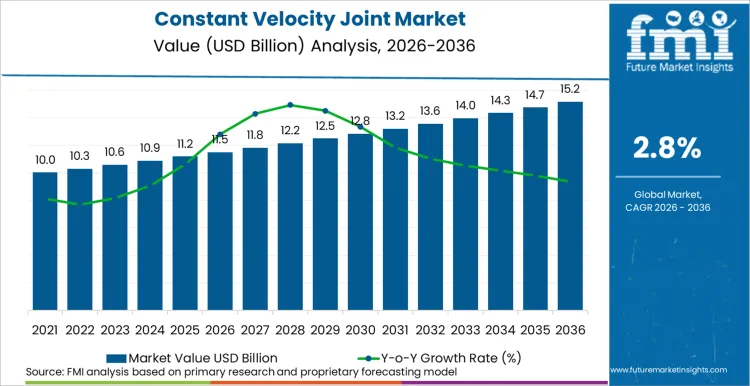
The constant velocity joint market size was established at USD 11.2 billion in 2025. Sales are expected to hit USD 11.5 billion in 2026 at a CAGR of 2.8% during the forecast period. Consistent investment lifts total industry valuation to USD 15.1 billion by 2036, as OEM platform fitment requirements, strict durability standards, and predictable lifecycle replacement patterns continue to support baseline consumption.
Summary of Constant Velocity Joint Market
- Market Snapshot
- The constant velocity joint industry is expected to expand from a baseline valuation of USD 11.2 billion in 2025 to claim USD 15.1 billion by the end of 2036.
- Generating USD 3.6 billion in absolute dollar opportunity, global sales are projected to record a steady 2.8% CAGR during the ten-year assessment period.
- Unlike rapidly evolving electronic components, this hardware space relies heavily on long-term factory installation contracts and proven mechanical durability rather than sudden technological shifts.
- Total revenue generation remains deeply connected to global factory output, the age of cars already on the road, and the specific axle layouts chosen by major automakers.
- Demand and Growth Drivers
- Massive manufacturing scale across major automotive hubs continues to provide a reliable foundation for component orders, keeping assembly lines busy worldwide.
- As consumers keep their cars running longer, particularly across European nations, repair shops are buying up aftermarket service parts at a steady clip to replace worn drivelines.
- Leading suppliers are tweaking classic designs to fight friction and harsh vibrations, proving that even mature mechanical parts can still be optimized for better fuel economy and a smoother ride.
- Looking at the regional expansion forecast, India sets the pace with an anticipated 5.9% CAGR, ahead of China which is expected to rise at 4.5%, Mexico at 4.0%, and the USA at 3.6%, while mature hubs like South Korea at 3.4%, Germany at 3.2%, and Japan at 2.8% post modest but reliable gains.
- Component volume grows slowly because qualification cycles take years to complete, and automakers are increasingly directing their engineering budgets toward fresh electric vehicle platforms instead of traditional mechanical joints.
- Product and Segment View
- Component analysis spans across factory and repair channels, capturing classic Rzeppa, Tripod, and double offset joint formats used in everything from daily commuters to heavy commercial trucks.
- These vital connections manage torque transfer and bending angles across front, rear, and all-wheel-drive architectures where mechanical reliability is absolutely non-negotiable.
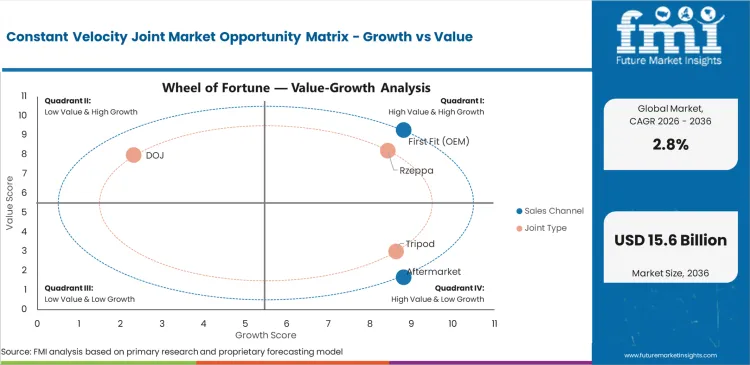
- Securing contracts before cars even leave the factory is the primary way to win in this business, which explains why First Fit (OEM) installations assessed to secure a massive 79% of total market volume.
- Expected to represent a 46% of global category demand, the Rzeppa design remains the undisputed standard for the outer wheel connections on modern passenger vehicles.
- The sheer number of everyday cars being built and driven globally pushes the Passenger Cars segment which is anticipated to capture 71% share, easily overshadowing heavy-duty commercial truck applications.
- Front-wheel-drive configurations are likely to account for nearly half the market at 49% share, a direct result of automakers favoring compact, cost-effective drivetrain packaging for mass-market cars.
- Advanced heat treatments exist, but mainstream buyers still prioritize basic value and proven durability, leaving Standard material configurations poised to control 62% of the sector in 2026.
- While standalone joint assemblies fall within this review, the data deliberately excludes full electrified axles and unrelated transmission parts to maintain strict focus on the actual coupling hardware.
- Geography and Competitive Outlook
- Manufacturing hubs like India, China, and Mexico are quickly adding new production capacity, while established centers in the USA, Germany, and Japan provide a massive baseline of both factory orders and consistent repair demand.
- Winning long-term automaker trust requires massive global reach and localized factories, pushing major names like GKN, NTN CORPORATION, Schaeffler, Dana Inc., JTEKT CORPORATION, and Hyundai WIA Corporation to fiercely defend their regional supply chains.
- No single company dictates the global landscape; the playing field is moderately divided, with even the most successful manufacturer capturing only a low-teens percentage of the total pie rather than holding a monopoly.
Purchasing managers are under pressure to allocate capital to new electric vehicle programs while continuing to support traditional gasoline vehicle components. These drivetrains deliver immediate torque, which raises noise, vibration, and load-handling demands. Standard constant velocity joint assemblies often cannot manage this requirement without a physical redesign. Engineers that delay approval of smoother, lower-friction alternatives risk losing placement in new vehicle programs tied to the electric vehicle e-axle segment. Constant velocity joint forecast assessments also point to a manufacturing constraint, as older production lines built for conventional vehicle layouts often struggle to produce the specialized, high-angle joints required for modern battery-powered architectures.
Vehicle designers support faster production ramp-up when they adopt a single adaptable joint design for both gasoline and electric variants of the same model. Consolidated sourcing of high angle CV couplings reduces part proliferation across assembly plants and makes inventory control easier for procurement teams. Suppliers offering these proven adaptable designs are better placed to secure long-term platform contracts. Producers left competing mainly in smaller replacement programs face tighter margins and weaker contract visibility.
Demand for constant velocity joint market in India is anticipated to rise at a CAGR of 5.9% through 2036 as local factories continue to scale production. Backed by electric vehicle expansion, China is projected to witness 4.5% CAGR in the constant velocity joint market through 2036. Mexico is set to record a CAGR of 4.0% during the assessment period, supported by North American nearshoring activity. Sales in the United States are poised to grow at a CAGR of 3.6% during the decade, sustained by heavy aftermarket fleet consumption. Concentrated export programs keep South Korea on a steady path, with constant velocity joints anticipated to grow at a CAGR of 3.4% over the forecast period, while Japan is likely to post a CAGR of 2.8% in constant velocity joints by 2036, reflecting measured refinement within a mature engineering base. The market for constant velocity joints in Germany is expected to grow at a CAGR of 3.2% through 2036 as premium automakers continue updating legacy vehicle platforms.
Segmental Analysis
Constant Velocity Joint Market Analysis by Sales Channel
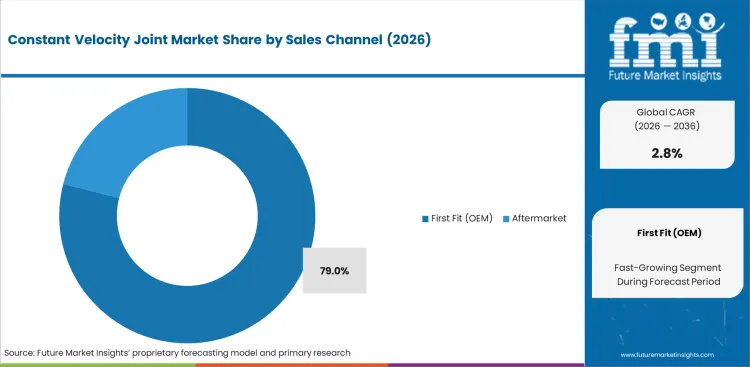
Car manufacturers finalize sourcing contracts three to five years before a vehicle enters production, which keeps factory-installed demand well ahead of replacement requirements. That procurement cycle gives original equipment suppliers a clear volume advantage, since automakers commit early to large, program-linked orders tied to platform production schedules. In 2026, the First Fit (OEM) category is expected to contribute 79.0% of total market share. Purchasing directors usually place greater weight on supply reliability, quality consistency, and low defect rates than on marginal unit cost savings, which strengthens long-standing supplier relationships. Independent repair channels account for the remaining volume, though demand there depends far more on uneven road conditions, vehicle age, and routine wear. OEM supply patterns are also shifting, as a growing share of these components now require localized finishing or final assembly near major vehicle plants to limit cross-border tariff exposure. Suppliers that do not establish such facilities close to key automotive hubs often lose contract opportunities even when their engineering capability remains competitive.
- Initial Qualification: Tier-1 procurement directors demand exhaustive NVH and fatigue testing data before authorizing any new supplier code. Unvalidated vendors face complete exclusion from multi-year platform sourcing matrices.
- Volume Validation: Manufacturing engineers conduct rigid line-rate audits verifying a supplier's capacity to deliver thousands of defect-free units weekly. Production bottlenecks instantly trigger secondary sourcing protocols.
- Lifecycle Extension: Platform architects occasionally carry over proven joint designs into mid-cycle vehicle refreshes. Retaining established suppliers minimizes re-engineering costs while guaranteeing predictable assembly plant performance.
Constant Velocity Joint Market Analysis by Joint Type
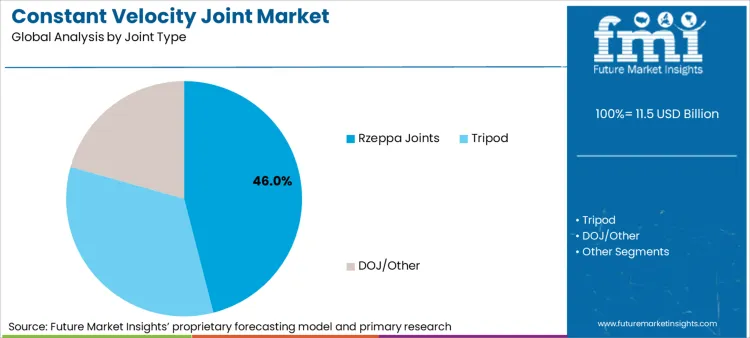
Modern car wheels offer very limited internal clearance, even though they must still articulate smoothly at steep steering angles. That constraint puts heavy design pressure on the outer connection points near the wheel. Automotive designers depend on the ball-and-groove geometry of the Rzeppa joint to maintain steady power transfer through tight turns and to limit steering vibration, which is why the Rzeppa segment is estimated to account for 46.0% share in 2026. The deeper weakness in these joints usually sits in the protective rubber cover rather than the metal assembly itself. Pure metal fatigue is rarely the first cause of failure. Fine dirt entering through small tears in the boot typically accelerates wear far earlier than expected. Premium rubber covers can extend part life significantly, yet purchasing teams often resist that upgrade when they are under pressure to reduce component cost. In a standard automotive transmission setup, that cost-saving decision can turn into expensive warranty exposure once rough road conditions damage lower-grade seals ahead of schedule.
- Cost Economics Analysis: Procurement teams negotiate basic carbon steel joint assemblies aggressively because the supplier base is broad and even small unit-cost reductions scale quickly across large vehicle programs. Saving a few pennies per joint can translate into substantial platform-level savings, which explains why lower-cost specifications remain attractive at sourcing stage.
- Hidden Operational Expenses: Maintenance teams regularly find that inferior boots crack early when exposed to wide temperature swings and harsh road conditions. The damage often develops unnoticed until contamination reaches the joint, after which wear progresses quickly and the assembly can fail with little warning.
- Lifecycle Total Value: Reliability engineers use accelerated wear testing to identify the failure thresholds of different boot materials under real operating stress. That analysis gives automakers a clearer basis for specifying premium protective elements in automotive transmission systems where longer service life matters more than marginal upfront savings.
Constant Velocity Joint Market Analysis by Vehicle Type
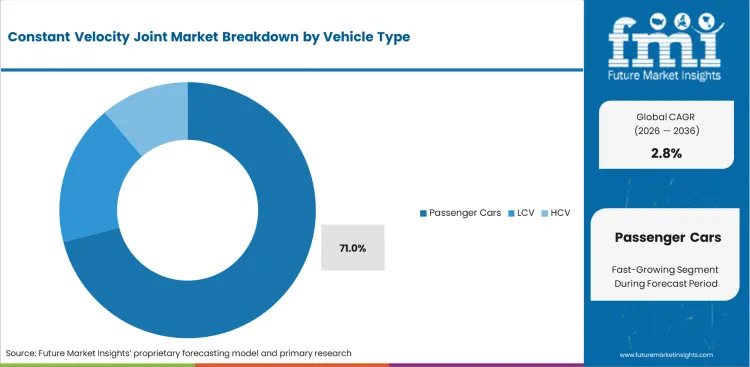
Passenger Cars category is likely to account for 71.0% share in 2026, as all the heavy and solid axles used in older cars have mostly been replaced by independent suspension setups in today's everyday vehicles. This massive volume is sustained by the fact that millions of commuter cars worldwide use space-saving front-engine designs. Planners depend on compact automotive wheel bearings and shorter half-shafts to maximize interior room without making the car physically larger. A silent split is happening within this massive volume of passenger cars. Traditional gas cars still use cheaper, older joint designs, while new electric versions of the exact same car need heavily reinforced internal metal cages. Parts makers trying to build components for both gas and electric vehicles on the exact same assembly line face terrible return rates when their standard parts break in electric cars. Delaying the switch to specialized, high-strength joints will cost suppliers their most profitable factory contracts.
- Critical Failure Prevention: Suspension designers engineer precise track geometries preventing ball bearings from binding during extreme articulation. Machining errors in these tracks instantly trigger catastrophic mechanical lockup during sharp cornering maneuvers.
- Residual NVH Risks: NVH engineers realize even perfectly machined joints transmit low-frequency hums into cabin spaces over time. Acoustic grease formulations only temporarily mask these vibrations before requiring comprehensive replacement.
- Full Benefit Capture: Driveline architects must align joint specifications perfectly with suspension travel limits. Capturing maximum articulation value requires precise structural coordination across multiple engineering departments.
Constant Velocity Joint Market Analysis by Drive
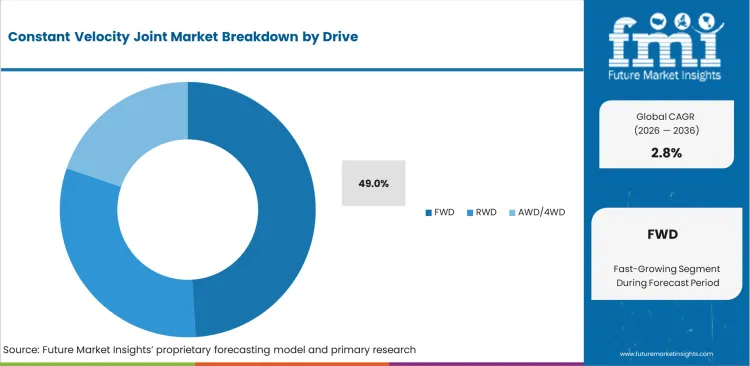
Placing the engine sideways in the front of the car remains the standard layout for most everyday vehicles. Factory managers prefer these front-wheel-drive setups because the engine, transmission, and drive wheels arrive as one pre-assembled package that drops straight into the car frame, avoiding complicated routing underneath the vehicle. This high volume masks a major shift happening in how power reaches the wheels. Dual-motor electric vehicles are pushing older front-wheel-drive designs toward advanced all-wheel-drive systems using complex dual clutch transmission technology, following FWD as predicted to represent a 49.0% of market share in 2026. This drastically changes the physical stress placed on front-end components. Purchasing officers who predict future part needs using only old gas-engine data will face severe shortages as electric models demand much stronger front assemblies. Guessing wrong about this design shift leaves automakers scrambling to find capable parts in the middle of production.
- Captive OEM Supply: Global driveline conglomerates control vast proprietary forging networks dedicated exclusively to FWD platforms. Sustaining massive throughput allows these titans to undercut smaller regional competitors on unit pricing.
- Material Constraints: Forging facility managers battle raw steel supply fluctuations impacting production schedules. Securing uninterrupted access to specialized alloys remains critical for maintaining multi-million unit output quotas.
- Future Trajectory: Platform engineers project future front joints will require integrated torque-sensing capabilities. Adapting basic mechanical components into smart driveline nodes defines next-generation competitive supply dynamics.
Constant Velocity Joint Market Analysis by Material/Heat Treatment
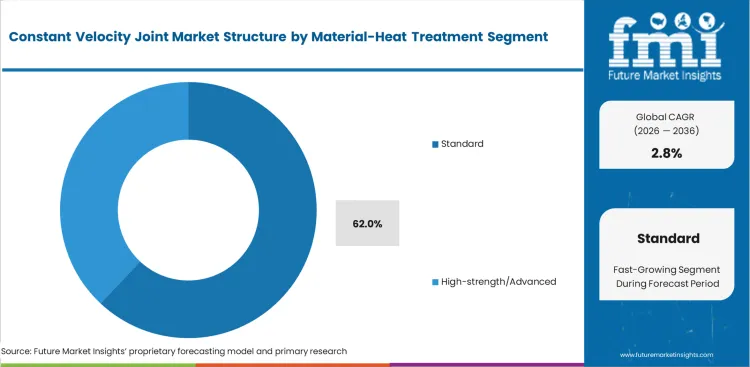
Metal experts constantly balance the high cost of advanced heat treatments against the basic durability needs of everyday commuter cars. These basic carbon steel parts stay dominant because most regular gas-powered cars simply do not produce enough instant power to justify using expensive, aerospace-grade metal. Cost estimators at major car brands ruthlessly cut out over-engineered parts during budget reviews, keeping standard steel firmly in place across the supply chain. Focusing only on factory fitment misses a large weakness in the replacement market, especially across the automotive bearing and clutch component aftermarket, where standard material variants are anticipated to emerge with 62.0% market share in 2026. Independent repair shops often fit low-cost counterfeit joints that match the original part visually but lack the deep-case hardening needed to withstand real operating stress. That shortfall rarely shows up at installation. It appears later under load, when premature wear turns into full mechanical failure. Fleet operators that buy replacement parts on price alone often face breakdowns within a year, particularly in vehicles exposed to higher duty cycles. In the automotive bearing and clutch component aftermarket, failure to verify heat-treatment depth remains one of the clearest signs of poor part quality and a common cause of roadside stoppages under heavy load.
- Standard Baseline Performance: Reliability engineers confirm basic carbon steel joints easily exceed 100,000-mile warranty targets under normal commuter driving conditions. Formulating optimal heat treatments ensures adequate performance without inflating component costs.
- Edge Condition Degradation: Test track drivers expose standard materials to extreme thermal stress during sustained high-speed articulation testing. Budget alloys rapidly lose structural integrity when internal temperatures exceed design parameters.
- Qualification Thresholds: Quality control directors enforce strict hardness testing protocols verifying subsurface material strength. Rejecting batches failing these microscopic evaluations prevents inferior metals from reaching assembly lines.
Constant Velocity Joint Market Drivers, Restraints, and Opportunities
Vehicle programs are now being engineered around lower weight, tighter NVH targets, and far quieter cabin environments. In internal combustion vehicles, minor driveline vibration and joint noise could be masked by engine sound. Electric platforms expose those flaws immediately. That shift is forcing OEMs to source higher-precision constant velocity joints with tighter tolerances, refined surface finishes, and grease systems designed for quiet operation under high load. Delays in securing supply from qualified specialist vendors can push back EV launch schedules, since vehicles that miss noise acceptance targets do not move forward into production. Demand for constant velocity joints is rising in step with the rollout of heavier electric SUVs, where higher torque loads and low-noise performance are both non-negotiable.
Material upgrades move slowly because validation standards for safety-critical driveline parts remain uncompromising. New hardening methods must pass extended thermal cycling, impact loading, and fracture testing before they are considered production-ready. EV applications make that process even more demanding, since sudden torque delivery places greater stress on the joint during launch and recovery events. Simulation tools help suppliers narrow development cycles and identify likely wear patterns earlier in the program. Approval still depends on bench testing and physical endurance validation, as engineering and safety teams at major automakers continue to rely on lab-proven performance before signing off on any material change.
- Electric Vehicle Torque Mitigation: High-capacity joints built to absorb instantaneous EV torque loads support premium pricing. Platform engineers specify these assemblies to prevent driveline shock and protect transmission components during hard acceleration.
- Acoustic Optimization: Internal surface finishing and advanced grease formulations are being engineered to suppress clicking and vibration. NVH teams favor these quieter joint systems to meet strict cabin noise limits in automatic transmission vehicle programs.
- Aftermarket Boot Upgrades: More durable thermoplastic elastomer boots help reduce contamination-related joint failure in service. Fleet maintenance operators accept higher replacement costs when longer boot life lowers breakdown risk across rough roads and wide temperature swings.
Regional Analysis
The global landscape for constant velocity joints is shifting rapidly as regions balance traditional repair needs with the heavy demands of new electric vehicles. While mature markets focus on precision and maintenance, emerging manufacturing hubs are aggressively scaling up local production to meet modern automotive challenges.
.webp "Top Country Growth Comparison Constant Velocity Joint Market Cagr (2026 2036)")
| Country | CAGR (2026 to 2036) |
|---|---|
| India | 5.9% |
| China | 4.5% |
| Mexico | 4.0% |
| USA | 3.6% |
| South Korea | 3.4% |
| Germany | 3.2% |
| Japan | 2.8% |
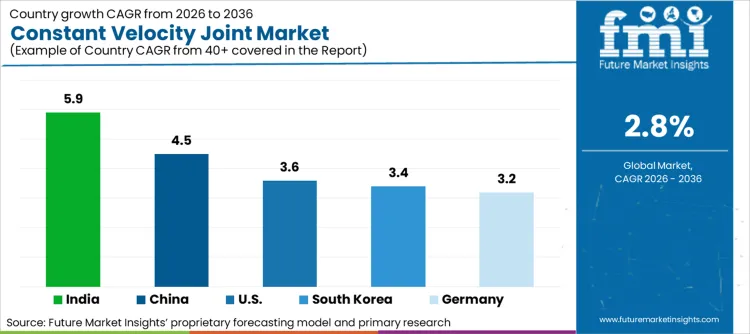
Source: Future Market Insights (FMI) analysis, based on proprietary forecasting model and primary research
Asia-Pacific Constant Velocity Joint Market Analysis
Asia-Pacific stands out as a massive testing ground and production engine for modern driveline parts, including the automotive axle. Automakers here are moving away from importing expensive pre-assembled modules, choosing instead to build strong local supply networks that can handle everything from rough regional roads to the high-tech needs of new electric vehicles.
- India: Carmakers are pushing hard to source parts locally, forcing suppliers to improve their own metal forging capabilities right at home. As this push for local manufacturing accelerates, India is anticipated to witness demand rise at a CAGR of 5.9% through 2036, creating a strong foundation for future exports. Securing these domestic contracts allows local factories to eventually supply high-quality parts to the rest of Asia.
- China: The massive shift toward battery-powered cars in the country is forcing engineers to quickly invent stronger joints that can handle sudden bursts of electric power. Driven by this explosive need to diversify EV platforms alongside modern electric vehicle e-axle systems, China is predicted to move ahead at a CAGR of 4.5% during the assessment period. This ensures factories stay incredibly busy despite tough pricing competition.
- South Korea: The country continues to rely on heavy upfront investments to upgrade older manufacturing lines so they can produce the export-grade precision joints, thereby predicting the sector to register a CAGR of 3.4% through 2036. Exporting cars to the rest of the world requires top-notch reliability to avoid expensive international warranty claims.
- Japan: Instead of just pumping out more volume, Japanese engineers are deeply focused on making parts lighter and reducing friction. This mastery of tiny efficiencies means Japan is poised to witness a CAGR of 2.8% over the forecast period, helping legacy suppliers maintain their status as premium partners for global brands.
FMI reports, the Asia-Pacific region is successfully blending rapid local expansion with cutting-edge electric vehicle development. By balancing mass production with intense technological upgrades, the area remains the core engine driving global automotive supply chains forward.
The Americas Constant Velocity Joint Market Analysis
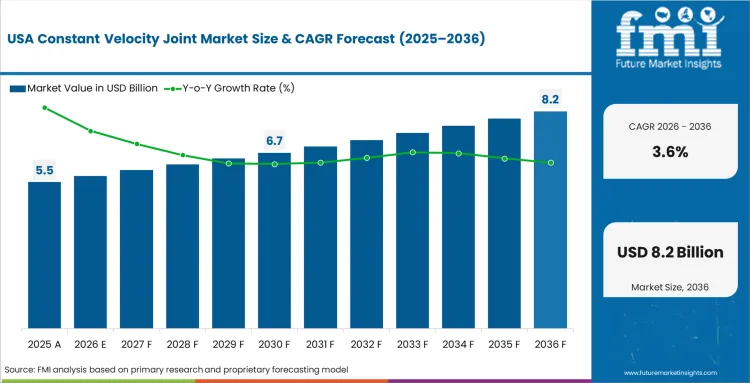
Across the Americas, the market is shaped by two distinct but connected forces: a massive aging fleet of trucks in the north and a strategic manufacturing shift toward the south. Companies are rethinking how they build and distribute parts to keep supply chains short and repair shops fully stocked.
- USA: Millions of older light trucks and SUVs on the road guarantee a steady, predictable stream of repair work for independent mechanics. Due to fleet managers operating in harsh environments, the United States is likely to scale a CAGR of 3.6% in demand by 2036, keeping aftermarket channels, similar to the broader automotive wheel bearing aftermarket, heavily reliant on well-stocked local inventories to turn repairs around quickly.
- Mexico: Companies are actively moving their critical metal machining operations closer to home to avoid long shipping delays across the Pacific. Getting in early allows suppliers to lock down long-term deals with major car builders while cutting down on shipping costs. Spurred by these nearshoring investments and expected to grow at a CAGR of 4.0% during the decade, Mexico is rapidly transforming from a simple assembly hub into a fully integrated engineering center.
FMI assesses, the Americas highlight a perfect synergy between keeping older vehicles running and optimizing new part production. As manufacturing moves closer to the end consumer, the region ensures that both massive aftermarket needs and fresh OEM contracts are met without cross-border friction.
Europe Constant Velocity Joint Market Analysis
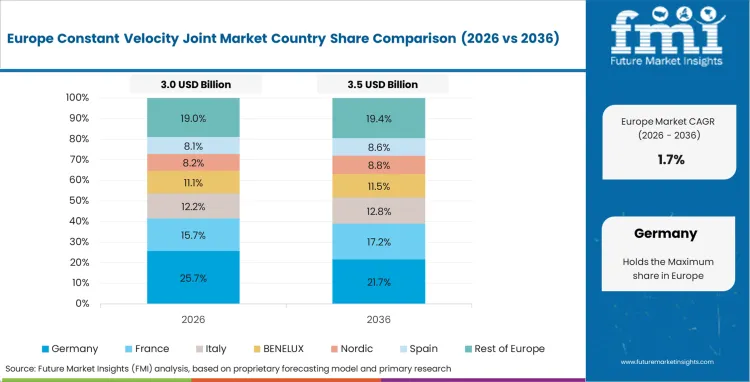
European car brands have built their reputations on premium driving experiences, and their shift to electric vehicles means their engineering standards are stricter than ever. Research directors demand components that are virtually silent and incredibly durable to maintain that high-end feel in the EV era.
- Germany: Elite engineering teams require custom-made, low-vibration joint designs to ensure their high-performance electric sedans run flawlessly alongside integrated e-axle input and output couplings. These technical expectations are so high, that demand in Germany is anticipated to incline at a CAGR of 3.2% through 2036, rewarding suppliers who can actually pass these brutal testing phases. Companies that crack these codes easily cement themselves as undisputed technical leaders worldwide.
FMI estimates, Europe continues to serve as the ultimate proving ground for premium automotive technology. By setting the world's most rigorous noise and durability standards, the region forces global suppliers to elevate their engineering capabilities to stay competitive in a changing industry.
Competitive Aligners for Market Players
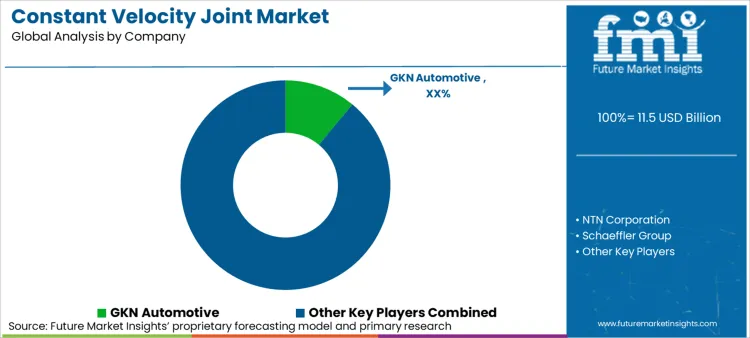
Competition in this market is decided model by model, with suppliers fighting for place on specific vehicle programs rather than dominating the industry as a whole. OEMs judge CV joint manufacturers on production footprint, metallurgical reliability, validation depth, and the ability to support global assembly networks without disruption. GKN (Dowlais Group) and NTN CORPORATION remain well placed because they can draw on long operating histories from conventional vehicle platforms to assess durability in newer electric driveline systems. That gives buyers more confidence when sourcing parts tied to the vehicle transfer case or other core joint applications, where failure risk carries direct warranty and production consequences. Established OEM CV joint manufacturers also have the balance sheet strength to build assembly capacity near customer plants, which helps them meet sequencing requirements and reduce logistics exposure.
The technical gap is just as important as the manufacturing one. Incumbent suppliers have years of internal data on vibration, acoustic behavior, grease chemistry, and long-term wear patterns across different duty cycles. New constant velocity joint manufacturers can invest in advanced machining equipment and still remain behind on application knowledge, especially when steel behavior and lubricant performance must be proven under the higher torque loads seen in electric vehicles. Schaeffler add another layer of competitive pressure by supplying broader driveline packages designed to work with electronic AWD coupling modules. That puts standalone joint suppliers in a harder position, since they are no longer competing only on part quality. They are being measured against the packaging, calibration, and sourcing convenience of a full system offer. New entrants usually gain ground only when they solve a specific engineering problem that larger suppliers have not prioritized.
OEM sourcing teams are equally careful about supplier dependence. Vehicle platforms are often engineered to accept assemblies from multiple approved vendors, giving automakers room to shift volumes if cost, quality, or regional supply conditions change. Large purchase contracts, including propeller shaft couplings and flanges, are commonly split across at least two suppliers to keep pricing disciplined and protect production if one site faces an interruption. That creates a constant negotiation between buyer priorities and supplier strategy. Automakers want interchangeable parts and supply security. Suppliers push for more proprietary designs that carry better margins and make replacement less straightforward. In response, smaller manufacturers are putting more development money into sensor-enabled components that can flag wear before breakdown, instead of competing only in conventional hardware categories.
Key Players in Constant Velocity Joint Market
- GKN (Dowlais Group)
- NTN CORPORATION
- Schaeffler
- Dana Inc.
- JTEKT CORPORATION
- Hyundai WIA Corporation
Scope of the Report
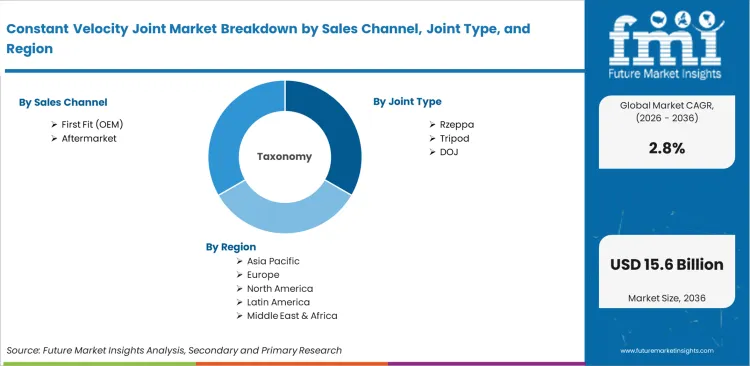
| Metric | Value |
|---|---|
| Quantitative Units | USD 11.5 billion in 2026 to USD 15.1 billion by 2036, at a CAGR of 2.8% |
| Market Definition | Constant velocity joints serve as critical mechanical interfaces transmitting torque from transaxles to driving wheels across variable suspension and steering angles. These assemblies ensure smooth, continuous power delivery without speed fluctuations. |
| Segmentation | Sales Channel, Joint Type, Vehicle Type, Drive, Material/Heat Treatment, Region |
| Regions Covered | North America, Latin America, Europe, East Asia, South Asia and Pacific, Middle East and Africa |
| Countries Covered | USA, Mexico, Germany, China, Japan, South Korea, India |
| Key Companies Profiled | GKN (Dowlais Group), NTN CORPORATION, Schaeffler, Dana Inc., JTEKT CORPORATION, Hyundai WIA Corporation |
| Forecast Period | 2026 to 2036 |
| Approach | Annual light and commercial vehicle production volumes cross-referenced with average drivetrain architecture fitment ratios. |
Source: Future Market Insights (FMI) analysis, based on proprietary forecasting model and primary research
Segments
Sales Channel
- First Fit (OEM)
- Aftermarket
Joint Type
- Rzeppa
- Tripod
- DOJ
Vehicle Type
- Passenger Cars
- LCV
- HCV
Drive
- FWD
- RWD
- AWD/4WD
Material/Heat Treatment
- Standard
- High-strength/Advanced
Regions:
- Asia Pacific
- India
- China
- Japan
- South Korea
- Indonesia
- Australia & New Zealand
- ASEAN
- Rest of Asia Pacific
- Europe
- Germany
- Italy
- France
- United Kingdom
- Spain
- Benelux
- Nordics
- Central & Eastern Europe
- Rest of Europe
- North America
- United States
- Canada
- Mexico
- Latin America
- Brazil
- Argentina
- Chile
- Rest of Latin America
- Middle East & Africa
- Kingdom of Saudi Arabia
- United Arab Emirates
- South Africa
- Turkey
- Rest of Middle East & Africa
Bibliography
- Afseoren, M., Ersoz, T. T., & Yildirim, M. (2024). Comparison of warm and cold forging with friction welding for inner constant velocity joints (CVJs). Transactions of the Indian Institute of Metals, 77, 3341-3352.
- HYUNDAI WIA. (2024). HYUNDAI WIA increased overseas orders of constant velocity joints last year significantly with the mechanical engineering technology.
- Lee, K.-H., & Lee, C.-H. (2024). Environmental and economic impact on scenario-based automotive part replacement: Case study of constant velocity (CV) joint replacement in Korea. Applied Sciences, 14(20), 9248.
- Opia, A. C., Hamid, M. K. A., Samion, S., Yekinni, A. A., Ruksana, M. S., Sillah, Y. M., & Kadirgama, K. (2025). Electric vehicles as a promising trend: A review on adaptation, lubrication challenges, and future work. Lubricants, 13(11), 474.
This bibliography is provided for reader reference. The full FMI report contains the complete reference list with primary source documentation.
This Report Addresses
- Torque demands placed on outboard articulation nodes by heavier battery-electric vehicle architectures.
- Qualification protocols Tier-1 procurement directors enforce before validating high-strength joint components.
- Acoustic testing failures prompting NVH engineers to specify advanced track geometries and proprietary grease.
- Localized forging investments necessary to capture emerging OEM supply contracts across South Asia.
- Fatigue testing metrics dictating material choices between standard carbon steel and induction-hardened alloys.
- Hidden vulnerabilities inside independent aftermarket distribution channels relying on unhardened counterfeit joints.
- Cost economics shifting platform architects toward modular driveline designs shared across ICE and EV models.
- Production scaling challenges component manufacturers face transitioning from legacy RWD to modern FWD assemblies.
Frequently Asked Questions
what is the size of the constant velocity joint market?
Sales are expected to reach USD 11.5 billion in 2026, signaling sustained reliance on mechanical articulation across global vehicle production lines despite ongoing electrification trends.
explain the constant velocity joint market outlook through 2036?
Continuous lifecycle replacement rhythms and rigid OEM platform fitment requirements anchor long-term demand, carrying total CV joint market valuation to USD 15.1 billion by 2036.
Why does First Fit (OEM) dominate sales channels?
Tier-1 driveline manufacturers lock in rigid multi-year platform contracts, forcing procurement directors to prioritize massive scale and zero-defect consistency over incremental aftermarket sales.
which joint type leads the CV joint market?
Chassis engineers depend entirely on ball-and-groove geometries like Rzeppa to maintain smooth torque delivery under severe steering angles, eliminating shudder common in inferior designs.
summarize CV joint demand by joint type and vehicle type?
Rzeppa leads outboard applications solving extreme packaging constraints, while passenger car volumes dwarf commercial variants due to universal adoption of front-wheel-drive commuter architectures globally.
Why do Passenger Cars represent the largest vehicle segment?
Universal adoption of transverse engine configurations across millions of commuter vehicles mandates compact half-shaft assemblies maximizing interior cabin space without expanding physical footprints.
What drives FWD architecture dominance?
Assembly plant managers favor pre-assembled forward modules dropping directly into chassis, drastically reducing manufacturing complexity compared to longitudinal routing requirements.
Why do standard materials retain significant share?
Cost estimators ruthlessly eliminate over-engineered components during value-engineering reviews because basic carbon steel joints easily survive standard internal combustion torque loads.
which countries are growing fastest in CV joints?
Aggressive localization mandates compel automakers in India to establish deep domestic forging networks, transforming local facilities from simple assembly operations into fully integrated driveline hubs.
How does China's growth profile differ from mature markets?
Explosive EV platform diversification requires continuous iteration of high-strength joints, acting as a real-time proving ground for next-generation automotive propeller shaft market technologies.
What anchors demand across the United States?
Millions of high-mileage utility vehicles ensure massive, predictable replacement cycles for independent repair shops managing harsh operating environments.
How are nearshoring dynamics affecting Mexico?
North American procurement directors seeking shortened supply chains actively relocate critical component machining operations, establishing long-term cross-border supply agreements.
What dictates engineering standards in Germany?
Premium automakers imposing the world's strictest NVH and durability requirements force suppliers to develop bespoke, low-vibration joint designs for high-performance electric sedans.
Why do legacy joints fail in electric vehicles?
Electric motors generate maximum torque at zero RPM, delivering violent mechanical shocks that shatter standard internal cages not specifically hardened for instantaneous loads.
What hidden vulnerability exists in aftermarket joints?
Independent repair shops routinely install cheap counterfeit assemblies mimicking OEM dimensions but lacking critical subsurface tempering, leading to rapid catastrophic failure.
How do premium elastomer boots extend component lifespan?
Catastrophic joint failure rarely stems from pure mechanical fatigue; specialized rubber compounds block microscopic debris ingress, preventing abrasive track degradation.
Why do dual-motor EVs complicate joint sourcing?
Software-defined all-wheel-drive platforms drastically alter load profiles on front axles, leaving automakers scrambling for high-capacity assemblies mid-production.
What role does acoustic grease play in EV platforms?
Silent electric powertrains expose minor mechanical clicks; specialized formulations temporarily mask these vibrations to meet strict cabin noise audit standards.
How do suppliers validate new metallurgical treatments?
Reliability directors demand months of accelerated fatigue testing, thermal cycling, and destructive analysis ensuring alloys survive sudden torque spikes without shattering.
What advantage do incumbent driveline manufacturers hold?
Established global conglomerates leverage massive historical ICE data sets to accurately model fatigue profiles for emerging automotive differential market applications, an analytical depth challengers lack.
which companies are active in the global CV joint market today?
Major participants guiding OEM platform decisions include GKN (Dowlais Group), NTN CORPORATION, Schaeffler, Dana Inc., JTEKT CORPORATION, and Hyundai WIA Corporation.
How do automakers resist vendor lock-in?
Purchasing departments intentionally design modular platform architectures accommodating assemblies from multiple qualified suppliers, maintaining continuous pricing tension.
Why are localized finishing facilities critical for OEM contracts?
Suppliers failing to establish final assembly operations near major automotive hubs face complex cross-border logistics tariffs, losing bids despite superior engineering.
What forces suppliers to pivot R&D investments?
Tension between standardized OEM requirements and proprietary supplier geometries pushes agile manufacturers toward developing smart driveline components with predictive maintenance sensors.
Preview the report firsthand - request a free sample
Get SampleGet the brochure for pricing and purchase details.
Get PDFTable of Content
- Executive Summary
- Global Market Outlook
- Demand-side Trends
- Supply-side Trends
- Technology Roadmap Analysis
- Analysis and Recommendations
- Market Overview
- Market Coverage / Taxonomy
- Market Definition / Scope / Limitations
- Research Methodology
- Chapter Orientation
- Analytical Lens and Working Hypotheses
- Market Structure, Signals, and Trend Drivers
- Benchmarking and Cross-market Comparability
- Market Sizing, Forecasting, and Opportunity Mapping
- Research Design and Evidence Framework
- Desk Research Programme (Secondary Evidence)
- Company Annual and Sustainability Reports
- Peer-reviewed Journals and Academic Literature
- Corporate Websites, Product Literature, and Technical Notes
- Earnings Decks and Investor Briefings
- Statutory Filings and Regulatory Disclosures
- Technical White Papers and Standards Notes
- Trade Journals, Industry Magazines, and Analyst Briefs
- Conference Proceedings, Webinars, and Seminar Materials
- Government Statistics Portals and Public Data Releases
- Press Releases and Reputable Media Coverage
- Specialist Newsletters and Curated Briefings
- Sector Databases and Reference Repositories
- FMI Internal Proprietary Databases and Historical Market Datasets
- Subscription Datasets and Paid Sources
- Social Channels, Communities, and Digital Listening Inputs
- Additional Desk Sources
- Expert Input and Fieldwork (Primary Evidence)
- Primary Modes
- Qualitative Interviews and Expert Elicitation
- Quantitative Surveys and Structured Data Capture
- Blended Approach
- Why Primary Evidence is Used
- Field Techniques
- Interviews
- Surveys
- Focus Groups
- Observational and In-context Research
- Social and Community Interactions
- Stakeholder Universe Engaged
- C-suite Leaders
- Board Members
- Presidents and Vice Presidents
- R&D and Innovation Heads
- Technical Specialists
- Domain Subject-matter Experts
- Scientists
- Physicians and Other Healthcare Professionals
- Governance, Ethics, and Data Stewardship
- Research Ethics
- Data Integrity and Handling
- Primary Modes
- Tooling, Models, and Reference Databases
- Desk Research Programme (Secondary Evidence)
- Data Engineering and Model Build
- Data Acquisition and Ingestion
- Cleaning, Normalisation, and Verification
- Synthesis, Triangulation, and Analysis
- Quality Assurance and Audit Trail
- Market Background
- Market Dynamics
- Drivers
- Restraints
- Opportunity
- Trends
- Scenario Forecast
- Demand in Optimistic Scenario
- Demand in Likely Scenario
- Demand in Conservative Scenario
- Opportunity Map Analysis
- Product Life Cycle Analysis
- Supply Chain Analysis
- Investment Feasibility Matrix
- Value Chain Analysis
- PESTLE and Porter’s Analysis
- Regulatory Landscape
- Regional Parent Market Outlook
- Production and Consumption Statistics
- Import and Export Statistics
- Market Dynamics
- Global Market Analysis 2021 to 2025 and Forecast, 2026 to 2036
- Historical Market Size Value (USD Million) Analysis, 2021 to 2025
- Current and Future Market Size Value (USD Million) Projections, 2026 to 2036
- Y-o-Y Growth Trend Analysis
- Absolute $ Opportunity Analysis
- Global Market Pricing Analysis 2021 to 2025 and Forecast 2026 to 2036
- Global Market Analysis 2021 to 2025 and Forecast 2026 to 2036, By Sales Channel
- Introduction / Key Findings
- Historical Market Size Value (USD Million) Analysis By Sales Channel , 2021 to 2025
- Current and Future Market Size Value (USD Million) Analysis and Forecast By Sales Channel , 2026 to 2036
- First Fit (OEM)
- Aftermarket
- First Fit (OEM)
- Y-o-Y Growth Trend Analysis By Sales Channel , 2021 to 2025
- Absolute $ Opportunity Analysis By Sales Channel , 2026 to 2036
- Global Market Analysis 2021 to 2025 and Forecast 2026 to 2036, By Joint Type
- Introduction / Key Findings
- Historical Market Size Value (USD Million) Analysis By Joint Type, 2021 to 2025
- Current and Future Market Size Value (USD Million) Analysis and Forecast By Joint Type, 2026 to 2036
- Rzeppa
- Tripod
- DOJ
- Rzeppa
- Y-o-Y Growth Trend Analysis By Joint Type, 2021 to 2025
- Absolute $ Opportunity Analysis By Joint Type, 2026 to 2036
- Global Market Analysis 2021 to 2025 and Forecast 2026 to 2036, By Vehicle Type
- Introduction / Key Findings
- Historical Market Size Value (USD Million) Analysis By Vehicle Type, 2021 to 2025
- Current and Future Market Size Value (USD Million) Analysis and Forecast By Vehicle Type, 2026 to 2036
- Passenger Cars
- LCV
- HCV
- Passenger Cars
- Y-o-Y Growth Trend Analysis By Vehicle Type, 2021 to 2025
- Absolute $ Opportunity Analysis By Vehicle Type, 2026 to 2036
- Global Market Analysis 2021 to 2025 and Forecast 2026 to 2036, By Drive
- Introduction / Key Findings
- Historical Market Size Value (USD Million) Analysis By Drive, 2021 to 2025
- Current and Future Market Size Value (USD Million) Analysis and Forecast By Drive, 2026 to 2036
- FWD
- RWD
- AWD/4WD
- FWD
- Y-o-Y Growth Trend Analysis By Drive, 2021 to 2025
- Absolute $ Opportunity Analysis By Drive, 2026 to 2036
- Global Market Analysis 2021 to 2025 and Forecast 2026 to 2036, By Material-Heat Treatment
- Introduction / Key Findings
- Historical Market Size Value (USD Million) Analysis By Material-Heat Treatment, 2021 to 2025
- Current and Future Market Size Value (USD Million) Analysis and Forecast By Material-Heat Treatment, 2026 to 2036
- Standard
- High-strength/Advanced
- Standard
- Y-o-Y Growth Trend Analysis By Material-Heat Treatment, 2021 to 2025
- Absolute $ Opportunity Analysis By Material-Heat Treatment, 2026 to 2036
- Global Market Analysis 2021 to 2025 and Forecast 2026 to 2036, By Region
- Introduction
- Historical Market Size Value (USD Million) Analysis By Region, 2021 to 2025
- Current Market Size Value (USD Million) Analysis and Forecast By Region, 2026 to 2036
- North America
- Latin America
- Western Europe
- Eastern Europe
- East Asia
- South Asia and Pacific
- Middle East & Africa
- Market Attractiveness Analysis By Region
- North America Market Analysis 2021 to 2025 and Forecast 2026 to 2036, By Country
- Historical Market Size Value (USD Million) Trend Analysis By Market Taxonomy, 2021 to 2025
- Market Size Value (USD Million) Forecast By Market Taxonomy, 2026 to 2036
- By Country
- USA
- Canada
- Mexico
- By Sales Channel
- By Joint Type
- By Vehicle Type
- By Drive
- By Material-Heat Treatment
- By Country
- Market Attractiveness Analysis
- By Country
- By Sales Channel
- By Joint Type
- By Vehicle Type
- By Drive
- By Material-Heat Treatment
- Key Takeaways
- Latin America Market Analysis 2021 to 2025 and Forecast 2026 to 2036, By Country
- Historical Market Size Value (USD Million) Trend Analysis By Market Taxonomy, 2021 to 2025
- Market Size Value (USD Million) Forecast By Market Taxonomy, 2026 to 2036
- By Country
- Brazil
- Chile
- Rest of Latin America
- By Sales Channel
- By Joint Type
- By Vehicle Type
- By Drive
- By Material-Heat Treatment
- By Country
- Market Attractiveness Analysis
- By Country
- By Sales Channel
- By Joint Type
- By Vehicle Type
- By Drive
- By Material-Heat Treatment
- Key Takeaways
- Western Europe Market Analysis 2021 to 2025 and Forecast 2026 to 2036, By Country
- Historical Market Size Value (USD Million) Trend Analysis By Market Taxonomy, 2021 to 2025
- Market Size Value (USD Million) Forecast By Market Taxonomy, 2026 to 2036
- By Country
- Germany
- UK
- Italy
- Spain
- France
- Nordic
- BENELUX
- Rest of Western Europe
- By Sales Channel
- By Joint Type
- By Vehicle Type
- By Drive
- By Material-Heat Treatment
- By Country
- Market Attractiveness Analysis
- By Country
- By Sales Channel
- By Joint Type
- By Vehicle Type
- By Drive
- By Material-Heat Treatment
- Key Takeaways
- Eastern Europe Market Analysis 2021 to 2025 and Forecast 2026 to 2036, By Country
- Historical Market Size Value (USD Million) Trend Analysis By Market Taxonomy, 2021 to 2025
- Market Size Value (USD Million) Forecast By Market Taxonomy, 2026 to 2036
- By Country
- Russia
- Poland
- Hungary
- Balkan & Baltic
- Rest of Eastern Europe
- By Sales Channel
- By Joint Type
- By Vehicle Type
- By Drive
- By Material-Heat Treatment
- By Country
- Market Attractiveness Analysis
- By Country
- By Sales Channel
- By Joint Type
- By Vehicle Type
- By Drive
- By Material-Heat Treatment
- Key Takeaways
- East Asia Market Analysis 2021 to 2025 and Forecast 2026 to 2036, By Country
- Historical Market Size Value (USD Million) Trend Analysis By Market Taxonomy, 2021 to 2025
- Market Size Value (USD Million) Forecast By Market Taxonomy, 2026 to 2036
- By Country
- China
- Japan
- South Korea
- By Sales Channel
- By Joint Type
- By Vehicle Type
- By Drive
- By Material-Heat Treatment
- By Country
- Market Attractiveness Analysis
- By Country
- By Sales Channel
- By Joint Type
- By Vehicle Type
- By Drive
- By Material-Heat Treatment
- Key Takeaways
- South Asia and Pacific Market Analysis 2021 to 2025 and Forecast 2026 to 2036, By Country
- Historical Market Size Value (USD Million) Trend Analysis By Market Taxonomy, 2021 to 2025
- Market Size Value (USD Million) Forecast By Market Taxonomy, 2026 to 2036
- By Country
- India
- ASEAN
- Australia & New Zealand
- Rest of South Asia and Pacific
- By Sales Channel
- By Joint Type
- By Vehicle Type
- By Drive
- By Material-Heat Treatment
- By Country
- Market Attractiveness Analysis
- By Country
- By Sales Channel
- By Joint Type
- By Vehicle Type
- By Drive
- By Material-Heat Treatment
- Key Takeaways
- Middle East & Africa Market Analysis 2021 to 2025 and Forecast 2026 to 2036, By Country
- Historical Market Size Value (USD Million) Trend Analysis By Market Taxonomy, 2021 to 2025
- Market Size Value (USD Million) Forecast By Market Taxonomy, 2026 to 2036
- By Country
- Kingdom of Saudi Arabia
- Other GCC Countries
- Turkiye
- South Africa
- Other African Union
- Rest of Middle East & Africa
- By Sales Channel
- By Joint Type
- By Vehicle Type
- By Drive
- By Material-Heat Treatment
- By Country
- Market Attractiveness Analysis
- By Country
- By Sales Channel
- By Joint Type
- By Vehicle Type
- By Drive
- By Material-Heat Treatment
- Key Takeaways
- Key Countries Market Analysis
- USA
- Pricing Analysis
- Market Share Analysis, 2025
- By Sales Channel
- By Joint Type
- By Vehicle Type
- By Drive
- By Material-Heat Treatment
- Canada
- Pricing Analysis
- Market Share Analysis, 2025
- By Sales Channel
- By Joint Type
- By Vehicle Type
- By Drive
- By Material-Heat Treatment
- Mexico
- Pricing Analysis
- Market Share Analysis, 2025
- By Sales Channel
- By Joint Type
- By Vehicle Type
- By Drive
- By Material-Heat Treatment
- Brazil
- Pricing Analysis
- Market Share Analysis, 2025
- By Sales Channel
- By Joint Type
- By Vehicle Type
- By Drive
- By Material-Heat Treatment
- Chile
- Pricing Analysis
- Market Share Analysis, 2025
- By Sales Channel
- By Joint Type
- By Vehicle Type
- By Drive
- By Material-Heat Treatment
- Germany
- Pricing Analysis
- Market Share Analysis, 2025
- By Sales Channel
- By Joint Type
- By Vehicle Type
- By Drive
- By Material-Heat Treatment
- UK
- Pricing Analysis
- Market Share Analysis, 2025
- By Sales Channel
- By Joint Type
- By Vehicle Type
- By Drive
- By Material-Heat Treatment
- Italy
- Pricing Analysis
- Market Share Analysis, 2025
- By Sales Channel
- By Joint Type
- By Vehicle Type
- By Drive
- By Material-Heat Treatment
- Spain
- Pricing Analysis
- Market Share Analysis, 2025
- By Sales Channel
- By Joint Type
- By Vehicle Type
- By Drive
- By Material-Heat Treatment
- France
- Pricing Analysis
- Market Share Analysis, 2025
- By Sales Channel
- By Joint Type
- By Vehicle Type
- By Drive
- By Material-Heat Treatment
- India
- Pricing Analysis
- Market Share Analysis, 2025
- By Sales Channel
- By Joint Type
- By Vehicle Type
- By Drive
- By Material-Heat Treatment
- ASEAN
- Pricing Analysis
- Market Share Analysis, 2025
- By Sales Channel
- By Joint Type
- By Vehicle Type
- By Drive
- By Material-Heat Treatment
- Australia & New Zealand
- Pricing Analysis
- Market Share Analysis, 2025
- By Sales Channel
- By Joint Type
- By Vehicle Type
- By Drive
- By Material-Heat Treatment
- China
- Pricing Analysis
- Market Share Analysis, 2025
- By Sales Channel
- By Joint Type
- By Vehicle Type
- By Drive
- By Material-Heat Treatment
- Japan
- Pricing Analysis
- Market Share Analysis, 2025
- By Sales Channel
- By Joint Type
- By Vehicle Type
- By Drive
- By Material-Heat Treatment
- South Korea
- Pricing Analysis
- Market Share Analysis, 2025
- By Sales Channel
- By Joint Type
- By Vehicle Type
- By Drive
- By Material-Heat Treatment
- Russia
- Pricing Analysis
- Market Share Analysis, 2025
- By Sales Channel
- By Joint Type
- By Vehicle Type
- By Drive
- By Material-Heat Treatment
- Poland
- Pricing Analysis
- Market Share Analysis, 2025
- By Sales Channel
- By Joint Type
- By Vehicle Type
- By Drive
- By Material-Heat Treatment
- Hungary
- Pricing Analysis
- Market Share Analysis, 2025
- By Sales Channel
- By Joint Type
- By Vehicle Type
- By Drive
- By Material-Heat Treatment
- Kingdom of Saudi Arabia
- Pricing Analysis
- Market Share Analysis, 2025
- By Sales Channel
- By Joint Type
- By Vehicle Type
- By Drive
- By Material-Heat Treatment
- Turkiye
- Pricing Analysis
- Market Share Analysis, 2025
- By Sales Channel
- By Joint Type
- By Vehicle Type
- By Drive
- By Material-Heat Treatment
- South Africa
- Pricing Analysis
- Market Share Analysis, 2025
- By Sales Channel
- By Joint Type
- By Vehicle Type
- By Drive
- By Material-Heat Treatment
- USA
- Market Structure Analysis
- Competition Dashboard
- Competition Benchmarking
- Market Share Analysis of Top Players
- By Regional
- By Sales Channel
- By Joint Type
- By Vehicle Type
- By Drive
- By Material-Heat Treatment
- Competition Analysis
- Competition Deep Dive
- GKN (Dowlais Group)
- Overview
- Product Portfolio
- Profitability by Market Segments (Product/Age /Sales Channel/Region)
- Sales Footprint
- Strategy Overview
- Marketing Strategy
- Product Strategy
- Channel Strategy
- NTN CORPORATION
- Schaeffler
- Dana Inc.
- JTEKT CORPORATION
- Hyundai WIA Corporation
- GKN (Dowlais Group)
- Competition Deep Dive
- Assumptions & Acronyms Used


