

- Industry Size (2026)
- USD 255 Mn
- Forecast (2036)
- USD 704.7 Mn
- CAGR (2026 to 2036)
- 10.7%
Bio-Based Joint Sealants for Timber and Hybrid Buildings Market Forecast and Outlook 2026 to 2036
The bio-based joint sealants for timber and hybrid buildings market is valued at USD 255 million in 2026 and is projected to reach USD 704.7 million by 2036, reflecting a CAGR of 10.7%. Structural movement tolerance, moisture management requirements, and compatibility with engineered wood systems influence demand growth. Cost structures reflect feedstock sourcing, formulation stability, and curing performance under variable site conditions. Sealants must accommodate shrinkage, load transfer, and seasonal expansion without compromising joint integrity. Suppliers controlling raw material consistency achieve steadier pricing outcomes. Value creation depends on performance reliability across mixed material interfaces rather than volume placement.
Between 2026 and 2036, value capture centers on integration within building system specifications and construction workflows. Developers and contractors prioritize sealants supporting predictable installation and long service life. Once approved within structural assemblies, replacement risk remains low due to revalidation cost and coordination complexity. Entry barriers persist through certification requirements and project level testing. Strategic trade offs arise between maximizing bio content and maintaining mechanical resilience. Firms aligning formulation design with timber engineering standards secure stronger positioning. Profit pools favor suppliers embedded in repeat building typologies where standardized joint designs support margin stability over successive projects.
Quick Stats for Bio Based Joint Sealants for Timber and Hybrid Buildings Market
- Bio-Based Joint Sealants for Timber and Hybrid Buildings Market Value (2026): USD 255 million
- Bio-Based Joint Sealants for Timber and Hybrid Buildings Market Forecast Value (2036): USD 704.7 million
- Bio-Based Joint Sealants for Timber and Hybrid Buildings Market Forecast CAGR (2026-2036): 10.7%
- Leading Building Type in Bio Based Joint Sealants for Timber and Hybrid Buildings Market: Mass timber residential buildings
- Key Growth Regions in Bio Based Joint Sealants for Timber and Hybrid Buildings Market: Europe, North America, Asia Pacific
- Top Players in Bio Based Joint Sealants for Timber and Hybrid Buildings Market: Henkel AG & Co. KGaA, Sika AG, Bostik (Arkema Group), Soudal Group, Mapei S.p.A.
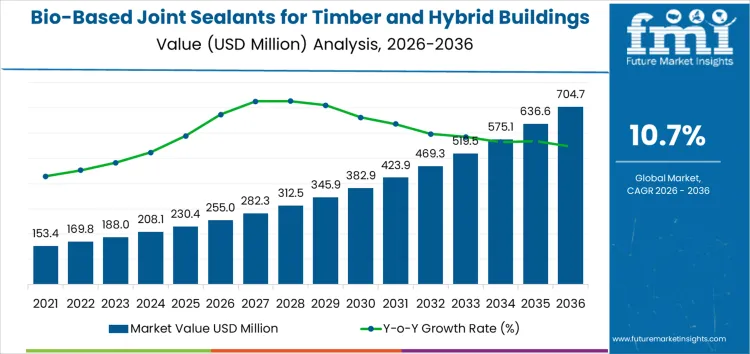
What Is the Growth Forecast for Bio-Based Joint Sealants for Timber and Hybrid Buildings Market through 2036?
Material compatibility requirements and moisture movement control shape the early growth phase of the Bio-Based Joint Sealants for Timber and Hybrid Buildings Market between 2026 and 2031. During this period, the market expands from USD 255 million to USD 379 million, adding USD 124 million in value. Annual progression from USD 140 million to USD 255 million reflects increasing use of engineered timber, cross laminated timber, and mixed material structural systems. Historical growth was limited by performance uncertainty and conservative specification practices in structural joints. Forward expansion in this phase is supported by improved elasticity, better adhesion to wood substrates, and growing confidence among architects and contractors working on mid rise timber and hybrid construction projects.
Design standardization and wider adoption of timber led construction systems drive growth from 2031 to 2036. Over this period, the market increases from USD 379 million to USD 704.7 million, adding USD 331 million and representing the stronger expansion window. Annual values rise from USD 417 million to USD 704.7 million, indicating accelerating year over year momentum. Earlier demand focused on pilot scale timber projects, while future growth reflects broader use in commercial, residential, and institutional buildings. Larger project volumes, repeat design templates, and longer joint durability requirements support sustained expansion as bio based joint sealants become established materials in timber and hybrid building envelopes.
Bio-Based Joint Sealants for Timber and Hybrid Buildings Market Key Takeaways
| Metric | Value |
|---|---|
| Market Value (2026) | USD 255 million |
| Forecast Value (2036) | USD 704.7 million |
| Forecast CAGR (2026-2036) | 10.7% |
What Is Driving Demand in the Bio-Based Joint Sealants for Timber and Hybrid Buildings Market?
Growth in the bio-based joint sealants market for timber and hybrid buildings stems from evolving design practices and performance demands that traditional petroleum-based sealants did not fully address. Timber and hybrid structures exhibit greater dimensional movement due to moisture changes and thermal cycling compared with masonry or steel frames, creating dynamic gaps in joints and connections. Conventional sealants often lacked elasticity or suffered adhesion loss when bonding to wood, engineered wood products, and dissimilar substrates used in hybrid assemblies. Early adoption of bio-based sealants began where material compatibility issues, cracking, and finish failures arose during construction or early service life, prompting selection of formulations that maintained bond strength while accommodating movement without cracking. Initial use occurred primarily in pilot projects and environmentally focused builds rather than standard practice across all timber construction.
Future demand for bio-based joint sealants will be shaped by sustainability criteria, regulatory frameworks, and documented performance expectations specific to timber and hybrid construction rather than by general preference for green products. Building codes and green certification programmes are increasingly incorporating lifecycle carbon metrics, material origin documentation, and indoor environmental quality parameters, encouraging adoption of bio-based materials that reduce reliance on fossil-derived chemistries. Advances in bio-polymer technology are improving elasticity, weather resistance, and adhesion to a range of substrates including cross-laminated timber, glulam, and metal connectors. Architects and specifiers are embedding sealant selection into early design stages to meet defined movement accommodation and durability criteria, linking material choice to long-term performance guarantees.
What Factors Are Affecting the Demand for Bio-Based Joint Sealants for Timber and Hybrid Buildings Market in Terms of Building Type and Application?
The bio based joint sealants market for timber and hybrid buildings is driven by low carbon construction targets, material transparency requirements, and increased use of engineered wood systems. Demand focuses on sealants that accommodate timber movement while meeting emission and durability standards. Adoption depends on building typology, joint movement profiles, and compatibility with wood, concrete, and steel interfaces. Market leadership reflects regulatory alignment, movement tolerance, and constructability rather than decorative or non-structural performance considerations.
What Is Driving Leadership by Building Type in the Bio Based Joint Sealants Market?
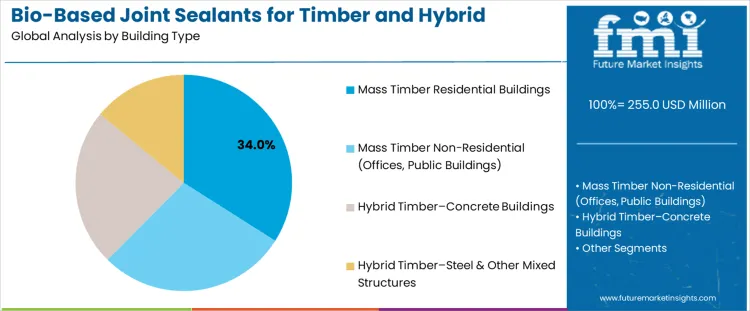
Mass timber residential buildings account for about 34% of demand because housing projects represent the largest volume deployment of engineered wood systems. These structures rely on cross laminated timber and glulam elements that exhibit moisture driven expansion and contraction. Bio based joint sealants are specified to manage this movement while maintaining airtightness and acoustic separation. Residential developments also face strong pressure to meet embodied carbon targets, accelerating substitution of petrochemical sealants. Standardized unit designs allow repeatable sealant detailing, supporting scale adoption. Developers favor bio based products that integrate with prefabricated wall and floor panels without disrupting construction sequencing. These factors concentrate demand within mass timber housing projects.
Mass timber non-residential buildings and hybrid structures contribute secondary demand. Office and public buildings use timber selectively, limiting joint volume. Hybrid timber-concrete and timber-steel structures introduce complex interfaces requiring tailored solutions. These projects adopt bio based sealants where specifications permit but at lower aggregate volume. Building type leadership therefore reflects residential scale, repetition, and regulatory incentives rather than structural complexity or architectural prominence alone.
What Is Driving Leadership by Application in the Bio Based Joint Sealants Market?
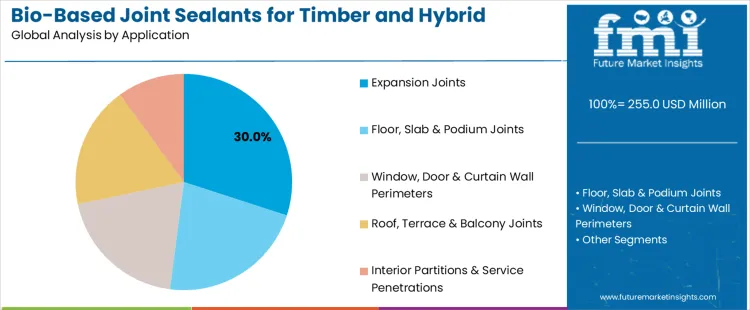
Expansion joints represent about 30% of demand because they accommodate the largest and most frequent movement in timber structures. These joints occur at panel interfaces, floor transitions, and building separations where dimensional change is unavoidable. Bio based sealants are selected for their elasticity, adhesion to wood substrates, and low emission profiles. Expansion joints are installed early and repeatedly across projects, driving higher material volumes. Performance failure in these joints compromises airtightness and durability, reinforcing careful material selection. Their prevalence across all timber building types anchors application leadership.
Floor, podium, perimeter, roof, and interior joints form significant secondary applications. Window and curtain wall perimeters require precise sealing but involve shorter joint lengths. Roof and balcony joints face weather exposure yet are fewer in number. Interior partitions and service penetrations prioritize acoustic sealing with lower movement demand. These applications adopt bio based sealants selectively based on exposure and specification. Application leadership therefore reflects joint length, movement magnitude, and repetition rather than the number of distinct sealing locations within a building envelope.
How Are Bio-Based Joint Sealants Being Applied Across Timber and Hybrid Building Construction?
Use appears in residential, commercial, and public infrastructure projects where sustainable materials and airtight sealing are required. Manufacturers adopt bio-based sealants derived from plant oils, resins, or polymers to bond timber, cross-laminated timber (CLT), and hybrid timber-concrete structures. Builders integrate these sealants to maintain joint flexibility, weather resistance, and structural integrity while reducing environmental impact. These applications reflect operational and sustainability priorities rather than purely aesthetic objectives, with adoption driven by eco-certifications, building performance, and material compatibility.
What Operational and Material Conditions Support Adoption of Bio-Based Joint Sealants?
Selection aligns with substrates requiring adhesion, flexibility, and durability under temperature and moisture variations. Formulations are optimized for curing speed, gap-filling capacity, and compatibility with timber coatings, finishes, or concrete interfaces. Construction workflows monitor surface preparation, application thickness, and curing conditions to ensure consistent joint performance. Quality control evaluates adhesion strength, flexibility, and weather resistance to meet building codes and sustainability certifications. These conditions emerge from operational efficiency, material performance, and environmental compliance priorities in structured timber construction workflows.
Which Practical Considerations Limit Wider Use of Bio-Based Joint Sealants?
Cost per unit may be higher than conventional synthetic sealants, affecting adoption in budget-sensitive projects. Performance can vary with timber moisture content, joint geometry, or exposure conditions. Long-term durability and UV resistance require validation. Regulatory approvals and eco-certifications differ by region. These factors lead to selective deployment where sustainability, joint performance, and compliance justify incremental cost and careful application management.
What is the Demand for Bio Based Joint Sealants for Timber and Hybrid Buildings by Country?
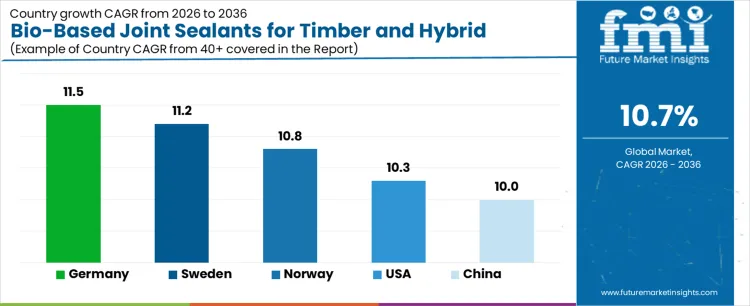
| Country | CAGR (%) |
|---|---|
| Germany | 11.5% |
| Sweden | 11.2% |
| Norway | 10.8% |
| USA | 10.3% |
| China | 10.0% |
The demand for bio based joint sealants for timber and hybrid buildings varies across countries, driven by sustainable construction practices, timber adoption, and regulatory focus on eco-friendly building materials. Germany leads with an 11.5% CAGR, supported by growing green building initiatives, increased use of timber and hybrid structures, and adoption of bio based sealants. Sweden follows at 11.2%, driven by sustainable construction trends and stringent environmental regulations. Norway records 10.8%, shaped by timber construction and eco-friendly material adoption. The USA grows at 10.3%, reflecting adoption in sustainable building projects. China posts 10.0%, supported by green construction initiatives and increasing hybrid building adoption.
How Are Bio-Based Joint Sealants Expanding Timber and Hybrid Building Applications in Germany?
In Germany, the Bio-Based Joint Sealants for Timber and Hybrid Buildings Market is growing at a CAGR of 11.5% through 2036, driven by increasing adoption of sustainable construction methods and strict EU environmental regulations. Construction companies are integrating bio-based sealants to improve joint durability, thermal insulation, and reduce VOC emissions in timber and hybrid structures. Demand is concentrated in urban construction hubs, sustainable housing projects, and industrial timber production zones. Compared to the USA, Germany emphasizes regulatory compliance and environmental performance over large-scale volume. Domestic suppliers provide high-performance, eco-friendly sealants suitable for recurring construction and assembly cycles.
- Urban construction hubs, sustainable housing projects, and timber production zones drive adoption
- Sealants improve joint durability, thermal insulation, and reduce VOC emissions
- Domestic suppliers provide high-performance, eco-friendly solutions
- Recurring construction and assembly cycles sustain adoption
How Are Green Building Standards Driving Growth in Sweden?
In Sweden, revenue is growing at a CAGR of 11.2% through 2036, supported by national sustainable building initiatives and demand for low-emission construction materials. Developers are adopting bio-based joint sealants for timber and hybrid buildings to enhance energy efficiency, structural integrity, and environmental compliance. Demand is concentrated in urban construction projects, prefabricated timber facilities, and commercial building zones. Compared to Germany, adoption emphasizes energy performance and eco-certification. Domestic suppliers provide high-quality, bio-based sealants compatible with automated and manual assembly processes. Recurring construction cycles sustain steady adoption across residential and commercial projects.
- Urban construction projects, prefabricated timber facilities, and commercial zones drive adoption
- Sealants enhance energy efficiency, structural integrity, and environmental compliance
- Domestic suppliers provide high-quality, bio-based solutions
- Recurring construction cycles sustain steady adoption
How Is Sustainable Timber Construction Driving Adoption in Norway?
In Norway, the market is expanding at a CAGR of 10.8% through 2036, fueled by growing timber and hybrid building projects, government sustainability incentives, and industrial prefabrication. Builders are integrating bio-based joint sealants to reduce VOC emissions, improve thermal performance, and maintain joint integrity in structural assemblies. Demand is concentrated in urban construction hubs, industrial timber plants, and commercial hybrid building projects. Compared to Sweden, adoption focuses more on structural reliability and industrial integration. Domestic suppliers provide eco-friendly, high-performance sealants suitable for recurring prefabrication and construction operations.
- Urban construction hubs, industrial timber plants, and hybrid building projects drive adoption
- Sealants reduce VOCs, improve thermal performance, and maintain joint integrity
- Domestic suppliers provide eco-friendly, high-performance solutions
- Recurring prefabrication and construction operations sustain adoption
How Are Sustainable Building Practices Supporting Growth in the United States?
In the United States, revenue is growing at a CAGR of 10.3% through 2036, driven by increasing adoption of timber and hybrid construction, green building certifications, and sustainable infrastructure initiatives. Contractors are using bio-based joint sealants to enhance joint durability, fire resistance, and environmental performance in residential and commercial structures. Demand is concentrated in urban construction hubs, prefabricated timber facilities, and hybrid building projects. Compared to Germany, adoption emphasizes operational flexibility alongside sustainability. Domestic suppliers provide cost-effective, high-performance sealants suitable for recurring construction and assembly cycles.
- Urban construction hubs, prefabricated timber facilities, and hybrid building projects drive adoption
- Sealants enhance joint durability, fire resistance, and sustainability
- Domestic suppliers provide cost-effective, high-performance solutions
- Recurring construction and assembly cycles sustain adoption
How Are Green Construction Initiatives Driving Market Growth in China?
In China, the market is expanding at a CAGR of 10% through 2036, supported by government incentives for sustainable buildings, growing timber and hybrid construction projects, and rising urban development. Builders are integrating bio-based joint sealants to improve environmental performance, reduce VOC emissions, and enhance joint strength in prefabricated and hybrid structures. Demand is concentrated in urban construction zones, industrial timber production hubs, and commercial development projects. Compared to Norway, adoption focuses more on large-scale urban integration and high-volume projects. Domestic suppliers provide high-performance, eco-friendly sealants suitable for recurring construction cycles and prefabrication operations.
- Urban construction zones, timber production hubs, and commercial projects drive adoption
- Sealants reduce VOC emissions and improve joint strength
- Domestic suppliers provide high-performance, eco-friendly solutions
- Recurring construction cycles sustain adoption
Which Strategic Approaches Define Competition in the Bio-Based Joint Sealants for Timber and Hybrid Buildings Market under Structural Movement and Material Compatibility Constraints?
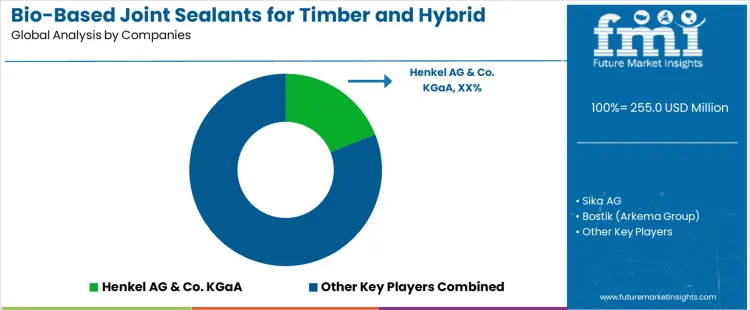
Competition in the Bio-Based Joint Sealants for Timber and Hybrid Buildings Market is shaped by how suppliers manage differential movement, moisture sensitivity, and long term durability in predominantly wood based structures. Henkel AG and Co. KGaA and Sika AG approach this segment by adapting bio based or partially bio derived chemistries within established elastic sealant platforms, prioritizing adhesion to timber, engineered wood, and concrete interfaces. Their strategies emphasize controlled modulus, crack bridging capability, and predictable curing under variable site humidity. Qualification is driven by joint movement tolerance, aging behavior, and compatibility with fire rated and acoustic assemblies commonly specified in mass timber construction.
A different competitive emphasis is evident among building focused formulation specialists. Bostik, part of Arkema Group, positions bio based sealants within hybrid structural systems, aligning material selection with prefabrication and offsite assembly practices. Soudal Group competes through practical application fit, offering sealants designed for ease of tooling and consistent performance across interior and exterior joints. Mapei S.p.A. approaches the market through system compatibility, integrating joint sealants with flooring, façade, and structural products used in mixed material buildings. Across the market, competitive advantage is built through validation with timber standards, moisture resilience, and coordination with architects and engineers. Success depends on predictable joint behavior over the building lifecycle rather than maximizing bio based content alone.
Key Players in the Bio Based Joint Sealants for Timber and Hybrid Buildings Market
- Henkel AG & Co. KGaA
- Sika AG
- Bostik (Arkema Group)
- Soudal Group
- Mapei S.p.A.
Scope of the Report
| Items | Values |
|---|---|
| Quantitative Units (2026) | USD million |
| Type | Bio Based Elastic Joint Sealants for Timber Systems, Bio Based Sealants for Hybrid Timber–Concrete Interfaces, Bio Based Sealants for Hybrid Timber–Steel Interfaces, Other Bio Derived Joint Sealant Formulations |
| Application | Expansion Joints, Floor Slab and Podium Joints, Window Door and Curtain Wall Perimeters, Roof Terrace and Balcony Joints, Interior Partitions and Service Penetrations |
| End Users | Timber Building Developers, Hybrid Building Developers, Construction Contractors, Prefabricated Timber System Manufacturers |
| Regions Covered | Asia Pacific, Europe, North America, Latin America, Middle East and Africa |
| Countries Covered | Germany, Sweden, Norway, United States, China, United Kingdom, France, Italy, Spain, Canada, Japan, Australia, Nordic countries, ASEAN countries, and other global regions |
| Key Companies Profiled | Henkel AG and Co. KGaA, Sika AG, Bostik part of Arkema Group, Soudal Group, Mapei S.p.A. |
| Additional Attributes | Dollar by sales across building type and application, joint movement tolerance and moisture management benchmarks, compatibility with engineered timber and hybrid material interfaces, curing performance under variable site conditions, certification and compliance requirements for timber construction, regional adoption trends linked to sustainable and timber-led building typologies |
Bio-Based Joint Sealants for Timber and Hybrid Buildings Market Segmentation
Building Type:
- Mass Timber Residential Buildings
- Mass Timber Non-Residential (Offices, Public Buildings)
- Hybrid Timber–Concrete Buildings
- Hybrid Timber–Steel & Other Mixed Structures
Application:
- Expansion Joints
- Floor, Slab & Podium Joints
- Window, Door & Curtain Wall Perimeters
- Roof, Terrace & Balcony Joints
- Interior Partitions & Service Penetrations
Region:
- Asia Pacific
- China
- Japan
- South Korea
- India
- Australia & New Zealand
- ASEAN
- Rest of Asia Pacific
- Europe
- Germany
- United Kingdom
- France
- Italy
- Spain
- Nordic
- BENELUX
- Rest of Europe
- North America
- United States
- Canada
- Mexico
- Latin America
- Brazil
- Chile
- Rest of Latin America
- Middle East & Africa
- Kingdom of Saudi Arabia
- Other GCC Countries
- Turkey
- South Africa
- Other African Union
- Rest of Middle East & Africa
Bibliography
- EN 15651-1:2012+A1:2017 - Sealants for non-structural use in joints in buildings and pedestrian walkways - Part 1: Sealants for façade elements, European Committee for Standardization (CEN).
- EN 16351:2015 - Timber structures - Cross laminated timber - Requirements, European Committee for Standardization (CEN).
Frequently Asked Questions
How big is the bio-based joint sealants for timber and hybrid buildings market in 2026?
The global bio-based joint sealants for timber and hybrid buildings market is estimated to be valued at USD 255.0 million in 2026.
What will be the size of bio-based joint sealants for timber and hybrid buildings market in 2036?
The market size for the bio-based joint sealants for timber and hybrid buildings market is projected to reach USD 704.7 million by 2036.
How much will be the bio-based joint sealants for timber and hybrid buildings market growth between 2026 and 2036?
The bio-based joint sealants for timber and hybrid buildings market is expected to grow at a 10.7% CAGR between 2026 and 2036.
What are the key product types in the bio-based joint sealants for timber and hybrid buildings market?
The key product types in bio-based joint sealants for timber and hybrid buildings market are mass timber residential buildings, mass timber non-residential (offices, public buildings), hybrid timber–concrete buildings and hybrid timber–steel & other mixed structures.
Which application segment to contribute significant share in the bio-based joint sealants for timber and hybrid buildings market in 2026?
In terms of application, expansion joints segment to command 30.0% share in the bio-based joint sealants for timber and hybrid buildings market in 2026.
Preview the report firsthand - request a free sample
Get SampleGet the brochure for pricing and purchase details.
Get PDFTable of Content
- Executive Summary
- Global Market Outlook
- Demand-side Trends
- Supply-side Trends
- Technology Roadmap Analysis
- Analysis and Recommendations
- Market Overview
- Market Coverage / Taxonomy
- Market Definition / Scope / Limitations
- Market Background
- Market Dynamics
- Drivers
- Restraints
- Opportunity
- Trends
- Scenario Forecast
- Demand in Optimistic Scenario
- Demand in Likely Scenario
- Demand in Conservative Scenario
- Opportunity Map Analysis
- Product Life Cycle Analysis
- Supply Chain Analysis
- Investment Feasibility Matrix
- Value Chain Analysis
- PESTLE and Porter’s Analysis
- Regulatory Landscape
- Regional Parent Market Outlook
- Production and Consumption Statistics
- Import and Export Statistics
- Market Dynamics
- Global Market Analysis 2021 to 2025 and Forecast, 2026 to 2036
- Historical Market Size Value (USD Million) Analysis, 2021 to 2025
- Current and Future Market Size Value (USD Million) Projections, 2026 to 2036
- Y-o-Y Growth Trend Analysis
- Absolute $ Opportunity Analysis
- Global Market Pricing Analysis 2021 to 2025 and Forecast 2026 to 2036
- Global Market Analysis 2021 to 2025 and Forecast 2026 to 2036, By Building Type
- Introduction / Key Findings
- Historical Market Size Value (USD Million) Analysis By Building Type , 2021 to 2025
- Current and Future Market Size Value (USD Million) Analysis and Forecast By Building Type , 2026 to 2036
- Mass Timber Residential Buildings
- Mass Timber Non-Residential (Offices, Public Buildings)
- Hybrid Timber–Concrete Buildings
- Hybrid Timber–Steel & Other Mixed Structures
- Mass Timber Residential Buildings
- Y-o-Y Growth Trend Analysis By Building Type , 2021 to 2025
- Absolute $ Opportunity Analysis By Building Type , 2026 to 2036
- Global Market Analysis 2021 to 2025 and Forecast 2026 to 2036, By Application
- Introduction / Key Findings
- Historical Market Size Value (USD Million) Analysis By Application, 2021 to 2025
- Current and Future Market Size Value (USD Million) Analysis and Forecast By Application, 2026 to 2036
- Expansion Joints
- Floor, Slab & Podium Joints
- Window, Door & Curtain Wall Perimeters
- Roof, Terrace & Balcony Joints
- Interior Partitions & Service Penetrations
- Expansion Joints
- Y-o-Y Growth Trend Analysis By Application, 2021 to 2025
- Absolute $ Opportunity Analysis By Application, 2026 to 2036
- Global Market Analysis 2021 to 2025 and Forecast 2026 to 2036, By Region
- Introduction
- Historical Market Size Value (USD Million) Analysis By Region, 2021 to 2025
- Current Market Size Value (USD Million) Analysis and Forecast By Region, 2026 to 2036
- North America
- Latin America
- Western Europe
- Eastern Europe
- East Asia
- South Asia and Pacific
- Middle East & Africa
- Market Attractiveness Analysis By Region
- North America Market Analysis 2021 to 2025 and Forecast 2026 to 2036, By Country
- Historical Market Size Value (USD Million) Trend Analysis By Market Taxonomy, 2021 to 2025
- Market Size Value (USD Million) Forecast By Market Taxonomy, 2026 to 2036
- By Country
- USA
- Canada
- Mexico
- By Building Type
- By Application
- By Country
- Market Attractiveness Analysis
- By Country
- By Building Type
- By Application
- Key Takeaways
- Latin America Market Analysis 2021 to 2025 and Forecast 2026 to 2036, By Country
- Historical Market Size Value (USD Million) Trend Analysis By Market Taxonomy, 2021 to 2025
- Market Size Value (USD Million) Forecast By Market Taxonomy, 2026 to 2036
- By Country
- Brazil
- Chile
- Rest of Latin America
- By Building Type
- By Application
- By Country
- Market Attractiveness Analysis
- By Country
- By Building Type
- By Application
- Key Takeaways
- Western Europe Market Analysis 2021 to 2025 and Forecast 2026 to 2036, By Country
- Historical Market Size Value (USD Million) Trend Analysis By Market Taxonomy, 2021 to 2025
- Market Size Value (USD Million) Forecast By Market Taxonomy, 2026 to 2036
- By Country
- Germany
- UK
- Italy
- Spain
- France
- Nordic
- BENELUX
- Rest of Western Europe
- By Building Type
- By Application
- By Country
- Market Attractiveness Analysis
- By Country
- By Building Type
- By Application
- Key Takeaways
- Eastern Europe Market Analysis 2021 to 2025 and Forecast 2026 to 2036, By Country
- Historical Market Size Value (USD Million) Trend Analysis By Market Taxonomy, 2021 to 2025
- Market Size Value (USD Million) Forecast By Market Taxonomy, 2026 to 2036
- By Country
- Russia
- Poland
- Hungary
- Balkan & Baltic
- Rest of Eastern Europe
- By Building Type
- By Application
- By Country
- Market Attractiveness Analysis
- By Country
- By Building Type
- By Application
- Key Takeaways
- East Asia Market Analysis 2021 to 2025 and Forecast 2026 to 2036, By Country
- Historical Market Size Value (USD Million) Trend Analysis By Market Taxonomy, 2021 to 2025
- Market Size Value (USD Million) Forecast By Market Taxonomy, 2026 to 2036
- By Country
- China
- Japan
- South Korea
- By Building Type
- By Application
- By Country
- Market Attractiveness Analysis
- By Country
- By Building Type
- By Application
- Key Takeaways
- South Asia and Pacific Market Analysis 2021 to 2025 and Forecast 2026 to 2036, By Country
- Historical Market Size Value (USD Million) Trend Analysis By Market Taxonomy, 2021 to 2025
- Market Size Value (USD Million) Forecast By Market Taxonomy, 2026 to 2036
- By Country
- India
- ASEAN
- Australia & New Zealand
- Rest of South Asia and Pacific
- By Building Type
- By Application
- By Country
- Market Attractiveness Analysis
- By Country
- By Building Type
- By Application
- Key Takeaways
- Middle East & Africa Market Analysis 2021 to 2025 and Forecast 2026 to 2036, By Country
- Historical Market Size Value (USD Million) Trend Analysis By Market Taxonomy, 2021 to 2025
- Market Size Value (USD Million) Forecast By Market Taxonomy, 2026 to 2036
- By Country
- Kingdom of Saudi Arabia
- Other GCC Countries
- Turkiye
- South Africa
- Other African Union
- Rest of Middle East & Africa
- By Building Type
- By Application
- By Country
- Market Attractiveness Analysis
- By Country
- By Building Type
- By Application
- Key Takeaways
- Key Countries Market Analysis
- USA
- Pricing Analysis
- Market Share Analysis, 2025
- By Building Type
- By Application
- Canada
- Pricing Analysis
- Market Share Analysis, 2025
- By Building Type
- By Application
- Mexico
- Pricing Analysis
- Market Share Analysis, 2025
- By Building Type
- By Application
- Brazil
- Pricing Analysis
- Market Share Analysis, 2025
- By Building Type
- By Application
- Chile
- Pricing Analysis
- Market Share Analysis, 2025
- By Building Type
- By Application
- Germany
- Pricing Analysis
- Market Share Analysis, 2025
- By Building Type
- By Application
- UK
- Pricing Analysis
- Market Share Analysis, 2025
- By Building Type
- By Application
- Italy
- Pricing Analysis
- Market Share Analysis, 2025
- By Building Type
- By Application
- Spain
- Pricing Analysis
- Market Share Analysis, 2025
- By Building Type
- By Application
- France
- Pricing Analysis
- Market Share Analysis, 2025
- By Building Type
- By Application
- India
- Pricing Analysis
- Market Share Analysis, 2025
- By Building Type
- By Application
- ASEAN
- Pricing Analysis
- Market Share Analysis, 2025
- By Building Type
- By Application
- Australia & New Zealand
- Pricing Analysis
- Market Share Analysis, 2025
- By Building Type
- By Application
- China
- Pricing Analysis
- Market Share Analysis, 2025
- By Building Type
- By Application
- Japan
- Pricing Analysis
- Market Share Analysis, 2025
- By Building Type
- By Application
- South Korea
- Pricing Analysis
- Market Share Analysis, 2025
- By Building Type
- By Application
- Russia
- Pricing Analysis
- Market Share Analysis, 2025
- By Building Type
- By Application
- Poland
- Pricing Analysis
- Market Share Analysis, 2025
- By Building Type
- By Application
- Hungary
- Pricing Analysis
- Market Share Analysis, 2025
- By Building Type
- By Application
- Kingdom of Saudi Arabia
- Pricing Analysis
- Market Share Analysis, 2025
- By Building Type
- By Application
- Turkiye
- Pricing Analysis
- Market Share Analysis, 2025
- By Building Type
- By Application
- South Africa
- Pricing Analysis
- Market Share Analysis, 2025
- By Building Type
- By Application
- USA
- Market Structure Analysis
- Competition Dashboard
- Competition Benchmarking
- Market Share Analysis of Top Players
- By Regional
- By Building Type
- By Application
- Competition Analysis
- Competition Deep Dive
- Henkel AG & Co. KGaA
- Overview
- Product Portfolio
- Profitability by Market Segments (Product/Age /Sales Channel/Region)
- Sales Footprint
- Strategy Overview
- Marketing Strategy
- Product Strategy
- Channel Strategy
- Sika AG
- Bostik (Arkema Group)
- Soudal Group
- Mapei S.p.A.
- Henkel AG & Co. KGaA
- Competition Deep Dive
- Assumptions & Acronyms Used
- Research Methodology


