

- Market Size (2026)
- USD 1.27 Bn
- Forecast (2036)
- USD 4.24 Bn
- CAGR (2026 to 2036)
- 12.8%
Business-Class Rear Seat Lounge Systems Market Size, Forecast and Outlook By FMI
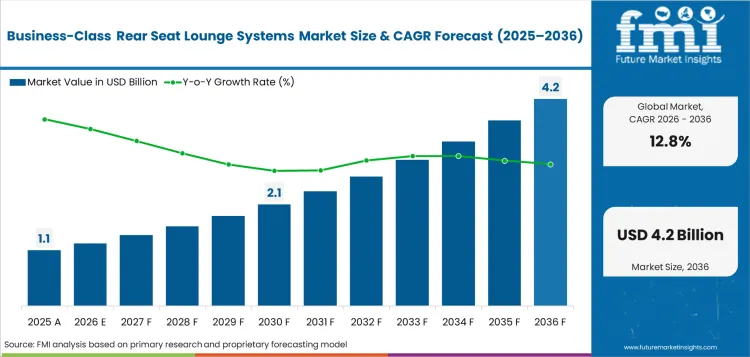
Business-class rear seat lounge systems market was valued at USD 1.13 billion in 2025 and are estimated at USD 1.27 billion in 2026. The market is projected to reach USD 4.24 billion by 2036 at 12.8% CAGR. Executive recliners are projected to lead seat architecture with 41.0% share. Factory fit systems are expected to hold 69.0% share by integration model in 2026.
Premium rear cabins are transitioning from basic trim upgrades to fully engineered comfort systems. According to the International Energy Agency, electric car sales exceeded 17 million units in 2024, with production reaching 17.3 million units. This shift enables automakers to design flatter cabin floors and provide greater electrical capacity, supporting advanced powered rear seating.
For example, BMW’s April 2026 update of the 7 Series retained Executive Lounge seating with automatic doors, reinforcing the importance of rear-seat luxury. Similarly, Lear’s February 2025 ComfortMax program with General Motors highlights the industry’s move toward integrating comfort hardware directly into seat structures. Rear-seat value is increasingly defined by space utilization, thermal comfort and integrated control systems.
Summary of the Business-Class Rear Seat Lounge Systems Market
- Market Snapshot
- The Business-Class Rear Seat Lounge Systems Market is estimated at USD 1.27 billion in 2026 after a USD 1.13 billion base in 2025.
- Industry revenue is projected to reach USD 4.24 billion by 2036 as premium rear cabins gain more powered functions.
- The forecast implies a 12.8% CAGR and USD 2.97 billion of incremental revenue over the forecast period.
- Factory fit systems are projected to account for 69.0% share in 2026 as OEMs control warranty and safety validation.
- Demand and Growth Drivers
- Electric luxury models create flatter second-row floors and support wider use of recliners with long-slide rails.
- Chauffeur-focused buyers in China and India are expected to raise demand for ottomans and privacy screens.
- Thermal comfort is becoming part of seat value as EV makers seek lower cabin energy loss from zonal heating.
- Rear-seat entertainment is moving into the seat system as screens and controls are bundled. Audio and recline positions add a separate comfort layer.
- Product and Segment View
- Executive recliners are projected to account for 41.0% share in 2026 due to broad use in sedans and luxury SUVs.
- Luxury SUVs are expected to represent 34.0% share in 2026 as premium buyers combine family use with chauffeur comfort.
- Ottoman modules are forecast at 32.0% share because leg support is the most visible rear-cabin upgrade.
- Touch controllers are projected to hold 44.0% share as seat, climate, light, and screen controls converge.
- Geography and Competitive Outlook
- China is projected to record 14.6% CAGR through 2036 as electric MPVs and chauffeur SUVs support cabin content.
- India is expected to expand at 13.9% CAGR through 2036 as luxury MPVs and large SUVs form a higher-value base.
- Adient and Lear shape the supplier mix through seating mechanisms and comfort modules. FORVIA and Toyota Boshoku add depth through interior architecture.
- Gentherm and Hyundai Transys strengthen the ecosystem through thermal functions and seating quality depth.
- Analyst Opinion
- Nikhil Kaitwade, Principal Consultant for Automotive at FMI, says, "I see this market less as a luxury trim story and more as a seat integration story. OEMs are asking the rear seat to work like a business cabin. The winners will be suppliers that prove recline safety, thermal comfort, low-noise mechanisms, and control software as one package. Price matters, but missed validation matters more because a rear lounge failure affects brand trust inside the highest-value vehicle programs."
- Business-Class Rear Seat Lounge Systems Market Value Analysis
- The market is moving from stand-alone comfort parts into complete rear-seat systems that carry higher content per vehicle.
- Pricing is concentrated in factory programs because OEMs prefer validated mechanisms and electronics before launch approval.
- Electric luxury vehicles create a larger design window because flat floors allow longer tracks and deeper recline angles.
- Supplier margins depend on mechanism durability and the ability to integrate thermal and control modules.
The value model treats rear lounge systems as a premium content layer inside luxury passenger vehicles. It covers powered seat frames, recline systems, leg-rest modules, comfort surfaces, thermal modules, local controls, and rear privacy or work functions. It excludes standard second-row benches and non-powered seat trim. The forecast is built from premium vehicle production, country luxury vehicle exposure, supplier program signals, and known content values. Results were reconciled with official automotive production data and recent supplier disclosures.
Key Takeaways, Market Size, and Forecast
- The business-class rear seat lounge systems market was valued at USD 1.13 billion in 2025.
- By 2036, the market is projected to reach USD 4.24 billion.
- From 2026 to 2036, the market is forecast to expand at 12.8% CAGR.
- The market is set to create an incremental opportunity of USD 2.97 billion between 2026 and 2036.
- Executive recliners are forecast to account for 41.0% share of seat architecture demand in 2026.
- Factory fit systems are estimated to account for 69.0% share of integration model demand in 2026.
- China at 14.6% CAGR and India at 13.9% CAGR are among the countries with stable demand outlook.
Business-Class Rear Seat Lounge Systems Market Definition
The business-class rear seat lounge systems market covers factory-ready rear cabin seating systems that turn the second row into a reclining business cabin. Scope includes powered recliners, ottomans, long-slide rails, thermal comfort, massage, privacy partitions, work surfaces, rear controls, and entertainment interfaces. The system must be supplied for premium passenger vehicles or luxury mobility fleets. Revenue covers hardware and integrated control elements sold as part of the rear seat system. Accessory-only parts stay outside scope unless sold as complete automotive seating accessories.
Business-Class Rear Seat Lounge Systems Market Inclusions
Market scope includes executive recliners, lie-flat lounges, rotating lounges, and work seats used in luxury sedans, SUVs, MPVs, and electric limousines. It includes factory fit systems, trim packages, and coachbuilt programs when the seat system is designed as a certified vehicle component. Comfort modules include ottomans, thermal systems, massage functions, privacy screens, and tables. Control interfaces include touch controllers, app control, seat memory, voice control, and biometric control when supplied with the seat package.
Business-Class Rear Seat Lounge Systems Market Exclusions
Scope excludes standard rear benches, child seats, non-powered trim covers, generic seat cushions, and informal aftermarket upholstery. It excludes aircraft seats, bus seats, rail seats, and office chairs. It also excludes front seat comfort systems unless the same mechanism is sold as a rear business-class package. Service labor, repair parts, and used seat modules are excluded unless a certified supplier sells them as a new complete package.
Business-Class Rear Seat Lounge Systems Market Research Methodology
- Primary Research: FMI analysts reviewed OEM package logic, seating supplier portfolios, coachbuilding practices, and luxury mobility requirements in major automotive countries.
- Desk Research: The study used public information from energy agencies, government trade bodies, national automotive associations, standards references, and company technical releases.
- Market sizing and forecasting: Market size was estimated through a bottom-up model using premium vehicle pools, system content values, and luxury rear-cabin penetration rates.
- Data validation: Forecast checks compared EV production, luxury vehicle country exposure, seat supplier activity, and related FMI automotive interior categories. The automotive interior systems assessment served as the final boundary check for full-cabin value.
Why is the Business-Class Rear Seat Lounge Systems Market Growing?
- Automakers are using rear cabin comfort to separate flagship sedans and SUVs from volume passenger vehicles.
- Electric platforms create space for longer tracks and ottomans because battery floors reduce drivetrain intrusion.
- Seat suppliers are combining thermal and electronics into modules that reduce OEM integration work.
Rear lounge seating is expanding as premium vehicle makers make rear comfort a product signal. The broader automotive seating systems category shows how seat value is moving toward power and comfort features. This market is narrower because it focuses on the second row and on business-class functions. That narrow scope keeps volumes limited. It also raises content value per vehicle because each program needs certified mechanisms and cabin controls.
Electric vehicles strengthen the case for rear lounge systems because energy and space are handled differently. The International Energy Agency reported that global electric car sales exceeded 17 million in 2024. It also reported 17.3 million electric cars produced worldwide in 2024. Those volumes do not convert directly into lounge seats. They do expand the premium EV base where OEMs can package flat floorsand powered comfort functions together. The automotive climate control link matters in the same package when rear passengers expect zonal heating and cooling.
Market Segmentation Analysis
- Executive recliners are projected to reach 41.0% share in 2026 as flagship vehicles need a familiar business-class seat form.
- Luxury SUVs are expected to represent 34.0% share in 2026 as premium buyers want comfort without leaving utility body styles.
- Ottoman modules are forecast to account for 32.0% share in 2026 as visible leg support anchors rear lounge value.
- Factory fit systems are projected to capture 69.0% share in 2026 because safety and warranty control sit with OEMs.
- OEM programs are estimated to account for 76.0% share in 2026 as automakers define the cabin package before launch.
- Touch controllers are expected to hold 44.0% share in 2026 as seat and comfort functions move into rear control panels.
The market is divided into six primary segment groups based on seat architecture, vehicle class, comfort module, integration model, buyer group, and control interface. Seat architecture explains the mechanical layout. Vehicle class shows where the package is installed. Comfort module clarifies which functions carry the value. Integration model and buyer group show who controls the program. Control interface explains how the passenger uses the system.
Insights into the Executive Recliners Seat Architecture Segment
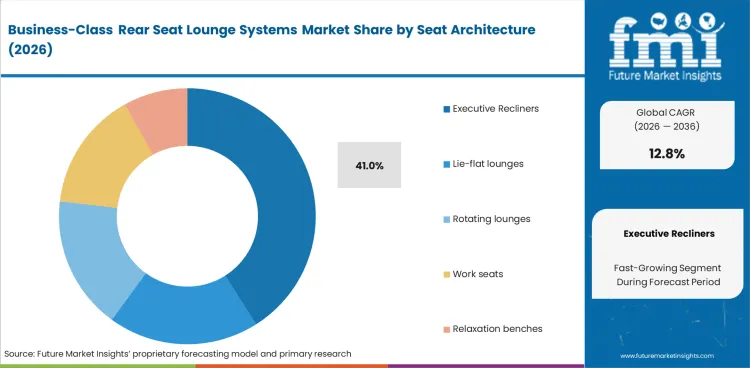
- Executive recliners are projected to account for 41.0% share of seat architecture demand in 2026. This format gives OEMs the safest route to add business-class comfort without redesigning the whole rear cabin.
- Lie-flat and rotating lounges address more flexible cabin ideas. Executive recliners keep the strongest near-term position because certification paths and user expectations are clearer.
Insights into the Luxury SUVs Vehicle Class Segment
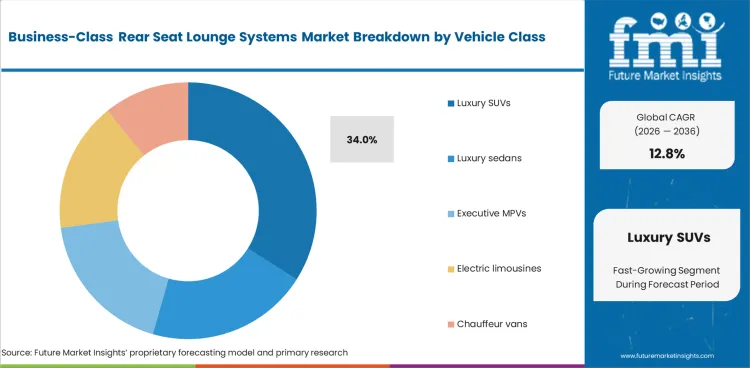
- Luxury SUVs are expected to represent 34.0% share of vehicle class demand in 2026. These vehicles combine high transaction prices with enough second-row space for recliners and ottomans.
- Luxury sedans retain a clear chauffeur link in China and Germany. Executive MPVs are rising in Asia as families and corporate users ask for more private rear cabins.
Insights into the Ottoman Modules Comfort Segment
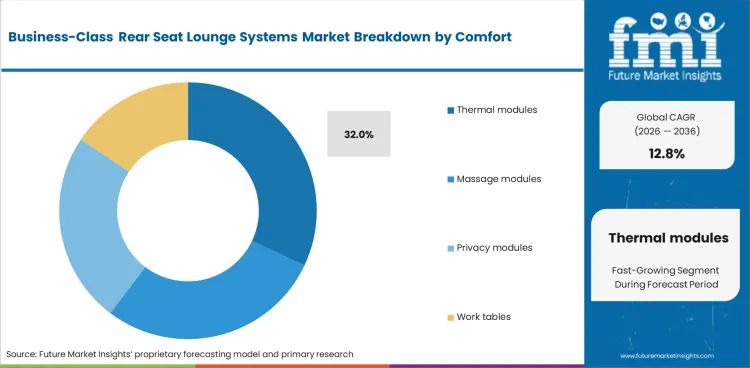
- Ottoman modules are forecast to account for 32.0% share of comfort module demand in 2026. Leg support is visible to buyers and easy to explain at retail.
- Thermal and massage modules add recurring value during long trips. OEMs are expected to package them together as rear-seat comfort moves from hardware to whole-cabin experience. The automotive heated seats reference remains relevant when rear lounge packages add localized warmth for long rides.
Insights into the Factory Fit Integration Segment
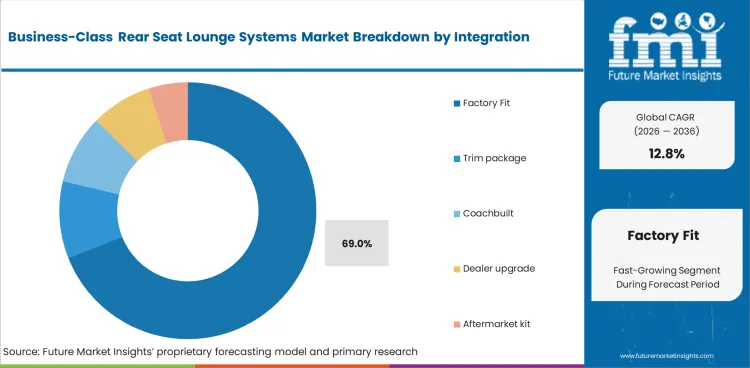
- Factory fit systems are projected to hold 69.0% share of integration model demand in 2026. OEM installation keeps crash validation and warranty terms under one program plan.
- Dealer and aftermarket upgrades serve local premium buyers. Their share stays smaller because powered recline and airbag packaging are difficult to validate after vehicle assembly.
Insights into the OEM Programs Buyer Segment
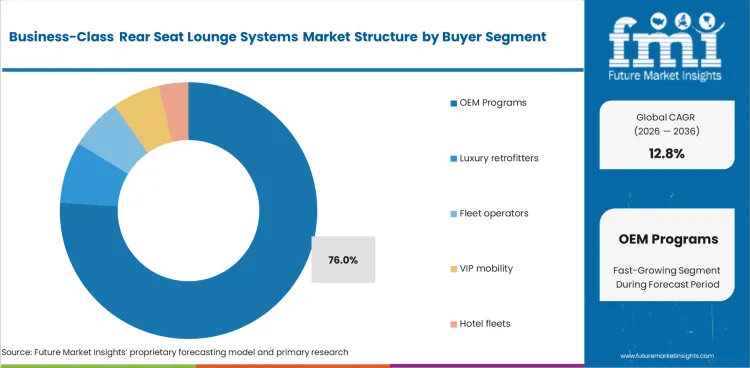
- OEM programs are estimated to account for 76.0% share of buyer group demand in 2026. Automakers decide seat layout before tooling and electrical architecture are locked.
- Luxury retrofitters serve special-build vehicles and VIP fleets. Their value is higher per unit but their volumes are limited by certification and sourcing constraints.
Insights into the Touch Controllers Interface Segment
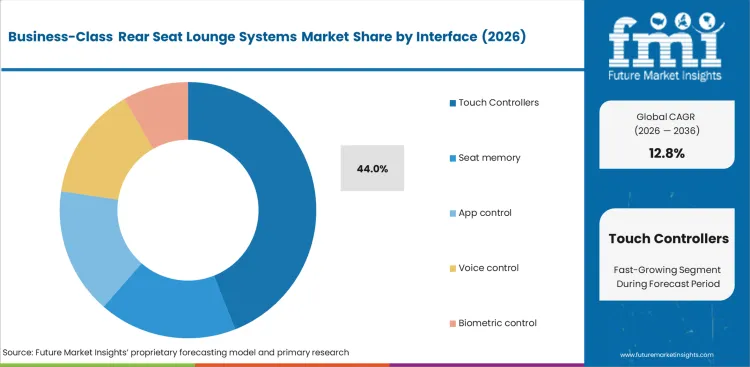
- Touch controllers are expected to capture 44.0% share of control interface demand in 2026. Rear passengers need one point for recline and screens. The automotive touch screen control systems reference supports the same rear passenger control logic.
- Voice and app control will expand with connected cabins. Seat memory stays important because chauffeur users expect repeatable settings across frequent trips.
Business-Class Rear Seat Lounge Systems Market Drivers, Restraints, and Opportunities
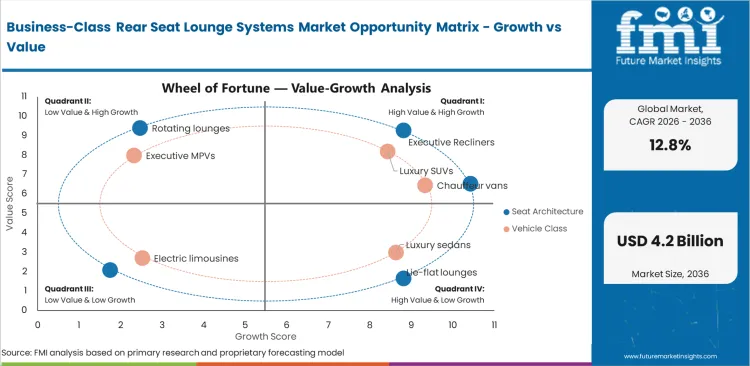
- Electric luxury platforms raise rear-cabin packaging value by giving designers flatter floors and quieter cabins.
- Certification cost slows wider use because powered recline and airbags must be validated with automotive seat belts.
- Modular comfort packages create opportunity as OEMs seek repeatable parts across sedan and SUV programs. MPV programs add a separate route for shared parts.
Business-class rear seating is gaining value because the second row now carries more of the brand message. BMW's April 2026 7 Series update retained Executive Lounge seating with comfort seats and automatic doors. That product signal matters because flagship cabins set the reference for lower segments. Seat suppliers need to match luxury feel with repeatable industrial quality. This pushes the market toward engineered modules instead of trim-only upgrades.
Validation Cost Slows Expansion
The main restraint is the cost of safety validation and electronics integration. Rear lounge systems place seat tracks, recline motors, belt anchors and climate modules in a confined space. A comfort upgrade becomes a safety program once the backrest angle or occupant position changes. Smaller suppliers lose ground when they cannot provide test data and OEM launch support. This keeps factory fit systems ahead of aftermarket kits in the forecast.
Modular Comfort Creates Program Value
The clearest opportunity sits in modules that carry recline and controls as a repeatable package. FORVIA stated in March 2024 that its modular seat architecture can cut manufacturing and assembly time by more than 50% in just-in-time plants. That type of approach changes buyer economics. OEMs can add lounge features to more nameplates if supplier modules reduce launch risk and plant complexity.
Analysis of Business-Class Rear Seat Lounge Systems Market By Key Countries
.webp "Top Country Growth Comparison Business Class Rear Seat Lounge Systems Market Cagr (2026 2036)")
| Country | CAGR |
|---|---|
| China | 14.6% |
| India | 13.9% |
| South Korea | 13.4% |
| Germany | 12.7% |
| United States | 12.1% |
| Japan | 11.8% |
| United Kingdom | 10.9% |
Source: Future Market Insights analysis, 2026.
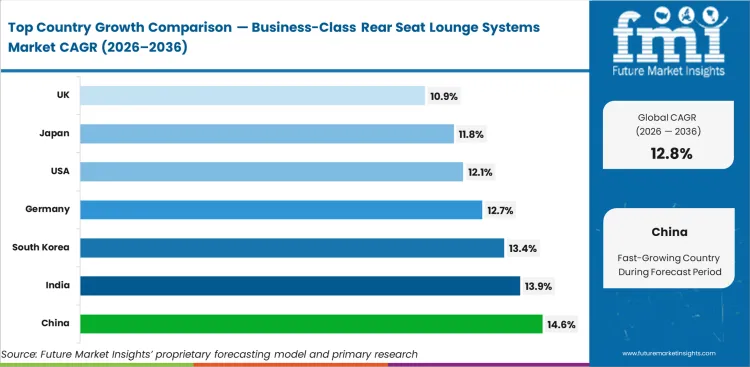
Business-Class Rear Seat Lounge Systems Market CAGR Analysis by Country
- China is projected to record 14.6% CAGR by 2036 as electric MPVs and chauffeur SUVs create strong rear-cabin demand.
- India is expected to expand at 13.9% CAGR by 2036 as luxury SUVs and executive MPVs gain more urban buyers.
- South Korea is forecast to grow at 13.4% CAGR by 2036 as local suppliers add comfort and quality depth.
- Germany is expected to advance at 12.7% CAGR by 2036 as luxury sedan and SUV programs support high content value.
- The United States and Japan remain relevant at 12.1% CAGR and 11.8% CAGR through premium vehicle demand.
Country-level analysis covers the main automotive markets where premium vehicles, EV platforms, and rear-cabin comfort packages support commercial demand. China and India track above the global rate because chauffeur use and premium MPVs raise second-row value. Germany and South Korea sit close to the global level because supplier depth is high. The United Kingdom and Japan grow slower because volumes are smaller and premium programs are more selective.
Demand Outlook for Business-Class Rear Seat Lounge Systems in China
China is the clearest rear lounge growth market because electric MPVs and chauffeur SUVs have moved comfort expectations upward. China is projected to record a 14.6% CAGR through 2036 as electric car production reached 12.4 million units in 2024. That production depth gives local OEMs room to build premium cabins around flat floors and connected controls.
- Shanghai and Shenzhen buyers favor privacy and ottoman systems in executive mobility vehicles.
- Domestic EV makers use rear lounge packages to separate premium trims from standard family variants.
- Local sourcing improves launch speed because seat frames and electronics can be validated near assembly plants.
Sales Analysis of Business-Class Rear Seat Lounge Systems in India
Urban premium buyers in India are shifting from sedans toward large SUVs and luxury MPVs. India is expected to expand at 13.9% CAGR through 2036 as passenger vehicle sales reached 4.3 million units in fiscal 2024 to 2025. That base supports higher rear-cabin content in imported and locally assembled premium vehicles. Suppliers need price discipline because buyers compare lounge packages against screen and audio upgrades.
- Delhi and Mumbai chauffeur users give premium rear seats a direct business travel role.
- Luxury MPVs support ottoman and privacy packages because the second row is the main seating position.
- Local assembly will become more relevant if OEMs offer rear lounge packages beyond top variants.
Opportunity Analysis of Business-Class Rear Seat Lounge Systems in South Korea
South Korea has a supplier-heavy route into this market through seating and thermal comfort systems. South Korea is forecast to grow at 13.4% CAGR through 2036 as EVs are projected to reach 20% of vehicle sales by the end of 2025. Hyundai Transys also ranked first in a 2024 USA seat quality category. That mix supports rear-lounge development for Genesis and export programs.
- Seoul-area OEM engineering teams can validate comfort and control functions close to seat suppliers.
- Genesis programs give rear-seat systems a higher-margin route than mass-market models.
- Supplier credibility rises when seat comfort awards and EV content growth support the same business case.
Demand Analysis of Business-Class Rear Seat Lounge Systems in Germany
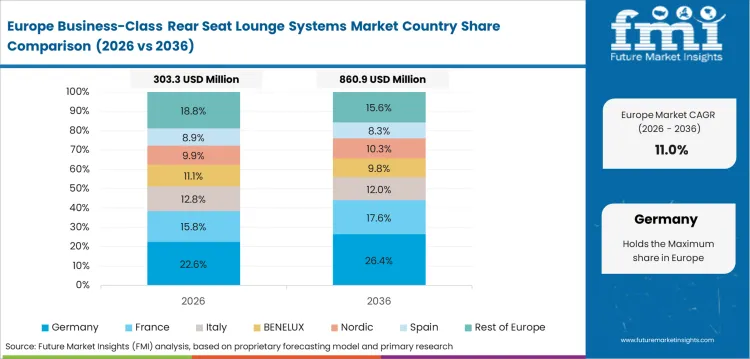
Germany's luxury vehicle base gives rear lounge systems a clear premium route even when overall vehicle volumes fluctuate. Germany is expected to advance at 12.7% CAGR through 2036 as 4.07 million passenger cars were produced in 2024. Mercedes-Benz and Audi programs keep demand focused on validated mechanisms and quiet motor actuation. Suppliers that prove safety and low-noise movement can win higher-value programs here.
- Stuttgart programs create demand for recliners that match long-wheelbase luxury sedans.
- Munich engineering teams value integrated controls because rear comfort is tied to digital cabin architecture.
- German suppliers must protect reliability because warranty costs are high in flagship vehicle programs.
Demand Outlook for Business-Class Rear Seat Lounge Systems in the United States
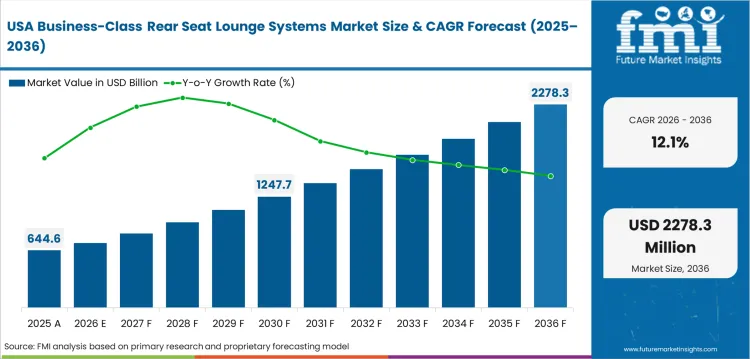
The United States market is shaped by large SUVs and high-value aftermarket culture. The United States is projected to rise at 12.1% CAGR through 2036 as vehicle exports exceeded USD 87 billion in 2024 and automotive parts exports exceeded USD 85 billion. Luxury SUVs offer the main route for rear recliners and entertainment screens. OEM fit remains safer than retrofit work because liability risk is higher.
- California premium EV buyers support rear comfort packages in large electric SUVs.
- Michigan engineering centers connect seat suppliers with OEM validation and launch planning.
- Florida and New York chauffeur fleets create selective demand for privacy and work-table packages.
Future Outlook for Business-Class Rear Seat Lounge Systems in Japan
Japanese demand is led by chauffeur vehicles and suppliers with deep seat engineering knowledge. Japan is forecast at 11.8% CAGR through 2036 as 4,421,494 new passenger vehicles were sold in 2024. Toyota Boshoku's 2024 Beijing concept showed MPV lounge layouts with rotating seats and long slides. Japan's growth stays below China because domestic volumes are smaller, but the supplier base is technically strong.
- Tokyo chauffeur users favor quiet mechanisms and repeatable seat positions for short executive trips.
- Toyota and Lexus programs create a route for ottoman and partition-based rear cabin packages.
- Japanese suppliers can export comfort modules when domestic programs prove durability and fit quality.
Future Outlook for Business-Class Rear Seat Lounge Systems in the United Kingdom
The United Kingdom is a smaller volume market, but luxury brands and coachbuilders give it a specialist role. The United Kingdom is expected to post 10.9% CAGR through 2036 as the automotive sector generated over GBP 83 billion turnover in 2024. Government support for zero-emission vehicles also keeps premium EV production in view. Suppliers will find more value in bespoke programs than broad volume packages.
- Luxury coachbuilders can package reclining rear seats with privacy trim and custom controls.
- Fleet and hotel users in London create selective demand for chauffeur-grade rear cabins.
- The country's lower CAGR reflects smaller output, but its design influence remains useful for premium suppliers.
Competitive Landscape and Strategic Positioning
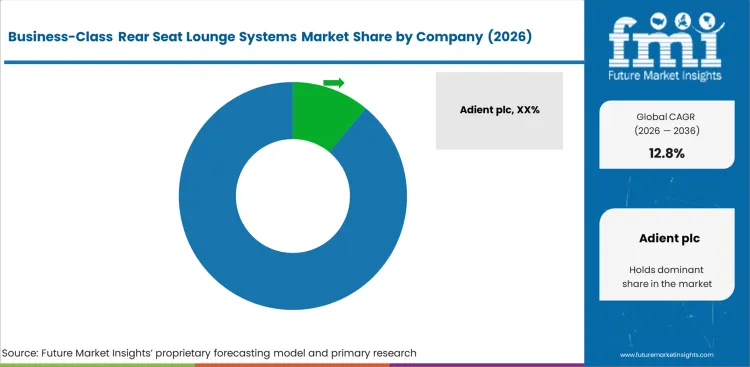
- The market is concentrated around complete seat engineering.
- Adient and Lear compete on full seat systems OEM launch support.
- FORVIA and Toyota Boshoku stand out when modularity and interior architecture matter together.
- Entry barriers include recline safety and warranty exposure.
Complete seating suppliers influence the competitive outlook because rear lounge systems require more than cushion comfort. Lear's February 2025 ComfortMax program integrates thermal comfort into trim covers for General Motors. Adient's September 2025 Pure Ergonomics concept targets up to 60 mm more second-row legroom. These signals show that seat value is moving toward packaging and comfort integration. Suppliers that control mechanisms and thermal systems are better placed for business-class rear cabins. The auto ventilated seats reference is relevant because cooling speed now affects rear comfort claims.
Interior architecture is the second basis of competition. FORVIA presented intelligent seating comfort at CES 2024 and later introduced a modular center console with tray tables and theater mode. Toyota Boshoku showed an MPV family lounge space in April 2024 with rotating seats and long slides. Those concepts are not direct revenue by themselves. They show how suppliers are preparing OEMs to sell rear cabins as work and entertainment spaces. The rear-seat entertainment display platforms reference also matters when lounge seats are paired with screen-based passenger use.
Thermal comfort and control software create a third supplier divide. Gentherm reported USD 600 million of automotive new business awards in the second quarter of 2025. Hyundai Transys ranked first in a 2024 USA seat quality category for small and compact car seats. That evidence supports a broader point. Rear lounge suppliers need proven comfort parts and strong quality systems before OEMs give them flagship programs. The in-cabin occupant detection platforms reference adds another gate when reclined passengers need reliable sensing.
Key Companies in the Business-Class Rear Seat Lounge Systems Market
Competition is best read by supplier role because complete seat systems, thermal modules, and interior controls do not come from the same capability base.
- Complete Seat System Leaders: Adient, Lear, FORVIA, Toyota Boshoku, Magna, and Hyundai Transys hold the clearest role in full rear seat packages. Their advantage comes from mechanisms, trim, just-in-time delivery, and OEM validation support.
- Comfort and Thermal Specialists: Gentherm holds a clear role in seat heating, cooling, and pneumatic comfort. Its position matters as rear lounge systems add zonal comfort for EVs and long trips.
- Interior Integration Specialists: FORVIA, Toyota Boshoku, and Hyundai Transys connect seat engineering with console design, rear entertainment, and control surfaces. This role carries more weight as business-class cabins move beyond recline alone.
Competitive Benchmarking: Business-Class Rear Seat Lounge Systems Market
| Company | Recline Mechanism Depth | Thermal Comfort Depth | OEM Validation Support | Geographic Footprint |
|---|---|---|---|---|
| Adient plc | High | Medium | Strong | Global with North America, Europe, and China program reach |
| Lear Corporation | High | Strong | Strong | Global with high OEM seating exposure and General Motors comfort integration |
| FORVIA SE | High | Medium | Strong | Europe centered with global seating and interior integration reach |
| Magna International Inc. | Medium | Medium | Strong | North America and Europe depth with broad OEM system access |
| Toyota Boshoku Corporation | High | Medium | Strong | Japan and Asia depth with Toyota and Lexus program links |
| Hyundai Transys Inc. | Medium | Medium | Strong | South Korea centered with Hyundai, Kia, and Genesis exposure |
| Gentherm Incorporated | Low | High | Medium | North America centered with global thermal comfort program reach |
Source: Future Market Insights competitive analysis, 2026. Ratings reflect relative positioning based on mechanism depth, thermal comfort depth, and OEM validation support.
Key Developments in Business-Class Rear Seat Lounge Systems Market
- In July 2025, Gentherm reported USD 600 million of automotive new business awards during the second quarter.
- In September 2025, Adient introduced Pure Ergonomics with up to 60 mm more legroom for second-row passengers.
- In October 2025, FORVIA introduced an on-demand center console with refrigerator, tray table, storage, and theater mode modules.
- In November 2025, Hyundai Transys and BASF unveiled a modular concept seat using Elastollan thermoplastic polyurethane.
- In April 2026, BMW presented the new 7 Series with Executive Lounge seating and updated automatic doors.
Key Players in the Business-Class Rear Seat Lounge Systems Market
- Adient plc
- Lear Corporation
- FORVIA SE
- Magna International Inc.
- Toyota Boshoku Corporation
- Hyundai Transys Inc.
- Gentherm Incorporated
Report Scope and Coverage
| Item | Value |
|---|---|
| Quantitative Units | Revenue in USD billion and CAGR from 2026 to 2036 |
| Market Definition | Complete rear lounge seat systems used in premium passenger vehicles and luxury mobility fleets |
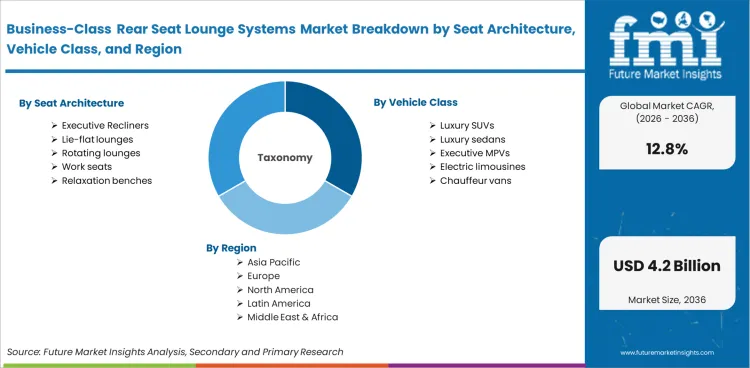
| Seat Architecture | Executive recliners, lie-flat lounges, rotating lounges, work seats, relaxation benches |
| Vehicle Class | Luxury SUVs, luxury sedans, executive MPVs, electric limousines, chauffeur vans |
| Comfort Module | Ottoman modules, thermal modules, massage modules, privacy modules, work tables |
| Integration Model | Factory fit, trim package, coachbuilt, dealer upgrade, aftermarket kit |
| Buyer Group | OEM programs, luxury retrofitters, fleet operators, VIP mobility, hotel fleets |
| Regions Covered | North America, Latin America, Europe, East Asia, South Asia, Oceania, Middle East and Africa |
| Countries Covered | United States, China, India, Germany, Japan, South Korea, United Kingdom |
| Key Companies Profiled | Adient, Lear, FORVIA, Magna, Toyota Boshoku, Hyundai Transys, Gentherm |
| Forecast Period | 2026 to 2036 |
| Approach | Bottom-up content model supported by automotive production data, supplier disclosures, and FMI analysis |
Business-Class Rear Seat Lounge Systems Market by Segments
Business-Class Rear Seat Lounge Systems Market Segmented by Seat Architecture:
- executive recliners (41.0% share for the leading subsegment where applicable)
- lie-flat lounges
- rotating lounges
- work seats
- relaxation benches
Business-Class Rear Seat Lounge Systems Market Segmented by Vehicle Class:
- luxury SUVs (34.0% share for the leading subsegment where applicable)
- luxury sedans
- executive MPVs
- electric limousines
- chauffeur vans
Business-Class Rear Seat Lounge Systems Market Segmented by Comfort Module:
- ottoman modules (32.0% share for the leading subsegment where applicable)
- thermal modules
- massage modules
- privacy modules
- work tables
Business-Class Rear Seat Lounge Systems Market Segmented by Integration Model:
- factory fit (69.0% share for the leading subsegment where applicable)
- trim package
- coachbuilt
- dealer upgrade
- aftermarket kit
Business-Class Rear Seat Lounge Systems Market Segmented by Buyer Group:
- OEM programs (76.0% share for the leading subsegment where applicable)
- luxury retrofitters
- fleet operators
- VIP mobility
- hotel fleets
Business-Class Rear Seat Lounge Systems Market Segmented by Control Interface:
- touch controllers (44.0% share for the leading subsegment where applicable)
- seat memory
- app control
- voice control
- biometric control
Business-Class Rear Seat Lounge Systems Market Segmented by Region:
- North America
- Latin America
- Western Europe
- Eastern Europe
- East Asia
- South Asia and Pacific
- Middle East and Africa
Research Sources and Bibliography
- International Energy Agency. (May 2025). Global EV Outlook 2025: Trends in electric car markets.
- International Trade Administration. (2025). SelectUSA Automotive Industry.
- International Trade Administration. (November 2025). Japan - Automotive.
- International Trade Administration. (July 2025). South Korea Electric Vehicles EV Market.
- Society of Indian Automobile Manufacturers. (August 2025). SIAM Annual Report 2024-25.
- Germany Trade and Invest. (May 2025). The Automotive Industry in Germany.
- Government of the United Kingdom. (April 2025). Backing British business: plan to support carmakers.
- Office for National Statistics. (November 2025). Economic activity and social change in the UK real-time indicators.
- Society of Motor Manufacturers and Traders. (January 2025). Vehicle production dips amid EV transformation and intense market pressure.
- BMW Group. (April 2026). The new BMW 7 Series.
- Lear Corporation. (February 2025). Lear integrates ComfortMax seat engineering technology with General Motors.
- FORVIA. (January 2024). FORVIA at CES 2024 highlights.
- FORVIA. (March 2024). Seats for the future: bridging innovation and affordability.
- FORVIA. (October 2025). FORVIA unveils the On-demand center console.
- Adient. (September 2025). Adient seating concept offers high space gains for the vehicle interior.
- Toyota Boshoku. (April 2024). 2024 Beijing International Automotive Exhibition special website.
- Toyota Boshoku. (February 2024). Toyota Boshoku future mobility life
- Hyundai Transys. (September 2024). Hyundai Transys tops US seat quality and satisfaction study.
- BASF. (November 2025). Hyundai Transys and BASF unveil modular concept seat.
- Gentherm. (July 2025). Gentherm reports 2025 second quarter results.
This Report Answers
- What is the projected value of the Business-Class Rear Seat Lounge Systems Market by 2036?
- Which rear seat architecture is projected to account for the strongest share in 2026?
- Why do factory fit systems hold the main share of business-class rear lounge integration?
- Which countries create the clearest demand signals for business-class rear seat lounge systems?
- Which suppliers are positioned around full seat systems and thermal comfort modules?
- How do EV platforms change second-row packaging for recliners, ottomans, and control interfaces?
- What barriers limit wider adoption beyond luxury sedans, luxury SUVs, and executive MPVs?
Frequently Asked Questions
How large is the Business-Class Rear Seat Lounge Systems Market in 2026?
The Business-Class Rear Seat Lounge Systems Market is estimated at USD 1.27 billion in 2026, based on premium vehicle content and rear-cabin package penetration.
What is the Business-Class Rear Seat Lounge Systems Market forecast for 2036?
The Business-Class Rear Seat Lounge Systems Market is projected to reach USD 4.24 billion by 2036, supported by EV platforms and higher rear comfort content.
What CAGR is projected for the Business-Class Rear Seat Lounge Systems Market?
The Business-Class Rear Seat Lounge Systems Market is projected to expand at 12.8% CAGR from 2026 to 2036 across premium vehicle programs.
Which segment leads the Business-Class Rear Seat Lounge Systems Market?
Executive recliners are projected to lead seat architecture with 41.0% share in 2026 because certification and user familiarity support faster OEM use.
Which country grows fastest in the Business-Class Rear Seat Lounge Systems Market?
China records the faster country outlook at 14.6% CAGR through 2036 as electric MPVs and chauffeur SUVs raise rear-seat content.
Who are the key companies in the Business-Class Rear Seat Lounge Systems Market?
Key companies include Adient, Lear, FORVIA, Magna, Toyota Boshoku, Hyundai Transys, and Gentherm across seat systems and comfort modules.
Preview the report firsthand - request a free sample
Get SampleGet the brochure for pricing and purchase details.
Get PDFTable of Content
- Executive Summary
- Global Market Outlook
- Demand-side Trends
- Supply-side Trends
- Technology Roadmap Analysis
- Analysis and Recommendations
- Market Overview
- Market Coverage / Taxonomy
- Market Definition / Scope / Limitations
- Research Methodology
- Chapter Orientation
- Analytical Lens and Working Hypotheses
- Market Structure, Signals, and Trend Drivers
- Benchmarking and Cross-market Comparability
- Market Sizing, Forecasting, and Opportunity Mapping
- Research Design and Evidence Framework
- Desk Research Programme (Secondary Evidence)
- Company Annual and Sustainability Reports
- Peer-reviewed Journals and Academic Literature
- Corporate Websites, Product Literature, and Technical Notes
- Earnings Decks and Investor Briefings
- Statutory Filings and Regulatory Disclosures
- Technical White Papers and Standards Notes
- Trade Journals, Industry Magazines, and Analyst Briefs
- Conference Proceedings, Webinars, and Seminar Materials
- Government Statistics Portals and Public Data Releases
- Press Releases and Reputable Media Coverage
- Specialist Newsletters and Curated Briefings
- Sector Databases and Reference Repositories
- FMI Internal Proprietary Databases and Historical Market Datasets
- Subscription Datasets and Paid Sources
- Social Channels, Communities, and Digital Listening Inputs
- Additional Desk Sources
- Expert Input and Fieldwork (Primary Evidence)
- Primary Modes
- Qualitative Interviews and Expert Elicitation
- Quantitative Surveys and Structured Data Capture
- Blended Approach
- Why Primary Evidence is Used
- Field Techniques
- Interviews
- Surveys
- Focus Groups
- Observational and In-context Research
- Social and Community Interactions
- Stakeholder Universe Engaged
- C-suite Leaders
- Board Members
- Presidents and Vice Presidents
- R&D and Innovation Heads
- Technical Specialists
- Domain Subject-matter Experts
- Scientists
- Physicians and Other Healthcare Professionals
- Governance, Ethics, and Data Stewardship
- Research Ethics
- Data Integrity and Handling
- Primary Modes
- Tooling, Models, and Reference Databases
- Desk Research Programme (Secondary Evidence)
- Data Engineering and Model Build
- Data Acquisition and Ingestion
- Cleaning, Normalisation, and Verification
- Synthesis, Triangulation, and Analysis
- Quality Assurance and Audit Trail
- Market Background
- Market Dynamics
- Drivers
- Restraints
- Opportunity
- Trends
- Scenario Forecast
- Demand in Optimistic Scenario
- Demand in Likely Scenario
- Demand in Conservative Scenario
- Opportunity Map Analysis
- Product Life Cycle Analysis
- Supply Chain Analysis
- Investment Feasibility Matrix
- Value Chain Analysis
- PESTLE and Porter’s Analysis
- Regulatory Landscape
- Regional Parent Market Outlook
- Production and Consumption Statistics
- Import and Export Statistics
- Market Dynamics
- Global Market Analysis 2021 to 2025 and Forecast, 2026 to 2036
- Historical Market Size Value (USD Million) Analysis, 2021 to 2025
- Current and Future Market Size Value (USD Million) Projections, 2026 to 2036
- Y-o-Y Growth Trend Analysis
- Absolute $ Opportunity Analysis
- Global Market Pricing Analysis 2021 to 2025 and Forecast 2026 to 2036
- Global Market Analysis 2021 to 2025 and Forecast 2026 to 2036, By Seat Architecture
- Introduction / Key Findings
- Historical Market Size Value (USD Million) Analysis By Seat Architecture , 2021 to 2025
- Current and Future Market Size Value (USD Million) Analysis and Forecast By Seat Architecture , 2026 to 2036
- Executive Recliners
- Lie-flat lounges
- Rotating lounges
- Work seats
- Relaxation benches
- Executive Recliners
- Y-o-Y Growth Trend Analysis By Seat Architecture , 2021 to 2025
- Absolute $ Opportunity Analysis By Seat Architecture , 2026 to 2036
- Global Market Analysis 2021 to 2025 and Forecast 2026 to 2036, By Vehicle Class
- Introduction / Key Findings
- Historical Market Size Value (USD Million) Analysis By Vehicle Class, 2021 to 2025
- Current and Future Market Size Value (USD Million) Analysis and Forecast By Vehicle Class, 2026 to 2036
- Luxury SUVs
- Luxury sedans
- Executive MPVs
- Electric limousines
- Chauffeur vans
- Luxury SUVs
- Y-o-Y Growth Trend Analysis By Vehicle Class, 2021 to 2025
- Absolute $ Opportunity Analysis By Vehicle Class, 2026 to 2036
- Global Market Analysis 2021 to 2025 and Forecast 2026 to 2036, By Comfort
- Introduction / Key Findings
- Historical Market Size Value (USD Million) Analysis By Comfort, 2021 to 2025
- Current and Future Market Size Value (USD Million) Analysis and Forecast By Comfort, 2026 to 2036
- Thermal modules
- Massage modules
- Privacy modules
- Work tables
- Thermal modules
- Y-o-Y Growth Trend Analysis By Comfort, 2021 to 2025
- Absolute $ Opportunity Analysis By Comfort, 2026 to 2036
- Global Market Analysis 2021 to 2025 and Forecast 2026 to 2036, By Integration
- Introduction / Key Findings
- Historical Market Size Value (USD Million) Analysis By Integration, 2021 to 2025
- Current and Future Market Size Value (USD Million) Analysis and Forecast By Integration, 2026 to 2036
- Factory Fit
- Trim package
- Coachbuilt
- Dealer upgrade
- Aftermarket kit
- Factory Fit
- Y-o-Y Growth Trend Analysis By Integration, 2021 to 2025
- Absolute $ Opportunity Analysis By Integration, 2026 to 2036
- Global Market Analysis 2021 to 2025 and Forecast 2026 to 2036, By Buyer
- Introduction / Key Findings
- Historical Market Size Value (USD Million) Analysis By Buyer, 2021 to 2025
- Current and Future Market Size Value (USD Million) Analysis and Forecast By Buyer, 2026 to 2036
- OEM Programs
- Luxury retrofitters
- Fleet operators
- VIP mobility
- Hotel fleets
- OEM Programs
- Y-o-Y Growth Trend Analysis By Buyer, 2021 to 2025
- Absolute $ Opportunity Analysis By Buyer, 2026 to 2036
- Global Market Analysis 2021 to 2025 and Forecast 2026 to 2036, By Interface
- Introduction / Key Findings
- Historical Market Size Value (USD Million) Analysis By Interface, 2021 to 2025
- Current and Future Market Size Value (USD Million) Analysis and Forecast By Interface, 2026 to 2036
- Touch Controllers
- Seat memory
- App control
- Voice control
- Biometric control
- Touch Controllers
- Y-o-Y Growth Trend Analysis By Interface, 2021 to 2025
- Absolute $ Opportunity Analysis By Interface, 2026 to 2036
- Global Market Analysis 2021 to 2025 and Forecast 2026 to 2036, By Region
- Introduction
- Historical Market Size Value (USD Million) Analysis By Region, 2021 to 2025
- Current Market Size Value (USD Million) Analysis and Forecast By Region, 2026 to 2036
- North America
- Latin America
- Western Europe
- Eastern Europe
- East Asia
- South Asia and Pacific
- Middle East & Africa
- Market Attractiveness Analysis By Region
- North America Market Analysis 2021 to 2025 and Forecast 2026 to 2036, By Country
- Historical Market Size Value (USD Million) Trend Analysis By Market Taxonomy, 2021 to 2025
- Market Size Value (USD Million) Forecast By Market Taxonomy, 2026 to 2036
- By Country
- USA
- Canada
- Mexico
- By Seat Architecture
- By Vehicle Class
- By Comfort
- By Integration
- By Buyer
- By Interface
- By Country
- Market Attractiveness Analysis
- By Country
- By Seat Architecture
- By Vehicle Class
- By Comfort
- By Integration
- By Buyer
- By Interface
- Key Takeaways
- Latin America Market Analysis 2021 to 2025 and Forecast 2026 to 2036, By Country
- Historical Market Size Value (USD Million) Trend Analysis By Market Taxonomy, 2021 to 2025
- Market Size Value (USD Million) Forecast By Market Taxonomy, 2026 to 2036
- By Country
- Brazil
- Chile
- Rest of Latin America
- By Seat Architecture
- By Vehicle Class
- By Comfort
- By Integration
- By Buyer
- By Interface
- By Country
- Market Attractiveness Analysis
- By Country
- By Seat Architecture
- By Vehicle Class
- By Comfort
- By Integration
- By Buyer
- By Interface
- Key Takeaways
- Western Europe Market Analysis 2021 to 2025 and Forecast 2026 to 2036, By Country
- Historical Market Size Value (USD Million) Trend Analysis By Market Taxonomy, 2021 to 2025
- Market Size Value (USD Million) Forecast By Market Taxonomy, 2026 to 2036
- By Country
- Germany
- UK
- Italy
- Spain
- France
- Nordic
- BENELUX
- Rest of Western Europe
- By Seat Architecture
- By Vehicle Class
- By Comfort
- By Integration
- By Buyer
- By Interface
- By Country
- Market Attractiveness Analysis
- By Country
- By Seat Architecture
- By Vehicle Class
- By Comfort
- By Integration
- By Buyer
- By Interface
- Key Takeaways
- Eastern Europe Market Analysis 2021 to 2025 and Forecast 2026 to 2036, By Country
- Historical Market Size Value (USD Million) Trend Analysis By Market Taxonomy, 2021 to 2025
- Market Size Value (USD Million) Forecast By Market Taxonomy, 2026 to 2036
- By Country
- Russia
- Poland
- Hungary
- Balkan & Baltic
- Rest of Eastern Europe
- By Seat Architecture
- By Vehicle Class
- By Comfort
- By Integration
- By Buyer
- By Interface
- By Country
- Market Attractiveness Analysis
- By Country
- By Seat Architecture
- By Vehicle Class
- By Comfort
- By Integration
- By Buyer
- By Interface
- Key Takeaways
- East Asia Market Analysis 2021 to 2025 and Forecast 2026 to 2036, By Country
- Historical Market Size Value (USD Million) Trend Analysis By Market Taxonomy, 2021 to 2025
- Market Size Value (USD Million) Forecast By Market Taxonomy, 2026 to 2036
- By Country
- China
- Japan
- South Korea
- By Seat Architecture
- By Vehicle Class
- By Comfort
- By Integration
- By Buyer
- By Interface
- By Country
- Market Attractiveness Analysis
- By Country
- By Seat Architecture
- By Vehicle Class
- By Comfort
- By Integration
- By Buyer
- By Interface
- Key Takeaways
- South Asia and Pacific Market Analysis 2021 to 2025 and Forecast 2026 to 2036, By Country
- Historical Market Size Value (USD Million) Trend Analysis By Market Taxonomy, 2021 to 2025
- Market Size Value (USD Million) Forecast By Market Taxonomy, 2026 to 2036
- By Country
- India
- ASEAN
- Australia & New Zealand
- Rest of South Asia and Pacific
- By Seat Architecture
- By Vehicle Class
- By Comfort
- By Integration
- By Buyer
- By Interface
- By Country
- Market Attractiveness Analysis
- By Country
- By Seat Architecture
- By Vehicle Class
- By Comfort
- By Integration
- By Buyer
- By Interface
- Key Takeaways
- Middle East & Africa Market Analysis 2021 to 2025 and Forecast 2026 to 2036, By Country
- Historical Market Size Value (USD Million) Trend Analysis By Market Taxonomy, 2021 to 2025
- Market Size Value (USD Million) Forecast By Market Taxonomy, 2026 to 2036
- By Country
- Kingdom of Saudi Arabia
- Other GCC Countries
- Turkiye
- South Africa
- Other African Union
- Rest of Middle East & Africa
- By Seat Architecture
- By Vehicle Class
- By Comfort
- By Integration
- By Buyer
- By Interface
- By Country
- Market Attractiveness Analysis
- By Country
- By Seat Architecture
- By Vehicle Class
- By Comfort
- By Integration
- By Buyer
- By Interface
- Key Takeaways
- Key Countries Market Analysis
- USA
- Pricing Analysis
- Market Share Analysis, 2025
- By Seat Architecture
- By Vehicle Class
- By Comfort
- By Integration
- By Buyer
- By Interface
- Canada
- Pricing Analysis
- Market Share Analysis, 2025
- By Seat Architecture
- By Vehicle Class
- By Comfort
- By Integration
- By Buyer
- By Interface
- Mexico
- Pricing Analysis
- Market Share Analysis, 2025
- By Seat Architecture
- By Vehicle Class
- By Comfort
- By Integration
- By Buyer
- By Interface
- Brazil
- Pricing Analysis
- Market Share Analysis, 2025
- By Seat Architecture
- By Vehicle Class
- By Comfort
- By Integration
- By Buyer
- By Interface
- Chile
- Pricing Analysis
- Market Share Analysis, 2025
- By Seat Architecture
- By Vehicle Class
- By Comfort
- By Integration
- By Buyer
- By Interface
- Germany
- Pricing Analysis
- Market Share Analysis, 2025
- By Seat Architecture
- By Vehicle Class
- By Comfort
- By Integration
- By Buyer
- By Interface
- UK
- Pricing Analysis
- Market Share Analysis, 2025
- By Seat Architecture
- By Vehicle Class
- By Comfort
- By Integration
- By Buyer
- By Interface
- Italy
- Pricing Analysis
- Market Share Analysis, 2025
- By Seat Architecture
- By Vehicle Class
- By Comfort
- By Integration
- By Buyer
- By Interface
- Spain
- Pricing Analysis
- Market Share Analysis, 2025
- By Seat Architecture
- By Vehicle Class
- By Comfort
- By Integration
- By Buyer
- By Interface
- France
- Pricing Analysis
- Market Share Analysis, 2025
- By Seat Architecture
- By Vehicle Class
- By Comfort
- By Integration
- By Buyer
- By Interface
- India
- Pricing Analysis
- Market Share Analysis, 2025
- By Seat Architecture
- By Vehicle Class
- By Comfort
- By Integration
- By Buyer
- By Interface
- ASEAN
- Pricing Analysis
- Market Share Analysis, 2025
- By Seat Architecture
- By Vehicle Class
- By Comfort
- By Integration
- By Buyer
- By Interface
- Australia & New Zealand
- Pricing Analysis
- Market Share Analysis, 2025
- By Seat Architecture
- By Vehicle Class
- By Comfort
- By Integration
- By Buyer
- By Interface
- China
- Pricing Analysis
- Market Share Analysis, 2025
- By Seat Architecture
- By Vehicle Class
- By Comfort
- By Integration
- By Buyer
- By Interface
- Japan
- Pricing Analysis
- Market Share Analysis, 2025
- By Seat Architecture
- By Vehicle Class
- By Comfort
- By Integration
- By Buyer
- By Interface
- South Korea
- Pricing Analysis
- Market Share Analysis, 2025
- By Seat Architecture
- By Vehicle Class
- By Comfort
- By Integration
- By Buyer
- By Interface
- Russia
- Pricing Analysis
- Market Share Analysis, 2025
- By Seat Architecture
- By Vehicle Class
- By Comfort
- By Integration
- By Buyer
- By Interface
- Poland
- Pricing Analysis
- Market Share Analysis, 2025
- By Seat Architecture
- By Vehicle Class
- By Comfort
- By Integration
- By Buyer
- By Interface
- Hungary
- Pricing Analysis
- Market Share Analysis, 2025
- By Seat Architecture
- By Vehicle Class
- By Comfort
- By Integration
- By Buyer
- By Interface
- Kingdom of Saudi Arabia
- Pricing Analysis
- Market Share Analysis, 2025
- By Seat Architecture
- By Vehicle Class
- By Comfort
- By Integration
- By Buyer
- By Interface
- Turkiye
- Pricing Analysis
- Market Share Analysis, 2025
- By Seat Architecture
- By Vehicle Class
- By Comfort
- By Integration
- By Buyer
- By Interface
- South Africa
- Pricing Analysis
- Market Share Analysis, 2025
- By Seat Architecture
- By Vehicle Class
- By Comfort
- By Integration
- By Buyer
- By Interface
- USA
- Market Structure Analysis
- Competition Dashboard
- Competition Benchmarking
- Market Share Analysis of Top Players
- By Regional
- By Seat Architecture
- By Vehicle Class
- By Comfort
- By Integration
- By Buyer
- By Interface
- Competition Analysis
- Competition Deep Dive
- Adient plc
- Overview
- Product Portfolio
- Profitability by Market Segments (Product/Age /Sales Channel/Region)
- Sales Footprint
- Strategy Overview
- Marketing Strategy
- Product Strategy
- Channel Strategy
- Lear Corporation
- FORVIA SE
- Magna International Inc.
- Toyota Boshoku Corporation
- Hyundai Transys Inc.
- Gentherm Incorporated
- Adient plc
- Competition Deep Dive
- Assumptions & Acronyms Used


