

- Market Size (2026)
- USD 0.46 Bn
- Forecast (2036)
- USD 1.55 Bn
- CAGR (2026 to 2036)
- 12.9%
Adaptive Beam Steering Headlamp Systems Market Size, Market Forecast and Outlook By FMI
Adaptive beam steering headlamp systems market was valued at USD 0.41 billion in 2025 and is projected to reach USD 0.46 billion in 2026. It is forecast to reach USD 1.55 billion by 2036 at 12.9% CAGR. Matrix light-emitting diode arrays are projected to lead beam control architecture with 41.0% share, and factory-installed systems are expected to hold 83.0% share by sales channel in 2026.
Summary of the Adaptive Beam Steering Headlamp Systems Market
- Demand and Growth Drivers
- Demand is rising as regulators allow adaptive driving beam systems to manage glare without switching high beam off fully.
- Automakers use adaptive beam control to support night visibility ratings and make premium safety features more visible to drivers.
- Supplier activity shows a shift from mechanical leveling toward pixel-based beam control that can change light shape by road context.
- Product and Segment View
- Matrix light-emitting diode arrays are projected to account for 41.0% share in 2026 because they fit current premium headlamp packages.
- Camera-based control is forecast to hold 57.0% share in 2026 because glare masking depends first on forward image detection.
- High-power light-emitting diode packages are expected to hold 64.0% share in 2026 because they are established in high-brightness light-emitting diode headlamps.
- Micro light-emitting diode emitters are gaining interest where road projection and high pixel density move into premium vehicle platforms.
- Geography and Competitive Outlook
- China is expected to lead country expansion as local vehicle output and domestic lighting supply remain deep.
- South Korea follows closely because electronics integration and lighting module supply work near original equipment manufacturers.
- Germany and Japan remain important premium launch countries because local brands treat light pattern quality as part of vehicle identity.
- Key players such as FORVIA HELLA, Koito Manufacturing, Valeo, Marelli, ZKW Group, ams-OSRAM, and Lumileds shape supplier competition.
- Analyst Opinion
- Nikhil Kaitwade, Principal Consultant at FMI says, “I see adaptive beam steering headlamps moving from a premium visual feature into a controlled safety interface. Buyers will not select suppliers only by lamp brightness. They will look at glare control proof, camera handoff and how fast the system can be validated across regions. The suppliers that win here will make beam control easy to certify and easy to install on repeated vehicle programs.”
- Adaptive Beam Steering Headlamp Systems Market Value Analysis
- The market is moving from limited premium fitment into wider upper-mid vehicle packages as adaptive beam rules become clearer.
- Revenue is concentrated in factory programs because the system needs lamp electronics, forward camera input, and vehicle controller logic.
- Micro light-emitting diode and digital projection designs lift value per vehicle where automakers want warning projection or road marking functions.
- Cost pressure remains visible because headlamp replacement can reach thousands of dollars when sealed electronics are not modular.
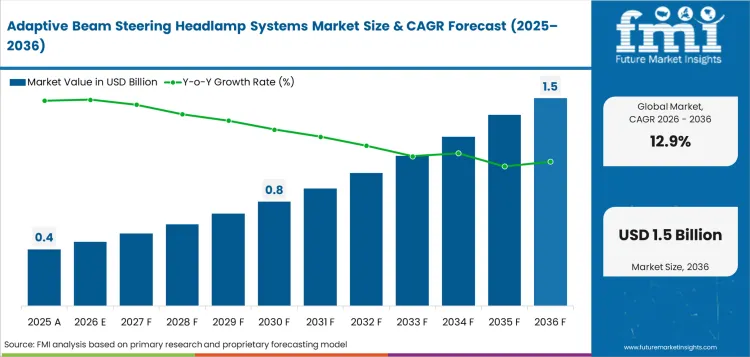
Key Takeaways, Market Size, and Forecast
- The adaptive beam steering headlamp systems market was valued at USD 0.41 billion in 2025.
- By 2036, the adaptive beam steering headlamp systems market is expected to be worth USD 1.55 billion.
- From 2026 to 2036, the market is projected to expand at 12.9% CAGR.
- The market is projected to create an incremental opportunity of USD 1.09 billion between 2026 and 2036.
- Matrix light-emitting diode arrays are projected to account for 41.0% share of beam control architecture demand in 2026.
- Factory-installed systems are expected to account for 83.0% share of sales channel demand in 2026.
- China at 14.2% CAGR and South Korea at 13.8% CAGR are among the countries with considerable demand outlook.
Night driving creates a direct design pressure because drivers need long reach without glare for other road users. In December 2024, NHTSA stated that ADB Table XXI measures maximum illuminance within a 220 m range. That turns adaptive beam steering into a certification challenge rather than a feature claim. Premium EV programs are already using matrix layouts to combine beam control with front-end design. In July 2024, FORVIA HELLA said the Audi Q6 e-tron uses 14 LEDs for glare-free high beam and 61 switchable daytime-running-light segments per headlamp.
That gives OEMs one package for safety function and brand identity. Pixel-level systems are raising the performance ceiling. In December 2024, Marelli listed h-Digi microLED options with 25,600 pixels and 19,200 pixels. That supports sharper beam steering and road projection features. Suppliers that can prove glare control and software-driven beam shaping are better placed for future headlamp awards.
Adaptive Beam Steering Headlamp Systems Market Definition
The adaptive beam steering headlamp systems market covers front lighting systems that change beam shape, direction, or intensity based on traffic, road geometry, weather, and camera input. Scope includes matrix light-emitting diode modules, micro light-emitting diode pixel arrays, digital micromirror projection units, beam steering control electronics, and factory-installed headlamp assemblies. The category is narrower than automotive lighting accessories because it includes only active beam control systems that adjust light distribution during driving.
Adaptive Beam Steering Headlamp Systems Market Inclusions
Market scope covers adaptive driving beam headlamps, glare-free high beam modules, curve beam steering functions, road projection headlamp units, and sensor-linked beam control software. It includes lighting electronics when those parts directly control beam pattern or pixel switching. It also includes actuators used inside headlamp assemblies where mechanical steering still supports the beam path. The boundary connects with automotive lighting actuators where motion control remains part of beam movement.
Adaptive Beam Steering Headlamp Systems Market Exclusions
Scope excludes static low beam lamps, rear lamps, decorative signature lighting, interior ambient lighting, and conventional replacement bulbs. It also excludes general camera modules unless their output is linked to adaptive beam control. Standard headlamp washers, bezels, and cosmetic lighting trim are excluded unless sold as part of a steering headlamp system. Standalone service tools are excluded except where calibration hardware is bundled with a system sale.
Adaptive Beam Steering Headlamp Systems Market Research Methodology
- Primary Research: FMI analysts reviewed lighting supplier disclosures, automaker launch details, vehicle platform timing, and feedback from component buyers.
- Desk Research: The study used public data from safety regulators, trade associations, government transport bodies, company technical releases, and vehicle production statistics.
- Market Sizing and Forecasting: Market size was estimated through a top-down split from adaptive front lighting and cross-checked with vehicle output and supplier launches.
- Data Validation: Forecast checks compared production volumes, light-emitting diode headlamp adoption, modular light engine signals, and country-level premium vehicle exposure.
Why is the Adaptive Beam Steering Headlamp Systems Market Growing?
- Regulatory clearance is making adaptive driving beam programs easier to specify on United States vehicle platforms.
- Premium passenger vehicles use beam steering to keep high beam reach and reduce glare for oncoming drivers.
- Camera input is becoming more useful as lighting control begins sharing road-scene data with driver assistance systems.
Adaptive beam steering headlamps are gaining share because they solve a direct night driving problem. The National Safety Council states that normal headlights illuminate about 250 feet ahead and high beams illuminate about 500 feet ahead. Beam steering lets automakers preserve high beam reach when traffic is detected. This creates a clear value case for the driver and a clearer engineering case for the vehicle maker.
The safety argument is reinforced by crash exposure. The National Highway Traffic Safety Administration reported 39,254 traffic deaths in 2024 and a fatality rate of 1.19 per 100 million vehicle miles traveled. Lighting suppliers cannot solve road risk alone. Better beam control supports visibility at the point where speed and glare meet. This keeps the category aligned with automotive camera systems and wider sensor-led safety functions.
Market Segmentation Analysis
- Matrix light-emitting diode arrays are projected to reach 41.0% share in 2026 as they match current premium headlamp packaging.
- Passenger cars are expected to represent 68.0% share in 2026 as premium and electric models adopt the feature first.
- Glare-free high beam is forecast to account for 46.0% share in 2026 because it is the main regulated use case.
- Camera-based control is estimated to account for 57.0% share in 2026 as forward image input remains the main trigger.
- High-power light-emitting diode packages are projected to hold 64.0% share in 2026 because they support lower-cost beam control.
- Factory-installed systems are expected to capture 83.0% share in 2026 because calibration is easier before vehicle delivery.
The market is divided into six primary segment groups based on beam control architecture, vehicle type, system function, sensor input, light source, and sales channel. These dimensions reflect how original equipment manufacturers specify the lamp, how suppliers package electronics, and how the system is validated on a vehicle program. The segmentation also links with automotive sensors because forward detection decides when the beam must dim, widen, or turn.
Insights into the Matrix Light-Emitting Diode Arrays Beam Control Architecture Segment
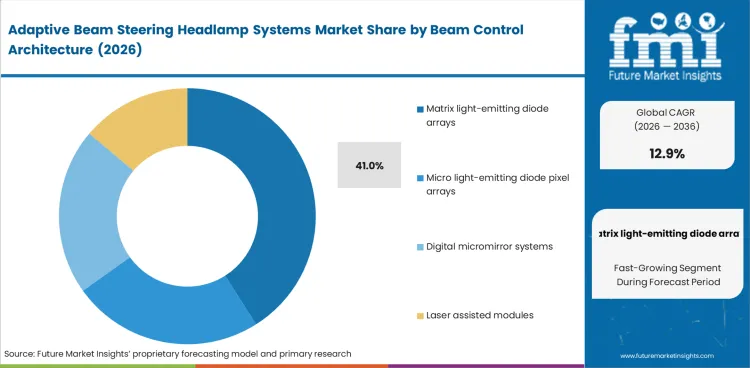
- Matrix light-emitting diode arrays are projected to account for 41.0% share of beam control architecture demand in 2026. The design gives automakers enough beam zones for glare masking without the cost of full high-pixel projection.
- Micro light-emitting diode pixel arrays and digital micromirror systems will gain share in premium cars for road projection features. Matrix arrays stay the practical volume choice because lamp makers already know how to validate them.
Insights into the Passenger Cars Vehicle Type Segment
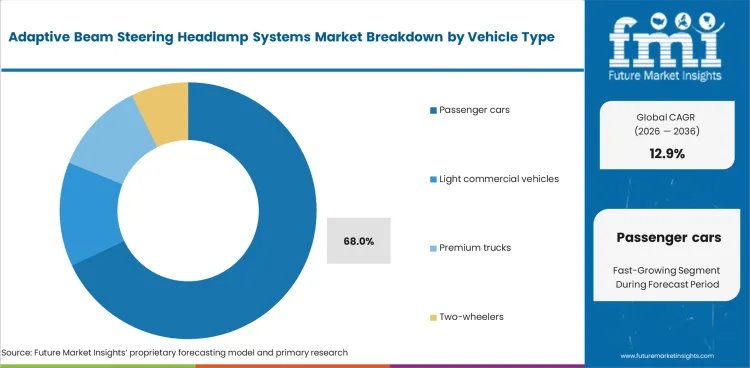
- Passenger cars are expected to represent 68.0% share of vehicle type demand in 2026. Premium sedans and electric crossovers are the first platforms as beam steering adds visible customer value.
- Light commercial vehicles will use simpler adaptive functions first because fleet buyers focus on repair cost and uptime. Premium trucks may adopt beam steering for highway safety packages where driver fatigue is a concern.
Insights into the Glare-Free High Beam System Function Segment
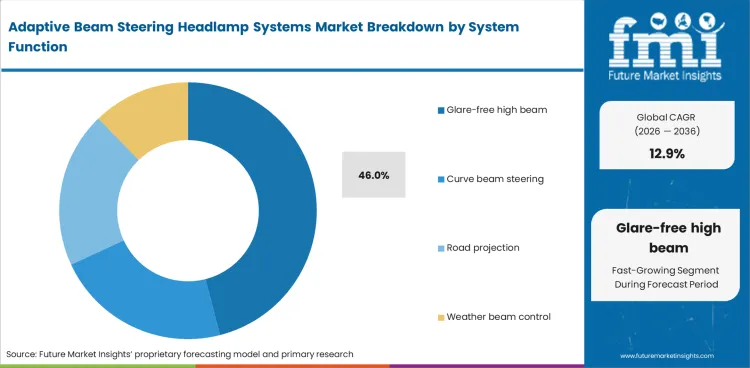
- Glare-free high beam is forecast to account for 46.0% share of system function demand in 2026. This function has the clearest safety purpose as it masks oncoming traffic and preserves long-range visibility.
- Curve beam steering and weather beam control serve narrower driving conditions. Road projection stays smaller in 2026 as regulation and driver acceptance still need more proof across countries.
Insights into the Camera-Based Control Sensor Input Segment
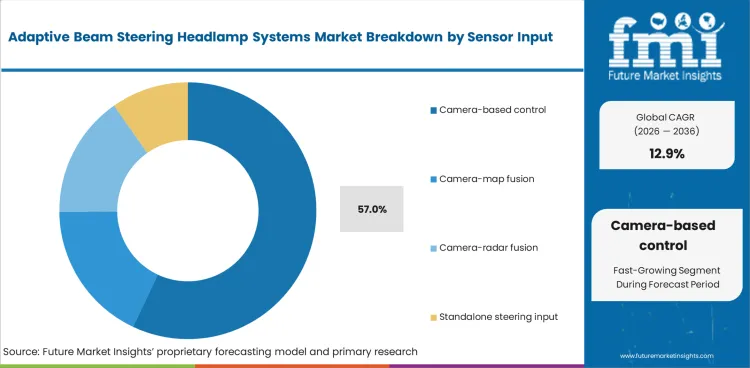
- Camera-based control is estimated to account for 57.0% share of sensor input demand in 2026. A forward camera gives the lighting controller the primary view needed to detect vehicles and road edges.
- Camera-map fusion will gain share as navigation and lighting data start working together. Camera-radar fusion stays more selective as cost and software validation are harder for headlamp-only value cases.
Insights into the High-Power Light-Emitting Diode Packages Light Source Segment
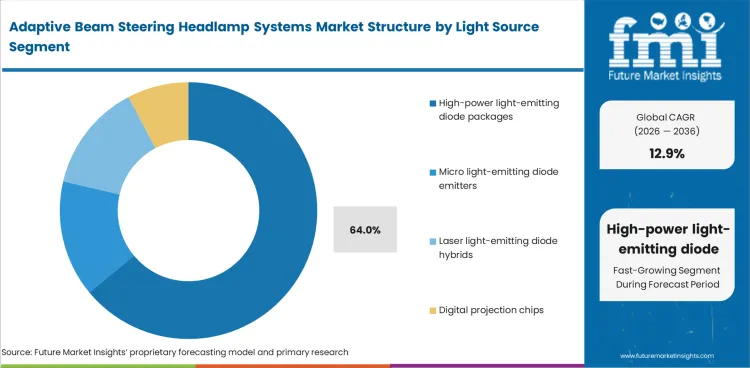
- High-power light-emitting diode packages are projected to hold 64.0% share of light source demand in 2026. These packages balance output and supplier availability for current headlamp programs.
- Micro light-emitting diode emitters will scale when high pixel density is needed. Laser assisted modules and digital projection chips stay premium options as cooling and repair cost are harder.
Insights into the Factory-Installed Systems Sales Channel Segment
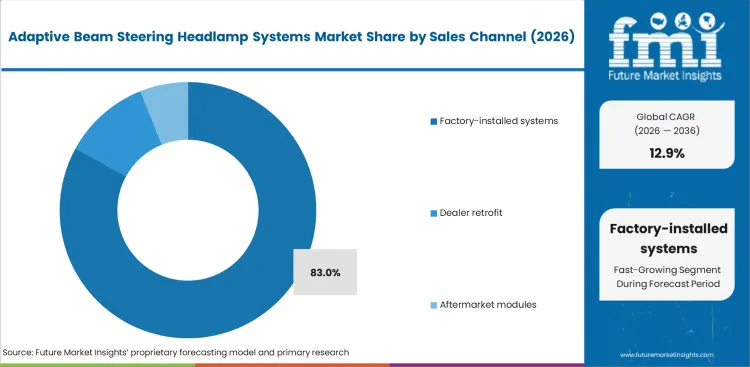
- Factory-installed systems are expected to account for 83.0% share of sales channel demand in 2026. Original equipment manufacturers prefer to calibrate cameras and software before delivery.
- Dealer retrofit and aftermarket modules stay smaller as legal compliance depends on exact lamp alignment and controller settings. Service demand is expected to rise around calibration and alignment equipment.
Adaptive Beam Steering Headlamp Systems Market Drivers, Restraints, and Opportunities
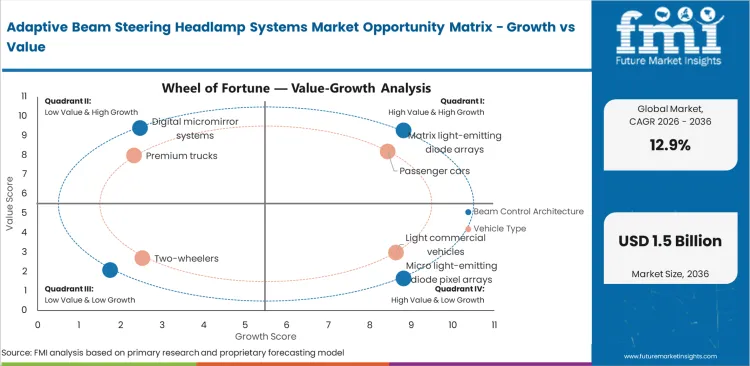
- Driver: Adaptive driving beam regulation is giving original equipment manufacturers a clearer path for glare-free high beam certification.
- Restraint: Sealed headlamp electronics raise replacement cost and can slow acceptance among cost-sensitive vehicle programs.
- Opportunity: Modular light engines can reduce repair cost and make adaptive beam content easier to repeat across platforms.
Regulation is the primary market driver as adaptive beam steering needs legal clarity before high-volume launch. The United States rule path is now clearer after the National Highway Traffic Safety Administration denied all reconsideration petitions in December 2024. That decision helps global suppliers plan systems for North American platforms without treating the region as a separate design case.
Service Cost Slows Wider Use
A significant demand restraint is service economics. Lumileds stated in February 2026 that light-emitting diode headlamp replacement costs can reach thousands of dollars and represent 8% or more of a car value based on manufacturer suggested retail price. This cost signal explains why modular lamps and replaceable regulated light sources are becoming important. The same logic connects beam steering with automotive electric actuators because repairable motion and light modules can lower lifetime cost.
Modular Light Engines Create Repeat Value
The clearest opportunity for companies in the market is in repeatable modules that separate the light source from the full headlamp assembly. Suppliers can win wider vehicle programs when they reduce validation time and repair risk at the same time. FORVIA HELLA, ams-OSRAM, and Lumileds show that the market is moving toward finer pixel control and cleaner module economics instead of brighter lamps alone.
Analysis of Adaptive Beam Steering Headlamp Systems Market by Key Countries
.webp "Top Country Growth Comparison Adaptive Beam Steering Headlamp Systems Market Cagr (2026 2036)")
| Country | CAGR |
|---|---|
| China | 14.2% CAGR |
| South Korea | 13.8% CAGR |
| Germany | 13.5% CAGR |
| Japan | 13.1% CAGR |
| United States | 12.7% CAGR |
| India | 12.3% CAGR |
| United Kingdom | 11.8% CAGR |
Source: Future Market Insights, 2026.
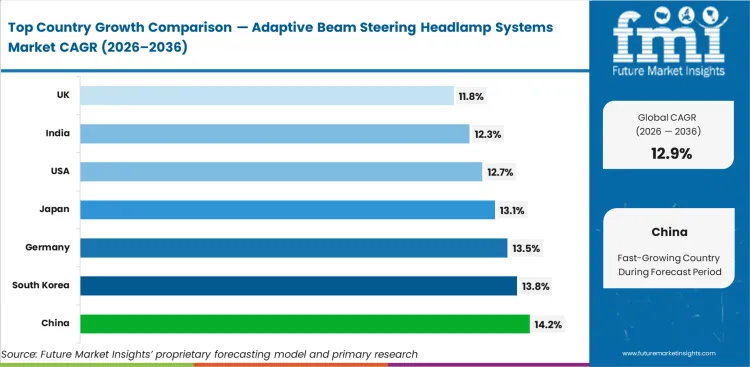
Adaptive Beam Steering Headlamp Systems Market CAGR Analysis by Country
- China is projected to record 14.2% CAGR by 2036 as domestic vehicle output and electric model launches increase lighting content.
- South Korea is expected to expand at 13.8% CAGR by 2036 as electronics and lighting module supply support premium headlamp programs.
- Germany is forecast to grow at 13.5% CAGR by 2036 as premium original equipment manufacturers test high-value lighting early.
- Japan is expected to advance at 13.1% CAGR by 2036 as local suppliers focus on precision beam control and global platforms.
- The United States, India, and the United Kingdom remain important markets with 12.7%, 12.3%, and 11.8% CAGR respectively.
Demand for adaptive beam steering headlamp systems is forecast to rise at 12.9% CAGR from 2026 to 2036. Country-level analysis covers vehicle production depth, premium vehicle share, regulation, supplier presence, and night safety needs. The fastest countries combine platform scale with lighting electronics skill, and countries below the global average face cost and model-cycle limits.
Demand Outlook for Adaptive Beam Steering Headlamp Systems Market in China
China is projected to record 14.2% CAGR through 2036 as domestic vehicle output and electric model launches increase lighting content. The State Council Information Office reported that total auto output reached 34.531 million units in 2025 and rose 10.4% from 2024. This production base gives lighting suppliers a large path for matrix beam systems across local electric platforms. Suppliers with local optical design and software support will have the clearest advantage.
- Shanghai electric vehicle programs can use adaptive beam steering as a visible safety and design feature.
- Hefei and Chongqing suppliers can support lamp electronics close to growing vehicle assembly clusters.
- Local brands need cost-managed modules as beam steering must fit both premium exports and domestic models.
Sales Analysis of Adaptive Beam Steering Headlamp Systems Market in South Korea
South Korean suppliers sell into vehicle programs that value electronics integration and fast platform updates. South Korea is expected to expand at 13.8% CAGR through 2036 as lamp modules and control electronics are developed close to original equipment manufacturers. The country benefits from a compact supplier base that can link camera input vehicle software faster than more dispersed supply chains. This gives local firms a route into export platforms.
- Seoul and Gyeonggi engineering centers can test pixel lighting with camera and sensor data.
- Hyundai and Kia vehicle programs create export visibility for locally validated adaptive headlamp packages.
- Smaller suppliers need proof of thermal control before they can enter high-resolution lighting supply.
Demand Analysis of Adaptive Beam Steering Headlamp Systems Market in Germany
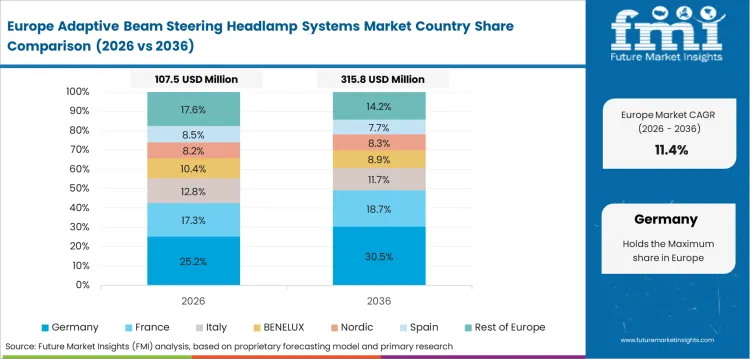
Premium engineering standards keep Germany central to adaptive headlamp launch planning. The European Automobile Manufacturers’ Association reported that global car production reached 78.7 million units in 2025 and the European Union represented 14.6% of output. Germany is forecast to grow at 13.5% CAGR through 2036 as local brands use lighting to support safety ratings and vehicle identity. The supplier implication is clear: validation depth matters as much as optical performance.
- Bavaria and Baden-Württemberg remain key centers for premium headlamp trials on electric vehicle platforms.
- German original equipment manufacturers need glare control proof before extending beam steering to wider trims.
- Local suppliers can win by linking lamp electronics with front body packaging and software validation.
Opportunity Analysis of Adaptive Beam Steering Headlamp Systems Market in Japan
Japan is expected to advance at 13.1% CAGR through 2036 as local suppliers focus on precision beam control and global platforms. Japan Automobile Manufacturers Association material from September 2025 confirms the country’s continued role as a major vehicle production and export base. Koito Manufacturing explains that adaptive driving beam systems use onboard cameras to dim specific light sections. This makes Japan a high-value base for optical control and reliability engineering.
- Toyota and Lexus platforms can carry adaptive beam systems into global premium and upper-mid vehicles.
- Shizuoka and Aichi supplier clusters support lamp design close to vehicle engineering teams.
- Export programs require systems that meet North American, European, and Asian lighting rules.
Future Outlook for Adaptive Beam Steering Headlamp Systems Market in the United States
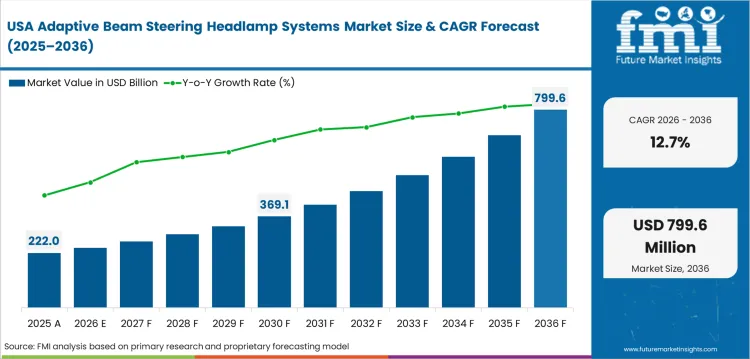
United States adoption depends on certification clarity and model-year timing. The National Highway Traffic Safety Administration completed its December 2024 response to petitions on adaptive driving beam rules and kept the certification path in place. The United States is projected to rise at 12.7% CAGR through 2036 as vehicle makers add glare-free high beam to premium trims first. Wider adoption is expected to depend on repair cost and dealer calibration readiness.
- Michigan vehicle engineering teams can use adaptive beams on pickup and premium electric platforms.
- California safety and software teams can connect headlamp logic with camera-based driver assistance features.
- Dealer networks need repeatable calibration steps before adaptive beam repair becomes routine.
Demand Outlook for Adaptive Beam Steering Headlamp Systems Market in India
India is forecast at 12.3% CAGR through 2036 as passenger vehicle upgrades move from convenience features toward safety content. The Society of Indian Automobile Manufacturers reported that passenger vehicles posted their highest-ever sales of 4.3 million units in financial year 2024 to 2025. Beam steering will first appear in premium sport utility vehicles and electric models when buyers accept a higher lamp cost. Faster uptake needs local module pricing to fall.
- Gurugram and Pune vehicle programs can introduce adaptive beams on premium sport utility vehicles first.
- Chennai supplier clusters can support lamp assembly once electronics sourcing is localized.
- Mass adoption will need lower replacement cost as price-sensitive buyers compare safety features carefully.
Future Outlook for Adaptive Beam Steering Headlamp Systems Market in the United Kingdom
United Kingdom production is smaller than Germany or China, and it stays important for premium vehicles and lighting design validation. The Society of Motor Manufacturers and Traders reported that British vehicle production slipped 11.8% to 905,233 units in 2024. The United Kingdom is expected to post 11.8% CAGR through 2036 as new electric vehicle programs restore some headlamp content. Suppliers should treat the country as a premium engineering node instead of a pure volume base.
- Midlands vehicle engineering teams can test adaptive beam packages for premium export models.
- UK safety interest supports clear benefits around night visibility and glare reduction.
- Lower production volume limits scale, so suppliers must tie UK programs to global vehicle launches.
Competitive Landscape and Strategic Positioning
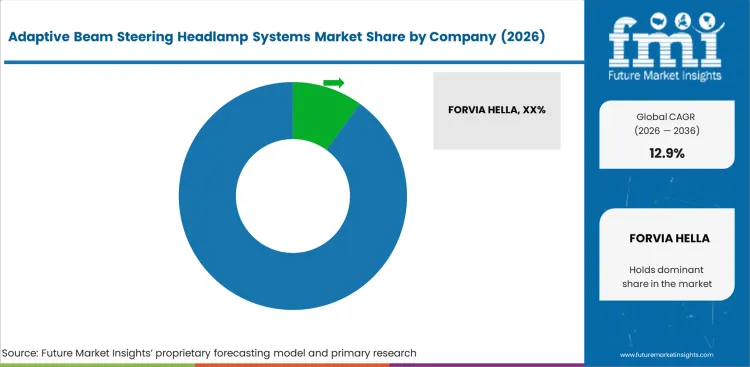
- The market is led by lighting system integrators that can combine optics and legal validation.
- Emitter specialists influence the next step in beam control as pixel density and thermal behavior decide system limits.
- Original equipment manufacturers prefer suppliers that can support one lighting concept across Europe, China, and North America.
- Entry barriers include glare validation and service cost management.
Key players such as FORVIA HELLA are using visible launch work with companies like Audi to show how digital signature lighting and glare-free high beam can work inside the same headlamp package. Koito Manufacturing keeps a strong position as it supplies high-value lamps and explains adaptive driving beam logic through camera-led masking. Valeo and Marelli compete through system know-how when beam pattern and thermal design must work with electronic control.
ams-OSRAM and Lumileds influence the component layer. ams-OSRAM stated in March 2025 that EVIYOS Shape is backed by more than 500 patent rights and trade secrets for Digital Light technology. Lumileds stated in February 2026 that modular light engines could represent 50% of solutions on road and in design by 2027. These moves support a shift from custom sealed assemblies toward more repeatable automotive actuator and light source modules.
Buyer criteria are becoming clearer. Automakers want pixel resolution, legal compliance, repairability, and regional manufacturing support in one supplier discussion. The strongest players will prove beam control on the road and then reduce total headlamp cost through modular design.
Key Companies in the Adaptive Beam Steering Headlamp Systems Market
Competition is best read by role as lighting system design, emitter supply, and platform validation differ sharply.
- Lighting System Integrators: FORVIA HELLA, Koito Manufacturing, Valeo, Marelli, and ZKW Group compete on full headlamp systems, optical design, and original equipment manufacturer program support.
- Emitter and Module Specialists: ams-OSRAM and Lumileds compete on light-emitting diode packages, micro light-emitting diode arrays, modular light engines, and thermal behavior.
- Vehicle Platform Influencers: Audi, BMW, Mercedes-Benz, Toyota, Hyundai, and Kia influence demand as their launch timing decides when beam steering reaches wider trims.
Competitive Benchmarking: Adaptive Beam Steering Headlamp Systems Market
| Company | Pixel Beam Resolution | Glare Control Validation | Original Equipment Launch Depth | Regional Production Reach |
|---|---|---|---|---|
| FORVIA HELLA | Strong | Strong | High | Global with Europe and China depth |
| Koito Manufacturing | Strong | Strong | High | Japan led with global original equipment reach |
| Valeo | Strong | Strong | High | Europe led with global vehicle program reach |
| Marelli | Strong | Medium | Medium | Europe and Asia centered lighting footprint |
| ZKW Group | Strong | Medium | Medium | Europe centered premium vehicle supply |
| ams-OSRAM | High | Medium | Medium | Global emitter supply and Austria technology base |
| Lumileds | Medium | Medium | Medium | Global light source module supply |
Source: Future Market Insights analysis based on company disclosures, regulatory signals, and supplier launch evidence reviewed in May 2026.
Key Developments in Adaptive Beam Steering Headlamp Systems Market
- In March 2025, ams-OSRAM made EVIYOS Shape available and highlighted its patent depth around Digital Light technology.
- In September 2025, Koito Manufacturing described adaptive driving beam use of onboard camera input to dim sections and avoid dazzling other road users.
- In July 2024, Audi described A6 e-tron lighting functions that use Matrix light signatures and warning symbols in defined driving situations.
- In February 2026, Lumileds introduced modular light source economics for headlamps and linked the move with repairability and lower service cost.
Key Players in the Adaptive Beam Steering Headlamp Systems Market
- FORVIA HELLA
- Koito Manufacturing Co., Ltd.
- Valeo SE
- Marelli Holdings Co., Ltd.
- ZKW Group GmbH
- ams-OSRAM AG
- Lumileds Holding B.V.
Report Scope and Coverage
| Item | Value |
|---|---|
| Quantitative Units | Revenue in USD billion, CAGR, segment share, country CAGR |
| Market Definition | Adaptive headlamp systems that alter beam pattern, direction, or pixel intensity during driving |
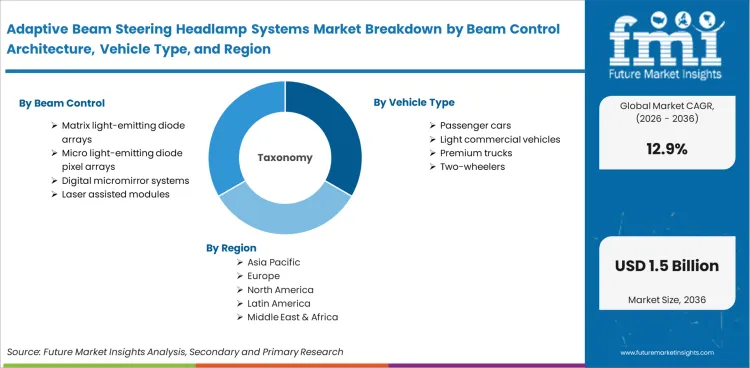
| Beam Control Architecture | Matrix light-emitting diode arrays, micro light-emitting diode pixel arrays, digital micromirror systems, laser assisted modules |
| Vehicle Type | Passenger cars, light commercial vehicles, premium trucks, two-wheelers |
| System Function | Glare-free high beam, curve beam steering, road projection, weather beam control |
| Sensor Input | Camera-based control, camera-map fusion, camera-radar fusion, standalone steering input |
| Light Source | High-power light-emitting diode packages, micro light-emitting diode emitters, laser light-emitting diode hybrids, digital projection chips |
| Sales Channel | Factory-installed systems, dealer retrofit, aftermarket modules |
| Regions Covered | North America, Latin America, Europe, East Asia, South Asia, Oceania, Middle East and Africa |
| Countries Covered | China, South Korea, Germany, Japan, United States, India, United Kingdom |
| Key Companies Profiled | FORVIA HELLA, Koito Manufacturing, Valeo, Marelli, ZKW Group, ams-OSRAM, Lumileds |
| Forecast Period | 2026 to 2036 |
| Approach | Top-down sizing from adaptive front lighting, cross-checked with vehicle production and supplier disclosures |
Adaptive Beam Steering Headlamp Systems Market by Segments
By Beam Control Architecture
- Matrix light-emitting diode arrays
- Micro light-emitting diode pixel arrays
- Digital micromirror systems
- Laser assisted modules
By Vehicle Type
- Passenger cars
- Light commercial vehicles
- Premium trucks
- Two-wheelers
By System Function
- Glare-free high beam
- Curve beam steering
- Road projection
- Weather beam control
By Sensor Input
- Camera-based control
- Camera-map fusion
- Camera-radar fusion
- Standalone steering input
By Light Source
- High-power light-emitting diode packages
- Micro light-emitting diode emitters
- Laser light-emitting diode hybrids
- Digital projection chips
By Sales Channel
- Factory-installed systems
- Dealer retrofit
- Aftermarket modules
By Region
- North America
- Latin America
- Europe
- East Asia
- South Asia
- Oceania
- Middle East and Africa
Research Sources and Bibliography
- National Highway Traffic Safety Administration. (2024, December 30). Federal Motor Vehicle Safety Standards; Lamps, Reflective Devices, and Associated Equipment; Adaptive Driving Beam Headlamps; Denial of Petitions for Reconsideration. United States Department of Transportation.
- National Highway Traffic Safety Administration. (2026, April). Overview of Motor Vehicle Traffic Crashes in 2024. United States Department of Transportation.
- European Automobile Manufacturers’ Association. (2026, April 2). Economic and Market Report: Global and EU Auto Industry, Full Year 2025.
- China Association of Automobile Manufacturers. (2026, January 14). China’s automobile production and sales both exceeded 34 million units last year. State Council of the People’s Republic of China.
- Society of Indian Automobile Manufacturers. (2025, August 28). Annual Report 2024-25.
- Society of Motor Manufacturers and Traders. (2025, January 30). Vehicle production dips amid EV transformation and intense market pressure.
- Japan Automobile Manufacturers Association. (2025, September). The Motor Industry of Japan 2025.
- FORVIA HELLA. (2024, July 17). FORVIA HELLA and Audi break new ground with digital headlamp concept for Q6 e-tron.
- ams-OSRAM AG. (2025, March 24). Unlocking safety and new horizons with EVIYOS Shape.
- Lumileds Holding B.V. (2026, February 2). Modularization of Automotive Light Sources Lowers Costs, Improves Repairability and Sustainability.
- Koito Manufacturing Co., Ltd. (2025). Integrated Report 2025.
- Marelli Holdings Co., Ltd. (2024, December 5). Marelli named Top Innovator at CLEPA Innovation Awards with h-Digi® microLED lighting technology.
- Audi AG. (2024, July 31). Rethinking the upper mid-size segment: The Audi A6 e-tron sets standards in design and range.
The bibliography is provided for reader reference and uses government, trade body, company, and official technical sources relevant to adaptive beam steering headlamp systems.
This Report Answers
- What is the current and future size of the adaptive beam steering headlamp systems market?
- How fast is the adaptive beam steering headlamp systems market expected to expand between 2026 and 2036?
- Which beam control architecture is expected to lead demand by 2026?
- Which vehicle type is projected to account for the largest share in 2026?
- Why are glare-free high beam functions important for this market?
- How do regulation and service cost affect adaptive beam steering headlamp adoption?
- Which countries are projected to record faster expansion during the forecast period?
- Who are the main companies active in adaptive beam steering headlamp systems?
- How does FMI define the adaptive beam steering headlamp systems market scope?
- How does FMI estimate and validate the adaptive beam steering headlamp systems forecast?
Frequently Asked Questions
What is the global market demand for Adaptive Beam Steering Headlamp Systems in 2026?
In 2026, the global adaptive beam steering headlamp systems market is expected to be worth USD 0.46 billion as factory programs expand.
How big will the Adaptive Beam Steering Headlamp Systems Market be in 2036?
By 2036, the adaptive beam steering headlamp systems market is expected to reach USD 1.55 billion as beam control spreads across premium platforms.
How much is demand for Adaptive Beam Steering Headlamp Systems expected to expand between 2026 and 2036?
Between 2026 and 2036, adaptive beam steering headlamp systems demand is expected to expand at 12.9% CAGR as regulation supports certification.
Which beam control architecture is expected to lead the Adaptive Beam Steering Headlamp Systems Market by 2026?
Matrix light-emitting diode arrays are projected to lead beam control architecture demand with 41.0% share in 2026 because they balance control and cost.
Which vehicle type is expected to lead Adaptive Beam Steering Headlamp Systems demand in 2026?
Passenger cars are expected to lead vehicle type demand with 68.0% share in 2026 as premium and electric models adopt beam steering first.
Which country is forecast to grow fastest in the Adaptive Beam Steering Headlamp Systems Market?
China is projected to record 14.2% CAGR through 2036 as large vehicle output and electric platform launches increase adaptive headlamp content.
What does the Adaptive Beam Steering Headlamp Systems Market include?
The market includes adaptive driving beam modules, matrix headlamps, pixel lighting controls, beam steering electronics, and related factory-installed headlamp systems.
How does FMI estimate the Adaptive Beam Steering Headlamp Systems Market forecast?
FMI uses adaptive lighting anchors, vehicle production checks, supplier disclosures, regulation signals, and country-level platform activity to validate the forecast.
Are adaptive beam steering headlamps better than standard headlamps?
Adaptive beam steering headlamps improve night visibility by shaping light around traffic. Standard headlamps remain cheaper for basic vehicle trims.
Who uses adaptive beam steering headlamp systems?
Early users include premium passenger car makers, electric vehicle brands, luxury sport utility programs, and suppliers serving global factory-installed lighting contracts.
Preview the report firsthand - request a free sample
Get SampleGet the brochure for pricing and purchase details.
Get PDFTable of Content
- Key Takeaways
- Market Size and CAGR
- Top Growth Driver
- Fastest Growing Segment
- Leading Region
- Key Companies
- Emerging Opportunities
- Executive Summary
- Global Market Outlook
- Demand-side Trends
- Supply-side Trends
- Technology Roadmap Analysis
- Analysis and Recommendations
- Analyst Perspective (What is happening? Why now? What should investors know?)
- Key Questions Answered
- How large is the market?
- What is the CAGR?
- What are key trends?
- Which region dominates?
- Who are the leaders?
- Market Overview
- Market Coverage / Taxonomy
- Market Definition / Scope / Limitations
- Research Methodology
- Chapter Orientation
- Analytical Lens and Working Hypotheses
- Market Structure, Signals, and Trend Drivers
- Benchmarking and Cross-market Comparability
- Market Sizing, Forecasting, and Opportunity Mapping
- Research Design and Evidence Framework
- Desk Research Programme (Secondary Evidence)
- Expert Input and Fieldwork (Primary Evidence)
- Tooling, Models, and Reference Databases
- Data Engineering and Model Build
- Quality Assurance and Audit Trail
- Market Background
- Market Dynamics (Drivers, Restraints, Opportunity, Trends)
- Scenario Forecast (Optimistic, Likely, Conservative)
- Impact Analysis
- AI Impact
- Sustainability Impact
- Regulatory Impact
- Technology Impact
- Consumer / Buyer Analysis
- Purchase Drivers
- Adoption Barriers
- Buyer Journey
- Opportunity Map Analysis
- Product Life Cycle Analysis
- Supply Chain Analysis
- Investment Feasibility Matrix
- Value Chain Analysis
- PESTLE and Porter's Analysis
- Regulatory Landscape
- Regional Parent Market Outlook
- Production and Consumption Statistics
- Import and Export Statistics
- Global Market Analysis and Forecast, 2021 to 2036
- Historical Market Size Value (USD Billion) & Volume (Unit) Analysis, 2021 to 2025
- Current and Future Market Size Value (USD Billion) & Volume (Unit) Projections, 2026 to 2036
- Y-o-Y Growth Trend Analysis
- Absolute $ Opportunity Analysis
- Global Market Pricing Analysis, 2021 to 2036
- Global Market Analysis and Forecast, By Beam Control Architecture, 2021 to 2036
- Introduction / Key Findings
- Historical Market Size Value (USD Billion) & Volume (Unit) Analysis By Beam Control Architecture, 2021 to 2025
- Current and Future Market Size Value (USD Billion) & Volume (Unit) Analysis and Forecast By Beam Control Architecture, 2026 to 2036
- Matrix light-emitting diode arrays
- Micro light-emitting diode pixel arrays
- Digital micromirror systems
- Laser assisted modules
- Matrix light-emitting diode arrays
- Y-o-Y Growth Trend Analysis By Beam Control Architecture, 2021 to 2025
- Absolute $ Opportunity Analysis By Beam Control Architecture, 2026 to 2036
- Global Market Analysis and Forecast, By Vehicle Type, 2021 to 2036
- Introduction / Key Findings
- Historical Market Size Value (USD Billion) & Volume (Unit) Analysis By Vehicle Type, 2021 to 2025
- Current and Future Market Size Value (USD Billion) & Volume (Unit) Analysis and Forecast By Vehicle Type, 2026 to 2036
- Passenger cars
- Light commercial vehicles
- Premium trucks
- Two-wheelers
- Passenger cars
- Y-o-Y Growth Trend Analysis By Vehicle Type, 2021 to 2025
- Absolute $ Opportunity Analysis By Vehicle Type, 2026 to 2036
- Global Market Analysis and Forecast, By System Function, 2021 to 2036
- Introduction / Key Findings
- Historical Market Size Value (USD Billion) & Volume (Unit) Analysis By System Function, 2021 to 2025
- Current and Future Market Size Value (USD Billion) & Volume (Unit) Analysis and Forecast By System Function, 2026 to 2036
- Glare-free high beam
- Curve beam steering
- Road projection
- Weather beam control
- Glare-free high beam
- Y-o-Y Growth Trend Analysis By System Function, 2021 to 2025
- Absolute $ Opportunity Analysis By System Function, 2026 to 2036
- Global Market Analysis and Forecast, By Sensor Input, 2021 to 2036
- Introduction / Key Findings
- Historical Market Size Value (USD Billion) & Volume (Unit) Analysis By Sensor Input, 2021 to 2025
- Current and Future Market Size Value (USD Billion) & Volume (Unit) Analysis and Forecast By Sensor Input, 2026 to 2036
- Camera-based control
- Camera-map fusion
- Camera-radar fusion
- Standalone steering input
- Camera-based control
- Y-o-Y Growth Trend Analysis By Sensor Input, 2021 to 2025
- Absolute $ Opportunity Analysis By Sensor Input, 2026 to 2036
- Global Market Analysis and Forecast, By Light Source, 2021 to 2036
- Introduction / Key Findings
- Historical Market Size Value (USD Billion) & Volume (Unit) Analysis By Light Source, 2021 to 2025
- Current and Future Market Size Value (USD Billion) & Volume (Unit) Analysis and Forecast By Light Source, 2026 to 2036
- High-power light-emitting diode packages
- Micro light-emitting diode emitters
- Laser light-emitting diode hybrids
- Digital projection chips
- High-power light-emitting diode packages
- Y-o-Y Growth Trend Analysis By Light Source, 2021 to 2025
- Absolute $ Opportunity Analysis By Light Source, 2026 to 2036
- Global Market Analysis and Forecast, By Sales Channel
- Introduction / Key Findings
- Historical Market Size Value (USD Billion) & Volume (Unit) Analysis By Sales Channel, 2021 to 2025
- Current and Future Market Size Value (USD Billion) & Volume (Unit) Analysis and Forecast By Sales Channel, 2026 to 2036
- Factory-installed systems
- Dealer retrofit
- Aftermarket modules
- Factory-installed systems
- Y-o-Y Growth Trend Analysis By Sales Channel, 2021 to 2025
- Absolute $ Opportunity Analysis By Sales Channel, 2026 to 2036
- Global Market Analysis and Forecast, By Region, 2021 to 2036
- Introduction
- Historical Market Size Value (USD Billion) & Volume (Unit) Analysis By Region, 2021 to 2025
- Current Market Size Value (USD Billion) & Volume (Unit) Analysis and Forecast By Region, 2026 to 2036
- North America
- Latin America
- Western Europe
- Eastern Europe
- East Asia
- South Asia and Pacific
- Middle East & Africa
- Market Attractiveness Analysis By Region
- North America Market Analysis and Forecast, By Country, 2021 to 2036
- Historical Market Size Value (USD Billion) & Volume (Unit) Trend Analysis By Market Taxonomy, 2021 to 2025
- Market Size Value (USD Billion) & Volume (Unit) Forecast By Market Taxonomy, 2026 to 2036
- By Country
- USA
- Canada
- Mexico
- By Beam Control Architecture
- By Vehicle Type
- By System Function
- By Sensor Input
- By Light Source
- By Sales Channel
- By Country
- Market Attractiveness Analysis
- By Country
- By Beam Control Architecture
- By Vehicle Type
- By System Function
- By Sensor Input
- By Light Source
- By Sales Channel
- Key Takeaways
- Latin America Market Analysis and Forecast, By Country
- Historical Market Size Value (USD Billion) & Volume (Unit) Trend Analysis By Market Taxonomy, 2021 to 2025
- Market Size Value (USD Billion) & Volume (Unit) Forecast By Market Taxonomy, 2026 to 2036
- By Country
- Brazil
- Chile
- Rest of Latin America
- By Beam Control Architecture
- By Vehicle Type
- By System Function
- By Sensor Input
- By Light Source
- By Sales Channel
- By Country
- Market Attractiveness Analysis
- By Country
- By Beam Control Architecture
- By Vehicle Type
- By System Function
- By Sensor Input
- By Light Source
- By Sales Channel
- Key Takeaways
- Western Europe Market Analysis and Forecast, By Country
- Historical Market Size Value (USD Billion) & Volume (Unit) Trend Analysis By Market Taxonomy, 2021 to 2025
- Market Size Value (USD Billion) & Volume (Unit) Forecast By Market Taxonomy, 2026 to 2036
- By Country
- Germany
- UK
- Italy
- Spain
- France
- Nordic
- BENELUX
- Rest of Western Europe
- By Beam Control Architecture
- By Vehicle Type
- By System Function
- By Sensor Input
- By Light Source
- By Sales Channel
- By Country
- Market Attractiveness Analysis
- By Country
- By Beam Control Architecture
- By Vehicle Type
- By System Function
- By Sensor Input
- By Light Source
- By Sales Channel
- Key Takeaways
- Eastern Europe Market Analysis and Forecast, By Country
- Historical Market Size Value (USD Billion) & Volume (Unit) Trend Analysis By Market Taxonomy, 2021 to 2025
- Market Size Value (USD Billion) & Volume (Unit) Forecast By Market Taxonomy, 2026 to 2036
- By Country
- Russia
- Poland
- Hungary
- Balkan & Baltic
- Rest of Eastern Europe
- By Beam Control Architecture
- By Vehicle Type
- By System Function
- By Sensor Input
- By Light Source
- By Sales Channel
- By Country
- Market Attractiveness Analysis
- By Country
- By Beam Control Architecture
- By Vehicle Type
- By System Function
- By Sensor Input
- By Light Source
- By Sales Channel
- Key Takeaways
- East Asia Market Analysis and Forecast, By Country
- Historical Market Size Value (USD Billion) & Volume (Unit) Trend Analysis By Market Taxonomy, 2021 to 2025
- Market Size Value (USD Billion) & Volume (Unit) Forecast By Market Taxonomy, 2026 to 2036
- By Country
- China
- Japan
- South Korea
- By Beam Control Architecture
- By Vehicle Type
- By System Function
- By Sensor Input
- By Light Source
- By Sales Channel
- By Country
- Market Attractiveness Analysis
- By Country
- By Beam Control Architecture
- By Vehicle Type
- By System Function
- By Sensor Input
- By Light Source
- By Sales Channel
- Key Takeaways
- South Asia and Pacific Market Analysis and Forecast, By Country
- Historical Market Size Value (USD Billion) & Volume (Unit) Trend Analysis By Market Taxonomy, 2021 to 2025
- Market Size Value (USD Billion) & Volume (Unit) Forecast By Market Taxonomy, 2026 to 2036
- By Country
- India
- ASEAN
- Australia & New Zealand
- Rest of South Asia and Pacific
- By Beam Control Architecture
- By Vehicle Type
- By System Function
- By Sensor Input
- By Light Source
- By Sales Channel
- By Country
- Market Attractiveness Analysis
- By Country
- By Beam Control Architecture
- By Vehicle Type
- By System Function
- By Sensor Input
- By Light Source
- By Sales Channel
- Key Takeaways
- Middle East & Africa Market Analysis and Forecast, By Country
- Historical Market Size Value (USD Billion) & Volume (Unit) Trend Analysis By Market Taxonomy, 2021 to 2025
- Market Size Value (USD Billion) & Volume (Unit) Forecast By Market Taxonomy, 2026 to 2036
- By Country
- Kingdom of Saudi Arabia
- Other GCC Countries
- Türkiye
- South Africa
- Other African Union
- Rest of Middle East & Africa
- By Beam Control Architecture
- By Vehicle Type
- By System Function
- By Sensor Input
- By Light Source
- By Sales Channel
- By Country
- Market Attractiveness Analysis
- By Country
- By Beam Control Architecture
- By Vehicle Type
- By System Function
- By Sensor Input
- By Light Source
- By Sales Channel
- Key Takeaways
- Key Countries Market Analysis
- USA
- Pricing Analysis
- Market Share Analysis, 2025
- By Beam Control Architecture
- By Vehicle Type
- By System Function
- By Sensor Input
- By Light Source
- By Sales Channel
- Canada
- Pricing Analysis
- Market Share Analysis, 2025
- By Beam Control Architecture
- By Vehicle Type
- By System Function
- By Sensor Input
- By Light Source
- By Sales Channel
- Mexico
- Pricing Analysis
- Market Share Analysis, 2025
- By Beam Control Architecture
- By Vehicle Type
- By System Function
- By Sensor Input
- By Light Source
- By Sales Channel
- Brazil
- Pricing Analysis
- Market Share Analysis, 2025
- By Beam Control Architecture
- By Vehicle Type
- By System Function
- By Sensor Input
- By Light Source
- By Sales Channel
- Chile
- Pricing Analysis
- Market Share Analysis, 2025
- By Beam Control Architecture
- By Vehicle Type
- By System Function
- By Sensor Input
- By Light Source
- By Sales Channel
- Germany
- Pricing Analysis
- Market Share Analysis, 2025
- By Beam Control Architecture
- By Vehicle Type
- By System Function
- By Sensor Input
- By Light Source
- By Sales Channel
- UK
- Pricing Analysis
- Market Share Analysis, 2025
- By Beam Control Architecture
- By Vehicle Type
- By System Function
- By Sensor Input
- By Light Source
- By Sales Channel
- Italy
- Pricing Analysis
- Market Share Analysis, 2025
- By Beam Control Architecture
- By Vehicle Type
- By System Function
- By Sensor Input
- By Light Source
- By Sales Channel
- Spain
- Pricing Analysis
- Market Share Analysis, 2025
- By Beam Control Architecture
- By Vehicle Type
- By System Function
- By Sensor Input
- By Light Source
- By Sales Channel
- France
- Pricing Analysis
- Market Share Analysis, 2025
- By Beam Control Architecture
- By Vehicle Type
- By System Function
- By Sensor Input
- By Light Source
- By Sales Channel
- India
- Pricing Analysis
- Market Share Analysis, 2025
- By Beam Control Architecture
- By Vehicle Type
- By System Function
- By Sensor Input
- By Light Source
- By Sales Channel
- ASEAN
- Pricing Analysis
- Market Share Analysis, 2025
- By Beam Control Architecture
- By Vehicle Type
- By System Function
- By Sensor Input
- By Light Source
- By Sales Channel
- Australia & New Zealand
- Pricing Analysis
- Market Share Analysis, 2025
- By Beam Control Architecture
- By Vehicle Type
- By System Function
- By Sensor Input
- By Light Source
- By Sales Channel
- China
- Pricing Analysis
- Market Share Analysis, 2025
- By Beam Control Architecture
- By Vehicle Type
- By System Function
- By Sensor Input
- By Light Source
- By Sales Channel
- Japan
- Pricing Analysis
- Market Share Analysis, 2025
- By Beam Control Architecture
- By Vehicle Type
- By System Function
- By Sensor Input
- By Light Source
- By Sales Channel
- South Korea
- Pricing Analysis
- Market Share Analysis, 2025
- By Beam Control Architecture
- By Vehicle Type
- By System Function
- By Sensor Input
- By Light Source
- By Sales Channel
- Russia
- Pricing Analysis
- Market Share Analysis, 2025
- By Beam Control Architecture
- By Vehicle Type
- By System Function
- By Sensor Input
- By Light Source
- By Sales Channel
- Poland
- Pricing Analysis
- Market Share Analysis, 2025
- By Beam Control Architecture
- By Vehicle Type
- By System Function
- By Sensor Input
- By Light Source
- By Sales Channel
- Hungary
- Pricing Analysis
- Market Share Analysis, 2025
- By Beam Control Architecture
- By Vehicle Type
- By System Function
- By Sensor Input
- By Light Source
- By Sales Channel
- Kingdom of Saudi Arabia
- Pricing Analysis
- Market Share Analysis, 2025
- By Beam Control Architecture
- By Vehicle Type
- By System Function
- By Sensor Input
- By Light Source
- By Sales Channel
- Türkiye
- Pricing Analysis
- Market Share Analysis, 2025
- By Beam Control Architecture
- By Vehicle Type
- By System Function
- By Sensor Input
- By Light Source
- By Sales Channel
- South Africa
- Pricing Analysis
- Market Share Analysis, 2025
- By Beam Control Architecture
- By Vehicle Type
- By System Function
- By Sensor Input
- By Light Source
- By Sales Channel
- USA
- Market Structure Analysis
- Competition Dashboard
- Competition Benchmarking
- Market Share Analysis of Top Players
- By Regional
- By Beam Control Architecture
- By Vehicle Type
- By System Function
- By Sensor Input
- By Light Source
- By Sales Channel
- Emerging Startups
- Innovation Benchmarking
- Competition Analysis
- Competition Deep Dive
- FORVIA HELLA
- Overview
- Product Portfolio
- Profitability by Market Segments (Product/Region/Sales Channel)
- Sales Footprint
- Strategy Overview
- Marketing Strategy
- Product Strategy
- Channel Strategy
- Koito Manufacturing Co., Ltd.
- Valeo SE
- Marelli Holdings Co., Ltd.
- ZKW Group GmbH
- ams-OSRAM AG
- Lumileds Holding B.V.
- FORVIA HELLA
- Case Studies
- Success Stories
- Recent Developments
- Competition Deep Dive
- Assumptions & Acronyms Used


