

- Industry Size (2026)
- USD 267.1 Mn
- Forecast (2036)
- USD 482.9 Mn
- CAGR (2026 to 2036)
- 6.10%
Wide Footprint Detection Light Market Forecast and Outlook 2026 to 2036
The wide footprint detection light market is projected to reach USD 267.1 million in 2026 and USD 482.9 million by 2036, registering a CAGR of 6.10% over the forecast period. Growth is tied to rising usage across security, logistics, and industrial zones where large-area detection is required for operational visibility and perimeter control. These fixtures reduce blind spots, improve incident response, and enable 24-hour surveillance without increasing unit count. Demand patterns are shifting as advanced LED optics, motion sensing, and automation compatibility become default requirements.
Buyers seek coverage efficiency, environmental resilience, and lower cost per lumen. Integration with smart systems, access controls, and security protocols is becoming essential. Wider adoption is also linked to infrastructure expansion, regulatory safety compliance, and electrification programs in key markets. Public and private sector deployments in warehouses, transit hubs, and forensic environments continue to reinforce baseline demand, positioning these systems as a fixed requirement in modern detection and monitoring frameworks.
Quick Stats for Wide Footprint Detection Light Market
- Wide Footprint Detection Light Market Value (2026): USD 267.1 Million
- Wide Footprint Detection Light Market Forecast Value (2036): USD 482.9 Million
- Wide Footprint Detection Light Market Forecast CAGR 2026 to 2036: 6.10%
- Leading Wattage in Wide Footprint Detection Light Market: 40W Systems (40% share)
- Leading Application in Wide Footprint Detection Light Market: Public Security Criminal Investigation (45% share)
- Key Growth Countries in Wide Footprint Detection Light Market: China, India, Germany, Brazil, USA
- Top Key Players in Wide Footprint Detection Light Market: LUYOR Instrument, Scientific Analytical Tools, Horiba, Foster + Freeman, FoxFury, Lynn Peavey, Lumatec

Wide Footprint Detection Light Market Key Takeaways
| Metric | Value |
|---|---|
| Wide Footprint Detection Light Market Value (2026) | USD 267.1 Million |
| Wide Footprint Detection Light Market Forecast Value (2036) | USD 482.9 Million |
| Wide Footprint Detection Light Market Forecast CAGR 2026 to 2036 | 6.10% |
Why is the Wide Footprint Detection Light Market Experiencing Consistent Growth?
The wide footprint detection light market is growing due to rising adoption in security, industrial, and commercial applications. These lights provide enhanced area coverage for surveillance systems, reducing blind spots and improving safety in public spaces, warehouses, and critical infrastructure. Increasing demand for energy-efficient and durable lighting solutions is further supporting adoption in both indoor and outdoor environments.
Technological improvements are driving growth in the wide footprint detection light market. Integration of motion sensors, advanced LED technology, and intelligent control systems enhances energy efficiency and operational reliability. Products now offer adjustable detection range, sensitivity settings, and compatibility with smart automation systems, enabling users to customize coverage and reduce operational costs while improving performance.
Expansion of urban infrastructure, industrial facilities, and smart building projects is reinforcing growth in the wide footprint detection light market. Security-conscious organizations, commercial establishments, and municipal authorities are increasingly deploying wide-coverage detection lights to improve monitoring and reduce accident risks. Rising awareness of safety standards and compliance requirements ensures continued adoption, supporting steady market growth over the forecast period.
What Does The Segment Overview Indicate About The Wide Footprint Detection Light Market?
The wide footprint detection light market is segmented by wattage and application, highlighting different energy output requirements and use-case intensity. 40W systems lead the wattage segment with approximately 40% share, offering a balance between illumination range and power consumption. Higher wattage models such as 100W and 150W are used in specialized or high-area coverage operations. On the application side, public security criminal investigation dominates with an estimated 45% share, as law enforcement agencies adopt these lights for evidence detection, surface scanning, and trace visibility. Forensic, laboratory, and security inspection units represent stable niche segments in technical environments.
Why Do 40W Lights Hold The Leading Wattage Share In The Wide Footprint Detection Light Market?
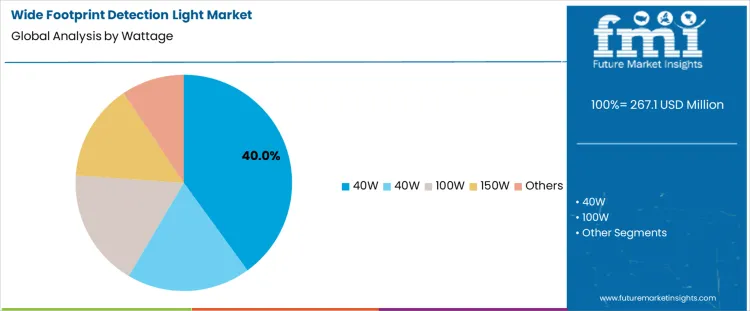
40W lights hold the leading 40% share in the wide footprint detection light market because they offer optimal performance for mid-range tasks requiring clarity without excessive power consumption. These lights are widely adopted in crime scene inspections, field security setups, and controlled forensic environments where moderate intensity is sufficient for illuminating biological traces, fingerprints, or residues. Their compact design, portable format, and energy efficiency make them suitable for both mobile and stationary use. Compared to 100W or 150W models, 40W systems are easier to deploy and maintain, especially for field operatives. Variations exist based on surface type, ambient lighting, and inspection distance, with some units incorporating filters and wavelength adjustment features.
How Does Public Security Criminal Investigation Drive Demand In The Wide Footprint Detection Light Market?
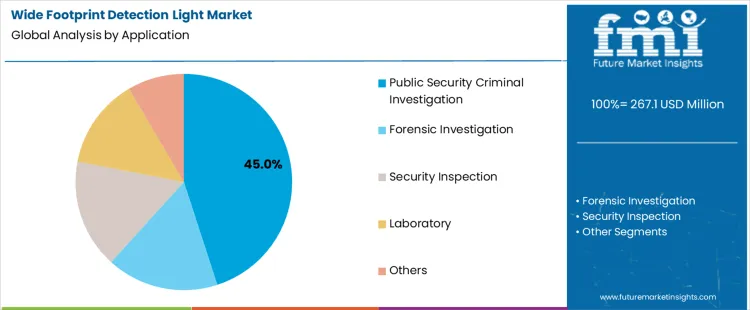
Public security criminal investigation accounts for the largest 45% share in the wide footprint detection light market, driven by the widespread use of detection lighting in evidence recovery, search operations, and crime scene management. Law enforcement agencies utilize these lights to scan large surfaces for latent prints, biological materials, and micro-traces in low-light or contaminated environments. The segment benefits from the integration of wide beam optics and wavelength filtering to enhance visibility across surfaces. Demand varies by investigative department size and case complexity, with urban centers adopting more compact, field-ready models. These tools are also favored in mobile forensic labs and patrol units, where quick deployment is critical. Procurement is often tied to public safety budgets and forensic equipment modernization programs.
What Functional Demands Are Driving Growth in the Wide Footprint Detection Light Market?
The wide footprint detection light market is expanding as industrial, security, and transport facilities adopt broader-area illumination integrated with motion sensing. These lights are designed to monitor large zones such as loading docks, perimeter fences, and transport hubs using passive infrared (PIR), microwave, or dual-technology sensors. Demand is increasing for fixtures that combine high-lumen LED arrays with wide-angle detection, reducing the number of units needed per site. Enhanced coverage reduces blind spots and supports surveillance automation. Energy-saving mandates and safety compliance also support adoption, especially in warehousing, logistics parks, and mining environments. Smart integration with access control and camera systems is becoming a key purchase factor.
Why Are Logistics and Outdoor Security Applications Expanding This Segment?
Adoption in the wide footprint detection light market is rising within logistics zones, airports, railyards, and commercial perimeters where reliable motion detection across large surface areas is required. Facilities managers prefer wide-beam lights to minimize equipment count while ensuring comprehensive detection coverage. Integration with real-time alerts, CCTV activation, and security protocols enhances incident response time. Outdoor security systems benefit from lights that function in varied weather and lighting conditions without false triggers. Wireless control, zone configuration, and dimming capabilities are increasingly being added for operational flexibility. Use is also increasing in parking areas and storage yards where low-maintenance, automated lighting is required.
What Constraints Are Impacting Broader Deployment of Wide Footprint Detection Lights?
Wider adoption in the wide footprint detection light market is restrained by high unit costs and sensor alignment complexity. These systems often require professional installation to calibrate coverage zones, avoid false activations, and ensure proper directional aiming. In areas with high thermal noise or dense obstructions, detection reliability can decline. Compatibility issues with legacy control systems and limited standardization across manufacturers add integration delays. In cost-sensitive sectors, simpler motion sensor lights are still favored due to lower installation and maintenance costs. Regulatory certification for outdoor and industrial use adds to procurement timelines, particularly in safety-critical environments.
What Is the Country-Wise Growth Outlook for the Wide Footprint Detection Light Market?
The wide footprint detection light market is seeing gradual growth across industrial and infrastructure sectors, with countries adopting broad-beam lighting solutions for enhanced area coverage, safety, and energy efficiency. China leads the segment with a CAGR of 8.2%, driven by warehouse automation, logistics centers, and urban tunnel lighting. India follows at 7.6% CAGR as industrial parks, mining operations, and public sector facilities increase lighting modernization. Germany records 7.0% CAGR, supported by automation in factories and rail stations. Brazil grows at 6.4% CAGR through infrastructure upgrades and port operations. The USA posts a 5.8% CAGR as demand rises in parking, defense, and commercial warehousing applications.

| Country | CAGR |
|---|---|
| China | 8.2% |
| India | 7.6% |
| Germany | 7.0% |
| Brazil | 6.4% |
| USA | 5.8% |
Why Is China Leading Growth in the Wide Footprint Detection Light Market?
Demand for the wide footprint detection light in China is growing at a CAGR of 8.2%, supported by rapid infrastructure expansion and industrial modernization programs. Large distribution centers, urban tunnels, highway networks, and smart city corridors are adopting broad-beam LED and sensor-integrated lighting systems. Chinese logistics parks and cold storage zones prefer wide footprint lighting for enhanced visibility with reduced energy consumption. The integration of occupancy sensors and real-time brightness modulation improves cost efficiency, especially in large-footprint indoor facilities. Suppliers also benefit from demand linked to rail terminals, shipyards, and underground utilities requiring dust- and moisture-resistant lighting. Local manufacturers deliver customized beam spreads and integrated power systems, increasing competitiveness across regional procurement contracts. Industrial zones under government development plans deploy wide detection lights in safety-critical areas such as machine yards and dock interfaces.
What Is Driving Adoption in India’s Wide Footprint Detection Light Market?
Sales for the wide footprint detection light in India are expanding at a CAGR of 7.6%, driven by state-run industrial park development, metro station rollouts, and electrification of logistics corridors. Facilities such as dry ports, railway yards, and SEZs increasingly deploy wide beam lighting systems to ensure large-area visibility with lower per-lumen costs. Indian manufacturers and EPC contractors integrate broad-coverage luminaires with occupancy-based switching for energy conservation in continuous-operation facilities. Government incentives for smart infrastructure projects and green building certifications are accelerating sensor-based LED upgrades across public warehouses and defense depots. Indoor installations in food storage zones, processing clusters, and airport cargo terminals further add to the addressable market. Adoption is strongest in Tier I and Tier II cities where legacy fixtures are being replaced with broader-angle luminaires that reduce shadow zones..
Why Is Germany a Key Contributor to the Wide Footprint Detection Light Market?
Demand for the wide footprint detection light in Germany is growing at a CAGR of 7.0%, supported by the country’s industrial automation goals, logistics modernization, and smart rail infrastructure programs. German factories adopt wide detection lighting in material handling areas, robotic zones, and walkways to minimize dark spots and improve occupational safety. Engineering firms and facility planners prefer high-uniformity light sources with motion sensing and integrated fault diagnostics. Sales also rise from deployment in underground stations, airport maintenance hangars, and auto assembly plants. Retrofit demand from aging fluorescent and halide fixtures continues across older logistics centers. Utility providers and municipal agencies specify wide detection lights for maintenance zones, substation sites, and underground cable corridors where beam coverage and ingress protection are critical. Procurement decisions are influenced by photometric testing, energy audits, and lifecycle cost modeling.
What Is Fueling Growth in the Wide Footprint Detection Light Market in Brazil?
Sales for the wide footprint detection light in Brazil are increasing at a CAGR of 6.4%, supported by industrial electrification, port expansion, and logistics warehousing growth. Brazilian operators of cargo terminals, refineries, and urban transit hubs deploy wide beam LED luminaires for uniform illumination across open and enclosed areas. Retrofit demand from legacy lighting systems is driven by rising electricity costs and maintenance downtime associated with older fixtures. Energy efficiency policies and smart infrastructure initiatives promoted by regional governments encourage broader adoption of sensor-based lighting systems with motion-triggered activation. Demand is also seen in mining and agri-logistics facilities requiring wide-angle, high-output luminaires resistant to moisture, dust, and voltage fluctuation. Domestic and imported brands compete in regional tenders, with modular designs and long replacement intervals as key differentiators. These conditions contribute to Brazil’s gradual but consistent growth in wide footprint detection lighting across industrial and infrastructure nodes.
Why Is the USA Showing Measured Growth in Wide Footprint Detection Lighting?
Demand for the wide footprint detection light in the USA is advancing at a CAGR of 5.8%, supported by upgrade cycles in commercial warehouses, military bases, and public safety infrastructure. Large-footprint spaces such as airport service hangars, government depots, and intermodal terminals deploy high-output luminaires with broad beam distribution to reduce fixture count and improve coverage. USA buyers emphasize fixture certification, safety compliance, and integration with building automation systems. Adoption is strongest in logistics zones undergoing LED retrofit funded by energy rebates or federal infrastructure budgets. Motion sensor integration and IoT-based lighting management systems gain traction in smart facility projects. Sales are also supported by indoor-outdoor use cases where fixture versatility and environmental resistance are critical. Despite the market’s maturity, consistent upgrades in high-traffic, security-sensitive facilities ensure recurring demand.
How Are Leading Companies Competing And Differentiating In The Wide Footprint Detection Light Market?

Competition in the wide footprint detection light market is being shaped by illumination intensity, coverage area, and spectral range. LUYOR Instrument is being positioned around forensic and laboratory applications, with product brochures highlighting uniform UV and LED coverage, durability, and rapid detection of trace substances. Scientific Analytical Tools is being differentiated through portable, multi-wavelength systems, emphasizing compact design, energy efficiency, and suitability for field investigations. Horiba focuses on precision spectral output, offering adjustable wavelengths and high-resolution detection for analytical and research applications.
Product versatility and operational ease are being leveraged by Foster + Freeman, FoxFury, and Lynn Peavey. Foster + Freeman promotes modular lighting systems for crime scene analysis, with brochures emphasizing ergonomic design, consistent illumination, and integration with imaging systems. FoxFury focuses on ruggedized, portable LED panels with wide-area coverage, highlighting battery life, weather resistance, and adaptability to multiple surfaces. Lynn Peavey positions detection lights for law enforcement and forensic professionals, emphasizing ease of use, low-maintenance operation, and reproducible results.
A different competitive angle is being taken by Lumatec. Its positioning emphasizes specialized LED solutions with customizable wavelength output and uniformity across larger areas, targeting both forensic and industrial inspection. Across the market, differentiation is being driven by illumination uniformity, wavelength precision, and portability. Product brochures translate technical performance into reliable detection outcomes, reinforcing confidence among forensic, laboratory, and industrial users.
Key Players in Wide Footprint Detection Light Market
- LUYOR Instrument
- Scientific Analytical Tools
- Horiba
- Foster + Freeman
- FoxFury
- Lynn Peavey
- Lumatec
Scope of Report
| Attributes | Description |
|---|---|
| Quantitative Unit | USD Million |
| Wattage | 40W, 100W, 150W, Others |
| Application | Public Security Criminal Investigation, Forensic Investigation, Security Inspection, Laboratory, Others |
| Regions Covered | Asia Pacific, Europe, North America, Latin America, Middle East & Africa |
| Countries Covered | China, Japan, South Korea, India, Australia & New Zealand, ASEAN, Rest of Asia Pacific, Germany, United Kingdom, France, Italy, Spain, Nordic, BENELUX, Rest of Europe, United States, Canada, Mexico, Brazil, Chile, Rest of Latin America, Kingdom of Saudi Arabia, Other GCC Countries, Turkey, South Africa, Other African Union, Rest of Middle East & Africa |
| Key Companies Profiled | LUYOR Instrument, Scientific Analytical Tools, Horiba, Foster + Freeman, FoxFury, Lynn Peavey, Lumatec |
| Additional Attributes | Market revenue by wattage and application; regional adoption patterns; growth contribution by forensic, security, and laboratory use; competitive landscape insights; emerging market trends; regulatory influence on public and private sector security adoption; forecasted growth trends over 2026-2036. |
Wide Footprint Detection Light Market by Key Segments
Wattage
- 40W
- 100W
- 150W
- Others
Application
- Public Security Criminal Investigation
- Forensic Investigation
- Security Inspection
- Laboratory
- Others
Region
- Asia Pacific
- China
- Japan
- South Korea
- India
- Australia & New Zealand
- ASEAN
- Rest of Asia Pacific
- Europe
- Germany
- United Kingdom
- France
- Italy
- Spain
- Nordic
- BENELUX
- Rest of Europe
- North America
- United States
- Canada
- Mexico
- Latin America
- Brazil
- Chile
- Rest of Latin America
- Middle East & Africa
- Kingdom of Saudi Arabia
- Other GCC Countries
- Turkey
- South Africa
- Other African Union
- Rest of Middle East & Africa
Bibliography
- International Commission on Illumination (CIE). (2024). Guidelines for measurement and evaluation of LED luminaires for security and forensic applications (CIE Report 244:2024). CIE.
- United States Department of Justice, National Institute of Justice. (2024). Forensic illumination and evidence detection lighting: Performance standards and testing protocols 2024. U.S. Department of Justice.
- International Organization for Standardization. (2024). Lighting of workplaces — Part 3: Outdoor workplaces (ISO 8995-3:2024). ISO
Frequently Asked Questions
How big is the wide footprint detection light market in 2026?
The global wide footprint detection light market is estimated to be valued at USD 267.1 million in 2026.
What will be the size of wide footprint detection light market in 2036?
The market size for the wide footprint detection light market is projected to reach USD 482.9 million by 2036.
How much will be the wide footprint detection light market growth between 2026 and 2036?
The wide footprint detection light market is expected to grow at a 6.1% CAGR between 2026 and 2036.
What are the key product types in the wide footprint detection light market?
The key product types in wide footprint detection light market are 40w, 100w, 150w and others.
Which application segment to contribute significant share in the wide footprint detection light market in 2026?
In terms of application, public security criminal investigation segment to command 45.0% share in the wide footprint detection light market in 2026.
Preview the report firsthand - request a free sample
Get SampleGet the brochure for pricing and purchase details.
Get PDFTable of Content
- Executive Summary
- Global Market Outlook
- Demand-side Trends
- Supply-side Trends
- Technology Roadmap Analysis
- Analysis and Recommendations
- Market Overview
- Market Coverage / Taxonomy
- Market Definition / Scope / Limitations
- Market Background
- Market Dynamics
- Drivers
- Restraints
- Opportunity
- Trends
- Scenario Forecast
- Demand in Optimistic Scenario
- Demand in Likely Scenario
- Demand in Conservative Scenario
- Opportunity Map Analysis
- Product Life Cycle Analysis
- Supply Chain Analysis
- Investment Feasibility Matrix
- Value Chain Analysis
- PESTLE and Porter’s Analysis
- Regulatory Landscape
- Regional Parent Market Outlook
- Production and Consumption Statistics
- Import and Export Statistics
- Market Dynamics
- Global Market Analysis 2021 to 2025 and Forecast, 2026 to 2036
- Historical Market Size Value (USD Million) Analysis, 2021 to 2025
- Current and Future Market Size Value (USD Million) Projections, 2026 to 2036
- Y-o-Y Growth Trend Analysis
- Absolute $ Opportunity Analysis
- Global Market Pricing Analysis 2021 to 2025 and Forecast 2026 to 2036
- Global Market Analysis 2021 to 2025 and Forecast 2026 to 2036, By Wattage
- Introduction / Key Findings
- Historical Market Size Value (USD Million) Analysis By Wattage, 2021 to 2025
- Current and Future Market Size Value (USD Million) Analysis and Forecast By Wattage, 2026 to 2036
- 40W
- 40W
- 100W
- 150W
- Others
- 40W
- Y-o-Y Growth Trend Analysis By Wattage, 2021 to 2025
- Absolute $ Opportunity Analysis By Wattage, 2026 to 2036
- Global Market Analysis 2021 to 2025 and Forecast 2026 to 2036, By Application
- Introduction / Key Findings
- Historical Market Size Value (USD Million) Analysis By Application, 2021 to 2025
- Current and Future Market Size Value (USD Million) Analysis and Forecast By Application, 2026 to 2036
- Public Security Criminal Investigation
- Forensic Investigation
- Security Inspection
- Laboratory
- Others
- Public Security Criminal Investigation
- Y-o-Y Growth Trend Analysis By Application, 2021 to 2025
- Absolute $ Opportunity Analysis By Application, 2026 to 2036
- Global Market Analysis 2021 to 2025 and Forecast 2026 to 2036, By Region
- Introduction
- Historical Market Size Value (USD Million) Analysis By Region, 2021 to 2025
- Current Market Size Value (USD Million) Analysis and Forecast By Region, 2026 to 2036
- North America
- Latin America
- Western Europe
- Eastern Europe
- East Asia
- South Asia and Pacific
- Middle East & Africa
- Market Attractiveness Analysis By Region
- North America Market Analysis 2021 to 2025 and Forecast 2026 to 2036, By Country
- Historical Market Size Value (USD Million) Trend Analysis By Market Taxonomy, 2021 to 2025
- Market Size Value (USD Million) Forecast By Market Taxonomy, 2026 to 2036
- By Country
- USA
- Canada
- Mexico
- By Wattage
- By Application
- By Country
- Market Attractiveness Analysis
- By Country
- By Wattage
- By Application
- Key Takeaways
- Latin America Market Analysis 2021 to 2025 and Forecast 2026 to 2036, By Country
- Historical Market Size Value (USD Million) Trend Analysis By Market Taxonomy, 2021 to 2025
- Market Size Value (USD Million) Forecast By Market Taxonomy, 2026 to 2036
- By Country
- Brazil
- Chile
- Rest of Latin America
- By Wattage
- By Application
- By Country
- Market Attractiveness Analysis
- By Country
- By Wattage
- By Application
- Key Takeaways
- Western Europe Market Analysis 2021 to 2025 and Forecast 2026 to 2036, By Country
- Historical Market Size Value (USD Million) Trend Analysis By Market Taxonomy, 2021 to 2025
- Market Size Value (USD Million) Forecast By Market Taxonomy, 2026 to 2036
- By Country
- Germany
- UK
- Italy
- Spain
- France
- Nordic
- BENELUX
- Rest of Western Europe
- By Wattage
- By Application
- By Country
- Market Attractiveness Analysis
- By Country
- By Wattage
- By Application
- Key Takeaways
- Eastern Europe Market Analysis 2021 to 2025 and Forecast 2026 to 2036, By Country
- Historical Market Size Value (USD Million) Trend Analysis By Market Taxonomy, 2021 to 2025
- Market Size Value (USD Million) Forecast By Market Taxonomy, 2026 to 2036
- By Country
- Russia
- Poland
- Hungary
- Balkan & Baltic
- Rest of Eastern Europe
- By Wattage
- By Application
- By Country
- Market Attractiveness Analysis
- By Country
- By Wattage
- By Application
- Key Takeaways
- East Asia Market Analysis 2021 to 2025 and Forecast 2026 to 2036, By Country
- Historical Market Size Value (USD Million) Trend Analysis By Market Taxonomy, 2021 to 2025
- Market Size Value (USD Million) Forecast By Market Taxonomy, 2026 to 2036
- By Country
- China
- Japan
- South Korea
- By Wattage
- By Application
- By Country
- Market Attractiveness Analysis
- By Country
- By Wattage
- By Application
- Key Takeaways
- South Asia and Pacific Market Analysis 2021 to 2025 and Forecast 2026 to 2036, By Country
- Historical Market Size Value (USD Million) Trend Analysis By Market Taxonomy, 2021 to 2025
- Market Size Value (USD Million) Forecast By Market Taxonomy, 2026 to 2036
- By Country
- India
- ASEAN
- Australia & New Zealand
- Rest of South Asia and Pacific
- By Wattage
- By Application
- By Country
- Market Attractiveness Analysis
- By Country
- By Wattage
- By Application
- Key Takeaways
- Middle East & Africa Market Analysis 2021 to 2025 and Forecast 2026 to 2036, By Country
- Historical Market Size Value (USD Million) Trend Analysis By Market Taxonomy, 2021 to 2025
- Market Size Value (USD Million) Forecast By Market Taxonomy, 2026 to 2036
- By Country
- Kingdom of Saudi Arabia
- Other GCC Countries
- Turkiye
- South Africa
- Other African Union
- Rest of Middle East & Africa
- By Wattage
- By Application
- By Country
- Market Attractiveness Analysis
- By Country
- By Wattage
- By Application
- Key Takeaways
- Key Countries Market Analysis
- USA
- Pricing Analysis
- Market Share Analysis, 2025
- By Wattage
- By Application
- Canada
- Pricing Analysis
- Market Share Analysis, 2025
- By Wattage
- By Application
- Mexico
- Pricing Analysis
- Market Share Analysis, 2025
- By Wattage
- By Application
- Brazil
- Pricing Analysis
- Market Share Analysis, 2025
- By Wattage
- By Application
- Chile
- Pricing Analysis
- Market Share Analysis, 2025
- By Wattage
- By Application
- Germany
- Pricing Analysis
- Market Share Analysis, 2025
- By Wattage
- By Application
- UK
- Pricing Analysis
- Market Share Analysis, 2025
- By Wattage
- By Application
- Italy
- Pricing Analysis
- Market Share Analysis, 2025
- By Wattage
- By Application
- Spain
- Pricing Analysis
- Market Share Analysis, 2025
- By Wattage
- By Application
- France
- Pricing Analysis
- Market Share Analysis, 2025
- By Wattage
- By Application
- India
- Pricing Analysis
- Market Share Analysis, 2025
- By Wattage
- By Application
- ASEAN
- Pricing Analysis
- Market Share Analysis, 2025
- By Wattage
- By Application
- Australia & New Zealand
- Pricing Analysis
- Market Share Analysis, 2025
- By Wattage
- By Application
- China
- Pricing Analysis
- Market Share Analysis, 2025
- By Wattage
- By Application
- Japan
- Pricing Analysis
- Market Share Analysis, 2025
- By Wattage
- By Application
- South Korea
- Pricing Analysis
- Market Share Analysis, 2025
- By Wattage
- By Application
- Russia
- Pricing Analysis
- Market Share Analysis, 2025
- By Wattage
- By Application
- Poland
- Pricing Analysis
- Market Share Analysis, 2025
- By Wattage
- By Application
- Hungary
- Pricing Analysis
- Market Share Analysis, 2025
- By Wattage
- By Application
- Kingdom of Saudi Arabia
- Pricing Analysis
- Market Share Analysis, 2025
- By Wattage
- By Application
- Turkiye
- Pricing Analysis
- Market Share Analysis, 2025
- By Wattage
- By Application
- South Africa
- Pricing Analysis
- Market Share Analysis, 2025
- By Wattage
- By Application
- USA
- Market Structure Analysis
- Competition Dashboard
- Competition Benchmarking
- Market Share Analysis of Top Players
- By Regional
- By Wattage
- By Application
- Competition Analysis
- Competition Deep Dive
- LUYOR Instrument
- Overview
- Product Portfolio
- Profitability by Market Segments (Product/Age /Sales Channel/Region)
- Sales Footprint
- Strategy Overview
- Marketing Strategy
- Product Strategy
- Channel Strategy
- Scientific Analytical Tools
- Horiba
- Foster + Freeman
- FoxFury
- Lynn Peavey
- Lumatec
- LUYOR Instrument
- Competition Deep Dive
- Assumptions & Acronyms Used
- Research Methodology


