

- Industry Size (2026)
- USD 2.8 Bn
- Forecast (2036)
- USD 6.7 Bn
- CAGR (2026 to 2036)
- 9.1%
High Brightness Bar Lights Market Forecast and Outlook 2026 to 2036
The high brightness bar lights market expands from USD 2.8 billion in 2026 to USD 6.7 billion by 2036, representing a CAGR of 9.10%. Buying decisions are often tied to visibility standards, safety audits, and task specific illumination requirements rather than to general building lighting budgets. In ports, mines, and large assembly halls, light output is treated as a productivity and risk control variable, not a comfort feature. Facilities specify these systems based on beam spread, glare control, and mounting geometry, which fixes product choice early in project design. As a result, suppliers compete on optical performance and mechanical robustness more than on unit price alone.
Over the period, market development follows changes in work practices and inspection regimes rather than simple expansion of floor space. Higher mechanization and extended operating hours raise expectations for consistent, shadow free illumination. Some operators standardize bar lights across sites to simplify spares, training, and compliance checks, while others adopt selectively in high risk zones only. Maintenance access, cleaning routines, and fixture downtime influence product selection as much as efficiency ratings. The category grows through deeper integration into operational standards and safety protocols, not through broad replacement of conventional luminaires in general purpose spaces.
Quick Stats for High Brightness Bar Lights Market
- High Brightness Bar Lights Market Value (2026): USD 2.8 billion
- High Brightness Bar Lights Market Forecast Value (2036): USD 6.7 billion
- High Brightness Bar Lights Market Forecast CAGR 2026 to 2036: 9.1%
- Leading Type in High Brightness Bar Lights Market: LED bar lights
- Key Growth Regions in High Brightness Bar Lights Market: Asia Pacific, North America, Europe
- Top Players in High Brightness Bar Lights Market: Philips Lighting (Signify), Osram Licht AG, Cree Lighting (Wolfspeed), Sharp Corporation, Acuity Brands, Zumtobel Group, Nichia Corporation
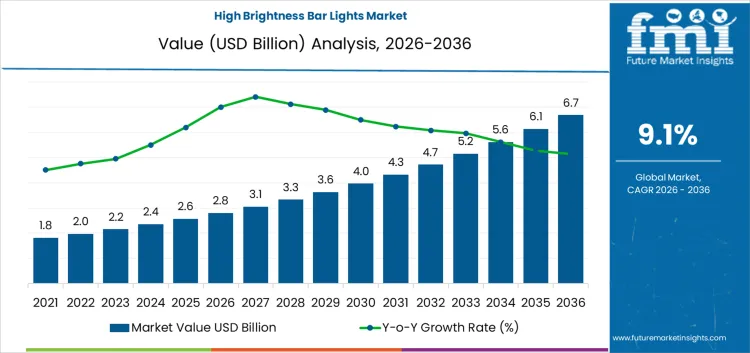
What is the Growth Forecast for High Brightness Bar Lights Market through 2036?
Between 2026 and 2031, the high brightness bar lights market is projected to expand from USD 2.8 billion along a trajectory consistent with a 9.1% CAGR, driven by the spread of modular, line-based lighting layouts in industrial, commercial, and outdoor applications. Bar lights are selected not only for illumination level but for their ability to create continuous, uniform light fields across long work areas, aisles, and architectural features. Growth in this phase is tied to facility retrofits and layout standardization rather than to new construction alone. Warehouses, factories, parking structures, and large retail spaces adopt these formats to simplify installation and maintenance. Purchasing decisions emphasize lumen output per meter, thermal management, and reliability over decorative features or complex control systems.
From 2031 to 2036, the market is expected to reach USD 6.7 billion, with expansion shaped by higher installation density and replacement of legacy linear lighting systems. As lighting designs increasingly favor fewer fixture types deployed at scale, high brightness bars become default choices for many long-span and high-ceiling environments. This raises unit volumes per project and shortens replacement cycles as utilization hours’ increase. Value growth comes from wider coverage and higher performance specifications rather than from price escalation. Competitive positioning depends on optical efficiency, heat dissipation, and consistency of output over long service life, as buyers prioritize operating cost control and uptime over stylistic differentiation.
High Brightness Bar Lights Market Key Takeaways
| Metric | Value |
|---|---|
| Market Value (2026) | USD 2.8 billion |
| Forecast Value (2036) | USD 6.7 billion |
| Forecast CAGR 2026 to 2036 | 9.1% |
How Are High-Brightness Bar Lights Enhancing Industrial and Commercial Illumination?
High-brightness bar lights are increasingly adopted to provide uniform, high-intensity illumination for manufacturing lines, inspection systems, signage, and commercial spaces. Historically, conventional lighting relied on standard fluorescent or halogen fixtures, which offered limited brightness, uneven light distribution, and higher energy consumption. Modern high-brightness bar lights integrate LED technology, precision optics, and modular designs to deliver consistent illumination, reduced power usage, and long operational life. Industrial operators, quality control facilities, and commercial developers prioritize lumen output, durability, and ease of installation. Early adoption focused on precision manufacturing and laboratory environments, while current demand spans warehouses, production lines, and retail displays, driven by visibility requirements, energy efficiency, and productivity optimization. Brightness level, thermal management, and optical uniformity influence supplier selection.
Increasing automation, quality inspection needs, and energy efficiency standards are shaping market growth. Compared with conventional lighting, high-brightness bar lights emphasize high luminous efficacy, uniform light distribution, and long-term reliability under continuous operation. Cost structures depend on LED quality, driver systems, and housing design, concentrating margins among suppliers capable of delivering reliable, high-performance fixtures. Manufacturers and facility operators adopt these lights to improve visibility, reduce defects, and optimize operational workflow. By 2036, high-brightness bar lights are expected to become standard in industrial, commercial, and inspection applications, supporting enhanced productivity, energy-efficient illumination, and long-term operational reliability.
What Factors Are Shaping the Demand for High Brightness Bar Lights by Light Source Technology and Use Case in 2026?
The high brightness bar lights market in 2026 is segmented by light source type and by application. By technology, demand is divided into LED, fluorescent, high intensity discharge, and OLED bar lights, each offering different efficiency, lifespan, and optical control characteristics. By application, demand is organized around commercial lighting, industrial lighting, residential lighting, and automotive or signage uses, which differ in operating hours, brightness requirements, and maintenance tolerance. These segments reflect how buyers balance energy cost, reliability, and light quality while selecting linear lighting formats for spaces that require uniform illumination and controlled glare.
Why Do LED Bar Lights Dominate the Technology Mix?
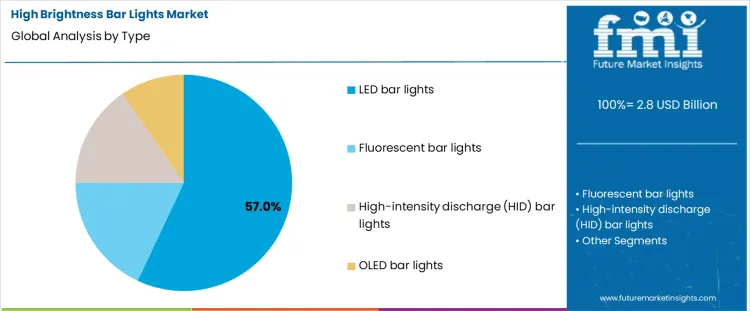
LED bar lights account for about 57% of demand in 2026, reflecting their high luminous efficacy and long service life. In commercial and industrial environments, lighting often operates for many hours per day, which makes energy consumption and maintenance frequency critical cost drivers. LED systems reduce both, while also offering better control over color temperature and beam shape. Their compact form factor supports slim bar designs and flexible installation in shelves, ceilings, and machinery. Thermal management and driver technology are now well established, which has improved reliability and reduced early failure rates. This combination of operating cost savings, design flexibility, and proven performance keeps LEDs as the default choice for most new installations.
Fluorescent, HID, and OLED technologies occupy more limited roles. Fluorescent bars remain in older installations, yet replacement cycles favor LED due to efficiency and regulatory pressure. HID bars deliver high output but require warm up time and more complex control gear, which limits use in spaces that need instant light. OLED bars offer thin form factors and uniform glow, but their brightness and cost restrict them to niche design applications. These technologies remain relevant in specific contexts, yet they do not match the broad economic and technical advantages that have made LED bars the dominant format.
Why Does Commercial Lighting Represent the Largest Application Segment?
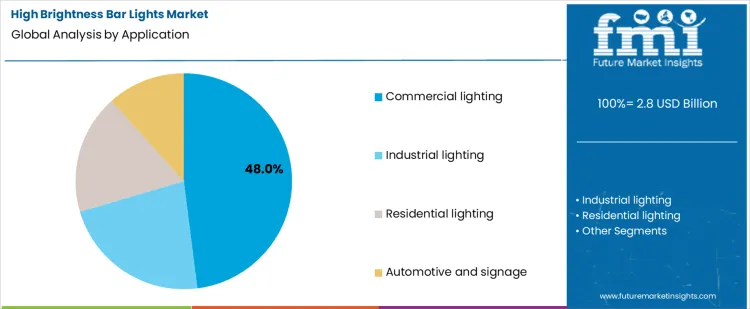
Commercial lighting represents about 48% of demand in 2026 because offices, retail spaces, and public buildings require consistent, uniform illumination over large floor areas. Bar lights fit well into ceiling grids, shelving systems, and architectural features where linear light distribution is preferred. Operating hours in these spaces are long, which increases the value of efficient and reliable fixtures. Renovation and retrofit activity in commercial buildings also drives replacement demand as older fluorescent systems are removed. The sheer number of commercial interiors and their regular refurbishment cycles concentrate a large share of total unit volume in this segment.
Industrial, residential, and automotive or signage applications follow different patterns. Industrial sites use high brightness lighting, yet fixture types vary widely depending on ceiling height and process needs. Residential use focuses more on accent and task lighting, which limits volumes of high brightness bars. Automotive and signage applications involve specialized designs and smaller production runs. These segments contribute to growth and innovation, but their total installed base does not match the scale and turnover found in commercial building lighting.
Why Are Machine Vision Requirements and Visual Inspection Reliability Driving the High Brightness Bar Lights Market through 2036?
Demand is being pulled by inspection accuracy rather than by general lighting upgrades. In automated production, logistics sorting, and quality control stations, consistent, high intensity, and well directed illumination determines whether cameras can detect defects, read codes, or measure dimensions reliably. As tolerances tighten and inspection speeds rise, ambient lighting becomes insufficient and controlled light sources become mandatory. Bar lights offer uniform, directional output that can be integrated into machine frames and conveyors. Once an inspection cell is validated with a specific lighting setup, it becomes locked into the process. Volume then follows automation deployment and line replication rather than building construction or facility expansion.
What Heat Management, Power Consumption, and Application Specific Tuning Are Limiting Broader Use?
The main restraint is operating tradeoffs. High brightness output generates heat, which requires heat sinking, airflow management, and careful mounting to avoid performance degradation or early failure. Power consumption also becomes visible in dense inspection lines with many light sources. Each application often needs specific wavelength, angle, and intensity tuning, which reduces standardization and increases engineering effort. In simpler tasks, lower intensity or passive lighting remains adequate and cheaper. These factors keep high brightness bar lights concentrated in critical inspection and vision guided processes rather than in general illumination or low precision automation.
How Are Vision System Integration and Standardized Inspection Modules Changing the Category?
The structure of demand is becoming more modular. Equipment builders increasingly sell inspection stations as repeatable modules, with lighting, camera, optics, and control pre-engineered as one package. This pushes bar lights to be specified as part of a system rather than as standalone components. Suppliers that can offer consistent form factors, stable output, and long term availability gain preference. Control integration also matters, with lights being synchronized to camera triggers and exposure cycles. Over time, procurement shifts from one off light selection to platform based sourcing aligned with standardized machine vision cells and replicated production lines.
What is the Demand for High Brightness Bar Lights by Country?
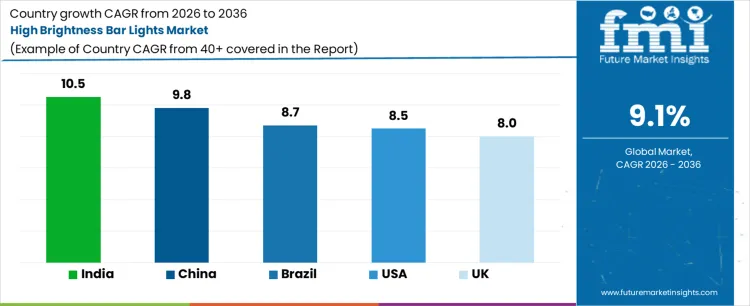
| Country | CAGR (%) |
|---|---|
| US | 8.5 |
| UK | 8.0 |
| China | 9.8 |
| India | 10.5 |
| Brazil | 8.7 |
Demand for high brightness bar lights is rising as industrial, commercial, and automotive sectors adopt efficient lighting solutions for improved visibility, operational safety, and performance. India leads with a 10.5% CAGR, driven by growing industrial facilities, commercial operations, and adoption of high-intensity lighting. China follows at 9.8%, supported by expanding manufacturing operations and demand for advanced lighting systems. Brazil records 8.7% growth, shaped by industrial and commercial applications. The US grows at 8.5%, influenced by replacement demand and adoption in automotive and industrial operations. The UK shows 8.0% CAGR, reflecting steady adoption of high-brightness lighting solutions across multiple sectors.
How is the United States experiencing growth in the high brightness bar lights market?
United States is experiencing growth at a CAGR of 8.5%, fueled by demand in commercial lighting, automotive applications, and industrial facilities in California, Texas, and New York. High brightness bar lights are optimized for energy efficiency, uniform illumination, and long operational life. Demand is concentrated in warehouses, manufacturing plants, retail stores, and commercial office spaces. Investments focus on material quality, LED efficiency, and compliance with federal electrical and safety standards. Growth reflects rising adoption of high-intensity lighting solutions for enhanced visibility, energy savings, and operational reliability.
- Commercial and industrial facilities drive adoption.
- Lights optimize energy efficiency and uniform illumination.
- Warehouses and retail spaces concentrate demand.
- Material quality and regulatory compliance guide investment.
How is the United Kingdom witnessing growth in the high brightness bar lights market?
United Kingdom is witnessing growth at a CAGR of 8%, supported by warehouse automation, retail lighting, and infrastructure upgrades in London, Birmingham, and Manchester. High brightness bar lights are optimized for high lumen output, energy conservation, and durability under continuous operation. Demand is concentrated in logistics centers, industrial warehouses, and commercial facilities. Investments prioritize LED efficiency, product lifespan, and compliance with UK electrical and building standards. Growth reflects increasing adoption of lighting solutions for operational efficiency and safety in commercial and industrial spaces.
- Warehouses and industrial facilities drive adoption.
- Lights enhance lumen output and durability.
- Logistics and commercial hubs concentrate demand.
- Energy efficiency and compliance guide investment.
How is China experiencing growth in the high brightness bar lights market?
China is experiencing growth at a CAGR of 9.8%, driven by rapid expansion in industrial zones, manufacturing plants, and commercial construction in Shanghai, Shenzhen, and Guangzhou. High brightness bar lights are optimized for consistent illumination, energy efficiency, and long-term reliability. Demand is concentrated in large-scale factories, industrial parks, and retail complexes. Investments focus on LED performance, product reliability, and compliance with national safety and electrical standards. Growth reflects high industrial activity, increasing warehouse automation, and adoption of efficient, high-lumen lighting solutions.
- Industrial zones and manufacturing plants drive adoption.
- Lights optimize illumination consistency and energy efficiency.
- Factories and industrial parks concentrate demand.
- Product reliability and regulatory compliance guide investment.
How is India witnessing growth in the high brightness bar lights market?
India is witnessing growth at a CAGR of 10.5%, supported by industrial expansion, commercial construction, and logistics infrastructure development in Mumbai, Bengaluru, and Delhi. High brightness bar lights are optimized for high-intensity illumination, thermal stability, and long service life. Demand is concentrated in industrial facilities, warehouses, retail chains, and commercial complexes. Investments focus on LED durability, energy efficiency, and adherence to national electrical and safety standards. Growth reflects increasing adoption of efficient lighting for operational productivity, warehouse safety, and energy savings in industrial and commercial sectors.
- Industrial and commercial infrastructure drives adoption.
- Lights enhance intensity, durability, and energy efficiency.
- Warehouses and industrial hubs concentrate demand.
- Material reliability and compliance guide investment.
How is Brazil experiencing growth in the high brightness bar lights market?
Brazil is experiencing growth at a CAGR of 8.7%, driven by demand from commercial buildings, warehouses, and automotive facilities in São Paulo, Rio de Janeiro, and Paraná. High brightness bar lights are optimized for long-term performance, uniform illumination, and energy efficiency in tropical climates. Demand is concentrated in industrial zones, distribution centers, and commercial complexes. Investments focus on product reliability, LED efficiency, and compliance with Brazilian electrical and workplace safety standards. Growth reflects expanding industrial and commercial operations and adoption of high-intensity lighting solutions to improve visibility and operational efficiency.
- Commercial and industrial operations drive adoption.
- Lights optimize illumination and energy efficiency.
- Warehouses and industrial zones concentrate demand.
- Product reliability and regulatory compliance guide investment.
How Are Suppliers Advancing Performance and Utility in the High Brightness Bar Lights Market?
Manufacturers in the high brightness bar lights market differentiate through luminous efficacy, thermal design, and system adaptability for commercial and industrial illumination. Philips Lighting (Signify) supplies LED bar lights engineered for uniform light distribution and energy efficiency, with controls that integrate into building management systems. Osram Licht AG provides modules with stable color performance and robust thermal pathways for extended service life in warehouses and transit hubs. Cree Lighting (Wolfspeed) delivers high‑output bar lights leveraging advanced semiconductor materials to achieve elevated lumen levels at reduced power consumption. Sharp Corporation offers bar light solutions that balance compact form factors with reliable performance across varied ambient conditions. Acuity Brands develops modular lighting systems that support dimming, sensor integration, and energy tracking for facility scale deployments.
Zumtobel Group focuses on optical control and tailored light distribution in architectural and retail spaces where both intensity and quality of light are critical. Nichia Corporation supplies high‑consistency LED chips and bar modules that support integration into fixtures used in industrial, commercial, and outdoor settings. Other niche and regional suppliers target specific application niches such as high‑bay lighting for manufacturing floors, signage, and transit platforms where brightness, durability, and regulatory compliance matter. Competitive differences arise from heat dissipation engineering, luminous efficacy (lm/W), control interface options (DMX, DALI, wireless), and the ability to meet strict safety and performance standards. Suppliers that combine documented light performance, interoperability with control ecosystems, and proven durability in harsh conditions maintain relevance as demand grows for cost‑effective, high‑intensity lighting solutions across sectors. Adoption reflects facility owners’ priorities for energy savings, reduced maintenance, and consistent illumination in high‑usage environments.
Key Players in the High Brightness Bar Lights Market
- Philips Lighting (Signify)
- Osram Licht AG
- Cree Lighting (Wolfspeed)
- Sharp Corporation
- Acuity Brands
- Zumtobel Group
- Nichia Corporation
Scope of the Report
| Items | Values |
|---|---|
| Quantitative Units (2026) | USD billion |
| Type | LED Bar Lights, Fluorescent Bar Lights, High-Intensity Discharge (HID) Bar Lights, OLED Bar Lights |
| Application | Commercial Lighting, Industrial Lighting, Residential Lighting, Automotive and Signage |
| Regions Covered | Asia Pacific, Europe, North America, Latin America, Middle East & Africa |
| Countries Covered | China, Japan, South Korea, India, Australia & New Zealand, ASEAN, Germany, United Kingdom, France, Italy, Spain, Nordic, BENELUX, United States, Canada, Mexico, Brazil, Chile, Saudi Arabia, Turkey, South Africa, and other regional markets |
| Key Companies Profiled | Philips Lighting (Signify), Osram Licht AG, Cree Lighting (Wolfspeed), Sharp Corporation, Acuity Brands, Zumtobel Group, Nichia Corporation |
| Additional Attributes | Dollar sales by type and application; LED bars as the dominant technology; commercial lighting as the largest use case; demand driven by machine vision and inspection accuracy needs; procurement shaped by optical performance, thermal management, and reliability; adoption constrained by heat dissipation, power consumption, and application-specific tuning requirements. |
High Brightness Bar Lights Market Segmentation
Type:
- LED bar lights
- Fluorescent bar lights
- High-intensity discharge (HID) bar lights
- OLED bar lights
Application:
- Commercial lighting
- Industrial lighting
- Residential lighting
- Automotive and signage
Region
- Asia Pacific
- China
- Japan
- South Korea
- India
- Australia & New Zealand
- ASEAN
- Rest of Asia Pacific
- Europe
- Germany
- United Kingdom
- France
- Italy
- Spain
- Nordic
- BENELUX
- Rest of Europe
- North America
- United States
- Canada
- Mexico
- Latin America
- Brazil
- Chile
- Rest of Latin America
- Middle East & Africa
- Kingdom of Saudi Arabia
- Other GCC Countries
- Turkey
- South Africa
- Other African Union
- Rest of Middle East & Africa
Bibliography
- American National Standards Institute & Illuminating Engineering Society. (2023). ANSI/IES RP-1-20: Recommended practice for roadway lighting. ANSI/IES.
- Illuminating Engineering Society. (2021). IES LM-79-08: Approved method for the electrical and photometric measurements of solid-state lighting products. IES.
- International Electrotechnical Commission. (2019). IEC 60598-1: Luminaires — Part 1: General requirements and tests. IEC.
- International Energy Agency. (2023). Energy performance and efficiency trends in lighting systems. IEA.
Frequently Asked Questions
How big is the high brightness bar lights market in 2026?
The global high brightness bar lights market is estimated to be valued at USD 2.8 billion in 2026.
What will be the size of high brightness bar lights market in 2036?
The market size for the high brightness bar lights market is projected to reach USD 6.7 billion by 2036.
How much will be the high brightness bar lights market growth between 2026 and 2036?
The high brightness bar lights market is expected to grow at a 9.1% CAGR between 2026 and 2036.
What are the key product types in the high brightness bar lights market?
The key product types in high brightness bar lights market are led bar lights , fluorescent bar lights, high‑intensity discharge (hid) bar lights and oled bar lights.
Which application segment to contribute significant share in the high brightness bar lights market in 2026?
In terms of application, commercial lighting segment to command 48.0% share in the high brightness bar lights market in 2026.
Preview the report firsthand - request a free sample
Get SampleGet the brochure for pricing and purchase details.
Get PDFTable of Content
- Executive Summary
- Global Market Outlook
- Demand-side Trends
- Supply-side Trends
- Technology Roadmap Analysis
- Analysis and Recommendations
- Market Overview
- Market Coverage / Taxonomy
- Market Definition / Scope / Limitations
- Market Background
- Market Dynamics
- Drivers
- Restraints
- Opportunity
- Trends
- Scenario Forecast
- Demand in Optimistic Scenario
- Demand in Likely Scenario
- Demand in Conservative Scenario
- Opportunity Map Analysis
- Product Life Cycle Analysis
- Supply Chain Analysis
- Investment Feasibility Matrix
- Value Chain Analysis
- PESTLE and Porter’s Analysis
- Regulatory Landscape
- Regional Parent Market Outlook
- Production and Consumption Statistics
- Import and Export Statistics
- Market Dynamics
- Global Market Analysis 2021 to 2025 and Forecast, 2026 to 2036
- Historical Market Size Value (USD Million) Analysis, 2021 to 2025
- Current and Future Market Size Value (USD Million) Projections, 2026 to 2036
- Y-o-Y Growth Trend Analysis
- Absolute $ Opportunity Analysis
- Global Market Pricing Analysis 2021 to 2025 and Forecast 2026 to 2036
- Global Market Analysis 2021 to 2025 and Forecast 2026 to 2036, By Type
- Introduction / Key Findings
- Historical Market Size Value (USD Million) Analysis By Type , 2021 to 2025
- Current and Future Market Size Value (USD Million) Analysis and Forecast By Type , 2026 to 2036
- LED bar lights
- Fluorescent bar lights
- High‑intensity discharge (HID) bar lights
- OLED bar lights
- LED bar lights
- Y-o-Y Growth Trend Analysis By Type , 2021 to 2025
- Absolute $ Opportunity Analysis By Type , 2026 to 2036
- Global Market Analysis 2021 to 2025 and Forecast 2026 to 2036, By Application
- Introduction / Key Findings
- Historical Market Size Value (USD Million) Analysis By Application, 2021 to 2025
- Current and Future Market Size Value (USD Million) Analysis and Forecast By Application, 2026 to 2036
- Commercial lighting
- Industrial lighting
- Residential lighting
- Automotive and signage
- Commercial lighting
- Y-o-Y Growth Trend Analysis By Application, 2021 to 2025
- Absolute $ Opportunity Analysis By Application, 2026 to 2036
- Global Market Analysis 2021 to 2025 and Forecast 2026 to 2036, By Region
- Introduction
- Historical Market Size Value (USD Million) Analysis By Region, 2021 to 2025
- Current Market Size Value (USD Million) Analysis and Forecast By Region, 2026 to 2036
- North America
- Latin America
- Western Europe
- Eastern Europe
- East Asia
- South Asia and Pacific
- Middle East & Africa
- Market Attractiveness Analysis By Region
- North America Market Analysis 2021 to 2025 and Forecast 2026 to 2036, By Country
- Historical Market Size Value (USD Million) Trend Analysis By Market Taxonomy, 2021 to 2025
- Market Size Value (USD Million) Forecast By Market Taxonomy, 2026 to 2036
- By Country
- USA
- Canada
- Mexico
- By Type
- By Application
- By Country
- Market Attractiveness Analysis
- By Country
- By Type
- By Application
- Key Takeaways
- Latin America Market Analysis 2021 to 2025 and Forecast 2026 to 2036, By Country
- Historical Market Size Value (USD Million) Trend Analysis By Market Taxonomy, 2021 to 2025
- Market Size Value (USD Million) Forecast By Market Taxonomy, 2026 to 2036
- By Country
- Brazil
- Chile
- Rest of Latin America
- By Type
- By Application
- By Country
- Market Attractiveness Analysis
- By Country
- By Type
- By Application
- Key Takeaways
- Western Europe Market Analysis 2021 to 2025 and Forecast 2026 to 2036, By Country
- Historical Market Size Value (USD Million) Trend Analysis By Market Taxonomy, 2021 to 2025
- Market Size Value (USD Million) Forecast By Market Taxonomy, 2026 to 2036
- By Country
- Germany
- UK
- Italy
- Spain
- France
- Nordic
- BENELUX
- Rest of Western Europe
- By Type
- By Application
- By Country
- Market Attractiveness Analysis
- By Country
- By Type
- By Application
- Key Takeaways
- Eastern Europe Market Analysis 2021 to 2025 and Forecast 2026 to 2036, By Country
- Historical Market Size Value (USD Million) Trend Analysis By Market Taxonomy, 2021 to 2025
- Market Size Value (USD Million) Forecast By Market Taxonomy, 2026 to 2036
- By Country
- Russia
- Poland
- Hungary
- Balkan & Baltic
- Rest of Eastern Europe
- By Type
- By Application
- By Country
- Market Attractiveness Analysis
- By Country
- By Type
- By Application
- Key Takeaways
- East Asia Market Analysis 2021 to 2025 and Forecast 2026 to 2036, By Country
- Historical Market Size Value (USD Million) Trend Analysis By Market Taxonomy, 2021 to 2025
- Market Size Value (USD Million) Forecast By Market Taxonomy, 2026 to 2036
- By Country
- China
- Japan
- South Korea
- By Type
- By Application
- By Country
- Market Attractiveness Analysis
- By Country
- By Type
- By Application
- Key Takeaways
- South Asia and Pacific Market Analysis 2021 to 2025 and Forecast 2026 to 2036, By Country
- Historical Market Size Value (USD Million) Trend Analysis By Market Taxonomy, 2021 to 2025
- Market Size Value (USD Million) Forecast By Market Taxonomy, 2026 to 2036
- By Country
- India
- ASEAN
- Australia & New Zealand
- Rest of South Asia and Pacific
- By Type
- By Application
- By Country
- Market Attractiveness Analysis
- By Country
- By Type
- By Application
- Key Takeaways
- Middle East & Africa Market Analysis 2021 to 2025 and Forecast 2026 to 2036, By Country
- Historical Market Size Value (USD Million) Trend Analysis By Market Taxonomy, 2021 to 2025
- Market Size Value (USD Million) Forecast By Market Taxonomy, 2026 to 2036
- By Country
- Kingdom of Saudi Arabia
- Other GCC Countries
- Turkiye
- South Africa
- Other African Union
- Rest of Middle East & Africa
- By Type
- By Application
- By Country
- Market Attractiveness Analysis
- By Country
- By Type
- By Application
- Key Takeaways
- Key Countries Market Analysis
- USA
- Pricing Analysis
- Market Share Analysis, 2025
- By Type
- By Application
- Canada
- Pricing Analysis
- Market Share Analysis, 2025
- By Type
- By Application
- Mexico
- Pricing Analysis
- Market Share Analysis, 2025
- By Type
- By Application
- Brazil
- Pricing Analysis
- Market Share Analysis, 2025
- By Type
- By Application
- Chile
- Pricing Analysis
- Market Share Analysis, 2025
- By Type
- By Application
- Germany
- Pricing Analysis
- Market Share Analysis, 2025
- By Type
- By Application
- UK
- Pricing Analysis
- Market Share Analysis, 2025
- By Type
- By Application
- Italy
- Pricing Analysis
- Market Share Analysis, 2025
- By Type
- By Application
- Spain
- Pricing Analysis
- Market Share Analysis, 2025
- By Type
- By Application
- France
- Pricing Analysis
- Market Share Analysis, 2025
- By Type
- By Application
- India
- Pricing Analysis
- Market Share Analysis, 2025
- By Type
- By Application
- ASEAN
- Pricing Analysis
- Market Share Analysis, 2025
- By Type
- By Application
- Australia & New Zealand
- Pricing Analysis
- Market Share Analysis, 2025
- By Type
- By Application
- China
- Pricing Analysis
- Market Share Analysis, 2025
- By Type
- By Application
- Japan
- Pricing Analysis
- Market Share Analysis, 2025
- By Type
- By Application
- South Korea
- Pricing Analysis
- Market Share Analysis, 2025
- By Type
- By Application
- Russia
- Pricing Analysis
- Market Share Analysis, 2025
- By Type
- By Application
- Poland
- Pricing Analysis
- Market Share Analysis, 2025
- By Type
- By Application
- Hungary
- Pricing Analysis
- Market Share Analysis, 2025
- By Type
- By Application
- Kingdom of Saudi Arabia
- Pricing Analysis
- Market Share Analysis, 2025
- By Type
- By Application
- Turkiye
- Pricing Analysis
- Market Share Analysis, 2025
- By Type
- By Application
- South Africa
- Pricing Analysis
- Market Share Analysis, 2025
- By Type
- By Application
- USA
- Market Structure Analysis
- Competition Dashboard
- Competition Benchmarking
- Market Share Analysis of Top Players
- By Regional
- By Type
- By Application
- Competition Analysis
- Competition Deep Dive
- Philips Lighting (Signify)
- Overview
- Product Portfolio
- Profitability by Market Segments (Product/Age /Sales Channel/Region)
- Sales Footprint
- Strategy Overview
- Marketing Strategy
- Product Strategy
- Channel Strategy
- Osram Licht AG
- Cree Lighting (Wolfspeed)
- Sharp Corporation
- Acuity Brands
- Zumtobel Group
- Nichia Corporation
- Philips Lighting (Signify)
- Competition Deep Dive
- Assumptions & Acronyms Used
- Research Methodology


