

- Industry Size (2026)
- USD 177.9 Mn
- Forecast (2036)
- USD 265.9 Mn
- CAGR (2026 to 2036)
- 4.1%
High Security Wedge Barricades Market Size, Market Forecast and Outlook By FMI
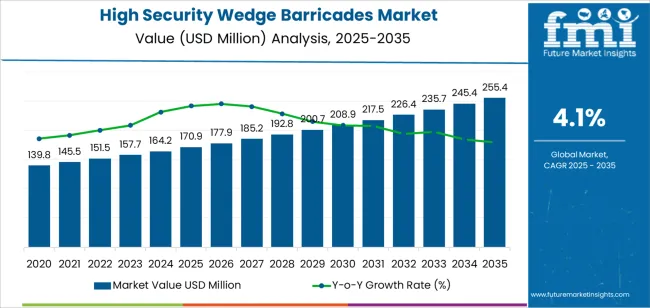
In 2025, the market was worth USD 170.9 million. It is expected to reach USD 177.9 million in 2026 and USD 265.9 million by 2036, implying a CAGR of 4.1%. This steady valuation uptake reflects a structural shift in critical infrastructure protection, where procurement is moving beyond simple access control to certified anti-ram wedge barrier systems capable of stopping multi-ton threats.
Growth momentum is increasingly governed by a "compliance gate" mechanism, where new international testing standards force facility operators to retrofit legacy perimeters. As regulatory bodies like the UK's NPSA retire older specifications in favor of ISO 22343-1, buyers in government and defense sectors are compelled to audit and replace non-compliant barriers to maintain insurance eligibility and operational security ratings [1]. This regulatory obsolescence cycle drives capital expenditure even in mature markets, ensuring that replacement volume complements new construction demand.
Regarding the industry's focus on rapid deployment capabilities, a corporate statement from Delta Scientific notes, "As of October 23, 2024, the MP100 portable barrier system has successfully achieved a M30/P3 designation. Total penetration was measured at a mere 51-ft, making this an industry leader." [2] For buyers, this signals a pivotal shift toward modular, non-excavated fortification that allows temporary high-security perimeters to be established during elevated threat levels without permanent civil works, significantly reducing the total cost of ownership for short-term events.
Summary of High Security Wedge Barricades Market
- High Security Wedge Barricades Market Definition
- Crash-rated rising wedge systems utilized for hostile vehicle mitigation at critical access points.
- Demand Drivers in the Market
- Rising geopolitical instability necessitating hardened perimeters for critical infrastructure.
- Strict adherence to new international crash-test standards like ISO 22343.
- Integration of AI-driven access controls requiring automated physical response.
- Key Segments Analyzed in the FMI Report
- Hydraulic-Powered Wedge Barricades (estimated 54.2% share).
- Government and Public Sector application.
- Asia Pacific high-growth markets versus mature North American replacement demand.
- Analyst Opinion at FMI
- Nikhil Kaitwade, Principal Consultant for Process Automation, opines, "In the updated High Security Wedge Barricades Market Report, CXOs will see a clear pivot from standalone hardware to connected defense nodes. My findings indicate that while heavy steel remains the core, the value is shifting toward barriers that integrate with 'zero trust' logic, where hydraulic actuation is triggered autonomously by threat detection systems rather than manual guard input."
- Strategic Implications/Executive Takeaways
- Prioritize modular, shallow-mount designs to reduce installation disruption.
- Invest in electric actuation to meet sustainability and low-maintenance requirements.
- Target emerging markets with localized manufacturing to bypass logistics costs.
- Methodology
- Validated through first-hand corporate production and capacity data.
- Zero reliance on speculative third-party market research reports.
- Based on verifiable industrial benchmarks and verified sources.
Global demand dispersion highlights distinct regional growth speeds, with China (5.5% CAGR) and India (5.1% CAGR) leading the expansion due to heavy infrastructure hardening, while Germany (4.7%), Brazil (4.3%), the United States (3.9%), the UK (3.5%), and Japan (3.1%) follow with steady procurement driven by asset modernization and counter-terrorism mandates.
High Security Wedge Barricades Market Definition
The high security wedge barricades market comprises the manufacturing and sale of robust, crash-rated vehicle access control systems designed to prevent unauthorized vehicular intrusion. These barricades feature a metal plate or wedge that rises from the ground to block traffic, typically rated against standards such as ASTM F2656 or ISO 22343 to stop vehicles traveling at high speeds. They serve as the primary physical deterrent in a layered security service edge strategy for protecting high-value assets.
High Security Wedge Barricades Market Inclusions
This report includes hydraulic, electric, and manually operated wedge barricades used in permanent or portable configurations. It covers applications across government facilities, military bases, data centers, commercial headquarters, and industrial plants where hostile vehicle mitigation is a priority. The analysis also encompasses associated control systems and safety loops essential for the operation of these barriers within broader perimeter security networks.
High Security Wedge Barricades Market Exclusions
The scope excludes non-wedge type barriers such as bollards, drop-arm beams, or sliding gates unless they are integrated as part of a hybrid wedge system. It also omits low-security traffic management devices like tire killers or standard parking arms that lack crash ratings. General fencing materials and surveillance cameras are excluded except where they directly trigger barrier actuation.
High Security Wedge Barricades Market Research Methodology
- Primary Research: Interviews with barrier engineers, perimeter security consultants, government procurement officers, and facility managers to understand specification trends.
- Desk Research: Analysis of defense budget outlays, counter-terrorism standards (NPSA, ASTM), and corporate annual reports to track spending and technology shifts.
- Market-Sizing and Forecasting: A bottom-up approach aggregating contract awards and construction permits, validated against top-down regional infrastructure security spending models.
- Data Validation and Update Cycle: Cross-referencing manufacturer shipment data with import/export codes and regulatory compliance logs to ensure accuracy.
Segmental Analysis
High Security Wedge Barricades Market Analysis by Type
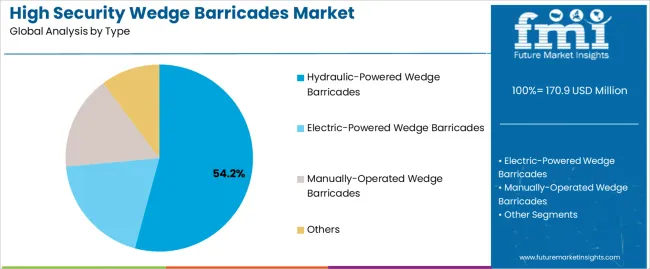
Hydraulic-powered systems dominate the segment, securing approximately 54.2% of the market share, as their high torque and reliability are essential for moving heavy steel plates under adverse environmental conditions.
- Reliability trigger: Demand for hydraulic wedges is reinforced by their proven ability to cycle heavy loads continuously, a critical requirement for busy checkpoints where failure is not an option. This operational resilience is why agencies like the US Army Corps of Engineers continue to award multi-million dollar maintenance contracts, such as the $40.7 million facility support deal in 2024, to ensure these high pressure pumps and hydraulic circuits remain combat-ready [3].
- Sustainability shift: Procurement shifts because electric-powered barricades offer a cleaner alternative, eliminating the risk of hydraulic fluid leaks and reducing maintenance frequency. This transition is accelerating in corporate sectors where environmental compliance is a KPI, leading to increased adoption of electromechanical drives that offer precise control without the environmental liability of oil-based systems.
- Cost constraint: Adoption accelerates where manually operated wedges provide a cost-effective solution for low-frequency access points that still require K-rated protection. These systems allow smaller facilities to achieve compliance with hostile vehicle mitigation standards without the capital expense of power infrastructure or complex control loops, expanding the addressable market to smaller commercial entities.
High Security Wedge Barricades Market Analysis by Application
The Government and Public Sector segment acts as the primary revenue engine, accounting for a significant portion of demand due to mandatory force protection requirements for courthouses, embassies, and military bases.
- Budgetary trigger: Growth is anchored in elevated defense and judicial security spending, which translates directly into physical hardening projects. For instance, the United States Courts requested USD 892 million for court security in FY 2026, explicitly targeting building ingress-egress controls to mitigate threats against judicial infrastructure [4].
- Data protection: Procurement shifts because industrial and commercial clients, particularly data centers, are fortifying perimeters to protect sensitive digital assets from physical intrusion. This trend mirrors the logic of a hardware security module in IT, where physical barriers serve as the outer shell protecting the critical core, driving demand for flush-mounted systems that blend with corporate architecture.
- Risk mitigation: Adoption accelerates where public venues and stadiums face pressure to prevent vehicle-as-a-weapon attacks during large events. Municipalities are increasingly deploying temporary or surface-mounted wedges to create "secure zones" for pedestrians, reacting to the evolving nature of urban terror threats that target soft, crowded spaces.
High Security Wedge Barricades Market Analysis by Installation Type
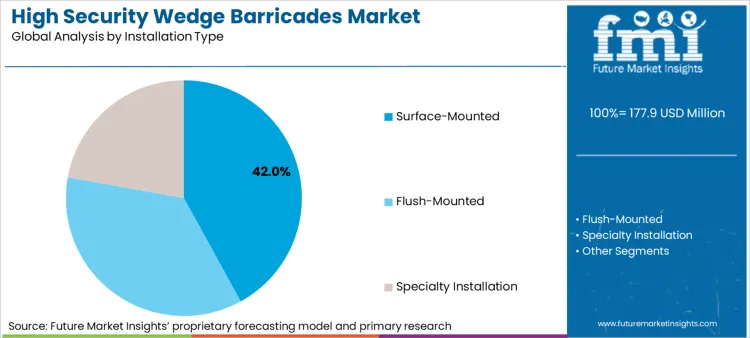
Surface-mounted installations capture around 42.0% of the market, favored for their ease of deployment and ability to be installed without deep excavation, which is crucial for urban environments with complex underground utilities.
- Urban constraint: Demand is reinforced by the difficulty of digging deep foundations in dense city centers, prompting planners to select surface or shallow-mount options. This preference is supported by the availability of heavy-duty construction anchors that allow these barriers to achieve high crash ratings while sitting largely above existing pavement, reducing project timelines from weeks to days.
- Aesthetic priority: Procurement shifts because flush-mounted installations are preferred for prestigious commercial and government entrances where visual continuity is paramount. These systems retract fully into the ground, maintaining an unobstructed architectural line when not in use, although they require significant civil works and drainage planning.
- Tactical flexibility: Adoption accelerates where specialty installations, such as portable wedge barriers, are needed for temporary high-threat windows. Products like Delta Scientific's MP100 allow security directors to rapidly harden a perimeter for a summit or crisis response without committing to permanent infrastructure changes [2].
High Security Wedge Barricades Market Drivers, Restraints, and Opportunities
The primary driver propelling the high security wedge barricades market is the escalation of geopolitical tensions and domestic threat levels, which compels nations to harden critical infrastructure against physical sabotage and terrorism. Governments are converting threat intelligence into concrete procurement mandates, shifting from passive fencing to active anti-ram barriers that can physically immobilize hostile vehicles. This mechanism is clearly visible in national defense outlays, such as India's 2025-26 defence budget allocation of Rs 6.81 lakh crore, which prioritizes capital outlay for modernizing armed forces infrastructure and enhancing physical security at sensitive installations [5]. Such massive funding streams ensure a sustained pipeline of projects for heavy-duty barrier installation at border posts, ammunition depots, and command centers.
A significant restraint facing widespread adoption is the high cost and logistical complexity associated with installing traditional deep-foundation wedge barricades. Excavating trenches for hydraulic units and counterweights often disrupts operations, risks damaging underground utilities, and requires expensive civil engineering, which can deter buyers with limited budgets or leased properties. Market players mitigate this friction by developing shallow-mount and surface-mount designs that drastically reduce site preparation requirements. However, for maximum security ratings, deep foundations remain necessary, and the associated disruption remains a hurdle. This trade-off is evident in municipal projects where temporary solutions are often favored over permanent ones to avoid long-term closure of public thoroughfares.
- Autonomous Perimeter Defense: Buyers in the high-end security sector stand to benefit from the integration of barriers with AI-driven surveillance, creating perimeters that react automatically to threats. Startups like Hakimo, which raised $10.5 million to develop autonomous security agents, are pioneering technologies that can potentially trigger physical barriers upon detecting anomalies, reducing human reaction time [6].
- Portable HVM for Event Security: Municipalities and event organizers present a growing opportunity for rental or purchase of mobile high-security barriers for crowd protection. The City of Edinburgh's award of a £240,000 contract for temporary Hostile Vehicle Mitigation systems illustrates the expanding market for flexible, non-permanent solutions that protect public gatherings without altering the cityscape permanently [7].
- Smart City Integration: Integrators can capitalize on the convergence of physical security and edge security by connecting barriers to city-wide traffic management systems. This connectivity allows barriers to function as intelligent traffic control nodes during non-emergency times, enhancing their value proposition beyond pure defense.
Regional Analysis
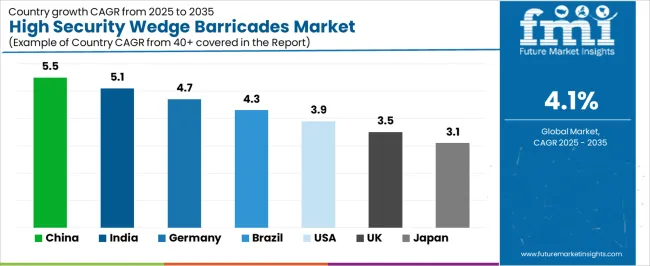
Based on the regional analysis, the high security wedge barricades market is segmented into North America, Latin America, Europe, East Asia, South Asia, Oceania and Middle East & Africa across 40+ countries. The full report also offers market attractiveness analysis based on regional trends.
| Country | CAGR (2026 to 2036) |
|---|---|
| China | 5.5% |
| India | 5.1% |
| Germany | 4.7% |
| Brazil | 4.3% |
| United States | 3.9% |
| United Kingdom | 3.5% |
| Japan | 3.1% |
Source: Future Market Insights (FMI) analysis, based on proprietary forecasting model and primary research
Asia Pacific High Security Wedge Barricades Analysis
Asia Pacific is characterized by a dual-speed market where rapid urbanization in developing economies drives new infrastructure protection, while mature nations focus on upgrading defense capabilities against regional threats. The demand mechanism is fueled by massive public sector capital outlays that prioritize self-reliance in defense manufacturing and critical infrastructure hardening. For instance, Japan's defense budget of ¥7,725 billion facilitates the steady execution of contracts for base measures, including the construction and fortification of hangars and barracks [8]. Simultaneously, corporate expansion in the technology and data center sectors is creating a secondary layer of private sector demand for high security registration plates recognition systems integrated with physical barriers.
- China: Demand for high security wedge barricades in China is set to grow at 5.5% CAGR through 2036, supported by a defense budget approaching $300 billion that emphasizes technological self-reliance and the hardening of missile and naval facilities [9].
- India: In India, the high security wedge barricades market is forecast to advance at 5.1% CAGR through 2036, with growth anchored in a record defence budget of Rs 6.81 lakh crore that explicitly allocates funds for capital outlay to modernize and secure border and military infrastructure [5].
- Japan: The outlook for high security wedge barricades in Japan indicates a 3.1% CAGR from 2026 to 2036 as base measure spending of ¥4,995 billion strengthens demand from both public programmes and private operators for earthquake-resistant and anti-ram security solutions [8].
FMI’s report includes a comprehensive breakdown of the Asia Pacific security landscape. Beyond the major economies, countries like Australia and Indonesia offer significant opportunities for hostile vehicle mitigation, particularly in the context of tourism and major events. In Australia, for example, the City of Sydney has undertaken multi-year tenders for traffic management and HVM services, signaling a robust market for municipal security upgrades [10].
North America High Security Wedge Barricades Analysis
North America remains a cornerstone market, driven by stringent homeland security regulations and a vast installed base of federal infrastructure requiring continuous modernization. The region is seeing a shift toward "smart" perimeters, where traditional steel barriers are integrated with security service edge technologies. Procurement is heavily influenced by federal budget cycles and compliance with updated ASTM standards. The US Courts' security budget request of $892 million highlights the sustained financial commitment to securing federal buildings against evolving physical threats [4].
- United States: The United States is likely to see high security wedge barricades revenues increase at 3.9% CAGR during 2026 to 2036, given the Department of Homeland Security's continued grant funding and the resulting push for capacity and workflow upgrades at federal facilities [4].
FMI’s report includes detailed insights into the North American market structure. Apart from the US, Canada and Mexico present growing avenues for perimeter security, particularly in the energy and cross-border logistics sectors. Buyers in these markets are increasingly looking for smart personal safety and security device integration, where barrier status can be monitored remotely to ensure uninterrupted border and facility operations.
Europe High Security Wedge Barricades Analysis
Europe acts as the global standard-setter for hostile vehicle mitigation, with a market driven by the replacement of aging infrastructure and the adoption of rigorous new testing protocols. The transition from PAS 68 to ISO 22343-1 is a key regulatory signal, forcing manufacturers to recertify products and buyers to upgrade defenses [1]. Regional demand is also supported by civil protection initiatives in response to climate and security crises. Germany's focus on civil defense is evident in Bavaria's €244 million expenditure on vehicle and equipment acquisition for disaster preparedness, which includes securing critical logistics hubs [11].
- Germany: Growth in high security wedge barricades across Germany is estimated at 4.7% CAGR through 2036, driven by federal support for civil protection that increases the value of reliability and compliance in buyer criteria for critical infrastructure defense [11].
- United Kingdom: The UK high security wedge barricades sector is poised to expand at 3.5% CAGR during 2026 to 2036 because the National Protective Security Authority has mandated ISO 22343-1 as the new benchmark, which lifts utilisation rates and justifies technology refresh decisions for government sites [1].
FMI’s report includes a granular analysis of the European security market. In addition to Germany and the UK, countries like France and Italy are critical markets for anti-terrorism infrastructure protection. The region is witnessing a trend where edge protector solutions are being applied to urban furniture and barriers to prevent injury to pedestrians, blending high security with public safety design.
Latin America High Security Wedge Barricades Analysis
Latin America is emerging as a high-potential market as governments invest in integrated social defense and the protection of critical data infrastructure. The market is transitioning from basic fencing to sophisticated access control, fueled by multilateral funding. Brazil's USD 76.5 million project, financed by the International Bank for Reconstruction and Development (BIRD), exemplifies this trend, directing substantial funds toward integrated defense centers that require robust physical hardening [12].
- Brazil: Brazil is expected to record 4.3% CAGR in high security wedge barricades demand over 2026 to 2036 as international funding for social defense initiatives tightens the link between operational constraints and adoption-led investment in secure facilities [12].
FMI’s report includes coverage of the broader Latin American region. Beyond Brazil, nations such as Chile and Argentina are modernizing their port and industrial security infrastructure. These markets are increasingly adopting material handling equipment safety standards that extend to vehicle barriers, ensuring that heavy logistics traffic is managed securely and efficiently at busy commercial hubs.
Competitive Aligners for Market Players
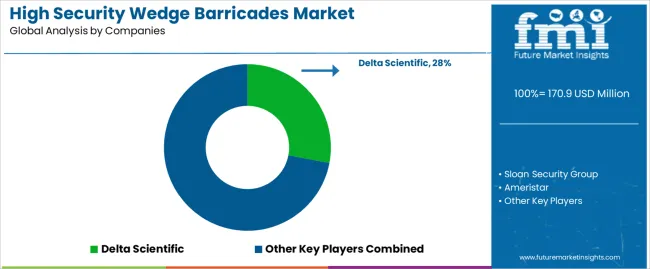
The competitive landscape is bifurcating between massive, diversified conglomerates and specialized, innovation-led barrier manufacturers. Large players like ASSA ABLOY are aggressively consolidating the market, leveraging their balance sheets to acquire niche firms and expand their footprint. In 2024 alone, ASSA ABLOY completed 26 acquisitions, driving an 8% increase in net sales [13]. This strategy allows them to offer end-to-end security suites, squeezing out mid-sized competitors who cannot match their distribution scale or R&D budgets.
Innovation in deployment flexibility has become a critical differentiator for survival. Companies that can offer certified high-security protection without the need for deep excavation are winning municipal and temporary event contracts. Delta Scientific's launch of the MP100 portable barrier with M30/P3 rating [2] directly addresses the "civil works constraint," allowing them to capture revenue from short-term deployments that traditional fixed-barrier manufacturers miss. This agility is forcing competitors to develop their own modular or shallow-mount solutions to remain relevant in the urban security segment.
Strategic partnerships with technology providers are reshaping the value proposition from "stopping power" to "intelligent defense." With the rise of AI-driven surveillance, hardware manufacturers are under pressure to make their barriers interoperable with third-party software. The funding success of startups like Hakimo and Lumana [6] signals a market appetite for autonomous security operations. Incumbents who fail to integrate open APIs or smart controllers into their hydraulic and electric wedges risk becoming commoditized steel fabricators, while those who embrace the "smart perimeter" concept can command premium pricing.
Recent Developments
The report includes full coverage of key trends from competitive benchmarking. Some of the recent developments covered in the reports:
- In October 2024, Delta Scientific launched the MP100 portable barrier system which achieved M30/P3 designation, enabling non-excavated deployments for high-security perimeters.[2]
- In July 2024, the USA Army Corps of Engineers executed a $40.7 million contract with Perimeter Security Partners for facility support, ensuring the maintenance of critical physical security equipment.[3]
Key Players in High Security Wedge Barricades Market
- Delta Scientific
- Sloan Security Group
- Ameristar
- Beijing ZhuoAoShiPeng Technology
- A1 Americas
- Barrier1 Systems
- HySecurity
- ASSA ABLOY
- Perimeter Security Partners
- Avon Barrier
Scope of the Report
| Metric | Value |
|---|---|
| Quantitative Units | USD 177.9 million (2026) to USD 265.9 million (2036), at a CAGR of 4.1% |
| Market Definition | The high security wedge barricades market comprises the manufacturing and sale of robust, crash-rated vehicle access control systems designed to prevent unauthorized vehicular intrusion, featuring a metal plate or wedge that rises from the ground. |
| Type Segmentation | Hydraulic-Powered, Electric-Powered, Manually-Operated, Others |
| Application Segmentation | Commercial Buildings, Government and Public Sector, Industrial Buildings, Others |
| Application Coverage | Perimeter Security, Hostile Vehicle Mitigation, Access Control |
| Regions Covered | North America, Latin America, Europe, East Asia, South Asia, Oceania, Middle East and Africa |
| Countries Covered | United States, Canada, Mexico, Brazil, Argentina, Chile, Germany, France, United Kingdom, Italy, Spain, China, India, Japan, South Korea, Indonesia, Australia and 40 plus countries |
| Key Companies Profiled | Delta Scientific, Sloan Security Group, Ameristar, Beijing ZhuoAoShiPeng Technology, A1 Americas, Barrier1 Systems, HySecurity, ASSA ABLOY, Perimeter Security Partners, Avon Barrier |
| Forecast Period | 2026 to 2036 |
| Approach | Hybrid top down and bottom up market modeling validated through primary interviews with resin producers and panel manufacturers, supported by trade data benchmarking and plant level capacity verification |
High Security Wedge Barricades Market by Segments
Type
- Hydraulic-Powered
- Electric-Powered
- Manually-Operated
- Others
Application
- Commercial Buildings
- Government and Public Sector
- Industrial Buildings
- Others
Barrier Height
- Medium Height (12-18 inches)
- High Height (above 18 inches)
- Low Height (up to 12 inches)
Installation Type
- Surface-Mounted
- Flush-Mounted
- Specialty Installation
Region
- Asia Pacific
- India
- China
- Japan
- South Korea
- Indonesia
- Australia & New Zealand
- ASEAN
- Rest of Asia Pacific
- Europe
- Germany
- Italy
- France
- United Kingdom
- Spain
- Benelux
- Nordics
- Central & Eastern Europe
- Rest of Europe
- North America
- United States
- Canada
- Mexico
- Latin America
- Brazil
- Argentina
- Chile
- Rest of Latin America
- Middle East & Africa
- Kingdom of Saudi Arabia
- United Arab Emirates
- South Africa
- Turkey
- Rest of Middle East & Africa
Bibliography
- [1] National Protective Security Authority. (2024). NPSA HVM Guidance Note ISO 22343-1.
- [2] Delta Scientific. (2024). Product release statement regarding portable barrier MP100 certified M30/P3.
- [3] USAspending.gov. (2024). Award Profile: Contract W912DY24F0163 to Perimeter Security Partners.
- [4] United States Courts. (2025). Court Security FY 2026 Budget Justification.
- [5] Press Information Bureau, Government of India. (2025). Ministry of Defence Budget Allocation 2025-26.
- [6] GlobeNewswire. (2025). Hakimo secures $10.5M to transform physical security.
- [7] Find a Tender Service. (2024). Contract Notice: City of Edinburgh Council Hostile Vehicle Mitigation.
- [8] Ministry of Defense Japan. (2024). Defense Programs and Budget of Japan FY2024.
- [9] World Defence Almanac. (2024). China Defense Expenditure Analysis.
- [10] City of Sydney. (2024). Tender T-2024-1400 Traffic Management and HVM Services.
- [11] Federal Office of Civil Protection and Disaster Assistance (BBK). (2024). Midterm Review Sendai Framework Germany.
- [12] Portal Nacional de Contratações Públicas (PNCP). (2025). State of Espírito Santo Integrated Social Defense Procurement.
- [13] ASSA ABLOY. (2025). Annual Report 2024.
Frequently Asked Questions
How large is the demand for high security wedge barricades in the global market in 2026?
Demand for high security wedge barricades in the global market is estimated to be valued at USD 177.9 million in 2026.
What will be the market size of high security wedge barricades in the global market by 2036?
Market size for high security wedge barricades is projected to reach USD 265.9 million by 2036.
What is the expected demand growth for high security wedge barricades in the global market between 2026 and 2036?
Demand for high security wedge barricades in the global market is expected to grow at a CAGR of 4.1% between 2026 and 2036.
Which Type is poised to lead global sales by 2026?
Hydraulic-Powered barricades are expected to be the dominant form, capturing approximately 54.2% of global market share in 2026 due to their ability to move heavy loads reliably.
How significant is the role of Government and Public Sector in driving high security wedge barricades adoption in 2026?
The Government and Public Sector represents a critical segment, projected to hold a substantial share of the total market in 2026 as defense hardening prioritizes rated vehicle mitigation.
What is Driving UF Demand in China?
Demand is driven by a massive defense budget approaching $300 billion which emphasizes technological self-reliance and facility hardening.
What Compliance Standards are Referenced for the United Kingdom?
The ISO 22343-1 performance rating is referenced as the new compliance benchmark replacing PAS 68 for hostile vehicle mitigation.
What is the China Growth Outlook in this Report?
China is projected to grow at a CAGR of 5.5% during 2026 to 2036.
Why is Asia Pacific described as a priority region in this report?
Growth is fueled by rapid urbanization and massive public sector capital outlays that prioritize self-reliance in defense manufacturing.
What Type of Demand Dominates in Europe?
Replacement driven demand for premium grade, compliant barriers dominates regional consumption as standards shift to ISO 22343.
What is India Growth Outlook in this Report?
India is projected to expand at a CAGR of 5.1% during 2026 to 2036.
Does the Report Cover Japan in its Regional Analysis?
Yes, Japan is included within East Asia under the regional scope of analysis.
What are the Sources referred to for analyzing the Market in Japan?
Official budget documents from the Ministry of Defense Japan covering base measures and construction expenditures are cited as primary reference sources.
What is the Main Demand Theme Linked to Japan in Asia Coverage?
Asia Pacific demand in Japan is associated with earthquake-resistant and anti-ram security solutions funded by base measure spending.
Does the Report Cover Brazil in its Regional Analysis?
Yes, Brazil is included within Latin America under the regional coverage framework.
What is the Main Brazil Related Demand Theme in Asia Coverage?
International funding for social defense initiatives and integrated defense centers is emphasized as a key driver.
Which Product Formats are Strategically Important for North America Supply Chains?
Smart perimeters integrated with security service edge technologies are prioritized to ensure continuous monitoring and border operations.
What is High Security Wedge Barricades and What is It Mainly Used For?
High security wedge barricades are crash-rated vehicle access control systems used to prevent unauthorized vehicular intrusion at critical infrastructure sites.
What does High Security Wedge Barricades Market Mean in this Report?
High security wedge barricades market refers to the global manufacturing and sale of hydraulic, electric, and manual wedge barriers.
What is Included in the Scope of this High Security Wedge Barricades Market Report?
Scope covers wedge barriers by type, application, and installation, including hydraulic and electric systems for government and commercial use.
What is Excluded from the Scope of this Report?
Non-wedge barriers like bollards or drop-arms are excluded unless integrated, as are general fencing and non-rated traffic devices.
What does Market Forecast Mean on this Page?
Market forecast represents a model based projection built on defined assumptions for strategic planning purposes.
How does FMI Build and Validate the High Security Wedge Barricades Market Forecast?
Forecast is developed using hybrid top down and bottom up modeling validated through primary interviews and trade data benchmarking.
What does Zero Reliance on Speculative Third Party Market Research Mean Here?
Primary interviews and verifiable public datasets are used instead of unverified syndicated market estimates.
Preview the report firsthand - request a free sample
Get SampleGet the brochure for pricing and purchase details.
Get PDFTable of Content
- Executive Summary
- Global Market Outlook
- Demand-side Trends
- Supply-side Trends
- Technology Roadmap Analysis
- Analysis and Recommendations
- Market Overview
- Market Coverage / Taxonomy
- Market Definition / Scope / Limitations
- Research Methodology
- Chapter Orientation
- Analytical Lens and Working Hypotheses
- Market Structure, Signals, and Trend Drivers
- Benchmarking and Cross-market Comparability
- Market Sizing, Forecasting, and Opportunity Mapping
- Research Design and Evidence Framework
- Desk Research Programme (Secondary Evidence)
- Company Annual and Sustainability Reports
- Peer-reviewed Journals and Academic Literature
- Corporate Websites, Product Literature, and Technical Notes
- Earnings Decks and Investor Briefings
- Statutory Filings and Regulatory Disclosures
- Technical White Papers and Standards Notes
- Trade Journals, Industry Magazines, and Analyst Briefs
- Conference Proceedings, Webinars, and Seminar Materials
- Government Statistics Portals and Public Data Releases
- Press Releases and Reputable Media Coverage
- Specialist Newsletters and Curated Briefings
- Sector Databases and Reference Repositories
- FMI Internal Proprietary Databases and Historical Market Datasets
- Subscription Datasets and Paid Sources
- Social Channels, Communities, and Digital Listening Inputs
- Additional Desk Sources
- Expert Input and Fieldwork (Primary Evidence)
- Primary Modes
- Qualitative Interviews and Expert Elicitation
- Quantitative Surveys and Structured Data Capture
- Blended Approach
- Why Primary Evidence is Used
- Field Techniques
- Interviews
- Surveys
- Focus Groups
- Observational and In-context Research
- Social and Community Interactions
- Stakeholder Universe Engaged
- C-suite Leaders
- Board Members
- Presidents and Vice Presidents
- R&D and Innovation Heads
- Technical Specialists
- Domain Subject-matter Experts
- Scientists
- Physicians and Other Healthcare Professionals
- Governance, Ethics, and Data Stewardship
- Research Ethics
- Data Integrity and Handling
- Primary Modes
- Tooling, Models, and Reference Databases
- Desk Research Programme (Secondary Evidence)
- Data Engineering and Model Build
- Data Acquisition and Ingestion
- Cleaning, Normalisation, and Verification
- Synthesis, Triangulation, and Analysis
- Quality Assurance and Audit Trail
- Market Background
- Market Dynamics
- Drivers
- Restraints
- Opportunity
- Trends
- Scenario Forecast
- Demand in Optimistic Scenario
- Demand in Likely Scenario
- Demand in Conservative Scenario
- Opportunity Map Analysis
- Product Life Cycle Analysis
- Supply Chain Analysis
- Investment Feasibility Matrix
- Value Chain Analysis
- PESTLE and Porter’s Analysis
- Regulatory Landscape
- Regional Parent Market Outlook
- Production and Consumption Statistics
- Import and Export Statistics
- Market Dynamics
- Global Market Analysis 2021 to 2025 and Forecast, 2026 to 2036
- Historical Market Size Value (USD Million) Analysis, 2021 to 2025
- Current and Future Market Size Value (USD Million) Projections, 2026 to 2036
- Y-o-Y Growth Trend Analysis
- Absolute $ Opportunity Analysis
- Global Market Pricing Analysis 2021 to 2025 and Forecast 2026 to 2036
- Global Market Analysis 2021 to 2025 and Forecast 2026 to 2036, By Type
- Introduction / Key Findings
- Historical Market Size Value (USD Million) Analysis By Type , 2021 to 2025
- Current and Future Market Size Value (USD Million) Analysis and Forecast By Type , 2026 to 2036
- Hydraulic-Powered systems
- Electric-Powered
- Manually-Operated
- Others
- Hydraulic-Powered systems
- Y-o-Y Growth Trend Analysis By Type , 2021 to 2025
- Absolute $ Opportunity Analysis By Type , 2026 to 2036
- Global Market Analysis 2021 to 2025 and Forecast 2026 to 2036, By Installation Type
- Introduction / Key Findings
- Historical Market Size Value (USD Million) Analysis By Installation Type, 2021 to 2025
- Current and Future Market Size Value (USD Million) Analysis and Forecast By Installation Type, 2026 to 2036
- Surface-Mounted
- Flush-Mounted
- Specialty Installation
- Surface-Mounted
- Y-o-Y Growth Trend Analysis By Installation Type, 2021 to 2025
- Absolute $ Opportunity Analysis By Installation Type, 2026 to 2036
- Global Market Analysis 2021 to 2025 and Forecast 2026 to 2036, By Region
- Introduction
- Historical Market Size Value (USD Million) Analysis By Region, 2021 to 2025
- Current Market Size Value (USD Million) Analysis and Forecast By Region, 2026 to 2036
- North America
- Latin America
- Western Europe
- Eastern Europe
- East Asia
- South Asia and Pacific
- Middle East & Africa
- Market Attractiveness Analysis By Region
- North America Market Analysis 2021 to 2025 and Forecast 2026 to 2036, By Country
- Historical Market Size Value (USD Million) Trend Analysis By Market Taxonomy, 2021 to 2025
- Market Size Value (USD Million) Forecast By Market Taxonomy, 2026 to 2036
- By Country
- USA
- Canada
- Mexico
- By Type
- By Installation Type
- By Country
- Market Attractiveness Analysis
- By Country
- By Type
- By Installation Type
- Key Takeaways
- Latin America Market Analysis 2021 to 2025 and Forecast 2026 to 2036, By Country
- Historical Market Size Value (USD Million) Trend Analysis By Market Taxonomy, 2021 to 2025
- Market Size Value (USD Million) Forecast By Market Taxonomy, 2026 to 2036
- By Country
- Brazil
- Chile
- Rest of Latin America
- By Type
- By Installation Type
- By Country
- Market Attractiveness Analysis
- By Country
- By Type
- By Installation Type
- Key Takeaways
- Western Europe Market Analysis 2021 to 2025 and Forecast 2026 to 2036, By Country
- Historical Market Size Value (USD Million) Trend Analysis By Market Taxonomy, 2021 to 2025
- Market Size Value (USD Million) Forecast By Market Taxonomy, 2026 to 2036
- By Country
- Germany
- UK
- Italy
- Spain
- France
- Nordic
- BENELUX
- Rest of Western Europe
- By Type
- By Installation Type
- By Country
- Market Attractiveness Analysis
- By Country
- By Type
- By Installation Type
- Key Takeaways
- Eastern Europe Market Analysis 2021 to 2025 and Forecast 2026 to 2036, By Country
- Historical Market Size Value (USD Million) Trend Analysis By Market Taxonomy, 2021 to 2025
- Market Size Value (USD Million) Forecast By Market Taxonomy, 2026 to 2036
- By Country
- Russia
- Poland
- Hungary
- Balkan & Baltic
- Rest of Eastern Europe
- By Type
- By Installation Type
- By Country
- Market Attractiveness Analysis
- By Country
- By Type
- By Installation Type
- Key Takeaways
- East Asia Market Analysis 2021 to 2025 and Forecast 2026 to 2036, By Country
- Historical Market Size Value (USD Million) Trend Analysis By Market Taxonomy, 2021 to 2025
- Market Size Value (USD Million) Forecast By Market Taxonomy, 2026 to 2036
- By Country
- China
- Japan
- South Korea
- By Type
- By Installation Type
- By Country
- Market Attractiveness Analysis
- By Country
- By Type
- By Installation Type
- Key Takeaways
- South Asia and Pacific Market Analysis 2021 to 2025 and Forecast 2026 to 2036, By Country
- Historical Market Size Value (USD Million) Trend Analysis By Market Taxonomy, 2021 to 2025
- Market Size Value (USD Million) Forecast By Market Taxonomy, 2026 to 2036
- By Country
- India
- ASEAN
- Australia & New Zealand
- Rest of South Asia and Pacific
- By Type
- By Installation Type
- By Country
- Market Attractiveness Analysis
- By Country
- By Type
- By Installation Type
- Key Takeaways
- Middle East & Africa Market Analysis 2021 to 2025 and Forecast 2026 to 2036, By Country
- Historical Market Size Value (USD Million) Trend Analysis By Market Taxonomy, 2021 to 2025
- Market Size Value (USD Million) Forecast By Market Taxonomy, 2026 to 2036
- By Country
- Kingdom of Saudi Arabia
- Other GCC Countries
- Turkiye
- South Africa
- Other African Union
- Rest of Middle East & Africa
- By Type
- By Installation Type
- By Country
- Market Attractiveness Analysis
- By Country
- By Type
- By Installation Type
- Key Takeaways
- Key Countries Market Analysis
- USA
- Pricing Analysis
- Market Share Analysis, 2025
- By Type
- By Installation Type
- Canada
- Pricing Analysis
- Market Share Analysis, 2025
- By Type
- By Installation Type
- Mexico
- Pricing Analysis
- Market Share Analysis, 2025
- By Type
- By Installation Type
- Brazil
- Pricing Analysis
- Market Share Analysis, 2025
- By Type
- By Installation Type
- Chile
- Pricing Analysis
- Market Share Analysis, 2025
- By Type
- By Installation Type
- Germany
- Pricing Analysis
- Market Share Analysis, 2025
- By Type
- By Installation Type
- UK
- Pricing Analysis
- Market Share Analysis, 2025
- By Type
- By Installation Type
- Italy
- Pricing Analysis
- Market Share Analysis, 2025
- By Type
- By Installation Type
- Spain
- Pricing Analysis
- Market Share Analysis, 2025
- By Type
- By Installation Type
- France
- Pricing Analysis
- Market Share Analysis, 2025
- By Type
- By Installation Type
- India
- Pricing Analysis
- Market Share Analysis, 2025
- By Type
- By Installation Type
- ASEAN
- Pricing Analysis
- Market Share Analysis, 2025
- By Type
- By Installation Type
- Australia & New Zealand
- Pricing Analysis
- Market Share Analysis, 2025
- By Type
- By Installation Type
- China
- Pricing Analysis
- Market Share Analysis, 2025
- By Type
- By Installation Type
- Japan
- Pricing Analysis
- Market Share Analysis, 2025
- By Type
- By Installation Type
- South Korea
- Pricing Analysis
- Market Share Analysis, 2025
- By Type
- By Installation Type
- Russia
- Pricing Analysis
- Market Share Analysis, 2025
- By Type
- By Installation Type
- Poland
- Pricing Analysis
- Market Share Analysis, 2025
- By Type
- By Installation Type
- Hungary
- Pricing Analysis
- Market Share Analysis, 2025
- By Type
- By Installation Type
- Kingdom of Saudi Arabia
- Pricing Analysis
- Market Share Analysis, 2025
- By Type
- By Installation Type
- Turkiye
- Pricing Analysis
- Market Share Analysis, 2025
- By Type
- By Installation Type
- South Africa
- Pricing Analysis
- Market Share Analysis, 2025
- By Type
- By Installation Type
- USA
- Market Structure Analysis
- Competition Dashboard
- Competition Benchmarking
- Market Share Analysis of Top Players
- By Regional
- By Type
- By Installation Type
- Competition Analysis
- Competition Deep Dive
- Delta Scientific
- Overview
- Product Portfolio
- Profitability by Market Segments (Product/Age /Sales Channel/Region)
- Sales Footprint
- Strategy Overview
- Marketing Strategy
- Product Strategy
- Channel Strategy
- Sloan Security Group
- Ameristar
- Beijing ZhuoAoShiPeng Technology
- A1 Americas
- Barrier1 Systems
- HySecurity
- Delta Scientific
- Competition Deep Dive
- Assumptions & Acronyms Used


