

- Industry Size (2026)
- USD 55738.3 Mn
- Forecast (2036)
- USD 165539.8 Mn
- CAGR (2026 to 2036)
- 11.5%
Smart Personal Safety and Security Device Market Forecast and Outlook 2026 to 2036
The global smart personal safety and security device market is on track to achieve a valuation of USD 165,539.8 Million by 2036, accelerating from USD 55,738.3 Million in 2026 at a CAGR of 11.5%. As per Future Market Insights, expansion is structurally underpinned by the convergence of satellite communication, AI-powered location analytics, and miniaturized gas detection into single wearable platforms. The International Labour Organization estimated in 2024 that approximately 2.93 million workers die annually from work-related accidents and diseases, confirming the structural demand for connected safety solutions. This compels manufacturers to invest in scalable production and distribution infrastructure that can meet accelerating demand. Simultaneously the regulatory and competitive landscape is shifting from standalone single-function devices to integrated connected platforms, which forces legacy manufacturers to either invest in software capabilities or risk displacement by technology-first entrants.
Cody Slater, CEO and Chair, Blackline Safety, stated: 'By unifying gas detection, real-time monitoring, and communication in one connected device, we're delivering more than incremental improvement.' This statement was made in the context of commenting on the launch of the g8 safety platform.. FMI opines that this reflects a broader structural shift in the industry where established players are accelerating investment to secure competitive positioning in a market defined by rapid evolution.
The operational reality for personal safety device manufacturers is defined by the convergence of multiple standalone functions into unified connected platforms that serve industrial, consumer, and family safety use cases simultaneously. Blackline Safety launched the G8 in January 2026, an all-in-one connected safety wearable that combines gas detection, lone worker protection, and radio-quality communication in a single device, raising the performance floor for competing industrial safety products. Garmin introduced the inReach Mini 3 Plus in December 2025, a compact satellite communicator with voice, text, and photo sharing capabilities that extends emergency connectivity into backcountry environments beyond cellular coverage. Apple expanded its safety feature set with the Apple Watch Ultra 3 in September 2025, embedding Emergency SOS via satellite and advanced health monitoring into its flagship wearable. As per FMI, these launches confirm that connected safety is consolidating around platforms that unify detection, communication, and location intelligence in form factors that consumers and workers will actually carry. Life360 completed its USD 120 million acquisition of Nativo in January 2026, surpassing 50 million monthly active users in the United States and validating the family safety segment as a scalable advertising-supported business model.
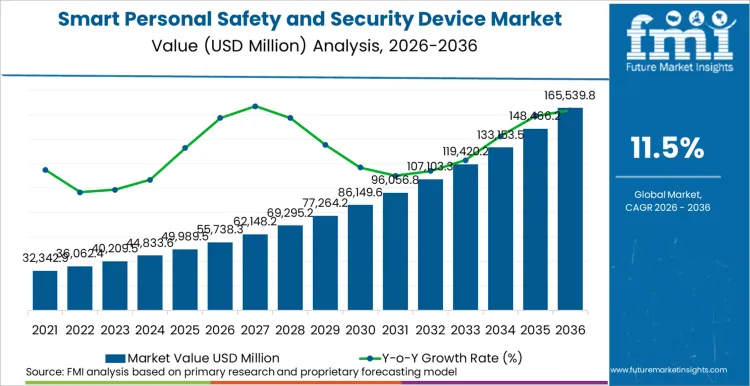
Summary of Smart Personal Safety and Security Device Market
What Is Growth Outlook for Smart Personal Safety and Security Device Market as per Future Market Insights Projection?
Future Market Insights projects the smart personal safety and security device market to expand at a CAGR of 11.5% from 2026 to 2036, increasing from USD 55,738.3 Million in 2026 to USD 165,243 Million by 2036.
FMI Research Approach: FMI proprietary forecasting model based on demand-supply correlation and end-use consumption analysis.
How Do FMI Analysts Perceive Smart Personal Safety and Security Device Market to Evolve?
FMI analysts perceive the market evolving toward a platform-convergence model where gas detection, satellite communication, and AI-powered location analytics merge into single connected wearable devices that replace multiple standalone products.
FMI Research Approach: Regulatory convergence analysis and competitive landscape mapping.
Which Country Holds Largest Share in Global Smart Personal Safety and Security Device Market?
The United States holds a significant share of the global smart personal safety and security device market by value, supported by stringent OSHA workplace safety mandates and a high concentration of industrial, energy, and construction end-users.
FMI Research Approach: FMI country-level revenue modelling by end-use consumption and trade data.
How Large Will Smart Personal Safety and Security Device Market Be by 2036?
The global smart personal safety and security device market is projected to reach USD 165,243 Million by 2036.
FMI Research Approach: FMI long-term revenue forecast derived from end-use demand projections and macroeconomic indicators.
What Is Definition of Smart Personal Safety and Security Device Market?
The smart personal safety and security device market includes revenue generated from the design, manufacture, and sale of electronically connected personal safety and security devices, covering wearable safety monitors, satellite communicators, personal alarms, GPS trackers, and smart home security devices.
FMI Research Approach: FMI market taxonomy and inclusion-exclusion framework.
What Are Globally Unique Trends Shaping Smart Personal Safety and Security Device Market?
Globally unique trends include the unification of gas detection, lone worker protection, and satellite communication into single connected wearable platforms, the integration of AI-driven privacy features into consumer devices, and the expansion of family safety apps beyond 50 million monthly active users.
FMI Research Approach: Competitive intelligence and regulatory directive tracking.
Smart Personal Safety and Security Device Market Key Takeaways
| Metric | Details |
|---|---|
| Industry Size (2026) | USD 55,738.3 Million |
| Industry Value (2036) | USD 165,539.8 Million |
| CAGR (2026 to 2036) | 11.5% |
Source: Future Market Insights (FMI) analysis, based on proprietary forecasting model and primary research
Category-wise Insights
The section contains information about the leading segments in the industry. By Type, the Smart Personal Security segment is projected to expand by 54.2% throughout 2035. Additionally, By End Use, the Telecommunication segment is estimated to grow at a CAGR of at 17.3% till 2035.
Smart Personal Security Segment Dominates the Market with Comprehensive Safety Solutions in terms of market share
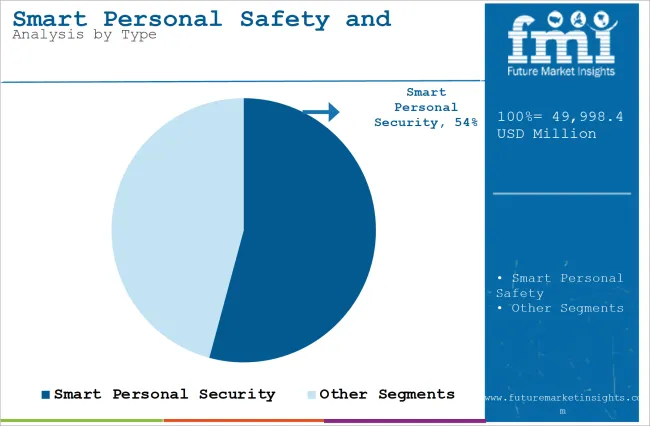
| Type | Smart Personal Security |
|---|---|
| Value Share (2025) | 54.2% |
The largest share of the market in the Smart Personal Safety and Security Device Market is held by the Smart Personal Security segment, due to its potential to address multiple types of safety concerns among individual users. The availability of smart panic buttons, GPS trackers, and wearable alert systems has deeply penetrated the consumer level to get proactive solutions for protection. Moreover, these devices are integrated with mobile applications that can track in real time, set geofences, and deliver an urgent response in case of emergencies.
This segment has been in the leadership position due to the increasing awareness of personal safety, especially among vulnerable groups such as women, children, and the elderly. Advancements in technology and user-friendly designs continue to attract a growing consumer base, further reinforcing its market dominance.
Telecommunication Segment is Growing at the Fastest CAGR with IoT Integration and Network Advancements
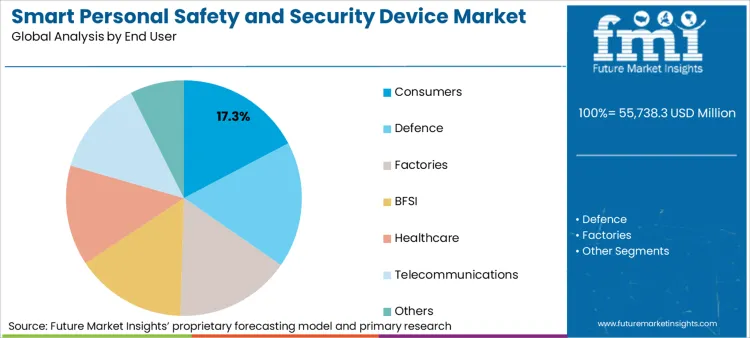
| End Use | Telecommunication |
|---|---|
| CAGR (2025 to 2035) | 17.3% |
The Telecommunication segment is experiencing the highest CAGR in the Smart Personal Safety and Security Device Market, driven by its critical role in enabling connectivity and communication for these devices. The proliferation of IoT and advancements in 4G and 5G networks have significantly improved device functionality, including real-time monitoring, instant alerts, and seamless data transmission.
This is because telecom companies are aggressively tying up with safety device manufacturers to bring in connectivity solutions to increase the reliability and reach of personal safety systems. Additionally, growth in the use of eSIMs and cloud-based technologies is further increasing the adoption of connected devices in this industry. Urban and rural areas are in high demand for better safety solutions, and the telecommunication industry will help support its strong growth pace over the forecast period.
Semi Annual Market Update
The above table presents the expected CAGR for the global Smart Personal Safety and Security Device market over several semi-annual periods spanning from 2024 to 2034. In the first half (H1) of the decade from 2024 to 2034, the business is expected to surge at a compound annual growth rate (CAGR) of 10.7%, followed by a slightly higher growth rate of 10.9% in the second half (H2) of the same decade.
| Particular | Value CAGR |
|---|---|
| H1, 2024 | 10.7% (2024 to 2034) |
| H2, 2024 | 10.9% (2024 to 2034) |
| H1, 2025 | 11.5% (2025 to 2035) |
| H2, 2025 | 11.7% (2025 to 2035) |
Moving into the subsequent period, from H1 2025 to H2 2035, the CAGR is projected to increase slightly to 11.5% in the first half and remain relatively moderate at 11.7% in the second half. In the first half (H1) the market witnessed a decrease of 60 BPS while in the second half (H2), the market witnessed an increase of 90 BPS.
Key Industry Highlights
Rising Concerns Over Personal Safety Amid Increasing Crime Rates and Urbanization
Increasing awareness of the need for active safety measures among persons has led to an improved adoption of wearable safety devices such as smart panic buttons, location trackers, and emergency alert systems. The rising population in urban cities, coupled with the increasing population of lone workers and travelers, have increased the demands for smart security solutions that include real-time tracking and instant emergency services.
Furthermore, media reports and government-led drives on personal safety technologies further catalyze the trend. Innovations in IoT, GPS, artificial intelligence (AI), and wireless communication technologies have revolutionized the Smart Personal Safety and Security Device Market, making devices more efficient, user-friendly, and accessible.
Technological Advancements in IoT, GPS, and AI Enabling Real-Time Tracking and Proactive Security Features
Innovative features, such as AI-driven predictive analytics, fall detection geofencing, and real-time monitoring, are becoming standard in personal safety devices, offering users enhanced functionality and peace of mind. These developments facilitate easier integration with smartphones and other intelligent devices.
For instance, smartphones and intelligent appliances can get real-time information such as alerts and warnings from the environment; the progressions of 5G are predicted to provide continued improvement of connections, facilitating increased data speeds while ensuring proper device' performance for many applications in developing countries worldwide.
Increased Adoption of Smart Wearables and Growing Awareness Among End Users Across Diverse Demographics
The penetration of smart wearables, such as smartwatches and fitness trackers, has increased with the addition of personal safety and security features to their functionality, driving market growth. These devices feature SOS alerts, health monitoring, and emergency location tracking, which appeal to consumers across various age groups, including children, women, and the elderly.
The increasing awareness of the existence and benefits of smart personal safety devices is also driving the market's expansion. Marketing events by manufacturers along with partnerships with government agencies and healthcare firms are further informing consumers and boosting confidence in such devices, and hence, their acceptance of such technologies is being promoted in large numbers.
High Initial Costs and Limited Awareness in Emerging Economies Impede Widespread Adoption
Despite the growing popularity of smart personal safety and security devices, their high initial cost acts as a significant barrier, particularly in emerging economies where disposable income levels are comparatively low. Many consumers remain unaware of the benefits and availability of these devices, especially in rural areas and underdeveloped regions.
The lack of infrastructure to support connected devices, such as weak internet connectivity and limited smartphone access, further hinders market penetration in these areas. Additionally, the perception that such devices are only necessary for high-risk scenarios or specific demographics reduces the overall adoption rate, limiting the market's potential growth.
2021 to 2025 Global Smart Personal Safety and Security Device Sales Outlook Compared to Demand Forecast from 2026 to 2036
The global Smart Personal Safety and Security Device industry recorded a compound annual growth rate (CAGR) of 11.7% during the historical period from 2021 to 2025. The growth of the Smart Personal Safety and Security Device industry was positive as it reached a value of USD 44,849.69 million from USD 29038.32 million in 2021.
The sales demand outlook for the Smart Personal Safety and Security Device Market from 2021 to 2025 reflected steady growth, primarily driven by heightened concerns for personal safety, technological advancements, and the increasing adoption of connected wearables. During this period, the market benefited significantly from rising urbanization, increased disposable incomes, and early adoption of IoT-enabled safety solutions.
Nonetheless, demand was only partially limited in those areas due to insufficient awareness and the cost constraints posed by emerging markets. Demand during the 2026 to 2036 period is poised to surge at a rate that is multiple times higher in light of innovations in AI, 5G, and smart city developments.
Growth in demand will continue to be sustained by the rollout of safe technologies, popularization programs at all levels of government, and the availability of affordable feature phones. As more people adopt these devices across various age groups, including children, women, and the elderly, and as more devices are integrated into the healthcare and law enforcement sectors, unprecedented market growth is likely to be observed during the forecast period.
Market Concentration
Tier 1 companies, including Garmin Ltd., Fitbit (owned by Google LLC), Apple Inc., and Samsung Electronics Co., Ltd., dominate the Smart Personal Safety and Security Device Market, as they possess vast technological expertise, a strong brand reputation, and robust global distribution networks.
These players utilize advanced IoT and AI technologies to provide feature-rich safety solutions integrated into popular consumer products like smartwatches and fitness trackers. Their strong R&D investments and partnerships with technology and healthcare providers ensure continuous innovation and market leadership.
Tier 2 players, which include Axon Enterprise, Inc., Honeywell International Inc., ADT Inc., and Kwikset, are large market shareholders as they target specific safety and security segments such as law enforcement, home security, and personal alarms.
Regional dominance and sector-specific expertise strengthen their proposition by high-quality, reliable products, although they do not have Tier 1-style global reach. Their focused strategies and long-standing customer relationships instead put them in a position to be the most vital contributors to market growth.
Tier 3 companies, including SOS Alert, Silent Beacon, LLC, Trackimo, AngelSense, Revolar Technology Inc., VALRT, and Tile, Inc., work in niche markets, focusing on specific consumer needs such as child safety, elder care, and personal tracking.
These firms are very innovative, affordable, and user-friendly, often serving underserved markets or regions. Their agility and the ability to offer customized solutions to meet various unique safety requirements enable them to carve out niche roles in the competitive landscape despite limited market reach compared to larger competitors.
Country-wise Insights
The section below covers the industry analysis for the Smart Personal Safety and Security Device market for different countries. Market demand analysis on key countries in several regions of the globe, including USA, France and China, is provided. The United States is anticipated to remain at the forefront in North America, with a value share of 71.2% through 2035. In East Asia, China is projected to witness a CAGR of 12.9% by 2035.
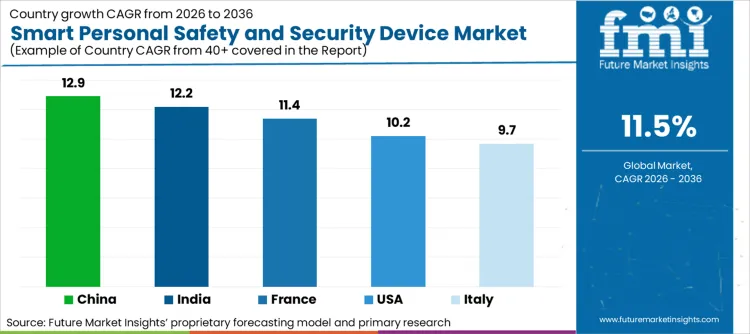
| Countries | Value CAGR (2025 to 2035) |
|---|---|
| USA | 10.2% |
| France | 11.4% |
| Italy | 9.7% |
| India | 12.2% |
| China | 12.9% |
Growth Driven by Technological Advancements, High Consumer Awareness, and a Robust Safety Ecosystem in United States
Smart personal safety and security devices are a leading market in the United States, primarily driven by advanced technological infrastructure, high consumer awareness, and increasing safety concerns. The strong presence of major innovators in the country encompasses Apple, Fitbit (Google LLC), and Axon Enterprise, ensuring ongoing innovations of cutting-edge solutions. Infiltration is widespread, the country's high disposable income and tech-savvy citizens allow maximum technology adoption.
Moreover, safety issues due to urbanization, workplace violence, and concerns for lone operators in sectors like healthcare and logistics are set to increase demand. Government support of personal safety projects, in association with law enforcement agencies for the use of body-worn cameras and emergency alert systems, have further increased the growth in this market.
Growth of market in France Fueled by Rising Safety Awareness, Government Initiatives, and Integration with Smart City Projects
Smart Personal Safety and Security Device Market growth in France is high, especially due to rising safety awareness, and a considerable focus on smart city and urban safety initiatives to integrate these devices. The country's development and growing focus on people safety have led to the adoption of wearable safety devices such as panic buttons and GPS trackers by individuals and organizations. Government regulations and programs to enhance worker safety, especially in sectors such as construction and healthcare, are driving adoption rates.
These devices have become more reachable to consumers as a result of the growth in e-commerce and retail channels in France. At the same time, collaborations between technology firms and public safety agencies ensure innovative solutions that are responsive to local needs.
Growth Propelled by Mass Urbanization, Advanced Manufacturing Capabilities, and Affordable Device Availability will driving the market in china
China has a huge population residing in cities and has advanced manufacturing capabilities, resulting in a booming market for smart personal safety and security devices, thanks to increasing consumer demand for safety solutions at reasonable prices. Leading IoT, AI, and wireless technology innovation in the country has facilitated cutting safety gear production for cost yet innovative accessibility towards wider markets.
Urbanization and industrial expansion have thus generated a need for self-safety on individuals, especially in cities with high populations and dangerous workplaces. Besides, wearable popularity and integration into local apps like WeChat has boosted demand. Smart cities and public safety policies of the government have complemented domestic brands that could deliver their offerings based on local preference. Therefore, the sector places China at a top position among its growth markets.
Competitive Landscape
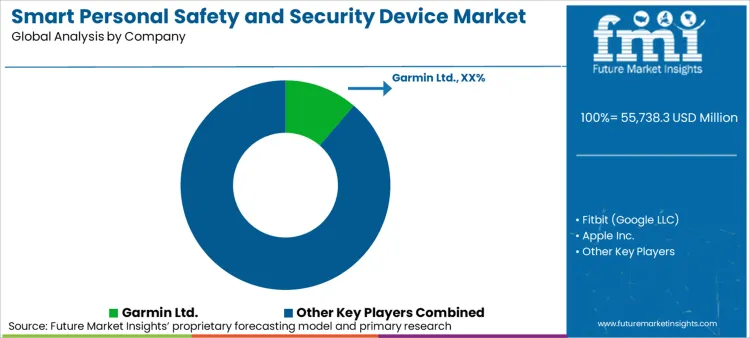
The competitive landscape of the Smart Personal Safety and Security Device Market is a mix of established players and emerging innovators that are trying to capture market share through product innovation, strategic collaborations, and regional expansion. The leading companies in the market include Garmin Ltd., Apple Inc., Fitbit (Google LLC), and Samsung Electronics Co., Ltd., which have extensive product portfolios, advanced technology integration, and global distribution networks.
Established companies, such as Axon Enterprise, Inc., and Honeywell International Inc., serve niche markets for specialized applications such as law enforcement and home security through their expertise. Emerging players in the market are AngelSense, Silent Beacon, and Trackimo, which offer affordable and customized solutions to reach underserved markets, thereby spurring innovation in wearables and GPS tracking devices.
The market is facing increased competition from regional manufacturers in Asia-Pacific due to cost-effective production and solid local distribution channels. Strategic alliances, R&D investments, and advancements in IoT, AI, and wireless technologies would be the competitive strategies for companies.R
Recent Developments:
- In January 2026, Smart Home Protection LLC launched Timeli, a patented portable smart personal safety system combining a flashlight, HD video, GPS, alarm, and instant two-way communication with emergency dispatch in one handheld device for immediate situational response during critical moments.
- In Feb 2025, LogicMark launched the Next-Generation Guardian Alert 911 Plus personal emergency response device, enhancing its medical alert product family with updated hardware and features to support immediate emergency communication and care.
- In Nov 2025, Silent Beacon expanded its product lineup with a Personal Safety Alarm, offering a 135 dB alarm, LED light, and vibration-activated modes designed for quick deterrence and user attention without requiring apps or subscriptions.
Key Players of Smart Personal Safety and Security Device Industry
- Garmin Ltd.
- Fitbit (Google LLC)
- Apple Inc.
- Samsung Electronics Co., Ltd.
- Axon Enterprise, Inc.
- Honeywell International Inc.
- ADT Inc.
- SOS Alert
- Silent Beacon, LLC
- Trackimo
- AngelSense
- Revolar Technology Inc.
- Kwikset (Spectrum Brands Holdings, Inc.)
- V.ALRT
- Tile, Inc
Market Definition
The smart personal safety and security device market represents revenue generated from the design, manufacture, and sale of electronically connected devices that monitor, detect, or communicate safety-related information for individual users. The market measures the value of wearable safety monitors, satellite communicators, personal alarms, GPS trackers, and smart home security devices.
Inclusions cover connected gas detection wearables, lone worker safety devices, satellite communicators with SOS capability, family location-sharing platforms, personal emergency response systems, and consumer smartwatches with safety features such as fall detection and emergency SOS. Smart home security cameras, doorbells, and motion sensors with mobile connectivity are also included.
Exclusions include enterprise-grade CCTV surveillance systems, commercial building access control, vehicle telematics not sold as personal safety products, and unconnected analog safety equipment such as smoke detectors without IoT capability. Cybersecurity software and digital identity protection services are outside the scope.
Key Segments of Smart Personal Safety and Security Device Industry
By Type:
In terms of type, the industry is divided into Smart Personal Security (Wearable Devices, Bulletproof Bags, Personal Alarm, Panic Button, Fall Detection Device and Others) and Smart Personal Safety (Smart Helmet, Smart Mouth Guard, Smart Knee Guard and Others).
By End User:
The End User is classified by end use industries as Consumers, Defence, Factories, BFSI, Healthcare, Telecommunications and Others.
By Region:
Key countries of North America, Latin America, Western Europe, Eastern Europe, East Asia, South Asia & pacific, Middle East and Africa (MEA) have been covered in the report.
Bibliography
- Blackline Safety. (2026, January). Launched the G8, an all-in-one connected safety wearable featuring gas detection. Blackline Safety corporate disclosure.
- Garmin. (2025, Dec). Introduced the inReach Mini 3 Plus, a compact satellite communicator with voice,. Garmin corporate disclosure.
- Apple. (2025, September). Launched Apple Watch Ultra 3 featuring Emergency SOS via satellite, 5G cellular . Apple corporate disclosure.
- Blackline Safety. (2025, November). Expanded global footprint by opening new offices in Germany and the UAE to suppo. Blackline Safety corporate disclosure.
- International Labour Organization. (2024). Global estimates on occupational safety and health. ILO.
- United States Occupational Safety and Health Administration. (2025). Workplace injury and illness data summary. OSHA.
Frequently Asked Questions
What is the future of global Smart Personal Safety and Security Device industry?
The global Smart Personal Safety and Security Device industry is projected to witness CAGR of 11.5% between 2025 and 2035.
What was the worth of the global Smart Personal Safety and Security Device industry in 2025?
The global Smart Personal Safety and Security Device industry stood at USD 49998.43 million in 2025.
What will the worth of global Smart Personal Safety and Security Device industry by 2035 end?
The global Smart Personal Safety and Security Device industry is anticipated to reach USD 148226.55 million by 2035 end.
Which region to showcase the highest CAGR during forecast period?
East Asia is set to record the highest CAGR of 13.5% in the assessment period.
Who are the key manufacturer of global Smart Personal Safety and Security Device industry?
The key players operating in the global Smart Personal Safety and Security Device industry include Garmin Ltd., Fitbit (Google LLC), Apple Inc., Samsung Electronics Co., Ltd, Axon Enterprise, Inc. and others.
Preview the report firsthand - request a free sample
Get SampleGet the brochure for pricing and purchase details.
Get PDFTable of Content
- Executive Summary
- Global Market Outlook
- Analysis and Recommendations
- Market Overview
- Market Coverage / Taxonomy
- Market Definition / Scope / Limitations
- Research Methodology
- Chapter Orientation
- Analytical Lens and Working Hypotheses
- Market Structure, Signals, and Trend Drivers
- Benchmarking and Cross-market Comparability
- Market Sizing, Forecasting, and Opportunity Mapping
- Research Design and Evidence Framework
- Desk Research Programme (Secondary Evidence)
- Company Annual and Sustainability Reports
- Peer-reviewed Journals and Academic Literature
- Corporate Websites, Product Literature, and Technical Notes
- Earnings Decks and Investor Briefings
- Statutory Filings and Regulatory Disclosures
- Technical White Papers and Standards Notes
- Subscription Datasets and Paid Sources
- Social Channels, Communities, and Digital Listening Inputs
- Additional Desk Sources
- Expert Input and Fieldwork (Primary Evidence)
- Primary Modes
- Qualitative Interviews and Expert Elicitation
- Quantitative Surveys and Structured Data Capture
- Blended Approach
- Why Primary Evidence is Used
- Field Techniques
- Interviews
- Surveys
- Focus Groups
- Observational and In-context Research
- Social and Community Interactions
- Stakeholder Universe Engaged
- C-suite Leaders
- Board Members
- Presidents and Vice Presidents
- R&D and Innovation Heads
- Technical Specialists
- Domain Subject-matter Experts
- Scientists
- Physicians and Other Healthcare Professionals
- Governance, Ethics, and Data Stewardship
- Research Ethics
- Data Integrity and Handling
- Primary Modes
- Tooling, Models, and Reference Databases
- Desk Research Programme (Secondary Evidence)
- Data Engineering and Model Build
- Data Acquisition and Ingestion
- Cleaning, Normalisation, and Verification
- Synthesis, Triangulation, and Analysis
- Quality Assurance and Audit Trail
- Market Background
- Market Dynamics
- Drivers
- Restraints
- Opportunity
- Trends
- Scenario Forecast
- Demand in Optimistic Scenario
- Demand in Likely Scenario
- Demand in Conservative Scenario
- Opportunity Map Analysis
- Product Life Cycle Analysis
- Supply Chain Analysis
- Investment Feasibility Matrix
- Value Chain Analysis
- PESTLE and Porter’s Analysis
- Regulatory Landscape
- Regional Parent Market Outlook
- Production and Consumption Statistics
- Import and Export Statistics
- Market Dynamics
- Global Market Analysis 2021 to 2025 and Forecast, 2026 to 2036
- Historical Market Size Value (USD Million) Analysis, 2021 to 2025
- Current and Future Market Size Value (USD Million) Projections, 2026 to 2036
- Y-o-Y Growth Trend Analysis
- Absolute $ Opportunity Analysis
- Global Market Pricing Analysis 2021 to 2025 and Forecast 2026 to 2036
- Global Market Analysis 2021 to 2025 and Forecast 2026 to 2036, By Type
- Introduction / Key Findings
- Historical Market Size Value (USD Million) Analysis By Type , 2021 to 2025
- Current and Future Market Size Value (USD Million) Analysis and Forecast By Type , 2026 to 2036
- Smart Personal Security
- Smart Personal Safety
- Smart Personal Security
- Y-o-Y Growth Trend Analysis By Type , 2021 to 2025
- Absolute $ Opportunity Analysis By Type , 2026 to 2036
- Global Market Analysis 2021 to 2025 and Forecast 2026 to 2036, By End User
- Introduction / Key Findings
- Historical Market Size Value (USD Million) Analysis By End User, 2021 to 2025
- Current and Future Market Size Value (USD Million) Analysis and Forecast By End User, 2026 to 2036
- Consumers
- Defence
- Factories
- BFSI
- Healthcare
- Telecommunications
- Others
- Consumers
- Y-o-Y Growth Trend Analysis By End User, 2021 to 2025
- Absolute $ Opportunity Analysis By End User, 2026 to 2036
- Global Market Analysis 2021 to 2025 and Forecast 2026 to 2036, By Region
- Introduction
- Historical Market Size Value (USD Million) Analysis By Region, 2021 to 2025
- Current Market Size Value (USD Million) Analysis and Forecast By Region, 2026 to 2036
- North America
- Latin America
- Western Europe
- Eastern Europe
- East Asia
- South Asia and Pacific
- Middle East & Africa
- Market Attractiveness Analysis By Region
- North America Market Analysis 2021 to 2025 and Forecast 2026 to 2036, By Country
- Historical Market Size Value (USD Million) Trend Analysis By Market Taxonomy, 2021 to 2025
- Market Size Value (USD Million) Forecast By Market Taxonomy, 2026 to 2036
- By Country
- USA
- Canada
- Mexico
- By Type
- By End User
- By Country
- Market Attractiveness Analysis
- By Country
- By Type
- By End User
- Key Takeaways
- Latin America Market Analysis 2021 to 2025 and Forecast 2026 to 2036, By Country
- Historical Market Size Value (USD Million) Trend Analysis By Market Taxonomy, 2021 to 2025
- Market Size Value (USD Million) Forecast By Market Taxonomy, 2026 to 2036
- By Country
- Brazil
- Chile
- Rest of Latin America
- By Type
- By End User
- By Country
- Market Attractiveness Analysis
- By Country
- By Type
- By End User
- Key Takeaways
- Western Europe Market Analysis 2021 to 2025 and Forecast 2026 to 2036, By Country
- Historical Market Size Value (USD Million) Trend Analysis By Market Taxonomy, 2021 to 2025
- Market Size Value (USD Million) Forecast By Market Taxonomy, 2026 to 2036
- By Country
- Germany
- UK
- Italy
- Spain
- France
- Nordic
- BENELUX
- Rest of Western Europe
- By Type
- By End User
- By Country
- Market Attractiveness Analysis
- By Country
- By Type
- By End User
- Key Takeaways
- Eastern Europe Market Analysis 2021 to 2025 and Forecast 2026 to 2036, By Country
- Historical Market Size Value (USD Million) Trend Analysis By Market Taxonomy, 2021 to 2025
- Market Size Value (USD Million) Forecast By Market Taxonomy, 2026 to 2036
- By Country
- Russia
- Poland
- Hungary
- Balkan & Baltic
- Rest of Eastern Europe
- By Type
- By End User
- By Country
- Market Attractiveness Analysis
- By Country
- By Type
- By End User
- Key Takeaways
- East Asia Market Analysis 2021 to 2025 and Forecast 2026 to 2036, By Country
- Historical Market Size Value (USD Million) Trend Analysis By Market Taxonomy, 2021 to 2025
- Market Size Value (USD Million) Forecast By Market Taxonomy, 2026 to 2036
- By Country
- China
- Japan
- South Korea
- By Type
- By End User
- By Country
- Market Attractiveness Analysis
- By Country
- By Type
- By End User
- Key Takeaways
- South Asia and Pacific Market Analysis 2021 to 2025 and Forecast 2026 to 2036, By Country
- Historical Market Size Value (USD Million) Trend Analysis By Market Taxonomy, 2021 to 2025
- Market Size Value (USD Million) Forecast By Market Taxonomy, 2026 to 2036
- By Country
- India
- ASEAN
- Australia & New Zealand
- Rest of South Asia and Pacific
- By Type
- By End User
- By Country
- Market Attractiveness Analysis
- By Country
- By Type
- By End User
- Key Takeaways
- Middle East & Africa Market Analysis 2021 to 2025 and Forecast 2026 to 2036, By Country
- Historical Market Size Value (USD Million) Trend Analysis By Market Taxonomy, 2021 to 2025
- Market Size Value (USD Million) Forecast By Market Taxonomy, 2026 to 2036
- By Country
- Kingdom of Saudi Arabia
- Other GCC Countries
- Turkiye
- South Africa
- Other African Union
- Rest of Middle East & Africa
- By Type
- By End User
- By Country
- Market Attractiveness Analysis
- By Country
- By Type
- By End User
- Key Takeaways
- Key Countries Market Analysis
- USA
- Pricing Analysis
- Market Share Analysis, 2025
- By Type
- By End User
- Canada
- Pricing Analysis
- Market Share Analysis, 2025
- By Type
- By End User
- Mexico
- Pricing Analysis
- Market Share Analysis, 2025
- By Type
- By End User
- Brazil
- Pricing Analysis
- Market Share Analysis, 2025
- By Type
- By End User
- Chile
- Pricing Analysis
- Market Share Analysis, 2025
- By Type
- By End User
- Germany
- Pricing Analysis
- Market Share Analysis, 2025
- By Type
- By End User
- UK
- Pricing Analysis
- Market Share Analysis, 2025
- By Type
- By End User
- Italy
- Pricing Analysis
- Market Share Analysis, 2025
- By Type
- By End User
- Spain
- Pricing Analysis
- Market Share Analysis, 2025
- By Type
- By End User
- France
- Pricing Analysis
- Market Share Analysis, 2025
- By Type
- By End User
- India
- Pricing Analysis
- Market Share Analysis, 2025
- By Type
- By End User
- ASEAN
- Pricing Analysis
- Market Share Analysis, 2025
- By Type
- By End User
- Australia & New Zealand
- Pricing Analysis
- Market Share Analysis, 2025
- By Type
- By End User
- China
- Pricing Analysis
- Market Share Analysis, 2025
- By Type
- By End User
- Japan
- Pricing Analysis
- Market Share Analysis, 2025
- By Type
- By End User
- South Korea
- Pricing Analysis
- Market Share Analysis, 2025
- By Type
- By End User
- Russia
- Pricing Analysis
- Market Share Analysis, 2025
- By Type
- By End User
- Poland
- Pricing Analysis
- Market Share Analysis, 2025
- By Type
- By End User
- Hungary
- Pricing Analysis
- Market Share Analysis, 2025
- By Type
- By End User
- Kingdom of Saudi Arabia
- Pricing Analysis
- Market Share Analysis, 2025
- By Type
- By End User
- Turkiye
- Pricing Analysis
- Market Share Analysis, 2025
- By Type
- By End User
- South Africa
- Pricing Analysis
- Market Share Analysis, 2025
- By Type
- By End User
- USA
- Market Structure Analysis
- Competition Dashboard
- Competition Benchmarking
- Market Share Analysis of Top Players
- By Regional
- By Type
- By End User
- Competition Analysis
- Competition Deep Dive
- Garmin Ltd.
- Overview
- Product Portfolio
- Profitability by Market Segments (Product/Age /Sales Channel/Region)
- Sales Footprint
- Strategy Overview
- Marketing Strategy
- Product Strategy
- Channel Strategy
- Fitbit (Google LLC)
- Apple Inc.
- Samsung Electronics Co., Ltd.
- Axon Enterprise, Inc.
- Honeywell International Inc.
- ADT Inc.
- SOS Alert
- Silent Beacon, LLC
- Trackimo
- AngelSense
- Revolar Technology Inc.
- Kwikset (Spectrum Brands Holdings, Inc.)
- V.ALRT
- Tile, Inc
- Garmin Ltd.
- Competition Deep Dive
- Assumptions & Acronyms Used


