

- Industry Size (2026)
- USD 3.9 Bn
- Forecast (2036)
- USD 11.0 Bn
- CAGR (2026 to 2036)
- 11.2%
Demand for Smart Home Security Camera in USA 2026 to 2036
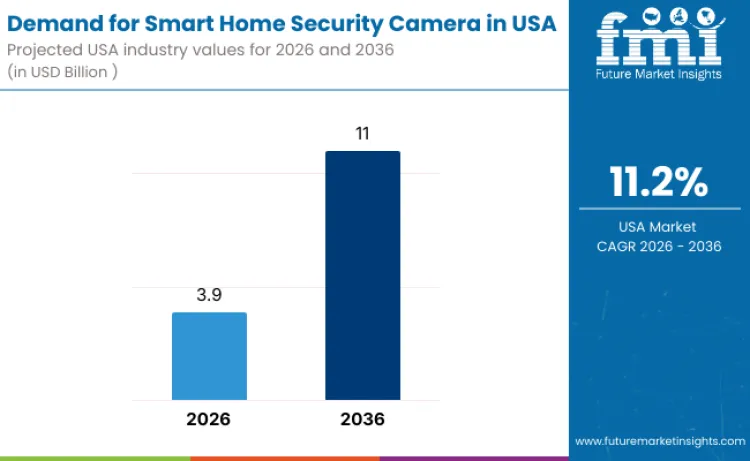
Demand for smart home security camera in USA is valued at USD 3.9 billion in 2026 and is forecasted to reach USD 11.0 billion by 2036, reflecting a CAGR of 11.2%. Demand expands as households prioritize residential safety, remote monitoring, and integrated smart-home ecosystems. Rising urbanization, higher parcel theft incidents, and broader adoption of connected devices support sustained installation across single-family homes and multi-unit residences.
Smart video doorbell cameras lead camera-type usage because real-time visitor alerts, motion detection, and two-way audio enhance entry-point security. Integration with mobile applications, cloud storage, and voice assistants improves usability and monitoring convenience. Advancements in image resolution, low-light performance, and AI-based event detection strengthen product appeal across varied household settings.
Physical stores and offline channels lead sales due to consumer preference for in-store demonstrations, professional installation support, and bundled security solutions. Retail partnerships and service-led offerings improve trust and reduce setup complexity for first-time buyers.
West USA, South USA, Northeast USA, and Midwest USA represent key growth regions driven by housing activity, smart-home penetration, and retail accessibility. Ring (Amazon), Google Nest, Arlo Technologies, ADT, and SimpliSafe anchor competitive activity through ecosystem integration, subscription-based services, and continuous feature upgrades aligned with evolving residential security requirements across the United States.
Quick Stats for Demand for Smart Home Security Camera in USA
- USA Smart Home Security Camera Sales Value (2026): USD 3.9 billion
- USA Smart Home Security Camera Forecast Value (2036): USD 11.0 billion
- USA Smart Home Security Camera Forecast CAGR (2026-2036): 11.2%
- Leading Camera Type in USA Demand: Smart Video Doorbell Cameras
- Key Growth Regions in USA Demand: West USA, South USA, Northeast USA, Midwest USA
- Top Players in USA Demand: Ring (Amazon), Google Nest, Arlo Technologies, ADT, SimpliSafe
USA Smart Home Security Camera Key Takeaways
| Metric | Value |
|---|---|
| USA Smart Home Security Camera Sales Value (2026) | USD 3.9 billion |
| USA Smart Home Security Camera Forecast Value (2036) | USD 11.0 billion |
| USA Smart Home Security Camera Forecast CAGR (2026-2036) | 11.2% |
How Are the Segments Classified in the Demand for Smart Home Security Cameras in the USA?
Demand for smart home security cameras in the USA is shaped by residential safety concerns, property monitoring needs, and integration with connected home ecosystems. Buyers evaluate video quality, installation flexibility, mobile access, and compatibility with existing smart platforms. Adoption patterns reflect increased use of visual verification, package monitoring, and perimeter surveillance across owner-occupied and rental housing environments.
Which Camera Type Accounts for the Largest Share of Demand in the USA?
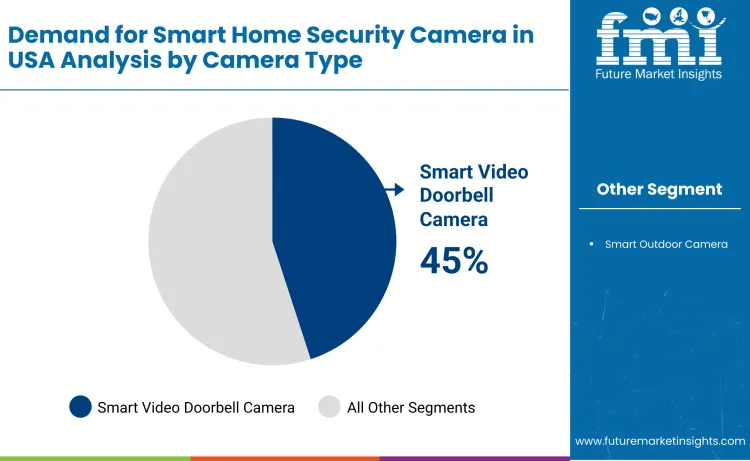
Smart video doorbell cameras hold 45.0%, making them the leading camera-type segment in the USA. These devices support front-door monitoring, package detection, and visitor identification without complex installation requirements. Smart outdoor cameras hold 41.0%, supporting perimeter surveillance, motion detection, and night-vision coverage for detached homes. Smart indoor cameras hold 14.0%, used primarily for room monitoring, pet observation, and supplemental interior security. Camera-type distribution reflects emphasis on entry-point visibility and external threat detection within U.S. residential settings.
Key Points:
- Video doorbells lead due to entry-point monitoring needs.
- Outdoor cameras support perimeter and night surveillance.
- Indoor cameras serve supplementary interior monitoring roles.
Which Sales Channel Accounts for the Largest Share of Demand in the USA?
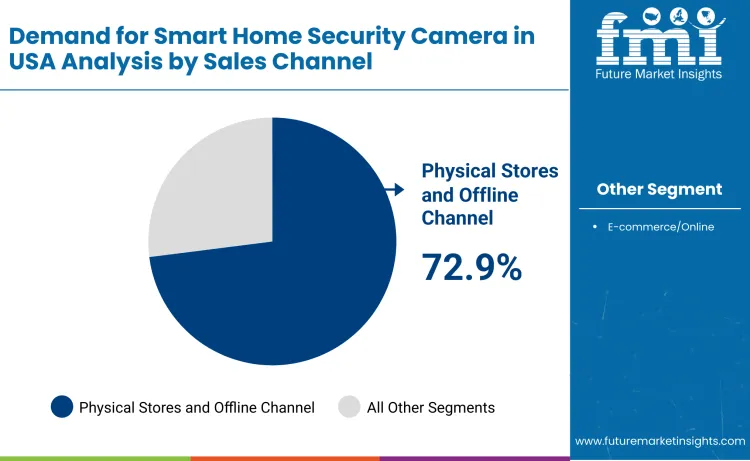
Physical stores and offline channels hold 72.9%, making them the leading sales-channel segment in the USA. Buyers prefer in-store purchases to assess device features, receive installation guidance, and bundle services with home-improvement providers. E-commerce and online channels hold 27.1%, supporting price comparison, direct-to-consumer models, and replacement purchases. Sales-channel distribution reflects reliance on retail networks and professional support during initial security system adoption.
Key Points:
- Offline channels dominate due to hands-on evaluation.
- Retail support influences installation and setup decisions.
- Online sales support convenience and repeat purchases.
What are the Key Dynamics in the Smart Home Security Camera Industry in USA?
Demand increases as households in USA adopt connected security solutions to monitor property, manage remote access, and integrate with broader smart home systems. Smart home security cameras support indoor and outdoor surveillance, cloud recording, and mobile alerts. Adoption aligns with suburban housing patterns, rising package theft concerns, and broadband availability. Retail distribution, DIY installation models, and subscription-based services shape purchasing behavior across residential segments.
How does residential security concern and smart home adoption drive demand in USA?
USA homeowners deploy security cameras to address burglary deterrence, porch theft monitoring, and neighborhood safety awareness. Growth in single-family homes and multi-unit residential developments supports installation volumes. Consumers favor Wi-Fi–enabled cameras offering real-time alerts, night vision, and app-based access. Integration with voice assistants and home automation platforms strengthens appeal. Insurance incentives and perceived safety benefits encourage uptake. Renters adopt wireless, non-invasive devices suited to temporary installation. E-commerce channels and big-box retailers expand access through bundled kits and promotional pricing. Demand concentrates in suburban and urban fringe areas with reliable internet connectivity and higher parcel delivery frequency.
How do privacy concerns, subscription costs, and competitive intensity influence demand stability?
Consumer sensitivity to data privacy and video storage practices affects brand selection and feature usage. State-level regulations on surveillance and audio recording shape product configuration and user compliance. Ongoing subscription fees for cloud storage influence long-term retention and purchasing decisions. Competition from doorbell cameras, neighborhood platforms, and professionally monitored systems limits differentiation. Price pressure exists due to commoditization of basic hardware. Installation quality and false alerts affect user satisfaction. Demand remains stable due to recurring security needs, while growth depends on trust in data handling, transparent pricing, and continued integration with USA smart home ecosystems.
How Is Demand for Smart Home Security Camera in USA Evolving by Region?
Demand for smart home security cameras in the USA is rising due to increased residential security concerns, smart home adoption, and integration with connected ecosystems. West USA leads with a 12.6% CAGR, supported by high smart home penetration, technology adoption, and subscription-based monitoring services. South USA follows at 11.3%, driven by suburban housing growth, property crime concerns, and DIY security installations. Northeast USA records a 10.1% CAGR, shaped by urban residential density, renter-focused solutions, and professional monitoring demand. Midwest USA posts an 8.7% CAGR, reflecting steady uptake driven by affordability, retail availability, and gradual smart home adoption. Regional variation reflects housing patterns, technology readiness, and security preferences across the USA.

| Region | CAGR (2026-2036) |
|---|---|
| West USA | 12.6% |
| South USA | 11.3% |
| Northeast USA | 10.1% |
| Midwest USA | 8.7% |
How is West USA driving demand for Smart Home Security Cameras?
West USA demand is driven by advanced smart home ecosystems, high disposable income, and strong preference for connected security solutions. The region’s CAGR of 12.6% reflects widespread use of indoor and outdoor cameras integrated with voice assistants, smart lighting, and access control systems. Consumers adopt AI-enabled features such as motion detection, facial recognition, and cloud video storage. High incidence of package theft supports deployment of doorbell cameras and perimeter monitoring systems. Subscription-based monitoring services gain traction due to digital-first consumer behavior. Demand favors high-resolution cameras with mobile app integration and cybersecurity safeguards.
- Strong smart home and IoT ecosystem adoption
- AI-enabled video analytics and cloud storage usage
- High deployment of doorbell and perimeter cameras
- Preference for premium, connected security platforms
How is South USA driving demand for Smart Home Security Cameras?
South USA demand is influenced by suburban expansion, detached housing prevalence, and cost-effective security solutions. The region’s CAGR of 11.3% reflects increased installation of outdoor cameras, floodlight cameras, and multi-camera systems for larger properties. Homeowners prioritize DIY installation, wireless connectivity, and affordability. Retail chains and e-commerce platforms support wide product availability. Climate considerations drive demand for weather-resistant hardware. Adoption remains volume-oriented, supported by rising awareness of property security and neighborhood safety.
- Suburban housing and large property coverage needs
- High adoption of DIY and wireless camera systems
- Strong retail and e-commerce distribution
- Demand for weather-resistant outdoor devices
How is Northeast USA driving demand for Smart Home Security Cameras?
Northeast USA demand reflects urban living conditions, multi-family housing, and renter-oriented security solutions. The region’s CAGR of 10.1% is supported by use of compact indoor cameras, doorbell cameras, and professionally monitored systems. Property managers and landlords deploy cameras for building access monitoring and common-area security. Consumers value data privacy, regulatory compliance, and reliable customer support. Subscription services focused on storage and alerts gain acceptance. Demand favors compact designs and systems compatible with apartment living.
- Urban and multi-family housing security needs
- Doorbell and indoor camera adoption
- Professional monitoring and subscription services
- Emphasis on privacy and compliance features
How is Midwest USA driving demand for Smart Home Security Cameras?
Midwest USA demand is steady and value-driven, reflecting gradual smart home adoption and price sensitivity. The region’s CAGR of 8.7% reflects use of basic indoor and outdoor cameras for residential monitoring and seasonal property protection. Consumers prioritize reliability, ease of use, and competitive pricing. Big-box retailers and regional chains support adoption through bundled offers. Advanced features are adopted selectively, while core monitoring functions drive purchasing decisions. Growth remains incremental, supported by expanding broadband access and increased familiarity with smart home technology.
- Value-oriented and reliability-focused purchasing
- Adoption of basic indoor and outdoor camera systems
- Strong presence of big-box retail distribution
- Gradual uptake of advanced smart features
What is the competitive landscape of demand for smart home security cameras in the USA?
Demand for smart home security cameras in the USA is driven by residential safety concerns, growth of connected home ecosystems, and wider adoption of subscription-based monitoring services. Usage spans indoor surveillance, outdoor perimeter monitoring, doorbell cameras, and integrated alarm systems across single-family homes and multifamily properties. Buyers evaluate video resolution, low-light performance, motion detection accuracy, cloud storage reliability, and cybersecurity safeguards. Device compatibility with voice assistants, mobile applications, and broader smart home platforms influences purchasing decisions. Procurement teams and channel partners prioritize suppliers offering reliable firmware updates, domestic customer support, and compliance with U.S. data privacy expectations. Trend in the USA market reflects rising DIY installation preference, increased demand for AI-based alerts, and growing emphasis on local data processing to reduce false notifications.
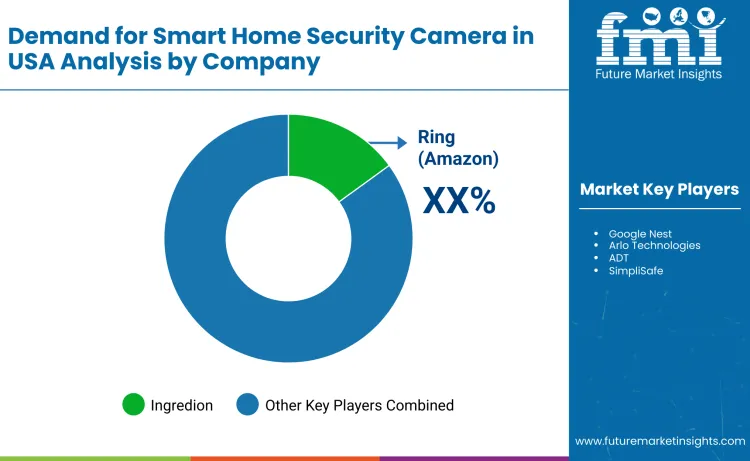
Amazon, through Ring, maintains strong adoption supported by broad retail distribution and integration with Alexa-enabled ecosystems. Google Nest participates with camera systems aligned to Google Home platforms and AI-driven video analytics. Arlo Technologies operates as a focused smart security provider offering subscription-enabled cameras with advanced detection features. ADT supports demand through professionally monitored camera solutions integrated into residential security service contracts. SimpliSafe maintains visibility with easy-to-install camera systems bundled with home security offerings targeting renters and homeowners. Competitive positioning in the USA reflects ecosystem integration, software intelligence, privacy controls, and reliability of ongoing service support across diverse residential segments.
Key Players in USA Smart Home Security Camera Demand
- Ring (Amazon)
- Google Nest
- Arlo Technologies
- ADT
- SimpliSafe
Scope of the Report
| Items | Values |
|---|---|
| Quantitative Units | USD billion |
| Camera Type | Smart Indoor Cameras; Smart Video Doorbell Camera; Smart Outdoor Camera |
| Sales Channel | Physical Stores / Offline; E-commerce / Online |
| Regions Covered | West USA; South USA; Northeast USA; Midwest USA |
| Key Companies Profiled | Ring (Amazon); Google Nest; Arlo Technologies; ADT; SimpliSafe |
| Additional Attributes | Dollar sales by camera type and sales channel; regional demand patterns across urban and suburban housing; adoption driven by smart home integration, remote monitoring, and subscription-based services; technology differentiation through AI motion detection, cloud storage, and mobile app ecosystems; preference shifts toward online purchasing and bundled security solutions. |
USA Smart Home Security Camera Demand by Segments
Camera Type:
- Smart Indoor Cameras
- Smart Video Doorbell Camera
- Smart Outdoor Camera
Sales Channel:
- Physical Stores/Offline
- E-commerce/Online
Region:
- West USA
- South USA
- Northeast USA
- Midwest USA
Frequently Asked Questions
What will be the size of smart home security camera demand in USA in 2036?
The demand size for smart home security cameras in USA is projected to reach USD 11.0 billion by 2036.
How much will the demand for smart home security cameras in USA grow between 2026 and 2036?
The demand for smart home security cameras in USA is expected to grow at a 11.2% CAGR between 2026 and 2036.
What are the key camera types in the smart home security camera demand in USA?
The key camera types in smart home security camera demand in USA include smart video doorbell cameras, indoor security cameras, and outdoor security cameras.
Which sales channel is expected to contribute a significant share in the smart home security camera demand in USA in 2026?
In terms of sales channel, physical stores and offline retail are expected to command 72.9% share in the smart home security camera demand in USA in 2026.
Preview the report firsthand - request a free sample
Get SampleGet the brochure for pricing and purchase details.
Get PDFTable of Content
- Executive Summary
- USA Market Outlook
- Demand Side Trends
- Supply Side Trends
- Residential Security and Data Privacy Landscape
- Analysis and Recommendations
- Market Overview
- Market Coverage and Taxonomy
- Market Definition Scope and Limitations
- Market Background
- Market Dynamics
- Drivers
- Restraints
- Opportunities
- Trends
- Scenario Forecast
- Demand in Optimistic Scenario
- Demand in Likely Scenario
- Demand in Conservative Scenario
- Opportunity Map Analysis
- Product Life Cycle Analysis
- Supply Chain and Channel Analysis
- Investment Feasibility Matrix
- Value Chain Analysis
- PESTLE and Porter Analysis
- Cybersecurity and Data Handling Framework
- Regional Parent Market Outlook
- Retail and Installation Ecosystem Analysis
- USA Smart Home Security Camera Demand Analysis 2020 to 2024 and Forecast 2025 to 2035
- Historical Demand Value USD Billion Analysis 2020 to 2024
- Current and Future Demand Value USD Billion Projections 2025 to 2035
- Year on Year Growth Trend Analysis
- Absolute Dollar Opportunity Analysis
- USA Smart Home Security Camera Pricing Analysis 2020 to 2024 and Forecast 2025 to 2035
- USA Smart Home Security Camera Demand Analysis 2020 to 2024 and Forecast 2025 to 2035 By Camera Type
- Introduction and Key Findings
- Historical Demand Value USD Billion Analysis by Camera Type 2020 to 2024
- Current and Future Demand Value USD Billion Analysis and Forecast by Camera Type 2025 to 2035
- Smart Video Doorbell Cameras
- Smart Outdoor Cameras
- Smart Indoor Cameras
- Year on Year Growth Trend Analysis by Camera Type
- Absolute Dollar Opportunity Analysis by Camera Type
- USA Smart Home Security Camera Demand Analysis 2020 to 2024 and Forecast 2025 to 2035 By Sales Channel
- Introduction and Key Findings
- Historical Demand Value USD Billion Analysis by Sales Channel 2020 to 2024
- Current and Future Demand Value USD Billion Analysis and Forecast by Sales Channel 2025 to 2035
- Physical Stores and Offline Channels
- E commerce and Online Channels
- Year on Year Growth Trend Analysis by Sales Channel
- Absolute Dollar Opportunity Analysis by Sales Channel
- USA Smart Home Security Camera Demand Analysis 2020 to 2024 and Forecast 2025 to 2035 By Region
- West USA
- South USA
- Northeast USA
- Midwest USA
- Market Structure Analysis
- Competition Dashboard
- Competition Benchmarking
- Market Share Analysis of Key Players
- By Camera Type
- By Sales Channel
- By Region
- Competition Analysis
- Competition Deep Dive
- Ring Amazon
- Google Nest
- Arlo Technologies
- ADT
- SimpliSafe
- Assumptions and Acronyms Used
- Research Methodology


