

- Market Size (2026)
- USD 0.41 Bn
- Forecast (2036)
- USD 0.98 Bn
- CAGR (2026 to 2036)
- 9.1%
High-Speed Highway Pilot and Lane Change Scenario Test Platforms Market Size, Market Forecast and Outlook By FMI
The market was valued at USD 0.3 billion in 2025 and is projected to reach USD 0.4 billion in 2026. It is expected to grow at a 9.1% CAGR from 2026 to 2036 and reach USD 0.9 billion by 2036. Software-defined vehicle programs are increasing validation demand, with Software-in-the-Loop leading platform type at 32% share and Highway Pilot leading scenario focus at 41% share in 2026.
Summary of the High-Speed Highway Pilot and Lane Change Scenario Test Platforms Market
- Demand and Growth Drivers
- Validation spending is rising as highway pilot and lane change functions require broader scenario coverage across virtual and physical environments. Software updates are in demand, since vehicle software operations now depend on repeated signoff cycles before release.
- Replay-based testing is gaining importance because engineering teams want to convert field events into repeatable scenario packs.
- Product and Segment View
- Software-in-the-Loop is expected to remain the leading platform type, supported by the need to test a large number of edge cases before hardware freeze. It fits well with the broader automotive simulation environment, where faster iteration and lower run cost help validation teams handle growing workload.
- Highway Pilot is likely to stay the leading scenario focus because it brings together lane keeping and fallback behavior in one operating domain.
- Geography and Competitive Outlook
- China is projected to remain a major growth market due to its large vehicle engineering base and active automated driving development work. Japan is also expected to post strong demand, while autonomous driving virtual simulation platform adoption supports deeper use of software-led validation across advanced programs.
- The United States and Germany will continue to represent large demand centers because both countries support dense OEM and Tier 1 validation activity. Their installed testing base keeps spending meaningful even though growth rates are lower than the faster Asian markets.
- Analyst Opinion
- Nikhil Kaitwade, Associate Vice President at FMI, says, “Spending in this market is moving toward connected validation environments that can link scenario generation, replay, SIL, HIL, and proving-ground execution without losing traceability. Decision makers are giving more weight to tools that shorten rerun cycles after software updates, improve correlation between virtual and physical evidence, and support stronger documentation around highway pilot and lane change performance.”
- High-Speed Highway Pilot and Lane Change Scenario Test Platforms Market Value Analysis
- The market is moving from a narrow validation niche into a more defined part of the automotive software and test infrastructure base.
- Adoption is being pushed by the need to validate more edge cases linked to steering control, fallback response, and driver supervision at higher road speeds.
- The market is also benefiting from faster software release cycles, which increase the number of reruns needed before assisted driving functions can move toward signoff.
- Demand is further supported by the need for validation workflows that can connect replay, coverage analytics, and physical correlation without slowing engineering progress.
High-Speed Highway Pilot and Lane Change Scenario Test Platforms Market Definition
This market covers dedicated platforms used to test supervised and higher automation functions on high-speed roads, especially highway pilot behavior and automated lane changes.
High-Speed Highway Pilot and Lane Change Scenario Test Platforms Market Inclusions
Included in scope are platforms and tools that directly support scenario-based validation of highway and interurban assisted or automated functions. This includes authoring environments for lane change and merge scenarios, sensor and traffic modeling, path and behavior replay, automated test execution, grading workflows, and correlation layers that connect virtual runs with bench and track tests.
High-Speed Highway Pilot and Lane Change Scenario Test Platforms Market Exclusions
Excluded from scope are full vehicle ADAS hardware revenues such as cameras, radar modules, LiDAR units, and ECUs sold without dedicated scenario test functionality. Generic infotainment test tools, broad vehicle NVH tools, and standard dynamometers are also outside scope unless they are configured for highway pilot or lane change scenario validation.
High-Speed Highway Pilot and Lane Change Scenario Test Platforms Market Research Methodology
- Primary Research - Market framing used official regulations, NCAP protocol updates, safety studies, and supplier releases covering scenario validation, highway assist grading, SIL, HIL, and digital twin execution.
- Desk Research - Secondary evidence relied on non-commercial government and association sources, including NHTSA, FHWA, UNECE, Euro NCAP, MLIT, and OICA, together with official supplier press materials.
- Market Sizing and Forecasting - Sizing used a top-down niche share approach anchored to automotive validation and simulation demand, adjusted for scenario intensity, software release frequency, and platform price mix across workflows.
- Data Validation and Update Cycle - Forecast assumptions were checked against current protocol changes, current company activity, and country engineering proxies, then reconciled for internal consistency across values, segments, and country growth.
Why is the High-Speed Highway Pilot and Lane Change Scenario Test Platforms Market Growing?
- Regulators and safety programs are expanding the number of assisted driving behaviors that need repeatable and traceable validation before launch.
- Software-defined vehicle programs increase release frequency and force engineering teams to rerun highway and lane change scenarios more often.
- Field data replay and scenario libraries now matter more because real-world crash reporting and scoring rules demand stronger evidence packages.
Regulatory scope is widening in a way that directly lifts scenario testing demand. NHTSA’s 2024 NCAP decision added blind spot warning, blind spot intervention, lane keeping assist, and pedestrian automatic emergency braking to the agency’s program. It raises the general burden around coordinated steering and path control behavior across assisted functions. Buyers therefore invest in reusable libraries that can move from simulation to HIL and then to proving-ground execution with minimal rework. This driver also connects naturally with the surrounding automotive network testing workflow because software interactions across sensors, actuators, and compute nodes must be verified in a controlled sequence automotive network testing.
Protocol pressure on highway functions is also getting deeper. Euro NCAP has evaluated Highway Assist systems since 2018 and its 2026 on-road speed assistance work stretches to 2,000 kilometers across at least three European countries. The same program now places explicit emphasis on driver collaboration and monitoring thresholds, which means a strong lane centering controller is not enough on its own. Suppliers need to help customers measure system status signaling, intervention quality, fallback, and handover readiness.
Segmental Analysis
- Software-in-the-Loop leads with 32% share, supported by broader automotive simulation use across scenario validation.
- Highway Pilot accounts for the largest scenario share at 41% in 2026.
- On-premise leads deployment with 52% share, reflecting protected validation data requirements.
- OEMs hold 46% share, while Simulation Software contributes 38% of demand.
The market for high-speed highway pilot and lane change scenario test platforms keeps growing because software-defined vehicle programs need broader scenario validation, faster reruns after updates, and stronger traceability between virtual and physical evidence. Even though there are problems like expensive correlation work and the complexity of linking software, bench, and track validation, there are still chances for growth in replay-based testing, connected validation workflows, and wider use of coverage analytics across assisted driving development.
Insights into the Software-in-the-Loop segment
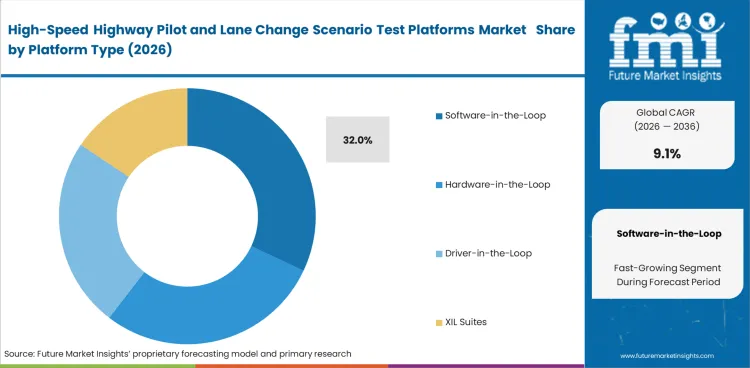
- Software-in-the-Loop is expected to account for 32% share in 2026. Early validation continues to move left because engineering groups need to test more combinations of road geometry and traffic behavior hardware is frozen.
- SIL also offers lower run cost and higher iteration speed than bench or track work, which is valuable in highway pilot and lane change projects that depend on many edge cases.
Insights into the Highway Pilot segment
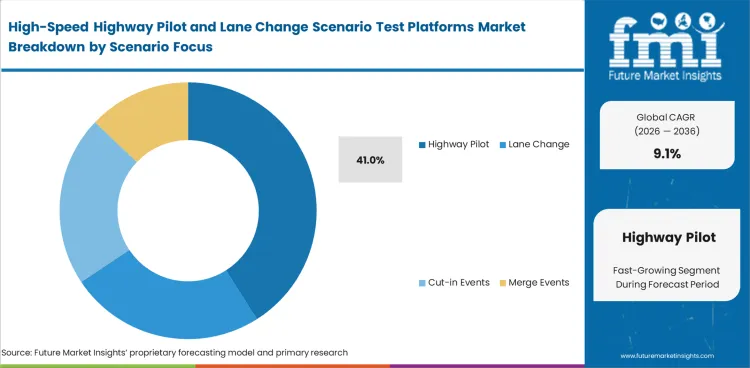
- Highway Pilot is anticipated to represent 41% of the market in 2026. It combines lane centering and driver supervision in one operating domain that already has published grading frameworks.
- Euro NCAP’s assisted driving assessment framework provides a visible benchmark for highway and interurban systems, while UNECE notes that Regulation 157 now allows lane change functionality and speeds of up to 130 kilometers per hour under specified conditions.
Insights into the On-premise segment
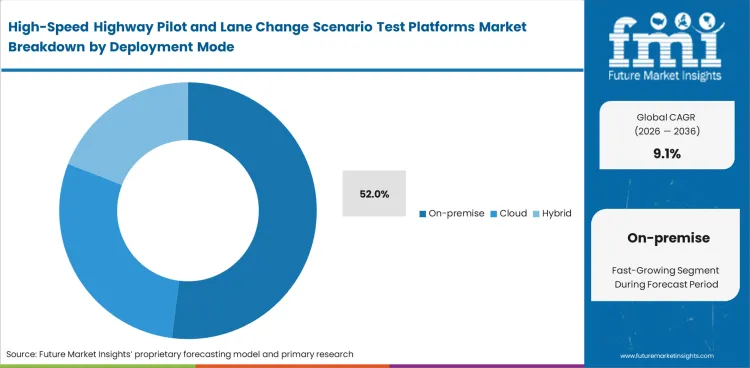
- On-premise is likely to secure 52% share in 2026. Vehicle manufacturers and major Tier 1 suppliers keep sensitive software models driving logs under controlled access because those assets contain intellectual property and safety evidence.
- Local deployment also helps engineering groups connect simulators and HIL benches with lower latency and tighter governance. Cloud use is rising for burst compute and scenario scaling. On-premise environments continue to anchor final signoff workflows.
Insights into the OEMs segment
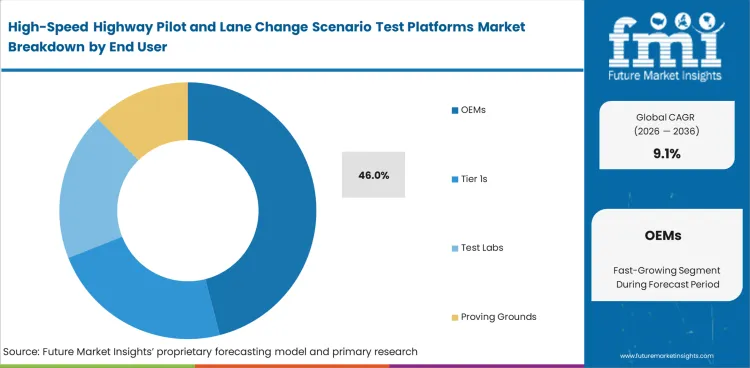
- OEMs are set to make up 46% of the market in 2026. Final responsibility for feature launch and evidence packages remains with vehicle manufacturers, so they continue to own the largest test budgets.
- The January 2025 PARTS study showed that automatic emergency braking cuts rear-end crashes in half, reinforcing the importance of measurable real-world safety performance.
Insights into the Simulation Software segment
- Market estimates place Simulation Software at 38% share in 2026. Buyers start with software because scenario creation and replay management define how much work can be automated before physical rigs are added.
- Applied Intuition’s digital twin work with Valeo highlighted the value of replicating sensor characteristics in real and virtual locations, while tracetronic’s LAURIN project showed how real accident scenarios can be reconstructed and mapped into swarm tests.
What are the drivers, restraints, and key trends in the High-Speed Highway Pilot and Lane Change Scenario Test Platforms Market
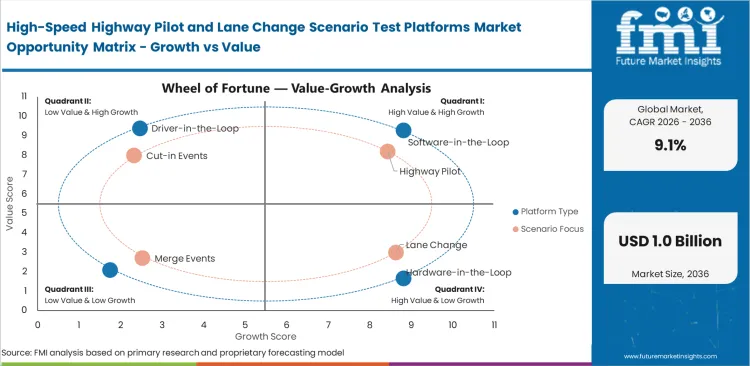
- Wider safety scoring and reporting frameworks increase the need for structured scenario validation.
- Correlation between virtual results and physical behavior remains expensive and time consuming.
- Manufacturers prefer connected workflows that link scenario generation, replay, SIL, HIL, and proving-ground evidence.
This market grows on the back of stronger validation demands, however, the spending pattern is selective and technically strict. They are purchasing measurable capability around scenario breadth, evidence quality, and speed of reruns after software change. Programs now need to cover driver collaboration, fallback, speed control, and lane change judgment across more conditions than before. That raises the value of data replay, coverage analytics, and integrated workflows.
Sourcing concentration
A restraint in this market is the difficulty of assembling a complete workflow from one supplier. One vendor may be strong in SIL and HIL, another in robots or proving-ground systems, and another in digital twins or coverage analytics. That forces OEMs to integrate multiple layers and raises project complexity. AVL’s collaboration with Microsoft, Hexagon, Synopsys, and tracetronic shows why integration is a selling point.
Analysis of High-Speed Highway Pilot and Lane Change Scenario Test Platforms Market by Key Countries
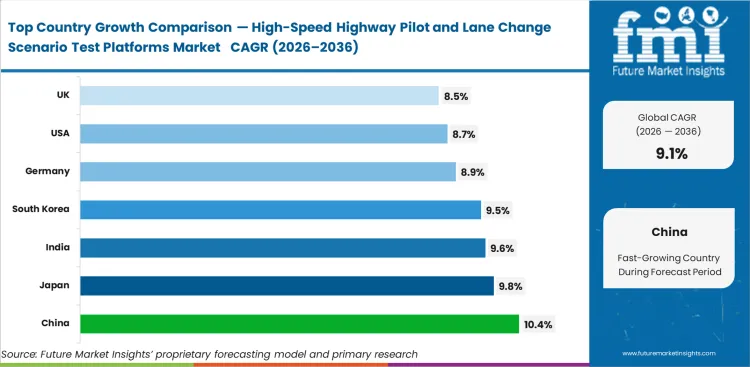
- China leads with a 10.4% CAGR, supported by a large vehicle engineering base and faster autonomous driving virtual simulation platform adoption.
- Japan follows at 9.8%, while India records 9.6% due to expanding software validation activity.
- South Korea is projected at 9.5%, supported by concentrated OEM programs and modern test workflows.
- Germany posts 8.9%, the United States 8.7%, and the United Kingdom 8.5%. ADAS testing equipment demand keeps these markets commercially important.
- The global market is expected to grow at a 9.1% CAGR from 2026 to 2036. The study covers the main demand centers listed above, with vehicle software operations and scenario-based validation continuing to support country-level demand.
.webp "Top Country Growth Comparison High Speed Highway Pilot And Lane Change Scenario Test Platforms Market Cagr (2026 2036)")
| Country | CAGR |
|---|---|
| China | 10.4% |
| Japan | 9.8% |
| India | 9.6% |
| South Korea | 9.5% |
| Germany | 8.9% |
| United States | 8.7% |
| United Kingdom | 8.5% |
Demand Outlook for High-Speed Highway Pilot and Lane Change Scenario Test Platforms Market in the United States
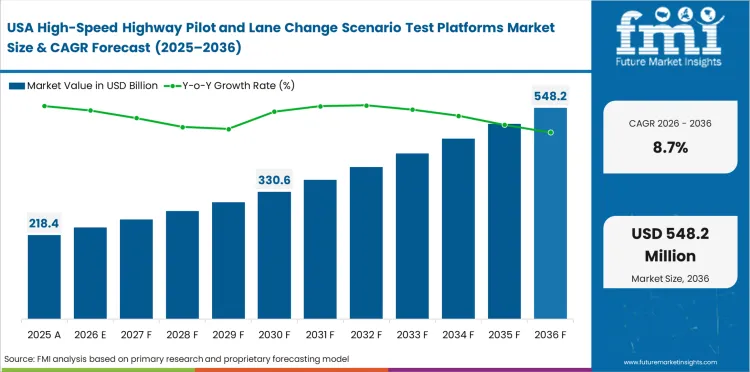
The USA market is projected to expand at a CAGR of 8.7% through 2036. Demand is supported by a large validation base across OEM and Tier 1 programs, while USA ADAS testing equipment demand keeps investment focused on replayable evidence, scenario control, and software reruns linked to assisted driving releases.
- Large OEM programs support repeat validation demand.
- Evidence quality remains important in local testing workflows.
- Replay tools help manage frequent software updates.
Demand Outlook for High-Speed Highway Pilot and Lane Change Scenario Test Platforms Market in the United Kingdom
The United Kingdom market is likely to grow at a CAGR of 8.5% through 2036. Demand is supported by specialist validation capability, active policy interest, and engineering work tied to assisted driving programs. United Kingdom ADAS testing equipment activity also supports demand for scenario platforms used in structured highway and lane change testing.
- Specialist labs support demand for technical validation tools.
- Policy activity keeps assisted driving assessment relevant.
- Flexible platforms suit mixed simulation and track programs.
Demand Outlook for High-Speed Highway Pilot and Lane Change Scenario Test Platforms Market in Germany
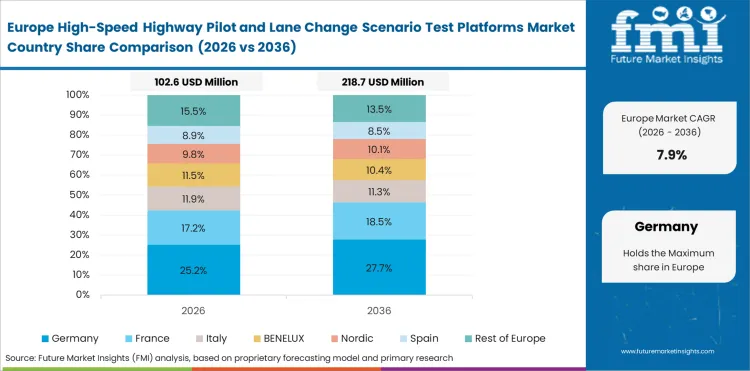
Germany is projected to witness a CAGR of 8.9% through 2036. Demand stays firm due to premium vehicle engineering, mature proving-ground use, and strong emphasis on correlation between virtual and physical validation. Automotive simulation adoption adds value here because buyers need deeper scenario control across software, bench, and track-based workflows.
- Premium programs require deeper validation discipline.
- Physical correlation carries strong weight in signoff.
- High-fidelity tools suit mature engineering environments.
Demand Outlook for High-Speed Highway Pilot and Lane Change Scenario Test Platforms Market in Japan
Japan is expected to grow at a CAGR of 9.8% through 2036. Demand is supported by a disciplined vehicle engineering base, continued automation development, and strong interest in reliable validation processes. Autonomous valet parking scenario test systems adoption also reflects local interest in structured scenario testing across advanced mobility functions.
- Reliability remains central in Japanese validation programs.
- Automation development supports broader scenario coverage needs.
- Stable workflows are valued across software validation activity.
Demand Outlook for High-Speed Highway Pilot and Lane Change Scenario Test Platforms Market in China
China is projected to record a CAGR of 10.4% through 2036. Demand is driven by a very large vehicle engineering base, active automated driving development, and faster iteration across software-led programs. Intelligent driving technology solution deployment strengthens the need for scenario replay, sensor modeling, and repeatable evidence generation across validation chains.
- Large engineering scale supports higher validation intensity.
- Domestic competition encourages faster software iteration cycles.
- Scenario replay stays important across local programs.
Demand Outlook for High-Speed Highway Pilot and Lane Change Scenario Test Platforms Market in India
India is forecast to grow at a CAGR of 9.6% through 2036. Demand is supported by a widening software engineering base, export-linked vehicle development, and stronger use of virtual validation tools before physical testing expands. Autonomous driving simulation tester demand fits this trend because local teams need scalable platforms for broader scenario execution.
- Software-led engineering supports virtual validation demand.
- Export programs increase interest in stronger test workflows.
- Scalable platforms help widen scenario coverage efficiently.
Demand Outlook for High-Speed Highway Pilot and Lane Change Scenario Test Platforms Market in South Korea
South Korea is likely to expand at a CAGR of 9.5% through 2036. Demand is supported by concentrated OEM activity, electronics-heavy supplier networks, and quicker movement toward connected validation workflows. Automotive radar sensors development also adds relevance because sensor-linked behavior must be checked under repeatable highway and lane change scenarios.
- OEM concentration supports connected validation spending.
- Supplier networks help accelerate workflow modernization.
- Sensor-linked testing increases scenario depth requirements.
Competitive landscape of High-Speed Highway Pilot and Lane Change Scenario Test Platforms Market
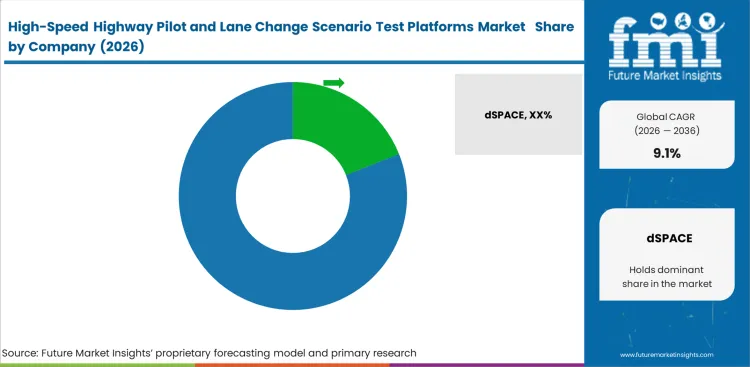
- Competition is moderate because buyers often combine several vendors across software, simulators, robots, and analytics.
- dSPACE, AVL, and IPG Automotive hold strong positions in integrated validation workflows and scenario execution depth.
- Specialists keep room to win where motion simulation, digital twins, or test automation solve a narrow engineering problem.
Competition centers on how much of the workflow a supplier can cover without creating integration drag for the customer. dSPACE, AVL, and IPG Automotive benefit from broad simulation and validation portfolios that connect early software checks with later bench and road activity. Smaller and more specialized firms remain competitive where they provide strong motion simulation, digital twin fidelity, or test automation around a specific workflow step. Because no company controls every layer, buyers often assemble mixed stacks. This keeps the market moderately fragmented even though the largest vendors enjoy repeat business from major OEM validation teams.
AVL’s collaboration with Microsoft, Hexagon, Synopsys, and tracetronic was positioned around an integrated and automated toolchain with a stated goal of increasing the number of tests by a factor of 500 while holding development time steady. dSPACE used CES 2025 to promote end-to-end SIL and HIL validation with data replay and artifact reuse across methods. These moves matter because customers want faster reruns and fewer breaks between scenario creation, hardware integration, and result reporting.
Major Industry Players
Suppliers in this market range from broad validation platform vendors to specialists in motion simulation, test automation, or digital twin execution.
- dSPACE, AVL, and IPG Automotive fit the global player group because they support large OEM and Tier 1 programs across multiple geographies and can span software validation, bench integration, and scenario execution.
- AB Dynamics, VI-grade, and tracetronic fit the regional player group because each has strong technical depth in selected workflows and recognized automotive presence.
- Applied Intuition and similar software-centric entrants fit the emerging player group because they are expanding quickly through digital twins, scenario generation, and data-driven validation layers instead of legacy bench hardware.
Competitive Benchmarking: High-Speed Highway Pilot and Lane Change Scenario Test Platforms Market
| Company | Scenario Breadth | Virtual-Physical Integration | Automation Depth | Geographic Footprint |
|---|---|---|---|---|
| dSPACE | High | High | Strong | Global |
| AVL | High | High | Strong | Global |
| IPG Automotive | High | Medium | Strong | Global |
| AB Dynamics | Medium | High | Moderate | Global |
| VI-grade | Medium | High | Moderate | Europe, Asia, North America |
| tracetronic | Low | High | Moderate | Europe, Japan |
| Applied Intuition | High | Medium | Moderate | North America, Europe |
| Foretellix | High | Low | Moderate | North America, Israel, Europe |
| Ansys | Medium | Medium | Low | Global |
| Vector | Medium | Medium | Low | Global |
Source: Future Market Insights competitive analysis, 2026.
Key Developments in High-Speed Highway Pilot and Lane Change Scenario Test Platforms Market
- In February 2025, IPG Automotive and UTAC said their joint solution would include required scenario catalogs, targets, driving robots, and simulation-to-physical correlation.
- In June 2025, tracetronic said the LAURIN project reconstructed real accident scenarios from data and mapped them automatically in swarm tests.
- In November 2025, VI-grade launched a Shanghai SimCenter focused on Driver-in-the-Loop, Hardware-in-the-Loop, and supporting demonstration systems.
Key Players in the High-Speed Highway Pilot and Lane Change Scenario Test Platforms Market
Major global players
- dSPACE
- AVL
- IPG Automotive
- AB Dynamics
- Ansys
- Vector
Key emerging players/startups
- Applied Intuition
- Foretellix
- VI-grade
- tracetronic
Scope of the Report
| Metric | Value |
|---|---|
| Quantitative Units | USD billion |
| Market Definition | Platforms used to validate highway pilot and automated lane change behavior through scenario-based virtual, mixed, and physical testing. |
| Regions Covered | North America, Europe, Asia Pacific |
| Countries Covered | China, Japan, India, South Korea, Germany, United States, United Kingdom |
| Key Companies Profiled | dSPACE, AVL, IPG Automotive, AB Dynamics, VI-grade, tracetronic, Applied Intuition |
| Forecast Period | 2026 to 2036 |
| Approach | Top-down niche sizing with non-commercial regulatory and industry anchors, then segment and country modelling based on engineering intensity and current validation activity. |
High-Speed Highway Pilot and Lane Change Scenario Test Platforms Market by Segments
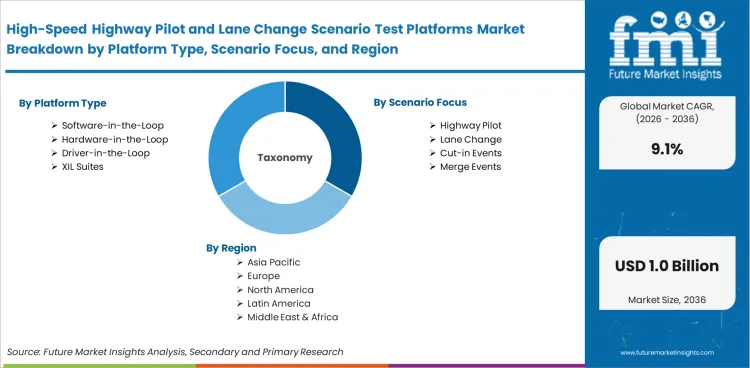
High-Speed Highway Pilot and Lane Change Scenario Test Platforms Market segmented as Platform Type
- Software-in-the-Loop
- Hardware-in-the-Loop
- Driver-in-the-Loop
- XIL Suites
High-Speed Highway Pilot and Lane Change Scenario Test Platforms Market classified by Scenario Focus
- Highway Pilot
- Lane Change
- Cut-in Events
- Merge Events
High-Speed Highway Pilot and Lane Change Scenario Test Platforms Market analysed by Deployment Mode
- On-premise
- Cloud
- Hybrid
High-Speed Highway Pilot and Lane Change Scenario Test Platforms Market classified by End User
- OEMs
- Tier 1s
- Test Labs
- Proving Grounds
High-Speed Highway Pilot and Lane Change Scenario Test Platforms Market by Region and Country
- North America
- USA
- Canada
- Mexico
- Latin America
- Brazil
- Chile
- Rest of Latin America
- Western Europe
- Germany
- UK
- Italy
- Spain
- France
- Nordic
- BENELUX
- Rest of Western Europe
- Eastern Europe
- Russia
- Poland
- Hungary
- Balkan & Baltic
- Rest of Eastern Europe
- East Asia
- China
- Japan
- South Korea
- South Asia and Pacific
- India
- ASEAN
- Australia & New Zealand
- Rest of South Asia and Pacific
- Middle East & Africa
- Kingdom of Saudi Arabia
- Other GCC Countries
- Turkiye
- South Africa
- Other African Union
- Rest of Middle East & Africa
Bibliography
- dSPACE. (2024, December 12). dSPACE at CES 2025: How seamless SIL/HIL validation accelerates automotive software development.
- IPG Automotive GmbH. (2025, February 19). Collaboration for simulation-based validation: UTAC and IPG Automotive join forces for future vehicle safety.
- VI-grade GmbH. (2025, November 18). VI-grade launches state-of-the-art SimCenter in Shanghai to drive next-generation vehicle development.
This bibliography is provided for reader reference.
This Report Addresses
- Market sizing for 2025, 2026, and 2036 with an analyst-built forecast and incremental opportunity.
- Segment analysis across platform type, scenario focus, deployment mode, end user, and component mix.
- Country comparison across seven national demand centers using forecast CAGR through 2036.
- Competitive assessment of broad platform vendors and specialist workflow providers.
- Regulatory and protocol effects from NCAP, crash reporting, and UNECE automation rules.
- Investment implications around scenario depth, evidence traceability, and integration between virtual and physical tests.
- Value chain coverage from scenario software and replay tools to simulators, targets, and driving robots.
- Publication-ready narrative, benchmarking, scope, and FAQ deliverables for market intelligence use.
Frequently Asked Questions
How big is the market in 2026?
The market is estimated at USD 0.41 billion in 2026, based on an analyst-built model using non-commercial safety and automotive engineering anchors.
What will be the market size in 2036?
The market is projected to reach USD 0.98 billion by 2036 as scenario testing expands across highway and lane change validation workflows.
What is the forecast CAGR from 2026 to 2036?
The forecast CAGR is 9.1% during 2026 to 2036, which places the niche in the upper range of specialized automotive validation spending.
Which segment leads the platform mix?
Software-in-the-Loop leads the platform mix with an estimated 32% share in 2026 because scenario expansion starts in virtual validation environments.
Which scenario focus leads the market?
Highway Pilot leads scenario focus with an estimated 41% share in 2026 because it combines steering, speed control, fallback, and engagement checks.
Which countries grow the fastest?
China leads at 10.4% CAGR, followed by Japan at 9.8%, India at 9.6%, and South Korea at 9.5% through 2036.
Preview the report firsthand - request a free sample
Get SampleGet the brochure for pricing and purchase details.
Get PDFTable of Content
- Demand-side Trends
- Technology Roadmap Analysis
- Analysis and Recommendations
- Market Overview
- Market Coverage / Taxonomy
- Market Definition / Scope / Limitations
- Research Methodology
- Chapter Orientation
- Analytical Lens and Working Hypotheses
- Market Structure, Signals, and Trend Drivers
- Benchmarking and Cross-market Comparability
- Market Sizing, Forecasting, and Opportunity Mapping
- Research Design and Evidence Framework
- Earnings Decks and Investor Briefings
- Statutory Filings and Regulatory Disclosures
- Technical White Papers and Standards Notes
- Trade Journals, Industry Magazines, and Analyst Briefs
- Conference Proceedings, Webinars, and Seminar Materials
- Government Statistics Portals and Public Data Releases
- Press Releases and Reputable Media Coverage
- Specialist Newsletters and Curated Briefings
- Sector Databases and Reference Repositories
- FMI Internal Proprietary Databases and Historical Market Datasets
- Subscription Datasets and Paid Sources
- Social Channels, Communities, and Digital Listening Inputs
- Additional Desk Sources
- Expert Input and Fieldwork (Primary Evidence)
- Primary Modes
- Qualitative Interviews and Expert Elicitation
- Quantitative Surveys and Structured Data Capture
- Blended Approach
- Why Primary Evidence is Used
- Focus Groups
- Observational and In-context Research
- Social and Community Interactions
- Primary Modes
- Stakeholder Universe Engaged
- C-suite Leaders
- Board Members
- Presidents and Vice Presidents
- R&D and Innovation Heads
- Technical Specialists
- Domain Subject-matter Experts
- Scientists
- Physicians and Other Healthcare Professionals
- Governance, Ethics, and Data Stewardship
- Research Ethics
- Data Integrity and Handling
- Tooling, Models, and Reference Databases
- Data Engineering and Model Build
- Data Acquisition and Ingestion
- Cleaning, Normalisation, and Verification
- Synthesis, Triangulation, and Analysis
- Quality Assurance and Audit Trail
- Market Background
- Market Dynamics
- Drivers
- Restraints
- Opportunity
- Trends
- Scenario Forecast
- Demand in Optimistic Scenario
- Demand in Likely Scenario
- Demand in Conservative Scenario
- Opportunity Map Analysis
- Product Life Cycle Analysis
- Supply Chain Analysis
- Investment Feasibility Matrix
- Value Chain Analysis
- PESTLE and Porter’s Analysis
- Regulatory Landscape
- Regional Parent Market Outlook
- Production and Consumption Statistics
- Import and Export Statistics
- Market Dynamics
- Global Market Analysis 2021 to 2025 and Forecast, 2026 to 2036
- Historical Market Size Value (USD Million) Analysis, 2021 to 2025
- Current and Future Market Size Value (USD Million) Projections, 2026 to 2036
- Y-o-Y Growth Trend Analysis
- Absolute $ Opportunity Analysis
- Global Market Pricing Analysis 2021 to 2025 and Forecast 2026 to 2036
- Global Market Analysis 2021 to 2025 and Forecast 2026 to 2036, By Platform Type
- Introduction / Key Findings
- Historical Market Size Value (USD Million) Analysis By Platform Type , 2021 to 2025
- Current and Future Market Size Value (USD Million) Analysis and Forecast By Platform Type , 2026 to 2036
- Software-in-the-Loop
- Hardware-in-the-Loop
- Driver-in-the-Loop
- XIL Suites
- Software-in-the-Loop
- Y-o-Y Growth Trend Analysis By Platform Type , 2021 to 2025
- Absolute $ Opportunity Analysis By Platform Type , 2026 to 2036
- Global Market Analysis 2021 to 2025 and Forecast 2026 to 2036, By Scenario Focus
- Introduction / Key Findings
- Historical Market Size Value (USD Million) Analysis By Scenario Focus, 2021 to 2025
- Current and Future Market Size Value (USD Million) Analysis and Forecast By Scenario Focus, 2026 to 2036
- Highway Pilot
- Lane Change
- Cut-in Events
- Merge Events
- Highway Pilot
- Y-o-Y Growth Trend Analysis By Scenario Focus, 2021 to 2025
- Absolute $ Opportunity Analysis By Scenario Focus, 2026 to 2036
- Global Market Analysis 2021 to 2025 and Forecast 2026 to 2036, By Deployment Mode
- Introduction / Key Findings
- Historical Market Size Value (USD Million) Analysis By Deployment Mode, 2021 to 2025
- Current and Future Market Size Value (USD Million) Analysis and Forecast By Deployment Mode, 2026 to 2036
- On-premise
- Cloud
- Hybrid
- On-premise
- Y-o-Y Growth Trend Analysis By Deployment Mode, 2021 to 2025
- Absolute $ Opportunity Analysis By Deployment Mode, 2026 to 2036
- Global Market Analysis 2021 to 2025 and Forecast 2026 to 2036, By End User
- Introduction / Key Findings
- Historical Market Size Value (USD Million) Analysis By End User, 2021 to 2025
- Current and Future Market Size Value (USD Million) Analysis and Forecast By End User, 2026 to 2036
- OEMs
- Tier 1s
- Test Labs
- Proving Grounds
- OEMs
- Y-o-Y Growth Trend Analysis By End User, 2021 to 2025
- Absolute $ Opportunity Analysis By End User, 2026 to 2036
- Global Market Analysis 2021 to 2025 and Forecast 2026 to 2036, By Region
- Introduction
- Historical Market Size Value (USD Million) Analysis By Region, 2021 to 2025
- Current Market Size Value (USD Million) Analysis and Forecast By Region, 2026 to 2036
- North America
- Latin America
- Western Europe
- Eastern Europe
- East Asia
- South Asia and Pacific
- Middle East & Africa
- Market Attractiveness Analysis By Region
- North America Market Analysis 2021 to 2025 and Forecast 2026 to 2036, By Country
- Historical Market Size Value (USD Million) Trend Analysis By Market Taxonomy, 2021 to 2025
- Market Size Value (USD Million) Forecast By Market Taxonomy, 2026 to 2036
- By Country
- USA
- Canada
- Mexico
- By Platform Type
- By Scenario Focus
- By Deployment Mode
- By End User
- By Country
- Market Attractiveness Analysis
- By Country
- By Platform Type
- By Scenario Focus
- By Deployment Mode
- By End User
- Key Takeaways
- Latin America Market Analysis 2021 to 2025 and Forecast 2026 to 2036, By Country
- Historical Market Size Value (USD Million) Trend Analysis By Market Taxonomy, 2021 to 2025
- Market Size Value (USD Million) Forecast By Market Taxonomy, 2026 to 2036
- By Country
- Brazil
- Chile
- Rest of Latin America
- By Platform Type
- By Scenario Focus
- By Deployment Mode
- By End User
- By Country
- Market Attractiveness Analysis
- By Country
- By Platform Type
- By Scenario Focus
- By Deployment Mode
- By End User
- Key Takeaways
- Western Europe Market Analysis 2021 to 2025 and Forecast 2026 to 2036, By Country
- Historical Market Size Value (USD Million) Trend Analysis By Market Taxonomy, 2021 to 2025
- Market Size Value (USD Million) Forecast By Market Taxonomy, 2026 to 2036
- By Country
- Germany
- UK
- Italy
- Spain
- France
- Nordic
- BENELUX
- Rest of Western Europe
- By Platform Type
- By Scenario Focus
- By Deployment Mode
- By End User
- By Country
- Market Attractiveness Analysis
- By Country
- By Platform Type
- By Scenario Focus
- By Deployment Mode
- By End User
- Key Takeaways
- Eastern Europe Market Analysis 2021 to 2025 and Forecast 2026 to 2036, By Country
- Historical Market Size Value (USD Million) Trend Analysis By Market Taxonomy, 2021 to 2025
- Market Size Value (USD Million) Forecast By Market Taxonomy, 2026 to 2036
- By Country
- Russia
- Poland
- Hungary
- Balkan & Baltic
- Rest of Eastern Europe
- By Platform Type
- By Scenario Focus
- By Deployment Mode
- By End User
- By Country
- Market Attractiveness Analysis
- By Country
- By Platform Type
- By Scenario Focus
- By Deployment Mode
- By End User
- Key Takeaways
- East Asia Market Analysis 2021 to 2025 and Forecast 2026 to 2036, By Country
- Historical Market Size Value (USD Million) Trend Analysis By Market Taxonomy, 2021 to 2025
- Market Size Value (USD Million) Forecast By Market Taxonomy, 2026 to 2036
- By Country
- China
- Japan
- South Korea
- By Platform Type
- By Scenario Focus
- By Deployment Mode
- By End User
- By Country
- Market Attractiveness Analysis
- By Country
- By Platform Type
- By Scenario Focus
- By Deployment Mode
- By End User
- Key Takeaways
- South Asia and Pacific Market Analysis 2021 to 2025 and Forecast 2026 to 2036, By Country
- Historical Market Size Value (USD Million) Trend Analysis By Market Taxonomy, 2021 to 2025
- Market Size Value (USD Million) Forecast By Market Taxonomy, 2026 to 2036
- By Country
- India
- ASEAN
- Australia & New Zealand
- Rest of South Asia and Pacific
- By Platform Type
- By Scenario Focus
- By Deployment Mode
- By End User
- By Country
- Market Attractiveness Analysis
- By Country
- By Platform Type
- By Scenario Focus
- By Deployment Mode
- By End User
- Key Takeaways
- Middle East & Africa Market Analysis 2021 to 2025 and Forecast 2026 to 2036, By Country
- Historical Market Size Value (USD Million) Trend Analysis By Market Taxonomy, 2021 to 2025
- Market Size Value (USD Million) Forecast By Market Taxonomy, 2026 to 2036
- By Country
- Kingdom of Saudi Arabia
- Other GCC Countries
- Turkiye
- South Africa
- Other African Union
- Rest of Middle East & Africa
- By Platform Type
- By Scenario Focus
- By Deployment Mode
- By End User
- By Country
- Market Attractiveness Analysis
- By Country
- By Platform Type
- By Scenario Focus
- By Deployment Mode
- By End User
- Key Takeaways
- Key Countries Market Analysis
- USA
- Pricing Analysis
- Market Share Analysis, 2025
- By Platform Type
- By Scenario Focus
- By Deployment Mode
- By End User
- Canada
- Pricing Analysis
- Market Share Analysis, 2025
- By Platform Type
- By Scenario Focus
- By Deployment Mode
- By End User
- Mexico
- Pricing Analysis
- Market Share Analysis, 2025
- By Platform Type
- By Scenario Focus
- By Deployment Mode
- By End User
- Brazil
- Pricing Analysis
- Market Share Analysis, 2025
- By Platform Type
- By Scenario Focus
- By Deployment Mode
- By End User
- Chile
- Pricing Analysis
- Market Share Analysis, 2025
- By Platform Type
- By Scenario Focus
- By Deployment Mode
- By End User
- Germany
- Pricing Analysis
- Market Share Analysis, 2025
- By Platform Type
- By Scenario Focus
- By Deployment Mode
- By End User
- UK
- Pricing Analysis
- Market Share Analysis, 2025
- By Platform Type
- By Scenario Focus
- By Deployment Mode
- By End User
- Italy
- Pricing Analysis
- Market Share Analysis, 2025
- By Platform Type
- By Scenario Focus
- By Deployment Mode
- By End User
- Spain
- Pricing Analysis
- Market Share Analysis, 2025
- By Platform Type
- By Scenario Focus
- By Deployment Mode
- By End User
- France
- Pricing Analysis
- Market Share Analysis, 2025
- By Platform Type
- By Scenario Focus
- By Deployment Mode
- By End User
- India
- Pricing Analysis
- Market Share Analysis, 2025
- By Platform Type
- By Scenario Focus
- By Deployment Mode
- By End User
- ASEAN
- Pricing Analysis
- Market Share Analysis, 2025
- By Platform Type
- By Scenario Focus
- By Deployment Mode
- By End User
- Australia & New Zealand
- Pricing Analysis
- Market Share Analysis, 2025
- By Platform Type
- By Scenario Focus
- By Deployment Mode
- By End User
- China
- Pricing Analysis
- Market Share Analysis, 2025
- By Platform Type
- By Scenario Focus
- By Deployment Mode
- By End User
- Japan
- Pricing Analysis
- Market Share Analysis, 2025
- By Platform Type
- By Scenario Focus
- By Deployment Mode
- By End User
- South Korea
- Pricing Analysis
- Market Share Analysis, 2025
- By Platform Type
- By Scenario Focus
- By Deployment Mode
- By End User
- Russia
- Pricing Analysis
- Market Share Analysis, 2025
- By Platform Type
- By Scenario Focus
- By Deployment Mode
- By End User
- Poland
- Pricing Analysis
- Market Share Analysis, 2025
- By Platform Type
- By Scenario Focus
- By Deployment Mode
- By End User
- Hungary
- Pricing Analysis
- Market Share Analysis, 2025
- By Platform Type
- By Scenario Focus
- By Deployment Mode
- By End User
- Kingdom of Saudi Arabia
- Pricing Analysis
- Market Share Analysis, 2025
- By Platform Type
- By Scenario Focus
- By Deployment Mode
- By End User
- Turkiye
- Pricing Analysis
- Market Share Analysis, 2025
- By Platform Type
- By Scenario Focus
- By Deployment Mode
- By End User
- South Africa
- Pricing Analysis
- Market Share Analysis, 2025
- By Platform Type
- By Scenario Focus
- By Deployment Mode
- By End User
- USA
- Market Structure Analysis
- Competition Dashboard
- Competition Benchmarking
- Market Share Analysis of Top Players
- By Regional
- By Platform Type
- By Scenario Focus
- By Deployment Mode
- By End User
- Competition Analysis
- Competition Deep Dive
- dSPACE
- Overview
- Product Portfolio
- Profitability by Market Segments (Product/Age /Sales Channel/Region)
- Sales Footprint
- Strategy Overview
- Marketing Strategy
- Product Strategy
- Channel Strategy
- AVL
- IPG Automotive
- AB Dynamics
- Ansys
- Vector
- Applied Intuition
- Foretellix
- VI-grade
- tracetronic
- dSPACE
- Competition Deep Dive
- Assumptions & Acronyms Used


