

- Market Size (2026)
- USD 1.18 Bn
- Forecast (2036)
- USD 2.10 Bn
- CAGR (2026 to 2036)
- 5.9%
High-Brix Fruit Quality Enhancement Fertilizer Market Size, Market Forecast and Outlook By FMI
Summary of the High-Brix Fruit Quality Enhancement Fertilizer Market
- Demand and Growth Drivers
- Fruit exporters are raising nutrition precision because packout losses rise when sugar loading and skin finish slip below buyer targets.
- Potassium and calcium programs support higher soluble solids and firmer fruit, which improves shipment tolerance in export channels.
- Micro-irrigation growth is widening access to fertigation blends that can be timed around fruit sizing and late ripening windows.
- Regulatory pressure on nutrient losses is pushing growers toward efficient soluble products and lower-dose foliar correction programs.
- Product and Segment View
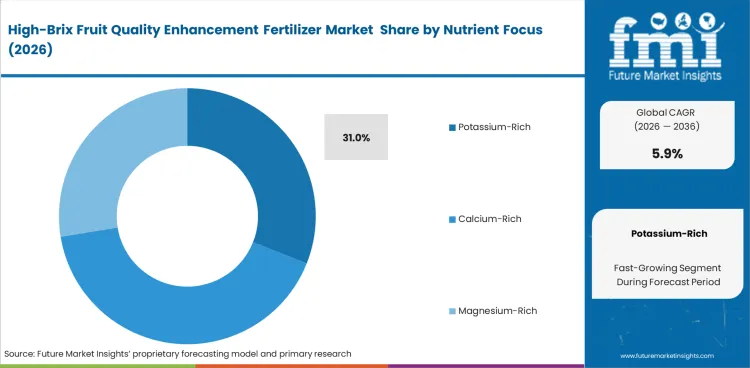
- Potassium-rich products are expected to remain the leading nutrient focus segment with a 31.0% share in 2026.
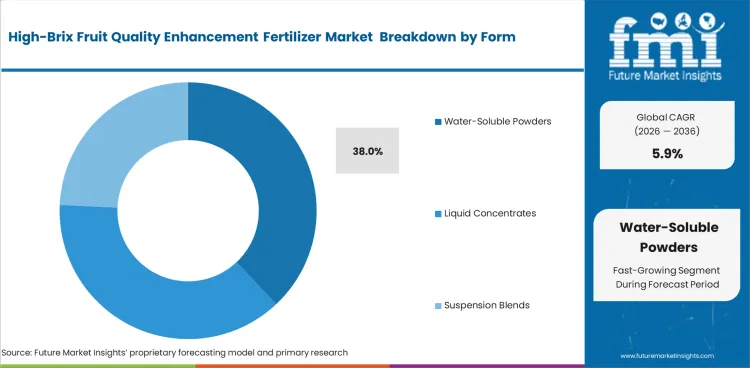
- Water-soluble powders are expected to hold the leading form share at 38.0% because orchard programs need rapid dissolution and flexible blending.
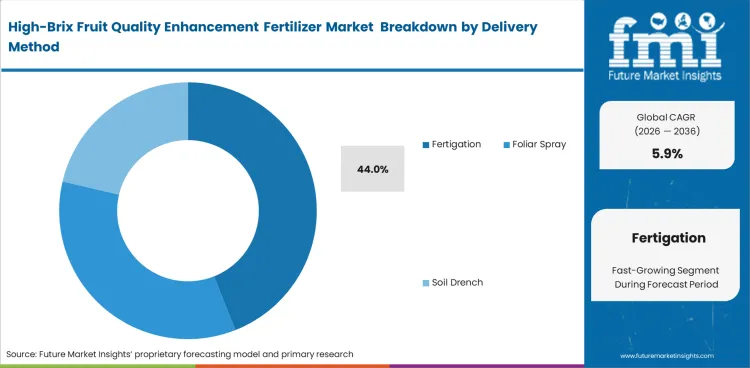
- Fertigation is projected to lead delivery method demand with a 44.0% share because growers match nutrient timing to sugar loading periods.
- Grapes are expected to remain the leading fruit type segment with a 24.0% share in 2026 due to export quality discipline.
- Geography and Competitive Outlook
- India and China are expected to record the fastest country growth because fruit acreage modernization and fertigation use are rising.
- Spain and Italy keep strong demand because export fruit programs reward color and firmness while soluble solids consistency remains essential.
- Yara International is estimated to lead the competitive set with a 13.0% share, while Haifa Group and ICL Group remain strong in specialty soluble nutrition.
- The market remains moderately fragmented because regional distributors and crop advisers still influence brand choice at orchard level.
- Analyst Opinion
- Nikhil Kaitwade, Principal Analyst at FMI says, “Industry is moving toward nutrition programs that support sugar accumulation and firmness retention while export packout matters more than simple yield gain alone. Growers now judge a fertilizer program by how clearly it improves soluble solids and shelf performance in a narrow harvest window. Pressure is rising from tighter residue expectations and from the need to protect margins in premium fruit chains. Companies with strong soluble nutrition portfolios and credible field advisory support are better placed because adoption still depends on crop-stage timing and local agronomy confidence. The product shift is moving toward potassium-led blends supported by calcium and boron plus biostimulant inputs that fit fertigation and foliar correction.”
- High-Brix Fruit Quality Enhancement Fertilizer Market Value Analysis
- This category has moved from a niche premium orchard input into a structured specialty nutrition line for export fruit programs.
- Adoption is being driven by grower focus on soluble solids and firmness retention while visual finish still shapes fruit value at the point of sale.
- Market value is supported by water-soluble nutrition systems that fit fertigation schedules and short correction cycles.
- Calcium and micronutrient support keeps demand steady where cracking risk and shelf-life losses hurt realized fruit prices.
- The category gains value when nutrition plans improve packout rates instead of adding field tonnage alone.
Key Takeaways
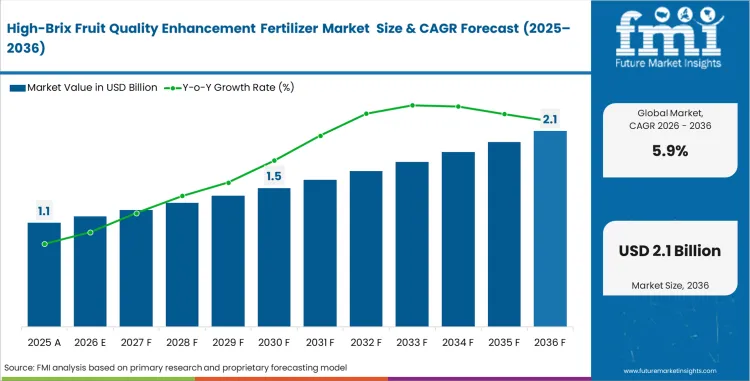
- The high-brix fruit quality enhancement fertilizer market was valued at USD 1.11 billion in 2025.
- By 2036, the high-brix fruit quality enhancement fertilizer market is expected to be worth USD 2.10 billion.
- From 2026 to 2036, the market is projected to expand at a CAGR of 5.9%.
- The market is projected to create an incremental opportunity of USD 0.92 billion between 2026 and 2036.
- In 2026, fertigation is expected to account for 44.0% of delivery method demand because soluble nutrition fits export fruit programs.
- India is projected to post a 7.4% CAGR through 2036, while China is expected to follow at 7.1%.
- Water-soluble powders are expected to hold 38.0% share in 2026 because growers need tank-mix flexibility during color and sugar-loading stages.
High-Brix Fruit Quality Enhancement Fertilizer Market Definition
The high-brix fruit quality enhancement fertilizer market includes specialty crop nutrition products sold to improve soluble solids and firmness while supporting color plus finish and storage performance in fruit crops. Products in scope are used across orchard and vineyard systems as well as berry and protected fruit systems where growers manage nutrition for premium grade realization. The market covers soluble nutrient blends and related quality-directed formulations used through fertigation or foliar spray and through targeted soil application.
High-Brix Fruit Quality Enhancement Fertilizer Market Inclusions
Market scope includes potassium-led quality blends, calcium-led firmness products, magnesium support products, boron and zinc blends, seaweed and amino based enhancers, soluble powders, liquid concentrates, suspension products, soluble granules, fertigation programs, foliar correction programs, orchard nutrition packs, vineyard quality programs, berry quality formulas, export-oriented fruit nutrition schedules, and advisory-led premium fruit input sales from 2026 to 2036.
High-Brix Fruit Quality Enhancement Fertilizer Market Exclusions
The scope excludes broad-acre commodity fertilizers, basal soil fertility products sold without fruit quality positioning, pesticide sprays, standalone irrigation hardware, packing waxes, post-harvest coatings, unrelated soil amendments, yield-only nutrient products without brix or firmness positioning, and commodity NPK sales that are not marketed for fruit quality enhancement.
High-Brix Fruit Quality Enhancement Fertilizer Market Research Methodology
- Primary Research: FMI analysts discussed orchard feeding practices with fruit growers and export packhouse advisers as well as fertigation consultants and regional distributors active in grapes and citrus programs.
- Desk Research: The study used government crop reports and fertilizer regulation documents along with codex quality references and official horticulture updates plus company releases on specialty nutrition investments.
- Market sizing and forecasting: The model combined specialty fertilizer spending per hectare with adoption levels in export fruit crops and then adjusted usage intensity by delivery system and crop value.
- Data validation: Forecasts were checked against specialty fertilizer parent categories and fruit acreage patterns as well as irrigation trends and company footprint evidence before the market curve was finalized.
Why is the High-Brix Fruit Quality Enhancement Fertilizer Market Growing?
- Export fruit chains now reward consistent sugar levels and firmness, which makes late-season nutrition programs more commercially important.
- Fertigation expansion is raising demand for soluble formulas that can be timed around sizing and ripening periods.
- Calcium support and balanced potassium feeding help reduce cracking and handling losses in premium fruit channels.
- Advisory-led selling is improving adoption because growers need crop-stage guidance and tank-mix confidence before switching brands.
Fruit quality is now tied more closely to realized farm income because premium chains pay for repeatable eating quality and stronger shipment performance. Growers who ship grapes and berries as well as citrus and pome fruit cannot rely on broad feeding plans when buyer specifications focus on finish and firmness plus sugar accumulation. This pattern supports products that act within a defined crop stage and that fit fertigation or foliar correction without interrupting existing spray schedules. Market expansion therefore tracks quality discipline in export horticulture rather than simple fruit acreage alone.
Another layer of growth comes from irrigation modernization and tighter nutrient-use expectations across orchard systems. Soluble products fit drip and micro-sprinkler programs that allow staged nutrition close to ripening. Growers can direct potassium and calcium plus boron and supportive biostimulants when visual finish and sugar loading matter most. That precision matters more in high-value fruit because rejected cartons quickly erase margin gains from higher yield. The category grows when a nutrition program helps secure a better grade outcome at harvest and after transport.
Market Segmentation Analysis
- Potassium-rich nutrition leads nutrient focus demand with a 31.0% share in 2026 because sugar loading remains the first quality target.
- Water-soluble powders hold 38.0% of form demand in 2026 as growers prefer rapid mixing and flexible dose correction.
- Fertigation leads delivery method demand with a 44.0% share because drip-fed orchards need staged nutrition through ripening.
- Grapes account for the largest fruit type share at 24.0% in 2026 because export quality thresholds are strict and pricing reacts quickly.
The market is segmented by nutrient focus, form, delivery method, fruit type, and farm type. Segment structure follows how growers buy quality-directed crop nutrition rather than how bulk fertilizer output is reported. Potassium-rich blends and water-soluble powders together with fertigation programs form the commercial core because they connect timing precision with observable fruit quality change. Grapes and export orchards keep a large share of spend because buyers in those chains place clear value on sugar loading and firmness plus finish.
Insights into the Potassium-Rich Nutrient Focus Segment
High-Brix Fruit Quality Enhancement Fertilizer Market Analysis By Nutrient Focus
- In 2026, potassium-rich products are expected to account for 31.0% of the nutrient focus segment. This lead reflects their direct role in sugar transport and fruit filling across grapes and citrus as well as pome crops.
- Calcium-rich products keep a strong secondary position because firmness support matters in long-haul fruit programs and in crops exposed to cracking risk near harvest.
- Micronutrient blends gain traction where boron and zinc correction plus magnesium support improve uniformity and visual quality in premium fruit grades.
Insights into the Water-Soluble Powders Form Segment
High-Brix Fruit Quality Enhancement Fertilizer Market Analysis By Form
- Water-soluble powders are expected to hold 38.0% of the form segment in 2026. Growers favor them because they dissolve fast and fit fertigation tanks used in export orchards.
- Liquid concentrates keep strong adoption where growers want quick foliar correction and lower handling effort during tight pre-harvest schedules.
- Soluble granules remain relevant in dealer-led programs that need easier storage and lower dust release during on-farm mixing.
Insights into the Fertigation Delivery Method Segment
High-Brix Fruit Quality Enhancement Fertilizer Market Analysis By Delivery Method
- Fertigation is projected to command 44.0% of the delivery method segment in 2026. Drip-fed orchards rely on stage-specific feeding that can be shifted with weather and fruit load.
- Foliar spray remains important for late correction because visible fruit quality issues often need a faster intervention than root-zone feeding can provide.
- Soil drench use stays narrower because quality enhancement programs usually demand tighter timing than broad soil placement allows.
Insights into the Grapes Fruit Type Segment
High-Brix Fruit Quality Enhancement Fertilizer Market Analysis By Fruit Type
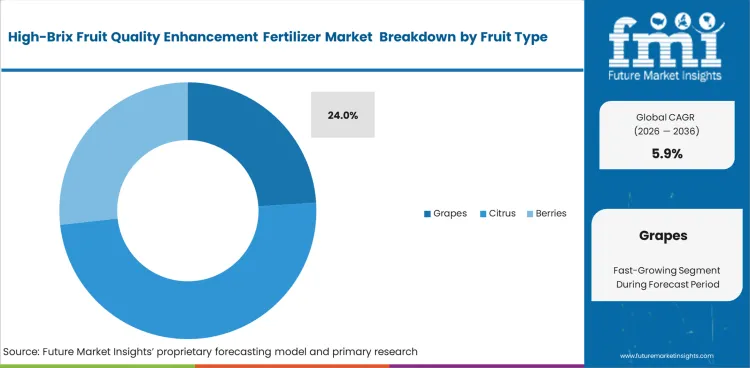
- Grapes are expected to represent 24.0% of the fruit type segment in 2026. Export table grape programs use nutrition to support berry finish and firmness while sugar balance remains a core quality target.
- Citrus remains close behind because packout depends on rind quality and internal solids while transport resilience matters across long shipment routes.
- Berry demand is rising at a faster pace because premium retailers penalize softness and inconsistent sweetness very quickly after harvest.
Insights into the Export Orchards Farm Type Segment
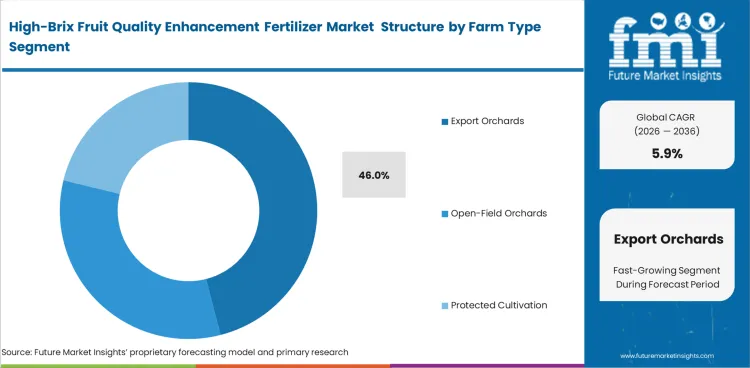
High-Brix Fruit Quality Enhancement Fertilizer Market Analysis By Farm Type
- Export orchards are expected to hold 46.0% of the farm type segment in 2026. These farms buy quality inputs when better grading can protect realized revenue.
- Protected cultivation keeps higher spending intensity per hectare because fruit quality targets are tight and fertigation control is already in place.
- Open-field orchards still account for broad volume but adoption moves more slowly where quality premiums are less consistent.
High-Brix Fruit Quality Enhancement Fertilizer Market Drivers, Restraints, and Opportunities
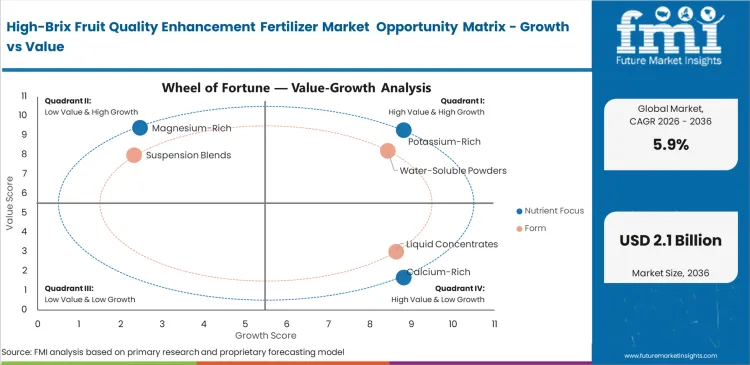
- Quality-linked fruit pricing is increasing demand for nutrition programs that improve brix and firmness while lifting visual finish near harvest.
- Product cost remains a restraint because quality-directed soluble inputs are priced well above broad nutrient blends.
- Fertigation adoption creates room for premium soluble products that deliver stage-specific nutrition with better nutrient-use control.
- Export fruit standards support demand where packout penalties are high and grower returns depend on repeatable quality.
Packout economics form the clearest demand driver for this category. When grapes and citrus as well as berries and apples miss quality thresholds, growers lose value through downgraded cartons rather than through absolute yield decline. That commercial reality favors nutrition programs that target sugar movement and firmness while supporting rind finish and storage behavior during the final crop stages. Products positioned around high-brix and premium quality therefore gain attention in export horticulture and in domestic premium channels. The strongest demand appears where advisers can connect input cost with better grade realization after sorting.
Price remains the main restraint because these products compete against lower-cost nutrition programs that promise broad crop support. Smaller growers often hesitate when field evidence is limited or when quality premiums vary by season. Adoption can stall when labor shortages or weather volatility reduce willingness to add late-season sprays, and weak farmgate prices create another barrier. The category therefore depends on technical selling and crop-stage guidance rather than on simple price competition. Brands that fail to show clear field results can lose repeat business quickly.
Precision irrigation creates the most visible opportunity because it allows growers to move from generic feeding toward stage-specific quality management. Drip and micro-sprinkler systems make it easier to dose soluble products in narrow ripening windows. That supports premium blends that combine potassium and calcium with boron plus amino inputs or seaweed support around fruit quality goals. The opportunity is strongest in fruit zones that modernize irrigation while expanding export orientation. Suppliers with crop programs rather than single products are better placed to capture that shift.
Analysis of High-Brix Fruit Quality Enhancement Fertilizer Market By Key Countries
.webp "Top Country Growth Comparison High Brix Fruit Quality Enhancement Fertilizer Market Cagr (2026 2036)")
| Country | CAGR |
|---|---|
| India | 7.4% |
| China | 7.1% |
| Brazil | 6.6% |
| Spain | 6.0% |
| Italy | 5.8% |
| United States | 5.2% |
| Japan | 4.9% |
Source: FMI analysis based on primary research and proprietary forecasting model
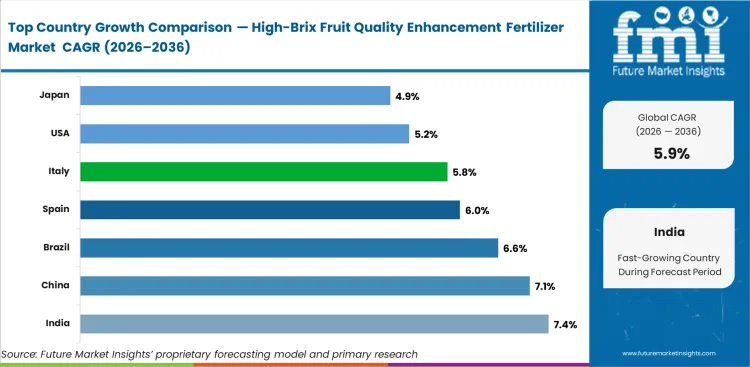
High-Brix Fruit Quality Enhancement Fertilizer Market CAGR Analysis By Country
- India leads with a 7.4% CAGR because fertigation use and premium fruit exports continue to expand.
- China follows at 7.1% as orchard modernization and quality grading systems gain more influence.
- Brazil is expected to record 6.6% CAGR because export fruit chains and specialty nutrition use keep widening.
- Spain and Italy remain steady growth markets because fruit exporters already buy quality-focused nutrition inputs.
- The United States and Japan grow at a slower pace because specialty programs are established and replacement demand is more mature.
Global growth averages 5.9% through 2036, yet country performance diverges based on irrigation penetration and export orientation plus advisory depth. India and China sit above the average because orchard modernization is still widening the addressable base for soluble quality nutrition. Spain and Italy stay important because growers already work within strict packout standards and keep spending to defend grade performance. The United States and Japan expand more steadily because much of the premium fruit base already uses specialized feeding programs.
Demand Outlook for High-Brix Fruit Quality Enhancement Fertilizer Market in India
High-Brix Fruit Quality Enhancement Fertilizer Market Country Value Analysis
India is projected to expand at a CAGR of 7.4% through 2036 as grape and pomegranate programs plus other premium fruit systems rely more heavily on fertigation-led quality management. Drip irrigation expansion and stronger exporter discipline are improving the case for late-stage nutrition that lifts sugar loading and finish. Specialty input suppliers are deepening field support because adoption still depends on guidance during sizing and ripening. That combination keeps India at the top of the country growth ranking for this study.
- Grape export programs keep demand strong for quality-directed soluble nutrition.
- Drip irrigation expansion supports staged feeding through ripening windows.
- Adviser-led selling improves confidence in premium orchard programs.
Sales Analysis of High-Brix Fruit Quality Enhancement Fertilizer Market in China
China is expected to grow at a CAGR of 7.1% through 2036 as fruit growers upgrade orchard management and packhouse sorting standards. Premium grapes and citrus as well as apples increasingly compete on eating quality and finish rather than on volume alone. Specialty fertilizer suppliers benefit when growers adopt soluble programs that match irrigation upgrades and closer harvest control. The country remains a large opportunity because even a modest shift toward premium nutrition translates into meaningful demand.
- Orchard modernization improves adoption of soluble quality nutrition programs.
- Packhouse grading discipline rewards better sweetness and external finish.
- Distributor reach and technical services help suppliers scale premium products.
Opportunity Analysis of High-Brix Fruit Quality Enhancement Fertilizer Market in Brazil
Brazil is projected to record a CAGR of 6.6% through 2036 because export fruit chains and intensive horticulture zones are strengthening demand for premium nutrition. Grapes and citrus as well as tropical fruits create room for products that improve firmness and transport resilience. Suppliers with strong distributor partnerships perform better because crop advice and seasonal availability both matter. Brazil stays attractive where irrigation systems and export-oriented farms support recurring use of soluble and foliar quality inputs.
- Export fruit channels support value capture from better packout and firmness.
- Irrigated fruit zones fit fertigation programs with staged nutrient delivery.
- Distributor strength remains important for repeat use across wide growing areas.
Demand Outlook for High-Brix Fruit Quality Enhancement Fertilizer Market in Spain
Spain is projected to advance at a CAGR of 6.0% through 2036 as exporters protect fruit quality under competitive retail programs. Citrus and berries as well as grapes and stone fruit all require strong finish and shipment tolerance. Nutrition inputs aimed at soluble solids and firmness therefore remain relevant even in a mature specialty market. Spain keeps solid demand because growers already understand how quality failures affect realized returns in export channels.
- Export discipline supports steady spending on crop quality nutrition tools.
- Berry and citrus programs need firmness support during shipment periods.
- Mature agronomy networks help suppliers defend premium product pricing.
Future Outlook for High-Brix Fruit Quality Enhancement Fertilizer Market in Italy
Italy is expected to grow at a CAGR of 5.8% through 2036 because premium grapes and kiwifruit as well as apples and stone fruit rely on strong finish and storage behavior. Growers use specialized nutrition to support uniformity in crops that face strict grading expectations. Market expansion is moderate rather than rapid because adoption is already established in many premium regions. Even so, demand stays resilient where fruit quality drives export value and repeat retail placement.
- Premium fruit regions keep quality nutrition use embedded in orchard plans.
- Storage-sensitive crops support calcium and micronutrient product demand.
- Established specialty supply chains favor repeat orders over trial activity.
Demand Analysis of High-Brix Fruit Quality Enhancement Fertilizer Market in the United States
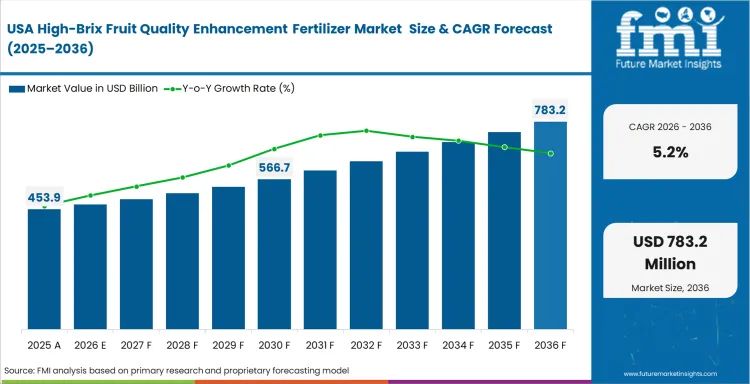
The United States is projected to progress at a CAGR of 5.2% through 2036 as premium fruit programs continue to invest in quality consistency rather than basic nutrition alone. California grape and citrus growers as well as berry and tree fruit growers already use specialized crop feeding in many regions. Growth therefore comes more from program refinement and replacement demand than from first-time adoption. Suppliers that combine field evidence with compatibility across spray and irrigation systems keep the strongest commercial position.
- Mature premium fruit systems support steady replacement and upgrade demand.
- Compatibility with existing spray programs remains a critical buying factor.
- Crop advisers influence repeat sales where product differentiation is narrow.
In-depth Analysis of High-Brix Fruit Quality Enhancement Fertilizer Market in Japan
Japan is expected to grow at a CAGR of 4.9% through 2036 because premium fruit quality standards remain strict and growers continue to value finish and sweetness. Demand growth is slower because many quality-focused orchards already operate with specialized nutrition regimes. The market still offers dependable revenue because consumers and retailers reward consistency in premium fruit categories. Suppliers need precise advisory support since product changes are adopted carefully and only after local validation.
- Premium fruit positioning supports ongoing demand for quality-linked nutrition.
- Adoption moves carefully because growers expect strong local performance proof.
- Smaller orchard structure favors trusted brands and precise field guidance.
Competitive Landscape and Strategic Positioning
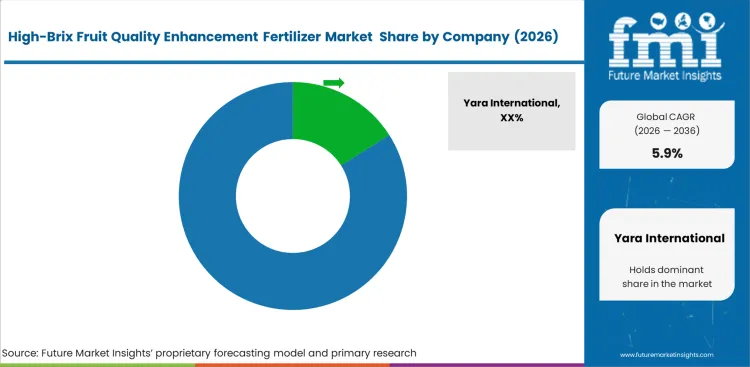
High-Brix Fruit Quality Enhancement Fertilizer Market Analysis By Company
- Yara International is estimated to lead with a 13.0% share because its soluble nutrition portfolio and agronomy reach are both broad.
- Haifa Group and ICL Group remain strong because fertigation and specialty soluble products sit at the center of their crop nutrition offers.
- Syngenta Biologicals and COMPO EXPERT as well as SQM and K+S compete through crop programs that combine quality nutrition with advisory selling.
- The market stays moderately fragmented because regional distributors still shape access and grower loyalty in orchard zones.
Competition in this market depends on crop-stage credibility. Growers buy when a program fits the ripening calendar and shows visible fruit quality improvement without disrupting other spray operations. That gives an edge to suppliers with strong soluble portfolios and local demonstrations plus advisers who can translate product claims into orchard schedules. Brand strength matters, yet local technical trust still decides conversion in many fruit belts. Competitive advantage therefore comes from service depth as much as from formulation breadth.
Large specialty suppliers hold an advantage where fertigation systems are already common and growers want packaged quality programs. Yara and Haifa as well as ICL fit this pattern because they sell soluble inputs with broad field support. COMPO EXPERT and SQM as well as K+S perform well where crop-specific positioning and distributor relationships are strong. Syngenta Biologicals has room to gain where fruit quality programs increasingly combine nutrition with biostimulant support. The category remains open enough for regional specialists when they prove performance on local fruit varieties.
Recent expansion activity points to a supply chain that is moving closer to key horticulture regions. ICL signed a specialty fertilizer distribution agreement in China during 2024 and opened a water-soluble fertilizer facility in Maharashtra during 2026. Haifa expanded through India partnerships during 2024 and opened a new Multicote blending facility in Brazil during 2025. These moves matter because high-brix programs rely on in-season product availability and technical follow-up. Suppliers that improve local stocking and crop support can convert trials into repeat orchard programs faster.
Key Companies in the High-Brix Fruit Quality Enhancement Fertilizer Market
Key global companies leading the high-brix fruit quality enhancement fertilizer market include:
- Yara International and Haifa Group as well as ICL Group have strong positions because they pair specialty soluble nutrition with broad field support in intensive fruit regions.
- COMPO EXPERT and SQM perform well where crop-specific potassium and calcium plus micronutrient programs are sold through technical distribution channels.
- Syngenta Biologicals and K+S hold relevant positions where quality-focused orchard nutrition increasingly includes biostimulant support and targeted secondary nutrient inputs.
Competitive Benchmarking: High-Brix Fruit Quality Enhancement Fertilizer Market
| Company | Soluble Nutrition Breadth | Fruit Program Depth | Advisory Reach | Geographic Footprint |
|---|---|---|---|---|
| Yara International | High | Strong | Strong | Global |
| Haifa Group | High | Strong | Moderate | Global |
| ICL Group | High | Strong | Strong | Global |
| COMPO EXPERT | Medium | Strong | Moderate | Europe, Latin America |
| Syngenta Biologicals | Medium | Moderate | Strong | Global |
| SQM | Medium | Moderate | Moderate | Latin America, Global |
| K+S Group | Medium | Moderate | Moderate | Europe, Global |
Source: Future Market Insights competitive analysis, 2026.
Key Developments in High-Brix Fruit Quality Enhancement Fertilizer Market
- In April 2024, Mahadhan Agritech and Haifa Group announced an agreement to promote specialty fertilizers aimed at improving crop quality and productivity in India and other countries.
- In July 2024, ICL expanded its specialty plant nutrition footprint in North America through an acquisition that added local crop nutrition capabilities.
- In August 2024, ICL signed a specialty fertilizer distribution agreement in China valued at about USD 170 million.
- In March 2026, ICL opened a new water-soluble fertilizer production facility in Maharashtra to strengthen supply security for Indian growers.
Key Players in the High-Brix Fruit Quality Enhancement Fertilizer Market
Major Global Players
- Yara International
- Haifa Group
- ICL Group
- COMPO EXPERT
- Syngenta Biologicals
Emerging Players/Startups
- SQM
- K+S Group
Report Scope and Coverage
| Parameter | Details |
|---|---|
| Quantitative Units | USD 1.18 billion to USD 2.10 billion, at a CAGR of 5.9% |
| Market Definition | The market covers specialty fertilizer products sold to improve soluble solids, firmness, color, finish, and storage performance in fruit crops. |
| Regions Covered | North America, Latin America, Europe, East Asia, South Asia and Pacific, Middle East and Africa |
| Countries Covered | India, China, Brazil, Spain, Italy, United States, Japan, 30+ countries |
| Key Companies Profiled | Yara International, Haifa Group, ICL Group, COMPO EXPERT, Syngenta Biologicals, SQM, K+S Group |
| Forecast Period | 2026 to 2036 |
| Approach | Hybrid bottom-up and top-down methodology starting with verified transaction data and projected adoption across fruit crops |
| Historical Reference Year | 2025 |
High-Brix Fruit Quality Enhancement Fertilizer Market by Segments
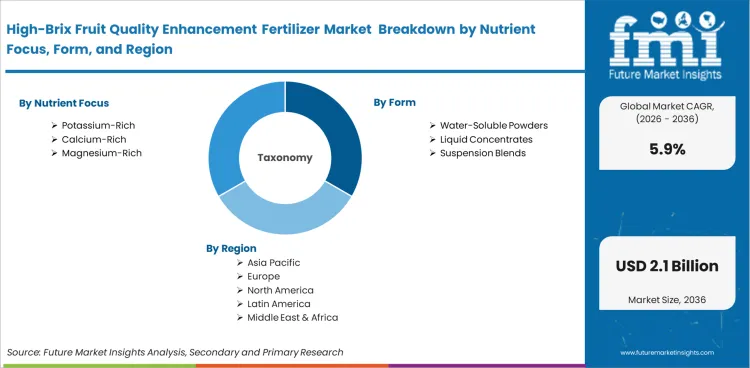
High-Brix Fruit Quality Enhancement Fertilizer Market Segmented by Nutrient Focus:
- Potassium-Rich
- Calcium-Rich
- Magnesium-Rich
- Micronutrient Blends
- Carbon-Based Inputs
- Amino and Seaweed Inputs
High-Brix Fruit Quality Enhancement Fertilizer Market Segmented by Form:
- Water-Soluble Powders
- Liquid Concentrates
- Suspension Blends
- Soluble Granules
High-Brix Fruit Quality Enhancement Fertilizer Market Segmented by Delivery Method:
- Fertigation
- Foliar Spray
- Soil Drench
High-Brix Fruit Quality Enhancement Fertilizer Market Segmented by Fruit Type:
- Grapes
- Citrus
- Berries
- Pome Fruits
- Stone Fruits
- Tropical Fruits
High-Brix Fruit Quality Enhancement Fertilizer Market Segmented by Farm Type:
- Export Orchards
- Open-Field Orchards
- Protected Cultivation
High-Brix Fruit Quality Enhancement Fertilizer Market by Region:
- North America
- United States
- Canada
- Mexico
- Latin America
- Brazil
- Chile
- Rest of Latin America
- Europe
- Spain
- Italy
- France
- Germany
- Rest of Europe
- East Asia
- China
- Japan
- South Korea
- South Asia and Pacific
- India
- ASEAN
- Australia and New Zealand
- Rest of South Asia and Pacific
- Middle East and Africa
- South Africa
- Other GCC Countries
- Rest of Middle East and Africa
Research Sources and Bibliography
- Food and Agriculture Organization of the United Nations. (2025). Codex general standard for fruit juices and nectars (CXS 247-2005, current edition).
- European Commission. (2025). Fertilising products regulation frequently asked questions.
- Department for Environment, Food and Rural Affairs. (2024). British survey of fertiliser practice 2024.
- USA Department of Agriculture Foreign Agricultural Service. (2025). Fresh deciduous fruit annual: China.
- USA Department of Agriculture Foreign Agricultural Service. (2025). Citrus annual: Mexico.
- ICL Group. (2024). ICL continues global specialty fertilizers expansion with approximately $170 million distribution agreement in China.
- Haifa Group. (2024). Haifa Group expands to India. https://www.haifa-group.com/events/haifa-group-expands-to-India
- Deepak Fertilisers and Petrochemicals Corporation Limited. (2024). Mahadhan Agritech and Haifa Group unite to drive agricultural innovation in India.
- ICL Growing Solutions. (2026). ICL Group opens specialty fertilizer manufacturing facility in India.
- Haifa Group. (2025). Haifa Group expands in Brazil: New Multicote blending facility opens in Uberlândia.
This Report Answers
- What is the current and future size of the high-brix fruit quality enhancement fertilizer market?
- How fast is the high-brix fruit quality enhancement fertilizer market expected to grow between 2026 and 2036?
- Which nutrient focus segment is likely to lead the high-brix fruit quality enhancement fertilizer market by 2026?
- Which delivery method segment is expected to account for the highest demand by 2026?
- What factors are driving demand for high-brix fruit quality enhancement fertilizer across export fruit chains?
- How are fertigation and foliar correction practices shaping product adoption in premium fruit programs?
- Which countries are projected to show the fastest growth through 2036 in the high-brix fruit quality enhancement fertilizer market?
- What is driving expansion in India and China for high-brix fruit quality enhancement fertilizer products?
- Who are the key companies active in the high-brix fruit quality enhancement fertilizer market?
- How does FMI estimate and validate the high-brix fruit quality enhancement fertilizer market forecast?
Frequently Asked Questions
What is the global market demand for High-Brix Fruit Quality Enhancement Fertilizer in 2026?
In 2026, the global market for High-Brix Fruit Quality Enhancement Fertilizer is expected to be worth USD 1.18 billion and remain closely tied to export fruit quality spending.
How big will the market for High-Brix Fruit Quality Enhancement Fertilizer be in 2036?
By 2036, the market for High-Brix Fruit Quality Enhancement Fertilizer is expected to be worth USD 2.10 billion as premium fruit nutrition programs keep expanding globally.
How much will demand for High-Brix Fruit Quality Enhancement Fertilizer grow between 2026 and 2036?
Between 2026 and 2036, demand for High-Brix Fruit Quality Enhancement Fertilizer is expected to expand at a CAGR of 5.9% as fertigation adoption rises.
Which delivery method segment is likely to lead High-Brix Fruit Quality Enhancement Fertilizer demand by 2026?
Fertigation is expected to lead High-Brix Fruit Quality Enhancement Fertilizer demand by 2026 with 44.0% share because growers need stage-specific nutrient control.
What is causing demand to rise in India for High-Brix Fruit Quality Enhancement Fertilizer?
India is expected to grow at 7.4% CAGR through 2036 because export grapes and other premium fruit programs increasingly rely on fertigation-led quality management.
What is causing demand to rise in China for High-Brix Fruit Quality Enhancement Fertilizer?
China is expected to grow at 7.1% CAGR through 2036 because orchard modernization and stricter packhouse grading support greater use of soluble quality nutrition.
What does this report mean by High-Brix Fruit Quality Enhancement Fertilizer market definition?
The High-Brix Fruit Quality Enhancement Fertilizer market includes specialty products used to improve fruit sweetness and firmness while supporting finish and storage behavior in commercial fruit systems.
How does FMI make the High-Brix Fruit Quality Enhancement Fertilizer forecast and check it?
FMI uses a hybrid bottom-up and top-down approach, then checks adoption against fruit crop value and irrigation trends plus specialty fertilizer categories and supplier footprint evidence.
Preview the report firsthand - request a free sample
Get SampleGet the brochure for pricing and purchase details.
Get PDFTable of Content
- Executive Summary
- Global Market Outlook
- Demand-side Trends
- Supply-side Trends
- Technology Roadmap Analysis
- Analysis and Recommendations
- Market Overview
- Market Coverage / Taxonomy
- Market Definition / Scope / Limitations
- Research Methodology
- Chapter Orientation
- Analytical Lens and Working Hypotheses
- Market Structure, Signals, and Trend Drivers
- Benchmarking and Cross-market Comparability
- Market Sizing, Forecasting, and Opportunity Mapping
- Research Design and Evidence Framework
- Desk Research Programme (Secondary Evidence)
- Company Annual and Sustainability Reports
- Peer-reviewed Journals and Academic Literature
- Corporate Websites, Product Literature, and Technical Notes
- Earnings Decks and Investor Briefings
- Statutory Filings and Regulatory Disclosures
- Technical White Papers and Standards Notes
- Trade Journals, Industry Magazines, and Analyst Briefs
- Conference Proceedings, Webinars, and Seminar Materials
- Government Statistics Portals and Public Data Releases
- Press Releases and Reputable Media Coverage
- Specialist Newsletters and Curated Briefings
- Sector Databases and Reference Repositories
- FMI Internal Proprietary Databases and Historical Market Datasets
- Subscription Datasets and Paid Sources
- Social Channels, Communities, and Digital Listening Inputs
- Additional Desk Sources
- Expert Input and Fieldwork (Primary Evidence)
- Primary Modes
- Qualitative Interviews and Expert Elicitation
- Quantitative Surveys and Structured Data Capture
- Blended Approach
- Why Primary Evidence is Used
- Field Techniques
- Interviews
- Surveys
- Focus Groups
- Observational and In-context Research
- Social and Community Interactions
- Stakeholder Universe Engaged
- C-suite Leaders
- Board Members
- Presidents and Vice Presidents
- R&D and Innovation Heads
- Technical Specialists
- Domain Subject-matter Experts
- Scientists
- Physicians and Other Healthcare Professionals
- Governance, Ethics, and Data Stewardship
- Research Ethics
- Data Integrity and Handling
- Primary Modes
- Tooling, Models, and Reference Databases
- Desk Research Programme (Secondary Evidence)
- Data Engineering and Model Build
- Data Acquisition and Ingestion
- Cleaning, Normalisation, and Verification
- Synthesis, Triangulation, and Analysis
- Quality Assurance and Audit Trail
- Market Background
- Market Dynamics
- Drivers
- Restraints
- Opportunity
- Trends
- Scenario Forecast
- Demand in Optimistic Scenario
- Demand in Likely Scenario
- Demand in Conservative Scenario
- Opportunity Map Analysis
- Product Life Cycle Analysis
- Supply Chain Analysis
- Investment Feasibility Matrix
- Value Chain Analysis
- PESTLE and Porter’s Analysis
- Regulatory Landscape
- Regional Parent Market Outlook
- Production and Consumption Statistics
- Import and Export Statistics
- Market Dynamics
- Global Market Analysis 2021 to 2025 and Forecast, 2026 to 2036
- Historical Market Size Value (USD Million) Analysis, 2021 to 2025
- Current and Future Market Size Value (USD Million) Projections, 2026 to 2036
- Y-o-Y Growth Trend Analysis
- Absolute $ Opportunity Analysis
- Global Market Pricing Analysis 2021 to 2025 and Forecast 2026 to 2036
- Global Market Analysis 2021 to 2025 and Forecast 2026 to 2036, By Nutrient Focus
- Introduction / Key Findings
- Historical Market Size Value (USD Million) Analysis By Nutrient Focus , 2021 to 2025
- Current and Future Market Size Value (USD Million) Analysis and Forecast By Nutrient Focus , 2026 to 2036
- Potassium-Rich
- Calcium-Rich
- Magnesium-Rich
- Potassium-Rich
- Y-o-Y Growth Trend Analysis By Nutrient Focus , 2021 to 2025
- Absolute $ Opportunity Analysis By Nutrient Focus , 2026 to 2036
- Global Market Analysis 2021 to 2025 and Forecast 2026 to 2036, By Form
- Introduction / Key Findings
- Historical Market Size Value (USD Million) Analysis By Form, 2021 to 2025
- Current and Future Market Size Value (USD Million) Analysis and Forecast By Form, 2026 to 2036
- Water-Soluble Powders
- Liquid Concentrates
- Suspension Blends
- Water-Soluble Powders
- Y-o-Y Growth Trend Analysis By Form, 2021 to 2025
- Absolute $ Opportunity Analysis By Form, 2026 to 2036
- Global Market Analysis 2021 to 2025 and Forecast 2026 to 2036, By Delivery Method
- Introduction / Key Findings
- Historical Market Size Value (USD Million) Analysis By Delivery Method, 2021 to 2025
- Current and Future Market Size Value (USD Million) Analysis and Forecast By Delivery Method, 2026 to 2036
- Fertigation
- Foliar Spray
- Soil Drench
- Fertigation
- Y-o-Y Growth Trend Analysis By Delivery Method, 2021 to 2025
- Absolute $ Opportunity Analysis By Delivery Method, 2026 to 2036
- Global Market Analysis 2021 to 2025 and Forecast 2026 to 2036, By Fruit Type
- Introduction / Key Findings
- Historical Market Size Value (USD Million) Analysis By Fruit Type, 2021 to 2025
- Current and Future Market Size Value (USD Million) Analysis and Forecast By Fruit Type, 2026 to 2036
- Grapes
- Citrus
- Berries
- Grapes
- Y-o-Y Growth Trend Analysis By Fruit Type, 2021 to 2025
- Absolute $ Opportunity Analysis By Fruit Type, 2026 to 2036
- Global Market Analysis 2021 to 2025 and Forecast 2026 to 2036, By Farm Type
- Introduction / Key Findings
- Historical Market Size Value (USD Million) Analysis By Farm Type, 2021 to 2025
- Current and Future Market Size Value (USD Million) Analysis and Forecast By Farm Type, 2026 to 2036
- Export Orchards
- Open-Field Orchards
- Protected Cultivation
- Export Orchards
- Y-o-Y Growth Trend Analysis By Farm Type, 2021 to 2025
- Absolute $ Opportunity Analysis By Farm Type, 2026 to 2036
- Global Market Analysis 2021 to 2025 and Forecast 2026 to 2036, By Region
- Introduction
- Historical Market Size Value (USD Million) Analysis By Region, 2021 to 2025
- Current Market Size Value (USD Million) Analysis and Forecast By Region, 2026 to 2036
- North America
- Latin America
- Western Europe
- Eastern Europe
- East Asia
- South Asia and Pacific
- Middle East & Africa
- Market Attractiveness Analysis By Region
- North America Market Analysis 2021 to 2025 and Forecast 2026 to 2036, By Country
- Historical Market Size Value (USD Million) Trend Analysis By Market Taxonomy, 2021 to 2025
- Market Size Value (USD Million) Forecast By Market Taxonomy, 2026 to 2036
- By Country
- USA
- Canada
- Mexico
- By Nutrient Focus
- By Form
- By Delivery Method
- By Fruit Type
- By Farm Type
- By Country
- Market Attractiveness Analysis
- By Country
- By Nutrient Focus
- By Form
- By Delivery Method
- By Fruit Type
- By Farm Type
- Key Takeaways
- Latin America Market Analysis 2021 to 2025 and Forecast 2026 to 2036, By Country
- Historical Market Size Value (USD Million) Trend Analysis By Market Taxonomy, 2021 to 2025
- Market Size Value (USD Million) Forecast By Market Taxonomy, 2026 to 2036
- By Country
- Brazil
- Chile
- Rest of Latin America
- By Nutrient Focus
- By Form
- By Delivery Method
- By Fruit Type
- By Farm Type
- By Country
- Market Attractiveness Analysis
- By Country
- By Nutrient Focus
- By Form
- By Delivery Method
- By Fruit Type
- By Farm Type
- Key Takeaways
- Western Europe Market Analysis 2021 to 2025 and Forecast 2026 to 2036, By Country
- Historical Market Size Value (USD Million) Trend Analysis By Market Taxonomy, 2021 to 2025
- Market Size Value (USD Million) Forecast By Market Taxonomy, 2026 to 2036
- By Country
- Germany
- UK
- Italy
- Spain
- France
- Nordic
- BENELUX
- Rest of Western Europe
- By Nutrient Focus
- By Form
- By Delivery Method
- By Fruit Type
- By Farm Type
- By Country
- Market Attractiveness Analysis
- By Country
- By Nutrient Focus
- By Form
- By Delivery Method
- By Fruit Type
- By Farm Type
- Key Takeaways
- Eastern Europe Market Analysis 2021 to 2025 and Forecast 2026 to 2036, By Country
- Historical Market Size Value (USD Million) Trend Analysis By Market Taxonomy, 2021 to 2025
- Market Size Value (USD Million) Forecast By Market Taxonomy, 2026 to 2036
- By Country
- Russia
- Poland
- Hungary
- Balkan & Baltic
- Rest of Eastern Europe
- By Nutrient Focus
- By Form
- By Delivery Method
- By Fruit Type
- By Farm Type
- By Country
- Market Attractiveness Analysis
- By Country
- By Nutrient Focus
- By Form
- By Delivery Method
- By Fruit Type
- By Farm Type
- Key Takeaways
- East Asia Market Analysis 2021 to 2025 and Forecast 2026 to 2036, By Country
- Historical Market Size Value (USD Million) Trend Analysis By Market Taxonomy, 2021 to 2025
- Market Size Value (USD Million) Forecast By Market Taxonomy, 2026 to 2036
- By Country
- China
- Japan
- South Korea
- By Nutrient Focus
- By Form
- By Delivery Method
- By Fruit Type
- By Farm Type
- By Country
- Market Attractiveness Analysis
- By Country
- By Nutrient Focus
- By Form
- By Delivery Method
- By Fruit Type
- By Farm Type
- Key Takeaways
- South Asia and Pacific Market Analysis 2021 to 2025 and Forecast 2026 to 2036, By Country
- Historical Market Size Value (USD Million) Trend Analysis By Market Taxonomy, 2021 to 2025
- Market Size Value (USD Million) Forecast By Market Taxonomy, 2026 to 2036
- By Country
- India
- ASEAN
- Australia & New Zealand
- Rest of South Asia and Pacific
- By Nutrient Focus
- By Form
- By Delivery Method
- By Fruit Type
- By Farm Type
- By Country
- Market Attractiveness Analysis
- By Country
- By Nutrient Focus
- By Form
- By Delivery Method
- By Fruit Type
- By Farm Type
- Key Takeaways
- Middle East & Africa Market Analysis 2021 to 2025 and Forecast 2026 to 2036, By Country
- Historical Market Size Value (USD Million) Trend Analysis By Market Taxonomy, 2021 to 2025
- Market Size Value (USD Million) Forecast By Market Taxonomy, 2026 to 2036
- By Country
- Kingdom of Saudi Arabia
- Other GCC Countries
- Turkiye
- South Africa
- Other African Union
- Rest of Middle East & Africa
- By Nutrient Focus
- By Form
- By Delivery Method
- By Fruit Type
- By Farm Type
- By Country
- Market Attractiveness Analysis
- By Country
- By Nutrient Focus
- By Form
- By Delivery Method
- By Fruit Type
- By Farm Type
- Key Takeaways
- Key Countries Market Analysis
- USA
- Pricing Analysis
- Market Share Analysis, 2025
- By Nutrient Focus
- By Form
- By Delivery Method
- By Fruit Type
- By Farm Type
- Canada
- Pricing Analysis
- Market Share Analysis, 2025
- By Nutrient Focus
- By Form
- By Delivery Method
- By Fruit Type
- By Farm Type
- Mexico
- Pricing Analysis
- Market Share Analysis, 2025
- By Nutrient Focus
- By Form
- By Delivery Method
- By Fruit Type
- By Farm Type
- Brazil
- Pricing Analysis
- Market Share Analysis, 2025
- By Nutrient Focus
- By Form
- By Delivery Method
- By Fruit Type
- By Farm Type
- Chile
- Pricing Analysis
- Market Share Analysis, 2025
- By Nutrient Focus
- By Form
- By Delivery Method
- By Fruit Type
- By Farm Type
- Germany
- Pricing Analysis
- Market Share Analysis, 2025
- By Nutrient Focus
- By Form
- By Delivery Method
- By Fruit Type
- By Farm Type
- UK
- Pricing Analysis
- Market Share Analysis, 2025
- By Nutrient Focus
- By Form
- By Delivery Method
- By Fruit Type
- By Farm Type
- Italy
- Pricing Analysis
- Market Share Analysis, 2025
- By Nutrient Focus
- By Form
- By Delivery Method
- By Fruit Type
- By Farm Type
- Spain
- Pricing Analysis
- Market Share Analysis, 2025
- By Nutrient Focus
- By Form
- By Delivery Method
- By Fruit Type
- By Farm Type
- France
- Pricing Analysis
- Market Share Analysis, 2025
- By Nutrient Focus
- By Form
- By Delivery Method
- By Fruit Type
- By Farm Type
- India
- Pricing Analysis
- Market Share Analysis, 2025
- By Nutrient Focus
- By Form
- By Delivery Method
- By Fruit Type
- By Farm Type
- ASEAN
- Pricing Analysis
- Market Share Analysis, 2025
- By Nutrient Focus
- By Form
- By Delivery Method
- By Fruit Type
- By Farm Type
- Australia & New Zealand
- Pricing Analysis
- Market Share Analysis, 2025
- By Nutrient Focus
- By Form
- By Delivery Method
- By Fruit Type
- By Farm Type
- China
- Pricing Analysis
- Market Share Analysis, 2025
- By Nutrient Focus
- By Form
- By Delivery Method
- By Fruit Type
- By Farm Type
- Japan
- Pricing Analysis
- Market Share Analysis, 2025
- By Nutrient Focus
- By Form
- By Delivery Method
- By Fruit Type
- By Farm Type
- South Korea
- Pricing Analysis
- Market Share Analysis, 2025
- By Nutrient Focus
- By Form
- By Delivery Method
- By Fruit Type
- By Farm Type
- Russia
- Pricing Analysis
- Market Share Analysis, 2025
- By Nutrient Focus
- By Form
- By Delivery Method
- By Fruit Type
- By Farm Type
- Poland
- Pricing Analysis
- Market Share Analysis, 2025
- By Nutrient Focus
- By Form
- By Delivery Method
- By Fruit Type
- By Farm Type
- Hungary
- Pricing Analysis
- Market Share Analysis, 2025
- By Nutrient Focus
- By Form
- By Delivery Method
- By Fruit Type
- By Farm Type
- Kingdom of Saudi Arabia
- Pricing Analysis
- Market Share Analysis, 2025
- By Nutrient Focus
- By Form
- By Delivery Method
- By Fruit Type
- By Farm Type
- Turkiye
- Pricing Analysis
- Market Share Analysis, 2025
- By Nutrient Focus
- By Form
- By Delivery Method
- By Fruit Type
- By Farm Type
- South Africa
- Pricing Analysis
- Market Share Analysis, 2025
- By Nutrient Focus
- By Form
- By Delivery Method
- By Fruit Type
- By Farm Type
- USA
- Market Structure Analysis
- Competition Dashboard
- Competition Benchmarking
- Market Share Analysis of Top Players
- By Regional
- By Nutrient Focus
- By Form
- By Delivery Method
- By Fruit Type
- By Farm Type
- Competition Analysis
- Competition Deep Dive
- Yara International
- Overview
- Product Portfolio
- Profitability by Market Segments (Product/Age /Sales Channel/Region)
- Sales Footprint
- Strategy Overview
- Marketing Strategy
- Product Strategy
- Channel Strategy
- Haifa Group
- ICL Group
- COMPO EXPERT
- Syngenta Biologicals
- Yara International
- Competition Deep Dive
- Assumptions & Acronyms Used


