

- Industry Size (2026)
- USD 2.52 Bn
- Forecast (2036)
- USD 4.19 Bn
- CAGR (2026 to 2036)
- 5.2%
High Security Registration Plates Market Size, Market Forecast and Outlook By FMI
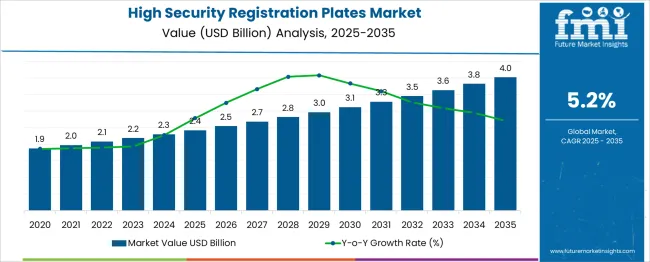
The high security registration plates market was valued at USD 2.40 billion in 2025, projected to reach USD 2.52 billion in 2026, and is forecast to expand to USD 4.19 billion by 2036 at a 5.2% CAGR. As per FMI, the high security registration plates category is transitioning from a supply-constrained commodity cycle into a specification-driven procurement environment where end-use qualification standards define purchasing decisions. Tightening quality benchmarks across downstream manufacturing segments are accelerating the shift toward certified high-purity grades, compressing the viable supplier base and reshaping contract structures across major consuming regions.
Summary of High Security Registration Plates Market
- Market Snapshot
- The high security registration plates market is valued at USD 2.40 billion in 2025 and is projected to reach USD 4.19 billion by 2036.
- The industry is expected to grow at a 5.2% CAGR from 2026 to 2036, creating an incremental opportunity of USD 1.67 billion.
- The market is a specification-driven industrial category where purity certification, supply chain traceability, and regulatory compliance define competitive positioning.
- Demand and Growth Drivers
- Demand is rising as downstream manufacturers impose stricter purity specifications and incoming quality requirements across production processes.
- Regulatory tightening and standardization mandates are compelling buyers to source exclusively from certified and auditable suppliers.
- Supply chain localization strategies in Asia Pacific and Europe are accelerating regional capacity investments and reshaping trade flows.
- Among key countries, China at 7.0%, India at 6.5%, Germany at 6.0%, France at 5.5%, UK at 4.9%, USA at 4.4%, Brazil at 3.9%.
- Product and Segment View
- RFID-embedded HSRP leads the Technology segment with 54.0% share in 2026, reflecting established adoption patterns and process integration advantages.
- Aluminum commands the Material segment with 61.0% share in 2026, driven by high-volume consumption across core end-use categories.
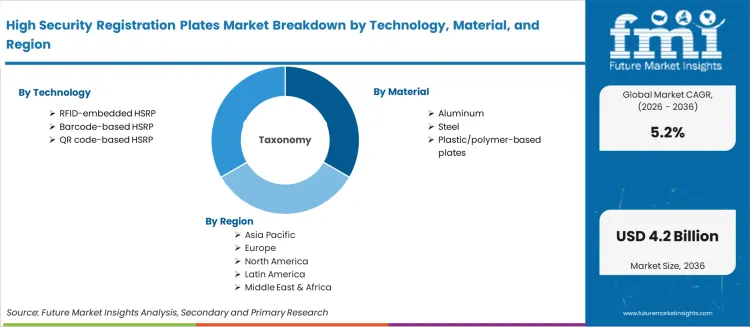
- Market scope includes RFID-embedded HSRP, Barcode-based HSRP, QR code-based HSRP; Aluminum, Steel, Plastic/polymer-based plates; Passenger vehicles, Hatchback, Sedan, SUV, Two-wheelers, Three-wheelers, Commercial vehicles, Light Commercial Vehicles, Medium Commercial Vehicles, Heavy Commercial Vehicles; OEM, Aftermarket; Government and law enforcement agencies, Private vehicle owners, Fleet operators across all major global regions.
- The scope excludes unrelated adjacent product categories and non-specification-grade materials that fall outside the defined market taxonomy.
- Geography and Competitive Outlook
- China and India are the fastest-growing markets due to industrial expansion and policy-driven procurement mandates, while UK and USA remain mature, high-value demand bases.
- Competition is shaped by purity certification capability, supply reliability, and integration with downstream qualification processes, with key players including Rosmerta Technologies, 3M Company, Fuwong, Hills Numberplates, Jepson, JH Toennjes, SAMAR’T.
- FMI is of the opinion that the competitive landscape is consolidating as smaller producers face escalating compliance costs and qualification barriers.
- Analyst Opinion at FMI
- Nikhil Kaitwade, Principal Consultant at Future Market Insights, opines: 'In my analysis, I have observed that the primary constraint in this market is not volume availability but specification compliance. Buyers operating in quality-sensitive manufacturing environments face narrowing supplier options as purity certification thresholds rise. Procurement teams that delay qualification of alternative supply sources risk operational bottlenecks as incumbent suppliers prioritize long-term contract holders over spot buyers. Organizations accelerating supplier diversification programs will capture cost stability advantages that competitors relying on single-source arrangements cannot replicate.'
- Strategic Implications / Executive Takeaways
- Procurement directors should initiate multi-source qualification programs to reduce dependency on single suppliers and secure supply continuity through the forecast period.
- Product development teams must align material specifications with evolving regulatory standards to maintain market access in specification-sensitive end-use categories.
- Capital allocation decisions should prioritize capacity investments in regions offering both raw material proximity and regulatory alignment with target export markets.
High Security Registration Plates Market Key Takeaways
| Metric | Details |
|---|---|
| Industry Size (2026) | USD 2.52 billion |
| Industry Value (2036) | USD 4.19 billion |
| CAGR (2026-2036) | 5.2% |
Source: Future Market Insights, 2026
FMI analysts observe that demand patterns are being reshaped by concurrent shifts in regulatory compliance requirements, manufacturing process intensification, and supply chain localization strategies. Procurement cycles are lengthening as buyers impose stricter incoming inspection protocols and require full traceability documentation from origin to point of use. Price formation is moving away from spot-indexed benchmarks toward formula-based contracts tied to input costs, energy indices, and purity certification premiums. Capacity additions by established producers are calibrated to qualification lead times rather than volume targets, limiting the rate at which new supply can be absorbed into specification-sensitive applications.
All major consuming regions reflect differentiated adoption trajectories shaped by local industrial policy and end-use demand composition. China sets the pace with a 7.0% CAGR, driven by aggressive industrial capacity expansion and state-backed procurement mandates. India follows at 6.5%, supported by manufacturing base diversification and growing domestic consumption requirements. Germany registers a 6.0% growth rate anchored by precision manufacturing standards and energy transition investments. France tracks at 5.5%, reflecting expanding industrial processing capacity and import substitution programs. UK advances at 4.9%, underpinned by established industrial infrastructure and replacement demand cycles. USA maintains a 4.4% trajectory supported by specialized manufacturing clusters. Brazil expands at 3.9%, shaped by mature industrial ecosystems and incremental capacity upgrades.
High Security Registration Plates Market Definition
High Security Registration Plates refers to the category of rfid-embedded hsrp, barcode-based hsrp, qr code-based hsrp and associated technologies designed to meet exacting purity and performance requirements across industrial and commercial applications. The market encompasses products classified by technology, material, vehicle, distribution channel, end use, serving buyers who require certified material grades for process-critical operations. Purchasing decisions in this category are governed by compliance with applicable industry standards, supplier qualification status, and documented traceability from production to point of use.
High Security Registration Plates Market Inclusions
Market scope includes all commercial grades of high security registration plates products sold through direct and distribution channels for industrial and commercial end use. Coverage extends to global and regional market sizes, the 2026 to 2036 forecast period, segment breakdowns by technology and material and vehicle and distribution channel and end use, and regional analysis across seven major territories.
High Security Registration Plates Market Exclusions
The scope excludes non-specification-grade materials, products intended for research-only laboratory use without commercial distribution, and adjacent product categories that fall outside the defined taxonomy. Downstream finished goods incorporating high security registration plates as a minor input component are not separately valued within this analysis.
High Security Registration Plates Market Research Methodology
- Primary Research: FMI analysts engaged with procurement managers, technical specification leads, and supply chain directors across major consuming industries to map decision gates and qualification requirements.
- Desk Research: Data collection aggregated regulatory filings, industry standards publications, trade body statistical releases, and publicly disclosed corporate capacity and investment announcements.
- Market-Sizing and Forecasting: Baseline values derive from a bottom-up aggregation of production volumes, trade flows, and end-use consumption, applying region-specific demand curves to project adoption velocity through 2036.
- Data Validation and Update Cycle: Projections are cross-validated against publicly reported financial data from leading producers and verified through iterative primary research feedback loops.
Why is the High Security Registration Plates Market Growing?
The high security registration plates (HSRP) market is being shaped by regulatory mandates, vehicle traceability initiatives, and the integration of smart identification technologies. Rising government enforcement for tamper-proof license plate systems has created momentum for widespread adoption across both private and commercial vehicle categories.
Integration with centralized vehicle databases and support from traffic safety policies have strengthened the compliance ecosystem, particularly in emerging economies. Improved manufacturing standards and advances in security printing, laser branding, and embedded chip technologies have expanded functional reliability and adoption readiness.
Over the forecast period, market growth is expected to be further supported by rising vehicle sales, public-private partnerships, and digital vehicle registration infrastructure enhancements across key automotive hubs.
Segmental Analysis
The high security registration plates market is segmented by technology, material, vehicle, distribution channel, end use, and geographic regions. The high security registration plates market is divided into RFID-embedded HSRP, Barcode-based HSRP, and QR code-based HSRP. The high security registration plates market is classified by material into Aluminum, Steel, and Plastic/polymer-based plates. The high security registration plates market is segmented into Passenger vehicles, Hatchback, Sedan, SUV, Two-wheelers, Three-wheelers, Commercial vehicles, Light Commercial Vehicles (LCV), Medium Commercial Vehicles (MCV), and Heavy Commercial Vehicles (HCV).
The distribution channel of the high security registration plates market is segmented into OEM and Aftermarket. The end use of the high security registration plates market is segmented into Government and law enforcement agencies, Private vehicle owners, and Fleet operators. Regionally, the high security registration plates industry is classified into North America, Latin America, Western Europe, Eastern Europe, Balkan & Baltic Countries, Russia & Belarus, Central Asia, East Asia, South Asia & Pacific, and the Middle East & Africa.
Insights into the RFID-embedded HSRP Technology Segment
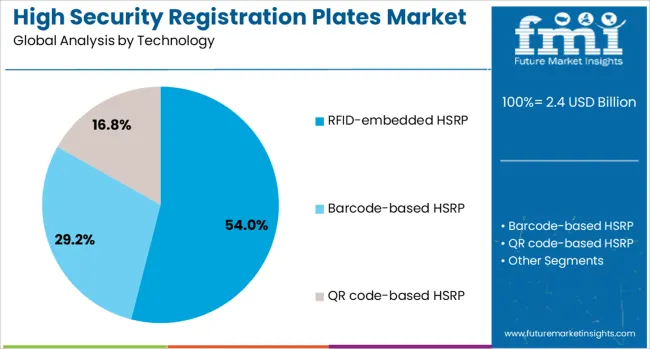
RFID-embedded HSRPs are projected to account for 54.00% of the market revenue in 2026, making them the leading technology segment. This dominance is driven by the increasing reliance on RFID-based identification systems that offer real-time data transmission, faster vehicle verification, and enhanced anti-theft capabilities.
Mandatory government guidelines in several countries have accelerated deployment in newly registered vehicles. The compatibility of RFID-enabled plates with tolling systems, smart parking, and law enforcement applications has positioned them as a foundational layer in intelligent transport infrastructure.
Their passive design, low power requirements, and minimal maintenance contribute further to operational efficiency and lifecycle cost benefits.
Insights into the Aluminum Material Segment
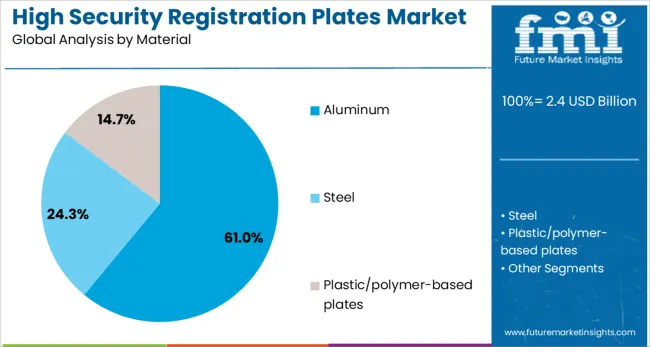
Aluminum is expected to lead the material segment with a 61.00% revenue share in 2026. Its prevalence is being attributed to its high strength-to-weight ratio, resistance to environmental degradation, and suitability for high-precision embossing and laser branding processes.
The material's recyclability and extended durability align with governmental sustainability benchmarks and automotive OEM quality standards. Moreover, aluminum’s ability to retain structural integrity under harsh conditions ensures consistent performance in both standard and high-usage fleet vehicles.
These properties have led to widespread preference across HSRP manufacturers and enforcement bodies alike.
Insights into the Passenger Vehicles Segment
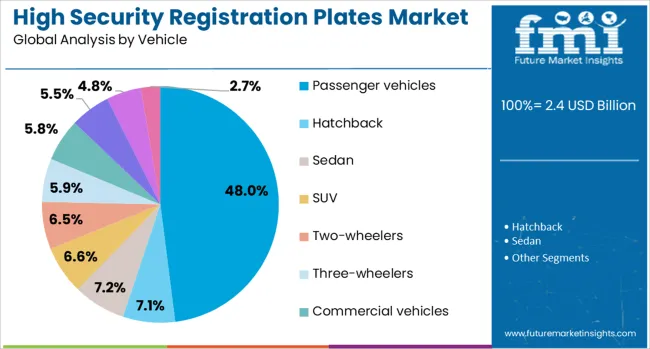
Passenger vehicles are anticipated to represent 48.00% of the market by revenue in 2026, marking them as the dominant vehicle segment. The surge in personal vehicle ownership, combined with regulatory enforcement for HSRP installation in new and existing vehicles, has led to increased deployment.
Urban regions with dense passenger vehicle populations have seen rapid implementation due to centralized monitoring programs and rising concerns over vehicle cloning and fraud. Government-subsidized compliance drives and mandatory retrofitting timelines have further expanded the adoption footprint within this category.
As digitization in vehicle registration and road surveillance scales, passenger vehicles are expected to remain the primary contributor to HSRP demand.
What are the Drivers, Restraints, and Key Trends of the High Security Registration Plates Market?
High Security Registration Plates (HSRP) are standardized vehicle license plates featuring security elements such as laser-etched codes, hot-stamped chromium holograms, and non-removable snap locks to prevent tampering and counterfeiting. These plates ensure traceability and compliance with regional transportation regulations.
Government mandates, digitization of vehicle records, and rising emphasis on road safety and theft prevention have reinforced growth. Manufacturers are adopting advanced embossing technologies, reflective films, and automated production processes to deliver tamper-proof solutions. Expansion in vehicle registrations and enforcement of uniform security norms continue to drive market adoption globally.
Regulatory Mandates and Vehicle Traceability Requirements
Adoption of HSRPs has been driven by strict government regulations aimed at standardizing vehicle identification and reducing theft. Mandates for secure registration systems in both new and existing vehicles have accelerated implementation in several regions. Increased emphasis on traffic management, automated toll collection, and road safety monitoring has reinforced the demand for secure plates integrated with unique identification features. Expansion of vehicle fleets and rising sales in emerging economies have created a significant growth opportunity for compliant solutions. Integration of HSRPs into smart transport systems has further contributed to their widespread deployment across various vehicle categories.
Implementation Delays and Cost Barriers
Market growth has been hindered by operational challenges in large-scale implementation, particularly in regions with high vehicle density and fragmented regulatory oversight. Delays in government tender processes and inconsistencies in compliance enforcement have slowed adoption. High upfront costs for plate manufacturing, embossing equipment, and holographic materials have imposed financial constraints on vendors. Limited consumer awareness and reluctance to replace existing plates with HSRPs have also affected market penetration. The presence of counterfeit and substandard plates in certain markets adds to security risks, creating challenges for authorities and genuine manufacturers striving to maintain compliance and quality standards.
Digital Integration and Regional Expansion
Significant opportunities exist in integrating HSRPs with advanced features such as embedded QR codes and RFID tags for real-time vehicle tracking and automated tolling. Partnerships with transport authorities for digitalized registration systems can provide long-term revenue streams for vendors. Emerging markets implementing stricter traffic regulations present avenues for rapid adoption, particularly in Asia-Pacific and Latin America. Expansion in aftermarket retrofitting programs for existing vehicles further boosts demand. Opportunities also lie in offering plate personalization within regulatory frameworks, supporting premium segments while maintaining security compliance. Development of centralized manufacturing and distribution hubs can improve operational efficiency for large-scale rollouts.
Automation, Tamper-Proof Designs, and RFID Integration
Current trends highlight the adoption of automated plate production systems that enhance precision and scalability in high-volume manufacturing. Advanced tamper-proof features, including self-destructive snap locks and chromium-based holographic elements, are becoming standard in premium compliance plates. RFID-enabled HSRPs are gaining prominence for seamless toll collection and vehicle monitoring. Integration with smart city infrastructure and vehicle databases is being prioritized to improve enforcement and road safety. Vendors are exploring lightweight, durable plate materials to reduce wear and tear over time. Consolidation among key players through strategic partnerships and government-approved manufacturing licenses continues to shape competitive dynamics in this sector.
Analysis of High Security Registration Plates Market By Key Countries
.webp "Top Country Growth Comparison High Security Registration Plates Market Cagr (2026 2036)")
| Country | CAGR |
|---|---|
| China | 7.0% |
| India | 6.5% |
| Germany | 6.0% |
| France | 5.5% |
| UK | 4.9% |
| USA | 4.4% |
| Brazil | 3.9% |
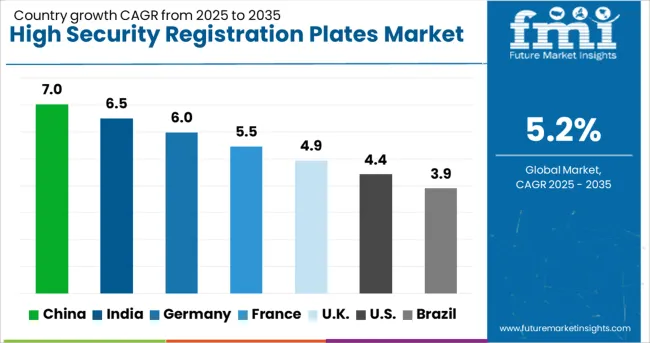
The high security registration plates (HSRP) market is projected to grow at a CAGR of 5.2% through 2036, supported by government mandates, vehicle security initiatives, and rising adoption of anti-counterfeiting technologies. China leads with a CAGR of 7.0%, driven by strict compliance norms and advanced manufacturing processes. India follows at 6.5%, benefiting from nationwide HSRP mandates for all vehicle categories. Germany records 6.0%, leveraging its advanced automotive ecosystem and demand for high-tech security solutions. The United Kingdom posts 4.9%, supported by technology integration in vehicle identification systems, while the United States grows at 4.4%, driven by standardization efforts and premium vehicle adoption. The analysis includes over 40 countries, with the top five detailed below.
Adoption in High Security Registration Plates Market in China
China is forecasted to grow at a CAGR of 7.0% through 2036, supported by strict regulatory frameworks mandating the use of tamper-proof plates for all new and existing vehicles. Rapid urbanization and rising vehicle ownership are creating high-volume demand for secure and standardized identification systems. Chinese manufacturers are leveraging automated production technologies for hot-stamped and laser-etched plates, ensuring compliance with government quality benchmarks. Integration of embedded RFID chips and QR codes is accelerating, improving law enforcement and toll collection efficiency. Partnerships between local suppliers and global security solution providers are enabling technology transfer for advanced plate designs. Strong government initiatives targeting road safety and counterfeit prevention further reinforce market adoption.
- Mandatory HSRP policies strengthen nationwide compliance rates.
- RFID and QR code integration enhance enforcement capabilities.
- Collaborations improve manufacturing efficiency and product security.
Infrastructure Growth in High Security Registration Plates Market in India
India is projected to grow at a CAGR of 6.5% through 2036, supported by the implementation of government directives mandating HSRPs for all vehicles, including retrofitting for existing fleets. Expanding vehicle ownership, coupled with initiatives to curb vehicle theft and cloning, is driving market penetration. Manufacturers are scaling production capacities to meet growing demand for embossed aluminum plates with laser-etched details and chromium-based holograms. State-level partnerships with approved vendors ensure compliance and quality assurance across regional markets. Integration of RFID tags within HSRPs facilitates vehicle tracking for toll collection, traffic monitoring, and law enforcement purposes. Growth in e-commerce-based plate distribution channels and online booking systems for HSRP installations further accelerates adoption in urban and semi-urban regions.
- Mandatory fitment for all vehicles drives large-scale adoption.
- RFID-enabled plates improve toll and traffic management systems.
- Vendor partnerships ensure standardized quality and secure supply.
Technological Advancements Fueling High Security Registration Plates Market in Germany
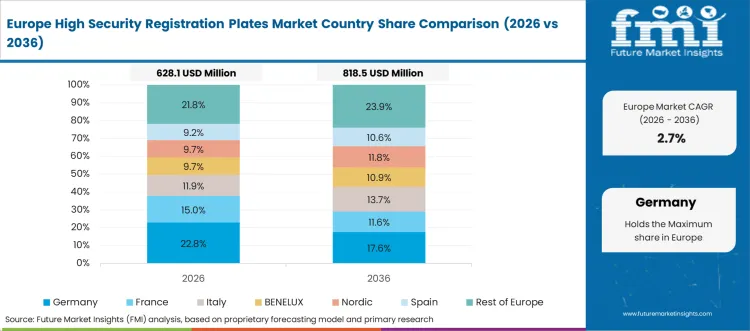
Germany is expected to expand at a CAGR of 6.0% through 2036, driven by stringent automotive security standards and advanced vehicle identification systems. High-security plates in Germany are designed with laser-etched codes, tamper-proof fasteners, and durable reflective materials to prevent counterfeiting. The demand for RFID-enabled solutions is increasing for integration with smart traffic management systems and automated tolling infrastructure. German manufacturers are adopting robotic stamping and laser-marking technologies for precision and scalability. Additionally, integration with digital vehicle registries supports real-time verification and enforcement, reducing fraud risks. Partnerships between automotive OEMs, registration authorities, and technology firms are boosting innovation in plate durability, corrosion resistance, and advanced authentication features.
- Laser-etched identifiers dominate secure plate manufacturing.
- RFID technology supports smart mobility and tolling operations.
- Collaborations enhance compliance and advanced security integration.
Implementation Trends in High Security Registration Plates Market in the United Kingdom
The United Kingdom is projected to achieve a CAGR of 4.9% through 2036, supported by regulatory adoption of high-security plates for new and imported vehicles. Demand for plates with built-in holograms, laser engravings, and tamper-evident features is growing among premium vehicle segments and fleet operators. Technology upgrades are emphasizing RFID-enabled HSRPs to enhance road monitoring and vehicle compliance systems. Domestic suppliers are collaborating with global security firms to develop plates compatible with emerging smart infrastructure. Automated production lines and advanced printing technologies ensure quality consistency in high-volume plate manufacturing. With the rising integration of connected mobility systems, HSRPs are expected to become a critical component for smart transportation frameworks.
- Adoption of hologram and laser engraving improves plate security.
- Fleet operators increasingly favor tamper-proof identification systems.
- RFID-linked plates boost efficiency in connected mobility projects.
Innovation in High Security Registration Plates Market in the United States
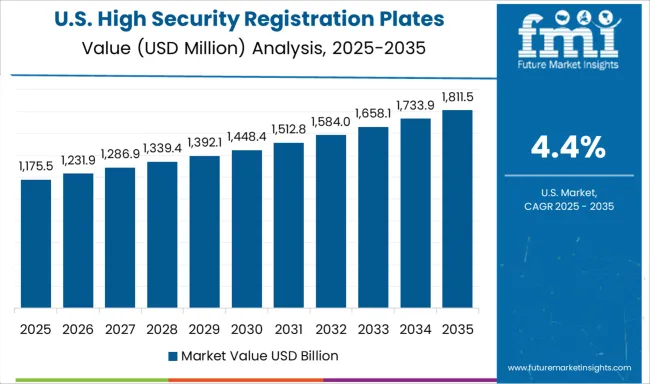
The United States is expected to post a CAGR of 4.4% through 2036, driven by federal and state initiatives promoting standardization of vehicle identification systems. High-security plates with laser-engraved serials, barcodes, and anti-cloning features are gaining traction to combat fraud and vehicle theft. The integration of RFID chips within license plates supports automated tolling, traffic monitoring, and connected vehicle applications. Leading manufacturers are investing in durable materials and advanced coating technologies to extend plate life under diverse climatic conditions. Collaborations between plate producers, automotive OEMs, and IoT solution providers are strengthening the adoption of smart identification solutions across major states.
- RFID integration enhances connected vehicle infrastructure readiness.
- Durable material innovation ensures extended product lifecycle.
- Public-private collaborations drive nationwide technology adoption.
Competitive Landscape of High Security Registration Plates Market
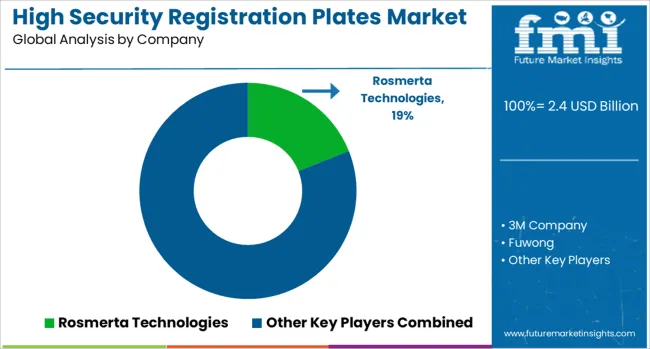
The high security registration plates (HSRP) market is dominated by specialized manufacturers and technology providers delivering tamper-proof, standardized plates that comply with government regulations. Rosmerta Technologies leads the Indian market with a strong presence in vehicle registration projects supported by government mandates for HSRP implementation. 3M Company offers advanced reflective sheeting and security features integrated into license plate manufacturing for global markets, ensuring durability and anti-counterfeit protection. Utsch Group and JH Toennjes are major European players providing turnkey license plate production systems with embedded security technologies like laser branding and holographic elements.
SAMAR’T and Jepson serve the European and Latin American markets with premium-quality plates featuring barcodes, RFID chips, and tamper-proof seals. UTAL specializes in automated production technologies for aluminum and composite-based plates, while Fuwong caters to emerging markets with cost-effective solutions combined with compliance-driven features. Shimnit India has a strong foothold in South Asia, focusing on government partnerships for large-scale HSRP rollouts. Competitive differentiation revolves around advanced security features, material longevity, compliance with ISO and national regulations, and integration with vehicle registration databases for traceability. Barriers to entry include high compliance costs, precision manufacturing requirements, and the need for government approvals. Strategic priorities include expanding RFID-enabled plate offerings for smart mobility systems, improving anti-tampering technologies, and forming long-term contracts with transportation authorities to secure recurring demand.
Key Developments in High Security Registration Plates Market
- On April 17, 2024, Utsch AG and DKT Deutsche Kennzeichen Technik GmbH announced a strategic cooperation to improve production efficiency and quality in high-security registration plates. The partnership focuses on manufacturing plates exclusively from recycled aluminum, optimizing logistics, and innovating license plate manufacturing processes.
- On April 16, 2025, uGroup announced the integration of the John R. Wald Company, Inc. (Wald) into its international network. This move strengthens uGroup’s presence in the USA license plate industry, adding over 100 years of expertise in automated production systems and digital printing technologies to its innovation-focused ecosystem.
Scope of the Report
| Metric | Value |
|---|---|
| Quantitative Units | USD 2.52 billion to USD 4.19 billion, at a CAGR of 5.2% |
| Market Definition | High Security Registration Plates encompasses rfid-embedded hsrp, barcode-based hsrp, qr code-based hsrp and associated technologies serving specification-sensitive industrial applications requiring certified purity and performance grades. |
| Technology Segmentation | RFID-embedded HSRP, Barcode-based HSRP, QR code-based HSRP |
| Material Segmentation | Aluminum, Steel, Plastic/polymer-based plates |
| Vehicle Segmentation | Passenger vehicles, Hatchback, Sedan, SUV, Two-wheelers, Three-wheelers, Commercial vehicles, Light Commercial Vehicles, Medium Commercial Vehicles, Heavy Commercial Vehicles |
| Distribution Channel Segmentation | OEM, Aftermarket |
| End Use Segmentation | Government and law enforcement agencies, Private vehicle owners, Fleet operators |
| Regions Covered | North America, Latin America, Europe, East Asia, South Asia, Oceania, Middle East & Africa |
| Countries Covered | China, India, Germany, France, UK, USA, Brazil, and 40 plus countries |
| Key Companies Profiled | Rosmerta Technologies, 3M Company, Fuwong, Hills Numberplates, Jepson, JH Toennjes, SAMAR’T, Shimnit India, UTAL, Utsch Group |
| Forecast Period | 2026 to 2036 |
| Approach | Forecasting models apply a bottom-up methodology starting with global production and consumption metrics, cross-validated against trade data and primary research inputs. |
High Security Registration Plates Market by Segments
Technology:
- RFID-embedded HSRP
- Barcode-based HSRP
- QR code-based HSRP
Material:
- Aluminum
- Steel
- Plastic/polymer-based plates
Vehicle:
- Passenger vehicles
- Hatchback
- Sedan
- SUV
- Two-wheelers
- Three-wheelers
- Commercial vehicles
- Light Commercial Vehicles (LCV)
- Medium Commercial Vehicles (MCV)
- Heavy Commercial Vehicles (HCV)
Distribution Channel:
- OEM
- Aftermarket
End Use:
- Government and law enforcement agencies
- Private vehicle owners
- Fleet operators
Region:
- North America
- USA
- Canada
- Mexico
- Latin America
- Brazil
- Chile
- Rest of Latin America
- Western Europe
- Germany
- UK
- Italy
- Spain
- France
- Nordic
- BENELUX
- Rest of Western Europe
- Eastern Europe
- Russia
- Poland
- Hungary
- Balkan & Baltic
- Rest of Eastern Europe
- East Asia
- China
- Japan
- South Korea
- South Asia and Pacific
- India
- ASEAN
- Australia & New Zealand
- Rest of South Asia and Pacific
- Middle East & Africa
- Kingdom of Saudi Arabia
- Other GCC Countries
- Turkiye
- South Africa
- Other African Union
- Rest of Middle East & Africa
Bibliography
- 1. Organisation for Economic Co-operation and Development. (2024). Global Industrial Policy Monitor. OECD.
- 2. World Bank Group. (2024). World Development Indicators: Manufacturing Value Added. World Bank.
- 3. International Organization for Standardization. (2024). ISO Standards Catalogue: Quality Management and Assurance. ISO.
- 4. United Nations Industrial Development Organization. (2024). Industrial Development Report: Manufacturing in a Digital Age. UNIDO.
- 5. European Commission, Directorate-General for Internal Market. (2024). Single Market for Industrial Products: Regulatory Framework Update. European Commission.
- 6. United States International Trade Commission. (2024). Industry and Trade Summary: Specialty Chemicals and Industrial Materials. USITC.
This bibliography is provided for reader reference. The full Future Market Insights report contains the complete reference list with primary research documentation.
Frequently Asked Questions
How large is the demand for High Security Registration Plates in the global market in 2026?
Demand for High Security Registration Plates in the global market is estimated to be valued at USD 2.52 billion in 2026.
What will be the market size of High Security Registration Plates in the global market by 2036?
Market size for High Security Registration Plates is projected to reach USD 4.19 billion by 2036.
What is the expected demand growth for High Security Registration Plates in the global market between 2026 and 2036?
Demand for High Security Registration Plates is expected to grow at a CAGR of 5.2% between 2026 and 2036.
Which Technology is poised to lead global sales by 2026?
RFID-embedded HSRP accounts for 54.0% in 2026, reflecting established process integration and qualification advantages in core end-use applications.
How significant is the role of Aluminum in driving High Security Registration Plates adoption in 2026?
Aluminum represents 61.0% of segment share in 2026, driven by high-volume consumption in specification-sensitive manufacturing processes.
What is the China growth outlook in this report?
China is projected to grow at a CAGR of 7.0% during 2026 to 2036.
What is High Security Registration Plates and what is it mainly used for?
High Security Registration Plates encompasses specialized products designed to meet exacting purity and performance requirements. Industrial buyers primarily use these products in process-critical applications where material specification compliance is mandatory.
How does FMI build and validate the High Security Registration Plates forecast?
Forecasting models apply a bottom-up methodology starting with global production and consumption metrics and cross-validate projections against primary research inputs and publicly reported financial data.
Preview the report firsthand - request a free sample
Get SampleGet the brochure for pricing and purchase details.
Get PDFTable of Content
- Executive Summary
- Global Market Outlook
- Demand-side Trends
- Supply-side Trends
- Technology Roadmap Analysis
- Analysis and Recommendations
- Market Overview
- Market Coverage / Taxonomy
- Market Definition / Scope / Limitations
- Research Methodology
- Chapter Orientation
- Analytical Lens and Working Hypotheses
- Market Structure, Signals, and Trend Drivers
- Benchmarking and Cross-market Comparability
- Market Sizing, Forecasting, and Opportunity Mapping
- Research Design and Evidence Framework
- Desk Research Programme (Secondary Evidence)
- Company Annual and Sustainability Reports
- Peer-reviewed Journals and Academic Literature
- Corporate Websites, Product Literature, and Technical Notes
- Earnings Decks and Investor Briefings
- Statutory Filings and Regulatory Disclosures
- Technical White Papers and Standards Notes
- Trade Journals, Industry Magazines, and Analyst Briefs
- Conference Proceedings, Webinars, and Seminar Materials
- Government Statistics Portals and Public Data Releases
- Press Releases and Reputable Media Coverage
- Specialist Newsletters and Curated Briefings
- Sector Databases and Reference Repositories
- FMI Internal Proprietary Databases and Historical Market Datasets
- Subscription Datasets and Paid Sources
- Social Channels, Communities, and Digital Listening Inputs
- Additional Desk Sources
- Expert Input and Fieldwork (Primary Evidence)
- Primary Modes
- Qualitative Interviews and Expert Elicitation
- Quantitative Surveys and Structured Data Capture
- Blended Approach
- Why Primary Evidence is Used
- Field Techniques
- Interviews
- Surveys
- Focus Groups
- Observational and In-context Research
- Social and Community Interactions
- Stakeholder Universe Engaged
- C-suite Leaders
- Board Members
- Presidents and Vice Presidents
- R&D and Innovation Heads
- Technical Specialists
- Domain Subject-matter Experts
- Scientists
- Physicians and Other Healthcare Professionals
- Governance, Ethics, and Data Stewardship
- Research Ethics
- Data Integrity and Handling
- Primary Modes
- Tooling, Models, and Reference Databases
- Desk Research Programme (Secondary Evidence)
- Data Engineering and Model Build
- Data Acquisition and Ingestion
- Cleaning, Normalisation, and Verification
- Synthesis, Triangulation, and Analysis
- Quality Assurance and Audit Trail
- Market Background
- Market Dynamics
- Drivers
- Restraints
- Opportunity
- Trends
- Scenario Forecast
- Demand in Optimistic Scenario
- Demand in Likely Scenario
- Demand in Conservative Scenario
- Opportunity Map Analysis
- Product Life Cycle Analysis
- Supply Chain Analysis
- Investment Feasibility Matrix
- Value Chain Analysis
- PESTLE and Porter’s Analysis
- Regulatory Landscape
- Regional Parent Market Outlook
- Production and Consumption Statistics
- Import and Export Statistics
- Market Dynamics
- Global Market Analysis 2021 to 2025 and Forecast, 2026 to 2036
- Historical Market Size Value (USD Million) Analysis, 2021 to 2025
- Current and Future Market Size Value (USD Million) Projections, 2026 to 2036
- Y-o-Y Growth Trend Analysis
- Absolute $ Opportunity Analysis
- Global Market Pricing Analysis 2021 to 2025 and Forecast 2026 to 2036
- Global Market Analysis 2021 to 2025 and Forecast 2026 to 2036, By Technology
- Introduction / Key Findings
- Historical Market Size Value (USD Million) Analysis By Technology , 2021 to 2025
- Current and Future Market Size Value (USD Million) Analysis and Forecast By Technology , 2026 to 2036
- RFID-embedded HSRP
- Barcode-based HSRP
- QR code-based HSRP
- RFID-embedded HSRP
- Y-o-Y Growth Trend Analysis By Technology , 2021 to 2025
- Absolute $ Opportunity Analysis By Technology , 2026 to 2036
- Global Market Analysis 2021 to 2025 and Forecast 2026 to 2036, By Material
- Introduction / Key Findings
- Historical Market Size Value (USD Million) Analysis By Material, 2021 to 2025
- Current and Future Market Size Value (USD Million) Analysis and Forecast By Material, 2026 to 2036
- Aluminum
- Steel
- Plastic/polymer-based plates
- Aluminum
- Y-o-Y Growth Trend Analysis By Material, 2021 to 2025
- Absolute $ Opportunity Analysis By Material, 2026 to 2036
- Global Market Analysis 2021 to 2025 and Forecast 2026 to 2036, By Vehicle
- Introduction / Key Findings
- Historical Market Size Value (USD Million) Analysis By Vehicle, 2021 to 2025
- Current and Future Market Size Value (USD Million) Analysis and Forecast By Vehicle, 2026 to 2036
- Passenger vehicles
- Hatchback
- Sedan
- SUV
- Two-wheelers
- Three-wheelers
- Commercial vehicles
- Light Commercial Vehicles
- Medium Commercial Vehicles
- Heavy Commercial Vehicles
- Passenger vehicles
- Y-o-Y Growth Trend Analysis By Vehicle, 2021 to 2025
- Absolute $ Opportunity Analysis By Vehicle, 2026 to 2036
- Global Market Analysis 2021 to 2025 and Forecast 2026 to 2036, By Distribution Channel
- Introduction / Key Findings
- Historical Market Size Value (USD Million) Analysis By Distribution Channel, 2021 to 2025
- Current and Future Market Size Value (USD Million) Analysis and Forecast By Distribution Channel, 2026 to 2036
- OEM
- Aftermarket
- OEM
- Y-o-Y Growth Trend Analysis By Distribution Channel, 2021 to 2025
- Absolute $ Opportunity Analysis By Distribution Channel, 2026 to 2036
- Global Market Analysis 2021 to 2025 and Forecast 2026 to 2036, By End Use
- Introduction / Key Findings
- Historical Market Size Value (USD Million) Analysis By End Use, 2021 to 2025
- Current and Future Market Size Value (USD Million) Analysis and Forecast By End Use, 2026 to 2036
- Government and law enforcement agencies
- Private vehicle owners
- Fleet operators
- Government and law enforcement agencies
- Y-o-Y Growth Trend Analysis By End Use, 2021 to 2025
- Absolute $ Opportunity Analysis By End Use, 2026 to 2036
- Global Market Analysis 2021 to 2025 and Forecast 2026 to 2036, By Region
- Introduction
- Historical Market Size Value (USD Million) Analysis By Region, 2021 to 2025
- Current Market Size Value (USD Million) Analysis and Forecast By Region, 2026 to 2036
- North America
- Latin America
- Western Europe
- Eastern Europe
- East Asia
- South Asia and Pacific
- Middle East & Africa
- Market Attractiveness Analysis By Region
- North America Market Analysis 2021 to 2025 and Forecast 2026 to 2036, By Country
- Historical Market Size Value (USD Million) Trend Analysis By Market Taxonomy, 2021 to 2025
- Market Size Value (USD Million) Forecast By Market Taxonomy, 2026 to 2036
- By Country
- USA
- Canada
- Mexico
- By Technology
- By Material
- By Vehicle
- By Distribution Channel
- By End Use
- By Country
- Market Attractiveness Analysis
- By Country
- By Technology
- By Material
- By Vehicle
- By Distribution Channel
- By End Use
- Key Takeaways
- Latin America Market Analysis 2021 to 2025 and Forecast 2026 to 2036, By Country
- Historical Market Size Value (USD Million) Trend Analysis By Market Taxonomy, 2021 to 2025
- Market Size Value (USD Million) Forecast By Market Taxonomy, 2026 to 2036
- By Country
- Brazil
- Chile
- Rest of Latin America
- By Technology
- By Material
- By Vehicle
- By Distribution Channel
- By End Use
- By Country
- Market Attractiveness Analysis
- By Country
- By Technology
- By Material
- By Vehicle
- By Distribution Channel
- By End Use
- Key Takeaways
- Western Europe Market Analysis 2021 to 2025 and Forecast 2026 to 2036, By Country
- Historical Market Size Value (USD Million) Trend Analysis By Market Taxonomy, 2021 to 2025
- Market Size Value (USD Million) Forecast By Market Taxonomy, 2026 to 2036
- By Country
- Germany
- UK
- Italy
- Spain
- France
- Nordic
- BENELUX
- Rest of Western Europe
- By Technology
- By Material
- By Vehicle
- By Distribution Channel
- By End Use
- By Country
- Market Attractiveness Analysis
- By Country
- By Technology
- By Material
- By Vehicle
- By Distribution Channel
- By End Use
- Key Takeaways
- Eastern Europe Market Analysis 2021 to 2025 and Forecast 2026 to 2036, By Country
- Historical Market Size Value (USD Million) Trend Analysis By Market Taxonomy, 2021 to 2025
- Market Size Value (USD Million) Forecast By Market Taxonomy, 2026 to 2036
- By Country
- Russia
- Poland
- Hungary
- Balkan & Baltic
- Rest of Eastern Europe
- By Technology
- By Material
- By Vehicle
- By Distribution Channel
- By End Use
- By Country
- Market Attractiveness Analysis
- By Country
- By Technology
- By Material
- By Vehicle
- By Distribution Channel
- By End Use
- Key Takeaways
- East Asia Market Analysis 2021 to 2025 and Forecast 2026 to 2036, By Country
- Historical Market Size Value (USD Million) Trend Analysis By Market Taxonomy, 2021 to 2025
- Market Size Value (USD Million) Forecast By Market Taxonomy, 2026 to 2036
- By Country
- China
- Japan
- South Korea
- By Technology
- By Material
- By Vehicle
- By Distribution Channel
- By End Use
- By Country
- Market Attractiveness Analysis
- By Country
- By Technology
- By Material
- By Vehicle
- By Distribution Channel
- By End Use
- Key Takeaways
- South Asia and Pacific Market Analysis 2021 to 2025 and Forecast 2026 to 2036, By Country
- Historical Market Size Value (USD Million) Trend Analysis By Market Taxonomy, 2021 to 2025
- Market Size Value (USD Million) Forecast By Market Taxonomy, 2026 to 2036
- By Country
- India
- ASEAN
- Australia & New Zealand
- Rest of South Asia and Pacific
- By Technology
- By Material
- By Vehicle
- By Distribution Channel
- By End Use
- By Country
- Market Attractiveness Analysis
- By Country
- By Technology
- By Material
- By Vehicle
- By Distribution Channel
- By End Use
- Key Takeaways
- Middle East & Africa Market Analysis 2021 to 2025 and Forecast 2026 to 2036, By Country
- Historical Market Size Value (USD Million) Trend Analysis By Market Taxonomy, 2021 to 2025
- Market Size Value (USD Million) Forecast By Market Taxonomy, 2026 to 2036
- By Country
- Kingdom of Saudi Arabia
- Other GCC Countries
- Turkiye
- South Africa
- Other African Union
- Rest of Middle East & Africa
- By Technology
- By Material
- By Vehicle
- By Distribution Channel
- By End Use
- By Country
- Market Attractiveness Analysis
- By Country
- By Technology
- By Material
- By Vehicle
- By Distribution Channel
- By End Use
- Key Takeaways
- Key Countries Market Analysis
- USA
- Pricing Analysis
- Market Share Analysis, 2025
- By Technology
- By Material
- By Vehicle
- By Distribution Channel
- By End Use
- Canada
- Pricing Analysis
- Market Share Analysis, 2025
- By Technology
- By Material
- By Vehicle
- By Distribution Channel
- By End Use
- Mexico
- Pricing Analysis
- Market Share Analysis, 2025
- By Technology
- By Material
- By Vehicle
- By Distribution Channel
- By End Use
- Brazil
- Pricing Analysis
- Market Share Analysis, 2025
- By Technology
- By Material
- By Vehicle
- By Distribution Channel
- By End Use
- Chile
- Pricing Analysis
- Market Share Analysis, 2025
- By Technology
- By Material
- By Vehicle
- By Distribution Channel
- By End Use
- Germany
- Pricing Analysis
- Market Share Analysis, 2025
- By Technology
- By Material
- By Vehicle
- By Distribution Channel
- By End Use
- UK
- Pricing Analysis
- Market Share Analysis, 2025
- By Technology
- By Material
- By Vehicle
- By Distribution Channel
- By End Use
- Italy
- Pricing Analysis
- Market Share Analysis, 2025
- By Technology
- By Material
- By Vehicle
- By Distribution Channel
- By End Use
- Spain
- Pricing Analysis
- Market Share Analysis, 2025
- By Technology
- By Material
- By Vehicle
- By Distribution Channel
- By End Use
- France
- Pricing Analysis
- Market Share Analysis, 2025
- By Technology
- By Material
- By Vehicle
- By Distribution Channel
- By End Use
- India
- Pricing Analysis
- Market Share Analysis, 2025
- By Technology
- By Material
- By Vehicle
- By Distribution Channel
- By End Use
- ASEAN
- Pricing Analysis
- Market Share Analysis, 2025
- By Technology
- By Material
- By Vehicle
- By Distribution Channel
- By End Use
- Australia & New Zealand
- Pricing Analysis
- Market Share Analysis, 2025
- By Technology
- By Material
- By Vehicle
- By Distribution Channel
- By End Use
- China
- Pricing Analysis
- Market Share Analysis, 2025
- By Technology
- By Material
- By Vehicle
- By Distribution Channel
- By End Use
- Japan
- Pricing Analysis
- Market Share Analysis, 2025
- By Technology
- By Material
- By Vehicle
- By Distribution Channel
- By End Use
- South Korea
- Pricing Analysis
- Market Share Analysis, 2025
- By Technology
- By Material
- By Vehicle
- By Distribution Channel
- By End Use
- Russia
- Pricing Analysis
- Market Share Analysis, 2025
- By Technology
- By Material
- By Vehicle
- By Distribution Channel
- By End Use
- Poland
- Pricing Analysis
- Market Share Analysis, 2025
- By Technology
- By Material
- By Vehicle
- By Distribution Channel
- By End Use
- Hungary
- Pricing Analysis
- Market Share Analysis, 2025
- By Technology
- By Material
- By Vehicle
- By Distribution Channel
- By End Use
- Kingdom of Saudi Arabia
- Pricing Analysis
- Market Share Analysis, 2025
- By Technology
- By Material
- By Vehicle
- By Distribution Channel
- By End Use
- Turkiye
- Pricing Analysis
- Market Share Analysis, 2025
- By Technology
- By Material
- By Vehicle
- By Distribution Channel
- By End Use
- South Africa
- Pricing Analysis
- Market Share Analysis, 2025
- By Technology
- By Material
- By Vehicle
- By Distribution Channel
- By End Use
- USA
- Market Structure Analysis
- Competition Dashboard
- Competition Benchmarking
- Market Share Analysis of Top Players
- By Regional
- By Technology
- By Material
- By Vehicle
- By Distribution Channel
- By End Use
- Competition Analysis
- Competition Deep Dive
- Rosmerta Technologies
- Overview
- Product Portfolio
- Profitability by Market Segments (Product/Age /Sales Channel/Region)
- Sales Footprint
- Strategy Overview
- Marketing Strategy
- Product Strategy
- Channel Strategy
- 3M Company
- Fuwong
- Hills Numberplates
- Jepson
- JH Toennjes
- SAMAR’T
- Shimnit India
- UTAL
- Utsch Group
- Rosmerta Technologies
- Competition Deep Dive
- Assumptions & Acronyms Used


