

- Industry Size (2026)
- USD 3.21 Bn
- Forecast (2036)
- USD 6.38 Bn
- CAGR (2026 to 2036)
- 7.10%
High Frequency Chest-Wall Oscillation Devices Market Size, Market Forecast and Outlook By FMI
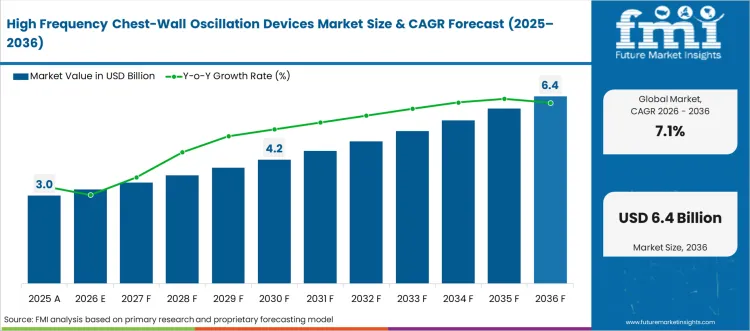
The high frequency chest-wall oscillation devices market was valued at USD 3.00 billion in 2025, projected to reach USD 3.21 billion in 2026, and is forecast to expand to USD 6.38 billion by 2036 at a 7.10% CAGR. Rising diagnosis rates for bronchiectasis and other chronic airway clearance conditions are compelling respiratory therapy departments to expand their oscillation device inventories. Reimbursement pathway maturation in multiple national health systems has removed a longstanding adoption barrier, converting what was previously an out-of-pocket expenditure into a covered durable medical equipment category.
Summary of High Frequency Chest-Wall Oscillation Devices Market
- Market Snapshot
- The high frequency chest-wall oscillation devices market is valued at USD 3.00 billion in 2025 and is projected to reach USD 6.38 billion by 2036.
- The industry is expected to grow at a 7.10% CAGR from 2026 to 2036, creating an incremental opportunity of USD 3.17 billion.
- The market is a niche, regulated durable medical equipment category where clinical evidence, reimbursement coverage, and respiratory therapist familiarity determine prescribing patterns and institutional procurement.
- Demand and Growth Drivers
- Demand is rising as bronchiectasis diagnosis rates increase with wider availability of high-resolution computed tomography screening in routine pulmonary workups.
- Reimbursement coverage expansion across multiple national payer systems is converting out-of-pocket device costs into covered durable medical equipment categories.
- Battery-powered, wearable oscillation vest designs are enabling ambulatory therapy compliance for patients who previously missed sessions due to device immobility.
- Among key countries, China leads at 9.5% CAGR, followed by India at 8.8%, Germany at 8.1%, and Brazil at 7.4%.
- Product and Segment View
- The market includes vest-based and panel-based oscillation systems that deliver high-frequency chest compressions to mobilize airway secretions in patients with chronic respiratory conditions.
- Clinical indications include bronchiectasis, cerebral palsy, emphysema, chronic bronchitis, spinal cord injury, muscular dystrophy, pneumonia, and post-operative lung transplant airway management.
- Smartvest leads by Product Type with 35.2% share in 2026.
- Bronchiectasis leads by Indication Type with 26.6% share in 2026.
- Scope includes powered chest-wall oscillation vests and panels. It excludes manual percussion therapy devices, positive expiratory pressure devices, and intrapulmonary percussive ventilators.
- Geography and Competitive Outlook
- China and India are the fastest-growing markets, while the United States remains a high-value and mature demand base.
- Competition is shaped by clinical outcome data, payer coverage breadth, and respiratory therapist training program penetration, with participants including Electromed, International Biophysics Corporation, Hill-Rom, Respiratory Technologies, Aetna Inc.
- Analyst Opinion at FMI
- Sabyasachi Ghosh, Principal Consultant for Healthcare observe that: 'In my analysis, I have observed that the primary adoption constraint for chest-wall oscillation devices has shifted from clinical evidence gaps to reimbursement pathway navigation. Manufacturers who can demonstrate cost-effectiveness data specific to each national payer system will capture disproportionate share in markets where coverage decisions are still pending. Device companies without ambulatory-ready, battery-powered products in their portfolios risk losing prescribing physician loyalty to competitors who can meet home therapy compliance requirements.'
- Strategic Implications / Executive Takeaways
- Device manufacturers must generate payer-specific cost-effectiveness data for each target national health system to accelerate reimbursement coverage decisions.
- Product development teams should prioritize battery-powered, wearable form factors to capture the ambulatory therapy segment where patient compliance depends on device portability.
- Sales organizations must invest in respiratory therapist training programs to build prescriber familiarity and increase device trial-to-purchase conversion rates.
High Frequency Chest-Wall Oscillation Devices Market Key Takeaways
| Metric | Details |
|---|---|
| Industry Size (2026) | USD 3.21 billion |
| Industry Value (2036) | USD 6.38 billion |
| CAGR (2026 to 2036) | 7.10% |
Source: Future Market Insights, 2026
The absolute dollar opportunity from 2026 to 2036 amounts to USD 3.17 billion, driven by expanding clinical indication coverage and payer acceptance across multiple respiratory therapy categories. Smartvest-type systems retain the largest installed base share due to their single-hose design that allows greater patient mobility during therapy sessions. Afflovest battery-powered units are capturing incremental share among ambulatory patients who require airway clearance therapy outside clinical settings. Device pricing is influenced by durable medical equipment reimbursement rate schedules that vary across national payer systems.
All major regional markets reflect distinct adoption trajectories. China sets the pace with a 9.5% CAGR, driven by expanding tertiary hospital respiratory rehabilitation departments. India follows with a 8.8% CAGR, supported by rising private hospital investment in pulmonary care equipment. Germany follows with a 8.1% CAGR, anchored by statutory health insurance coverage for airway clearance devices. Brazil follows with a 7.4% CAGR, fueled by SUS public health system procurement for chronic respiratory care. USA follows with a 6.7% CAGR, backed by established Medicare durable medical equipment reimbursement pathways. UK follows with a 6.0% CAGR, supported by NHS pulmonary rehabilitation service expansion. Japan follows with a 5.3% CAGR, reflecting gradual adoption within aging-population respiratory care programs.
High Frequency Chest-Wall Oscillation Devices Market Definition
High frequency chest-wall oscillation devices are externally applied respiratory therapy systems that deliver rapid, rhythmic compressions to the thorax to mobilize and clear airway secretions. These devices consist of an inflatable vest or panel connected to an air-pulse generator that produces oscillation frequencies typically between 5 and 25 Hz. Clinical indications span bronchiectasis, cystic fibrosis, chronic bronchitis, neuromuscular disorders affecting cough effectiveness, and post-operative airway management following lung transplantation.
High Frequency Chest-Wall Oscillation Devices Market Inclusions
Market scope includes all powered chest-wall oscillation vest and panel systems across Smartvest, Afflovest, Respirtech, and general vest-type categories. Indication coverage spans bronchiectasis, cerebral palsy, emphysema, chronic bronchitis, spinal cord injury, muscular dystrophy, and other qualifying respiratory conditions. Distribution channel segments include hospitals, clinics, and other settings. Regional and country-level market sizing and forecast data are included.
High Frequency Chest-Wall Oscillation Devices Market Exclusions
Manual chest percussion therapy devices, positive expiratory pressure oscillation devices, and intrapulmonary percussive ventilators are excluded. Flutter valves and Acapella-type handheld oscillating PEP devices fall outside analytical parameters. Standard respiratory physiotherapy equipment without powered oscillation capability is not included.
High Frequency Chest-Wall Oscillation Devices Market Research Methodology
- Primary Research: Analysts engaged with pulmonary rehabilitation program directors, respiratory therapist educators, and durable medical equipment procurement managers to map the prescribing patterns and reimbursement pathways driving device adoption.
- Desk Research: Data collection aggregated national medical device approval databases, Medicare and national health insurance coverage determination records, and clinical practice guideline publications from respiratory societies.
- Market-Sizing and Forecasting: Baseline values derive from a bottom-up aggregation of product-level shipments and license deployments, applying region-specific adoption curves to project future demand velocity.
- Data Validation and Update Cycle: Projections are cross-checked against publicly reported capital expenditure guidance from leading end-use operators and OEM financial disclosures.
High Frequency Chest-Wall Oscillation Devices Market Drivers, Restraints, Opportunities
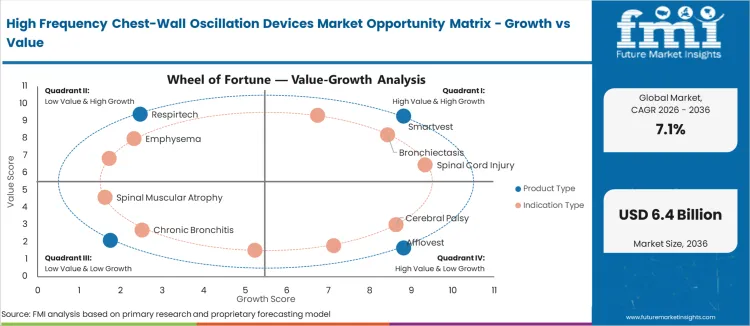
Future Market Insights analysis indicates the high frequency chest-wall oscillation category has evolved from a cystic fibrosis-specific therapy tool into a broader airway clearance platform prescribed across multiple chronic respiratory conditions. The expansion of clinical evidence supporting HFCWO for non-CF bronchiectasis, neuromuscular disease, and post-surgical airway management has widened the addressable patient population well beyond the original cystic fibrosis indication. FMI analysts observe that this indication expansion is the primary growth driver, as the CF patient population alone would not sustain the growth rates projected for this category.
The central market tension is the gap between clinical evidence maturity and reimbursement coverage breadth. In the United States, Medicare coverage for HFCWO devices is well established under HCPCS code E0483, creating a predictable procurement pathway through durable medical equipment suppliers. Outside the United States, FMI is of the opinion that reimbursement coverage decisions remain the binding constraint on market growth, with national health technology assessment bodies in Germany, the United Kingdom, and Japan at various stages of reviewing coverage applications for non-CF indications.
- Ambulatory therapy compliance: Battery-powered oscillation vests that allow patients to conduct therapy sessions while performing daily activities are demonstrating 30 to 40% higher therapy adherence rates compared to tethered pneumatic systems that require patients to sit stationary during 20 to 30 minute treatment sessions, making portability a clinical outcome variable rather than a convenience feature.
- Pediatric indication expansion: Chest-wall oscillation prescribing for pediatric patients with cerebral palsy and spinal muscular atrophy is growing as respiratory therapists recognize the limitations of manual percussion techniques for patients who cannot reliably perform directed cough maneuvers, creating a new prescriber pathway through pediatric pulmonology departments.
- Post-transplant protocol integration: Lung transplant centers are incorporating HFCWO devices into standardized post-operative airway clearance protocols, creating an institutional procurement channel that bypasses the individual patient prescription pathway and aggregates device orders at the facility level.
Segmental analysis
High Frequency Chest-Wall Oscillation Devices Market Analysis by Product Type

Based on FMI's High Frequency Chest-Wall Oscillation Devices market report, consumption of Smartvest product type is estimated to hold 35.2% share in 2026. Smartvest systems retain the largest installed base share because their single-hose pneumatic design allows patients greater freedom of movement during therapy sessions compared to dual-hose alternatives. The Smartvest platform also benefits from the longest track record of Medicare reimbursement approval and the widest respiratory therapist training program penetration among competing device families.
- Afflovest portability advantage: The Afflovest battery-powered, mechanical oscillation design eliminates the requirement for an external air-pulse generator, enabling fully ambulatory therapy sessions that appeal to younger, active patients and home care programs prioritizing patient independence [1].
- Respirtech pressure differentiation: Respirtech systems deliver oscillation through multiple chest and back contact points simultaneously, creating a circumferential compression pattern that some clinicians prefer for patients with severe mucus plugging who require more aggressive secretion mobilization [2].
- General vest-type procurement: Unbranded and regional vest-type oscillation devices are capturing share in price-sensitive markets where national health systems prioritize unit cost over brand-specific clinical data, particularly in procurement tenders across China, India, and Brazil [3].
High Frequency Chest-Wall Oscillation Devices Market Analysis by Indication Type

Based on FMI's High Frequency Chest-Wall Oscillation Devices market report, the Bronchiectasis indication type is estimated to hold 26.6% share in 2026. Bronchiectasis represents the largest indication segment because the chronic, progressive nature of the condition requires long-term daily airway clearance therapy, generating sustained device utilization rates that translate into higher lifetime value per prescription. The broadening of bronchiectasis diagnostic criteria and the increasing use of chest CT screening in routine pulmonary evaluations are expanding the diagnosed patient population eligible for HFCWO therapy.
- Cerebral palsy airway management: Pediatric patients with cerebral palsy who lack effective cough reflexes are increasingly prescribed HFCWO therapy as an alternative to manual chest physiotherapy, driven by respiratory therapist workflow efficiency gains and caregiver fatigue reduction in home settings [4].
- Post-transplant standardization: Lung transplant programs are standardizing HFCWO into post-operative care protocols, creating institutional procurement pathways that bypass individual patient durable medical equipment prescription channels [5].
Why is the High Frequency Chest-Wall Oscillation Devices Market Growing?
The High Frequency Chest-Wall Oscillation Devices market is experiencing robust growth, driven by the rising prevalence of respiratory disorders and increasing adoption of airway clearance therapies. The growing incidence of chronic conditions such as bronchiectasis, cystic fibrosis, and chronic obstructive pulmonary disease has created significant demand for devices that improve mucus clearance and enhance lung function. Advancements in device technology, including wearable and portable systems, have improved patient comfort and therapy adherence, further supporting adoption.
Integration with digital monitoring and telehealth platforms enables clinicians to track patient usage and outcomes remotely, enhancing treatment effectiveness. Increasing awareness among healthcare providers and patients regarding non-invasive airway clearance solutions is contributing to market expansion.
Hospitals, clinics, and home healthcare providers are increasingly implementing these devices to optimize patient outcomes and reduce hospitalization rates As regulatory support and reimbursement frameworks strengthen, the market is expected to sustain long-term growth, with technological innovation and clinical evidence reinforcing adoption across diverse healthcare settings.
Segmental Analysis
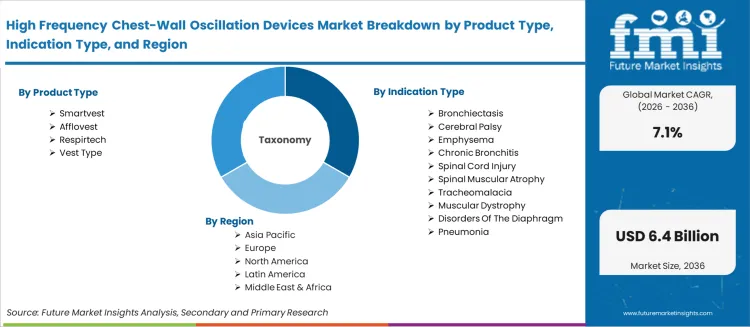
The high frequency chest-wall oscillation devices market is segmented by product type, indication type, distribution channel, and geographic regions. By product type, high frequency chest-wall oscillation devices market is divided into Smartvest, Afflovest, Respirtech, and Vest Type. In terms of indication type, high frequency chest-wall oscillation devices market is classified into Bronchiectasis, Cerebral Palsy, Emphysema, Chronic Bronchitis, Spinal Cord Injury, Spinal Muscular Atrophy, Tracheomalacia, Muscular Dystrophy, Disorders Of The Diaphragm, Pneumonia, Post-Operative Lung Transplant, and Others. Based on distribution channel, high frequency chest-wall oscillation devices market is segmented into Hospitals, Clinics, and Others. Regionally, the high frequency chest-wall oscillation devices industry is classified into North America, Latin America, Western Europe, Eastern Europe, Balkan & Baltic Countries, Russia & Belarus, Central Asia, East Asia, South Asia & Pacific, and the Middle East & Africa.
Insights into the Smartvest Product Type Segment
The Smartvest segment is projected to hold 35.2% of the market revenue in 2026, establishing it as the leading product type. Growth in this segment is being driven by its proven efficacy in delivering high-frequency chest-wall oscillation therapy in a non-invasive and patient-friendly manner. Smartvest devices offer adjustable therapy intensities and programmable treatment schedules, enhancing patient compliance and improving clinical outcomes.
The ability to integrate with monitoring systems allows caregivers and clinicians to track therapy effectiveness and adjust treatment protocols in real-time. Wearable design and portability support home-based therapy, reducing dependency on hospital visits and improving quality of life for patients.
Clinical studies demonstrating improved mucus clearance and lung function further reinforce the segment’s adoption With growing awareness of respiratory disease management and the demand for advanced, user-friendly devices, Smartvest is expected to maintain its leading market position, supported by continuous technological enhancements and robust clinical validation.
Insights into the Bronchiectasis Indication Type Segment
The bronchiectasis segment is anticipated to account for 26.6% of the market revenue in 2026, making it the leading indication type. Growth is being driven by the increasing prevalence of chronic bronchial infections and airway obstruction conditions, which necessitate effective airway clearance solutions. High frequency chest-wall oscillation devices improve mucus mobilization and reduce infection risk, providing significant therapeutic benefits for bronchiectasis patients.
The adoption of these devices is further supported by clinical guidelines recommending airway clearance therapy as a standard treatment component. Advancements in device customization, patient monitoring, and comfort have enhanced adherence, leading to better clinical outcomes.
Awareness campaigns and patient education regarding early intervention and non-invasive therapy options are contributing to demand growth As healthcare providers increasingly emphasize improved quality of life and reduced hospitalizations, the bronchiectasis segment is expected to remain the primary driver of market expansion, supported by ongoing technological and clinical developments.
Insights into the Hospitals Distribution Channel Segment

The hospitals segment is projected to hold 45.6% of the market revenue in 2026, establishing it as the leading distribution channel. Growth is being driven by the increasing integration of high frequency chest-wall oscillation devices in hospital respiratory therapy programs and pulmonary rehabilitation services. Hospitals provide access to trained healthcare professionals who ensure proper device usage and optimize treatment protocols, improving clinical outcomes.
The adoption is further reinforced by institutional purchasing agreements, reimbursement coverage, and hospital-led patient education initiatives. Hospitals also serve as centers for clinical trials and demonstration of new device technologies, accelerating awareness and adoption among patients and clinicians.
Rising patient inflow for respiratory disorders and chronic lung conditions has strengthened the role of hospitals as the primary distribution channel As healthcare infrastructure continues to expand and focus on non-invasive respiratory therapies increases, hospitals are expected to maintain their leadership in delivering these devices to patients, supporting sustained market growth.
Market Overview
High Frequency Chest-Wall Oscillation Devices Market Overview
Respiration is the main process for the every living organization, as the pollution level is increasing various problem are occurring with respect to lungs. The formation of mucus is the major problem in the lungs which can caused many diseases such as cystic fibrosis, pneumonia, bronchiectasis, and chronic bronchitis.
Lungs problem is very complicated which directly affect the lifestyle of the patients, the treatment is generally prescribed and available are medicine which may treat the patients for a time being, as for support the patients suffering from lungs diseases then the high frequency chest-wall oscillation devices is very helpful for the patients.
The high frequency chest-wall oscillation devices is easy to carry with them, the device is like a jacket which can be wear and provide the refile to the patients. The high frequency chest-wall oscillation devices is portable and fit on the upper part of the body just as jacket, the device is wearable. The high frequency chest-wall oscillation devices have inflatable air bladder all around.
Analysis of High Frequency Chest-Wall Oscillation Devices Market By Key Countries
.webp "Top Country Growth Comparison High Frequency Chest Wall Oscillation Devices Market Cagr (2026 2036)")
| Country | CAGR |
|---|---|
| China | 9.5% |
| India | 8.8% |
| Germany | 8.1% |
| Brazil | 7.4% |
| USA | 6.7% |
| UK | 6.0% |
| Japan | 5.3% |

Country-wise Analysis
The High Frequency Chest-Wall Oscillation Devices Market is expected to register a CAGR of 7.1% during the forecast period, exhibiting varied country level momentum. China leads with the highest CAGR of 9.5%, followed by India at 8.8%. Developed markets such as Germany, France, and the UK continue to expand steadily, while the USA is likely to grow at consistent rates. Japan posts the lowest CAGR at 5.3%, yet still underscores a broadly positive trajectory for the global High Frequency Chest-Wall Oscillation Devices Market. In 2024, Germany held a dominant revenue in the Western Europe market and is expected to grow with a CAGR of 8.1%. While Japan and South Korea markets are estimated to be valued at USD 138.7 million and USD 103.5 million respectively in 2026.
Key Players in the High Frequency Chest-Wall Oscillation Devices Market

- Electromed
- International Biophysics Corporation
- Hill-Rom
- Respiratory Technologies
- Aetna Inc
Scope of the Report
| Metric | Value |
|---|---|
| Quantitative Units | USD 3.21 billion to USD 6.38 billion, at a CAGR of 7.10% |
| Market Definition | High frequency chest-wall oscillation devices deliver rapid thoracic compressions to mobilize airway secretions in patients with bronchiectasis, neuromuscular conditions, and other chronic respiratory disorders. |
| Product Type Segmentation | Smartvest, Afflovest, Respirtech, Vest Type |
| Indication Type Segmentation | Bronchiectasis, Cerebral Palsy, Emphysema, Chronic Bronchitis, Spinal Cord Injury, Spinal Muscular Atrophy, Tracheomalacia, Muscular Dystrophy, Disorders Of The Diaphragm, Pneumonia, Post-Operative Lung Transplant, Others |
| Distribution Channel Segmentation | Hospitals, Clinics, Others |
| Regions Covered | North America, Latin America, Europe, East Asia, South Asia, Oceania, Middle East & Africa |
| Countries Covered | China, India, Germany, Brazil, USA, UK, Japan, and 40 plus countries |
| Key Companies Profiled | Electromed, International Biophysics Corporation, Hill-Rom, Respiratory Technologies, Aetna Inc |
| Forecast Period | 2026 to 2036 |
| Approach | Forecasting models apply a bottom-up methodology starting with global installed base metrics and projecting the conversion rate to next-generation adoption. |
High Frequency Chest-Wall Oscillation Devices Market by Segments
Product Type:
- Smartvest
- Afflovest
- Respirtech
- Vest Type
Indication Type:
- Bronchiectasis
- Cerebral Palsy
- Emphysema
- Chronic Bronchitis
- Spinal Cord Injury
- Spinal Muscular Atrophy
- Tracheomalacia
- Muscular Dystrophy
- Disorders Of The Diaphragm
- Pneumonia
- Post-Operative Lung Transplant
- Others
Distribution Channel:
- Hospitals
- Clinics
- Others
Region:
- North America
- USA
- Canada
- Mexico
- Latin America
- Brazil
- Chile
- Rest of Latin America
- Western Europe
- Germany
- UK
- Italy
- Spain
- France
- Nordic
- BENELUX
- Rest of Western Europe
- Eastern Europe
- Russia
- Poland
- Hungary
- Balkan & Baltic
- Rest of Eastern Europe
- East Asia
- China
- Japan
- South Korea
- South Asia and Pacific
- India
- ASEAN
- Australia & New Zealand
- Rest of South Asia and Pacific
- Middle East & Africa
- Kingdom of Saudi Arabia
- Other GCC Countries
- Turkiye
- South Africa
- Other African Union
- Rest of Middle East & Africa
Bibliography
- World Health Organization. (2024). Chronic Respiratory Diseases: Global Burden and Intervention Strategies Report. WHO.
- USA Centers for Medicare & Medicaid Services. (2024). Durable Medical Equipment Coverage Determination: High Frequency Chest Wall Oscillation Devices. CMS.
- European Respiratory Society. (2024). ERS Clinical Practice Guidelines: Airway Clearance Techniques in Non-Cystic Fibrosis Bronchiectasis. ERS.
- USA Food and Drug Administration. (2024). 510(k) Premarket Notification Database: Airway Clearance Systems. FDA.
- National Health Service England. (2024). Pulmonary Rehabilitation Service Specification and Equipment Standards. NHS.
This bibliography is provided for reader reference. The full Future Market Insights report contains the complete reference list with primary research documentation.
Frequently Asked Questions
How large is the demand for High Frequency Chest-Wall Oscillation Devices in the global market in 2026?
Demand for High Frequency Chest-Wall Oscillation Devices in the global market is estimated to be valued at USD 3.21 billion in 2026.
What will be the market size of High Frequency Chest-Wall Oscillation Devices in the global market by 2036?
Market size for High Frequency Chest-Wall Oscillation Devices is projected to reach USD 6.38 billion by 2036.
What is the expected demand growth for High Frequency Chest-Wall Oscillation Devices in the global market between 2026 and 2036?
Demand for High Frequency Chest-Wall Oscillation Devices is expected to grow at a CAGR of 7.10% between 2026 and 2036.
Which Product Type is poised to lead global sales by 2026?
Smartvest accounts for 35.2% in 2026, as per FMI analysis of procurement pattern data and end-use application requirements.
How is the role of Bronchiectasis in driving High Frequency Chest-Wall Oscillation Devices adoption in 2026?
Bronchiectasis represents 26.6% of indication type share in 2026, based on FMI's assessment of end-use demand allocation and specification requirements.
What is China's growth outlook in this report?
China is projected to grow at a CAGR of 9.5% during 2026 to 2036.
What is Japan's growth outlook in this report?
Japan is projected to expand at a CAGR of 5.3% during 2026 to 2036.
What does market forecast mean on this page?
The market forecast represents a model-based projection built on defined industry, technology, and regulatory assumptions for strategic planning purposes.
Preview the report firsthand - request a free sample
Get SampleGet the brochure for pricing and purchase details.
Get PDFTable of Content
- Executive Summary
- Global Market Outlook
- Demand-side Trends
- Supply-side Trends
- Technology Roadmap Analysis
- Analysis and Recommendations
- Market Overview
- Market Coverage / Taxonomy
- Market Definition / Scope / Limitations
- Research Methodology
- Chapter Orientation
- Analytical Lens and Working Hypotheses
- Market Structure, Signals, and Trend Drivers
- Benchmarking and Cross-market Comparability
- Market Sizing, Forecasting, and Opportunity Mapping
- Research Design and Evidence Framework
- Desk Research Programme (Secondary Evidence)
- Company Annual and Sustainability Reports
- Peer-reviewed Journals and Academic Literature
- Corporate Websites, Product Literature, and Technical Notes
- Earnings Decks and Investor Briefings
- Statutory Filings and Regulatory Disclosures
- Technical White Papers and Standards Notes
- Trade Journals, Industry Magazines, and Analyst Briefs
- Conference Proceedings, Webinars, and Seminar Materials
- Government Statistics Portals and Public Data Releases
- Press Releases and Reputable Media Coverage
- Specialist Newsletters and Curated Briefings
- Sector Databases and Reference Repositories
- FMI Internal Proprietary Databases and Historical Market Datasets
- Subscription Datasets and Paid Sources
- Social Channels, Communities, and Digital Listening Inputs
- Additional Desk Sources
- Expert Input and Fieldwork (Primary Evidence)
- Primary Modes
- Qualitative Interviews and Expert Elicitation
- Quantitative Surveys and Structured Data Capture
- Blended Approach
- Why Primary Evidence is Used
- Field Techniques
- Interviews
- Surveys
- Focus Groups
- Observational and In-context Research
- Social and Community Interactions
- Stakeholder Universe Engaged
- C-suite Leaders
- Board Members
- Presidents and Vice Presidents
- R&D and Innovation Heads
- Technical Specialists
- Domain Subject-matter Experts
- Scientists
- Physicians and Other Healthcare Professionals
- Governance, Ethics, and Data Stewardship
- Research Ethics
- Data Integrity and Handling
- Primary Modes
- Tooling, Models, and Reference Databases
- Desk Research Programme (Secondary Evidence)
- Data Engineering and Model Build
- Data Acquisition and Ingestion
- Cleaning, Normalisation, and Verification
- Synthesis, Triangulation, and Analysis
- Quality Assurance and Audit Trail
- Market Background
- Market Dynamics
- Drivers
- Restraints
- Opportunity
- Trends
- Scenario Forecast
- Demand in Optimistic Scenario
- Demand in Likely Scenario
- Demand in Conservative Scenario
- Opportunity Map Analysis
- Product Life Cycle Analysis
- Supply Chain Analysis
- Investment Feasibility Matrix
- Value Chain Analysis
- PESTLE and Porter’s Analysis
- Regulatory Landscape
- Regional Parent Market Outlook
- Production and Consumption Statistics
- Import and Export Statistics
- Market Dynamics
- Global Market Analysis 2021 to 2025 and Forecast, 2026 to 2036
- Historical Market Size Value (USD Million) Analysis, 2021 to 2025
- Current and Future Market Size Value (USD Million) Projections, 2026 to 2036
- Y-o-Y Growth Trend Analysis
- Absolute $ Opportunity Analysis
- Global Market Pricing Analysis 2021 to 2025 and Forecast 2026 to 2036
- Global Market Analysis 2021 to 2025 and Forecast 2026 to 2036, By Product Type
- Introduction / Key Findings
- Historical Market Size Value (USD Million) Analysis By Product Type , 2021 to 2025
- Current and Future Market Size Value (USD Million) Analysis and Forecast By Product Type , 2026 to 2036
- Smartvest
- Afflovest
- Respirtech
- Vest Type
- Smartvest
- Y-o-Y Growth Trend Analysis By Product Type , 2021 to 2025
- Absolute $ Opportunity Analysis By Product Type , 2026 to 2036
- Global Market Analysis 2021 to 2025 and Forecast 2026 to 2036, By Indication Type
- Introduction / Key Findings
- Historical Market Size Value (USD Million) Analysis By Indication Type, 2021 to 2025
- Current and Future Market Size Value (USD Million) Analysis and Forecast By Indication Type, 2026 to 2036
- Bronchiectasis
- Cerebral Palsy
- Emphysema
- Chronic Bronchitis
- Spinal Cord Injury
- Spinal Muscular Atrophy
- Tracheomalacia
- Muscular Dystrophy
- Disorders Of The Diaphragm
- Pneumonia
- Post-Operative Lung Transplant
- Bronchiectasis
- Y-o-Y Growth Trend Analysis By Indication Type, 2021 to 2025
- Absolute $ Opportunity Analysis By Indication Type, 2026 to 2036
- Global Market Analysis 2021 to 2025 and Forecast 2026 to 2036, By Distribution Channel
- Introduction / Key Findings
- Historical Market Size Value (USD Million) Analysis By Distribution Channel, 2021 to 2025
- Current and Future Market Size Value (USD Million) Analysis and Forecast By Distribution Channel, 2026 to 2036
- Hospitals
- Clinics
- Others
- Hospitals
- Y-o-Y Growth Trend Analysis By Distribution Channel, 2021 to 2025
- Absolute $ Opportunity Analysis By Distribution Channel, 2026 to 2036
- Global Market Analysis 2021 to 2025 and Forecast 2026 to 2036, By Region
- Introduction
- Historical Market Size Value (USD Million) Analysis By Region, 2021 to 2025
- Current Market Size Value (USD Million) Analysis and Forecast By Region, 2026 to 2036
- North America
- Latin America
- Western Europe
- Eastern Europe
- East Asia
- South Asia and Pacific
- Middle East & Africa
- Market Attractiveness Analysis By Region
- North America Market Analysis 2021 to 2025 and Forecast 2026 to 2036, By Country
- Historical Market Size Value (USD Million) Trend Analysis By Market Taxonomy, 2021 to 2025
- Market Size Value (USD Million) Forecast By Market Taxonomy, 2026 to 2036
- By Country
- USA
- Canada
- Mexico
- By Product Type
- By Indication Type
- By Distribution Channel
- By Country
- Market Attractiveness Analysis
- By Country
- By Product Type
- By Indication Type
- By Distribution Channel
- Key Takeaways
- Latin America Market Analysis 2021 to 2025 and Forecast 2026 to 2036, By Country
- Historical Market Size Value (USD Million) Trend Analysis By Market Taxonomy, 2021 to 2025
- Market Size Value (USD Million) Forecast By Market Taxonomy, 2026 to 2036
- By Country
- Brazil
- Chile
- Rest of Latin America
- By Product Type
- By Indication Type
- By Distribution Channel
- By Country
- Market Attractiveness Analysis
- By Country
- By Product Type
- By Indication Type
- By Distribution Channel
- Key Takeaways
- Western Europe Market Analysis 2021 to 2025 and Forecast 2026 to 2036, By Country
- Historical Market Size Value (USD Million) Trend Analysis By Market Taxonomy, 2021 to 2025
- Market Size Value (USD Million) Forecast By Market Taxonomy, 2026 to 2036
- By Country
- Germany
- UK
- Italy
- Spain
- France
- Nordic
- BENELUX
- Rest of Western Europe
- By Product Type
- By Indication Type
- By Distribution Channel
- By Country
- Market Attractiveness Analysis
- By Country
- By Product Type
- By Indication Type
- By Distribution Channel
- Key Takeaways
- Eastern Europe Market Analysis 2021 to 2025 and Forecast 2026 to 2036, By Country
- Historical Market Size Value (USD Million) Trend Analysis By Market Taxonomy, 2021 to 2025
- Market Size Value (USD Million) Forecast By Market Taxonomy, 2026 to 2036
- By Country
- Russia
- Poland
- Hungary
- Balkan & Baltic
- Rest of Eastern Europe
- By Product Type
- By Indication Type
- By Distribution Channel
- By Country
- Market Attractiveness Analysis
- By Country
- By Product Type
- By Indication Type
- By Distribution Channel
- Key Takeaways
- East Asia Market Analysis 2021 to 2025 and Forecast 2026 to 2036, By Country
- Historical Market Size Value (USD Million) Trend Analysis By Market Taxonomy, 2021 to 2025
- Market Size Value (USD Million) Forecast By Market Taxonomy, 2026 to 2036
- By Country
- China
- Japan
- South Korea
- By Product Type
- By Indication Type
- By Distribution Channel
- By Country
- Market Attractiveness Analysis
- By Country
- By Product Type
- By Indication Type
- By Distribution Channel
- Key Takeaways
- South Asia and Pacific Market Analysis 2021 to 2025 and Forecast 2026 to 2036, By Country
- Historical Market Size Value (USD Million) Trend Analysis By Market Taxonomy, 2021 to 2025
- Market Size Value (USD Million) Forecast By Market Taxonomy, 2026 to 2036
- By Country
- India
- ASEAN
- Australia & New Zealand
- Rest of South Asia and Pacific
- By Product Type
- By Indication Type
- By Distribution Channel
- By Country
- Market Attractiveness Analysis
- By Country
- By Product Type
- By Indication Type
- By Distribution Channel
- Key Takeaways
- Middle East & Africa Market Analysis 2021 to 2025 and Forecast 2026 to 2036, By Country
- Historical Market Size Value (USD Million) Trend Analysis By Market Taxonomy, 2021 to 2025
- Market Size Value (USD Million) Forecast By Market Taxonomy, 2026 to 2036
- By Country
- Kingdom of Saudi Arabia
- Other GCC Countries
- Turkiye
- South Africa
- Other African Union
- Rest of Middle East & Africa
- By Product Type
- By Indication Type
- By Distribution Channel
- By Country
- Market Attractiveness Analysis
- By Country
- By Product Type
- By Indication Type
- By Distribution Channel
- Key Takeaways
- Key Countries Market Analysis
- USA
- Pricing Analysis
- Market Share Analysis, 2025
- By Product Type
- By Indication Type
- By Distribution Channel
- Canada
- Pricing Analysis
- Market Share Analysis, 2025
- By Product Type
- By Indication Type
- By Distribution Channel
- Mexico
- Pricing Analysis
- Market Share Analysis, 2025
- By Product Type
- By Indication Type
- By Distribution Channel
- Brazil
- Pricing Analysis
- Market Share Analysis, 2025
- By Product Type
- By Indication Type
- By Distribution Channel
- Chile
- Pricing Analysis
- Market Share Analysis, 2025
- By Product Type
- By Indication Type
- By Distribution Channel
- Germany
- Pricing Analysis
- Market Share Analysis, 2025
- By Product Type
- By Indication Type
- By Distribution Channel
- UK
- Pricing Analysis
- Market Share Analysis, 2025
- By Product Type
- By Indication Type
- By Distribution Channel
- Italy
- Pricing Analysis
- Market Share Analysis, 2025
- By Product Type
- By Indication Type
- By Distribution Channel
- Spain
- Pricing Analysis
- Market Share Analysis, 2025
- By Product Type
- By Indication Type
- By Distribution Channel
- France
- Pricing Analysis
- Market Share Analysis, 2025
- By Product Type
- By Indication Type
- By Distribution Channel
- India
- Pricing Analysis
- Market Share Analysis, 2025
- By Product Type
- By Indication Type
- By Distribution Channel
- ASEAN
- Pricing Analysis
- Market Share Analysis, 2025
- By Product Type
- By Indication Type
- By Distribution Channel
- Australia & New Zealand
- Pricing Analysis
- Market Share Analysis, 2025
- By Product Type
- By Indication Type
- By Distribution Channel
- China
- Pricing Analysis
- Market Share Analysis, 2025
- By Product Type
- By Indication Type
- By Distribution Channel
- Japan
- Pricing Analysis
- Market Share Analysis, 2025
- By Product Type
- By Indication Type
- By Distribution Channel
- South Korea
- Pricing Analysis
- Market Share Analysis, 2025
- By Product Type
- By Indication Type
- By Distribution Channel
- Russia
- Pricing Analysis
- Market Share Analysis, 2025
- By Product Type
- By Indication Type
- By Distribution Channel
- Poland
- Pricing Analysis
- Market Share Analysis, 2025
- By Product Type
- By Indication Type
- By Distribution Channel
- Hungary
- Pricing Analysis
- Market Share Analysis, 2025
- By Product Type
- By Indication Type
- By Distribution Channel
- Kingdom of Saudi Arabia
- Pricing Analysis
- Market Share Analysis, 2025
- By Product Type
- By Indication Type
- By Distribution Channel
- Turkiye
- Pricing Analysis
- Market Share Analysis, 2025
- By Product Type
- By Indication Type
- By Distribution Channel
- South Africa
- Pricing Analysis
- Market Share Analysis, 2025
- By Product Type
- By Indication Type
- By Distribution Channel
- USA
- Market Structure Analysis
- Competition Dashboard
- Competition Benchmarking
- Market Share Analysis of Top Players
- By Regional
- By Product Type
- By Indication Type
- By Distribution Channel
- Competition Analysis
- Competition Deep Dive
- Electromed
- Overview
- Product Portfolio
- Profitability by Market Segments (Product/Age /Sales Channel/Region)
- Sales Footprint
- Strategy Overview
- Marketing Strategy
- Product Strategy
- Channel Strategy
- International Biophysics Corporation
- Hill-Rom
- Respiratory Technologies
- Aetna Inc
- Electromed
- Competition Deep Dive
- Assumptions & Acronyms Used


