

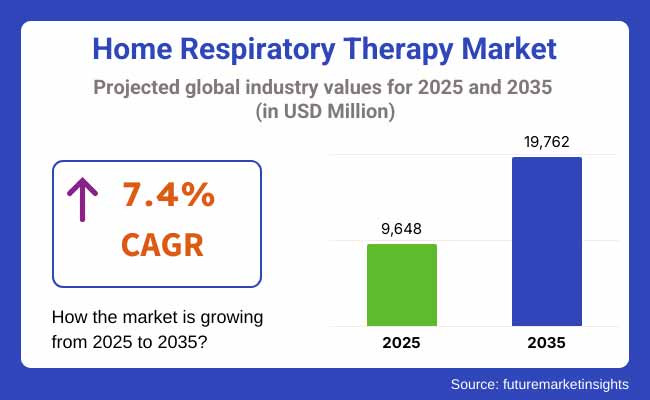
- Industry Size (2025)
- USD 9648 Mn
- Forecast (2035)
- USD 19762 Mn
- CAGR (2025 to 2035)
- 7.4%
Home Respiratory Therapy Market Outlook 2025 to 2035
The home respiratory therapy market is also expected to increase exponentially within the timeframe 2025 to 2035 because of the growing burden of long-term respiratory diseases such as chronic obstructive pulmonary disease (COPD), asthma, and sleep apnea.
The home respiratory therapy market is expected to increase to around USD 9,648 million in the year 2025. It is expected to increase up to USD 19,762 million in the year 2035 with a compound annual growth rate (CAGR) of 7.4% during the forecasted period.
Several drivers fuel the market growth. The most significant driver is increased numbers of geriatric patients, who also present a high risk for respiratory disease with home oxygen therapy and ventilatory support. Home and portable respiratory product technology, which enhances patient convenience and fuel demand, is the second driver.
For example, transportable oxygen concentrators, which are light, allow mobility without compromising oxygen provision and extend lives dramatically. Despite this, cost and reimbursement dictate whether they will be used with the cost-saving strategies to include availability everywhere on their side and the manufacturers/suppliers.
Various product segments and applications available in the market include, for example, oxygen therapy, non-invasive ventilation (NIV), continuous positive airway pressure (CPAP) devices, and nebulizers. The oxygen therapy segment is also among the most common segments and is particularly targeted towards severe COPD and the need for continuous oxygenation throughout the day.
CPAP segment is also increasing at high rates due to the increasing incidence of sleep apnea, and usage of auto-adjusting CPAP machines, resulting in painless nights with auto-regulated airway pressure at nighttime. Nebulizers are also employed at a mass scale for delivering drugs to patients with asthma so that the respiratory system can be effectively treated inside the home itself.
Regional Market Trends
North America
North America leads the market for home respiratory therapy owing to the highly established healthcare infrastructure and the staggering rate of uptake of advanced medical devices.
The United States is the highest contributor, and the positive government reimbursement policies for home respiratory care. Increased demand for portable oxygen concentrators and CPAP devices is fueling the market. Doctors are also prescribing home-based therapy at an increasing rate in an attempt to prevent hospital readmission and healthcare cost.
This move towards telehealth and home monitoring solutions also propels market growth. For instance, connectivity-based CPAP machines enable clinicians to track patient compliance and titration of therapy in real time in order to provide optimal delivery of therapeutic device benefits.
Europe
Europe is the largest market, with the United Kingdom, France, and Germany dominating the home respiratory therapy product market. Demand drivers are the prevalence of the incidence of respiratory disease and government programs funded to promote home healthcare. Italy, for instance, has a large number of geriatric populations that rely on oxygen therapy, particularly liquid oxygen systems with greater mobility and longer stamina.
Tight medical and environmental regulations are compelling manufacturers to produce innovative noise-reducing and energy-saving home respiratory products. Green inhalation therapy, low-power, high-respiratory relief products are what manufacturers want to produce.
Asia-Pacific
The Asia-Pacific region will witness the fastest growth rate in home respiratory therapy due to increasing healthcare consciousness, increasing disposable incomes, and aging populations in China, Japan, and India.
Mass production in massive quantities of inexpensive respiratory therapy equipment by the large-capacity China medical devices manufacturing sector is making coverage of the treatment for humongous quantities of individuals possible. Increased occurrence of respiratory conditions through urbanization and tobacco consumption in India is leading to the adoption of in-home treatment of the respiratory system by physicians. Ventilators powered by artificial intelligence that supply airflow automatically according to the requirement of the patient are also gaining popularity in the nation.
Challenges and Opportunities
Challenge: Cost and Reimbursement Barriers
Cost is still an unaffordable barrier in nearly everything, despite advancements in technology. Home respiratory therapy equipment, particularly new ventilators and portable oxygen concentrators, is costly to buy. Patterns of reimbursement also significantly vary, causing disparity of access among patients. Insurance policies in some environments provide very low reimbursement for home respiratory therapy, thus placing economic burdens on caregivers and patients.
Opportunity: Convergence of Smart and AI-based Technologies
The increasing need for AI-based respiratory therapy products is a leading market opportunity. Smart CPAP and respiratory-monitoring wearables offer real-time feedback to track and regulate therapy based on autonomous real-time physiological feedback. Firms that invest in AI-based solutions, such as machine-learning-based prediction and detection of breathing and respiratory distress, will fuel the next level of market growth.
Shifts in the Home Respiratory Therapy Market from 2020 to 2024 and Future Trends 2025 to 2035
Between 2020 to 2024, respiratory therapy at home saw advancements in the portability of equipment, battery life, and remote care. The pandemic of COVID-19 had accelerated oxygen therapy in the home setting and non-invasive ventilation because severe cases were filling up the beds in the hospital. Patients became more aware of the functioning of the respiratory system, and CPAP units and personal oxygen concentrators in demand were very high.
Market, 2025 to 2035, will be controlled by the convergence of digital health technology in the form of telemedicine platforms with real-time consultation and device control. Artificial intelligence-driven respiratory support systems will control individualized therapy and green, energy-saving product design of respiratory devices based on international environmental standards. Home respiratory therapy market will be driven into patient-centric era by convergence of emerging technologies and rising health care needs.
Market Shifts: A Comparative Analysis 2020 to 2024 vs. 2025 to 2035
| Market Shift | 2020 to 2024 |
|---|---|
| Regulatory Landscape | The regulatory landscape focused on patient safety, the effectiveness of devices, and insurance payment policy. More telehealth usage was seen, but remote respiratory therapy regulatory clearances were complex. |
| Technological Advancements | The development of portable oxygen concentrators and CPAP devices improved patient mobility. Patient compliance monitoring with the help of Bluetooth and mobile apps became achievable. |
| Home Ventilation Demand | Growing rates of COPD and sleep apnea fueled CPAP and BiPAP equipment demand. Hospital overload hastened the use of home ventilators during the pandemic. |
| Oxygen Therapy Trends | Portable oxygen concentrator used increased for COPD and pulmonary fibrosis patients. Light, FAA-certified products made travel easier. |
| Telehealth and Remote Monitoring | Respiratory therapy telehealth consultations increased, but reimbursement concerns hindered expansion. Connected CPAP devices for remote monitoring boosted compliance. |
| Environmental Sustainability | Minimization of disposable medical waste from masks and oxygen tubing was paramount. Manufacturers implemented to some extent the use of recyclable materials. |
| Production & Supply Chain Dynamics | The COVID-19 pandemic laid bare the weaknesses in the supply chain, creating ventilator and oxygen equipment shortages. Local manufacturers increased production to address emergency needs. |
| Market Growth Drivers | Population aging, increased incidence of chronic respiratory diseases, and post-pandemic emphasis on home care fueled growth. Technological improvements in non-invasive ventilation were drivers of growth. |
| Market Shift | 2025 to 2035 |
|---|---|
| Regulatory Landscape | Regulations target the increase in home-based healthcare access, with governments encouraging remote patient monitoring. Efficient FDA and EU MDR approvals for AI-based respiratory devices speed up innovation. |
| Technological Advancements | Predictive analytics based on AI improves therapy personalization. Intelligent respiratory devices combine real-time data sharing with healthcare professionals, promoting proactive interventions. Wearable and portable ventilators with enhanced battery life lead the market. |
| Home Ventilation Demand | Personalized ventilation treatment based on AI-powered diagnostics increases popularity. Cloud-connected, non-invasive ventilators monitor continuously, decreasing readmissions. |
| Oxygen Therapy Trends | Second-generation oxygen therapy equipment is designed with better battery life and ultralight weight. Hybrid platforms that pair oxygen therapy with intelligent respiratory analysis are used universally. |
| Telehealth and Remote Monitoring | Telemedicine solutions powered by AI incorporate real-time respiratory data for early intervention. Insurance companies begin to cover remote respiratory treatment as a routine service. |
| Environmental Sustainability | Circular economy norms prevail, and biodegradable respiratory consumables capture market share. Energy-efficient oxygen concentrators with environmentally friendly battery technologies are industry norms. |
| Production & Supply Chain Dynamics | Diversified global supply chains guarantee production stability. 3D printing and automation minimize the cost of production, while sustainable materials become the main concern in respiratory device production. |
| Market Growth Drivers | AI-based respiratory therapy, IoT integration in home-based devices, and growing demand for hospital-at-home models drive growth. Expansion of reimbursement policies and home care programs also drives market adoption. |
Country-Wise Outlook
United States
The USA home respiratory market is growing leaps and bounds with the growing incidence of chronic respiratory conditions such as COPD and sleep apnea. The market has widespread adoption of portable oxygen concentrators and new generation CPAP machines that enhance patient compliance and mobility. Government programs such as Medicare reimbursement for home respiratory appliances spur market penetration, and private payers are adopting remote patient monitoring devices more and more. One of its key growth drivers is the growth in AI-driven remote monitoring.
ResMed and Philips Respironics are some of the leading companies that integrate AI algorithms in CPAP and BiPAP devices to facilitate predictive maintenance and provide personalized therapy adjustment. Also, growing demand for home non-invasive ventilation (NIV) is decreasing hospitalization rates, further driving demand for the market. Innovative production of equipment from recyclable material and energy-efficient concentrators is one of the strategies that supports other healthcare sustainability initiatives.
| Country | CAGR (2025 to 2035) |
|---|---|
| USA | 7.1% |
United Kingdom
National Health Service (NHS) care-at-home policies drive United Kingdom domestic respiratory therapy. Digital health technology and AI-powered respiratory monitoring are on the rise, enhancing patient outcomes and unloading the burden from the healthcare system. Advanced oxygen and CPAP therapy equipment are in demand among patients as they look for improved compliance monitoring.
Second, the Green Healthcare Initiative in the UK finds environmental policies requiring manufacturers to create power-saving and recyclable respiratory equipment. Increased reimbursement policy for telehealth also drives market growth through the cost-effective utilization of home-based respiratory therapy.
| Country | CAGR (2025 to 2035) |
|---|---|
| UK | 7.8% |
European Union
The European Union's home respiratory therapy market is spearheaded by robust Medical Device Regulation (MDR) policies, compelling the demand for quality compliant devices. More investment in artificial intelligence (AI)-led respiratory solutions is led by Germany, France, and Italy, along with better reimbursement policies for home care.
Through proactive promotion of green medical technology, European companies lead the way in manufacturing biodegradable tubes, reusable masks, and low-energy concentrators. Telemedicine equipment and local high-technology density enable real-time monitoring of the respiratory system and play an important role in ensuring patient compliance and hospital evasion. Increased population aging and increased incidence of COPD fuel the market further.
| Country | CAGR (2025 to 2035) |
|---|---|
| European Union | 7.3% |
Japan
Japan's domestic respiratory therapy market is being driven by technological advancements in respiratory therapy and a fast-growing aging population. AI-driven ventilators and intelligent CPAP machines are the rage, with portability and miniaturization driving the trend.
Convergence with 5G remote care makes real-time transfer of data to clinicians possible for enhanced patient management. Government emphasis on home care and reduced hospitalizations drives market expansion. Noise-masking and energy-saving oxygen treatment devices are also picking up speed with increased patient comfort and ecumenical requirements.
| Country | CAGR (2025 to 2035) |
|---|---|
| Japan | 7.0% |
South Korea
South Korea's smart healthcare infrastructure is driving adoption of AI-based respiratory products. Government support of digital health programs and telemedicine coverage policies has driven demand for home respiratory therapy services vigorously. A growing aging population and COPD prevalence drive the demand for portable oxygen concentrators and non-invasive ventilators. South Korea's top medical device players are adopting 3D printing and IoT connectivity to produce cost- and environment-friendly respiratory products.
| Country | CAGR (2025 to 2035) |
|---|---|
| South Korea | 7.2% |
Segmentation Outlook - Home Respiratory Therapy Market
Respiratory Care Devices Rule Market With Rising Demand for Home Monitoring and Treatment
Respiratory care products take market share in the home respiratory therapy market due to the rise in prevalence of chronic respiratory conditions as well as the innovation of portable medical devices. Therapeutic products, such as CPAP products and nebulizers, take this share due to their prevalence in disease management, for instance, COPD and sleep apnea. CPAP machines, for instance, have become more in demand following the preference of patients for non-invasive ventilation that is delivered at home but offers hospital-level treatment.
Pulse oximeters and spirometers are a few of the other remote monitoring tools that are integral to this segment. Remote patient monitoring solutions make it possible for healthcare professionals to keep track of the oxygen levels of patients and the respiratory system of the patient in real time, as well as preventing readmission to the hospital. More usage of respiratory wearable monitoring solutions is further driving the market growth.
The accessories and consumables segment, such as oxygen masks, nasal cannulas, and breathing circuits, is continuously in demand as they are included in respiratory therapy equipment. Disposable lines ensure repeat business, especially with the emerging home healthcare market underway.
Oxygen Therapy Emerges as a Prominent Respiratory Care Service Segment
Among all the treatments of respiratory care, the most important one is oxygen therapy because more and more patients need supplementary oxygen due to COPD, pulmonary fibrosis, and other chronic respiratory lung diseases. With the arrival of portable oxygen concentrators, which are much lighter in weight, converting to home oxygen therapy also became popular and facilitated greater mobility among patients with less cumbersome oxygen cylinders.
Aerosol therapy, medication nebulization, is another leading segment. As the prevalence of asthma is increasing all over the world, home usage nebulizers are now a necessity for instant and efficient medication delivery. Smart nebulizers are being introduced by firms with controlled dosage and connectivity through mobile applications for better patient compliance.
The type of mechanical ventilation, though fewer in number, contributes to the situation in the case of patients with severe respiratory insufficiency. Long-term home ventilation, especially in the case of neuromuscular disease patients, has grown in demand due to improved battery life, mobility, and user-friendliness. Other interventions in respiratory therapy, such as pulmonary rehabilitation programs offered through telehealth interfaces, are increasing in the case of those needing treatments not hospital-based.
Respiratory Care Drugs Witness Rising Demand with Growing Prevalence of Chronic Respiratory Diseases
Respiratory care drugs are boosting their sales as more and more patients are now being given treatment at home for chronic diseases such as asthma and cystic fibrosis. The top medications in the segment are corticosteroids, mucolytics, and bronchodilators, and the trend is towards inhalation therapy. Networked smart inhalers with usage monitoring and compliance trackers are leading the segment.
Biologics medications, and more importantly, monoclonal antibodies in asthma and chronic obstructive pulmonary disease, are also gaining popularity in the home treatment segment. Drug companies are offering subcutaneous versions of medications that enable the patient to self-administer the medication rather than going back and forth to the hospital.
COPD Still to Drive Maximum Application-Based Demand
Among all the most common applications, the most motivated application is chronic obstructive pulmonary disease (COPD) due to rising air pollution, higher smoking prevalence, and aging populations globally. Home oxygen therapy, nebulization, and ventilatory support are the most commonly prescribed among COPD patients to control exacerbations and preserve lung function. Implementation of digital health technology, including mobile phone applications for symptom tracking and teleconsults, has also supported home-based disease management.
Asthma is yet another fund base with increased cases due to environmental allergens and urban living. Home-based respiratory therapy using inhalers and nebulizers reassures asthmatic patients by reducing visits to the emergency room. Smart inhaler devices that track drug use and remind patients have also enhanced drug compliance.
More rare cystic fibrosis still supports respiratory specialty care demand through use of HFCWO devices and aerosolized antibiotics. Personalized medicine drugs like gene therapy and CFTR modulators still displace disease management from home environments.
Geriatric Population The Chief Home Respiratory Therapy Consumer
Demographically, the geriatric patient group is most common in the home respiratory therapy market because of a very high incidence of chronic respiratory disease among elderly patients. Aging and compromised lung function with increasing age and increased interest in aging in place have driven demand for home respiratory care equipment and services. CPAP machines and portable oxygen concentrator equipment are most in demand by this patient group.
The working population is another giant market size with rising numbers of people being victims of respiratory illnesses induced by working conditions, lifestyle, and exposure to smog. Most of the working adult population now turns to home therapy in its pursuit of staying active without worsening its condition.
The pediatrics market, while small, is slowly growing with increasing infant respiratory disease and childhood asthma. Pediatric-only nebulizers, light-weight CPAP masks, and pediatric-only inhalation therapy are focus market segments for pediatrics segment companies. As a result of continued innovations in home respiratory treatment devices and increasing access to care, the industry will grow in a linear and steady pattern in all market segments.
Competitive Outlook
The home respiratory therapy market is an established competitive marketplace with well-documented world players and local manufacturers dominating supply and innovation. Established players hold large market shares, and technology development in oxygen therapy, non-invasive ventilation, and portable respiratory devices is the place to watch.
Patient-focused solutions, cost-effective homecare models, and telehealth are targeted strategies of such businesses, combating rising demand due to an aging population and victims of chronic respiratory disease. The market comprises legacy and new brands, and each of these dictates industry trends and market growth in home respiratory therapy.
Market Share Analysis by Company
| Company Name | Estimated Market Share (%) |
|---|---|
| Philips Respironics | 15-20% |
| ResMed Inc. | 13-18% |
| Invacare Corporation | 10-14% |
| Drive DeVilbiss Healthcare | 7-12% |
| Fisher & Paykel Healthcare | 5-9% |
| Other Companies (combined) | 40-50% |
Key Company Offerings and Activities
| Company Name | Key Offerings/Activities |
|---|---|
| Philips Respironics | Provides advanced CPAP, BiPAP, and oxygen concentrators for sleep apnea and COPD patients. Invests in AI-driven therapy monitoring solutions. |
| ResMed Inc. | Specializes in non-invasive ventilation, cloud-connected respiratory devices, and sleep therapy solutions. Expands into digital health and remote patient monitoring. |
| Invacare Corporation | Manufactures oxygen therapy devices, nebulizers, and home ventilators. Focuses on lightweight, travel-friendly respiratory equipment. |
| Drive DeVilbiss Healthcare | Develops cost-effective oxygen concentrators, nebulizers, and CPAP machines. Targets homecare providers with user-friendly, durable devices. |
| Fisher & Paykel Healthcare | Produces heated humidifiers, nasal high-flow therapy devices, and advanced ventilation solutions. Integrates humidification technology for improved patient comfort. |
Key Company Insights
Philips Respironics (15-20%)
Philips Respironics is the market leader with the largest market share in the home respiratory therapy solution market, treating patients with oxygen concentrators, BiPAP, and CPAP for sleep apnea and chronic respiratory diseases. Philips is also leading with AI-powered therapy monitoring, tracking patient compliance through connected health platforms. Philips is also leading with connected solutions to providers and patients in digital healthcare.
ResMed Inc. (13-18%)
Invacare Corporation is committed to non-invasive sleep therapy and ventilation technology, along with cloud-enabled respiratory therapy devices. Invacare was the leader in digital health technologies by keeping the door open for remote patient monitoring and AI-optimized therapy. ResMed's worldwide market presence, along with its collaborative relationship with the healthcare systems, has scattered its highly efficient respiratory therapy devices all over the globe.
Invacare Corporation (10-14%)
Invacare Corporation is among the leading home oxygen therapy players that manufacture portable oxygen concentrators, ventilators, and nebulizers. Invacare is dedicated to developing simple-to-use, portable devices for enhanced mobility among respiratory patients. Invacare's R&D emphasis is on providing maximum comfort and compliance to long-term therapy users.
Drive DeVilbiss Healthcare (7-12%)
Drive DeVilbiss Healthcare distributes value-priced respiratory therapy devices, such as oxygen concentrators, nebulizers, and CPAP devices. Drive DeVilbiss is a cost-containment and reliability company and sells its products at a discount to patients and homecare distributors across the globe. Drive DeVilbiss captures market share through product innovation promotion and merger and acquisition strategy.
Fisher & Paykel Healthcare (5-9%)
Fisher & Paykel Healthcare is a global pioneer in the most advanced humidification technology for respiratory care equipment. Fisher & Paykel is manufacturing heated humidifiers, nasal high-flow therapy devices, and non-invasive ventilation devices to provide more comfort and therapy results to patients. Fisher & Paykel is a globally renowned brand that offers better respiratory care.
Other Key Players (40-50% Combined)
Apart from the market leaders, there are a few manufacturers who are playing a leading role in innovation and moving into the home respiratory therapy market. These include:
- 3B Medical, Inc.
- OxyGo
- CAIRE Inc.
- DeVilbiss Healthcare GmbH
- Medline Industries, LP
- Air Liquide Healthcare
- Chart Industries, Inc.
Key Segmentation
By Product Type:
- Respiratory care devices
- Therapeutic devices
- Monitoring devices
- Consumables and accessories
- Respiratory care services
- Oxygen therapy
- Aerosol therapy
- Mechanical ventilation
- Others
- Respiratory care drugs
By Application:
- Chronic obstructive pulmonary disease ( COPD)
- Asthma
- Cystic fibrosis
- Others
By Age Group:
- Pediatrics
- Adults
- Geriatrics
By Region:
- North America
- Latin America
- Western Europe
- Eastern Europe
- East Asia
- South Asia Pacific
- Middle East and Africa
Frequently Asked Questions
What was the overall size of the home respiratory therapy market in 2025?
The overall market size for home respiratory therapy market was USD 9,648 million in 2025.
How big is the home respiratory therapy market expected to be in 2035?
The home respiratory therapy market is expected to reach USD 19,762 million in 2035.
What will drive the demand for home respiratory therapy market during the forecast period?
The increasing prevalence of respiratory diseases, rising geriatric population, and advancements in home healthcare technology fuel the home respiratory therapy market during the forecast period.
List the top 5 countries contributing in home respiratory therapy market?
The top 5 countries which drive the development of home respiratory therapy market are USA, Germany, UK, China, and Japan.
Which is the leading segment in the home respiratory therapy market?
On the basis of product, oxygen therapy devices are expected to command a significant share over the forecast period.
Preview the report firsthand - request a free sample
Get SampleGet the brochure for pricing and purchase details.
Get PDFTable of Content
- Executive Summary
- Industry Introduction, including Taxonomy and Market Definition
- Market Trends and Success Factors, including Macro-economic Factors, Market Dynamics, and Recent Industry Developments
- Global Market Demand Analysis 2020 to 2024 and Forecast 2025 to 2035, including Historical Analysis and Future Projections
- Global Market Analysis 2020 to 2024 and Forecast 2025 to 2035
- Product Type
- Application
- Age Group
- Global Market Analysis 2020 to 2024 and Forecast 2025 to 2035, By Product Type
- Respiratory care devices
- Therapeutic devices
- Monitoring devices
- Consumables and accessories
- Respiratory care services
- Oxygen therapy
- Aerosol therapy
- Mechanical ventilation
- Others
- Respiratory care drugs
- Respiratory care devices
- Global Market Analysis 2020 to 2024 and Forecast 2025 to 2035, By Application
- Chronic obstructive pulmonary disease (COPD)
- Asthma
- Cystic fibrosis
- Others
- Global Market Analysis 2020 to 2024 and Forecast 2025 to 2035, By Age Group
- Pediatrics
- Adults
- Geriatrics
- Global Market Analysis 2020 to 2024 and Forecast 2025 to 2035, By Region
- North America
- Latin America
- Western Europe
- Eastern Europe
- East Asia
- South Asia Pacific
- Middle East and Africa
- North America Sales Analysis 2020 to 2024 and Forecast 2025 to 2035, by Key Segments and Countries
- Latin America Sales Analysis 2020 to 2024 and Forecast 2025 to 2035, by Key Segments and Countries
- Western Europe Sales Analysis 2020 to 2024 and Forecast 2025 to 2035, by Key Segments and Countries
- Eastern Europe Sales Analysis 2020 to 2024 and Forecast 2025 to 2035, by Key Segments and Countries
- East Asia Sales Analysis 2020 to 2024 and Forecast 2025 to 2035, by Key Segments and Countries
- South Asia Pacific Sales Analysis 2020 to 2024 and Forecast 2025 to 2035, by Key Segments and Countries
- Middle East and Africa Sales Analysis 2020 to 2024 and Forecast 2025 to 2035, by Key Segments and Countries
- Sales Forecast 2025 to 2035 by Product Type, Application, and Age Group for 30 Countries
- Competition Outlook, including Market Structure Analysis, Company Share Analysis by Key Players, and Competition Dashboard
- Company Profile
- Philips Healthcare
- ResMed Inc.
- Medtronic PLC
- Fisher & Paykel Healthcare Limited
- Drägerwerk AG & Co. KGaA
- GlaxoSmithKline Plc
- Merck & Co., Inc.
- AstraZeneca Plc
- Genesis Rehab Services
- West River Health Services


