

- Industry Size (2026)
- USD 1863.8 Mn
- Forecast (2036)
- USD 3498.6 Mn
- CAGR (2026 to 2036)
- 6.5%
High-Barrier Tie-Layer Resins Market Forecast and Outlook 2026 to 2036
The high-barrier tie-layer resins market is likely to be valued at USD 1,863.8 million in 2026 and is forecasted to reach USD 3,498.6 million by 2036, at a CAGR of 6.5% over the period. Value expansion reflects structural reliance on multilayer packaging architectures where incompatible polymers must be bonded without compromising barrier efficiency. Tie-layer resins function as critical enablers rather than standalone materials, linking oxygen- and moisture-barrier layers to sealant and structural films. Adoption intensity correlates with shelf-life requirements in food, pharmaceutical, and specialty packaging, where failure at the adhesive interface directly affects product viability and regulatory compliance.
Cost behavior and value retention in this market are shaped by processing stability and performance persistence under high-speed coextrusion conditions. Converters prioritize tie-layer grades that maintain adhesion across temperature fluctuations, shear stress, and downgauging initiatives. Material selection is constrained by compatibility with EVOH, polyamides, and emerging recyclable structures, limiting substitution flexibility. Qualification cycles are lengthy because delamination risks manifest late in distribution or storage. Demand concentration remains strongest where packaging failure carries financial or compliance penalties, anchoring long-term consumption despite incremental innovation in barrier film design.
Quick Stats for High-Barrier Tie-Layer Resins Market
- High-Barrier Tie-Layer Resins Market Value (2026): USD 1,863.8 million
- High-Barrier Tie-Layer Resins Market Forecast Value (2036): USD 3,498.6 million
- High-Barrier Tie-Layer Resins Market Forecast CAGR 2026 to 2036: 6.5%
- Leading Resin Chemistry by Demand Share: Anhydride-modified polyolefins
- Fastest-Growing Regions: China, Brazil, USA, Germany, South Korea
- Key Industry Participants: Mitsui Chemicals, Dow, LyondellBasell, ExxonMobil Chemical, Mitsubishi Chemical Group
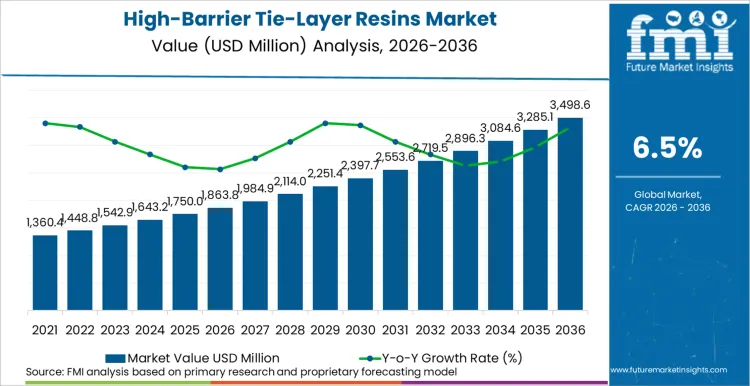
High-Barrier Tie-Layer Resins Market Key Takeaways
| Metric | Value |
|---|---|
| Market Value (2026) | USD 1,863.8 million |
| Market Forecast Value (2036) | USD 3,498.6 million |
| Forecast CAGR 2026 to 2036 | 6.5% |
Source: Future Market Insights analysis, supported by a proprietary forecasting model and primary research
Why is the Demand for High-Barrier Tie-Layer Resins Market Growing?
Demand for high‑barrier tie‑layer resins is increasing as packaging manufacturers seek solutions that enhance barrier performance in multilayer structures used for oxygen‑ and moisture‑sensitive products. Food and beverage producers of snack foods, coffee, and ready meals require packaging films that prevent ingress of gases that accelerate rancidity or loss of aroma. Tie‑layer resins act as adhesives between dissimilar polymers such as polyethylene and ethylene vinyl alcohol, enabling creation of films that balance strength, sealability, and barrier properties without excessive thickness. Converters operating blown and cast film lines specify tie‑layer grades that demonstrate predictable adhesion performance under high drawdown and rapid cooling. Growth in moisture‑barrier demands for pharmaceutical blister packs and medical device barrier films further reinforces adoption because these applications depend on controlled permeability to protect sterility and active stability.
Procurement of high‑barrier tie‑layer resins is also shaped by technical requirements in flexible packaging formats and regional regulatory expectations for shelf life and packaging waste reduction. Packaging engineers aim to reduce overall polymer usage while maintaining barrier performance, so tie layers with optimized adhesive performance help achieve thinner, lighter films that meet mechanical and barrier benchmarks. Material scientists refine compatibility and crystallinity to improve lamination strength and reduce delamination risk during conversion and end use. Quality assurance teams implement barrier testing through oxygen transmission rate and water vapor transmission rate measurements to validate performance prior to commercialization. These factors drive continued integration of high‑barrier tie‑layer resins across diverse packaging applications.
How Is the High-Barrier Tie-Layer Resins Industry Segmented by Resin Chemistry, Application, and Processing Route?
Demand for high-barrier tie-layer resins is driven by multilayer packaging architectures requiring durable adhesion between dissimilar polymers. Converters prioritize compatibility with barrier layers, thermal stability during processing, and recyclability alignment. Selection decisions are influenced by package format, end-use performance expectations, and integration with existing extrusion infrastructure. Segmentation by resin chemistry, application, and processing route explains how adhesion performance, barrier requirements, and manufacturing methods shape material adoption across flexible, rigid, and specialty packaging formats.
Which Resin Chemistry Accounts for the Largest Share in High-Barrier Tie-Layer Resins?
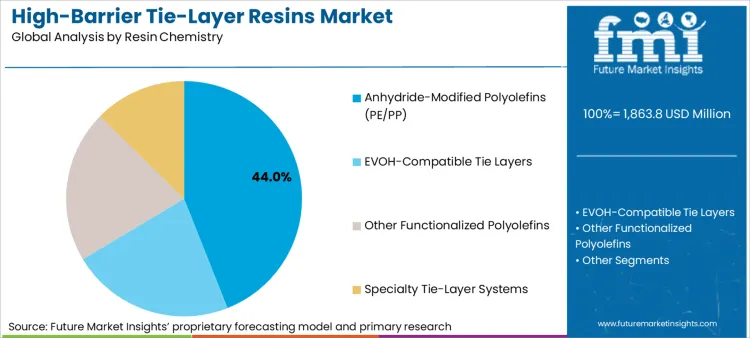
Anhydride-modified polyolefins hold 44.0%, reflecting strong adhesion performance between polyolefin substrates and polar barrier layers. These chemistries are widely adopted due to processing stability, broad resin compatibility, and predictable bonding behavior. EVOH-compatible tie layers are used where oxygen barrier integration is required. Other functionalized polyolefins support adhesion across diverse multilayer structures. Specialty tie-layer systems address demanding thermal or chemical environments. Resin chemistry segmentation reflects the need to balance adhesion strength, extrusion stability, and compatibility with evolving barrier material systems.
Key Points
- Anhydride-modified polyolefins provide reliable interlayer adhesion.
- EVOH compatibility supports oxygen-barrier packaging structures.
- Specialty systems address high-performance multilayer needs.
How Do Application Areas Influence Demand for Tie-Layer Resins?
Food and beverage flexible packaging accounts for 36.0%, driven by multilayer film structures requiring oxygen and moisture barrier integration. These applications emphasize seal integrity, shelf-life protection, and regulatory compliance. Rigid and semi-rigid packaging applications apply tie layers to bond barrier materials in containers and trays. Industrial and specialty packaging uses focus on chemical resistance and mechanical durability. Other uses include non-food laminates and technical films. Application-based segmentation highlights how barrier performance expectations and package format complexity shape tie-layer resin selection.
Key Points
- Flexible food packaging drives the highest tie-layer usage.
- Rigid formats require consistent barrier adhesion.
- Industrial uses emphasize durability and resistance.
Which Processing Route Drives the Highest Utilization of Tie-Layer Resins?
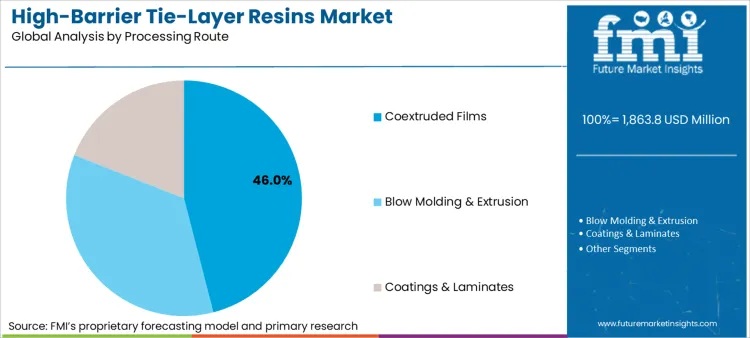
Coextruded films represent 46.0%, reflecting widespread use of multilayer blown and cast film technologies. Tie-layer resins are critical in maintaining adhesion across layers during high-speed coextrusion. Blow molding and extrusion processes apply tie layers in barrier bottles and containers. Coatings and laminates use tie layers to bond dissimilar substrates in post-extrusion structures. Processing-route segmentation reflects alignment between tie-layer performance, thermal exposure, and shear conditions across different manufacturing methods.
Key Points
- Coextrusion dominates due to multilayer film demand.
- Blow molding integrates tie layers in barrier containers.
- Laminates rely on tie layers for substrate bonding.
What are the Key Dynamics in the high barrier tie layer resins market?
Demand in the high barrier tie layer resins market is driven by the need for enhanced multi layer packaging structures that deliver oxygen, moisture, and aroma protection for sensitive products. Food, beverage, pharmaceutical, and pet food manufacturers specify tie layer resins to bond disparate polymer layers, for example polyolefin to barrier polymers like EVOH or nylon, enabling robust performance without sacrificing machinability. Growth is linked to stringent freshness and shelf life requirements in chilled and ambient formats, where barrier integrity directly affects quality outcomes from production through consumer use.
How do specific product protection need influence resin uptake?
High barrier tie layer resins are adopted where end use applications require precise control of gas and vapor transmission rates. Snack foods that are susceptible to staling and rancidity depend on multi layer films with strong adhesion between layers to maintain low oxygen transmission rates (OTR). Meat and cheese packaging uses tie layers to ensure uniform bonding between moisture resistant outer films and oxygen barrier inner layers, preserving color and flavor during chilled storage. In pharmaceutical packaging such as blister foils, tie layer materials ensure blister integrity and moisture protection for hygroscopic drugs. Specialty pet foods with high fat content use engineered tie layers to prevent aroma migration and maintain product appeal. Manufacturers assess barrier performance, clarity, and seal strength as part of formulation decisions for tie layer selection based on target shelf life and processing speeds.
How do processing demands and sustainability expectations shape market expansion?
High barrier tie layer resin demand is influenced by processing compatibility with high speed co extrusion and lamination equipment and by sustainability expectations from brands and retailers. Tie layers must exhibit reliable melt flow and adhesion characteristics to deliver consistent layer bonding on extrusion lines without causing delamination or weak points. Variability in resin rheology can lead to production challenges such as gauge banding or weak seals, which affects throughput and quality metrics. Sustainability pressures encourage development of tie resins that support mono material or mechanically recyclable structures while retaining barrier functionality, addressing recycling infrastructure constraints. Cost sensitivity arises where premium tie layers add to film costs versus conventional structures, particularly in value oriented segments. Regulatory frameworks on recycled content and packaging waste reduction influence where high barrier tie layers are specified, compelling suppliers to innovate solutions that balance performance, recyclability, and economic considerations in complex multi layer films.
How Is Demand for the High-Barrier Tie-Layer Resins Market Evolving Globally?
Global demand for high-barrier tie-layer resins is rising as industries focus on improving packaging performance, particularly for multi-layer films in food, beverage, and pharmaceutical packaging. Growth reflects increasing demand for barrier properties in packaging, which prevent oxygen, moisture, and contaminants from affecting product quality and shelf life. These resins provide critical adhesion between layers in multi-layered packaging. China records 7.7% CAGR, Brazil records 7.3% CAGR, USA records 6.2% CAGR, Germany records 6.1% CAGR, and South Korea records 5.7% CAGR. Adoption is driven by the growing need for improved packaging performance and regulatory requirements for product safety.
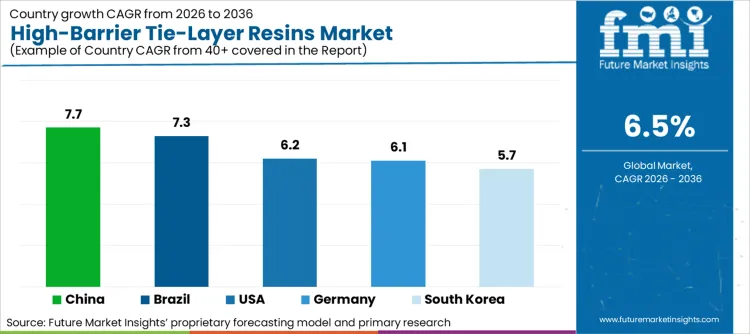
| Country | CAGR (%) |
|---|---|
| China | 7.7% |
| Brazil | 7.3% |
| USA | 6.2% |
| Germany | 6.1% |
| South Korea | 5.7% |
What is driving growth of high-barrier tie-layer resins demand in China?
Demand for high-barrier tie-layer resins in China is expanding as packaging systems increasingly prioritize multi-layer structures for food, beverage, and pharmaceutical products. Growth at 7.7% CAGR reflects rising adoption of barrier materials that extend shelf life and preserve product quality. China’s growing food packaging sector and export-oriented production amplify demand for high-performance resins that improve product protection. Stringent regulatory standards for packaging safety and performance are pushing companies toward multi-layer packaging solutions using high-barrier tie-layer resins. The demand for these resins remains strong in the food packaging and medical supply sectors, where barrier properties are essential.
- Growing demand for food and beverage packaging
- Increased use of multi-layer packaging for product protection
- Regulatory pressure for improved packaging performance
- Strong export-oriented packaging production
Why is Brazil seeing expansion in high-barrier tie-layer resins adoption?
High-barrier tie-layer resins demand in Brazil is increasing as the country’s food and beverage packaging industry scales up. Growth at 7.3% CAGR reflects the adoption of multi-layer packaging solutions that enhance product shelf life and prevent spoilage. High-barrier resins are critical in ensuring barrier properties for packaging that requires longer storage and transport durations. As Brazil’s food packaging sector responds to consumer demands for longer-lasting products, the need for high-performance tie-layer resins grows. These resins are increasingly used in combination with other layers like polyolefins and aluminum to provide an optimal balance of performance and cost-effectiveness.
- Rising demand for longer-lasting food and beverage packaging
- Increased focus on barrier properties in multi-layer structures
- Need for cost-effective yet high-performance packaging solutions
- Growth in food export markets requiring shelf-stable packaging
What factors are shaping high-barrier tie-layer resins sales in the USA?
Sales of high-barrier tie-layer resins in the USA are increasing as manufacturers seek to meet sustainability goals while improving packaging performance. Growth at 6.2% CAGR reflects the expanding use of multi-layer films in food packaging, pharmaceuticals, and personal care products, where barrier properties are essential for maintaining freshness and preventing contamination. Regulatory pressures and consumer demand for longer-lasting products are driving the market toward the adoption of high-barrier solutions. Manufacturers are increasingly focused on using resins that provide strong adhesion between layers while maintaining high product safety and quality standards.
- Rising demand for shelf-stable food packaging
- Focus on meeting regulatory packaging performance standards
- Consumer-driven demand for longer shelf life and freshness
- Growing use of multi-layer films in packaging
How is Germany supporting growth of high-barrier tie-layer resins demand?
High-barrier tie-layer resins demand in Germany is advancing as industries align with the EU’s sustainability and packaging performance regulations. Growth at 6.1% CAGR reflects the continued integration of high-barrier packaging solutions across food, beverage, and pharmaceutical sectors. Multi-layer packaging technologies using high-barrier tie-layer resins help meet EU directives aimed at reducing plastic waste and ensuring safer packaging. The German market focuses on improving product quality, safety, and shelf life through superior packaging solutions. The growing trend of sustainable packaging drives innovation and adoption of high-barrier resins that meet both regulatory and consumer expectations.
- Strong EU regulatory focus on packaging performance and sustainability
- Increasing use of multi-layer packaging technologies
- Need for high-quality, compliant packaging solutions
- Consumer preference for safe, long-lasting products
What is driving expansion of high-barrier tie-layer resins demand in South Korea?
Demand for high-barrier tie-layer resins in South Korea is increasing as packaging requirements for high-performance applications, such as food, beverages, and pharmaceuticals, continue to grow. Growth at 5.7% CAGR reflects the increasing use of multi-layer packaging solutions that ensure product integrity and enhance shelf life. As South Korea's packaging sector adapts to stricter environmental and product safety regulations, the demand for high-barrier solutions rises. These resins are particularly important in the pharmaceutical and food packaging sectors, where barrier properties are crucial to maintain the quality and safety of products.
- Growing demand for multi-layer packaging solutions
- Regulatory pressure on food and pharmaceutical packaging
- Rising consumer demand for extended shelf life and product protection
- Increased focus on product safety and packaging compliance
What Defines the Competitive Landscape for High-Barrier Tie-Layer Resins Market Globally?
The global demand for high-barrier tie-layer resins is driven by the growing need for advanced packaging solutions in the food, pharmaceutical, and electronics sectors, where long shelf life and protection from external contaminants are critical. Buyers evaluate tie-layer resins based on their compatibility with other layers, barrier efficiency, ease of processing, and overall performance in multi-layer structures. Companies focus on sustainability, seeking resins that can integrate recycled content and meet environmental standards. The global trend reflects a shift towards more sophisticated packaging materials that provide enhanced protection, improve product quality, and align with circular economy principles.
Mitsui Chemicals holds a strong position globally with its advanced high-barrier tie-layer resins, which are used extensively in multi-layer packaging, particularly in the food and pharmaceutical industries. Dow competes with a wide range of high-performance tie-layer resins known for their exceptional adhesion and barrier properties. LyondellBasell maintains relevance through its versatile resin solutions designed to meet various packaging needs while ensuring product integrity. ExxonMobil Chemical supports demand with high-quality tie-layer resins that are widely adopted for packaging sensitive products, ensuring product protection throughout distribution. Mitsubishi Chemical Group and SK Functional Polymer participate with tailored solutions for industries requiring high-performance packaging. Borealis and SABIC are key players, providing durable and cost-effective high-barrier resins that offer superior protection against oxygen and moisture. Sumitomo Chemical and Kuratec support the market with specialized resins for specific applications that require advanced barrier technologies. Competitive differentiation is driven by resin customization, barrier performance, sustainability efforts, and the ability to meet complex packaging requirements across multiple industries.
Key Players in the High-Barrier Tie-Layer Resins Market
- Mitsui Chemicals
- Dow
- LyondellBasell
- ExxonMobil Chemical
- Mitsubishi Chemical Group
- SK Functional Polymer
- Borealis
- SABIC
- Sumitomo Chemical
- Kuratec
Scope of the Report
| Items | Values |
|---|---|
| Quantitative Units | USD million |
| Resin Chemistry | Anhydride-Modified Polyolefins (PE/PP); EVOH-Compatible Tie Layers; Other Functionalized Polyolefins; Specialty Tie-Layer Systems |
| Application | Food & Beverage Flexible Packaging; Rigid & Semi-Rigid Packaging; Industrial & Specialty Packaging; Other Uses |
| Processing Route | Coextruded Films; Blow Molding & Extrusion; Coatings & Laminates |
| Regions Covered | Asia Pacific, Europe, North America, Latin America, Middle East & Africa |
| Countries Covered | India, China, USA, Germany, South Korea, and 40+ countries |
| Key Companies Profiled | Mitsui Chemicals; Dow; LyondellBasell; ExxonMobil Chemical; Mitsubishi Chemical Group; SK Functional Polymer; Borealis; SABIC; Sumitomo Chemical; Kuratec |
| Additional Attributes | Dollar sales by resin chemistry, application, and processing route; material quality and compatibility with EVOH; technological advancements in multi-layer film production; capex trends focused on high-barrier performance for food and beverage packaging; procurement patterns towards cost-efficient yet high-quality solutions. |
High-Barrier Tie-Layer Resins Market by Segment
Resin Chemistry:
- Anhydride-Modified Polyolefins (PE/PP)
- EVOH-Compatible Tie Layers
- Other Functionalized Polyolefins
- Specialty Tie-Layer Systems
Application:
- Food & Beverage Flexible Packaging
- Rigid & Semi-Rigid Packaging
- Industrial & Specialty Packaging
- Other Uses
Processing Route:
- Coextruded Films
- Blow Molding & Extrusion
- Coatings & Laminates
Region:
- Asia Pacific
- China
- Japan
- South Korea
- India
- Australia & New Zealand
- ASEAN
- Rest of Asia Pacific
- Europe
- Germany
- United Kingdom
- France
- Italy
- Spain
- Nordic
- BENELUX
- Rest of Europe
- North America
- United States
- Canada
- Mexico
- Latin America
- Brazil
- Chile
- Rest of Latin America
- Middle East & Africa
- Kingdom of Saudi Arabia
- Other GCC Countries
- Turkey
- South Africa
- Other African Union
- Rest of Middle East & Africa
Bibliography
- European Commission. (2024). Regulation (EU) 2024/1781 on packaging and packaging waste (PPWR). Official Journal of the European Union.
- PlasticsEurope. (2024). Design guidelines for recyclable flexible packaging structures. PlasticsEurope Association.
- Food and Agriculture Organization of the United Nations. (2023). Food packaging materials and shelf-life protection: Technical guidance. FAO.
- European Food Safety Authority. (2023). Scientific opinion on food contact materials for multilayer plastic packaging. EFSA Journal.
-
FAQs
- How big is the high-barrier tie-layer resins market in 2026? The high-barrier tie-layer resins market is projected to be valued at USD 1,863.8 million in 2026.
- What will be the size of the high-barrier tie-layer resins market in 2036? The market size for high-barrier tie-layer resins is projected to reach USD 3,498.6 million by 2036.
- How much will the demand for high-barrier tie-layer resins grow between 2026 and 2036? The demand for high-barrier tie-layer resins is projected to grow at a 6.5% CAGR between 2026 and 2036.
- Which resin chemistry holds the largest share in the high-barrier tie-layer resins market in 2026? Anhydride-modified polyolefins are expected to account for 44.0% of the market in 2026.
- Which application contributes the most to the high-barrier tie-layer resins market in 2026? Food & beverage flexible packaging is expected to contribute 36.0% of the market in 2026.
Frequently Asked Questions
How big is the high-barrier tie-layer resins market in 2026?
The global high-barrier tie-layer resins market is estimated to be valued at USD 1,863.8 million in 2026.
What will be the size of high-barrier tie-layer resins market in 2036?
The market size for the high-barrier tie-layer resins market is projected to reach USD 3,498.6 million by 2036.
How much will be the high-barrier tie-layer resins market growth between 2026 and 2036?
The high-barrier tie-layer resins market is expected to grow at a 6.5% CAGR between 2026 and 2036.
What are the key product types in the high-barrier tie-layer resins market?
The key product types in high-barrier tie-layer resins market are anhydride-modified polyolefins (pe/pp), evoh-compatible tie layers, other functionalized polyolefins and specialty tie-layer systems.
Which application segment to contribute significant share in the high-barrier tie-layer resins market in 2026?
In terms of application, food & beverage flexible packaging segment to command 36.0% share in the high-barrier tie-layer resins market in 2026.
Preview the report firsthand - request a free sample
Get SampleGet the brochure for pricing and purchase details.
Get PDFTable of Content
- Executive Summary
- Global Market Outlook
- Demand-side Trends
- Supply-side Trends
- Technology Roadmap Analysis
- Analysis and Recommendations
- Market Overview
- Market Coverage / Taxonomy
- Market Definition / Scope / Limitations
- Market Background
- Market Dynamics
- Drivers
- Restraints
- Trends
- Scenario Forecast
- Demand in Optimistic Scenario
- Demand in Likely Scenario
- Demand in Conservative Scenario
- Opportunity Map Analysis
- Product Life Cycle Analysis
- Supply Chain Analysis
- Investment Feasibility Matrix
- Value Chain Analysis
- PESTLE and Porter’s Analysis
- Regulatory Landscape
- Regional Parent Market Outlook
- Production and Consumption Statistics
- Import and Export Statistics
- Market Dynamics
- Global Market Analysis 2021 to 2025 and Forecast, 2026 to 2036
- Historical Market Size Value (USD Million) Analysis, 2021 to 2025
- Current and Future Market Size Value (USD Million) Projections, 2026 to 2036
- Y-o-Y Growth Trend Analysis
- Absolute $ Opportunity Analysis
- Global Market Pricing Analysis 2021 to 2025 and Forecast 2026 to 2036
- Global Market Analysis 2021 to 2025 and Forecast 2026 to 2036, By Resin Chemistry
- Introduction / Key Findings
- Historical Market Size Value (USD Million) Analysis By Resin Chemistry , 2021 to 2025
- Current and Future Market Size Value (USD Million) Analysis and Forecast By Resin Chemistry , 2026 to 2036
- Anhydride-Modified Polyolefins (PE/PP)
- EVOH-Compatible Tie Layers
- Other Functionalized Polyolefins
- Specialty Tie-Layer Systems
- Anhydride-Modified Polyolefins (PE/PP)
- Y-o-Y Growth Trend Analysis By Resin Chemistry , 2021 to 2025
- Absolute $ Opportunity Analysis By Resin Chemistry , 2026 to 2036
- Global Market Analysis 2021 to 2025 and Forecast 2026 to 2036, By Application
- Introduction / Key Findings
- Historical Market Size Value (USD Million) Analysis By Application, 2021 to 2025
- Current and Future Market Size Value (USD Million) Analysis and Forecast By Application, 2026 to 2036
- Food & Beverage Flexible Packaging
- Rigid & Semi-Rigid Packaging
- Industrial & Specialty Packaging
- Other Uses
- Food & Beverage Flexible Packaging
- Y-o-Y Growth Trend Analysis By Application, 2021 to 2025
- Absolute $ Opportunity Analysis By Application, 2026 to 2036
- Global Market Analysis 2021 to 2025 and Forecast 2026 to 2036, By Processing Route
- Introduction / Key Findings
- Historical Market Size Value (USD Million) Analysis By Processing Route, 2021 to 2025
- Current and Future Market Size Value (USD Million) Analysis and Forecast By Processing Route, 2026 to 2036
- Coextruded Films
- Blow Molding & Extrusion
- Coatings & Laminates
- Coextruded Films
- Y-o-Y Growth Trend Analysis By Processing Route, 2021 to 2025
- Absolute $ Opportunity Analysis By Processing Route, 2026 to 2036
- Global Market Analysis 2021 to 2025 and Forecast 2026 to 2036, By Region
- Introduction
- Historical Market Size Value (USD Million) Analysis By Region, 2021 to 2025
- Current Market Size Value (USD Million) Analysis and Forecast By Region, 2026 to 2036
- North America
- Latin America
- Western Europe
- Eastern Europe
- East Asia
- South Asia and Pacific
- Middle East & Africa
- Market Attractiveness Analysis By Region
- North America Market Analysis 2021 to 2025 and Forecast 2026 to 2036, By Country
- Historical Market Size Value (USD Million) Trend Analysis By Market Taxonomy, 2021 to 2025
- Market Size Value (USD Million) Forecast By Market Taxonomy, 2026 to 2036
- By Country
- USA
- Canada
- Mexico
- By Resin Chemistry
- By Application
- By Processing Route
- By Country
- Market Attractiveness Analysis
- By Country
- By Resin Chemistry
- By Application
- By Processing Route
- Key Takeaways
- Latin America Market Analysis 2021 to 2025 and Forecast 2026 to 2036, By Country
- Historical Market Size Value (USD Million) Trend Analysis By Market Taxonomy, 2021 to 2025
- Market Size Value (USD Million) Forecast By Market Taxonomy, 2026 to 2036
- By Country
- Brazil
- Chile
- Rest of Latin America
- By Resin Chemistry
- By Application
- By Processing Route
- By Country
- Market Attractiveness Analysis
- By Country
- By Resin Chemistry
- By Application
- By Processing Route
- Key Takeaways
- Western Europe Market Analysis 2021 to 2025 and Forecast 2026 to 2036, By Country
- Historical Market Size Value (USD Million) Trend Analysis By Market Taxonomy, 2021 to 2025
- Market Size Value (USD Million) Forecast By Market Taxonomy, 2026 to 2036
- By Country
- Germany
- UK
- Italy
- Spain
- France
- Nordic
- BENELUX
- Rest of Western Europe
- By Resin Chemistry
- By Application
- By Processing Route
- By Country
- Market Attractiveness Analysis
- By Country
- By Resin Chemistry
- By Application
- By Processing Route
- Key Takeaways
- Eastern Europe Market Analysis 2021 to 2025 and Forecast 2026 to 2036, By Country
- Historical Market Size Value (USD Million) Trend Analysis By Market Taxonomy, 2021 to 2025
- Market Size Value (USD Million) Forecast By Market Taxonomy, 2026 to 2036
- By Country
- Russia
- Poland
- Hungary
- Balkan & Baltic
- Rest of Eastern Europe
- By Resin Chemistry
- By Application
- By Processing Route
- By Country
- Market Attractiveness Analysis
- By Country
- By Resin Chemistry
- By Application
- By Processing Route
- Key Takeaways
- East Asia Market Analysis 2021 to 2025 and Forecast 2026 to 2036, By Country
- Historical Market Size Value (USD Million) Trend Analysis By Market Taxonomy, 2021 to 2025
- Market Size Value (USD Million) Forecast By Market Taxonomy, 2026 to 2036
- By Country
- China
- Japan
- South Korea
- By Resin Chemistry
- By Application
- By Processing Route
- By Country
- Market Attractiveness Analysis
- By Country
- By Resin Chemistry
- By Application
- By Processing Route
- Key Takeaways
- South Asia and Pacific Market Analysis 2021 to 2025 and Forecast 2026 to 2036, By Country
- Historical Market Size Value (USD Million) Trend Analysis By Market Taxonomy, 2021 to 2025
- Market Size Value (USD Million) Forecast By Market Taxonomy, 2026 to 2036
- By Country
- India
- ASEAN
- Australia & New Zealand
- Rest of South Asia and Pacific
- By Resin Chemistry
- By Application
- By Processing Route
- By Country
- Market Attractiveness Analysis
- By Country
- By Resin Chemistry
- By Application
- By Processing Route
- Key Takeaways
- Middle East & Africa Market Analysis 2021 to 2025 and Forecast 2026 to 2036, By Country
- Historical Market Size Value (USD Million) Trend Analysis By Market Taxonomy, 2021 to 2025
- Market Size Value (USD Million) Forecast By Market Taxonomy, 2026 to 2036
- By Country
- Kingdom of Saudi Arabia
- Other GCC Countries
- Turkiye
- South Africa
- Other African Union
- Rest of Middle East & Africa
- By Resin Chemistry
- By Application
- By Processing Route
- By Country
- Market Attractiveness Analysis
- By Country
- By Resin Chemistry
- By Application
- By Processing Route
- Key Takeaways
- Key Countries Market Analysis
- USA
- Pricing Analysis
- Market Share Analysis, 2025
- By Resin Chemistry
- By Application
- By Processing Route
- Canada
- Pricing Analysis
- Market Share Analysis, 2025
- By Resin Chemistry
- By Application
- By Processing Route
- Mexico
- Pricing Analysis
- Market Share Analysis, 2025
- By Resin Chemistry
- By Application
- By Processing Route
- Brazil
- Pricing Analysis
- Market Share Analysis, 2025
- By Resin Chemistry
- By Application
- By Processing Route
- Chile
- Pricing Analysis
- Market Share Analysis, 2025
- By Resin Chemistry
- By Application
- By Processing Route
- Germany
- Pricing Analysis
- Market Share Analysis, 2025
- By Resin Chemistry
- By Application
- By Processing Route
- UK
- Pricing Analysis
- Market Share Analysis, 2025
- By Resin Chemistry
- By Application
- By Processing Route
- Italy
- Pricing Analysis
- Market Share Analysis, 2025
- By Resin Chemistry
- By Application
- By Processing Route
- Spain
- Pricing Analysis
- Market Share Analysis, 2025
- By Resin Chemistry
- By Application
- By Processing Route
- France
- Pricing Analysis
- Market Share Analysis, 2025
- By Resin Chemistry
- By Application
- By Processing Route
- India
- Pricing Analysis
- Market Share Analysis, 2025
- By Resin Chemistry
- By Application
- By Processing Route
- ASEAN
- Pricing Analysis
- Market Share Analysis, 2025
- By Resin Chemistry
- By Application
- By Processing Route
- Australia & New Zealand
- Pricing Analysis
- Market Share Analysis, 2025
- By Resin Chemistry
- By Application
- By Processing Route
- China
- Pricing Analysis
- Market Share Analysis, 2025
- By Resin Chemistry
- By Application
- By Processing Route
- Japan
- Pricing Analysis
- Market Share Analysis, 2025
- By Resin Chemistry
- By Application
- By Processing Route
- South Korea
- Pricing Analysis
- Market Share Analysis, 2025
- By Resin Chemistry
- By Application
- By Processing Route
- Russia
- Pricing Analysis
- Market Share Analysis, 2025
- By Resin Chemistry
- By Application
- By Processing Route
- Poland
- Pricing Analysis
- Market Share Analysis, 2025
- By Resin Chemistry
- By Application
- By Processing Route
- Hungary
- Pricing Analysis
- Market Share Analysis, 2025
- By Resin Chemistry
- By Application
- By Processing Route
- Kingdom of Saudi Arabia
- Pricing Analysis
- Market Share Analysis, 2025
- By Resin Chemistry
- By Application
- By Processing Route
- Turkiye
- Pricing Analysis
- Market Share Analysis, 2025
- By Resin Chemistry
- By Application
- By Processing Route
- South Africa
- Pricing Analysis
- Market Share Analysis, 2025
- By Resin Chemistry
- By Application
- By Processing Route
- USA
- Market Structure Analysis
- Competition Dashboard
- Competition Benchmarking
- Market Share Analysis of Top Players
- By Regional
- By Resin Chemistry
- By Application
- By Processing Route
- Competition Analysis
- Competition Deep Dive
- Mitsui Chemicals
- Overview
- Product Portfolio
- Profitability by Market Segments (Product/Age /Sales Channel/Region)
- Sales Footprint
- Strategy Overview
- Marketing Strategy
- Product Strategy
- Channel Strategy
- Dow
- LyondellBasell
- ExxonMobil Chemical
- Mitsubishi Chemical Group
- SK Functional Polymer
- Borealis
- SABIC
- Sumitomo Chemical
- Kuratec
- Mitsui Chemicals
- Competition Deep Dive
- Assumptions & Acronyms Used
- Research Methodology


