

- Industry Size (2026)
- USD 4.45 Bn
- Forecast (2036)
- USD 7.09 Bn
- CAGR (2026 to 2036)
- 4.80%
Connector and Terminal Systems for Harsh Environment Wiring Market Size, Market Forecast and Outlook By FMI
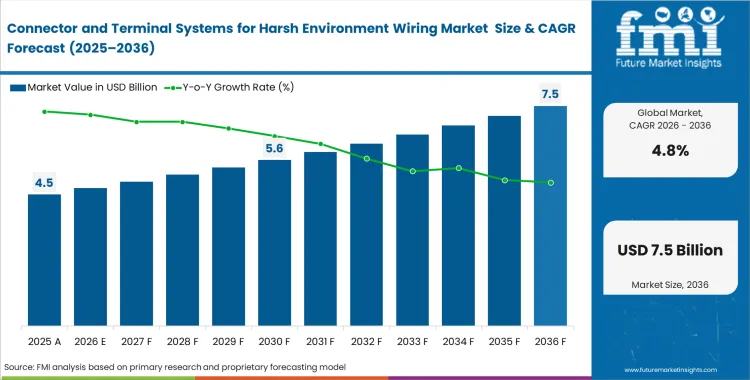
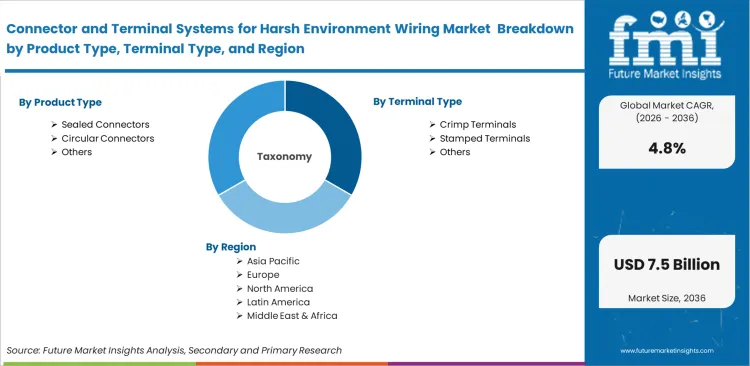
The connector and terminal systems for harsh environment wiring market was valued at USD 4.25 billion in 2025. Sales are poised to surpass USD 4.45 billion in 2026 at a CAGR of 4.80% during the forecast period. Demand outlook propels cumulative valuation to USD 7.09 billion through 2036 as automotive OEMs require high-voltage tolerance under heavy vibration profiles.
Procurement directors at automotive manufacturers face immediate pressure to standardize high-voltage harnesses across electric vehicle platforms. Delaying this transition exposes supply chains to recall risks if ingress protection fails during extended deployment. Engineering teams prioritize hermetic sealing over basic mechanical locking to prevent moisture-induced short circuits. Integrating connector components early in design phases allows manufacturers to lock in supplier capacity before competing industrial buyers absorb available inventory.
Summary of Connector and Terminal Systems for Harsh Environment Wiring Market
- Connector and Terminal Systems for Harsh Environment Wiring Market Snapshot
- The connector and terminal systems for harsh environment wiring market is estimated at USD 4.25 billion in 2025 and is projected to reach USD 7.09 billion by 2036.
- The market is forecast to grow at a 4.8% CAGR from 2026 to 2036, creating an incremental opportunity of USD 2.64 billion over the period.
- Product selection in this market depends heavily on sealing reliability, vibration tolerance, thermal performance, and long-term electrical stability under demanding operating conditions.
- Demand comes from wiring systems used in automotive, industrial, aerospace, marine, and energy applications where exposure to moisture, dust, chemicals, shock, and temperature variation is a routine operating requirement.
- Connector and Terminal Systems for Harsh Environment Wiring Market Demand and Growth Drivers
- Demand is increasing as vehicle platforms, industrial equipment, and off-road systems use more sealed and durable interconnects to maintain stable signal and power transmission under harsh operating conditions.
- IEC 60529 ingress requirements, along with real exposure to water, dust, and chemicals, are pushing buyers toward higher-rated connector and terminal systems.
- Higher electrical content in electrified mobility and industrial automation is also lifting the value of rugged housings, contacts, and terminals used per system.
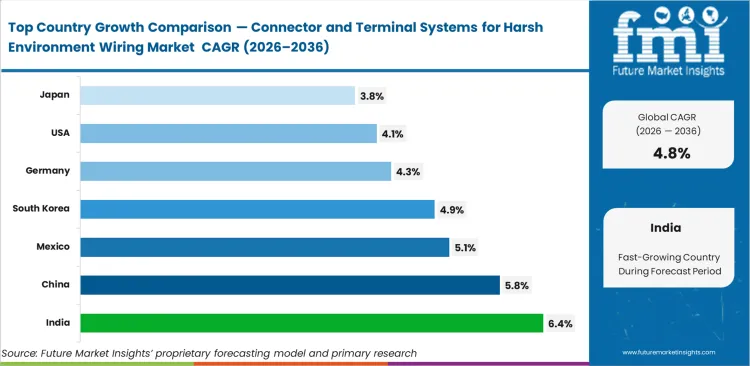
- India is expected to lead growth among the key countries at 6.4% CAGR, followed by China at 5.8%, Mexico at 5.1%, South Korea at 4.9%, Germany at 4.3%, the United States at 4.1%, and Japan at 3.8%.
- Qualification timelines, higher sealing and material costs, and strict automotive, industrial, and defense-grade reliability requirements continue to limit faster adoption in some programs.
- Connector and Terminal Systems for Harsh Environment Wiring Market Product and Segment View
- The market includes rugged connector housings, terminals, contacts, and sealing systems produced mainly from copper alloys, stainless steel, engineering plastics, and elastomers for harsh-duty wiring assemblies.
- These components are used across vehicle harnesses, industrial automation systems, defense electronics, rail platforms, marine systems, and process-control or oil-and-gas wiring applications.
- Copper alloys are expected to remain the material benchmark, with 61% share in 2026, because buyers still need the best balance of conductivity, corrosion resistance, and fatigue performance in harsh-duty connection systems.
- Crimp terminals are likely to stay central to the market and are projected to account for 44% share in 2026. Their position comes from established use in harness production, reliable retention under vibration, and easier large-scale processing on high-volume assembly lines.
- IP67 is anticipated to represent 42% of market share in 2026, reflecting its broad fit across automotive, industrial, and mobile equipment applications where dust ingress and temporary water exposure are routine design concerns.
- Sealed connectors are forecast to command 38% share in 2026 as OEMs and equipment makers continue to prioritize protection against moisture, dust, and contamination in field operating conditions.
- Automotive is expected to contribute 34% of total market share in 2026, supported by large harness volumes, rising electrical complexity, and the need for dependable connector performance across increasingly sensor-heavy vehicle platforms.
- The scope covers connector shells, terminals, contact systems, sealing accessories, and ruggedized interconnect assemblies, while excluding full wire harnesses, cable-management hardware, and indoor commodity connectors used in non-harsh settings.
- Connector and Terminal Systems for Harsh Environment Wiring Market Geography and Competitive Outlook
- India, China, and Mexico are expected to post faster growth, while the United States and Germany remain important high-value markets tied to premium industrial, aerospace, defense, and mobility programs.
- Competition is shaped by sealing performance, validation depth, platform approvals, and long-term customer relationships, with TE Connectivity, Amphenol, Molex, Aptiv, Yazaki, ITT Cannon, and Smiths Interconnect among the principal participants.
- The market is moderately concentrated, with TE Connectivity and Amphenol holding the strongest global positions across transportation, industrial, and harsh-duty interconnect applications.
- Competitive activity is moving toward broader ruggedized portfolios, application-specific circular formats, and integrated harsh-environment solution sets rather than competing mainly on price.
Key Takeaways
| Metric | Details |
|---|---|
| Industry Size (2026) | USD 4.45 billion |
| Industry Value (2036) | USD 7.09 billion |
| CAGR (2026 to 2036) | 4.80% |
Source: Future Market Insights (FMI) analysis, based on proprietary forecasting model and primary research
Once aerospace manufacturers shift procurement from custom-machined contacts to standardized circular formats, commercial viability expands quickly. Volume commitments trigger tooling investments among tier-one suppliers to lower unit costs. High-volume production replaces batch manufacturing and accelerates adoption across adjacent heavy-duty applications.
Domestic manufacturing mandates in India force localized production of heavy-duty harnesses, where demand is anticipated to rise at a CAGR of 6.4% through 2036. Electric vehicle export volume pushes the China harsh environment wiring connectors market to a 5.8% CAGR. Mexico is expected to post a CAGR of 5.1% by 2036 due to nearshoring of automotive assembly lines. Battery system integration requirements in South Korea leads to an estimated 4.9% growth rate. Industrial automation demands higher ingress protection in Germany, which is set to record 4.3% CAGR during the forecast period. Aerospace modernization supports a 4.1% CAGR in the United States. Japan follows at 3.8% driven by robotics upgrades. Divergence occurs between regions pushing high-voltage automotive networks versus those upgrading legacy industrial grids.
Segmental Analysis
Connector and Terminal Systems for Harsh Environment Wiring Market Analysis by Product Type
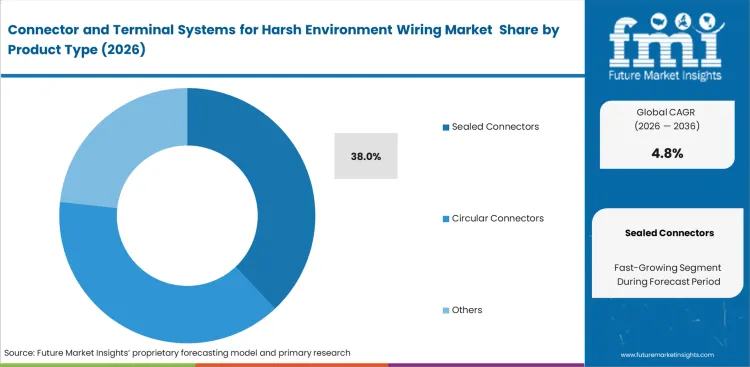
Mandatory ingress protection protocols force automotive engineers to specify closed architectures. The sealed connectors segment is estimated to account for 38.0% share in 2026 as these components prevent fluid ingress during high-pressure washdowns. The procurement directors at heavy equipment manufacturers rely on these parts to reduce warranty claims. Choosing unsealed alternatives exposes organizations to liability when field failures occur. What procurement software fails to capture is how silicone seals degrade under specific chemical exposures, requiring formulation adjustments that void generic certifications. Opting for cheaper global automotive wiring harness integration without verifying seal compatibility leads to premature electrical failure.
- Initial specification: Automotive designers select sealed formats to meet baseline safety requirements. Component buyers face immediate rejection if alternative formats lack proven field data.
- Validation testing: Quality assurance managers subject samples to thermal shock cycles. Parts failing these tests require complete redesigns.
- Lifecycle renewal: Maintenance teams reorder specific brands matching original equipment specifications. Deviating from established supply chains risks operational downtime.
Connector and Terminal Systems for Harsh Environment Wiring Market Analysis by Terminal Type
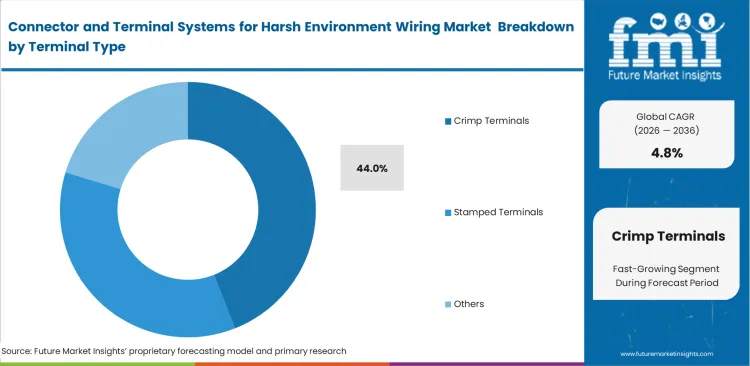
Automated wire processing equipment dictates component selection across high-volume production facilities. The manufacturing engineers at tier-one suppliers prefer this termination method to guarantee cycle times. The crimp terminals category is expected to hold 44.0% share in 2026 because machinery applies consistent mechanical force without requiring manual soldering. Transitioning toward hand-soldered connections destroys production throughput and increases defect rates. Reliance on automated crimping masks underlying contact deformation issues when improper tooling gets deployed on shop floors. Operations managers who neglect regular die calibration face scrap rates when low voltage wire and cable assemblies fail continuity testing.
- Labor reduction: Automated application eliminates manual soldering requirements. Production managers achieve higher output with fewer specialized technicians.
- Hidden tooling expenses: Specialized crimp dies require constant recalibration. Facility directors absorb unexpected maintenance costs to keep lines running.
- Total cost evaluation: Rapid application speeds offset initial equipment investments. Financial controllers approve capital expenditures after reviewing long-term labor savings.
Connector and Terminal Systems for Harsh Environment Wiring Market Analysis by Material
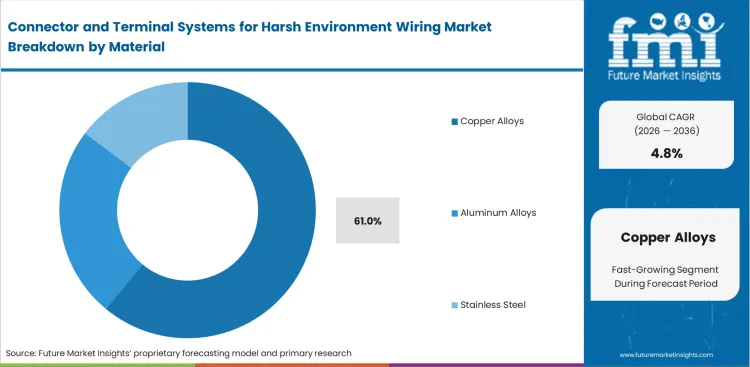
Thermal conductivity requirements dictate baseline metal choices for high-current applications. It has been estimated that the electrical designers specify these materials to prevent overheating in enclosed spaces. Copper alloys are anticipated to capture 61.0% of the market in 2026 owing to superior electrical performance under continuous load. Selecting inferior conductors causes temperature spikes that melt surrounding cable accessories. Engineers specifying generic copper often miss how specific alloy blends react to extreme vibration, leading to micro-cracking at termination points. Organizations delaying material upgrades suffer recurring field failures as power requirements increase across modern machinery.
- Thermal prevention: Superior conductivity stops heat accumulation inside tight housings. Design engineers avoid melting events.
- Vibration vulnerability: Basic alloys crack under continuous mechanical stress. Maintenance directors replace failed components frequently if specific blends remain unspecified.
- Plating requirements: Base metals demand specialized coatings to resist corrosion. Buyers must specify tin or gold plating to ensure long-term reliability.
Connector and Terminal Systems for Harsh Environment Wiring Market Analysis by End Use
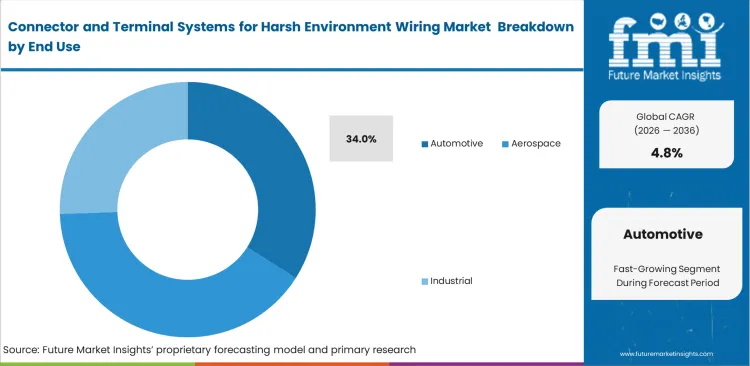
Electric vehicle platforms demand robust high-voltage distribution networks. Automotive applications are poised to garner 34.0% share in 2026 as manufacturers electrify passenger and commercial fleets. The powertrain engineers rely on specialized interconnects to maintain battery system integrity. Failing to implement secure components results in vehicle shutdowns during adverse weather. Standard automotive wires cable materials testing ignores long-term exposure to road salts, creating unexpected degradation near wheel wells. Fleet operators absorb repair costs when commercial vehicles sit idle awaiting replacement wiring harnesses.
- Early adopters: Premium electric vehicle brands implement advanced sealing first. Powertrain engineers secure reliable performance data to justify higher component costs.
- Follower integration: Mid-market manufacturers adopt proven architectures. Supply chain directors benefit from established production volumes and lower unit pricing.
- Commercial conversion: Heavy truck manufacturers convert legacy systems last. Fleet managers demand absolute reliability before approving new electrical architectures.
Connector and Terminal Systems for Harsh Environment Wiring Market Analysis by Protection Rating
Standard industrial equipment typically operates under baseline fluid and dust exposure parameters. The facility managers specify this rating to balance cost against realistic environmental threats. The IP67 category is likely to account for 42.0% share in 2026 by offering sufficient protection for general factory environments. Over-specifying to higher ratings consumes capital budgets without delivering tangible operational benefits. Equipment buyers routinely assume IP67 guarantees underwater operation, failing to realize prolonged submersion compromises basic elastomer seals. Deploying these units in continuous submersion scenarios instead of dedicated underwater connectors causes immediate operational failure.
- Production origins: High-volume molding facilities produce these components efficiently. Operations directors sustain output by standardizing assembly processes.
- Resin constraints: Material shortages limit production capacity during peak demand. Procurement officers must secure multiple sourcing agreements to ensure uninterrupted supply.
- Future availability: Expansion into emerging markets guarantees long-term supply stability. Supply chain managers plan regional procurement strategies to mitigate geopolitical risks.
Connector and Terminal Systems for Harsh Environment Wiring Market Drivers, Restraints, and Opportunities
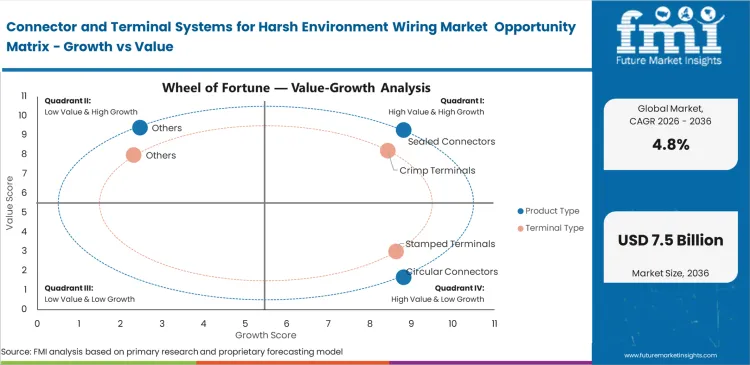
Electrification of commercial fleets forces automotive powertrain engineers to replace legacy 12-volt systems with high-voltage networks requiring absolute isolation from environmental contaminants. Relying on basic electrical tape and unsealed housings exposes manufacturers to short circuits when vehicles encounter standing water or heavy vibration. Upgrading to fully sealed, heavy-duty architectures prevents these failures but demands complete redesigns of existing chassis layouts. Manufacturers delaying this transition face warranty liabilities as field failures compound.
Testing delays block rapid adoption even when engineering teams approve new component designs. Validating thermal shock resistance and chemical compatibility takes months of continuous laboratory operation. Engineers cannot accelerate physical aging tests without compromising data integrity, leaving production lines waiting for final sign-offs. Digital simulation software provides baseline estimates but fails to replace physical vibration testing required by automotive safety standards.
Opportunities in the Connector and Terminal Systems for Harsh Environment Wiring Market
- Alternative alloy development: Engineers formulate new metal blends offering high conductivity with lower weight. Aerospace designers gain critical fuel efficiency improvements.
- Miniaturization architectures: Suppliers design compact sealed housings. Medical equipment designers integrate robust connections into smaller portable devices.
- Fiber integration: Manufacturers embed harsh environments fiber optic lines alongside copper power delivery. Industrial managers achieve high-speed data transmission without expanding physical cable footprints.
Regional Analysis
Based on regional analysis, Connector and Terminal Systems for Harsh Environment Wiring is segmented into North America, East Asia, and South Asia across 40 plus countries.
.webp "Top Country Growth Comparison Connector And Terminal Systems For Harsh Environment Wiring Market Cagr (2026 2036)")
| Country | CAGR (2026 to 2036) |
|---|---|
| India | 6.4% |
| China | 5.8% |
| Mexico | 5.1% |
| South Korea | 4.9% |
| Germany | 4.3% |
| United States | 4.1% |
| Japan | 3.8% |
Source: Future Market Insights (FMI) analysis, based on proprietary forecasting model and primary research
Asia Pacific Connector and Terminal Systems for Harsh Environment Wiring Market Analysis
Asia Pacific remains the main volume center for this market because it combines large-scale electrical component manufacturing with rising demand from electric vehicles, battery systems, industrial automation, and heavy-duty wiring applications. Buyers across the region focus on reliability, assembly efficiency, and cost control, especially where connectors and terminals must perform under heat, vibration, moisture, and continuous operating stress. Local manufacturers have improved tooling, molding, and materials capability, which is tightening competition across both mid-range and high-volume applications. OEMs are also widening their supplier base across the region to balance cost, quality, and production resilience.
- China: China is projected to expand at a 5.8% CAGR over the forecast period. Electric vehicle production and export programs are sustaining demand for standardized high-voltage connectors and rugged terminal systems that support faster assembly and dependable field performance. Manufacturers are under pressure to manage cost without weakening quality as platforms scale across domestic and export markets. Local suppliers are gaining share in mid-tier applications by improving quality while staying price competitive.
- South Korea: Advanced battery system development continues to support demand for specialized connector and terminal systems in South Korea. Thermal control, power distribution reliability, and compact system design remain important buying criteria, especially in battery-intensive applications. Sales are expected to rise at a 4.9% CAGR during the assessment period. Quality control remains strict because any weakness in connection performance can raise safety and warranty risk.
- Japan: Industrial automation and robotics upgrades are supporting connector demand in Japan, where buyers place a premium on durability, signal stability, and long operating life. Maintenance teams and equipment designers continue to favor components that can withstand repeated motion, tight installation spaces, and demanding factory conditions. The market is likely to grow at a 3.8% CAGR by 2036. High-precision interconnect selection remains important in applications where signal consistency and equipment uptime directly affect production efficiency.
- India: India remains one of the faster-growing markets in Asia Pacific, with demand expected to increase at a 6.4% CAGR during the forecast period. Commercial vehicle upgrades, tighter safety and emissions requirements, and the growing use of sensors and control systems are lifting demand for sealed and durable connector solutions. OEMs and tier-one suppliers are also pushing for more local sourcing to control cost and reduce dependence on imports. Suppliers that invest in local tooling and production support are likely to strengthen their position further.
FMI notes that Asia Pacific will remain the key growth region for connector and terminal systems for harsh environment wiring, led by EV production, battery systems, and industrial automation. China and India will drive volume growth, while Japan and South Korea will support demand in high-specification applications. Supplier advantage will depend on localized production, quality consistency, and OEM approval strength.
North America Connector and Terminal Systems for Harsh Environment Wiring Market Analysis
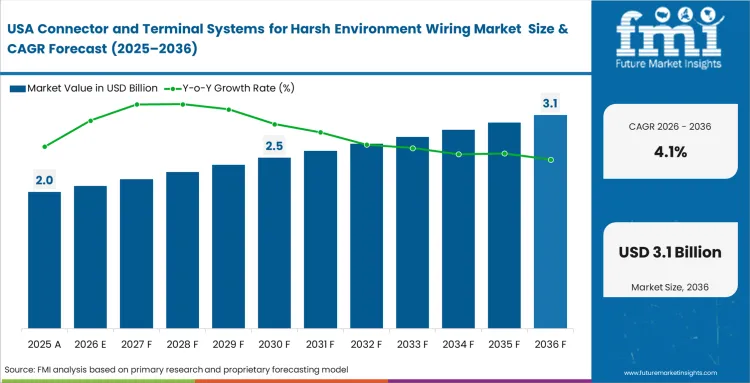
North America remains a specification-driven market where demand is shaped more by performance requirements than by unit volume alone. Aerospace and defense programs continue to replace aging electrical systems with lighter and more durable interconnect solutions, especially where vibration resistance, sealing performance, and weight control directly affect platform design. Military and aerospace buyers are also putting more pressure on domestic sourcing, which keeps certified local suppliers in a favorable position. Capacity remains selective in highly specialized military-grade components, and that gives approved manufacturers stronger pricing control when qualification barriers are high.
- United States: Demand for connector and terminal systems for harsh environment wiring in the United States is projected to rise at a 4.1% CAGR through 2036. Defense spending and aerospace modernization keep demand firm for ruggedized interconnects that meet tight military and aviation specifications. Engineers are placing higher value on components that reduce weight without weakening vibration tolerance or electrical reliability. Suppliers with proven certifications and long approval histories are better placed to secure premium programs.
- Mexico: Nearshoring is strengthening demand in Mexico as automotive harness assembly and related electrical integration move closer to North American vehicle production hubs. Industry in Mexico is expected to expand at a 5.1% CAGR through 2036, supported by the need for reliable components that can hold up under high-volume manufacturing conditions. Assembly plants value short lead times and supply continuity as much as price. Regional suppliers that can serve plants quickly and consistently are in a better position to win long-term sourcing agreements.
FMI’s analysis finds that North America remains a high-value market for connector and terminal systems for harsh environment wiring, supported by aerospace, defense, and automotive demand. The United States drives specification-led demand, while Mexico benefits from nearshoring and regional vehicle production. Supplier strength in the region will depend on certification depth, delivery reliability, and proximity to OEM programs.
Europe Connector and Terminal Systems for Harsh Environment Wiring Market Analysis
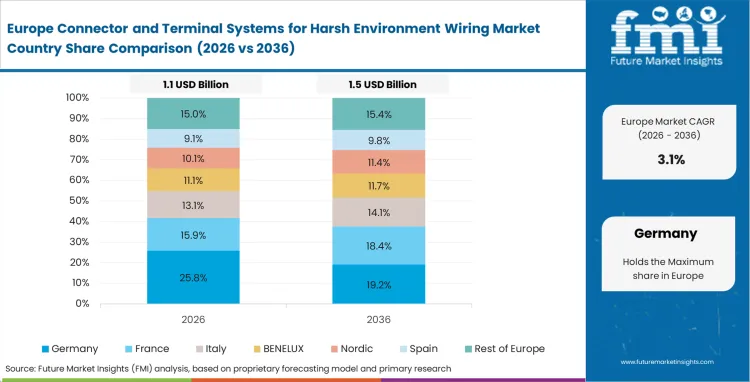
Europe remains a quality-driven market where demand is shaped by automotive engineering standards, industrial automation requirements, and the need for long-life electrical performance in demanding operating conditions. Buyers across the region place strong emphasis on sealing reliability, dimensional accuracy, vibration resistance, and compliance with OEM and industrial specifications. The market is less volume-led than Asia Pacific, but it holds strategic value because specification approval, engineering support, and product consistency strongly influence supplier selection. Suppliers that can meet tight validation requirements and support localized programs are better placed to retain long-term business.
- Germany: Germany remains a steady demand center for connector and terminal systems used in harsh environment wiring across automotive, industrial equipment, and factory automation applications. Buyers focus on long service life, fit precision, and stable electrical performance in demanding operating conditions. The market is expected to grow at a 4.3% CAGR over the forecast period. Suppliers with strong engineering support and proven compliance with OEM quality standards are better placed to hold share in this market.
FMI analysis reveals that Europe remains an important market for connector and terminal systems for harsh environment wiring, supported by automotive production, industrial automation, and specification-led demand. Germany continues to anchor regional consumption through its strong manufacturing base and high-performance application requirements. Supplier position in Europe will depend on engineering support, quality consistency, and compliance with OEM standards.
Competitive Aligners for Market Players
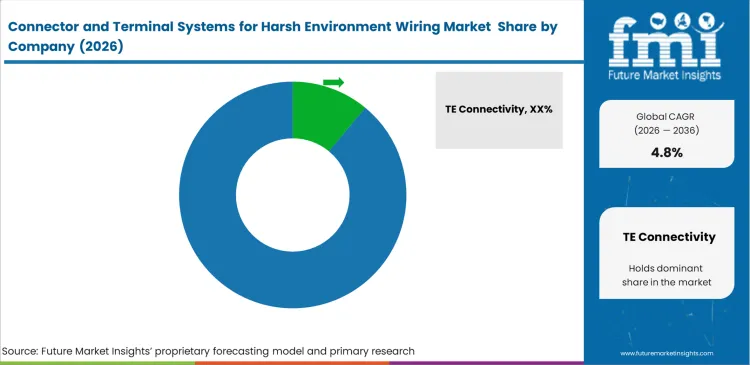
Tier-one automotive suppliers dictate pricing power through purchasing volumes and strict vendor qualification protocols. TE Connectivity is forecast to command 16.0% share in 2026 by leveraging global manufacturing footprints that local competitors cannot match. Component buyers rank supplier reliability and global availability above minor technical specifications during qualification rounds. Establishing localized injection molding capacity remains a primary barrier preventing smaller regional players from capturing multinational OEM contracts.
Incumbent manufacturers possess libraries of certified designs and proprietary tooling that challengers struggle to replicate. Developing a new fiber optic connector requires capital investment in precision machining and months of environmental testing. Established companies use intellectual property portfolios to block competitors from copying successful mechanical locking mechanisms. Securing raw material supply chains for specialized engineering plastics provides large firms with cost advantages during resin shortages.
Major industrial buyers resist vendor lock-in by aggressively standardizing interface geometries across equipment portfolios. Procurement directors mandate that new components mate seamlessly with existing legacy hardware, stripping proprietary advantage from suppliers attempting to force closed ecosystems. Component manufacturers must focus heavily on automated assembly compatibility rather than just environmental sealing performance to secure future contracts.
Key Players in Connector and Terminal Systems for Harsh Environment Wiring Market
- TE Connectivity
- Amphenol
- Molex
- Aptiv
- Yazaki
- ITT Cannon
- Smiths Interconnect
Scope of the Report
| Metric | Value |
|---|---|
| Quantitative Units | USD 4.45 billion to USD 7.09 billion, at a CAGR of 4.80% |
| Market Definition | Components built to secure electrical connections against severe environmental degradation define this space. Assemblies maintain integrity despite vibration and fluid exposure. |
| Segmentation | Product Type, Terminal Type, Material, End Use, Protection Rating, and Region |
| Regions Covered | North America, Latin America, Europe, East Asia, South Asia, Oceania, Middle East and Africa |
| Countries Covered | United States, China, India, Germany, Japan, South Korea, Mexico |
| Key Companies Profiled | TE Connectivity, Amphenol, Molex, Aptiv, Yazaki, ITT Cannon, Smiths Interconnect |
| Forecast Period | 2026 to 2036 |
| Approach | Automotive production volumes and industrial automation capital expenditure trends |
Source: Future Market Insights (FMI) analysis, based on proprietary forecasting model and primary research
Connector and Terminal Systems for Harsh Environment Wiring Market Analysis by Segments
By Product Type
- Sealed connectors
- Circular connectors
- Rectangular connectors
- Feedthroughs
- Terminal blocks
By Terminal Type
- Crimp terminals
- Stamped terminals
- Machined contacts
- Socket contacts
- Ring terminals
By Material
- Copper alloys
- Aluminum alloys
- Stainless steel
- Engineering plastics
- Elastomers
By End Use
- Automotive
- Aerospace
- Industrial
- Energy
- Marine
By Protection Rating
- IP67
- IP68
- IP69K
- Hermetic
- EMI-shielded
Region
- North America
- Latin America
- Europe
- East Asia
- South Asia
- Oceania
- Middle East and Africa
Bibliography
- Amphenol Corporation. (2026, January 28). Amphenol reports record fourth quarter and full year 2025 results.
- Aptiv. (2024, December 12). Key considerations when designing connectors for harsh environments.
- Electronic Components Industry Association. (2024, September). Short-Lived Positive Sales Sentiment for Electronic Components Clipped by September Survey Results.
- TE Connectivity. (2025). 2025 annual report.
- Yazaki Group. (2024). Sustainability report 2024.
This bibliography is provided for reader reference. The full FMI report contains the complete reference list with primary source documentation.
This Report Addresses
- Electric vehicle architectures are raising demand for sealed high-voltage interconnects that can maintain isolation performance under vibration, fluid exposure, and continuous operating stress.
- High-volume wire harness production continues to favor crimp terminals because automated processing is faster, more consistent, and easier to scale than manual joining methods.
- Copper alloys remain the preferred choice in high-current applications where thermal control, conductivity, and reliability inside compact housings directly affect connector performance.
- Aerospace and defense programs are increasing demand for lighter interconnect components that can reduce weight without weakening vibration resistance or service reliability.
- Micro-fretting at contact interfaces remains a key reliability risk in sealed systems, since electrical degradation can begin before any visible seal failure appears.
- Crimping operations also face execution risk when die wear affects connection consistency, raising maintenance cost and interrupting line efficiency.
- In India, tighter vehicle safety and emissions requirements are encouraging suppliers to localize molding and related component production to reduce tariff exposure and improve OEM access.
- Industrial buyers continue to resist closed connector ecosystems, which is increasing interest in standardized interface designs that work across mixed equipment fleets.
Frequently Asked Questions
What limits the adoption of multi-coaxial routing systems in standard commercial vehicles?
Assembly line technicians lack the microscopic crimping tools required to reliably terminate complex nodes.
Why are sealed connectors expected to account for 38.0% of the product type share in 2026?
Sealed connectors are expected to lead because buyers need stronger protection against moisture, dust, and contamination in automotive and industrial wiring applications.
What condition supports the 4.8% overall growth rate in this market?
Rising electrical content in vehicles, industrial systems, and harsh-duty equipment is increasing demand for connectors and terminals with better sealing and durability.
How does tooling control competitive dynamics in this space?
Tooling affects competitive position because suppliers with proven automation compatibility and processing consistency are better placed to secure long-term OEM programs.
What specific vulnerability affects IP67 and IP68 rated systems?
Contact degradation can begin through vibration-related wear and micro-fretting even when the outer sealing system continues to resist moisture ingress.
Why is India projected to grow at 6.4% CAGR versus 4.1% in the United States?
India is expanding faster because vehicle electrification, local sourcing, and broader industrial buildout are lifting demand from a lower installed base.
What operational consequence does the buyers face when mixing component brands?
Mating a connector with an incompatible receptacle instantly compromises the critical interference fit.
How do zonal architectures impact automotive connector stress?
Centralizing processing power pushes peripheral connections outward into highly exposed wheel wells and engine compartments.
Why are copper alloys expected to account for 61.0% of the material segment share in 2026?
Copper alloys are expected to lead because they offer the best balance of conductivity, fatigue resistance, and corrosion performance in harsh-duty connector systems.
What friction slows the aerospace transition to advanced interconnects?
Rigid aviation certification pathways force engineers to restart validation cycles whenever a flight component changes.
How does localized manufacturing alleviate supply chain strain?
Multinational OEMs mandate critical parts be procurable from geographically isolated factories to prevent shutdowns.
What prevents rapid adoption of liquid-cooled terminals in logistics?
Fleet managers struggle to retrofit existing depot skeleton to handle specialized active coolant routing.
Why is continuous ultrasonic welding critical for heavy duty cables?
Ultrasonic welding fuses metals directly, eliminating microscopic air gaps where corrosive elements initiate connection failure.
How do raw material fluctuations impact long term supply agreements?
Procurement directors negotiate complex price-hedging clauses to prevent sudden copper price spikes from eroding margins.
What drives aerospace engineers to specify high-density pin configurations?
Launch vehicle designers face crippling weight penalties for every excess cubic inch of bulkhead utilization.
Why do defense contractors insist on mil-spec verification logs?
Lead engineers demand decades of documented extreme-temperature survival data before integrating new radar arrays.
What limits aluminum alloy adoption in high-power applications?
Aluminum rapidly builds an oxide layer in humid conditions, severely degrading critical electrical continuity.
How do secondary mechanical locks prevent equipment downtime?
Latches secure the mating housing, ensuring continuous telemetry data flows uninterrupted during heavy industrial vibration.
Why do marine integrators avoid un-plated base metal components?
Constant saltwater exposure rapidly strips electrons, requiring precision plating layers as protective sacrificial barriers.
What drives industrial robotics manufacturers toward IP69K ratings?
Smart automation requires sensor nodes to survive aggressive daily sanitation routines using caustic hot-water jets.
How does thermal expansion mismatch cause intermittent faults?
Different expansion rates between housing and pins momentarily break electrical continuity during extreme temperature shifts.
Why do battery swapping stations require specialized blind-mate designs?
Ruggedized self-aligning modules absorb mechanical misalignment, guaranteeing perfect electrical connections instantly without manual intervention.
Preview the report firsthand - request a free sample
Get SampleGet the brochure for pricing and purchase details.
Get PDFTable of Content
- Executive Summary
- Global Market Outlook
- Demand-side Trends
- Supply-side Trends
- Technology Roadmap Analysis
- Analysis and Recommendations
- Market Overview
- Market Coverage / Taxonomy
- Market Definition / Scope / Limitations
- Research Methodology
- Chapter Orientation
- Analytical Lens and Working Hypotheses
- Market Sizing, Forecasting, and Opportunity Mapping
- Research Design and Evidence Framework
- Desk Research Programme (Secondary Evidence)
- Company Annual and Sustainability Reports
- Peer-reviewed Journals and Academic Literature
- Corporate Websites, Product Literature, and Technical Notes
- Earnings Decks and Investor Briefings
- Statutory Filings and Regulatory Disclosures
- Technical White Papers and Standards Notes
- Trade Journals, Industry Magazines, and Analyst Briefs
- Conference Proceedings, Webinars, and Seminar Materials
- Government Statistics Portals and Public Data Releases
- Press Releases and Reputable Media Coverage
- Specialist Newsletters and Curated Briefings
- Sector Databases and Reference Repositories
- FMI Internal Proprietary Databases and Historical Market Datasets
- Subscription Datasets and Paid Sources
- Social Channels, Communities, and Digital Listening Inputs
- Additional Desk Sources
- Expert Input and Fieldwork (Primary Evidence)
- Primary Modes
- Qualitative Interviews and Expert Elicitation
- Quantitative Surveys and Structured Data Capture
- Blended Approach
- Why Primary Evidence is Used
- Observational and In-context Research
- Social and Community Interactions
- Primary Modes
- Stakeholder Universe Engaged
- C-suite Leaders
- Board Members
- Presidents and Vice Presidents
- R&D and Innovation Heads
- Technical Specialists
- Domain Subject-matter Experts
- Scientists
- Physicians and Other Healthcare Professionals
- Governance, Ethics, and Data Stewardship
- Research Ethics
- Data Integrity and Handling
- Desk Research Programme (Secondary Evidence)
- Tooling, Models, and Reference Databases
- Data Engineering and Model Build
- Data Acquisition and Ingestion
- Cleaning, Normalisation, and Verification
- Synthesis, Triangulation, and Analysis
- Quality Assurance and Audit Trail
- Market Background
- Market Dynamics
- Drivers
- Restraints
- Opportunity
- Trends
- Scenario Forecast
- Demand in Optimistic Scenario
- Demand in Likely Scenario
- Demand in Conservative Scenario
- Opportunity Map Analysis
- Product Life Cycle Analysis
- Supply Chain Analysis
- Investment Feasibility Matrix
- Value Chain Analysis
- PESTLE and Porter’s Analysis
- Regulatory Landscape
- Regional Parent Market Outlook
- Production and Consumption Statistics
- Import and Export Statistics
- Market Dynamics
- Global Market Analysis 2021 to 2025 and Forecast, 2026 to 2036
- Historical Market Size Value (USD Million) Analysis, 2021 to 2025
- Current and Future Market Size Value (USD Million) Projections, 2026 to 2036
- Y-o-Y Growth Trend Analysis
- Absolute $ Opportunity Analysis
- Global Market Pricing Analysis 2021 to 2025 and Forecast 2026 to 2036
- Global Market Analysis 2021 to 2025 and Forecast 2026 to 2036, By Product Type
- Introduction / Key Findings
- Historical Market Size Value (USD Million) Analysis By Product Type , 2021 to 2025
- Current and Future Market Size Value (USD Million) Analysis and Forecast By Product Type , 2026 to 2036
- Sealed Connectors
- Circular Connectors
- Others
- Sealed Connectors
- Y-o-Y Growth Trend Analysis By Product Type , 2021 to 2025
- Absolute $ Opportunity Analysis By Product Type , 2026 to 2036
- Global Market Analysis 2021 to 2025 and Forecast 2026 to 2036, By Terminal Type
- Introduction / Key Findings
- Historical Market Size Value (USD Million) Analysis By Terminal Type, 2021 to 2025
- Current and Future Market Size Value (USD Million) Analysis and Forecast By Terminal Type, 2026 to 2036
- Crimp Terminals
- Stamped Terminals
- Others
- Crimp Terminals
- Y-o-Y Growth Trend Analysis By Terminal Type, 2021 to 2025
- Absolute $ Opportunity Analysis By Terminal Type, 2026 to 2036
- Global Market Analysis 2021 to 2025 and Forecast 2026 to 2036, By Material
- Introduction / Key Findings
- Historical Market Size Value (USD Million) Analysis By Material, 2021 to 2025
- Current and Future Market Size Value (USD Million) Analysis and Forecast By Material, 2026 to 2036
- Copper Alloys
- Aluminum Alloys
- Stainless Steel
- Copper Alloys
- Y-o-Y Growth Trend Analysis By Material, 2021 to 2025
- Absolute $ Opportunity Analysis By Material, 2026 to 2036
- Global Market Analysis 2021 to 2025 and Forecast 2026 to 2036, By End Use
- Introduction / Key Findings
- Historical Market Size Value (USD Million) Analysis By End Use, 2021 to 2025
- Current and Future Market Size Value (USD Million) Analysis and Forecast By End Use, 2026 to 2036
- Automotive
- Aerospace
- Industrial
- Automotive
- Y-o-Y Growth Trend Analysis By End Use, 2021 to 2025
- Absolute $ Opportunity Analysis By End Use, 2026 to 2036
- Global Market Analysis 2021 to 2025 and Forecast 2026 to 2036, By Region
- Introduction
- Historical Market Size Value (USD Million) Analysis By Region, 2021 to 2025
- Current Market Size Value (USD Million) Analysis and Forecast By Region, 2026 to 2036
- North America
- Latin America
- Western Europe
- Eastern Europe
- East Asia
- South Asia and Pacific
- Middle East & Africa
- Market Attractiveness Analysis By Region
- North America Market Analysis 2021 to 2025 and Forecast 2026 to 2036, By Country
- Historical Market Size Value (USD Million) Trend Analysis By Market Taxonomy, 2021 to 2025
- Market Size Value (USD Million) Forecast By Market Taxonomy, 2026 to 2036
- By Country
- USA
- Canada
- Mexico
- By Product Type
- By Terminal Type
- By Material
- By End Use
- By Country
- Market Attractiveness Analysis
- By Country
- By Product Type
- By Terminal Type
- By Material
- By End Use
- Key Takeaways
- Latin America Market Analysis 2021 to 2025 and Forecast 2026 to 2036, By Country
- Historical Market Size Value (USD Million) Trend Analysis By Market Taxonomy, 2021 to 2025
- Market Size Value (USD Million) Forecast By Market Taxonomy, 2026 to 2036
- By Country
- Brazil
- Chile
- Rest of Latin America
- By Product Type
- By Terminal Type
- By Material
- By End Use
- By Country
- Market Attractiveness Analysis
- By Country
- By Product Type
- By Terminal Type
- By Material
- By End Use
- Key Takeaways
- Western Europe Market Analysis 2021 to 2025 and Forecast 2026 to 2036, By Country
- Historical Market Size Value (USD Million) Trend Analysis By Market Taxonomy, 2021 to 2025
- Market Size Value (USD Million) Forecast By Market Taxonomy, 2026 to 2036
- By Country
- Germany
- UK
- Italy
- Spain
- France
- Nordic
- BENELUX
- Rest of Western Europe
- By Product Type
- By Terminal Type
- By Material
- By End Use
- By Country
- Market Attractiveness Analysis
- By Country
- By Product Type
- By Terminal Type
- By Material
- By End Use
- Key Takeaways
- Eastern Europe Market Analysis 2021 to 2025 and Forecast 2026 to 2036, By Country
- Historical Market Size Value (USD Million) Trend Analysis By Market Taxonomy, 2021 to 2025
- Market Size Value (USD Million) Forecast By Market Taxonomy, 2026 to 2036
- By Country
- Russia
- Poland
- Hungary
- Balkan & Baltic
- Rest of Eastern Europe
- By Product Type
- By Terminal Type
- By Material
- By End Use
- By Country
- Market Attractiveness Analysis
- By Country
- By Product Type
- By Terminal Type
- By Material
- By End Use
- Key Takeaways
- East Asia Market Analysis 2021 to 2025 and Forecast 2026 to 2036, By Country
- Historical Market Size Value (USD Million) Trend Analysis By Market Taxonomy, 2021 to 2025
- Market Size Value (USD Million) Forecast By Market Taxonomy, 2026 to 2036
- By Country
- China
- Japan
- South Korea
- By Product Type
- By Terminal Type
- By Material
- By End Use
- By Country
- Market Attractiveness Analysis
- By Country
- By Product Type
- By Terminal Type
- By Material
- By End Use
- Key Takeaways
- South Asia and Pacific Market Analysis 2021 to 2025 and Forecast 2026 to 2036, By Country
- Historical Market Size Value (USD Million) Trend Analysis By Market Taxonomy, 2021 to 2025
- Market Size Value (USD Million) Forecast By Market Taxonomy, 2026 to 2036
- By Country
- India
- ASEAN
- Australia & New Zealand
- Rest of South Asia and Pacific
- By Product Type
- By Terminal Type
- By Material
- By End Use
- By Country
- Market Attractiveness Analysis
- By Country
- By Product Type
- By Terminal Type
- By Material
- By End Use
- Key Takeaways
- Middle East & Africa Market Analysis 2021 to 2025 and Forecast 2026 to 2036, By Country
- Historical Market Size Value (USD Million) Trend Analysis By Market Taxonomy, 2021 to 2025
- Market Size Value (USD Million) Forecast By Market Taxonomy, 2026 to 2036
- By Country
- Kingdom of Saudi Arabia
- Other GCC Countries
- Turkiye
- South Africa
- Other African Union
- Rest of Middle East & Africa
- By Product Type
- By Terminal Type
- By Material
- By End Use
- By Country
- Market Attractiveness Analysis
- By Country
- By Product Type
- By Terminal Type
- By Material
- By End Use
- Key Takeaways
- Key Countries Market Analysis
- USA
- Pricing Analysis
- Market Share Analysis, 2025
- By Product Type
- By Terminal Type
- By Material
- By End Use
- Canada
- Pricing Analysis
- Market Share Analysis, 2025
- By Product Type
- By Terminal Type
- By Material
- By End Use
- Mexico
- Pricing Analysis
- Market Share Analysis, 2025
- By Product Type
- By Terminal Type
- By Material
- By End Use
- Brazil
- Pricing Analysis
- Market Share Analysis, 2025
- By Product Type
- By Terminal Type
- By Material
- By End Use
- Chile
- Pricing Analysis
- Market Share Analysis, 2025
- By Product Type
- By Terminal Type
- By Material
- By End Use
- Germany
- Pricing Analysis
- Market Share Analysis, 2025
- By Product Type
- By Terminal Type
- By Material
- By End Use
- UK
- Pricing Analysis
- Market Share Analysis, 2025
- By Product Type
- By Terminal Type
- By Material
- By End Use
- Italy
- Pricing Analysis
- Market Share Analysis, 2025
- By Product Type
- By Terminal Type
- By Material
- By End Use
- Spain
- Pricing Analysis
- Market Share Analysis, 2025
- By Product Type
- By Terminal Type
- By Material
- By End Use
- France
- Pricing Analysis
- Market Share Analysis, 2025
- By Product Type
- By Terminal Type
- By Material
- By End Use
- India
- Pricing Analysis
- Market Share Analysis, 2025
- By Product Type
- By Terminal Type
- By Material
- By End Use
- ASEAN
- Pricing Analysis
- Market Share Analysis, 2025
- By Product Type
- By Terminal Type
- By Material
- By End Use
- Australia & New Zealand
- Pricing Analysis
- Market Share Analysis, 2025
- By Product Type
- By Terminal Type
- By Material
- By End Use
- China
- Pricing Analysis
- Market Share Analysis, 2025
- By Product Type
- By Terminal Type
- By Material
- By End Use
- Japan
- Pricing Analysis
- Market Share Analysis, 2025
- By Product Type
- By Terminal Type
- By Material
- By End Use
- South Korea
- Pricing Analysis
- Market Share Analysis, 2025
- By Product Type
- By Terminal Type
- By Material
- By End Use
- Russia
- Pricing Analysis
- Market Share Analysis, 2025
- By Product Type
- By Terminal Type
- By Material
- By End Use
- Poland
- Pricing Analysis
- Market Share Analysis, 2025
- By Product Type
- By Terminal Type
- By Material
- By End Use
- Hungary
- Pricing Analysis
- Market Share Analysis, 2025
- By Product Type
- By Terminal Type
- By Material
- By End Use
- Kingdom of Saudi Arabia
- Pricing Analysis
- Market Share Analysis, 2025
- By Product Type
- By Terminal Type
- By Material
- By End Use
- Turkiye
- Pricing Analysis
- Market Share Analysis, 2025
- By Product Type
- By Terminal Type
- By Material
- By End Use
- South Africa
- Pricing Analysis
- Market Share Analysis, 2025
- By Product Type
- By Terminal Type
- By Material
- By End Use
- USA
- Market Structure Analysis
- Competition Dashboard
- Competition Benchmarking
- Market Share Analysis of Top Players
- By Regional
- By Product Type
- By Terminal Type
- By Material
- By End Use
- Competition Analysis
- Competition Deep Dive
- TE Connectivity
- Overview
- Product Portfolio
- Profitability by Market Segments (Product/Age /Sales Channel/Region)
- Sales Footprint
- Strategy Overview
- Marketing Strategy
- Product Strategy
- Channel Strategy
- Amphenol
- Molex
- Aptiv
- Yazaki
- ITT Cannon
- Smiths Interconnect
- TE Connectivity
- Competition Deep Dive
- Assumptions & Acronyms Used


