

- Industry Size (2026)
- USD 502 Mn
- Forecast (2036)
- USD 1308 Mn
- CAGR (2026 to 2036)
- 9.3%
Environmentally Benign Biocides for Industrial Water Market Breakpoint Analysis 2026 to 2036
The Environmentally Benign Biocides for Industrial Water market is valued at USD 502 million in 2026 and is projected to reach USD 1,221.5 million by 2036, with a CAGR of 9.3%. Initial breakpoints occur between 2026 and 2028, driven by the adoption of enzymatic and bio-based biocides in cooling towers and industrial water systems. Regulatory pressure to phase out conventional oxidizing and non-oxidizing biocides is a major driver. Liquid dosing systems, tablets, and powders are key delivery methods, supporting early-stage market expansion.
A second growth interval is observed between 2030 and 2032, as wastewater treatment and oil & gas water injection systems adopt eco-friendly alternatives. During 2034–2036, market acceleration peaks as plant-derived biocides gain traction in pulp, paper, and food processing applications. Technology innovations in encapsulation and time-release dosing enhance performance, reduce chemical use, and improve adoption. Key players driving these breakpoints include Ecolab, Solenis, Kemira, Veolia Water Technologies, and Kurita Water Industries. Growth is closely linked to environmental compliance and operational efficiency improvements across industrial sectors.
Quick Stats for Environmentally Benign Biocides for Industrial Water Market
- Environmentally Benign Biocides for Industrial Water Market Value (2026): USD 502 million
- Environmentally Benign Biocides for Industrial Water Market Forecast Value (2036): USD 1,221.5 million
- Environmentally Benign Biocides for Industrial Water Market Forecast CAGR: 9.3%
- Leading Type in Environmentally Benign Biocides for Industrial Water Market: Enzymatic & Bio-Based Biocides
- Key Growth Regions in Environmentally Benign Biocides for Industrial Water Market: North America, Europe, and Asia Pacific
- Top Players in Environmentally Benign Biocides for Industrial Water Market: Ecolab, Solenis, Kemira, Veolia Water Technologies, Kurita Water Industries
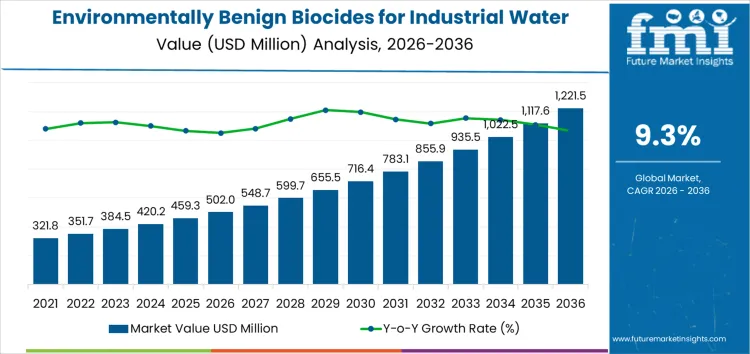
What is the Growth Forecast for the Environmentally Benign Biocides for Industrial Water Market through 2036?
From 2026 to 2031, the environmentally benign biocides market grows from USD 502 million to approximately USD 782 million, representing the early adoption phase. Annual increments increase from USD 46 million in 2026 to USD 66 million in 2031. Growth is driven by industrial water treatment applications in power generation, cooling towers, and process water systems, where regulatory pressure and sustainability targets encourage low-toxicity, environmentally friendly biocides. North America and Europe account for roughly 60% of early adoption, with uptake concentrated in high-volume industrial facilities validating product efficacy, corrosion control, and biofouling prevention.
Between 2031 and 2036, the market expands from roughly USD 782 million to USD 1,221.5 million, illustrating the late adoption phase characterized by broader commercialization and multi-site integration. Annual increments rise from USD 66 million to USD 122 million, supported by portfolio-wide adoption, repeat procurement, and scaling into emerging industrial markets in Asia Pacific and Latin America. Growth is reinforced by environmental regulations, corporate sustainability mandates, and integration into automated water-treatment systems. Early-stage growth relied on pilot deployments and selective facilities, while later expansion reflects structural adoption and normalization across global industrial water management operations.
Environmentally Benign Biocides for Industrial Water Market Key Takeaways
| Metric | Value |
|---|---|
| Market Value (2026) | USD 502 million |
| Forecast Value (2036) | USD 1,308 million |
| Forecast CAGR (2026 to 2036) | 9.3% |
What Is Driving Growth in the Environmentally Benign Biocides for Industrial Water Market?
Demand for environmentally benign biocides in industrial water treatment emerged in response to limitations in traditional chemical control methods rather than simple preference for greener options. Conventional biocides such as oxidising halogens, formaldehyde donors, and heavy metal-based agents controlled microbial growth but generated by-products that posed risks to aquatic ecosystems, treatment systems, and discharge compliance. Facilities such as cooling towers, pulp and paper mills, and municipal water systems observed compliance failures, regulatory fines, or secondary corrosion issues tied to aggressive chemistries. Early adoption of benign alternatives focused on formulations that degraded rapidly, produced fewer toxic by-products, and maintained microbial control without persistent residuals. Historical demand was driven by specific environmental compliance challenges rather than broad industrial adoption.
Future growth in this market is expected to be shaped by tightening discharge standards, regulatory frameworks that mandate eco-toxicity thresholds, and corporate water stewardship commitments rather than isolated performance fixes alone. Governments and environmental agencies are increasingly specifying limits on residual biocide toxicity and by-product formation, prompting water treatment engineers to select chemistries that meet defined effluent criteria. Advances in bio-based agents, enzyme-assisted control systems, and tailored dosing technologies are improving efficacy against target organisms while reducing non-target impacts. Industrial purchasers are incorporating lifecycle impact assessments into procurement, evaluating biocide selection based on ecosystem risk, regulatory alignment, and operational reliability rather than on cost and kill-rate alone.
What Factors Are Affecting the Demand for Environmentally Benign Biocides for Industrial Water Market in Terms of Biocide Type and Application Area?
The environmentally benign biocides market for industrial water is shaped by tightening discharge regulations, rising water reuse, and pressure to reduce toxic residuals in industrial operations. Demand is shifting toward biocide solutions that balance microbial control with lower environmental persistence and safer handling profiles. Adoption is strongest in industries exposed to regulatory oversight and community scrutiny, where compliance and operational continuity are equally critical. Market leadership reflects regulatory alignment and application reliability rather than broad replacement of conventional biocides across all water treatment systems.
What Is Driving Leadership by Biocide Type in the Environmentally Benign Biocides for Industrial Water Market?
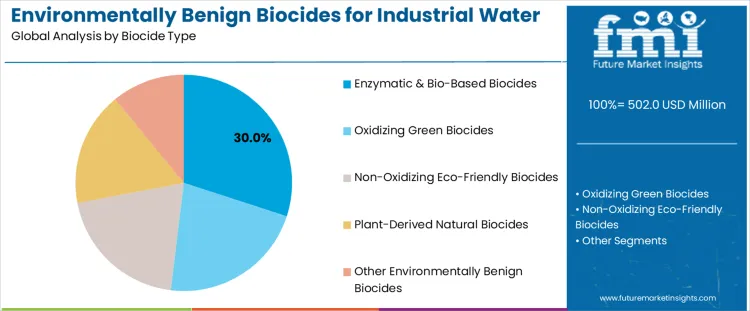
Enzymatic and bio based biocides account for about 30% of demand because they align most closely with regulatory and sustainability objectives without compromising microbial control. These biocides function through targeted biological mechanisms, reducing biofilm formation while limiting toxic byproducts. Industrial operators adopt them where discharge limits are strict and worker exposure risk must be minimized. Their compatibility with continuous dosing systems supports stable performance in circulating water environments. Although efficacy can be application specific, their predictable degradation profile supports wider regulatory acceptance across regions today globally.
Oxidizing green biocides, non-oxidizing ecofriendly options, and plant derived natural biocides expand the market but remain more application constrained. Oxidizing green biocides offer rapid microbial kill but require careful control to avoid corrosion. Non oxidizing ecofriendly biocides provide longer lasting control but may face performance tradeoffs. Plant derived solutions appeal in food and paper processing but scale remains limited. These alternatives complement enzymatic solutions rather than displace them, reinforcing leadership based on regulatory alignment and operational predictability.
What Is Driving Leadership by Application Area in the Environmentally Benign Biocides for Industrial Water Market?
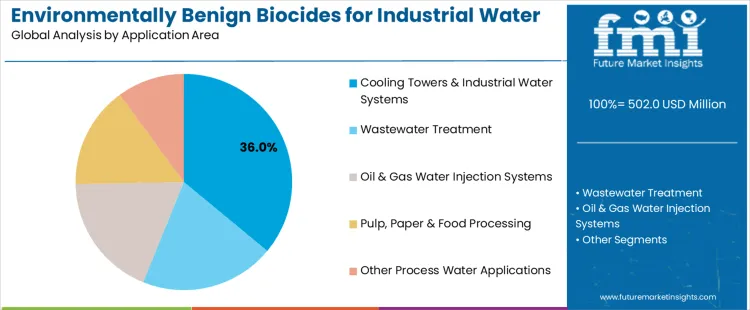
Cooling towers and industrial water systems represent about 36% of demand because they operate under continuous microbial pressure and face strict discharge requirements. Biofouling in cooling systems directly impacts energy efficiency, equipment life, and regulatory compliance. Environmentally benign biocides are increasingly specified to control microbial growth while minimizing blowdown toxicity. High water volumes and constant circulation make these systems primary adopters of greener biocide strategies, anchoring demand across power generation, manufacturing, and large industrial facilities worldwide today.
Wastewater treatment, oil and gas water injection, and pulp, paper, and food processing represent secondary applications. Wastewater facilities adopt benign biocides selectively where biological treatment compatibility is required. Oil and gas applications balance microbial control with reservoir protection, limiting widespread use. Food and paper processing favor plant derived options but volumes remain smaller. These segments expand overall demand but do not match the scale or consistency of cooling systems, reinforcing application leadership driven by operational continuity and regulatory exposure.
How Are Environmentally Benign Biocides Being Applied Across Industrial Water Systems?
Use appears in cooling towers, boilers, and process water systems where microbial growth can cause biofouling, corrosion, and operational inefficiency. Industrial operators adopt environmentally benign biocides to control bacteria, algae, and fungi while minimizing ecological impact. Facilities in power generation, manufacturing, and food processing implement these biocides to comply with discharge regulations and reduce chemical hazards. These applications reflect operational and environmental priorities rather than performance marketing, with adoption driven by microbial control, regulatory compliance, and sustainability targets.
What Operational and Material Conditions Support Adoption of Environmentally Benign Biocides?
Selection aligns with water systems that require effective microbial control at varying pH, temperature, and flow conditions. Formulations are optimized for biodegradability, low aquatic toxicity, and compatibility with system materials such as steel, copper, and polymers. Water treatment teams monitor dosing, residual levels, and system efficacy to maintain continuous protection. Facilities implement monitoring protocols to ensure compliance with discharge standards and minimize environmental impact. These conditions emerge from operational efficiency, microbial control, and regulatory adherence priorities in structured industrial water management workflows.
Which Practical Considerations Limit Wider Use of Environmentally Benign Biocides?
Effectiveness may be lower against certain resilient microbial strains, requiring higher dosages or complementary treatments. Costs per volume can be higher than conventional biocides. Compatibility with corrosion inhibitors, scale control agents, and other water treatment chemicals must be ensured. Regulatory approvals vary across regions and industries. These factors lead to selective deployment where microbial management, environmental compliance, and operational reliability justify incremental cost and treatment monitoring.
What is the Demand for Environmentally Benign Biocides for Industrial Water by Country?
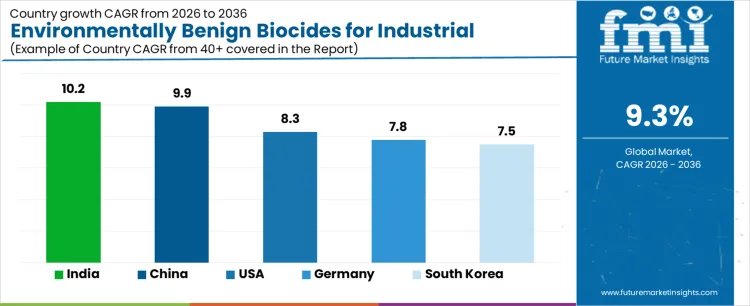
| Country | CAGR (%) |
|---|---|
| India | 10.2% |
| China | 9.9% |
| USA | 8.3% |
| Germany | 7.8% |
| South Korea | 7.5% |
The demand for environmentally benign biocides for industrial water varies across countries, driven by water treatment regulations, sustainability initiatives, and industrial growth. India leads with a 10.2% CAGR, supported by expanding industrial sectors, increasing environmental compliance, and adoption of eco-friendly water treatment solutions. China follows at 9.9%, driven by large scale industrial operations, regulatory focus on water safety, and adoption of green biocides. The USA grows at 8.3%, reflecting industrial demand for compliant water treatment chemicals. Germany records 7.8%, shaped by strict environmental standards and mature industrial water management practices. South Korea posts 7.5%, supported by industrial water treatment initiatives and regulatory compliance.
How Are Environmentally Benign Biocides Driving Industrial Water Management in India?
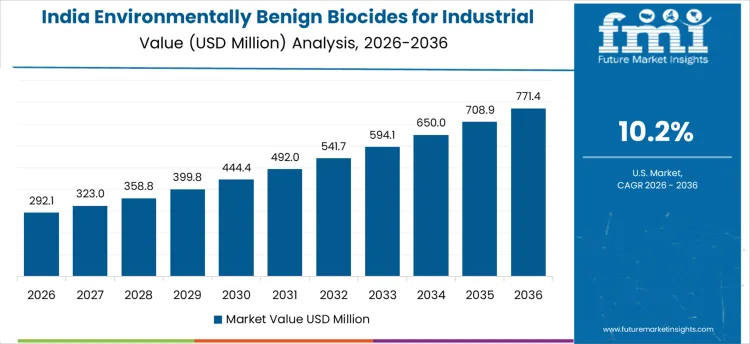
In India, the Environmentally Benign Biocides for Industrial Water Market is expanding at a CAGR of 10.2% through 2036, driven by increasing industrial water treatment requirements across power generation, chemical processing, and manufacturing sectors. Companies are adopting eco-friendly biocides to control microbial growth, prevent biofilm formation, and comply with environmental regulations. Demand is concentrated in industrial clusters, thermal power plants, and chemical processing facilities. Domestic suppliers provide high-performance, regulatory-compliant biocides compatible with various water treatment systems. Government regulations, sustainability initiatives, and recurring water treatment operations are sustaining robust adoption nationwide.
- Industrial clusters, power plants, and chemical facilities drive adoption
- Biocides prevent biofilm formation and microbial contamination
- Domestic suppliers provide eco-friendly, regulatory-compliant solutions
- Recurring water treatment operations sustain robust adoption
How Is Industrial Water Safety Supporting Biocide Adoption in China?
In China, revenue is growing at a CAGR of 9.9% through 2036, supported by stringent industrial water quality standards and rapid expansion of manufacturing and chemical industries. Companies are integrating environmentally benign biocides to control microbial proliferation and maintain system efficiency in cooling towers, boilers, and process water systems. Demand is concentrated in urban industrial zones, heavy manufacturing plants, and power generation facilities. Domestic suppliers are scaling production of high-performance, eco-friendly biocides compatible with existing water treatment infrastructures. Rising regulatory oversight, operational efficiency requirements, and recurring treatment cycles are sustaining rapid adoption.
- Urban industrial zones, power plants, and chemical facilities drive adoption
- Biocides maintain system efficiency and prevent microbial proliferation
- Domestic suppliers scale eco-friendly, treatment-compatible solutions
- Recurring treatment cycles sustain rapid adoption
How Is Industrial Water Management Driving Growth in the United States?
In the United States, the market is expanding at a CAGR of 8.3% through 2036, driven by increasing adoption of environmentally safe biocides in power generation, chemical, and industrial water systems. Companies are using these biocides to control microbial contamination, prevent corrosion, and maintain operational efficiency in cooling towers, boilers, and process water systems. Demand is concentrated in industrial hubs, energy facilities, and manufacturing plants. Domestic suppliers provide regulatory-compliant, high-performance biocides compatible with diverse water treatment technologies. Environmental regulations, recurring treatment programs, and operational efficiency initiatives are sustaining predictable adoption nationwide.
- Industrial hubs, energy facilities, and manufacturing plants drive adoption
- Biocides prevent microbial contamination and corrosion
- Domestic suppliers provide high-performance, regulatory-compliant solutions
- Recurring treatment programs sustain predictable adoption
How Are Regulatory Standards Supporting Biocide Adoption in Germany?
In Germany, the market is growing at a CAGR of 7.8% through 2036, supported by strict industrial water quality regulations and sustainability requirements. Companies are adopting environmentally benign biocides to reduce microbial growth, prevent biofilm accumulation, and comply with environmental standards in cooling towers, boilers, and process water systems. Demand is concentrated in chemical plants, power generation facilities, and industrial clusters. Domestic suppliers provide high-quality, eco-friendly biocides compatible with existing water treatment technologies. Regulatory compliance, recurring treatment operations, and industrial efficiency programs are sustaining steady adoption nationwide.
- Chemical plants, power facilities, and industrial clusters drive adoption
- Biocides reduce microbial growth and prevent biofilm formation
- Domestic suppliers provide eco-friendly, treatment-compatible solutions
- Recurring treatment operations sustain steady adoption
How Is Industrial and Water Treatment Infrastructure Driving Growth in South Korea?
In South Korea, revenue is expanding at a CAGR of 7.5% through 2036, driven by adoption of environmentally benign biocides in industrial water systems across power generation, manufacturing, and chemical processing facilities. Companies are using biocides to prevent biofilm formation, control microbial contamination, and maintain system efficiency. Demand is concentrated in industrial zones, chemical plants, and thermal power facilities. Domestic suppliers provide high-performance, eco-friendly biocides compatible with various water treatment infrastructures. Growing industrial water treatment needs, regulatory oversight, and recurring maintenance cycles are sustaining steady adoption nationwide.
- Industrial zones, chemical plants, and power facilities drive adoption
- Biocides prevent microbial contamination and biofilm formation
- Domestic suppliers provide eco-friendly, treatment-compatible solutions
- Recurring maintenance cycles sustain steady adoption
Which Strategic Approaches Are Companies Using to Compete in The Environmentally Benign Biocides for Industrial Water Market?
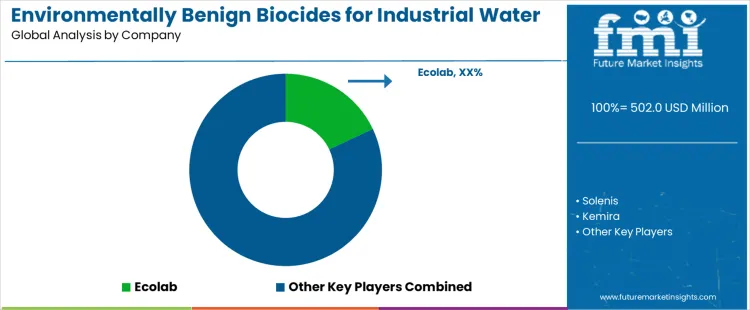
Competition in the Environmentally Benign Biocides for Industrial Water Market is shaped by how suppliers balance microbial control with tightening environmental and discharge constraints. Ecolab and Solenis pursue program based strategies, embedding lower toxicity biocides within broader water management frameworks that emphasize monitoring, dosage control, and compliance documentation. Their positioning relies on demonstrating effective biofouling control while reducing halogen load, persistence, and downstream impact. Kemira focuses on selective chemistry optimization, supplying biocides and boosters designed to work at lower active concentrations across cooling, process water, and effluent systems. Customer adoption is driven by proven performance under real operating conditions, regulatory acceptance, and compatibility with existing treatment infrastructure rather than by single product substitution.
System integration and lifecycle stewardship define competitive differentiation. Veolia Water Technologies approaches the market through engineered treatment solutions, where environmentally benign biocides are specified as part of plant level design and long term operation contracts. Kurita Water Industries emphasizes precision control, leveraging data driven dosing and localized chemistry adaptation to reduce overall biocide load while maintaining system integrity. Across the market, strategies prioritize risk reduction, operator safety, and regulatory resilience. Suppliers invest in field validation, site specific optimization, and long term service relationships. Competitive advantage depends on reliability, environmental compliance, and the ability to tailor solutions to diverse industrial water systems rather than rapid chemistry innovation or price based competition.
Key Players in the Environmentally Benign Biocides for Industrial Water Market
- Ecolab
- Solenis
- Kemira
- Veolia Water Technologies
- Kurita Water Industries
Scope of the Report
| Items | Values |
|---|---|
| Quantitative Units (2026) | USD million |
| Biocide Type | Enzymatic & Bio-Based Biocides, Oxidizing Green Biocides, Non-Oxidizing Eco-Friendly Biocides, Plant-Derived Natural Biocides, Other Environmentally Benign Biocides |
| Application Area | Cooling Towers & Industrial Water Systems, Wastewater Treatment, Oil & Gas Water Injection Systems, Pulp, Paper & Food Processing, Other Process Water Applications |
| Delivery Method | Liquid Dosing Systems, Solid Tablet / Powder Formulations, Encapsulated / Time-Release Systems, Bio-Augmentation & Microbial Control, Other Delivery Formats |
| End-Use Industry | Power Generation, Oil & Gas, Pulp & Paper, Food & Beverage, Chemical & Process Industries, General Manufacturing |
| Region | Asia Pacific (China, Japan, South Korea, India, Australia & New Zealand, ASEAN, Rest of Asia Pacific), Europe (Germany, UK, France, Italy, Spain, Nordic, BENELUX, Rest of Europe), North America (USA, Canada, Mexico), Latin America (Brazil, Chile, Rest of Latin America), Middle East & Africa (KSA, Other GCC, Turkey, South Africa, Other African Union, Rest of MEA) |
| Key Companies Profiled | Ecolab, Solenis, Kemira, Veolia Water Technologies, Kurita Water Industries |
| Additional Attributes | Dollar by sales by biocide type, Dollar by sales by application area, Dollar by sales by delivery method, Dollar by sales by region, Annual procurement cycles, Adoption intervals / breakpoints, Regulatory compliance (EPA, REACH, local standards), Operational efficiency metrics, Water treatment system compatibility, Lifecycle impact assessment, Recurring treatment operations, Performance under varying pH, temperature, and flow conditions, Integration with automated dosing systems, Domestic vs. international supplier distribution |
Environmentally Benign Biocides for Industrial Water Market Segmentation
By Biocide Type:
- Enzymatic & Bio-Based Biocides
- Oxidizing Green Biocides
- Non-Oxidizing Eco-Friendly Biocides
- Plant-Derived Natural Biocides
- Other Environmentally Benign Biocides
By Application Area:
- Cooling Towers & Industrial Water Systems
- Wastewater Treatment
- Oil & Gas Water Injection Systems
- Pulp, Paper & Food Processing
- Other Process Water Applications
By Delivery Method:
- Liquid Dosing Systems
- Solid Tablet / Powder Formulations
- Encapsulated / Time-Release Systems
- Bio-Augmentation & Microbial Control
- Other Delivery Formats
By Region:
- Asia Pacific
- China
- Japan
- South Korea
- India
- Australia & New Zealand
- ASEAN
- Rest of Asia Pacific
- Europe
- Germany
- United Kingdom
- France
- Italy
- Spain
- Nordic
- BENELUX
- Rest of Europe
- North America
- United States
- Canada
- Mexico
- Latin America
- Brazil
- Chile
- Rest of Latin America
- Middle East & Africa
- Kingdom of Saudi Arabia
- Other GCC Countries
- Turkey
- South Africa
- Other African Union
- Rest of Middle East & Africa
Frequently Asked Questions
How big is the environmentally benign biocides for industrial water market in 2026?
The global environmentally benign biocides for industrial water market is estimated to be valued at USD 502.0 million in 2026.
What will be the size of environmentally benign biocides for industrial water market in 2036?
The market size for the environmentally benign biocides for industrial water market is projected to reach USD 1,221.5 million by 2036.
How much will be the environmentally benign biocides for industrial water market growth between 2026 and 2036?
The environmentally benign biocides for industrial water market is expected to grow at a 9.3% CAGR between 2026 and 2036.
What are the key product types in the environmentally benign biocides for industrial water market?
The key product types in environmentally benign biocides for industrial water market are enzymatic & bio-based biocides, oxidizing green biocides, non-oxidizing eco-friendly biocides, plant-derived natural biocides and other environmentally benign biocides.
Which application area segment to contribute significant share in the environmentally benign biocides for industrial water market in 2026?
In terms of application area, cooling towers & industrial water systems segment to command 36.0% share in the environmentally benign biocides for industrial water market in 2026.
Preview the report firsthand - request a free sample
Get SampleGet the brochure for pricing and purchase details.
Get PDFTable of Content
- Executive Summary
- Global Market Outlook
- Demand-side Trends
- Supply-side Trends
- Technology Roadmap Analysis
- Analysis and Recommendations
- Market Overview
- Market Coverage / Taxonomy
- Market Definition / Scope / Limitations
- Market Background
- Market Dynamics
- Drivers
- Restraints
- Opportunity
- Trends
- Scenario Forecast
- Demand in Optimistic Scenario
- Demand in Likely Scenario
- Demand in Conservative Scenario
- Opportunity Map Analysis
- Product Life Cycle Analysis
- Supply Chain Analysis
- Investment Feasibility Matrix
- Value Chain Analysis
- PESTLE and Porter’s Analysis
- Regulatory Landscape
- Regional Parent Market Outlook
- Production and Consumption Statistics
- Import and Export Statistics
- Market Dynamics
- Global Market Analysis 2021 to 2025 and Forecast, 2026 to 2036
- Historical Market Size Value (USD Million) Analysis, 2021 to 2025
- Current and Future Market Size Value (USD Million) Projections, 2026 to 2036
- Y-o-Y Growth Trend Analysis
- Absolute $ Opportunity Analysis
- Global Market Pricing Analysis 2021 to 2025 and Forecast 2026 to 2036
- Global Market Analysis 2021 to 2025 and Forecast 2026 to 2036, By Biocide Type
- Introduction / Key Findings
- Historical Market Size Value (USD Million) Analysis By Biocide Type , 2021 to 2025
- Current and Future Market Size Value (USD Million) Analysis and Forecast By Biocide Type , 2026 to 2036
- Enzymatic & Bio-Based Biocides
- Oxidizing Green Biocides
- Non-Oxidizing Eco-Friendly Biocides
- Plant-Derived Natural Biocides
- Other Environmentally Benign Biocides
- Enzymatic & Bio-Based Biocides
- Y-o-Y Growth Trend Analysis By Biocide Type , 2021 to 2025
- Absolute $ Opportunity Analysis By Biocide Type , 2026 to 2036
- Global Market Analysis 2021 to 2025 and Forecast 2026 to 2036, By Application Area
- Introduction / Key Findings
- Historical Market Size Value (USD Million) Analysis By Application Area, 2021 to 2025
- Current and Future Market Size Value (USD Million) Analysis and Forecast By Application Area, 2026 to 2036
- Cooling Towers & Industrial Water Systems
- Wastewater Treatment
- Oil & Gas Water Injection Systems
- Pulp, Paper & Food Processing
- Other Process Water Applications
- Cooling Towers & Industrial Water Systems
- Y-o-Y Growth Trend Analysis By Application Area, 2021 to 2025
- Absolute $ Opportunity Analysis By Application Area, 2026 to 2036
- Global Market Analysis 2021 to 2025 and Forecast 2026 to 2036, By Delivery Method
- Introduction / Key Findings
- Historical Market Size Value (USD Million) Analysis By Delivery Method, 2021 to 2025
- Current and Future Market Size Value (USD Million) Analysis and Forecast By Delivery Method, 2026 to 2036
- Liquid Dosing Systems
- Solid Tablet or Powder Formulations
- Encapsulated or Time-Release Systems
- Bio-Augmentation & Microbial Control
- Other Delivery Formats
- Liquid Dosing Systems
- Y-o-Y Growth Trend Analysis By Delivery Method, 2021 to 2025
- Absolute $ Opportunity Analysis By Delivery Method, 2026 to 2036
- Global Market Analysis 2021 to 2025 and Forecast 2026 to 2036, By Region
- Introduction
- Historical Market Size Value (USD Million) Analysis By Region, 2021 to 2025
- Current Market Size Value (USD Million) Analysis and Forecast By Region, 2026 to 2036
- North America
- Latin America
- Western Europe
- Eastern Europe
- East Asia
- South Asia and Pacific
- Middle East & Africa
- Market Attractiveness Analysis By Region
- North America Market Analysis 2021 to 2025 and Forecast 2026 to 2036, By Country
- Historical Market Size Value (USD Million) Trend Analysis By Market Taxonomy, 2021 to 2025
- Market Size Value (USD Million) Forecast By Market Taxonomy, 2026 to 2036
- By Country
- USA
- Canada
- Mexico
- By Biocide Type
- By Application Area
- By Delivery Method
- By Country
- Market Attractiveness Analysis
- By Country
- By Biocide Type
- By Application Area
- By Delivery Method
- Key Takeaways
- Latin America Market Analysis 2021 to 2025 and Forecast 2026 to 2036, By Country
- Historical Market Size Value (USD Million) Trend Analysis By Market Taxonomy, 2021 to 2025
- Market Size Value (USD Million) Forecast By Market Taxonomy, 2026 to 2036
- By Country
- Brazil
- Chile
- Rest of Latin America
- By Biocide Type
- By Application Area
- By Delivery Method
- By Country
- Market Attractiveness Analysis
- By Country
- By Biocide Type
- By Application Area
- By Delivery Method
- Key Takeaways
- Western Europe Market Analysis 2021 to 2025 and Forecast 2026 to 2036, By Country
- Historical Market Size Value (USD Million) Trend Analysis By Market Taxonomy, 2021 to 2025
- Market Size Value (USD Million) Forecast By Market Taxonomy, 2026 to 2036
- By Country
- Germany
- UK
- Italy
- Spain
- France
- Nordic
- BENELUX
- Rest of Western Europe
- By Biocide Type
- By Application Area
- By Delivery Method
- By Country
- Market Attractiveness Analysis
- By Country
- By Biocide Type
- By Application Area
- By Delivery Method
- Key Takeaways
- Eastern Europe Market Analysis 2021 to 2025 and Forecast 2026 to 2036, By Country
- Historical Market Size Value (USD Million) Trend Analysis By Market Taxonomy, 2021 to 2025
- Market Size Value (USD Million) Forecast By Market Taxonomy, 2026 to 2036
- By Country
- Russia
- Poland
- Hungary
- Balkan & Baltic
- Rest of Eastern Europe
- By Biocide Type
- By Application Area
- By Delivery Method
- By Country
- Market Attractiveness Analysis
- By Country
- By Biocide Type
- By Application Area
- By Delivery Method
- Key Takeaways
- East Asia Market Analysis 2021 to 2025 and Forecast 2026 to 2036, By Country
- Historical Market Size Value (USD Million) Trend Analysis By Market Taxonomy, 2021 to 2025
- Market Size Value (USD Million) Forecast By Market Taxonomy, 2026 to 2036
- By Country
- China
- Japan
- South Korea
- By Biocide Type
- By Application Area
- By Delivery Method
- By Country
- Market Attractiveness Analysis
- By Country
- By Biocide Type
- By Application Area
- By Delivery Method
- Key Takeaways
- South Asia and Pacific Market Analysis 2021 to 2025 and Forecast 2026 to 2036, By Country
- Historical Market Size Value (USD Million) Trend Analysis By Market Taxonomy, 2021 to 2025
- Market Size Value (USD Million) Forecast By Market Taxonomy, 2026 to 2036
- By Country
- India
- ASEAN
- Australia & New Zealand
- Rest of South Asia and Pacific
- By Biocide Type
- By Application Area
- By Delivery Method
- By Country
- Market Attractiveness Analysis
- By Country
- By Biocide Type
- By Application Area
- By Delivery Method
- Key Takeaways
- Middle East & Africa Market Analysis 2021 to 2025 and Forecast 2026 to 2036, By Country
- Historical Market Size Value (USD Million) Trend Analysis By Market Taxonomy, 2021 to 2025
- Market Size Value (USD Million) Forecast By Market Taxonomy, 2026 to 2036
- By Country
- Kingdom of Saudi Arabia
- Other GCC Countries
- Turkiye
- South Africa
- Other African Union
- Rest of Middle East & Africa
- By Biocide Type
- By Application Area
- By Delivery Method
- By Country
- Market Attractiveness Analysis
- By Country
- By Biocide Type
- By Application Area
- By Delivery Method
- Key Takeaways
- Key Countries Market Analysis
- USA
- Pricing Analysis
- Market Share Analysis, 2025
- By Biocide Type
- By Application Area
- By Delivery Method
- Canada
- Pricing Analysis
- Market Share Analysis, 2025
- By Biocide Type
- By Application Area
- By Delivery Method
- Mexico
- Pricing Analysis
- Market Share Analysis, 2025
- By Biocide Type
- By Application Area
- By Delivery Method
- Brazil
- Pricing Analysis
- Market Share Analysis, 2025
- By Biocide Type
- By Application Area
- By Delivery Method
- Chile
- Pricing Analysis
- Market Share Analysis, 2025
- By Biocide Type
- By Application Area
- By Delivery Method
- Germany
- Pricing Analysis
- Market Share Analysis, 2025
- By Biocide Type
- By Application Area
- By Delivery Method
- UK
- Pricing Analysis
- Market Share Analysis, 2025
- By Biocide Type
- By Application Area
- By Delivery Method
- Italy
- Pricing Analysis
- Market Share Analysis, 2025
- By Biocide Type
- By Application Area
- By Delivery Method
- Spain
- Pricing Analysis
- Market Share Analysis, 2025
- By Biocide Type
- By Application Area
- By Delivery Method
- France
- Pricing Analysis
- Market Share Analysis, 2025
- By Biocide Type
- By Application Area
- By Delivery Method
- India
- Pricing Analysis
- Market Share Analysis, 2025
- By Biocide Type
- By Application Area
- By Delivery Method
- ASEAN
- Pricing Analysis
- Market Share Analysis, 2025
- By Biocide Type
- By Application Area
- By Delivery Method
- Australia & New Zealand
- Pricing Analysis
- Market Share Analysis, 2025
- By Biocide Type
- By Application Area
- By Delivery Method
- China
- Pricing Analysis
- Market Share Analysis, 2025
- By Biocide Type
- By Application Area
- By Delivery Method
- Japan
- Pricing Analysis
- Market Share Analysis, 2025
- By Biocide Type
- By Application Area
- By Delivery Method
- South Korea
- Pricing Analysis
- Market Share Analysis, 2025
- By Biocide Type
- By Application Area
- By Delivery Method
- Russia
- Pricing Analysis
- Market Share Analysis, 2025
- By Biocide Type
- By Application Area
- By Delivery Method
- Poland
- Pricing Analysis
- Market Share Analysis, 2025
- By Biocide Type
- By Application Area
- By Delivery Method
- Hungary
- Pricing Analysis
- Market Share Analysis, 2025
- By Biocide Type
- By Application Area
- By Delivery Method
- Kingdom of Saudi Arabia
- Pricing Analysis
- Market Share Analysis, 2025
- By Biocide Type
- By Application Area
- By Delivery Method
- Turkiye
- Pricing Analysis
- Market Share Analysis, 2025
- By Biocide Type
- By Application Area
- By Delivery Method
- South Africa
- Pricing Analysis
- Market Share Analysis, 2025
- By Biocide Type
- By Application Area
- By Delivery Method
- USA
- Market Structure Analysis
- Competition Dashboard
- Competition Benchmarking
- Market Share Analysis of Top Players
- By Regional
- By Biocide Type
- By Application Area
- By Delivery Method
- Competition Analysis
- Competition Deep Dive
- Ecolab
- Overview
- Product Portfolio
- Profitability by Market Segments (Product/Age /Sales Channel/Region)
- Sales Footprint
- Strategy Overview
- Marketing Strategy
- Product Strategy
- Channel Strategy
- Solenis
- Kemira
- Veolia Water Technologies
- Kurita Water Industries
- Ecolab
- Competition Deep Dive
- Assumptions & Acronyms Used
- Research Methodology


