

- Industry Size (2026)
- USD 0.9 Bn
- Forecast (2036)
- USD 1.8 Bn
- CAGR (2026 to 2036)
- 8.0%
Environmental Allergy Monitoring Market Forecast and Outlook 2026 to 2036
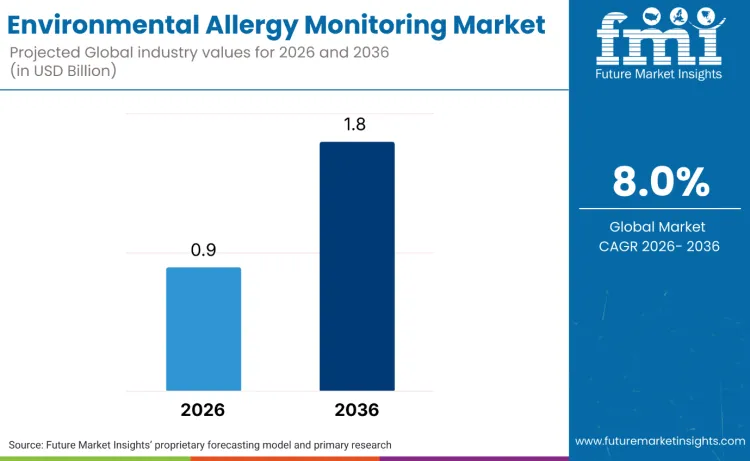
The global environmental allergy monitoring market is forecasted to reach USD 0.9 billion in 2026 and expand to USD 1.8 billion by 2036, growing at a CAGR of 8.0%. As per FMI, public health infrastructure is witnessing transformation toward proactive allergen management, where traditional manual sampling methods have become obsolete and are transitioning toward automated monitoring platforms. Growth is owing to rising prevalence of environmental allergies, with healthcare systems and environmental agencies embracing specialized monitoring technologies across urban centers globally.
By leveraging artificial intelligence and machine learning, researchers can now perform continuous airborne allergen detection that analyzes particle composition and concentration patterns before adverse health events occur. This predictive capability allows for the rapid deployment of early warning systems and the development of personalized exposure recommendations that were previously impossible to deliver at scale, effectively reducing emergency healthcare interventions and improving quality of life for allergy sufferers. Companies are also investing in intense R&D and AI to enhance monitoring accuracy. In July 2024, Agilent Technologies Inc. acquired Sigsense Technologies, a USA-based startup that deploys artificial intelligence and power monitoring to help optimize lab operations.
“We are excited to welcome the Sigsense team to Agilent. They are an innovator in leveraging artificial intelligence for lab operations,” said Armin Jehle, vice president, Agilent CrossLab Services Division. “By working closely as one team, we will extend their AI technology further, enabling more customers to gain more insights that contribute to reduced downtime and increased productivity.”
"Our progress in 2025 reflects innovation built on a customer-focused approach that creates real value and extraordinary customer intimacy through a unified commercial organization that delivers a seamless end-to-end experience. Powered by our expanded Ignite Operating System, these strengths continue to unlock operating efficiencies, fuel innovation, enhance commercial execution, and create long-term value for customers and shareholders.”- Agilent President and CEO Padraig McDonnell
The industry's value proposition is moving from basic allergen detection toward comprehensive environmental health management platforms. Advanced service providers are leveraging meteorological data, pollution monitoring, and personalized health tracking to create predictive models that forecast allergen exposure risks hours or days in advance. Research-focused organizations and specialized monitoring companies are gaining traction, creating direct partnerships with healthcare systems and customized monitoring solutions across municipal and commercial applications.
Summary of Environmental Allergy Monitoring Market
What is the growth outlook on the environmental allergy monitoring market?
Future Market Insights projects the market to grow at a 8.0% CAGR from 2026 to 2036, expanding from USD 0.9 billion to USD 1.8 billion.
FMI research approach: Bottom-up technology revenue modeling, allergen exposure assessment, monitoring infrastructure analysis, and AI-driven detection scenario modeling.
How do FMI analysts perceive the environmental allergy monitoring market to evolve?
The market is expected to move from static monitoring stations toward integrated IoT platforms combining real-time detection, predictive analytics, and personalized health management.
FMI research approach: IoT integration analysis, AI algorithm development tracking, consumer adoption assessment, and predictive health platform evaluation.
Which country holds the largest share in the environmental allergy monitoring market?
The United States accounts for the largest global value share.
FMI research approach: Country-level healthcare infrastructure modeling, allergen prevalence analysis, technology adoption scoring, and public health investment evaluation.
How large will the environmental allergy monitoring market be by 2036?
The global market is forecast to reach USD 1.8 billion by 2036.
FMI research approach: Long-term forecasting by technology type and application focus, infrastructure scaling demand, clinical integration assessment, and historical adoption validation.
What is the market definition of environmental allergy monitoring?
It covers technologies and services supporting allergen detection, environmental monitoring, exposure assessment, and health management for allergy prevention and treatment.
FMI research approach: Market taxonomy validation, inclusion-exclusion structuring, application mapping by health outcomes, and technology scope filtering.
What globally unique trends are shaping the environmental allergy monitoring market?
Key trends include AI-powered allergen identification, consumer wearable integration, and climate change adaptation in monitoring infrastructure.
FMI research approach: AI adoption tracking, wearable device integration analysis, climate impact assessment, and next-generation monitoring technology evaluation.
Environmental Allergy Monitoring Market Key Takeaways
| Metric | Value |
|---|---|
| Market Value (2026) | USD 0.9 billion |
| Market Forecast Value (2036) | USD 1.8 billion |
| Forecast CAGR (2026-2036) | 8.0% |
Source: Future Market Insights (FMI) analysis, based on proprietary forecasting model and primary research
What is Driving the Demand for Environmental Allergy Monitoring?
Demand for environmental allergy monitoring technologies is being propelled by the rising global prevalence of allergic diseases and the increasing recognition of environmental factors in triggering adverse health responses. Climate change is extending pollen seasons and introducing new allergen patterns to previously unaffected regions, creating urgent needs for real-time monitoring and early warning systems. The integration of artificial intelligence and Internet of Things technologies into monitoring platforms has amplified demand for predictive analytics capabilities that can forecast allergen exposure events days in advance, enabling proactive healthcare interventions.
The regulatory momentum toward evidence-based public health policies is driving widespread adoption of continuous monitoring systems in urban planning and healthcare delivery. Healthcare systems are increasingly investing in environmental health data to support personalized allergy treatment protocols and reduce emergency department visits. Companies are focusing on rigorous R&D investments and FDA approvals for the launch of improved capabilities of products. In April 2024, HORIBA secured 510(k) clearance from the US Food and Drug Administration (FDA) for its high-throughput hematology analyzer Yumizen H2500.
How is the Environmental Allergy Monitoring Market Segmented?
The environmental allergy monitoring market has been segmented based on offering type, use case, end user, and region. In terms of offering type, the market is divided into pollen monitoring stations (hardware), airborne allergen sampling consumables, digital monitoring platforms & analytics, indoor allergen sensors, forecasting APIs / data subscriptions, and monitoring & maintenance services. By use case, the market is divided into public health surveillance, clinical allergy management support, workplace / environmental compliance, smart home / consumer use, and research & academic monitoring. By end user, the market is segmented into government agencies, healthcare providers & payers, employers / facility managers, consumers / individuals, and universities & research institutes. Regionally, the market is divided into North America, Europe, East Asia, South Asia, Latin America, and Middle East and Africa.
Why Do Digital Monitoring Platforms & Analytics Dominate the Environmental Allergy Monitoring Market?
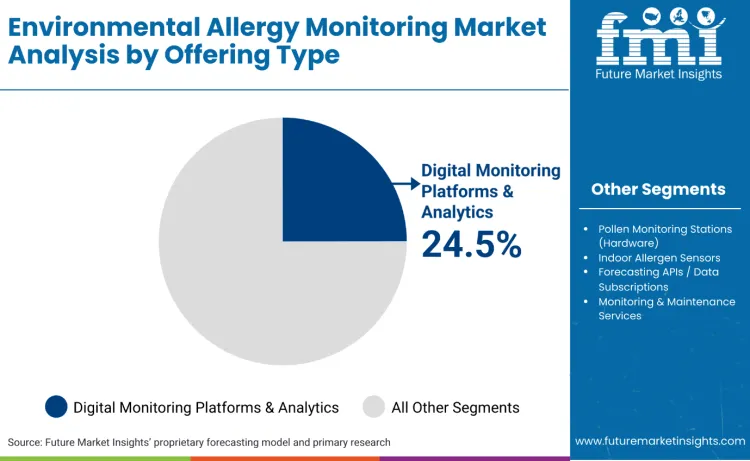
Digital monitoring platforms & analytics continue to lead the market, accounting for 24.5% of the share, driven by their widespread use in predictive allergen forecasting, data integration, and real-time health alerts. This offering type provides the computational foundation needed for all subsequent monitoring and response activities, making it essential for healthcare systems, government agencies, and consumer applications. Pollen monitoring stations capture 22.0% of the market, supporting the collection of baseline environmental data for atmospheric allergen detection. Their precision is critical for establishing regional allergen patterns and supporting public health decision-making. Forecasting APIs and data subscriptions, holding 16.5% of the market, remain popular choices for delivering actionable allergen predictions to healthcare providers and consumer applications requiring real-time environmental health data.
These platforms are popular because they serve as critical risk-mitigation strategies in an increasingly complex environmental health landscape. Companies are investing heavily in AI-powered analytics platforms with personalized health management capabilities. For instance, PerkinElmer Environmental Analysis Solutions cover integrated analytical instruments, workflows, and informatics tools for air, water, and soil testing. Specialized platform providers integrate atmospheric modeling, health data analytics, and mobile connectivity to identify high-risk exposure events while filtering out false positives. This predictive approach reduces unnecessary health interventions and shortens response times, allowing healthcare systems to remain cost-effective while focusing resources on prevention rather than reactive treatment.
How Do Use Case Requirements Influence Environmental Allergy Monitoring Solution Selection?
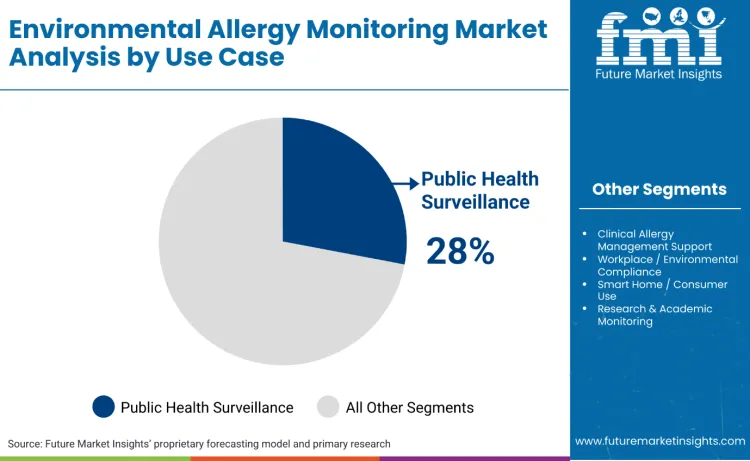
Public health surveillance stands as the dominant segment, commanding 28.0% of the market share. Environmental allergy monitoring remains centered on public health applications due to the population-scale impact these systems offer in preventing widespread health emergencies. Urban areas often experience concentrated allergen exposure events that can trigger thousands of simultaneous allergic reactions, requiring coordinated monitoring and response systems. Public health surveillance enables early detection of allergen outbreaks and supports evidence-based policy decisions for air quality management and healthcare resource allocation.
Governments across the globe are allocating huge sums of money in public surveillance, which is boosting the demand for advanced monitoring tools. For instance, Vision 2035 for Public Health Surveillance in India proposes using digital data collection, analytics, and integrated digital health platforms across communicable and non-communicable conditions, strengthening national surveillance systems that could encompass environmental and allergy-related data.
Which Technological Advancements are Shaping the Environmental Allergy Monitoring Market?
The environmental allergy monitoring market is undergoing a significant shift with the introduction of real-time, portable monitoring devices that provide more accurate allergy data. By equipping individuals with continuous, real-time data, these devices enable quicker and more effective responses to allergens, particularly in urban environments where pollution and allergen levels fluctuate rapidly. This shift is also enhancing diagnostic accuracy and enabling more precise management of allergic reactions, pushing the boundaries of precision medicine in allergy treatment. Companies, such as Thermo Fisher Scientific, HORIBA, Ltd, and others are using advanced analytics to boost product capabilities. Citing an instance, the MAX‑iAQ Ambient Air Monitoring System by Thermo Fisher Scientific is a fully automated multi‑point solution for ambient air monitoring, capable of detecting trace compounds even in high‑humidity environments with minimal user interaction.
What Role Does Regulatory Development Play in Advancing Allergy Monitoring Technologies?
Evolving regulatory standards are stabilizing the allergy monitoring technology landscape, promoting broader adoption and encouraging R&D investment. In November 2025, the FDA introduced a new regulatory pathway for bespoke therapies when traditional clinical trials are not viable. The regulatory framework is helping smaller startups and established medical device companies alike to navigate the approval process more efficiently, fostering greater innovation and expanding the accessibility of these technologies. It is also reducing barriers for companies looking to integrate allergy diagnostic devices into broader health management systems, allowing for more seamless patient care integration.
How Is the Environmental Allergy Monitoring Market Evolving Globally?
Global demand for environmental allergy monitoring technologies is increasing as healthcare systems expand preventive health capabilities while addressing allergen detection, exposure prediction, and health management application requirements. Growth demonstrates rising use of automated monitoring platforms, location-specific service positioning, and efficiency-optimized detection specifications across healthcare institutions, government agencies, and consumer applications. Technology selection focuses on detection accuracy, prediction capabilities, and platform performance under various environmental conditions. China records 14.7% CAGR, India records 13.1% CAGR, Brazil records 11.5% CAGR, USA records 9.9% CAGR, and Germany records 5.1% CAGR. Adoption remains driven by health outcome requirements and detection capabilities rather than cost reduction alone.
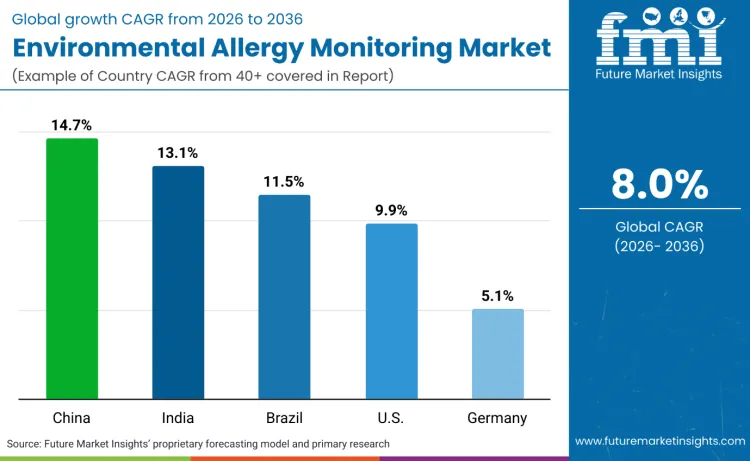
| Country | CAGR (2026-2036) |
|---|---|
| China | 14.7% |
| India | 13.1% |
| Brazil | 11.5% |
| USA | 9.9% |
| Germany | 5.1% |
Source: FMI historical analysis and forecast data
China: How is the Rapid Urbanization and Air Quality Focus Driving Advanced Monitoring Adoption?
The primary driver in China is the significant expansion of urban air quality management infrastructure and environmental health monitoring capabilities. With rapid urbanization affecting air quality patterns, Chinese metropolitan areas are experiencing new allergen exposure scenarios that make traditional monitoring methods insufficient. This has promoted advanced monitoring platform adoption for municipal environmental management to ensure public health protection and air quality compliance. In April 2025, China's Ministry of Ecology and Environment proposed a plan to further transform the country's national ecological monitoring network into a digitized and smart system. Driven by this national scale of urban development, the Chinese environmental allergy monitoring market is set to grow at a 14.7% CAGR during the study period, led by massive demand in municipal health management and environmental protection sectors.
Over the next five years, the most significant opportunity lies in the integration of air quality monitoring with allergen detection systems across smart city initiatives. As China targets leadership in environmental technology, there is growing demand for monitoring platforms that combine pollution measurement with biological allergen detection for comprehensive air quality management. Companies are expanding their technology development capabilities in the country to support smart city initiatives.
India: Is Health Infrastructure Modernization Elevating Detection Standards?
In India, the market is dominated by health infrastructure modernization and precision-focused environmental monitoring applications. This modernization approach is essential for Indian healthcare systems currently competing with international health outcome standards in domestic public health applications. Reflecting this development, the Indian environmental allergy monitoring market is projected to grow at a 13.1% CAGR during the study period.
The expansion of telemedicine and digital health platforms, supported by improved internet infrastructure, will necessitate remote allergen monitoring services for real-time patient assessment and treatment guidance. Second, India's growing pharmaceutical and biotechnology sector creates opportunities for specialized allergen detection services tailored to drug development and clinical research. There is growing demand for cost-effective monitoring platforms that use standardized protocols, addressing the healthcare needs of tier-2 and tier-3 cities while maintaining international quality standards. The government of India has also Biopharma SHAKTI to strengthen the country’s biologics and biosimilars manufacturing capability.
Brazil: Will Climate Diversity and Agricultural Expansion Accelerate Monitoring Integration?
Brazil's environmental allergy monitoring market is shaped by climate diversity and expanding agricultural production that introduces new allergen sources to populated areas. Brazilian healthcare systems are increasingly adopting precision monitoring platforms, maintaining health outcome positioning while using accessible pricing for broader population coverage. The Brazilian environmental allergy monitoring market is expected to grow at an 11.5% CAGR during the study period, as healthcare organizations invest in validated detection and predictive analytics capabilities.
The market is predicted to shift toward agricultural allergen monitoring and climate-adaptive detection platforms. As domestic agricultural production expands into new regions, there is immediate opportunity to provide specialized monitoring services for crop-related allergen exposure in both rural and urban areas. The integration of satellite-based environmental monitoring with ground-level detection will likely redefine exposure prediction capabilities, allowing healthcare systems to anticipate allergen events based on agricultural activity and weather patterns across Brazil's diverse climate zones.
Germany: Are Precision Detection Methods Advancing Monitoring Capabilities?
In Germany, the market is being driven by precision detection methods and automated monitoring systems in healthcare and environmental management. A major development is healthcare institutions and environmental agencies upgrading to research-grade monitoring platforms that feature clinical-excellence capabilities to compete against standard detection methods in European health applications. As German institutions prioritize environmental health innovation and detection excellence, the German environmental allergy monitoring market is set to grow at a 5.1% CAGR during the study period, focusing heavily on precision and detection capability enhancement.
Growth is also owing to modernization of monitoring networks and laboratory workflows. Automated samplers, faster identification methods, and software driven interpretation reduce manual effort and improve turnaround time. Local authorities, employers, and schools use alerts to plan activities during high exposure periods. Digital health tools and telecare models also benefit from cleaner exposure context, since clinicians can align symptoms with local conditions. These shifts support steady procurement of instruments, consumables, and data services.
USA: How are Public Health Initiatives Driving Environmental Health Innovation?
The USA market is increasingly focused on the innovation and integration of precision environmental health applications. This transition aims at reducing dependence on reactive healthcare approaches while improving domestic environmental health monitoring competitiveness. Supported by these health innovation mandates, the USA environmental allergy monitoring market is set to grow at a 9.9% CAGR during the study period.
The most significant opportunity lies in the integration of environmental monitoring with electronic health records and telemedicine platforms. In 2025, the Health Resources & Services Administration allocated more than USD 18 million to two National Telehealth Resource Centers and 12 Regional Telehealth Resource Centers to offer personalized telehealth technical assistance across the country. As healthcare providers increasingly adopt digital health solutions, there is growing market demand for monitoring systems that can integrate with existing healthcare technology infrastructure to provide personalized allergen exposure assessments. The development of consumer-grade monitoring devices connected to healthcare provider networks will allow USA companies to leverage health data networks to optimize treatment protocols, effectively improving patient outcomes while establishing new standards for environmental health management.
Who are the Major Players Active in the Environmental Allergy Monitoring Market?
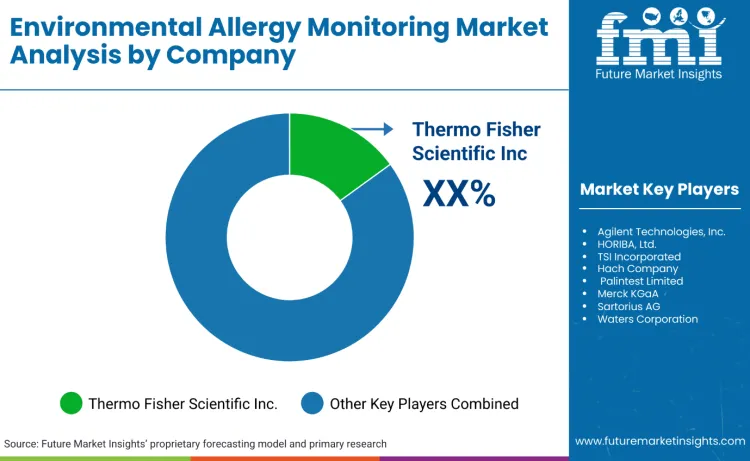
The environmental allergy monitoring market is driven by a mix of large analytical instrumentation leaders and specialized environmental testing solution providers, each competing through technology depth, measurement accuracy, and application breadth. Companies such as Thermo Fisher Scientific, Agilent Technologies, PerkinElmer, and Waters Corporation lead the market with advanced analytical platforms that support allergen detection through particulate analysis, chromatography, and mass spectrometry. These firms benefit from strong laboratory footprints, global service networks, and established relationships with public health agencies, research institutes, and environmental laboratories.
Mid tier and specialized players including HORIBA, TSI Incorporated, Hach Company, and Palintest Limited compete through application focused instrumentation, field deployable monitoring systems, and simplified testing workflows suited for municipal, occupational, and academic use. Sartorius and Merck KGaA support the ecosystem through filtration, sampling, and analytical consumables that enable consistent allergen and particulate capture across controlled environments. Competition in the market is increasingly shaped by data integration capabilities, portability, and real time monitoring potential rather than standalone measurement hardware.
Key Industry Developments:
- In September 2025, Thermo Fisher Scientific Inc. acquired Solventum’s Purification & Filtration business for USD 4 billion. This move helped the company broaden its bioprocessing portfolio.
- In June 2024, Agilent Technologies Inc. launched Agilent 7010D Triple Quadrupole GC/MS System which targets the food and environmental markets.
Key Players in the Environmental Allergy Monitoring Market
- Thermo Fisher Scientific Inc.
- Agilent Technologies, Inc.
- HORIBA, Ltd.
- TSI Incorporated
- Hach Company
- Palintest Limited
- Merck KGaA
- PerkinElmer, Inc.
- Sartorius AG
- Waters Corporation
Market Definition
The environmental allergy monitoring market refers to the global technology and service applications designed to support allergen detection, environmental monitoring, exposure assessment, and health management activities. It includes both precision and standard monitoring offerings, with segments that cater to various application areas such as public health surveillance, clinical support, and consumer health management. The market size is measured in USD billion and analyzed over the 2026 to 2036 period.
The environmental allergy monitoring market includes technology types such as allergen detection sensors, digital analytics platforms, sampling consumables, and monitoring services, utilized through both direct purchase and service-based applications. The market is expanding due to growing interest in preventive healthcare approaches, environmental health awareness, and evolving regulatory requirements toward more comprehensive allergen exposure assessment capabilities.
Market Inclusion
Included in the environmental allergy monitoring market scope are monitoring technologies categorized by type (hardware, software, consumables, services), with segmentation based on application areas (public health, clinical support, consumer use), user focus (healthcare, government, individual), and performance requirements (accuracy, prediction capability, connectivity). The scope includes allergen monitoring platforms with a focus on health outcomes, detection precision, and data analytics, particularly those marketed through specialized technology providers, healthcare institutions, and government agencies.
Geographically, the market encompasses key regions such as North America, Europe, East Asia, South Asia, Latin America, and the Middle East and Africa, with country-level analysis for significant markets like China, India, Brazil, USA, and Germany.
Market Exclusion
Excluded from the environmental allergy monitoring market scope are non-allergen environmental monitoring platforms and technologies not designed for health-related allergen assessment, such as general air quality monitoring without biological detection capabilities, industrial pollution monitoring systems, and weather monitoring equipment. Additionally, technologies not intended for health or environmental applications are not included.
The market excludes non-monitoring allergen products, as well as allergen-related products that are not marketed as monitoring platforms, such as allergy treatment medications or diagnostic test kits. Products with non-compliant detection specifications or those that do not meet regional regulatory standards for health monitoring applications are outside the market's defined scope.
Scope of the Report
| Items | Values |
|---|---|
| Quantitative Units | USD billion |
| Offering Type | Pollen Monitoring Stations (Hardware); Airborne Allergen Sampling Consumables; Digital Monitoring Platforms & Analytics; Indoor Allergen Sensors; Forecasting APIs / Data Subscriptions; Monitoring & Maintenance Services |
| Use Case | Public Health Surveillance; Clinical Allergy Management Support; Workplace / Environmental Compliance; Smart Home / Consumer Use; Research & Academic Monitoring |
| End User | Government Agencies; Healthcare Providers & Payers; Employers / Facility Managers; Consumers / Individuals; Universities & Research Institutes |
| Regions Covered | North America, Europe, East Asia, South Asia, Latin America, Middle East & Africa |
| Countries Covered | China, India, Brazil, USA, Germany, and 40+ countries |
| Key Companies Profiled | Thermo Fisher Scientific; Agilent Technologies; Horiba; TSI Incorporated; Hach; Others |
| Additional Attributes | Revenue analysis by offering type, use case, and end user; performance in health applications and detection capabilities across healthcare institutions, government agencies, and consumer applications; detection efficiency enhancement, analytics optimization, and platform benefits under health applications; impact on health outcomes, monitoring precision, and platform differentiation during procurement processes; compatibility with health protocols and monitoring preferences; procurement dynamics driven by health outcome positioning, environmental health programs, and long-term monitoring partnerships. |
Environmental Allergy Monitoring Market by Segment
Offering Type:
- Pollen Monitoring Stations (Hardware)
- Airborne Allergen Sampling Consumables
- Digital Monitoring Platforms & Analytics
- Indoor Allergen Sensors
- Forecasting APIs / Data Subscriptions
- Monitoring & Maintenance Services
Use Case:
- Public Health Surveillance
- Clinical Allergy Management Support
- Workplace / Environmental Compliance
- Smart Home / Consumer Use
- Research & Academic Monitoring
End User:
- Government Agencies
- Healthcare Providers & Payers
- Employers / Facility Managers
- Consumers / Individuals
- Universities & Research Institutes
Region:
- East Asia
- China
- Japan
- South Korea
- Taiwan
- Rest of East Asia
- Europe
- Germany
- United Kingdom
- France
- Italy
- Spain
- BENELUX
- Nordic
- Rest of Europe
- North America
- USA
- Canada
- Mexico
- South Asia
- India
- Australia & New Zealand
- Southeast Asia
- Rest of South Asia
- Latin America
- Brazil
- Chile
- Colombia
- Argentina
- Rest of Latin America
- Middle East & Africa
- Kingdom of Saudi Arabia
- Other GCC Countries
- Turkey
- South Africa
- Other African Union
- Rest of Middle East & Africa
Bibliography
- USA Food and Drug Administration. (2024). 510(k) premarket notification database: Medical device clearance overview. USA Department of Health and Human Services.
- European Environment Agency. (2024). Air quality monitoring and data integration in Europe: Digital platforms and real-time analytics. European Environment Agency.
- USA Environmental Protection Agency. (2023). Air sensor guidebook: Monitoring air quality and environmental exposure. USA Environmental Protection Agency.
Frequently Asked Questions
How big is the environmental allergy monitoring market in 2026?
The global environmental allergy monitoring market is estimated to be valued at USD 0.9 billion in 2026.
What will be the size of the environmental allergy monitoring market in 2036?
The market size for the environmental allergy monitoring market is projected to reach USD 1.8 billion by 2036.
How much will the environmental allergy monitoring market grow between 2026 and 2036?
The environmental allergy monitoring market is expected to grow at a 8.0% CAGR between 2026 and 2036.
What are the key offering types in the environmental allergy monitoring market?
The key offering types in the environmental allergy monitoring market include pollen monitoring stations (hardware), digital monitoring platforms & analytics, forecasting APIs / data subscriptions, and indoor allergen sensors.
Which end user will contribute a significant share in the environmental allergy monitoring market in 2026?
In terms of end user, the government agencies segment is set to command a 30.0% share in the environmental allergy monitoring market in 2026.
Preview the report firsthand - request a free sample
Get SampleGet the brochure for pricing and purchase details.
Get PDFTable of Content
- Environmental Allergy Monitoring Market Size and Share Forecast Outlook (2026 to 2036)
- Environmental Allergy Monitoring Market Forecast and Outlook (2026-2036)
- Environmental Allergy Monitoring Market Key Takeaways
- Key Shifts in the Environmental Allergy Monitoring Market from 2026 to 2036
- Environmental Allergy Monitoring Market Segmentation Analysis
- By Offering Type
- Pollen Monitoring Stations (Hardware)
- Airborne Allergen Sampling Consumables
- Digital Monitoring Platforms & Analytics
- Indoor Allergen Sensors
- Forecasting APIs / Data Subscriptions
- Monitoring & Maintenance Services
- By Use Case
- Public Health Surveillance
- Clinical Allergy Management Support
- Workplace / Environmental Compliance
- Smart Home / Consumer Use
- Research & Academic Monitoring
- By End User
- Government Agencies
- Healthcare Providers & Payers
- Employers / Facility Managers
- Consumers / Individuals
- Universities & Research Institutes
- By Region
- By Offering Type
- Market Dynamics and Growth Analysis
- Growth Drivers
- Market Restraints
- Strategic Trends
- Environmental Allergy Monitoring Market Global Analysis
- Asia Pacific
- North America
- Europe
- Latin America
- Middle East & Africa
- Competitive Landscape Analysis
- Key Players in the Environmental Allergy Monitoring Market
- Market Definition, Inclusion, and Exclusion Criteria
- Scope of the Environmental Allergy Monitoring Market Report
- Environmental Allergy Monitoring Market by Segment
- Bibliography
- Frequently Asked Questions (FAQs)


